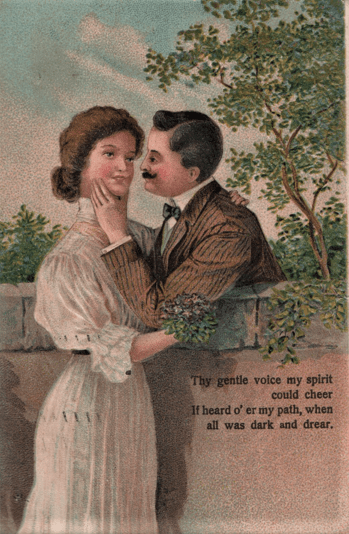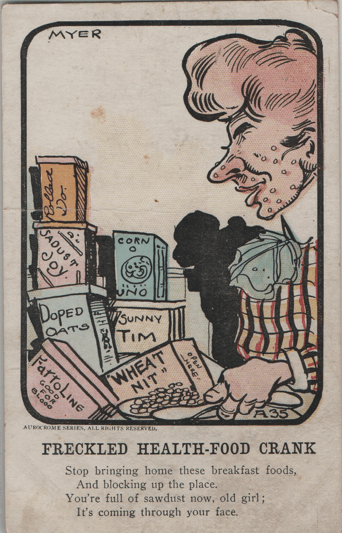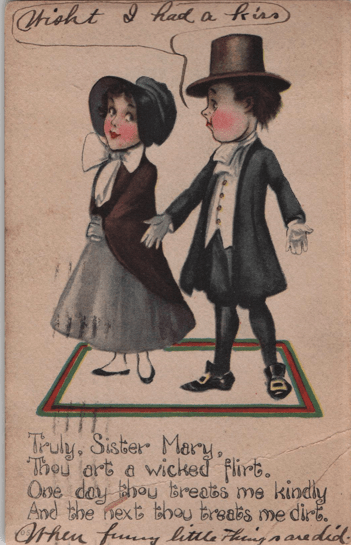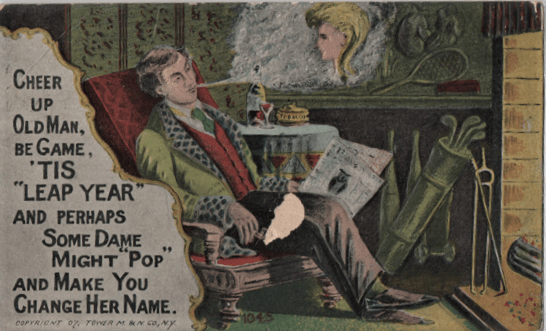
The Course of True Love

     Well, here it is Monday again, and do you know what it’s time for, Chocolate Lasagna?  No, not getting to sit next to that lady with the mask-dislodging sneeze on your commute.  It’s time for another installment of our old joke quiz.

     You say you prefer the lady with the sneeze?  Well, there’s no disputing about tastes.  I’ve met people who don’t like chocolate lasagna.

     This finishes the chapter of jokes on romance and dating.  You remember the rules: really old joke with the punchline removed, tucked away in the Answer section where you don’t need it because you know all about romance.  (And no, I don’t need you to tell me where you and the sneezing lady went for lunch.)

     J1.Henrietta is the type of girl you’d take home to mother, provided (          ).

J2.Dear Henrietta:

     I love you, I adore you, I idolize you.  Nothing van come between us.  For you, my loveliest love, I would climb the highest mountain, swim the widest ocean, crawl through the hottest desert.

     Love, Love Love, Johnny XOXOXOXOX

     P.S. See you Saturday night (          ).

J3.”Henrietta,” said Johnny, “I know I can’t buy you furs, like Pat Westfield, or drive you around in the latest Rolls Royce, like Pat Westfield, and offer you a palatial mansion to live in, like Pat Westfield.  But I worship you.  Do you think you could love a man like me?”

     “Of course, silly,” she replied, “But (          ).”

J4.”How did your date with Henrietta go last night?”

     “Not so bad.  We went for a drive in the country, and it was a lovely moonlit night, so she wanted to enjoy it with the top down.  So after an hour and a half, I got the roof open….”

     “An hour and a half?  My car can open the roof in, like, two minutes!”

     “Yes, but (          )”

J5.Lewis and Thelma were out for a drive in the country that night, too.  “Can you drive with one hand?” Thelma asked.

     “Sure!” said Lewis.

     “Great!”  said Thelma, “Then (          )”

J6.”You’re not just saying you love me because my uncle left me nineteen oil wells, are you?”

     “Of course not.  I’d love you (          ).”

J7.The Census Bureau was curious about an Iowa town that had reported exactly the same population for over a century.  They sent out a representative to find out if this was really true.

     “No mystery to it,” said the mayor, “Whenever a baby is born, (          )”

J8.”Kate’s a beauty and cooks like a gourmet chef, but Edith’s not bad to look at and has plenty of money.  I don’t know what to do.”

     “Well, make up your mind.  You can’t (         )”

J9.Henrietta’s father had it out with Johnny one night.  “You’ve been seeing my daughter a lot lately.  Are your intentions honorable or are you just fooling around with her?”

     “:Gosh!” said Johnny “(          )”

J10.Henrietta’s mother, meanwhile, was telling the neighbor, “I hope she doesn’t marry Johnny.  He can’t drink, he can’t smoke, and he can’t gamble.”

     “Well, I think those are admirable traits,” said the neighbor.

     “He can’t smoke, drink, or gamble,” said her mother, “But (          ).”

J11.Henrietta’s grandfather, 98 years young, announced his intention to marry a chorus girl seventy-five years younger.  “That kind of excitement could be fatal!” exclaimed his son.

     The old man shrugged.  “(          )”

J12.Henrietta and Johnny were married, though both sets of parents thought they were too young.  During the ceremony, as Johnny repeated the formula, “With all my worldly goods I thee endow,” his mother sighed, “Well, (          )”

     Just so you can check whether you had the grammar right in your ANSWERS, here are the official ones.  (Stop sneezing.)

     A1.If you could trust your father

     A2.if it doesn’t rain

     A3.tell me more about Pat Westfield

     A4.You have a convertible

     A5.have an apple

     A6.I’d love you no matter how many oil wells he left you

     A7.some guy leaves town

     A8.You can’t have your Kate and Edith too

     A9.I get a choice?

     A10.He does

     A11.If she dies, she dies

     A12.there goes his bicycle

We Can Do It

     You will recall, from our last thrilling episode, that we were discussing postcards designed for servicemen to send home to let the folks at home know they were doing well, enjoying much of their life getting ready to fight the enemy.  There were some humorous drawbacks to being employed by Uncle Sam—having to wash dishes and do laundry—but these were things that could be laughed off.  The reality of fighting island to island in the Pacific or storming beaches in Italy was left to eh newspapers and Life Magazine.  That allowed some distance.  The postcards tried to keep spirits high.

     But there was at least one line of postcards which aimed to do the same for women in the service, specifically women who joined the Women’s Army Corps, or WACs.  There was a Naval counterpart (the WAVES, and a Marine equivalent (shout out to Muriel underwood, who enlisted in the Marines during World War II and was told on the first day that there was no funny acronym for them to learn.  “They told us we were Marines, period.”)

     Bur the Beals Company of Des Moines, Iowa, proud of its postcards with their Glo-Var Finish (whatever that was) concentrated on the Women’s Army Corps.  The lettering was unique and the art consistent, and if someone in the Great Interwebs Community knows what artist was responsible for these women, I’d like to hear about it.  But these cards did for the WACs what the earlier cards did for other branches of the service.

     First of all, they let the folks at home know they were safe and well out of harm’s way.  That was, after all, the chief aim of the whole Postcard War.

     And they passed along the information that Uncle Sam was keeping them busy and out of mischief.

     Recalling that once upon a time, one could slack off while doing exercises with radio fitness programs, but now things were taken more seriously.

     A constant theme the WACS tried to reinforce in much of their publicity was that this was war, and the women were not just signing up to be decorations.  They learned to march and perform just like the boys.

     They did the same kitchen chores.

     Sometimes under conditions of peril.

     Though they did get to enjoy the fruits of their labor.

     Many of them were put into office work, freeing men for combat duty.  (Men also learned these same chores, but I haven’t seen any postcards pointing this out.)

     But they had not joined the Army to be uniformed secretaries.  Many WACs found themselves working with other mechanical equipment.

All types of military hardware.

     Including some invented just for this particular war.

     Altogether, the Beals postcards (and there were more than I have room to show you here) indicated that a woman had a place in the military, a place she could be proud of (look back at the top of the column) and, which, frankly, offered a way of contributing to one’s country that was natural, fulfilling, and fu;;y acceptable.  (Talking like a soldier came with the territory.)

Having Wonderful Time

     Morale was a major concern during World War II.  Not only was the government worried about the state of mind of people in the service, whether they were training for war or already busy in it, but there were the people at home.  Waiting around for victory can be very wearing on the nerves, especially if one has a child, spouse, or parent out fighting.  One way to make sure the folks fighting the homefront war could be kept happy was to provide those in the service with a lot of postcards which could be sent home to assure everyone that things weren’t so terrible.

     These existed for every service, cards extolling the pride and even fun of your chosen service.  The card at the top of the column salutes the Air Corps (eventually the Air Force) while the one below lets everyone know you really like the Navy (even if not EVERY  aspect of service was easy to take.)

     That touch of realism was important.  The government didn’t want the folks at hoke getting too rosy a picture of life in the service, because the folks at home were not stupid.  They knew, and it gnawed at them, that their family members and neighbors were going out for hardship and danger.  So the thing to do was not deny that gnawing fear, but play with it a bit.  Sure, the boys might be fooling around with high explosives, but hey, one could get used to that.

     Yes, one was being forced into a much more controlled work environment, which had its displeasures, but there were compensating pleasures as well.

     Of course, men and women were being asked to do new and dangerous things, were being ordered to learn to do things they would neither have cared or tried to do as civilians.  The thing to do was let the folks at home know these things were difficult, but in a way that was workable, and even funny.

     Sure, there were drawbacks to being expected to jump out of an airplane.  Let everyone KNOW what bothered you about this job.  As long as you could share a laugh about it, it seemed less daunting.

     Even better, emphasize the indignities of military chores, chores that for some years had not seemed to be in a man’s repertoire at all.  Let the folks at home know your main problem was not getting shot at, but being brought another stack of dishes.

     Or how a soldier in the field could not expect to have his laundry done for him by his mom, wife, or the laundromat down the street.

     These were things that brought the life of military service down to a familiar level.  The fact that K.P. (Kitchen Police) work played a huge part in military comedies in the theaters and cartoons and comics strips built up a picture of the life of a soldier or sailor being heavily involved with soap suds and rueful double takes.  (Among the postcards I have up for sale, these tned to be the ones I most often find were actually used, franked for someone sending news home.  Those in the service did not have to pay postage; their postcards could be sent free, “franked” like the mail sent by a member of Congress.)

     Of course, those military comedies and cartoons stressed another part of military life that the folks at home found easy to believe in.  The soldier, sailor, or marine found certain pleasures in the service.  Some of these things might be discouraged in peacetime, but a guy was entitled to loosen his serious life up here and there, wasn’t he?  Maybe you didn’t send this one home to Mom, but Dad understood that, regardless of what the commercials might claim, the boys in uniform didn’t always drink Coca-Cola.

     And shooting dice, once considered an exceedingly low class (and, in some quarters, exclusively African-American) pursuit, was now considered pretty standard for anyone in uniform (the slang might differ from service to service but dice fit into just about anyone’s pack, even more easily than a deck of cards.)

     And maybe you didn’t send THIS card home to your wife or girlfriend, but there were always the ladies. (Next time: The Ladies)

Class Act

     Ah, ‘tis Monday, our weekly Old Joke Day.  Fear not: some day I will run out of the jokes from this joke quizbook I wrote in the 1990s, and will have to find something else to do.  (And reflect that if some enterprising publisher had actually published this book in the 1990s, you would not be getting it in installments now.  The sins of the fathers….)

     We return in this episode to the adventures of children in the classroom.  The punchlines, which you probably know by heart, are tucked away at the end of the column.

J1.”Tommy, where is the Red Seas”

“It’s (          )”

     J2.”Tommy, if you had six potatoes, but nine people were eating, how would you divide the potatoes so each person got an equal amount?”

     “That’s easy, Teacher.  (         )”

J3.“Teacher, you always tell us to double-check our work, so I did this math problem six times.”

 “Very good, Tommy.”

 “And (          ).”

     J4.”So we see, class, that the light from the sun reaches Earth in just nine minutes.”

     “So what?  (          )”

J5.”Teacher, is a chicken old enough to eat when it’s six days old?”

“Of course not, Tommy.”

“Then (          )”

      J6.”Tommy, where are elephants found?”

     “Well, Teacher, (          )”

J7.”Tommy, I asked you a question.  Do you know the answer or not?”

“I shook my head.”

“Well, (        )”

     J8.”Tommy, who wrote ‘To a Field Mouse’?”

     “I don’t know, teacher, but (          )”

J9.”Tommy, will your father be attending the PTA meeting tomorrow night?”

“He ain’t coming.”

“Tommy!  He ISN’T coming.  I am not coming.  They aren’t coming.”

“Gosh! (          )”

     J10.”Tommy, what is the plural of man?”

     “Men.”

     “And what is the plural of woman?”

     “Women.”

     “And what is the plural of child?”

     “(          )”

J11.”Tommy, how do you spell the word ‘weather’?”

“W-H-I-T-H-E-E-R.”

“Well, (          )”

     J12.”Tommy, spell ‘Mississippi”.”

     “Sure.  (          )”

J13.”Tommy, spell ‘farm’.”

“(          )’

     J14.The class had taken a field trip to the big museum, and stood before an Egyptian mummy, before which was a sign which read “1365 B.C.”

     “And what does that mean?” prompted the teacher.

     “I don’t know,” said Tommy, “Maybe (          ).”

And now you can check and make sure you knew more ANSWERS than Tommy.  Raise your hand when you have finished.  (And then put it down again.  People are looking.

     A1.All over my report card

     A2.Mash ‘em!

     A3.Here are my six answers.

     A4.It’s downhill all the way!

     A5.Why don’t they starve?
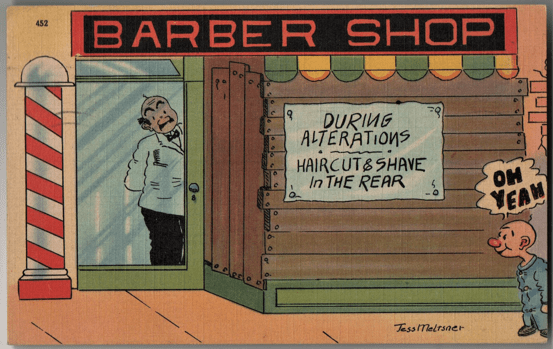
     A6.Elephants are so big nobody ever loses ‘em.

     A7.Did you expect me to hear it rattle from here?

     A8.I bet he didn’t get an answer.

     A9.Ain’t nobody coming?

     A10.Twins

     A11.That’s the worst spell of weather we’ve had around here in years.

     A12.The river or the state?

     A13.E-I-E-I-O

     A14.Maybe it’s the license plate of the car that hit him

Reality and Mystery

     It has been a little while since we considered the charms of the rppc, or Real Photo Postcard.  This, in case you missed it the first time around, is a sort of homemade postcard: you could make them in your own darkroom at home or you could ask your drugstore, or whoever processed your film, to print the pictures on postcard backs.  These were generally made in very small batches, and can be very rare.

     This, for example, is a postcard with a photograph as its base, but it is NOT an rppc.  It’s an ad for furniture with Formica surfaces, and was manufactured by the thousands by Formica.

     A real rppc (Real Real Photo PostCard?) is personal, like the one at the top of this column, in which someone who apparently believes he is as dapper as he can get is wishing someone the compliments of the season.  There were only as many made as he thought he needed Christmas cards, and this could be the last one that has survived the emissaries of tidiness who like to go through the world destroying what they consider inessential.

     It would be a tragedy if this were the only surviving picture of this young lady reading (or, if she’s in a photography studio, pretending to read an empty photo album provided for the pose.)

     Now, little though I like it, I must point out what the tidy-minded are thinking when they throw things like this away.  See, unless the postcard was actually MAILED, there is almost never any data on it to show where it was taken, when it was taken, who was being photographed, and why.  To the tidy-minded individual, the obvious answer is “Throw it away.  If you don’t know who it is, why give it house room?”  For example, the only note on the back of this rppc of heavily-dressed individuals is an ad for the photography studio in St. Paul, Minnesota.  (Which may explain the heavy coats.)

     One’s curiosity may be aroused by a photo, but without any data, you will never know the answer.  I’m guessing these are sisters, but, allowing for fashion, it COULD be Mom and Daughter.  And what was the occasion?

     It is clear that THIS photo was taken in a studio: the background and props are unmistakable.  So, um, why did somebody bring their spaniel to the studio to have a picture taken?  What was the puppy’s name?  had he just won a local prize, or was he a lost dog, and someone wanted to post pictures of him in case someone was looking for him?

     The same goes for this young lady.  For what occasion was she dragged downtown to the photographer’s lair to have her image captured?  Was she starting school?  Was she the flower firl at the wedding?  She looks really, really thrilled about it all, so this was not HER idea.  And would a name have been completely out of place?

          What were these boys doing in the garden with that wagon of flowers?  They’re not really dressed for gardening.  Are they itinerant flower sellers?  Or were they so cute their folks dragged them into the garden to be photographed with something picturesque?

     It’s like shuffling through a shoebox of someone else’s family photos, those things they were going to get around to labeling.  That isn’t to say they don’t throw you a bone from time to time.  This enchantingly bad photograph is actually captioned (the photographer could do that while printing the photo) and it lets us know they are “Draining the Marsh”.  Well, I never would have guessed that, and I still don’t quite know what we’re looking at.  And would it have been too much to ask “What marsh?  Where?”  But there is no further data available.

     And THIS postcard is well documented: on the back someone has written the date, with the names (and ages) of all the women involved.  (I’d tell you these, but someone has already bought this from me, so if you recognized your great-grandmother, I’d have to disappoint you.)  But, um, nowhere does it explain why these women are sitting together outside a tent, which is at LEAST as interesting as knowing which one is 63 and which one is 2.

     I suppose it’s a message to us all to label all those photos: in the shoebox, in the album, even on the phone.  You know who you are.

Nine to Four-Thirty-Seven

     Sorry to throw things off by publishing Friday’s blog on Monday, but those people at the hospital adored having me there so much they had to be convinced to let me go.  But I refuse to let that brief indisposition cause the world to collapse into tears because of the lack of an Old Joke Quiz.  So here are a few more really old jokes about the working world, without their punchlines, which will be found, if you need to find them, in the answer section at the bottom.

     J1.Basil was in business for himself, but you wouldn’t have known it for the first week.  He spent most of his time rearranging the blotter on his desk, deciding exactly where he wanted his (empty) file cabinets, and pacing, waiting for a client to walk into the establishment.

     He was thrilled to see a shadow approach the window of his office door, and jumped into hi s chair.  Grabbing up the telephone, he snapped, “I don’t want to hear excuses!  I made a promise to my client based on your estimate, and what I tell my clients is sacred!  Just a sec.  Come in; I’ll be with you in a moment.  Listen, someone’s here and I can’t bother with this any longer.  Either get that equipment to my client, or I’ll see you never get another order!”

     He slammed down the receiver and smiled at his visitor.  “And what can I do for you, sir?”

     The man looked him over, and said, “(          )”

J2.Basil stayed in business somehow, and after a month or so, made enough to hire a secretary.  One day, a client walked in the door, and she buzzed her intercom to let him know.  Basil, who had been playing solitaire with an old deck of cards, called back through the little machine, “I just have to finish up this call and I can see clients.  Get my broker on the other line, would you?”

     The client was duly impressed until the secretary answered, “Yes, sir.  (          )”

J3.The next day, Basil was playing solitaire again, when he heard his secretary say, “It sure is!” and hang up.

     He peeked under a red seven to see if the other black six was there, and heard her answer the phone again.  “It sure is!” said the secretary, and hung up.

     He was gathering the cards to deal again, when the phone rang a third time.  The secretary barked, “It sure is!” and slammed down the receiver.

     Basil put his head out of his office to ask, “What’s going on, Miss Gulder?”

     The secretary shook her head.  “This crank keeps calling us and saying (          ).”

J4.The reporter from the Wall Street Journal was interviewing the CEO of a new shampoo plant.  “And how many people work at your factory?” she inquired.

     The CEO replied, “(          )”

J5.That CEO had a son who, when he finished college, got orders from Dad to start his own business, to show he was worthy to step up in the firm one day.  On his way to lunch a few months later, the CEO stopped by the shop and found the place filled with customers.  Gratified, he asked his son, “How did you get so many people in the place?  is it your advertising?”

     “No, Dad, it’s my pricing,” said Junior.  “I sell bicycles for eighty dollars.”

     “That is a good price for a bike,” said Dad.  “What do you pay for them?”

     “A hundred and twenty,” said Junior.

     Dad turned red.  “How do you expect to be a success if you take a loss on every sale.”

     “Easy,” said Junior.  “(          )”

J6.”So how’s business?”

     “Well, the economy’s down, the pandemic isn’t much help, and I can’t get much product to sell.  But we had a fire and the insurance company paid $200,000, so I’m okay.”

     “I was having those same problems, but my warehouses were wiped out in a flood, and the insurance brought in $500,000.”

     “That is good.  So tell me, (          )”

I know you keep track of your investments online, and have the latest banking app, so you knoe asll the ANSWERS.  But here they are anyhow.

     A1.I’m here to hook up your phone

     A2.Stock or pawn?

     A3.Long distance from Paris

     A4.About two-thirds

     A5.Quantity

     A6.How do you start a flood?

Interpreting Artifacts

     It has been a while since we delved into the archaeology of humor as reflected in postcard art of the past (as opposed to our rather shallow digs every Monday.)  More postcards come in all the time, and some of the jokes are moderately obscure unless you’re old enough, or are thoroughly obscure despite all sorts of digging.

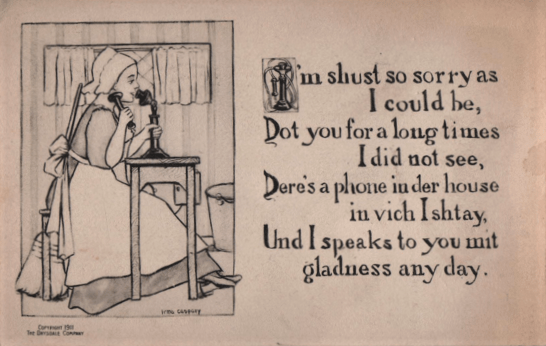
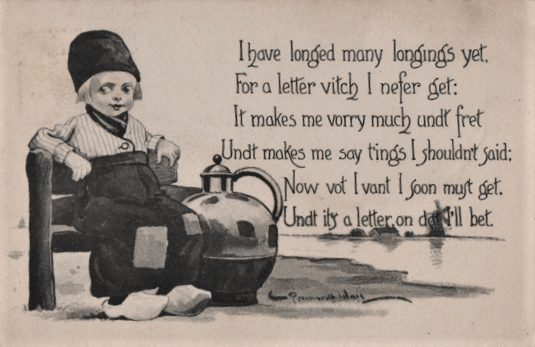
     Now, of you have been a steady reader of this column (as any well-adjusted soul would be) you will see that the card at the top of this column combines two mysterious manias of ther 1910s: a lover of Dutch children (with speech patterns based on Pennsylvania Dutch, or German, Americans) with the still somewhat mysterious catchphrase of the era, that to :hand someone a lemon” was a contemptuous negative reply.  A soft lemon was even more brutal, but these kids don’t go that far.

    This one is fairly obvious IF you recall (or have seen in, say, Three Stooges movies) that dentists used to offer their patients anesthetic (or gas, or sometimes laughing gas) as an option during dental surgery.  The gas shortages of World War II gave this joke about a dentist who was offering gas as a free alternative to old-style dentistry its punch.  I think this use of “gas” died away at some point during the 1960s, with the phrase “It’s a gas” perhaps being its last hurrah.

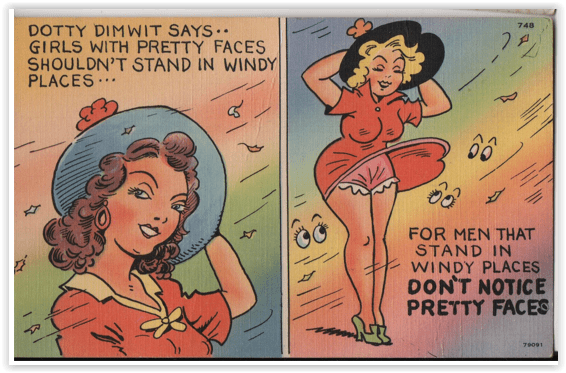
     Walter Wellman, somewhere around 1915, implied a vasty number of paramours with this reference to the Heinz claim that it sold 57 varieties (memorialized in Heinz 57 Sauce).  They have never QUITE given up this slogan, but it has faded considerably over the last thirty years or so (and the number was never especially accurate anyhow)  So you have to be old enough to recognize the gag.  Yeah, that’s what they all say.

     This joke depends on you knowing that a “grass widow” was a married woman whose husband was far away, leaving her to pursue romance wherever she found it.  This is another phrase which really started to fade in the Sixties, when women seeking recreational romance became more common.  Again, you need to be old enough to remember…okay, I’ll stop bringing that up.

     We considered this card when we were dealing with the bygone but long-lived song refrain, “I Love My Wife, but Oh, You Kid.”  Undressed kid and patent leather were kinds of gloves one could buy, back when everyone wore gloves when dressed up.  I don’t believe I mentioned the implications of that undressed…yeah, I don’t usually slip up that way.

     You can get the joke, I suppose, without knowing the whole lore of small theatrical companies traveling through the land, prone to dissolving without notice when losing money, as the manager would frequently take all the box office receipts and leave town, abandoning the unlucky (and probably under-talented) actors and actresses to hoof it home.  The line about the ghost not walking is a remnant of these days, too, referring to a production of hamlet in which the manager was informed that unless the actors got paid “The ghost doesn’t walk” (obviously, if Hamlet’s father doesn’t show up in the first scene, the play gets a LOT shorter.)

     This joke is just the Dutch Kids and their accent again.  This isn’t really so much a joke as a small Dutch lad singing lines from K-K-K-Katy, a popular stutter song of the World War I era.  Hearing a modern song sung with a weird accent seemed hilarious to our ancestors.  (By the way, have you heard the version of Blue Christmas as sung by Porky Pig?)

     Here we have a political phrase which was well-known for such a tiny period of time that it has eluded the Interwebs.  But it SEEMS to have involved the attitude of the Turkish government (that’s an outline of Turkey there in the background) to foreign dignitaries.  They were willing to apply the boot, as Father is, as well.  You needed to sell cards like this quickly, while the audience still cared.

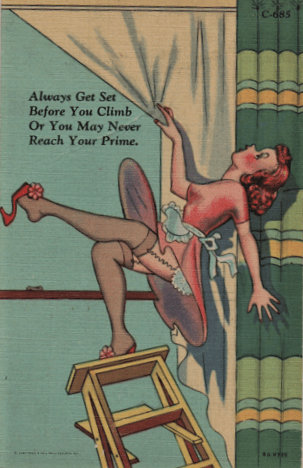
     Whereas this one remains popular even if you don’t know about General Motors introducing an independent suspension system for its cars, which it publicized in the 1930s as “knee-action”.  This particular model and her suspension system are eternal, as is the beflustered look of her chosen escort for the evening.  People can enjoy this card and never even THINK of a coupe or a runabout.  (Well, maybe a runabout.)

Comin’ Atcha

    One of the things you might not expect, living in the era of fairly calm, sedate postcards, is the postcard which would come up and confront you, face to face.  You need to keep in mind that the postcard to some degree took the place of texting in that bygone golden age of postcards around 1908, and emojis had not been invented yet.  You had to rely on an artist to do your In The face work.

     It was not necessarily hostile, of course.  It could be a challenge like the one at the top of this column.  I have found that the reaction of people to this young man is about fifty percent hostile, but that’s in the reaction of the beholder.  All the artist really intended was to dare you not to smile, and left it up to you to score the game.

     I think this Bamforth postcard, featuring a good natured old toper seen in many postcards, was designed along the same lines: just a shot to try to get you to smile.  (In fact, you could look at the Old Boy and the young boy above: the difference in dates between the two MIGHT be too brief to allow them to be the same person, just playing the same game, but let’s not rule out the possibility.)

     A challenge could be of any nature.  This one makes other demands on you than just a smile.  I wonder who would have sent this kind of card to challenge whom.  (By the way, the lady is wearing a style of blouse which was very popular in the 1915 era, and almost always comes off as vaguely unattractive—at least to our eyes–in the hands of a cartoonist.  There was just a lot of extra material in the shirtwaists of the period, and it wasn’t really that all fashionable women were built like…let’s move along before someone comes along and confronts me with my gutter  brain.

     I THINK this is intended to be the same sort of challenge, but less self-pitying. And a bit more in the “get up and go” style of the 1910s.  You decided what you wanted and you went out and got it, letting your drive and concentration break down all obstacles along your way.  This postcard was meant to let you know who was the object of affection.

     And this attitude was freely available to men AND women.  Ambition and drive were the modern way, and the modern woman was not shy about her requirements.

     In fact, some were not shy at all.  HERE is a confrontational postcard, if you like.  When someone sent you this postcard, your only choice would have been to buy a ring, or a ticket out of town.  Depends on what you thought of her maiden aim.

Have Another

     It is Old Joke Monday again, and I find that we are back into the chapter on bars and drinking jokes, which gives me an excuse to use up a couple of postcards I found too late to include in one of my postcards blogs a while back.  You remember the rules: these are really old jokes (or they WERE, in the 1990s: old jokes are like phoenixes, to be reborn anew when people get so sick of them they don’t tell them any more) without punch lines, which you can supply, since you know your old jokes,.  Just to check your wording, I include those at the end.  Now, then, these three artichokes walk into a bar….

J1.The two men were standing at the bar because neither was sober enough to fall down.  “S-say,” said Arnold.  “You g-gonna pay me back that fifty you borrowed off me in Dundee, Iowa?”

     “Never been in Dundee in all my life,” said Matthew.

     “Me neither, come to think of it,” said Arnold.  “(          )”

J2.The big man peered over the little man’s shoulder.  “Whatcha writin’?”

     The little man looked up from his little black book.  “This is a list of all the men I can beat up.”

     The big man thought about this,.  “Is my name in there?”

     “Yep.”

     The big man rolled up his sleeves.  “Well I ain’t one to argue, but I don’t believe you could beat me.”

     The little man scowled at him  “I guess there’s just one thing to do, then.  (          ).”

J3.Jim spotted Roy in a low dive on Clark Street, drinking cheap whiskey.  “Don’t you know that stuff’s slow poison?”

     “Well,” said Roy, “(          )”

J4.”Would you like another Old-Fashioned?” asked the smiling host.

     “Well,” the guest temporized, “I don’t know.  I’ve had five already…..”:

     “You’ve had nine,” said the host, and quickly added “(          )”

J5.”Here, boy,” said the drunk, coming out of the club.  “Call me a cab.”

     “Sir!” the man roared.  “I will have you know I am an Admiral in the United States Mavy.”

     “Oh, sorry,” said the drunk.  “(          )”

J6.The doctor informed Uncle Soak, “I can’t find any medical cause for your problems,  It must be a result of drink.”

     “If you say so, Doc,” Uncle Soak replied, “(          )”

J7.The bishop didn’t trust the smell of the barber’s breath, but really needed a shave.  Sadly, his suspicions were confirmed, when the barber cut him on the very first sweep of the razor.

     “There, man!” the bishop roared, “Do you see the undeniable consequences of heavy drink?”

     “I do, Reverend, I do,” said the barber, “(          )”

J8.”Hey, barkeep!  Was I in here last night?”

     “:You don’t remember?  I do,.”

     “I was here?”

     “Here?  You spent close to six hundred bucks!”

     “Whew!  (           )”

J9.I tried to write a drinking song but (          ).

J10.The man at the bar said, “That was the best Moscow Mule anyone’s ever served me.  I want you to have this.”  And he pulled am live lobster out of one pocket.

     The bartender eyed his tip dubiously.  “Well, I guess I could have him for dinner.”

     The customer shook his head.  “No.  (          )”

After sober reflection, I believe we will proceed to the ANSWERS                        

     A1.Must’ve been two other fellers

     A2.I’ll take your name off the list

     A3.I’m in no hurry

     A4;But who’s counting?

     A5.Call me a battleship

     A6.I’ll come back when you’re sober.

     A7.It does make the skin tender

     A8.I was afraid I’d lost it

     A9.I couldn’t get past the first two bars

     A10. He’s had dinner; take him to a show

More to Celebrate

     I had a wave of good reviews for Wednesday’s blog.  (Okay, there was one, but you take what you can get in this business.)  My examination of the excitements of the literary world in 1922 apparently found a response and that is naturally all I need to try again with something similar.  (One of the few things I have in common with the modern literary world.)  I promise well get back to pictures of people’s backsides  on postcards again one of these days.

     So I checked 1822, to consider what bicentennials we had on our list.  I expected a lot of pioneering works, and a bit of gossip from that Byron, Shelley, Keats crowd.  Well, Shelley’s body washed up on the shore in 1822, and was cremated in the presence of Lord Byron, and just whether or not one of Shelley’s other fans was able to reach into the fire at a key moment and pluck out Shelley’s heart as a souvenir is still a matter of some discussion.  But I couldn’t see getting a whole blog out of that.

     Well, a lot of other people are doing anniversaries from 1972, so maybe what we really need are semi-centennials.  I considered the Number One Bestsellers for the year, and found a three-way battle among some of the usual suspects, Irving Wallace (The Word), Arthur Hailey (Wheels), and Herman Wouk (Winds of War), until October, when Richard Bach’s Jonathan Livingston Seagull knocked everyone else down a rung.  Oh, and Watership Down came out in 1972, promoted as a children’s book on one side of the Atlantic, and a novel for adults on the other.  So if birds or bunnies appeal to you, it was a decent year.

     How about jumping back a half century.  The whole Sesquicentennial business can be a little anticlimactic (kind of like a midterm centennial) but if we can turn up enough in the way of literary milestones, it can be turned into a blog, and we can all practice writing Sesquicentennial.  (Some in the audience may remember that I was part of a push to popularize the word Quasquicentennial during the 125th anniversary of a major literary institution.  We came out pretty much where we went in on that one.)

     Um, well.  Okay, let’s deal with this.  This is the year that saw the publication of Middlemarch, a novel for which there has been a massive swelling of interest over the last couple of decades.  I have not gotten around to reading it yet (after I finish Finnegan’s Wake, perhaps).  If you are a fan of Susan Coolidge’s Katy series of children’s books, the first one, What Katy Did, came out this year.  Haven’t read that one yet, either.  (Maybe after Finnegan’s Wake.)  Abd another children’s classic, Dog of Flanders, appeared first this year.  (HRIY, MAFW.)

     Picturesque America was published, one of the most popular of early coffee table books (predating the coffee table, in many ways).  This was a massive volume of engravings of America, explained by a major literary light of the day, and generally came in two volumes, which generally came into three or more pieces after the kids had flipped through the pages enough.  THAT was always fun to sell at the Book Fair.

     Now, or readers of speculative literature, 1872 was not a bad year.  J. Sheridan LeFanu published the second most famous Victorian vampire novel, Carmilla, which, the Interwebs tells me, really launched the whole Lesbian Vampire Genre.  (I did read that when I was about ten; missed that part, somehow.)  Jules Verne took us Around the World in Eighty Days, which was more science fictiony then than now, and had a very satisfying trick ending,  George MacDonald’s classic children’s fantasy The Princess and the Goblin appeared.  This was one of C.S. Lewis’s favorites, and those looking for somewhere to go after Narnia could check this out.  And a scholar who had wrestled for years with ancient alphabets was able to let us read, for the first time in a couple of millennia, the adventures in the Epic of Gilgamesh, which has inspired more than one fantasy novel in its days.

      1872 was the birth year of such memorable authors as Zane Grey, Paul Laurence Dunbar, and maker of eccentric cartoons W. Heath Robinson.  Keeping to the fantasy and science fiction theme, however, we have Max Beerbohm.  He would go on to become a raconteur *(gossip) and precursor to Truman Capote, now best remembered for one of the great time travel stories of all time, Enoch Soames, a story so beloved that when the date came for Enoch Soames to make his appearance in modern London, hundreds turned out to welcome him if he showed up.

     Hey, look, I filled a blog with material which COULD have been written up in one sentence.  “They can’t all be 1922.”