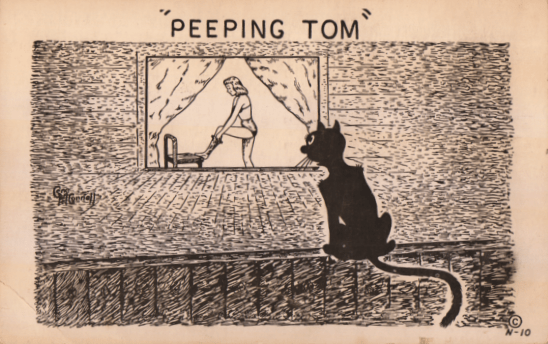
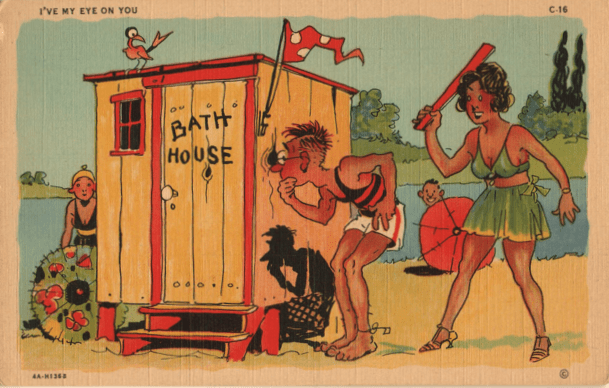
Now, in pursuing my research on your behalf into the question of peeping Tom postcards (there’s no end to the trouble I go to for your reading enjoyment, but that’s just the kind of blogger I am), I thought I would consider the question of what is NOT a peeping Tom postcard.
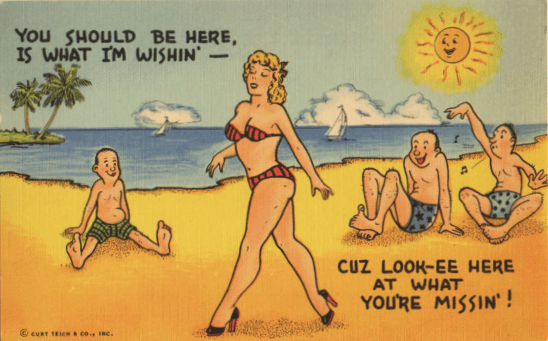
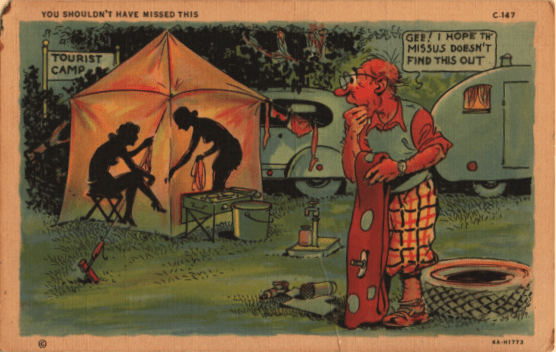
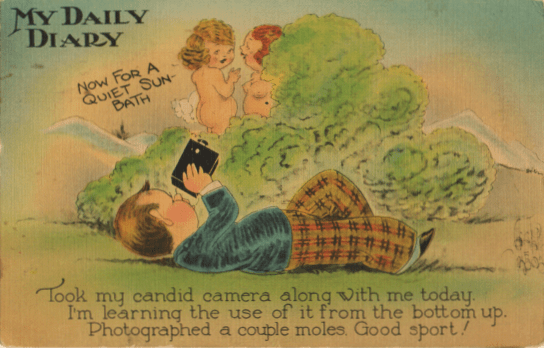
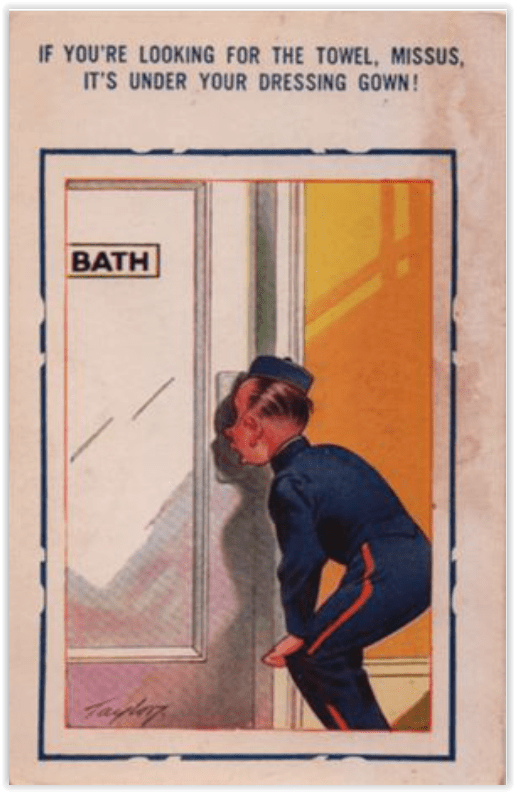
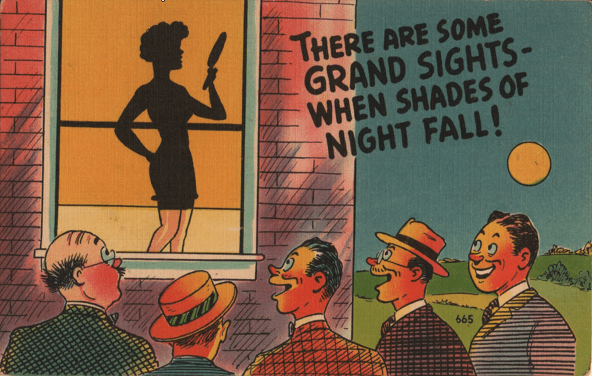
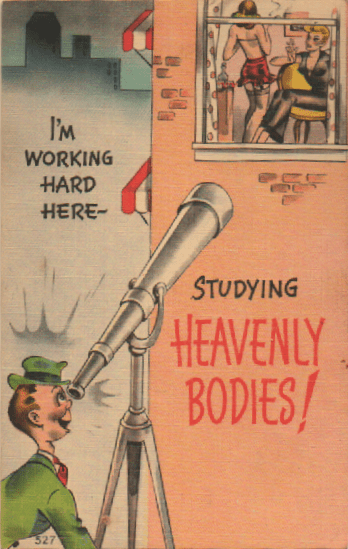
For example the gentlemen in these two cards are doing what you might call “gawking”, or, in a more elegant age, “ogling”. But they are certainly not peeping Peeping implies that the person involved is doing something surreptitiously, and these blokes are pretty obvious about it. Nor are they looking at someone who thinks they are in private.
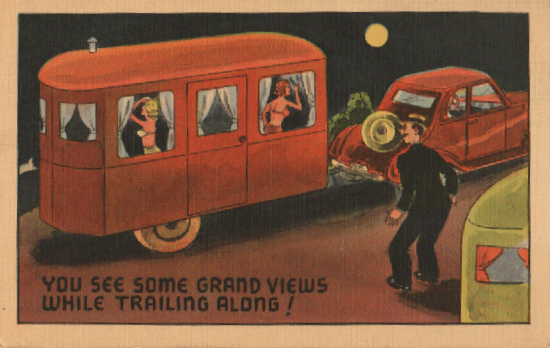
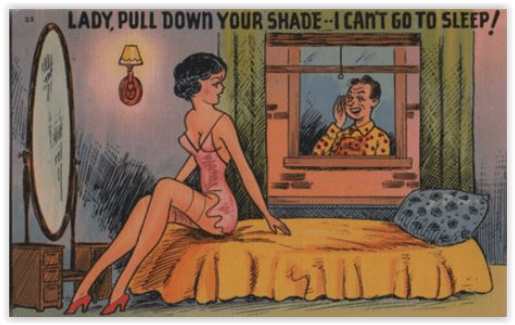
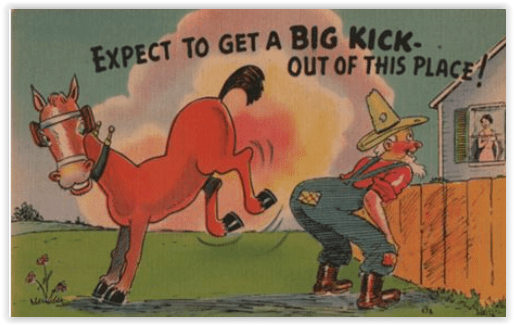
Now, here we have someone who at least apparently believes they are undressing in private. But I’M not sure we can stigmatize the witness as a peeping Tom. He didn’t sneak up on the windows; he just happened to be in the right place at the right time. For all we know, a moment afterward, he thought “Oh, gosh, they don’t mean for me to see this” and looked away.
I checked around the Interwebs for a concrete definition of “peeping Tom”, by the way, and, as usual when I do this kind of simple request, I found about a dozen different answers. Some stress the perverse sexual gratification felt when looking at something the witness is not supposed to see while others instead go into detail on what the witness is trying to see (“people in private or intimate situations” “sex acts or sex organs of others” “naked people”).
Most insist the act of peeping is voluntary, which I think leaves out these people who are seeing what they shouldn’t by accident. Special credit to Merriam Webster for its alliteration (“a prudently prying person”), to those who insist a peeping Tom MUST be male (logical, I suppose, since Tom is a boy’s name, but we HAVE seen postcard peepers who are female), to those who claim the victim MUST be “a woman undressing”, to the one who specified that a peeping Tom is one who looks through windows at night to see naked women. Others…but you get the general idea.
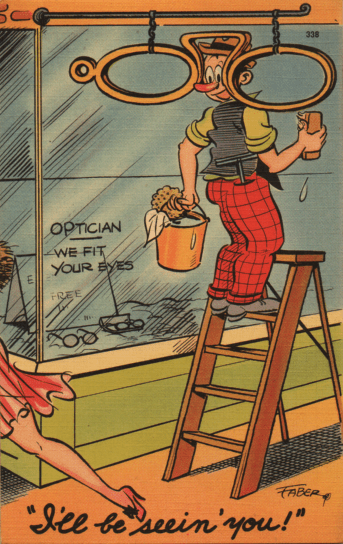
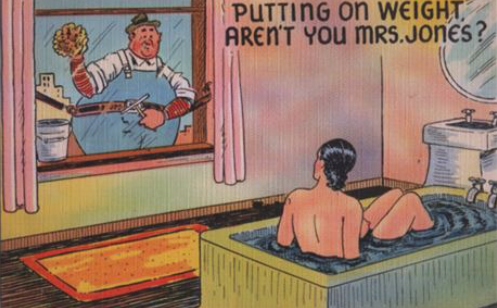
In any case, as one of the lengthier definitions told us, some “violation of privacy” is involved. I am not particularly sure how to rank people who may do a bit of peeping that is job-related. Window washers, for example, have a long reputation along these lines. (I suppose I may give in to temptation and blog about George Formby one day. If anyone really helped immortalize the opportunities of cleaning windows….)
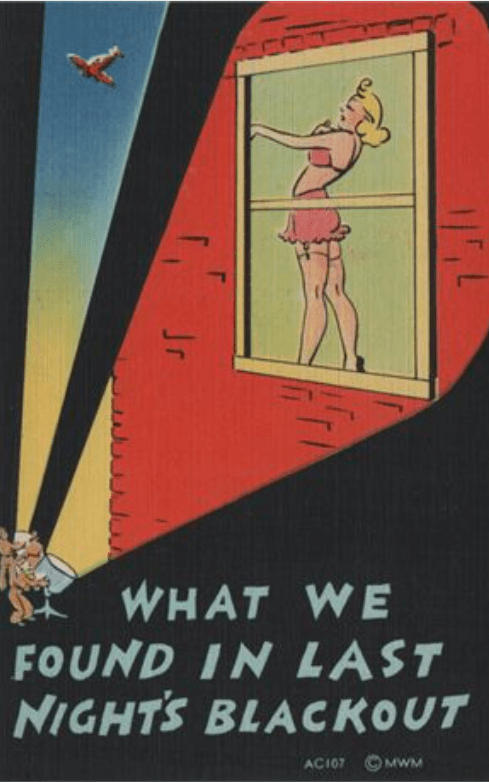
And if you add wartime necessity, should we really include such working men on the job among our peeping Toms?
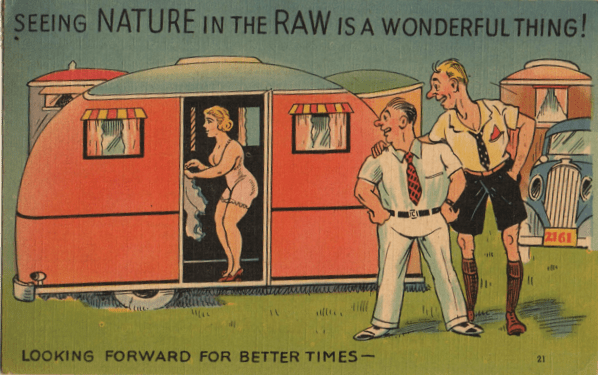
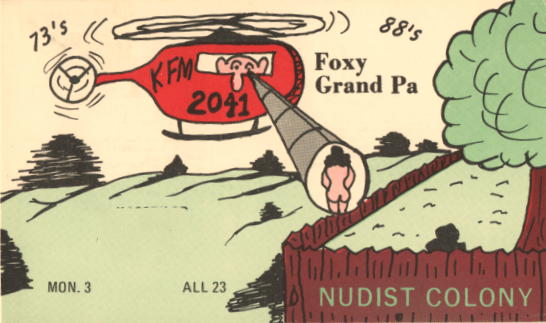
Nudists present another question. Is Tom really peeping if he’s sneaking a look at people who are naked on purpose?
I think we need to say that he is. Given the safeguards nudists put around their colonies to shut out idle oglers and other opportunists, these gents are definitely peeping. I hope, but doubt, that this little study clarifies matters. When we chat again on this subject, I will disclose some interesting facts about the original Peeping Tom of Coventry which I recently discovered (i.e., “made up”. This ARE the Interwebs, after all.)
Do you know where we get the phrase “Peeping Tom” for a man who tries to get a look at women in a state of undress? Well, that’s a pity, because I’m going to tell you the story anyhow.
There are plenty of versions of the story of Lady Godiva. My favorite is Will Cuppy’s, though Dr. Seuss had an imaginative take on it. But, to summarize (go read Will Cuppy’s on your own time; it’ll make you forget about this one, another evidence of why HE deserved a Nobel Prize), Godiva was married to grumpy old Earl Leofric, and argued with him about taxes. The sheer repetition of her arguments drove him so crazy he finally told her he’d forget about taxes if she would ride through the streets of Coventry naked. Godiva was so dedicated to the cause that she did this, after first sending out a decree that everybody in Coventry had to stay inside and bar their windows. She went on the ride, the Earl remitted the taxes, and the only man who could testify to what had happened, a tailor named Tom who HAD to peek out of his window, was struck blind by the wrath of God. And everyone lived happily ever after, even Tom, who at least had his memories.
Both Godiva AND Tom inspired generations of readers. Naturally, there are all manner of objections to the story, beginning with a suggestion that shuttered windows hadn’t been invented yet, so Tom couldn’t have unbarred his, and running right through the inevitable suggestion that there was no Lady Godiva, that the whole story is simply a modern perversion of an old Celtic fertility rite. (When I have the time, I might go into the history of deciding every folk story is part of an old fertility rite, but the research would be vast. Or at least half that.)
Well, you will be relieved to know that there was indeed a Lady Godiva, and an Earl Leofric, too. Godiva is mentioned by name (under numerous creative spellings) in documents of the eleventh century, along with Earl Leofric, along with their children and grandchildren (she was the grandmother-in-law of King Harold II.) They gave a lot of money to religious establishments—one monastery claims Godiva signed their charter–and it is remarked by several researchers that in the century after Godiva’s supposed adventure, the people of Coventry did not pay taxes. (Except on horses, which is an interesting sidelight on the story, since Godiva was riding on a horse. Did the Earl bear a little bit of a grudge, perhaps?)
Unfortunately, the story of the naked ride does not turn up until two hundred years after it was supposed to happen, and TOM does not turn up for another five hundred years after that. The bit about the taxes is supposedly attested to by a stained glass window of the fourteenth century, but that has inconveniently not existed for a few hundred years, and didn’t allude to the nudity. There are extreme skeptics, in fact, who feel the whole naked bit was promoted by Protestant reformers to discredit a devout Catholic (Godiva owned one of the earliest known rosaries), OR by the town council of Coventry to drum up tourist trade. One or two people, too conservative themselves to consider a lady riding out dressed only in her long hair (which supposedly covered her to the ankles) insist that she was probably wearing tight silk, or was clad only in her shift, like someone doing public penance. This would, of course, kind of contradict the whole fertility goddess business, or the more modern concept that this was all just a metaphor for wives using their bodies to get their husbands to do stuff.
The question of when and why Tom was added to the story is a subject for dozens of other studies. He and his peeping might have been known long before the story was written down: a bill to refurbish a statue of him shows up a generation or so before the first printed account. I admit to a little curiosity about what this statue, used in the annual Godiva procession, looked like in the early days, but the best I can learn is that it showed a man looking out a window. AND, according to people who don’t tell me why they think so, was probably not originally named Tom. In early versions of the story, Lady Godiva’s decree said anyone who peeked would be put to death, and that’s what happened to him. Whether he was executed on her command, or on Earl Leofric’s, or by that bolt from the blue, or by irate citizens of Coventry varies on the version told. Only later was he struck blind, which seemed to the literary set a more reasonable punishment for peeking. (Though Frederic Wertham might have had more to say on the subject.)
The best I can learn about why he joined the company is that the writers, being suspect in any case, have always added comic relief to the most intense dramas (medieval religious plays frequently include a few drunks, or a cranky old man, or somebody else to lighten the load.) Oh, and nobody has told me why he was a tailor. Early stories made him a groom in the Earl’s stable, which maybe eliminates the necessity of a window, but DOES bring up all sorts of side issues. Did nobody help Godiva into the saddle when she set out? Why weren’t THEY blinded? Or did the servants, who would probably have been used to seeing their bosses in the buff, not count? Tailors do seem to get a lot of coverage in folktales, but, again, this will have to wait for a whole nother blog.
Anyway, this is why we call ‘em Peeping Toms, even if they happen to be female. In our next thrilling episode, we will consider the question more, but this time, I promise, we’ll talk about the postcards.
In the damp northern land of Tarrefol, a young man named Lyall worked as a shepherd. Every day, he took his village’s sheep to the hills north of town where they could feed on the green grass.
His job was to see that at least as many sheep came home at night as went out in the morning, and that all of them were fed. He kept the lambs and the older sheep from being pushed away from the tenderest grass by the sheep in their prime. It was his duty to nudge sheep back from pits or high rocks. And he had to have an eye out for people or wolves who might try to steal a sheep. His was a job which called for a deal of sitting and watching, which Lyall varied from time to time by standing and watching.
One morning, he found that a mighty rain had washed dirt and grass down from the hills. Lyall and the sheep had to go much farther north to find enough space for the whole flock to eat. Even there he found new gullies that had washed dirt down toward the village, and rocks which had been exposed for the first time in ages.
But there was grass enough left for a sheep’s content. Lyall mostly stood and watched here, for the sheep always managed to find a way into trouble in a new place. Sure enough, it wasn’t long before he heard a terrible ruckus. He hurried over to where a ram was thrashing about, and found it had both hind legs stuck right into the ground. The earth had been washed so thin at this point that the ram, just by walking over it, had broken through into a cave underneath.
The ram didn’t help much bucking and bawling as Lyall tried to haul it up without himself falling into the hole. He heard other sounds besides those made by the ram but had no time to worry about them. It did, though, sound a little like people shouting.
Once the ram was freed, Lyall gave it a shove in the direction he felt it should go. Then he knelt and peered into the hole in the ground, to make sure one of the lambs hadn’t fallen in first. The sounds he heard might well come from a small sheep crying out, and making echoes underground.
His eyes went wide and his breath came fast. In the shadows below were great grey chests covered with moss, but standing open and filled to the brimming with bright gold. Around these in the dirt sat gold cups and gold plates, golden bells, golden armlets, gold necklaces, gold chains, and the golden crowns of a dozen kings. Lyall might well have climbed down for a closer look, had that been all he saw.
But a shepherd needs to have eyes that see plenty, and what else Lyall was seeing was more eyes. Squinting, he could just make out the faces going with those eyes, little wizened faces. Lyall understood at once what had happened. The ram had broken through the roof of a cave that belonged to the little people of the hills. Sunlight now poured in through the gap, and the little people could work no magic.
“Well, you have a problem there and no mistake,” he called down. “But not to worry, good people. You’ve stolen none of my sheep, and I’ll be stealing none of your gold.”
Lyall made more than a promise. Moving around the hill, he took up twigs and sticks which had blown down in the storm. These he wove into a broad framework, a little bigger than the hole the ram had made in the hill. He smeared this framework with mud and carried it back to the hole.
“There you be,” he said, setting it down, “You can be sleeping again now. Night is the time for your waking.”
“True enough,” said a rough voice.
Lyall turned to find a small man dressed in grey and green, and wearing a red mustache as long as the man was tall. The little fellow was studying the patch in the hill. Paying no attention to Lyall at all, at all, he walked three times around the framework, murmuring “Soooo. Soooo.”
After the third turn, he stopped and looked up at Lyall. “It’s never so neat a job as we could do ourselves, understood, but it will no doubt hold until nightfall. Now I suppose you’ll be wanting some gold.”
The little man moved the patch a bit with one foot so Lyall could see the treasure again. “It’s the rule that you can ask us for any of it, or all of it,” he said. “I’d suggest you leave us a little, though, if you value our good will.”
Lyall shrugged. “What would I do with so much gold? How could I be carrying it, and where would I be putting it? And how would I be explaining where it came from? I can’t deny that a bit of gold now and then would be handy, but there’s a power of trouble in taking so much.”
“Take a little, then,” the man told him. “For you’ve done us a service and we’re in your debt. And if there’s any one thing we like less than a mortal stealing our gold, it’s for a mortal man to be putting us in debt to him.”
“Well, if you must be giving me something for a neighborly act,” Lyall replied, “I would not have you breaking your rules. But does it have to be gold?”
The little man stood back, hands on his hips. “No gold? Soooo. Soooo. What’s it to be, then?”
“Teach me to whistle,” said Lyal.
Now the little man took three steps backward. “Lad,” he said, “The world has changed for the worse since we started living in our castle down below. In my day, every lad in Tarrefol could whistle.”
“And so I can whistle,” Lyall retorted. “I can whistle to call a dog, and I can whistle a tune and recognize it when I hear myself whistling it. But my dad and my grand-dad could whistle to break the heart. They could whistle the birds down out of their very nests or whistle a song to make you think the sun shone in the dark dead of winter. And I’ve never been such a whistler myself. Can you teach me such a thing?”
I can give you that power,” said the little man, with a shrug. “But you’ll need to be coming back at night, since I can work no….”
“All I want given me is lessons,” Lyall informed him. “Don’t give me the power. Show me how it’s done, so I’ll know what I’m doing when I’m doing it.”
The little man grinned, which made the tips of his mustache bounce up. “You drive a hard bargain, my lad. Is it watching sheep all day a young man like you should be doing?”
Lyall shrugged. “Why not?”
The little man said no more on that subject, but sat right down over the patch in the hill, and taught Lyall to whistle. By the end of that day each sheep bore on its back forty birds that had come down to listen.
“It’s a passable whistler you are, lad,” said the little man, as the sun slanted down.
“That’s fine,” said Lyall. “That’s mighty fine. Now I’ll have to be getting the sheep back.” He whistled a little tune and the birds whistled it back to him. “Ah, it’s a diner thing than gold you’ve passed along to me.”
“It is that,” the little man said to himself, watching Lyall herd the sheep down toward the village. “And because you had the wit to ask for music instead of gold, you shall have both.”
For days after that, Lyall herded the sheep as he’d always done, knowing nothing of the little man’s promise. To be sure, he had more visitors than before. People coming along the road, who had thought to pass the herd of sheep, would pause in their passing to listen to what sounded like the rose of all birds. More than one walked carefully between the sheep to ask Lyall to show them how to whistle that well. Knowing himself to be no more than a shepherd, Lyall never considered the possibility that there were more important things he might be doing. He’d give a few whistling lessons to anyone who asked, keeping his eyes on the sheep all the while.
And when one of his students tried to pay him, not a coin would he take, be it copper of silver or gold. “A pity it would be if there were one soul in Tarrefol who could not whistle,” he’d say.
And never did he see the little man with the red mustache, hiding among the rocks, murmuring, “Soooo. Soooo.”
The people took to calling him Lyall Whistle-Lips, and many’s the time he was called to a dance at the village or at the manor house, to whistle a tune now and again while the fiddler’s fingers rested. Not a penny would he take for that, either. “I walk into more dances than any shepherd in the land of Tarrefol,” Lyall said. “I dance when I will and eat my fill. What more could I possibly honestly ask?”
And he never noticed a little man outside the door, stroking a red mustache and saying “Soooo. Soooo.”
This made Lyall very popular, but it did not exactly make him a respected citizen. Any man who would turn down money honestly offered was little better than a fool, particularly when, with all that skill, he went on herding sheep. It was thought that, at the very least, he could buy a few sheep and go into business for himself. And of course he was no one’s choice for a son-in-law, and no woman really wanted a husband with so little money and less ambition, a man who seemed to want no more than to watch sheep and whistle his days away.
The only person who took Lyall Whistle-Lips seriously was the King of Tarrefol himself.
The King had difficulties with his only child, a daughter named Fianna. Princess Fianna was a beautiful and dutiful daughter to the King, but on one matter they disagreed. Fianna knew she was to be Queen, come the sad day when her father died. When that day came, she planned to be an unmarried Queen. The Kings from all the countries around Tarrefol would come in solemn procession then, offering gifts of jewels, rich clothes, and golden chains as they asked for her hand. She liked this idea.
Anything else her father asked of her, she was willing to perform, from hosting feasts to judging cattle. She wanted to be a real Queen, so she studied history, floriography, onomastics, and other sciences so she would understand the many things it was necessary for a Queen to be knowing. But she would marry no one.
The King worried about all of this and finally took himself to a quiet part of the garden. For centuries, whenever a King of Tarrefol had an especially sticky problem, it was the custom to resort to a magic well tucked away there. If the monarch dropped in a gold piece, one of the little people from the hills would appear, to answer questions. For rather more gold, the little people might actually help out with a magical favor or two. The King didn’t know if he was quite as desperate as all that yet.
So the King dropped his gold coin int the well and soon a little man all in grey and green, twirling a long red mustache, stood before him. The King told him all about Princess Fianna, and asked his advice.
“You need no advice,” the little man said, “For you have no problem. The next man the princess kisses will be her husband.”
The King was so happy to get a straight answer (the little people had been known to talk in riddles) that he kicked his heels and went running back to the castle. Knowing how stubborn Fianna could be, though, he told no one at all what the little man had said. Well, no one but his Prime Minister, who, besides being his most trusted advisor, was the sister of his dear, departed wife. She told no one about what the King had said. Except for her husband, who told no one but the Captain of the Guard, who swore to keep it a secret. And yet somehow the story got out.
And Fianna never so much as puckered her lips for weeks after this, lest someone should sneak up and kiss her. Even when a page boy slipped her a glass of straight lemon juice at breakfast one morning, not so much as a pucker did she make. The King was frantic. So when he heard of a personable young shepherd called Lyall Whistle-Lips, he wondered if this lad might have the answer to his troubles.
He sent for Lyall, who found someone to take care of the sheep that day, and explained the problem. “Now what I want you to do, Lyall, my lad,” the King said, “Is teach the princess to whistle, as you have taught the others. When the time is right, and her lips are puckered up tight, you’re to dive right in and kiss her.”
When Lyall looked surprised, the King leaned in to whisper, “You see, my daughter doesn’t understand these kings, but I do, more then half of them being cousins of mine. And if, when I die, my Fianna has no husband, they’ll likely come with armies, not gifts, and any chains they set on her will be far from golden.”
Lyall scratched his head. “And you’re thinking I might frighten such men away?”
The King looked the shepherd up and down. “Well, they’ll not be seeing you; they’ll know only that there IS a husband, and hold off. Still, if you don’t like the idea of marrying a Queen, you’ll at least be getting her to pucker her lips, and some man with more determination may make the attempt.”
Lyall shrugged. “I will do as you ask, Your Highness. I can’t say as I believe kings can be quite so foolish as you tell me but, to be sure, you know your family better than I do.”
The King clapped his hands and called for the Prime Minister to take the shepherd to Princess Fianna’s Tower. “And leave them alone there,” he went on. “Lyall Whistle-Lips has some very important things to teach her.”
Princess Fianna’s eyes flashed when she heard what her new tutor was there to teach, for she knew at once why her father would want her to work on this craft. But the shepherd lad was pleasant enough, and hardly to blame for her father’s plotting, so she reached out a hand to his and said, “Good morning, sir.”
Lyall said nothing. Princess Fianna was by far the most beautiful woman he had ever met, though he had been to dances in a dozen villages and half a dozen manor houses. Her eyes were brighter than the sun at sunrise, and the sheen of her hair stood out brighter than the dew on the grass of a spring meadow.
“I understand you’re the finest whistler in all of Tarrefol,” the Princess went on, “And that His Highness my father wishes me to learn the art. I’m sure I don’t mind that. But you will please oblige me by turning your back to me during the lesson, and standing in that corner of the room.”
By this Lyall understood that the Princess knew about the sort of trick the King expected him to play. Since he had not cared much for the idea of kissing someone who did not want to be kissed, he agreed. “Still and all,” he said, “It will be a power of difficulty teaching anyone to whistle that way.”
“Nevertheless, that’s the way you’ll be doing it,” Fianna told him.
Lyall nodded. To be sure, it would not have worked the King’s way. If the little people spoke truth, his kissing the Princess would have made little difference. It was the man she kissed that mattered, not the man who kissed her. And if by some chance, the Princess did decide to kiss him, it would hardly matter which way he turned.
To the Princess herself, he said “When we finish, you should be whistling like this.” And he whistled a bit of “Wolf in the Sheepfold”, a popular tune in the dances around Tarrefol.
Fianna enjoyed the song very much indeed, but didn’t like to be saying so with that bright face still pointed at her. “That was pretty, to be sure,” she told Lyall, “But I can’t see why I should be after learning any such thing. If I need any whistling done, I can be sending for you.”
“Why, if that is the case, then I can be off now and not be the cause of wasting any more of your time,” said Lyall, taking a step toward the door. “Strange it is to be meeting someone in Tarrefol who cannot whistle, but I suppose there is so much other music in a castle that you have no need to whistle.”
Fianna frowned. “And do you all whistle, then, down in the villages?”
“That we do,” said Lyall Whistle-Lips. “Everyone in Tarrefol can whistle.”
“I’ll not be the only one who can’t then!” said Fianna. “But I wonder why it should be that all the people whistle. There was nothing about this in my history books.”
“Well, now,” said Lyall.
Taking the princess’s hand, he walked over to a window. From here they could see two or three villages among the hills, and several flocks of sheep with their own shepherds. And he whistled her a little tune of the cottages they could see, of hungry winters and the freedom of the thaw. Hot summer days came into the tune, and autumn days at market. He whistled her the clouds rolling across the sky as you sat watching sheep, and the rolling of your collar when the clouds turned out to be rain clouds.
Fianna looked at him wide-eyed, and then out at the villages below. And when he’d whistled up all the days’ life outside the castle, she reached up to take his face between her hands, and she kissed him.
Lyall, startled, stepped back a bit. But then, with a laugh, he stepped back to where he’d been and kissed her in return.
“Oh!” Fianna cried, remembering what all this was about. She looked behind her, but saw no one else in the room.
She turned back to face Lyall Whistle-Lips. “Don’t tell!” she whispered.
“I will not,” said Lyall, without hesitation. “I am not bound by what is said by the little people in the hills, nor such a fool as to wish to marry someone who does not wish to be married.”
“Oh, I’m not worrying about that,” she told him. “It suddenly seems to me that a man at hand might be better than any five kings in the bush.” She tossed her head to throw her hair back a bit. “But I’ve not learned to whistle yet.”
Teacher and student puckered their lips again, never noticing at all a pair of eyes or a long red mustache, or a voice that murmured “Soooo. Soooo.”
“Now, remember, Forsyth. You were voted the best man for the job.”
“It’s an honor, sir. Unusual, but quite an honor to be chosen for the first interplanetary blind date.”
“Yes, the women of Earth picked you as the best overall…ah, here she comes. Remember, you’re the hope of an entire planet.”
“But, sir! She’s….”
“Other planets, other standards, Forsyth: that huge belly is considered quite sexy on her home world.”
“It’s not her stomach, sir. Her legs….”
“You said on the questionnaire you liked hairy legs, Forsyth.”
“Sir, she has eight of them!”
“We had no guarantee they’d send a bipedal ambassador.”
“No, sir. But…. Don’t some species bite the head off the male after mating?”
“The women voted you number fourteen in Sexually Attractive, Forsyth. But number one in Dispensable. Now, brace yourself. Looks like she’s interested.”
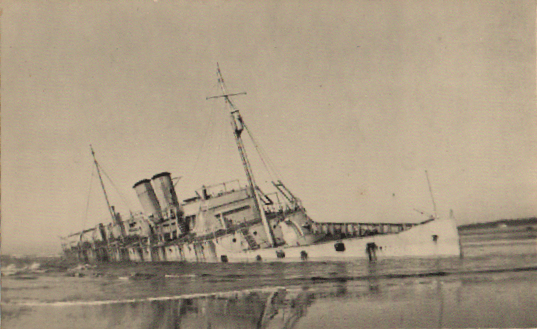
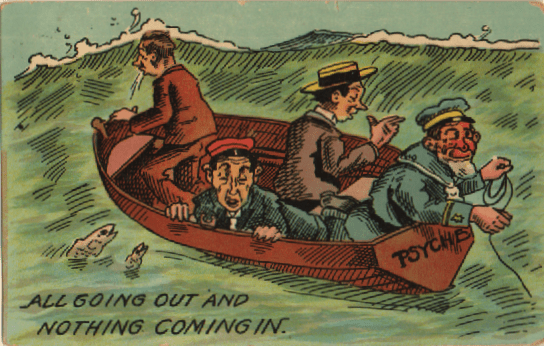
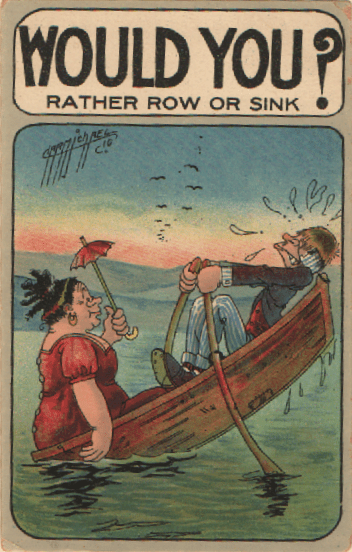
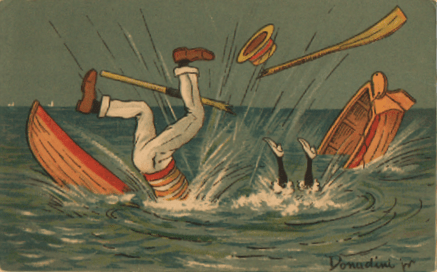
Now, although this is the Interwebs, we really need to be fair to both sides here. For every maritime disaster postcard, there are a hundred showing boats and ships going about their business without calamity. The places which sold postcards sometimes had a vested interest in reminding you of the peaceful, calming effects of travel.
Still, most postcards were mailed by people who were traveling. And whether out of joy at having eluded a soggy fate or rueful admission that not everything about the vacation turned out exactly as desired, the other kind of card is common, too.
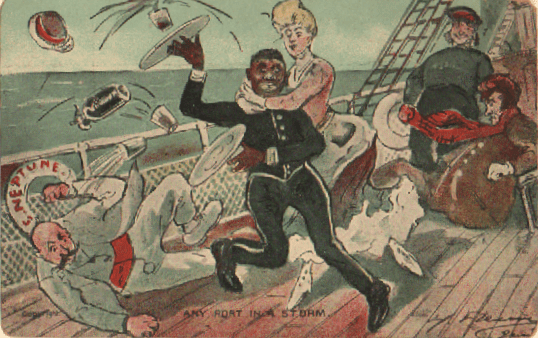
Everybody could laugh at—and some could sympathize with—postcards about being seasick. (Note to self: is no one ever lakesick or riversick?) This byproduct of going out on the water is so well-known that Lord Dunsany wrote a short story about a man whose great failing is merely the FEAR of being seasick, which he describes as far worse than the condition itself.
Although it is the most famous result, seasickness is not the only way turbulent seas can lead to a loss of lunch. (The waiter was doing so well, too, until he was chosen as an emergency handrail.)
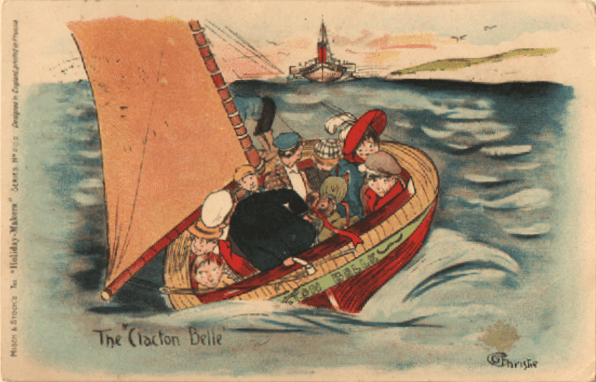
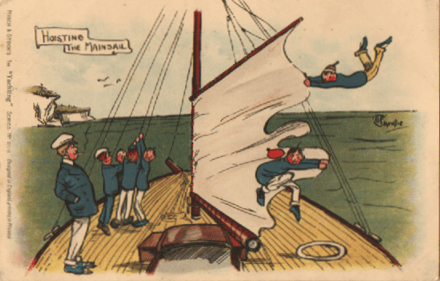
There must be thousands of postcards showing the elegance and serenity of yachts as they sail along on the breeze. Only a few point out the adventures to be had by weekend sailors.
Bringing to mind the fine old joke about the newly rich businessman who bought himself a yacht and went to show his mother how he looked in his captain’s uniform. His mother nodded sagely and reminded him, “By me, son, are you a captain. And by you are you a captain. But remember, my boy, by captains you are no captain.”
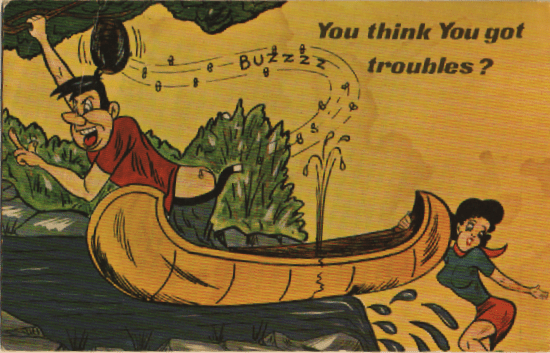
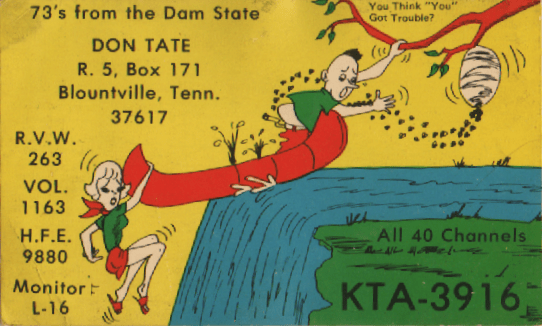
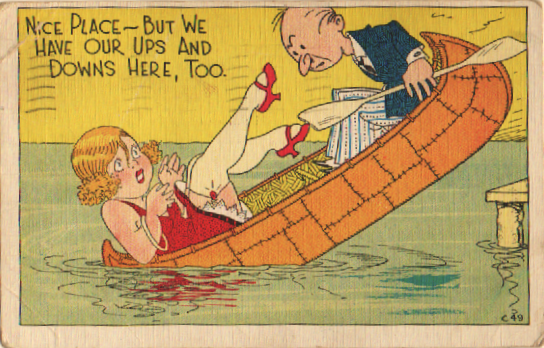
For sheer contrariment, however, the postcard artists preferred a canoe. This may be the one area where people having trouble with a kind of boat outnumber those who are enjoying a peaceful glide.
In fact, the number of postcards showing exactly this situation–woman and waterfall, leaking canoe, man with broken belt grabbing at branch while stinging insects head for the largest target—that I may, once the Powerball picks the right numbers, do deep research and find out which artist originated the classic.
Of course, as one person with experience in camping and hiking told me, “Anything is seven times as difficult in a canoe.”
We have already examined THIS phenomenon in some detail. (Without determining who started this joke either.) But leaving it out of the discussion would be gross neglect.
The moral of the story is that whether you come back from your boat ride afloat, adrift, or afoot, just grin and buy a postcard. The cartoonists will gladly throw you a line.
“I’ve broken my soul!” wailed Egbert, looking left and right for a door in the wall. “I know it. I’ve broken my soul and I shall never be happy again!”
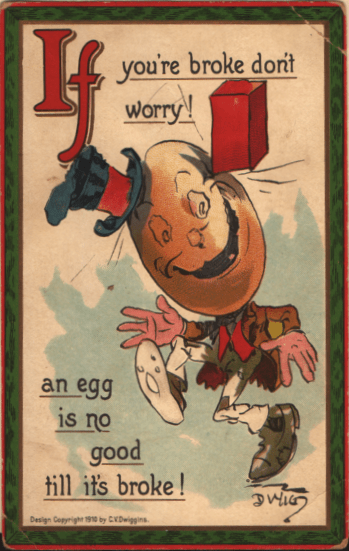
The egg had not, as a matter of fact, broken. On the other side of the wall was the garden of the King. And just behind the wall where Egbert had been boiling his soul sat the youngest and largest of the King’s daughters. She was not considered the most beautiful of princesses, but could be quite friendly when she wasn’t hungry. Having finished everything she had brought in her hamper for a little mid-morning picnic, she was looking around to make sure she hadn’t missed any of the food when a boiled egg plopped out of the sky onto her lap.
“How lovely!” she thought. “Daddy must have had one of the wizards put a spell on the birds here so they’d lay boiled eggs. Very useful.” She cracked the egg against the hamper handle, and peeled it. It was quite nicely cooked.
She heard someone shout “Oh!”
Looking up, she saw a shirtless man climb over the wall, carrying a salt shake. “Oh, alas!” she told him. “If I had known you were coming, I might have waited, A little salt would have been just the thing.”
“My…my soul!”
The princess raised her eyebrows. “I beg your pardon?”
Egbert dropped into the garden, landing on his knees. “You have eaten my soul! I shall never be a whole man again!”
The princess looked him up and down. “Do you know? That’s quite the prettiest thing anyone’s ever said to me.”
“The reverend was right.” Egbert could hardly believe his bad luck. “My soul was high, and low, and all over. And now it is in you.”
The princess clapped her hands. “And your soul is important to you? You say you won’t feel whole without it?”
“It’s priceless,” said Egbert, his mind on all his money, not to mention the rhubarb plants. “I could never buy such a soul again. Now I can never be happy.”
“I think you’d better come with me,” said the princess. Taking Egbert by one hand, she led him into the castle. Egbert paid no attention to where he was going; he hardly cared what happened to him now.
The princess walked right into the throne room where her father and mother were sitting. “This man is in love with me,” she told them. “He says I have captured his soul and he shall never be whole again without me.”
The King looked the shirtless man over. “Is this true?”
“Oh, my soul, my soul. I have no hope of ever getting it now.” Egbert noticed, all at once, that the man before him was wearing a crown, and sitting on a throne. Realizing where he must be, and remembering the respect that a good citizen needed to show the monarch, he pulled himself up straight.
“But at least, Your Majesty,” he told the King, “It is better that she should have my soul than Stanley. Or a goose.”
The princess applauded, but the King frowned. “This man talks like a fool!”
The queen reached over and patted his hand. “All men in love do, dear. I suppose we had best let them marry. Since it’s a matter of souls.”
“Well, it wouldn’t be the first fool I’ve added to the family through marriage,” the King muttered, quietly, so the Queen wouldn’t hear this. He looked to his youngest and largest daughter. “Are you sure this is what you want? I could find you a nice, clean Baron, or Earl.”
“Oh, they could never say such pretty things!” She turned and, taking both of Egbert’s hands, held them to her throat. “Would you like that? To stay here with me?”
Egbert brightened at once, at least facially. “That would be wonderful! I could always be near my soul, the only soul I ever had!” This was such a pretty thing to say that the Queen ordered a minstrel to write a song around it to be sung at the wedding.
Ah, wasn’t there just a wedding when Egbert and the princess were married, with even more food and drink than had been at the other! The princess and Egbert were very happy in a little castle of their own. If the princess sometimes suspected that her husband was nothing but a fool, her mother and her married sisters were always ready to assure her that all husbands were like that.
And to be sure, Egbert made the most loving husband. For, all other considerations aside, the princess had eaten his soul, for which he had paid every penny he had, plus those rhubarb plants. So he took very good care of her, all his days.
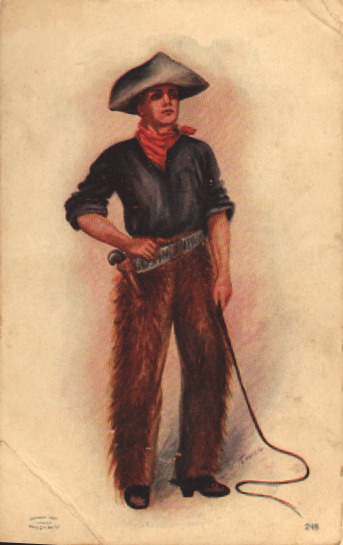
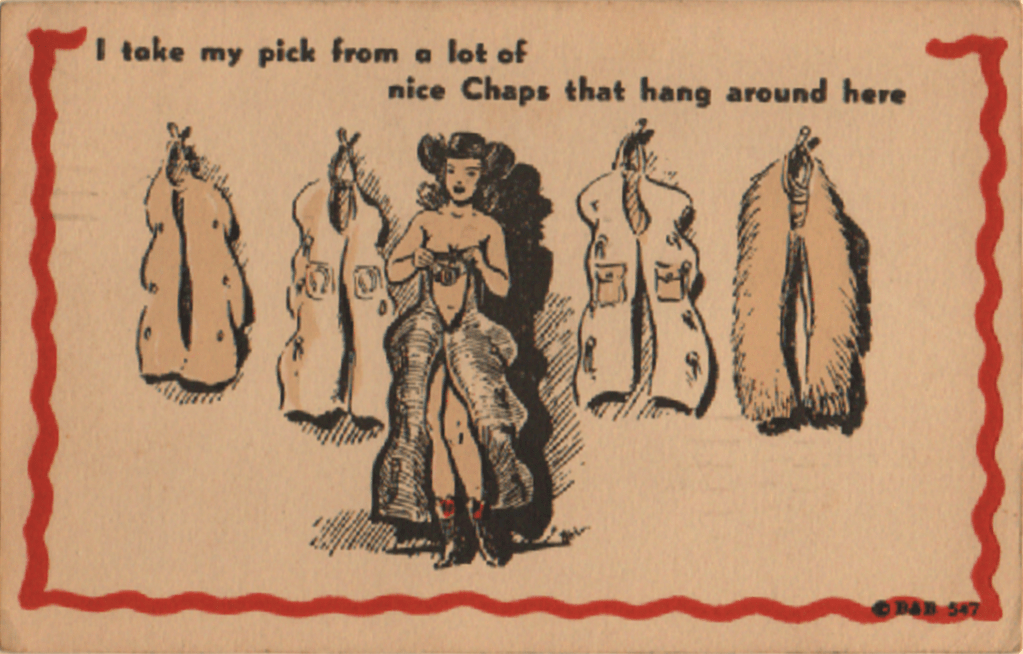
Today’s consideration of fine old jokes takes us to the wild west, and the garment known as chaps. The word is short for chaparreras, which American cowboys shortened to chaps, at first pronounced shaps. They apparently start appearing in tales of the west in the 1830s, and were intended to keep a cowboy’s legs dry in muddy weather. These fuzzy ones were made of goatskin, and very popular because the hair made them kept more water off the legs than plain leather.
This style, which was adored by mid-century postcard cartoonists, is sometimes called bat wings or, more commonly, rodeo chaps. The funny floppiness is functional: this gives more play to the lower leg and makes it easier for the rider to mount the horse. It is also,as cartoonists and modern rodeo riders can attest, more attention-grabbing.
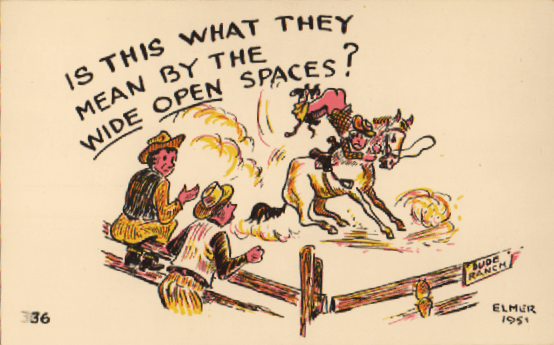
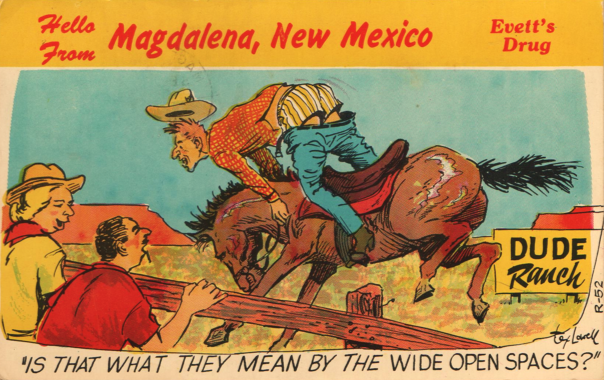
So where do the jokes come in? Well, in the late nineteenth century, a thing now known as the “dude ranch” appeared out west, a combination of rough financial markets and an ancient tradition of city folk going out into the country in warm weather (out east, people would pay to go live on a farm and do chores for the summer.) Around the same time, there was a vein of East vs. West humor, related to the town vs. country jokes, where people who knew what they were doing made fun of the visitors.
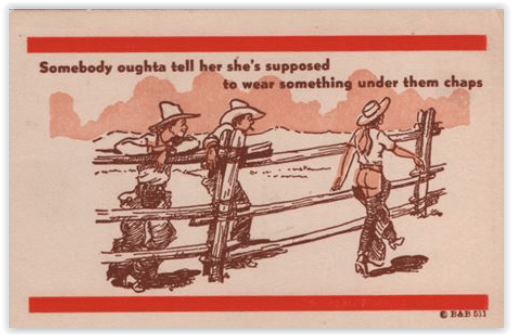
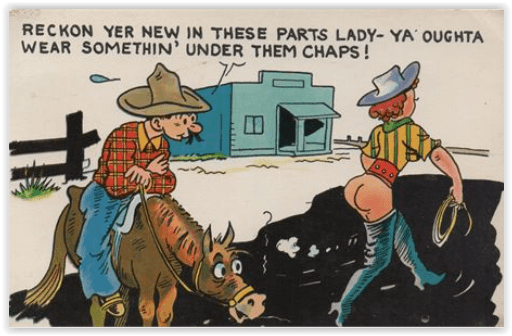
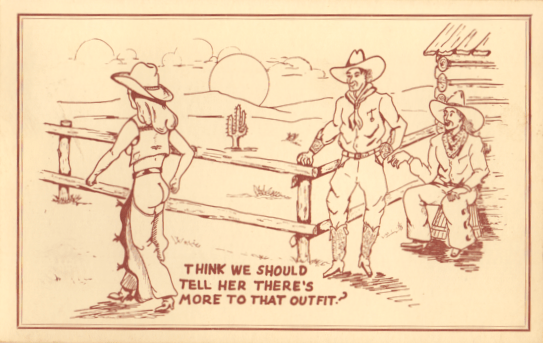
And the postcard featuring the south end of a young lady from the city who didn’t know chaps were worn over trousers was born. (Not that the cartoonists knew all that much about it. What the lady is wearing here are technically known as “boots”.)
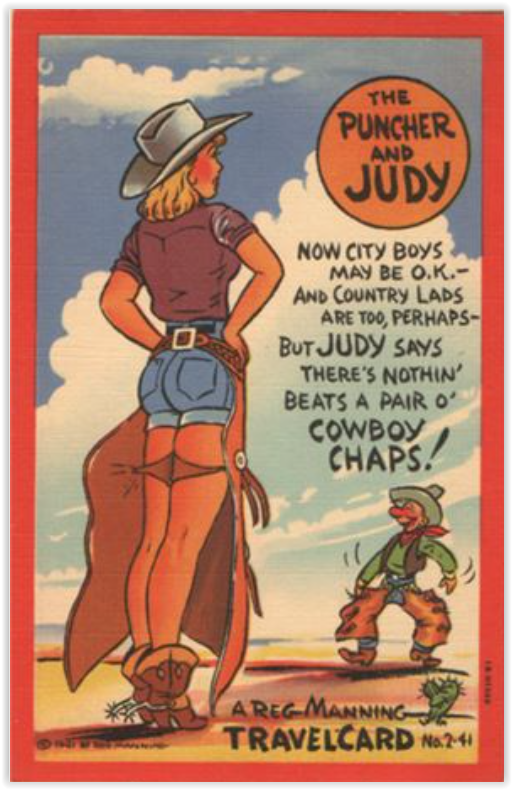
Some artists did dare to buck the trend. Reg Manning here shows a dudette who knows how it’s done. (AND shows us a useful pun.)
Still, chaps had become associated with semi-nudity, whether the young lady knew how to dress or not. (If she’s put on her hat and boots and now is picking out chaps, maybe she doesn’t.)
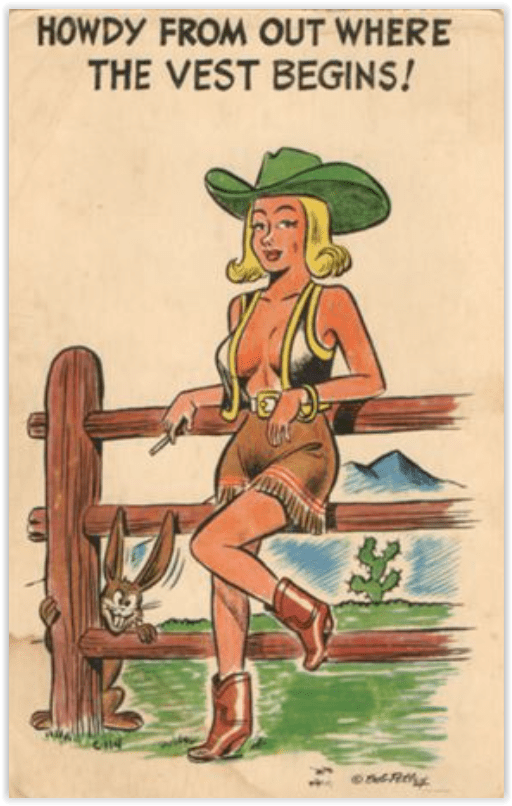
After all, one headed for the country to get away from the city’s over-civilized requirements. THIS young lady has donned a matching vest.
This accessory started a tradition of its own.
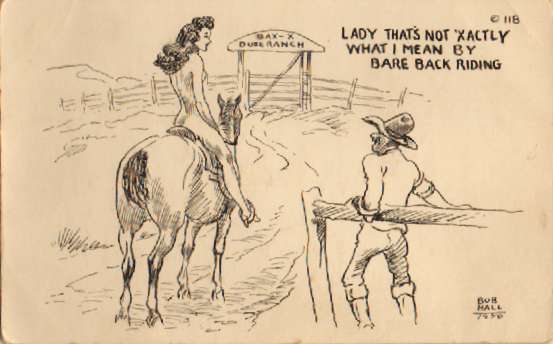
Maybe it was all a marketing ploy by the ranches themselves. THIS gag also has a line of relatives. (There is no time here to discuss the history of the nudist dude ranch, or Nude Ranch. There may have been more of these in movies and sitcoms than in the desert.)
The ladies who went to dude ranches could not catch a break at all.
Mind you, the men from the city who came west got a share of the jokes. But THEY got to keep their underdrawers on.
If you’ve been here before, you know that one of our chief activities is looking at old postcards to see what we can learn from them (and to see whether I can sell them, but that’s a different issue.) From time to time I run across a card with a joke that has so completely lost its point with the passage of time that no amount of Interwebs searching can bring that punchline back. We’re not going to discuss that sort of thing today. These are some cards that have left me with minor puzzles which do not detract from the card’s original appeal. Here, for example, we see at waitress at the Molokai Bar in the Mai-Kai, a Tiki restaurant which still exists in Fort Lauderdale. What she is holding in her hands is the Mystery Bowl, a beverage served only to the very adventurous…back when this card was issued. The Mai-Kai, perhaps motivated by the fact that the law is not fond of mystery ingredients, no longer serves the Mystery Bowl (or at least does not mention in on their online menu.) So what was in the Mystery Bowl? It must have been an expensive and potent potable, since the purchaser not only got the bowl but that string of orchids around her neck. (I know; I was trying to resist the pull of the traditional lei jokes.)
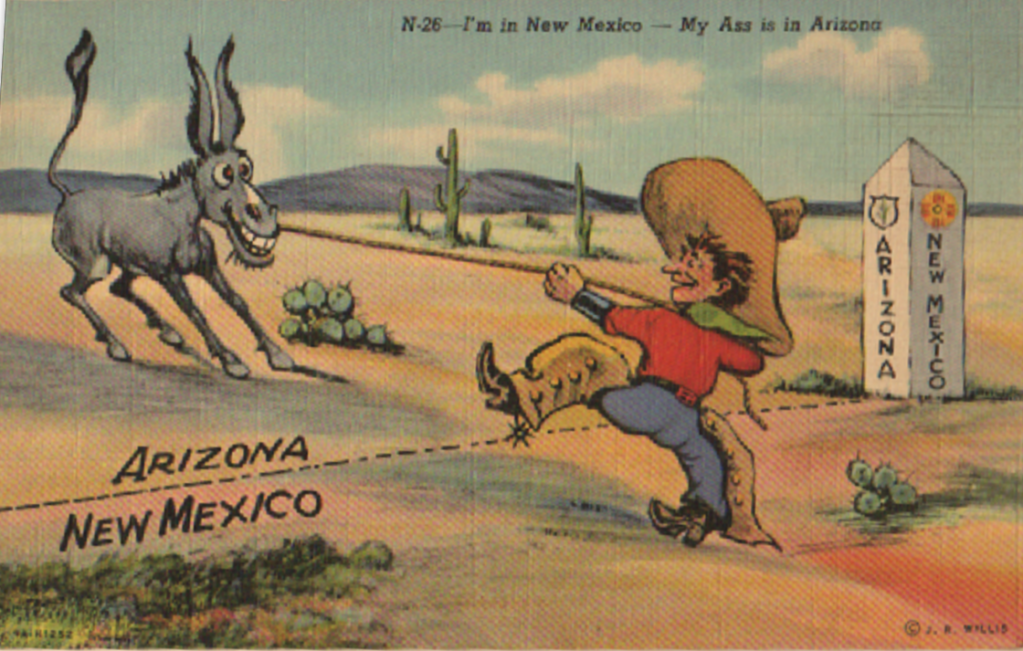
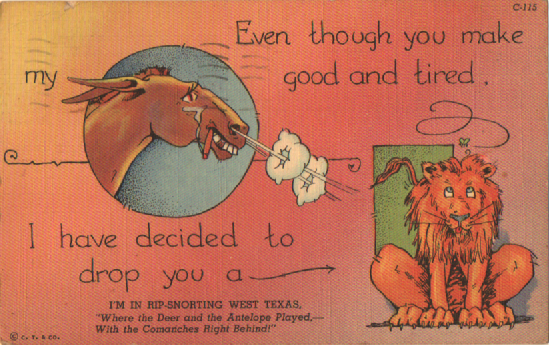
This is more of a marketing mystery. This basic joke here was very popular—people liked the ass gag—and I pulled it from inventory because you HAVE to list the more common cards. Only after I scanned it did I notice that remark about Rip-Snorting West Texas, which was NOT on other copies I had. Checking the mighty database of eBay, I find that the Curt Teich Company did this on at least two unrelated cards (the other is a fireman carrying a lady down a ladder.) How many cards did they repurpose for Rip-Snorting West Texas? Was it just one store in Amarillo (where most of the used versions of these have been mailed) and was it just those two cards or anything that was overstocked back at the warehouse? And did they do it for, say, East Los Angeles or North Woonsocket?
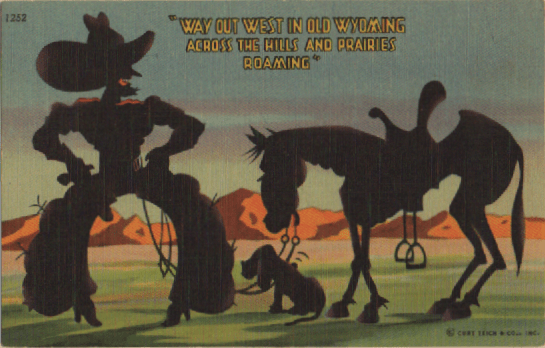
While dealing with Curt Teich in the Wild west, THIS little mystery is just something I want to know. This was one of their most popular silhouette postcards, and you can see why. But I was wondering about that verse. It seems such a perfect start to a song, and yet, when I look it up, all the Interwebs will show me is this postcard. Was it just a couplet composed for this? If so, could somebody out there please write the rest of the song, so I can stop worrying about it?
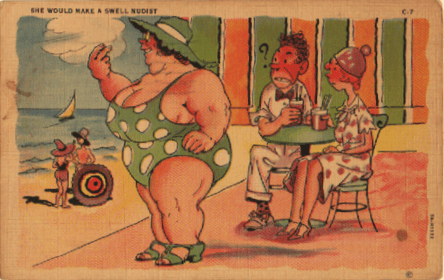
I was brung up on New Yorker cartoons, meself, and New Yorker editors destroyed the work of many a cartoonist by demanding “Who is speaking?” This would NOT have passed muster. Neither of our onlookers is expressing the opinion: their mouths aren’t open and their expressions don’t go with the sentiment. Is it just the opinion of Ray Walters, our cartoonist? Is he really talking about the woman who SEEMS to be the subject, or the demure young lady at the table, whose own figure is a little…let’s move on.
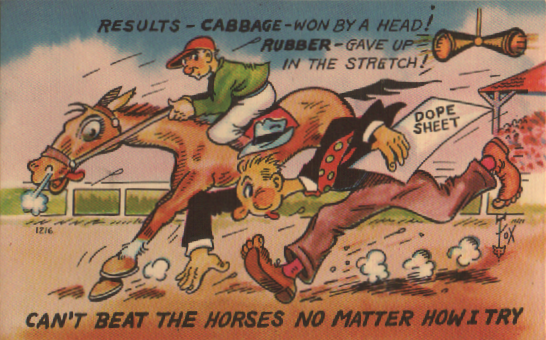
The next few are just glitches in joke history, that question you really ought never to ask: “Who told it first?” I also grew up with Spike Jones records, and of course, Doodles Weaver’s rendition of the dialogue on “William Tell Overture” (known to most of us as “Beetle Bomb”, which is how we heard the name of the racehorse Feitlebaum.) We hear how the progress of the race included Cabbage leading by a head and Girdle in the stretch. The record was so popular that a board game was based on it (with Beetle Bohm, so there.) But this card dates from before the 1948 release of the record. Did this cartoonist hear the song on the radio first, or are the jokes just so obvious they didn’t need to be swiped?
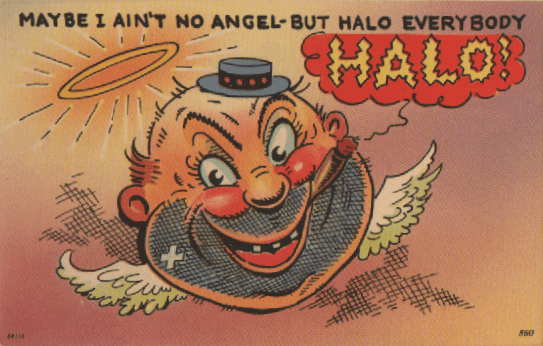
This card, on the other hand, seems to have come out at about the same time that Halo Shampoo was promoting itself with one of advertising’s most nearly immortal jingles. The mystery here is “Did nobody get sued over this?”
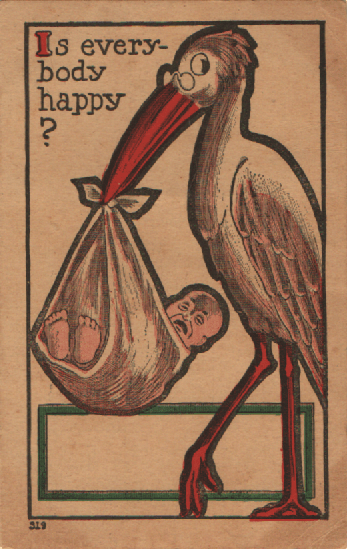
A huge effect on the peculiar structure of my brain was the nostalgia boom of the 1970s (we have a tradition of nostalgia crazes going back to at least 1826.) So of course I know about Ted Lewis and his trademark call during performances of “Is Everybody Happy?” Glancing through eBay, I found two or three cards from 1907 to 1909 that use the catchphrase. The phrase must have been everywhere to attract the postcard cartoonists. But looking up Ted Lewis informs me he would have been high school age at that time, and not at all a famous band leader. So somebody ELSE was making the phrase popular. No one will tell me about it; all sources simply say “Ted Lewis’s trademark phrase.”
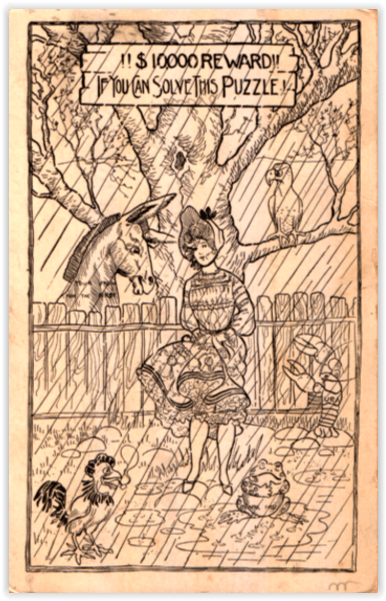
Let’s close with a classic. I still can’t figure out this picture puzzle. It’s not a matter of the money—the prize must have vanished generations ago—or even, at this point, of pride. I never can figure out who the murderer was until the detective explains it to me and I would not care to see my win percentage on the daily Jumble. I just want to know. What IS this incredibly complex rebus trying to communicate? No, I KNOW it isn’t going to be worth the trouble. Why should THIS postcard mystery be different?
A power of years ago, but not so far from Fairview, there lived a fool named Egbert. Egbert was a good, honest fellow, understand: a man who grew vegetables on his little farm, went to services of a Sunday, and never fought with his neighbors. He was just not so very clever. Everybody knew that.
“Egbert’s a good lad,” the neighbors said to each other. “But he’s one of those who doesn’t know enough to pull his head in before he shuts the window.” They said things like this to Egbert’s face now and again, too. Since Egbert had never been anything but a fool, he didn’t feel bad about it.
“It’s just as well I am a fool,” Egbert would say while he walked around with a salt shaker trying to catch wild geese by tossing salt on their tails, “Seeing as how that’s all I know how to do.”
One Sunday, Egbert was in church and the good reverend fetched a powerful sermon to the people about the proper care of their souls./ “The forces of this world will always try to steal the souls of good folks,” he said. “Your soul is in danger from all sides, from high and low. You can be poor and find money. You can be sick and get well. But once you’ve lost your immortal soul, it’s the last drop in the jug.”
The good reverend went on for some time about the sad, sorry life to be had by those who lost their souls, until Egbert was quite thoroughly horrified. “I really must take better care of my soul,” he told himself. “In fact, first thing tomorrow morning, I’ll put a lock on my front door.”
That afternoon, however, he attended a wedding party in town. It was quite the wedding for the groom was the son of the second richest landlord in the county. The King, of course, was the richest landlord in the county, but the King had no sons, so even Egbert could have told you none of them could be grooms. Still, even the second-richest landlord had food and drink aplenty for everyone, even Egbert who, being a fool, always ate and drank too much.
He felt simply terrible the next morning, of course. “Oh, my head hearts and my stomach hurts and both my legs hurt. If I had three legs, I’d feel sorry for me, because they’d all three be hurting. I wonder if maybe I’ve lost my soul. The reverend said people who lose their souls are perfectly miserable, and I don’t suppose miserable could get any more perfect than this. Oh, me!”
The pain in his head made it hard for him to get up, but get up he did. “I’d better find out what I did with that soul,” he said, “Before somebody steals it. Oh, my toes and little fingers!”
He looked on his windowsill first: that was where he generally threw his shirt at bedtime. Just as he looked up, one of the wild geese that used to come around his farm reached in and snapped up a little piece of wedding cake Egbert had dropped the night before.
“My soul!” screamed Egbert. “You are eating my soul! Give it back this second!”
The goose hissed at him. “Talk back to me, will you? I’ll teach you!” Egbert ran right out of the house, without his shoes or shirt, pausing only to pick up his trusty salt shaker.
The goose flapped long goose wings at Egbert. Being a fool, Egbert wouldn’t take warning. The goose was not at all used to people running at him when sensible persons would have known better. Fluttering backward, it hissed again.
“See here!” snapped Egbert. “All this is hurting my head! Just give me my soul back ad I won’t ask for a feather more!” He walked forward, not even noticing he was walking right across his rhubarb plants.
The goose decided to look for food elsewhere. With a “Honkkkk!” it flapped up into the sky.
“No!” cried Egbert, tripping over the early peas. “Come back with my soul!”
Doing his best to follow the fast, crafty goose, Egbert ran through his garden and right down into the town. He tripped over stones, ran into clotheslines, and stepped on cats. A few dogs chased him, but when they noticed he wasn’t paying attention at all, they quit. Some silly fools just didn’t know how to play, they decided, slinking back to their doghouses.
The goose eventually tired of all this, and settled to rest a moment in the yard behind a little yellow house. By great misfortune, this happened to be the home of Stanley, a pillowmonger who was fast and crafty, and hungry as well.
“Ah!” he cried, leaping out to get a hand around the throat of the goose. “You’ll make pillows AND supper!” Without asking whether the goose wanted to do either of these things, he dragged the big bird across to his chopping block and whacked its head off.
Egbert had seen the goose go to land and reached Staley’s yard just as Stanley was holding up the bird. Egbert’s eyes grew big as bird’s nests.
“My…my…my soul!” he whispered, for he was nigh out of breath.
“My goose,” said Stanley, catching up the axe again just in case. “It was in my yard. You can’t have any.”
“I don’t want a goose,” said Egbert, swaying back and forth in despair. “I’m not such a fool as that. I just want my soul!”
“I see,” said Stanley, who didn’t see ay all. “Your soul, is it? And what might your soul have to do with this goose in particular?”
Egbert pointed at the limp bird. “That is the goose that ate my soul just as I went to the window. It wouldn’t have been so bad if it had eaten my shirt, since I’ve got three shirts. But I have only one soul, which the goose ate. And now you have killed it!”
“Ah!” Stanley nodded. “That’s what it was, then.”
Egbert had been looking for a place to sit down and cry, but now looked straight at Stabley. “What what was?” He decided he liked the sound of that enough to say it a few more times. “What what was what what was what what was?”
Stanley set the goose down. “Just before it died,” he told Egbert, “This goose laid a beautiful egg. It was so beautiful, in fact, that it must be your soul. I thought at the time this was an egg beautiful enough to be a soul, and wondered what a goose would be doing with it.”
“My soul is in an egg?” Egbert demanded. “How wonderful!”
“Wait right here and you can take a look.” Stanley went into the house and brought out an egg he was planning to cook for breakfast. “This is it.”
“Oh!” cried Egbert, reaching for it.
“Careful,” said Stanley, drawing it back. “It’s raw, you know, and I won’t have you breaking my egg.”
“Your egg?” said Egbert. “But that’s my soul!”
“That may be,” Stanley told him, “But the goose laid this egg in my yard, and it’s quite a beautiful egg. You may not know this, but I am quite a fancier of beautiful eggs. I meant to keep it and put it above my fireplace as an ornament.”
“Oh, but I must have my soul!” Egbert cried, wringing his hands. “Couldn’t you give me that egg and let the goose lay another one?”
“I have killed the goose,” Stanley reminded him. “It won’t be laying any more eggs. Or souls. But if you like, I might be able to sell it to you. If you have enough money, that is.”
Egbert gave Stanley all the money he had in his pockets. Then he ran home to get all the money he had, plus two very nice rhubarb plants. “Now may I please have my soul?”
“You may,” said Stanley, bowing as he handed over the egg. “But be careful. You might drop it and break it before you get it home to eat it.”
“Eat it?” Egbert demanded, cradling his soul in his arms.
“Of course, eat it,” said Stanley. “You want your soul back inside of you where it’s safe, don’t you?”
“Oh! Yes!” Egbert nodded. “Thank you so much. I might not have thought of that. I’m such a fool I might have left it sitting where a dog might eat it next.”
Stanley nodded. “Or it might have gone rotten. Pity to have your soul spoil.”
“I shall take it home and eat it straight away,” said Egbert, and started to run back to the farm.
He had not gone far when he tripped on a small rock. This hurt his toes something considerable, for he was still barefoot, but what took his breath away was that he had nearly dropped his soul. When he could breathe again, he began to walk very slowly, keeping both hands, and both eyes, on the egg.
Of course, with his eyes on the egg, he couldn’t watch his feet. When he stepped on the grey cat’s tail, they both jumped into the air. The cat ran away. Egbert stood clutching his egg.
“I don’t think I can carry this all the way home without dropping it,” he thought. “Whatever can I….”
In running, the grey cat had bumped somebody’s garbage, and a tin can fell loose now and rolled into the roadway. “Oh oh oh!” cried Egbert. “I know! I don’t have to walk all the way home to cook an egg.”
He caught up the old can and ran to a nearby horse trough, where he filled it with water. Then he found a sheltered spot next to a high white wall. There he built a fire.
Over this fire he carefully hardboiled his soul, watching it every moment. He had listened to the good reverend for a good many Sundays and knew that the last thing anyone wanted was to have their soul burn.
After a good length of time, Egbert carefully poured all of the water out of the can, being not such a fool as to put his hand into boiling water. Then he tipped the can so the egg fell out into his free hand.
“Aieeeee!” he screamed, being just such a fool as to hold an egg which had just been boiled. His hand jerked up, throwing his hot soul over the wall and into the yard behind it.
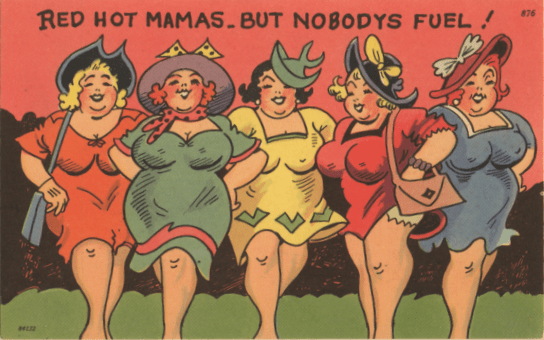
This was mentioned in our last examination of old postcards featuring round people, but it is largely borne out by this latest acquisition of postcards. These folks DO seem to know how to have a good time.
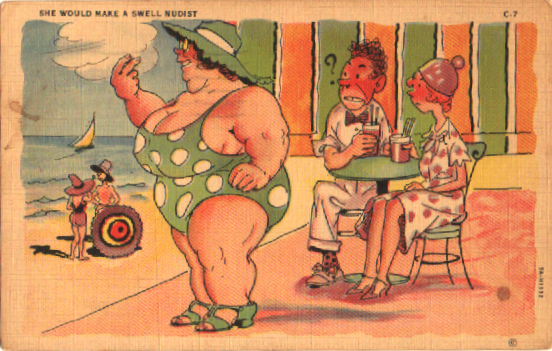
Last time, we discussed gentlemen in their fancy gaudy suits. The ladies, however, tend to go out to have fun at the beach, where what they wear seldom even has room for much of a pattern. (This artist, however, was probably just being prudent in not placing those polka dots on the top of her outfit.)
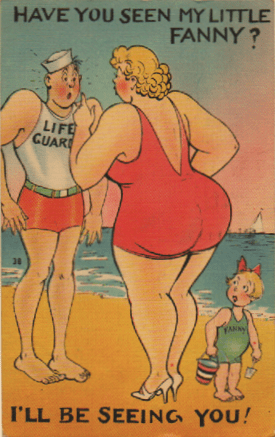
As with the men, there ARE occasionally comments about the sheer size of our protagonist. But these judgments are not always exactly the ones we might expect.
Well, okay, some jokes are so traditional in the world of postcard humor that we DID expect THOSE.
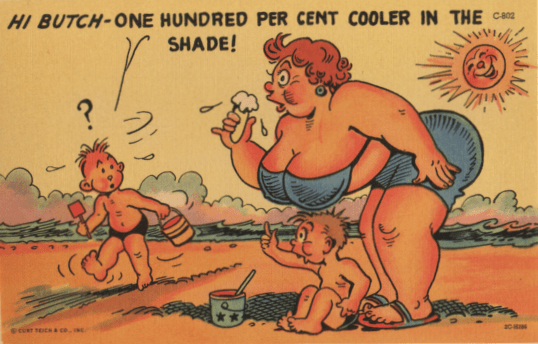
Even there, though, the verdict isn’t necessarily the one we’ve been conditioned to wait around for. One of the basic premises of jokes is, after all, the principle of surprise. (If you have not been following along in this space, the gag about finding shade is found far and especially wide on postcards about round women. Except the person taking shelter almost always finds it on the far side of our heroine.)
Nonetheless, onlookers are far less judgy than we were expecting about the body shapes they find on the beach.
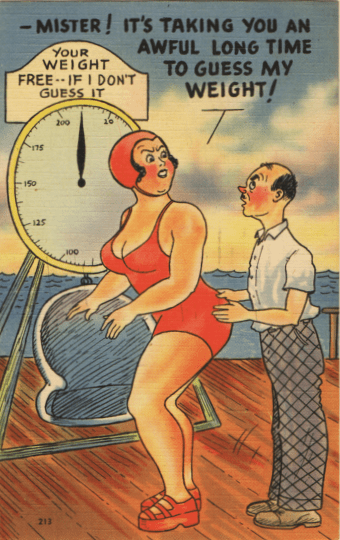
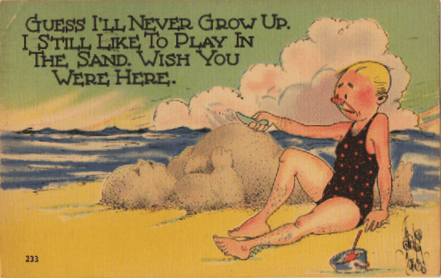
In fact, now and again, we find a protagonist who would like people to be quicker to judge.
And, as mentioned hereinabove, everyone seems to be having so much fun, regardless of size and shape. Or even BECAUSE of size and shape.
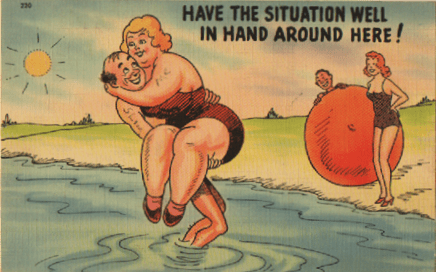
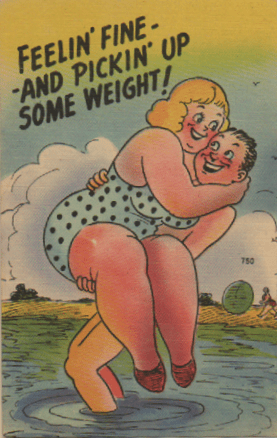
You cannot convince me these ladies needed rescuing from the water, OR that the men thought they did for a single moment. They’re just playing around. (Unless those are ruby slippers she has on her feet, and he’s carrying her back to a yellow brick road somewhere.)
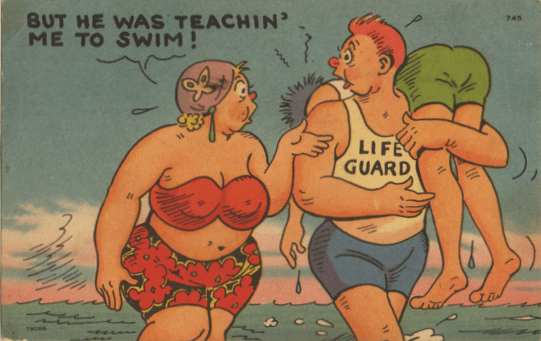
When someone DOES need rescuing, it isn’t our damsel who was in distress.
And the men who are not having good times with the large lady of their choice are those who can’t find one, and need to substitute.
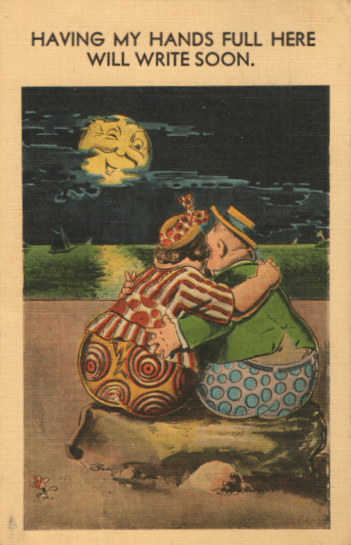
It’s all about having a good time at the seaside, and the obvious happy ending involves one of those jolly snappy dressers from our last installment. And so they lived heavily after ever. (Yeah, I know. That joke was hardly worth the weight.)



 Blogsy Babbles