CEO of this Chicken Outfit

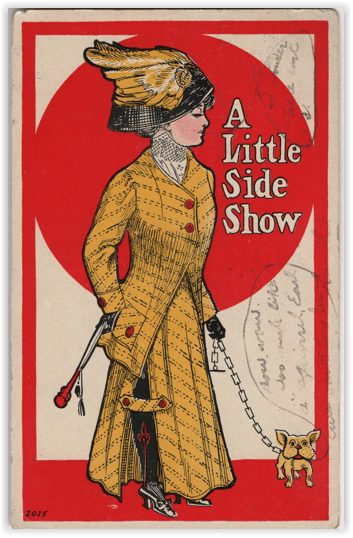
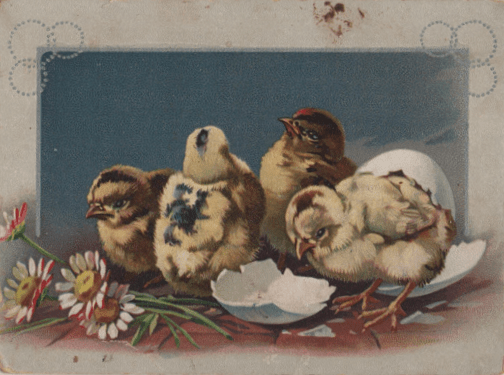
     I hope you didn’t think we finished up our concerns with the animal world, having covered bulls and horses.  We must not neglect the animal frequently associated with farms which writers have often advocated bringing to the city: the chicken.

     There have always been those writers who, hoping to instill in you a degree of self-sufficiency, wrote that what we all need is a few chickens in our life.  This would provide us with eggs, which can be sold, making us a nice side income, and bring us to more healthy habits, as if you have chickens, you need to “go to bed with the chickens”, meaning going to sleep early so you can get up when the chickens awake at the rising of the sun (or earlier,.)  Why suddenly changing your daily cycle to reflect that of a bunch of birds indicates self-sufficiency is a matter they discuss at great length without ever making the answer clear, at least to me.

     Of course, our ancestors, being knowledgeable about such things whether they decided to go into egg hustling or not, knew that none of this would be possible without the rooster.  The rooster played several roles in the cartoons of the postcard companies, but one job was paramount.  For amateur or professional egg-grower, the rooster was essential.

     And didn’t he know it.  The strut of the male chicken who knew he was the be-all and end-all of the egg business gave us the expression “cock of the walk”, for an alpha male.

     Not that his work day was any less hectic than that of the person who bought the postcards.

     And he was just as liable to complaints that he was falling behind in his job.

     Now and again, he would be mistake himself for an absolute ruler.

     But the fact of the matter was that he was simply CEO of a large work force.  And like any other manager he had to deal with slow-downs by his workers.

     He is shown in business negotiations.

     Technically, the work force was made up of free-lancers, who might work for chicken feed (sorry) but who could always decide not to put in the effort.

     Many of whom were perfectly willing to work, but just wanted to see the boss sweat a bit, too.

     No matter what observers had to say about the relationship of management and labor.

     Still, one way or another, the work got done.

     One way or another.  Um, remember what I said about his employees being free-lancers?

     (On Friday: the fruit of his labors.)

Ranunculus to You, Browallia to Carnation

BROWALLIA JAMISONII   “Could You Bear Want?”

            This shrub is now officially Steptosolen jamisonii.

BRYONY   “Prosperity”

BRYONY, BLACK   “Be My Support”

            This is a climbing plant without tendrils, so it cannot climb without some kind of support.  And why did Nature provide us with a climbing plant that can’t climb?

BUCKBEAN   “Calm repose”*

            Also known as Hogbean, this plant was used to predict the weather.  It would not bloom unless the weather was going to be calm.  Henry Phillips, however, says the meaning comes from its way of floating in calm waters.  I could do that.

Buckthorn: see JUJUBE TREE

BUGLOSS   “Falsehood”*

            This was an early cosmetic, and of course the use of make-up was considered subversive for eons.  According to the experts, a rouge made of bugloss will last for days and cannot be washed off; water will only freshen it and make it look redder.  Please do not try this at home without supervision.  I don’t want a lot of angry emails.

BULRUSH   “Docility”

            This is one of those plants where two different stories vie for the meaning.  Docility is the older and more common meaning, and comes from Isaiah 58:5, where the bulrushes are bowing their heads.  For the other story and meaning, see REED.

BURDOCK   “Importunity”

            This plant has burs, which are likened to a person bothering, or importuning, you.  The minority meaning, “Touch Me Not”, in related.  You’re basically saying, “Stop bugging me, okay?”

*BURNET   “Nourishment”

            Mary McNicol, who wrote a book on cooking with flowers, says the French love this in their soup.  I would say that settles it, but this meaning is one of Mr. Morato’s, and he’s Italian.

BUTTERCUP   “Ingratitude”

            Hardly a floriographer has any kind words for the buttercup.  Of course, the floriographers are not as firm as I’d wish on what flower they mean, going off on tangents about Crowfoots of various kinds, King-Cups, and Double Yellow Violets.  A couple of minority meanings are very popular, though Ingratitude is the oldest, appearing first in Robert Tyas’s 1836 translation of Mme. De Latour (though not in Mme. De Latour’s original.)  Robert Tyas was a naturalist who remained interested in floriography all his life.  Some flower language experts prefer “Childishness” as a meaning, a reference, like “Ingratitude”, to how hard buttercups are to grow in the garden.  Others like “Riches”, since the flower is gold.  Jane Webb Loudon lists “Ingratitude” but adds that the ancient, original meaning of the buttercup throughout Europe was  “Jealousy”.  Jane Webb Loudon is the ONLY floriographer who uses “Jealousy” as a meaning for buttercups.

            We’ll come back and discuss Jane Webb Loudon a little later.

BUTTERFLY WEED   “Let Me Go”

                                                                        C

CABBAGE   “Profit”

            Most food plants, as referred to heretofore, refer to some kind of wealth or prosperity.

            Elizabeth W. Wirt, in her flower language book, has a section full of lore, which includes instructions for cabbage divination, a fortune-telling procedure she says young ladies used to find out about their future husbands.  Cabbages for this need to be pulled from the ground the night of October 31, and provide all manner of information.  The shape and size of the root indicate something she does not specify about “the object of their desire”.  Any dirt adhering to the root shows the future husband will be rich.  Tasting the stem tells you whether his disposition will be sweet or bitter.  The stem is then placed over a doorway: the first man through the doorway after that will bear the same first name as the future husband.

            Nobody in my neighborhood grows cabbage, so I have been unable to check any of this out.  I can thus not offer a money-back guarantee on it.

*CABBAGE LEAF   “Providence”

*CABBAGE FLOWER   “New Worry”

            This is Mr. Morato again, so maybe my translation has failed again.  Does cabbage HAVE a flower, or was he talking about Cauliflower?

Cabbage, Skunk:  see SIPHOCAMPYLOS

CACALIA   “Adulation”

            Flower language was very popular in American magazines.  It travelled from journal to journal through a process known to scholars as “theft”.  The editor of a little weekly in Boston knew no one on their subscription list would be reading that cheap little monthly from Columbia, South Carolina, and lifted pages of stuff with impunity, either by simply reprinting it, or by calling it an “Exchange” giving credit (but no cash) to the original.  Late in the nineteenth century, Wyoming newspaper editor Bill Nye became the second most famous humorist in the country through this method.  So many newspapers in new York lifted his stuff that what he had to say spread through the country.  He worked himself nearly to death doing lecture tours, when he learned he was going to die of spinal meningitis, trying to make enough money for his family to live on when he was gone.  Adulation, which he had, wouldn’t buy groceries.  But he did get quoted in Mark Twain’s autobiography.

CACTUS   ”Warmth”

            Some writers prefer “I burn”.  Either makes sense if you’ve ever sat on one.

*CACTUS SPECIOSISSIMUS   “Perfect Beauty”

            Tovah Martin, flower historian, notes that a cactus craze swept this country in the 1830s and again in the 1890s.  A plant that needed so little watering was as good as furniture.

*CACTUS, VIRGINIA   “Horror”

            Claire Powell explains this is a serpentine cactus that shoots out little snakelike runners.

*CALAMINT   “I Wish You Well”

CALCEOLARIA   “I Will Lend You Money”

            This is also known as the Pocketbook Plant; the blossoms look kinda like purses if you squint a bit.

CALENDULA    “Anxiety”

            Richard Folkard, Jr., a nineteenth century plantlorist who disapproved of flower language, put two dictionaries of flowers in his book: one giving the true, ancient language of flowers while the other showed the modern, corrupt version.  This meaning comes from his true, ancient language.  Folkard, by the way, is the only author I’ve found prior to 1985 who mentions Calendula at all.

*CALISAYA   “Assistance”

            Callisaya cinchona is the tree from which quinine is derived.  This drug was more famous in the nineteenth century, but has not lost its usefulness to this day.

CALLA AETHIOPICA   “Magnificent Beauty”

            This is also Calla Lily, or just plain Calla.

*CALLIOPSIS   “Exultation”
CALYCANTHUS   “Benevolence”

            The plant produces extra flowers if you cut off the leaf buds.  Sarah Josepha hale thought this was benevolent.

CAMELLIA   “Unpretending Excellence”

            Starting in the 1880s, floriographers tried to differentiate between a red camellia (“Unpretending Excellence”) and a white one (“Perfect Loveliness”).  This did not spread far enough for me to consider it definitive.  As a public service, I should point out that the name of this flower is properly pronounced ca-MELL-ia, and not ca-MEE-lia.  The confusion comes from calling La Dame Aux Camellias Camille, but they aren’t supposed to be pronounced similarly.  It’s too late for me to change, but perhaps you’re younger and less set in your ways.

*CARAWAY   “Treachery”

            Caraway appears only in Fritz Klingenbeck’s Lasst Blumen Sprechen (Let Flowers Speak), published in Austria in 1944.  The Germans had Mme. De Latour in translation by 1820, and their floriographers took flower language in a separate direction.  Herr Klingenbeck’s book was the only book from this tradition I turned up during my research, and I have included him because the idea of a flower language dictionary being published in Nazi-occupied Austria struck me as symbolic of something or another.

CARDAMIME   “Paternal Error”

            Henry Phillips identifies this as the Cuckoo Flower in King Lear’s crown during his mad days, and makes in an emblem for Lear’s fatal mistakes in child-rearing.  (Of course, it would have been too simple for Lear’s Cuckoo Flower to have been just a Cuckoo Flower, which see.)

CARDINAL’S FLOWER   “Distinction”

            This lobelia gets its name the same way it gets its meaning: because it is so bright red.

CARNATION   “Woman’s love”

            See also PINK.  Some people claim, there was once a real difference between a carnation and a pink, but with all the gardeners crossbreeding them, there’s no point now in bothering with it.  Sure, blame the gardeners.

            I would like, at this juncture, to introduce you to Lydia H. Sigourney.  Lydia, who seems always to have written as Miss Sigourney or L.H. Sigourney, was simply the Number One Female Poet of her day.  She wrote acres of flower poems, all quoted in the better flower language books, but did not get around to writing her own flower language book until 1846.  This was about the same time she was making highly-publicized European tours, during which she was celebrated as a major American literary light.  (But you should read what her hostesses said about her after she left.)

            Her vogue passed, and she was dropped from American literary history so fast and so far that she has not recovered to this day.  All she is remembered for now are Mark Twain’s parodies of her style, particularly her way of churning out obituary verse.  I have been unable to find out what Mark Twain thought of floriography, and I admit I’d rather not now.

            Anyway, she was right there standing up for Carnations.

*CARNATION, DOUBLE   “Give Me Time for Reflection”

CARNATION, PINK   “Encouragement”

CARNATION, PURPLE   “I Have No Affection For You”

CARNATION, RED   “Alas, For My Poor Heart!”

‘CARNATION, RED, WITH PINK CARNATIONS   “Send Letter”

*CARNATION, RED, WITH PINK AND RED CARNATION PETALS   “Call As Soon As

Possible”

Carnation, Striped: See PINK, STRIPED

CARNATION, WHITE   “Devotion”

            By the way, the Carnation is the official flower of Mother’s Day.  This does not, apparently, mean that you give Mom carnations.  (That’s what Mums are for, I guess.)  You wear one to show that you are aware you had a mother.  A white carnation indicates that your mother is still living, while a red one shows that she has passed to where you can no longer borrow money from her.

Carnation, Yellow: see PINK, YELLOW

            A yellow pink?  That’s worse than West North Avenue.

The Horse Strikes Back

     In our last thrilling episode, we considered our ancestors and their mutually beneficial relationship with the horse, an animal you could easily ride or hitch to a wagon, carriage, or plow.  People worked together with horses to make a happy, peaceful society based on a relationship of mutual trust and admiration.

     Except when they didn’t.

     Cartoonists do a WHOLE lot better when they are complaining about something than when they praise it.  So the cranky, ornery side of the horse made it onto postcards with regularity.  See, horses did things besides run or pull.  For one thing, they kicked.

     And sometimes they sat down and declined to go to work today.  The horse knew what it meant when that harness went on, and occasionally just said “Nay.”  (Please note that I went all through the last column without a single horse pun and don’t nag me with your tale of whoa.)

     Alternately, some horses went entirely the other way and decided to run and run without stopping, or, in fact, paying any attention to any other suggestions the rider made.

     As anyone who knows their western folk songs knows, the horse that didn’t want to take you anywhere had other options besides just sitting down.  A horse could perform amazing gymnastic moves in trying to buck a rider.

     And frequently succeeded

     The cartoonists, like any good rider, was willing to admitted that being thrown was not always entirely the horse’s fault.  Sometimes the rider was simply not much good at it.

     Or was simply unlucky.

     The cartoonists were also willing to show that not all the grievances were on the human side of the relationship.  Horses are one of the few animals regularly shown as worn out, exhausted, or even physically impaired by the work their humans put them through.

     Horses are also more likely than any other animal to be shown getting old.  Being retired, or “put out to pasture”, was not necessarily the lot of every working horse.

     Of course, if there was one thing horses did that the cartoonists covered most…but we discussed that in a previous blog, and there’s no need to cover that whole territory again (though this human has to.)

Our Pal the Horse

     We’ve discussed this before.  Our ancestors, those of the era when sending postcards was far more common, were also more likely to encounter animals on a daily basis.  I am not making some pitch to consider them as more harmonious in our relation to nature than our degenerate generation.  They had mice gnawing through the floorboards on a regular basis, spiders in the outhouse, and bedbugs under the mattress in every hotel.  The next door neighbors might keep a pig or goat in the back yard—frowned upon in most urban areas today, except where you can get ‘em classified as pets (companion animals)—and if not, they almost certainly had a cat that yowled on the fence, a rooster who crowed at 4 A.M., or a dog that was chained to a guardhouse in the yard and took out its frustration on passersby.

     Of course, of all the animals the urban inhabitant was likely to meet, the horse leads the list.  The golden age of postcards was the same ag when people were thinking about making the change from four-legged drive to four-wheel drive.  So everyone was aware of the hard-working horse.  (Horses could not form unions to improve working conditions; we had to do that for them.  Black Beauty, a classic of horse literature for kids, was written originally to show people how the horses they took for granted could suffer.)

     Horses could be seen on every side: they hauled freight.

     Sometimes they hauled freight AND passengers.

     They hauled people intent on business and people riding for pleasure, and frequently people whose pleasure was monkey business.

     The passengers thus hauled remembered this service fondly for generations.

     And, as many a postcard cartoonist pointed out, they could haul the new-fangled undependable forms of transportation.

     Just like humans, though, there were some horses who turned to a life of sports.  The race horse was a breed apart, and people who would not have looked twice at a horse with a rider up in the middle of town flocked to see the same sort of thing on a competitive basis at the track.  (This led to an argument which goes on to this day: did you bet on a reliable horse or a reliable jockey?  One side of the question preferred to give the credit to our own species, while the other side pointed out the jockey couldn’t get down and carry a horse across the finish line.  The debate continues to this day.)

     And, of course, racing goes on to this day, becoming a major tourist industry.

     And leading to its own peculiar lingo.  Yes, the horse was a mighty worker and athlete, and an all-around friend to humankind. 

If you bought the right postcards, of course.  (Next time: the other postcards)

Ranunculus to You, Bilberry to Broom

BILBERRY   “Treachery”

            This is also the whortleberry, and was originally a chap named Myrtillus.  Pelops was racing his chariot against that of Myrtillus’s master, and bribed Myrtillus to sabotage the man’s chariot.  Pelops, on winning the race, killed Myrtillus for betraying his master.  Pelops was a man of principle, see.  Myrtillus, as a son of the god Hermes, was turned into a whortleberry bush after death.  How much good this did Myrtillus I am not in a position to say.

BINDWEED   “Humility”*

            Claire Powell notes that this plant has no strength to rise from the ground until it winds itself around another plant.  Some floriographers specify this meaning for the Small, or White, Bindweed.

*BINDWEED, SEA    “Uncertainty”

Bindweed, Small: See BINDWEED

Bindweed, White:   see BINDWEED

BIRCH   “Meekness”

            This is related to how birches bend before the wind, which also gives it its minority meaning, “Gracefulness”.  The birch was always a symbol of something that was willing to give way in the face of overwhelming odds, only to spring back into place once the Irrepressible Force has passed.  The proverb went something like, “The oak stands straight and proud, and the wind blows it down.  The birch bends, and laughs at storms.”

            Some floriographers reject this, stating that “Meekness” comes from the use of birch switches to whip children into a proper state of quivering submission.  The very qualities which made the birch a sweet, bendable tree made its branches fearsome whips.  These are primarily twentieth century floriographers who doubled as Victorian bashers, blaming everything wrong with the world on English speaking people of the nineteenth century.  Just as a matter of passing interest, the Victorians were not so united on the subject of whipping children as the twentieth century liked to believe.  Henry Phillips, writing before the Victorian Age had really gotten off the ground, claims whipping children has gone out of style.  Lapsing into garden lingo, he says everyone knows that “birch manure” produces only weeds where flowers might have developed.  If you have the stomach for it, you can check out a debate on the subject which ran for two years in a letters column in The Englishwoman’s Domestic Magazine in the 1860s.  Of course, plenty of people who wrote in claimed the modern, progressive parents who refused to beat their children were responsible for the lawless younger generation and the decline of civilization generally.

            Anyway, I see no reason to make the birch a symbol of brutality.  But whoo gosh, look at the next entry.

‘BIRCH RODS, BUNDLE OF   “Unity, Strength”

            It’s a lesson to us all: those pliant, meek rods become a weapon of power when tied in a bundle, a symbol of what people can do when they work together for a common goal.  Aesop made a fable of it, to which Tommy Smothers added his own moral, “When you stick together, you make a bundle.”

            HOWEVER, the term for this bundle is “fasces”, the symbol of the Fascist Party in Italy.  Fasces are, of course, an ancient symbol, predating the fascists, and survived this spell of infamy.  Nowadays they occupy a spot on the back of the Roosevelt dime.

BIRD-CHERRY   “Hope”

“BISHOP’S PURSE   “Answer Quickly”
Bittersweet: see NIGHTSHADE, BITTERSWEET

Blackberry: See BRAMBLE

Black-Eyed Susan: see RUDBECKIA

BLACKTHORN   “Difficulty”*

            This may refer to the use of blackthorn as a wood for walking sticks, which makes walking through difficult places easier.  On the other hand, its berry is the sloe in sloe gin, which can make walking difficult again.

BLADDER-NUT TREE   “Frivolity, Amusement”*

            This and the following are two different plants, but each bears a fruit resembling the inflated pig’s bladder used by jesters and other comedians before the rubber chicken was

invented.  Everyone agrees that this is where the meaning comes from EXCEPT Mme. De Latour, who came up with the meaning in the first place.  She says it refers to the way that women of fashion who, when bored, would take the little fruits and squeeze them until they popped.  This custom is part of the frivolous past.  In the twentieth century, we invented bubble wrap, which served the same purpose and didn’t need to be watered.

*BLADDER SENNA   “Frivolous Amusements”

*BLEEDING HEART   “Compassion”

BLUEBELL   “Constancy”

            Virtually any blue flower can be used to represent faith, fidelity, and constancy.  “True blue”, you understand.

*BLUEBERRY   “Ingenuous Simplicity”

Blue Bottle: see CENTAURY

BLEUT   “Delicacy”*

            This is also sometimes known as Quaker Ladies.

BONUS HENRICUS   “Goodness”

            This is also called Good King Henry, supposedly a reference to Henry IV.  However, Geoffrey Grigson, who is not a floriographers but a plant lore expert of reputation and common sense, says it was originally known just as Good Henry, to distinguish it from a similar, but poisonous, plant called Bad Henry.  Who Henry was, Grigson is not sure, but he says the name goes back to before the days of henry IV.  He suggests it might be a corruption of Hermes, the Greek God of Thieves and Businessmen.  In Roman mythology, Hermes is known as mercury, and the two plants in question are also sometimes known as Good Mercury and Bad Mercury.

            Bonus Henricus, also known as Goosefoot, is supposed to be edible.  (That’s why it’s GOOD Henry, or BONUS Henricus.)  Grigson checked this out, which is farther than I would go in this line of research, and said it didn’t kill him any but he wasn’t in a hurry to add it to his diet.

BORAGE   “Bluntness”

            A concoction of this was often drunk, we are told, to give people courage.  People who gain courage by drinking are often blunt.  (Most experts tell you to ignore the story that “Borage” is just a corruption of the word “Courage”.)  It is a rough, shaggy-looking plant, and those are often chosen to mean bluntness or roughness by floriographers.  (If you would like to drink borage and see what it does for you, it is an essential ingredient in Pimm’s Cup Number One.)

Bouquet: see NOSEGAY

BOX   “Stoicism”*

            This is an evergreen which doesn’t require much care and will survive careless gardening.  It can also survive being cut into all manner of decorative shapes.  Cut down, it yields a hard, durable wood.  We should all learn a lesson from the valuable Box, to not complain but just go on doing what we were meant to do despite difficulty or discomfort.  I could go on about this, but my typing fingers are kind of sore.

BRAKE   “Confidence, Shelter”

BRAMBLE   “Envy”

            This is a choking plant which will destroy more virtuous plants, killing off the good ones until only the bad ones are left.  You catch the symbolism here.

            The bramble was symbolic enough to attract some interesting minority meanings.  Miss Carruthers, an Irish floriographers of 1879, said the bramble can represent lowliness because it

grows so low to the ground, or remorse, because it can plaque you with so many prickles.  These did not catch on.

            And Claire Powell, for once giving the Victorians credit for a sense of humor, says the Bramble was sometimes called “Lawyers” because it enjoyed tripping people up.

“BRAMBLE BLOSSOM WITHOUT ANY THORNS   “There is No Deceit At All”

BROOM   “Humility” or “Neatness”*

            These meanings are equally popular, and will often both be listed by the same floriographer.  We are obviously dealing with someone’s maid here.  Mme. De Latour started “Neatness” on its way, while “Humility” is the contribution of Dorothea Dix, who goes out of her way to let us know she DISAPPROVES of the meaning, since there is no reason for any poet to use the Broom to signify humility, except for that pesky story about the Plantagenets.  She assumes we all know the story of the Plantagenets.

            No, don’t look it up; I’ve saved you the trouble.  The Plantagenets never completely agreed on one story, but the gist of it is that a nobleman whose name may have been Fulk offended the Church and worked off his offense by making a pilgrimage to the Holy Land with a sprig of broom in his hat.  No clue as to why he picked broom, though Dorothea Dix hints that a bundle of broom was used “in place of the birch” on him.  Anyway, when he came back, he chose a new family name.  Not speaking English, as it hadn’t been invented yet, he called himself a Plantagenet, after “planta genista”, or broom.  (Botanists keep telling us it is improper to call broom a genista but people keep doing it.  Just ornery, I guess.)  His descendants got to be kings and queens of England, and Fulk is now featured on any number of fine family trees.

*BROOM, SPANISH   “Light of My Life”

Time Travel

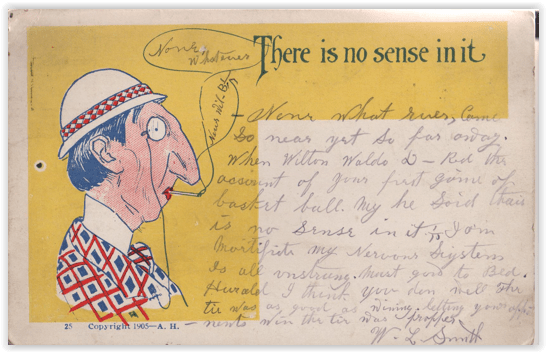
     I ran into an article on the Interwebs telling about how old postcards are time capsules, left by people in the past to take us back for a slice of history.  It was quite a pleasant article, with nice illustrations (the kind of thing we try to do here) and I DO intend to steal the idea for today’s blog, but there is that inside me which moves me to register one slight objection.

     See, old postcards are NOT time capsules.  Time capsules were left specifically for the purpose of sending information to the future, while postcards were matters of immediate moment.  No one even THOUGHT about them being read by anyone but the recipient and maybe the mail deliverers and the postmaster.  Yes, they can take us back in time, but they weren’t meant to.  Those document boxes I was given at the Book Fair by a middle school which had its students assemble time capsules in grade school in the seventies to be opened in the distant twenty-twenties, but then got tired of storing them and dumped them on me—those were intentional.  Or a time capsule would be left to be retrieved by the people who made it, like those college seniors of the 1880s who buried a letter, a fruitcake, and a bottle of whiskey to be unearthed thirty years hence at a class reunion.  (I often wonder how many of those fruitcakes are still buried on Midwestern campuses.  I assume someone retrieved the whiskey the first time they got thirsty.)

     But I know what the writer of that article MEANT, and so I am going to repurpose her basic thesis and show you a few postcards which hide a chance for time travel to people reading them in 2022.

     At the top of this column is a simple card made by a company to encourage stores to stock their product: picture of the product, space for the order.  But what the heck is “Washing-Tea”?  It’s a laundry soap named from the idea that women who used it could have the laundry done by nine o’clock, and  stop for a cup of tea.  Different world: nowadays we toss the laundry in the machine and ask Alexa to start the teapot.

     This little card was printed, message and all, for the YMCA in England to hand to members of the American army landing to take part in World War I.  No need for the censors to check it for sensitive information spies might read.  It was a quick and easy way to tell someone back home you’d made it this far, before texting was invented.

     From the same era comes this announcement of a meeting of a German language church group which is saving money by putting its New Year’s Party invitation for 1918 on the leftover cards from 1917.  They had to economize, as the club was undoubtedly having a hard time.  In Iowa, where it was mailed, public use of German had been outlawed with the start of the war.  Did they get together  to welcome 1919?

     Return with us now to those thrilling days before streaming, Netflix, and cable, when going to a movie involved going out of your house.  Not every theater could afford to book first run movies, so how to advertise reruns?  Easy, explain that you’re booking only those movies that you KNOW will be interesting (because millions of people saw them three years ago.)

     This was a fold-out postcard.  Here’s what you found inside, in case you wondered who was still box office when the movie was five years old.

     This card goes back to when even telephones were rare and expensive items, at least for a salesman out in his territory.  The Des Moines Register and leader Company expected a daily postcard from its sales reps, with a note on what they were doing and where they could be found over the next couple of days.

     Here’s a card which demonstrates in a couple of ways how the world has changed.  The Delbridge Company made its founder’s fortune by providing pages and pages of mathematical computations for how much this many bales of that would cost at this price.  No pocket calculators yet, much less phones with calculators in them.  You looked up the page with the amount and the price per, and the columns of figures would show you what eighty-three barrels or bales or pounds would cost.  (And, because it was a different world, Mr. Delbridge took his money and founded a new town devoid, by his decree, of laws or rules except for The Golden Rule.  You couldn’t live there unless you promised to abide by that basic premise.  It, um, started well.)

     I have been able to learn nothing about the Sunrise Club, but the place it met was used for that purpose by many clubs, including the famous Turtle Club, which annually elected its president by a method which would NOT go over today.  The Turtle Club served bowls of very rich turtle soup at its dinners.  Whoever could consume the most bowls of this soup and still walk around the dining room became the president.  (Lawsuits would put the club AND the meeting place out of business in one year these days.)

     And here’s a little time capsule to let us know that NOT everything has changed.  This was mailed out for the first conference of a group which still exists today.  And I betcha even today they have to remind their members to go through the buffet line just once or prices will go up next year.

     Enough of this.  I’m going to get out my metal detector and go prospecting for buried fruitcake.  No, not to eat: the holiday gift season is coming.

Another Day Older and….

     We have seen in this space many postcards reminding you of the value of a good day’s work.  The virtues of elbow grease in keeping one’s nose to the grindstone, or something like that, was extolled in card after card.  AND we have seen cards which complained about tough bosses, long hours, short vacations, and the annoyance of having to work at all.  In either case, it was clear that the postcard artists knew we were out there sweating for our daily bread.

     So naturally, the poor working stiff was accorded great respect, right?  Ho ho.

     See, the cartoonists followed the lead of comedians past, who knew that most of the people we bumped into on a daily basis, and who bumped into us, elbowed us on the streetcar, pushed ahead of us in line, or actually SOLD us our daily bread were working stiffs like the rest of us.  So they reckoned that we would buy postcards slamming our fellow citizens.

     Those people who worked all day long selling us things were obviously cheating us (or we’d have more money left after the deal was complete.)  Sometimes they used tools to accomplish their cheats.

     And sometimes they managed on sheer nerve.

     On other occasions, it wasn’t so much the prices they charged as their general attitude toward perfectly respectable customers like us.

     Some professions just naturally attracted complaint.  Jokes about barbers and their personalities go back at least eighteen hundred years.  (Here’s a joke from a Latin classic: “How would you like your hair cut today, sir?”  “In silence.”)

     Women who worked were always being subjected to accusations that they got their jobs on looks alone.  Counter clerks in stores were always getting that sort of gag.

     And, of course, waitresses.  (Another golden oldie, going back at least to Victorian comics, “The barmaid shortchanged me again.  I doubt she can even count on her fingers.”  “No, but she can count on her figure.”)

     Mind you, men who worked in occupations where they waited on women could rely on jokes about their predatory leanings.  Shoe salesmen were always under suspicion.

     The same went for window washers.  (Cue George Formby’s number “When I’m Cleaning Windows”.)

     You’d think firefighters would be immune, but no, they had to take their lumps as well.

     As the old joke goes, “A man can serve sodas at a counter eight hours a day with a smile on his face, and yet to other people he’s still a jerk.”

     Postcards admitted that there was really only one sure way to get a compliment on the job you’d done.

Ranunculus to You, Baby’s Breath to Betony

                                    B

*BABY’S BREATH   “Reserved”

BACHELOR’S BUTTON   “Celibacy”

            Celibacy, strictly speaking, means the state of being unmarried, if you were giggling.  All bachelors are by definition celibate, no matter how many of them go along with the popular alternate meaning for this flower, “I With the Morning’s Love Have Oft Made Sport”.  I don’t know what that means, exactly, but it sure does SOUND Devil-May-Care.

“BALOON VINE  “Let Us Kiss and Make Up”

BALM   “Sympathy”

            Claire Powell says the Victorians brewed this into a refreshing tea.  Tea and sympathy, don’t you see.

BALM, GENTLE   “Pleasantry”*

            This refers to a joke, or a pleasant little play on words.

BALM OF GILEAD   “Cure, relief”

            Most of the meanings for the various balms derive from the use of them in soothing ointments.  Some experts insist that the Biblical “Balm of Gilead” was camphorated oil.  There are people who cannot sleep nights if they don’t tell us these things.

BALSAM   “Impatience”*

            In fact, the scientific name of this plant is Impatiens.  The balsam spits out its seeds when touched, giving it the air of always being in a hurry.  This also gives it its minority meaning, “Touch me not”.  Some people call the plant Touch-Me-Not Balsam.  If life were always so simple, this would have been a much shorter book.

BARBERRY   “Sourness”*

            I have not tasted barberries, but Mme. De Latour’s word is good enough for me.  You give this to someone to hint that they have a sour disposition.

BASIL   “Hatred”*

            Lots of stories involve basil, none of which exactly explains this meaning.  For example, all the experts tell me you have to curse as you sow basil.  But no one tells me why.  A heroine of many legends, Isabella, kept her lover’s head in a pot of basil after her brothers knocked said head off to teach him a lesson.  Salome is also said to have kept the severed head of John the Baptist in a pot of basil.  Does anybody say why decapitation and basil go together?  They do not.  There is also a relation to the basilisk, whose gaze turned men into stone (including their heads, of course.)

            Maybe none of these stories have anything to do with the meaning.  Maybe Mme. De Latour had a crystal ball and found out that one day a whole stratum of society would be dependent on pesto, and decided she didn’t like the idea.

Bay: see LAUREL

BAYBERRY   “Instruction”

BAY LEAF   “I Change But in Dying”

            Sarah Josepha Hale says this is because bay leaves do not close at night, as other leaves do.  By the way, Sarah Josepha Hale was a leader in the crusade to establish an annual holiday called Thanksgiving, a time during the year when people are likely to be experimenting with recipes involving bay leaves.

Bay Wreath:   See LAUREL

Bead Tree:  See PRIDE OF CHINA

*BEAN   “Immortality, Transmigration, Magic, Mysticism”

            Ernst and Joanna Lehner put together a book, Folklore and Symbolism of Flowers, Plants, and Trees, which is one of the most widespread flower language books in the libraries of this country.  (The British counterpart is Josephine Addison’s The Illustrated Plant Lore.)  The Lehners collected every single symbolic meaning any human being ever ascribed to any plant in any culture that left written records for them to consult.  This would not upset me except for the section of the book where they reduce these all to short phrases and call it Flower Language.  This greatly enlarged floriography, introducing a lot of plants and meanings never dreamed of by the nineteenth century floriographers and their followers.

            Many floriographers since the Lehners have felt obligated, therefore, to list all symbolic facets of every plant they mention.  This has muddied the waters.  A good bilingual dictionary (Flower-English/English-Flower) should be terse, not listing a dozen different meanings for every plant.  Flower language was originally a fairly shallow language, a gimmick to trick people into learning botany or reading poetry while looking at flowers.  The Lehners sent a generation of American floriographers into sociology and anthropology, deep waters into which I never venture until two hours after I have eaten.

            Anyway, Me. De Latour and Dorothea Dix never thought the bean meant transmigration, or if they did, they kept their mouths shut about it.

“BEAN LEAF   “Avarice”

*BEAN BLOSSOM   “Industry”

*BEAN POD   “Guard Me Well”

BEARDED CREPIS   “Protection”

BEECH   “Prosperity”

            The beech is a fast grower, and virtually every part of it can be used for something.  The fruit became cattle feed, the nuts were pressed for oil, and the tree was just so all around useful that anyone with plenty of them on the property was considered highly fortunate.  

*BEECH NUT   “You Are Not Without Treason”

            Still, there’s a cynic in every crowd, even when discussing beeches.

*BEET, RED   “Don’t Think About It Any More”

*BEET, WHITE   “Time Slips Away”

            What is a white beet, anyhow?  Perhaps Mr. Morato meant a rutabaga, or maybe my powers of translation are at fault.

            It is time to introduce you to Fulvio Pellegrino Morato, who contributed a lot of unusual entries to this dictionary and who caused me as much anguish as all the other floriographers put together.  He is responsible for a little book called Traite Curieux des Coleurs et des Leurs Blazons et Symboles Mysterieux aux Armoirs, aux Livrees, et aux Faveurs, et des Divises et Significations d’Amour, d’Indifference, et des Mespris Qui S’Expliquent par Toute Sortes d’Arbres, d’Herbes, et des Fleurs, published in The Hague in 1664.

            If you read all that scintillating prose in the introduction about how flower language came up the Seine from Turkey in the eighteenth century, the existence of a perfect little flower dictionary in France in 1664 may startle you.  I know it did me.  The problem is worse than that, though, because the little book was printed, as the title hints, as a curiosity by a printer who got hold of the original Italian edition, Del Significatio de Colori e de Mazzoli, published in 1545.

            The book is a collection of trivia dealing mainly with the uses of the different colors throughout history.  At the end, though, Morato tacks on this twenty-page flower language dictionary that looks uncannily like flower language dictionaries published four centuries later.  He makes no mention of Turkey at all.  In fact, he comes right out and says the flower language dictionary is a trifle he made up on his own to amuse women and little children.

            Checking into the matter, I find that his contribution to floriography begins and ends right there.  His book was not reprinted after 1664, and no one seems to have picked up his flower

language.  (He did write one other book, a study of Dante, which was reprinted quite a lot, so it must have been pretty good.)  The Traite Curieux was never translated into English, and the founders of our flower language never seem to have run across it.  His meanings and ours have little in common beyond, say, things like the olive branch for peace, which he and our floriographers simply got from the same source.

            So there is no reason to include his meanings, White Beets and all, in this book, but I did it anyhow.  First, I wouldn’t mind nudging somebody into doing an English translation of it, so I can read it more easily.  Second, if I have to put in so many irrelevant plants and meanings because Ernst and Joanna Lehner listed them, why can’t I throw in Fulvio’s flowers as well?  Third, he is the only floriographers who comes right out with a flower  he says means “I Want to Go to Bed With You.”  No, I won’t tell you which one it is.  You’ll have to read the whole book here and find it for yourself.  Hurry up: Time Slips Away.

BEGONIA   “Dark Thoughts”

BELL-FLOWER   “Gratitude”

            A bell-flower, or campanula, is any flower shaped like a bell, regardless of species or other names.  Bells seem frequently to be associated with Gratitude (see Agrimony.)  Some floriographers specify a small white bell-flower for this meaning, so as not to get it mixed up with the following entry.

BELL-FLOWER, BLUE PYRAMIDAL   “Constancy”*

            A small group of floriographers seem to have held the belief that giving flowers had the power to make the meanings come true.  Giving your love a blue pyramidal bell-flower, then, would insure fidelity, or constancy.  The most recent of these was one Edward Lyndoe, who

suggested it in Everybody’s Book of Fate and Fortune in 1938.  He goes on to say, “For this, I fear, there is not a great deal of evidence and one has to be very careful not to strain the symbology attaching to any of these things.”

Bell-Flower, Small White: see BELL-FLOWER

BELLADONNA   “Silence”

            This is also known as Deadly Nightshade.  It would pretty much guarantee Silence, I guess.

“BELLWORT   “Hopelessness”

BELVIDERE   “I Declare Against You”

BETONY   “Surprise”

Say When Again

     Not long ago in this space, we considered postcards suggesting that what the average drinking male wanted from his alcoholic beverage was more.  Another load of postcards has come in suggesting there is an aspect of this we did not consider.

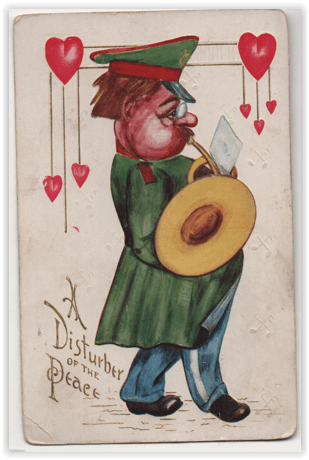
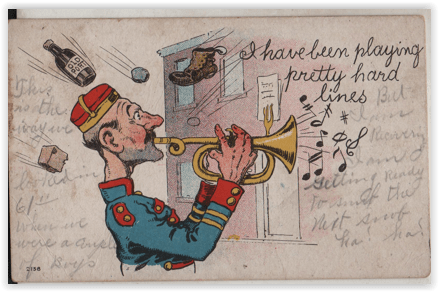
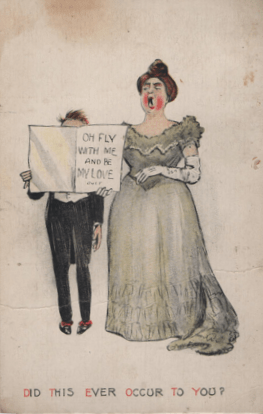
     Anthropologists, as I have mentioned hereintofore, have split the western world into a Southern tradition of drinking—a modest amount of alcohol to facilitate uninhibited conversation—and a Northern tradition—massive amounts of strong drink to blot out a hostile environment.  For those interested in the first tradition, bottles of wine and distilled spirits were readily available over the centuries.  For those in the second tradition, the keg or barrel was the natural source of beverage.  Sipping was the rule of the day for the Southern tradition; Northern style drinking called for straight guzzling.  And those who consumed alcohol in the postcard cartoons often STARTED with guzzling and escalated from there.

     The chap at the top of this column, like his counterpart below, are not going to be slowed down by something as time-wasting as pouring their drink from the keg into a mug.  The second gentleman is too impatient even to bother with the tap.

     This kind of drinking could have its side effects, but that was something to be considered later.  (“Later” was not really a concern of the dedicated drinker in either the Northern or Southern tradition.  The Southern drinker took longer to get there but was often just as surprised by what waited at that end of the spree.)

     By and large, the keg of beer was a symbol of a golden good time, without any hint of aftermath.  (One of those fine old jokes we did not cover in the Old Joke Quizzes.  “What’s the best cure for a hangover?”  “Don’t sober up.”)

     But in that age when postcards were the equivalent of today’s tweets, the whiskey barrel was a very common artifact, and presented more opportunities for fun than mere beer, which was actually perceived as more of a family beverage back in the day.  (It was, I am informed, entirely plant-based and filled with nutrients which the industry has since filtered away.)  The whiskey barrel was for your dedicated drinker, and was obviously a single-serving container.

     A feller could really wash away his cares and ignore the world if he had a good supply.

     While the powers of a truly potent potable were hardly to be questioned.

     All in all, it makes the descendants of these blokes, dependent on corkcrews and discussion of shaken vs. stirred seem like hopeless pikers.

Ranunculus to You, Angelica to Azalea

ANGELICA   “Inspiration”

            This struck me as an easy one: angels carried inspiration to humans, right?  Claire Powell, a floriographer who has no truck with easy answers, says it derives from the custom of poets in Lapland to sniff it before reciting their latest work.  Really great Laplander poets were awarded a crown of angelica.  That’s about as much as a poet can expect these days, too.

ANGREC   “Royalty”

APOCYNUM   “Falsehood”

            This is one of the traditional meanings which come from Dorothea Dix rather than Mme. De Latour.  Dorothea is one of the top five pioneer floriographers whose work informs most subsequent lists.  Unlike the others (Mme. De Latour, Henry Phillips, E.W.Wirt, and an anonymous “Lover of Flowers” we’ll discuss later), she ignores the Turks and Greeks and draws her meanings from English flower poets, blokes who went around writing verses in honor of specific flowers, as if they knew that’s what floriographers would be looking for.  If one of these gentry mentioned a sentiment in the same sentence as a flower, Dorothea popped it into her glossary.  She would quote a bit of the poem as evidence, though not quite enough to show what the poet was thinking about at the time.  And she would neglect to give us the title of the poem because we, being bright enough to read flower language books, would also be familiar with the complete works of James Percival or Erasmus Darwin.

            Because of this, I am not quite clear on why so many floriographers agree that the apocynum, or dogsbane, means falsehood.  My guess is that it’s poisonous (hence the “bane” in “dogsbane”.)  Floriographers always took it amiss when something so pretty would not allow itself to be eaten.  This is another matter of personal taste, but I think the floriographers expected too much.  We can’t all be attractive AND edible.

APPLE “Temptation”

            I don’t have to explain this, do I?  But see also QUINCE.

APPLE BLOSSOM   “Preference”

            You give this to someone to say “I Prefer You”, you see.  It’s a reference to the Judgement of Paris, which actually involved an apple, but the apple was already taken, more people being familiar with the story of Adam and Eve (see above.)

            The Judgement of Paris was the start of the Trojan War which, like a bunch of wars, started miles away from where the fighting took place.  The Spirit of Discord, hoping to start something, tossed out a golden apple at a banquet of the gods atop Mt. Olympus.  It was inscribed with some foolish line about being intended for the fairest of all the goddesses.  Lunging for it at once were the Goddess of Wisdom, the Goddess of Marriage, and the Goddess of Love, who had never gotten along all that well together anyhow.  Athena, Hera, and Aphrodite took the apple to Zeus, the Head God, and demanded that he tell them for whom the apple was meant.

            Zeus could be crude and clueless, but he did not get to be Head God by being stupid.  He was married to one contestant and the probable father of the other two.  So he suggested they seek out an impartial judge, preferably a human.  Zeus had never liked humans: nasty, dirty things.  Greek myth suggested he invented woman just to make their life more miserable.  Greek myths are full of jabs at women like this, as you might have guessed from how this story is going so far.  Women get to state a few home truths in Finnish Myth, but let’s stick to the Trojan War.  The War Between the Sexes is a saga of its own.

            The goddesses took their apple down to the most famous playboy of his day: Paris, prince of Troy.  Each tried to slip him a bribe, but Aphrodite knew the quickest way to a man’s heart.  She promised him a really good-looking woman, and he handed her the apple, showing her his PREFERENCE.  That’s where the meaning comes from.

            Anyway, Hera and Athena because fiercely anti-Trojan, and stirred up the Greeks after Aphrodite helped Paris get his hands on the Greek Queen Helen, sister of Althaea and already married to….  There’s a fellow named Homer who has covered it all pretty well, if you want to read the rest of the story.  If he’s not available, go for Bernard Evslin.

*APRICOT  “More Good-Looking Than Good”

APRICOT BLOSSOM   “Doubt”

*APRICOT TREE   “Disloyalty”

            Some floriographer had a bad experience with an apricot at some point.

ARBOR VITAE   “Unchanging Friendship”

            Arbor Vitae means “Tree of Life”: it’s a good, durable tree.  You can see how this meaning and the one which follows came about.

*ARBOR VITAE, AMERICAN   “Immortality”

ARBUTUS, TRAILING   “Only Thee Do I Love”

*ARETHUSA   “I Would rather Not Answer”

            Arethusa was a nymph who went in skinny-dipping, as nymphs do, and was pestered by a river god who didn’t amount to much.  The gods, hearing her complain, turned her into a fountain.  This myth is sadly lacking.  She should have been turned into a flower, shouldn’t she, to explain the name of the flower?  Okay, the arethusa, a type of orchid, was not known to the Ancient Greeks (or to most floriographers, for that matter) but even so, what kind of a rescue is it if you’re saved from a watery god by being turned into something water flows through?  What were the Ancient Greeks thinking?

ARGENTINE   “Naivete”

*ARTICHOKE   “Your Enterprise There is Dangerous”

            Not nearly as dangerous, I expect, as giving your sweetie an artichoke bouquet.  The artichoke was once a woman too, according to some floriographers, but none have spelled the story out for me.

ARUM   “Ardor”*

            This flower gives off heat when it opens, and is generally impressive to look at, too.  Not necessarily pretty: just impressive.  The arum has thus attracted attention from primitive days, and is believed to be the all-time leader in number of picturesque folk-names.  These include Birthroot, Wake Robin, Cuckoo Pint (rhymes with Mint, and refers to an indispensable body organ of the male cuckoo), Lords-and-Ladies, Cows-and-Calves, Jack-in-the-Pulpit, and my favorite, Kitty-Come-Down-the-Lane-Jump-Up-and-Kiss-Me.

ASCLEPIUS   “Cure for Heartache”

            Asclepius was the Greek God of Medicine.  Maybe you can take it from there.

ASH   “Grandeur”

            If the ancients ascribed a meaning and a personality to every plant they saw, they naturally put a lot of thought into trees, which were so much bigger, towering over the rest.  Every tree that grows comes chock full of ancient sentiments and cultural implications which, of course, the floriographers were bound to respect.

            Only the floriographers didn’t.  The meanings they chose have nothing to do with what the Oak meant to the Druid, or the Ash to the Viking.  The floriographers were far more interested in the tales of the Greeks, so much more polished and interesting than the mere savages farther north.  And, anyhow, they were interested in flowers; trees were a sideline.  So when we come to trees, we find meanings which come from Classical myth, or just some general impression of a tree’s shape and size and commercial uses.

            Well, when you think about it, when was the last time you gave your sweetie a bouquet of maple trees?

ASH, MOUNTAIN   “Prudence”

*ASPARAGUS   “Request”

ASPEN   “Lamentation”

            The aspen is famous for shaking, so its meanings refer to a person quivering from intense emotion.  All kinds of fables explain why the aspen shakes.  The most widespread claims that at the time of the Crucifixion, when the sky grew dark, every plant on earth trembled except for the aspen, which up and said, “Hey!  The humans made all this trouble for themselves!  Why

should WE worry?”  It immediately began to shake, as comeuppance for this, and has trembled ever since.

ASPHODEL “My Regrets Follow You to the Grave”*

            Asphodel is a gloomy-looking plant which the Greeks set out on graves.  According to the Greeks, this was the only plant which grew in Hades, that afterworld of constant gloom.  Practically everyone who died went to Hades, where, unless they had committed some notorious crime which won them the personal attention of Hades, the lord of Hades, they just wandered among the asphodel, moaning for all eternity.  So, said the Greeks, you had to have a swell time in this life, because it was the only chance you got.  Explains a lot about Greek literature.

*ASPIC   “Reform Yourself”

            This refers to a lavender, not the jelly.

*ASPIDISTRA   “Strong Character”

            This is also known as Iron Plant, hence the meaning.

ASTER   “Afterthought”*

            Also known as Starwort (“Aster” comes from the Latin for star; wort is an antique word meaning flower), this frequently blooms late in the season, hence the meaning and also the name “Michaelmas Daisy” given to some varieties, Michaelmas coming at the end of September.  A few floriographers claim this as the original “She Loves Me, She Loves Me Not” flower, while others claim the official honor for the marigold.  The rest of us are waiting for the next edition of the Petal-Pluckers Handbook.

ASTER, CHINA   “Variety”*

            A wild variety of flowers was the only wildness a well-bred lady would ever want.  “The female who loves the study of botany has no great relish for the wild and feverish dissipations of society.”  Monthly Repository and Library of Entertaining Knowledge, Dec., 1832, p. 17

ASTER, DOBULE   “I Partake Your Sentiments”.

            Nowadays, we simply say, “I agree with you”.

Aster, Sea: see MICHAELMAS DAISY

ASTER, SINGLE   “I Will Think of it”

AURICULA   “Painting”

            A pioneer floriographer, Henry Phillips, gave the game away when he came right out and said he made this up.  Why assign “Painting” to the auricula?  Because, he wrote, all the really good flowers were already taken.

*AURICULA, GREEN-EDGED   “Importune Me Not”

AURICULA, SCARLET   “Avarice”

*AURICULA, YELLOW   “Splendor”

AUSTURITUM   “Splendor”

*AVENS   “When You Will”

AZALEA   “Temperance”

            Because, they say, it grows best in dry soil.  A lot of the earlier books call this Acalia, or Acalea.  It must be an old-fashioned spelling.  All those floriographers couldn’t have been sozzled.

AZALEA, INDIAN   “True to the End”