Not long ago, we blogged together in this space about the mishaps of lovers who had to operate under the watchful eyes of a parent or two True to the belief that the course of true love runs never smooth, postcard cartoonists were cheerfully willing to admit that those who got out into the open air, away from the confines and surveillance of the parlor, did not have it all that easy, either. And a constant theme of these cartoonists was the danger of damp.
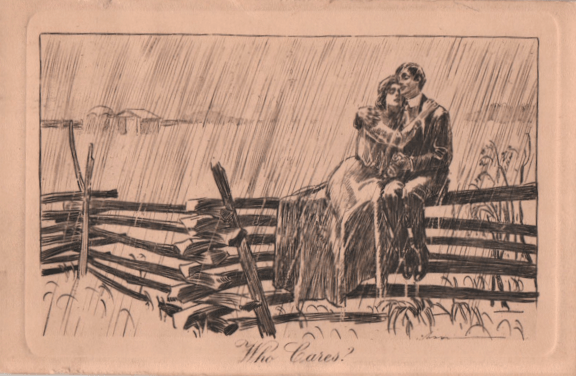
It is unfair, I suppose, to call the mighty Charles Dana Gibson a postcard cartoonist, since his work had become world-famous in the pages of magazines before postcards were even allowed to have pictures on ‘em. But his publishers DID bring out a line of postcards as an afterthought, and here we see one of the most popular of his works, the couple in love who simply have no idea (and don’t care) what’s going on around them.
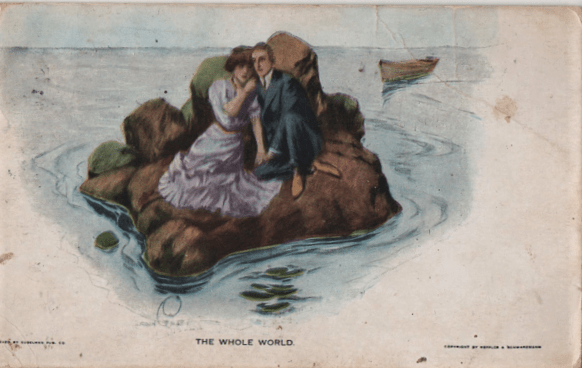
This couple is similarly inclined. The tide is coming in and their boat is drifting away, but none of this will matter until rather later
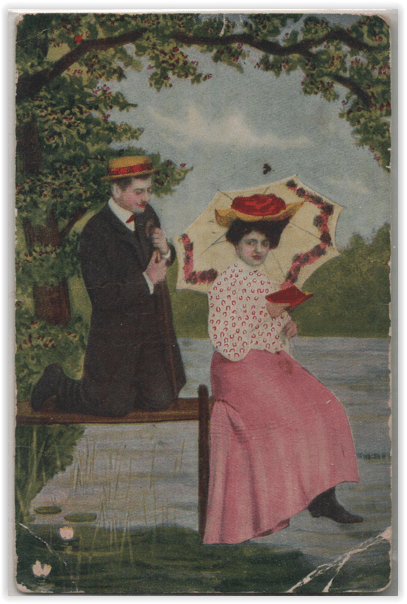
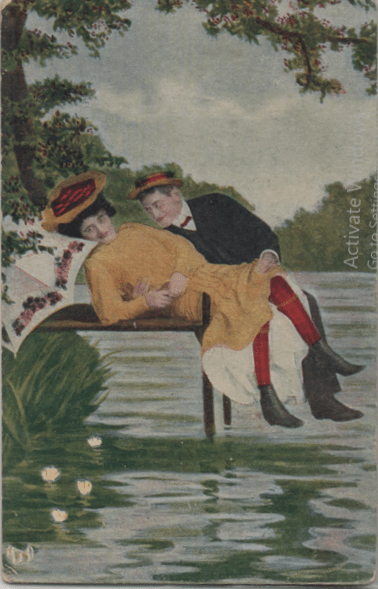
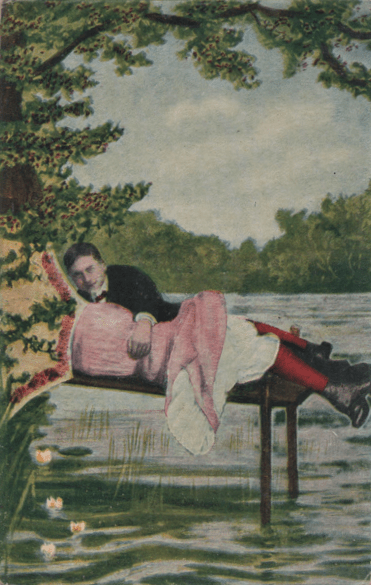
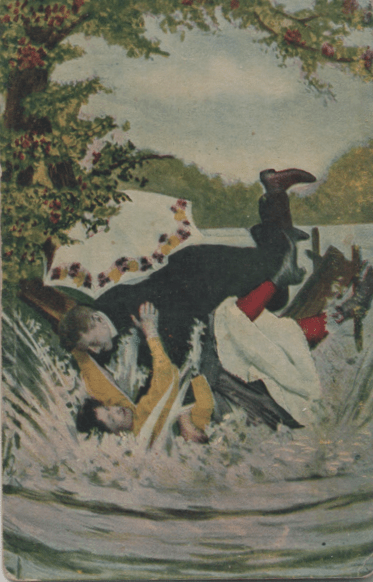
A trick of the postcard publisher was the story series, in which you could follow an entire comedy by buying half a dozen or so postcards. This couple is high and dry, if not high-minded.
They have come out to the riverside to have a nice time together in privacy. Note that there are no fishermen or boaters handy to sneak a peek at what’s going on. They have picked just the right dock: it’s kind of small to attract people who are here to enjoy the water.
Two grown-ups can surely find a time and a place for private contemplation of the intricacies of their relationship. Perhaps he is thinking about how much money he sets aside from his paycheck each week to be able to afford, one day, a happy home for them to move into as newlyweds.
Perhaps she is even now running over the contents of her hope chest, and thinking of what else she needs for her trousseau.
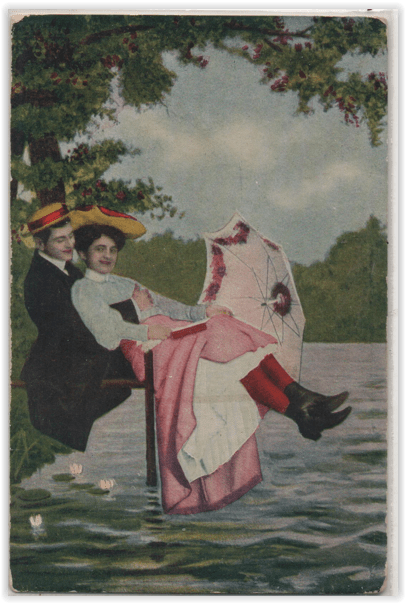
There is, by the way, a YouTube channel (creamofcardstv) where a postcard collector has made short animated films by photographing these sequential series in order. The films are short, but tell their story, as we have here: another splashy ending for an unsuspecting couple.
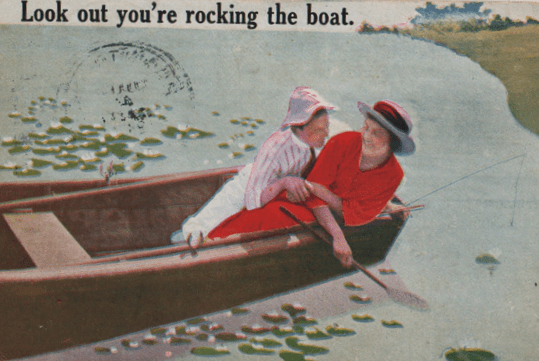
This is not to say that every single couple canoodling in a canoe (yes, several postcard artists used the joke about canoe-dling) was unaware of the danger.
A sudden moment of passion could, of course, lead to a drenching (and profitable stocking exposure for that sort of postcard buyer.)
What it comes down to, I guess, is that the postcard artists wanted you to understand the essential incorrectness of the naughty old admonition, “You can’t walk home from a boat ride.”
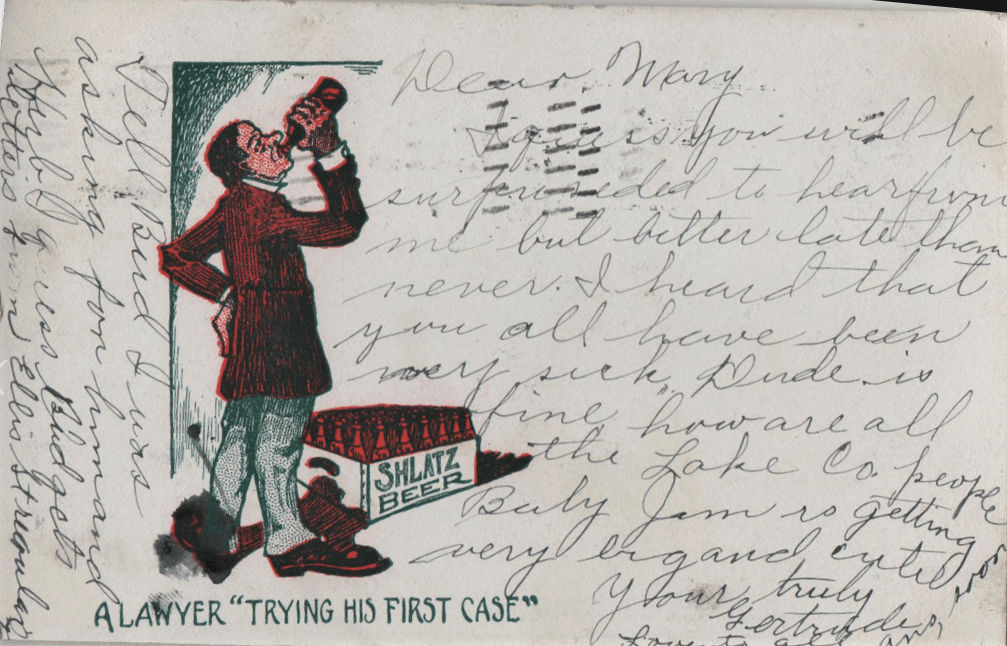
Once upon a time at the Book Fair, I would get calls from potential donors asking whether we’d be interested in a donation of old postcards. And perhaps half the time, I would be told all the postcards were in really great condition because “I threw away all the ones that had messages on the back”.
If the person had not yet reached the point of actually throwing things away yet, I would try to explain that roughly half the postcard collectors in the world feel a message on the back ENHANCES the value, even if, as I can testify, a lot of the time that message does not rise beyond the level of “How are you? I am fine.” (Actually, in the early days, when postcards were as big as texts were, say, in the 2010s the message was more often either “I got your card; here’s one for you” or “I sent you a card and haven’t heard back yet.”)
For one thing, that postmark tells us when the card was mailed (unless it was lost when some opportunistic stamp collector decided to pull off the stamp. Have I told you—lately—about the postcard someone slipped off into a corner at the Book fair and just tore off the corner with the stamp on it? I understand: this was, after all, a card which would have cost a WHOLE DOLLAR. And to that bungler who tore the inscription out of a book, effectively destroying the value of both the book and the autograph, I have renewed that curse on you, using the usual pumpkin shell filled with…where were we?) If you’re not sure whether you have a genuine old postmark or a modern reprint, a stamp and postmark from 1907 can be mighty reassuring. Sometimes the message on the back will comment on the climate or local news of the area shown on the other side: useful local history. And let’s not sniff at the appeal of just reading someone else’s mail.
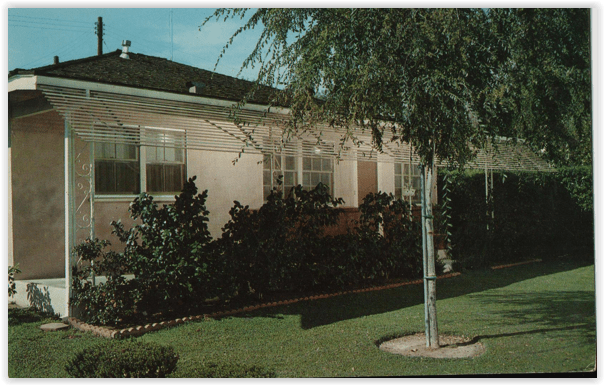
But sometimes the back of the card can amplify the interest or the resale value of a card. Take that shot at the top of this column. Very nice, very predictable. Do you suppose it’s a motel, or a new branch of a local bank? Funeral home? It might even be a new school building or post office, OR the residence of some new, exciting celebrity.
This one was never mailed, and you can see why. The ad for aluminum siding pretty much fills the message space. It is, in its own way, exciting. It’s part of that post-war world in which the aluminum siding salesman became a force to be reckoned with in the suburbs and city councils across America. Until he was replaced, of course, by the vinyl siding salesman.
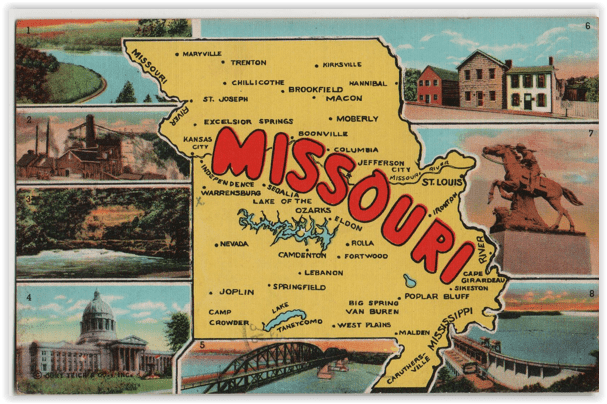
Here is another ho-hum type of postcard: the state map surrounded by tourist attractions. These used to be valued by grader school geography teachers: an inexpensive, graphic way to show a state’s individuality. Fifty of these—wait, maybe forty-eight for some of us—would make kids remember SOMETHING at least from geography class. This one has the added attraction of a small hand-drawn X, probably at the spot where the sender bought the card. What fun! Let’s flip it over and see if it tells us what these tourist stops in Missouri are.
Um, no. it does not. Somebody at the Curteich postcard factory fed the wrong card into the printer at some point. (You can check online and find both these cards with their correct flip sides.) We have instead an ad for the resort in Indiana which boasts Pluto Water. What I like best about this is that the sender DID buy it in Missouri, and wrote that message and marked that X without particularly caring that the text had nothing to do with the Show-Me State. WHICH teaches us something about postcard consumers.
Now this lad carries all sorts of interesting stories behind his back, but let’s enjoy the front for a moment. This kind of goes with a previous blog in this spot about inebriated gentlemen, especially their use of streetlights. You will notice that it comes from Italy, and that someone has translated the original caption for a reader of English.
On the B side, we find out much about the sender and a little about the English reader. It is franked, marked to be mailed free of charge for a serviceman on active duty in Italy in 1944. That alone gives it a bit of added interest, although I expect millions of postcards franked for members of the service are still in attics around the world. Note that he has not bought one of the usual American postcards available at the PX, but has gone for a homegrown specimen. We may observe also that Italy, after so many years of war, was stilling producing postcards for sale to tourists, a testament to the human spirit (or avarice; take your pick.)
If you read the message, though, you learn a little about the recipient, who is now singing with a big band. (At what point in our history did we decide this had to be capitalized?) This is the sort of thing a dealer in second-hand mail dreams of: something that touched a celebrity. Can’t QUITE make out that last name, though: Bekale? Of course, they’d have made her change it if she hit it big, but somewhere on the Interwebs…. Then, too, there were a lot more big bands out there performing than ever achieved any more than local fame. For every Benny Goodman and His orchestra there were three dozen Kevin LaBaron and His Big Blue Bands.
But the possibility is still there that someone who fell in love while dancing to the dulcet tones of Betty Bekale would find this card a treasure. All because somebody did NOT throw it away because somebody wrote on it (and it didn’t even have a stamp.)
We honestly do, alas, creep closer and closer to the last jokes in my Old Joke Quizbook. Yes, I heard some of you sigh with relief, but reflect on this, Turnip Taco. I have already decided which of my books I will serialize next. We can hold that sorry fate off only so long as we have elderly japes and jibes to put in this space on a Monday.
Anyway, I was explaining why this is sort of a Miscellaneous Monday. These are odds and ends from the last pages of chapters, and do not show the exquisite sorting and classification for which I am legendary. Yeah, you can go look up “Legendary Sorters” if you like, but the jokes will still be waiting, with the unnecessary answers at the end.
J1.”So, like I was sayin’, them Bears was on the ten yard line and they was gonna….”
“You are hopeless! Don’t you know the King’s English?”
“Yeah. ( )”
J2.”As your doctor, I need to tell you to hive up all that smoking, drinking, nd running around with women.”
“Will I live to be a hundred?”
“No. ( )”
J3.”That curve on the hill just outside your town is mighty dangerous. I’m surprised you don’t have a warning sign.”
“Well, we DID have a sign up there for a couple of years, ( )”
J4.It’s the kind of job cub reporters get. Jeremy was at the local assisted living building interviewing the oldest men there, inquiring after the secrets of long life.
“Well, now,” said a white-haired man who had walked in leaning on a cane, “I never touched alcohol in any form, not so much as a sip. That’s how I got to be ninety-five.”
“Something the same with me,” said another, a bald man who had come to the interview with a walker. “I avoided tobacco my whole life. That’s how I figure I made it to ninety-eight.”
A bald man with scraggly white whiskers piped up from his wheelchair. “Not me. I drank enough to float a goat, smoked all kinds of stuff, legal and not, never got to bed before three A.M., and maybe I shouldn’t even mention sex, since the subject didn’t come up, but I kept mighty busy along those lines, too.”
“Amazing,” said Jeremy. “And how old are you?”
The man leaned back in his chair to take a deep breath before answering, “( )’
J5.”Doc, my right leg hurts.”
“Probably just old age.”
“But, Doc, ( )”
J6.”Doc, my hearing’s getting so bad I can’t hear myself cough.”
“Take these pills.”
“Will they improve my hearing?”
“No, but ( )’
J7.”I finally had to break down and buy a hearing aid. Not one of those you see on late night TV commercials. I went through medical channels and got the best model money can buy.”
“What kind is it?”
“( )”
J8.Old Mr. Wrinklerag, who had built a tailor shop into a major fashion industry, was reaching the end, lying in a hospital bed under an oxygen tent as his son stood by. “I don’t have much time left, son,” said the billionaire. “I’m leaving everything to you, of course.”
“Don’t talk that way, Dad,” said his son. “You’ve made amazing recoveries before.”
“Not this time, my boy. I’ve told the lawyers it’s all yours, even my secret Swiss bank account, those three houses I kept hidden for any super models who needed personal attention. There’s even a map to wear I buried a chest of diamonds, just in case the government collapsed and I needed something besides paper money. The cryptocurrency is all going to be yours, too, of course.”
“Dad, Dad, stop!” the young man sobbed, “I know you’re going to make it! And through all this, and with everything you’ve done for me, there’s absolutely nothing I can do for YOU.”
“Actually, there is something you can do, Son,” said Mr. Wrinklerag. “( )”
I don’t say these will satisfy all those of you who go onto the Interwebs seeking ANSWERS, but here they are.
A1.So’s the Queen!
A2.But it’ll feel like it
A3.But nobody died so we took it down
A4.Twenty-seven
A5.My left leg’s just as old and it doesn’t hurt
A6.They’ll make you cough louder.
A7.Abbout 9:30 A8.Get your foot off that oxygen tube
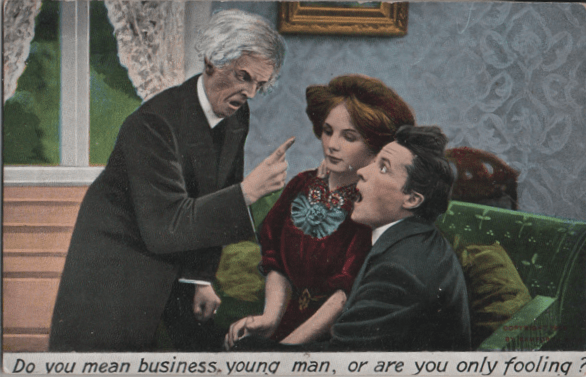
Once upon a time, rutabaga meringue, a young man courting a young lady faced complications far more difficult to confront than they are today. A lot of this had to do with opportunity. Especially in rural areas, people went out in the evening less than they do now. Even in the cities, there were simply fewer chances of meeting the (current) love of your life out in public. (Meeting your snooky ookums in a public place was handy because there were generally private places not far away that you assumed the older folks didn’t know about.) You might meet a yiung lady at a party or a church supper, but such entertainments were few and far between.
This meant a lot of your campaign had to be conducted in enemy territory, that is, you had to call on the young lady in her parents’ home. The early stages of the relationship needed to be developed while under scrutiny: the family parlor was where the family gathered of an evening, especially if there was a visitor, and you had to pretend you were really interested in Dad’s jokes, Aunt Lily’s discussion of her doctor visits, and little Booboo’s latest violin piece. And while you were pretending not to gaze on the object of your affection, all of her relatives were pretending, with differing shades of obviousness, that they weren’t watching YOU. Some were interested in guaranteeing propriety, others were just placing bets on what your chances were of victory, and one or two were just curious about your general strategy.
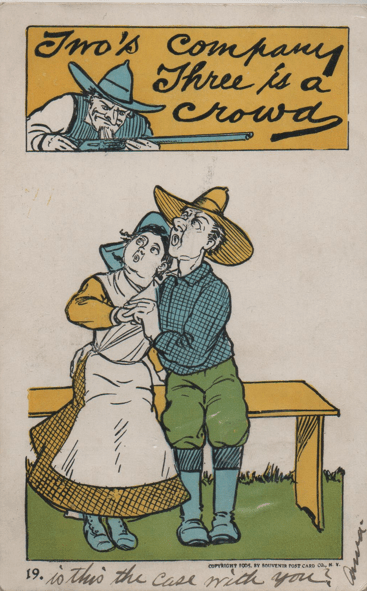
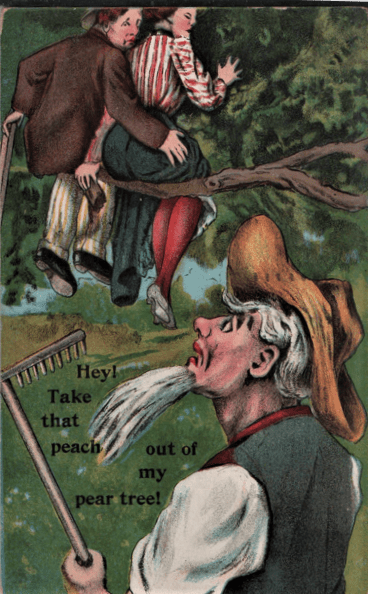
The postcard cartoonists knew, as you did, that even if you and your sweetheart were able to find some privacy, her parents would be alert to your plan. (Hey, if it was the family home, they were probably trying to get away with the same sort of canoodling in the same places a generation ago. This was another peril of calling on your dearest darling at her place.)
You could not elude the watchful eye of chaperonage. Not noplace.
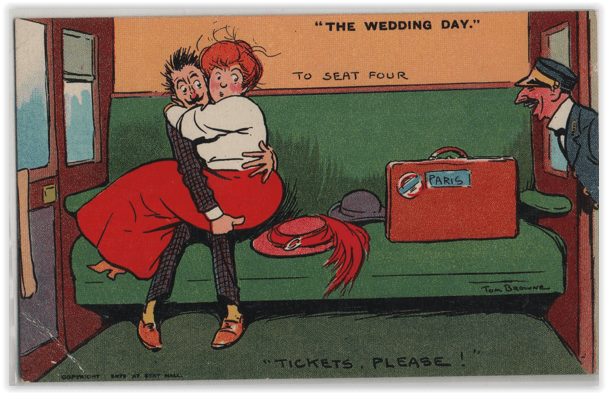
Of course, even the parents knew life goes on, and didn’t particularly want to go on paying her room and board forever, so if you were considered a reasonable prospect, a certain amount of privacy would be allowed to you. But this was a qualified privilege, with the safeguards of propriety never too far away, and perfectly willing to remind you that curfew was approaching.
With varying degrees of subtlety.
Wildly varying degrees of subtlety.
But you were not without resources. For the price, or at least promise, of ice cream, it might be possible to bribe a few allies in the enemy camp.
Sometimes sympathy and support can be found even at high levels in the enemy camp.
Because even the high command of the opposing force knows that time is not on their side. All they’re really working for, in most cases, is a respectable peace settlement.
Not that you’re going to be safe from interference even then, of course.
So here it is Monday again and it is time for our Old Joke Quiz. What? Wednesday? Well, yes, I know that, but I didn’t want to break with tradition. Anyway, the old jokes are two days older now, so you’re getting your money’s worth.
This week, we return to fine traditional gags featuring children and their various pursuits while outside the school building. These are just as disreputable as their pursuits IN school, but it’s their parents who have to deal with them, or other innocent bystanders. (If you consider the parents to be innocent bystanders, of course. My mother always admitted it was her fault for deciding to have children in the first place. “I could have had guppies!” she would remind us.)
J1.Rodney was walking to work when he spotted a rough wooden box which bore the sign “Puppies, One Million Dollars Each”. A small boy sat behind the box, while a half dozen fuzzy bundles slept in a wire cage next to him.
“Are those your puppies?” he asked.
“Until somebody buys ‘em,’ said the boy.
“Are the pedigreed?” Rodney inquired.
The boy pointed at the sign, “They’re puppies!”
Rodney nodded. “How many do you expect to sell at a million dollars apiece?”
“Well,” the boy said, “At that price ( ).”
J2.On his way home that night, Rodney passed the same yard, and found the boy still sitting behind the box. But now the sign said “Oatmeal Cookies, $100 each.”
“Gave up on selling puppies, huh?” he said.
“Nope,” said the boy. “Sold ‘em all.”
“I see. At a million dollars apiece?”
The boy replied with a sharp nod. “Yup. Every single one.”
Rodney stepped back. “You mean you sold six puppies for a million dollars each? In cash, or did they write you a check?”
“Neither,” the boy told him. “They ( )”
J3.Tommy was bragging about his family’s many talents. “My Uncle Tim plays the piano by ear.”
“That’s nothing,” said Velma. “My grandpa ( )”
J4.A hundred years ago or thereabouts, a father called his son before him and said, “My boy, I know last night was Halloween, and of course a lot of pranks get played at Halloween. Did you tip over our outhouse as a part of the general festivities?”
The boy stood straight and tall, looking Dad in the eye. “Father,” he said, “I cannot tell a lie. I did it.”
His father nodded, snatched up a hairbrush he had been keeping handy, and gave the boy the spanking of his life. When he was done, the tearful boy said, “But, Pa, I told the truth, just like George Washington did when he chopped down the cherry tree. And his pa didn’t spank HIM!”
“No,” said his father, “But ( ).”
J5.”Remember, son, whatever you do in life, you will become a success if you just start at the bottom and keep working your way up.”
“Is that right, Pa? What if I ( )?”
J6.”Drive you to the mall, drive you to the swimming pool, drive you to school: you don’t get enough exercise, with your mother and me driving you everywhere. When I was your age I thought nothing of a nine mile walk.”
“Well, Pa, ( ).”
J7.”Bah! With all your modern conveniences, you kids today don’t know what good hard work is!”
“That’s true, Pa. ( )”
J8.”Furthermore, it’s shocking that you spend every penny of your allowance on snacks at the store or fast food at the drive-in. You never give a thought to donating any to charity, to make the world around you a better place.”
“That’s not fair, Dad. Just yesterday I gave five dollars to a man who was crying.”
“Really? A man who was crying?”
“Yes, sir. He was crying ( )”
J9. The kids are being really quiet. I’d better go see what they’re doing ( ).
Even if this is Wednesday and not Monday, I’ll bet your wits are as sharp as ever and you don’t need these ANSWERS. But just to show we observe the same rules in the middle of the week, here they are.
A1.I only need to sell one.
A2.swapped me a six million dollar cat.
A3.fiddles with his whiskers
A4.George Washington’s father wasn’t sitting in the tree when George chopped it down.
Oh, very well. If you have to hear how the story finishes up, we can put the joke column off until Wednesday. How the millions of joke column fans will…what was that? Don’t be rude.
I hope everyone who read the first two installments has tuned in for the conclusion and was not thrown off by what may have seemed an unnecessarily crude detail in our second installment. Those who had been reading may have remembered vaguely that this was a story about the immigrant experience, and how my grandfather felt there was a lesson to be learned in the story of HIS grandmother about how to treat The Other, the stranger who wasn’t like you.
Yes, we ARE going to get to the story, We left sixteen year-old Magdalena “Lena” Ruppel lying in the straw at the livery stable, afflicted by the pangs of cholera, a deadly disease that was seasonal throughout the civilized world at this time. No one wanted tyo have anything to do with the German-speaking waif who was obviously sick: half a dozen white people hurried past and a black man turned and ran.
Well, if you think of Galena as Oz, and Lena as Dorothy, she had just encountered her three main allies. The freedman who turned and ran was going to serve as her Scarecrow, Tin Woodman, and Cowardly Lion. Like the Woodman, he had a heart, and it went out to anyone dying on a sunny day in Galena. Like the Lion, he had courage, and did not fear the disease that was going around. But like the Scarecrow, he also had a brain. This was Galena, Illinois, it was 1843, and he knew what would happen to a black man seen carrying a white woman through the streets of town. He would be no use to Lena once he’d been pummeled to pulp.
So when he ran, it was home to his wife, where he called “Ma, there’s a little Dutchy girl with the cholera lying in the straw at the livery stable, and she;s going to die if we don’t help!” His wife did not pause to take off her apron, but hurried down to carry Lena to safety.
Lena received the care she needed to recover, and also got some advice from the couple who had carried her away from death. “You’ll always catch the cholera when it comes back, now you’;ve had it once,” she was told. :What you want to do is cross the river and go to Dubuque, Iowa. They never have the cholera there.”
Dubuque was a lead-mining town well-known in a lead-shipping city like Galena. And it had grown up in one of the hilliest sections of Iowa. (It ain’t all flat fields of corn and hallucinatory baseball diamonds.) Because of all the hills, sewage ran down into the Mississippi River before it had time to contaminate the drinking water supply (except for those who drew directly from the Mississippi) and it thus had an accidental but true reputation of being healthy.
So when she was well enough to travel, Lena hit the road again. She had learned a modest bit of English by this time, and was able to find work in the home of an old woman who lived alone. Lena, you need not guess, did the laundry, washed the dishes, washed the floors…Lena’s life was a soap opera in more ways than one.
Iowa had not even become a state at that point, and life was still on the frontiersy rugged side: they had absolutely NO WiFi. So the lady of the house amused herself by taking an interest in the lives of those around her. There was a sturdy young man from Alsace doing the yardwork and carpentry and other heavy chores around the house, and the lady never lost a chance to drop a hint to Lena about what a fine husband Heinrich would make for some lucky girl.
Lena and Heinrich (later Henry) were married, and had four children, whom she tried to teach, among other things, that people who didn’t look like you or talk like you were not necessarily evil. Henry died young (trying to build a better house than his brother’s, he lifted a stone that was just THAT much too heavy.) Lena fretted about her youngest child, a ne’er-do-well who hopped freights around the country, learning about more people who didn’t look or talk like him, until she finally bought stock in a furniture company so she could make the supervisors give the boy a job. He was named Jacob, after Lena’s brother, but legally switched his first name with his middle name, August, so people would call him Gus, which sounded less foreign. (Lena did not live to see World War I, when speaking German in public eas banned in Iowa, but there were already those who looked on foreigners with suspicion.)
My grandfather preferred to end this tale by pointing it out that it happened in 1843, and noting that in 1943, just one hundred years after Lena decided she was going to die in a pile of straw, he was leader of a Boy Scout troop. The local Scout supervisor came to him and asked if he could add one more boy to the troop.
The troop was already about as big as he could efficiently manage, but he said, “I suppose so.”
The Scoutmaster said, “I should warn you. This boy has been turned down by three other troops.”
My grandfather thought it over. “Does he smoke?’
“No.”
“:Does he drink?”
“No.” “:Is he crazy?”
“No, He’s a Negro.”
<y grandfather kept asking questions. “Is he over twelve?”
“Yes.”
“Does he want to be a Scout?”
“Yeah, that’s the problem. He….”
“Will he take the Boy Scout oath?”
“I suppose.”
My grandfather nodded. “My manual says if ha boy is over 12, wants to be a Scout, and will take the oath, he can be a Scout,. It doesn’t say anything about being a Negro.”
“You’ll take him?”
My grandfather never mentioned this Scout’s name, but mentioned he was a good Scout: not the best and far from the worst, and lost to the world of Scouting when high school started. (The Boy Scouts lost a lot of them at high school age in Dubuque because baseball practice night was the same night as Scouting night, and each boy had to make a choice.) But in his own way, he felt he had lived up to Lena’s story about a man who rescued a stranger who spoke a different language and was a different color.
As you may recall from our last episode, we are glancing in the direction of immigrants to the United States through the experiences of the Ruppels, four Hessians in their mid-teens to early twenties, making their way out of the country ahead of the Hessian draft officials, in the distant year of 1843. When we left them, they had made it to the coast, in good spirits but totally broke, without a pfennig to pay for transport across the Atlantic Ocean.
Jacob, the oldest and the only male in the group, handled negotiations. Finding a well-dressed ship’s captain and made the proposition: could an honet young man work his way across the Atlantic. The captain asked if he’d ever been to sea before. Jacob felt there was no use for a farm boy to pretend, and said no.
“Then I won’t waste time trying to make a sailor of you,” the captain said, “But I have plenty of cargo to load and unload along the way, so I’ll take you across if you’ll join that crew.”
Jacob was glad it had been so easy, but the captain raised one finger. “But for one man’s work, I can’t ship four people.” He looked over the Ruppel girls. “We haven’t had a decent cook on this tub in out last three trips. Can any of your sisters cook?”
Well, of course, one sister said she’d been the family cook. When she affirmed that, yes, she had certainly cooked fish before, she was signed on to the crew.
“I like a clean ship and a tidy crew,” the captain went on, “So there’s always plenty of laundry.” He nodded to the next sister, and then considered Magdalena, the youngestand smallest, a sixteen year-old who stood just four feet tall.
“I have to go ashore at every port and talk to the port authorities and I need to look good,” the captain said. “I have special suits of clothes for that, with lacer and gold buttons,. That kind of laundry takes someone with small fingers and a delicate touch.” And Lena was now a part of the crew as well.
It sounded all right at the time, but in later years, Lena recalled that all she really saw of the voyage was soap suds: the captain DID have a lot of washing to do and, as they were still working their way along the coast of Europe, lots of stops to make requiring the use, and washing, of those special jackets. But the trip, once onto the ocean, did not take long, and soon they were within sight of the New World. And there they stopped.
See, it was, naturally, a sailing ship, and they had encountered the fate feared by most experienced sailors: a complete lack of wind to make the ship go. “Ve sat for two veeks looking at KOOBA!” as Lena told the story, still resenting Cuba for the way it had sat there, just out of reach, tantalizing them with the nearness of port, and the end of the voyage.
The Ruppels said farewell to the captain, and his laundry tubs, in New Orleans, where they stopped at the Ursuline Convent, a well-known refuge for immigrants. Not only were the sisters of the convent willing to help the confused newcomer to the United States, but they were also skilled nurses. This was essential because New Orleans was in the grip of a cholera epidemic, a seasonal affliction of many large cities until the days when the importance of sanitation standards for drinking water was established. (The hazards of proximity between sewers and drinking water…you get the idea.)
One of the Ruppel sisters came down with cholera, and died in the convent. Another sister was so touched by the sight of the sisters of the convent caring for dying strangers impressed her so much that she decided to sign on as a lay sister at the convent. Jacob and Lena, however, had no desire to stay in New orleans, and got busy finding a way to get themselves farther north, perhaps where heat and disease were less common.
Jacob found a barge captain who was headed up the Mississippi (I always heard barges did not move that direction, but this is the way I heard the story, and my grandfather had studied his river history and saw nothing wrong with the story.) It was familiar work: Jacob would do loading and unloading while Lena….well, all she really remembered of the trip up the Mississippi was soapsuds. The captain had his wife and kids along with him, so there was plenty of laundry.. At length, Jacob came to Lena and confessed, as she had been guessing, that he had fallen in love with the captain’s daughter, and intended to marry her. This meant turning off the Mississippi and going with the captain and family to Ohio, which had not been their plan. Lena opted to stick to the original plan alone and so, one merry day in 1843, set foot in GFalena, Illinois: four feet tall, sixteen, as mentioned before, speaking barely a word of English, and without any friends or acquaintances in this new place.
But Lena had made it this far (I wonder if she didn’t do a lot of Jacob’s hob interviews for him) and Galena was a bustling, international center for the lead ore trade (lead ore is known as galena; no points for guessing where the city got its name). She meandered through the crowds riverside until her ears caught the sound of German being spoken. It was slightly foreign German, not being a hessian dialect, but she could understand it, and she understood that something was going on. She followed the German speakers to see what was so interesting.
She wound up in front of a store where the proprietor was explaining, in German with some English mixed in, that it was expensive, but worth it. Workmen were installing a big glass window at the front of his store (ion installments: glass was rare and delicate, so his window was actually dozens of small panes set into compartments of molding.” Lena worked her way to the front of the crowd.
There she noted to the storeowner, “Das ist ja ein’ grosses Fenster.” (I have bnee withholding my high school German bravely so far.) “That is one honking big window!”
“It is,” said the owner, his chest swelling with pride.
Lena looked him in the eye. “You’re going to need someone to wash that window.”
In very little time, lena had become the latest employee at the store, and, in return for room and board, doing the laundry for the storeowner’s family. Lena was starting to pick up a pattern to American life.
All went well until the day that Lena, running errands for the storeowner, felt herself flushed with fever, dazed by the sunlight, and intensely tired. She thought it she sat down for a moment, she might recover, but Galena was not overly supplied with spots for servant girls to stop and rest. She curled up on a pile of hay at the livery stable, waiting for the fever to pass. It didn’t pass. Galena had been gripped by cholera, and Lena realized she had caught it.
“Hilf mir,” she called to passersby. “Help me.” But realizing what the problem was, the passersby passed by. Two women put handkerchiefs over their faces and moved on. Three white men crossed the street, and a black man turned and ran the other way. Lena realized that after all her work to get to America, she was going to die in a pile of hay for rental horses.
On Wednesday: Lena does not die, and if you looked closely, you saw the reason why in that last paragraph.
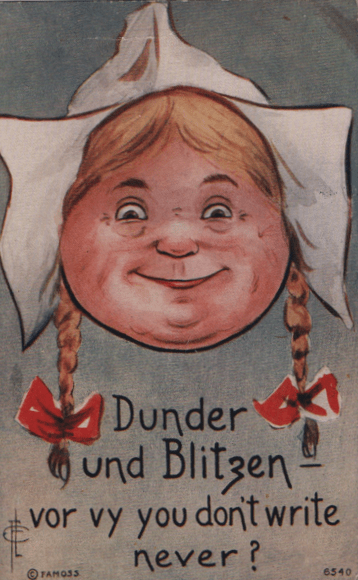
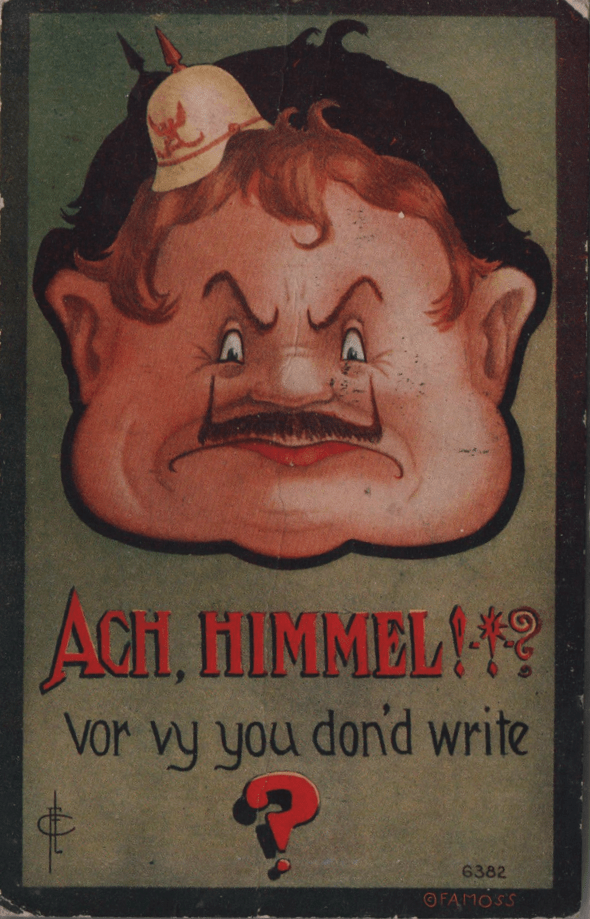
Eons ago, a lot of jokes in this country dealt with The Other, people who were outside the norm, who had different clothing, different ways, and different language. This became known as “ethnic humor”, and is now largely considered passe, if not downright evil. I don’t have much interest in debating the question: some people regarded jokes about their ethnic group as recognition that their group existed at all, while others took the jokes as straight insult. These postcards from Cavally’s portrait series seem rather genial to me, but I have been told I am incorrect. I think it is no coincidence that the downfall of the ethnic joke came around the same time as the generation that had been born over here, and didn’t LIKE to be mistaken for those people who were funny, and awkward, and different (their parents and grandparents.) One of my grandfathers, as a boy, disliked intensely being reminded of his ethnic background, and didn’t like visiting his heavily accented and over emotional grandmother.
My grandfather grew into a staunchly conservative Republican, and had definite views about The Other, and how people who were different ought to be treated. He regretted very much that he hadn’t been nicer to his grandmother, and, when fortified with strong coffee, would tell her story. Sometimes he could take two hours about it, and I wish I had had the nerve to tale a tape recorder with me. But I will tell the story of this ethnic adventuress in rather less time,. (I hope.)
Once upon a time in Hesse (I have forgotten whether it was Hesse-Darmstadt or Hess-Casse;, but my grandfather knew) there was a family of farming Hessians comprising Mom and Dad and four children. Jacob was the oldest of the children, the only boy, AND the tallest of them, coming it at around five foot one. Not a tall family, the Ruppels.
Mom and Dad died in an epidemic. The children mourned, but there was a farm to run, and the cows need to be milked no matter who died. Jacob and his three sisters worked the farm together until one day the Notice was posted.
If you have heard of Hessians at all, you know that these were Herman soldiers hired by the British to fight in the American Revolution. This was how the Hessian governments stayed solvent: they drafted their young men, trained them, and rented them out to other countries. The Notice stated that all men of a certain age should report for duty: the government needed the money.
Jacon didn’t especially want to go. Hesse was filled with the damaged veterans of previous levies, and, anyhow, he didn’t see how he could leave his sisters alone to run the farm. For one thing, he was the only one tall enough to harness the horse (not wealthy, either, this family). Those of you from the city might think one of the girls could just stand on a footstool. But a horse is no dummy. He knows all he has to do is take one step away from you and you have to get down, move the stool, and start over, whereupon he can move one step forward. He can do this as long as you can: it may be tedious but it’s more fun than hauling a plow.
Then, too, if news got out that the farm was being run by three small teenaged girls (The shortest and youngest was Magdelena, who at 16 was just four feet tall) this might give ideas to some of those veterans who, unable to find work, gathered into gangs to pillage and loot. Killing three girls would have been easy work for someone who had been off fighting in other countries’ wars. And, after all, killing wasn’t exactly necessary: they could do other things which would make the women happy to marry them and let them loaf on the farm while the young ladies, between producing offspring, could do the work.
So Jacob and his sisters resolved to get out of Dodge. They sold the farm quickly got noy much money. The neighbors were sympathetic about Jacob’s plight, but knew a desperate seller won’t haggle. The four used that money to get transportation. They turned up at the seaside one jump ahead of the authorities (who had some experience finding draftees who didn’t want to go), and completely out of funds.
Next time: How the Kids got to America, though all Lena saw on the ocean trip was suds.
So we arrive, once again, at Monday. If you did not spend your weekend at the Newberry Library Book Fair, well, you missed it. It was a post-pandemic affair, a bit watered-down from previous concoctions, but there were still books for sale at popular prices. If you were unable to tear yourself away for it, this Old Joke Quiz is here to console you with tales of other things people do in their free time. If you have enough time, you can check the ANSWERS below, but I;m sure you won’t actually HAVE to do so.
J1.Jerry was an awful bore, but people came to his parties because he stocked very good liquor, even though this meant listening to his stories. “There,” he said, pointing to a mounted bear’s head on the wall. “Did I ever tell you how I bagged Old Grizzle? I was down to my last bullet. It was a case of him or me.”
“Well,” said Susan, “He ( )”
J2.”What about you?” Jerry asked another guest, later. “You ever hunt bear?”
“No,” said Tim, “( )”
J3.There’s so much game in Africa that the hunting’s great. One night I shot an elephant in my pajamas. ( )”
J4.”You’re suire tjios is a safe place to swim?” the tourist asked the guide, as he left his clothes on the bank. “No alligators out there?”
“No, sir,” said the guide, “) _”
J5.”Coming to the big game to see the Red Sox and the Yankees fight for the pennant?”
“No, thanks. I know what the score will be before the game even starts.”
“Really?”
“Sure. ( ).”
J6.At halftime, the home team was trailing the Fighting Peacocks by seven touchdowns, so the coach stood up in front of the players in the locker room and said, “The way you guys are playing, we’d better go over some basics. Lesson one: this here is a football. Lesson two….”
“Coach, Coach, please!” came a voice from the back, “( )”
J7.Bob and Bambi got stuck in traffic on the way to the big game. Bob was grumbling to Bambi about the other drivers all the way. They finally got to their seats in the third quarter. “What’s the score?” Bob asked the man in the next seat.
“Nothing to nothing,” the man said.
“Oh, good,” said Bambi. “( )”
J8.Sarah and Thea were wandering through the annual art fair, admiring the cedar windchimes and the photographs of balloon animals. At a booth hung with dozens of paintings on black velvet, they stopped short. There, nearly lifesize, was a painting that lseemed to be Sarah, in the nude, in a position which could only be described as indiscreet.
“Hood grief!” Thea exclaimed. “You didn’t pose for that, did you?”
“Certainly not,” snapped Sarah. “( )”
J9.Steve dropped in at the studio of his old friend, an artist whose paintings hung in several galleries. His buddy had just finished work for the day and was washing up. Steve stepped over to the new painting on the easel and reached out to touch the nose of the figure.
“Don’t!” said his friend. “Can’t you see the paint’s still wet?”
“Oh, it’s okay,” Steeve said. “( )”
J10.The party had been going on for some time when the host walked to a closet and brought out a tuba. “Bought this about a year ago, and I’m getting pretty good. I can play songs that will make you weep, or I can play lullabies that will put a baby hummingbird to sleep. I can even tell time with it.”
“How?” demanded one of his guests.
The host raised the instrument and performed a few bars of “Beer Barrel Polka”. Sure enough, ( )
J11.Bambi was practicing her trombone, playing “Who Threw the Overalls in Mrs. Murphy’s Chowder?” The phone rang and an angry voice demanded, “Do you know there’s a little old lady here trying to sleep?”
“No,” she said, “But ( )”
These jokes are just like old songs: you may think you remember all the lyrics, but you want to check the ANSWERS to see if you had the same words as the original.
A1.He certainly makes a better trophy
A2.I usually wear a jacket, atr least
A3.How he got in my pajamas I’ll never know
A4.The piranhas scare them all way
A5.Nothing to Nothing
A6.Not so fast!
J7.We haven’t missed anything
J8.He must have painted it from memory
J9.I have gloves on
J10.Someone banged on the wall and shouted “Hey, it’s two in the morning!”
I’m not sure I’ve ever even met anybody who was rich. Oh, I have chatted on a friendly basis with people who might admit they were successful, or well-to-do, or comfortably well-off. But the ones who were willing to discuss the matter with me could always cite someone richer than they were, someone whose affluence was a distant mark to which they could only aspire.
Mind you, I can’t say that everyone I ever knew felt this way. There seem to be a lot of people who remember they have to rush to another appointment when you ask “Are you rich?”
I think the question here is not one of some subjective term like “rich” but the more immediately understandable (if still subjective) concept of “having enough”. People who are rich have enough money for anything they choose to buy, and nobody ever really has enough. Postcard cartoonists have long understood that, and there was no way to raise a sympathetic chuckle like showing some poor bloke who just couldn’t scrape up the necessary.
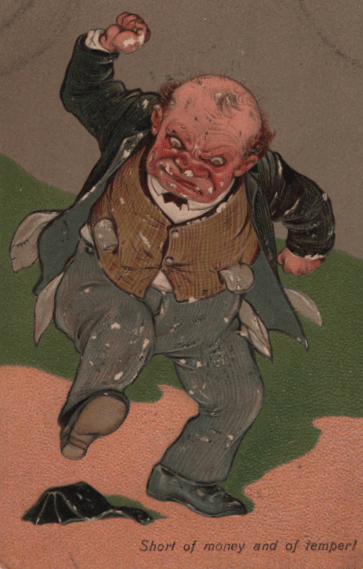
Carl Sandburg wrote of the sweet hellos and goodbyes people whispered to their money, and the cartoonist was willing to show that all affluence is fleeting, if not actually an illusion, as in the chap at the top of this column, who invested in a bunch of sure things.
Having enough money is, of course, all a matter of luck, as some postcards found out to their sorrow.
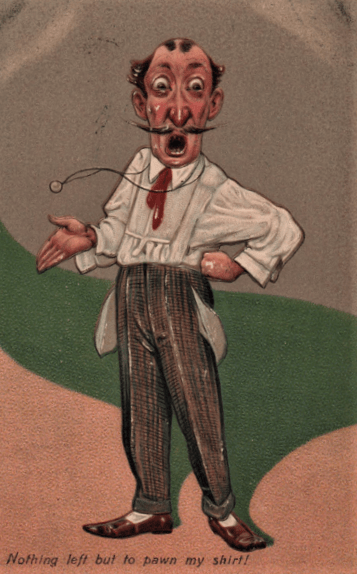
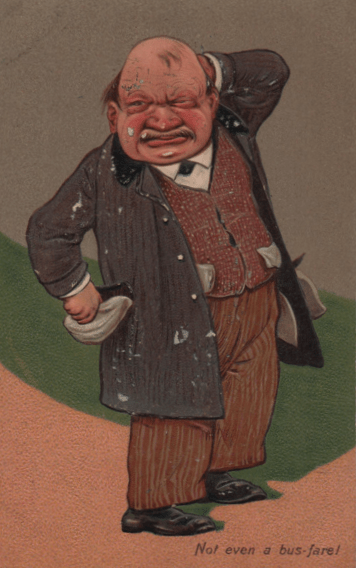
And although there were plenty of postcards advising you to get out and get under, to take arms against your troubles, and keep looking up, the cartoonists knew that the FIRST thing you need to do when you’re broke is complain about it. This is one of a series of European postcards with almost-okay English captions which illustrate what would have been an amazing opera about being completely out of clover.
I wish I could find the whole series dealing with these gentlemen who sing somehow while devoid of the dough-re-mi.
These cards were embossed: the surfaces of the star of the picture were raised above the flat background, and liable to friction. In this case, it helps: the loss of color gives their clothes a more threadbare look, lending a little more authenticity to their arias about their lack of substance.
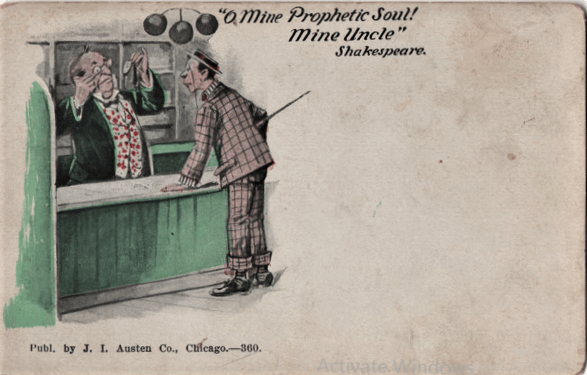
There are, of course, resources available to the low-income individual. I feel this one, from the 1960s (if you couldn’t tell the clothes) is a tad bit harsh. It probably appealed to those who were broke but not broke enough for government aid.
But even in the nineteen-aughts, people knew there were ways out of financial difficulties, though these might involve still greater difficulties. (Is there any truth to the story of one of my favorite authors who, it was said, would find himself broke and take all the first editions of his own books to the pawn shop, use the money to buy enough whiskey to help him write another book, and then go back to the pawnshop with the money from his publisher and buy all his books back? Or did he make that one up himself?)
In any case, there are always optimists who are willing to keep looking up even when reserves are down. Remember this, broccolini waffle, when you have spent all your money at a book fair and can’t afford lunch.














 Blogsy Babbles