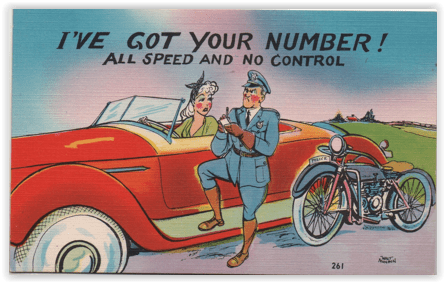
I suppose I’d be an influencer to be reckoned with in this world iof only I had developed a longer attention span at some point in my development. If I were willing to put more time into things, why, I might have followed my original passion, composing great music, and would now be so famous that people would have started calling me a has-been thirty years ago. But when someone looked at one of my early compositions, remarked that my staff had six lines instead of five, and suggested I look into how music was actually written, I decided to switch to something new. (Maybe that was my Lego phase, when I built one building over and over again because why…another loss for the world, this time in architecture.)
What has led me to this melancholy determination is the realization, when reading recently about Slo Poke candy was that I had not noticed the original Slo Poke—a long hunk of solid semihard caramel on a stick—was gone from the candy shelf, replaced by a new version, which is supposed to be the same thing, only without the stick. I realized shortly after that that I hadn’t noticed it missing because I hadn’t missed it.
Where I lived was more Sugar Daddy territory. The Sugar Daddy, a long hunk of solid semihard caramel on a stick, was very much in the commercials they pushed cartoons between on Saturday in my day because it was part of a family of products: Sugar Daddy, Sugar Mama, and Sugar Babies. I tried all of these at the time, and if you are familiar with these products at all, you may well guess that Sugar Babies, which I regard as one of nature’s perfect foods, are my favorite.
The Sugar Daddy came first, introduced in 1925, followed by the competing Slo Poke in 1926. (The Sugar Daddy NAME came along in 1932, when Sugar Babies were introduced. Before that is was known as, er, a Papa Sucker.) Both the Slo Poke and the Sugar Daddy appear with glowing reviews in all kinds of memoirs and nostalgia pieces. Their main attraction is suggested in the name of the Slo Poke: that caramel did NOT surrender easily and, if a kid was determined, could last a whole day. Our ancestors lived in an era when sugar in any form was rationed pretty carefully (see the column in this space about the folklore of stealing jam) and having all the caramel you could possibly want all day long was an intensely-felt luxury.
I grew up in a softer age, the despair of relatives who had gone through the Depression and the Second World War, and I had no time for such nonsense. Even had I been around in the Thirties, I would have preferred the smaller, more easily disposed-of Sugar Babies. What did you do with an all-day sucker if the impulse to play baseball came along? Shove the Sugar Daddy into a pocket and pry it free later? Where did you put it at lunchtime? Much better to take something you could chew, swallow, and dismiss from one’s list of responsibilities.
It isn’t that my tawdry era was devoid of long-lasting candy. We introduced, remember, the Sugar Mama, which was a Sugar Daddy with a chocolate coating. We had the Ring Pop, a long-lasting sucker which could be worn on the hand for easy reference. We pioneered the Astro Pop, a cone-shaped sucker with three stages of candy like a three-stage rocket (cherry, passionfruit, and pineapple, they tell me.) It isn’t as if EVERYBODY in my generation had the attention span of a fruitfly.
Nah, just me. I still prefer my caramel in the form of Rolo, or Sugar Babies or, if I can summon up the patience, Milk Duds (so named, by the way, because they kept coming out the wrong shape. But that’s a whole nother blog, and I don’t write a food blog.)
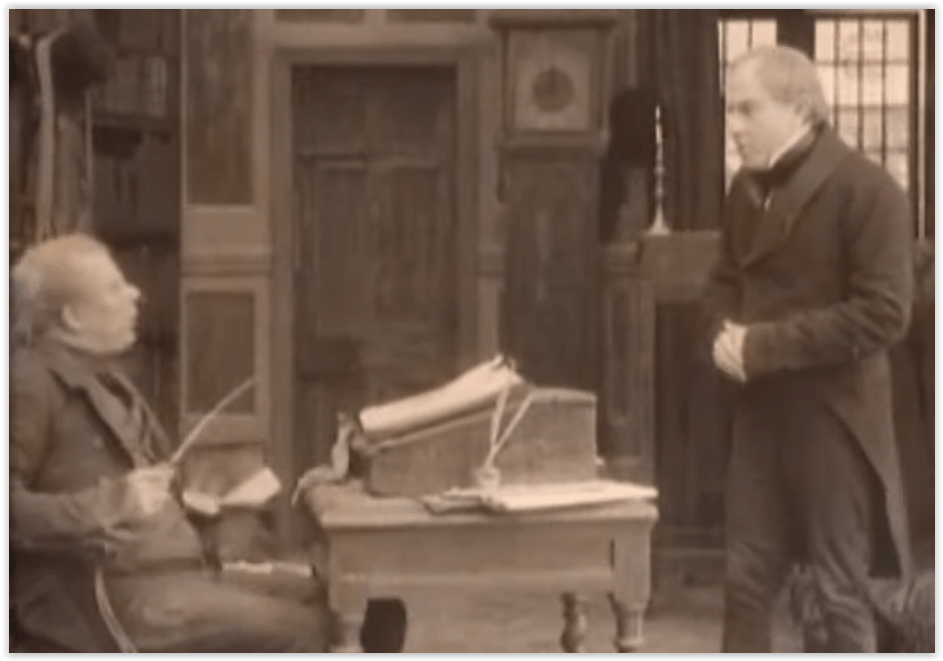
This lunatic, in letting Scrooge’s nephew out, had let two other people in. They were portly gentlemen, pleasant to behold, and now stood, with their hats off, in Scrooge’s office. They had books and papers in their hands, and bowed to him.
“Scrooge and Marley’s, I believe,” said on of the gentlemen, referring to his list. “Jave I the pleasure of addressing Mr. Scrooge, or Mr. Marley?”
“Mr. Marley has been dead these seven years,” Scrooge replied. “He died seven years ago, this very night.”
“We have no doubt his liberality is well represented by his surviving partner,” said the gentleman, presenting his credentials.
It certainly was, for they had been two kindred spirits. At the ominous word “liberality”, Scrooge frowned, and shook his head, and handed the credentials back.
“At this festive season of the year, Mr. Scrooge,” said the gentleman, taking up a pen, “it is more than usually desirable that we should make some slight provision for the poor and destitute, who suffer greatly at the present time. Many thousands are in want of common necessaries, hundreds of thousands are in want of common comforts, sir.”
“Are there no prisons?” asked Scrooge.
“Plenty of prisons,” said the gentleman, laying down the pen again.
“And the Union workhouses?” demanded Scrooge. “Are they still in operation?”
“They are. Still,” returned the gentleman, “I wish I could say they were not.”
“The Treadmill and the Poor Law are in full vigour, then?” said Scrooge.
“Both very busy, sir.”
“Oh! I was afraid, from what you said at first, that something had occurred to stop them in their useful course,” said Scrooge. “I’m very glad to hear it.”
“Under the impression that they scarcely furnish Christmas cheer of mind or body to the multitude,” returned the gentleman, “A few of us are endeavoring to raise a fund to but the Poor some meat and drink, and means of warmth. We choose this time because it is a time, of all others, when Want is keenly felt, and Abundance rejoices. What shall I put you down for?”
“Nothing,” Scrooge replied.
“You wish to be anonymous?”
“I wish to be left alone,” said Scrooge. “Since you ask me what I wish, gentlemen, that is my answer. I don’t make merry myself at Christmas, and I can’t afford to make idle people merry. I help to support the establishments I have mentioned; they cost enough, and those who are badly off must go there.”
“They can’t go there, and many would rather die.”
“If they would rather die,” said scrooge, “they had better do it, and decrease the surplus population. Besides—excuse me—I don’t know that.”
“But you might know it,” observed the gentleman.
“It’s not my business,” Scrooge returned. “It’s enough for a man to understand his own business, and not to interfere with other people’s. Mine occupies me constantly. Good afternoon, gentlemen!”
Seeing clearly that it would be useless to pursue their point, the gentlemen withdrew. Scrooge resumed huis labors with an improved opinion of himself, and in a more facetious temper than was usual with him.
Whew! Everybody enjoys this scene twice. We get to feel superior to Scrooge’s meanness and yet, at the same time, we also get tired of fund drives and requests even from the worthiest charities. So we hiss Scrooge at the same time we wish we had his strength of character in the face of altruism. This scene is almost always rendered in full, with changes for passing time. (You don’t really want to spend precious onscreen moments explaining what the treadmill and union workhouses were.) Only Matthau omits it altogether; although it is lacking in the most common videocassette Hicks, the scene is in the full version.
Finney and Scott give us the most elaborate variations, both outdoors.
Finney meets two men only after he has locked up for the night, giving him an entire frozen street for his attempts to dodge their company. A persistent and optimistic pair, however, they cut him off time and again, intent on their mission and confident that they will win a donation from him. Trapping him briefly, one calls “Have we the pleasure of addressing Mr. Scrooge or Mr. Marley?” Scrooge snaps back, “It’s no pleasure to me, sir, to be addressed by either of you.” The usual dialogue continues as he moves up stairs and down, through narrow alleys and around corners. When he finally convinces them that the institutions he had been “forced to pay for…through taxation” are all the provision he intends to make for the poor, they stand stunned before his cry of “Humbug!” This leads to two musical numbers, his own jolly diatribe “I Hate People” as he pushes through a holiday crowd collecting money from slow paying customers en route, and “Father Christmas”, a song used by the carolers to torment him. (They also steal his hat and play Keepaway with it.)
Scott leaves the office first that evening, snarling at Cratchit not to close a minute early before going through the “You’ll want the whole day” exchange (see later chapter.) Outside, he towers over Tiny Tim, growling “Humbug” at him, pushes through a group of carolers, and gleefully drives a hard bargain for corn at the Exchange. Leaving that discussion, he finds his way blocked by two men. “Mr. Scrooge, I presume?” “Indeed you do, sir.” “You don’t know us.” “Nor do I wish to,” he returns; this is not an option with such determined solicitors. Their names are Poole and Hacking, which interests Scrooge not at all. He continues to try to walk past them. When he does finally gather what they want, his face falls like an avalanche. “Are you seeking money from me, then?” he demands. Most of the speeches as written follow. Scrooge’s two most outrageous remarks—“the poor must go there” and “Then they had better die”—are delivered with smiles. “Surely you don’t mean that, sir,” they protest. “With all my heart,” he replies. “Now, if you will go about your business, gentlemen, and allow me to go about mine.”
Hicks, in the uncut version, has this at the very beginning of the picture. Cratchit has just started to slip over to steal coal when he spots two figures approaching through the fog. He opens the door; they cough and wish him a merry Christmas. He asks them inside, perhaps so he can close the door and shut out the fog. “Scrooge and Marley’s, I believe?” Bob asks if there is something he can do for them and is told “Well, if it is quite convenient, I would like to speak to a member of the firm.” Scrooge turns to let his face be seen for the first time. “You, ah, wish to see me I presume, sir.” “Have I the pleasure of addressing Mr. Scrooge or Mr. Marley?” “Mr. Marley has been dead these seven years.” “Oh.” “Dead as a doornail. Died seven years ago this very night.” The solicitors now explain they called at Mr. Scrooge’s address, assuming he’d have closed by now, but no one answered. Scrooge states that this is hardly surprising, since no one else lives there. The solicitors get down to business; Scrooge’s face turns petulant. He begins to walk around the office, passing them several times as they talk. “Are there no prisons?” elicits a glance between the men, and a subdued “Yes.” Somehow, however, they feel they are convincing him. One finally bursts out, “What shall I put you down for?” “Nothing,” dismays them only briefly; one exclaims, “Oh! Oh, I see! You wish to remain anonymous!” There is an explosive reply; we watch the faces of the solicitors as each realizes what sort of man they are dealing with. In parting, one makes a final attempt, apologizing for anything her might have said that upset Mr. Scrooge. Scrooge snaps “Good evening!”
Owen is one of the few versions to accord full dignity to the two men, laughing at them not at all. Scrooge is annoyed by the very entrance of Messers. Twill and Grubbage, who ask Bob Cratchit whether HE is Mr. Scrooge or Mr. Marley. Scrooge barks that Mr. Marley has been dead these seven years; he died seven years ago this very night. “On Christas Eve. Tsk tsk,” says one man. “As good a time as any!” snaps Scrooge. As the solicitors explain about many being in want of common comforts, Bob Cratchit nods agreement; fortunately, Scrooge does not observe this. Scrooge finally chases the men out, even as they are apologizing for the interruption. “Humbug!” he snarls, before turning his glare on Cratchit.
Sim I arrives at his office to find two very ingratiating men smiling at him. They begin to speak but he walks past as if he has not seen them at all. Eventually, the written conversation takes place. When, in response to Scrooge’s inquiries about prisons and so forth, one man begins to explain that a few of them are trying to raise a fund to buy the poor some meat and drink, Scrooge breaks in with “Why?” When he tells them “Nothing”, his accompanying laugh would quench the spirits of all but the most ardent crusaders. They, for their part, are not shy about showing disapproval. When Scrooge tells them, “Besides, it’s not my business”, the chief solicitor replies, firmly, “Isn’t it, sir?” Dismissed, they say nothing to him.
March’s solicitors start early by receiving ten pounds from Jonas, the man who is buying “A Christmas Carol” at a bookstore. (This is a rare edition with the opening credits for this picture in it.) Checking a scroll, they move on to the firm of Scrooge & Marley. When they ask whom they are addressing, Scrooge growls, “That’s Marley,” pointing to a rather impressionistic portrait. The “Nothing” sequence comes immediately after, but the men persist. Scrooge ignores them and their expressions of concern and disbelief, stalking around them from desk to desk in his office. When he declares his sentiments, he follows “decrease the surplus population” with a grin, as if expecting them to laugh with him. They exchange a look. Finally he shows them the door.
Rathbone skips this sequence.
Magoo looks bored throughout the visit; he’s heard it all before. He is loud on the “I wish to be left alone” and ends the interview by shaking his fist and ordering “Begone! Out!”
Haddrick wears a tight scowl throughout, and goes on writing. The only variation in the scene as written is one of punctuation. When asked if the noble institutions Scrooge supports are in operation, one solicitor replies. “They are still. I wish I could say they are not.”
Sim II is confronted by a pair of portly, balding men. He is brusque, far too busy for this sort of thing. Further, he had dealt with this sort of request many’s the time. First he states that the poor had better go to the establishments he has mentioned but does not let the reply, explaining that they will no doubt tell him many would rather die, and goes on to suggest they do so. “Good evening, gentlemen,” is followed by a glowing grin of triumph and self-satisfaction.
McDuck is the only Scrooge who welcomes the two men, under the impression that they are customers. (Perhaps the other Scrooges are accustomed to clients too desperate for polite conversation.) The solicitors here are Rat and Mole, from “The Adventures of Mr. Toad”. Scrooge gets rid of them through a quibble: if he gives them money, they will give it to the poor who won’t be poor any more, so the two men will be out of work raising money for them. Surely they wouldn’t ask Scrooge to put them out of work ON CHRISTMAS EVE. Once he has them outside again, he becomes fierce, hurling Fred’s wreath at them. Slamming the door, he sighs, “What’s the world coming to, Cratchit? You work all your life to make money and people want you to give it away!”
In Caine, Charles Dickens explains the mission of the two men (Bunsen Honeydew and Beaker.) They do not speak of Marley; Scrooge, exasperated by nephew Fred, snaps “Who are you?” They are from the Order of Victoria Charities, raising funds for the poor and destitute. Fred joins in the following conversation, footnoting his uncle’s replies; when Scrooge asks if he hasn’t other things to do, he makes a donation himself and then leaves. Scrooge finally shows them the door as well and tells them to use it.
Curry also points to a portrait of Marley when explaining Mr. Marley died seven years ago this very night. Just as the solicitors are saying they are sure Mr. Marley’s generosity is shared by his surviving partner, Bob returns from fetching the coal Scrooge threw at the carolers earlier, and is abashed when Scrooge snarls at him for being one lump of coal short. This rightly worries the solicitors. But they hurry optimistically to “What shall I put you down for?” Scrooge replies that his taxes pay for the prisons and the workhouses, and that the poor must go there. When they persist, he sets his dog on them. Debit does tear a chunk out of the taller man’s coat.
Stewart is offered a hand by the solicitors; he does not take it. He is not in a welcoming mood. On explaining that Mr. Marley died seven years ago this very night, he turns reflective, saying it to himself as if the thought had just occurred to him. When Mr. Williams and Mr. Foster express regret at Marley’s death, Scrooge wonders whether they are relatives of his old partner. As the conversation goes on, these men grow increasingly uneasy; Cratchit retires to the security of the Tank. During the explanation of their errand, they pause to ask if Mr. Scrooge does not agree. Scrooge asks if they are new to the district. His subsequent declaration “I wish to be left alone” is simple exasperation. After declaring that the poor had better do their best to decrease the surplus population, he orders Cratchit to show the men out.
FUSS FUSS FUSS #4: What did Scrooge & Marley DO?
The partnership was clearly no multinational corporation, as all the work seems to be done by Ebenezer Scrooge and his clerk. A;; we know from Dickens is they the firm has a warehouse with a counting house (finance department) attached. Craychit, we are told, is copying letters, a necessity in the days before copy machines and computer files.
Later, Marley does refer to the office as a “money-changing hole”; this had led many people to conclude that Scrooge is a moneylender (an occupation considered a sin in and of itself by many Christian commentators.) Finney is the most explicit about this; his sign declares the firm to be “Private Merchant Bankers and Moneylenders”. Later, we get to watch Scrooge gouge higher interest payments on outstanding loans to a Punch and Judy operator, a druggist, an elderly pair of old clothes dealers, and, most notably, Tom Jenkins, the hot soup man. As for other versions which are specific, Scott speculates in the grain market, while Caine appears to have invested his profits in real estate, becoming a slumlord. Fred declares to Sim I that he has come neither for a loan nor a mortgage.
And how honest were Scrooge and Marley? This is discussed by most versions on reaching Jacob Marley’s appearance to his old partner, which allows Marley to wail about the misdeeds which led to his eternal punishment. McDuck frankly makes Marley a swindler, while Curry’s Marley can point to individual segments of his long chain and remember the individual crimes involved; he speaks of the time he cheated old Mrs. Avery. March’s Marley complains about thousands of injustices he committed without stating whether these were legal,; he elaborates only to the extent of bemoaning deeds of unkindness and the echo of empty houses. In general, the screenwriters attribute Marley’s fate and Scrooge’s probable damnation to their dishonest practices in dealing with the poor. (Especially against widows and orphans; the responsibility of a villain to evict widows and orphans is a theatrical tradition of long standing.)
Oddly, apart from calling Scrooge an old sinner, Dickens doesn’t say anything to imply that ebenezer Scrooge and Jacob Marley were anything but honest men. He seems to have felt that greed, disappropriation of the poor, and general injustice were perfectly possible within the law. And some people accuse him of being a clueless idealist.
I have read a lot of joke books You might have gathered that just generally, reading what I have to write, or perhaps you have been with this blog for a while and remember when I serialized my old joke quizbook. But I mean to say that I have read a LOT of joke books, and a lot of different kinds of jokebooks, from the little ones which appeared in boxes of Cracker Jacks to massive, exhaustive tomes. I have experienced, in a small way, the phenomenon from the days of vaudeville and minstrel shows when gag writers would simply publish a regular magazine for those involved in the trade, filled with jokes and skits to perform.
But I have never run into anything quite like these.
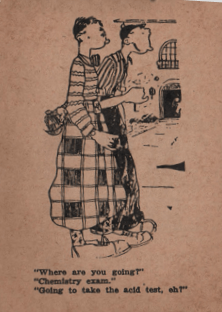
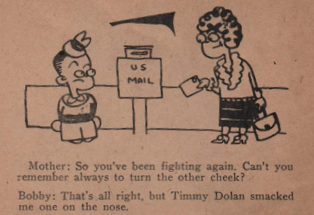
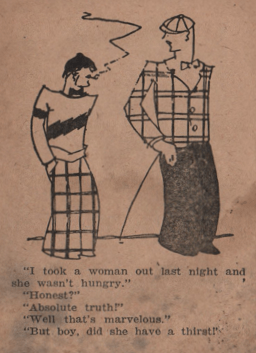
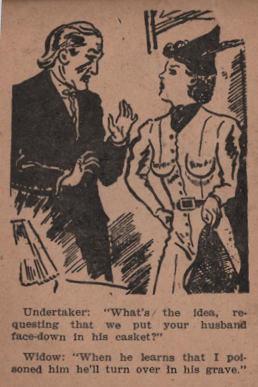
In format, they resemble the eight-page narratives I have discussed in this space, but these are NOT pornographic, and they come with twelve pages each.. Each page contains a different joke with an accompanying illustration, so you were not getting a LOT of jokes when you picked these up. They are the work of Ceagee Publishing a company which, um, I cannot find listed anywhere on the Interwebs. It may have been one person with a stencil machine and a mind for telling jokes. They all date from 1944, so it may have been a G.I. with an office job and time on his hands
Some of the jokes are hits and some are misses, but that’s true of every joke book and every reader. Not every joke is going to strike you as a Button Buster. “How much money do you earn, dear?” “About $1,500 a year.” “But we can’t live on that!”. “:Oh, but they pay me $7,000.”)
What fascinates me about the way he tells his jokes, though, is the casual relationship between the joke and the illustration. For the joke just cited, for example, we have what appears to be a secretary, holding her dictation pad, talking to a businessman who for some reason is lying on the floor next to his desk.
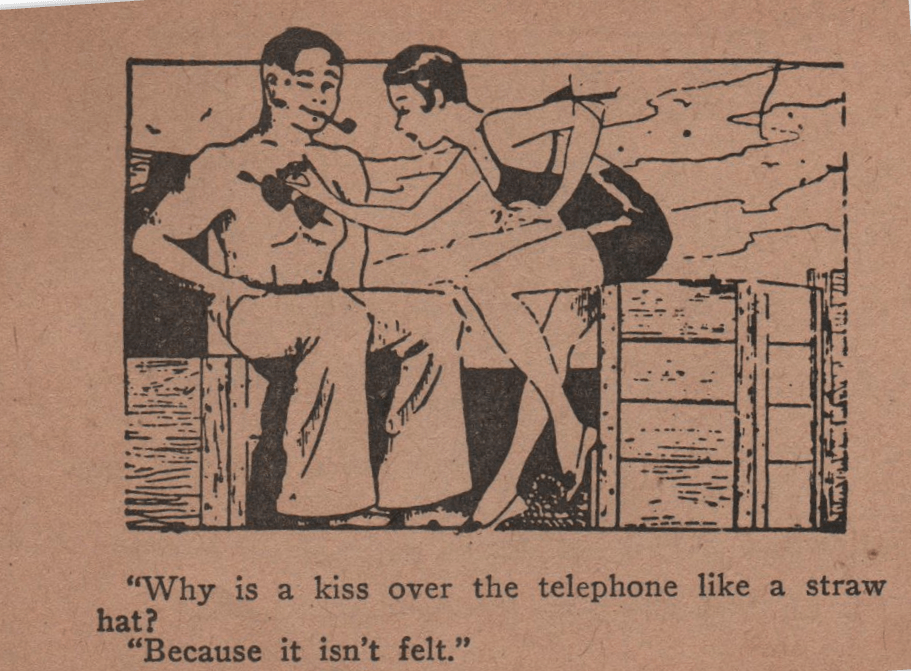
Take this classic bit of humor. There is no earthly reason why this dialogue should NOT be exchanged by two people, one of whom is fondling the other’s chest tattoo, but I’m afraid I don’t see why it should, either.
We are dealing with a number of artists here, some of whom can draw, and some of whom take aim at the target. This little witticism deals with a child explaining her father sells waterproof milk, because it holds water. (The text seeps off the page.)What’s the angry lady with the large posterior doing in our story? I admit she is by far the funniest thing on this page, but why….
It looks as if we’re dealing with someone who had a lot of stock illustrations, and a number of jokes. He then mixed these together as best he could.
That would help explain why some cartoons are drawn in the style of the forties, while others hearken back to an earlier day.
And some seem to exist in a world of their own.
I will go on hunting for Mr. or Ms. Ceagee. I’ve already checked to see if there was a Camp Ceagee or a Ceagee Field or a U.S.S. Ceagee some serviceman might have produced these on. It may have been some high school kid with access to the school machinery, or someone who edited a summer camp newsletter and had access to some cuts. Maybe there was a person whose initials were CAG, or three kids with those first initials. These could easily be the last existing copies of these little volumes on earth (he might also have stolen everything here wholesale from a larger joke magazine, which had the peculiar aesthetic I am crediting to Ceagee.)
But I salute you, oh auteur. You did what you could with what you had, which is all any humorist can do. If sometimes I laughed for the wrong reason, well, I laughed.
I hate it, hate it, hate it when a certain kind of joke is explained to me. The manner of joke of which I speak is the joke which has been there in clear sight, sometimes for years, and I simply failed to recognize it. Having a humor grenade go off in my face after thinking I was safe around it is a terrible shock. There’s a Smothers Brothers joke which sailed over my head as a child, but you’d think in later years…well, when I do my series on “Is That Still Funny?” I can cover these things.
The fine old joke which leapt out at me on the Interwebs was the explanation that “Chips Ahoy” sandwich cookies were meant to be understood as a play on the phrase “Ship Ahoy!” For years I have observed both these phrases in the wild and never once thought of connecting them.
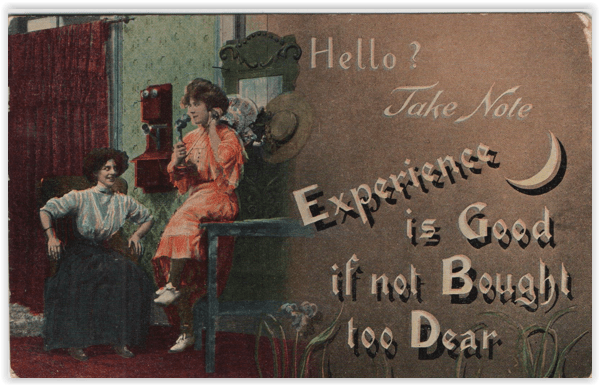
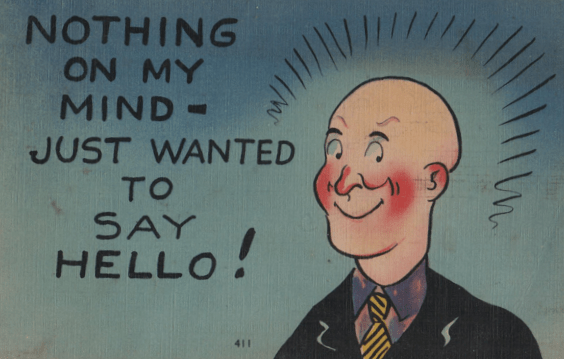
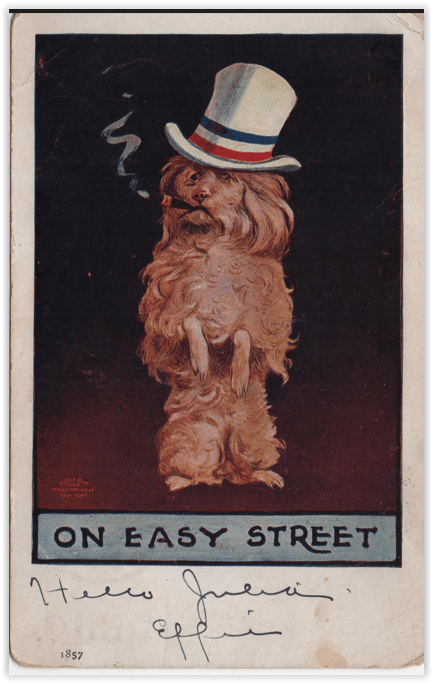
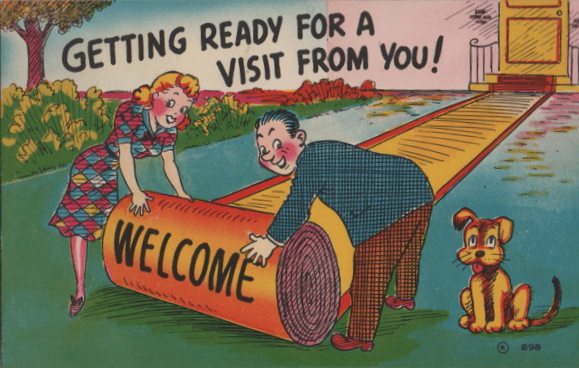
See, I was looking at all these telephone postcards headed with “Hello”, and knowing the fine old story about Alexander Graham Bell…no, not the one about shouting to Mr. Watson and realizing his invention worked. The one about how Bell felt his invention ought to be used. All his life, I am told, he answered the telephone with “Ahoy!” The word, I am told, dropped from common usage for a while, but was revived when more and more people took up sailing as a pastime. Bell was also known for his nautical interests, so it was a natural usage. (Later in life, he worked on hydrofoil vessels and for a while operated the world’s fastest boat. The telephone was not his WHOLE life.)
Anyway, “ahoy” derives from a general lookout yell “Hoy!” which sailors added an a to the front of to make it more noticeable. (We like to add an a to things when we go a-wording. I can’t think of any examples except maybe a-tisket, a-tasket. Maybe we have given up that…no. I refuse to look up the word “ahem” and see if it’s the same sort of thing. I…come to think of it, I have seen “Hem!” used as an interjection, so it could….)
Let’s walk to another rabbit hole. The word “hello” derives from an exclamation of surprise, spelled, variously “Hullo” and “Hallo”, which is related to “Hola” which, and I swear I read this online, so it must be true, derives from the French for “Whoa there”, which they tell me is “Ho La”, la being the word for “there” and…okay, you in the back,. We are also not making jokes about French h…yes, keep that word to yourself, too.
Anyway, the use as a greeting, especially over the telephone, was promoted by no less a media influencer than Thomas Edison. Tom was interested in all sorts of new inventions, and was marketing his own version of the telephone when he wrote a letter using the word, and spelling it “Hello”. (Theories that his hearing, always bad, simply made him mishear Hallo or Hullo will have to go unconfirmed.)
I am not clear on why Tom’s expression should have superseded Alexander’s, but it did. When telephone operators were invented, some people called them “Hello Girls”, and when songs about the new invention spread around the world, through the use of Tom’s phonograph, the most popular of these was “The Telephone Song”, which opens “Hello, My Baby, Hello, My Honey.” (Maybe that’s it. Ahoy, with it’s accent on the second syllable, was harder to fit into songs.)
And that concludes our words for today, except for the words I want to have with that heckler who broke in during our discussion of hola and…by the way, I just checked, and “ahem” is apparently a preferred spelling of the little cough sound people use to get someone’s attention. Abd I promise that is the last a-word we will mention today.
“A merry Christmas, uncle! God save you!” cried a cheerful voice. It was the voice of Scrooge’s nephew, who came upon him so quickly that this was the first intimation he had of his approach.
“Bah!” said Scrooge. “Humbug!”
He had so heated himself with rapid walking in the fog and frost, this nephew of Scrooge’s, that he was all in a glow; his face ruddy and handsome’ his eyes sparkled, and his breath smoked again.
“Christmas a humbug, uncle!” said Scrooge’s nephew. “You don’t mean that, I am sure.”
“I do,” said Scrooge. “merry Christmas! What right have you to be merry? You’re poor enough.”
“Come, then,” returned the nephew gaily, “What right have you to be dismal? What right have you to be morose? You’re rich enough.”
Scrooge having no better answer ready on the spur of the moment, said “Bah!” again, and followed it up with “Humbug!”
“Don’t be cross,. uncle,” said his nephew.
“What else can I be?” returned the uncle, “When I live in such a world of fools as this? Merry Christmas! Out upon merry Christmas! What’s Christmas time to you but a time for paying bills without money’ a time for finding yourself a year older, and not an hour richer; a time for balancing your books and having every item in ‘em through a round dozen of months presented dead against you? If I could work my will,” said Scrooge, indignantly, “every idiot who goes about with ‘Merry Christmas’ on his lips, should be boiled with his own pudding, and buried with a stake of holly through his heart. He should!”
“Uncle!” pleaded the nephew.
“Nephew!” replied the uncle, sternly, “keep Christmas in your own way and let me keep it in mine.”
“Keep it!” repeated Scrooge’s nephew. “But you don’t keep it.”
“Let me leave it alone, then,” said Scrooge. “Much good may it do you! Much good has it ever done you!”
“There are many things from which I might have derived good, by which I have not profited, I dare say,” returned the nephew; “Christmas among the rest. But I am sure I have always thought of Christmas time, when it has come around—apart from the veneration due to its sacred name and origin, if anything belonging to it can be apart from that—as a good time; a kind, forgiving, charitable, pleasant time; the only time I know of, in the long calendar of the year, when men and women seem by one consent to open their shut-up hearts freely, and to think of people below them as if they really were fellow-passengers to the grave, and not another race of creatures bound on other journeys. And therefore, uncle, though it has never put a scrap of gold or silver in my pocket, I believe that it has done me good, and will do me good, and I say God bless it!”
The clerk in the tank voluntarily applauded; becoming immediately sensible of the impropriety, he poked the fire, and extinguished the last frail spark forever.
“Let me hear another word from YOU,” said Scrooge, “And you’ll keep your Christmas by losing your situation. You’re quite a powerful speaker, sir,” he added, turning to his nephew, “I wonder you don’t go into parliament.”
“Don’t be angry, uncle. Come! Dine with us tomorrow!”
Scrooge said that he would see him–yes, indeed he did. He went the whole length of the expression, and said that he would see him in that extremity first.
“But why?” cried Scrooge’s nephew. “Why?”
“Why did you get married?” said Scrooge.
“Because I fell in love.”
“Because you fell in love,” growled Scrooge, as if that were the only one thing in the world more ridiculous than a merry Christmas. “Good afternoon!”
“Nay, uncle, but you never came to see me before that happened. Why give it as a reason for not coming now?”
“Good afternoon,” said Scrooge.
“I want nothing from you; I ask nothing of you; why cannot we be friends?”
“Good afternoon,” said Scrooge.
“I am sorry, with all my heart, to find you so resolute. We have never had any quarrel, to which I have been a party. But I have made the trial in homage to Christmas, and I’ll keep my Christmas humour to the last. So A Merry Christmas, uncle!”
“Good afternoon!” said Scrooge.
“And a Happy New Year!”
“Good afternoon!!” said Scrooge.
His nephew left the room without an angry word, notwithstanding. He stopped at the outer door to bestow the greetings of the season on the clerk, who, cold as he was, was warmer than Scrooge; for he returned them cordially.
“There’s another fellow,” muttered Scrooge; who overheard him, “my clerk, with fifteen shillings a week, and a wife and family, talking about a merry Christmas. I’ll retire to Bedlam.”
This is all good fun just as Dickens wrote it, with rolling speeches and plenty of spots open for comic business. Most versions rearrange, abridge, or expand the dialogue. Scrooge’s big speech is often cut to the punchline about being boiled and buried with a stake of holly and so forth, while that of nephew Fred (who, like Bob Cratchit, has no name yet) is often replaced with a new one expressing whatever the filmmaker thought this version was here to prove. Bob Cratchit’s part in the scene is in direct proportion to his importance to his place in the cast generally.
Apart from these speeches, which even Dickens cut very little in his live performances, what the screenwriters like best are Scrooge’s increasingly explosive “Good afternoons” to dismiss his nephew, and Fred’s defiance of his uncle by pausing to chat with Bob on his way offscreen. Touches not in Dickens which seem to be becoming traditional include Fred’s offered handshakes, rebuffed y his uncle, and a Christmas gift for Scrooge, similarly rebuffed. This is most often a wreath, though Matthau’s Fred brings two gifts, a necktie and a poinsettia, which speaks to his generosity if not his originality.
Whatever the added business, the speeches make this scene. Fred represents the Forces of Good and delivers a ringing endorsement of, as noted, whatever the true Meaning of Christmas is this time. For his part, Scrooge gets to fulminate against any facet of the holiday which strikes the filmmaker as being vital. (Sometimes, indeed, he seems to swing toward the side of the angels, decrying the mindless shopping.) The speeches also set up the fan/Fred storyline encountered later and, most important, gives our hero his first “Bah!” and his first “Humbug!”
Fred is generally a hearty, good-looking chap, sometimes as young as twenty, sometimes apparently in his mid-thirties. (In Finney, he looks hardly younger than his uncle.) He retains his youthful idealism and enthusiasm. Of course, in every version he is well-dressed and well-fed, hardly in danger of the abject poverty Scrooge feels he is risking.
Three versions make major revisions of the scene, most notably Owen. That version, in fact, opens with Fred, whom we meet strolling along the street and impulsively joining boys who slide on the ice. In doing so, he makes the acquaintance of Tim and Peter Cratchit, and performs another slide with Tim on his shoulders. He explains later that he knows their father, and is headed in that direction. They give him a note from their mother, so they won’t need to enter the den of the fearsome Mr. Scrooge, who doesn’t like small boys. Fred says he knows this; when he reveals he is Mr. Scrooge’s nephew, they run away.
Fred visibly braces himself before entering the office, but finds Bob Cratchit alone. He also finds it cold, and urges Bob to put a little more coal on the fire, only to be reminded that Mr. Scrooge disapproves of such waste. Fred produces a bottle of port, unbroken in an earlier fall on the ice, to keep off the chill. His speech in its honor—“the fifth essence of the Christmas spirit”—so excites Bob that not only does he step into Scrooge’s office to borrow a glass (Scrooge uses it for cold medicine) but even puts more coal on the fire. They are about to drink when Scrooge enters, and glares. This not only keeps Bob from drinking, but, as soon as he is unobserved, starts to pull the extra coal OFF the fire.
The scene now continues much as written. Fred offers his uncle a handshake, which is refused. When he delivers his version of the speech about Christmas, Bob, listening outside the room, applauds and then tries to cover the sound by poking the fire, which he does here and in Dickens, but nowhere else.
Owen’s Fred is a very 1930s movie hero; if this were a western, he’d leave the office to ride out to save the rancher’s daughter from rustlers and pumas. He is not yet married to “Bess”; his invitation is for Scrooge to come and dine with his fiancée’s family. Unfortunately, this is the first Scrooge has heard of the engagement. When Fred tries to reassure him, telling him they will of course not marry until there is enough money, the old boy is immediately suspicious. “Has she tried HER relatives?” he demands. In spite of his snappish uncle, Fred keeps his Christmas humor to the last, laughing through much of the “Good afternoons”.
Matthau is alerted to the approach of Fred by Bob Cratchit, who is perhaps trying to distract him from the purloined lump of coal. Scrooge wonders aloud what “that fool” wants, prompting Bob to reply, “I like him, sir. His smile warms my heart.”
The debate between uncle and nephew about Christmas is rendered in song: “When You Say Merry Christmas, I Say Bah!” Scrooge’s main complaint about Christmas seems to be the unjustifiable expense. When Fred offers gifts, he hurls them away, making rude remarks about St. Nicholas, the spendthrift. Invited to dinner, Scrooge, at his most W.C. Fieldsian, exclaims, “Christmas dinner! What a repugnant, revolting institution!” The song then moves to a description of Christmas food.
Throughout this, Bob Cratchit (and our narrator, B.A.H. Humbug) grow more shocked at Scrooge’s remarks, Bob at one point having to restrain the infuriated Humbug. But Fred keeps his Christmas humor to the last. “I pity you, Uncle. Maybe I’ll never be as rich as you, but I’ll go to my grave still believing in a merry Christmas.”
“Good afternoon.”
“A wonderful Christmas.”
“Good afternoon.”
“A magnificent Christmas!”
“Good afternoon!”
On that, Fred exits, singing “An Old-Fashioned Christmas”.
Stewart’s Fred is a well-dressed young man of mischief. He peers through the window and gestures to Cratchit for silence, so he can surprise his uncle. His uncle is less surprised than exasperated.
They move through to the dialogue about poor and rich (instead of “poor enough” and “rich enough”.) “Damn your merry Christmas!” snaps Scrooge at last. He goes on with the speech about idiots being boiled with their own pudding; this is not very forceful, a grumble to himself at best, and Fred, though he grimaces, seems inclined to think his uncle is making a joke.
“I still say merry Christmas.”
“That’s all you do say.”
Fred goes on to his speech in favor of Christmas, which Bob applauds, having come to the door to listen. Scrooge turns, like a sadistic schoolmaster facing a student who has dropped a pencil.
“You said something, Mr. Cratchit?”
“No, sir.”
“Another sound out of you and you’ll make this a truly merry Christmas by losing your job.”
Fred pleads for Cratchit, but Scrooge pays this no heed, and shifts to a discussion of Fred’s marriage. Invited to dine, Scrooge says he’ll see Fred damned first, and calls love a humbug.
“So you won’t come to see me because I married.”
“Yes.”
“Well, you never came to see me when I wasn’t married.”
Fred does not quite keep his Christmas humor to the last; his “Happy New Year” has at least as much anger in it as benevolence. After Fred has departed, Scrooge turns on his clerk again.
“You find my nephew amusing, Cratchit?”
“He’s a very pleasant fellow.”
“You’re another Christmas lunatic like him.”
“If you say so, sir.”
“It seems you doubt me, Mr. Cratchit.” Instead of using the “I’ll retire to Bedlam” speech as an aside, Scrooge uses it to further humiliate his employee.
Outside, Fred moves along until asked for directions by a pair of well-dressed men. They are new to the district, they explain, and are soliciting funds for charity. They would like to find the offices of Scrooge & Marley. Fred tells them how to find these, without a word of warning, merely making a face at the thought of what lies ahead for them.
The other versions of the story, without making quite such extensive rewrites, add their own bits of business. Hicks show his origins by speaking of burying Christmas lunatics not with a stake of holly through their heart but ‘olly through their ‘eart. (Fred also speaks of people opening their shut ‘earts.) On the line “paying bills without money”, he knocks one of Fred’s parcels from his nephews arms, and is about to say exactly where he’d see his nephew rather than dine with him when Fred demands “But why? Why?” . Two good afternoons (which are good evenings in this version) are replaced. When Fred states that he asks nothing and wants nothing, Scrooge snaps, “Well, ye won’t get it, so ye won’t be disappointed, will ye?” The final good evening becomes “You’re a noisy devil, that’s what you are, sir!” On his way out, it becomes clear that Fred and Bob know each other; Bob offerings the wishes of the season to “Mrs. Fred” as well.
In Sim I, Fred is enough in awe of his uncle to knock before entering. Scrooge won’t even look up at the offered handshake. The dialogue is quickly handled; it is obvious that this Fred married against his uncle’s express wishes. Fred’s Christas humor is enduring stuff; he actually whacks his uncle on the shoulder in hearty cheer on departing; Scrooge calls “Humbug!” after him. The old uncle looks uncomfortable (guilty?) at the leavetaking. During the chat with Bob at the door, we find Fred knows Cratchit well enough to wish a merry Christmas to the “small assorted Cratchits” and even ask after “:”the little lame boy”. Bob says Tim is getting stronger every day, and you can see in his face that chatting with Fred has brought him warmth and hope.
In March, as in Sim I, the scene comes after that with the Charity Solicitors. Here is the most robust of Freds, who talks as heartily as he sings, and provokes the most violent reactions on the part of his uncle. It is difficult to say here whether Scrooge detests Christmas or his nephew more. He does throw Fred a grin after expressing a wish see each of certain idiots buried with a stake of holly “through his fatuous heart”. Invited to dinner, Scrooge declares, “I’ll see you in…well, you know the place I mean. I’ll see you there first.” When Fred leaves, it is Bob who stops him, telling him his speech about Christmas really made his day. An exasperated Scrooge growls the “I’ll retire to Bedlam” line, adding “They’re all mad” for good measure.
Rathbone’s Fred is a well set-up man in his early thirties. He greets Bob first, by name, and Cratchit returns the greeting. Scrooge immediately shuts his money-box. There follows a very condensed version of the dialogue, which includes no mention of boiling with pudding or retiring to Bedlam. The :Good afternoons” are there (though Fred called “Good evening, Bob!” on his way in.) In pace of the final “Good afternoon”, Scrooge merely snuffs out his candle.
Haddrick’s Fred is a chinless buffoon with one protruding tooth. For no wildly apparent reason, he delivers his Christmas speech in song, while Bob daydreams in the Tank. Scrooge sings back that Christmas is not an excuse for confounded good cheer. Invited to dinner, he replies, “Never. And especially not at Christmas.” (By the way, the version is not a musical, and this is the only song sung by characters in the whole picture.)
Sim II and Fred deliver most of this dialogue nose=to-nose across Scrooge’s counting table. Fred is heavyset, with pronounced laughlines about his eyes. Cratchit is visibly troubled by the idea of boiling someone with his own pudding. Invited to dinner, Scrooge replies simply, “Never.” Fred looks genuinely grieved when saying he is sorry to find his uncle so resolute. Scrooge here uses his final “Good afternoon!” to object to Fred wishing Bob a merry Christmas.
Finney’s Fred is named Harry, and is a roundfaced jolly chap who announces that it is a joy to see his uncle’s smiling face. Scrooge has just chased off the carolers and warned Cratchit about having a sense of humor, and is NOT in the mood for merriment from his nephew. “God save you!” cries Harry. “God save me from Christmas. It’s a humbug.” But Harry has come in full expectation of sour replies, and enjoys them. In answer to “You’re rich enough”, Scrooge snaps that there is no such thing as rich enough, only poor enough. He orders Harry to leave him alone during business hours. Harry states that 3 P.M. on Christmas Eve is not business hours, but drudgery for the sake of it, and an insult to all men of good will. It is to this that Bob calls a determined “Here here!” Scrooge rebukes him and then snarls to his nephew, “I wonder you don’t go into politics. You’re fool enough.” Invited to dine, Scrooge declares that the “hypocrisy of a happy marriage to some idiot lovesick female” is the only thing “more nauseating” than a merry Christmas. Fred enjoys his uncle’s wrath exceedingly during the “Good afternoons”, telling Scrooge as he departs that his uncle is always welcome, just like Christmas itself.”
Scrooge McDuck’s nephew is, as all the world knows, Donald Duck. His Christmas wishes to his uncle are exuberant,. But when Scrooge declares Christmas is “just another work day”, adding an abbreviated version of the boiled with his own pudding speech, it is Bob Cratchit who replies with Fred’s speech in defense of Christmas. Fred merely endorses this with “I say merry Christmas”, which Bob applauds. Scrooge is affronted; Bob, suddenly abashed, claims he was just keeping his hands warm. Fred hands over a wreath and invites his uncle to Christmas dinner. Scrooge leads his nephew on for a while. But then announces he’ll just get indigestion, jams the wreath down over his nephew’s head, and kicks the poor duck out into the snow. Fred, defiant, returns to hang the wreath on a doorknob and wish his uncle one more merry Christmas. “That Fred,” says Bob, “Always so full of kindness.” “Ayre,” says Scrooge, “He always was a little peculiar.”
Scott’s Fred is a brooding Byronic hero who betrays not a spark of Christmas humor through the whole visit. Scrooge shows his own sense of humor, as well as much forbearance, in sitting through Fred’s lecture, as well as his clerk’s defiant applause. In response to the dinner invitation, Scrooge growls, “I’d see myself in Hell first.” He growls “Idiot!” as his nephew departs.
Caine combine’s Fred’s visit with that of the Charity Solicitors (which see, next installment) allowing Fred a great deal of fun at his uncle’s expense. (Fred donates to the fund himself.)
Curry’s Fred is a handsome, square-faced man (who looks a whole lot like Bob Cratchit, actually.) As Bob is outside fetching coal during most of this scene, a mouse takes his place, fainting away in dead shock at “Stuffed like a turkey, buried with a stake of holly through his heart” but chittering cheerily at Fred’s speech in defense of the holiday. He is later chased away by Scrooge and by Debit. Some dialogue is altered. To Fred’s “:But you don’t keep it”, Scrooge replies, “No. I keep busy.” But this is one of the few versions which keep in the bit about “its sacred name and origin”; Scrooge and Debit cover their ears at this. Fred finally concludes, “If you want to be miserable, fine!”, one of the least Dickensian lines in any production.
Among the books I own which I preserve not because I’ll ever read them is a slender volume on why we must enforce the local laws against feeding wild birds. This was given to me by someone who found it disgusting, and wanted me to read itso I would understand what intolerant people there are in the world. I do not need this book to understand that point, so it rests on the shelf as a memorial to the defiant bird feeder who thrust it into my paws.
I have known several defiant bird feeders.
In some parts of this world, like the town where I grew up, feeding the birds is a matter of personal choice. My parents eventually had nearly a dozen bird feeders, along with a couple of places where, in self-defense, they fed the squirrels as well. New devices to keep the squirrels out of the feeders intended for flying visitors were always worth a try in the effort to give the birds a bit of sustenance through the snowy season. There were plenty of other people who similarly tried to support the migration crowd, and swapping of notes about grosbeaks and cedar waxwings was a congenial way to pass the time. (We were not the only ones in the world with a small portable heating device for the birdbath, for birds do not live by seed alone.)
But living in a city, you find that this way of life is by no means universal. Feeding the birds is, in fact, forbidden by law in my neighborhood, a neighborhood where real estate values are all, and investors point out that scattering bread or seed on the ground can attract rats. Rats are a little scarce in my neighborhood, and this argument is often supplemented by the warning that feeding birds also attracts BIRDS. Pigeons are just not decorative, we are informed, and lower property values and, in any case, all birds, until such time as some good soul provides birdy bathrooms, leave spots on the sidewalk, and clean sidewalks are key to selling your condo. (One of the defiant birdfeeders I will mention always growled “There’s an easy way to fix that. Go buy a house somewhere and take care of the sidewalks yourself.”)
As noted above, however, human nature will not be denied. Some of us just feel a need to look after our feathered fellows, and will not obey the rules. One birdlover I worked for, who held a patent for a security device you could affix to your birdhouses to hold predators at bay, always carried croutons about her person. This may have been before the days when security cameras were planted at the corner of every building, or she may have figured no one would worry about her tossing a few croutons in the grass. She HAD been spotted once or twice, and reprimanded, so she had developed a method for foiling marauding rats.
She explained it to me once. “I count the birds on the lawn,” she said, “And put out just one crouton for each. There won’t be any leftovers for the rats to find.” I was quietly agog at her dedication.
The growling birdlover I mentioned earlier tried to make sure she had a plastic bag of birdseed in her coat pocket when she went out in winter. It wasn’t a lot—just a sandwich bag full—but she would use this supply and replenish it several times each week. (She would have tossed out more, but she knew she was being watched.) A handful of seeds, she felt, would be quickly dealt with, and the birds were good enough at this to make sure nothing was left to encourage browsing rats.
What impressed me most about her, though, was that she had made her peace with the squirrels as well. Next to the baggie of wild bird mix was generally a second bag with peanuts or croutons for her furry friends. She liked animals (but was allergic, so she could never have a four-legged pet.) She told me once, as we were leaving work, that she had learned to talk to them.
I replied that my parents talked to squirrels, too: a lot. Most of this was “Get out of that feeder, you mangy besom!”
“No no,” she told me. “I talk squirrel. Watch.”
We were walking past a small park and stopped to chitter. I waited to see if a squirrel would respond.
But whatever she said was the squirrel equivalent of “Red Light Special in the Beer Aisle!” Every squirrel in that tree-shaded block came at us: a hundred? A thousand? Ten million? The grass before us was suddenly an undulating carpet of eager squirrels. Impressed? I was stunned.
So was she. “Oh dear,” she said, lapsing into human. “And I don’t have anything for you!” She turned to me and asked if I had any bread or something on my person, but I was totally unprepared. She apologized to the squirrels (in human) and they gradually departed, slowly, as if they thought she was kidding about not having any croutons.
I have not yet sold my screenplay for a sequel to “The Birds” called “The Squirrels.” It may just be because Hitchcock isn’t here to direct it.
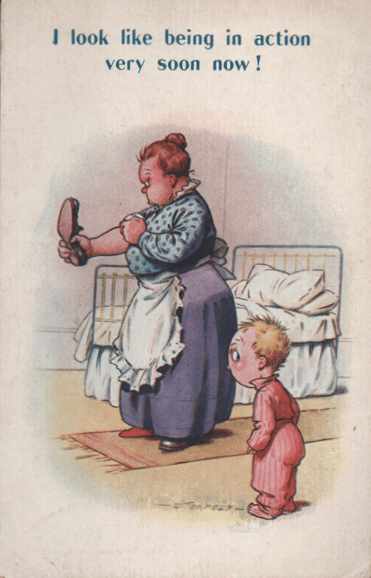
I know what you’re thinking, after seeing that postcard, but no, we are not continuing our discussion of how hilarious our ancestors considered the spanking od miscreants. I have been told my last discussion was in questionable taste, and we know that is a death sentence in today’s world of humor. I thought we might instead consider one of the supporting pillars of comedy, antici
Pation. You knew that joke already? Of course you did. I told you it was one of the great supports of comedy as well as other forms of fiction. Alfred Hitchcock suggested as a basic principle of suspense the object that the audience knew was a bomb, though the characters in the story did not/
Take this joke, surely one of the most reliable of the last couple of centuries. The whole point of the illustration and caption is that YOU know what’s going to happen. He doesn’t.
The use of an ironic caption enhances the joke and/or the anticipation of what happens next.
This is naturally a standard in slapstick, whether rural
Or urban.
But it works just as well when the exact reaction isn’t as thoroughly telegraphed. (For those who have not experienced this plot development in stories or plays, the actor, unable to pay his rent, is sneaking out by night, but has already been spotted by the landlady. Something he isn’t expecting, we know, is going to happen next.)
Complex comedy is possible even in one picture. Here, neither man knows what is about to happen to him but is enjoying what is about to happen to someone else.
We can also enjoy the comedy if the victim does suspect what is about to happen. WE are enjoying the anticipation while HE experiences dread. Whether we are enjoying his dread or his impending fate, we can enjoy the joke. (Is that, um, a club, by the way? Where did this cartoonist grow up?)
Sometimes the humor of the anticipation is enhanced by our sharing the dread, if the oncoming fate is something we have experienced ourselves. The joke can be enjoyed whether the threat is blatant
Or subtle. (The joke has nothing to do with his eyes, which are apprehensive, and studying that cane in teacher’s hand.)
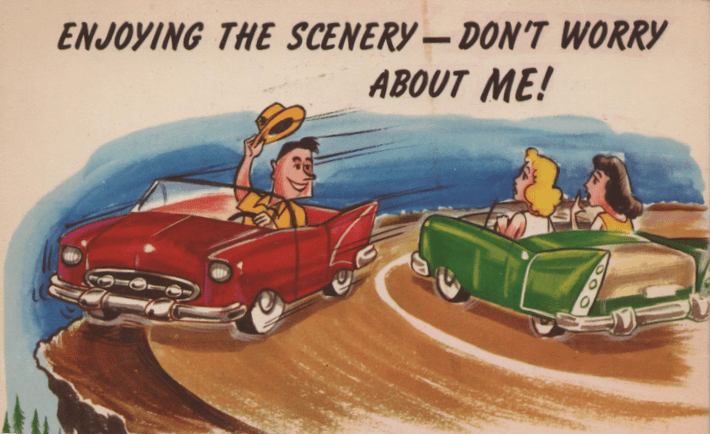
And, as noted, we can enjoy impending disaster whether it is about to happen to the loud and confident soul on the scenic drive, above, or the small and cute, as here.
Anticipation and/or dread, therefore, are basic to suspense, and suspense is very useful in comedy. You may use it to dread or anticipate the day when I feel I can discuss postcard spankings again, but sigh with relief that we passed over that this time.
Once upon a time—of all good days in the year, on Christmas Eve—old Scrooge sat busy in his counting-house. It was cold, bleak, biting weather: foggy withal: and he could hear people in the court outside, go wheezing up and down, beating their hands upon their breasts, and stamping their feet upon the pavement-stones to warm them. The city clocks had only just gone three, but it qas quite dark already: it had not been light all day: and candles were flaring in the windows of the neighboring offices, like ruddy smears upon the palpable brown air. The fog came pouring in at every chink and keyhole, and was so intense without, that although the court was of the narrowest, the houses opposite were mere phantoms. To see the dingy cloud come drooping down, obscuring everything, one might have thought Nature lived hard by, and was brewing on a large scale.
The door of Scrooge’s counting-house was open that he might keep an eye upon his clerk, who in a dismal little cell beyond, a sort of tank, was copying letters. Scrooge had a very small fire, but the clerk’s fire was so very much smaller that it looked like one coal. But he couldn’t replenish it, for Scrooge kept the coal-box in his own room; and so surely as the clerk came in with the shovel, the master would predict that it would be necessary for them to part. Wherefore the clerk put on his white comforter, and tried to warm himself at the candle, in which effort, not being a man of strong imagination, he failed.
This is one of Dickens’s gifts to the filmmaker. He tells us, briefly but with a subliminal chuckle, that it is about three in the afternoon, the weather is cold and dark, and Scrooge keeps an eye on his clerk for wasteful habits like using coal to keep warm. Note that as written, Bob Cratchit, who doesn’t even have a name yet, doesn’t actually try to snitch any coal. He knows better.
But hardly a filmmaker misses the opportunity to amuse or alarm us with Scrooge’s meanness here. Even in Bugs Bunny’s Looney Christmas tales (1979), which reduces the whole story to seven minutes, there is a coal scene (Porky Pig makes an exceptionally chilly Bob Cratchit, as he never wears pants anyhow.)
Some films, notably Magoo, change Scrooge’s character by giving him a comfy, well-heated office while Bob shivers outside in the chill of the Tank. Caine, at the other extreme, doesn’t seem to have any fire in the whole establishment. Most versions limit the business to one fire—in Scrooge’s office—though Owen in fact gives Bob a good, roaring blaze.
In Hicks, we have two fires, as stated; Cratchit’s is not merely low on heat but so low on light he is having trouble squinting at his books, his candle being as inadequate as his fire. He has no better luck warming his fingers at his mouth. When he tries to sneak some coal behind his boss’s back, he is spotted in the mirror Scrooge has obviously set up for just that purpose. Bob starts to explain that his fire is in danger of going out, but Scrooge corrects him. Since Scrooge’s money pays for the coal, that is certainly NOT Bob Cratchit’s fire. Bob puts the coal back, grumbling, whereupon Scrooge beckons him over. As the older man inquires about his family, Cratchit seems to entertain some hopes, but Scrooge is merely warning him to safeguard that family’s future by making sure he is worth his salary. Wasting coal is not a step in that direction.
Owen combines the scene with that of nephew Fred’s visit.
Sim I’s office, located in a fairly dismal and oil-traveled street, looks warmer than most, but Cratchit is doing his best to warm frigid fingers at the candle without attracting the attention of the Charity Solicitors, who are waiting with him in the Tank. This Cratchit is a small, nervous soul who wishes to offend no one, and accustomed to leaping just before his master cries frog.
March is one of the few versions which abbreviate the scene, and brings it in after the visit of the Charity Solicitors. When Cratchit asks for more coal, Scrooge barks that they will be closing in five minutes and the fire can just go out.
Rathbone skips the scene entirely.
Magoo’s Scrooge, in his warm, bright office, sings “Ringle Ringle”, a song about what fun it is to have lots and lots of jingling coins, and does not seem to notice Cratchit slipping in from his dark, cobwebby Tank with a coal shovel. Bob has just reached the glowing stove when there is a cry of “Cratchit!” The clerk, shivering despite his hat and comforter, asks for a bit more coal in the name of Christmas Eve. This is quite the wrong strategy; Scrooge informs him that as it is Christmas Eve, this would be a disastrous time for him to be losing his position and then advises him to warm himself by attending to his work. “Be asking for a feather bed and tea service next,” Scrooge grumbles. He then continues to sing “Ringle Ringle” counterpointed by Cratchit, in the next room, singing “It’s Cold”.
Haddrick leaves out the coal. He demonstrates his personality by kicking a caroler’s doll out of the way as he enters the office and snaps at Cratchit not to chatter when his clerk says “Hello, Sir”.
Sim II shows us a clock with the hands pointing to three o’clock. Cratchit is trying to warm his hands at his candle. The door opens, allowing a cold wind to rustle the papers on Scrooge’s desk.
As the opening credits finish, Matthau scolds Cratchit for enjoying the opening theme song, “An Old-Fashioned Christmas”, and then threatens him with dismissal. He thumps Cratchit’s desk for emphasis, dislodging a lump of coal Bob has been concealing. Scrooge is furious at the attempted theft; B.A.H. Humbug confides to us that Bob has to smuggle coal into the fire lump by lump. “Next thing you’ll be picking my pockets,” Scrooge snarls.
Finney’s office is dark, but not too frigid. His Cratchit seems submissive, but doesn’t cringe. There is no business here with coal.
Scrooge McDuck arrives at his office on the morning of Christmas Eve in time to find Bob Cratchit putting a lump of coal into the fire. Cratchit points out that his ink has frozen (his quill pen, in fact, has turned blue) but Scrooge reminds him that he used a lump of coal just last week.
In Scott, we see a number of shoppers and passers-by blowing on their hands for warmth. Cratchit here is not even trying to swipe coal; he is reprimanded for just poking up the fire, which will waste coal by making the fire burn it faster. He is then treated to a lecture in which Scrooge points out the difference between coal, which can be used up, and warm clothing, which can be useful over and over. Bob’s face is one of tight-lipped resentment; Scrooge seems not so much angry as weary, perhaps of having to deal with people who do not understand these basics. This Cratchit does seem more comfortable in his position, perhaps guessing that Scrooge would never find so cooperative a clerk so cheap, and even attempts small talk with his boss. Scrooge rebuffs this.
Caine’s Cratchit is in charge of a whole corps of bookkeepers, who are appropriately rats. This office is the darkest of the lot, its windows caked with dirt and its candles utterly inadequate. Scrooge’s part of the office is no brighter or warmer. Scrooge demands the eviction notices for tomorrow and when reminded that tomorrow, responds, “Very well, you may giftwrap them.” He goes on about Christmas being the foreclosure season, with so many people spending money on frivolities. His sudden grin of pleasure is unpleasantly cheerful. This may be as close to a good mood as he ever comes, so the bookkeepers push Bob to request a little more coal to thaw their frozen ink and defrost their frozen assets. When Scrooge bellows a threat of unemployment, the bookkeepers disavow any feeling of chill, breaking into a chorus of “Island in the Sun”. Scrooge chuckles to himself as Cratchit admits, “I think you’ve convinced them again, Mr. Scrooge.”
Curry’s London includes a road-mender’s fire, at which vagrants warm themselves. One of these is a boy we shall see later as a caroler, and then as a turkey-fetcher. People are engaged in full holiday frolic on the snow-clad cobblestones; the crowd includes a jester pedaling a unicycle among the revelers as he juggles. Cratchit watches through the window; he is a squarely handsome man of optimistic mien, though he hides this when Scrooge snaps at him for humming along with the opening theme music. The business with the coal will be combined with the bit about carolers later.
Stewart has a well-lit but bleak office. Most movie Scrooges have polished paneling, which gives off a warm glow, but here the wood is thin, old, and scrubbed to a cheerless blue-grey. There is a shelf for hats with a row of pegs underneath; the point is to stress Scrooge’s utilitarian attitude over his Victorian picturesqueness. A lean, mournful Cratchit attempts to rebuild the small fire with which both rooms are heated, and is met with a sharp look and a command to “Poke it, sir! Poke it!” Poking the fire kindles no warming glow; Cratchit shivers, and goes on to fail to warm his fingers either at his candle or his mouth. This Cratchit has been with the firm at least since the death of Jacob Marley, and seems less afraid to speak to his boss than some of the others.
FUSS FUSS FUSS #3: Mr. Robert Cratchit, Esq.
Bob Cratchit comes on stage more often than any character other than Scrooge himself. Only in the visions of Christmas Past is he absent, and one wonders why some enterprising filmmaker has done nothing about this.*
Cratchit is harder to cast, too. he has hardly a speech where he isn’t reprimanded either by his employer or his wife. A lot of modern viewers despise him, considering him a spineless cringer without Uriah Heep’s redeeming qualities. Anti-Carol folks, whose name is legion, point out that Cratchit has been with the firm seven years or better (perhaps he was hired to help with the work load when Marley fell ill) and is still making only 15 bob a week. He can’t be much of a clerk, goes the argument, since if he was worth more, he’d have been hired away from Scrooge & Marley by now. These people are entitled to their opinion, of course. But I wouldn’t sit down to a bowl of smoking bishop with any of them.
What you need is someone who can convincingly play a likeable chap who lacks ambition and will suffer anything—cold, low pay, abuse from the boss—just to keep a job. Maybe that’s why some viewers loathe him; his character hits too close to home.
As far as looks, Dickens is, as usual, no help at all. He tells us almost nothing about this clerk, not even giving him a name until we are halfway through the story. The only hint he affords us is to twice call him “little Bob”, surely making him the ideal father for “Tiny Tim.” (And for once, Dickens has been too subtle for his audience. “Little Bob” is actually a pun: a bob is a shilling, see, and as he does not get paid many of them, Mr. Cratchit is a man of “little bob”. Yeah? Well, go write your own Christmas classic.)
Naturally, the filmmakers regularly provide a tall, lanky Bob Cratchit, younger than Scrooge but too old to be a mere apprentice. Magoo’s Cratchit is surely the tallest and thinnest of all, with a long nose on which spectacles are precariously perched. Sim I’s Cratchit, on the other hand, is surely the smallest to start with and shrinking, rather, the more he gets barked at. Owen’s version, as Michael Pointer noted, is built more along the lines of Mr. Fezziwig than the traditional Bob Cratchit.
Hicks’s Cratchit may be the oldest of all. (Dickens himself portrayed Cratchit, in public readings, as an older man who had lost a few teeth as he aged, whistling when he used the letter S.) Cratchit seems generally to grow younger as we move to the newer versions. Finney’s seems the youngest. March’s has the best hair, while Caine’s is best dressed, as well as being one of the few who does not wear those trademark fingerless gloves. In Two versions, Cratchit is valued almost as much as Scrooge, the role being handed to major stars (though one is a mouse and the other a frog.) In March, by Contrast, almost all of Cratchit’s scenes are simply dropped; even the scene at the death of Tiny Tim is cut away.
Matthau’s Cratchit is the most groveling (he even argues against his own raise at the end) though Rathbone’s may be the most easily frightened. Sim I’s Bob tries to disavow any interest in Christmas, suggested he’d gladly work through the holiday if it weren’t for his family (this is a lie.) Finney’s is a Christmas fanatic right up there with Dickens himself. (Like Owen’s Cratchit, he makes a huge deal out of the punch, for example.) One gets the feeling that even his family finds this a bit much, and is just humoring him, but, anyway, it beats being at work.
*PSSSST! (footnote)
It is not the purpose of this volume to give hints to screenwriters (at least, not without suitable recompense.) But here’s one way to do it.
Fan has just told Ebenezer he is leaving his dreadful school forever, and they run to the coach outside. On their way, Ebenezer gets tangled with a smaller boy; they both fall down. The smaller boy scrambles to his feet, all breathless apologies, but young Scrooge grabs hold of his hands and shakes them crying, “It’s all right! It’s Christmas! Everything’s all right at Christmas!” He then runs off with Fan, the smaller boy watching in admiration and growing cheerfulness until a voice calls, “Bob! Bob Cratchit! You’ll miss the coach”
He runs off in the other direction, and we have given Bob a cameo in the vision of a Christmas Past. You’re welcome.
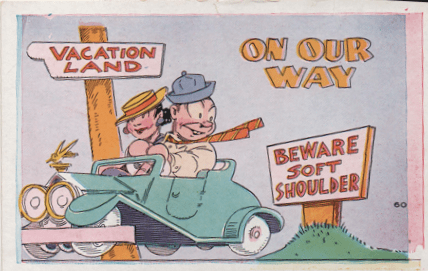
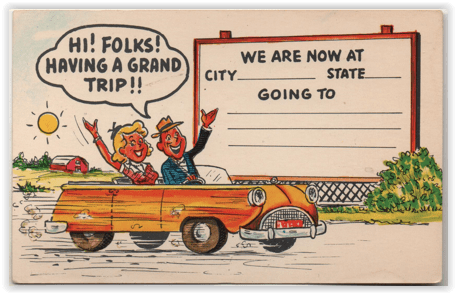
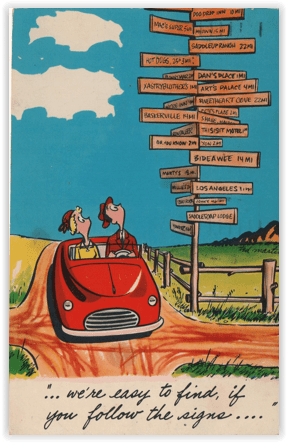
In previous columns derived from postcards in my “Vacation” file, we have considered the early days of the camper and the way cartoonists saw American automobiles moving from squarish to rounded to squarish again. I have a few postcards left in this stack and noticed a separate phenomenon which the cartoonists can help us meander through. I refer to the prevalence on postcards of the roadster.
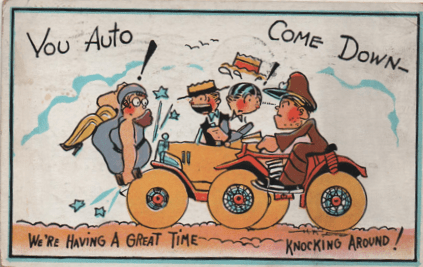
“Roadster” is a type of automobile which the dictionaries and car lovers have been very definite about, though it is a word few people use nowadays. (The party was over when they updated the Nancy Drew books so she no longer drove one.) It is an open-top conveyance of “sporting appearance or character” which is designed to hold, at most, three people (two is more comfortable.) Roadsters (sometimes known as runabouts, spiders, or city cars) differs from other sportscars in its complete lack of a roof, which may explain why you don’t see a whole lot of them offered to the general public today.
It also differed from modern sportscars in that some models were available at a low price to people who wanted to drive only when the weather was good or just for errands around town (this was a long time ago, when wheels were not essential to adulthood.) A small car with a reputation for joyrides and party excursions, it could be made even smaller for the purposes of the cartoonist.
The roadster was a godsend to cartoonists anyhow: it was compact, and didn’t take up space the postcard could use for other things.
For many, the roadster was the vehicle for singles, people who were carefree and without a lot of emotional baggage to be loaded in the vehicle along with groceries or family members.
It was the perfect vehicle for someone who just hankered after a nice, long road trip, or someone who was pulling up stakes and headed for whatever life offered somewhere down the road.
The roadster was also perfect for those quick trips by the young and the reckless.
The freedom to climb into a car with one other person and set off with the breeze in your face made a driver feel affluent and care-free.
There are plenty of postcards featuring traffic jams, but you hardly ever see roadsters on these: THOSE drivers have roofs over their heads and troubles on their mind. Traveling light and free was a part of the American dream.
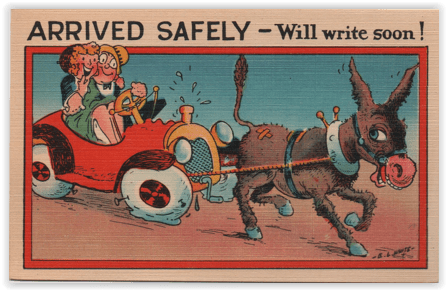
Motels were clean and frequent along the dream road, and postcards were available all along the way so that the roadster lovers could make progress reports along the way.
Some cartoonists were willing to hint that even in a road trip, that dream could be hard to realize.
And even in a roadster, certain necessities could make your road rougher.
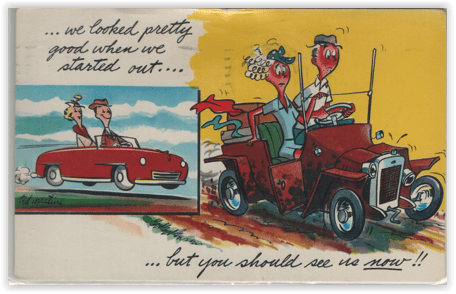
Reality and the roadster, however, were not an ideal match, As the occasional cartoonist pointed out.
When I was poking through my inventory of vacation-related postcards in quest of a subject for this column (and deciding I will not write about vacations as long as I am still wearing my winter coat when I venture outside) I noticed that every cartoonist has a personal way of drawing cars. Cars have been essential to vacation cartoons at least since the late nineteen-teens, which is about when the observation on tourists at the top of this blog was published.
It was obvious at the outset that some cartoonists really love drawing cars, and put a lot of thought and detail into their vehicle work, while others, while okay at car-drawing, would just as soon concentrate on something else. This can also be reflected in the kind of car that appears in the picture. Some artists wanted to stay as up-to-date in car design as possible, as this would appeal to the modern eye, while others went for their favorite jalopy as long as it was plausible.
This vacationer, for example, is having his hot time somewhere in the late 1930s or thereabouts, but this model of car was on its last legs, at least as far as new cars were concerned. In the world of used cars, this square-nosed model with running boards and fold-down top would stick around for a generation, As Jack Benny fearlessly drove his Maxwell into the Sputnik age, and Archie drove his pals around in one at least until the Reagan administration.
Other cartoonists, however, quickly adapted the more streamlined look. Note that the bumpers, fenders, and grille are far less square and tend toward the Art Deco or Airflow ideal. (The joke dates to horseless buggy days, of course.)
This is a more intermediate design. It’s a visual cue similar to that used by Archie or, say, The Beverly Hillbillies. The square, open auto helped emphasize how much you were piling in: the squarer design just implied weight and bulk.
Round, though, was the wave of the future. Something smooth and efficient could be just as much fun to draw, and could look just as anthropomorphic as that jalopy we saw smoking earlier.
Even the larger models could be drawn to imply speed and elegance.
Especially speed.
Artists who wanted to imply something else could slip in a few features of bygone models to suggest obsolescence.
Those smooth, elegant lines could be made more angular to suggest long, hard wear.
World War II interrupted to some degree. Some people drove their rattling Model Ts for a few more years while those who had the sleek automobiles enjoyed their speed and elegance where possible. (Note that this couple rides on the rims, the actual tires being stacked on top so as not to wear them out on the long vacation trip.)
After the war, of course, that old streamlined look seemed too decade-specific. Car designers started to look at the straight line again, breaking up the curves, prompted, according to some critics, by the resemblance of 1930s automobiles to helmets, which were an unpleasant reminder. At the same time, the postcard was moving into its last days as a major tool of cartoon humor
It wasn’t that people stopped piling things into and on top of the car for a vacation; they were just more likely to buy a card that showed where they’d been instead of how they got there. Pity, really, as they were driving into the era of the Volkswagen Beetle, surely the most cartooned vehicle since the Model T. I’m not sure that’s what this cartoonist had in mind but it sure isn’t a Corvette.