Oh, all right, if you’re going to cry and kick your heels, we’ll talk about the chicks and their role on postcards of a century or so ago. This is NOT the right time of year, as you will see, but as, just like last year, I don’t really have any Halloween cards, I will accept the inevitable.
Eggs are laid all year around, and yet somehow the little ball of fluff which comes out of it is tied by tradition to the coming of Spring. Maybe it’s some deep inner spring within the human imagination which looks at a chick, a creature which can be seen working its way gradually into the outside world and thinks of the slow but inevitable emergence of life after a long hibernation. Or perhaps we look at something which could be born at any time of year and see in this the hopes of the new season, which is just as cyclical and (one hoped) as inevitable.
Or maybe we just like looking at critters that are cute.
The first great feast day of Spring was, of course, Easter. We will let the philosophers debate whether the date of Easter is really linked to earlier Spring holidays, and discuss the symbolism of birth, rebirth, and resurrection. For every poem showing Christ emerging from the tomb there are a hundred showing a fluffy yellow fuzzball emerging from an egg.
This card shows the momentous occasion, and uses a frame to remind us what that shell used to look like, in case we forgot.
Sometimes the chick is a little surprised to see us making a fuss about it. (“are there going to be bells every time I undress? Wait ‘til I start molting.”)
The chick is frequently seen looking at its old home. (“Seems to me I got free meals when I was inside there. Any leftovers for alumni?”)
And because we want to toss in as many Spring symbols as possible, there are generally always flowers in the vicinity. Does the chick care about these? Probably not. (“I/d like to climb back in there. I just saw something called a cat and it was a lot more violent than those pussywillows.”)
We will also see Easter eggs mixed into the picture. This also confuses the former egg occupant. (“They tell me these are hardboiled, so these guys should be really interesting when they hatch out. Speaking of new words, what does ‘a la king’ mean?”)
The world of the postcard has no particular limits on what may come out of eggs, further confusing the chick. (“If you sit on this one, Mamma, there won’t be any room left for me.”)
Or does a chick look on its egg as a past phase, to be forgotten as soon as it is finished? This chick apparently ignores pretty much everything, though. (“Art Nouveau? Phooey! Where’s the food?”)
Some postcard artists simply plunk a chick down in the middle of everything else. This distinguishes the Easter cards from all the other cards they do with pretty flowers all over the place. (“Well, this is a little roomier than my last egg. Nice view from the window. But who are all these people looking at me?”)
Others bundle him in with whatever Easter symbol might appeal to the viewer. (“A basket full of roses, huh? What’s the matter: nobody’s invented jellybeans yet?”)
The more symbols you can fit in, of course, the more likely the postcard-buying public will know this is an Easter card. (“This is really nice, and I can see a homily coming about why Dad crows at daybreak. You wait for that while I go pick out a Halloween costume. I’ll throw on everything I find and go as a postcard artist.”)
As Dennis the Menace will not tell you, eating all your cooked carrots builds good character.
Animals, birds, and insects seem to get all the really good superhero names; even weather conditions and abstract qualities seem to be preferred. There was Captain Carrot (a superhero rabbit) and The Black Orchid, but more villains get named for plants than heroes: there’s Poison Ivy, long a favorite in Batman, and Nightshade. You could count Starfire, the Teen Titan, whose name, Koriand’r, may remind you of Coriander. If you think that was accidental, what about her evil sister, Komand’r? I used to write stuff like that and look how I ended up.
CASHEW “Perfume”
*CASTOR OIL PLANT “Merit”
*CATALPA TREE “Beware of the Coquette”
CATCHFLY “Snare”*
CATCHFLY, RED “Youthful Love”
CATCHFLY, WHITE “Betrayed”
Of course, trapping flies is what gives most of our flycatching plants their meanings. I’m not sure how “Youthful Love” gets in there: someone may be making an editorial comment on teen romance. For this plant, Laura Peroni tosses in the proverb “He who allows himself to be taken is lost.” This is one of those wise old sayings which means less every time you look at it. Maybe it runs better in Italian.
*CATNIP “Playfulness”
*CATTLEYA “Mature Charms”
CATTLEYA PINOLI “Matronly Grace and Dignity”
I have been unable to identify the cattleya pinole; the cattleya experts I have consulted tell me there was a mad orchid craze in the 1830s and 1840s, just when flower language was at its height. A tangle of new names, many of which became obsolete, was one result; a craze for building greenhouses in North America was another. Cattleya was one of the species most crossbred; it has been suggested that it was the parent of most commercial orchids today, hence perhaps the matronly part of the meaning. In any case, the name cattleya pinole seems to have been lost in the shuffle.
CEDAR “Strength”
This is a reference to its good, strong wood, as is the following.
CEDAR OF LEBANON “Incorruptible”
Celandine, Greater: see SWALLOWWORT
CELANDINE, LESSER “Joys to Come”
*CELERY “Assure Me”
CENTUARY “Delicacy”
This is also blue bottle, blue bottle centaury, cornflower, corn bottle, and sometimes bachelor’s button. Some books claim it is known as centaury because the centaurs, half-man half-horse doctors of the Ancients, used it in medicine. Laura C. Martin, another plantlorist, informs us that centaurs actually used gentians, and the first Greek to see a centaury thought it was a gentian and therefore called it centaury. Gosh, those crazy Greeks: what can you do?
*CEREUS “Long Life”
CEREUS, CREEPING “Horror”
The floriographers didn’t like plants creeping around. By the way, in two books, you will find separate meanings for “Creeping Cereus” and “Cereus, Creeping”. Can’t ANYBODY take this seriously?
CEREUS, NIGHT-BLOOMING “Transient Beauty”
Cerinthe: see HONEYWORT
CHAMOMILE “Energy in Adversity”
Chamomile, or Camomile, is famous for growing stronger the more it’s walked on. Shakespeare mentioned this, and Dorothea Dix tells the Revolutionary tale of a Boston woman who was asked about it by a British soldier. “It grows stronger the more it’s trod upon,” she told him. “We call it Rebel Flower.”
Champignon: see MUSHROOM
CHERRY “Good Education”*
Claire Powell says this is because the wild cherry was so thoroughly improved by gardeners. I was expecting someone along the line to mention George Washington, but nobody did.
CHERRY BLOSSOM “Spiritual beauty”
CHERRY, WINTER “Deception”
Some say this is because it looks like a cherry but tastes terrible. So why doesn’t THAT symbolize education? Claire Powell, however, says the Winter Cherry tastes perfectly all right, but isn’t so sweet as a cultivated cherry.
CHERRY, WHITE “Deception”
Cherry Tree, Cornelian: see DOGWOOD
CHERVILM, GARDEN “Sincerity”
CHESTNUT “Do Me Justice”
They tell me the fruit of the chestnut is good, but ugly.
CHESTNUT, HORSE “Luxury”*
Claire Powell tells us this was not much good for lumber or fruit, but was grown because people liked it, making it a luxury tree. I do notice several other nut-bearing trees being given “luxury” as a meaning, though.
CHICKWEED “Rendezvous”
CHICKWEED, MOUSE-EAR “Ingenuous Simplicity”
CHICORY “Frugality”*
Chicory has been added to coffee to make the coffee supply last longer for as long, it seems, as people have been drinking coffee. Those who get used to coffee with chicory won’t drink any other kind. Mme. De Latour also mentions Cicero’s tale of a frugal meal of chicory and mallows.
*CHICORY WITH NARCISSUS “Try to Save Me”
Chicory for frugality—that is, saving—and Narcissus for ego, or me. Kind of a play on words. Not the especially funny kind.
Chinaberry: see PRIDE OF CHINA
*CHIVES “Protection, Healing”
CHOROZEMA VARIUM “You Have Many lovers”
CHRYSANTHEMUM “Cheerfulness under Adversity”
*CHRYSANTHEMUM, POMPON “Abundance”
*CHRYYSANTHEMUM, PINK “Fidelity, friendship”
CHRYSANTHEMUM, RED “I Love You”
This dates back to Flora’s Dictionary by “A Lady”, who was Elizabeth W. Wirt. Biographical data on her is sparse because she is overshadowed by her husband, William Wirt, U.S. Attorney General who prosecuted Aaron Burr. He wrote a number of books, too, the most popular of which was his biography of Patrick Henry. A biographer calls him one of those characters who hovers forever between being historically significant and a passing celebrity.
People who write about his wife mention that she was the author of Flora’s Dictionary, the first flower language book published in the United States, in 1829. This does not seem to be especially true. All the copies I’ve seen are dated 1831, and, in fact, she quotes Dorothea Dix’s book a couple of times. Still, we can’t blame her for what other people wrote about her.
CHRYSANTHEMUM, YELLOW “Slighted Love”
More than one floriographer notes that yellow plants frequently carry unlucky meanings, usually things to do with faded love and infidelity. Plantlorist Roberta M. Coughlin says this is a French custom. Henry Phillips, writing in 1825, keeps referring to a slang expression I haven’t run into elsewhere: “to wear yellow stockings”, which seems to mean one is jealous, or has been betrayed by a lover.
The way to keep your lover’s interest fresh is simple: lots of flowers. “Flowers increase the attractions of a home and are a safeguard against temptation.” The Ladies’ Wreath, 1849-50.
CINERARIA “Always Delightful”
CINQUEFOIL “Maternal Affection”
In wet weather, the leaves contract over the flower, reminding poets of a mother protecting her child. (Two floriographers give it the meaning “Parental Affection”, letting fathers in on the picture.) Joseph E. Meyer, one of a family of famous herbalists, said the flower was used as a charm to protect children. The five leaves (cinque foil) symbolize the fingers, see: it was felt this natural hand would slap away any danger approaching the wearer.
Circaea: see NIGHTSHADE, ENCHANTER’S
CISTUS “Popular Favor”
Henry Phillips says this flower is just about as short-lived as popular favor.
CISTUS, GUM “I Shall Die Tomorrow”
This seems a bit dark, but I assume it was something you sent to a lover who was taking someone else to the dance tomorrow. One could make us of it if one was a secret agent, of course, trapped by a mad doctor and about to be boiled down into tapioca meatloaf. The trouble is that in such a situation one is unlikely to find gum cistus ready to hand. Oh, I know, James Bond would have a belt buckle that turns into gum cistus at need, but the rest of us are not so well equipped.
CITRON “Ill-Natured Beauty”
This may be in tribute to the sourness of the fruit. On the other hand, a lot of it goes into fruitcakes. Too many holiday fruitcakes, of course, can make you ill-natured.
CLARKIA “The Variety of Your Conversation Delights Me”
Cleavers: see SCRATCHWEED
CLEMATIS “Mental beauty”
This is Dorothea Dix’s meaning, just beating out Mme. De Latour’s “Artifice”. Mme. De Latour was referring to the way beggars used clematis to make fake sores and win audience sympathy. It was sometimes known as Bohemian Plant, or Beggar’s Plant.
Clematis, English: see TRAVELER’S JOY
CLEMATIS, EVERGREEN “Poverty”
CLIANTHUS “Self-Seeking, Worldly”
CLOTBUR “Rudeness”
CLOVER “Fertility”
Clover is very generic in floriography. Of the eleven floriographers who mentioned it, there were ten different meanings, from “The Holy Trinity” to “Will You Marry Me?”
*CLOVER, CRIMSON “Prudent, Watchful”
Huh! It really means another Tommy Sands comeback.
CLOVER, FOUR-LEAF “Be Mine”
*CLOVER, FIVE-LEAF “Bad Luck”
CLOVER, PURPLE “Provident”
Henry Phillips said this was the most valuable clover for making hay. A provident farmer would have plenty on hand.
CLOVER, RED “Industry”
Claire Powell attributes this to the bees which busily collect nectar from it. Bees don’t like any other color?
*CLOVER, SCARLET “Gay But Good”
CLOVER, WHITE “Think of Me”
Most of the clover meanings appear first in A Lover’s Language of Flowers, one of the five or six most influential works of floriography. It was published in Halifax, Nova Scotia part of A Lover’s Book of series, credited to “A Lover of Flowers:”. This Lover of Flowers took some of her material from Lucy Hooper’s The Lady’s Book of Flowers and Poetry but added more, to make a book which became important because the text was stolen almost (but not quite) word for word and reprinted as Kate Greenaway’s Language of Flowers in 1884. This is the single most reprinted flower language book in the English language. (Kate Greenaway
herself probably had nothing to do with the text; she merely illustrated it. When you can, get a look at the original edition: the many cheap reprints don’t do her illustrations justice.) The Hooper to Lover to Greenaway connection created a flower language that has been thoroughly pirated ever since.
CLOVES “Dignity”
Well, of course. How can you be dignified if you’ve got no cloves on? Cloves seem to have been worn as a mark of dignity among the Moluccan Islanders, whose chief export was cloves. The western world’s discovery of, and craze for, cloves made the Moluccan Islanders a force to be reckoned with in history.
COBAEA “Gossip”
Because the plant, like gossip, spreads so rapidly.
COCKSCOMB “Singularity”
The floriographers phrase it different ways, but it all comes down to the cockscomb being a slang expression for a fop, a dandy, a dude: a person, generally male, who dresses for impact, hoping to stand out from the crowd and be considered singular.
*COCONUT MILK “Deception”
Colchicum: see SAFFRON, MEADOW
COLTSFOOT “Justice Shall be Done You”
Mme. De Latour preferred “They Shall Render You Justice”, but it comes to the same thing. The story, which I do not bind to my breast with hoops of steel, says the Coltsfoot, or Sweet-Scented Saxifrage, was discovered by a man who was so amazed that such a lovely plant had gone unnoticed for so many years that he cried out “You shall have justice!” and immediately wrote it up for the scientific journals. This was back when scientists were still considered human.
COLUMBINE “Folly”*
Somebody felt this flower resembled horns, the symbol of the cuckold, or husband whose wife has proven unfaithful, so it was taken to mean “Slighted Love”. Other floriographers said the slighted husband felt foolish, and the meaning came from that. However, Mme. De Latour felt the flower looked like the horned cap and bells of a jester, or fool, and took the meaning from that, an opinion concurred in by those people who know the Columbine as Fool’s Cap, or Folly Flower.
Every few years, a proposal comes up to make the Columbine the National Flower of the united States, for Christopher Columbus. Chris had nothing to do with it. The flower was named by people who looked at the plant and saw neither horn’s nor fool’s cap, but thought it resembled a dove or, in Latin, columba.
COLUMBINE, PURPLE “Resolved to Win”
Some people believed that lions ate this flower whenever they had a big hunt coming up, for added stamina and strength of purpose. If you rubbed it on your hands, they said, it would give you the courage and resolution of a lion yourself.
COLUMBINE, RED “Anxious and Trembling”
I guess the lions didn’t like this one.
*COMPASS FLOWER “Faith”
CONVOLVULUS “Bonds”
A dandy little compendium of probably swiped material, glorying in the title The Language and Poetry of Flowers and Poetic Handbook of Wedding Anniversary Pieces, Album Verses, and Valentines, Together With a Great Number of Poetical Quotations from Famous Authors decrees that there is a delicate difference in your message if your convolvulus is fresh. If you send fresh convolvulus, you are telling your sweetheart “I am Trapped in the Bonds of Love”. If the convolvulus has faded or withered, however, you are saying “I am in Prison”. In those days, news of arrest moved more slowly, and all good prisons had convolvulus growing on the walls.
*CONVOLVULUS, FIELD “Captivation”
CONVOLVULUS, MAJOR “Extinguished Hopes”
Henry Phillips says he added this meaning to flower language to give ladies a flower they could hand to rejected suitors.
CONVOLVULUS, MINOR “Night”
This is also known as Night Convolvulus.
CONVOLVULUS, PINK “Worth Sustained By Judicious and tender Affection”
CORCHORUS “Impatient of Absence”
Essentially “I’m tired of you being away so long”.
COREOPSIS “Always Cheerful”
Dorothea Dix says that the long-lasting blooms of the Coreopsis bring lasting cheer to your garden. Readers of James Thurber, however, realize that it can be almost as hazardous as a case of the kohlrabis.
COREOPSIS AKANSA “Love At First Sight”
The difference between this and ordinary Coreopsis has not been explained to me. Some floriographers weren’t sure either, and switched the meanings.
As you may recall from our last thrilling episode, we were considering the rooster as CEO of a work force, producing a great deal of effort on the part of his work force by sheer inspiration. (Okay, he contributed a bit more than inspiration. If you’re not willing to play along, you can sit with your phone in the corner and deal yourself you ten thousandth game of solitaire.)
As CEO, the rooster had at least one other major job which the postcard cartoonists took very much to heart. He was also in charge of Public Engagement, or what we used to call marketing. The rooster raised his voice to let us know what was going on at just about any time he felt good and ready. (I’ve worked for bosses like that myself. By the way, that whole business of his being Nature’s Alarm Clock is the bunk, according to experts who have warned me, unnecessarily, about relying on a rooster for my wake-up call. A rooster may easily start crowing hours before the sun comes up, or just sleep through dawn and start hollering later in the day. Some roosters are no use at all in this way. I’ve worked for bosses like that, too.)
But let us not forget that his chief duties lay (sorry) in the egg factory. Like many human managers, he had to keep an eye on production if he didn’t want to become Sunday dinner.
A contented work force was essential for delivery of product.
Though some were tough managers who kept demanding more and faster production.
His work force might have their own opinions on this, leading to fatigue and unhappiness in the ranks.
Or straight rebellion.
The wise manager showed he valued his workers, consulting (or pretending to consult: you’ve worked for roost…managers like that yourself, haven’t you?) Considering their needs when locating a new coop, for example.
I have not covered the role of chicks in this process so far, but they had their part to play in the company as well. Egg production was primarily for the market to be turned into meringue, pumpkin bread, or over-hard with three slices of bacon—okay, I’ll take four. But a few had to be allowed to hatch, to become the workers and managers of tomorrow. I kind of have a feeling we have two potential CEOs here, trying to define their roles in the barnyard as they work through the ranks to become the High Cockalorum for the next generation.
Silly would-be roosters. They didn’t realize that until they grew up, they had only two jobs to worry about (especially on postcards.) One was to symbolize the effort of making a living generally.
And the other, though much more important, was only one day a year.
I hope you didn’t think we finished up our concerns with the animal world, having covered bulls and horses. We must not neglect the animal frequently associated with farms which writers have often advocated bringing to the city: the chicken.
There have always been those writers who, hoping to instill in you a degree of self-sufficiency, wrote that what we all need is a few chickens in our life. This would provide us with eggs, which can be sold, making us a nice side income, and bring us to more healthy habits, as if you have chickens, you need to “go to bed with the chickens”, meaning going to sleep early so you can get up when the chickens awake at the rising of the sun (or earlier,.) Why suddenly changing your daily cycle to reflect that of a bunch of birds indicates self-sufficiency is a matter they discuss at great length without ever making the answer clear, at least to me.
Of course, our ancestors, being knowledgeable about such things whether they decided to go into egg hustling or not, knew that none of this would be possible without the rooster. The rooster played several roles in the cartoons of the postcard companies, but one job was paramount. For amateur or professional egg-grower, the rooster was essential.
And didn’t he know it. The strut of the male chicken who knew he was the be-all and end-all of the egg business gave us the expression “cock of the walk”, for an alpha male.
Not that his work day was any less hectic than that of the person who bought the postcards.
And he was just as liable to complaints that he was falling behind in his job.
Now and again, he would be mistake himself for an absolute ruler.
But the fact of the matter was that he was simply CEO of a large work force. And like any other manager he had to deal with slow-downs by his workers.
He is shown in business negotiations.
Technically, the work force was made up of free-lancers, who might work for chicken feed (sorry) but who could always decide not to put in the effort.
Many of whom were perfectly willing to work, but just wanted to see the boss sweat a bit, too.
No matter what observers had to say about the relationship of management and labor.
Still, one way or another, the work got done.
One way or another. Um, remember what I said about his employees being free-lancers?
This shrub is now officially Steptosolen jamisonii.
BRYONY “Prosperity”
BRYONY, BLACK “Be My Support”
This is a climbing plant without tendrils, so it cannot climb without some kind of support. And why did Nature provide us with a climbing plant that can’t climb?
BUCKBEAN “Calm repose”*
Also known as Hogbean, this plant was used to predict the weather. It would not bloom unless the weather was going to be calm. Henry Phillips, however, says the meaning comes from its way of floating in calm waters. I could do that.
Buckthorn: see JUJUBE TREE
BUGLOSS “Falsehood”*
This was an early cosmetic, and of course the use of make-up was considered subversive for eons. According to the experts, a rouge made of bugloss will last for days and cannot be washed off; water will only freshen it and make it look redder. Please do not try this at home without supervision. I don’t want a lot of angry emails.
BULRUSH “Docility”
This is one of those plants where two different stories vie for the meaning. Docility is the older and more common meaning, and comes from Isaiah 58:5, where the bulrushes are bowing their heads. For the other story and meaning, see REED.
BURDOCK “Importunity”
This plant has burs, which are likened to a person bothering, or importuning, you. The minority meaning, “Touch Me Not”, in related. You’re basically saying, “Stop bugging me, okay?”
*BURNET “Nourishment”
Mary McNicol, who wrote a book on cooking with flowers, says the French love this in their soup. I would say that settles it, but this meaning is one of Mr. Morato’s, and he’s Italian.
BUTTERCUP “Ingratitude”
Hardly a floriographer has any kind words for the buttercup. Of course, the floriographers are not as firm as I’d wish on what flower they mean, going off on tangents about Crowfoots of various kinds, King-Cups, and Double Yellow Violets. A couple of minority meanings are very popular, though Ingratitude is the oldest, appearing first in Robert Tyas’s 1836 translation of Mme. De Latour (though not in Mme. De Latour’s original.) Robert Tyas was a naturalist who remained interested in floriography all his life. Some flower language experts prefer “Childishness” as a meaning, a reference, like “Ingratitude”, to how hard buttercups are to grow in the garden. Others like “Riches”, since the flower is gold. Jane Webb Loudon lists “Ingratitude” but adds that the ancient, original meaning of the buttercup throughout Europe was “Jealousy”. Jane Webb Loudon is the ONLY floriographer who uses “Jealousy” as a meaning for buttercups.
We’ll come back and discuss Jane Webb Loudon a little later.
BUTTERFLY WEED “Let Me Go”
C
CABBAGE “Profit”
Most food plants, as referred to heretofore, refer to some kind of wealth or prosperity.
Elizabeth W. Wirt, in her flower language book, has a section full of lore, which includes instructions for cabbage divination, a fortune-telling procedure she says young ladies used to find out about their future husbands. Cabbages for this need to be pulled from the ground the night of October 31, and provide all manner of information. The shape and size of the root indicate something she does not specify about “the object of their desire”. Any dirt adhering to the root shows the future husband will be rich. Tasting the stem tells you whether his disposition will be sweet or bitter. The stem is then placed over a doorway: the first man through the doorway after that will bear the same first name as the future husband.
Nobody in my neighborhood grows cabbage, so I have been unable to check any of this out. I can thus not offer a money-back guarantee on it.
*CABBAGE LEAF “Providence”
*CABBAGE FLOWER “New Worry”
This is Mr. Morato again, so maybe my translation has failed again. Does cabbage HAVE a flower, or was he talking about Cauliflower?
Cabbage, Skunk: see SIPHOCAMPYLOS
CACALIA “Adulation”
Flower language was very popular in American magazines. It travelled from journal to journal through a process known to scholars as “theft”. The editor of a little weekly in Boston knew no one on their subscription list would be reading that cheap little monthly from Columbia, South Carolina, and lifted pages of stuff with impunity, either by simply reprinting it, or by calling it an “Exchange” giving credit (but no cash) to the original. Late in the nineteenth century, Wyoming newspaper editor Bill Nye became the second most famous humorist in the country through this method. So many newspapers in new York lifted his stuff that what he had to say spread through the country. He worked himself nearly to death doing lecture tours, when he learned he was going to die of spinal meningitis, trying to make enough money for his family to live on when he was gone. Adulation, which he had, wouldn’t buy groceries. But he did get quoted in Mark Twain’s autobiography.
CACTUS ”Warmth”
Some writers prefer “I burn”. Either makes sense if you’ve ever sat on one.
*CACTUS SPECIOSISSIMUS “Perfect Beauty”
Tovah Martin, flower historian, notes that a cactus craze swept this country in the 1830s and again in the 1890s. A plant that needed so little watering was as good as furniture.
*CACTUS, VIRGINIA “Horror”
Claire Powell explains this is a serpentine cactus that shoots out little snakelike runners.
*CALAMINT “I Wish You Well”
CALCEOLARIA “I Will Lend You Money”
This is also known as the Pocketbook Plant; the blossoms look kinda like purses if you squint a bit.
CALENDULA “Anxiety”
Richard Folkard, Jr., a nineteenth century plantlorist who disapproved of flower language, put two dictionaries of flowers in his book: one giving the true, ancient language of flowers while the other showed the modern, corrupt version. This meaning comes from his true, ancient language. Folkard, by the way, is the only author I’ve found prior to 1985 who mentions Calendula at all.
*CALISAYA “Assistance”
Callisaya cinchona is the tree from which quinine is derived. This drug was more famous in the nineteenth century, but has not lost its usefulness to this day.
The plant produces extra flowers if you cut off the leaf buds. Sarah Josepha hale thought this was benevolent.
CAMELLIA “Unpretending Excellence”
Starting in the 1880s, floriographers tried to differentiate between a red camellia (“Unpretending Excellence”) and a white one (“Perfect Loveliness”). This did not spread far enough for me to consider it definitive. As a public service, I should point out that the name of this flower is properly pronounced ca-MELL-ia, and not ca-MEE-lia. The confusion comes from calling La Dame Aux Camellias Camille, but they aren’t supposed to be pronounced similarly. It’s too late for me to change, but perhaps you’re younger and less set in your ways.
*CARAWAY “Treachery”
Caraway appears only in Fritz Klingenbeck’s Lasst Blumen Sprechen (Let Flowers Speak), published in Austria in 1944. The Germans had Mme. De Latour in translation by 1820, and their floriographers took flower language in a separate direction. Herr Klingenbeck’s book was the only book from this tradition I turned up during my research, and I have included him because the idea of a flower language dictionary being published in Nazi-occupied Austria struck me as symbolic of something or another.
CARDAMIME “Paternal Error”
Henry Phillips identifies this as the Cuckoo Flower in King Lear’s crown during his mad days, and makes in an emblem for Lear’s fatal mistakes in child-rearing. (Of course, it would have been too simple for Lear’s Cuckoo Flower to have been just a Cuckoo Flower, which see.)
CARDINAL’S FLOWER “Distinction”
This lobelia gets its name the same way it gets its meaning: because it is so bright red.
CARNATION “Woman’s love”
See also PINK. Some people claim, there was once a real difference between a carnation and a pink, but with all the gardeners crossbreeding them, there’s no point now in bothering with it. Sure, blame the gardeners.
I would like, at this juncture, to introduce you to Lydia H. Sigourney. Lydia, who seems always to have written as Miss Sigourney or L.H. Sigourney, was simply the Number One Female Poet of her day. She wrote acres of flower poems, all quoted in the better flower language books, but did not get around to writing her own flower language book until 1846. This was about the same time she was making highly-publicized European tours, during which she was celebrated as a major American literary light. (But you should read what her hostesses said about her after she left.)
Her vogue passed, and she was dropped from American literary history so fast and so far that she has not recovered to this day. All she is remembered for now are Mark Twain’s parodies of her style, particularly her way of churning out obituary verse. I have been unable to find out what Mark Twain thought of floriography, and I admit I’d rather not now.
Anyway, she was right there standing up for Carnations.
*CARNATION, DOUBLE “Give Me Time for Reflection”
CARNATION, PINK “Encouragement”
CARNATION, PURPLE “I Have No Affection For You”
CARNATION, RED “Alas, For My Poor Heart!”
‘CARNATION, RED, WITH PINK CARNATIONS “Send Letter”
*CARNATION, RED, WITH PINK AND RED CARNATION PETALS “Call As Soon As
Possible”
Carnation, Striped: See PINK, STRIPED
CARNATION, WHITE “Devotion”
By the way, the Carnation is the official flower of Mother’s Day. This does not, apparently, mean that you give Mom carnations. (That’s what Mums are for, I guess.) You wear one to show that you are aware you had a mother. A white carnation indicates that your mother is still living, while a red one shows that she has passed to where you can no longer borrow money from her.
Carnation, Yellow: see PINK, YELLOW
A yellow pink? That’s worse than West North Avenue.
In our last thrilling episode, we considered our ancestors and their mutually beneficial relationship with the horse, an animal you could easily ride or hitch to a wagon, carriage, or plow. People worked together with horses to make a happy, peaceful society based on a relationship of mutual trust and admiration.
Except when they didn’t.
Cartoonists do a WHOLE lot better when they are complaining about something than when they praise it. So the cranky, ornery side of the horse made it onto postcards with regularity. See, horses did things besides run or pull. For one thing, they kicked.
And sometimes they sat down and declined to go to work today. The horse knew what it meant when that harness went on, and occasionally just said “Nay.” (Please note that I went all through the last column without a single horse pun and don’t nag me with your tale of whoa.)
Alternately, some horses went entirely the other way and decided to run and run without stopping, or, in fact, paying any attention to any other suggestions the rider made.
As anyone who knows their western folk songs knows, the horse that didn’t want to take you anywhere had other options besides just sitting down. A horse could perform amazing gymnastic moves in trying to buck a rider.
And frequently succeeded
The cartoonists, like any good rider, was willing to admitted that being thrown was not always entirely the horse’s fault. Sometimes the rider was simply not much good at it.
Or was simply unlucky.
The cartoonists were also willing to show that not all the grievances were on the human side of the relationship. Horses are one of the few animals regularly shown as worn out, exhausted, or even physically impaired by the work their humans put them through.
Horses are also more likely than any other animal to be shown getting old. Being retired, or “put out to pasture”, was not necessarily the lot of every working horse.
Of course, if there was one thing horses did that the cartoonists covered most…but we discussed that in a previous blog, and there’s no need to cover that whole territory again (though this human has to.)
We’ve discussed this before. Our ancestors, those of the era when sending postcards was far more common, were also more likely to encounter animals on a daily basis. I am not making some pitch to consider them as more harmonious in our relation to nature than our degenerate generation. They had mice gnawing through the floorboards on a regular basis, spiders in the outhouse, and bedbugs under the mattress in every hotel. The next door neighbors might keep a pig or goat in the back yard—frowned upon in most urban areas today, except where you can get ‘em classified as pets (companion animals)—and if not, they almost certainly had a cat that yowled on the fence, a rooster who crowed at 4 A.M., or a dog that was chained to a guardhouse in the yard and took out its frustration on passersby.
Of course, of all the animals the urban inhabitant was likely to meet, the horse leads the list. The golden age of postcards was the same ag when people were thinking about making the change from four-legged drive to four-wheel drive. So everyone was aware of the hard-working horse. (Horses could not form unions to improve working conditions; we had to do that for them. Black Beauty, a classic of horse literature for kids, was written originally to show people how the horses they took for granted could suffer.)
Horses could be seen on every side: they hauled freight.
Sometimes they hauled freight AND passengers.
They hauled people intent on business and people riding for pleasure, and frequently people whose pleasure was monkey business.
The passengers thus hauled remembered this service fondly for generations.
And, as many a postcard cartoonist pointed out, they could haul the new-fangled undependable forms of transportation.
Just like humans, though, there were some horses who turned to a life of sports. The race horse was a breed apart, and people who would not have looked twice at a horse with a rider up in the middle of town flocked to see the same sort of thing on a competitive basis at the track. (This led to an argument which goes on to this day: did you bet on a reliable horse or a reliable jockey? One side of the question preferred to give the credit to our own species, while the other side pointed out the jockey couldn’t get down and carry a horse across the finish line. The debate continues to this day.)
And, of course, racing goes on to this day, becoming a major tourist industry.
And leading to its own peculiar lingo. Yes, the horse was a mighty worker and athlete, and an all-around friend to humankind.
If you bought the right postcards, of course. (Next time: the other postcards)
This is also the whortleberry, and was originally a chap named Myrtillus. Pelops was racing his chariot against that of Myrtillus’s master, and bribed Myrtillus to sabotage the man’s chariot. Pelops, on winning the race, killed Myrtillus for betraying his master. Pelops was a man of principle, see. Myrtillus, as a son of the god Hermes, was turned into a whortleberry bush after death. How much good this did Myrtillus I am not in a position to say.
BINDWEED “Humility”*
Claire Powell notes that this plant has no strength to rise from the ground until it winds itself around another plant. Some floriographers specify this meaning for the Small, or White, Bindweed.
*BINDWEED, SEA “Uncertainty”
Bindweed, Small: See BINDWEED
Bindweed, White: see BINDWEED
BIRCH “Meekness”
This is related to how birches bend before the wind, which also gives it its minority meaning, “Gracefulness”. The birch was always a symbol of something that was willing to give way in the face of overwhelming odds, only to spring back into place once the Irrepressible Force has passed. The proverb went something like, “The oak stands straight and proud, and the wind blows it down. The birch bends, and laughs at storms.”
Some floriographers reject this, stating that “Meekness” comes from the use of birch switches to whip children into a proper state of quivering submission. The very qualities which made the birch a sweet, bendable tree made its branches fearsome whips. These are primarily twentieth century floriographers who doubled as Victorian bashers, blaming everything wrong with the world on English speaking people of the nineteenth century. Just as a matter of passing interest, the Victorians were not so united on the subject of whipping children as the twentieth century liked to believe. Henry Phillips, writing before the Victorian Age had really gotten off the ground, claims whipping children has gone out of style. Lapsing into garden lingo, he says everyone knows that “birch manure” produces only weeds where flowers might have developed. If you have the stomach for it, you can check out a debate on the subject which ran for two years in a letters column in The Englishwoman’s Domestic Magazine in the 1860s. Of course, plenty of people who wrote in claimed the modern, progressive parents who refused to beat their children were responsible for the lawless younger generation and the decline of civilization generally.
Anyway, I see no reason to make the birch a symbol of brutality. But whoo gosh, look at the next entry.
‘BIRCH RODS, BUNDLE OF “Unity, Strength”
It’s a lesson to us all: those pliant, meek rods become a weapon of power when tied in a bundle, a symbol of what people can do when they work together for a common goal. Aesop made a fable of it, to which Tommy Smothers added his own moral, “When you stick together, you make a bundle.”
HOWEVER, the term for this bundle is “fasces”, the symbol of the Fascist Party in Italy. Fasces are, of course, an ancient symbol, predating the fascists, and survived this spell of infamy. Nowadays they occupy a spot on the back of the Roosevelt dime.
BIRD-CHERRY “Hope”
“BISHOP’S PURSE “Answer Quickly”
Bittersweet: see NIGHTSHADE, BITTERSWEET
Blackberry: See BRAMBLE
Black-Eyed Susan: see RUDBECKIA
BLACKTHORN “Difficulty”*
This may refer to the use of blackthorn as a wood for walking sticks, which makes walking through difficult places easier. On the other hand, its berry is the sloe in sloe gin, which can make walking difficult again.
BLADDER-NUT TREE “Frivolity, Amusement”*
This and the following are two different plants, but each bears a fruit resembling the inflated pig’s bladder used by jesters and other comedians before the rubber chicken was
invented. Everyone agrees that this is where the meaning comes from EXCEPT Mme. De Latour, who came up with the meaning in the first place. She says it refers to the way that women of fashion who, when bored, would take the little fruits and squeeze them until they popped. This custom is part of the frivolous past. In the twentieth century, we invented bubble wrap, which served the same purpose and didn’t need to be watered.
*BLADDER SENNA “Frivolous Amusements”
*BLEEDING HEART “Compassion”
BLUEBELL “Constancy”
Virtually any blue flower can be used to represent faith, fidelity, and constancy. “True blue”, you understand.
*BLUEBERRY “Ingenuous Simplicity”
Blue Bottle: see CENTAURY
BLEUT “Delicacy”*
This is also sometimes known as Quaker Ladies.
BONUS HENRICUS “Goodness”
This is also called Good King Henry, supposedly a reference to Henry IV. However, Geoffrey Grigson, who is not a floriographers but a plant lore expert of reputation and common sense, says it was originally known just as Good Henry, to distinguish it from a similar, but poisonous, plant called Bad Henry. Who Henry was, Grigson is not sure, but he says the name goes back to before the days of henry IV. He suggests it might be a corruption of Hermes, the Greek God of Thieves and Businessmen. In Roman mythology, Hermes is known as mercury, and the two plants in question are also sometimes known as Good Mercury and Bad Mercury.
Bonus Henricus, also known as Goosefoot, is supposed to be edible. (That’s why it’s GOOD Henry, or BONUS Henricus.) Grigson checked this out, which is farther than I would go in this line of research, and said it didn’t kill him any but he wasn’t in a hurry to add it to his diet.
BORAGE “Bluntness”
A concoction of this was often drunk, we are told, to give people courage. People who gain courage by drinking are often blunt. (Most experts tell you to ignore the story that “Borage” is just a corruption of the word “Courage”.) It is a rough, shaggy-looking plant, and those are often chosen to mean bluntness or roughness by floriographers. (If you would like to drink borage and see what it does for you, it is an essential ingredient in Pimm’s Cup Number One.)
Bouquet: see NOSEGAY
BOX “Stoicism”*
This is an evergreen which doesn’t require much care and will survive careless gardening. It can also survive being cut into all manner of decorative shapes. Cut down, it yields a hard, durable wood. We should all learn a lesson from the valuable Box, to not complain but just go on doing what we were meant to do despite difficulty or discomfort. I could go on about this, but my typing fingers are kind of sore.
BRAKE “Confidence, Shelter”
BRAMBLE “Envy”
This is a choking plant which will destroy more virtuous plants, killing off the good ones until only the bad ones are left. You catch the symbolism here.
The bramble was symbolic enough to attract some interesting minority meanings. Miss Carruthers, an Irish floriographers of 1879, said the bramble can represent lowliness because it
grows so low to the ground, or remorse, because it can plaque you with so many prickles. These did not catch on.
And Claire Powell, for once giving the Victorians credit for a sense of humor, says the Bramble was sometimes called “Lawyers” because it enjoyed tripping people up.
“BRAMBLE BLOSSOM WITHOUT ANY THORNS “There is No Deceit At All”
BROOM “Humility” or “Neatness”*
These meanings are equally popular, and will often both be listed by the same floriographer. We are obviously dealing with someone’s maid here. Mme. De Latour started “Neatness” on its way, while “Humility” is the contribution of Dorothea Dix, who goes out of her way to let us know she DISAPPROVES of the meaning, since there is no reason for any poet to use the Broom to signify humility, except for that pesky story about the Plantagenets. She assumes we all know the story of the Plantagenets.
No, don’t look it up; I’ve saved you the trouble. The Plantagenets never completely agreed on one story, but the gist of it is that a nobleman whose name may have been Fulk offended the Church and worked off his offense by making a pilgrimage to the Holy Land with a sprig of broom in his hat. No clue as to why he picked broom, though Dorothea Dix hints that a bundle of broom was used “in place of the birch” on him. Anyway, when he came back, he chose a new family name. Not speaking English, as it hadn’t been invented yet, he called himself a Plantagenet, after “planta genista”, or broom. (Botanists keep telling us it is improper to call broom a genista but people keep doing it. Just ornery, I guess.) His descendants got to be kings and queens of England, and Fulk is now featured on any number of fine family trees.
I ran into an article on the Interwebs telling about how old postcards are time capsules, left by people in the past to take us back for a slice of history. It was quite a pleasant article, with nice illustrations (the kind of thing we try to do here) and I DO intend to steal the idea for today’s blog, but there is that inside me which moves me to register one slight objection.
See, old postcards are NOT time capsules. Time capsules were left specifically for the purpose of sending information to the future, while postcards were matters of immediate moment. No one even THOUGHT about them being read by anyone but the recipient and maybe the mail deliverers and the postmaster. Yes, they can take us back in time, but they weren’t meant to. Those document boxes I was given at the Book Fair by a middle school which had its students assemble time capsules in grade school in the seventies to be opened in the distant twenty-twenties, but then got tired of storing them and dumped them on me—those were intentional. Or a time capsule would be left to be retrieved by the people who made it, like those college seniors of the 1880s who buried a letter, a fruitcake, and a bottle of whiskey to be unearthed thirty years hence at a class reunion. (I often wonder how many of those fruitcakes are still buried on Midwestern campuses. I assume someone retrieved the whiskey the first time they got thirsty.)
But I know what the writer of that article MEANT, and so I am going to repurpose her basic thesis and show you a few postcards which hide a chance for time travel to people reading them in 2022.
At the top of this column is a simple card made by a company to encourage stores to stock their product: picture of the product, space for the order. But what the heck is “Washing-Tea”? It’s a laundry soap named from the idea that women who used it could have the laundry done by nine o’clock, and stop for a cup of tea. Different world: nowadays we toss the laundry in the machine and ask Alexa to start the teapot.
This little card was printed, message and all, for the YMCA in England to hand to members of the American army landing to take part in World War I. No need for the censors to check it for sensitive information spies might read. It was a quick and easy way to tell someone back home you’d made it this far, before texting was invented.
From the same era comes this announcement of a meeting of a German language church group which is saving money by putting its New Year’s Party invitation for 1918 on the leftover cards from 1917. They had to economize, as the club was undoubtedly having a hard time. In Iowa, where it was mailed, public use of German had been outlawed with the start of the war. Did they get together to welcome 1919?
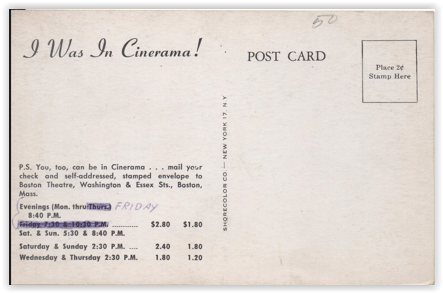
Return with us now to those thrilling days before streaming, Netflix, and cable, when going to a movie involved going out of your house. Not every theater could afford to book first run movies, so how to advertise reruns? Easy, explain that you’re booking only those movies that you KNOW will be interesting (because millions of people saw them three years ago.)
This was a fold-out postcard. Here’s what you found inside, in case you wondered who was still box office when the movie was five years old.
This card goes back to when even telephones were rare and expensive items, at least for a salesman out in his territory. The Des Moines Register and leader Company expected a daily postcard from its sales reps, with a note on what they were doing and where they could be found over the next couple of days.
Here’s a card which demonstrates in a couple of ways how the world has changed. The Delbridge Company made its founder’s fortune by providing pages and pages of mathematical computations for how much this many bales of that would cost at this price. No pocket calculators yet, much less phones with calculators in them. You looked up the page with the amount and the price per, and the columns of figures would show you what eighty-three barrels or bales or pounds would cost. (And, because it was a different world, Mr. Delbridge took his money and founded a new town devoid, by his decree, of laws or rules except for The Golden Rule. You couldn’t live there unless you promised to abide by that basic premise. It, um, started well.)
I have been able to learn nothing about the Sunrise Club, but the place it met was used for that purpose by many clubs, including the famous Turtle Club, which annually elected its president by a method which would NOT go over today. The Turtle Club served bowls of very rich turtle soup at its dinners. Whoever could consume the most bowls of this soup and still walk around the dining room became the president. (Lawsuits would put the club AND the meeting place out of business in one year these days.)
And here’s a little time capsule to let us know that NOT everything has changed. This was mailed out for the first conference of a group which still exists today. And I betcha even today they have to remind their members to go through the buffet line just once or prices will go up next year.
Enough of this. I’m going to get out my metal detector and go prospecting for buried fruitcake. No, not to eat: the holiday gift season is coming.
We have seen in this space many postcards reminding you of the value of a good day’s work. The virtues of elbow grease in keeping one’s nose to the grindstone, or something like that, was extolled in card after card. AND we have seen cards which complained about tough bosses, long hours, short vacations, and the annoyance of having to work at all. In either case, it was clear that the postcard artists knew we were out there sweating for our daily bread.
So naturally, the poor working stiff was accorded great respect, right? Ho ho.
See, the cartoonists followed the lead of comedians past, who knew that most of the people we bumped into on a daily basis, and who bumped into us, elbowed us on the streetcar, pushed ahead of us in line, or actually SOLD us our daily bread were working stiffs like the rest of us. So they reckoned that we would buy postcards slamming our fellow citizens.
Those people who worked all day long selling us things were obviously cheating us (or we’d have more money left after the deal was complete.) Sometimes they used tools to accomplish their cheats.
And sometimes they managed on sheer nerve.
On other occasions, it wasn’t so much the prices they charged as their general attitude toward perfectly respectable customers like us.
Some professions just naturally attracted complaint. Jokes about barbers and their personalities go back at least eighteen hundred years. (Here’s a joke from a Latin classic: “How would you like your hair cut today, sir?” “In silence.”)
Women who worked were always being subjected to accusations that they got their jobs on looks alone. Counter clerks in stores were always getting that sort of gag.
And, of course, waitresses. (Another golden oldie, going back at least to Victorian comics, “The barmaid shortchanged me again. I doubt she can even count on her fingers.” “No, but she can count on her figure.”)
Mind you, men who worked in occupations where they waited on women could rely on jokes about their predatory leanings. Shoe salesmen were always under suspicion.
The same went for window washers. (Cue George Formby’s number “When I’m Cleaning Windows”.)
You’d think firefighters would be immune, but no, they had to take their lumps as well.
As the old joke goes, “A man can serve sodas at a counter eight hours a day with a smile on his face, and yet to other people he’s still a jerk.”
Postcards admitted that there was really only one sure way to get a compliment on the job you’d done.