More Worries

   We were discussing faded fads in our last column, considering those phenomena that blazed through the culture with such acclaim that everyone knew what they were about, but which disappeared so suddenly that it isn’t easy to figure out, years later, exactly what was going on.  (Not now, Butterscotch Broth, we’ll discuss pogs some other time.)

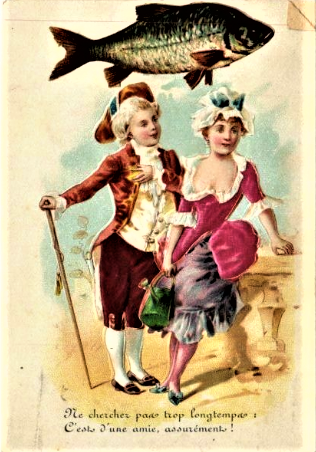
   I’ve been turning up plenty of postcards with cute little jokes beginning “I should worry” 

These seem to have hit the American consciousness about 1913, when songwriter Sam Lewis produced an I Should Worry song called “Isch Ga-Bibble”.  Now, if you are up on your nostalgia, you are aware that there was in the 1930s and 40s a singer named Merwyn Bogue who made a hit with Kay Kyser’s band under the name Ish Kabibble.  He took this name because his rendition of the old song “Isch Ga-Bibble” was so popular.  Ish Kabibble, and Isch Ga-Bibble, it was explained, was Yiddish for “I should worry”, or “No, that doesn’t bother me.”  (Several sources draw an analogy to Alfred E. Neumann’s What-Me Worry?, but that, and the postcards associated with it, is a whole nother blog.  Besides, they don’t deduce anything from it: they just like pointing it out.)

   Isch Ga-Bibble, as numerous sources will tell you, is neither good Hebrew nor good Yiddish.  It might have been a series of nonsense syllables meant to SOUND Yiddish for comic effect, or it may derive from “nish gefidelt” ,a Yiddish phrase meaning “No worries”.

   Well, I say it DID derive from nich gefidelt, on no evidence at all except that songwriter  Sam Lewis (nee Levine) must have heard Yiddish working his way up as a New York café singer.  Maybe he just didn’t know how to spell it out.  (Sam Lewis was not a one-hit wonder, being responsible for “Dinah”, “Has Anybody Seen My Gal?”, and “How Ya Gonna Keep ‘Em Down on the Farm?”, with other faded blockbusters of the American Song Book.)

   None of this worries me.  My own problem, Noodle Nugget, is that I don’t see the connection between the song and the postcards.  The jokes on the postcards are wordplay-based and, um, actually funnier than the ones in the song. I’m not saying the jokes on the cards strike me as all that uproarious, just that they’re funnier than the song.

   The song gets no more pun-inclined than “I should worry just to give and lend; A goat has got a scent that he can never spend.”  A man on a postcard says, “I should worry a lot, and build a house on it.”  Points to the postcard.

   The song mentions a painting high in the consciousness of the public and says, “I should worry if my clothes are torn And show…my indignation like September Morn.”  Not bad, but the postcard shortens it to “I should worry like September Morn and get cold feet?”

   I understand these jokes.  I get, even if I don’t laugh at “I should worry like a dressmaker and lose my form”, or “I should worry seven days and become a little weak” and “I should worry like an oyster and get in a stew.”

   But then I hit the Shape Jokes.  This seems to be a whole series on its own, and perhaps picks up another popular trend now forgotten.  A young man with a yellow vest speaks of getting a shape like a corn and getting the chickens all around him.  A girl thinks about getting a shape like a lamp post and having all the boys hang around.  And a child worries about getting a shape like a barrel and having his head knocked in. 

   Which of these I Should Worry jokes were the real ones, and which the second-rate attempts?  Did the Shape Like jokes come first, or did they come along at the end, as the postcard writers were running out of I Should Worry jokes?

If you know more about these things, pass the information along, so I shouldn’t worry.

Making Lemonade

So, as I was trying to point out, before I was so rudely interrupted by a pandemic, the world is so full of wondrous things that I’m sure we should all be as busy as bees.  I may not have that quotation exactly right, but that’s the way it goes.

Whereas I used to sort and research books for an annual book sale, I now do the same thing for vintage postcards.  My expertise in postcards is modest, but I suppose there are people in the world who would be glad to enlighten me there.  What I bring to the task is thirty-five years of book research, and even more years of pointing out strange little factoids which brought me the rousing endorsement, “Gee, Uncle Blogsy, that was almost interesting!”

I have, in the months I have been postcarding, become acquainted, or reacquainted, with the world of pop music from about 1907 to 1912.  This was a formative period in the world of postcards, and artists drew on whatever was hot in pop culture to fuel their postcard gags.  I already knew Jack Norworth and Nora Bayes’s song to Mr. Moon Man, which I found a couple of kids who would later work for Campbell’s singing on a postcard, but I was unaware that a song I had heard thousands of times in cartoons and cheap movies actually had lyrics, and a title.  But a postcard series turned up with swipes of the lyrics of Cheyenne, a cowboy love song destined to be used for years as background for western scenes for decades to come.

A simple “I wonder what THAT’S all about” led me to a song about money which became a frequent punchline for postcards dealing with seasickness, only to become a slogan for a popular (now defunct) laxative.  Other postcards have led me into the ancient history of beer and soft drink slogans, or car ads, and thanks to the Interwebs, I generally come up with an answer.

Not always, though.  Research into “May Your Shadow Never Grow Less”, a good wish I had seen only in The Hobbit before hitting it on a postcard of about 1907, let me out where I walked in. (I suspect all the experts were reading too much into it.)  And I found a card with a red hot political jab at somebody, and even had that somebody’s initials to work with.  But I never did find out who he was or how he offended the cartoonist.  Maybe the customer who bought the card already knew, but he didn’t tell me.

What’s especially frustrating is when the subject comes up on a variety of cards from a variety of companies, and still I can’t track it down.  What’s bothering me today, oh blogreader, is lemons.

I know what a lemon is, in the slang of my own generation.  It’s something you don’t want your car to be, something you’d rather sell than buy, something you don’t want.  That’s apparently related to the slang expression of a century or so ago, but there’s something else to it I’m just not getting.

Here, for example, is a card of 1908, from the S.P.C. Company.  It was made for you to give somebody your opinion.  “This For Yours!” it exclaims, with a sense of really paying off a grudge, or replying to an insult.  By sending this card, you have “handed someone a lemon”.

And that’s not a phrase I know anything about.  Obviously, you don’t want to be handed a lemon but there is great satisfaction in handing it to someone else, as in this card, mailed in 1909, which hands someone lemons “With my compliments”.  If the send had added a message to the card, it could have helped, but, no, handing them these lemons was enough.

There are cards showing a rejected suitor walking away with a lemon, there are cards showing strong men weeping at the receipt of a lemon.  Handing someone a lemon was harsh, sometimes unnecessary, as here, where the kind, intelligent looking man tells the brute not to hand the other man—a beggar?  A street salesman?—a lemon but give him money instead.

The Interwebs has so far been no help to me in this,  The dictionaries available there cite car sales and nineteenth century insults to sourpusses.  Some actually cite phrases from the period of these cards, but all in the context of the poorly-maintained used car.  “Being handed a lemon” seems to predate “being sold a lemon”, at least in the eyes of one beset blogger with half a dozen lemon postcards to explain.  It is ridiculous to think the Interwebs can be wrong about something, but I think these particular lemons could use a little more research.

Unless you know the answer and can pass it along to me.  Please don’t hand me any lemons.  I’ve got plenty.