One of Those Songs, Part One

Pop Music was defined by one wise man as the music your father listens to.  What YOU listen to is REAL music, not popular stuff, and the songs you find yourself humming are songs that will live forever and not disappear into the mass of forgotten “pop” music.  Yeah, we’re always kidding ourselves about these things.  Eventually, all we have left is our ability to say to a rising generation, “Yeah, just wait ‘til it’s YOUR turn to get ignored!”  (P.S.  They aren’t listening.)

Now, a few songs will roll along for generations.  “In the Shade of the old Apple Tree” hit the pop charts in 1905, and was immediately recorded by everyone.  One of the few romantic songs written in the form of a series of limericks,, it was catchy enough to encourage jazz versions in the thirties, and sentimental versions for a generation after that.  It was probably also in the back of the mind of the writers of “Don’t Sit Under the Apple Tree With Anyone Else but Me”, setting off another series of recordings.

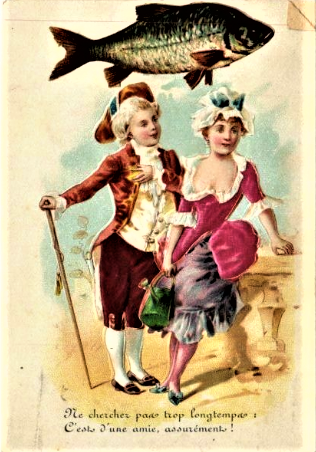
There were also parodies and, of course, a postcard jibe or two, as seen above, where a young man is pouting because all he’s finding in the shade of the old apple tree is apples.

Other songs, equally big hits at their inception, made more modest splashes.  Mr. Moon Man was a reply song to Shine On, harvest Moon.  The hero of Shine On has a girlfriend who is so terrified of the dark that she will only go out with him if the moon is bright.  As it has been a rough year for weather, he begs the harvest Moon to stay bright.  In the sequel, the moon is now asked to switch off, as “Two is company and three’s a crowd.”  It was a big success in the hands of Jack Norworth and Nora Bayes, but it did not last as long as its predecessor, even when posted with these cousins of the Campbell Soup Kids.

(These kids were drawn by the artist responsible for Campbell’s trademark children, Grace Drayton, but at this point in her life she had not yet married Mr. Drayton, so that signature down there is R. Wiederseim.)

And this, nice though the card is, is a pop song that was swallowed by obscurity almost immediately.  Yes, maybe you have heard a country chorus singing “Keep on the Sunny Side”, but this is a later song with the same title and different lyrics.  It couldn’t keep up.

One of the oddest fates for any pop song hit was probably suffered by “All Going Out and Nothing Coming In”, which was a hit for Bert Williams.  In his day the best-paid comedian on Broadway, and possibly the best comedian of his day (even other comedians said so.  W.C. Fields, not known for generous praise, called him “the funniest man I ever saw.”)

His stage character was a slow-moving, often depressed, usually penniless individual.  One song that described his financial situation was recorded by him in 1901, “All Going Out and Nothing Coming In”.  It’s basically a description of the difference in your friends and family when your cash is running low.

It was a big hit, especially with postcard publishers, who thought of another application of the lyrics immediately.

The joke was popular enough to be repeated by other cartoonists, since it’s hard to copyright a specific gag (so to speak.)

But then it was picked up as an advertising slogan, one of the things many songwriters hope for.  A popular chocolate flavored product which had been around since 1894, Cascarets was selling millions of boxes of their tasty but violent laxative tablets.  See, the song…yeah, you figured it out. Cascarets issued tokens of its Laxative Angel and the slogan, but did not, so far, as I’ve seen, immortalize it on postcards.

Oh Yeah?

You will recall, of course, from our last thrilling episode that postcard publishers were always ready to supply ammunition to those people who wanted to motivate their friends and family, passing along wisdom about how to conduct one’s life and how to feel about it while they were doing it.  Work hard, mind your own business, and smile all the while were the main messages: virtue and hard work were their own reward, and you should be grateful just to be on the team.

            But postcard artists and postcard publishers knew there was a flip side.  People whose motto was “Make Sure You’re Right, Then Go Ahead” tended to be people who were always sure they were right.  And enough adults had seen their friends smile their way into disaster over and over.  So an equal and opposite set of non-motivational postcards was also available.

            Take, for example, that oft-used slogan “Do It Now”, to discourage hesitation and procrastination.  Postcard artists didn’t even bother to change the motto to give it a satiric edge.

            All you needed was the proper picture to give a fine old aphorism a new home

            However bitter that home might be.

            Famous cartoonist R.F. Outcault, having brought America The Yellow Kid (the first sarcastic cartoon character to directly address the audience) and Buster Brown (who found too often—standing in a corner—that good intentions were not enough to guarantee acclaim) knew something about great old words of wisdom.  He took a literal turn on “It’s never too late to mend” and brought out its unpleasant side.

            Another encouraging phrase, now lost but once very popular due to a song which advised this, was that every tiny bit of progress at least put you farther ahead, or, as in the siong “Every Little Bit Added To What You’ve Got Makes Just a Little Bit More”.  The reminder that progress sometimes comes in small installments was repeated over and over, until you had the inevitable backlash, as in this card.  (The caption, in dark green, is almost impossible to read without magnification, but the man is commenting on the woman’s figure: “Every Little Bit Padded to What You’ve Got Makes Just a Little Bit More.”

            Sometimes it was just a matter of giving a twist to a cliché.  The sentiment that “Man wants but little here below” could be pursued to its logical extension.

            But sometimes the humor was a touch grim, as in this observation of what rewards hard work and perseverance bring.

            Other artists took up the matter not of the advice itself but the advisor.  Restraint in indulging oneself is probably a good notion, but it sounds funny coming from the wrong person.

            And, in the end, the artists and publishers were willing to reflect on what your life would be like if you DID follow every piece of improving advice you were given.

Necessary Nagging

I was thinking of returning to a topic I’ve blogged about before, possibly blaming it all on Psalm of Life, Longfellow’s magnificent bit of motivational poetry.  But it obviously goes back before that.  Poets, among others, have always been willing to tell us how to live, and how to feel about what we were doing.  Perhaps they took their cue from their Sunday School lessons: if it was good enough for David and Solomon, it was good enough for them.

Wherever it comes from, the relics of our ancestors contain thousands of mottos of motivation, and rhymes of righteousness.  Reminders that life is out there just waiting for us if we have the strength of will to take care of business abound.  Many of these were for hanging on the walls—the samplers of the nineteenth century giving way to the motivational posters of the twentieth—but more private motivators in the form of bookmarks or wallet-sized prompts were produced by the millions.

Postcard publishers and postcard artists were certainly not immune: whether their own motivation was encouragement of their fellow human beings or just selling placards of encouragement to those who wanted to pass the right message along, they produced hundreds of different designs for those who needed a nudge.  You could buy these for your own bulletin board or desk, or, more likely, mail them to your nephew Humphrey, who was just about to graduate from high school and needed some avuncular nagging.

            There were several very popular themes in this line.  There was the “Get to Work” theme, for those people who were hesitating

Or slow-moving (This motto wound up on a bunch of walls and a LOT of postcards, some of questionable taste),

            Or wasting time worrying.

            The blues, like worry, were just a self-indulgent waste of time to the motivators.

            After all, whatever worried you probably wasn’t going to happen.

            Another waste of time was losing one’s temper.  People who lost their temper were, like the worries, thinking about themselves instead of keeping their eyes on the prize.

            Or, more simply, were setting themselves up to lose.

            You were expected, just generally, to behave yourself properly.  Gossip was an evil deed and a waste of time.

            And keeping one’s mouth shut generally was good counsel.

            In the end, it was your own effort, and your own personal worth that mattered.

            Above all, they kept coming around to the idea that if you wanted something, you had to set yourself up to go and get it.  No one else could do the job for you.  You feel sorry, sometimes, for all those folks who had samplers that said, “All Things Come To hIM Who Waits”, because few mottos were less respected by the postcard artists.

            NEXT IME: OH YEAH?

Oh! You Running Gag!

Albert and Harry Von Tilzer were responsible for a lot of pop culture at the end of the nineteenth and beginning of the twentieth centuries.  Albert composed “After the Ball”, considered the first pop song to sell over a million copies (sheet music, since records were at this point going through a format war and sales were harder to come by.)  His songs of moderately deranged women gave us such icons as “Shine On, Harvest Moon” and “Take Me Out to the Ballgame.”  Harry was responsible for “A Bird in a Gilded Cage”, “Wait ‘til the Sun Shines, Nellie”, “And the Green Grass Grew All Around”, and “Under the Anheuser Busch”. 

(Some people have pointed out that this incredible production of hits MIGHT be attributed to the fact that the Von Tilzers owned the publishing company involved, and could, like other powerful song publishers, simply insist on credit (and royalties) on just about any song they printed.  This is relevant to the cause of justice, but irrelevant in the court of pop culture, which never really cares WHERE a joke came from, so long as it’s useful.)

Pop songs, then as now, the sources of catchphrases, parodies, and gags, which occasionally outlived the song which inspired them.   And harry Von Tilzer probably had no idea he was setting off a joke that would live for generations with a little song called “I Love, I Love, I Love My Wife but Oh! You Kid!”  This was a rip-off…an homage to two previous songs, which had been mild hits and which had taught Americans to use the word kid as a synonym for “pal”.  (Up to that point, the only people you addressed as “Hey, kid” were children or young goats.”

What set Harry’s song apart in 1909 from the previous numbers was that his was the first to include the suggestion that the singer and the woman addressed were indulging in an extramarital relationship, and having fun while they were at it.  It was such a hit that it inspired not only a lot of sequels by other songwriters (“I Love My Wife, but OH! Her Family!”)  Guardians of public decency were outraged, and tried to have the song outlawed, and punish anyone who used the phrase “Oh, you kid!” in public.  Groucho Marx kept the line alive, and it continued to echo in the Seventies musical “I Love My Wife”.
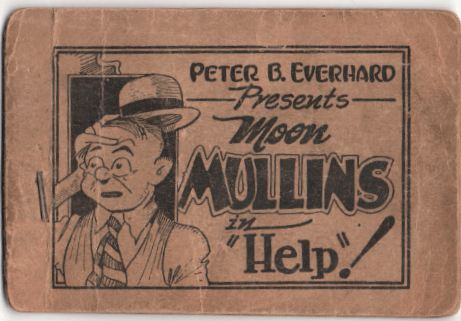
And the world of postcards was nor far behind.  The gentleman at the top of this column was featured in a whole series of postcards, most of which implied he was more interested in food than anything else.

This card, from a generation later, shows someone who is at least his spiritual son.

The gag on an older meaning of kid was probably inevitable.  (Particularly the fairly constant stream of postcards in this era showing tired husbands walking a fussy baby, often while their wives snored nearby.)

In fact, the other meaning of kid was used as well, as in the case of the customer who couldn’t decide what kind of leather to choose for gloves.

Eventually, people got the joke if neither the wife nor the kid was included in the joke, as in parody songs of the time, “I Love My Horse and Buggy, But OH! You Buick!” or “I Love That Roosevelt but Uh! You Taft!”  And this salute, which is filled with tender regrets.

Top that, Burt Bacharach.

Undivided Attention

Some people have noted that the postcards I have been showing off in this column have had writing on the front, and asked if the message was just so long it wouldn’t fit on the back.  It’s a bit of postcard history reflected in the design of some of the cards.

            Sending a card through the mail without an envelope around it was made legal in the United States in 1861.  Other countries had been doing it, and it was very convenient.  But no idea can possibly be allowed to go around as simply as that.

            The United States produced what were called Postal Cards, and the idea was so popular that hundreds of thousands were sold the first few weeks post offices had them for sale.  Other people wanted to get into the act.  After all, there were companies producing envelopes for use in mailing letters, why not Postal Cards?

            So, a little reluctantly, the government allowed private citizens to produce cards for mailing.  HOWEVER, these could NOT be called Postal Cards: that was a governmental privilege.  If you wanted to buy cards from someone other than the Post office, you had to use Correspondence cards or Mailing Cards, or whatever name the printing company used for them.  The main difference here was that Postal Cards cost a penny to mail, but privately produced cards cost two cents.

            Furthermore, none of these cards could have messages on the address side of the card.  One side was for the message, the other for the address.  Anything else made it more complicated to read the address.

            In 1901, the government monopoly was ended, and not only could any kind of card (weighing under an ounce) be sent for one cent, but just anybody at all could call them Postal Cards, or postcards, which was becoming the more common term.  Sales, which had continued to be brisk, now went into the stratosphere, and millions of postcards were being produced each month.  Until March of 1907, however, it was still illegal to mail cards which had anything but an address written on the address side.

            Postcards with pictures on them had become popular during the 1893 Chicago World’s Fair.  But until 1907, designers of postcards had to make sure that picture left space for the sender to include a message.  This is known as the era of the Undivided Back, as the back of the postcard had just one space, for the address. The space on the front for the message didn’t have to be a LOT of space: in the days when mail was delivered twice a day (occasionally three times on major holidays) it was customary to send a card saying “I’ll pick you up for dinner at 7.  And anyone with a long message could always write a letter.

            Some cards included just marginal space

            Others pushed the illustration to one side

            A few artists would include a little cartouche for adding a message

            Or enclosed the picture in a cartouche

            Others framed the message with the picture

            Or let the message frame the picture

            In the end, of course, American consumers being American consumers, the senders could ignore the design completely and just do what they wanted

Behind the Seen

     I have always stood with Jim Henson and his Muppet crew, who had as one of their guidelines the motto that “A joke not worth telling once might be worth telling seventeen times.”  I have tried, in my own small way, to hold true to that standard, and I see that the postcard makers of days gone by did as well.

     The number of jokes about donkeys alone would fill a few blogs, and the lion, equally useful for “line” or “lyin’” is popular as well.  But I was just going to burro a little inspiration from the donkey and consider a couple of jokes derived from the humorous potential of the southern end of the body, known sometimes as the situpon.

     Here, for example, is a fairly simple means to an end.  I’ve heard of high water pants, but this lady’s swimsuit was not what I ever pictured.  The phrase provides the artist with an excuse to illustrate the tale of a summer vacationer whose clothing is humorously revealing, without being actionable.

     Now, maybe great minds think alike, or maybe artists visit the same beaches.  Anyway, someone else found the image compelling enough to offer us a second helping. I feel he has let us down with the lady’s hat, though: more realistic, perhaps, than the first lady’s, but it lacks the firm definition of her sister’s example.

     And a third artist wanted to give us an action shot. The joke is a fairly harmless pleasantry, but what made it popular enough to earn so many reruns.? And in none of these pictures do I see a particularly high tide.  I could just waive that requirement, but somehow it all seems wishy-washy.

     There is a word which is deep-seated in United States English in reference to the rump is a source of some confusion as it is, in the slang of other English-speaking nations, used to refer to either the chest or the pubic area.  It is also to complicate matters further, frequently used as a first name, but itself or as a short version of Frances.

    “Tush tush, Uncle Blogsy,” you say, “Anyone can tell from the context which meaning is meant!”

     No.  No, actually they can’t, and that is what has the young lady in this card so concerned.  Or perhaps she is concerned, as any thinking person would be, about what, exactly, the lady on the phone is sitting on.  (I mean the furniture, not the fanny.)

     A fellow has to be so careful, when paying compliments, to avoid backfire.  From the lady’s expression in this version, she is clearly taking this the wrong way.

     And I’m not certain the joke really called for repetition, but another artist thought he could do it as well or better, giving us these two ladies who have not learned to wear clothes that fit.  The bearded gentleman, looking a lot like George Bernard Shaw, must be a man of iron nerve, because the look on Mom’s face here would make anyone turn tail.      I suppose this kind of joke was aimed more at collectors who wanted to plump up their albums than at people who would use them to send a message through the mail.  In any case, almost none of these cards has anything written on the back side

Insufficient Centennial Note

Once upon a time, Pineapple Fry, there was no Internet.  No, come back.  I know most of your grandfather’s stories start this way, but stick with me and we may get somewhere.

In those dear, bygone days, the major electronic entertainment devices in our home were the radio, which we used for weather reports, news, and a string of endlessly replayed popular songs and the television, which the whole world retired to watch during something called Prime Time.  There were three major networks, and a number of small local stations which got by on a diet of cheap syndicated shows and old, old movies.

The major networks, during Prime Time, aired expensive, first run television series into which they poured a lot of publicity.  We waited with abated breath the annual announcement of the new season, cheering if our favorite shows were renewed for another year.  The episodes of these shows generally aired twice a year: one first run episode and once later in the season as a “rerun”.  No, there were no marathon viewings or channels which played one program’s episode for twelve hours straight.  The phrase “binge watching” did not exist because unless you had a film projector and a friend who could get you films of television programs, you simply couldn’t do this.

Into this world came a series called Star Trek, and yes, plomeek fondue, I am aware you know all about this.  Captain Kirk, Mr. Spock, Dr. McCoy, just seventy-nine episodes from 1966 to 1969, and then canceled by people who did not have the power of prophecy.  That much is common history, and will be repeated a great deal this year because Gene “Great Bird of the Galaxy” Roddenberry, who was the brain behind the original series, turns 100 years old this year.  But that wasn’t what I wanted to bring to your attention.

Lovers of the show were now thrown back on local stations which could air syndicated episodes in reruns.  These were recut to allow for more commercials.  And what did the fans who lived in areas without mid-afternoon reruns of their show?  Remember, there was no Internet.

Yes, they had to rely on the written word.  There were newsletters and fanzines (like a fan website, only on paper) and there were books.  Gene Roddenberry saw how valuable merchandising was, and one of the early spin-offs of the series was a series of books in which the original episodes were novelized—or short story-ized, actually.  There were twelve volumes of these, continuing even after the series was cancelled, until all the original episodes were summed up.

These books were the only recourse of some fans in areas without syndicated reruns.  The short stories tried to stick to the original episode, keeping much of the dialogue but resorting to description for the action sequences.  They were aids to memory, helping the fan think back to that moment when Captain Kirk spotted the Green Girl, or Dr. McCoy jubilantly realized he got the last line in a story.  Almost all of these prose versions of television gold were written by science fiction author James Blish, who, along the way, also wrote what is considered the first official Star Trek novel, Spock Must Die!

A science student who went on to write science fiction, Blish was author, science fiction reviewer, and motivator of science fiction as a genre.  He died while finishing up the Star Trek novelizations, and the last few were written by another author.  He had moved to England during this period, and his papers, as well as a complete collection of his works—Star Trek and otherwise—are at Oxford.  His Star Trek adaptations we re-released when science fiction television was recognized as a good financial bet, but it was not the same as the early 1970s, when the books were the only dose of genuine Star Trek many fans could get.

And James Blish ALSO turns 100 years old this year.  It’s a WEE bit frightening to see stalwarts of pop culture turning 100, but it does happen.  I suppose the day will come when I am over thirty myself.  In any case, if you gather with other Trekkers and raise a glass of Saurian brandy to Gene Roddenberry, I hope you will retain the presence of mind to call out “And here’s one for James Blish!”

Around His Neck

   So in our last two installments, we considered the mockery postcard cartoonists made of two items of women’s fashion in the 1905-1915 era: the hobble skirt and the picture hat.  Can we have the same wild and crazy time considering men’s fashion of the period?

   Well, if you look at that first picture, you can see the problem.  The lady (let’s be courteous) is rather definitely of a particular time, but the man’s outfit doesn’t give us quite so many cues.  True, the hat would raise a few eyebrows nowadays, and I have never actually, in my lifetime, seen a person sincerely and without being part of a costume, wear a pince nez (those pinch-nose glasses.)  Still, if you look closely enough, there is one detail that DOES set him apart, and which cartoonists made great use of.

   And that is his collar.  For much of the nineteenth and early twentieth centuries, it was possible to buy a shirt with only a small stub of a collar.  This made it possible for a man to wear the same shirt for a week and still look fresh and clean, simply by changing collars.  (Clean cuffs could be acquired the same way.)  These are now worn primarily by the clergy, by courtroom attorneys in England, and with certain types of elegant evening dress, but once upon a time, they were the choice for everyday wear  for men who wanted to save money by owning a small number of shirts but a large number of collars.    There was no particular shame to this, so collars did not pretend to be part of the shirts they rode above.  They were white, starched, and often rather high, as cartoonists liked to notice.

   To make this work, of course, one had to have a variety of collars.  (As in the old song: You wear the prettiest ties and collars; whereabouts do you get the dollars?)  Only the especially stingy would limit themselves, as in this card, where his wife is asking him if he’s sure he checked for his collar studs in BOTH of his collars.  (Collars were held in place by studs, which are remembered in literature largely as something a man would lose at critical moments., though some writers remember the joyful POP sound made when pushing a stud into a newly-starched collar.)

   One could indulge in a variety of styles: since a collar was meant to be worn once and then washed and restarched, you could have the points doing especially notable things at parties, as in the next card.  (Um, I was referring to the collar points of the man on the left.  I do not know quite what the man on the right is up to, but the comic photography of J. Murray Jordan is material for a whole nother blog.)

   The greatest glee of the cartoonists, however, was simply building up that collar as part of a general character study.  We have the stiff collar of the well-dressed but clueless young man, in this limerick card.

   Here we observe the collar of the man who is trying to dress up a face and figure that can’t be helped.

   And here the artist gives us the fashion of the poseur, the young man so full of himself he knows he must dazzle all eyes, the young man who is the embodiment of the pronoun “I”.  As for some reason while looking him over I suddenly thought of people who blog, I believe I will leave you to a contemplation of the detachable collar and go do something else for a while.

Picture This

   Now, the world has never been long without big, bizarre hats, the kind that really catch the eye (and the wind.)  Floppy or rigid, expressing extreme elegance or extreme zaniness, the wide-brimmed hat was worn by women who wanted to express SOMETHING with a flair.

   The postcard hasn’t been around long, its modern version coming into public notice around the time of the Columbian Exposition.  It  was popular before 1907, but it really caught its stride after that, when the United States government, which had held a hard line on the handling of post cards (Message on THIS side, address on the other) decided it was okay to use all of one side for a picture and use the other side for address AND message.  This happened right in the middle of a major blossoming of wide-brimmed hats, and the postcard cartoonists were ready.

   The hats were known by many nicknames: the Garden Hat, the Gainsborough Hat (the artist Gainsborough frequently painted his society ladies in massive hats) and, in my part of the country, the Picture Hat (maybe because so many people saw them in those pictures painted by Gainsborough).  But most of the cartoonist were aware of yet a third current in pop culture.  Franz Lehar’s most famous operetta had opened to massive acclaim in 1905 and spawned, as other pop culture icons did at the time, popular items of clothing (remind me to tell you about men’s hats and the novel Trilby some day).  So to a lot of people, this was the Merry Widow Hat

   The Merry Widow Hat differed slightly from the Picture Hat because of the sometimes mountainous decoration with feathers, generally ostrich plumes, but it was the extensive brim which defined it at base.  Yes, by the way, women did wear them outside of postcard cartoons.

Drawbacks to the hat abounded: even if skewered to the hairdo with long hatpins or attached under the chin through use of a fashionable scarf, they could do unhelpful things in a high wind.  They could, as seen above, make walking along the boulevard a lonely proposition.  But they could hold back an unwelcome suitor, hide a welcome one from spying eyes if held down to one side, and, well, they could be useful at times.  

  It would be wrong to picture the whole of female high society walking out looking like fancy mushrooms.  There WERE other types of hats to be worn, some of them small enough to comprise one little cloth cap with one stuffed bird on it, some tall but with narrow brims, some frothy, and some…well, there’s a reason THIS style was known as the Peach Basket Hat.

Hobbled

            I graduated from high school at a time when it seemed everyone, male or female, was trying very hard to look like Cher.  I remember very well a class where our teacher was explaining how things come into fashion and then disappear, to be laughed at by the next generation.

One of my serious-minded classmates said, “Oh, I don’t think anyone would laugh at long hair.”

“That’s what we thought about short hair,” he told her.  She shook her head in disbelief.  I haven’t seen her to ask her about it lately, and perhaps there’s no real need.

Mocking fashion was a habit of postcard artists.  The fashionable female figure went through enormous changes in just the first thirty years of the twentieth century, from the demise of the bustle and the impossibly corseted waist to the era when the Boyishform Bra was produced to the rounder silhouettes of the Thirties (welcomed by one postcard gentleman who sang out “Hippy Days Are Here Again!”  Someone who was growing up when I did had to look at THAT caption twice.)

Consider, for example, the earth-shaking phenomenon of the Hobble Skirt, an invention of around 1908, which was also a pivotal year in the postcard fad.  Inspired, according to legend, by the first American woman to ride in an airplane, it copied the way she tied her skirt around her ankles so it wouldn’t be blown around by the winds in the open-air flying machines of the day.

Tight at the ankle and lacking the sweep of earlier skirts, the hobble skirt was so named because it made walking difficult and running nearly impossible.  Some fashion magazines actually suggested women tie their knees together before donning the skirt. Streetcar companies introduced new models without steps so women in hobble skirts could still ride, but some women in the new skirt style died from the inability to get out of the way of oncoming danger.  Some designers came up with a modified version which had a slit up the side, for easier locomotion.

Many of the artists who made their living drawing for postcards at this time were men, so the difficulty of walking around took a back seat to other considerations.  The dropping of wide skirts and ruffles for the straight, severe lines of the hobble skirt gave women a whole new profile, and THIS is what the artists sought to bring to your attention.

This artist, for example, clearly thought the new styles were so revealing as to be dangerous to passing men.

This artist, on the other hand, simply wondered if the ladies really knew how they looked in the new fashion.

A novelist once suggested that high fashion, male or female, was meant to emphasize the general uselessness of the wearer, since only someone incredibly rich could afford to be of no use to society.  Like a lot of things, the hobble skirt did not survive the First World War.  Women retrieved the ability to move their legs to take on a more active role in a time of crisis.

Hobble skirts were not the only fashion trend of the pre-war period adored by the cartoonists.  But we’re running out of space, so we will have to use another blog to consider, well, those hats.