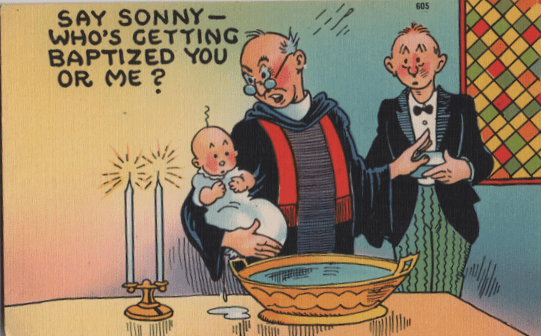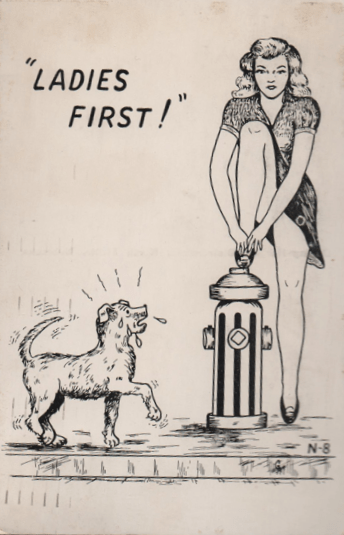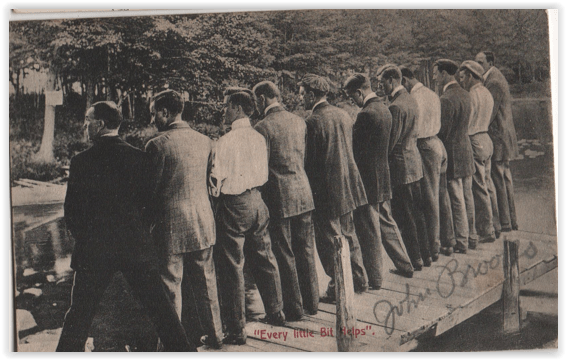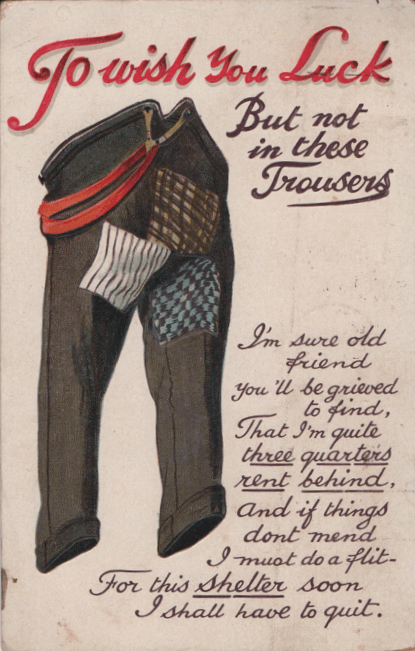
More side issues

    A few years ago, I wasted considerable time trying to track down my mother’s recipe for macaroni and cheese.  This was not because I do not know the recipe.  I gave the recipe memorized, and for those of you who are interested in such things, I will discuss it farther along.  I just wanted to know where the recipe came from.
     As a child, I took macaroni and cheese for granted.  My mother occasionally apologized for it, but by the time I was old enough to notice this, I was old enough to know my mother frequently said things that didn’t make any sense.  (Like “How can you want something to eat?  You just had supper!”)  I believed, as children do, that what my mother cooked was what every mother cooked and every macaroni and cheese on earth was identical.

     I was five or six before I learned that other people had other kinds of macaroni and cheese, and some people didn’t eat macaroni and cheese at all.  (We will drop such people from our discussion right now.  I’m surprised I embarrassed them by mentioning them at all.)  As ioI grew and moved out into the world at large, I found even more types of macaroni and cheese, and even moved into those circles in which macaroni and cheese was a side dish, or even a salad.  My mother’s macaroni and cheese did not need some other entrée to support it.

     I also learned, as I got older, that she was ambivalent about it because it was not the kind of macaroni and cheese HER mother made.  Her mother, as I understand it, made a heavenly dish involving quantities of genuine cheddar so strong that my grandfather used to pour sorghum on his, just to cut the flavor of the overpowering cheese.  My mother did make this once or twice for us and it was not a hit.  (I still regard my mother’s cooking as first rate food, but I do sometimes wonder whether she listened all that well when her mother was showing how things were cooked.  One or two secrets seem to have dropped by the wayside.  On the other hand, I avoided developing a taste for sorghum.)

     I have had other macaroni and cheese which were very good, and some which I would not hand out to trick-or-treaters who had already egged the house.  I will not try to dictate on these matters except in one detail: if you have cooked your macaroni until it collapses under its own weight and becomes a limp morsel of soggy bread, you’re overdoing it.  If you like it that way. I will not blame you, buy don’t come running to me when you lie on your deathbed wishing you hadn’t led that kind of life.  (In fact, if people on their deathbeds would stop running to me completely, I would not whine.)

     Now, as to my mother’s recipe.  You take a pound of macaroni.  (Pasta had not been invented yet in the Midwest at mid-century.  There was spaghetti, noodles, and elbow macaroni.  Fancy restaurants had different types of macaroni, but our stores, in my memory, stocked only elbow macaroni until the 1960s.  Anybody cooking with macaroni, whether it was macaroni and cheese, goulash, pasta salad, or Christmas tree ornaments with macaroni dyed red and green and strung on fishline, used elbow macaroni.

     You boil this to the consistency you like.  (See previous note about limpness.)  The only change I have made in my mother’s recipe is that I do not at this point rinse the macaroni in cold water.  The sky did not fall in on me.

     Now you take about a third of a pound of Veklveeta.  (We will discuss at another point how to make a caterpillar catcher out of a Velveeta box.  We’re trying to stay focused here.)  You slice this with a Velveeta slicer, start it melting in the pot you cooked the macaroni in, plunk the macaroni on top of this, and slice in the rest of the Velveeta.  Some people, like my mother, adore the taste of Velveeta and want more, while others want just enough to glue the pasta together.  Experiment with this, if you like.  Stir until the Velveeta has completely melted into the Creamettes.  (This was the only brand of elbow macaroni available.  We were nmot, as a people, very experimental about macaroni in my boy days.)

     Now comes the most important part.  Remember to put a trivet on the table before you plump that pot on the dining room table.  Dole out portions to the smaller diners and invite the elders to help themselves.  It is about the simplest recipe in the world, this side of ice cubes.  Don’t overcook the Creamettes, and don’t burn the Velveeta, and you’re good.  No casserole dish and so long in the oven, no sprinkling of corn flakes, no nothing.  Just a pot of warm, golden ballast to keep your keel even.

     Now, as mentioned, I went to some trouble trying to track down the source of this recipe.  I was sure, once I ruled out divine inspiration, that it probably came from the side of the Creamettes box or the Velveeta box.  So I went to the Interwebs to find out where this mighty comfort food originated.

     Creamettes was no help at all.  Their website, of course, had dozens of recipes, including several for macaroni and cheese (or mac and cheese, as you young’uns call it.)_  These involved making a white sauce and adding various types of cheese, with salt, pepper, pimento, chili flakes, and who knows what all else.  I figured Creamettes perhaps did not wish to admit how much it owed to Velveeta.

     But lo!  The Velveeta website was just as bad.  THEIR macaroni and cheese recipe started with Velveeta, but you add milk, and at least one other kind of cheese, and….  It was too disheartening.  Maybe no one wants to own up to a recipe with just two ingredients.  It doesn’t seem to be the gourmet way  If a recipe doesn’t involve fifteen ingredients, and require you to buy a new kitchen tool, it just doesn’t fit.

     Or maybe my mother did think of it.  Have I mentioned her peach pie?  You take a….  Sorry, we’ve gone on too long, and I need to start boiling water.  Those Creamettes won’t cook themselves.

On With the Dough

     It is Monday again, luckless mortals, and time to examine the world of really old jokes as I wrote them out in the last century  Today’s excerpt from that book is about money, and what people do with it.  I am not one to salute the wisdom of my own past self, whom I regard as a pleasant chap but foolish, but I do believe he nailed it this time.  His introduction consisted of just one phrase.  “Money,” he wrote, “Is funnier if you have it.”

     The missing punchlines, which you so surely know, are added at the end of the column.

J1.”I wish I had enough money to buy an elephant.”

     “Why do you want an elephant?”

     “(          )”

J2.”Years ago, I won a hundred thousand dollars in the lottery,”

     “What did you do with it?”

     “Well, some I spent on women and some I spent drinking in bars, and the rest of it (          ).”

J3.Tim MacTavish bought two tickets for the Wednesday lottery drawing and hit the big jackpot.  One of his friends congratulated him later that week, but added, “You look kind of depressed about the lottery win.  What’s wrong?”

     “It’s this other ticket,” Tim told him. “(          )”

J4.Two friends at a party were chatting about a mutual acquaintance, who had become a multi-millionaire selling a cheap, shoddy product on late night TV ads.    “Nice fellow,” said one, “Pity his money’s tainted.”

     “It’s twice-tainted,” said the other. “(          ).”

J5.A lottery winner and his wife were mingling with a new crowd, and in the course of dinner conversation, listened to the others discussing the merits of various Swiss resorts and the acoustics in foreign concert halls.  Determined to be a part of the conversation, Mrs. Lotterybucks waited for an opportunity and, when someone mentioned Mendelssohn, exclaimed ecstatically, “Oh, Mendelssohn is my very favorite wine!”

     There was an awkward pause, but the conversation went on, with the newly rich couple feeling even more shut out.  After dinner, Mr. Lotterybucks scolded his wife.  “If you had just kept your mouth shut, people wouldn’t know how uncultured you are!  Couldn’t you just keep quiet and let me do the talking?  Mendelssohn’s your favorite wine?  Mendelssohn (          )”

J6.”The cost of living is sure going up.”

     “Yep.  And half the time (          ).”

J7.”I’ve started budgeting my money.  Every month I spend 40% in shelter, 30% on food, 30% on clothing and transportation, and 20% on entertainment.”

     “That adds up to 120%.  That must be a mistake..”

     “(          )”

J8.“What’s the problem?”

     “Ah, it’s the wife, always nagging about money.  Last week it was thirty bucks, then on Monday she wants fifty bucks, and this morning she was asking for another twenty.”

     “What does she do with it all??”

     “I don’t know.  (          ).”

And here, just as on late-night TV, are all your money ANSWERS./

    .A1.I just want that much money.

     A2.I just wasted.

     A3.Why did I waste my money on that?

     J4.Tain’t yours and tain’t mine.

     A5.is a kind of cheese!

     J6.it isn’t fit to drink

     J7.You’re telling me!

     J8.I never give her any.

Side Issue

     I had no idea frying potatoes was such a contentious proposition.

     Take your basic fried potato.  Well, no, don’t.  There IS no basic fried potato.  To some people a fried potato is a bulky object, made up of a quarter of the potato, while other people snub these in favor of thinner slicing.  These thin sliced potatoes are sneered at as “potato chips” by people who prefer what restaurants prefer to call “country fries” or even “wedge fries”.  My parents’ marriage nearly went to pieces at a very early stage because one of them was used to bulky fries and one to thin ones.  (And the potato chip as experienced commercially was invented because a chef was infuriated by a customer’s demand for thinner fried potatoes.  He sliced ‘em so thin he figured nobody would eat such things, the stunned customer realized the result was fun to eat, and an industry was born.)

     Maybe you think we’re on safer ground with French fries.  Or are you old enough to remember when they were Freedom fries?  This is merely the tip of the iceberg (no lettuce allowed in today’s blog: only good, healthy fried food permitted.)  Do you like THIN fries or THICK ones?  Crinkled or straight-cut?  Waffle fries?  Curly fries?  Would you put Tater Tots in this category, or do they belong in their own, singular glory, along with their cousins, the tater Babies and Smiley Fries?  (This last is basically a pureed potato pressed into a smiley face design and then deep fried.)  Or are Tater Tots a bite-sized version of hash browns?

     WHICH brings us to today’s burning (or at least frying) question.  I do love hash browns.  And I absolutely hate has browns.  Like my parents and their fried potatoes, I prefer hash browns the way by parents made them.  (On retirement, my father took over much of the cooking, and took my mother’s really excellent has browns and turned them into something exalted and amazing.  I will take either recipe, thank you, with just about anything.)

     See, some hash browns are cubed, some are grated, some are pureed.  Some are fried crisp, while others come out limp and soggy.  (I know, my preferences are showing here.  I can only assure you that there are people who adore soggy hash browns and seem completely lucid otherwise.)  Some chefs insist that they be prepared with only potatoes, while other people add onions, or corn, or peppers.  What, exactly, ARE hash browns, and why can’t I find decent ones in a restaurant?

     The Interwebs, which I assume are all stealing from Wikipedia, trace the dish back to the 1887 cookbook of Maria Parloa, who included a recipe for “hashed and browned potatoes”, which was a way of using up leftover boiled potatoes by chopping them up, frying them, and folding them like an omelet.  (Hence the listing of this dish as Hashed Browns by people who are sticklers for history.)  I have not seen what this is supposed to look like when done, and you can skip it, for me.  Only hash browns made with raw potatoes need apply.  They then go on to explain how hash browns made their way into diners, and then were picked up by fast food joints in the 1980s, almost invariably, at first, for breakfast.  They discuss the hash brown squares or triangles or pennies available in the frozen food cases, and finish with non-frozen but preserved varieties available for carrying on hikes.  (Real jikers, I have been informed by experts, always pack a frying pan.)

     And there they pretty much leave it.  There has to be more to it than that.  What about people who cube the potatoes?  Is this an ethnic or regional variation?  Are the graters mostly Midwestern, and the soggy hash brown people from the south, where sausage gravy will probably be poured over them anyway, or am I just coming up with that out of my own prejudices?  (I have had soggy hash browns with sausage gravy, and these are absolutely excellent.  I just refuse to call ‘em “hash browns”.)  Are people who take squares of chopped potatoes out of the freezer and make them in a toaster oven happy with their “hash browns” or do they, deep down, feel they’re missing something?  (I do not consider Tater Tots, whatever form they take, to be hash browns either, though they are also excellent in their own way.)

     Obviously, more research is needed, on the Interwebs AND at the table.  In the meantime, enjoy your potatoes in whatever form they come, and remember the special note Wikipedia throws in—a very important distinction—that “hash brownies” are an entirely different kettle of cuisine.

Laugh In Peace

If you cast your mind back to last Friday’s column (I know: you worked so hard to forget it, but be brave; this will be over soon) you will recall my hunt through my inventory of elderly postcards in quest of Halloween-related images.  This was very nearly fruitless, but on the way, I did notie that our ancestors did occasionally give in to a morbid stream of humor.

     The Cemetery lady said it often enough, that Death was the new Pornography.  We don’t like to think about it or be reminded it exists, but our ancestors handled things differently, putting up huge signs and symbols around their houses when there was a death in the family, and holding a big a funeral as they could afford.  Deathbed photos were a valued family possession (Queen Victoria had a massive collection, they tell me) and there were even postcards with post-mortem photos of the late lamented.  (I have a couple of those, but I will spare you.  And, after all, how do I know these aren’t just people who owned really uncomfortable beds?)

     If that weren’t enough, our ancestors were very big on the Memento Mori school of motivational verse.  The postcard at the top of this column symbolizes it: you’re going to die, so don’t waitr around until the time is right to get the job done.  From what I’ve seen of these, this image was actually considered pretty funny: college kids apparently sent them to each other on a regular basis.

     There was also a considerable literature on the subject of the Funny Tombstone.  You should have heard the Cemetery Lady on THAT subject.  She had nothing against a bit of humor on a grave marker, but she objected very much to undocumented epitaphs, most of which, she said, were patently fake.  I have not looked up this one to make sure it existed.  But the card does.

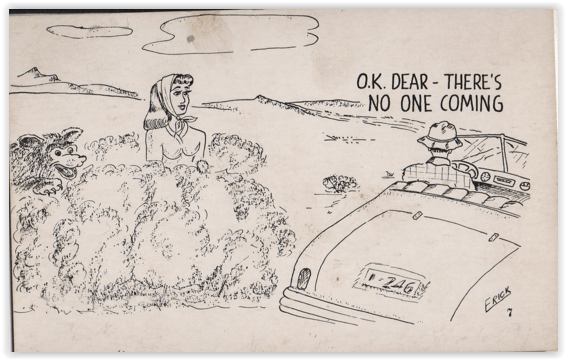
         She had no objection to a good pun, and might have found THIS postcard worthy of inclusion in her postcard collection.   Have a feeling, though, that nothing like it would have appeared in postcard racks in the drugstore in my boy days.  They might have sold it, but possibly at some counter at the back of the store.  By my day, jokes involving caskets would have been considered “sick humor”, and would have cited it as evidence of the degeneration of young people ion the modern world.

     And this sort of gag would only have appeared in underground comic books in my boy days.

     This would have been decried as evil propaganda, and a plot against the American tobacco industry.  (One of my heroes wrote in a column that his generation knew cigarettes were dangerous in the 1940s.  “Why do you think we called them coffin nails?”  This card dates to before that, even.)

     While this joke would never be published today at all: just because a previous generation thought it was funny doesn’t mean it’s permissible today.

     It isnIn fact, death was perfectly acceptable, as we have seen in previous columns, if it involved certain habits.

     By and large, though, the post-World War II generation, having gone through periods of mass-produced death, preferred to ignore that part of life.  When they considered such things at all, they went straight to considering the afterlife, and how it would look to those who encountered it.

     Besides considering the rewards which awaited those who had suffered in life.

     An earlier generation told jokes about the afterlife, too, but postcard sellers of the Fifties would never have accepted this pre-war vision.

Assisting With Inquiries

     For this episode in ancient joke identification, we move to the world of law and crime.  For the purposes of keeping this on a calm and genteel level, we will NOT be going into hot button issues like, say, stealing jokes.

     J1.”Psst!  Bud!  Wanna buy a hot?”

     “A hot what?”

     “(          )”

     J2.“I want you to take him to jail and teach him a lesson, Officer.  Him and his filthy songs!  Every time he goes by my window, morning noon and night!  He ought to be locked up!”

     “Well, Ma’am, all I can really do is take him in for a warning.  You say he sings dirty songs when he passes your place?”

     “No! (          ).”

     J3.Another time, Emma called the polic to complain about some young men who were swimming nude in the creek that ran behind her back yard.  “They’re shameless!  I can see them from the kitchen window as plain as a pikestaff!”

     An officer was sent out to discuss this with the young men, and asked them to move farther downstream, for their skinny-dipping.  Emma called again to complain, “Well, they’;ve moved, but nor far enough!  I can still see them from my uostairs bedroom window!”

     The officer came out again and discussed this with the young men, who agreed to keep moving along the creek.  Emma called a third time.  “I can still see those young men swimming!”

     “But, Ma’am,” said the Chief, “I know where theu’ve gone, and they’

Re so far from your house you can’t possibly see them!”

     “That’s what you think,” she replied, “(          )”

     J4.”Oh, my goodness!  Have you seen a policeman, sir?”

     “Not lately.”

     “Oh.  Okay.  (          )”

-J5.”Can you describe the man who punched you, sir?”

     “Of course.  (          ).”

J6.”Take your pole and your can of worms and get off my property or I’ll have you arrested for trespassing!”

     “Then I’ll sue for false advertising!”

     “Huh?”

     “Doesn’t that sign say (         ).”

J7.”Why did you pull me over, Officer?  Was I driving  too fast?”

     “No, sir.  (          ).”

J8.”Oificer, could I have a word with the man you caught burglarizing my house last night?”

     “We really can’t allow that, sir.  Just let us take care of him.”

     “Oh, it’s not for revenge or like that.  (          ).”

J9,”Some guy just drove off in your car!”

     “Oh no!  Did you see what he looked like?”

     “No, but (          ).”

J10.”Here’s another drunk, Sarge.”

     “Hey, this man’s not drunk.  He’s been drugged!”

     “I know, Sarge.  (          )”

If you are planning to step into the police station yourself, you will need to have your ANSWERS all ready.

     A1.Business has been good; Waddya need?

     A2.Whistling them

     A3.I can see them perfectly if I go up into the attic, climb on the boxes by the window and use my grandfather’s telescope!

     A4.Stick ‘em up

     A5.That’s what I was doing when he hit me

     A6.Fine for Fishing

     A7.Flying too low

     A8.I want to know how he got in without waking my wife

     A9.I got the license number

     A10.I drugged him all the way from Walton Street!

Hollow Ween

     In gladder, pre-pandemic times, I would be writing now about Halloween-type books.  This was not as easy as it might sound, because Halloween, unlike Christmas, does not have a lot of traditional stories: the headless horseman being about the only literary character tro be found only at Halloween.  Our propensity for scary movies year-round, as well as that of our ancestors for ghost stories at Christmas, may be to blame for this.

     On the other hand, there are LOTS of Halloween postcards.  But I’m not going to write about those just now.  Other people have done a good job on them and, anyway, they tend to revolve around the same cliches: Jack o’ Lanterns, witches, black cats: you can find lots of those elsewhere online, too.  At very high prices, because they are wildly popular, which is the reason I don’t have any, and another reason I thought I’d write about something else.

    I thought we could consider scary critters on other, non-Halloween postcards.  I thought we could leave out normal, everyday things people might be afraid of, of which there are many on postcards: dentists, cars out of control, mothers-in-law, large round ladies dropping out of the sky on you (It’s alarming how many of these there are: was that really such an everyday problem?)  We can consider the monsters and supernatural threats which might go bump in the night the other 364 days of the year.

     TOTAL; waste of time: there weren’t that many.  See, in the golden age of the postcard, before World War I, some of our favorites were missing.  The books Frankenstein and Dracula existed, but Boris Karloff and Bela Lugosi had not yet made the respective movies which made them part of our culture.  And although some newspapers were trying to convince people that opium fiends might stab you byu night or Asian masterminds might pipe poison into your bedroom, it just hadn’t caught on with the general public.

     Black cats were actually considered signs of good luck (unless they crossed your path) and were generally drawn as funny critters.  This chap and his brethren did a whole line of postcards performing interpretations of pop songs.

     And black kittens were just plain cute.

     You’d think giant chickens would be a source of fear, but these chaps just regard them as a chance for a hearty meal.

     And monster fish were so common on fishing postcards because they were good for a laugh

     Especially if you could toss in a bad pun.

     Your most common place for monsters on postcards was in the realm of a drunken man’s visions, or delirium tremens (the D.T.s) and this was always a source of great good humor, the quality of the liquor our ancestors consumed meaning many drinkers had experienced the effects.  (The Newberry Library has a very nice collection of these, which includes dragons the size of skyscrapers coming down to greet the souse on his way home.)

     But the viewer was not expected to tremble in fear, just laugh.  This giant baby makes MY heart palpitate. But Mom seems pleased

     Postcards even anticipated our slasher movies, but when they did, they did it with a grin.

     Maybe it’s my fault.  Maybe I just don’t HAVE any postcards with really dark, sinister, Halloween type characters on them.

Still On the Line

     Before we abandon the subject of clotheslines and their place in the lives of ages gone by, there is one more theme in postcards to be considered.    It is a mysterious concept, and an elusive commodity nowadays, but SOME of our ancestors prized it highly.  They called it “Privacy”.

     It is one of my hidden beliefs that our ancestors were not ALL that different from us in many ways.  (I go into this more fully in a never-demanded lecture called “Victorian Applications of New Communication Technologies”: it’s a rouser.)  And much though, in my heart, I would like to think differently, I have a feeling a number of our ancestors would have been perfectly comfortable in a world where we now post pictures online of what we ate for dinner, what we stole in our latest burglary, whom we had sex with, and the results of the baby’s paternity test.

    Still, our ancestors claimed to value privacy, and having one’s clothes out on the line was a risk of that [privacy.  We even had a phrase to describe people who made a fuss about things that were too personal: they were “airing their dirty linen in public”.  And you will note that the lady displaying her underdrawers on the line, above, is credited to California, still at that time (and actually now) a part of the Wild West.

     One did not have to be Sherlock Holmes to make deductions from what one saw on a person’s clothesline.  This is one reason some authorities suggested you hang up certain garments under the drying sheets, or inside the drying pillowcases

     Drying certain nether garments in public were believed to have an impact on one sex in particular.

     It would at least create certain assumptions and expectations on the part of the viewer.

     And might draw unwelcome (or apparently sometimes welcome) comment. .

     But what really bothered our ancestors were that that the display would bring on criticism.  You could count on passersby the think negative thoughts about the wearer of such underwear.

     The greatest fear apparently being that people might make the assumption that this was ALL the underwear you owned hanging on the line at the same time

     They might even take advantage of the situation.

     It happens often enough in the postcards to make ME, assume that, after all, it may sometimes have happened that way.

     Though I’m not sure it ever went as far as some postcards suggest.

Representative Humor

     Once upon a time, of course, religion and politics were two things you didn’t discuss unless you were among friends, and sure of your audience.  This was before the invention of social media  Nowadays, unless you’re screaming your convictions each day, you are an unaware, unpatriotic, and probably unworthy of your account.

     This did not keep our ancestors from joking about these subjects, though.  Last week in this spot, we covered religion, so let’s consider the more temporal side of the question.  As always, these are jokes so old the punchline should be second nature to you, and so has been tucked away in the answers section.

     J1.The postmaster at a little post office found an envelope addressed simply to GOD.  Not sure how to route this, he opened it and read what a small boy had written:

     “Dear God: We are having a rough time.  Dad can’t get work and Mom can’t fo her job unless she gets an operation on her foot.  There’s no groceries, and my baby sister cries because she’s so hungry all the time.  Please send us a hundred dollars.  That would help.”

     The postmaster had grown up in a poor home, and was touched enough by the letter to send it on to the district’s Congressman.  That worthy was so touched that he put a ten dollar bill in an envelope and mailed it without any other message to the return address the boy had put on the envelope.

     Not much later, the postmaster found a new envelope in the mail, addressed to GOD, with the return address the same as before.  He opened it and read, “Dear God.  Thanks for the money.  But (          ).”

     J2.”Don’t ho in there.  The Senator’s been talking for two hours.”

     “What about?”

     “(          )”

     J3.”Ma’am, we’re getting up a fund for a monument in honor for the late Senator Knoop-Busch/  Would you donate ten dollars to bury a Senator?”

“Here’s a hundred dollars.  (         )”

     J4.Senator Hayley was campaigning for re-election, and, aware of a new law allowing residents of the Mesquakie reservation to vote, took a trip out there, mounting a platform in a pasture to give a rousing speech.  “I feel a real connection to you people!” ge declared.

     “Oola Olla!” cheered the crowd.

     “I know how much you have been neglected in the past and I will see to it that more funding is provided for your needs!”

     The crowd roared, “Oola olla!”

     “I know that, with your advice, I can usher in new legislation to repair your roads, provide 24-hour electricity, and build new schools!”

     The crowd’s shout echoed through the plain.  “Oola olla!”

     When his speech was done, he asked his host, “I’d like to take a look around your reservation.  That’s a fine herd of cattle you have there.”

     “Better walk over on this side, Senator,” the man told him, “Otherwise (          ).”

     J5.”When the United Socialists take over the government, everyone will have strawberries and cream for breakfast!”

     “I don’t like strawberries and cream!”

     “Under the United Socialist administration, lady, (          )”

J6.The Republicrat candidate in the debate pointed to the Democan and said, “My opponent is a very rich man.  Now, there are many ways to get rich, but only one honest way.”

     “What’s that?” demanded the Democan.

     “Yep,” said the Repunlicrat, “(          )”

     J7.”Listen, bud, it’s no use you blathering around here.  I’d vote for Satan himself before I’d vote for you.”

     “Well, okay.  But (          ).”

And here, among the ASNWERS, are things you already knew.

            A1.next time don’t send it through Washington.  They took ninety percent.

            A2.He hasn’t said

            A3.Bury ten

            A4.Or you’ll step in the oola olla

            A5.You will have strawberries and cream and like it!

            A6.I figured you wouldn’t know

            A7.If your friend decides not to run, can I count on your vote?

Online

     Just in the interest of full disclosure, our ancestors did not consider sex and romance to be the only concepts associated with clotheslines.  There were practical considerations as well.

     Our ancestors were a little more accustomed to the great outdoors than we are, and their towns and cities contained a good many more varieties of animals than can be found in OUR back yards.  A few town dwellers still found space to keep a few hogs, as a measure against rising meat prices, and every few decades there is another push to tell people who live in the city how easy it is to raise chickens for fun and profit.  (With a very few exceptions, people who have tried this report very little of either.)  Until people got sniffy bout zoning laws, cows were often to be found in urban yards, providing milk for the kiddies.  Cows, in fact, have their own massive postcard literature, and we will save them for another blog.

     And there were goats.  Goats also provided milk, and were smaller than cows.  Goats have a large representation on postcards as well, and we could do a blog just on the “Don’t Butt In” postcards.  But of course their main place in folklore was as eaters of tin cans, old shoes, or anything else left within their reach.

     Not to mention laundry.  I cannot look at these cards without being cast back to my piano lesson days, and the classic “Bill Grogan’s Goat”, with its pounding left hand accompaniment.  (Bill Grogan’s Goat BOMP BOMP BOMP BOMP Was feeling fine BOMP BOMP BOMP BOMP  Ate three red shirts BOMP BOMP BOMP BOMP Right off the line.)

     No, they weren’t the ONLY animals free to wander through the yard and chew your laundry.  Cows could go for an occasional change of diet.  (Still worried about the caption on this one.  Does she have THAT many critters wanting to chew on her lingerie?  What’s the address of this place?)

     Even supposedly domesticated livestock might take a whirl at your clothes when you hung them outside.

     Moore than a mere opportunity for the local animals to browse among your lacy garments, laundry on the clothesline was a chore that everybody had to do, that everybody had been doing since the beginning of clothing.

     Oh, yes, everybody had to put the clothes out to dry.

     Of course, your modern, up to date household had a washer and drier indoors.  But you could hardly take them with you on vacation, and laundromats tended to be urban phenomena.  So washing by hand was a feature of the adventurous holiday in the wild, and often a sign to other people that you were on vacation.

     (Ready for a Spot The Differences Game?  In one of these duplicate ideas, the dog gets no lines, in one there is an outhouse handy, in another the lady has a much bigger tub…okay, you take it from there.)

     Everybody did laundry, and did it throughout their lifetimes.  One postcard artist, in fact, spread a whole life across the line for us.  What memories and lessons can be pinned to the notion are up to us.

Love Line

     So after two weeks of discussing potties, indoor and outdoor, on the modern postcard (or at least those I have on hand), what can we discuss?  Well, looking over the array, I noticed a strange preponderance of postcards dealing with something else most humans used to do outdoors and now primarily do inside the house, namely, drying the laundry.

     Washing clothes was hard, sweaty, dangerous work, what with tubs of scalding water, soap based on caustic chemicals, and that exceedingly dangerous wringer.  Naturally, our ancestors found some humor in all this, but they found more fun in hanging the wet clothes out on the line, which, though similarly backbreaking, at least got you outside where you could cool off in the gentle breeze.  (It is NEVER a hundred degrees or ten below on laundry day on a postcard.  Besides, in the winter, you strung the clothes up in the laundry room or somewhere, so they wouldn’t freeze solid.)

     What struck me particularly about the clothesline postcards is how many of them deal with  love (and/or sex).  Was it the domestic nature of the chore?  Was it  seeing the cool breeze waft through your undies?  What is it we have lost with our indoor washer and dryer combinations?  Look at that couple at the top.  That looks in their eyes has NOTHING to do with the satisfaction of getting their clothes cleaned.  The look in his eyes, especially…well, let’s move on before she bends over the basket again.

     Of course, the possibility for a simple pun had some attraction.

     Yes, a simple pun and a simple drawing….

     A realty simple…look, if there were a law against ever using a joke again, all our standyup comedians would have to be mimes,.  So count your blessings.

     Maybe that’s what it is, though.  The word “pants” was kind of taboo for a while, and even mentioning underdrawers (“unmentionables” was a word for them for a reason) so maybe the idea of letting it all hang out just…no.  I am NOT going to go into a lot of research on whether or not that phrase was related to hanging panties on the clothesline.  You can do that in YOUR blog.

     SOME experts recommended you observe proprieties by never hanging male garments next to female ones on the line, or even hanging up a ladies nether garments inside a pillow case.  Yes, they took longer to dry that way, but the price of public decency is easily budgeted.

     But it ain’t just the clothes that are involved in romantic interludes at the clothesline.  Here’s a little  scene involving a man who was apparently just passing (you don’t wear a hat or shoes like that for helping with chores) and stopped for a bit of good, clean flirtation.

     And then there’s this cheerful couple: once again, it seems obvious he was just passing by and stopped for a neighborly greeting.

     I suppose there’s no posted limit to what you can do at the clothesline if you are of a romantic nature.  I’m not sure that justifies getting between the sheets thisaway.