Nine to Four-Thirty-Seven

     Sorry to throw things off by publishing Friday’s blog on Monday, but those people at the hospital adored having me there so much they had to be convinced to let me go.  But I refuse to let that brief indisposition cause the world to collapse into tears because of the lack of an Old Joke Quiz.  So here are a few more really old jokes about the working world, without their punchlines, which will be found, if you need to find them, in the answer section at the bottom.

     J1.Basil was in business for himself, but you wouldn’t have known it for the first week.  He spent most of his time rearranging the blotter on his desk, deciding exactly where he wanted his (empty) file cabinets, and pacing, waiting for a client to walk into the establishment.

     He was thrilled to see a shadow approach the window of his office door, and jumped into hi s chair.  Grabbing up the telephone, he snapped, “I don’t want to hear excuses!  I made a promise to my client based on your estimate, and what I tell my clients is sacred!  Just a sec.  Come in; I’ll be with you in a moment.  Listen, someone’s here and I can’t bother with this any longer.  Either get that equipment to my client, or I’ll see you never get another order!”

     He slammed down the receiver and smiled at his visitor.  “And what can I do for you, sir?”

     The man looked him over, and said, “(          )”

J2.Basil stayed in business somehow, and after a month or so, made enough to hire a secretary.  One day, a client walked in the door, and she buzzed her intercom to let him know.  Basil, who had been playing solitaire with an old deck of cards, called back through the little machine, “I just have to finish up this call and I can see clients.  Get my broker on the other line, would you?”

     The client was duly impressed until the secretary answered, “Yes, sir.  (          )”

J3.The next day, Basil was playing solitaire again, when he heard his secretary say, “It sure is!” and hang up.

     He peeked under a red seven to see if the other black six was there, and heard her answer the phone again.  “It sure is!” said the secretary, and hung up.

     He was gathering the cards to deal again, when the phone rang a third time.  The secretary barked, “It sure is!” and slammed down the receiver.

     Basil put his head out of his office to ask, “What’s going on, Miss Gulder?”

     The secretary shook her head.  “This crank keeps calling us and saying (          ).”

J4.The reporter from the Wall Street Journal was interviewing the CEO of a new shampoo plant.  “And how many people work at your factory?” she inquired.

     The CEO replied, “(          )”

J5.That CEO had a son who, when he finished college, got orders from Dad to start his own business, to show he was worthy to step up in the firm one day.  On his way to lunch a few months later, the CEO stopped by the shop and found the place filled with customers.  Gratified, he asked his son, “How did you get so many people in the place?  is it your advertising?”

     “No, Dad, it’s my pricing,” said Junior.  “I sell bicycles for eighty dollars.”

     “That is a good price for a bike,” said Dad.  “What do you pay for them?”

     “A hundred and twenty,” said Junior.

     Dad turned red.  “How do you expect to be a success if you take a loss on every sale.”

     “Easy,” said Junior.  “(          )”

J6.”So how’s business?”

     “Well, the economy’s down, the pandemic isn’t much help, and I can’t get much product to sell.  But we had a fire and the insurance company paid $200,000, so I’m okay.”

     “I was having those same problems, but my warehouses were wiped out in a flood, and the insurance brought in $500,000.”

     “That is good.  So tell me, (          )”

I know you keep track of your investments online, and have the latest banking app, so you knoe asll the ANSWERS.  But here they are anyhow.

     A1.I’m here to hook up your phone

     A2.Stock or pawn?

     A3.Long distance from Paris

     A4.About two-thirds

     A5.Quantity

     A6.How do you start a flood?

Interpreting Artifacts

     It has been a while since we delved into the archaeology of humor as reflected in postcard art of the past (as opposed to our rather shallow digs every Monday.)  More postcards come in all the time, and some of the jokes are moderately obscure unless you’re old enough, or are thoroughly obscure despite all sorts of digging.

     Now, of you have been a steady reader of this column (as any well-adjusted soul would be) you will see that the card at the top of this column combines two mysterious manias of ther 1910s: a lover of Dutch children (with speech patterns based on Pennsylvania Dutch, or German, Americans) with the still somewhat mysterious catchphrase of the era, that to :hand someone a lemon” was a contemptuous negative reply.  A soft lemon was even more brutal, but these kids don’t go that far.

    This one is fairly obvious IF you recall (or have seen in, say, Three Stooges movies) that dentists used to offer their patients anesthetic (or gas, or sometimes laughing gas) as an option during dental surgery.  The gas shortages of World War II gave this joke about a dentist who was offering gas as a free alternative to old-style dentistry its punch.  I think this use of “gas” died away at some point during the 1960s, with the phrase “It’s a gas” perhaps being its last hurrah.

     Walter Wellman, somewhere around 1915, implied a vasty number of paramours with this reference to the Heinz claim that it sold 57 varieties (memorialized in Heinz 57 Sauce).  They have never QUITE given up this slogan, but it has faded considerably over the last thirty years or so (and the number was never especially accurate anyhow)  So you have to be old enough to recognize the gag.  Yeah, that’s what they all say.

     This joke depends on you knowing that a “grass widow” was a married woman whose husband was far away, leaving her to pursue romance wherever she found it.  This is another phrase which really started to fade in the Sixties, when women seeking recreational romance became more common.  Again, you need to be old enough to remember…okay, I’ll stop bringing that up.

     We considered this card when we were dealing with the bygone but long-lived song refrain, “I Love My Wife, but Oh, You Kid.”  Undressed kid and patent leather were kinds of gloves one could buy, back when everyone wore gloves when dressed up.  I don’t believe I mentioned the implications of that undressed…yeah, I don’t usually slip up that way.

     You can get the joke, I suppose, without knowing the whole lore of small theatrical companies traveling through the land, prone to dissolving without notice when losing money, as the manager would frequently take all the box office receipts and leave town, abandoning the unlucky (and probably under-talented) actors and actresses to hoof it home.  The line about the ghost not walking is a remnant of these days, too, referring to a production of hamlet in which the manager was informed that unless the actors got paid “The ghost doesn’t walk” (obviously, if Hamlet’s father doesn’t show up in the first scene, the play gets a LOT shorter.)

     This joke is just the Dutch Kids and their accent again.  This isn’t really so much a joke as a small Dutch lad singing lines from K-K-K-Katy, a popular stutter song of the World War I era.  Hearing a modern song sung with a weird accent seemed hilarious to our ancestors.  (By the way, have you heard the version of Blue Christmas as sung by Porky Pig?)

     Here we have a political phrase which was well-known for such a tiny period of time that it has eluded the Interwebs.  But it SEEMS to have involved the attitude of the Turkish government (that’s an outline of Turkey there in the background) to foreign dignitaries.  They were willing to apply the boot, as Father is, as well.  You needed to sell cards like this quickly, while the audience still cared.

     Whereas this one remains popular even if you don’t know about General Motors introducing an independent suspension system for its cars, which it publicized in the 1930s as “knee-action”.  This particular model and her suspension system are eternal, as is the beflustered look of her chosen escort for the evening.  People can enjoy this card and never even THINK of a coupe or a runabout.  (Well, maybe a runabout.)

Comin’ Atcha

    One of the things you might not expect, living in the era of fairly calm, sedate postcards, is the postcard which would come up and confront you, face to face.  You need to keep in mind that the postcard to some degree took the place of texting in that bygone golden age of postcards around 1908, and emojis had not been invented yet.  You had to rely on an artist to do your In The face work.

     It was not necessarily hostile, of course.  It could be a challenge like the one at the top of this column.  I have found that the reaction of people to this young man is about fifty percent hostile, but that’s in the reaction of the beholder.  All the artist really intended was to dare you not to smile, and left it up to you to score the game.

     I think this Bamforth postcard, featuring a good natured old toper seen in many postcards, was designed along the same lines: just a shot to try to get you to smile.  (In fact, you could look at the Old Boy and the young boy above: the difference in dates between the two MIGHT be too brief to allow them to be the same person, just playing the same game, but let’s not rule out the possibility.)

     A challenge could be of any nature.  This one makes other demands on you than just a smile.  I wonder who would have sent this kind of card to challenge whom.  (By the way, the lady is wearing a style of blouse which was very popular in the 1915 era, and almost always comes off as vaguely unattractive—at least to our eyes–in the hands of a cartoonist.  There was just a lot of extra material in the shirtwaists of the period, and it wasn’t really that all fashionable women were built like…let’s move along before someone comes along and confronts me with my gutter  brain.

     I THINK this is intended to be the same sort of challenge, but less self-pitying. And a bit more in the “get up and go” style of the 1910s.  You decided what you wanted and you went out and got it, letting your drive and concentration break down all obstacles along your way.  This postcard was meant to let you know who was the object of affection.

     And this attitude was freely available to men AND women.  Ambition and drive were the modern way, and the modern woman was not shy about her requirements.

     In fact, some were not shy at all.  HERE is a confrontational postcard, if you like.  When someone sent you this postcard, your only choice would have been to buy a ring, or a ticket out of town.  Depends on what you thought of her maiden aim.

Have Another

     It is Old Joke Monday again, and I find that we are back into the chapter on bars and drinking jokes, which gives me an excuse to use up a couple of postcards I found too late to include in one of my postcards blogs a while back.  You remember the rules: these are really old jokes (or they WERE, in the 1990s: old jokes are like phoenixes, to be reborn anew when people get so sick of them they don’t tell them any more) without punch lines, which you can supply, since you know your old jokes,.  Just to check your wording, I include those at the end.  Now, then, these three artichokes walk into a bar….

J1.The two men were standing at the bar because neither was sober enough to fall down.  “S-say,” said Arnold.  “You g-gonna pay me back that fifty you borrowed off me in Dundee, Iowa?”

     “Never been in Dundee in all my life,” said Matthew.

     “Me neither, come to think of it,” said Arnold.  “(          )”

J2.The big man peered over the little man’s shoulder.  “Whatcha writin’?”

     The little man looked up from his little black book.  “This is a list of all the men I can beat up.”

     The big man thought about this,.  “Is my name in there?”

     “Yep.”

     The big man rolled up his sleeves.  “Well I ain’t one to argue, but I don’t believe you could beat me.”

     The little man scowled at him  “I guess there’s just one thing to do, then.  (          ).”

J3.Jim spotted Roy in a low dive on Clark Street, drinking cheap whiskey.  “Don’t you know that stuff’s slow poison?”

     “Well,” said Roy, “(          )”

J4.”Would you like another Old-Fashioned?” asked the smiling host.

     “Well,” the guest temporized, “I don’t know.  I’ve had five already…..”:

     “You’ve had nine,” said the host, and quickly added “(          )”

J5.”Here, boy,” said the drunk, coming out of the club.  “Call me a cab.”

     “Sir!” the man roared.  “I will have you know I am an Admiral in the United States Mavy.”

     “Oh, sorry,” said the drunk.  “(          )”

J6.The doctor informed Uncle Soak, “I can’t find any medical cause for your problems,  It must be a result of drink.”

     “If you say so, Doc,” Uncle Soak replied, “(          )”

J7.The bishop didn’t trust the smell of the barber’s breath, but really needed a shave.  Sadly, his suspicions were confirmed, when the barber cut him on the very first sweep of the razor.

     “There, man!” the bishop roared, “Do you see the undeniable consequences of heavy drink?”

     “I do, Reverend, I do,” said the barber, “(          )”

J8.”Hey, barkeep!  Was I in here last night?”

     “:You don’t remember?  I do,.”

     “I was here?”

     “Here?  You spent close to six hundred bucks!”

     “Whew!  (           )”

J9.I tried to write a drinking song but (          ).

J10.The man at the bar said, “That was the best Moscow Mule anyone’s ever served me.  I want you to have this.”  And he pulled am live lobster out of one pocket.

     The bartender eyed his tip dubiously.  “Well, I guess I could have him for dinner.”

     The customer shook his head.  “No.  (          )”

After sober reflection, I believe we will proceed to the ANSWERS                        

     A1.Must’ve been two other fellers

     A2.I’ll take your name off the list

     A3.I’m in no hurry

     A4;But who’s counting?

     A5.Call me a battleship

     A6.I’ll come back when you’re sober.

     A7.It does make the skin tender

     A8.I was afraid I’d lost it

     A9.I couldn’t get past the first two bars

     A10. He’s had dinner; take him to a show

More to Celebrate

     I had a wave of good reviews for Wednesday’s blog.  (Okay, there was one, but you take what you can get in this business.)  My examination of the excitements of the literary world in 1922 apparently found a response and that is naturally all I need to try again with something similar.  (One of the few things I have in common with the modern literary world.)  I promise well get back to pictures of people’s backsides  on postcards again one of these days.

     So I checked 1822, to consider what bicentennials we had on our list.  I expected a lot of pioneering works, and a bit of gossip from that Byron, Shelley, Keats crowd.  Well, Shelley’s body washed up on the shore in 1822, and was cremated in the presence of Lord Byron, and just whether or not one of Shelley’s other fans was able to reach into the fire at a key moment and pluck out Shelley’s heart as a souvenir is still a matter of some discussion.  But I couldn’t see getting a whole blog out of that.

     Well, a lot of other people are doing anniversaries from 1972, so maybe what we really need are semi-centennials.  I considered the Number One Bestsellers for the year, and found a three-way battle among some of the usual suspects, Irving Wallace (The Word), Arthur Hailey (Wheels), and Herman Wouk (Winds of War), until October, when Richard Bach’s Jonathan Livingston Seagull knocked everyone else down a rung.  Oh, and Watership Down came out in 1972, promoted as a children’s book on one side of the Atlantic, and a novel for adults on the other.  So if birds or bunnies appeal to you, it was a decent year.

     How about jumping back a half century.  The whole Sesquicentennial business can be a little anticlimactic (kind of like a midterm centennial) but if we can turn up enough in the way of literary milestones, it can be turned into a blog, and we can all practice writing Sesquicentennial.  (Some in the audience may remember that I was part of a push to popularize the word Quasquicentennial during the 125th anniversary of a major literary institution.  We came out pretty much where we went in on that one.)

     Um, well.  Okay, let’s deal with this.  This is the year that saw the publication of Middlemarch, a novel for which there has been a massive swelling of interest over the last couple of decades.  I have not gotten around to reading it yet (after I finish Finnegan’s Wake, perhaps).  If you are a fan of Susan Coolidge’s Katy series of children’s books, the first one, What Katy Did, came out this year.  Haven’t read that one yet, either.  (Maybe after Finnegan’s Wake.)  Abd another children’s classic, Dog of Flanders, appeared first this year.  (HRIY, MAFW.)

     Picturesque America was published, one of the most popular of early coffee table books (predating the coffee table, in many ways).  This was a massive volume of engravings of America, explained by a major literary light of the day, and generally came in two volumes, which generally came into three or more pieces after the kids had flipped through the pages enough.  THAT was always fun to sell at the Book Fair.

     Now, or readers of speculative literature, 1872 was not a bad year.  J. Sheridan LeFanu published the second most famous Victorian vampire novel, Carmilla, which, the Interwebs tells me, really launched the whole Lesbian Vampire Genre.  (I did read that when I was about ten; missed that part, somehow.)  Jules Verne took us Around the World in Eighty Days, which was more science fictiony then than now, and had a very satisfying trick ending,  George MacDonald’s classic children’s fantasy The Princess and the Goblin appeared.  This was one of C.S. Lewis’s favorites, and those looking for somewhere to go after Narnia could check this out.  And a scholar who had wrestled for years with ancient alphabets was able to let us read, for the first time in a couple of millennia, the adventures in the Epic of Gilgamesh, which has inspired more than one fantasy novel in its days.

      1872 was the birth year of such memorable authors as Zane Grey, Paul Laurence Dunbar, and maker of eccentric cartoons W. Heath Robinson.  Keeping to the fantasy and science fiction theme, however, we have Max Beerbohm.  He would go on to become a raconteur *(gossip) and precursor to Truman Capote, now best remembered for one of the great time travel stories of all time, Enoch Soames, a story so beloved that when the date came for Enoch Soames to make his appearance in modern London, hundreds turned out to welcome him if he showed up.

     Hey, look, I filled a blog with material which COULD have been written up in one sentence.  “They can’t all be 1922.”

A Century? Already?

     We are going to step away from postcards for a passing moment, and think back to when I wrote a book blog.  In those days, one of the chief services I provided the public around the New Year was to let it know about what anniversaries are coming up to celebrate, if you feel the impulse.  (Everybody’s favorite book is somebody else’s hated classic they were forced to read by an eighth grade teacher or Aunt Prudence.)

     Checking centennials found me in a world of creative ferment: 1922 was a real landmark in the world of the eventual classic.  F. Scott Fitzgerald was having one of his best years.  His book The Beautiful and the Amend came out in March, and the first movie version was available in time for Christmas.  (He also published a story called the Curious Case of Benjamin Button, which would take 86 years to become an award-winning film.)

     At the same time, he was doodling around some notes and possible plot points doe a book he would eventually, after an absurd amount of dithering, decide to call The Great Gatsby.  AND his famous story “The Diamond as Big as the Ritz” was published, a story I remember mainly because it was turned into a story for Mickey Mouse comics by Twilight Zone writer Charles F. Beaumont.  (Literature can make REALLY strange bedfellows.)

     Meanwhile, in Paris, someone is going to steal a small but significant valise in which Ernest Hemingway has the only manuscripts of every short story he has written.  This valise is never seen again.  The value of the lost valise has expanded as time has gone on, and is now worth any amount you’d care to imagine, if you have your time machine warmed up.  (Mind you, if you’re the thief, that was a nasty thing to do to a writer just trying to make his way into the world of classic lit.)

     Probably the wo most anthologized and high school-assigned poets in America have also been busy.  In one night, Robert Frost writes two major poems: New Hampshire, and Stopping By Woods on a Snowy Evening.  (A night in early summer, by the by.)  Carl Sandburg, for his part, has produced Rootabaga Pigeons, one of the best unsung children’s books of its era.  It was his attempt to produce a book on uniquely American fairy tales, and it was certainly uniquely something.  Sandburg’s words are at full romop in this.  (He went on writing Rootabaga Stories for years, and some have never yet been published.  One was published only as one side of a record reads by Sandburg himself, and it’s nice to listen to his voice playing with his own words.)

     There will doubtless be plenty of tributes to the hundredth anniversary of the publications of such books as Babbitt or Ulysses, but let us not forget The Worm Ouroboros (convoluted but rewarding fantasy novel),. The first book about Miss Mapp, and A.A. Milne’s Red House Mystery, with its controversial ending.  (I have my own theory about that: the professional detective simply lied to his partner to get the partner off his back.)

     The Cat and the Canary, a melodramatic mystery which would become campy fun for hundreds of high school drama classes, made its first appearance, as did Einstein’s The Meaning of Relativity, a relatively important book.  Frank Harris began to publish My Life and Loves, a massive collection of history, sex, lies, and self-aggrandizement (Harris was the literary editor who asked Robert Browning if he had learn3d everything he knew about sex from Elizabeth Barrett.  When Browning turned away without answering, Harris decided he was hiding something.  So Harris was also a great tabloid reporter, before the tabloid was even invented.)  Oh, and James George Frazer began publishing the Golden Bough, a massive tome which explained anthropology and all folklore for all nhuamanity (the book is still honored as a landmark, though most anthropologists admit his basic principles were completely wrong-headed.  C.S. Lewis really did a number on him in Narnia.)

     There are numerous highlights of later literature who were born in 1922, and who will turn 100 this year.  As usual, it’s a confusing mix: Kurt Vonnegut, Jr., Jack Kerouac, Stan lee, Alastair MacLean, Hal Clement, and Charles M. Schulz.

  How on earth can you pick among such events (and there are plenty more) to choose the most earthshaking literary event of a hundred years ago?  If I had to choose, though, I will just mention that a hundred years ago this year, Margery Williams moved herself from the list of Okay Authors to that of Immortals with the publication of The Velveten Rabbit, a toy book that turned out to be real.  Happy New year!

More On Your Plate

     Ah, the first Monday of 2022, and our first official old joke day.  (For newcomers, old jokes told the rest of the week are a matter of chance.  Don’t think yourself safe just because it’s Wednesday.)

     As mentioned last Monday, we start again at the beginning of my brilliant but somehow unpublished old joke quizbook.  We begin with some little numbers that did not get played the first time we covered Food and Drink.

J1.”Oh, I don’t know.  Where do you want to eat?”

“Is there a good place right here in the neighborhood>”

“Sure!  Let’s eat up the street!”

“No thanks,  (          )”

      J2.”Waiter. do you have frog’s legs?”

     “No, sir. (          )”

J3.Fortescue was walking along a street when a noticed a café with a big sign in the window.  “We Serve Cutlets.  All Kins”.

     So he went in and sat down and when the waiter came to his table, said, “I’ll have an elephant cutlet, please.”

     “An elephant cutlet, sir?” the waiter inquired.

     “:Yes, your sign says all kinds and I have a fancy for an elephant cutler,” said Fortescue.  “Medium rare.”

      The waiter went away.  After a few minutes, a man in a business suit came to Fortescue’s table.  “Are you the party who ordered an elephant cutlet, sir?”

     “Yes, and I’m in a hurry, so I’d like it pretty sudden.”

     “Medium rare, sir?”

     “Yes, indeed.  Am I going to be served or will you take that lying sign out of the window?”

     “Well, sir,” said the man.  “I am very sorry, but (          )”

J4.”I’ll have the lamb chop, the green peas, and the boiled potatoes.  And you make that chop lean.”

“Yes, Ma’am.  (          )”

     J5.”What can I bring you, honey?”

     “I been on the road eight days.  All I want is fried eggs and some kind words.”

     The waitress was back in five minutes.  “Here you go, Hon.”

     “Those are the eggs.  What about the kind words?”

     “(          )”

J6.”I’d like to order the peaches and cream, only without the cream.”

“I am sorry, Ma’am.  (          )”

     J7.”I’d like the liver and onions, only I’d like that made with turkey liver, and Vidalia onions only, please.  I’d like that with a bottle–not a can–of Dr. Pepper which has been on ice for at least sixteen hours, and I would like that with Tater Tots made by the official maker of Tater Tots and not some off brand.  Got that?”

     “Certainly, sir.”  The waiter called to the cook, “(          )”

J8.The joint didn’t look too appetizing.  The man told the waiter, “Just a cup of coffee for me.”

     :Me too,” said his wife.  “And make sure the cup is clean.”

     A short wait, and the waiter had returned.  “Two coffees,” he said, “(          )”

J9.The man sat down in the diner and sighed, “Bring me some burnt toast, greasy scrambled eggs, and lukewarm coffee.”

     “Very well, sir,” said the waitress, jotting this down.  “Anything else?”

     “Yeah.  (           )”

     I know you already know all these ANSWERS, but I am putting them here so that thinking of them won’t spoil your digestion.

     A1.U don’t like concrete/

     A2.It’s rheumatism makes me walk this way.

     A3.We can’t cut up a whole elephant for just one cutlet.

     A4.Which way?

     A5.Don’t eat the eggs/

      A6.We are out of cream.  You’ll have to have them without milk/

      A7.One number seven!

     A8.Which one of yez gets the clean cup?

     A9.Sit down and nag me; I’m REALLY homesick.

Good Advice?

     In our last thrilling episode. We considered those postcards of about 110 years ago which offered good advice suitable for use in New Year’s Resolutions.  There is,. Of course, a flip side.  Some of the advice given is worth exactly what the recipient of the card paid for it.

     For the moment, I am ignoring those bits of advice which seemed good at the time and have fallen under disapproval in the modern age.  (You’d be surprised how many romantic postcards used the captions “Never Take No for an Answer”.)  I’m looking at the advice that was a little off even at the time, BUT which was offered up as worldly wisdom (then, as now, some postcards offered you dumb advice knowing you would enjoy the dumbness.  These folks don’t get into this blog, either.)

     Let us take the card at the top of this column.  My problem here is not so much with the advice as with the phrasing.  I kinda get what he’s telling us but what, exactly, is a “pawned opportunity”  You borrowed money on it and left it in the shop?

     And explain this one, will you?  I hate it when people try to improve on an old saying by adding words to make it deeper.  “Every dog has its day” is rather encouraging, making you think that one of these days, it will be your turn.  This feller seems to want to put a little more burden on you, making sure you’re the right kind of dog for the right kind of day.  Or am I missing something here?

     This artist did the same thing.  “Money talks” is a fairly broad saying, explaining how the world works.  What’s going on here, though?  If money really talked, why would we need an ear trumpet (I will forgive him the typo).  What’s he telling us?  Is this one more admonition to be on our toes, so we will respond when money talks??  But doesn’t that still contradict….
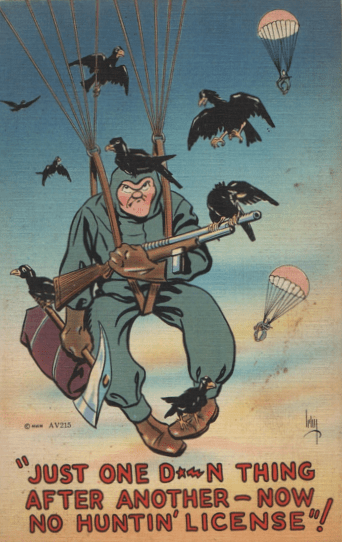
     One of the most common bits of advice of the day was about maintaining a positive attitude.  This artist goes a little overboard about it AND adds in a little anti-union sentiment to make it even cheerier.  By the way, on the subject of that positive attitude….

     It can go a long way, but that better not be all you have in your arsenal./  yet, lots of cards and motivational plaques our ancestors revered told the viewer over and over that if you weren’t happy, it was obviously your fault.  You weren’t looking at your troubles as opportunities, you saw only the clouds and not the silver lining, you weren’t really fit to compete in the business world, where it was the positive, cheerful chaps who made their way through.

     In the late 1930s, Thorne Smith made a great deal of a businessman whose motto was “Smile and Chase the Depression Away”.  He mentions the man’s hardworking and unsmiling partners who, by might and main, managed to keep him from smiling the firm into bankruptcy.  I’m not saying it’s the grouches who are the main power in business.  I’m just reiterating what the poet wrote when he said that if you let a smile be your umbrella you’ll wind up soaking wet.

     There were some people who pointed these things out at the time, and at least there were some postcards which seemed to realize it wasn’t always easy to smile every day.  (This was another popular theme of the day: Smile every chance you get and laugh once in a while just for the sport of it.)

     But I have strayed into critiquing philosophies I just feel are too shallow.  Let’s get back into serious advice.  I haven’t decided yet whether this is just quaintness, or if the Dutch kids have stumbled onto a real nugget of worldly wisdom.  You try this and let me know how it works out.

     On the other hand, here’s this.  As fatuous a homily as one could wish. No shading, no discussion of the man, just what is expected of a GOOD woman.  Frankly, I think a little depends on the dog having his day and what kind of dog he is.  To whom, out of curiosity, do you send this kind of card?  Your daughter-in-law?  Your Aunt Booney, on the passing of her fourth husband?

     Well, if you found some nuggets here for your resolution list, well and good.  Let me know if you find out how to pawn an opportunity.

Good Advice

     Though I think I have made it clear that this blog exists primarily to spotlight and criticize certain postcards I have for sale on other venues,. I do like to think it serves other purposes as well.  And with this in mind, I thought my postcards and I might just give you a hand writing your New year’s Resolutions.

     I, personally, gave up on New Year’s resolutions many new years ago, and opted instead for an annual statement (seen only by me) in which I congratulate the old year on a good, hard fight, and hope that the new year will occasionally go easy on me.  I will leave you to judge how our most recent new years have succeeded in coming up to my expectations.  (It was Ogden Nash who pointed out that new years are incorrigible, and wondered why we have all these parties to incorrige them.  Complaints must be addressed to Mr. Nash.)

     But you can bet your boots that our ancestors had plenty of advice to pass along, and frequently did so by means of the postcard.  Take this hearty bit of advice, which plays on some minor wordplay and suggests you not let people see your self-doubts.

     Our ancestors, going back centuries, have always been good at telling their descendants tyo keep working hard and all will be well.  This was a very popular verse in the world of business around the turn of the last century, though for business purposes, you were supposed to “work like Helen advertise”  Ther marketing department will not let a chance go by to get a word in, even if that would contradict what THIS version says..

     But in case you thought hard work was all it takes, even back in 1912, this young man was willing to give you advice on success in the business world which you MIGHT not get from your CEO.  It is good to keep in mind that our ancestors were not blind to the ways of the world, either.

     I KNEW the Dutch kids would have useful advice for the coming year.  The advice isn’t new, of course,  It’s the way she says it.

     This is another new phrasing to an old, old bit of advice, and well worth pinning up somewhere.  (Yes, jumping to conclusions IS more fun than waiting for confirmation on Instagram or Facebook, but remember the tumble.)

     Another attitude you might be surprised to find among the corporate world of 1912 or thereabouts is this admonition.  Yes, it says, you want to be nice to your workers, but….

     Here is another little touch of equality, at least in theory, between the sexes, suggested by a man who looked a bit like W.C. Fields as a time when W.C. Fields himself was still a skinny juggler in a tramp costume.  Still, his jovial, worldly wise attitude has a charm which will lead me to hunt down more of his advice in postcard form.

     Even if some of it may not quite be up to the level you want for your New Year’s resolutions.

Jest Jumble

This Monday old joke quiz comes from the dainties offered in the Miscellaneous chapter of the original quiz book, which was the LAST chapter.  But do not rush to a cliff’s edge, Shortbread Lasagna,  I did not use up all the jokes in each of the previous subjects, so we may have whole Mondays devoted to one subject of old jokes again, or, even better, a jumble of unrelated jests like these.  I know, I know: you thought the period of holiday miracles was over.  But I have old jokes enough to last WELL into next year.  Don’t make faces like that; you won’t be able to read the jokes.

     J1.”Who gave you that black eye?”

     “Nobody gave it to me. (          )“

J2.”In Boston, we regard breeding to be of paramount importance.”

“Ah well, (          )”

     J3.A hundred years ago or so, a young lady from Chicago was attending a public event in Boston, and paused to adjust her elbow-length gloves.  A passing matron, staring coldly, said, “In Boston, a gentleman would as soon see a lady adjust her garter in public as a adjust a glove.”

     “Teah?” said the lady other, “In Chicago (          )”

J4.That same matron was passing a construction site in Boston when she stared at the graffiti on the fence.  “Disgusting!” she exclaimed.  “This kind of hooliganism can only make tourists think less of our fair city.  Such vulgar phrases!  And (          )”

     J5.”Honey, you know she’s been a big help all these years: sewing labels in the kids’s clothes for school, helping keep them corralled when we go to the zoo or the big department store, always carrying bandages or a needle and thread for an emergency.  But I was wondering, Honey, if for this trip on our thirtieth anniversary, we could leave your mother at home.”

     “What?  (          )“

J6.”Had a great dream last night.  I was ay Coney Island, back when Coney Island WAS Coney Island, only I wasn’t a kid.  I’m as grown up as I am now, so I cab take my money and go on all the rides and see the shows and eat anything I want, without anybody to tell me to stop.  Great time!”

     “Yeah?  Well, last night I must’ve fallen asleep reading Kant’s Critique of Pure Reason, and there’s this knock on the door.  Before I can answer, in walks that movie star, Satin LaSheen, and sits down next to me on the couch.  We’re just starting a lively philosophical discussion when there’s a knock on the door again, and in walks Debby Hairy, that rock singer, and she comes and sits down on my other side, so we can have this three-sided dialogue, and…..”

     “Some friend you are!  You had two women like that in your room and didn’t think of giving me a call.”

     “I did call.  (          )“

J7.Leif liked to take his sandwich over to Grant Park when the weather was nice, and eat lunch there.  One day, he noticed an elderly man sweeping leaves off the sidewalk, and realized he’d seen that man just about every day for many years.  But he’d never spoken to the man,.  So today, he called “I see you’re doing quite a job there.”

     “Well, it’s what they pay me to do,” came the reply.

     “And you’ve been doing it,” said Leif.  “What’s your name?”

     “John F. Kennedy.”

     “That’s a famous name.”

     “Should be.  (          )”

I know you know these already, but for one last time this year, here are the ANSWERS.

A1.I had to fight for it

A2.We like it, too, but we encourage the young people to take up other interests as well

A3.he’d rather

A4.And so many are spelled incorrectly!

A5.I thought she was YOUR mother

A6.Your wife said you were on Coney Island

A7.I’ve been sweeping these sidewalks for fifty years