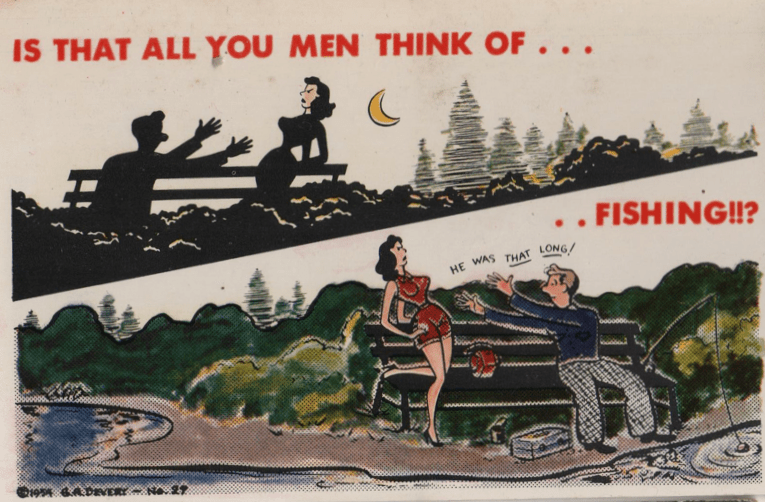
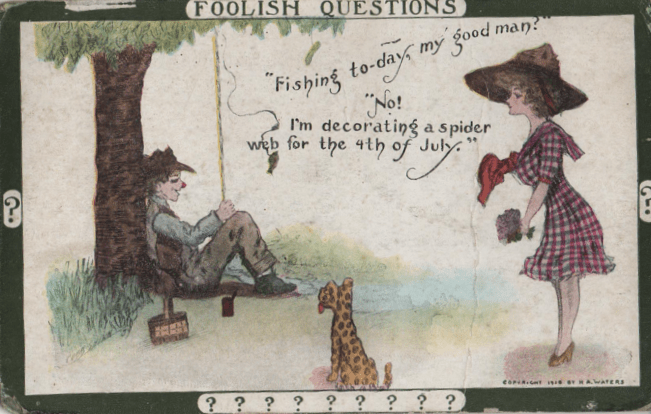
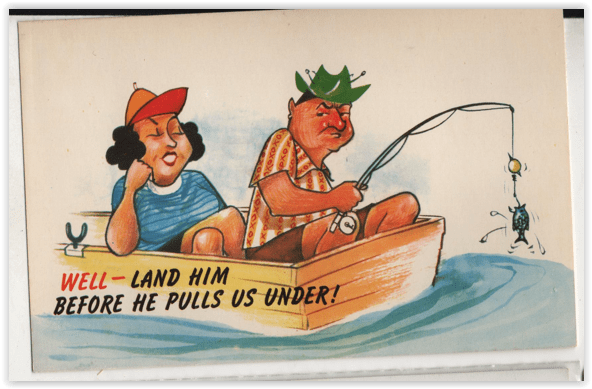
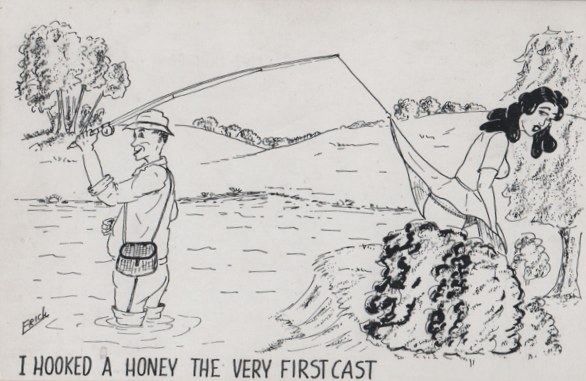
Well, here it is: April. I am proud that you thought of my blog on April fool’s…okay, maybe it isn’t that much of a stretch. Anyway, you may recall that some time ago, we discussed the Old World custom of sending your friends postcards with fish on them on April 1. I can’t do that, but I can revisit a subject we worked over last year: the many postcards which center on piscatorial pursuits, the art of catching fish and/or explaining why you didn’t.
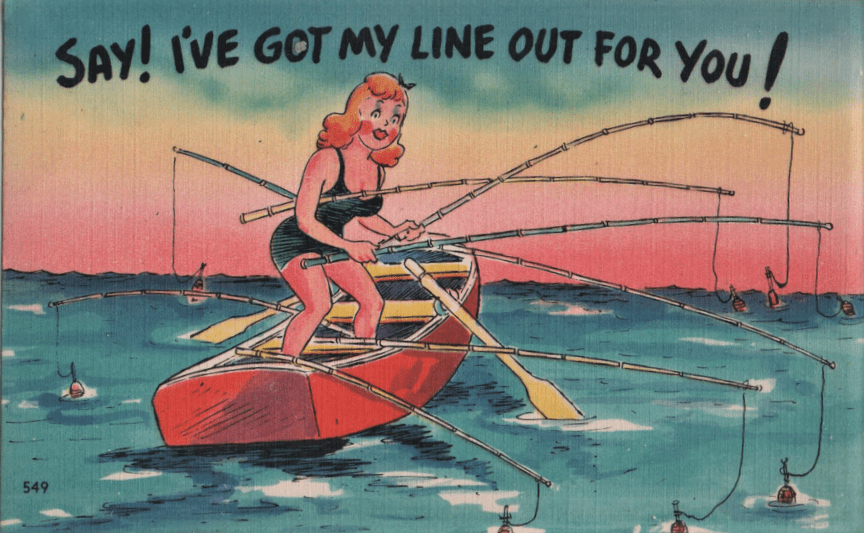
While this is commonly considered a male passion (see above), postcards were always willing to grant women a role in the sport, even if it was occasionally just as an onlooker.
An onlooker who was not necessarily clueless.
Many, many postcards over the years confused the roles of onlooker and prey.
Hooking something and taking it home as a trophy are two different things, of course.
Some cards, alas, treat women as a mere distraction from a man’s true role in life.
While others cannot dream of a true fishing trip without the company of women.
As cards have acknowledged, though, at least since 1912, when this card was printed, women do go fishing, too. And most of them are fishing for fish
Though this young lady is apparently fishing for compliments, as well as for a letter.
When encountering a rival in any sport, of course, sometimes a man can only sit back and admire the other person’s style.
And, as a gentleman, never forgets his manners.
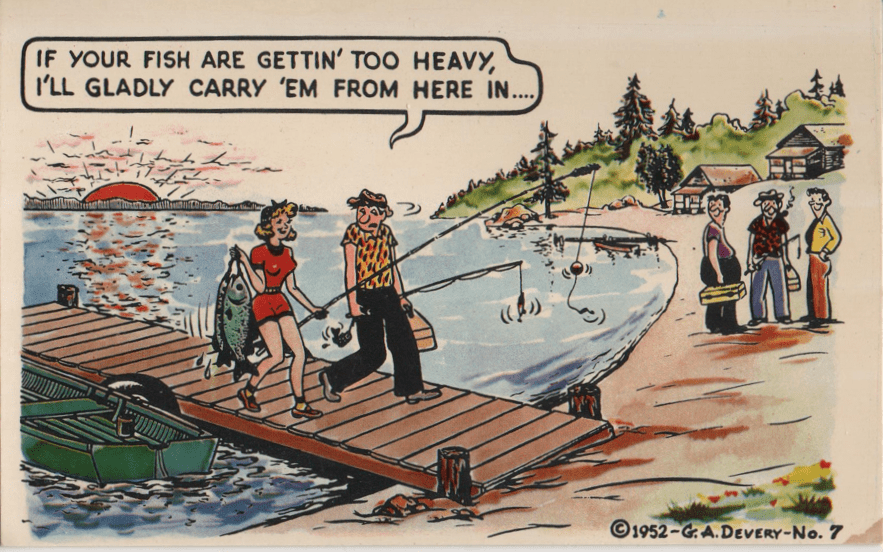
And like any other person with a passion for piscatorial pursuits, a woman is happy to show off her catch and taking it for dinner.
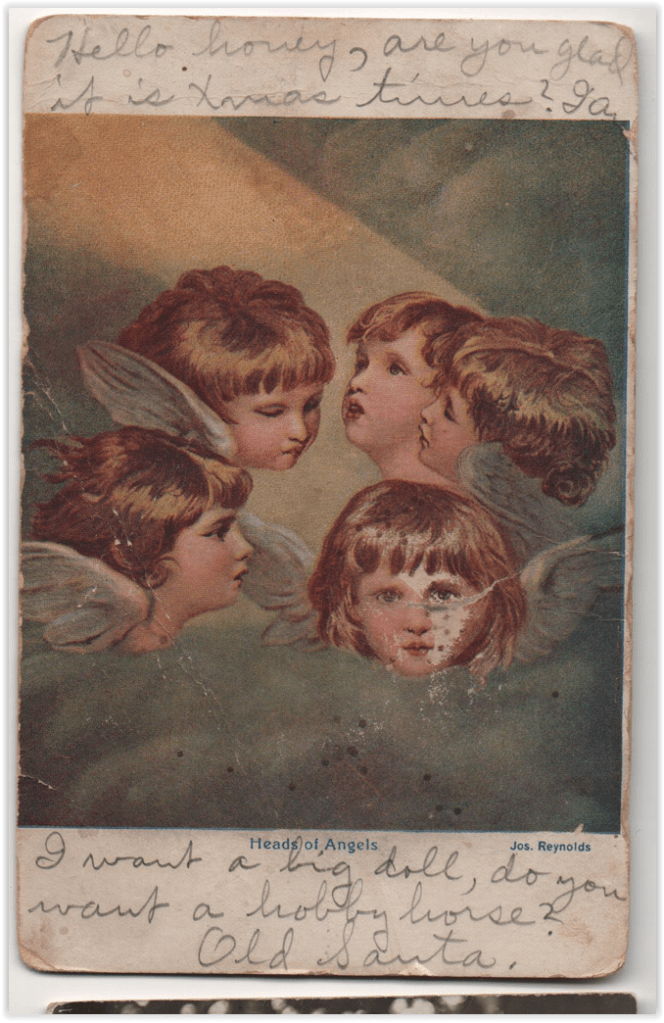
I have been led down another rabbit hole by a mildly boring art postcard, and I am going to take you with me as I reflect on the trip. But first, let me introduce you to a Chicago banker of a previous century.
Lyman Gage made his mark in Chicago, where he started as a bookkeeper and finished as a bank president. He was president of the Board of Director’s of the city’s world’s fair committee in the 1890s, and was part of a committee of businessmen that tried to clean up government. (Asking a committee of businessmen to clean up government is like…well, that’s a whole nother blog.)
He must be one of a modest number of people (You look it up; I can’t spend ALL my time on one postcard) who have been offered a Cabinet position by both a Democratic and a Republican President. He turned down the job of Secretary of the Treasury under Grover Cleveland, but he accepted during the next administration, when William McKinley made the same offer. As a financial illiterate, I cannot grade his work there, but I am told he was strong but cooperative, and if he made a few decision which backfired, well, what Secretary of the treasury didn’t? Later he headed up a new York bank and was a power in setting up the 1915 World’s Fair. His time in California had NOTHING to do with his less public side, which involved spelling reform, astrology, and psychic experiences. (He had claimed to have “psychic flashes”, which might explain his success in banking and politics.) He was eventually buried in Chicago.
Well and good: an apparently genial footnote to American history was Lyman J. Gage. And why do I expect you to care about this?
I have this postcard for sale, you see, addressed to Lyman Gage and sent by Old Santa. It was enclosed with something, or left by a chimney, so there is no postmark. The card has an undivided back, however, which signifies that it was manufactured somewhere between 1901 and 1907. Well, at that point in his life, he was in his sixties, so unless this was somebody’s idea of a joke, it can’t really have been addressed to him. “Master” was a title generally awarded to a boy, technically any male under 21.
But what are the chances that “Old Santa” was Gage himself, writing to his namesake?
There are two possible candidates, and it all depends on when this card was sent. People did not stop using undivided back cards in 1907, when the divided ones became legal. He may have really liked this collection of heads by Sir Joshua Reynolds and put in a supply of them. Or he may have sent this around 1901 (dang that missing postmark.) Gage had four children, none of them named Lyman. But one of his grandsons was Lyman J. Gage II, born in 1896. If Old Santa wrote and addressed this card to Master Lyman when he was five or six, that fits in nicely. There WAS another Lyman J. Gage, born somewhere during the 1910s, the result of OUR Lyman marrying his third wife, Frances (known universally as Gloria). IF our Lyman saved these angel head postcards long enough….
I would like it best if Gloria was the “big doll” Santa was hoping for, but nothing in Mr. gage’s Memoirs suggest he ever talked like that. (You may be a bit more formal in your memoirs, of course.) AND, of course, there’s no real evidence that this was not written by his wife, his daughter-in-law, or anybody else who happened to know master Lyman wanted a hobby-horse. And, if you want to be brutal about it, how much does anybody CARE about a postcard probably written to a grandson of William McKinley’s Secretary of the treasury?
Well, anyway, it was an entertaining rabbit hole to venture down, and I got to skim through gage’s memoirs. If you ever need entertaining anecdotes about William McKinley, or a few tales about psychics and spiritualists, you ought to look those up. (Hey, and maybe buy this postcard to use as a bookmark? Just a thought.)
Here it is, the first Monday of Spring, a season of newness: new leaves, new baby animals, new flowers. BUT it is universally regarded as a spirit of rebirth: those new buds are on old trees which have seemed dead over the winter, and those old lawns are born again and will need mowing in no time at all (barring a couple of April blizzards.)
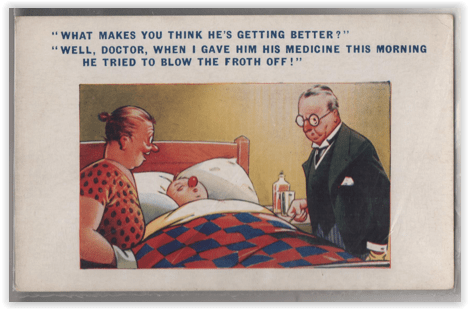
Yes, oh yes, this is another way of breaking it to you that we have returned to Old Joke Quiz Monday, and we will see some really antique jests coming into view. No, it is NOT like a Zombie Apocalypse. It’s all because of Spring. And we return once again to one of the longest chapters in this book I tried to get published thirty years ago, the section on Medical Jokes. We’ll prescribe ANSWERS, if needed, below this pile of Spring blossoms.
J1.”I’d like a refill on these, please.”
“I’m sorry, Madame. We can’t refill that without a note from your doctor, since those pills have been identified as addictive.”
“Addictive! That’s silly: they aren’t addictive. And I should know. I’ve ( ).”
J2.”I need a bottle of an acetyl derivative of salicylic acid, please.”
“You want aspirin?”
“That’s right. ( ).”
J3.”Doc, come over quick. I broke my leg in three places.”
“You should ( ).”
J4.”You should go to the hospital and have a kidney removed. You are really sick.”
“If you don’t mind, Doc, I’d like to get a second opinion.”
“Okay. ( ).”
J5.Kurt woke up in the hospital, feeling terrible. “Oh no! Did you bring me here to die?”
“No,” said the nurse. “We ( ).”
J6.”What do you think, Doc? Will I be able to play the violin after my operation?”
“After a week or so, certainly.”
“Wonderful! ( ).”
J7.”First I had appendicitis, cirrhosis, and cholera. Then they gave me penicillin, azulfidine, and lomotil.”
“Sounds like you had a rough time.”
“I’ll say. ( ).”
J8.”I hear you had Kramer as a patient. What did you operate on him for?”
“Twenty thousand dollars.”
“No, I mean what did he have.”
“( ).”
J9.”Doc, will my scar show?”
“Well, Ma’am, ( ).”
J10.”Dr. Krankheit told me he’d have me walking within a week of surgery.”
“Did he?”
“Oh yes. ( ).”
J11.There is a classic story about Will Mayo, one of the siblings who founded the Mayo Clinic. He was confronted one day by a pushy patient who demanded, “Are you the head doctor here?”
“My brother is the head doctor,” he replied, “I’m ( ).”
J12.Dr. Krankheit worked his way through medical school as a waiter. The first time he walked into the operating room, the patient gasped, “There you are! Do you think you can help me?”
“Sorry,” he replied, “( ).”
I provide these ANSWERS, even though I’m sure you know them, just in case you’;ve been looking out the window at the tulips. (No tiptoeing until you put your coat on. Doctor’s orders.)
A1.been taking them every day for twenty-five years!
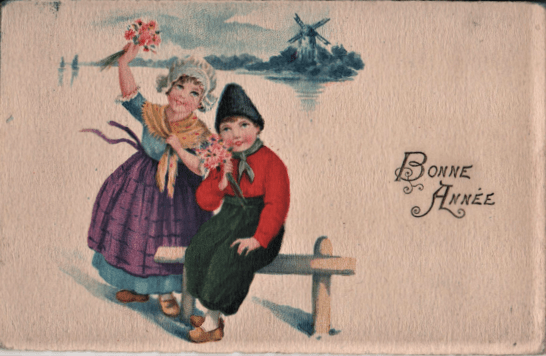
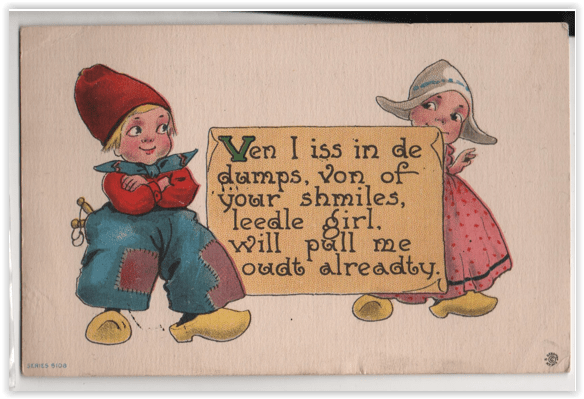
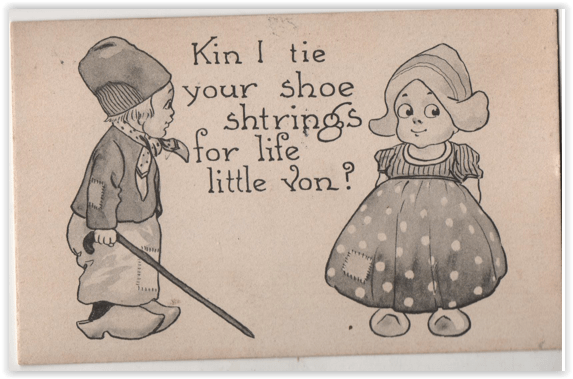
When last we spoke, we were discussing the Dutch kids in love, those smiling, happy wooden-shoed children who, at least in American postcards of the 1910s, spoke a fluent Pennsylvania Dutch, to nag about why you haven’t written, to espouse certain positive philosophies, or to reflect on the course of love. (As noted by the card above, the Dutch kids phenomenon was not limited to the United States. This is a French new Year card featuring a boy and a girl who are apparently good friends. I have seen Dutch kids in cards from other countries, where the Pennsylvania Dutch accent obviously can’t be the attraction. These tend to go for the picturesque, emphasizing those windmills and wooden shoes, and generally very pretty. For nasty caricatures of Dutch kids, you need to find cards from Holland, where Dutch kids are no great novelty, wooden shoes or not.)
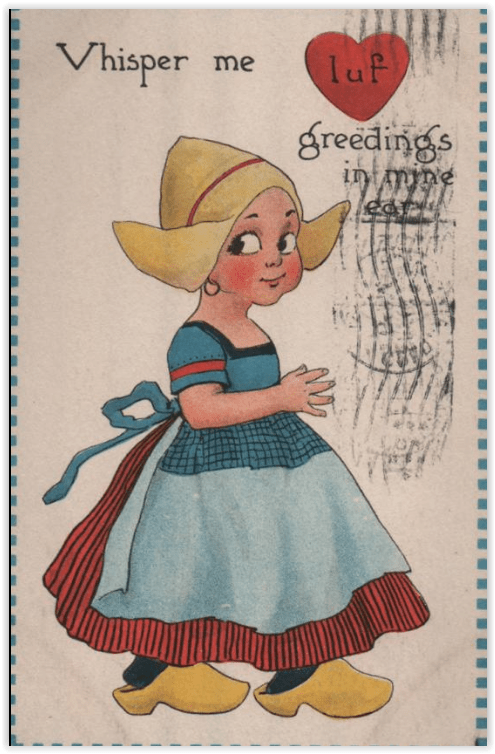
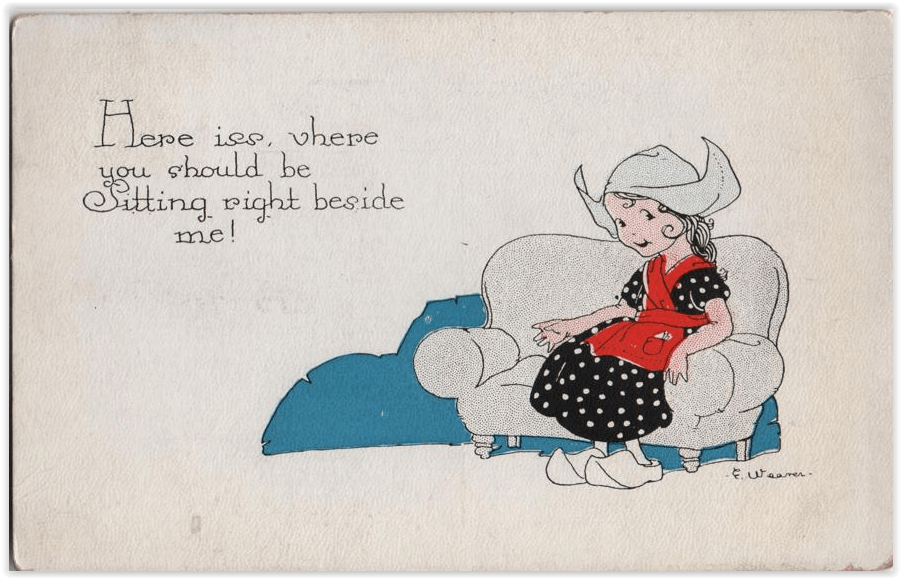
It was very much the vogue in postcards to use children to say things you might be shy of saying as an adult, and this was very handy when it came to romantic longings. Here the cuteness of the girl and her accent combine to take any scandal away from what might, around 1910, have been considered a fairly forward suggestion.
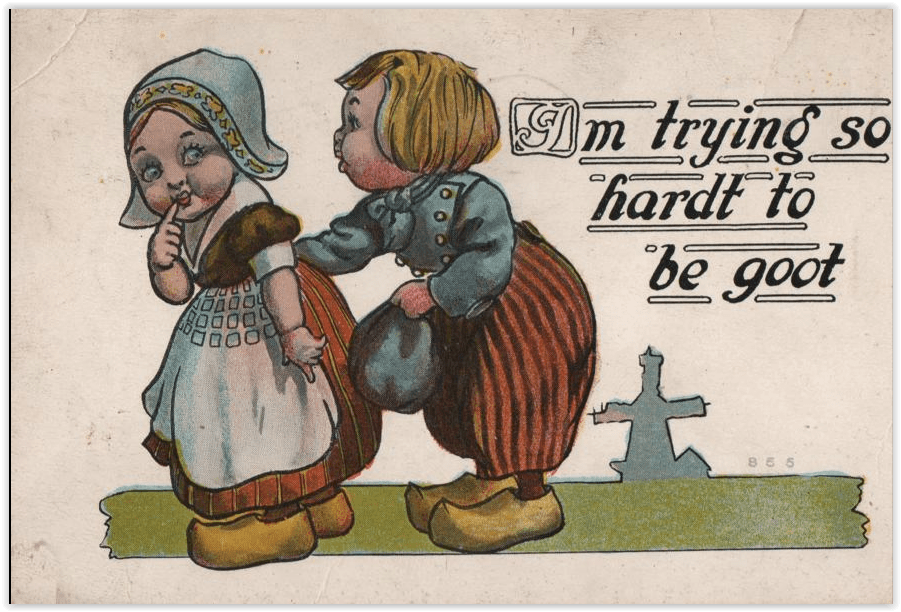
Like this one as well. Temptation to be naughty was not something a grown-up would admit to so readily.
And a young red-blooded American male would get all tongue-tied if he tried to say something shveet like this.
Or come out with a straightforward proposal.
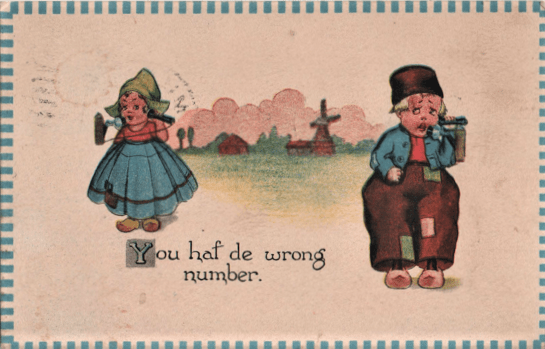
Of course, the wide world will put up blockades to romance, and sometimes a couple is separated by distance. Under these circumstances, the Dutch kids admit readily to something when an adult would be struggling to find the words.
Such separations can cause misunderstandings, and a falling away from one’s love, and we witness this sort of thing among the Dutch kids as well. You cannot make me believe, Gouda dumpling, that he really called the wrong number. She’s the one who has decided to disconnect.
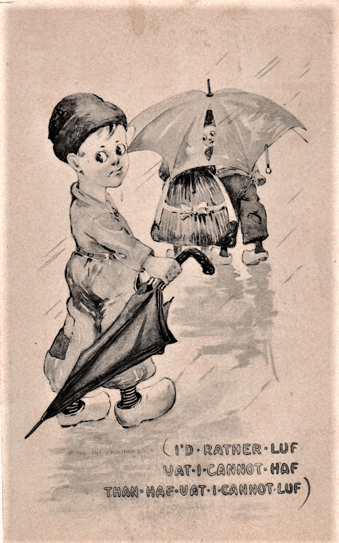
Forlorn lovers admit their troubles in the world of the Dutch kids.
Unhappiness can take over on both sides of the question.
But the Dutch kids are willing to come right out and explain what they need to make them happy again. (In this post-postcard age, we’re stuck with emojis for this.)
And, depending on how one arranges the postcards, of course, one can find one’s way to a happy ending, all through wooden shoes, a nice smile, and a thick accent. (Emojis, phooey.)
It has been a little while since we checked in with the Dutch kids, and their postcards do keep rolling in. For those of you who missed my earlier perorations on the subject, there was, in the 1910s, a mysterious (to me, anyhow) fascination with postcards featuring children who dressed in the folk costume of the Netherlands and spoke what was known as Pennsylvania Dutch (a German idiom found among those German settlers who minded their own business in rural Pennsylvania.)
Their postcards are a combination of cuteness and acuteness. Our humorists learned early on that a plain truth, dressed up in dialect, could make people admire and chuckle about what would have, in plain English, been flat and matter-of-fact. There were thousands of postcards of cute kids, sometimes speaking plain English and sometimes speaking baby talk. And I have pointed out cards which involved cute children using Italian dialect, and sometimes cute adults using Pennsylvania Dutch or, to a lesser extent, Irish, Italian, and German lingo. (I have not had a chance yet to look at every postcard ever produced, so I can’t speak to other dialects.)
But in the 1910s there was an explosion of postcards featuring Dutch kids. Different companies and different artists indulged the fad, and what caused it all and what made it disappear, I couldn’t say. (The Dutch kids seem to flourish even during World War I,) The earliest card I have found is shown at the top, there, part of a series of ads for Utica Yarn which featured Dutch kids enjoying yarn. This was around about 1906, but whether this started the fashion or just serving as a warning shot before the main melee I can’t say. (Jow many people paid attention to yarn ads?)
The Dutch kids spent their time dishing out cheerful advice, and were a mainstay of the nagging “Where’s that letter you promised me?” genre of postcard. When they weren’t doing that, they were trying to sort out the complexities of romance. The thought embodied in this postcard….
….is perennial. It just seems cuter when it’s said with an accent. The following thought is as old as “Rose are red, violets are blue.”
But who could resist it when it’s combined with that smile? The hunt for romance is universal, even when one realizes the dangers.
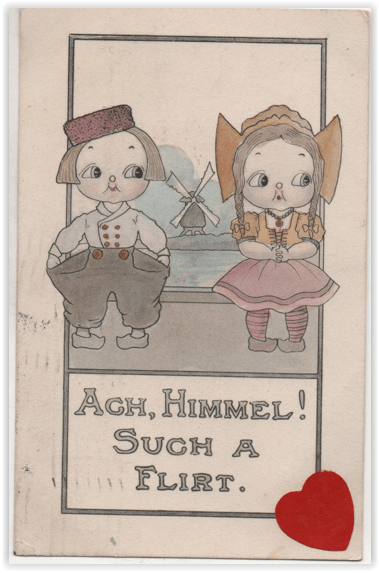
You get an innocent, adorable vibe when small children are flirting. This would have looked distinctly sinister if it involved adults, even with an accent.
And if this kid had tried this ten years later, he’d have been arrested, despite his bashful air. But at that size, and with that accent….
Don’t think for a moment the Dutch kids didn’t know what it was all about, either.
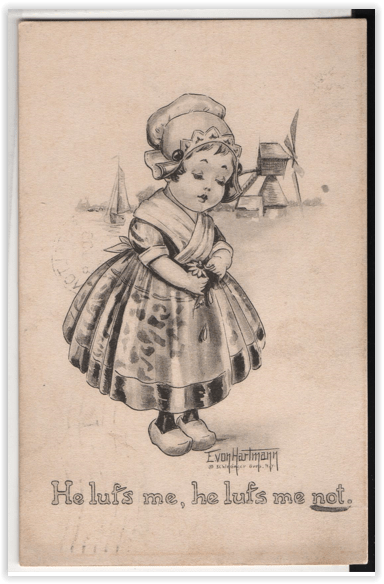
And it was all desperately important, too, wondering if someone returned your regard. That struck a responsive chord, beyond the accent and the dimples.
The slow response on the part of the opposite number could be inexplicable. When one knew one’s own worth.
And even a bright kid, confused by romance, could come up with the most ridiculous conclusions about what he meant to the opposite sex, not unlike older mem.
The city where I live does not want to let St. Patrick’s Day go by unobserved. It has been the custom, even in the depths of the pandemic, when the holiday falls in the middle of the week, to observe two St. Patrick’s Day weekends. In addition, there are plenty of people who add a celebration of St Joseph’s Day on or around March 19. (St. Joseph covers a lot of ground, and is the patron saint of Bohemians and Italians.)
So on the Monday after, we present these recipes to use up all the leftover corned beef, marinara, Guinness, and dill gravy. That’s a joke: there IS no leftover Guinness. If this were a food blog, we would help. out But it is not, and this is Monday besides, so here is another Old Joke Quiz. In the spirit of the Monday After, we are assembling odds and ends of jokes left over at the ends of previous chapters. A hash of answers will be found at the end if you’re still hungry.
J1.Do you know the difference between a mailbox and a lion?
“No.”
“( )”
J2.”Do I look okay for the party?”
“Hang on. There’s some snew in your hair.”
“What’s snew?”
“( )”
J3.Once upon a time, a suburban housewife opened her refrigerator and found a large rabbit inside. “What are you doing here?” she demanded.
“Isn’t this a Westinghouse?” it replied.
“Yes.”
“Well, ( ).”
J4.These two coin collectors met at a bar so they could ( ).
J5.The cruise ship was docking in Athens. “What’s that stuff on the mountaintops?” asked one tourist.
“Snow,” another told her.
“That’s funny,” she replied. “I thought it was ( ).”
J6.When Mr. Gotlots died, his relatives gathered in great excitement to hear the reading of the will. The lawyer read the preamble about the sound mind and body, and then got down to the various bequests. “Dirst,” he read, “To my nephew Rodney, whom I promised to remember in my will, ( ).”
J7.”Can I put this wallpaper on myself?”
“You can, but ( ).”
J8.”How can you charge six dollars a pound for corned beef? I can get it for three dollars a pound at Super Value!”
“Well, go buy it at Super Valu, then.”
“They’re all out.”
“Huh! ( ).”
J9.”Those sausages you sold me were all meat at one end and bread crumbs at the other!”
“Well, nowadays ( ).”
J10.Bob was visiting a small town and stepped into the grocery store to buy corned beef. To his surprise, he found only a few boxes of cereal, a can or two of Cream of Mushroom soup, and row after row of salt. Bags of salt, canisters of salt, and individually wrapped salt shake filled with salt sat on every shelf. He said to the woman behind the counter, “You must sell a lot of salt.”
“No,” the woman told him, “But ( .”
If you really need help with these ANSWERS, perhaps you’re the reason there’s no leftover Guinness.
A1.Remind me never to send you to mail a latter
A2.Nothing much; what’s snew with you?
A3.I’m westing. (Jokes based on old advertising slogans have their pitfalls; you may wish to avoid this one and, say, the joke about the kin you love to touch, and promise him anything but give him…okay, we’ll move on. Whole nother blog.
A4.catch up on old dimes
A5.I thought it was Greece
A6.Hi, Rodney!
A7.It’ll look better on the wall
A8.When I’m out of it, I sell it for ten cents a pound
A9.It’s hard to make both ends meat
A10.But the salesman who sells me salt, HE sure sells a lot of salt!
Last time, we were discussing the cdv, or carte-de-visite, a combination portrait and calling card popular for about fifty years, roughly between the Civil War and World War I. The vast majority of these were produced for use, rather than as collectibles, and do not benefit from having a name printed on them. And, of course, they were produced largely to be given away. As time went by, just as with business cards today, people looked at them and wondered, “Who gave me this? Why did I keep it?” As photos. They had a slightly longer life expectancy but, with time, thousands found their way into the great retail recyclery: the garage sale. Once separated from their natural habitat, unlabeled cdvs lost virtually any chance of being labeled.
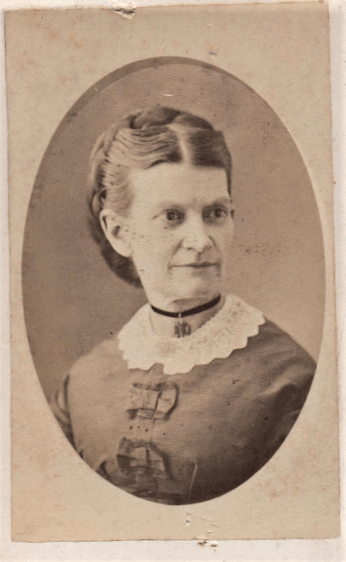
So we have little or no chance of finding out who that young lady at the top of this column is. Her picture was yaken in Berlin: we have that much information. But who she was and what her goals (she had some: look at that face) and why she was important enough to someone to clip the corners of the card and fit her into an album, we will probably never know.
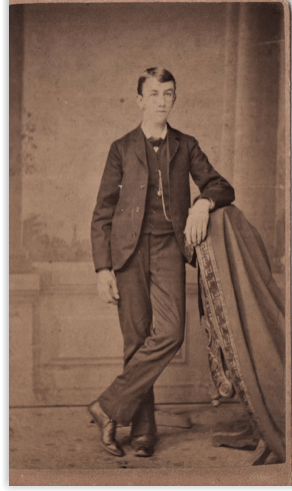
What about this young man? Shoes glossily polished, watch chain displayed, barely old enough to shave, he must have been on the verge of something important. Is the picture a memento of his first day on the job, his first day of college, or his appearance before a judge to answer charges of outhouse-tipping?
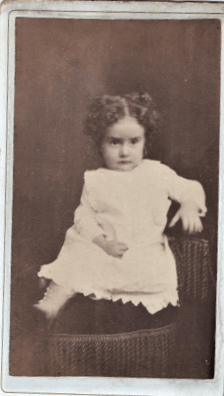
And this young lady? Why did she choose this picture to hand out to friends, or send with job applications? Has she just taken a degree or been awarded a prize for her essay on toenail fungus? Without a note on the back, we have no way of knowing.
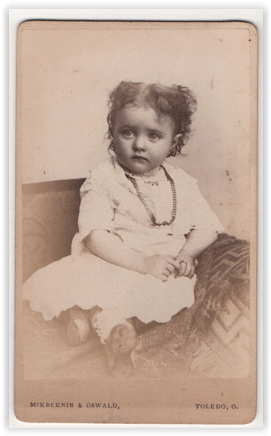
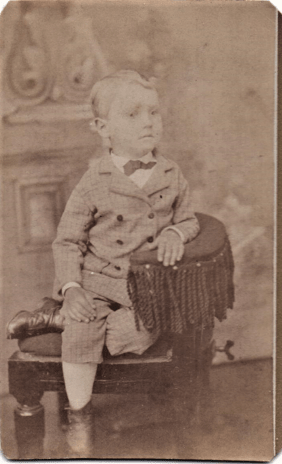
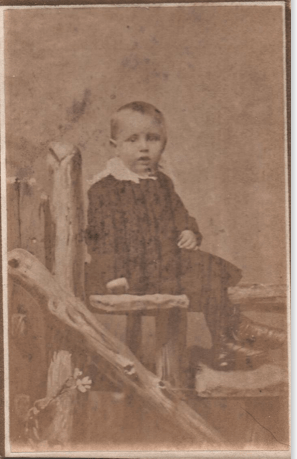
Particularly susceptible to this sort of thing, of course, are cdvs of children. Since children don’t especially need business cards or calling cards, these were probably made by proud parents to leave at friends houses to let them know how little Jehosaphat was getting along. With time, babies change their faces and often become largely unrecognizable. So unless they got labeled right away, the picture now tells us very little. Except personality, perhaps. This toddler is clearly plotting world domination.
While this one is simply wishing she were someplace else, and wondering why the man with the big machine there keeps telling her about watching birdies she can’t even see.
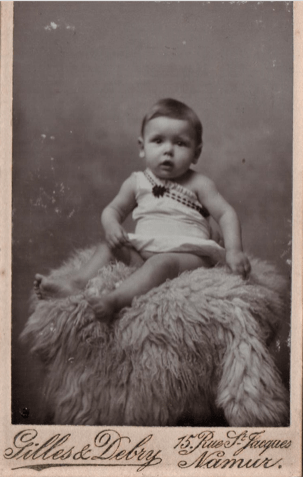
This infant wants to know how much longer he has to sit barelegged on this mangy sheep skin.
Whereas this young man wants to know when his next coffee break is. (Man, this job will be easier once I can tell time.)
This one, of course, knocked off work early and is already on his way to the club, where he can show off his fancy new suit.
And get into a fight with this other party animal. (Though he may be late; he looks a little overwhelmed by whatever contraption that is the photographer has him sitting on.)
WHY can’t people label their photographs, especially those on cdvs, made especially for dropping off at other people’s houses? Why can’t they be more like the parents of Harry, here. Thanks to the fact that they labeled AND dated this cdv before they dropped it off, and thanks to the photographer putting a logo on the back, we know that in August of 1879 there lived a lad named Harry D. Earl. And he really liked thumbs.
The Interwebs informs me that the business card came first, and the calling card second. At some point in the seventeenth century (in Europe; China was two hundred years ahead, as usual. But they had printing first, so they had a head start) businessmen would drop these off at the offices or homes of prospective clients as a warning that they would be coming to give a sales talk at some later date. The upper classes picked up on this custom and converted it to social calls. (My own theory is that the bourgeois came up with the whole card idea first because they were the first class that really needed to be able to read. It is only my own mean-spirited imagination that sees the dukes and earls picking it up just to show off they they’d been to school, too. I suppose Moliere has already included a character who could NOT read, but was high class enough to drop off calling cards, and learned only too late that the printer had made an unfortunate and obscene typo, leading the people he visited to expect…where were we?)
So technically, the “Visiting Card” or business card came first, and then came the “Calling Card”. I had rather expected that these cards were unnecessary in the days of the Interwebs, unlike the days when business folk had special file drawers or Rolodex-style wheels for saving them. It is not so. Estimates claim that in 2019 alone, over 7 billion cards were printed, mainly business cards, as calling cards have fallen out of favor except with certain quirky teenagers who use them for dating. HOWEVER, then the Covids came along, and nobody wanted to take something you had touched, and the business went into something of a spiral. We’ll see what happens next. Tweetcards?
But we are taking a long time to get to the subject of this column, which is a special sort of calling card. During the nineteenth century, a bunch of techno-geeks were fooling around with an invention which would eventually be called the camera. Like a lot of techno-geeks, they came up with the invention first, and then had to come up with ways to make money on it. Some chaps became artists and took breathtaking photographs for exhibit, while others set up galleries and sold pictures of anything at all in bulk. Others set up studios and would take your picture for a fee, cameras being too complex for the average human to handle.
Other techno-geeks, like techno-geeks everywhere, thought of odd branches of the profession. Have I told you about the Parisian pornographer who tried to convince the French government that old-style passports, with a lengthy description of the rightful user, could be replaced with new ones, with a photograph? Yep, this fellow turned aside from raunch to invent the passport photo and, by extension, the ID photo, driver’s license photo, and the rest. Another photographer looked at the calling card and invented the Carte-de-visite.
The carte-de-visite, or cdv as collectors call it, was a stiff piece of cardboard of the same kind used for larger family photos, but about the size of a large calling card. In place of the name, a photograph was applied, so you could drop these off at a friend’s home, and they would recognize who it was who had called. The usefulness of this could be debated (you might not recognize your neighbors once they dressed up for the photographer) but the popularity was obvious. Everybody wanted the new notion and ordered plenty. The photographers, understanding their customers, printed up cdvs with pictures of celebrities and royalty on them, creating an early form of trading card. Millions of cards with millions of faces were produced, and as most of them were on good, solid card stock, millions exist today.
But they are still collected, some for the same reasons they were collected in the 1870s: the faces were instantly recognizable and important. (“I’ll trade you these three prince Alberts for that Sarah Bernhardt.” “Throw in that Princess Alice or no deal.”) Others are saved because they are like the Real Photo Post Cards, because the faces are unknown, but were frozen at a moment of acclaim or passing importance. That’s what I have sitting around here mostly, and we will look at some of those in our next thrilling installment. (Book now: seating is limited.)
Today is, of course, National Pie Day, but since, as mentioned hereintofore, this is NOT a food blog, I shall save the dissertation on my mother’s pie recipes for another day. Anyhow, Monday is Old Joke Quiz Day around here.
So here is a collection of tart remarks (catch that one, did you? Ooh, you’re good.) The answers, should these not occur to you right away on a Monday morning, are tucked away below.
J1.”I see my buddy gave you a black eye.”
“Ah, you don’t even know the guy who did this?”
“Yeah? ( )”
J2.”So it’s a battle of wits you want, eh?”
“No way. ( )”
J3.”If you were my husband, I’d give you poison.”
“If you were my wife, ( ).”
J4.”How ‘bout them Hawks?” said the barber, as Mickey sat down in the chair. “Pretty good game, I thought. Hot today, isn’t it? Good for the corn, I suppose. “How’d you like your hair cut today, sir?”
Mickey smiled. “( )”
J5.”Doc, this liniment yougave me makes my arm smart.”
“Well, why don’t you ( )?”
J6.”I’ve changed my mind.”
“Good. ( )”
J7.Harlan was always borrowing things and “forgetting” to bring them back. When Jim saw Harlan at the door, he steeled himself to refuse the next request. He opened the door and Harlan said, “Hey, neighbor! You using your lawn mower today?”
“Why, yes,” said Jim. “I was just about to go out and mow the front lawn. Then I was going to mow the back yard, and after that I was going to go over to my mom’s place and mow her lawn. I guess I’;m going to be using that lawn mower all day.”
“Oh,” said Harlan. “Then ( )”
J8.”Put your ear up to this box.”
“Why?”
“Just put your ear to it and listen.”
“Okay. I don’t hear a thing.”
“( )”
J9.”I’ve invented a pill that makes you smarter.”
“That could be useful.”
“I’ll let you try it for fifty bucks.”
“Fifty bucks? That’s…..”
“Guaranteed to make you smarter.”
“Okay, here’s your money. Let me take that pill. Looks like a plain aspirin, but here goes. Well, how long does it take?”
“It all depends. Wait and see.”
“Wait and see, eh? I think you’re a complete fake!”
“( )”
J10.Lee, Lionel, and Leonard were lost in the woods and had been going in circles for days. Supplies were getting low and the men were down to their last hope. “Listen,” said Lee, “There’s no chance all three of us can survive this. We’re down to one salami and that’s not enough food for another day of this. Let’s pick one of us to eat it and go on while the other two just give up and wait for death. We can draw straws.”
“We ate the straws yesterday,” Leonard reminded him.
“Why don’t we sleep on it?” said Lionel. “We’ll have a contest. Whoever has the best dream tonight wins the salami.”
This seemed fair, so they settled in for the night, their rumbling stomachs singing them to sleep. In the morning, Lee said, “I guess I win the salami. I dreamt that I died and went straight to Heaven. They rolled out a golden carpet for me, and led me to the heavenly choir, where the director handed me the baton and said he could now retire. And then I led the heavenly choir in a mighty hymn of joy.”
“Not a bad dream,” said Lionel. “But I also dreamt I died and went to Heaven. They met me in a golden chariot so I wouldn’t have to walk, and I was taken to St. Peter’s office, where the saint told me what they’d been looking for was a really good bookkeeper, and I would get the job. My first job would be to see why the heavenly choir was spending so much. Tough dream to follow, I think. What about you, Leonard?”
“Well,” said Leonard. “I dreamed you two guys died and went to heaven. ( ).”
None of these smart guys are as smart as you are, of course, since you already know all these ANSWERS.
A1.Anyone who gives you a black eye is a buddy of mine.
A2.I’d never fight an unarmed man.
A3.I’d drink it. (one of Winston Churchill’s, ca. 1930)
In my pursuit of archaic humor, I rely, as any detective would, on a combination of information and deduction. I have learned, when a caption aooears on postcards by different artists, to check the world of advertising or the realm of pop song. This has led me to a greater familiarity of the recordings of Billy Murray and Bert Williams, and I think I am the better for that. Whether the descriptions of the postcards in question, enhanced by this added data, happen to sell better, I will allow the market to decide.
As you have seen, ye weary hardworking regular readers of this column, we have also ventured into the world of bygone slang, and the nearly-forgotten catchphrase, And you have also seen that I have occasionally come out right where I began, none the wiser for my search through the echoing halls of ancestral comedy.
I am going to bring up a few of these unsolved cases in this episode of our saga, in the hopes that you will be as confused as I was. If you DO see at once the joke I’ve missed, you can let me know in the comments, but I’d really rather think these are stumpers. Just affirmation of my role as jokemaster around here.
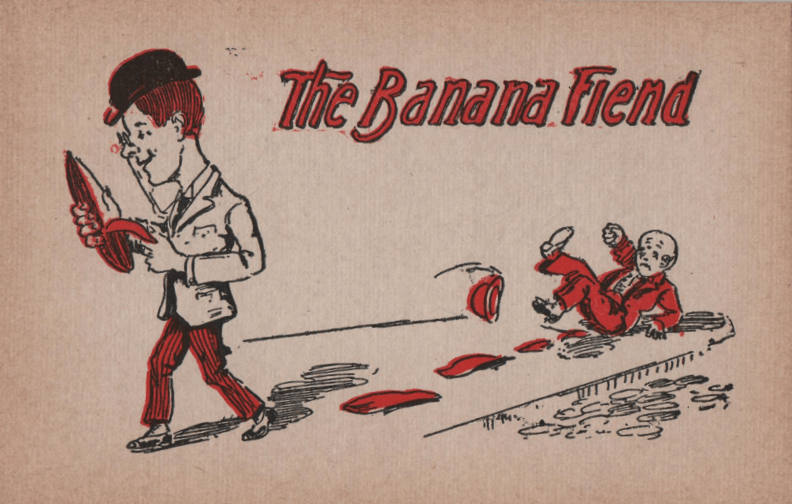
The postcard above dares to somewhere around 1914, I have been through the history of bananas, and even of the song Yes, We Have No Bananas, which would lead to its own fiendish craze some years after this. But I have found no song or silent movie about a banana fiend. It could be that this was part of a series by one artist, and included pineapple fiends and kumquat fiends. Or, he may just have loved the idea of a fiendish soul spreading really old jokes about banana peels on pavements. But I feel incomplete, somehow. The question “Why a banana fiend?” will haunt me until someone tells me this was an early supervillain who roamed the streets of Gotham City at the turn of the century.
My problem with this young lady is that I can’t quite figure out what she’s doing,. Is she holding a mirror, and studying her black eye? Was her publisher cad enough to think a punch in the eye from a man was funny enough to warrant a card? Or IS that a black eye? It might be a stray shadow, and the lady is actually studying something else she’s holding in her hand. If she’s holding something in that hand. If she’s even a lady (given the tendency of early postcards to feasture female impersonators, this is another possibility. This could be a famous vaudeville performer who sang a song called “Sent By Male”. Haven’t found him yet, though.)
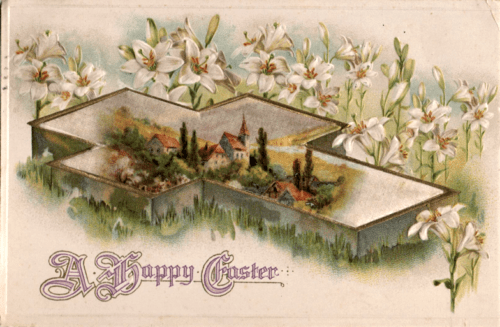
Now here, I know what they were up to. The publisher wanted to combine a number of icons of spring and Easter in one card. This has been done in a variety of ways, but I’;ve never found one quite so startling as this. If I am seeing this right, somebody built an Easter diorama of a little country town inside a box shaped like a cross. They then apparently filled it with strawberry Jello (that pink tinge around the village, but just as high as the edges of the box.) And then they left it on the lawn. Were they tired of hiding colored eggs?
In this case, I am perfectly convinced that this is the work of some important avant-garde artist of the 1910s, and no one has told me which one yet. The card was printed in Germany, and has no text on the front or back to explain the photo. That grimace is unpleasant for a card I would send anyone, but I wasn’t around at the time, so maybe I just don’t understand. And what is she doing, anyhow? Is she in pain? Is she weeping? Is she, as someone I have decided to ignore in the future suggests, laughing really, really hard? I have had one or two other suggestions, but really, I don’t want people to get the idea this column is devoted to bathroom humor.
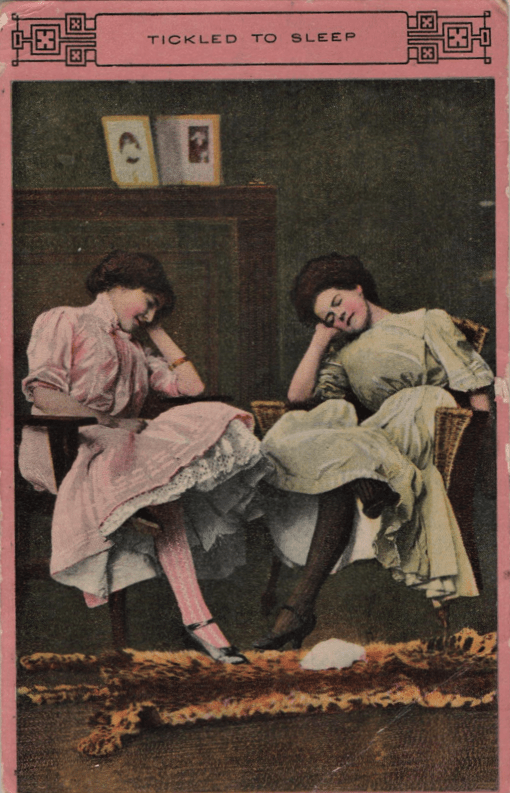
And if we’re going to be indelicate, we can save it for this postcard. When I searched the Interwebs for “tickled to sleep”, I was sent to a lot of really unusual websites. But the basic explanation is reasonably G-rated. It is possible to tickle someone until they are exhausted, and pass out. There are videos of people doing this to puppies and kittens and small children online, and I hope these people are being carefully watched. But who’s been tickling whom? Is the lady on the left still slightly awake? Is she the tickler, and her friend with both eyes shut the ticklee? But how is this all possible? I can’t believe that if that much tickling had been going on that thjeir hair and clothes would not be disheveled. And speaking of their clothes, um, where was someone being tickled? They have their shoes on: we can see that, thanks to the design of the photo to let us stare at their calves and ankles (this card dates from about 1908). Their clothes look kind of tickle-proof to me, so where…how…no, I really don’t want to hear ALL your theories. Once again, I may just not be understanding something obvious to a person in 1908.
And, if there’s anything these cards demonstrate, it’s that we just don’t know what will tickle somebody else.




















 Blogsy Babbles