Four Cheap Old Comic Books II

    As you will recall from our last thrilling episode, I was going to tell you about some wildly collectible comic books I turned up after years of wondering if I would ever own, if temporarily, any comic books people were thirsting for.  Then I got bogged down in discussing the theory of collecting things, condensing A. Edward Newton’s suggestion that you should collect things you like, so you’ll be surrounded by nice things even if they never appreciate in value.  Buying something for resale, he suggested that you go in for stocks or land you never look at.  Since if you’re planning to sell it some day it has to be something you won’t fall in love with.

    I might, if I had wanted to continue along those lines, to a rule set up by A.S.W. Rosenbach, the legendary book dealer who, among the many other things he did, worked hard to make sure everyone knew he was a legendary book dealer.  He frequently sold books with six and even seven figure price tags, and once in a while, his customers would suffer reverses and sell them back to him.  His rule was never to sell that returned book to a new customer: in almost all cases, he said,. The previous owner, as soon as he recouped his fortune, would be glad to come buy it back at an increased price, and be grateful for the opportunity.  (I actually knew a man who bought a book from Rosenbach’s successor, John Fleming, for a million dollars, had business losses and sold it back to him for about three-fourths of that and then, after doing his best to hold off, went back and repurchased it for two million dollars.  (The story ends happily: when he sold his best books at auction, it brought in a little over six million, a new record in the bookselling world.)

    But I was talking about comic books.  One day I spotted some auctions online with some comic books I’d read about but never read.  The prices seemed relatively low for what the comic books were, so I put in some modest bids.  I did not win…MOST of the auctions.  To my surprise, however, I was the winner of four legendary comic books  Not the sort I could have taken home to my mother, who got me hooked on Uncle Scrooge and Little Lotta and Wendy, the Good Little Witch,

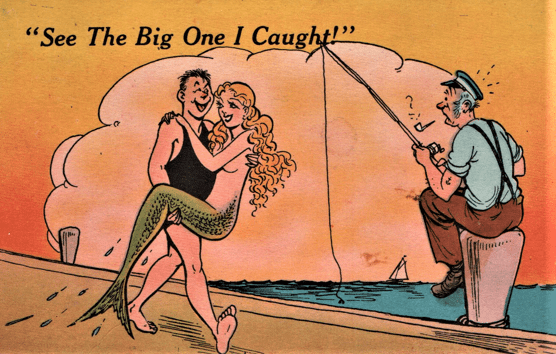
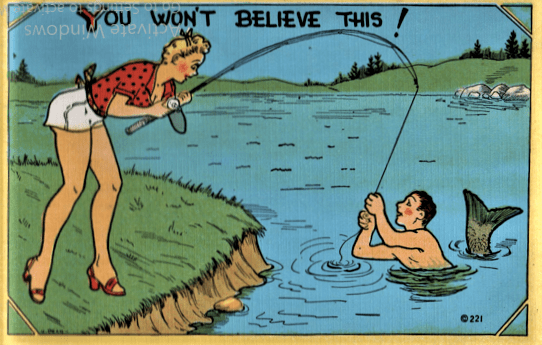
    I had won four Tijuana Bibles, also known as Dirty Little Eight-Pagers.  These were small (postcard-sized) pornographic comic books which usually exploited celebrities from the world of movies, radio, and comic books.  They were published somewhere by someone from roughly the 1930s we;; into the 1950s,  (The form has occasionally been revived: I saw one featuring Donald Trump last time I went hunting.)  They are now old enough to be historic, and several books have been written about them, including several collections of reprints.  But even a faithful reprint has been through a filter.  Someone saw it and decided it was worth reprinting.  Here I had four at random.  I could read them without footnotes, make up my own mind about them, and then, I hoped, resell them for many times the purchase price.  (Remind me to tell you how Ronald Reagan’s presidency convinced me I would make mu millions in reselling old western paperbacks.  I’ll tell you the happy ending now: those books are still in excellent condition in a box in a storage locker, because I never had to sell a single one of them…no matter ow I tried.)

   I could judge the narrative flow, the accuracy of the caricatured portraits of the rich and famous, the risibility of the jokes, if any.  I could gauge for myself just how pornographic they were.  You know the ancient cliché: “That may have been pornographic back THEN, before people understood about sex, but nowadays….”  (This is generally untrue, by the way.  As I noted in a public lecture once, our ancestors knew all about sex.  It’s how they became  ancestors.

    I could…well, I could go on, but I see I’ve run out of space again.  See you next week, breathless fans.  (You can save your breath over one thing: I am anxious to maintain my PG-13 rating, so you ain’t gonna see much reprinted but the covers.  The contents ARE pornographic by 2021 standards.)

Four Cheap Old Comic Books

    The time to get into collecting anything is before anybody else thinks of it.  If you wait until the market is established, rarities agreed upon, and prices set, you will look in vain for legendary items and have to settle for lesser choices. 

    Do keep in mind, as you look over that last sentence, that it simplifies matters.  If you want to make money in collectibles, you must also be sure to collect something that people will eventually yearn for.  Your collection of ice cream sandwich wrappers may be definitive, but no one but a reporter from the Sunday paper, or the staff of Hoarders, is going to be interested.  Similarly, if you’re planning a profitable collection, you need to dispose of it while the iron is hot: not like all the people who went into beer can collecting because everyone else was doing it only to realize everyone else had moved on to collecting pogs, and nobody wanted to buy those precious bits of tin and aluminum.

    In fact, the best advice I ever read on collecting came from book collector A. Edward Newton, who suggested collecting things you like.  Then even if you never make money, you’ll enjoy the stuff.

    I was really starting for another destination at the beginning of this blog.  I was going to note that I came to comic book collecting much too late.  The time to start collecting was really around 1954, when the comic books which had survived the World War II paper drives were still affordable and horror comics were in their prime.  The new age of superheroes was right around the corner, and somewhere around the time The Fantastic Four first appeared, people started collecting comic books in earnest.  By the time I was interested, that first Fantastic Four was selling at prices in four figures, and the legendary issues, like Action #1 (first Superman) or Detective #27 (first Batman) were sneaking up to six figures.  I had to settle for what odds and ends I could pick up (baseball cards were not as hot at that moment, so I wound up swapping my duplicates—which would have been worth a cool profit just ten years later—for a World War II Batman and some 1920s comic strip reprint booklets.)

    I pored over the price guides, dreaming of what I MIGHT find at some garage sale, and sent away to comic book archives for photocopies, so I could read the not very classic adventures of the Rubber Robot, Invisible Scarlet O’Neil, and the Blue Blaze (whom I have hitherto nominated for one of the dumbest origin stories in the world of superheroes  He was, like Spider-Man, a scientific accident, but all Peter Parker had to do was get bitten by a radioactive spider.  The Blue Blaze got dressed up for a costume party just before an earthquake struck, throwing him in front of his father’s experimental ray gun, after which he was buried alive for about eighty years until grave robbers dug him up and….  He was also easily one of the grimmest of superheroes: Superman may have matched him in the invulnerability department but Superman never picked up an evil scientist and walked through the scientist’s river of acid, knowing HE would come out of it okay but the villain would be dissolved to a mere skeleton.)

    But the great finds always eluded me.  One garage sale—involving the sale of the estate of someone rumored to be a fence, so everything there was under suspicion of being stolen—turned up a number of Animal Comics featuring early Pogo stories, but I didn’t have the wherewithal to buy all of them and, as usual, picked the ones that ,looked like fun but were worth the least.  And that was about the extent of my rare finds until just recently while hunting online for things to sell to buy pretzels and cheese during the pandemic, I bid on fourteen comic books I’d HEARD about but never expected to hold in my hand—not superheroes, it’s true, and not by artists people were yearning for, but….

    Oh, I see that’s all the room for today’s column.  Next time, then, true believers.

Travelogue

 So it says here that Graustark is bordered by Axphain to the north and Dawsbergen on the south.  I see no reason to doubt this.  This does not, however, explain its general proximity to Ruritania, which is somewhere near Bohemia (now the Czech Republic).  The two tiny countries have so much in common that they can’t be all that far from each other.

    Ruritania is the more famous of the two, which is why it and Graustark and a number of similar obscure principalities are referred to as “Ruritanian countries.”  They consist of a court where everyone speaks perfect English, a populace which speaks some other language (Graustarkian in Graustark) and are exceedingly gullible.  The ruling families of these countries, which HAVE to be related, are known for their amazing resemblance to each other, or to any likely looking well-bred foreigner, allowing for vast amounts of mistaken identity, impersonation, or other skullduggery.

    Ruritania became famous first, coming to us in 1894 When Anthony Hope brought us The Prisoner of Zenda.  It was the setting of two more novels of villainy and heroism, and then Hope went on to pursue other interests, leaving the field to George Barr McCutcheon, a Chicago author who began with the novel Graustark in 1902, and followed it up with half a dozen more novels, off and on, for a quarter of a century, with dramatizations on stage, movie versions, and other marketing opportunities.  (A Chicago author, George had a younger brother, John T. McCutcheon, who became an editorial cartoonist and late in life, after winning his Pulitzer, noted with some satisfaction that after years of being introduced as the younger brother of George, the author, whose books were out of fashion, was now being introduced as the older brother of John.)

    Beverly of Graustark was the second of the novels.  The turgid political saga of the royal family continued as the Prince of Ruritania, unable to appear in public due to a hunting accident, is impersonated by his female cousin, who has to wend her way through plots and counterplots while falling in love with her cousin’s bodyguard.  It was adapted for the stage by Robert Baker and, as noted here, toured the United States for four or five seasons, apparently to great success.  (Would THE Arthur G,. Delamater lie to us?)  I haven’t been able to find any cast lists, and A. Delamater is the largest name shown in any advertising, well above George Barr McCutcheon’s, but apparently Edith M. Shayne took the starring role for at least one tour.  Edith made a few movies, so she is a little less obscure than Arthur G. Delamater nowadays.

    The play was filmed twice, though never as a talkie.  It is one of Marion Davies’s hits, as it played to two of her skills: comedy and cross-dressing.  It must have been one of her last starring roles, as talkies came in shortly thereafter and she suffered from a fatal lisp. 

    A peculiar thing about this card is that it seems to be missing a chunk off the bottom, but only at the front.  My guess would be that A. Delamater had a bunch of these printed with blank backs, for hyping later seasons of the play.  And there must have been something below George Barr McCutcheon’s name on the front that needed to be removed: showtimes, perhaps, or the words “Free Pass” beloved of drama critics.  George certainly didn’t ask to have his name removed; he had no objection whatever to collecting royalties.

    I suppose both Ruritania and Graustark are due for a screen revival: the 1926 Marion Davies movie seems to be the last appearance of Graustark in the media, and though there have been numerous adaptations of prisoner of Zenda, the critics seem to agree that the 1037 version was the last good one.  (Please do not write in if your prefer the Peter Sellers version or the Stewart Granger version or the Bollywood  version.  I haven’t gotten around to screening them all yet.)  If you can find a script from A. Delamater’s presentation, I would assume the copyright has expired by now.  Start with a nice, short Tik Tok version and work your way up to producing your own postcards.

‘Til You Make It

    We strayed a little from the path in this column and discussed food again on Wednesday, but we are going to get right back to business today.  We will waste no more time on tales like that of the French kitchen assistant who invented Danish pastry.

    Oh, come now: you saw that on Wednesday.  A chef’s apprentice named Claudius Gelee forgot to put any butter in his pastry dough until it was ready to bake, and decided if he slipped butter between the layers, that would do just as well.  It wound up doing better, and the rest is at least supposed history.

    Yes, we do have our own American variant on the story, about Ruth Wakefield, cooking at the Toll House restaurant (remember the name; it comes back into the story.)  She was making some chocolate cookies, ‘tis said, and found out she didn’t have any baking chocolate the recipe called for.  So she busted up a bar of Nestle’s semi-sweet chocolate and put that in instead, figuring it would melt.  The resulting cookies with lumps of chocolate in them were a hit, and during World War II, when these cookies were sent to soldiers who had eaten them at the Toll House, the recipe caught on.  Nestle bought the recipe and the chocolate chip cookie went around the world.  It’s one of the great tributes to American ingenuity, and part of our natural culture.

    One problem is that Ruth Wakefield generally denied the story.  Yes, it weas a nice story, but she always claimed she came up with the recipe on purpose, because she wanted something a little different than the butterscotch nut cookies she always served with ice cream, and knew very well the chunks of chocolate wouldn’t melt and make plain chocolate cookies.  Anyway, she and Nestle lived happily ever after, whichever story is true.  (Nestle bought the recipe from her for a lifetime supply of chocolate.  Makes me want to get out there and invent.)

    My mother never got paid for the recipe, but she had a dessert she came up with in the same desperate tradition.  According to her story, she was getting things ready for her father to have lunch when he walked home from the sash and door company.  She realized, in a panic, that there was nothing in the house that would do for a working man’s dessert.  (My grandfather spent most of his life as middle management, which meant he spent half of every day walking the factory floor to inquire how certain orders were coming along, and trying to make sure things went the way which would gladden the heart of the customer.  He called himself an “expeditor”.)

    She couldn’t run out to the store and buy anything (no allowance for teenagers in those days: “You’d just spend it.”)  She had to improvise with what was in the kitchen.  She made a pie crust, feeling that was at least a start in the right direction.  Grabbing a box of vanilla pudding, she started that on the stove.  But you could NOT just pour vanilla pudding in a crust and call it a pie (you could with chocolate, but such are the vagaries of our culture.)  She grabbed a can of peaches, drained the liquid, poured the peaches in the pie shell, poured the vanilla pudding over that, and put the concoction in the icebox to cool.  I do not know if she had recourse to whipped cream for the topping, but the result was approved, and became one of her stalwart recipes.  I have not seen this elsewhere, though I suppose there must be other cooks who have known the same sort of desperation.  Imagine my surprise when I grew up and found that other people’s “Peach Pie” was something quite different.

    It reminds me of a friend of mine, a genius, who had to feed her son, who had quietly expiring from starvation, having had nothing to eat since lunchtime but a few raisins, some Gummibears, and half a cookie she hadn’t been quick enough to finish herself.  She had been to the store and bought hot dogs, but realized, in horror, while they were cooking that she was entirely out of bread.  All she had were a few soft corn tortillas she used in making quesadillas..  So with a prayer that her son, who sounds as if he was a judgmental a diner as my grandfather, would accept it, she put a piece of cheese on a tortilla and rolled this around a hot dog.

    The lad looked this over and explained “Aha!  A dogadilla!”  And another family recipe was born.
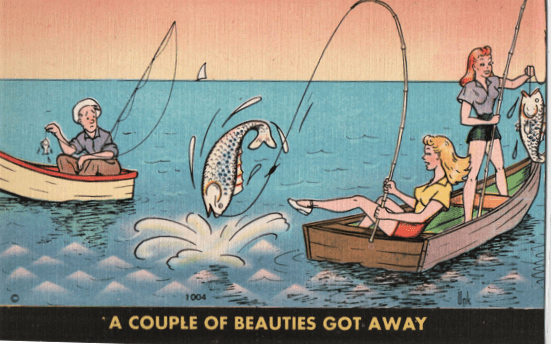
    But anyway, the postcards I wanted to discuss today….

Ethnic Eating?

    This is NOT a column about food.  I have sworn that off,  This is about ethnic identity, a topic I picked up on when I was informed I was eating Swedes.  Learning that it is quite common for rutabagas are also known as Swedish turnips of simply Swedes because they were discovered in Sweden in 1820 (we missed the Bicentennial) I wondered about a lot of these things, and was encouraged to look into this by someone who told me she had always assumed a Belgian waffle was a pancake, and that this was some kind of American insult to the Belgians.  So here is a quick quiz: according to the assembled wisdom of the Interwebs, which of the following foreign-named foods were invented in the United States?

            Belgian Waffles

            French Toast

            French Dressing

            French Fries

            Italian Dressing

            Cheese Danish

            Russian Dressing

            German Chocolate Cake

            Butterscotch

    There is no scoring to be done, simply because I got so many of these wrong myself.  Actually only about four of these are our inventions.  In some other cases, the country used in the description is actually quite proud of the dish, and refuses to consider the claims of any other country.

    Belgian Waffles date to the 1950s, being introduced at a World’s fair in Brussels, Belgium in 1958.  The waffles, which are lighter than average waffles, with bigger and deeper squares, were used under strawberries and whipped cream, and in that form, as Brussels Waffles, were served at world’s fairs in Seattle and New York.  At the New York World’s Fair in 1964, the seller realized hardly an American knew where Brussels WAS, so he renamed his offering the Belgian Waffle.  And that stuck.

    French Toast, which my father called “Egged Bread”, has been known by many names since it first appeared in a collection of recipes about 25 centuries ago.  The French call it Lost Bread, and Canadians call it Golden Bread.  Exactly why it became known as French Toast is debated, on whether this comes from an archaic term meaning to slice, whether a man named French was the first to serve it in a café, or whether calling it French just meant you could charge more for it, since it was fancy.

    French Dressing is rejected by a lot of French food commentators.  Americans, it seems, lead the world in liking creamy salad dressings with lots of STUFF in them.  French Dressing was originally just a vinaigrette, but American chefs and cookbooks started adding ketchup in the 1920s, for reasons lost to history.

    French Fries are, on the other hand, hotly claimed by many French experts, who sneer at the rival claims that they were invented in Belgium.  Potatoes were an acquired taste in Europe; when the plants were brought from the Americas, Europeans took one look and decided they didn’t like ‘em.  The potato’s looks were against it: people decided anything like that must be a cause of leprosy.  Famines saw people experimenting with potatoes, and deciding they weren’t so bad after all.  At some point, frying strips of them in fat became popular in Belgium and/or France.  Thomas Jefferson ate them in Paris, loved them, and always ordered his potatoes “the French way”, when he got back home.  So Tom seems to have been the source of the name, at least.

    Before we leave the French, we will just note that French Vanilla is called that because it originally used vanilla beans from Tahiti, which belonged to the French at that point.

    Italian salad dressing was probably invented at Ken’s Steak House, a restaurant in Massachusetts, in the 1940s.  His wife, who was Italian, used to make her family dressing for the house salad dressing, and it became very popular.  Other restaurants picked up on the recipe, especially the Wishbone, in Kansas City, Missouri, which got so many demands for it that it had to start a separate shop just to make salad dressing (which it still does today.)

    Danish pastry was invented in Denmark.  Says Denmark.  Austria and France have put in their claims, too.  The story goes back to a baker’s apprentice in France who forgot to blend butter into his pastry dough until it was otherwise completely finished.  So he layered the butter between folds of the dough, figuring no one would notice.  They noticed, and they loved it.  His recipe spread from there to Austria.  Austria was the source of a number of bakers hired in Denmark in 1852 when Danish bakers went on strike.  They brought this recipe with them, and when the strike ended, Danish bakers took it over and altered the amount of eggs and butter to make it uniquely theirs (the French and Austrians sniff at this.)  This is why Danish pastry is known as Vienna Bread in most of Denmark.  (Cheese fillings were popular throughout Europe, so that wasn’t our idea either.)

     Russian dressing seems to have been invented in New Hampshire by a man who was already selling mayonnaise.  He toyed with the recipe, added ingredients, and came up with what he called Russian salad dressing.  I was not clear on whether his recipe included caviar, but a number of them did, enhancing the Russian identity.

    In 1852, an American company, Baker’s Chocolate, introduced a new dark chocolate for baking, called Baker’s German’s Baking Chocolate.  They called it that because it had been developed for them by a baker named Samuel German.  In 1957, a woman sent a recipe called German’s Chocolate Cake to a newspaper in Dallas, and it was a huge hit.  Baker’s Chocolate saw it, distributed it as widely as possible, and saw sales of German’s Chocolate skyrocket.  (No one is quite sure when the apostrophe and s were dropped.)

    Butterscotch, which some people adore and others regard as a low-class poor cousin of caramel, seems to have been produced in England in the seventeenth century.  No one is sure how the Scots got mixed into it, though some people believe Scotch was a necessary ingredient (no evidence for this) while others derive it from an archaic word meaning slice (see French Toast, above; this is getting silly.)  Some feel the original recipe came about when someone scorched his caramel.  We need to scotch these rumors.

    So we are basically responsible only for three salad dressings, and one cake recipe, most of which date from mid-century (the Russian dressing recipe dates to before World War I.)  Run out and celebrate this with some Belgian waffles with butterscotch syrup.  (You can out French dressing on them if you want to: just don’t tell me about it.  Have some rutabagas on the side.)

Time Capsule’s Full?

    The metropolis in which I reside officially decreed, on June 11, that it was Over It.  That is, it reopened, declared Mission Accomplished on this latest pandemic, and freed its citizens to go back to the life they were living up through March, 2020.  (Except you can’t visit the businesses which closed its doors for good, and you WILL be expected to stay six feet from people if they prefer it, and you’ll have to wear a mask if you visit a hospital, a school, a prison, or if you use a cab or a bus or a train, or if you venture into a business which politely requests you to wear a mask.  Everything except that is okay.)

    Now, I am as excited as the next blogger to see life getting back to normal, but while we wait to see whether it’s the Old Normal or some New New Normal, I am aware that there are certain segments of our society which are going to be greatly inconvenienced by this declaration.  This of course includes all the businesses which spent hundreds of thousands of dollars on pandemic precautions, and cultural institutions which assumed this pandemic would go on for another year or so, and arranged a whole lot of Zoom events.  But I am especially concerned for the stores and businesses which strobe to supply us during the emergency.

    In other words, what the heckfire are they supposed to do with these warehouses full of hand sanitizer, latex gloves, and facemasks?

    Well, your Uncle B,ogsy is perfectly available for consultation on these matters, and at a very low price, too.  (What did it cost you to open up this blog?  That’s what I thought.  I’ll work on that next week some time.)

    I am not SO worried about the latex glove surplus.  We kind of moved out of that phase months ago, and I assume these are already moving out through their Old Normal venues: cleaning companies, Book Fair volunteers with dusty books to process, food service workers, and so on.

    Hand sanitizers will probably sustain their vogue for a while (they took the place of singing to yourself to make sure you washed your hands long enough) and, in any case, they ARE supposed to be seventy percent alcohol.  It’s just a matter of finding the right mixer.

    But all those facemasks: homemade and commercial!  They became political flags for a while and then symbols of security and safety.  A goodly percentage of the population will go on wearing them for a while, and others will need one to carry, for admittance into certain places.  But there are millions awaiting users who may never come for them.  Can they be reurposed?

    All of your Uncle Blogsy’s remarks about their application as beachwear have been met with scowls and/or sneers, so I will not even MENTION that here (though some of the more decorative ones might still…no, no, put the pitchfork down.  I will desist.)

    I think there is much to be said for the suggestion of a reader of this blog that they would make excellent Hamster Hammocks.  The application is excellent but it must be admitted that there simply aren’t enough hamsters to go around, another problem of modern society which the government has not sufficiently addressed.  (Don’t blame the hamsters: they seem to be willing to work on the problem.  It’s one reason they could use a hammock or two.)

    We are well into the season for iced tea, or iced coffee, if you prefer.  Why not brew up a little something using those gourmet loose teas you got for your last birthday using these handy strainers?  I do NOT know how well they’d work in a coffee maker: check first and see whether there are wires or plastic support strings which might melt during the process (unless you’;re one of those microwave chefs who makes the mistake so often you’re used to the flavor of molten plastic in your grilled cheese.)

    You could get a bunch and decorate them as party favors.  Sketch a tuxedo and cummerbund on them and have a gathering where formal dress is required.  Or plaster slogans on them and have your group wear them at their next protest rally.  You could really come up with varieties to wear for Halloween, including, of course, sparing some for padding yourself to dress as Elvira, Mistress of the…okay, okay, I’ll put that away with the bikini suggestion.  Gosh, you people are particular about where you wear your masks.

Another Assessment

    I had no particular intention of revisiting the subject of Monday’s column.  It isn’t that I had exhausted the wordplay available with donkeys on postcards: I just felt I had rambled on long enough about the subject and ought to move to a subject where I could offer more substantive commentary.

    But the Interwebs is filled with substantive commentary and, anyhow, it was pointed out to me that I had skipped over an anatomical anomaly that was worthy of a mention.

    First, let us make it clear that the jovial insult was as popular then as now, and calling the recipient of your card a donkey was a very popular joke,  The following card comes from the era when the message, if any, was to be written on the front of the card.  So what was on the back?

    The name and address of the recipient, of course.  Other cards went to Shakespeare for inspiration.

    This particular joke was beloved by cartoonists, and several variants exist, but this one wins out because, just in case the recipient doesn’t immediately realize what you’re calling him (and yourself), the donkeys have their backsides pointed at the viewer.

    But it is not the backside of the donkey we are here to consider.  Our ancestors lived in a world before motorized transport, and though our pioneer ancestors tended to depend more on oxen than on the more expensive horse, it was the horse-drawn vehicle which ruled the day as postcards were coming into vogue.  Horses could be seen everywhere, with faces that were noble or lonely, legs which were strong or skinny, backs which were sturdy or bowed, and…say, did you know that once upon a time, the automobile was considered a CURE for transportation pollution?

    A mighty author referred to “the aroma inseparable from horses”, and postcard cartoonists were not going to let anything so obvious slip away without comment.  There were those who took the side of the horse, applying his troubles to those of us all.

    Others were content simply to remark on the phenomenon.

    And this, Cowslip Cocktail, is why a certain phrase was popular to apply to unpleasant, unsavory, or otherwise undesirable acquaintances.  I sometimes feel a hundred different cartoonists used this gag (which is nonetheless a true tale.)

    Other cartoonists went for something a little more subtle.

    Which brings us back around (pardon me while I try to visualize that) to the postcards which call the sender names instead of the recipient.  If you found this week’s theme in my columns tedious, well, I can only say

Grin and Bear

I hope what I wrote in Monday’s column could not be construed as suggesting the donkey (burro, jackass, etc.) served only one purpose in the postcard of midcentury vintage.  The donkey appeared regularly on postcards in many roles: at the beginning of the twentieth century he appeared as a sometimes patient, sometimes recalcitrant beast of burden, and throughout the century he was part of the scenery in the Wild West, often commenting on the generally miserable life to be led.  I did not even mention how often he is to he found carrying excessively fat women, muttering “Well, I Ain’t the only jackass to support a woman”.  I turned my attention to one use of the donkey, but this should not imply that he could not be burroed for others,  (I’ve told you not to make faces like that.)

    Similarly, the bear took a lot of jobs in postcards of yore,.  He was a presidential symbol, after all, for teddy Roosevelt, and the Roosevelt bears which spun off from that had a long life on cards, completely unrelated to a similar long career of the teddy bears.

    But like the jackass, the bear suggested certain uses which called out to be made, and made they were.  One, of course,  is seen above and below, in people letting you know they could not bear to be away from you.

    I’m not particularly sure what’s going on in this one, by the way.  That’s an awfully small bear and I can’t quite figure out where those stars are coming from.  But if I worry too much about that, we will barely have time to get to any other jokes.

    The bear here is no more than a catalyst to the punchline, which really turns on her running barely and saying she bearly…okay, you got that.  Did you notice the bear is there more as the cherry on top of the sundae, just adding in a bear among the bares?

    Well, I’m glad you caught that because you will then have no trouble at all with these bears, who do take part in the action.  This is one of the most common bear jokes in the postcard forest, and it is not new.  (I won a newspaper caption contest with the exact same joke in my boyhood: even then I was working on the excavation and display of archaeological specimens.)  It is shown here in simple, classic form: not a lot of plot to get in the way of the story, just a blend of the two expressions.

    This example, which has art that I like a little better, is nonetheless not quite as clear about the punchline.  You have to stop and think about it a bit.  (Okay, maybe you don’t, but I still think the joke would be too subtle for some readers.)

    This young lady, whose postcard predates the Coppertone Girl, removes the violence from the narrative and performs the joke merely as an act of cuteness.  Children’s bottoms were so often an object of artistic cuteness in the era of the postcard that someone could probably write a dissertation on the subject, provided they had a strong stomach, high security bookcases for the research material, and a good lawyer.

    This version restores the violence, but I am puzzled by both the art and the story here.  What, exactly, has this pair been up to, resulting in a bandage on the bear’s behind right in the same area where her suit is torn?  Is she unaware that bears can swim?  Maybe that’s the edge of a cliff, and the bear will simply be frightened by the drop.  Or maybe there’s a rescue party led by Ranger Smith from Jellystone Park, waiting to rescue her and take the bear into custody.  Or….

    Enough of this second-guessing of the cartoonists.  Here’s a scene of genuine potential violence, and someone in great trouble because of a bear behind, even if it doesn’t use the joke at all.  And we will the subject rest.

The Means, The Ends

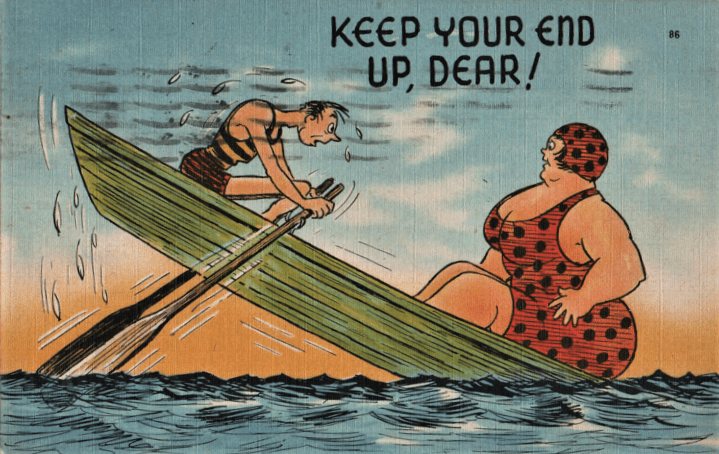
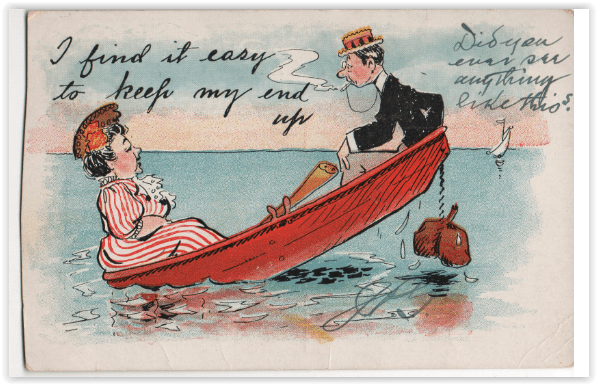
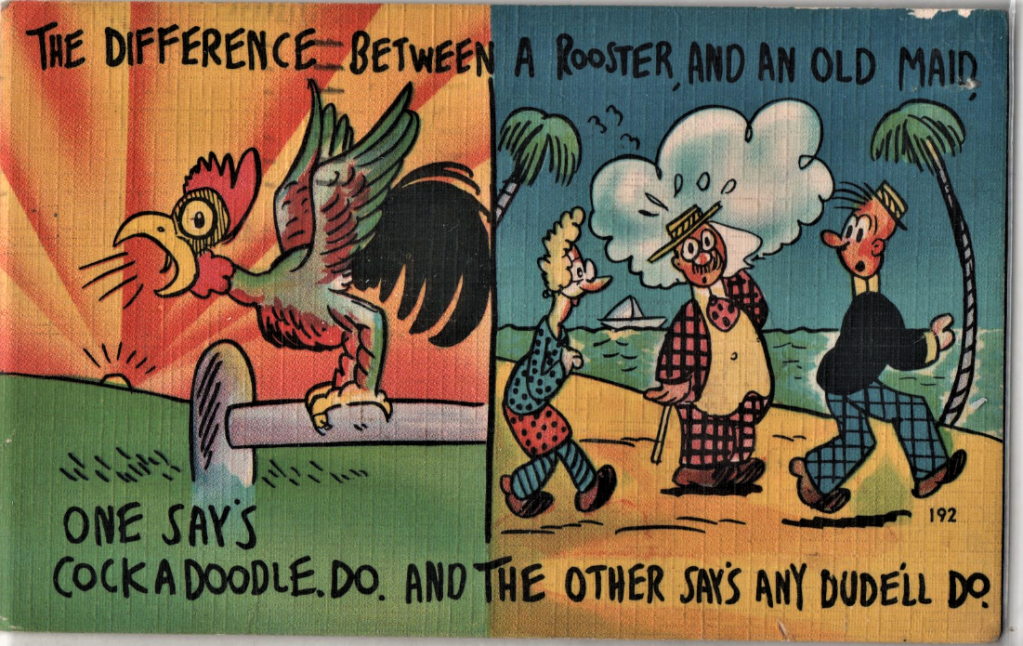
    There are some jokes which appear over and over in the postcard world, and bits of wordplay that seemed to leap from cartoonist to cartoonist and company to company.  There is the amorous golfer (want to play a round?), the tourist in the ice cream parlor observing how broadening travel is, the little brown hen and the big red rooster.  I might, unless sent a sizeable bribe, consider some of these this week.  But the one which has turned up most often, at least among ther postcards which have been condemned to my inventory is a simple, easy connection between a word people could say and a word they couldn’t, but did.

    Exactly how and when the small equine mammal and a person’s seaterrumpus got associated isn’t known, but both uses of the word go back nearly a thousand years.  The fact that one could talk about the animal but not the anatomy created an assortment of comic possibilities.

    Of course, by the time the gag was really popular, people didn’t keep donkeys or burros around the house except in the wild west.  So travel formed the theme of many such cards.  This one, for example, is repeated by different artists for different state borders.

    The association with canyon and mountain travel was another frequent choice.

    Any kind of traveling could be exhausting

    But the assiduous traveler persevered.

    And sent a postcard to let people know you had arrived safely

    And were enjoying the sights of the local flora and fauna.

     A really popular travel card was this sort of insurance.  I’ve seen an assortment of designs and rewordings

     Meaning a LOT of people expected to be in this predicament.

    Not all of the possibilities involved travel.  Some assertions are simply generally observation on kindness to animals.

    Or an admiration of our fellow creatures.

    However, sometimes these innocent compliments could be misunderstood.  Sometimes a postcard company (Kropp, in this case) would assume a customer might be squeamish about such a simple tribute.

    So these companies would allow you to use some other synonym and still tell the tale.

Less Filling

    I have no desire to be regarded as a crank, which would suggest I should keep my mouth shut about certain topics about which I have opinions which are not in line with those of the majority.  Still, this is the Facebook Age, when social manners demand that you shout such things at the top of your lungs.

    And I wasn’t planning to turn this blog toward the subject of food again so soon.  I am not a culinary expert, and I would not qualify to play one on TV.

    Besides, it’s June, when, of you happen to be aged and gray, means certain foods are currently In Season.  This means very little at the store nowadays, but it does mean you will see certain things available on menus, especially at those places which like to brag they use locally sourced ingredients.  And certain ingredients feed my imagination as well as, I fear, my wrath.

    I like strawberries.  When I was a child, I encountered them primarily in frozen form.  A can of strawberries was opened and would be poured over vanilla ice cream and (occasionally) angel food cake.  I have not checked recently, but I suspect this food of the gods is no longer available, like a lot of the canned fruits I knew as a child.  I occasionally tan into strawberry shortcake, but this was, I am informed, MOCK strawberry shortcake, with strawberries poured over sponge cake.  Only when I was older did I experience strawberry shortcake made with shortcake, and I was convinced that shortcake is the natural habitat of strawberries.  (I know many, many ;people who live largely on strawberry jam, and I admit this is good, too.  There are plenty of strawberries, after all,)

    I grew up in a house where rhubarb regularly grew, and I have eaten rhubarb in many forms.  A sales clerk told me once that rhubarb is “a Midwestern thing”, but this is not so.  Rhubarb is enjoyed throughout the western world, especially in areas where fruit trees do not grow.  Rhubarb is technically a vegetable, but is regarded as a fruit by many, as it is known almost universally as The Pie Plant.  I have eaten many good rhubarb crisps and rhubarb sauces, but pie is the natural home of rhubarb.

    I hope I do not seem overly conservative, but I would like to state here and now that strawberries and rhubarb, excellent by themselves, should be enjoyed that way.  Make your strawberry pie if you must, or your rhubarb shortcake.  But if you serve me strawberry-rhubarb pie, I will make an annoying grimace before I give in and eat it.  See,. To me, strawberry-rhubarb pie tastes neither like strawberries nor like rhubarb.  It is a pleasant enough pie, but I think of it as a waste of good fruits, much as one of my muses, Will Cuppy, regarded pineapple pie.

   Yes, I KNOW rhubarb and strawberries are ready to eat in June.  This does not excuse mixing them together.  Do you make strawberry-asparagus pie, by any chance?  Then you see what IO…you, in the fourth row!  You are nodding.  Do you make…no, don’t tell me.  I don’t want to know.

    Do not foist your strawberry-rhubarb pie on me, thank you.  Save that lattice crust for cherry and blueberry pies, where it belongs.  And as long as I have doomed myself to ignominy already, I may as well admit that the most commonly encountered rhubarb pie, which is rather like an apple pie only with rhubarb and a lot more sugar, is not what I would choose either.  My mother served exclusively rhubarb meringue pie, in which the rhubarb is suspended in a sort of custard and which is fit for monarchs at the rank of emperor and above.  In an act of lunatic generosity, I made one once and took it with me to work, and was gratified to see it consumed in very little time.  (This did not happen when I tried my mother’s peach pie on the same crowd, but we’ll save that recipe for another time.)

    For those who have read this far, in mounting anger, yes, that is actually a postcard showing lemon meringue pie.  I figured I needed something to remind everyone that we write mainly about postcards here, and did not have any rhubarb postcards to show.  Doesn’t matter: the powerful strawberry-rhubarb forces will have this column deleted from the Interwebs at any moment now.