They Didn’t Mean It That Way

    I hope we have established that our ancestors who sent (or at least bought) postcards were not babes in the woods.  We have discussed what they thought about having a bear behind, and looked over those people admitted they had tired donkeys, or suggested you spank their donkeys.  We have looked at a few (by no means all) of their jokes concerning laxatives, and how they took urination in stride as a basic, if occasionally awkward, bodily process.

    We have not yet covered the vast number of postcards about the activities of people on their honeymoon (hinted at above), the vast number of cards which involve obviously illegitimate offspring due to maternal flings (so far I’ve seen rabbits with skunk stripes, colts with mile ears, and a WHOLE lot of baby chicks with duck bills.)  The postcard studies of what roosters do for a living cover at least seventy years, and I do not refer to crowing at sunrise.

    This does NOT mean that they thought exactly as we do about all things dealing with the bathroom and the bedroom.  One or two of their jokes might appear to mean something to us when the makers of the postcard had no such idea in their heads.  The world has changed.  That’s why we study history: if our ancestors were exactly like us, there wouldn’t be much point in reading about them.

    This, for example, is just supposed to make you chuckle at how the lad is overreacting to his milk being spilled.  (You wouldn’t have liked it anyhow, kid: where did you get black milk?)  It is only to us, used to a generation of gags of men and boys getting hit in the crotch, that it seems obvious what the young man running away has done to make the boy spill his milk, and tears.

    I wasted a great deal of time researching this card.  I am still convinced that a hump was some kind of term expressing the form of a wave, and we are encouraged to make the connection between that surfside term and the quite alarming hip measurement of this bathing beauty.  “Humping” existed as a slang term as early as the Revolutionary Wat, but people who performed this were Humpers, never Humps.  I hope we have made that clear.  (Um, you DID think that, didn’t you?  It’s not just MY dirty mind that…next slide, please.”
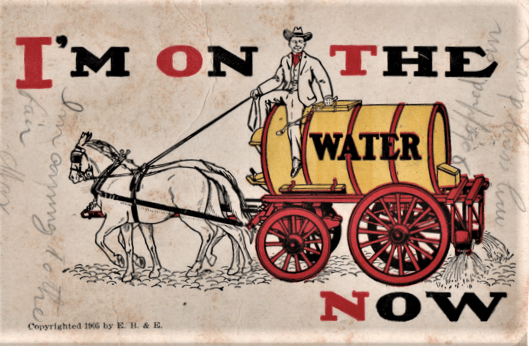
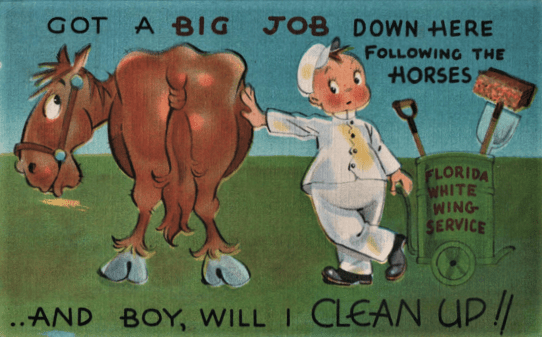
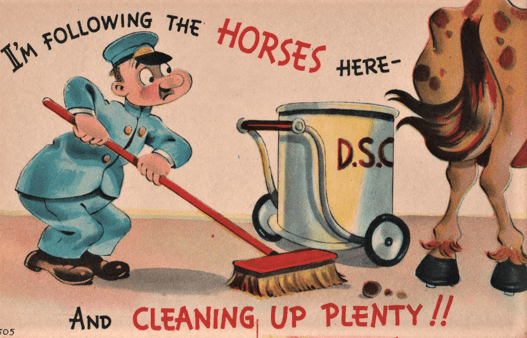
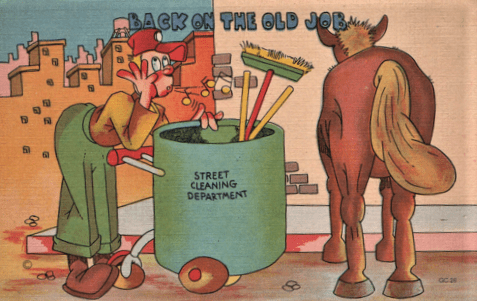
    Anyway, this one deals with someone who is making an excuse for not writing which will sound good as long as you don’t know about the picture.  (Like all those cards about cleaning up at the race track by men pushing sanitation carts or the salesman who has been making contacts…with the local dancing girls.)  I am certain the double meaning of “feeling low” naturally refers to the height of the sofa, and not at all to wherever she (or he) is feeling (out of sight to us but causing come concern to the dog.)  Anyway, that’s the story you’d tell your Aunt Hazel, even if you told your brother the card had a triple joke.

    This one, however, has no intention of moving along transgressive lines.  It’s our favorite Dutch kids back again, and referring to the fact that a lover would go down on one knee to declare his undying love.  The young lady is suggesting that his knees are patched because he’s been reciting poetry on one knee, and not that…of course, then why would BOTH knees…well, lovers could kneel using both knees, and….

    Oh, well.  Let’s address the 300-pound zucchini in the room.  That is her HAND.  They’re just making a joke about Blind Man’s Buff, and how she’s cheating to get out of his way and never intended…and even if they did, her face is too far from him for that to….

    Coming Soon: Yeah, they meant that one.

YOUR Future

    It is not often I feel I must perform a public service, and when I feel like that, I generally lie down for a while until the urge goes away.  This is why I will never be a star on social media.

    But this postcard was such a strain to me I thought I would just improve on it a bit for the modern reader.  My complaint is not with its basic precepts, which are appropriate for their day and age, but with the fact that the dang thing had to be printed so small, so everything would fit on a postcard.  I bought it largely sight unseen because I couldn’t enlarge the picture online enough to figure it out.  I just thought it would be interesting.  It was a little easier in person, but even then, it was a trifle small.  So we are going to go over it here, at a magnification which will make the whole device easier to handle.

    See, this is a postcard meant to be cut apart and reassembled into a fortune-telling device.  It’s a rather elementary toy (at this period, books which would do the same thing in greater detail, and take longer to play with, were bestsellers.)  Here are the directions.

    See, this is a postcard meant to be cut apart and reassembled into a fortune-telling device.  It’s a rather elementary toy (at this period, books which would do the same thing in greater detail, and take longer to play with, were bestsellers.)  Here are the directions.

    Now, to begin.  All these magnifications have been kept to scale, so the device, though larger, should work as well or as badly as the original (my thanks to whoever owned this and decided NOT to cut it up, by the way.  First, you cut out the arrow, and stick a pin through it.  This is your spinner, to be used on the succeeding circles, which should be readable under each other, as they have been measured to work that way.

    Spinning the srrow on Circle I will grant you a Yes or No answer to anything you ask (provided you ask a question that can be answered yes or No.  Asking “Who will win the World Series this year?” will do you no good.)  You should also spin for a number, which will tell you how many times to spin for the next circles (I suppose it’s harder to cheat the spin that way.)

    Also making the spin difficult to cheat is that the letters of the alphabet have not been placed on Circle II in alphabetical order.  This will give you the first letter of the name of the man you will marry.  (YOU pick first name or last name or nickname: there has to be SOME fudge factor in this.  These fortunetelling games were, by the way, generally aimed at women, or, to be more precise, women between the ages of 10 and 17.  There WERE fortune-telling books which could suit men or women, but these were in the minority.)

    Circle III probably is of the most sociohistorical interest.  This spin will tell you the profession of the man you will marry, and it is an interesting selection.  Farmer, for example, does not get a look in, and neither does Writer (we bloggers are united in our disappointment.)  I THINK that’s supposed to be a sailor hat under “Marine”, indicating someone in a seagoing profession and not necessarily a member of the Corps, but I can’t be sure.  I am also troubled by the inclusion of “Millionaire” since, after all, any of the other professions COULD become a millionaire (except, possibly, handicraft, whatever that means.)  Does this mean if you spin one of the other professions, your hubby will NOT be a millionaire?  But since, after all, a Soldier could be an Artist as well, or that odd handicraft person could be an artist, maybe…or am I overthinking this again?

    And if you recall the poem—First comes Love, then comes Marriage, then comes Blogsy pushing a baby carriage—you know what Circle IV is all about.  You spin to find out how many children you will have in your “married life”.  I assume this phrasing does not imply anything about you up to the wedding.  Presumably if you spin a 12 ut NOT the twins or triplets spaces, you are going to have all those children one at a time.  When does your husband have time for handicrafts?  Note, also, that Zero is not a possibility; presumably we could not conceive of that sort of…yeah, I said it, but I’m not proud of it.

    So, as Cupid blows on the fires of prophecy to keep them bright, I leave you to print out the blog, assemble the bits, and check on your future.  Let me know how the whole handicraft thing works out, won’t you?

Takin’ What They’re Givin’

    A number of years ago, in response to no particular demand, I developed a musical lecture on the “I Hate My Job” song, a style of song as basic to the American experience as the hymn.  Had I been able to clear all the rights….

    But there is a broad literature of people taking out their workday frustrations, and this means there were plenty of jokes about the subject.  Yes, banana cream burrito, this was all an excuse to present another excerpt from my unpublished joke quiz.  I honestly am struggling hard to keep this from becoming a Monday tradition, but what can I do in the face of overwhelming demand?

    You recall the rules: these are really, really old jokes which you should know well enough to supply the missing punch lines.  Answers provided below so you can critique the way I phrased a classic.

        J 1. “I’d like to apply for that job as blogger,” said Justin.  “What’s the salary?”

    “I’ll pay you what you’re worth,” said henry.

    “Oh,” said Justin, “(          )”

        J 2. “Hey, where have you been?” called Fred, as Manny walked into the bar.

    Manny collapsed onto a barstool.  “Got a new job.  It’s a killer: eight hours without a break, the foreman’s a slavedriver who isn’t convinced you’re working until you drop over exhausted.  Nothing but work, work, work.”
    “Sounds rough,” said Fred.  “How long have you been at it.”

    Manny sighed.  “(          )”

        J 3. “Hello?  A young man named Hollingsworth listed you as a reference on his application for a job with my firm, and I wondered what you could tell me about him.”

    “Young Hollingsworth?  Comes of excellent stock.  He’s descended from the Feltons, the Harringtons…in fact, most of the First families of new England.  His grandfather was one of our leading bank executives, and….”

    “That’s very interesting.  But (          ).”

        J4. “The job is yours.  You realize, of course, that what we pay you is a private matter, and not to be gossiped about.  You are expected to keep your salary a secret.”

    “Don’t worry about that, sir.  (          ).”

        J5.  They call it Take-Home Pay because  (          ).

        J6. The junior assistant held the phone away from his ear as Mr. Gotlots ranted about a mistake in his latest report.  “Whew!  He’s going to get an ulcer!”

    “Not him,” said his office partner.  “(          )”

        J7. Alvin showed up for work at eleven, his face bandaged, his arm in a sling.  “Sorry I’m late,” he told the boss.  “I leaned out the window this morning to check the weather, went too far, and fell twenty-two stories.”

    The boss glared at him.  “(          )”

        J8. “Miss Collins, where’s my pencil?”

    “Behind your ear, sir.”

    “Come, come!  I’m a busy man!  (          )”

        J9.  Zuleika hugged her friend.  “Now that you’ve won the lottery, I guess you’ll be quitting your job as a cleaning woman.”

    “No,” said Arabella, “After thirty-five years I wouldn’t know how to go on without a job.  But (          ).”

        J10. “Took kind of a long lunch break, didn’t you, Buster?”

    “I had lunch and then I got a haircut.”

    “What makes you think it’s okay to get a haircut on company time?”

    “”Why not?  (          )”

        And, if you really need them, the ANSWERS

A1 I couldn’t live on THAT.

A2, I start tomorrow.

A3. We weren’t hiring the young man for breeding purposes.

A4. I’m as ashamed of it as you are.

A5. That’s the only place you can afford to go with it.

A6. He gives them.

A7. That took two hours?

A8. Which ear?

A9. “God help the boss if he gets in the way of my mop.”

A10. It grew on company time.

Something In It For You

    What do Nathaniel Wyeth, Luella Gamber, and Frederick J. Baur have in common?  No, besides that you’re not interested in them.  No, besides that they are probably the answers to trivia questions.  And no, not that they have nothing to do with your daily life.  Chances are that they DO make a difference to your daily life, and we’ll prove that if you’ll let me get ON with this and stop tossing snark at me.  This is my blog, and I am the resident snarkshooter, Salmon S’mores.

    In the late 1960s, Pepsi was thinking of ways to compete with a new glass bottle over at Coca-Cola.  The 6.5 ounce bottle was really selling, and Pepsi execs, like executive everywhere, wanted a new product that was exactly the same but completely different to counter it.  V.P. John Sculley, however, did the research, and decided the world didn’t need another small bottle.  Pepsico needed to look the other direction.  If there was an easy way to get people to buy LOTS of Pepsi all at once, this would help the company’s bottom line better than producing a lot of small bottles.  Coke had experimented earlier with a 26 ounce bottle, but it was glass, and the resulting explosion when it was dropped was discouraging.

    So the job was assigned to Nathaniel Wyeth, who came up a large plastic bottle, something which would hold two quarts, or, since the Metric movement was busy in the United States at the time, two liters.  In 1970, the two liter bottle of Pepsi hit store shelves and the world changed.  People who like a fizzy soft drink with their lunch could now serve everyone at the table without opening a lot of bottles and trying to make sure Skippy didn’t tip his over while grabbing for the pickles.  You didn’t need to run to the fridge to get more of those little 12 ounce cans, either.

    (For those of us who are old enough to recall,. These bottles USED to be flat on the bottom.  To the 2 liter bottle as you know it today, a special base was glued so the bottle was more stable on the table.  This was complicated and expensive, so in 1993, the industry as a whole gave up that second piece of plastic, and Skippy has been knocking over 2 liter bottles ever since.  If you’re interested, the 3 liter bottle and the 1 liter bottle had very short stays.  The 12 ounce can appeared first in 1963, around the time the pull tab was invented, and the 20 ounce bottle dates to 1993.  For a history of the 12 ounce can, the 16 ounce can, the 23 ounce bottle, the 26 ounce can, the new 13.2 ounce bottle, please look elsewhere.  It just gets too complicated.)

   Luella and Ralph Gamber bought some bees, taking up beekeeping as a hobby.  Very lucky and/or very industrious, by the end of World War II, they were shipping Dutch Gold Honey around the country.  In 1957, they were looking for a cute little novelty gift container, and developed a bear-shaped honey bottle with a hat which doubled as a dispenser tip.  They figured this cute novelty would make a nice gift over the Christmas season and then disappear, so they didn’t go to the added expense of trademarking or patenting their invention.

   The bear now appears under dozens of different names for dozens of companies.  There was some tinkering with the design over the years (early models often developed leaky ears, the original bear was too fat to allow an informational label on his back, and putting that pointy cap on had to be done by hand, so factory workers were spraining their wrists a lot) but it is now logically considered one of THE finest ways to present honey at the table.

    You don’t THINK of proctor and gamble when you think snack food, but you’re not looking beyond the surface.  In the 1960s, the company took on the weighty problem of potato chips.  One of the most popular snacks in parts of the world with plenty of potatoes (you can look up their invention by an angry chef and their banning during World War II elsewhere)  they nonetheless had a tendency to break up into fragments at the bottom of the bag.  (If the folks at P&G had realized these are the best part, the world would be different today, but we can’t go back.)

    Frederick J. Baur was assigned to fix the problem, and developed a machine and recipe and, most important, a container.  And in 1968, Pringle’s newfangled Potato Chips hit the market.  There are three hundred theories about why these were called pringles, probably all of them wrong, and a lot of discussion of how long it took to make them taste like something other than unflavored mashed potatoes, but the Pringles can is considered one of the great innovations of the 1960s.  (The face on the can is Julius, by the way.  The handlebar mustache was supposed to make him an old-fashioned inventor type who might be interested in a “new-fangled potato chip”.  His face has altered slightly over the years, and Pringles has dropped both the “newfangled” and, when ordered to do so by lawyers, the phrase “potato chips”.  Everyone calls ‘em Pringles anyhow.)

    And yes, what you’ve heard is true.  Frederick J. Baur did ask that his cremated remains be buried in his great invention.  His kids were a little dubious about this, but when Dad died, they decided he ought to get his way.  AND, rather than apply at the factory for a fresh, unused can, they decided to go all the way and just buy a can at the store, share the chips, and then send the inventor on his last trip.  After some argument, they decided the “original” flavor was the most appropriate.

    So are you NOW impressed with Luella Gamber, Fredrick J. Baur, and Nathaniel Wyeth?  Okay, be that way.

Poor Deluded Girl

    In my ongoing quest for elderly humor in the world of postcards, U have run across many examples of what I call the Deluded Lover Gag.  This involves someone, usually a young woman, who has not checked to see who has reached out for a personal touch, but simply assumes she knows the person with such intimate feelings.    One frequent version is the “Guess Who” game plated above, about half the time with a caption showing the young lady has guessed it is Charlie.  I don’t know the name of the passing hobo, but I’m guessing it ain’t Charlie.

    The seaside is a frequent scene for such encounters, if you recall one of last week’s unmailable postcards ()And you’re such a small man)  I am sometimes puzzled at how the lady can make such a mistake, but it is wrong to overthink these things.

    After all, since this lady is sitting down, surely the young man accused would have to be leaning over her to reach down to…but of course the point is that the lady is thinking, but of other things than deductive identification.

    If I DID worry about such things, I’d be worrying about George’s usual greetings, and the strength of his grip.  (By the way, this card is by the same company which made those two lady-with-cat postcards from last week’s unmailable columns.)

        While, as for Melvin, I wonder…well, I just wonder what she’s envisioning.

    More often, the intruder who is accused is on dry land.  Vast numbers of picnickers, it seems, have over the year taken naps in the sun only to assume their date is trying to get a little too friendly,

    Since few picnickers are likely to stop to eat around a hog wallow, the visitors are more often cows

    And it is not always the female half of the company who is fooled.

    Let us now consider the exceedingly popular story of the Elephant and the Newlyweds, which always makes me a little sad.  Wilbur and his bride must face the results of unrealistic expectations in the future.  This version is a little sadder, since the only character we can see, the elephant, seems to have a trunk which is very oddly formed, and going into the  opening of the tent at an odd angle and….

    Well, anyhow, it’s better than the censored version. Goodness, Dear!

Set ‘Em Up Again

I didn’t plan to do this every Monday, but I felt that, having done this together last week, we needed to get back on before we developed a fear of it.  This is the second in a series of excerpts from my unpublished bestseller, So I Bit Him!, a book of really, really old jokes with their punchlines removed.  If you are read up or listened up on comedy work, these jokes should be known to you.  UNLESS, of course, in the time which has passed since I wrote the book, these jokes have all gotten SO old that they’re new again, in which case, you get to learn some new ones.

    Anyway, having rationalized recycling an unpublished book, here we can look over some of the gags from chapter 2, again with the answers tucked in at the end.  These are old gags which concern the drinking of spirituous liquors, something attributed in legend to Noah, who invented wine after the Ark landed, and whose undutiful son scrawled the first joke about it the next morning.  No one knows exactly how old these jokes are, but that’s not what we’re asking.

    J 1.Sally knew she couldn’t trust her husband to do the grocery shopping, but she was busy that morning.  She was shocked when he came home bearing eight bottles of whiskey and a loaf of bread.  “Good Lord, you jerk!” she said, “(          )”

    J 2.Ladislaus walked into a bar, where a horse was serving the drinks.  He stood there openmouthed until the horse turned to him and said, “What’s the matter?  Surprised to see me here?”

    “I’ll say,” said Ladislaus, “(          )”

    J 3.Toby had stopped to pass the time of day in Kip’s pub.  “How many barrels of beer do you sell in a week?” he inquired.

    “Fifty,” said Kip, proudly.

    “Not bad,” said Toby.  “But I can tell you how to sell a hundred.”

    “How?”  Kip demanded.

    “Easy,” said Toby, “(          )”

    J 4.Vince finished his drink and told the bartender, “That was excellent: just what I needed.  To show my appreciation, I want you to have this.”  He reached into his pocket and pulled out a lobster.

    The bartender looked this over.  “Well…I guess I could take it home for dinner.”

    Vince shook his head.  “(          )”

J 5.Lester bragged he was the world’s finest judge of wine, so his friends put him to the test.  After blindfolding him, they handed him a glass, which he sniffed and then sampled.  “That’s a Philomathean Rose, ’96,” he said.  “Excellent for after dinner.”  He was correct about this and, indeed, the next eight wines they passed him.  Then Meredith, nodding to the others, handed him a glass of water.

    He sniffed the bouquet and then took a sip, rolling the liquid around his mouth.  He swallowed it and frowned.  Then he said, “(          )”

    J 6.”And how are you this fine day, Barry?” asked the bartender as one of his regulars came in and leaned on the bar.

“Not so ipsy-pipsy, Roger,” Barry told him.  “Just came from the doctor and he said I had a third-degree case of yoors.”

    “What’s yoors?” asked the man on the next barstool.

    Barry told him, “(          )”

    J 7.In the days of the Old West, when men were men or at least didn’t worry about it, a desperado marched into the Fork and Spoon Saloon and fired his guns into the ceiling for attention.  “All you lily-livered perfume-swilling sons of sows clear out!”  he fired his guns into the ceiling again and then pointed them at the crowd.

    There was a mad dash for the windows and emergency exits.  When the dust had cleared, one white-haired librarian was sipping beer at one table.  The desperado stomped back to him, guns ready..

    The librarian looked up and said, “(          )”

            Of course, you know all these ANSWERS, but in case you want to check your friends, here they are.

A1. ”What do you think we’re going to do with all that bread?”

A2. “Did the anteater sell the place?”

A3. ”Fill the glasses.”

A4. “He’s had dinner.  Take him to a movie.”

A5. “I don’t recognize it.  But it’ll never sell.”

A6. “Whiskey neat, thanks.”

A7. “Sure were a lot of them, weren’t there?”

Wait, What? II

    In our last thrilling episode, we took up the question of postcards with slightly surprising content.  U grew up being told, don’t you recall, that the nineteenth century was an era of repression and  tight-lipped prudery which forbade books by male and female authors to sit on the same shelf (unless they were married.)  The gay Nineties loosened things up a bit, but it took World War I to bring about the less restrictive morals of the Roaring Twenties, while the Depression and World War II  allowed things to be shaken up to the point where authors could use words like “Hell” and :damn” in general magazines.  Then came the Sixties, and all barriers were lowered, and from there on, anybody could say and do what they pleased.

    As time went by, I learned most of this was spinach.  Only one writer made that instruction about male and female authors, and most people made fun of her even at the time.  Sure, in the 1920s, Hemingway was infuriated when some of his dialogue was printed as “F—“, but most people knew what word he meant.  I had been misled by the Sixties generation, which was merely the latest in the line of generations which knew THEY had discovered the true meanings of love, free speech, and social justice.

    Nonetheless, I did still cherish an idea that for much of our recent history, and especially the period between the Civil War and the Vietnam War, the majority of Americans looked away from rude jokes (though they might tell them, the ladies at their teas and the men behind the barn.)  Certainly, the U.S. postal Service, which at that time held a lock on what sorts of literature could and couldn’t be sent through the mails, would not allow anything that would raise an eyebrow to pass uncensored.

    Most of the postcards we looked at last time dated from the Thirties through the fifties, when, as my mental history book has it, things were lightening up.  And, in any case, postcards were seeing a drop in their social level, being restricted as the century went on, to people on vacation of traveling salesmen on the road, who might send a rude joke now and again.  But surely nothing suggestive was to be seen before the twenties started to Roar.

    Well, now.  The pun is nice, but there’s that naked leg, that corset, and, most notably, that stocking which has somehow retained the form of its wearer, AND the little boy reaching into it.  Jokes about ladies keeping their mad money in their stocking tops were fairly popular (there was a postcard of the same era which noted that such women are keeping all their treasures together.  And even THAT went through the mail.)

    As long as we’re in the bathroom, where we left off at the end of the last column, let’s visit this young lady, whom I adore for her deep resentment of her plight.  But, um, wasn’t that a little, er, ANATOMICAL a reference for the authorities of the time?  (If you didn’t catch it from the chamberpot, she is grieved that a woman has to undress so much more than a man just to…okay, you got it.  Just checking.)

    This, of course, would not fly at all today.  Around 1910, when this series of baseball romance cards was published, though, spanking was much more openly discussed.  Besides,

    She does get some of her own back later in the series.  The spanking of children was a common trope in humor well into the Sixties, and postcards abound with examples through much of the first half of the century.  And there was the birthday spanking, after all, which was all in gun.

    All in fun, I say.  Note that both these ladies are smiling, to show how all in fun this is.  And yet…well, let’s just say this probably wouldn’t fly today either.

    And what might this couple be up to?  What will they be up to when they get down to it?

    With any luck, too, they could go on plying with their Happy Thoughts for sine tine without consequences.  Please tell me my great-grandmothers at least blushed when this card turned up in the mailbox.

    And with these last two, I’m sure I’m just exercising a filthy, modern imagination/  yes, the lady is in her nightie, and it is dark, and she is patting her Cat, which she would know if she felt it in the dark.  I have been unable to tie this card or the next one (which is from the same publisher) with the lyrics of a pop song of 1910 or an advertising slogan, or///and I’ve checked the history of slang expressions in English, and the dictionaries all tell me the same thing.  But really?  There must me a misunderstanding somewhere.

Wait, What?

    When making one’s way through another world’s jokes, something we do here as we examine the comic postcards of a century or half century ago, it us important not to get too judgy.  Roger Ebert stated once that it is not a critic’s job to say “That’s not funny.”  No one appointed the critic as the final arbiter on everything anyone ever wrote.  The best he can say, according to Roger, is “That didn’t make ME laugh.”

    So I try to steer clear of the word “offensive” when I am looking over postcards.  Some jokes do strike me as offensive, but I try to remember the world of jokes includes people who like to swap offensive jokes.  Besides, some jokes are offensive and funny.  (Another reference here: Dorothy L. Sayers referred to what the old lady said to the young man: “Some people can be funny without being offensive and some can be both funny and offensive.  I suggest you be one or the other.)

    But I do run across postcards once in a while that make me stop and wonder.  What I am wondering is either a. Would a publisher dare publish that today? Or b. How did a publisher dare publish that THEN?  I HAVE found a few postcards which are clearly stamped that they must be enclosed in an envelope and not sent through the mail as is.  For example, there is

    But Mr. Goldring specialized in slightly off-color cartoons, and I’m not sure the post office would blench at this today, any more than they would care about this other one, (stamped “Not to Be Mailed”) in which a so-so cartoonist has repeated an old image of a man flushing himself down a toilet, saying “Goodbye, Cruel World!”  This dates from the mid-fifties, and I’m not sure even then why someone thought the authorities would object.  But this one was completely free to mail as is.

    Okay, maybe he’s just squirting water between his hands.  Sure he is.  And the fact that he has found the Fountain of Youth “again”…it’s probably just me.  This was a very popular gag, and seems to have been available with small boys of different races and colors.

    Bathroom humor is a fairly common theme.  Our era is proud of its openness about these things (a cartoon bear reminds us “We all have to go.”)  But our ancestors were surrounded by horse-drawn vehicles, besides themselves having limited bathroom facilities and a medical community which considered bowel control to be essential for mental and physical health.  So there are dozens of manure jokes and hundreds of outhouse jokes. They seem to have loved the lady with furs and lorgnette stopping by the road to step into an outhouse: just a sign that we all have to go, I suppose.  This, for example, was a simple gag most anyone could appreciate without blushing.

    But was the combination of kids and castor oil so commonplace that this slightly more explicit version would pass postal inspection?

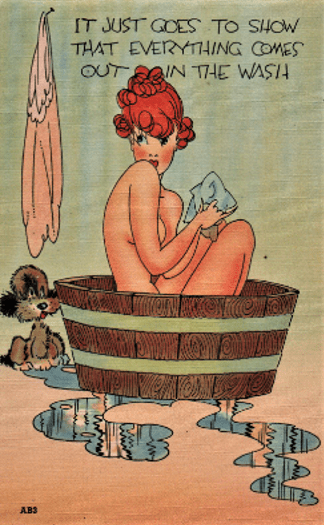
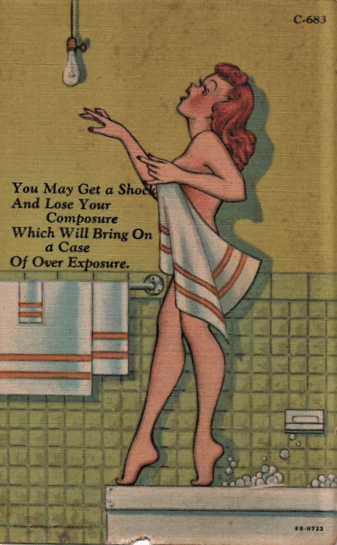
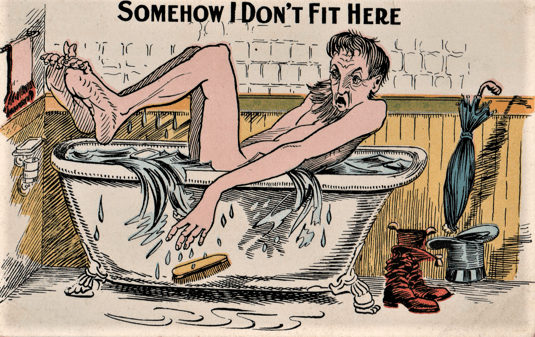
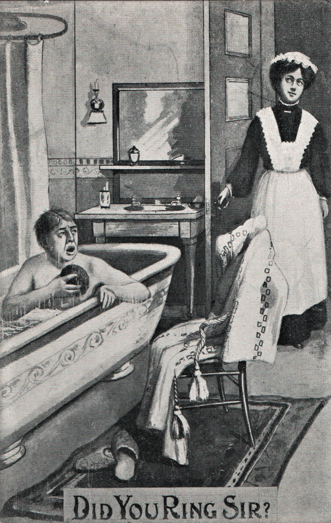
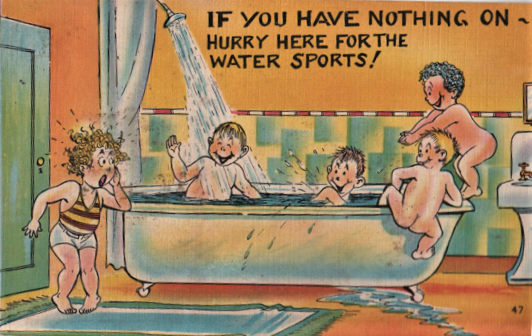
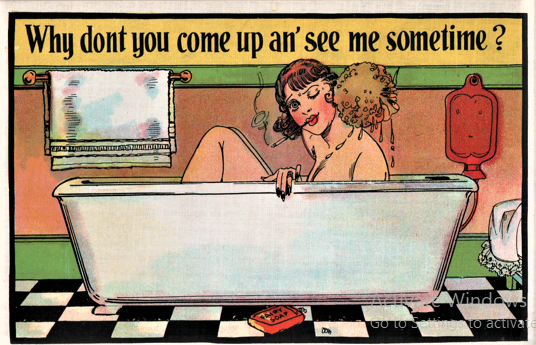
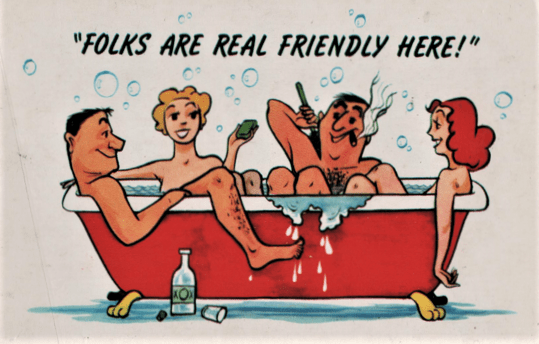
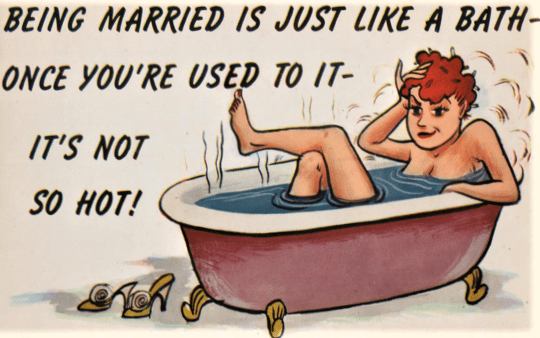
    Indoor toilets provided a world of naughty fun, too, particularly of the slightly snobbish variety.  We could all chortle at the backwoods family who used the toilet seat as a picture frame and the bowl itself as a sort of kettle.  Or there was the fellow from the country, washing his hair in this newfangled sink way too low to the ground.  Bathtubs were not as common a source of fun, but they certainly made their postcard appearances.   The most frequent use of the tub was the one holding half a dozen people at once, letting you know how crowded the hotel is or how friendly your neighbors are.  None of this shocked me, nor did I suppose the postal inspectors were appalled.  But I was stunned for a few moments by this image.

    There were people who wanted the very phrase “Come up an’ see me some time” banned for public use. The use of a cigarette holder in the tub suggests sinful luxury.  And, um…well, there were only two uses for a hot water bottle with a tube on it, and neither one could be discussed in mixed company.

    But this is a postcard from the 1930s or thereabouts.  Wait until you see a couple of these from the 1910s.

Don’t Stop Me: You’ve Heard This

    Well, I heard no  clamorous outcry when I suggested I might bring out my unsold quiznook of antiquated jokes and try a few of the questions on you, but I heard no pleas for mercy, either.  (If you get no comments at all, you can write as you please.)  So I will present a few of the entries from my unsold bestseller “So I Bit Him!”

    The point in the book was to show you were a master of ancient jokes by providing the missing punchlines.  My main fear is that in the years since I wrote this book, some of these jokes became SO old that they went untold, and will now be new to you.  Only one way to find out, I suppose.

    I find, with displeasure, that the first category of jokes in the book was FOOD.  And here I’ve been repeating that this is NOT a food blog.  But so it goes.  If you’ve read this far, you want to try your wits against the ancient gags.  Answers at the bottom of the column.  Let’s go.

    J1.The pie was passed down the table at the boarding house.  Two pieces remained when it reached the end.  Rick put the larger slice on his own playe and passed the other to Ambrose.

    “Huh! Some manners!” snarled Ambrose.  “If I’d been sitting there, I’d’ve been polite and taken the smaller piece.”

    Rick didn’t look up from his plate.  “Well,” he said, “(        )”

      J 2. “So Rick and I went to this fancy dinner party,” Ambrose told his friends at the bar.  “That guy’s got no manners at all.  I turn my back on him for a second and when I look, he’s eating his peas with his knife!  I was so shocked (             ).”

     J 3. At another fancy event, the guests were serving themselves from a vast buffet.  Rick picked up a fork and lifted an entire chicken from the platter onto his plate. 

    Ambrose was shocked.  “You’re not going to eat that whole chicken all alone!”

    “Of course not,” said Rick. “(          ).”

    J 4. Ambrose wasn’t always sure of the rules himself.  “Scuse me, friend,” he murmured to a man next to him at the buffet.  “Is it okay to east pickles with your fingers?”

    “Never,” the man told him.  “The fingers (          ).”

     J 5. “This new diet is dreadful,” Kate told Jackie.  “I get so hungry I even dream about food.  Last night I dreamt I was eating a ten pound marshmallow!”

    “That’s not so bad,” said Jackie.

    “Oh yeah?” Kate replied. “(          ).”

      J 6. Kate’s cousin Winsome was the one who needed to diet.  She stepped on one of those public scales that prints out your weight, put a dime in, and the little card that came out said “(          ).”

    J 7. Winsome didn’t know why the doctor wanted her to diet.  According to his chart of heights and weights, she weighed exactly what she should.  She was just (          ).

     J 8. The submarine had set off for a yearlong cruise under the polar icecap, and the captain called the men together.  “We are on a trip where we will not have any kind of contact with other ships or anyone on land for the next twelve months.  I have good news and bad news.  The contractor supplying our rations made a mistake, and all we have in the galley to eat is dog food.”

    “Good lord!” said one of the men.  “What’s the good news.”

    The captain smiled.  “(          ).”

      J 9. “Do you like codfish balls?”

    “I don’t know. (          ).”

    J 10: “Care to join me in a cup of tea?”

    “No.  (          ).”

I’m sure you knew all these answers, but if you want to check my wording of them, it was

A1. Well, that’s what you got.

A2. I dropped a handful of mashed potatoes.

A3. I’m going to have some mashed potatoes with it.

A4. The fingers should be eaten separately.

A5. When I woke up, my pillow was gone.

A6. One at a time, please.

A7. Two feet too short.

A8. There’s plenty of it.

A9. I’ve never been to one.

A10.I don’t think there’s room.

     There are, um, hundreds more of these.  I will await your cries of gladness before going on.

Love Road

    It has been oh, WEEKS since we have checked in with the Dutch Kids, so I thought we might revisit this social phenomenon of the last century.

    Doe newcomers, and for those with psychogenic amnesia whose brains have blotted out the information in self-defense, there was a craze beginning around 1910 for postcards featuring Dutch children.  These cards were not the work of a single artist or company; the kids have no particular identity beyond whatever each individual firm called the series.  Sometimes solo, more often in couples, they dispensed advice, spoke out their experiences and philosophies of love, and nagged you to write (or made excuses for not writing more often.)  They were cute, they wore identifiably Dutch ethnic clothing, and spoke in a Pennsylvania Dutch (i.e. German) accent which made even the most commonplace things they said seem perky and cute.

    There are all sorts of opportunities here for someone who wants to study the history of ethnic stereotypes in popular culture.  Other children of other ethnic and racial groups (I have seen Irish, Italian, Chinese, African-American, and back-country Cracker accents in the world of postcard children).  Why the Dutch kids had such a vogue, even surviving well into World War I (when suddenly their accent was that of The Hun) is worthy of study.  I haven’t done that.  Maybe you have.  Or maybe you were content simply to think of them as a dusty relic of a bygone age.

    And yet…they WERE kids, and kids generally are a symbol of our future, besides being cotton-picking rapscallions with new-fangled devices which make the world a loud and uncomfortable place.  the Dutch Kids were not immune.  There was, after all, the temptation of the automobile.

    For example, note how quickly this young man has figured out that the fellow with the cool automobile (obviously an imported Dutch model) has something to offer the young ladies.  Our protagonist here comes right to the point: I’m not even sure he’s bothered top ask her name yet.  As for her, she seems a little startled, a little affronted, and a little intrigued.

    Of course, the problem with this in pop culture of the past century, is that a fellow can’t always count on his car’s ability to perform when required.  We see here the basic dilemma as simply as we would fifty years later when Archie tried to start his old jalopy and Veronica, in a huff, climbed into Reggie’s sportier model.

    And a czar can’t ALWAYS refuse to operate, not if it wants to stay off the scrap heap (or the woodpile.  You DID catch on some time ago that this car is an immense wooden shoe on wheels, didn’t you?  To go along with the whole Dutch theme of…okay, okay.  Just making sure.)  We are now prepared for a pleasant ride and any degree of canoodling the young man has in mind.

    Unless we aren’t.  If a feller is going to go out with fast women, he has to be prepared to find that they’re sometimes a little quicker than he is.  It’s back to the old drawing board.

    Automobiles are kind of old hat anyhow, aren’t they?  New technologies are always coming over the horizon, and ANY guy could come around and pick you up in a mere car, wooden or not.

    And so we come to the happy ending, and show that even Dutch children, with their quaint clothes and eccentric accents, understood the twentieth century and the need for speed.  (And they look young enough to have made up part of the jet set, come the 1960s.)