Just a note to anyone who has a behind and has not yet gotten said behind to the Newberry Library Book Fair at 60 W. Walton Street in Chicago that said behind can be taken there Friday, Saturday, and Sunday to find a nice variety of books, jigsaw puzzles, CDs, :{s. and even a music box or two. Admission is free, checkout is cashless (bring plastic), and it all starts at 10 on Friday July 29. That behind wanted to get out from behind that compyter for a while anyhow.
Postcard cartoonists in days of yore held strong opinions, or anyway expressed strong opinions, about clothes. They were cartoonists, after all, and whether clothes make the man or vice versa, they found clothes a very easy way to establish character. The way a character was clothed told you what the cartoonist wanted you to think about him. We are, as I think I have hinted in those last few sentences, going to look at how men dressed in postcards, as women’s dress had to carry a variety of messages, from what the cartoonist thought of some new fashion to whether we were expected to take the postcard home and pin it up somewhere the ladies of the house wouldn’t look
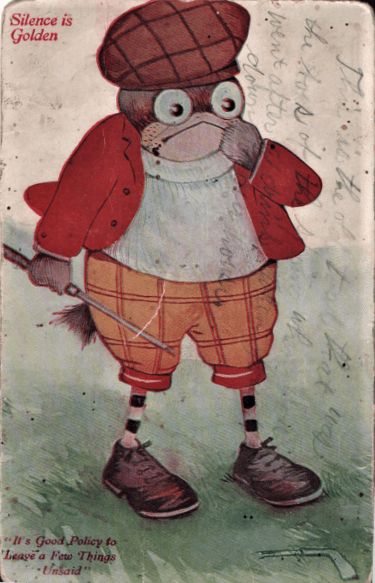
We are excluding, with some regret, golf clothes, which are also an entirely different matter, both on postcards and in life generally. Froggy,. At the top of this column, will have to wait for some other blog.
We have discussed, hereintofore, some fashions in men’s clothes, particularly the stiff collar a man could attach to his shirt. The height of one’s collar had said something about one’s status as a man in polite society, and it was argued from the beginning of the nineteenth century until World War I. A very high collar signified high fashion and wealth to some people, and stupidity and uselessness to others. To some cartoonists, the four went together anyhow, as seen in this scene, which, in case you didn’t know you were supposed to laugh at these blokes, monocles and a kind of male bustle have been added to the scene.
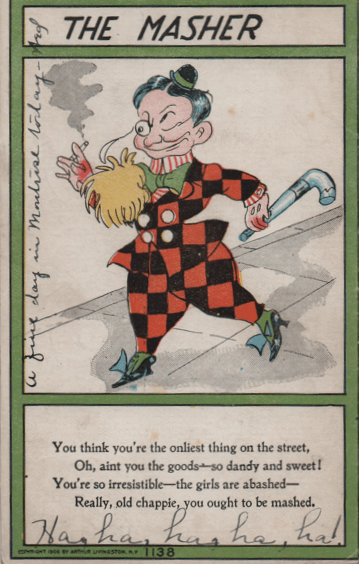
At least their clothing is the right color. Going back in men’s fashion, we find that it is prince Albert who, by his sober example, changed men’s fashion in the direction of dark hues. A Regency buck in, oh, 1808, would have thought nothing of light blue trousers or a forest green jacket (probably not together.) But Prince Albert’s dark suits led to five or six funereal generations in men’s clothing. Men could, and did, wear colors, but the cartoonists recorded what the rest of society thought of them.
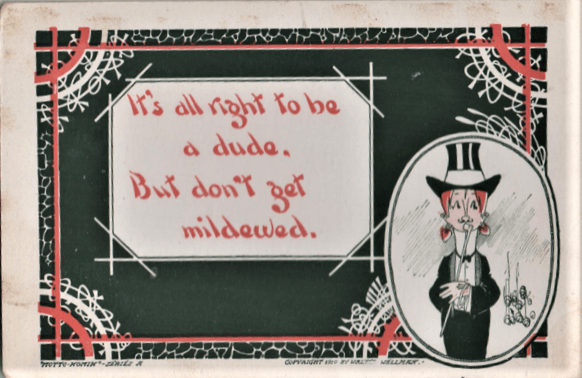
Such men were suspected of donning flashy dress to make a stir, which the proper gentleman did not. (This fellow is succeeding in making a stir, but, the cartoonist feels, not a really good one.)
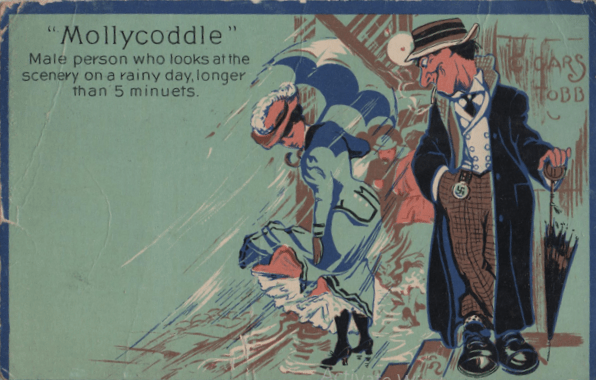
The artist of the Mollycoddle series could have indulged in worse name-calling than that, but preferred to express opinions through wardrobe. The central figure here is wearing a gaudy striped sweater with spotless white pants (known universally as “white ducks”), the marks of a weekend athlete, if that. (Striped sweaters were fabored by muscular members of college football teams—in pre-uniform, pre=helmet days—and he’s not exactly showing off a football physique.) And any sport you could indulge in while wearing heels that high was not considered much of a sport.
This mollycoddle goes in for fashion faux pas of another sort. His watch fob (if he has a watch) is prominent, and adorned with a popular good luck charm. His tie is broad, his mustache is thin, and his pants are baggy. Once again, the mollycoddle has dressed to impress, but is not impressing us favorably. (Quick quiz: list three words the cartoonist may have wanted you to think of instead of “mollycoddle” while looking at these pictures. Very good. Now go wash your brain out with Henry Wadsworth Longfellow.)
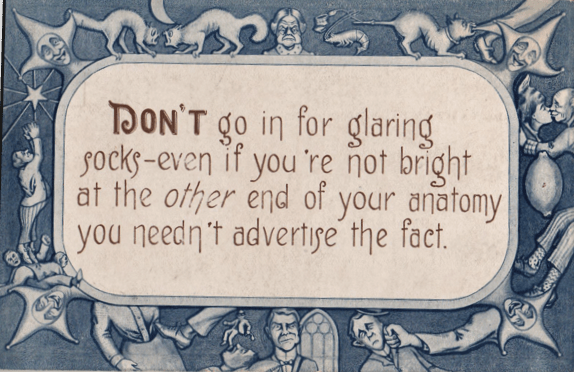
Dressing so people notice you is to be avoided. People may not be thinking of you what you think they should.
As an antidote to all these encouragements to dress soberly, we shall close with the always reasonable Walter Wellman, who warns us that fashions change, and wishes us to be mindful of that. After all, it is now the twenty-first century, and if you wish to wear a plaid jacket with a striped sweater and polka dot trousers, you just go ahead and be you. (As a precaution, though, you might want to add a bag of golf clubs.)
Now, this is the third time in a row I am going to begin this column by opointing out that it is summer and, as Lewis Carroll decreed, what I tell you three times is true. It seems appropriate, then, in this time of vacations and warm leisure, to present a collection of old jokes dealing with the things people do when they’re off work. As always, the answers are hidden at the end, when you feel like going to the trouble of working that far down the page.
J1.”How was the game, honey?” the woman asked her husband as he set his golf clubs in the closet.”
“The worst,” he said. “It was hot, the golf cart wouldn’t work, and after playing four holes in that heat, Ted grabbed his chest and dropped dead.”
“Wow! How horrible.”
“I’;l say. After that ( )”
J2.The golfer was about to try a putt when, on the highway just beyond the ninth green, a funeral procession passed. He set the putter against his bag, took off his hat, and waited until the heatrse and the fifty or sixty cars behind it passed in slow procession. Then he addressed the ball and sank the putt.
“It was thoughtful of you to show respect like that,” said his partner.
“It was only right,” he replied. “After all ( )”
J3.”If you’re so bored,” Steve’s wife said, “Why don’t you play golf?”
“Ah, everyone’s busy today,” he told her.
“Why not call up Jim. He’s retired, too, so he should be available.”
“Huh! Would you play with someone who kicks your ball into the rough when you’re not looking, coughs whenever you putt, and refuses to count the swings where he misses the ball when he’s counting up his strokes?”
“I guess not.”
“Well, ( ).”
J4.Every Thursday, the foursome met for cards at Casey’s bar and Pizza. And, every Thursday they could depend on old Buck wandering over to watch, criticizing their play on every hand, expressing contempt for their lack of skill, and just generally making a nuisance of himself.
“We need to teach him a lesson,” said Bill, one Thursday. “Let’s start playing, but make up the game as we go along. Then he can’t criticize.”
The rest agreed, and when they saw Buck start in their direction, started a game in which each player was dealt eight cards. “Lemme see,” said Bill, “I’ll take one card and discard two. I think I have an ultrapong. I’ll bet ten.”
“Ha!,” said Jim, tossing down one card. “I’ll see you ten. Looks like I have a pippeck.”
“I can do better,” said Joe, pulling his cards to his chest. “I have a snozzle. I make it twenty.”
Tim tossed four twenties into the pot. “Well, I’ll raise you. I’ve got a spludge!”
Buck couldn’t take any more. “What are you doing?”
“Can’t figure it out, eh?” said Jim.
“No!” snapped Buck, “( )”
J5.Carl, carrying his rod and his tackle box, stopped at the store on his way home. He told the man behind the meat counter. “Wrap up two trout. And can you throw them over the counter to me?”
“Sure thing,” said the butcher. “But why?”
“Headed home,” said Carl, “And ( )”
J6.The hunters trudged through the forest, becoming more and more convinced that their guide was leading them in circles. “Admit it,” said Tom, “You’re lost! And I thought you said you were the best guide in the state of Maine!”
“I am,” said their guide, “But ( )”
Set that frosty mug of root beer to one side, adjust your bag of chips, and check to see whether I have gotten the same ANSWERS you did.
A1.It was fourteen holes of Hit the ball, drag Ted, hit the ball, drag Ted….
A2.We were married for thirty-five years.
A3/Neither will Steve
A4.What kind of idiot raises a snozzle with a spludge?
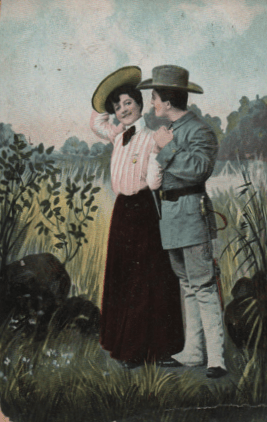
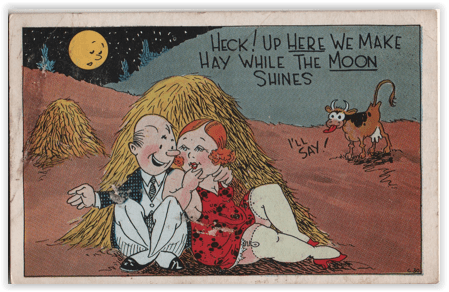
Well, we are thoroughly into summer now (I saw my first Back-to-School Sale ads) so perhaps you feel this is the wrong time to discuss romance in the long grass. But hey (this is the last time I’ll make that joke on this outing. Promise.) But grass grows more months of the year than in autumn, and romance is seasonless. What I mean to say is that hay can be gathered from late spring through the earlt frosts, and there is no cut and dried season for gathering rosebuds. (And we will put an end to the cut and dried jokes now, too.)
Ecen in the big cities, few people were far from the concept of open fields, and the knowledge that long grass and other crops could provide camouflage for experiments in animal husbandry. I do think the publishers of this postcard could have shoved down the grass just THERE, as it creates a sightline that gives the impression the young lady’s figure…well, I wasn’t there. Maybe the growth was abundant that year.)
This all played into a city-grown concept of farm romance, which was a major factor in popular literature in the nineteenth century. See, it probably derives from the idea, pushed by Thomas Jefferson and others, that city life was generally unhealthy, and life in the country air was more robust, more real. This is now seen mainly in cowboy romances, but there used to be a vast movement by city folk to spend some time on a farm during the main growing season, during which the city folk would pay for the privilege of working like, well, like farmers from dawn ‘til dusk, just so they might have a chance at scenes like this. (In reality, the city folk would be too exhausted by the constant work—so were a lot of the farm folk—to engage in hanky=panky, but we are dealing in romance here. The caption of this card, by the way, is a reference to an urban pop song, though tall grass plays its part in the story.)
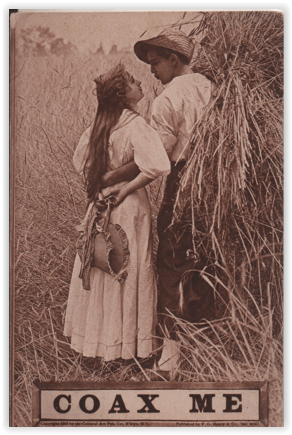
Of course, if one stayed up late at night, after the chickens had gone to roost, maybe you’d all get your second wind. Then the camouflage of a handy haystack might prove useful.
I do not have much data on the mechanics of the proposition, but I do think what you did if underneath a haystack was try to get out again. Maybe this form of hay is easier to draw so it can be understood than a hayloft, which I should think would be more convenient for this sort of hay fever. Note that the chickens seem to be shocked. (We will be making no jokes about shocks of grain, as I feel that is best left to the farm joke professionals.)
Now, to get to the main target of this blog, we must consider the hayride, that adventure on which, if old stories are to be believed, romance could blossom and young couples got to know each other rather better than they could during the workday. The hayride, I am told by the unromantic, started as a time when those working on the harvest could get a nap. The hay had to be transported once cut, and kids and tired, er, hired hands would ride on top of the hay to the spot where it needed to be unloaded. The hayride was wildly popular in farm romance, and pretty soon the farmers who charged city folk a fee to come and work on the farm realized that other city folk, out to the country on a day trip, would pay a fee to ride on the cargo. One load of hay could bring in several loads of money, as carloads of tourists could be transported from farm to barn or railroad depot several times before the hay actually had to be unloaded. (The approach of rain had to be measured against the approach of tourists, and the canny farmer had to time these trips just right for maximum profit.)
The romantic possibilities of the hayride and the tourists who enjoyed it started somewhere in the late nineteenth century, and the city folk seemed to be having so much fun that hayrides became traditional even if there were no tourists available. Even country folk were caught up in the romance of the thing, and the hayride, sold to tourists as an old rural tradition, eventuallt SDID become a rural tradition, associated with the autumn harvest and the celebrations that went along with completing the hard labor of the season. All work and no play, after all….
This postcard appears to have been published in 1910 by a major agricultural company (THE major agricultural company, as a matter of fact) and to my naughty modern eyes makes no secret about what we’re up in the hay for: good wholesome fresh air and a sense of fun. The fact that we’ve paired off and are reclining…well, there’s nothing like the scent of new-mown hay.
Well, we are well into summer now, so I suppose this would be a good time to discuss hammocks. Hammocks have a role of their own to play in the postcard world. Despite the occasional reference to hammocks used by those who go down to the sea in ships, and the occasional vacationer beset my mosquitoes while sitting in a hammock, hammocks were for lovers. And by that, I do not mean people who wanted to sit next to each other and hold hands.
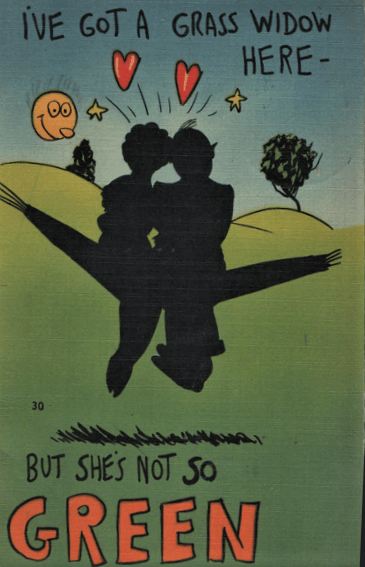
Take the couple at the top of this column, secure in silhouette on a modest hammock. Being told that a grass widow isn’t green lets us know that this is the wife of somebody who is far away, and she knows what she’s getting into when she gets into a hammock
A fabric swing that was also widely used as a bed carried with it certain possibilities, though this friendly couple would be well-advised to note the one-person dimensions of their hammock and the condition of their trees before moving to another stage of this relationship. (Er, is it my imagination, or is she studying his shoe?)
The romance of the hammock was something which could go on into one’s golden years, even if the local wildlife is watching,
A cartoonist, of course, could get away with a lot, of course. This couple have taken up a romantic pose in a hammock of good size held up by reasonably solid trees. One should not allow questions like how two people small enough to fit into a hammock in this position were able to climb up that far in the first place, and, judging from their expressions, whether they wouldn’t be too exhausted at this point in the date to wave a fan need not get in the way. (Just as a side note, to distract you from the slanderous suggestion I just made about this pair, fans were, at this point, considered almost inseparable from hammocks: all part of the general association with those lazy, hazy, crazy days of summer.)
Only rarely did an artist consider such nagging propositions as gravity. This artist has noticed not only what happens to the hammock when a couple get into it, but what can happen with the couple, but this is generally left to the mind of the reader.
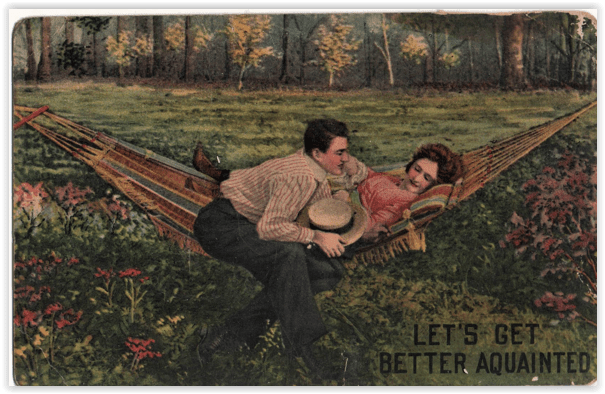
Postcards which went in for photography over cartooning had to deal with such matters. Take a look at how much more there is to this hammock than most of the drawn versions, and how this couple is burdening it.
The reality of physical science as it related to summer romance could not be dismissed with a few brush strokes. Of course, romance in a hammock was not a mere cartoon frivolity, so obviously there were ways to enjoy oneself even if one WAS three-dimensional.
Not every hammock in creation could be suspended three feet off the ground. All you needed was enough clearance to swing, as we can see with this down to earth couple.
As we near the end of the chapters in my old joke quizbook, the offerings become more miscellaneous, but I can assure you that the quality of the gags themselves will not diminish for being less organized. (I heard that, you in the back. For that, you can stay after class and watch recordings of Ed Sullivan and Johnny Carson.)
As usual, the punchlines are missing, but I feel you will know what they are without checking the ANSWERS.
J1.The nude model arrived at the artist’s studio to find him sitting at a small table in front of his half-finished painting of her. “I just don’t seem to have the spark today,” he told her. “Do you mind having a cup of coffee or two instead of getting right to work.”
She shrugged and sat down across from him, sipping the coffee he poured while he discussed his latest insurance problems and what he thought about the chances the Cubs had of making the Pennant race. He was in the middle of a sentence when they heard a knock at the door.
“Good grief, that’s my wife!” he exclaimed. “Quick! ( )”
J2.I was doing my comedy act at the Castle Theatre back in ’99, and they added these jugglers to the show. Brother, they were terrible! Dropped stuff, tripped over their own shoes, couldn’t keep a rhyth,. The audience started to throw things and just booed them off the stage. Let me tell you how bad they were. They were so bad that a minute after I started my routine, the audience ( )
J3.Old Sherman Fiveandime was dying in the little apartment over the store he had opened sixty years before. His family gathered around him, awaiting his last words. After hours of silence, he opened one eye and gasped, “Is Mabel here?”
“Yes, Sherman,” said his wife.
“And Junior?”
His son stepped to the bed. “Yes, Father.”
“And Annabelle?”
His daughter exclaimed, “Yes, Father! Yes!”
Sherman opened both eyes. “( )”
J4.”Unless my boss takes back what he said to me today, I’m never going back to the office again!”
“Why, what did he say?”
“He said ( )”
J5.At the staff meeting, Mr. Gotlots told one of his best jokes, the one about the white horse and the black horse. Everyone roared with laughter except one woman at the far end of the table.
“What’s wrong with you?” he asked, “Didn’;t you get it?”
“Oh, yes,” she said, “But ( )”
J6.Ed and Carolyn went to the latest blockbuster movie and settled in to enjoy the show. After a couple of minutes, Ed whispered to his wife, “Can you hear all right?”
“:Yes, dear,” she said.
“Can you see the screen okay?”
“Yes, dear.”
“Not sitting in a draft, are you?”
“No, dear,” she said.
“That’s good,” he told her. “( )”
J7.One of Ed’s friends asked him the next day, “So did the picture have a happy ending?”
“Oh, yes,” he said. “( )”
J8.The play was the hit of the season, with waiting lists a mile long to get tickets. Jack was amazed, when he was shown to his seat, to find the spot next to him empty, though the theater was packed. “I wonder what happened to this fellow,” he observed to the woman on the other side of the empty spot.
“Oh, that’s my husband’s seat, but he couldn’t be here,” she said.
“That’s too bad,” Jack said, “But don’t you have a friend who could have used his ticket?”
“Oh, no,” she replied. “( )”
Naturally, you know all these ANSWERS, but here they are so you can show them to your friends who didn’t.
Once upon a time, watermelon fondue, it wasn’t as easy to get water-soaked as it is today. Taking a bath involved heating many buckets of water and filling a large waterproof tub in a large warm room (frequently the kitchen, so the tub was near the stove, meaning both the water and the bather would be warm. (And since it was a huge waste of time to empty the tub and refill between every bather, you kind of wanted to be first in line,)
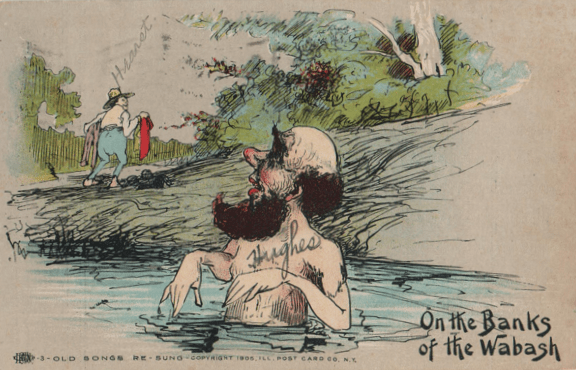
Public swimming pools were few and far between, and there weren’t all that many private ones, either. Your best recourse, whether your plan was to wash off a layer of dirt from the road you traveled or cool off in the summer, was to find some handy source of natural fresh water. For those who lived near a beach, this was simple enough. Some towns had traditional “swimming holes”, which might involve a little maintenance or supervision by the town council (more often not.) If you lacked these things, you had to rely on occasionally finding an unsupervised bit of creek or lakefront. If this was handy enough, you might bring a towel and swimming suit, but more often, it was a matter of serendipity. This meant you took your chances for a quick swim by wrapping your clothes in a bundle on the shore and indulging in a bit of “skinny-dipping”, a quick bath in the fresh water.
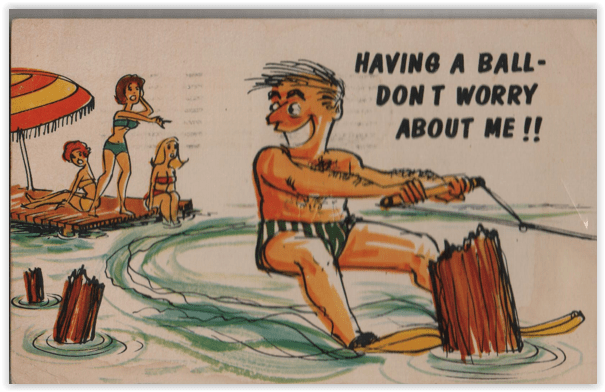
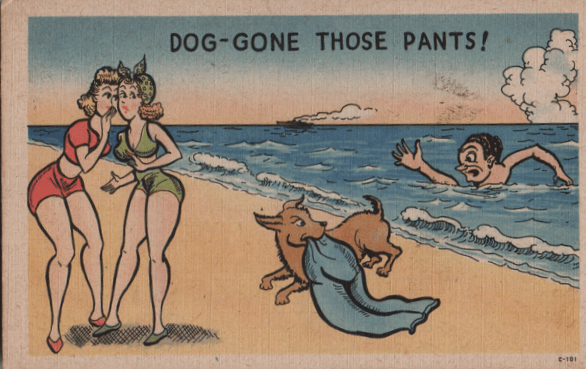
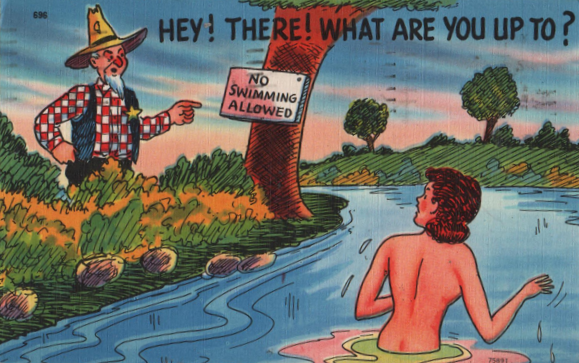
The world of cartoon and comic strip (and silent movie) is filled with the perils of this practice. And postcards could not lag behind. Chief among these perils was, of course, the danger that the private spot one found was not quite private enough. In secluded rural areas, a lot of convenient bathing spots were known to wandering vagrants who were less interested in a bath than in a change of wardrobe. OR a merry prankster who just wanted to see how you’d get home in your bares.
Here our hero is beset by a playful dog. AND a couple of witnesses who are laying bets.
Alternately, one had to deal with the clueless, who, oblivious to your presence, nonetheless had to perch in some place with a good view, preventing you from leaving the water until they left the scene.
There does seem to have been something of a double standard, mid-century, in how much you got to see of the embarrassed swimmer. I think this is partly because it seemed funnier to show a bold, brave man cowering in the water up to his shoulders, and partly because your postcard artist didn’t get a lot of legitimate chances to draw nudes. There ARE postcards involving female skinny=dippers in the early twentieth century, but in the cards I’ve seen, the women do not appear at all: there’s just an eager man hunting along the riverside after he finds piles of clothes.
This card makes use of the punchline of a fine old joke and loses a little in the translation. (See, in the original, the swimmer realizes someone is coming but doesn’t have time to get to her clothes. She grabs up an old washtub on the bank for modesty and snaps at the new arrival “Do you know what I think?’ and then…yeah, it’s not much funnier the way I tell it, is it?)
I could whine about the joke here, too, if I wanted to. This is a mere accidental skinny-dipper, someone who somehow got to the water past a number of onlookers, and never realized she’d forgotten an important part of dressing for the beach.
This is just a contextual gag; the sender simply wants to know what you’ve been doing, and uses this skinny=duiipper to frame the joke.
There WAS at least one other joke about skinny-dippers, when the swimmers don’t realize they are being observed. This one takes a neutral approach, but there are others which deal with the inconvenience caused to the accidental witness. The poor would-be fisherman has his whole afternoon plan has been thrown off. Might as well go home, if there’s nothing to do here after all.
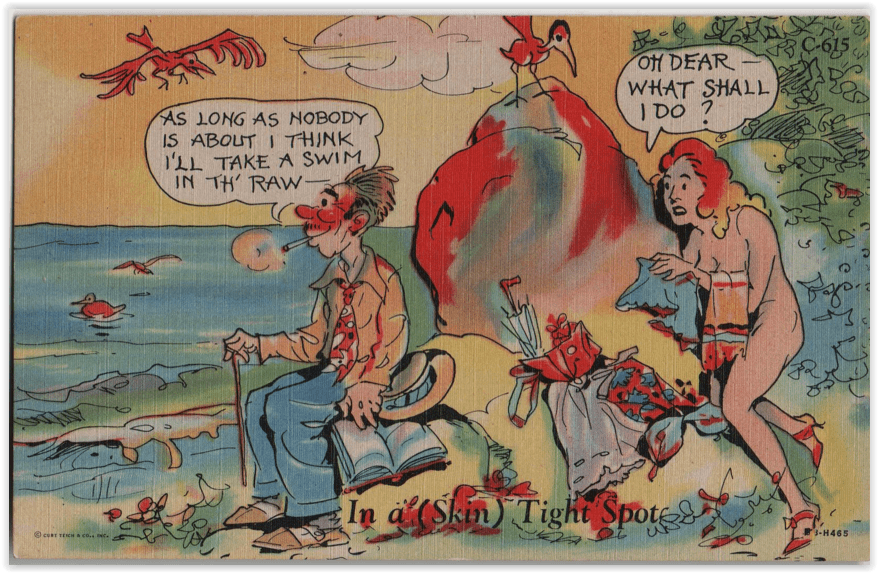
And there’s this wonderful scene which mingles inconvenience and embarrassment and a horrible lapse in logic that of course I am going to froth at the mouth about. Let’s turn my complaints into a game, shall we, pickled marshmallow? Which of these two is more clueless: the man who sat down to read, not noticing the clothes spread out on the rock, or the woman who has made it to her clothes without him seeing her, and lacks the brainpower to pick up ger undies and slip away? Or is she just trying to decide whether to do that otr stay and watch HIM disrobe? Frankly, they are both dim enough that if I was writing this little script, they would wind up at the end being embarrassed and getting dressed in a hurry in each other’s outfit. Ah, the treasures the world lost because I wasn’t around to write for postcard companies.
I think I’ll cool my seething brain with a nice cold shower. I’ll pull the curtain.
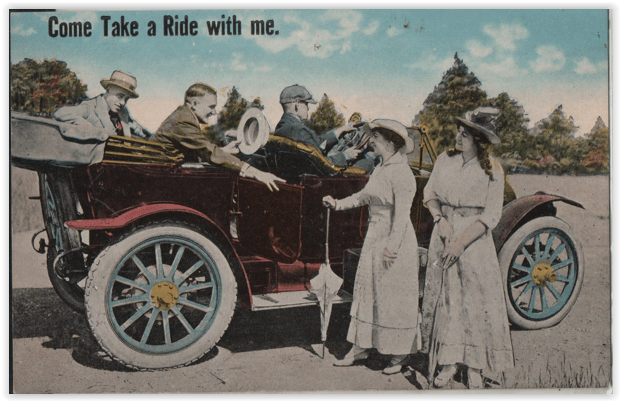
Compared to today’s automobiles, you find in the picture above a rather comfortable back seat, with nice padding and plenty of, er, leg room. If you could combine that with a very discreet chauffeur, so you didn’t have to waste any of your attention on actual driving, you created prime romantic real estate. Or so our ancestors liked to pretend, in song, story, and postcard.
In truth, those seats were built to be solid and largely unyielding, and anyone with sense would have put the roof up. (No matter how discreet the driver, the neighbors are going to pay a lot of attention to auto-hugging.) But you did get a little more fresh air than you would have in the family parlor, and that horsehair sofa was certainly no more soft and comfortable than the car’s :eather seat. (Our ancestors, who by all accounts favored feather mattresses into which one could sink a good eighteen inches, preferred hard, straight furniture for sitting. Somebody else should write a dissertation on this: I have postcards to polish.
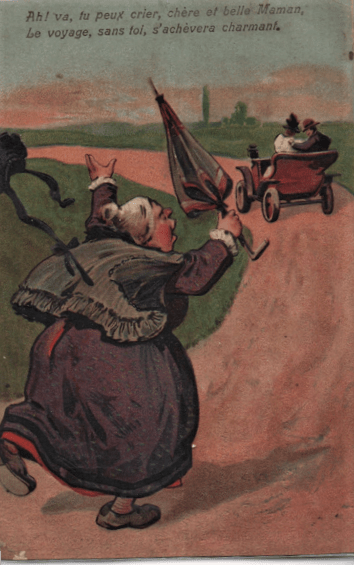
Those same ancestors were well-acquainted with the romantic possibilities of a long buggy ride. The automobile might have offered greater speed and perhaps more distance, but the principle was very much the same. A ride in the country offered that fresh air, beautiful scenery, and distance between a couple of joy riders and their parents.
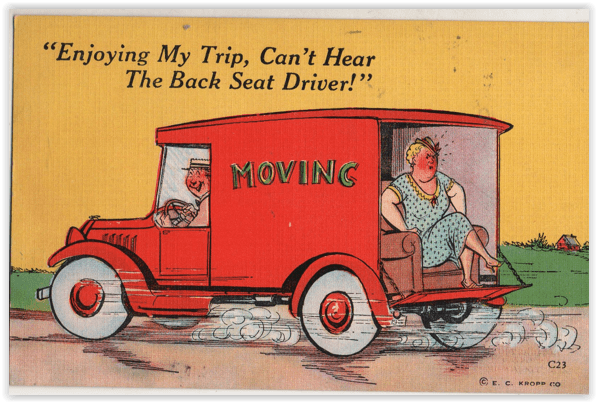
If Ma didn’t drive, she couldn’t keep track of what you were up to. (If you reads French, you may realize this is actually a married couple explaining to Ma/Ma-in-Law that they’ll have a more charming trip by car if she walks.)
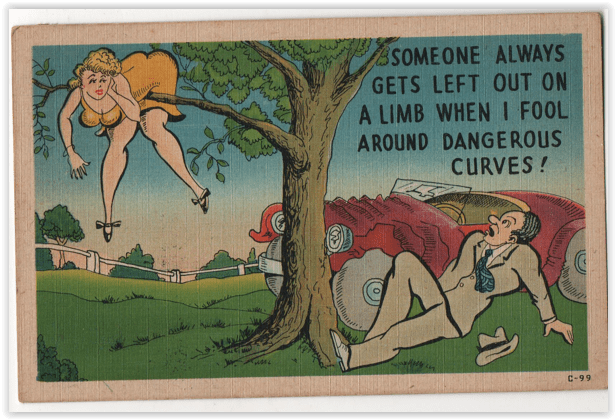
Postcard artists were not, certainly, unaware of the dangers of a long ride in the country, and were willing to warn their readers of the same.
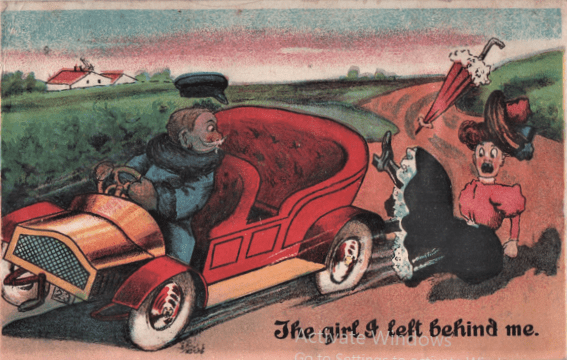
Horse-drawn vehicles, after all, had offered a certain stability which might be lacking in an automobile. The multi-tasking driver, having lost that equine ally, was taking new risks.
The joys of observing nature were no excuse for not keeping one’s eyes on the road.
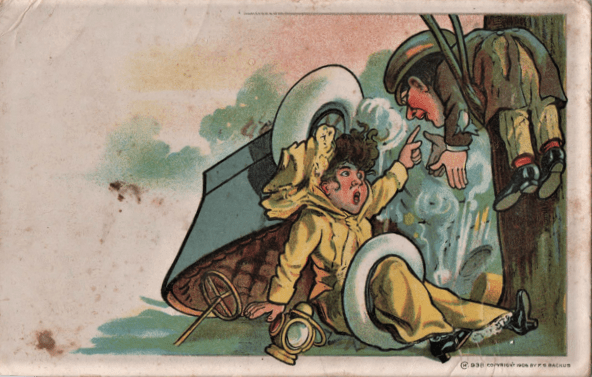
One was risking damage to one’s automobile, one’s body, and, most of all, one’s relationships.
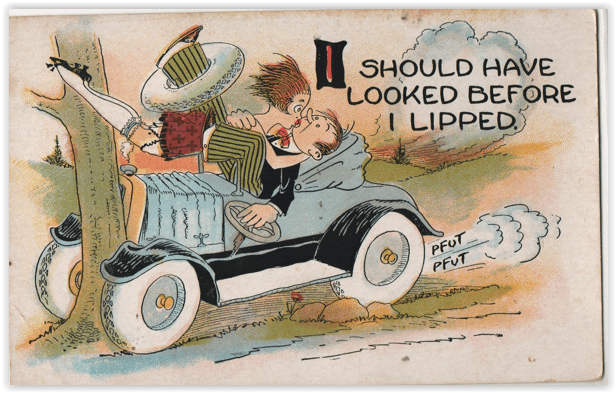
Mind you, the artists were also willing to warn you about paying TOO much attention to your driving. This was an era of open cars.
Even if one paid a proper amount of attention to the driving AND one’s passengers, the toll could be exacting. Romance on the road had its hazards no matter how it was conducted.
One of those was marriage, of course, after which a ride in the country had to be rearranged.
I hope you did not fear, when this blog took the holiday off last week, that we were out of old jokes. We have not yet reached that catastrophe. We have a few tales of other people’s catastrophes to try out on you first. As always, in case you catastrophically cannot remember the punchline to one of these antiques, those are tucked away below.
J1.Walter Prince opened his morning paper and found his own name and biography on the Obituary page. Once he had checked his pulse and found it to be there, he called the Gazette and demanded that the mistake be corrected.
“We never print retractions, sir,” said the editor. “But I’ll tell you what. Tomorrow ( )”
J2.”Boy, call me a cab.”
“Okay. ( )”
J3.The phone rang at three o’clock in the morning. “Hey, is this the Metro Auto Loans Company?” asked a voice.
“No,” said Rosemary. “This is a private home.”
“Oh, wow. I’m really sorry to have called you at this hour.”
“That’s okay. ( )”
J4.”Who was that lady I saw with you last night?”
“That was no lady. ( )”
J5.”Well, you are the first person to answer our Help Wanted ad, so we give you points on self-motivation. Now, where did you get your training for this kind of work?”
“Yale.”
“That is excellent. And what is your name?”
“( )”
J6.Andrew called in an investment consultant after he’d won the lottery. “I want to be intelligent about the money,” he said.
“Very wise, young man,” said the consultant. “You are aware, of course, that I charge one hundred thousand dollars to answer any two questions.”
“A hundred thousand! Isn’t that a lot of money to charge for just two questions?”
“Yes. ( )”
J7.”I know a man with a wooden leg, name of Smith.”
“Oh? ( )”
J8.”Do you serve crabs here?
“( )”
J9.”Have you lived in Needleburg all your life?””
“( )”
J10.Scott was finally able to take a break from his work at the bank and decided to make it worthwhile, with a nice long cruise. On the second day out of port, however, he was admiring the ocean when a massive wave swept up and washed him overboard. He yelled for help and was relieved to hear the cries of “Man overboard!”
A voice from the deck called out, “We’re coming, sir! Can you float alone?”
“Yes,” he called back, “But ( )”
J11.”And thus,” said the professor, “We see that all our best measurements point to an end of the universe as we know it in fifteen billion years.”
A hand shot up in the audience. “How many years?”
“Fifteen billion.”
“Whew! ( )”
J12.”You have an impressive resume. Now, why did you leave your previous job?”
“Illness.”
“Illness?”
“Yes. ( )”
I know while these people were caughts in their various dilemmas, you had all the ANSWERS, but here they are anyhow.
Have I ever confided in you the deep, dark secret that I have no ambition to write a food blog? I have occasionally considered starting a series where I could discuss some of my personal recipes (I am the originator and only known provider of Crawford Sausage, for example) but every time I think about it, it calls to mind that letter from Washington, D.C., asking that I spread my cooking advice only among those people known to be hostile to the United States.
HOWEVER, I do wonder, as most people do, about the foods and beverages I see around me, and it occurred to me one day to worry what club invented the club sandwich and club soda. Is there a placque somewhere? Can I get a menu and find out whether there was also a club pie or a club meatloaf?
For those of you who have important things to do today, I will divulge the main answer right away. No. Not the same club. You can now go paint your toenails puce while the rest of us munch our way through history.
Clubn soda was one of a series of beverages which followed Joseph Priestley’s discovery of a convenient way to carbonate water in 1803. Priestley, like most of the nineteenth century fans of fizz, felt it had medicinal properties (he figured it as a preventative for scurvy.) I believe, as stated hereintofore, that the mere production of burps was enough, but there are all sorts of theories about neutralizing acid in the stomach and stuff like that there. In 1877, Cantrell and Cochrane was commissioned to produce a new type of carbonated beverage for the Kildare Street Club of Dublin, which called it their Club Soda. The company still retains the rights to the name, and though the club was very important and exclusive (the Duke of Wellington belonged), its main contributuion to human history is club soda (no word on who first discovered its ability to remove red wine stains, but that sounds clubbish.)
The club sandwich, however, is claimed by clubs both American and British and the correct recipe is also a matter of debate. It SEEMS to require toast instead of bread, certainly mayonnaise and often butter, and usually at least two kinds of meat (one of which must be chicken or turkey, while the other is expected to be ham or bacon), as well as tomatoes and lettuce. (One person who DOES write a food blog called it a chicken sandwich with a BLT hat,) Whether it MUST be a at least three slices of toast is hotly debated, as is whether the sandwich HAS TO be cut into triangles.
For some years, the sandwich appeared in literature as a Union Club sandwich, but the Saratoga Club also claims it, while a British source credits the Tenderloin Club. All of these clubs are mentioned in articles at the end of the nineteenth or start of the twentieth century; the sandwich started appearing on menus and in cookbooks aroundabout 1899. One article insists that the club sandwich must be served with good coffee to show at its best. No mention is made of potato chips, which were invented in Saratoga Springs a generation earlier.
To take care of side issues before they arise, Canadian Club Whiskey was originally marketed by Hiram Walker as Club Whiskey, because he figured men who drank in clubs would like it. He moved part of his production from Michigan to Canada to keep ahead of the temperance movement in 1855. His competitors demanded he mark the label “Canadian” so everyone would know THEIR whiskey was American, and this backfired so beautifully (customers figured Canadian whiskey must be more exotic, and bought more of it) that the word moved down the label.
Clicquot Club ginger ale also had nothing to do with a specific club (Veuve Clicquot champagne probably inspired it). That brand eventually perished, along with its mascot Klee-O, so you cannot order it, even at the Kildare Street Club.
Now Crawford sausage is a fickle and delicate dish, as I can demonstrate by this scar across the knuckle of my left thumb…oop, I think one of the Men In Black is coming. Next time, perhaps.




















 Blogsy Babbles