Despite its appearance in eight of the flower language books consulted, abatina is still a mystery to me. The best io can tell you is that once upon a time, the conifers, or trees with cones, were referred to as “abietinae”. But see the next entry.
ABECEDARY “Volubility”
Almost everyone who listed abatina followed it up with the abecedary. As a flower, abecedary is another mystery. However, it is a word referring to any book in alphabetical order, like a flower language dictionary, so it could be a ringer. Reference books often include joke entries, so people who make them can find out what other reference books just swiped the data word for word without doing any original research. This entry appears in seven books, so six of those nice floriographers…but perhaps I’m overlooking something obvious.
Abele: see POPLAR, WHITE
ACACIA “Platonic Love”*
The floriographers go into a number of variations on this theme, but all boil down to a quiet kind of love, a chaste love. Sarah Josepha Hale, the flower language pioneer now best remembered for writing “Mary Had a Little Lamb”, says the meaning comes from the way the acacia blooms unnoticed in the wilderness. Mme. De Latour was plainer: the acacia did its blooming far away in savage lands (specifically Canada.) Henry Phillips, among others, explains North American Indians themselves considered acacia a symbol of chaste love. And Laura Peroni, a twentieth century Italian floriographer, says that chaste love is so hopelessly outdated that we should drop this meaning and make acacia an emblem of the Women’s Movement. There are people like Laura Peroni all over the world; it isn’t Italy’s fault.
Acacia, Pick: see ACACIA, ROSE
ACACIA, ROSE: “Elegance”*
Claire Powell attributes this to the flower’s resemblance to a woman in a ball gown. Um, okay, fine. A lot of floriographers, swiping from Me. De Latour, list this under the roses, as the Acacia Rose. Forgetting their high school French, which taught us that the adjective follows the noun, they assumed it was French rose, whereas it actually means “Pink Acacia” (which appears in dictionaries by floriographers with better French).
You didn’t ask, but Acacia was also the name of the most elegant fraternity on campus in my college days, a house of four-point scholars who got together for cribbage and beer. They went after any freshman who might raise the grade point average. Yeah, they asked me to pledge. Spelled my name wrong in the letter.
Acacia, White: see ROSE ACACIA
Acacia, Yellow: see ACACIA
ACANTHUS “The Arts”*
Do kids in school still have to memorize the styles of capitals on Greek columns? There were three, as you recall, and our teachers thought this information was vital to our understanding of the universe. Doric was plain, Ionian was mildly interesting, and Corinthian was a real bear to draw on the test papers: all swirls and curlicues. Well, the swirls and curlicues represented the acanthus. Callimachus, an ancient Greek who still carries some clout, spotted acanthus plants twining around a woman’s tombstone, and thought they were amazing. According to Will Cuppy, who is generally to be relied upon except in the matter of fried bananas, Callimachus was a critic whose word was law. If he said acanthus was artistic, you were simply null and void if you didn’t include some in your work. Greek artists started twining so much acanthus in their sculpture that it was remembered centuries later by Mme. De Latour.
Achillea millefolia: See YARROW
ACHILLEA PTARNICA: “Tears”
This old-fashioned plant was also known simply as “The Pearl”. A resemblance of tears to pearls is implied.
ACHIMENES CUPREATA “Such Worth is rare”
Aconite: See MONK’S HOOD
Aconite, Winter: see FAIR MAIDS OF FRANCE
*ACORN: “Goodness”
ADAM’S NEEDLE “Mend Your Ways”
Also called Spanish Bayonet, or Yucca filamentosa, this was believed to have been used to sew fig leaves into the first lingerie. (Note that Adam was doing the sewing.)
ADDER’S TONGUE “Jealousy”
ADONIS “Sorrowful remembrances”
Adonis was simply the best-looking Greek of his day. The Goddess of Love, Aphrodite, fell for him hard, though he was the rugged outdoorsy type and she ran more along the lines of “Beulah, peel me a grape”. Isn’t that always the way? Adonis was gutted by a wild boar on one of his hunting trips. This flower allegedly sprang from his blood. (Aphrodite’s tears became the anemone.)
Adonis has been a symbol of male beauty ever since, and, to some, of beauty that dies young. One of the practices of the cult of Adonis was a perverse sort of gardening in which flowers were planted in shallow soil so they would spring up, blossom, and then wither, allowing everyone to grieve for the memory of glories that had died. Well, it passed the time on a Sunday afternoon.
Floriographers also call this Flos Adonis, Adonis Flos, Adonis Vernalis, and Pheasant’s Eye. Others insist that Adonis Flos and Adonis Vernalis are different plants (but give them similar meanings.)
AGERATUM “Indispensable for Progress”
AGNUS CASTUS “Coldness; To Live Without Love”
People go on about aphrodisiacs, potions alleged to improve the sex drive, but you don’t get nearly as much literature these days about anaphrodisiacs, or sex suppressants. This plant was popular for such uses during the Middle Ages. Its seeds were considered contraceptive, while monks and nuns supposedly made britches and girdles of the stuff to insure chastity. It would insure something.
AGRIMONY “Gratitude”*
The floriographers are not as clear on how they thought this up as I’d like. A modern floriographer, Claire Powell, says the plant is actually called “Gratitude” by gardeners, and does nothing about it. She goes on to say that its blossoms are shaped like little bells. This makes people think of church bells. That in turn reminds people of medieval monasteries, which granted hospitality to weary travelers, who were then Grateful. Well, of course. Obvious, when you think about it.
*AILANTHUS “Have Faith”
*ALDER “Baffled, Bewildered”
*ALDER, BLACK “I Wait Help”
*ALDER, DWARF “Convenience”
Alfalfa: See LUCERNE
ALLSPICE “Compassion”
A twentieth century floriographer, Lesley Gordon, says this is because whenever you cut off one bud, two grow back.
Now that we have sent two blogs on the introduction and foreword and such, that flower language can settle into the Monday slot previously occupied by the glories of my Old Joke Quizbook. Those of you who have been yearning for postcard pictures can resume their regularly-scheduled program today, while those waiting for more flower language will need to yearn until Monday. Those of you yearning for more old joke quizzes can go back and read the old ones, or check online for a good therapist.
Nonetheless, we are not straying too far from floriography today. As I mentioned in the introduction and will examine more thoroughly in the installments to come, flower language is not especially limited to flowers. The floriographers were interested in anything botanical, so they developed meanings for fruits, vegetables, trees, mosses, individual flower petals and, in the case of some extreme floral cryptographers, even the cloth or string the bouquet was tied up in. (And if you handed someone a flower sideways instead of rightside up, it changed the meaning to…let’s wait for Monday, eh?)
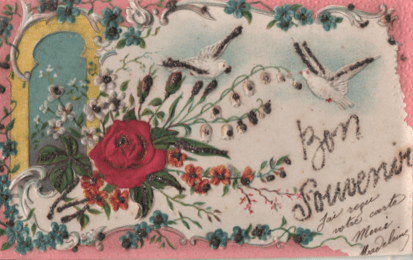
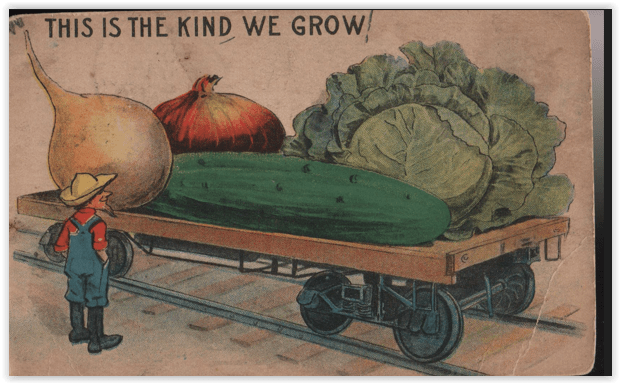
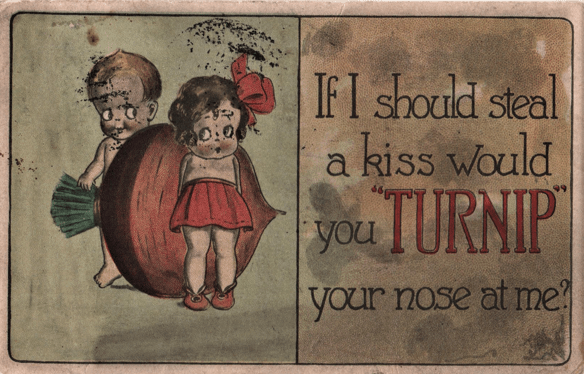
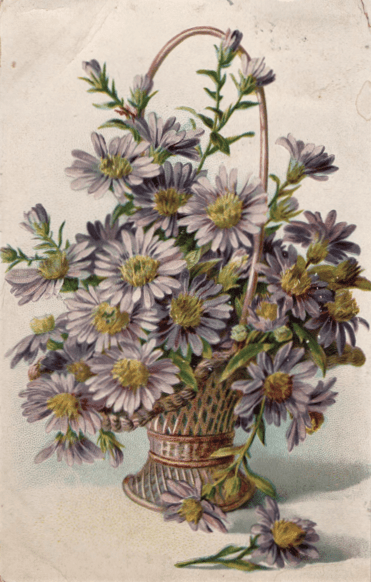
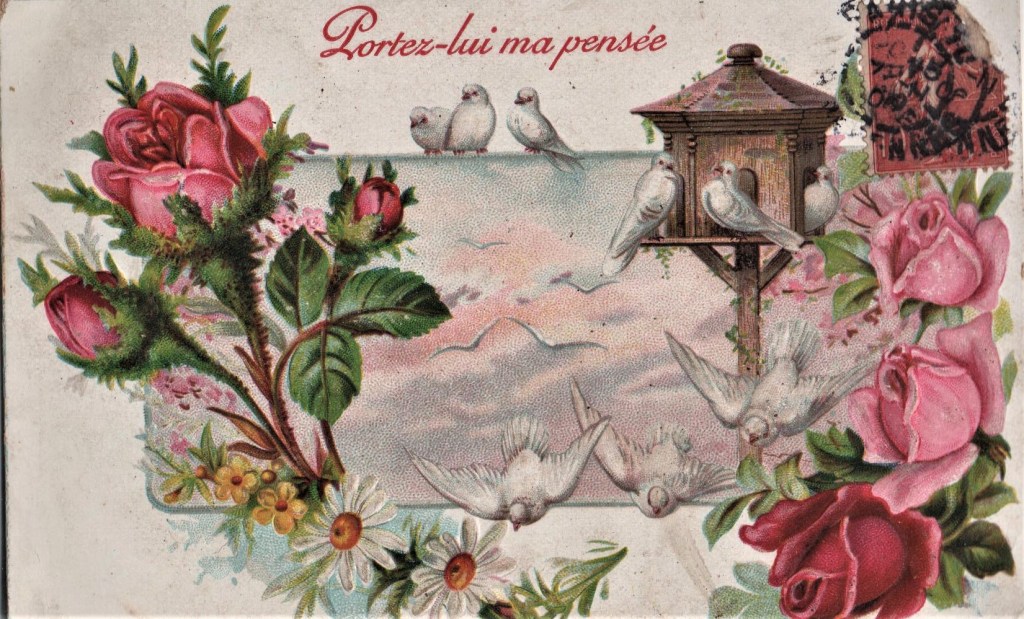
But postcard publishers, besides printing their own series of flower language postcards, were willing to show just pretty flower pictures, as you will see in weeks to come as I illustrate the floriography installments. AND they were interested in other parts of the botanical world. For one thing, there was a massive vogue, not quite dead even today, for pictures of big vegetables. These are known as “exaggerated” postcards, and unlike the one at the top of this column, often involved trick photography. Corn was one of the most popular subjects, but apples, pumpkins, tomatoes, and just about anything else was fair game.
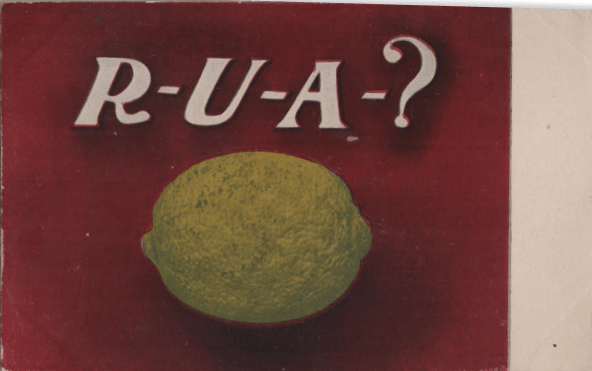
Our ancestors, who lived in a world where refined sugar was a lot harder to get, found fruit extremely appealing, as food and as symbol. Of course, sour fruits were considered kind of a disappointment, as we have discussed in previous columns where we discussed the custom of “handing someone a lemon”. Lemons were considered a symbol of undesirability long before the term was applied mainly to used cars.
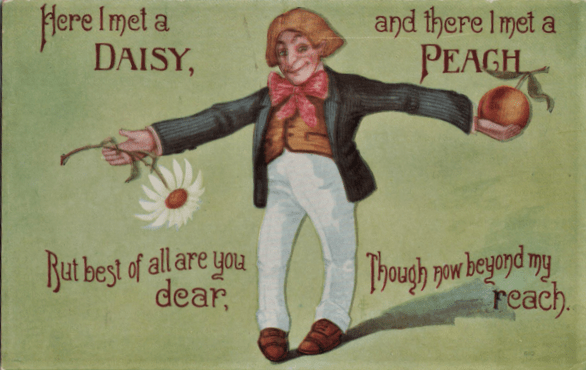
I have not done the research on when really, really good things, especially young women, were described as “peaches” for the first time, but it does feature in a number of pop songs from the turn of the last century, and it is not neglected by postcard artists.
The number of postcards dealing solely with the puns on pear and peach in the same card would probably make a nice collection alone.
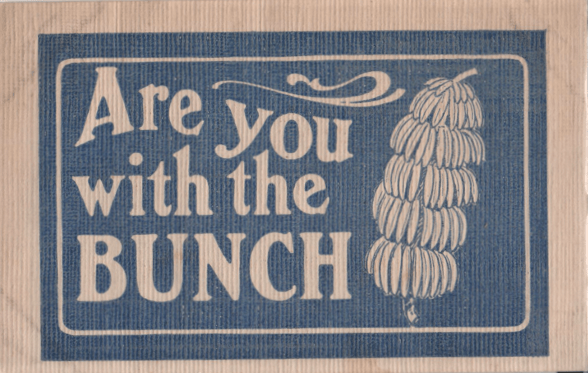
And then there was this banana craze at roughly the same point in our history, culminating in the inescapable success of the song “Yes, We have No Bananas” in 1923. Fotr those of you old enough to recall this ditty, I am happy to have introduced your earworm for the morning.
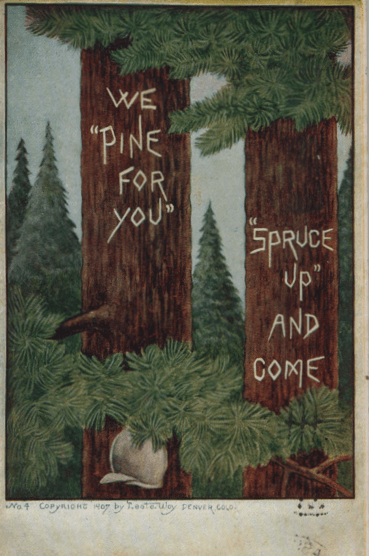
Ytrr puns were not neglected, since tree names have a tendency to have kust one syllable, making them vulnerable. This artist used up two puns in one card, and could have done more, but may not have wanted to go that fir. (Thank you, thank you: just throw money.)
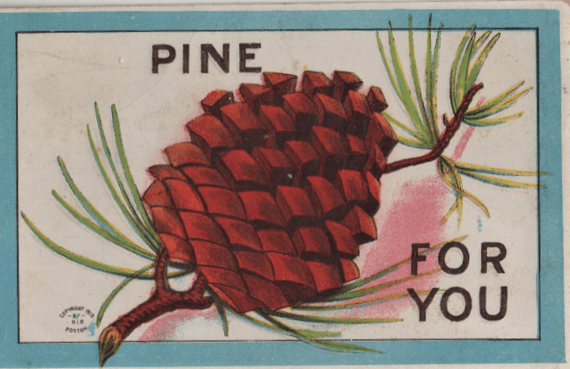
I think this artist has clouded the issue. Very nice picture, of course, but is the message “Pine for you” or “Pine cone for you”? Or am I missing some subtle cultural association, as usual?
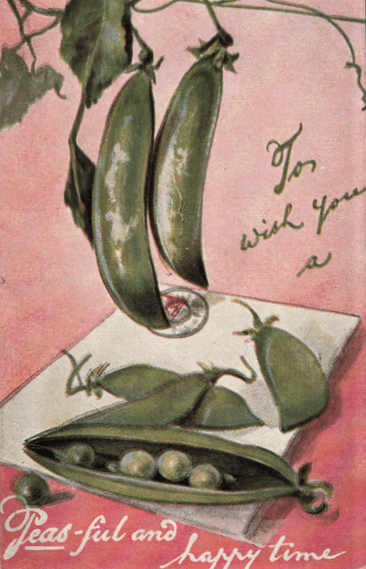
Returning to vegetables, we find that even normal-sized ones had their applications in the postcard world, and were just as liable to atrocious punning
There was really intense debate, on a professional level, as to whether a pun constituted humor at all, or was just a sort of really cheap word puzzle. This did not slow down the minds of writers, though, who were not at all abashed to be involved in such games.
Sorry if you don’t carrot all for such things. We’ll turn back to flower subjects come Monday.
An average entry in this book consists of two to four parts and looks something like this:
BANANA BLOSSOM* “Old Jokes
A” B C
D
Slipping on a banana peel is one of the oldest jokes in the book. It may or may not be one of the oldest jokes in THIS book. I have kept no statistics on that.
A.THE NAME OF THE PLANT
You’d think this would be the easy part, wouldn’t you? A rose is a rose is not a rutabaga, right? Ho. And if I may inject a personal note, ha ha.
What the world could really use is a thesaurus of plant and flower names. You will not find that here, as I have tried to stick to the names used in the books I saw. Some botanical experts sit around together and debate what some dreamy poet meant six hundred years ago by “marygowld”. Floriographers have not done much better than the poets. A cowslip is this book from 1845 may not be the same plant at all as the cowslip mentioned in this title from 1867.
Some people can be sidetracked by old names and spellings, but these are not the worst problem in the plant world. Anyone who can’t guess what the writers meant by “Lilach”, “Nasturtion”, or “Persimon” should probably go in for another line of work. Folk names are usually not a problem, either: there are already plant nickname dictionaries to tell us what a floriographers meant by the “Kissmequick” or “Cowsandcalves”.
No, it’s the most basic, common everyday name of the plant which is the problem, the things you assume you already know. Floriography traveled from Turley to France to the rest of the world. Thinking about this gives you the hint: plants that grow naturally in Turkey are not the same plants to be found in Provence, Sussex, or Massachusetts.
But sometimes the NAMES are the same. A homesick immigrant in New Jersey, seeing a little blue flower, will call it by the name of his favorite little blue flower back home, unaware that another homesick immigrant, once his neighbor, is applying that name to an entirely different flower in Georgia. Botanists have wrestled with the ensuing confusion for centuries, with little or no help from gardeners and seed catalogs. (In 1730, a Society of Gardeners was formed to standardize plant names; it seems not to have worked.)
Some scientifically-minded floriographers would note the scientific, or Latin, name of the plant being written about. But botanists have been changing the scientific names for years, apparently in the belief that this accomplishes something. They could be right, regarding current accuracy, but it only confuses those of us with thumbs of another color. I do not type this with my fingers crossed: my own botanical knowledge is limited to being able to tell a dandelion from a sunflower at ten paces. I’m in good company. A lot of the floriographers were in the same condition.
Take the “Champion Rose”, which appears in several flower language dictionaries. Maybe there is such thing. But its meaning is the same as that given in other books as “Rose Campion”. Somebody writing a book, never having heard of Rose Campion, could easily say “This is a typo for ‘Rose, Champion’!” So they corrected the “error”. I keep running into the “Cuckoo Pink”, too. This is not a kind of pink, but an arum, known as the Cuckoo Pint. Someone saw this, again assumed there was an error, and “fixed” it, So the researcher in fields of floriography must deal not only with archaic folk names but misprinted folk names, too.
The best I can promise is that I’ve looked into the business at some length, and if a majority of experts told me Common Milfoil and Achillea millefolia were the same thing, and its name was Yarrow, I have written up such entries under Yarrow.
Unless, of course, some floriographer decided to give each different name a different meaning, in which case these will appear under the names that got the credit. I have tried to steer clear of noted historical controversies, and there will be no arguing in this book over whether the Forbidden Fruit in the Garden of Eden was a peach, a plum, or a pomegranate, and you will look
in vain for the troublemakers who insist St. Patrick never saw a shamrock, and converted Ireland with wood sorrel.
You are free to study these things on your own and draw your own conclusions, writing corrections in the margins of this book (assuming you paid for it.) But please don’t write to tell me about it. I’ve gotten weary of the arguments.
B. THE ASTERISK
If only one book I found mentioned a plant, I have put an asterisk at the front of the entry (A). This means that plant is not really a part of the flower language tradition, just something a floriographer threw in because existence would be meaningless without it. It may also indicate a folk name only that particular floriographer used.
An asterisk after the meaning (C) means just the opposite. That flower was in Mme. De Latour’s text and was thus part of flower language from the very beginning.
C. THE MEANING
This, in quotations, is what I felt was the consensus of the experts, whether it was a majority of two or of twenty. In the case of ties, Mme. De Latour’s meaning, or the one nearest to it in age, was chosen. If you are planning to use this book as a code for your messages, you need read no further.
D. INTERPRETATION
Here’s where I guess why the floriographers assigned this meaning to that plant. If I don’t have a clue, the section is lacking. Sometimes the connection is easy to pick out. More
than one commentator points out that white flowers generally indicate purity and innocence, blue ones fidelity, and yellow ones something nasty. Dark trees or flowers which hung their heads
suggest mourning. Food plants indicate wealth; poisonous plants evil. Early spring blossoms often mean hope, while flowers of later fall indicate consolation.
Beyond these elementary guidelines, floriographers looked to literature, particularly Classical mythology and the Bible, in that order. Poetry was an essential part of flower language books, and though the floriographers generally picked the meaning first and then the verse to go with it, sometimes a poem would suggest the meaning. If you have ever known a poet, you know how chancy this can be: those livestock are likely to come out with most anything.
What is endearing about the floriographers is that once they started assigning meanings to plants, they did not stick to the obvious easy choices but pulled in every wild flower they’d ever seen. This included some which today draw the response, “Why bother with a weed like that?” But to them, “A weed is just a flower in disguise.” The militant floriographers saw blossoms as something more than what you hiked past on a nature walk or ripped up to use as decoration. Flowers had been put on earth for a reason, so there had to be some sentiment attached to them to record in a flower language book. (And it made the book bigger.)
Meanings were not, as I hope you read earlier in this book, decreed by ancient tradition or put together by one writer in any systematic plan. Floriographers of varying intelligence and ability reshaped Mme. De Latour’s original any time they saw fit, adding meanings they
“plucked from the wayside, broke from the heather, tore from the thickets, ripped from the lane”. The result is a tumbled and miscellaneous collection of folklore and myth. Most floriographers
admit this. A few claim to be conveying ancient wisdom, though how they came by that wisdom they never say. Such authors frequently spurn previous floriographers and seek out flower
learning among people too primitive to be as nasty and materialistic as we. These primitives often live in the Orient: we never outgrew our habit of looking to the East for enlightenment, or at least relief from boredom. People who are immersed in nature, as nature intended, ascribe to every tree and plant a personality and ancient significance beyond the grasp of westerners. (These writers are generally part of the materialistic, grasping civilization, yet THEY have no trouble perceiving the primitive wisdom, for reasons they never come right out with. Do you feel a little insulted? Or is it just me?)
Thus a native of Thribaty or Slapyak, on seeing a lotus, will not say “Oh, how pretty!” but instead experience a transcendent and enlightened understanding of all the flower’s cultural and historical associations. These writers feel that’s all to the good, and provide their flower dictionaries to help young people experience a fuller consciousness of the natural world.
It is possible to go in for a deep understanding of the historical and metaphysical implications of everything you see. I’m not knocking it; I just have other things to do. There’s the roast to be taken to the groomer, and the poodle to be put in the oven. And I do think it’s a bit much to expect from one catch phrase in a dictionary.
Anyway, what’s wrong with “Oh, how pretty!”? It beats “That must have cost a bundle!”, which is what I generally hear when someone shows off a bouquet. I do mention anything of historical or metaphysical import that I find, but I can work only with what the floriographers give me.
This is information for which there is NO PRACTICAL USE. None/ None whatsoever. Stop looking for it.
From the outset, flower language experts—floriographers—had no illusions. Elizabeth W. Wirt, author of the second flower language book published in the United States, wrote, “The lady who has given her leisure hours to this little play of fancy, has not the vanity to attach any serious importance to it” and goes on, with a kind of literary shrug, to say that, at least, “One may be worse employed than in conversing with flowers.” One of her successors wrote, more flatly, “:We spend our time in the invention and production of vanities, and our money and talents to procure them.”
Like all trifles that last for generations, flower language begins with a simple premise. When you hand someone a flower, you may seem to be indulging in a simple display of regard, But in the language of the flowers, each specific plant has an attendant meaning: depending on the bloom you choose, you may be testifying to your sweetheart’s intelligence, beauty, and fidelity. Or, just as easily, you can tell her she’s getting a little thick in the hips, or inform him that the sleek young tramp he was out with last night didn’t LOOK like his cousin from Dubuque.
Communication through flowers goes back eons, perhaps to a time before communication with spoken language. (I wasn’t there; I can’t say.) Shakespeare immortalized his era’s version of flower language in “Hamlet”. That’s all beside the point. This book outlines a specific flower language system first set down in the early nineteenth century, which became standard in the English-speaking world and continues to pop up in gift books and tomes on flower arrangement to this day. This flower language has some connections with its ancestors, but it is not a descendant born in wedlock.
Where this particular flower code—floriography—came from is a matter of debate. A few floriographers take it back to Ancient Rome, and the Feast of Flora, Goddess of Flowers, with feasting and games lasting from about April 28 to May 2. William S. Walsh, in 1897, called this festival, the Floralia, “highly distasteful”. Most Roman festivals carry an unsavory air, but the Floralia seems to have been the McCoy, a fertility festival involving naked dancers in a series of events designed to remind everybody that flowers are, after all, the plant’s reproductive organs.
According to this theory, Roman floriography went into a decline, along with other modestly important things, when Rome fell. It was revived in the Middle Ages by, of all institutions, the Roman Catholic Church, which decided to advance civilization by inventing an Age of Chivalry. This is not the way my professors explained the Age of Chivalry, but let it pass.
That theory won’t carry much water. Scholars have written extensively about the Roman Empire, even its attitude about flowers, and have explored the symbolism of Christian painting in the Middle Ages in depth (and at length.) Almost nothing was carried over from those systems to modern floriography. Most floriographers look farther East.
Our ancestors saw the orient—by which they meant everything from Egypt to Japan—as a land of peaceful, lazy, highly cultured, illiterate, high-minded, unprincipled, deeply spiritual pagans who perceived the beauty and symbolism of nature more readily than the materialistic Christian societies of Europe. This “wisdom of the East” concept persists to this day, and goes back at least to the Crusaders, who took their holy war east and brought back new philosophies and new viewpoints (as well as a new set of numbers, making possible long division, Algebra, and the IRS.)
Going to the orient continued to be an adventure even after the Crusades were over, and tourists of the sixteenth and seventeenth centuries brought back many tales of wonder, including stories of a secret language of the flowers. A very nice tale of how floriography came to Europe can be found in the Southern Literary Messenger of May, 1841: all about a young French tourist who learns the language, exchanges bouquets with the neglected umpteenth wife of a sultan, and eloped with her one step ahead of the royal executioner.
Oddly, there might be a grain of truth in this wild romance. The first Western record of floriography appears in A New Voyage to the levant by Jean Dumont, published in Paris in 1694 and in England in 1696 (from a publisher named, if you please, Matthew Gillyflower.) Dumont tells what is basically the same story…in a darker version. His French tourist swaps bouquets for a while, and the messages eventually cause him to be smuggled into the harem. After a day or two of entertaining the neglected umpteenth wife, he is so worn down that he tries to leave. His paramour informs him that he is now her property for as long as he lasts. He is able to beg assistance from an elderly (and virginal) harem maid, who offers a way out in return for a service he is in no state to perform. But he struggles manfully (if I may so express it) and is smuggled out of the harem through a chimney. (I am resisting the symbolism here.) M. Dumont says the experience cured him of any interest in Turkish ladies.
Dumont does not say a lot about the language itself, however, noting only that harem ladies received “instead of a BILLET-DOUX…nothing but bits of CHARCOAL, SCARLET CLOTH, SAFFRON, ASHES, and such like trash, wrapt up in a Piece of paper.” Dumont does not seem to have been much of a romantic, despite his interest in…you don’t suppose HE was the French tourist in the story, do you? Might explain a lot.
The story was romantic enough, in any case, to appeal to society women with as much time on their hands as the ladies of the harem. In the next century, when Lady Mary Wortley Montagu was at the British Embassy in Turkey, a friend back home wrote and asked her to send a Turkish love Letter and a handsome Greek slave. (Our ancestors were also obsessed by the idea of the cultured Greeks being slaves of the illiterate, unprincipled, etc. etc.) Lady Mary wrote back, “I see you have taken your ideas of turkey from that worthy author Dumont, who has
writ with equal ignorance and confidence.” She declined to ship over a handsome slave, but she did enclose a Turkish love letter, which she admitted Dumont had described correctly. “There is no flower, no seed, no fruit, herb, pebble, or feather that has not a verse belonging to it,” she wrote.
The letter and her translation of the verses to explain it is dated March 16, 1718; they were probably circulated among the recipient’s friends. After Lady Mary’s death, her letters were published, including this one, setting off a fad for Turkish flower language in 1763. The example she sent included not only flowers and plants, but other artifacts as well. Sticking to our interest in the botanical part of the language, with her translation of the sentiment and, just to be troublesome, a more modern translation of the original Turkish, given in the 1965 edition of The Complete Letters of Mary Wortley Montagu, Oxford, 1965, edited by Robert Halsband.
GRAPE: My Eyes (My Two Eyes)
JONQUIL Have Pity on My Passion (Find the remedy for My passion)
PEAR: Give Me Some Hope (Give Me Some Hope)
PEPPER: Send me An Answer (Send Me a True Answer)
ROSE: May You be pleased and All Your Sorrows Mine (I Weep; You Laugh)
STRAW: Suffer Me To Be Your Slave (The modern translator agrees, but says it should have been a straw sandal, not a straw)
CLOVE: You Are As Slender As This Clove; You Are an Unblown Rose (The translator says this should have been CARNATION: You Are the Carnation inconstant; You Are the Budding Rose Inattentive. I Have Long loved You. You Have had No Word of It From Me.)
Meanwhile, another travel writer, Aubrey de la Mottraye, had been doing his best for Turkish love Letters. Like Dumont, he knew Western readers were hungry for details about the legendary sex lives of the Turks. In 1730, in his Travels through Europe, Asia, and a Part of Africa, he wrote about Turkish men who slashed themselves with knives to express their love. “Those who are of a high rank, and more Polite, make use of certain signs, as Fruit, Flowers, and Gold and Silver thread, or silk of divers Colours, which have each of them their particular meaning explained by certain TURKISH verses, which the young ladies learn by tradition of one another…they learn this before their ABCs.”
Even better, he included, in an appendix, two examples of such letters. Like the letters cited by Dumont and Lady Mary, these included not just flowers but broken coffee cups, ashes, and anything else that might be found lying about in a harem. Here are the plants and flowers extracted from his letters.
APPLE: Depart Not From Me, Thou Spring of My Life
BARLEY: My Love Met With Insurmountable Obstacles
CELERY: What Shall I Not Be Forced to Flee?
CHESTNUT: May There Be a Mutual Transmigration of Souls
CUCUMBER: If It Be So, My Rivals Will Distract Me
CUMIN SEED: If I Did Not Send to Her Who Is the Life of My Heart
HARLIC: Let My Arms Soon Supply the Place of Your Girdle
LENTIL: Mahomet (sender of one of the letters)
NARCISSUS: I Am Entirely Yours
OATS: I Will Not Be Perjured
OLIVE: I Had Rather See Thee Carried Dead Before My Door Than (Have You) Live Inconstant and Perjured
SPINACH: Assist Me to Disperse All the Obstacles and Clouds Which hide Me From the Sparkling Stars of My Beloved
STRAW: Where is the Word of a Muslim?
TEA: Thou Sun of My Brightest Days and Moon of My Serenest Nights
TOBACCO: My Heart is Innocent of What You reproach Me With
VINE LEAF: Fatima (Sender of the other letter)
Rather talky, and a little cumbersome for an efficient code, but very romantic, and appearing in a Europe already wrapped up in fashions for botany, nature, and folklore. The work of Linnaeus, particularly in his identification of the sexual nature of plants, had given people a whole new reason to study flowers. The Age of Reason had also precipitated another of those Back to Nature movements. And a rising interest in folklore, which would come to a peak in the work of the Brothers Grimm, encouraged an interest in lore passed down through the centuries. (By the way, that era of nature study and folklore was followed by one which became famous for prudery and repression, Keep your eyes open.)
A few anti-floriography voices could be heard. The leading expert on Middle Eastern Studies in his day, Ritter Joseph von hammer (later Freiherr Joseph von Hammer-Purgstall) stated that the whole thing was balderdash. (He used more scientific terms. And in German, too.) After reading a hundred of the traditional Turkish flower language verses, he stated that somehow that deep inner meaning always rhymed with the name of the flower. Turkish flower
language, he said, was no great oral tradition dating back to the beginning of human perception, but a game made up to entertain during long, boring hours of harem life, and handed down from one generation of floozies to the next. This was neither the first nor the last time that Romance and Science got a good look at each other and ran screaming in opposite directions.
Interest in flower language continued in spite of such scientific souls, but it remained an oral tradition. One aristocratic lady would pass it along to a younger one, and it continued as it had in the harems. What was needed was an authority who could codify all this data into a dictionary. Only after that was done, and the result printed up in an attractive and relatively inexpensive format, could it really spread among all classes.
The mother (or perhaps father) of floriography as we know it called herself Charlotte de Latour. Her book, Le Langage des Fleurs, was published around 1817. (The earliest edition with a date printed inside is a German edition of 1820.) Charlotte de Latour, according to a number of authorities, including the Library of Congress, was Louise Cortambert, wife of geographer Eugene Cortambert, mother of novelist Richard Cortambert, and sister-in-law of Louis Cortambert, an important figure in French-American publishing, settling in St. Louis, Missouri (Which may explain why the earliest English translations of Charlotte de Latour’s book were published in this country, though British floriographers certainly read it.)
Mme. Cortambert never admitted in print that she was Charlotte de Latour, though she DID use the name, fifty years later, when writing novels. This does not convince some experts, including cataloguers at the British museum, who hold that the real Charlotte was Louis-Aime Martin, author of Lettres a Sophie, a book quoted in Le Langage des Fleurs. Belgian editions of Le Langage des Fleurs do name Louis-Aime Martin as the author, but the text of these editions is
oddly altered: Louis-Aime Martin would not be the last floriographers to steal his data, rearrange it a bit to make it look new, and publish it as his own. (If that’s what he did, and it wasn’t all some mistake at the publisher’s office.) An 1825 auction of Louis-Aime-Martin’s book collection does include a special limited edition of Le Langage des Fleurs, of which only twenty copies were printed. But I’m not sure what that proves.
Regardless of who wrote Charlotte de Latour’s book (and one must not ignore the possibility that it was someone named Charlotte de Latour), this French-Flower bilingual dictionary swept Europe and charged overseas. The first American floriography may have been The Garland of Flora, printed in 1829 in Boston, of all places, and written by Dorothea Dix, of all persons. This was followed by Flora’s Dictionary by “A Lady” (Elizabeth W. Wirt) and “Flora’s interpreter” by Sarah Josepha hale. An anonymous translation of Charlotte de Latour’s original appeared in 1634, and the floodgates were opened. Newspapers and magazines found it easy to fill space with the new language; the annual gift books fashionable in the period practically required a section of flower language. Floriography became, for a while, an essential adjunct to fashion.
Flower language guides of the 1840s followed a basic pattern. One flower was featured per page. Beneath the name of the flower came a Significance (its floriographic definition), a Sentiment (a sweet little poem suitable for recital), and a paragraph of scientific information (so you knew exactly which plant you were talking about.) These books were considered by their owners as educational toys: elegant, civilized, useful. “The cultivation of the language of flowers in America,” said the New York Mirror of October 27, 1832, “is a highly favorable
indication of increasing refinement among us.” The reader could commune with nature, contemplate edifying poetry, and study botany all at once.
The sort of person who enjoyed codes and ciphers picked up on the flower dictionaries as well. The era was one when anagrams and acrostics were considered not just good fun but fine literature. Other clever languages developed: a language of knots, a language of handkerchiefs, a language of fans, a language of stamps. (In my day, a stamp upside-down on an envelope was still regarded as a signal of distress.)
All of these things were Louis-Aimed at adults. Sarah Josepha Hale, for example, puts her dictionary together to popularize American flower poets. But they rapidly found their audience among teens and pre-teens, especially the girls. A language of flowers was custom-made for those whose romantic inclinations outpaced their ability to do anything concrete about them. Floriography continued to be popular among this audience even after the fashion faded. Flower language fell from adult attention nearly as quickly as it had bloomed. The Victorians became more utilitarian: more “scientific”, they would have said. Flower language was beginning to look silly by the 1860s; it lacked uniformity and horticultural sense.
In 1901, a magazine writer remarked that some truly hideous bouquets would result from floriography, and even if you made up a nice bouquet, you had to be sure your sweetheart was using the same flower dictionary you had. People had moved to the cities, where an interest in flowers was harder to pursue. Flower language was a toy of days past, and to the truly utilitarian mind, such things are expendable. By 1901, there was not one flower language dictionary in print in the United States. (Flower names went out of style at about the same time. A woman named Daisy or Petunia was obviously from out in the sticks.)
For decades, flower language appeared in books mainly as something silly our ancestors used to enjoy. The 1960s saw a rush to flowers, of course, but not to flower language. The flower power folks wanted symbolism and herbalism. That a plant helped bones knit was one thing. That it meant “May I Have Your Hand for the Next Quadrille?” was quite another: irrelevant and possibly counterproductive. Flower language had to wait until people could go back to the pleasures of having a slew of hollyhocks in the yard, a thing the shallower embers of the Flower generation neglected because previous generations had valued it. Flower language started turning up in gift books again in the 1980s, but generally with a touch of condescension. Some history had been lost, and regarding the whole science with a wink and a giggle was the style. (Not, as noted, that the writers of the 1830s were that much more serious about it.)
Do children still keep albums to press flowers in, or is this all done electronically? And do flowers make it into these high-tech memory books? Maybe we should all just shift to a Language of Dinosaurs for the younger set. We could have a dictionary that sets of dinosaur meanings:
BRONTOSAURUS: It Is Going to Rain
APATOSAURUS: It Is Not Going to Rain
ANKYLLOSAURUS: My Ankle Is Sore
ALLOSAURUS: I Am Sore All Over
TYRANNOSAURUS REX: King of My Heart
DIMETRODON: Guys Like You Are a Dime a Dozen
TRICERATOPS: For a really Good Time, Check Out Sarah Stawvik’s Website
Someone could write verses to go with these (And why should a Stegosaurus be less poetic than the Mouse-Eared Scorpion Grass?) and become the Sarah Josepha Hale of this century.
That’s just one of the risks you take in this business. But where were we?
This volume tries to bring the floriographers of the past two centuries together and figure out what they were getting at. About a hundred books were consulted, their similarities and differences compared, to come up with a consensus. This list should show what are the most common meanings for each flower and, where possible, to explain the origin of those meanings.
What use is all of this? Didn’t read that first paragraph, did you?
I suppose one ought to TRY to be fair, even if one is posting material for the Interwebs. This column, some months ago, did suggest that dogs on postcards are primarily concerned with indiscriminate urination. Although you can find a lot of postcards to demonstrate this (I have plenty more you haven’t seen yet), dogs on postcards did many, many other things.
We will set aside any serious postcards involving dogs. We are here concerned with the cartoonists. Our ancestors, who lived in a less sanitary and tidied-up world, were made aware of dogs just about any day, at any time of the day or night. And they were aware of all sorts of other activities a dog might pursue in the day’s schedule. Dogs on postcards sleep in the sun, sniff each other’s backsides (mostly on postcards of the midcentury and later), had sex in public (also primarily mid-century, and then mostly on cards bought at penny arcades), stole food, scratched fleas (especially on all those “Itching to Hear From You” cards). had tin cans tied to their tails (mainly early in the century this time, thank goodness, though the decline in tin can jokes is probably less due to our growing kindness and more to a lack of cans), tore up random toys and other objects, sniffed at the bases of trees and lamp posts, chased cats, chased rats, chase chickens, chased cars, chased their tails, and, especially, chased people.
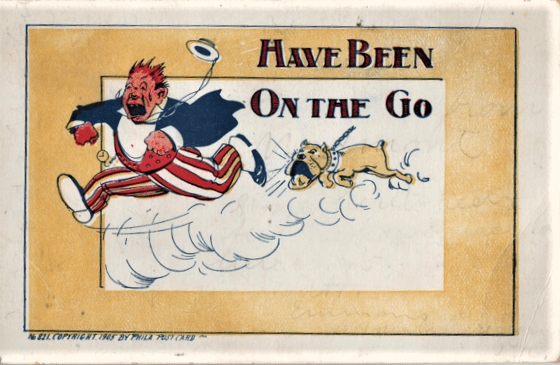
Bulls and goats will often be found chasing people on postcards, but this was increasingly a rural pursuit (literally.) Dogs, being as urban as people, could be found guarding their home territory (whatever they perceived that to be, in their complex canine craniums) I suspect the dude at the top of this column actually had the dog sicced on him by Annabelle’s father, but in general, no motive is really needed. In the following case, the rather pudgy bulldog may simply have decided that this was quarry he might actually be able to catch.
Ditto this sturdy fellow. There is no immediate or obvious reason for either of these apparently well-to-do passersby offended the dogs on duty (this one, in fact, doesn’t have his jacket on, so he may have been indoors when the chase began.)
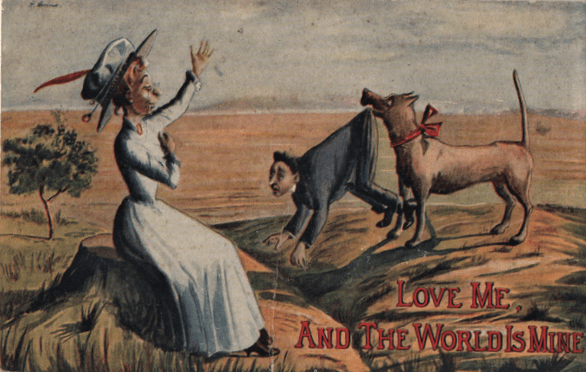
Perhaps the dogs involved were sent to pursue a man with the intent of fetching him home. (This is an unusual card in many ways: consider the comparative heights of the woman, the man, and the dog. Make a spot in your nightmare schedule for this trio.)
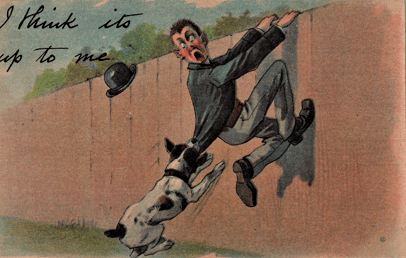
The job of the watchdog is, of course, to chase away intruders. This chap seems harmless, but someone who had an honest purpose in coming around would head for the gate in this situation. No, the miscreant obviously came into the yard by way of the fence and wants very much to depart the same way.
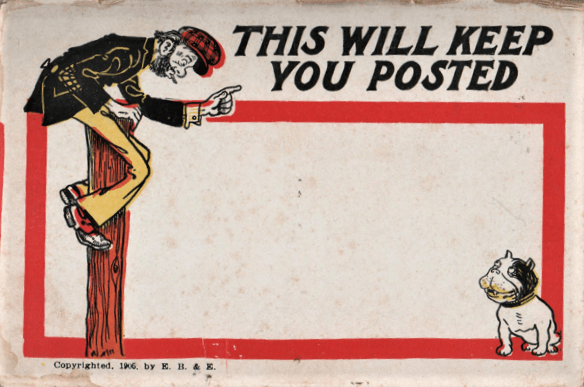
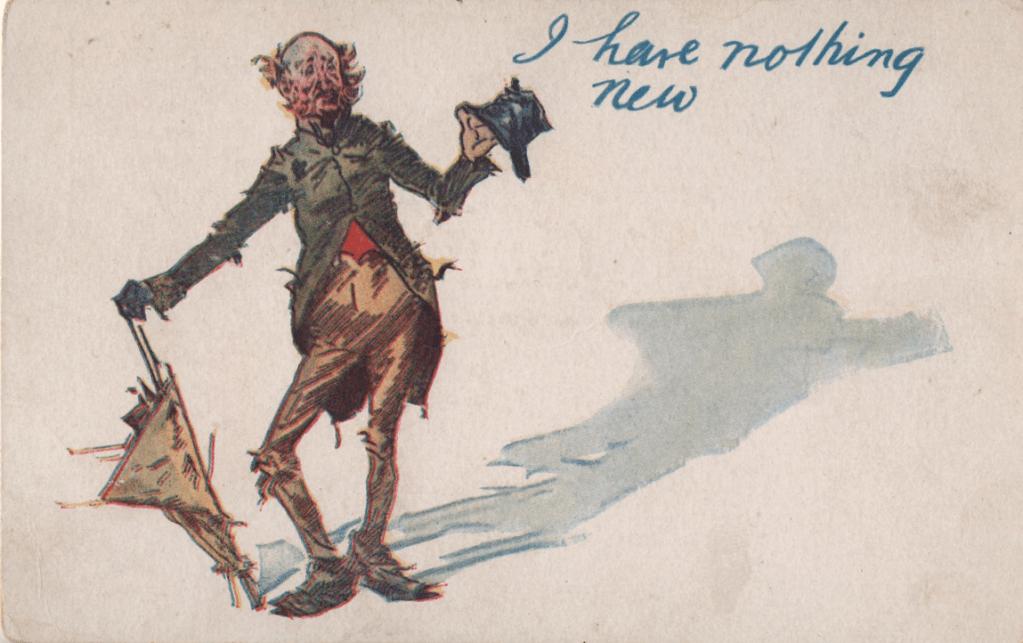
This man’s clothes and beard mark him as a hobo, a traveling man whose profession, or lack thereof, led him to become familiar with all the dogs along the road. Knowing when and where to run was essential to a long career for such men.
As time went on, of course, even those who believed in having a few canines of mass destruction on hand realized there was a certain fuss and mess involved to letting them run free to pursue any passing suspect. And this is where we start getting the jokes about muzzles and chains.
And, of course, the postcard featuring those really responsible homeowners who raised a sign to warn passersby of the presence of a vicious guard animal.
I am, of course, the first philosopher in the history of mankind to observe this but, man, things used to be easier. In grade school, I was taught every year that autumn began on September 22. This was not especially, um, true, as it depends on certain phases of the moon and other useful data, so sometimes it was September 21 and occasionally even September 20, but our teachers were going for information which could be easily assimilated, and I was taught that seasons always began on the 22d. Even then, we felt that summer really ended on the first day of school, while today, we are told that Meteorological Summer ends August 31, while businesses and society generally in the United States end summer with the Labor Day weekend. It’s a matter of holiday convenience, since summer “starts” on Memorial Day weekend. (In my days at the Book Fair, we discouraged donations between these two holidays, thinking that would be easy to remember. The number of people who somehow worked the Fourth of July into this….)
In any case, I thought we might bid bye-bye to the summer of 2022 with a glance at vacation postcards. After World War II, most individuals sending postcards did so to show people they were out of town. The quick communication offered by a postcard were superseded by the telephone and, anyhow, the Post office had pretty much dropped having two mail deliveries a day. But a postcard was still cheaper than a long-distance call. (Those of you who are confused by the phrases “long distance call” or “mail delivery” may stay after class.)
Many of these postcards involved pictures of the sights you were seeing (this, plus the postmark, verified that you HAD actually been there.) Others stressed what fun you were having. But, um, there were others. Lots of others.
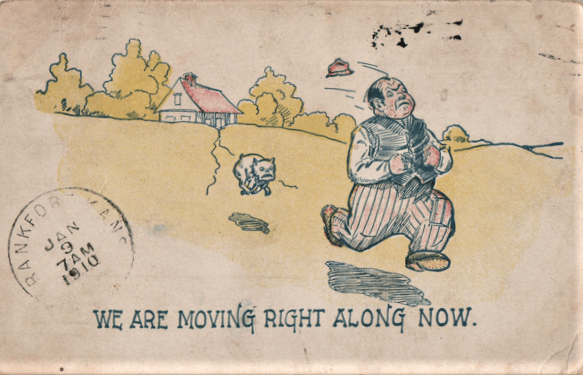
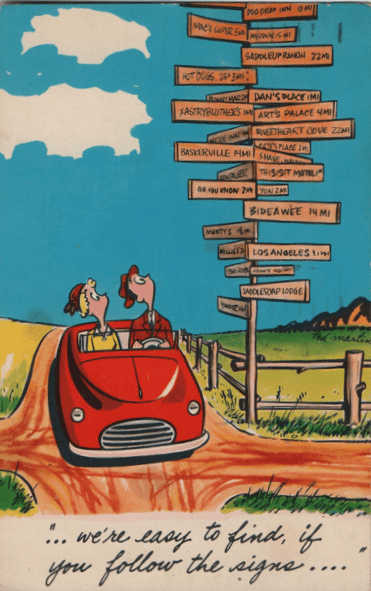
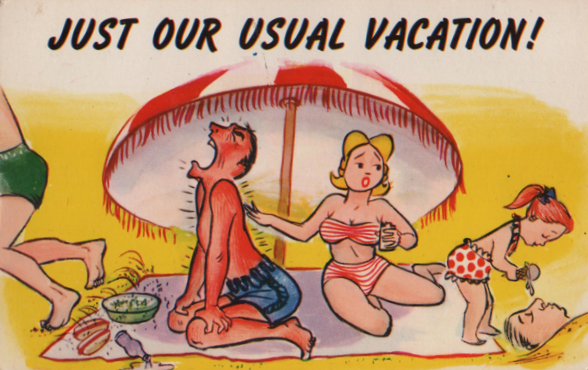
Some, like the one at the top of this column, and the one below, stressed, and I do mean stress, how hard it was to set out on the fun-filled trip.
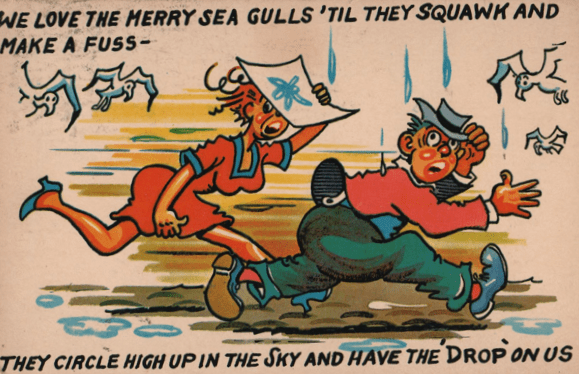
Others referred to the joys of experiencing nature in whole new places.
Please refer to previous blog about mosquitoes for much more on this subject. Not that our ancestors neglected other insect encounters. (I am NOT going to do a blog on all these hotel bedbug postcards. I am NOT.)
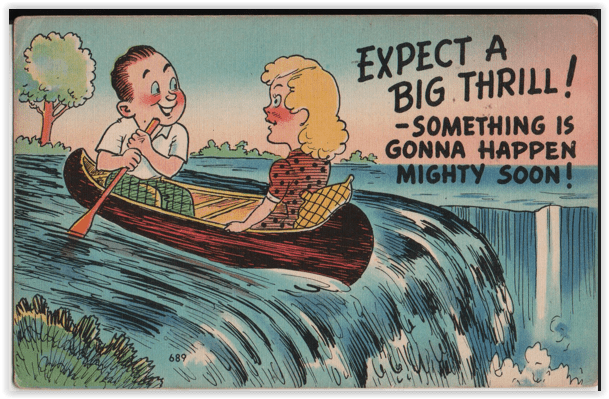
There were plenty of postcards dealing with other sources of excitement. A vacationer weas in peril in the forest
On a stream
Or even at the beach.
The whole experience was obviously one of fun and frolic unconfined.
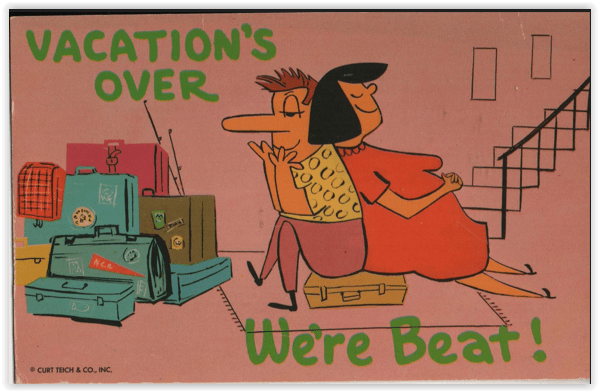
The end of the vacation was practically a relief, provided you could deal with the exhaustion.
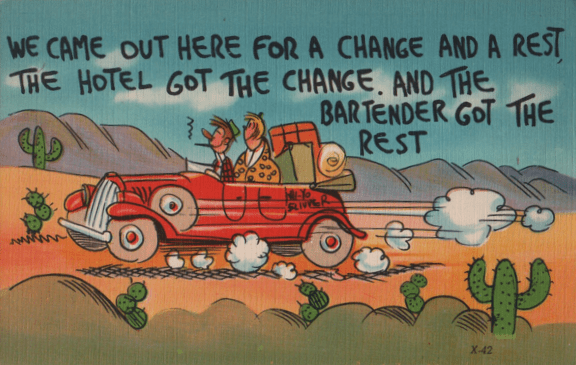
And it wasn’t just your energy that was exhausted.
To some people this was an elderly joke, but to others it was stark reality.
One postcard artist came up with this mathematical equation to calculate the whole experience of a summer vacation. This was immediately copied by dozens of other artists at other companies, so perfectly does it express the dark side of summer. Well, anyhow, see you in September.
And so we come, butternut squash latte, to the klast of our Old Joke Quizzes. I know there are a lot of jokes we did not cover: the book I wrote way back in, well, the twentieth century, did not make space for really old joke poems, or really old dirty jokes, or any of the rich supply of ancient ethnic jokes. But we have now reached the last of the jokes in the original book, leaving nothing but the scoring page (useful in the book but not in a series of columns) and the note about the author (you have probably written your own several times over since we started this trek.)
I have already selected another book tio serialize on Mondays, a little piece of nonfiction which cost me months and many dollars and is now almost wholly obsolete in an era of Interwebs. Of course, it was obsolete to begin with—that was the point—but…say, which Monday is this, anyhow? We have a few old jokes to cover before we get to the obsolete material of the next book.
As usual, the ANSWERS, if at all necessary, will be found below.
J1.”And therefore, we shall see that science has confidently predicted that the universe as we know it will come to its end in a mere three billion years.”
“Good heavens, Professor! HOW many years?”
“Three billion.”
“Oh, thank goodness. I thought uou sad ( )”
J2.The great violinist had performed for virtually every audience in the world and, with his skill and vast repertoire, he had enthralled every audience. Offers poured in, and he made more money than he could spend in a lifetime. In Sweden, there was a debate over whether to create a Nobel prize for Music just for him, but in the end, they decided to award him the Peace Prize because of the way his performances made people think, and reflect.
Exhausted, he decided to take a vacation, and booked a flight to Africa, to as remote a spot as he could find, where there would be no audiences, and no temptation to perform. He took his trusty violin, of course, since an artist must keep practicing his art.
Against all the advice of the travel agents and guides, he started to go on long walks into the great open savannah by himself. He wanted to get as far from people as he possibly could and, besides, he enjoyed walking (though he did notice, after a while, that if he wasn’t walking in time to Flight of the Bumblebee, he was stepping along to the rhythm of Turkey in the Straw.)
One day, it turned hot early, and he felt fatigue building when he was far from any refreshment. He finished the last swallow in his canteen about the same time he spotted a distant water hole. He had been warned about drinking the water, but he felt if he just took off his boots and bathed his feet, he would be able to make the trek back.
He felt much better after just a few minutes, but he felt worse immediately when he heard a rustle in the long grass. A full grown lion stepped into view, and spotted him at once. The lion lowered its head and started forward. The musician reached for his boots but, on second thought, took up his violin case, which was always with him. Slowly and carefully, he drew the instrument and the bow into view, tucked the fiddle under his chin, and stroked the strings.
The lion paused as if confused and then, to the violinist’s delight, settled on its haunches, listening to every note. As the violinist continued the concert, two more lions joined it, followed, to the musician’s delight, but three antelopes, a giraffe, and a mother elephant and baby. He noticed their heads were all nodding in time to the music, but ignored this, the same way he did when concertgoers started to hum along. Once again, the power of music had been proven. He felt he could now retire; he had played successfully before every kind of audience possible.
This was a good thing, because his retirement came suddenly. A panther, leaping over the heads of the other animals, landed on top of him and tore him tyo bits. The elephants trumpeted with anger, the antelopes loped off, and the lion who had come up first roared, “How could you do that? That was the most beautiful sound I’;ve ever heard!”
The panther turned and said, “( )”
J3.And how else could we finish a book of old jokes ecept with
“Say good night, , Gracie.”
“( )”
And now, what you’ve all been waiting for, the last of the ANSWERS.
There was a time, avocado sherbet, when people avoided eating “out”. They dined at home or, like my grandmother, packed large lunches when a trip might require being on the road over lunch time. Fast food did not exist, local inspection of dining establishments did not exist, and people tried to avoid any meal which took place outside the home. (Picnics didn’t count, as this involved food prepared or at least purchased by those who ran the household, like the cold Spam sandwiches and storebought potato chips my mother remembered so fondly from her childhood road trips. And even then…cold Spam sandwiches? Well, SHE liked ‘em.)
One social historian explains why men’s clubs proliferated in the late nineteenth century by explaining that men who worked in the city, farm from home, eventually had to find a place to eat. A private club, where one could vote on the sort of menu offered, allowed for an alternative to the bare possibilities of dining in the big city. A person could pay a hefty price at a restaurant in a fancy hotel. This involved cigars, different wines with each of usually five courses, and (in Chicago, anyhow) Scotch as the main beverage of choice. This left one in a very bad state to go back and work in the afternoon.
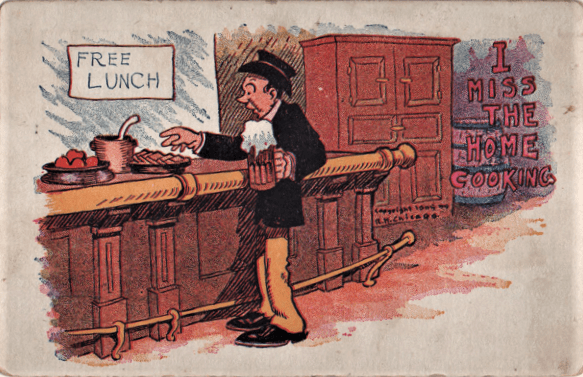
Alternately, if one didn’;t mind eating with the labor force, one could go to a bar, put down a nickle for a pint of beer, and help oneself to the free lunch, plates standing out all day in all weathers, laden with foods that were pickled, boiled, and likely marked with the thumbprints of whoever had been there ahead of you.
There was also the boarding house, where one could buy a week’s worth of meal tickets for whatever meal one would be there for, sit down family style with whoever else had paid for a ticket, and grab what grub was put on the table, eating as fast as possible so one could grab more, if desired. As boarding houses were in business to make a profit, the food was notoriously cheap and often just a wee bit past its prime. This was welcomed by young people with tight budgets and strong digestions.
When the restaurant owners decided to try appealing to the growingly mobile middle class, therefore, there was a lot of back publicity that had to be counteracted. Many tried to point out that they were staffed by proud, happy, hard-working chefs.
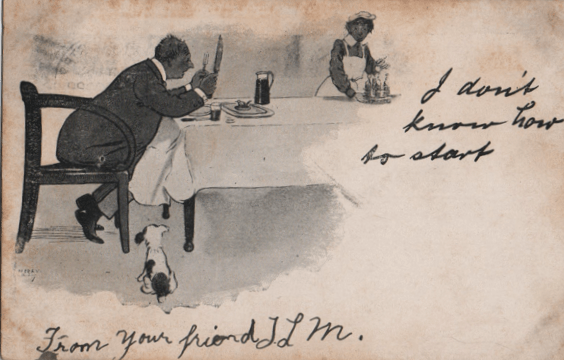
Postcard cartoonists took some convincing. Food in these new drop-in dining establishments could still be unpredictable. (Anyone who can explain his entrée is welcome to do so. I DO like the optimism of the dog, waiting for table scraps.)
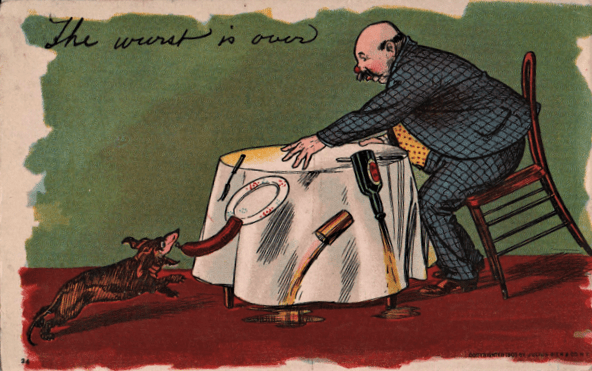
In the days when stray dogs roamed the streets of the city at will, by the way, and before the screen door became a must-have for your neighborhood diner, these were a regular feature of the eating experience. (I don’t know if this dachshund is stealing food, or trying to rescue a fellow sausage.)
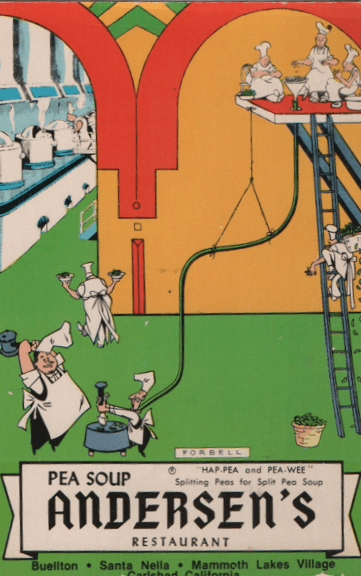
Soup covered a multitude of sins, often including whatever leftovers had already been in the hash twice and were looking for a new job. (Hey, if you want a soup joke that does NOT employ a fly, here’s one which goes back at least to the days of vaudeville. “How did you like the soup, sir?” “To tell you the truth,. I’m kind of sorry I stirred it up.”)
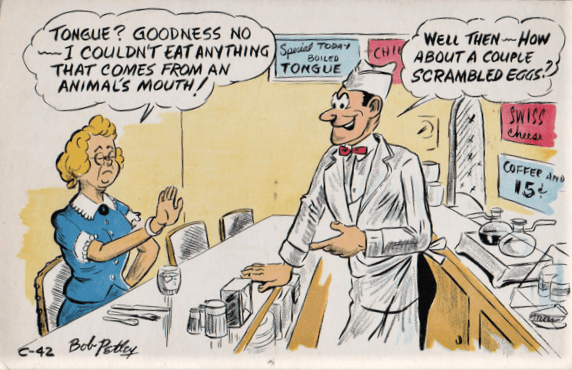
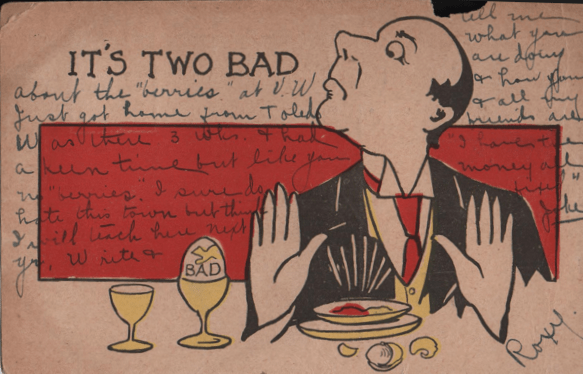
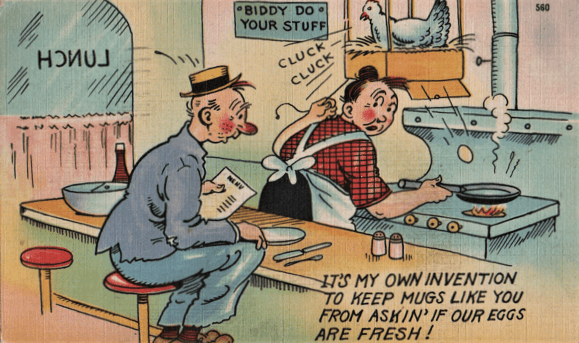
The quality of the eggs served in a restaurant was another constant source of humor.
And for more than one generation, at that.
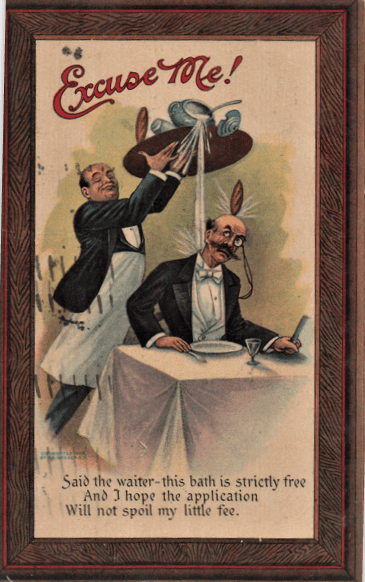
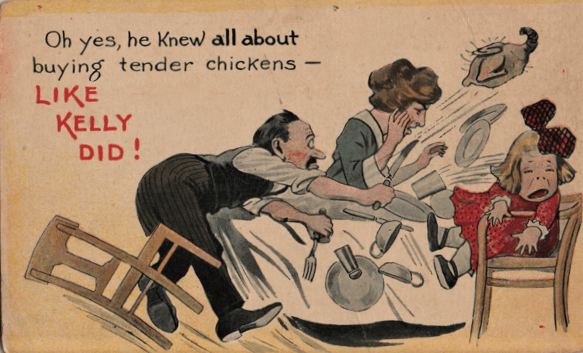
Meat was tough, fish and butter were likely to be too old to be bought by a boarding house, and if all that was not enough to worry about, the wait staff, as usual, consisted of the veteran and the novice, and fraught with similar perils.
All in all, it was just safer to eat at home. (Usually.)
I may be doing my civic duty, waiting for jury duty, so I am preparing an emergency blog to keep you entertained while I am helping decide the fate of some fellow citizen. (Unless I use my mother’s suggestion and just say, “Sure, I can serve on a jury. Anybody who gets accused oughta go to jail, or they wouldn’t be here!” She never actually tried it herself, so this would answer a long-wondered question.)
I any case, I have a number of shaggy dogs to corral before we can conclude our collection of old joke quizzes, so here are a few more un[pompadoured puppies. These jokes even have dogs in them. No. Sit. Stay.
J1.The two horses were chatting in the stable. “So this dim human can’t get his car to start and I tell him something’s wrong with his transmission. What does he do but run and tell the farmer about it!”
“I heard,” said the other. “And the old fool tells the driver that you don’t know a thing about cars. He never does give us any credit.”
“I’ll say,” the first horse replied. “And he still drives a Model T because he can’t figure out how to start a car he doesn’t have to crank.”
A dog who had been curled up in the hay listening piped up. “Yeah? Well, I was sitting by the road that day,. and when the mechanic finally showed up, it turned out nothing was wrong with the transmission. You really don’t know anything about these new Buicks!”
The first horse looked at the second. “What do you know!” he said. “( )”
J2.A man walked into a theatrical agent’s office with a small piano and two cages. “Scram,” growled the agent, by way of greeting, “No animal acts.”
“Just listen,” said the man, who was used to this. He set up the piano and opened the cages. A dog and a cat strolled out. “May I introduce yeti and Sammy,. The eighth AND ninth wonders of the world!”
The cat sat down at the piano and played a magnificent introduction, and then the dog began to sing “Blues My Naughty Sweetie Gives to Me.” The agent listened, his eyes widening. Finally he slapped both hands on the desk.
“Incredible! Amazing!” he said. “This should bring in millions! How did you train them to do all that?”
“Well,” whispered the man, leaning in. “There’s a trick to it. ( ).”
J3.Another man came into the same office later that day, leading a dog. “:Get out,” the agent invited.
“This is the greatest talking dog of all time! Just listen,” the man said, and turned to face the dog. “What do you call the shingles on top of a house?”
“Roof!” responded the dog.”
“Scram,” growled the agent, chompiong on his cigar.
“We’re just getting warmed up,” the man said. “Listen! How would you describe sandpaper?”
“Rough!” the dog answered.
The agent stood up. “I’m warning you, Mister.”
“Wait for the big finish!” replied the man. “Who was the greatest baseball player that ever lived?”
The dog barked, “Ruth!”
“I warned you,” said the agent. Mere seconds later, the man and his dog found themselves in the gutter outside the building. The dog looked over at the man and said, “( )”
I hope you came up with more ANSWERS than the poor soul who had ME on his jury.
I see that a great deal of what is left in my Old Joke Quizbook are the shaggy dog stories. Bennet Cerf once explained, in one of his joke collections, where this phrase came from, but it didn’t make a lot of sense, which is the essence of a shaggy dog story. I just classified these as the stories which went on a long time, considering the payoff. But in the interests of completeness, I have decided to bring these to you as well. It DOES stave off the next bestseller I will be serializing. So sit back and relax and try to wake up in time to supply the missing punchline.
!>”Ywes,” Travis was saying, down at the general store in Kakoola, “It had been a pretty good hunting trip. I didn’t shoot every single bear I saw, because I needed some of them to haul the pelts of the ones I did get. I picked off so many rabbits that you’d think they were multiplying after I had ‘em in the load with the bearskins. It got so bad that after a while, I had to load Old Betsy, by trusty shooting iron, with string, so’s I could just lasso the grouse by one leg when I fired. This way I could just tie ‘;em down to the rest of the load and they could fly most of the way. This lessened the load on the pack grizzlies who had to do the hauling, of course.”
“Of course,” said the bored man behind the counter, who had heard these stories before.
“Of course. And of course, too, I got to the point where I was just about out of ammunition. Then I saw this real prize of a bear climbing up to get at a bee’s nest and get all the honey. I had just the one bullet left, and I was getting a little tired, anyhow, of getting those bearskins tossed up on the big old load of game. So I took a look, pointed Old Betsy, and shot right through that nest of bees.”
“That a fact?” yawned the grocer.
“It is that,” said Travis. “That nest exploded, and the honey splashed out, blinding olsd Bruin, who tripped and fell right back onto the nearest load. I tied him down quick while scooping up the honey and putting that in my hat for later. Thing is, I didn’t pay a lot of attention to the bees/ They were confused and angry and swam down too close to the brook, where the hungry trout started jumping up to eat ‘em. I heard the flapping and, quick as I could, I yanked out the old fishing rod I take with me, hooked ‘em, and threw THEM up on the stack. I counted when I got home, and found I’d hauled in nine hundred and ninety-nine prize trout.”
“Oh, for the sake of sugar!” exclaimed the grocer, slapping the counter. “Why don’t you just say it was a thousand?”
“Well,” said Travis. “I guess I could. ( )”
J2.It had been a long struggle, but King Dexter David Donovan III had won the war. His troops were exhausted, the warhorses had been pushed to their last ounce of equine prowess, and the archers were completely out of arrows. But they had won. No one remained of the evil wizard’s mighty army but his little court jester, who had run away and could not be tracked.
“Let us now prepare for the victory feast,” King Dexter proclaimed. “Go to the Queen and tell Her Majesty to join me on the balcony for the proclamation.” He proceeded up to the balcony.
Soon a frightened court flunky came onto the balcony and whispered, “Your Majesty, the Queen is gone! That tricky jester from the evil wizard’s forces tossed her into an enchanted carriage and rode off with her just as the evil wizard was making his death speech on the battlefield!”
“This is an outrage!” roared the King. “See if we have a warrior among the army who is fit to pursue him, and bring the fastest horses that can still stand!”
Sir Horace the Heavyhanded, his arms covered with bandages from the fight and one eye patched, reported for duty. “Only I can ride out, Your Majesty!” he said. “All the other men are too weary. But I can go. Unfortunately, not a single horse can move from the stables. This is the only animal we have left for me to ride forth on.” And a court flunky led in a slow, fat, shaggy St. Bernard.
The King shook his head. “Then the Queen is lost to us,” he sighed. “( )”
I know you picked out the ANSWERS during the first half hour of each story, but here they are, if you want to check.
A1.If I wanted to lie.
A2.I wouldn’t send a knight out on a dog like this.
















 Blogsy Babbles