It’s that time of year again. The air is chill, night comes more quickly than before, and ghosts roam out with ghouls in search of things that go crunch in the night. And by that I mean Nestle’s Crunch, along with bite-size Snickers, miniature Snickers, and full-size Snickers. Here’s hoping your share of the loot this year does not contain a lot of apples and sugar-free gum, and you can instead gorge on Milk Duds or SweeTarts or Peanut M&Ms, as suits your tastes.
It is also that time of year when I have to explain that I have no Halloween postcards to show off.
See, although there are plenty of people who collect the postcards of Christmas or St. Patrick’s Day or the Fourth of July, those tend to be a little diffused. There are LOTS of symbols of Christmas, and collectors tend to go for one part or another: they collect Santa Clauses or Snowmen or children opening gifts. The Fourth of July may be flags or Uncle Same or fireworks, and St. Patrick’s Day may involve sentimental scenes of Ireland or comical Pats and Mikes in bars or shamrocks.
But Halloween is SCARY, and artists toss off their restraints with spooky cats and pumpkins and witches with cauldrons. The colors are bright, and artists go for impact, so demand is high for these. So are prices. These do not come to me in the job lots I deal with
I do have black cats, some of which look pretty sinister.
And there are monsters aplenty on land who do not rely on October 31st to look dangerous.
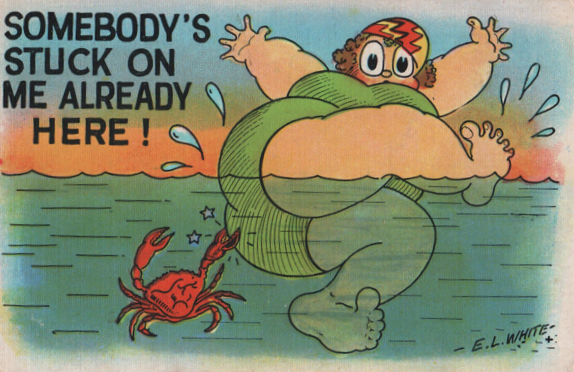
Sea creatures have always struck our ancestors as dangerous.
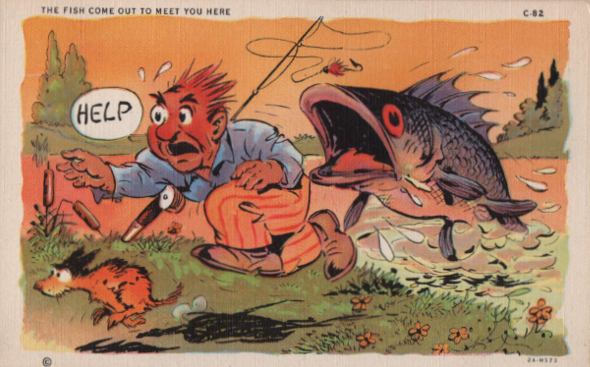
And even our happy-go-lucky fishing cards carry terrors from the deep.
Some of which belong in Halloween visions or nightmares.
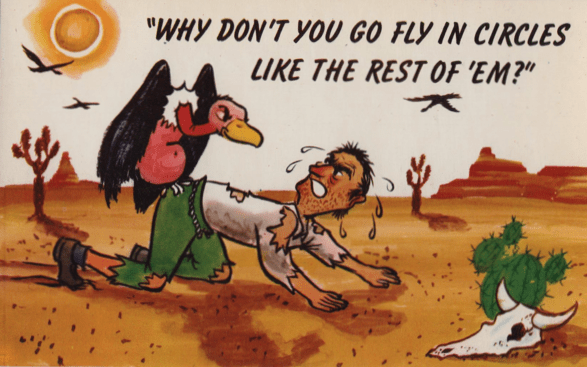
More land-based critters can be sinister while going about their daily jobs as well.
Even the noble wild rabbit can seem dangerous in some of its rarer versions.
And no good Halloween movie festival would be complete without a few examples of animals whom science has turned into something else. (All of those of you who saw this and wanted to make a joke about T&A, shame on you for knowing such an old naughty phrase,. That will cost you one Hershey bar—WITH almonds. Pay your fine in the basket by the door.)
As long as we’re speaking of themes the horror movie festival should not be without, let us not forget invoking the Other World.
This zombie picture comes from the era when the poem about the “pansy faces” was still current. (When our flower language dictionary gets to the letter P, we will discuss some of this word’s history, but the poem was talking simply about flowers, and so is this zombie dream.)
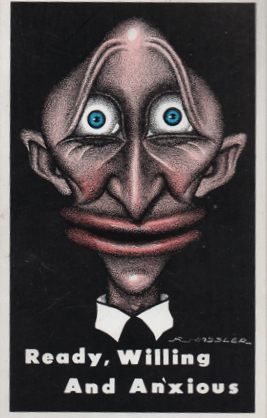
As for this chap from the Sixties, he is clearly a refugee from some B-movie monster show.
So, as we have shown before, it IS possible to discuss Halloween and postcards without actually having any Halloween postcards to show off. (For some terrific bursts of orange and black, go Google “vintage Halloween postcard” and see what sorts of things you will probably never be able to buy from me.)
There are plenty of postcards which deal with doctors, just as, if you can remember way back to the serialization of my book on old jokes, there were a lot of jokes about doctors. I have related this to a medieval fear of powerful community figures who spoke Latin and who seemed to be in business just to give you trouble (lawyers, priests, and doctors) and how this fear led to a number of salty stories and jokes.
Another result of this feeling about the learned professions was an inclination to have as little as one possibly could to do with such people. (There were other types of people, of course. There were always those who considered the lawyer, priest, doctor their infallible ticket to riches, Heaven, or perfect health. The truth lies somewhere between.) Postcard cartoonists, being equal opportunity annoyers, were quick to make fun of those who relied on home remedies or other non-prescription ways to cure all your ills.
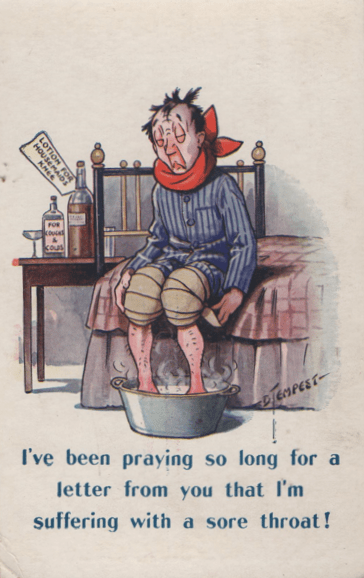
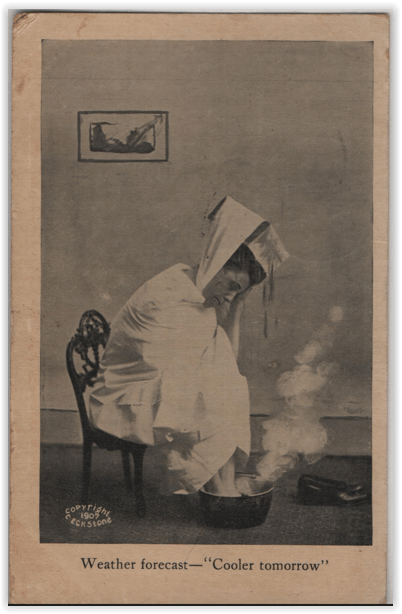
Cold? Sore throat? The man at the top of this column is making use of several traditional remedies–the foot bath, the flannel around the neck—but below is someone going full into cold prevention, with ice on his head to keep the fever down, a blanket around the shoulders, the steaming footbath…and the caption lets us know whether he can really hold off the inevitable.
Speaking of postponing the inevitable…but this is still a multi-million dollar industry, so let’s speak of other things. Part of the joke here is in its caption, which makes reference to a very popular painting, now largely forgotten, involving a nymph and an urn and not really having much to do with the cartoon. The artist just wanted to toss in the topical reference. (And by the way, when was the last time there was a painting that was a pop hit? Nighthawks? American Gothic? But that’s a whole nother blog.)
While we’re on the subject home remedies and multi-million dollar industries…note that she is modern enough to have forsaken the cold cream her mother might have used, and is relying on over-the-counter cures. The caption also regards sunburn as an inevitable part of summer fun. (Been there: you always figure you won’t let it happen THIS summer.)
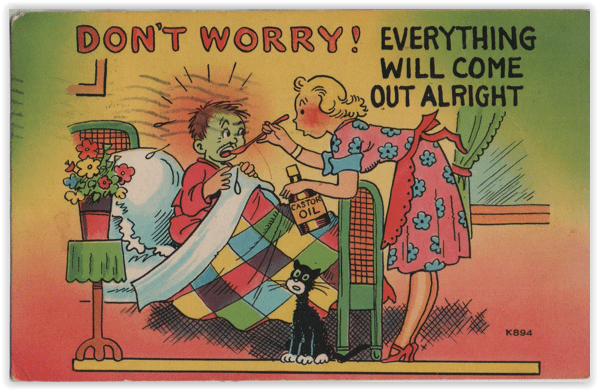
One over-the-counter and/or home remedy was in every home. I could have done a whole blog just on laxative postcards alone, with castor oil leading the pack. You’re welcome.
Some people tried to handle their ailments and complaints with a change in diet. Thank goodness we have outgrown THIS notion, or we’d be offending another multi-million dollar industry. (Anybody else fascinated by the Gluten-Free Olives on the grocery shelves? We will gloss over the vile anti-freckle sentiment expressed on this card.)
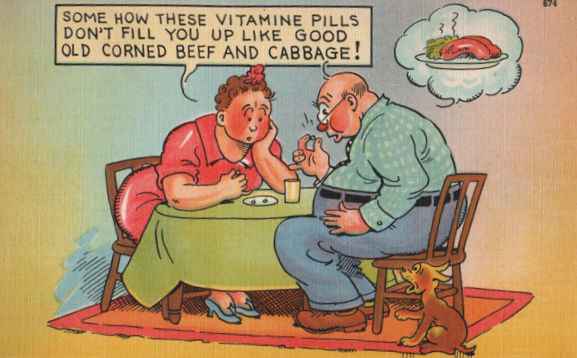
If your cure wasn’t a change in diet, it might be plain dieting. This card combines the idea with dieting and a mid-century fascination with the emerging science of vitamins for a science fictiony look at an era when food itself would be obsolete.
But even more important to the consumer and the cartoonist was the increasing emphasis on regular exercise. Even before the fitness experts were doing their motivational strenuous lessons on radio, a health-conscious person could buy the same thing on 78 rpm records. (Were there any cylinder recording exercise programs? Someone go research that for me, would you?) The point, as with a lot of home remedies, was to avoid having to bother the doctor, but this fellow is going to require medical intervention just to stand up.
Fitness through regular exertion also became big business. How big the business was came secondary for cartoonists to explaining how big the customers were.
As popular as gym programs was the vacation exercise program, where you went on vacation to a spot which offered calisthenics on the beach. As you may have noticed in the vitamin card above, part of the fun was in seeing how seriously the consumer needed such attentions, and cheerfully admitting that it wasn’t any use anyhow.
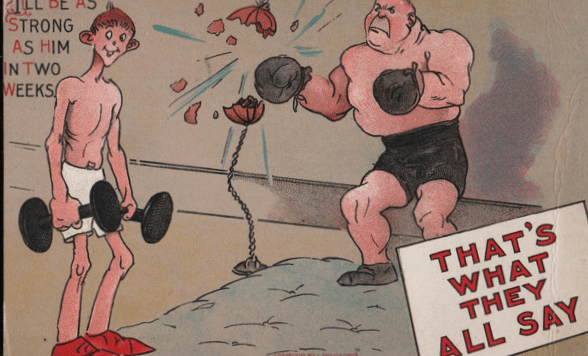
Where all such home remedies wind up making their money is on the optimist, the person who believes that one or two doses of vitamins or a couple of trips to the gym would work miracles. And the cartoonists made their money by pointing out the gap between expectation and reality. This card dates from 1911 or thereabouts, and shows us that we haven’t changed all that much.
Henry Phillips says this comes from the use of coriander as an anti-colic drug given to women and children disguised in a bonbon. The men took it straight, I guess.
Anyway, most all the pioneers agree on this meaning: Mme. De Latour, Robert Tyas, Lucy Hooper, and Frances S. Osgood. Lucy Hooper’s book and Frances Osgood’s came out in 1841: they have so many meanings in common that one lady must have read the other’s book, and they both read Henry Phillips. Frances S. Osgood wrote two flower language books (which don’t always agree) and even a Language of Gems book. In this, gemstones agree that the reason so many more lovers give each other flowers than gems is because flowers have their own language (yeah, right.) So they decide the diamond will mean genius, the emerald hope, the sapphire truth, and so on.
Miss Osgood (most female poets were billed as Miss something or other at the time) was a literary light in her day, a person of some importance. Her personal reputation was at one time endangered by no less a personage than Edgar Allan Poe, and she went through a lot of trouble to get hold of some indiscreet letters she had written him. On his side, Poe wrote a number of poems to her, but left her out of his article on handwriting analysis, which did mention other floriographers. He analyzed the handwriting (and/or poetry) of Lydia H. Sigourney (“Freedom, dignity, precision, and grace, without originality…she has taste, without genius”), Sarah Josepha Hale (“Well known for her masculine style of thought”), and Miss Sedgwick (“Strong common sense, with a masculine disdain of mere ornament.”)
CORN “Riches”
Several books point out that they mean maize. In the old country, y’see, corn meant wheat, or just about any grain, while maize was used to refer to what right-thinking people call corn, or sweet corn.
Cornbottle: see CENTAURY
CORN COCKLE “Gentility”
See also CAMPION, ROSE
Cornflower: see CENTAURY
Cornel Tree: see DOGWOOD
COROMILLA “Success Crown Your Wishes”
Henry Phillips saw “corona” or crown in this name. His meaning was picked up by Lucy Hooper, whose book was more widely read than Phillips’s, and was passed on by the Lover of Flowers and Kate Greenaway. Lucy Hooper’s day job was as a poet, and her flower language compendium was her crowning achievement: a number of other poets, including William Cullen Bryant, contributed original verse to the collection. Her own verse, according to the critics, was only so-so, but some of it showed promise. She might have been another Lydia Sigourney or Frances Osgood had she not died at 25, after ten years as a professional poet and just after her flower language book appeared.
COSMELIA SUBRA “The Charm of a Blush”
*COSMOS “Far-Reaching”
Can’t argue with that.
*COTTON BLOSSOM “Happiness”
*COUCH-GRASS “Advice”
COWSLIP “Pensiveness. Winning Grace”
These two meanings run neck-and-neck, and lots of flower language books list both. This is a nice flower with a funny name, and it’s fun to watch the floriographers tiptoe around it. One expert claims the name comes from the flower’s aroma: it smells like a cow’s breath. Several others claim cows eat them, so you often see them dangling from a cow’s lip. More logical than asking why it shows Winning Grace to see a cow slip.
The real origin of the name, according to word workers, is in something else cows did. In fact, they claim the original form of the name was Cowslop; in some parts of England it is known as the Horseblob. See, the cowslip sprang up wherever the ground experienced a little extra fertilization. That is, wherever…you know.
COWSLIP, AMERICAN “You Are My Divinity”
According to our main floriographers, the Cowslip, or European Cowslip, is a yellow Primrose, whereas the American Cowslip is a Marsh Marigold, or Shooting Star. Naturally, other floriographers are flustered by this, and you will find the meanings switched between cowslips. However, this is the arrangement preferred by the percentage of dentists who chew gum.
This meaning is drawn from the scientific name of the flower, Dodecathon, which refers to a grouping of twelve gods. Claire Powell attributes this to each plant having twelve flowers, while John Ingram says each flower has twelve petals. They could both be correct. John Ingram, by the way, was the author of Flora Symbolica, which tried to investigate in an orderly way the history of flower language, and find out where the meanings came from. You could do this kind of thing in 1869.
CRAB BLOSSOM “Ill Nature”
How enchantingly direct!
CRAB BLOSSOM, SIBERIAN “Deeply Interesting”
I am deeply interested in whoever thought floriography would be lost without the Siberian Crab Blossom. A fellow researcher has suggested that some poor dub gave his girl a crab blossom without checking the flower dictionary first. So when she threw it in his face and cried, “So I’m ill-natured, am I?”, he realized what was wrong and spoke up right quick, saying, “No, that’s the DOMESTIC Crab Blossom. This is a SIBERIAN Crab Blossom.”
Nice idea, but the Siberian Crab Blossom pops up in Hooper and Osgood’s books in 1841, while the plain ill-natured crab blossom doesn’t appear until 1867, when A Lover of Flowers mentioned it. Another great story shot down by research.
CRANBERRY “Cure for Heartache”
I’d like to say a few words about people who cannot leave well enough alone. Some floriographers try to simplify and regulate the language of flowers (as opposed to the Lehners, who complicated it). Take George O’Neill, for example, who published in Brooklyn a guide which reduced all flower language meanings to one word per flower. These could then be
amplified by turning to second list in another chapter. He simplified things, you see, by making it necessary to consult two different lists for each blossom. Most people like this go into government, not flowers.
Then there was Carole Potter, not a floriographer but a general folklorist and collector of superstitions. In her book, Knock on Wood and Other Superstitions, she took flower language meanings from Claire Powell and Kate Greenaway and rewrote them for modern readers. My personal favorite is the Peach, which floriographers of the past made “Your Qualities, Like Your Charms, Are Unequalled” or “Your Charms Are Matchless.” Carole Potter makes it “You’re Terrific!” This system had its drawbacks. For the Cranberry, for example, she has “Cure for Headache”.
Crane’s Bill: see GERANIUM
Creeper, Virginia: see WOODBINE
*CRESS, GARDEN “Solace and Comfort”
CRESS, INDIAN “Resignation”
This refers not to leaving your job, but calmly and quietly accepting your fate.
CRESS, WATER “Stability”
They do tell me that when a florist talks about Indian Cress, like as not a nasturtium is meant. A botanist, however, uses Nasturtium to refer to Water Cress. The two cresses are not that closely related, so this is another victory of language over science. Most floriographers declined to get into the fight, and listed an entirely different meaning for Nasturtium than they used for any cresses.
CROCUS “Cheerfulness”
Laura Peroni insists that the ancient meaning of the crocus is Passionate Love. Peroni is the only floriographers to mention this. I have a deep distrust of true ancient wisdom known to only one person.
Crocus, Autumn: see SAFFRON, MEADOW
CROCUS, SAFFRON “Mirth”
CROCUS, SPRING “Youthful Gladness”
CROCUS, YELLOW “Be Merry”
All these crocus meanings relate to its early appearance in Spring, obviously an occasion for wild hooraw. Just to show you how this works, check Autumn Crocus, or Meadow Saffron.
CROSS OF JERUSALEM: “Devotion”
Crowfoot: see BUTTERCUP
Crowfoot, Aconite-Leaved: see FAIR MAIDS OF FRANCE
*CROWFOOT, CELERY-LEAVED “Ingratitude”
This is another buttercup. Claire Powell calls it the very worst: the nicer you are to it, the worse it grows.
*CROWFOOT, MUSK “Weakness”
CROWFOOT, WATER “Ingratitude”
CROWN IMPERIAL “Majesty and Power”
You want to be sure to toss this into the hat if ever you try John Ingram’s Flower Oracle. In this fortune-telling game, you write the names of different flowers on slips of paper. Each
person then draws a slip from the hat and checks the flower language dictionary. This predicts the chief quality of your future spouse or consort.
But you’re not done. Now toss all the flower slips back into the hat and draw again. This second slip will tell you your future spouse’s occupation. A lily indicates a nobleman, a rose an artist, a thistle a soldier, an oak leaf a farmer, a laurel leaf a poet, an apple blossom a lawyer, cypress a doctor, and a tulip a freeholder. (I checked: a freeholder is one who owns a freehold.)
That’s as far as Ingram goes. We could do rather better, I think. A hollyhock could represent a pawnbroker, Dogwood could be a veterinarian, cyclamen a professional bicycle racer, rock madwort a pop singer, narcissus a movie star, and parsley an Elvis impersonator.
CROWSBILL “Envy”
CUCKOO FLOWER “Ardor”*
According to B.J. Healey, a flower name man, this plant is loaded with sexual connotations, cuckoos being considered highly sexual critters. It is also known as Lady’s Smock, and for some of our history, smock was not a word used by polite people. “Smock” was used generally to imply a greater interest in what was under the garment than the garment itself, and the smock was the garment worn closest to the skin by much of the population in the Middle Ages. All this got passed on to the flower, which became an emblem of lust, or strong passion, or ardor, depending on how politely you wanted to express yourself.
Cuckoo Pint: see ARUM
CUCUMBER “Critics”
Most of the early floriographers were poets as well, and if you want to know what they thought of critics, you need only observe that this is listed in most books as the Spitting Cucumber.
Cudweed: see EVERLASTINH
*CUMIN “The Door Is Open”
Must have our little joke.
CURRANT “They frown Will Kill Me”
CURRANTS, BRANCH OF “You Please All”
Henry Phillips claims the flavor of currants is so bland they can’t displease anyone. Some floriographers specify Black Currants for “Thy Frown Will Kill Me” and Red Currants for “You Please All”.
*CURRANTS, RED “Lechery”
CURRANTS, WHITE “I Would Change You”
Cuscuta: see DODDER
Cushew Nut: see CASHEW
Cyanus: see CENTAURY
CYCLAMEN “Diffidence”
Henry Phillips says the Cyclamen never raises its head, and is thus diffident, or lacking in self-confidence. Most other floriographers refer to a superstition that a pregnant woman who steps over cyclamen is risking miscarriage. I don’t quite see what this has to do with diffidence.
CYPRESS “Mourning”
This has been used as a symbol of death, grief, and mourning since the days of Ancient Egypt. The Greeks told the tale of Cyparissus. Apollo, one of the smoothest and best-looking of Greek gods, had the worst track record as a lover. It seems, looking over the storybooks, that practically anybody he looked at twice wound up as a plant. Cyparissus was a young man who enjoyed Apollo’s favors, but wept himself to death when he accidentally killed his pet stag. Apollo used his influence to get Cyparissus turned into the cypress tree, which continues to mourn.
When Apollo strolled through the forest, it wasn’t so much a nature walk as a look through his scrapbook.
CYPRESS WITH MARIGOLDS “Despair”
Agatha Christie knew her flower language, and wrote a mystery called Sad Cypress. She also wrote a short story in which flower language played a major role. No, NOT “The Blue Geranium”: she made up the flower language in that one. In “The Four Suspects”, she used the real thing. (She was also clever enough to be sure flower language wasn’t the only clue; she could deduce what percentage of her readers were students of floriography.)
There have been so many references to roosters, hens, and chickens in this space lately that I thought a few of my own reflections on birds would be of interest. No, I said that incorrectly. I thought they would be of no interest at all except to me, but it’s my blog, and I’ll reminisce if I feel good and like it
I come from a family of regular birdwatchers. My parents had their worn copy of Roger Tory Peterson’s guide in the living room to identify unusual guests at the birdfeeders (four outside these windows and about six in the back yard.) My mother would order me to check out some unknown visitor bird while she called my father at work. “Does it have a yellow stripe under its eye?” she would ask me.
It isn’t something I stressed about unduly as a child, but I am completely unfitted for this sort of work. Yellow stripe? Under its eye? That thing’s on the lawn, Ma, in the grass: I can’t even tell which end the head is on. Even with glasses as thick as hickey pucks, my experience birdwatching was later expressed in a poem with the refrain “I cannot believe, despite all I have heard, that that blob on that branch is a bird.”
So despite home training and regular visits to a local resident known as the Bird Man, who kept peacocks and other exotic birds in his back yard, my acquaintance with our feathered friends was amiable, but never close.
Working at a Book Fair inside a library for thirty-five years may not seem an ideal way to watch birds, but for roughly thirty of those years I worked in a large room which, conveniently for me and the donors, opened on the parking lot. There were benefits to this besides being able to just step outside and unload encyclopedias out of someone’s trunk. Once when the electricity went out all over the block and everyone in the place was sent home, I just opened the doors and worked by sunlight until I was tracked down and told to scram. (The open door was alerting the emergency security alarms.)
However, this also brought the occasional unwanted guest. Some passing sparrow would see the open double doors and fly inside to see if this was a useful shelter. This would shut down all operations. I, personally, do not work well when I am unacquainted with other living things in the room. Besides, if I opened the door into the library and the sparrow flew into the lobby to register for a reader’s card, I would be in for a long run of meetings, possibly with my supervisors or, worse, with committees.
Perhaps you’ve heard the folk wisdom which tells us that in cases like this, you need merely turn off the lights, leaving the door open. The bird will fly to sunlight, unnerved by the sudden appearance of night in this strange place. It never worked like that.
The sparrows in question, enjoying the temperature inside the room and seeing night come on, would find little spots to shelter among the stacked boxes of books, or a dark corner of a bookcase. This made working even more adventurous: nothing like reaching for a book and having something move under your hand.
So I developed my own system. Leaving the big doors open, I would move up the ramp to the light switch, and darken the room. THEN I would start to meow. I once had a fluent and realistic cat vocabulary. Many a sparrow decided that between the darkness and the prowling cat, this was a bad bet, and zipped back into the outside world. Yeah, on other occasions, I would meander through the room for half an hour or so, meowing as the sparrow zipped from one safe nesting spot to another around the room. Fortunately, no one ever came into the room while I was busy with this.
Once, the sparrow flew in on a Saturday afternoon, and I had to leave before chasing it outside. The receiving room was used as a loading and unloading spot by catering crews which handled weekend weddings at the library. I wondered what THEY would make of the guest. I found out Monday morning. Having no skill at meowing birds out of a room, they had taken my stack of paperback romances for ammunition. The sparrow was still there, but was glad to leave when I opened the back door (no food in this stupid place.) And it took three years to find all the romance novels that had landed among the ductwork by the ceiling.
On another occasion I just left, allowing the guest free range in the receiving room. I heard a flutter of wings and turned to glare at the offending sparrow and found a much larger bird, confused but willing to look around the joint. I considered the tourist and left him to it. A curlew, see, comes armed with a long, thin bill about as long as, oh, a small alligator. I didn’t even bother to meow: let the big thug with the knife find his own way out.
I also once allowed the Loading Dock outside the doors to serve as a Bird Sanctuary. During a Polar Vortex, I opened the back doors one morning and found the recycling bins on the dock decorated wall to wall with a puffed-out birds sheltering together from the wind: pigeons and robins and the occasional sparrow. I looked at them and they looked at me: they had no intention of moving until the sun was fully out. I just said “Thought you guys flew south” and retired back into the relative warmth before they could try to join me.
My bastion of books and occasional birds was removed during a Grand Renovation, and now my bird observations are limited to hearing the songbirds in my neighborhood (which sing, in chorus, songs which have recognizable verses and refrains) and even the crows. Why listen to crows?
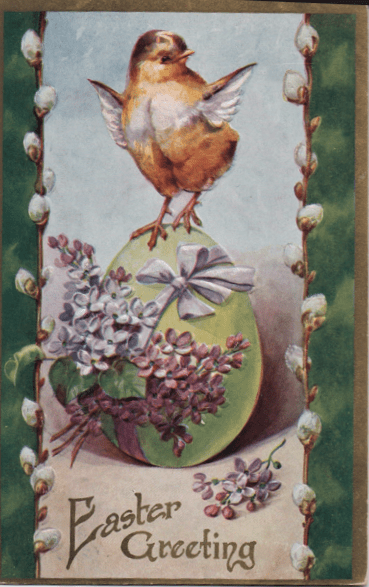
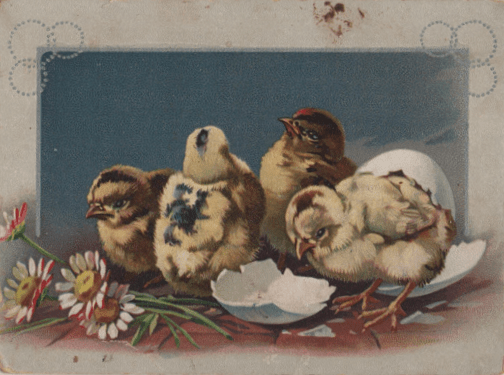
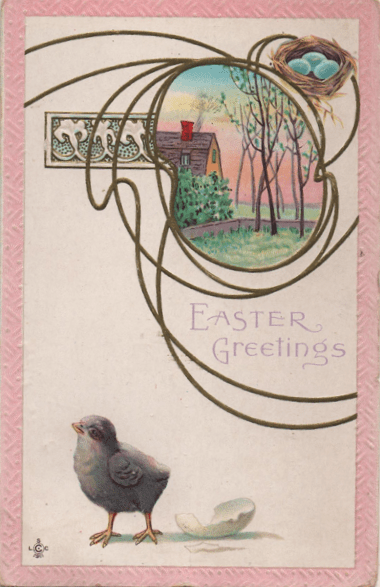
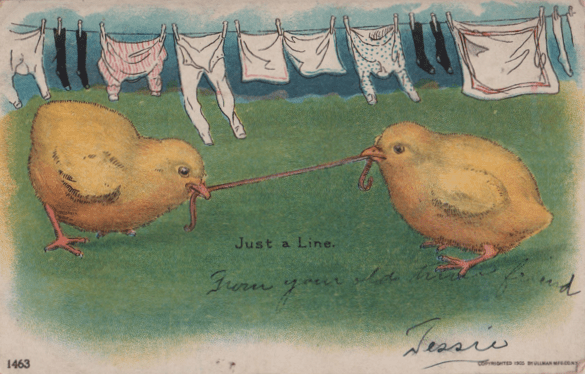
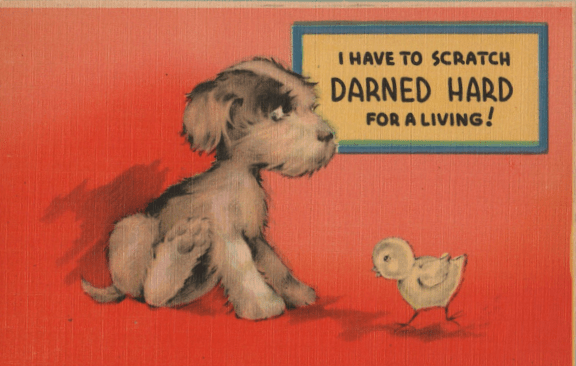
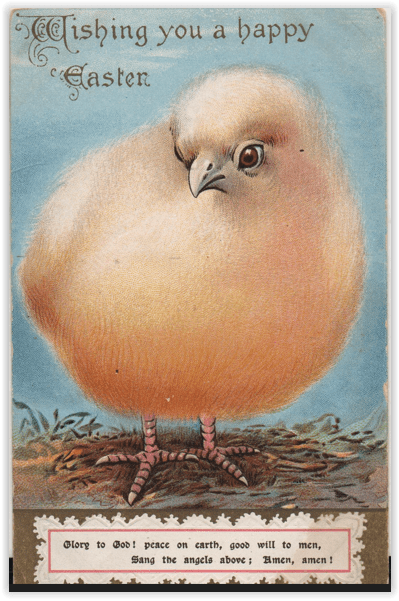
Oh, all right, if you’re going to cry and kick your heels, we’ll talk about the chicks and their role on postcards of a century or so ago. This is NOT the right time of year, as you will see, but as, just like last year, I don’t really have any Halloween cards, I will accept the inevitable.
Eggs are laid all year around, and yet somehow the little ball of fluff which comes out of it is tied by tradition to the coming of Spring. Maybe it’s some deep inner spring within the human imagination which looks at a chick, a creature which can be seen working its way gradually into the outside world and thinks of the slow but inevitable emergence of life after a long hibernation. Or perhaps we look at something which could be born at any time of year and see in this the hopes of the new season, which is just as cyclical and (one hoped) as inevitable.
Or maybe we just like looking at critters that are cute.
The first great feast day of Spring was, of course, Easter. We will let the philosophers debate whether the date of Easter is really linked to earlier Spring holidays, and discuss the symbolism of birth, rebirth, and resurrection. For every poem showing Christ emerging from the tomb there are a hundred showing a fluffy yellow fuzzball emerging from an egg.
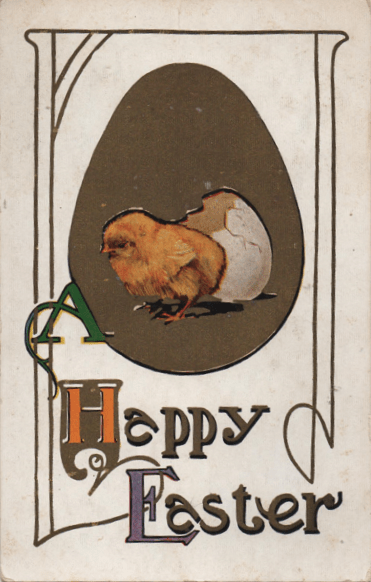
This card shows the momentous occasion, and uses a frame to remind us what that shell used to look like, in case we forgot.
Sometimes the chick is a little surprised to see us making a fuss about it. (“are there going to be bells every time I undress? Wait ‘til I start molting.”)
The chick is frequently seen looking at its old home. (“Seems to me I got free meals when I was inside there. Any leftovers for alumni?”)
And because we want to toss in as many Spring symbols as possible, there are generally always flowers in the vicinity. Does the chick care about these? Probably not. (“I/d like to climb back in there. I just saw something called a cat and it was a lot more violent than those pussywillows.”)
We will also see Easter eggs mixed into the picture. This also confuses the former egg occupant. (“They tell me these are hardboiled, so these guys should be really interesting when they hatch out. Speaking of new words, what does ‘a la king’ mean?”)
The world of the postcard has no particular limits on what may come out of eggs, further confusing the chick. (“If you sit on this one, Mamma, there won’t be any room left for me.”)
Or does a chick look on its egg as a past phase, to be forgotten as soon as it is finished? This chick apparently ignores pretty much everything, though. (“Art Nouveau? Phooey! Where’s the food?”)
Some postcard artists simply plunk a chick down in the middle of everything else. This distinguishes the Easter cards from all the other cards they do with pretty flowers all over the place. (“Well, this is a little roomier than my last egg. Nice view from the window. But who are all these people looking at me?”)
Others bundle him in with whatever Easter symbol might appeal to the viewer. (“A basket full of roses, huh? What’s the matter: nobody’s invented jellybeans yet?”)
The more symbols you can fit in, of course, the more likely the postcard-buying public will know this is an Easter card. (“This is really nice, and I can see a homily coming about why Dad crows at daybreak. You wait for that while I go pick out a Halloween costume. I’ll throw on everything I find and go as a postcard artist.”)
As Dennis the Menace will not tell you, eating all your cooked carrots builds good character.
Animals, birds, and insects seem to get all the really good superhero names; even weather conditions and abstract qualities seem to be preferred. There was Captain Carrot (a superhero rabbit) and The Black Orchid, but more villains get named for plants than heroes: there’s Poison Ivy, long a favorite in Batman, and Nightshade. You could count Starfire, the Teen Titan, whose name, Koriand’r, may remind you of Coriander. If you think that was accidental, what about her evil sister, Komand’r? I used to write stuff like that and look how I ended up.
CASHEW “Perfume”
*CASTOR OIL PLANT “Merit”
*CATALPA TREE “Beware of the Coquette”
CATCHFLY “Snare”*
CATCHFLY, RED “Youthful Love”
CATCHFLY, WHITE “Betrayed”
Of course, trapping flies is what gives most of our flycatching plants their meanings. I’m not sure how “Youthful Love” gets in there: someone may be making an editorial comment on teen romance. For this plant, Laura Peroni tosses in the proverb “He who allows himself to be taken is lost.” This is one of those wise old sayings which means less every time you look at it. Maybe it runs better in Italian.
*CATNIP “Playfulness”
*CATTLEYA “Mature Charms”
CATTLEYA PINOLI “Matronly Grace and Dignity”
I have been unable to identify the cattleya pinole; the cattleya experts I have consulted tell me there was a mad orchid craze in the 1830s and 1840s, just when flower language was at its height. A tangle of new names, many of which became obsolete, was one result; a craze for building greenhouses in North America was another. Cattleya was one of the species most crossbred; it has been suggested that it was the parent of most commercial orchids today, hence perhaps the matronly part of the meaning. In any case, the name cattleya pinole seems to have been lost in the shuffle.
CEDAR “Strength”
This is a reference to its good, strong wood, as is the following.
CEDAR OF LEBANON “Incorruptible”
Celandine, Greater: see SWALLOWWORT
CELANDINE, LESSER “Joys to Come”
*CELERY “Assure Me”
CENTUARY “Delicacy”
This is also blue bottle, blue bottle centaury, cornflower, corn bottle, and sometimes bachelor’s button. Some books claim it is known as centaury because the centaurs, half-man half-horse doctors of the Ancients, used it in medicine. Laura C. Martin, another plantlorist, informs us that centaurs actually used gentians, and the first Greek to see a centaury thought it was a gentian and therefore called it centaury. Gosh, those crazy Greeks: what can you do?
*CEREUS “Long Life”
CEREUS, CREEPING “Horror”
The floriographers didn’t like plants creeping around. By the way, in two books, you will find separate meanings for “Creeping Cereus” and “Cereus, Creeping”. Can’t ANYBODY take this seriously?
CEREUS, NIGHT-BLOOMING “Transient Beauty”
Cerinthe: see HONEYWORT
CHAMOMILE “Energy in Adversity”
Chamomile, or Camomile, is famous for growing stronger the more it’s walked on. Shakespeare mentioned this, and Dorothea Dix tells the Revolutionary tale of a Boston woman who was asked about it by a British soldier. “It grows stronger the more it’s trod upon,” she told him. “We call it Rebel Flower.”
Champignon: see MUSHROOM
CHERRY “Good Education”*
Claire Powell says this is because the wild cherry was so thoroughly improved by gardeners. I was expecting someone along the line to mention George Washington, but nobody did.
CHERRY BLOSSOM “Spiritual beauty”
CHERRY, WINTER “Deception”
Some say this is because it looks like a cherry but tastes terrible. So why doesn’t THAT symbolize education? Claire Powell, however, says the Winter Cherry tastes perfectly all right, but isn’t so sweet as a cultivated cherry.
CHERRY, WHITE “Deception”
Cherry Tree, Cornelian: see DOGWOOD
CHERVILM, GARDEN “Sincerity”
CHESTNUT “Do Me Justice”
They tell me the fruit of the chestnut is good, but ugly.
CHESTNUT, HORSE “Luxury”*
Claire Powell tells us this was not much good for lumber or fruit, but was grown because people liked it, making it a luxury tree. I do notice several other nut-bearing trees being given “luxury” as a meaning, though.
CHICKWEED “Rendezvous”
CHICKWEED, MOUSE-EAR “Ingenuous Simplicity”
CHICORY “Frugality”*
Chicory has been added to coffee to make the coffee supply last longer for as long, it seems, as people have been drinking coffee. Those who get used to coffee with chicory won’t drink any other kind. Mme. De Latour also mentions Cicero’s tale of a frugal meal of chicory and mallows.
*CHICORY WITH NARCISSUS “Try to Save Me”
Chicory for frugality—that is, saving—and Narcissus for ego, or me. Kind of a play on words. Not the especially funny kind.
Chinaberry: see PRIDE OF CHINA
*CHIVES “Protection, Healing”
CHOROZEMA VARIUM “You Have Many lovers”
CHRYSANTHEMUM “Cheerfulness under Adversity”
*CHRYSANTHEMUM, POMPON “Abundance”
*CHRYYSANTHEMUM, PINK “Fidelity, friendship”
CHRYSANTHEMUM, RED “I Love You”
This dates back to Flora’s Dictionary by “A Lady”, who was Elizabeth W. Wirt. Biographical data on her is sparse because she is overshadowed by her husband, William Wirt, U.S. Attorney General who prosecuted Aaron Burr. He wrote a number of books, too, the most popular of which was his biography of Patrick Henry. A biographer calls him one of those characters who hovers forever between being historically significant and a passing celebrity.
People who write about his wife mention that she was the author of Flora’s Dictionary, the first flower language book published in the United States, in 1829. This does not seem to be especially true. All the copies I’ve seen are dated 1831, and, in fact, she quotes Dorothea Dix’s book a couple of times. Still, we can’t blame her for what other people wrote about her.
CHRYSANTHEMUM, YELLOW “Slighted Love”
More than one floriographer notes that yellow plants frequently carry unlucky meanings, usually things to do with faded love and infidelity. Plantlorist Roberta M. Coughlin says this is a French custom. Henry Phillips, writing in 1825, keeps referring to a slang expression I haven’t run into elsewhere: “to wear yellow stockings”, which seems to mean one is jealous, or has been betrayed by a lover.
The way to keep your lover’s interest fresh is simple: lots of flowers. “Flowers increase the attractions of a home and are a safeguard against temptation.” The Ladies’ Wreath, 1849-50.
CINERARIA “Always Delightful”
CINQUEFOIL “Maternal Affection”
In wet weather, the leaves contract over the flower, reminding poets of a mother protecting her child. (Two floriographers give it the meaning “Parental Affection”, letting fathers in on the picture.) Joseph E. Meyer, one of a family of famous herbalists, said the flower was used as a charm to protect children. The five leaves (cinque foil) symbolize the fingers, see: it was felt this natural hand would slap away any danger approaching the wearer.
Circaea: see NIGHTSHADE, ENCHANTER’S
CISTUS “Popular Favor”
Henry Phillips says this flower is just about as short-lived as popular favor.
CISTUS, GUM “I Shall Die Tomorrow”
This seems a bit dark, but I assume it was something you sent to a lover who was taking someone else to the dance tomorrow. One could make us of it if one was a secret agent, of course, trapped by a mad doctor and about to be boiled down into tapioca meatloaf. The trouble is that in such a situation one is unlikely to find gum cistus ready to hand. Oh, I know, James Bond would have a belt buckle that turns into gum cistus at need, but the rest of us are not so well equipped.
CITRON “Ill-Natured Beauty”
This may be in tribute to the sourness of the fruit. On the other hand, a lot of it goes into fruitcakes. Too many holiday fruitcakes, of course, can make you ill-natured.
CLARKIA “The Variety of Your Conversation Delights Me”
Cleavers: see SCRATCHWEED
CLEMATIS “Mental beauty”
This is Dorothea Dix’s meaning, just beating out Mme. De Latour’s “Artifice”. Mme. De Latour was referring to the way beggars used clematis to make fake sores and win audience sympathy. It was sometimes known as Bohemian Plant, or Beggar’s Plant.
Clematis, English: see TRAVELER’S JOY
CLEMATIS, EVERGREEN “Poverty”
CLIANTHUS “Self-Seeking, Worldly”
CLOTBUR “Rudeness”
CLOVER “Fertility”
Clover is very generic in floriography. Of the eleven floriographers who mentioned it, there were ten different meanings, from “The Holy Trinity” to “Will You Marry Me?”
*CLOVER, CRIMSON “Prudent, Watchful”
Huh! It really means another Tommy Sands comeback.
CLOVER, FOUR-LEAF “Be Mine”
*CLOVER, FIVE-LEAF “Bad Luck”
CLOVER, PURPLE “Provident”
Henry Phillips said this was the most valuable clover for making hay. A provident farmer would have plenty on hand.
CLOVER, RED “Industry”
Claire Powell attributes this to the bees which busily collect nectar from it. Bees don’t like any other color?
*CLOVER, SCARLET “Gay But Good”
CLOVER, WHITE “Think of Me”
Most of the clover meanings appear first in A Lover’s Language of Flowers, one of the five or six most influential works of floriography. It was published in Halifax, Nova Scotia part of A Lover’s Book of series, credited to “A Lover of Flowers:”. This Lover of Flowers took some of her material from Lucy Hooper’s The Lady’s Book of Flowers and Poetry but added more, to make a book which became important because the text was stolen almost (but not quite) word for word and reprinted as Kate Greenaway’s Language of Flowers in 1884. This is the single most reprinted flower language book in the English language. (Kate Greenaway
herself probably had nothing to do with the text; she merely illustrated it. When you can, get a look at the original edition: the many cheap reprints don’t do her illustrations justice.) The Hooper to Lover to Greenaway connection created a flower language that has been thoroughly pirated ever since.
CLOVES “Dignity”
Well, of course. How can you be dignified if you’ve got no cloves on? Cloves seem to have been worn as a mark of dignity among the Moluccan Islanders, whose chief export was cloves. The western world’s discovery of, and craze for, cloves made the Moluccan Islanders a force to be reckoned with in history.
COBAEA “Gossip”
Because the plant, like gossip, spreads so rapidly.
COCKSCOMB “Singularity”
The floriographers phrase it different ways, but it all comes down to the cockscomb being a slang expression for a fop, a dandy, a dude: a person, generally male, who dresses for impact, hoping to stand out from the crowd and be considered singular.
*COCONUT MILK “Deception”
Colchicum: see SAFFRON, MEADOW
COLTSFOOT “Justice Shall be Done You”
Mme. De Latour preferred “They Shall Render You Justice”, but it comes to the same thing. The story, which I do not bind to my breast with hoops of steel, says the Coltsfoot, or Sweet-Scented Saxifrage, was discovered by a man who was so amazed that such a lovely plant had gone unnoticed for so many years that he cried out “You shall have justice!” and immediately wrote it up for the scientific journals. This was back when scientists were still considered human.
COLUMBINE “Folly”*
Somebody felt this flower resembled horns, the symbol of the cuckold, or husband whose wife has proven unfaithful, so it was taken to mean “Slighted Love”. Other floriographers said the slighted husband felt foolish, and the meaning came from that. However, Mme. De Latour felt the flower looked like the horned cap and bells of a jester, or fool, and took the meaning from that, an opinion concurred in by those people who know the Columbine as Fool’s Cap, or Folly Flower.
Every few years, a proposal comes up to make the Columbine the National Flower of the united States, for Christopher Columbus. Chris had nothing to do with it. The flower was named by people who looked at the plant and saw neither horn’s nor fool’s cap, but thought it resembled a dove or, in Latin, columba.
COLUMBINE, PURPLE “Resolved to Win”
Some people believed that lions ate this flower whenever they had a big hunt coming up, for added stamina and strength of purpose. If you rubbed it on your hands, they said, it would give you the courage and resolution of a lion yourself.
COLUMBINE, RED “Anxious and Trembling”
I guess the lions didn’t like this one.
*COMPASS FLOWER “Faith”
CONVOLVULUS “Bonds”
A dandy little compendium of probably swiped material, glorying in the title The Language and Poetry of Flowers and Poetic Handbook of Wedding Anniversary Pieces, Album Verses, and Valentines, Together With a Great Number of Poetical Quotations from Famous Authors decrees that there is a delicate difference in your message if your convolvulus is fresh. If you send fresh convolvulus, you are telling your sweetheart “I am Trapped in the Bonds of Love”. If the convolvulus has faded or withered, however, you are saying “I am in Prison”. In those days, news of arrest moved more slowly, and all good prisons had convolvulus growing on the walls.
*CONVOLVULUS, FIELD “Captivation”
CONVOLVULUS, MAJOR “Extinguished Hopes”
Henry Phillips says he added this meaning to flower language to give ladies a flower they could hand to rejected suitors.
CONVOLVULUS, MINOR “Night”
This is also known as Night Convolvulus.
CONVOLVULUS, PINK “Worth Sustained By Judicious and tender Affection”
CORCHORUS “Impatient of Absence”
Essentially “I’m tired of you being away so long”.
COREOPSIS “Always Cheerful”
Dorothea Dix says that the long-lasting blooms of the Coreopsis bring lasting cheer to your garden. Readers of James Thurber, however, realize that it can be almost as hazardous as a case of the kohlrabis.
COREOPSIS AKANSA “Love At First Sight”
The difference between this and ordinary Coreopsis has not been explained to me. Some floriographers weren’t sure either, and switched the meanings.
As you may recall from our last thrilling episode, we were considering the rooster as CEO of a work force, producing a great deal of effort on the part of his work force by sheer inspiration. (Okay, he contributed a bit more than inspiration. If you’re not willing to play along, you can sit with your phone in the corner and deal yourself you ten thousandth game of solitaire.)
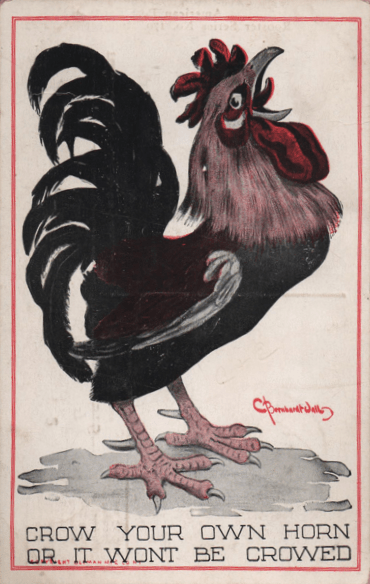
As CEO, the rooster had at least one other major job which the postcard cartoonists took very much to heart. He was also in charge of Public Engagement, or what we used to call marketing. The rooster raised his voice to let us know what was going on at just about any time he felt good and ready. (I’ve worked for bosses like that myself. By the way, that whole business of his being Nature’s Alarm Clock is the bunk, according to experts who have warned me, unnecessarily, about relying on a rooster for my wake-up call. A rooster may easily start crowing hours before the sun comes up, or just sleep through dawn and start hollering later in the day. Some roosters are no use at all in this way. I’ve worked for bosses like that, too.)
But let us not forget that his chief duties lay (sorry) in the egg factory. Like many human managers, he had to keep an eye on production if he didn’t want to become Sunday dinner.
A contented work force was essential for delivery of product.
Though some were tough managers who kept demanding more and faster production.
His work force might have their own opinions on this, leading to fatigue and unhappiness in the ranks.
Or straight rebellion.
The wise manager showed he valued his workers, consulting (or pretending to consult: you’ve worked for roost…managers like that yourself, haven’t you?) Considering their needs when locating a new coop, for example.
I have not covered the role of chicks in this process so far, but they had their part to play in the company as well. Egg production was primarily for the market to be turned into meringue, pumpkin bread, or over-hard with three slices of bacon—okay, I’ll take four. But a few had to be allowed to hatch, to become the workers and managers of tomorrow. I kind of have a feeling we have two potential CEOs here, trying to define their roles in the barnyard as they work through the ranks to become the High Cockalorum for the next generation.
Silly would-be roosters. They didn’t realize that until they grew up, they had only two jobs to worry about (especially on postcards.) One was to symbolize the effort of making a living generally.
And the other, though much more important, was only one day a year.
I hope you didn’t think we finished up our concerns with the animal world, having covered bulls and horses. We must not neglect the animal frequently associated with farms which writers have often advocated bringing to the city: the chicken.
There have always been those writers who, hoping to instill in you a degree of self-sufficiency, wrote that what we all need is a few chickens in our life. This would provide us with eggs, which can be sold, making us a nice side income, and bring us to more healthy habits, as if you have chickens, you need to “go to bed with the chickens”, meaning going to sleep early so you can get up when the chickens awake at the rising of the sun (or earlier,.) Why suddenly changing your daily cycle to reflect that of a bunch of birds indicates self-sufficiency is a matter they discuss at great length without ever making the answer clear, at least to me.
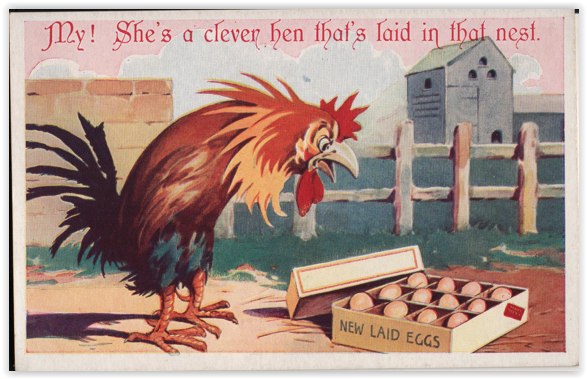
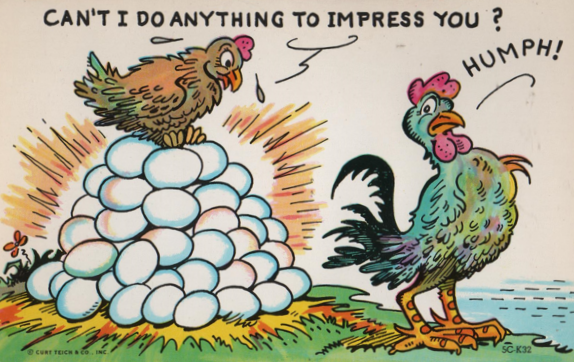
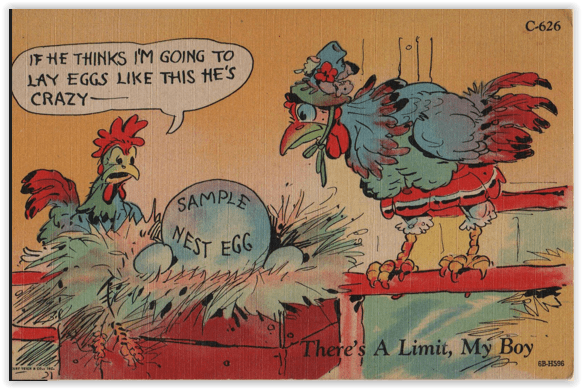
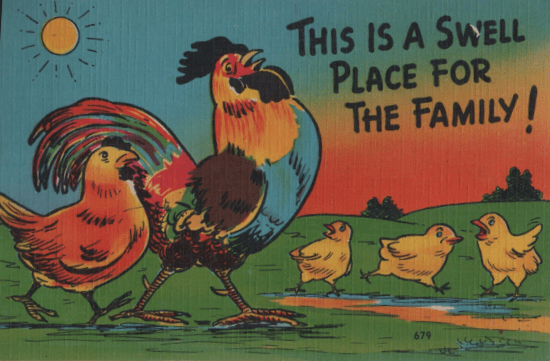
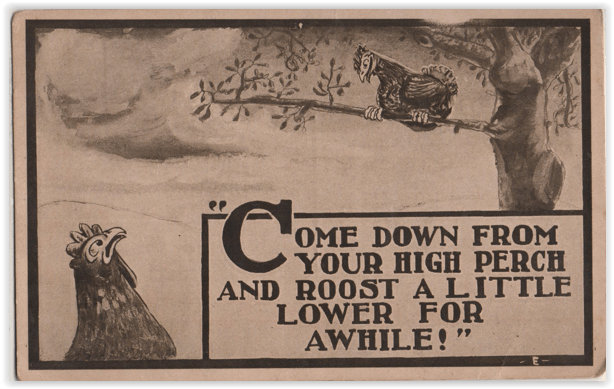
Of course, our ancestors, being knowledgeable about such things whether they decided to go into egg hustling or not, knew that none of this would be possible without the rooster. The rooster played several roles in the cartoons of the postcard companies, but one job was paramount. For amateur or professional egg-grower, the rooster was essential.
And didn’t he know it. The strut of the male chicken who knew he was the be-all and end-all of the egg business gave us the expression “cock of the walk”, for an alpha male.
Not that his work day was any less hectic than that of the person who bought the postcards.
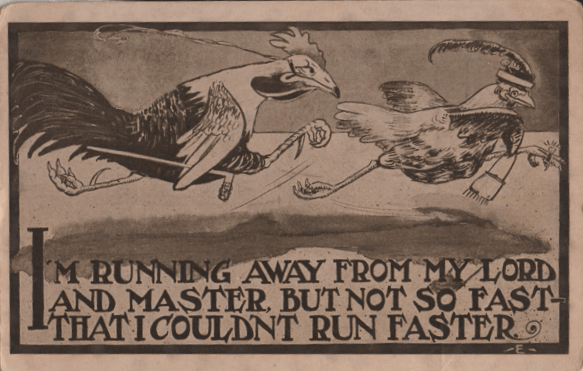
And he was just as liable to complaints that he was falling behind in his job.
Now and again, he would be mistake himself for an absolute ruler.
But the fact of the matter was that he was simply CEO of a large work force. And like any other manager he had to deal with slow-downs by his workers.
He is shown in business negotiations.
Technically, the work force was made up of free-lancers, who might work for chicken feed (sorry) but who could always decide not to put in the effort.
Many of whom were perfectly willing to work, but just wanted to see the boss sweat a bit, too.
No matter what observers had to say about the relationship of management and labor.
Still, one way or another, the work got done.
One way or another. Um, remember what I said about his employees being free-lancers?
This shrub is now officially Steptosolen jamisonii.
BRYONY “Prosperity”
BRYONY, BLACK “Be My Support”
This is a climbing plant without tendrils, so it cannot climb without some kind of support. And why did Nature provide us with a climbing plant that can’t climb?
BUCKBEAN “Calm repose”*
Also known as Hogbean, this plant was used to predict the weather. It would not bloom unless the weather was going to be calm. Henry Phillips, however, says the meaning comes from its way of floating in calm waters. I could do that.
Buckthorn: see JUJUBE TREE
BUGLOSS “Falsehood”*
This was an early cosmetic, and of course the use of make-up was considered subversive for eons. According to the experts, a rouge made of bugloss will last for days and cannot be washed off; water will only freshen it and make it look redder. Please do not try this at home without supervision. I don’t want a lot of angry emails.
BULRUSH “Docility”
This is one of those plants where two different stories vie for the meaning. Docility is the older and more common meaning, and comes from Isaiah 58:5, where the bulrushes are bowing their heads. For the other story and meaning, see REED.
BURDOCK “Importunity”
This plant has burs, which are likened to a person bothering, or importuning, you. The minority meaning, “Touch Me Not”, in related. You’re basically saying, “Stop bugging me, okay?”
*BURNET “Nourishment”
Mary McNicol, who wrote a book on cooking with flowers, says the French love this in their soup. I would say that settles it, but this meaning is one of Mr. Morato’s, and he’s Italian.
BUTTERCUP “Ingratitude”
Hardly a floriographer has any kind words for the buttercup. Of course, the floriographers are not as firm as I’d wish on what flower they mean, going off on tangents about Crowfoots of various kinds, King-Cups, and Double Yellow Violets. A couple of minority meanings are very popular, though Ingratitude is the oldest, appearing first in Robert Tyas’s 1836 translation of Mme. De Latour (though not in Mme. De Latour’s original.) Robert Tyas was a naturalist who remained interested in floriography all his life. Some flower language experts prefer “Childishness” as a meaning, a reference, like “Ingratitude”, to how hard buttercups are to grow in the garden. Others like “Riches”, since the flower is gold. Jane Webb Loudon lists “Ingratitude” but adds that the ancient, original meaning of the buttercup throughout Europe was “Jealousy”. Jane Webb Loudon is the ONLY floriographer who uses “Jealousy” as a meaning for buttercups.
We’ll come back and discuss Jane Webb Loudon a little later.
BUTTERFLY WEED “Let Me Go”
C
CABBAGE “Profit”
Most food plants, as referred to heretofore, refer to some kind of wealth or prosperity.
Elizabeth W. Wirt, in her flower language book, has a section full of lore, which includes instructions for cabbage divination, a fortune-telling procedure she says young ladies used to find out about their future husbands. Cabbages for this need to be pulled from the ground the night of October 31, and provide all manner of information. The shape and size of the root indicate something she does not specify about “the object of their desire”. Any dirt adhering to the root shows the future husband will be rich. Tasting the stem tells you whether his disposition will be sweet or bitter. The stem is then placed over a doorway: the first man through the doorway after that will bear the same first name as the future husband.
Nobody in my neighborhood grows cabbage, so I have been unable to check any of this out. I can thus not offer a money-back guarantee on it.
*CABBAGE LEAF “Providence”
*CABBAGE FLOWER “New Worry”
This is Mr. Morato again, so maybe my translation has failed again. Does cabbage HAVE a flower, or was he talking about Cauliflower?
Cabbage, Skunk: see SIPHOCAMPYLOS
CACALIA “Adulation”
Flower language was very popular in American magazines. It travelled from journal to journal through a process known to scholars as “theft”. The editor of a little weekly in Boston knew no one on their subscription list would be reading that cheap little monthly from Columbia, South Carolina, and lifted pages of stuff with impunity, either by simply reprinting it, or by calling it an “Exchange” giving credit (but no cash) to the original. Late in the nineteenth century, Wyoming newspaper editor Bill Nye became the second most famous humorist in the country through this method. So many newspapers in new York lifted his stuff that what he had to say spread through the country. He worked himself nearly to death doing lecture tours, when he learned he was going to die of spinal meningitis, trying to make enough money for his family to live on when he was gone. Adulation, which he had, wouldn’t buy groceries. But he did get quoted in Mark Twain’s autobiography.
CACTUS ”Warmth”
Some writers prefer “I burn”. Either makes sense if you’ve ever sat on one.
*CACTUS SPECIOSISSIMUS “Perfect Beauty”
Tovah Martin, flower historian, notes that a cactus craze swept this country in the 1830s and again in the 1890s. A plant that needed so little watering was as good as furniture.
*CACTUS, VIRGINIA “Horror”
Claire Powell explains this is a serpentine cactus that shoots out little snakelike runners.
*CALAMINT “I Wish You Well”
CALCEOLARIA “I Will Lend You Money”
This is also known as the Pocketbook Plant; the blossoms look kinda like purses if you squint a bit.
CALENDULA “Anxiety”
Richard Folkard, Jr., a nineteenth century plantlorist who disapproved of flower language, put two dictionaries of flowers in his book: one giving the true, ancient language of flowers while the other showed the modern, corrupt version. This meaning comes from his true, ancient language. Folkard, by the way, is the only author I’ve found prior to 1985 who mentions Calendula at all.
*CALISAYA “Assistance”
Callisaya cinchona is the tree from which quinine is derived. This drug was more famous in the nineteenth century, but has not lost its usefulness to this day.
The plant produces extra flowers if you cut off the leaf buds. Sarah Josepha hale thought this was benevolent.
CAMELLIA “Unpretending Excellence”
Starting in the 1880s, floriographers tried to differentiate between a red camellia (“Unpretending Excellence”) and a white one (“Perfect Loveliness”). This did not spread far enough for me to consider it definitive. As a public service, I should point out that the name of this flower is properly pronounced ca-MELL-ia, and not ca-MEE-lia. The confusion comes from calling La Dame Aux Camellias Camille, but they aren’t supposed to be pronounced similarly. It’s too late for me to change, but perhaps you’re younger and less set in your ways.
*CARAWAY “Treachery”
Caraway appears only in Fritz Klingenbeck’s Lasst Blumen Sprechen (Let Flowers Speak), published in Austria in 1944. The Germans had Mme. De Latour in translation by 1820, and their floriographers took flower language in a separate direction. Herr Klingenbeck’s book was the only book from this tradition I turned up during my research, and I have included him because the idea of a flower language dictionary being published in Nazi-occupied Austria struck me as symbolic of something or another.
CARDAMIME “Paternal Error”
Henry Phillips identifies this as the Cuckoo Flower in King Lear’s crown during his mad days, and makes in an emblem for Lear’s fatal mistakes in child-rearing. (Of course, it would have been too simple for Lear’s Cuckoo Flower to have been just a Cuckoo Flower, which see.)
CARDINAL’S FLOWER “Distinction”
This lobelia gets its name the same way it gets its meaning: because it is so bright red.
CARNATION “Woman’s love”
See also PINK. Some people claim, there was once a real difference between a carnation and a pink, but with all the gardeners crossbreeding them, there’s no point now in bothering with it. Sure, blame the gardeners.
I would like, at this juncture, to introduce you to Lydia H. Sigourney. Lydia, who seems always to have written as Miss Sigourney or L.H. Sigourney, was simply the Number One Female Poet of her day. She wrote acres of flower poems, all quoted in the better flower language books, but did not get around to writing her own flower language book until 1846. This was about the same time she was making highly-publicized European tours, during which she was celebrated as a major American literary light. (But you should read what her hostesses said about her after she left.)
Her vogue passed, and she was dropped from American literary history so fast and so far that she has not recovered to this day. All she is remembered for now are Mark Twain’s parodies of her style, particularly her way of churning out obituary verse. I have been unable to find out what Mark Twain thought of floriography, and I admit I’d rather not now.
Anyway, she was right there standing up for Carnations.
*CARNATION, DOUBLE “Give Me Time for Reflection”
CARNATION, PINK “Encouragement”
CARNATION, PURPLE “I Have No Affection For You”
CARNATION, RED “Alas, For My Poor Heart!”
‘CARNATION, RED, WITH PINK CARNATIONS “Send Letter”
*CARNATION, RED, WITH PINK AND RED CARNATION PETALS “Call As Soon As
Possible”
Carnation, Striped: See PINK, STRIPED
CARNATION, WHITE “Devotion”
By the way, the Carnation is the official flower of Mother’s Day. This does not, apparently, mean that you give Mom carnations. (That’s what Mums are for, I guess.) You wear one to show that you are aware you had a mother. A white carnation indicates that your mother is still living, while a red one shows that she has passed to where you can no longer borrow money from her.
Carnation, Yellow: see PINK, YELLOW
A yellow pink? That’s worse than West North Avenue.
In our last thrilling episode, we considered our ancestors and their mutually beneficial relationship with the horse, an animal you could easily ride or hitch to a wagon, carriage, or plow. People worked together with horses to make a happy, peaceful society based on a relationship of mutual trust and admiration.
Except when they didn’t.
Cartoonists do a WHOLE lot better when they are complaining about something than when they praise it. So the cranky, ornery side of the horse made it onto postcards with regularity. See, horses did things besides run or pull. For one thing, they kicked.
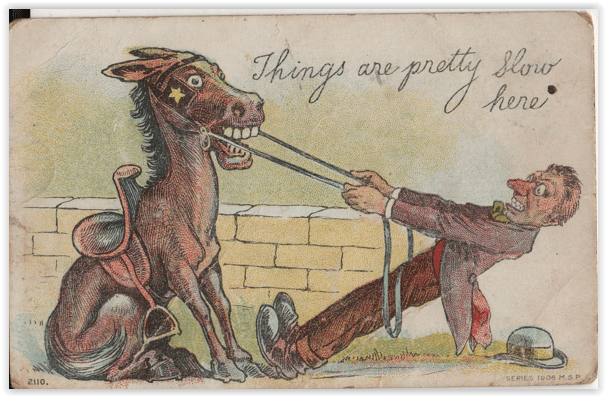
And sometimes they sat down and declined to go to work today. The horse knew what it meant when that harness went on, and occasionally just said “Nay.” (Please note that I went all through the last column without a single horse pun and don’t nag me with your tale of whoa.)
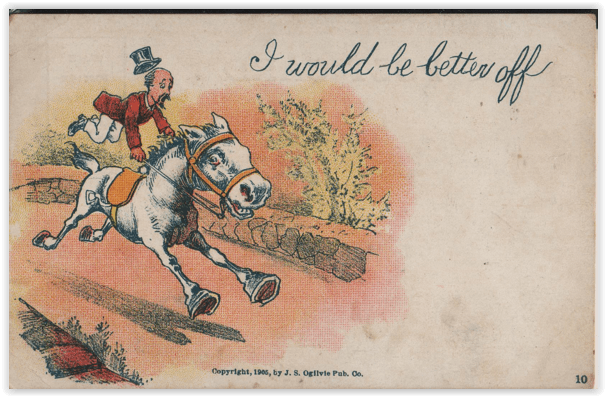
Alternately, some horses went entirely the other way and decided to run and run without stopping, or, in fact, paying any attention to any other suggestions the rider made.
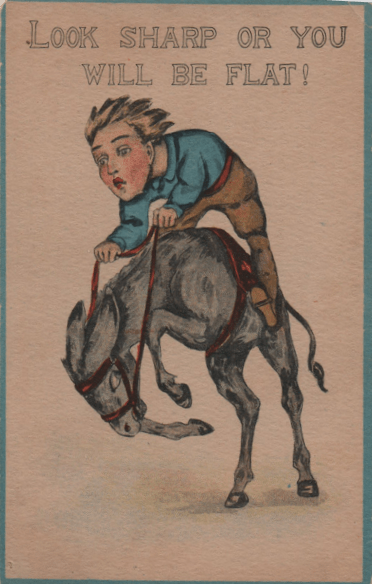
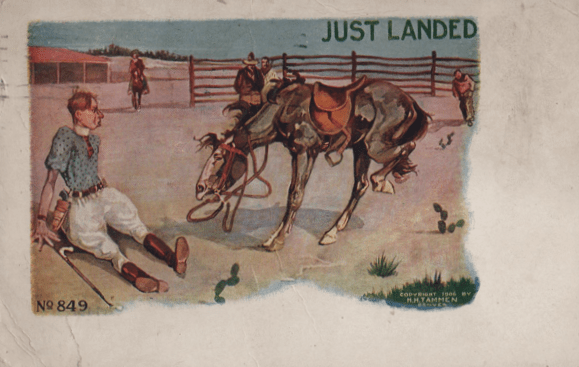
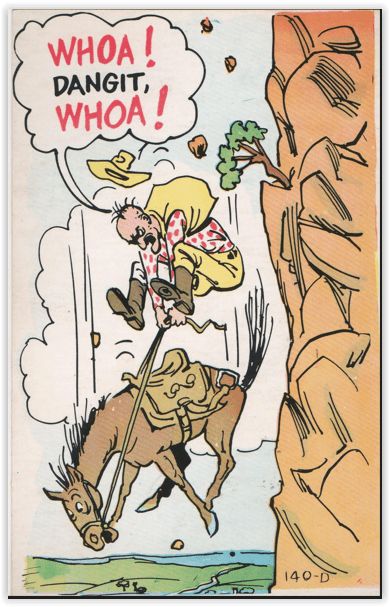
As anyone who knows their western folk songs knows, the horse that didn’t want to take you anywhere had other options besides just sitting down. A horse could perform amazing gymnastic moves in trying to buck a rider.
And frequently succeeded
The cartoonists, like any good rider, was willing to admitted that being thrown was not always entirely the horse’s fault. Sometimes the rider was simply not much good at it.
Or was simply unlucky.
The cartoonists were also willing to show that not all the grievances were on the human side of the relationship. Horses are one of the few animals regularly shown as worn out, exhausted, or even physically impaired by the work their humans put them through.
Horses are also more likely than any other animal to be shown getting old. Being retired, or “put out to pasture”, was not necessarily the lot of every working horse.
Of course, if there was one thing horses did that the cartoonists covered most…but we discussed that in a previous blog, and there’s no need to cover that whole territory again (though this human has to.)






























 Blogsy Babbles