We have, hereintofore, considered the various locales favored y our ancestors at the turn of the last century when it came to romance. The people passing through the years 1900-1920 hand-in-hand (lip-to-lip, perhaps, but that’s really as far as the mails would let ‘em go) have been shown to enjoy the comforts of benches, hammocks, haystacks, and the back seats of primitive automobiles. But we must not ignore their choices in landscaping.
If we have learned anything from our journey through the world of flower language (and that was optional) it is that certain of our ancestors were fully alive to the bounty of nature. When choosing a spot for a romantic rendezvous, certain aesthetics were considered ideal. Even for those whose aesthetic requirements extending to no more than a modicum of privacy, foliage was very significant. Consider the couple holding hands next to what I had dubbed the Peacock Bush. Not only do they have the wafting aroma of all those blossoms to carry their hearts to new heights, but they are also concealed from viewers at the other side of the park. (They do not seem to care about the camera taking pictures for postcards, but hey…it’s spring.)
This alarming topiary, on the other hand, does not offer much shelter, though it IS vaguely heart-shaped. (I don’t think he’s getting very far. If she was really interesting, she wouldn’t be sitting that way, taking up the whole bench so he can’t squeeze in next to her.)
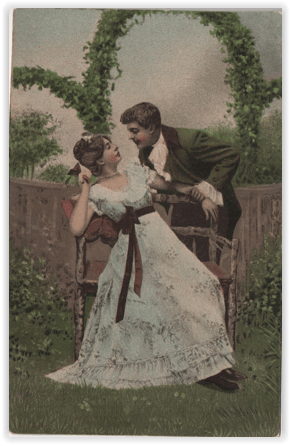
This couple has chosen more wisely. They have picked a hiding spot with LOTS of cover.
Whereas this couple, courting long before the days of drones with cameras, are not likely to be found by anybody until they’re ready to be found.
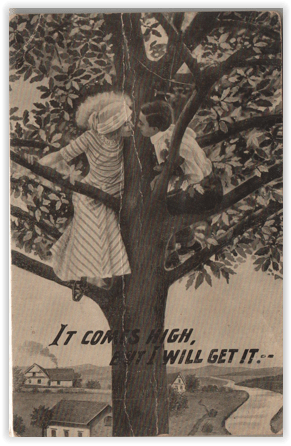
Some people, of a more adventurous nature, seem to have favored trees. These provided a spot less likely to be found by passing wildlife, and, in the right season, offered plenty of cover. Certain hazards accompanied this sort of spooning spot, but, as this caption notes, the higher up the fruit grows, the sweeter it is.
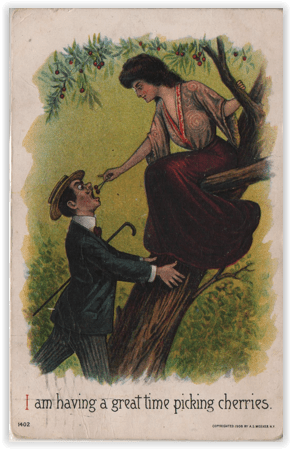
Which is, I am certain, the only message communicated by this…I wonder who’s supposed to be speaking here. I mean, if he’s the one…but he wouldn’t say anything like that on a postcard. Anyway, she’s the picking cherries, of course, and the one offering the man…we’ll just move along, shall we?
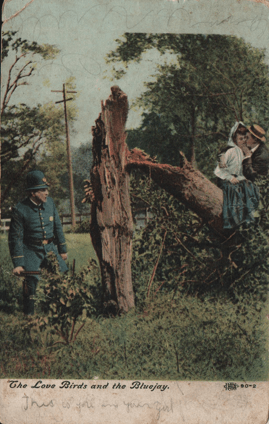
The tree also offered refuge to lovers in public parks, where the police patrolled to make sure no courting couples went beyond the bounds of decency. (Public kissing was actually banned in a number of communities.) This couple found a slightly elevated bench without having to climb a whole tree, though it has not saved them from the watchful eye of the law.
Ah, it was an era when plant life and the good life were seen as natural partners. Not that we have given up the shady bower or the treetop rendezvous. But the machine age was well o its way for romantics of a new generation.
This is not a current events blog, so this particular column is NOT about the AI writing controversy. The magazines which regularly send me rejection slips (sneaking up on the magic number 7,500) are divided on the issue, some refusing stories which have been written using AI and others saying it’s okay as long as you admit it upfront. Personally, after all the time I have spent screaming and the Spelling and Grammar Check programs of the last thirty years, I have grave suspicion of the world to come. But that would be true even without AI.
The thing is, writers spend some time picking the proper word for the proper feel in a sentence. I have a small collection of vocabulary tricks of my own, the success of which can be judged by something I said in the last paragraph. In any case, whenever I wish to remind people of the choice of the right word, my mind dashes back to a young lady (she would have turned 77 last month, but her BRAIN was always somewhere around ten years old) whose ability to tell a story often hung on her choice of words.
Some of my tidy-minded acquaintances regarded her with suspicion. No one, they figured, could be that, um, unique in her word choices. They thought she rehearsed. My take is that she cannot have been that great an actress because such excellent delivery takes brai…I forget what I was going to say.
But let us take her story of one of Illinois’s great blizzards. She lived in a house she had bought from her parents, on which some genius had added a one-story section with a flat roof, This roof leaked (the Midwest is not kind to flat roofs) but she would walk her dog there on snowy days (the main leak was above the dining room table, by the way) and she kept a serape hung by the upstairs window so she could just call to the dog and step out on the roof when nature called.
Well, nature called big time in the form of a massive overnight blizzard, and she decided the only hope for that roof was if she went out and shoveled the snow off before it reached a critical weight. So in the teeth of a snowstorm, she donned her serape and went out onto a roof, and just kept pushing snow over the edge until the sky brightened and she knew that perhaps now her yard guy would show up to finish the job. It was an achievement of tenacity and dumb luck (she didn’t go through or off the roof) and she liked to point this out.
“You just think about that scene,” she told me, “A woman in her sixties on the roof in the middle of the night, getting it off all by herself!”
See, her word choices…but there’s another story.
As I have mentioned before, she was afflicted by poverty: both her cars were secondhand and her cook and yard guy were part-time. After the Crash of 2008, she had to cut her trips to England back from three times to twice a year. She was extremely frugal during these trips abroad, and booked the cheapest available hotel rooms. On one occasion, she found herself the only guest at a small village hotel during the off-season. On a dark country night, she would be the only person in the hotel except for the night manager.
During the night, she heard strange sounds. She tossed a robe over her flannel nightgown and rushed to peek through the old-fashioned lock. Through the keyhole, she saw the night manager. “He was in his pajamas, on his knees, whispering for me to let him in!”
She was rightly terrified, and hauled a heavy piece of furniture across the door. This being the days before cell phones, with the only phone in the place out in the hallway, she stayed awake all night, keeping watch, and checked out the next morning to move to a much more expensive motel chain.
It was a truly terrifying traveler’s tale, and I congratulated her on her escape. But a few days later, I heard her tell the story again, with a slightly altered text.
There she was, on a dark country night, sleeping in a hotel where only one other person was staying. In the night she heard strange sounds, “And there was the hotel manager on his knees, whispering into my keyhole!”
As the words were spoken, they passed through the wall, and stood upon an open country road, with fields on either hand. The city had entirely vanished. Not a vestige of it was to be seen, the darkness and the mist had vanished with it, for it was a clear, cold winter day, with snow upon the ground.
“Good Heaven!” said Scrooge, clasping his hands together, as he looked about him. “I was bred in this place. I was a boy here!”
The Spirit gazed upon him mildly. Ts gentle touch, though it had been light and instantaneous, appeared still present in the old man’s sense of feeling. He was conscious of a thousand odours floating in the air, each one connected with a thousand thoughts, and hopes, and joys, and cares long, long forgotten!
“Your lip is trembling,” said the Ghost. :And what is that upon your cheek?”
Scrooge muttered, with an unusual; catching in his voice, that it was a pimple, and begged the Ghost to lead him where he would.
“You recollect the way?” inquired the Ghost.
“Remember it?” cried Scrooge with fervour—“I could walk it blindfold.”
“Strange to have forgotten it for so many years!” observed the Ghost. “Let us go on.”
They walked along the road; Scrooge recognized every gate, and post, and tree; until a little market town appeared I the distance, with ita bridge, its church, and winding river. Some shaggy ponies now were seen trotting towards the with boys upon their backs, who called to other boys in country gigs and carts, driven by farmers. All these boys were in great spirits, and shouted to each other, until the broad fields were so full of merry music, that the crisp air laughed to hear it.
“These are but the shadows of the things that have been,” said the Ghost. “They have no consciousness of us.”
The jocund travellers came on, and as they came, Scrooge knew and named them every one. Why was he rejoiced beyond all bounds to see them! Why did his cod eye glisten, and his heart leap up as they went past! Why was he filled with gladness when he heard them give each other Merry Christmas, as they parted at cross-roads and bye-ways, for their several homes! What was merry Christas to Scrooge? Out upon merry Christmas! What good had it ever done to him?
“The school is not quite deserted,” said the Ghost. “A solitary child, neglected by his friends, is left there still.”
Scrooge said he knew it. And he sobbed.
They left the high-road, by a well-remembered lane, and soon approached a mansion of dull red brick, with a little weathercock-surmounted cupola on the roof, and a bell hanging in it. It was a large house, but one of broken fortunes; for the spacious offices were but little used, their walls were damp and mossy, their windows broken, and their gates decayed. Fowls clucked and trotted in the stables; and the coach-houses and sheds were over-run with grass. Nor was it more retentive of its ancient state, within; for entering the dreary hall, and glancing through the open doors of many rooms, they found them poorly furnished, cold, and vast. There was an earthy savour in the air, a chilly bareness in the place, which associated itself somehow with too much getting up bu candle-light, and not too much to eat.
They went, the Ghost and Scrooge, across the hall, to a door at the back of the house. It opened before them, and disclosed a long, bare, melancholy room, made barer still by lines of plain deal forms and desks. At one of these a lonely boy was reading near a feeble fire; and Scrooge sat down upon a form, and wept to see his poor forgotten self as he had used to be.
Not a latent echo in the house, not a squeak and scuffle from the mice behind the panelling, not a drip from the half-thawed water-spout in the dull yard behind, not a sigh among the leafless boughs of one despondent poplar, not the idle swinging of an empty store-house door, no, not a clicking in the fire, but fell upon the heart of Scrooge with a softening influence, and gave a freer passage to his tears.
The spirit touched him on the arm, and pointed to his younger self, intent upon his reading. Suddenly a man, in foreign garments; wonderfully real and distinct to look at; stood outside the window, with an axe stuck in his belt, and leading an ass laden with wood by the bridle.
“Why, it’s Ali Baba!” Scrooge exclaimed in ecstasy. “It’s dear old honest Ali baba! Yes, yes, I know! One Christmas time, when yonder solitary child was left here all alone, he DID come, for the first time, just like that. Poor boy! And Valentine,” said Scrooge, “and his wild brother Orson; there they go! And what’s his name, who was put down in his drawers, asleep, at the Gate of Damascus; don’t you see him! And the Sultan’s Groom turned upside-down by the Genii; there he is upon his head! Serve him right. I’m glad of it. What business had HE to be married to the princess?”
To hear Scrooge expounding all the earnestness of his nature on such subjects, in a most extraordinary voice between laughing and crying; and to see his heightened and excited face; would have been a surprise to his business friends in the city, indeed.
“There’s the Parrot!” cried Scrooge. “Green body and yellow tail, with a thing like a lettuce growing out of the top of his head; there he is@ Poor Robin Crusoe, he called him, when he came home again after sailing round the island. ‘Poor Robin Crusoe, where have you been, Robin Crusoe?’ The man thought he was dreaming, but he wasn’t. It was the Parrot, you know. There was Friday, running ro his life to the little creek! Halloa! Hoop! Halloo!”
Then, with a rapidity of transition foreign to his usual character, he said, in pity for his former sef, “Poor boy!” and cried again.
“I wish” Scrooge muttered, putting his hand in his pocket, and looking about him, after drying his eyes with his cuff; “but it’s too late now.”
“What is the matter?” said the Ghost.
“Nothing,” said Scrooge. “Nothing. There was a boy singing a Christmas Carol at my door last night. I should like to have given him something; that’s all.”
The Ghost smiled thoughtfully, and waved his hand: saying as it did so, “Let us see another Christmas.”
Ever notice how, having opened the window, the Ghost doesn’t take Scrooge out that way? Anyhow, we’re done now with the prologue and introduction of characters and set-up of the situation and can now get on with the stuff the filmmakers like to play with. Those who go in for analysis love this Ghost best; they can tell us why Scrooge grew up into such a grouch. Others, looking for a quicker story, skip much of this, particularly the school section seen here. Even Dickens, in his public readings of the Carol, omitted much of this section (though he is obviously letting us know what stories HE read as a kid.)
Oddly, a lot of the versions which DO include the school leave out the punchline. (“There was a boy singing a Christas Carol at my door”). More give us Ali Baba or Robinson Crusoe, in fact, not wanting THEIR Scrooge to go so soft so fast.
Hicks fades out of his bedroom and into the next scene (which is not this one.”
Owen rises; beneath him, the roofs of London become flat, snow-covered farmland. Scrooge’s smile is brilliant. He and the Ghost come down in front of a huge manor house. “Good heavens! This is my old school! I was a boy here!” A coach passes; he calls to the boys inside (who include Dick Wilkins, to be seen again later.) The Ghost explains that these are but shadows, and so forth, asking “You know them?” “I went to school with ‘em! All of ‘em!” “Your lip is trembling.” “The cold!” “Let us continue. Do you remember this way?” “Remember it? I could walk it blindfold!” Strange to have forgotten it for so long.” She leads him on, amid heavy snow. Young Ebenezer is standing on the front stairs. “That is myself.” “WAS yourself.” Scrooge admits, with regret, “Was”. “What is that on your cheek?” “Nothing, nothing. The cold.” “Listen.” Young “Eb” is chatting with another student. Lying, he explains that he and his father talked it over, you know, and decided Christmas is really only for children; he can use the extra time for his studies. When his companion leaves, he walks, reluctantly but with dignity, back into the well-kept schoolhouse, where he stops by a window and, burying his face in his hands, sobs. This doesn’t last long; his head is up again as we move into the next scene. (By the way, after the Ghost says “Listen”, there is no sign of her or the older Scrooge anywhere.)
Sim I comes with the Ghost, shaking his head as he does so. Wind blows on them; we see hourglasses and snow, and come to a landing among snowy hils. Scrooge recognizes the place and notes that he was a boy here; the Ghost explains that these are but shadows of the things that have been. “Look, there’s my old school. How lonely and deserted it looks.” The Ghost remarks that it is not quite deserted, that a solitary boy is there: “Yourself, Ebenezer.” Scrooge slumps a bit. “I now.” They materialize inside a dim schoolroom, where adolescent Scrooge is walking to a window. The next scene will be arriving to surprise him in just a moment.
March, led through the window, walks straight into the next scene (which is not this one.) Staring at what he sees, he pushes the shutters shut behind him.
Rathbone and the Spirit vanish, and reappear in a landscape with heavy fog up to their shins. The Spirit points out a pile of buildings in the distance. “Good Heavens! I was bred in this place! I was a boy here!” “Strange to have forgotten it for so many years.” A few boys gallop silently in front of them, Scrooge watches them without comment. He is told, “These are the shadows of things that have been. They have no consciousness of us.. Let us be on.” The Spirit raises his hands, and Scrooge follows through the fog. “The school is not quite deserted. A solitary child, neglected by his friends, is left there still.” They have reached a Gothic arched window, bordered by stone laden with ivy but possessing no walls. Scrooge peers in, excited, saying “I know! It’s myself!” Inside the classroom, we see a door, school desks, a blackboard on a tripod, but, again, no walls, the fog taking their place. A youngish boy sits at a desk in the middle of all these clouds, reading; he looks to be about nine.
Magoo flies through the window and over the city into fog and spirals; he comes to rest in some place we can’t quite see until the Ghost waves her holly. “Do you know this place? Do you remember the way?” Scrooge sets off at a run through the streets of a village, calling “Merry Christmas!” to the individual shoppers until the Ghost informs him that these are but the shadows od things that have been. Soon we stand before a big red schoolhouse with the word “SCHOOL” over the door. There is a classroom with globe, blackboard, and other accoutrements, along with a solitary boy. “Do you know this child?” “The child is…young Ebenezer Scrooge! You see he is left here all alone. Nobody wants him. Poor lad.” There follows a musical number, “All Alone in the World”. Old Scrooge sings along with his younger self, while the Ghost looks on in pity. (Note that Young Ebenezer has drawn on the blackboard figures labeled “MOMA”, “POPPA”, and “SIS”; this is the only reference to Scrooge’s sister n this version. If you want to go further with the analysis, of the three figures on the board, only SIS is smiling.)
Haddrick flies from his bedroom and comes down in the rolling hills near a snowclad village. “You recollect this place?” “Remember it? I walked these streets as a boy.” The spirit explains that these are but shades of the things that have been, and goes on to say “Though we are actually here, no one can see us or hear us.” This is not, however, the village where Scrooge went to school; this is where he was apprenticed to Fezziwig, and we skip ahead to that.
Sim II encounters a blinding light and tumbles among dark rooftops. “Good heavens!” he cries, looking over snowy fields, “I was a boy here!” “Your lip is trembling. And what is that on your cheek?” “Nothing nothing. Nothing.” She explains about these being but the shadows of things that have been, and points out the school, noting that it is not quite deserted. The schoolroom is a very empty, very cold place; the only color here is in the Ali Baba visions above young ebenezer’s head as he reads. Scrooge wipes his eyes and says, “Poor boy!” “Let us see another Christmas,” says the Ghost, hurrying us to Fezziwig’s.
Finney sees a coach full of costumed boys and girls singing, followed by several similar coaches. They are rendering “Sing a Christmas Carol”, one of the more sedate numbers in this production. “Do you remember these children?” “Of course. All of them. Look! There’s my little sister!” He calls out to “Fran” and demands, “Why doesn’t she wave back?” “She cannot see you. These are but shadows of the things that have been.” Scrooge watches, and then remarks, “I could never join in those Christas parties.” The Ghost points out the school, which is “not quite empty, is it?” They find a solitary boy, neglected by his family, and watch him read a book. Scrooge murmurs “Poor boy!” and then “I wish….” The Ghost nags him until he admits that there were some boys singing outside his door; he should’ve given them something.
Matthau flies through the window into a sky of distorted buildings and a twisted clock. Scrooge declares, “I know not where you take me, yet all is strangely familiar.” “Look upon yourself when you were younger.” And on to Fezziwig’s.
McDuck flies above the rooftops, running afoul of chimney smoke on the way. He is terrified. “What’s wrong, Scrooge? I thought you enjoyed looking down on the world.” They fly straight on to Fezziwig’s.
Mist rises around Scott; we see strange shapes and then a snowy landscape. Scrooge exclaims at the cleanliness of country air. Delighted to see the passing coaches, he names the boys who pass and finally calls out to them. They do not answer. “I told you, Ebenezer. They can’t hear you.” “How happy they all seem.” “That’s right. They do.” Scrooge allows as how he could walk this way blindfold, and they move on to a cramped, ill-lit schoolroom. “Your school.” “I remember.” “And it’s Christas Day.” “There’s a boy in there,” Scrooge tells the Ghost, “Neglected.” “The boy is deserted by his friends and his family,” the Ghost reminds him. “His mother is dead,” says Scrooge, “His father bears him a grudge.” She asks why, and hears that the boy’s mother died in childbirth, giving birth to him. “Weep for the boy,” she tells Scrooge, “If the tears will come.” :He has his friends, even on tis day,” Scrooge tells herm going on to explain the boy has his beloved books. “But not a real child to talk to, not a living person,” says the Ghost. Scrooge scoffs: “Robinson Crusoe not real? And Friday? And the Parrot with the green body and yellow tail? Not real? He made do, this boy.” When the Ghost says “Let us see another Christmas”, it is with a definite air of “Okay, buster, this next one’s really gonna sting.”
Caine flies over the rooftops of London. (Dickens, having caught at the pair with a grappling hook, flies along below, knocking over chimneypots.) A brilliant light confuses Scrooge. “It cannot be dawn!” “It is the past.” They fly over trees and snowy fields to land in a farmyard complete with farm cat for a bit of business with Dickens’s sidekick Rizzo. It is the afternoon of Christmas Eve; Dickens explains about the thousand odors. In wonder, Scrooge cries, “It’s my old school! I was a boy here!” he calls out to the boys, and the Ghost explains about these being but the shadows of things that have been. They move inside; Scrooge notes the desks, and the familiar scent of chalk. “I chose my profession in this room,” he explains. The Ghosts asks if he remembers the boy as well. “Good heavens! It’s me!” Two boys hurry past the door, calling out to Ebenezer that the last coach is leaving. “Come on; he never goes home for Christmas.” Young Ebenezer whirls to shout, “Who cares about stupid old Christmas?” HE does, as a matter of fact. Old Scrooge is stricken. “I was often alone.” He rallies, though, and lies about how all this solitude gave him time to study, and get extra work done. “Let us see another Christmas in this place,” the Ghost suggests. Scrooge is not enthusiastic about the idea. “They were very much the same. Nothing ever changed.” “You changed.”
Curry flies over London; there is fog and light and suddenly Scrooge is smiling. “I was a boy here!” They come to snowy hills. “Do you recollect the way?” “Recollect it? I could walk it blindfold!” A tall red pile of a building stands all alone; the door is reached by a long flight off stairs. Scrooge is surprised to find he can walk through the door. Inside, he sniffs the air and recalls the smell of chalk dust and smoke. There are long tables; the place does have the decayed air described in the text. Debit runs at the school cat and slides through it, allowing the Ghost to explain that these are but the shadows of the things that have been. Then the Ghost points out “a small boy, all alone, neglected by his friends, rejected by the father wot left ‘im ‘ere.” “Poor forgotten boy,” sighs Scrooge, “He…I…was never invited home for the holidays.” Recalling the boy at his keyhole, he wishes he’d given the lad something. The Ghost points out that Scrooge did give him something: a fistful of coal. The Robinson Crusoe material is here, revised a bit: “You’ve been visited by Spirits before,” says the Ghost. “Don’t mock me, Spirit.” Old Scrooge’s recollections give way to young Scrooge’s reveries, which lead to a musical number extolling the adventures one can have reading alone. The boy doesn’t quite convince himself; his enthusiasm and the fire die about the same time. “Let’s see another Christmas.”
As the Ghost touches Stewart, the walls fade and become a green forest, which then whitens. Scrooge looks down to find autumn leaves brushing across the floor. When the leaves have blown away, the floor is snow. We can see now that the Ghost’s hair and sash and shoes are gold. Scrooge is stunned to recognize his surroundings. “Good heavens! I know this place! I was a boy here!” “Do you remember the way?” Scrooge replies, robustly, “Remember it? I could walk it blindfold!” Moving along, he spots the children. “I know those boys! We went to the same school!” he exclaims their names, more labeling them to prime his memory than calling to them; when he sees one of his particular friends, however, he runs after him. The Ghost must explain that these are but the shadows of the things that have been. “They can’t see us or hear us. They’re going home for the Christas holidays.” Scrooge’s face shows he thinks it completely unfair to be shut out of the festivities a second time. The Ghost turns away and Scrooge follows to a high pile of a building; part of this is in ruins. In that part which is still watertight, they find a classroom which is cluttered, but capable of producing an echo. Scrooge has to come around and gaze into the face of his younger self, perfectly amazed. The Ghost is grave. “Why didn’t you go home for Christmas?” “Wasn’t wanted. My father turned against me when my mother died. Sent me away. Didn’t want to see me, ever.” “That’s hard.” Scrooge will have none of this compassion, snapping “”Life is hard!”
I was thinking of writing a column in this space about the use or misuse of Shakespearean lines on postcards, back in the day when Shakespeare mattered a whole lot more to the individual citizen of these United States. I may still do that, but in doing my research, I ran into a separate question.
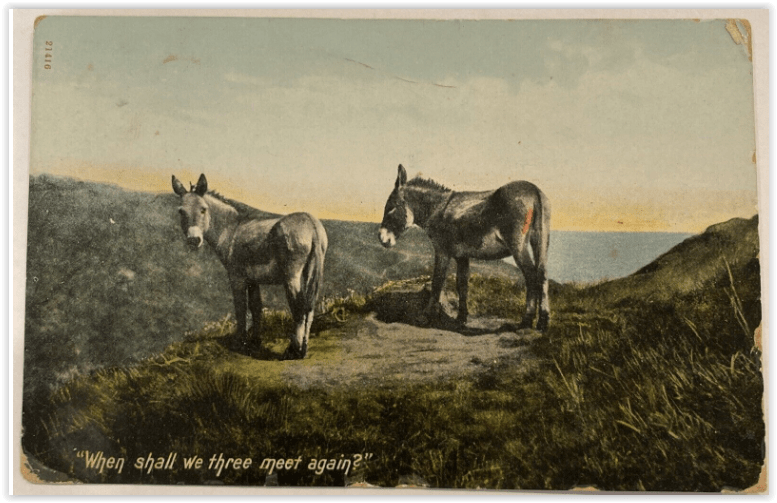
Can a joke be overused?
Now, I am, myself, a supporter of Jim Henson’s rule, that a joke not funny enough to be told once MIGHT be funny enough to be told seventeen times. But then what’s your limit? Nineteen? Twenty-one?
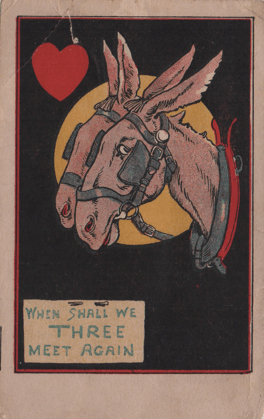
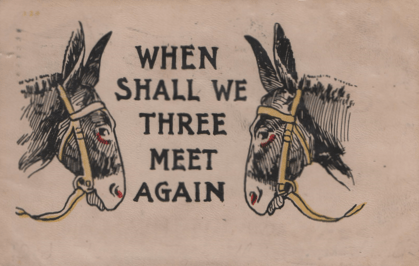
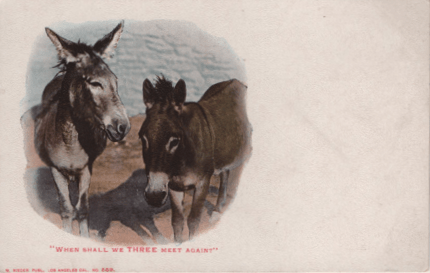
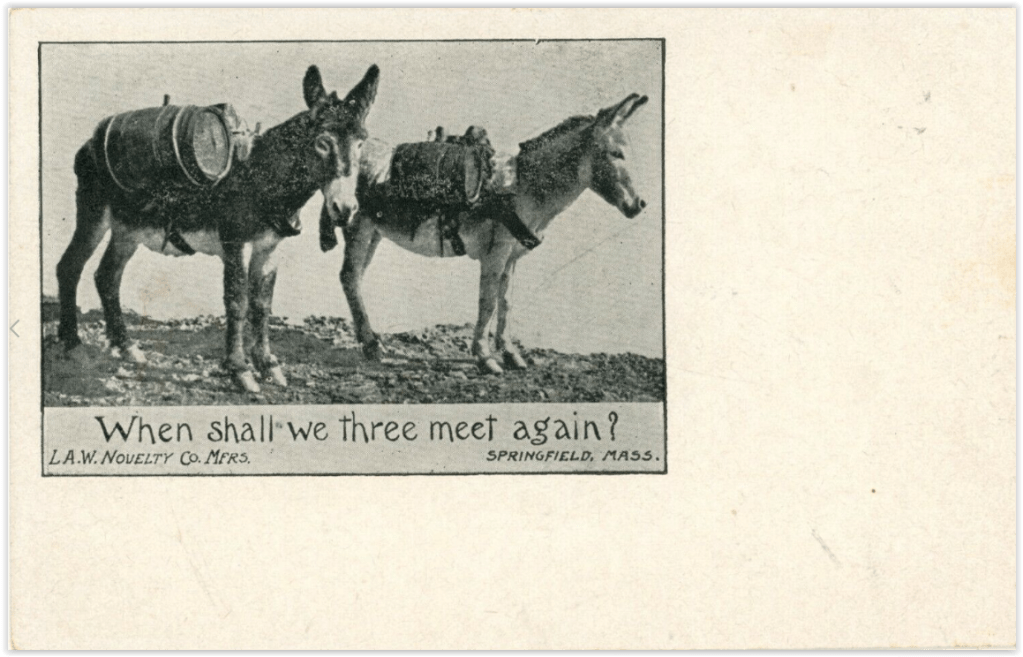
These are the opening lines of one of the “essential” Shakespearean plays. The dialogue from this whole weird prologue is used and reused wherever Shakespeare generally is parodied, but that first line was applied to a particular situation early on. I haven’t been able to find the first cartoonist to use it, but it did exist on postcards probably as far back as picture postcards. (I have had to resort to eBay for the rest of these illustrations, and will give credit to the seller whose image I’ve swiped. This one is from vintage-ephemera-postca.)
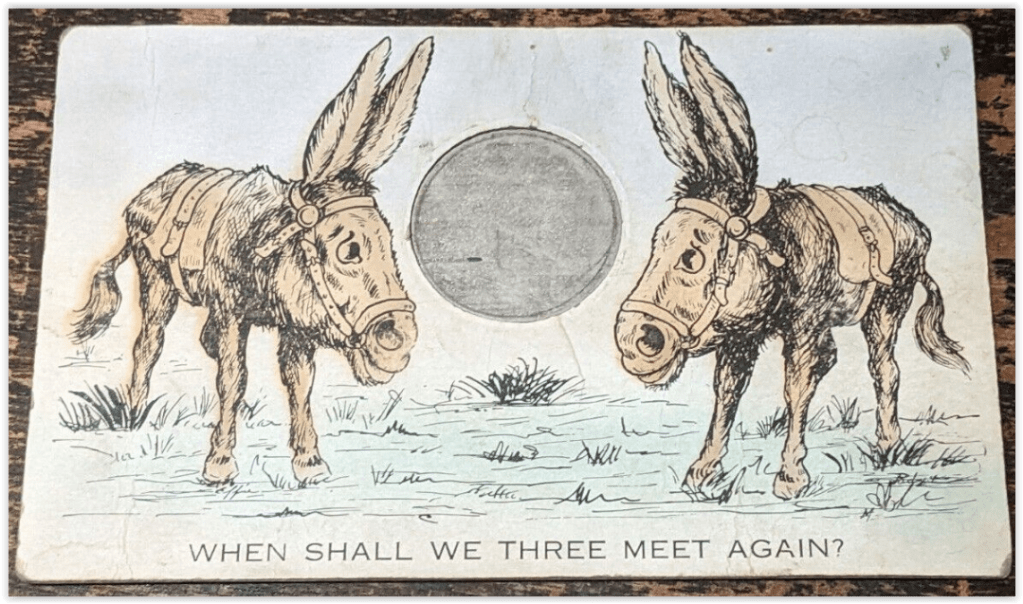
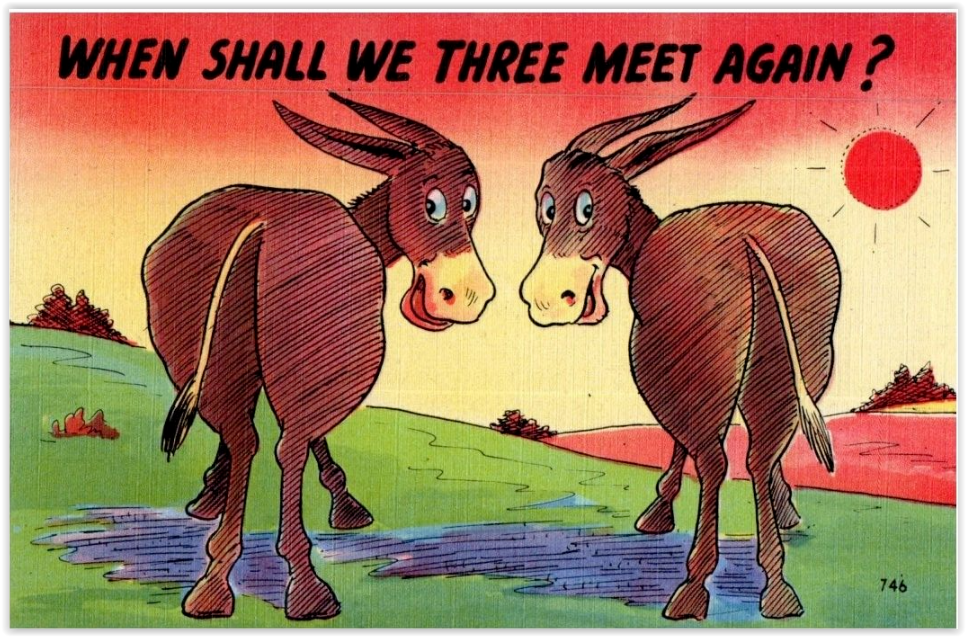
I have run across a few listings where the seller didn’t quite get the joke. They get as far as Shakespeare, but don’t know where the donkeys play a role in Macbeth. This one, which includes a rudimentary mirror, should help. (searcher1955)
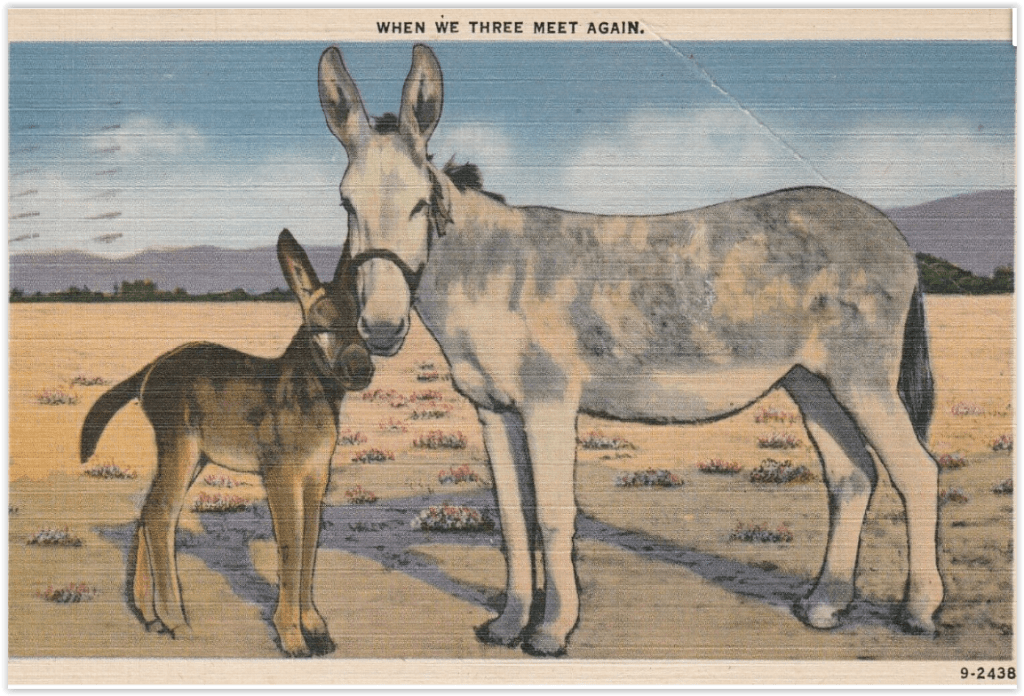
Although sometimes I’m not sure if the maker of the postcard understood the jape, either. This one suggests to me an entirely different back story, as Mamma and Junior wonder if Daddy is going to be back in town any time soon. (great old postcards)
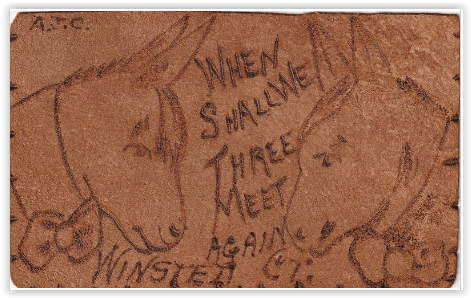
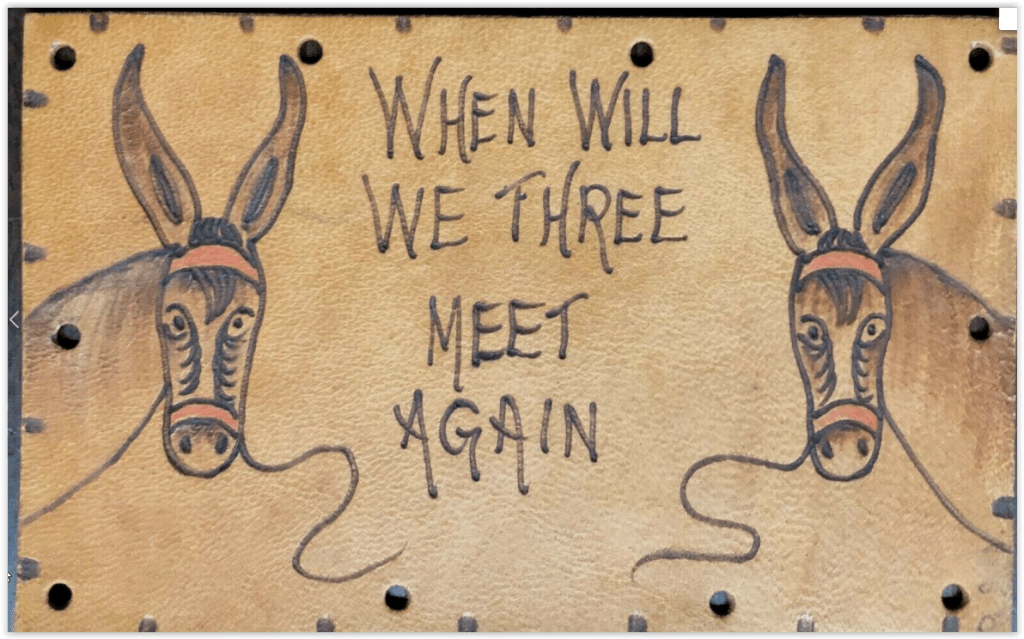
Apart from these considerations, the joke seems to have been fatally easy to illustrate. Anybody who could draw a donkey, even with the implements needed to put an image on leather, could manage the job. (11951)
Embellishments were up to the artist. (This is NOT the only version in which the jackasses are wearing neckties, by the way.) (pcl0910)
You could go full oil painting and not spoil the joke. Or any photographer who had access to the necessary cast members could snap a picture and be done. (lowy-24)
This joke, though thoroughly pandemic around 1910, did not fully fade away for years. It was still available in the 1940s. (calbeach)
And the 1950s. (This one, alas, has the caption on the message side; you’ll just have to take my word for what it says.) (collbear*collectibles)
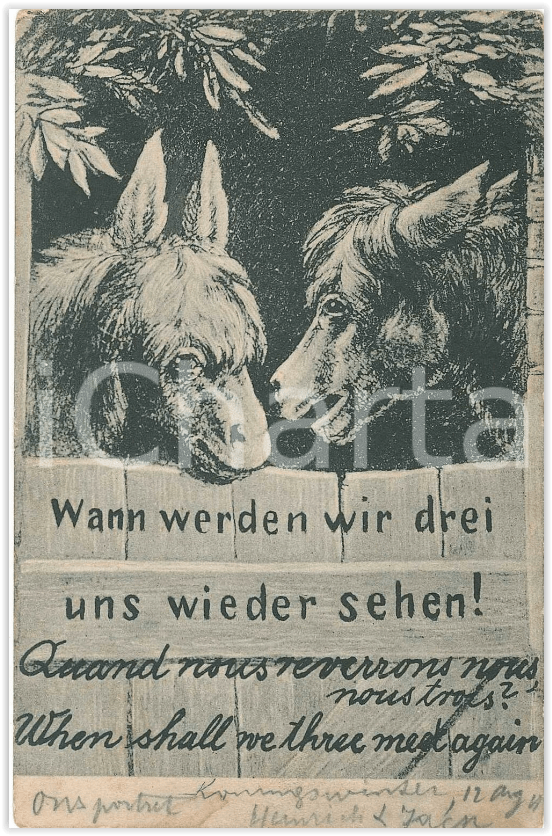
AND the joke was not limited to the English-speaking world, as Shakespeare was international, and especially beloved I Germany. (I assume your German is good enough to read that first line. I think I’ve given you enough hints.) (ichartasd)
The joke is simple, rewarding enough since it takes a second to get the punchline, and completely out of copyright (another benefit to knowing your Shakespeare.) I promise you, this column has shown less than a third of the different iterations of this postcard theme I found on the Interwebs. And now we must move along. This column is for showing off MY postcards, not looking at other people’s asses. (gls-othc)
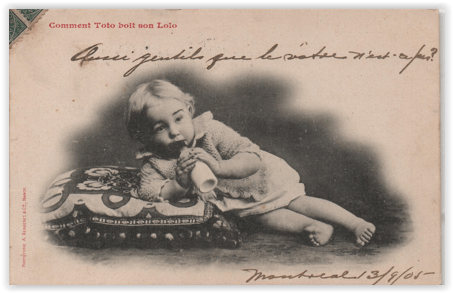
The recent addition to my inventory of a pile of postcards featuring babies made me wonder a little more specifically about a matter we have mentioned hereinbefore. Postcards of infants are filled with sociological observations, but most of those can be left to others, i.e., the proportion of mothers to fathers in baby-holding, the vying for prestige based on baby clothes and vehicles, and so forth. The thing that is really obvious at once is the variety of bottles used in days of yore to feed said babies. (An important job, as anyone who has ever listened to a hungry infant will testify.)
The “feeding bottle” can be traced to ancient Egyptian times in pictures and in actual surviving examples. Devoid of social and medical commentary, these ancient ones are most interesting for what they tell about human ingenuity, from hollowed-out animal horns to whimsical ceramic contraptions with an opening at one end for baby to get food and/or beverage (and THAT has varied over the years) and an opening at the other where the feeder could control the flow by putting a thumb across the intake.
Commercial products, which have the advantage of attached advertising hype, seem to begin in the seventeenth or eighteenth centuries, and grew more numerous in the nineteenth century, when the age-old alternative of simply hiring a young woman to breastfeed (a wet nurse) became suspect. A number of these went for a breast-shaped design, as something baby would recognize.
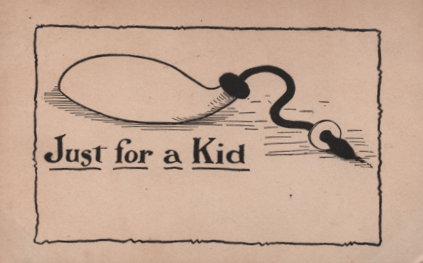
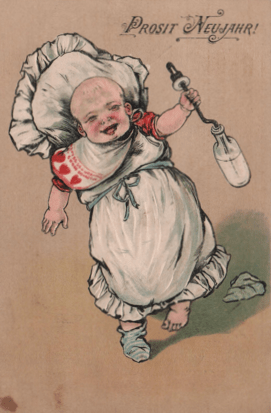
But what a lot of people wanted was something baby, having reached a certain age, could handle all alone. This design, with the feeding tube, is seen on a lot of postcards. The secret of its popularity between 1890 and 1910 comes from two factors: it was relatively cheap (you could buy the tube and attach it to any empty bottle you had at home) and if little Bubble would cooperate, you could leave it on a table, shove the nipple into Bubble’s mouth, and do something else while Bubble had lunch.
Some babies really took to this, finding that long handle easy to pay with. This did not speed up lunch, and needed to be discouraged (so Mom or Pop couldn’t go TOO far away during feeding.)
Modern eyes are not accustomed to this design, hence the inclination in sales listings of such pictures to label them “enema bags”. Other viewers wonder how on earth Mom or Pop could wash the milk out of such a long tube. The answer, briefly, is that they couldn’t, and didn’t, leading this popular design to be labeled, by intolerant later generations, as “the murder bottle”. Some of these gentry have gone so far as to crunch the numbers and find that the infant mortality rate actually rose for several years. This design started being banned around 1910, and had lost its spot in the market by 1920 (the usual reaction of consumers to an announcement that a product isn’t safe: I wonder why it only took ONE decade.)
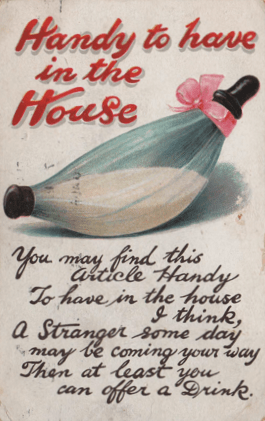
What replaced it was known, as you could probably guess by looking at it, as the “banana bottle”. Note the simple design: intake valve and filling hole at one end, nipple at the other. (The design and construction of nipples is a whole nother story; you may imagine for yourself what Junior’s reaction in the nineteenth century was to Victorian nipples made of rubber with a strong smell of sulfur.)
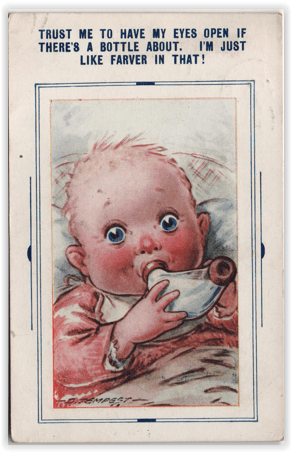
As you can see here, this was a design that little Thimble could hold all by herself (if the opening at the back was properly closed). You can also see how the joke about Thimble and her Daddy both hitting the bottle is as common as babies and fine old jokes.
The cylinder shape most of us are familiar with from the late twentieth century was easy to construct, especially once plastic started to replace glass, and even when glass was promoted as the easiest design to wash and sanitize. (It was also easiest to fit with a disposable plastic liner, which was also supposed to limit how much air Blossom sucked in with the milk or formula; the banana design was also promoted as assisting in this anti-colic feature.)
In the twenty-first century, of course, we have the medical profession coming out in opposition to ANY design of bottle, as they hold breastfeeding to be the optimum service to little Bimble. This might revive the profession of wet nurse, or, of course, other traditional baby feeding methods.
“Are you the Spirit, sir, whose coming was foretold to me?” asked Scrooge.
“I am!”
The voice was soft and gentle. Singularly low, as if instead of being so close beside him, it were at a distance.
“Who, and what, are you?” Scrooge demanded.
“I am the Ghost of Christmas Past.”
“Long Past?” inquired Scrooge: observant of its dwarfish nature.
“No. Your past.”
Perhaps, Scrooge could not have told anybody why, if anybody could have asked him; but he had a special desire to see the Spirit in his cap, and begged him to be covered.
“What?” exclaimed the Ghost, “would you so soon put out, with worldly hands, the light I give? Is it not enough that you are one of those whose passions made this cap, and force me through whole trains of years to wear it low upon my brow?”
Scrooge reverently disclaimed all intention to offend, or any knowledge of having willfully “bonneted” the Spirit at any period of his life. He then made bold to inquire what business brought him there.
“Your welfare!” said the Ghost.
Scrooge expressed himself much obliged, but could not help thinking that a night of unbroken rest would have been more conducive to that end. The Spirit must have heard him thinking for it said immediately:
“Your reclamation, then. Take heed!”
It put out its strong hand as it spoke, and clasped him gently by the arm.
“Rise! And walk with me!”
It would have been vain for Scrooge to plead that the weather and the hour were not adapted to pedestrian purposes; that bed was warm, and the thermometer a long way below freezing; that he was clad but lightly in his slippers, dressing-gown, and nightcap; and that he had a cold upon him at that time. The grasp, though gentle as a woman’s hand, was not to be resisted. He rose; but finding that the Spirit made towards the window, clasped its robe in supplication.
“I am a mortal,” Scrooge remonstrated, “and liable to fall.”
“Bear but a touch of my hand THERE,” said the Spirit, laying it upon his heart, “And you shall be upheld in more than this!”
This passage holds a lot of classic lines, which does not keep filmmakers from changing them. (Amazing, for starters, how many bits were not dialogue in the original at all; Scrooge only THINKS about a night of unbroken rest, for example.) About the only thing omitted outright in most cases is the Spirit’s cap. When a ghost does carry this in the movies, the Ghost frequently is moved to explain the whole metaphor, which Dickens thought we’d be able to get on our own. Since no two Ghosts seem to agree on its significance, though, maybe he was wrong.
Hicks skips all of this. His Ghost simply tells him, “I am the Ghost of Christmas Past. I am here to show you the things that have been. Look back beyond the gulf of vanished years.”
“Are you the Spirit I was told to expect?” asks Owen, “Who are you?” “I am the Ghost of Christmas Past.” She approaches; Scrooge cries, “The light! It hurts my eyes!~ It blinds me!” “I’m not surprised,” is the Ghost’s calm response, “It’s the warming light of cheerfulness, the light of gratitude to others.” “I’ve never seen it before.” Again, she is unsurprised; she tells Scrooge that men of greed like him have long forgotten gratitude. “Oh. What’s your business with me?” “Your welfare, your reclamation: rise and walk with me.” Scrooge climbs wearily out of bed. The window opens; Scrooge looks around in apprehension. “We spirits have no fear,” she assures him. “But I’m not a spirit!” “Bear but a touch of my hand on your heart and you shall be safe.”
Oh, look at the expression on Sim I’s face! When told the Spirit is here for his welfare, he responds “My welfare.” The Ghost comprehends. “Your reclamation, then. Take heed, rise, and walk with me.” A lift of the ghostly hand makes the distant window slide open. Scrooge doesn’t care for the trick. “Through the window?” “Are you afraid?” Scrooge explains that he is a mortal, and liable to fall, but the way he shuffles his feet and pulls at the collar of his robe show this is merely a schoolboy excuse; he just doesn’t want to go. They complete the dialogue as written.
March asks “Are you the Spirit I was to expect?” “I am.” “Odd. Very odd. You resemble HER so very much. What Spirit are you?” “I am the Spirit of Christmas Past.” “What past?” “Your past, among others.” “What did you wish to see me about,” says the constant man of business. “Your welfare.” “I;ve had so little sleep.” “I am sent to save you from yourself. You have forgotten what the world is like for children.” She pushes the window open. “Come with me.” “as I am?” “As you are.” “Which way?” She indicates the shutters and he draws back. “No! Not that way! I shall fall!” “Not when you’re with me.”
Rathbone boils this down considerably. “Are you the Spirit whose coming was foretold to me?” “I am.” “Who and what are you?” “I am the Spirit of Christmas Past.” “And what business brings you here?” “Your welfare and your reclamation. Come with me.” At the window, Scrooge pulls back. “But I am a mortal!” Something about the Spirit’s face makes him moderate his tone and he adds, more quietly, “And liable to fall.” “Bear but a touch of my hand here and you shall be upheld in more than this.” The hand does go to Scrooge’s chest.
When told why the Ghost is there, Magoo replies, “Well, I’m much obliged, but a good night of unbroken rest is what I need, of you’re so concerned.” “Rise, and walk with me.” “Oh, humbug! Forcing a fellow to leave his bed in the middle of the night!” “Come!” He complains of being cold, and of not having a decent stitch to warm his old bones. When close enough to see the window is their destination, he whines about that as well. “Touch my hand, and you shall be upheld.”
Haddrick stammers in terror. The dialogue about “Your past” and “Your welfare” is omitted. “’Tis hardly the hour or the weather for pedestrian purposes,” he complains, “It is below freezing and I am but lightly clad.” The Ghost touches his hand to lead him out. “I’m mortal, don’t forget, and likely to fall.” (Since we have not approached a window, where he is going to fall is not immediately obvious.)
After Sim II’s frightened stammering, the scene moves quickly past a lot of unuttered dialogue.
Finney demands, “Who are you?” “I am the Spirit whose coming was foretold to you.” “You don’t look like a Ghost.” “Thank you.” “May I inquire more precisely who or what you are?” The dialogue follows much as Dickens wrote it, without any of the cap business. When his welfare comes up, Scrooge points out, “To be awakened by a ghost at one o’clock in the morning is hardly conducive to my welfare.” “Your redemption, then. Rise! And walk with me.” “Where are we going?” “We are going to look at your childhood.”
Matthau is informed, “I am the Ghost of Christmas past.” “Long past?” “Your past. Here. Hold my hand.”
The Ghost has to bang on the alarm clock bell to wake McDuck. “Well?” he demands, when Scrooge does wake up, “About time! Haven’t got all night, y’know.” Startled, Scrooge asks, “Who are you?” “Why, I’m the Ghost of Christmas Past.” “Oh.” Scrooge rolls over to go back to sleep, adding, “I thought you’d be taller.” The Ghost snaps that if men were measured by kindness, Scrooge himself would be no bigger than a speck of dust. “Kindness is of little use in this world,” Says Scrooge, sleepily. “You didn’t always think so. Come on, Scrooge: it’s time to go.” “Then go!” The Ghost opens a window, allowing a gust of cold wind to startle Scrooge. “What are you going?” “We’re going to visit your past.” “I’m not going out there. I’ll fall!” “Just hold on.” Scrooge clutches the miniature ghost.
Scott’s ghost is stern. She explains that HER light is the light of truth. When he makes a crack about a night of unbroken sleep, she warns him severely, “Be careful, Ebenezer Scrooge. I speak of your reclamation.” Scrooge’s expressions shows he never really thought she’d listen to reason. “Ah. Well, if tit’s reclamation, then let’s get on with it.” They do not bother with the window; mist surrounds them. “Come. We shall be invisible, and silent as the grave. You will see a child, a youth; you will see yourself, Ebenezer.”
Caine asks “Are you the Spirit whose coming was foretold to me?” “I am.” “But you’re just a child.” “I can remember nearly 1900 years.” A little later, he objects that a night of unbroken rest might be better for his welfare, she replies, “Your salvation, then.” They head for the window; when he shows apprehension, she assures him, “A touch of my hand, and you shall fly.”
Curry is so startled he bangs his head on the headboard of the bed. When he inquires whether this is the first Spirit Jacob talked about, the Ghost tells him, “Spot on, Guvnor. I’m the Ghost of Christmas past.” The reclamation/welfare bit is reduced to “It’s for your own good.” At the window, the Ghost calls, “Shuffle your stumps, Scrooge!” Scrooge, having some spirit left of his own, snaps, “I’m not made of mist and moonlight, like you.” The Ghost takes his wrist and pulls him out. Debit, chomping tight to the hem of the dressing gown, tries to hold Scrooge back, and winds up being towed through the air as well.
Stewart shields his eyes against the light of the Spirit, and begs the Ghost to don that cap. “Be covered.” The ghost becomes fierce in reply but, when Scrooge apologizes, does tone down his light just a touch. When told to rise, Scrooge overflows with excuses. “Some other time, perhaps. I’m not dressed. I have a weak chest, monstrous head cold….” The Ghost insists, and Scrooge, shaking his head, puts out a hand. He is genuinely frightened as they near the window. “All I have to do is touch you…there.” The Ghost lays a hand on Scrooge’s chest.
FUSS FUSS FUSS #8: How Do You Feel About This?
The Ghost of Christmas Past is here to point out inconsistencies in Ebenezer Scrooge’s past and, as hinted at the very end of the passage, try to touch his heart. Dicken sketches the lessons for us, but does not tell us what the teacher thinks of the pupil. Was the Ghost supposed to be neutral? Gently persuasive? Ironic? Downright nasty? All these angles can be seen in various versions, though the preference seems to be for an otherworldly serenity. I read the different Pasts as
VOICE OF DOOM: Hicks
CALM DETACHMENT: Owen, Sim I, March, Rathbone, Magoo, Sim II, Matthau, Caine, Stewart
DISAPPOINTMENT: Haddrick
AMUSED CONTEMPT: McDuck, Scott, Curry
LOFTY CONTEMPT: Finney
Some Ghosts show a change of heart as they move through the scenes of Scrooge’s past. Magoo’s Ghost becomes suddenly sardonic at the end, apparently disgusted with her charge. Curry’s Ghost, who gets a great deal of joy out of tormenting Scrooge, begins to show sympathy as the young Scrooge and Belle break their engagement, as does Finney’s Ghost. Scott’s, however, does not soften in the slightest, becoming, if anything, even stonier as they move along.
We have been discussing stockings worn by ladies on postcards of the past. I mentioned that in this, as in so much of a cartoonist’s life, what is really important is knowing just where to draw the line. And so today, we are going to discuss stocking tops.
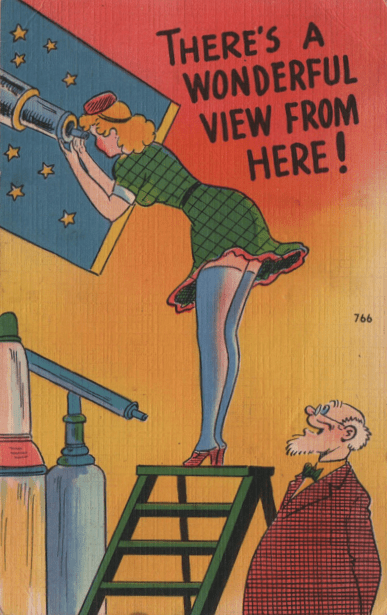
Maybe this is what is meant when the self-appointed experts on the Interwebs insist that women’s stockings were of no great interest before the invention of the nylon stocking. At any rate, it DOES appear to be about now that cartoonists really utilize the stocking for what sociologists have been claiming the leg does as an erogenous focus. It draws the eye upward.
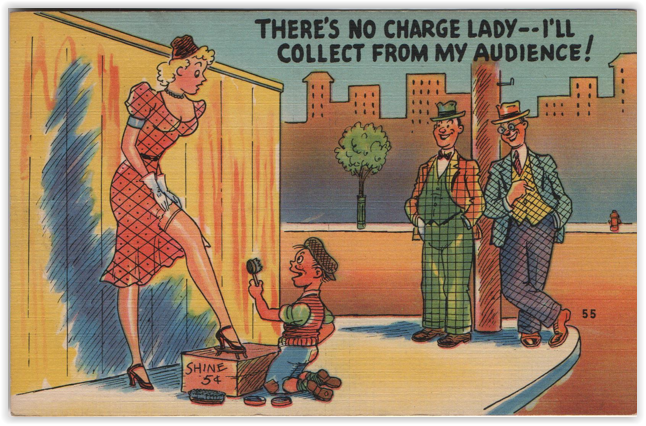
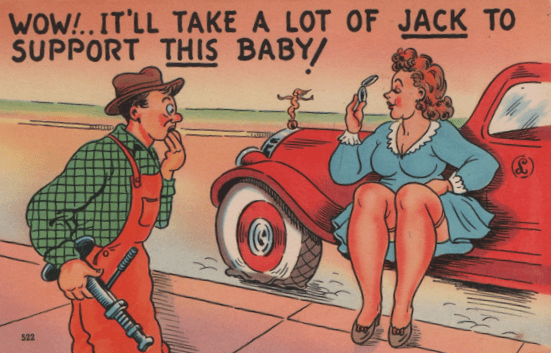
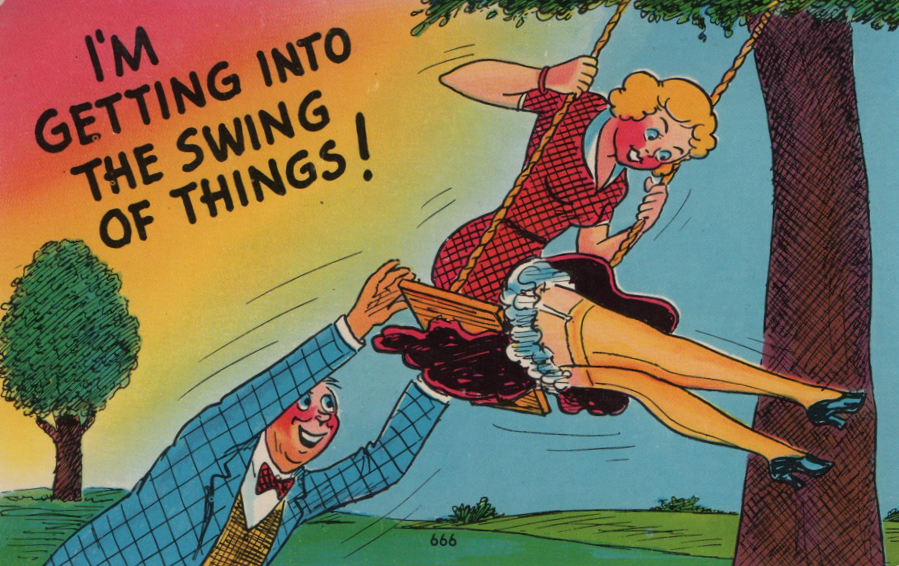
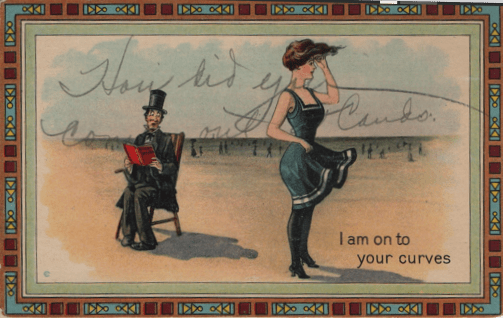
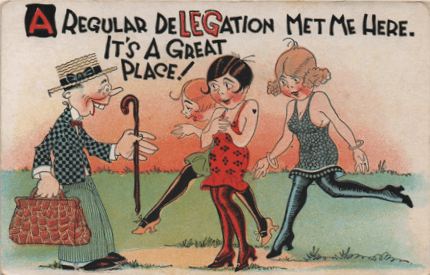
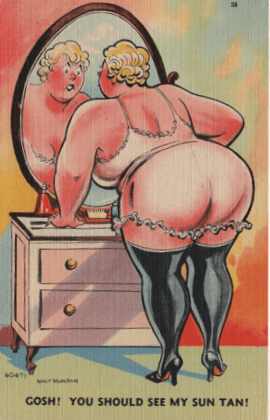
We saw stockings in the pre-nylon postcards, but not very many garters. NOW the garter and the top of the stocking are an essential part of the design. They emphasize that little patch of bare skin showing above the stocking. This made the picture appealing to more than one audience. Those fascinated by pictures of stocking had long stretches of leg to examine, but the stocking top was there to remind the others that the artist knew there was more to life than a stretch of fabric.
And this may be why you also see very few flesh-colored stockings in these postcards. The contrast made it clearer what the viewer was seeing (and what the viewer did NOT get to see.)
Raymond Chandler, inspiration for so many hardboiled detectives in book and noir motion picture, had his detective refer to the long legs fashionable in the era as a race track which led to the finish line.
Benny Hill, less noir, simply noted that the good thing about stockings was that no matter how long they were, the top was always near the bottom.
This, some experts have claimed, is what made the garter and/or garter belt such popular erotic icons. They dented the flesh at key points, emphasizing the nature of what they were up against.
Some cartoonists found them unnecessary, preferring to imply texture with line alone.
Not to claim that these are the more subtle cartoonists.
The cartoonists, at least the ones included in my inventory, did not include EVERY feature of the stocking which attracted viewers of the day. This, for example, is the only card I’ve noticed which emphasizes the seam at the back of the stocking (memorialized by songwriters and comedians in days of yore; these replaced the jokes about the “clocks” on pre-nylon stockings, which on postcards frequently have mice trying to run up them. This seam was already important enough by World War II that when nylons were rationed, and some companies sold a nylon-colored leg paint to take their place, women were urged to take an eyebrow pencil and draw in the seam, which no doubt resulted in a lot of improbable seam work until the skill could be mastered.)
But enough of thighs and thigh-high stockings and garters and such. We can now move on and apply our mind to higher th…yeah, let’s just tiptoe out of here now.
I hate to whine, and I KNOW this is going to be a revolutionary thought that no one has ever expressed before. But I am going to be brave and stalwart and come right out with it and take the tidal wave of anger that comes from making such a bold statement.
This World Wide Web of ours just doesn’t seem to have all the answers. There. I said it and I’m glad.
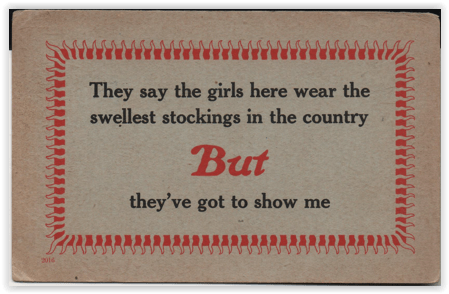
See, I was looking into the subject of women’s stockings as seen on postcards, as we were considering that subject on Friday last, and I have more postcards to show off. And everywhere I go on the Interwebs, I am told that ladies’ stockings were simply not considered a matter of erotic interest until the invention of nylons, around 1937.
I learned from all sorts of websites, not all of which seemed to be stealing from the same source, that in the days of wool and silk stockings, ladies wore their skirts long, and stockings, though occasionally available in fun designs, simply were not considered a matter of great interest by the male viewing public.
I dunno, cranberry catsup. I think we could consider the invention of the long-;egged chorus girl (which goes back to a musical called “The Black Crook” from 1869) or even the invention of the upskirt picture, which predates photography by a generation or two, and the scandalous works of Rowlandson or Gillray (though they did their work in Merrie Olde England, when stockings, and even underwear, were optional and a nasty breeze…well, look it up. Those gentry didn’t do postcards.)
Mind you, the shorter skirts of the 1920s did offer opportunities for illustration not hitherto available, to the extent that some experts on these matters have decided nylons were available in 1919, since stockings were not worth ogling until the days of nylons, and men were decidedly ogling. (We could consider the whole history of Rayon and nylon and how they changed the world, but there’s only so much time in the day.)
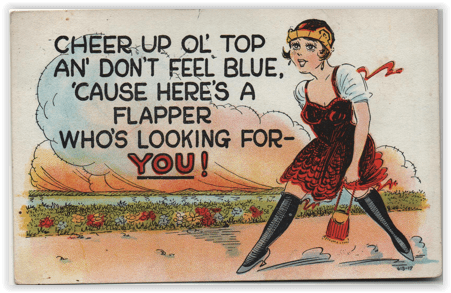
What interests me as well is all the discussion of how thigh-high stockings did not become general until the days of nylons. And yet one of the scandalous things the Flappers of the 1920s did was roll their stockings DOWN. It was showing actual skin, not the stockings, that mattered. (I interviewed a lady in her eighties who recalled her college days in the Flapper Era, when she and several other girls liked to sit in the front row in the classroom, and fluster the professors by NOT keeping their knees together.) Still, you will notice that the cartoonists of the 1920s were able to focus attention with a well-delineated stocking.
Maybe I’m not seeing the line between staring at women’s legs and staring at their stockings is drawn. Our postcard cartoonists, though, knew where to draw that line.
But drawing the line is a whole nother blog. Class dismissed until Friday…except for you in the front row. I want to know where you found thigh-high Argyles.
The curtains of the bed were drawn aside, I tell you, by a hand. Not the curtains at his feet, nor the curtains at his back, but those to which his face was addressed. The curtains of his bed were drawn aside and Scrooge, starting up into a half-recumbent attitude, found himself face to face with the unearthly visitor who drew them; as close to it as I am now to you, and I am standing in spirit at your elbow.
It was a strange figure—like a child; yet not so like a child as like an old an, viewed through some supernatural medium, which gave him the appearance of having receded from the view, and being diminished to a child’s proportion. Its hair, which hung about its neck and down its back, was white as if with age; and yet the face had not a wrnle in it, ad the tenderest bloom was on the skin. The arms were very long and muscular; the hands the same, as if its hold were of uncommon strength. Its legs and feet, ost delicately formed, were, like those upper members, bare. It wore a tunic of the purest white; and round its waist was bound a lustrous belt, the sheen of which was beautiful. It held a branch of fresh green holly in its hand; and, in singular contradiction of that wintry emblem, had its dress trimmed with summer flowers. But the strangest thing about it was, that from the crown of its head there sprung a bright clear jet of light, by which all this was visible; and which was doubtless the occasion of its using, in its duller moments, a great extinguisher for a cap, which it now held under its arm.
Even this, though, when Scrooge looked at it with increasing steadiness, was not its strangest quality. For as it s belt sparkled and glittered now in one part and now in another, and what was light one instant, at another time was dark, so the figure itself fluctuated in distinctness being now a thing with one arm, now with one leg, now with twenty legs, now a pair of legs without a head, now a head without a body; of which dissolving parts, no outline would be visible in the dense gloom wherein they melted away. And in the very wonder of this, it would be itself again, distinct and clear as ever.
Well, this is clearly unfilmable as written. Oh, we have the gadgetry to do it, especially nowadays, but if you did produce a computer projection which reproduced exactly what Dickens had in mind, this representation of mingled and fading memories, no one could look at it for very long, while at the same time, few of us would have an eye for anything else happening onscreen. As is pointed out in The Annotated Christmas Carol, this is also the one ghost John Leech did not attempt to show us in his illustrations for the first edition of the book itself.
So Ghosts of Christmas Past come in a variety on the screen.
THE ORIGINAL
Sim II makes the attempt. This apparition is a girl (though Scrooge, true to the text, address it as “Sir”) who is chubby, thin, pump again, had one head, then two then three, then one again as her hands and arms wither and grow young again repeatedly. She carries a sprig of holly and a cap, and wears a skirt much plumped out by crinolines or ectoplasm. She has a sash, and walks barefoot. Her voice is that of a middle-aged woman.
MEN
Hicks gets a luminous outline of a man. Its voice is serene, and detached.
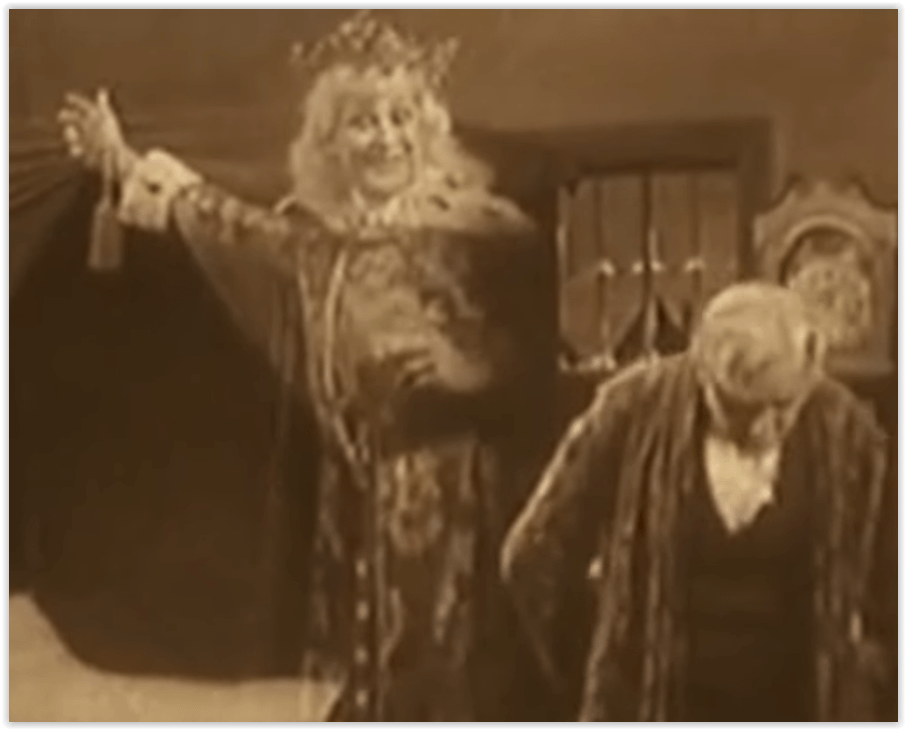
A blob of light in Sim I resolves itself into a benign old man with long white hair, wearing a white robe and cape. He is barefoot, with a glittering sash at his waist and a garland about his neck.
Rathbone, having just checked the locks on his door, turns to find a Biblical Patriarch fading into view. The figure, which wears a white robe and sash (and gloves), beckons.
Haddrick has an old man with a beard and a crozier. He wears a robe, and is the picture of a gentle elderly saint. His voice is high and slightly sepulchral.
Matthau meets a small old man with a slight resemblance to Jacob Marley. Rays of light rise from this ghost’s head in a sort of crown, and he wears a white brown with colored collar and cuffs, and a belt. In one hand he carries the cap, in the other a sprig of holly.
Stewart gets a small older manchild with long hair. His clothes are silvery-satiny, and he is luminescent, with an aura. He carries a cap and wears a necklace of holly. His clothes and face could make him a solemn official rom some distant medieval banquet, or a grave jester, or even a Muppet. His attitude is calm, slow, serene.
WOMEN
Owen watches as a lump of light resolves itself into a Hollywood ingenue auditioning for the role of Glinda the Good. She has golden ringlets, a nurse’s cap with a star on it, and a belted satin gown.
March is rousted from bed when his shutters fly open, allowing a cold wind to blow back his bedcurtains. He rises to close the shutters but a bright light alerts hi to strange doings. Turning, he finds a fresh-faced brunette with a smile. Her hair is pulled back under a shining circlet, and her plain white gown is cut rather daringly in front.
Magoo finds a girl (or just possibly a boy) with neatly bobbed blonde hair, a tunic and short skirt (or a long tunic belted in the middle) and shoes bound at the ankle. A flame rides above her head; she holds a sprig of holly in one hand.
Finney gets a very solid=looking matron in a fashionable red dress and very expensive hat. Her earrings glitter, and she wears a black choker. Hands clad in white gloves reside within a fur muff. She is very sure of herself, and obviously intends to take no nonsense from any Ebenezer Scrooge.
Scott meets a woman whose voice is older than her face. She wears a white robe with a sash of leaves. She is barefoot, a tad feral, and carries holly in one hand while that cap hangs from a ribbon attached at her waist.
THE ECCENTRIC
McDuck gets Jiminy Cricket.
Caine, after opening the bedcurtains himself and brandishing a poker, watches the light that woke hi coalesce into a diaphanous clump of white gauze with a girl’s head; this head has long blonde hair and a hat. The voice is that of a young girl; her hand, when she extends it to Scrooge, is that of a baby.
Curry gets an impudent pearlie who laughs WAY too much.
Over the years, there have been numerous studies of the history and role in cultural themes of the various erogenous zones of the body: how they relate to the state of society when this or that spot is heavily featured in advertisement, and what it means in the mental processes of the individual viewer. Which proves, once again, that taking Statistics courses in high school can produce long-range benefits.
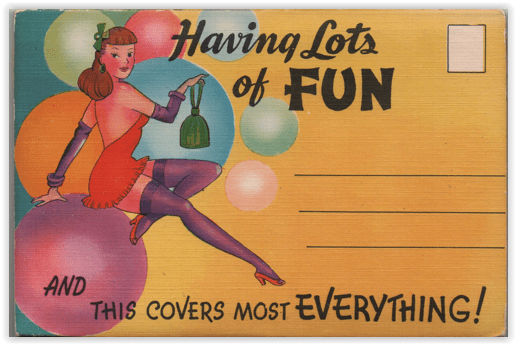
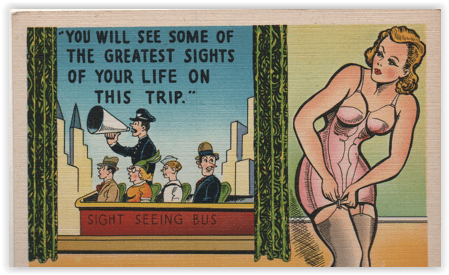
Today, we are going to consider the subject of leg art, or specifically the art of female legs in stockings, in the world of postcards. This was fairly popular, partly because one of the golden ages of postcards more or less coincided with the Second World War, a proven haven for the legs as a focus of pin-ups, and second because it was a little easier than some parts of the body to feature on postcards. (Although those who have seen the numerous columns in this about postcards and the human situpon will know some were easier.)
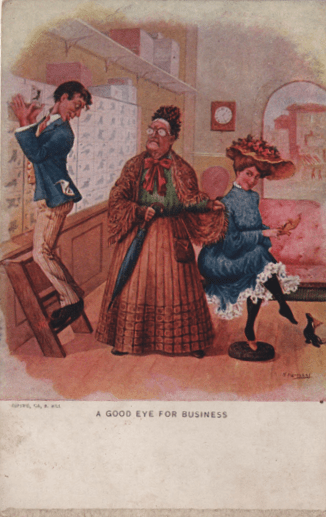
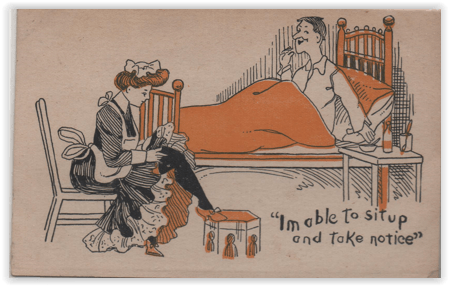
Yes, there were those in the Victorian and Edwardian ages who would not even utter the word “leg”, preferring the somehow more acceptable “limb”. And yet these attitudes were not universal. Not only were stockings permissible (if a bit racy) but it was even possible as in this card mailed in 1906, to show stockings in action. (I doubt the nurse is putting that stocking on; she’s merely straightening it a bit, thus reviving her patient.
For pictures of ladies putting their stockings on (or just possibly taking them off), the postcard buyer largely had to wait for the next generation.
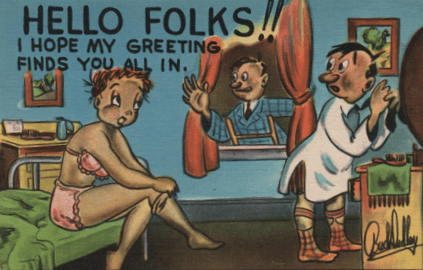
Bud Dudley, an artist we must discuss one of these days, frequently showed stockings on their way off.
Notice that in both cases, our heroine begins with the right stocking. Is this common practice (must watch tonight when I take off my socks) or did he just feel he got maximum leg to draw this way? (Also, those with eagle eyes will observe that his ladies are not in either case wearing garters, even though in the second card, Hubby is wearing his.)
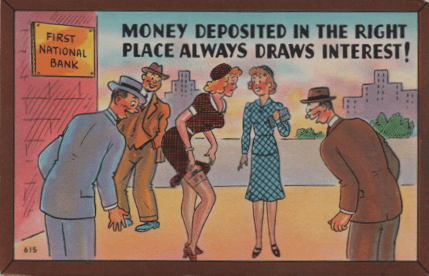
I think we have alluded to this briefly before, but stockings have more uses than simply as leg coverings (or limb drapery.) Tucking a ;little mad money away in the stocking tops was well known at the outset.
And went on for generations. Was it shorter skirts or shorter stockings that led to most women abandoning this branch of the bank? (Speaking of limbs.)
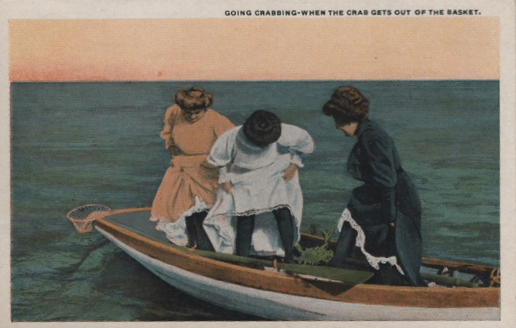
Stockings did not always cooperate, of course. They could tear, if cloth, or develop runs, if constructed of sheerer material. Here is a perfectly innocent postcard, wherein our model is simply checking her stockings for any need of repair. An example of forethought and industry, and not intended to appeal to the prurient interests at all, at all.
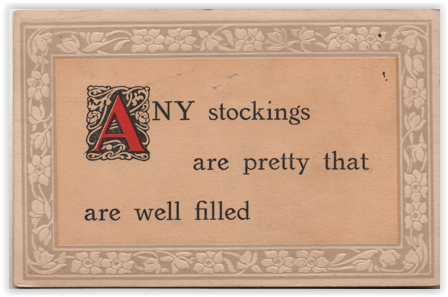
We conclude on the note that it is not, ultimately, the overworked stocking itself which was the focus of any of these pictures. I’m sure there must be such things, but I don’t recall ever having seen a postcard showing a stocking with no one inside it. (Socks are another matter, darn ‘em.)




















 Blogsy Babbles