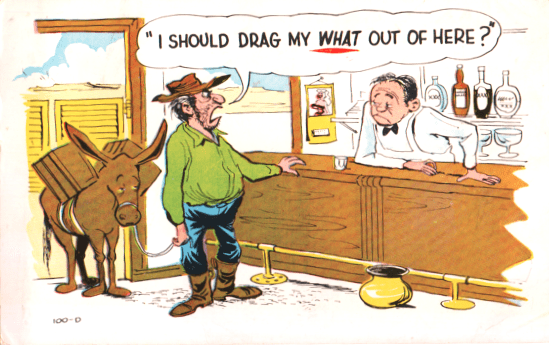
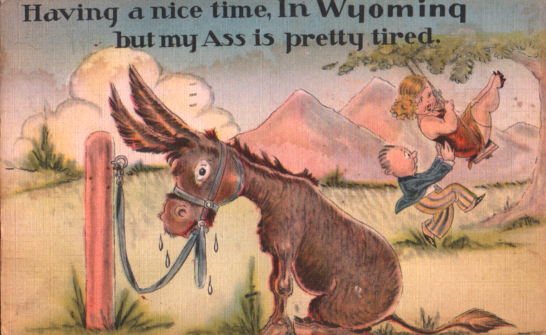
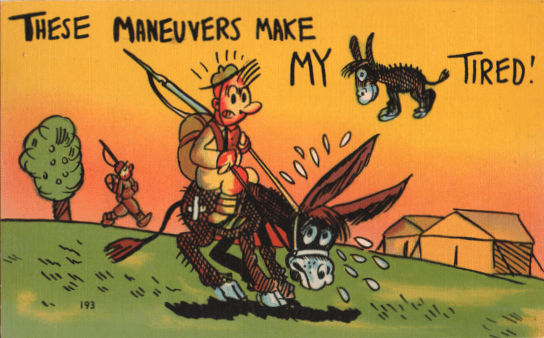
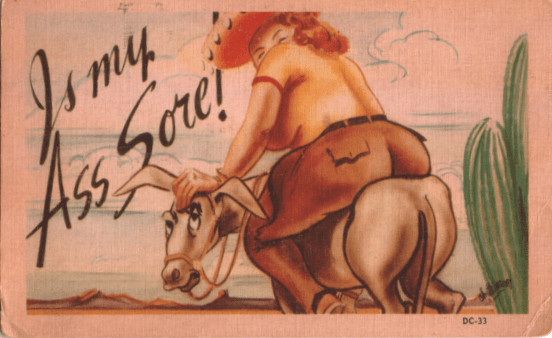
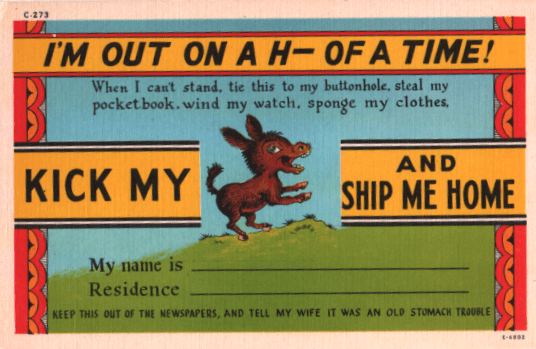
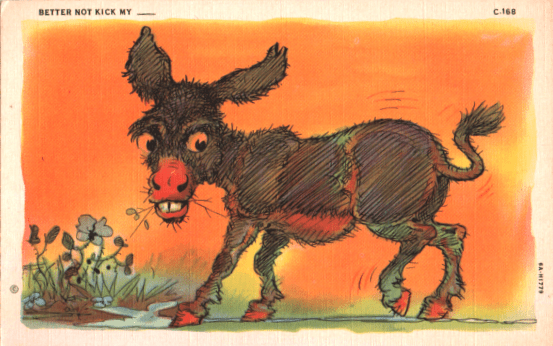
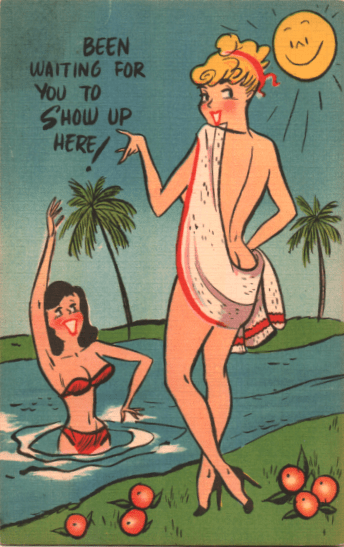
In the middle of the last century, a number of postcard publishers decided to take arms against a major injustice. They, and their staff cartoonists, did their very best to draw the attention of the American public to thus social evil, hoping to provoke action on behalf of an overworked and underappreciated stalwart of American labor, suffering difficulties around the country due to the unfair demands of society.
In some places, these oppressed souls could not even be mentioned by name, but postcards could find their way everywhere and plead their case. It should be obvious that we are addressing the twentieth century postcard’s attention to the ass.
The situation causing concern was most often associated with the West, as an area where the ass was put to a great deal of work on long hot days.
But the cartoonists did not fail to mention that asses did not get a workout in places like Atlantic City, and other resort towns nearer to the east coast.
World War II brought new chores for the busy ass. Men whose asses were in danger at all times raised their voices to express their discomfort with this arrangement.
However, it is more often women whose asses were the focus of attention. This may be because women were perceived as being more sensitive about their asses. I am in possession of no statistics or studies on the matter, though, and it may simply be that women were seen by postcard cartoonists as putting their asses through rougher assignments.
As a third possibility, it could be that their asses were considered more delicate. Certainly, we see more postcards dealing with women dragging their asses from place to place (though for some reason, when the subject turns to asses being dragged from state to state, the dragger is more often a cowboy. I thought about checking the Interwebs for information about the states of cowboys’ asses, but my algorithms are so confused now, I didn’t like to add a lot of research to the mix.)
After all, the AI has given up on me already. You should see some of the sites it showed me when I asked about women dragging their asses. I hope you would be as amazed as I was about the number of websites dedicated to female dragons.
In any case, our benevolent postcard cartoonists sought to cast light on the trials and tribulations of a noble animal, suggesting that, whether a man or woman was involved, an ass could expect little more than slaps, spanks, and kicks in return for all that work.
Only the always pioneering Curt Teich Company came out with an explicit ass postcard, making its position on asses clear. And I hope that I have helped convey this clarity into the new century.
“I should warn you, sir, that the last person who attempted robbery here is now the stuffed mermaid you see on the wall over….”
“I wasn’t going to try it. But can you sell me something that will make me so much money so fast that I can pay you well and still have some left?”
“I do have this magic ring.”
“That’s a tin circle with a pebble set in it.”
“It is well camouflaged, sir; the witch who crafted it was a woman of strange whims.. This grants the purchaser the power to turn anything he touches into gold.”
“I’ve heard about such things. No, thank you. Somebody always winds up turning their daughter or their wife into a….”
“The witch knew those stories as well, sir, so the ring comes with safeguards. If you wear these elytra gloves under the ring, nothing will turn to gold, since you are not touching the ring. And, if you say “Pumpernickel” three times, the ring will transform anything you mistakenly turned into gold back into its original form.”
“It sounds better and better. Um, why are you selling it, then?”
“I enjoy the work, sir. It isn’t about just piling up gold.”
“Hey, I’d like to have that attitude myself some day. How much do you want?”
“I need some token payment to make it a purchase, but after that I will take only as much gold s you make the first time you put on the ring.”
“Interesting. And if I don’t turn anything into gold while I’m here? Or what if I touch YOU?”
“Part of the enjoyment of the job, sir, is seeing how these things work out. What were you thinking of touching first?”
“I have half a dozen pennies in my pocket here.”
“Gold pennies are a novelty, sir. If you touch nothing else while you’re here, that will do nicely.”
“Done and done. Here’s the copper penny. Give me the ring.”
“Here you go, sir. And the gloves with….”
“Ha! I hope you like that penny, because I’m not…I’m not…I’m not moving.”
“Well, no, sir. You are currently touching your clothes and boots, and now that they are solid gold you won’t….”
“Pumpernickel! Pumpernickel! Pumpernickel!”
“I’m glad you remember the spell, sir. Very good.”
“But I still can’t move1 It’s not working!”
“True. The witch, as I say, had strange whims. And since you were touching the ring, it is now itself gold, and no longer the magic tin….”
“But what now? I can’t just stand here in your shop forever.”
“No indeed, sir: it will scare away customers. I’ll just fetch the tin snips.”
“He’s ripping her overalls off now. It’s a real pity you can’t see this.”
The screen had been out of Nubry’s line of vision since the golden woman started dancing. His Imperial Worship had thoughtfully provided commentary on how her dancing became a general hugging, kissing, squeezing lovefest among the four prisoners, preoccupying them too much to see their danger until they stepped into trap doors which dropped them inside warm, soothing tubes where they were bounced and jiggled into painful levels of sexual tension.
However, by twisting her neck and tipping her head way back, Nubry could just see the monitor which printed out their dialogue.
“OOH, MY DARLING CAPTAIN1 DO TRY TO BE GENTLE!”
“I SJALL LOVE EVERY PARTICLE OF YOUR LUSH GREEN BODY!”
She could not hold the position long, and had to tuck her ears back between her knees, a position the manacles had forced her to assume some ten minutes or eighty years ago. All she could see in this position was herself, where the blades had cut away her uniform. The view would not have inspired her even had her eyes been the only organs offended by the process. The worst, though, was that the machinery had also let her hair loose, and she could not move a hand up to brush the strands away from her face.
“Quite the grip he’s got on her breasts. I had some thoughts about pumping in an aphrodisiac vapor, but I see now that would have been redundant.”
Nubry pressed her lips together. It hurt. The last moisture to touch them had been sweat, and she doubted she could manage even that now. He’d made fourteen copies in a row; the memory of that pain was bad enough, but she also knew how much her strength had been depleted. Soon she’d be too weak to do anything about escape even if she got the chance.
“Nothing new about what they’re up to mow. I’ll just let them go at it and stop neglecting my guest.”
Sje tried to turn her head again, but at the same moment, her wrists were drawn between her thighs to roll her into another midair somersault. Her heels came down to the floor, pressed against each other. The cuffs on her knees pulled as far apart as her hip joints would allow. The thigh bones were trying to pull away from the hips entirely.
Ignoring that and the pain in her neck, she tossed her head to flip her hair back. Her eyes went up to the big monitor, n found it blank. She looked down to the conversation screen again.
“OH, CAPTAIN!”
“WE CAN DO THIS EVERY AFTERNOON AND EVENING ONCE WE’VE CONVERTED THE DRAGONSHELF TO OUR USES.”
“ARE YOU GOING TO SELL THE BOOKS, OR JUST DUMP THEM?”
Her eyes grew round. Then she lost sight of the screen as her head pulled down behind her and her heels, still together, were tanked up to meet it. A deep breath rattled in her throat as the thigh bones popped from their sockets.
The words on the monitor hurt worse. Bott wouldn’t do that, would he? He would ot! But would he? Dumping the books had to be a Klamathan suggestion. He was a pirate, of course, and not a librarian. He might not know the value of books as books, not merchandise. And perhaps he thought one of the copies was the real thing, and, since that person had died, he no longer had to think about the Dragonshelf’s captain.
“And I thought of sending some of my pets in, but those four would wear out my poor little pihhes.” She could hear, but not see, the Imperial chair move around her. “Do you like piggies, my dear?”
“What….” She licked her lips, but her tongue was nearly as dry as they were. “What will you do…with my ship…if we don’t get out?”
The chair moved again; a painful jerk brought her eyes where she could see it. “Concerned about your books? You needn’t be.” A fat thumb came down to the pads on his console. “I’ll keep them—and your ship—forever as a trophy.”
Her wrists shot straight up, and her ankles rubbed her ears. “You…will?”
“In my office.” The mobile throne moved closer; one Imperial hand raised a long glass from a holster on the side. “I have a very efficient compactor: your ship will crush down to a cube about the size of this chair. I don’t know whether I will put your bodies inside before the crushing, or sprinkle your bones around the cube in a tasteful arrangement.”
He slurped at the long light blue glass. Ice clinked when he moved his hand.
Nubry couldn’t keep from pressing her lips together, bits of the surface flaking off as she did so. “The…books?” she said, when she could.
“Will be preserved forever.” He slurped again. “You’ll never need worry again about someone tearing a page because they will have been mashed into immovable objects about the width of one of tour fingernails. Perhaps I should take a fingernail or two now, so my technicians will have something for comparison.”
It would have been a relief to cry, so, of course, she couldn’t. “There are…valuable things…in the collection. Are there? Yes, there are.” She swallowed. That felt as if the sides of her throat were scraping together as her lips had. “Where else will you find forty years of Eetervi tram schedules?”
His free hand made some adjustments. Her heels rested on her shoulders. Her wrists were brought down around her knees and up again to her forehead. “Anyone can find them right in my office. You couldn’t ask for more efficient filing.”
“But they won’t be…no one can….” She tried to lift her head enough to relieve her shoulder joints. It didn’t seem to help. “Books are imp…aw!”
She was rotated ninety degrees. The Emperor rolled a dark blue ball with blunt spikes protruding from it across his knees. A nudge from one knee sent it to the floor.
“See if you can fail to land with anything delicate against that.” A thumb jabbed out again to his control pad.
The power was cut off to all her manacles at once. Nubry could do nothing to stop, or even adjust, her fall. The ball caught her at the base of her stomach.
Something beeped on the wall of monitors. Nubry opened one eye to find His Imperial Worship riding the chair back to his usual viewing spot. She reached out experimentally with one hand.
This did not feel good, nor was she terribly encouraged. The manacles were still attached to her and, deprived of their lifting power, were heavy. Those of her joints still working together felt fragile. She moved forward, and nearly screamed as one of her hips popped back into conjunction with that thigh. But she didn’t want to upset His Imperial Worship by letting hi know about her troubles, and kept dry lips jammed together.
She did not so much crawl as slither, pulling herself along the deceptively cool-colored floor. Bypassing the trap door which dropped her copies into the maze, she aimed herself at a door in the wall. If only it was motion-sensitive: she certainly lacked the strength to pull herself up to work the controls.
“Leaving? Without your party favors?”
One of her mistakes, she reflected, was in thinking that once she’d dropped free of the immense half-egg duplicating machine, the manacles would have no power to move her. She rose spread-eagled into the air. He let her come down and straddle the sharp edge of the eggshell for a moment before letting her drop inside again, ankles together, her hands on her hips.
She met the Imperial eyes. “If it’s a party…when do you serve refreshments?”
Her right leg was jerked up into a perfect right angle to her body. “One thing at a time, my sweet guest. Party favors first.”
His chair moved. She tried to watch it, but jerked as she felt the power in the manacle on her rised keg die. The manacle was probably big enough to break her left ankle if she just let it fall.
“Sooner or later, tender librarian, you will have to let that leg fall.”
She looked to him, and then to the floor. Somehow, the controls of the copier had been shifted to exactly where her right heel would land.
“I will need more copies,” His Imperial Worship explained. “Your pirate is so amazingly randy it may take twenty or so to make any impression.”
Nubry looked past him. The big screen was still dark, but she could again see the conversation screen.
‘OH, PLEASE.”
‘NO, WE MUST CLIMB OUT OF THIS MAZE AND BURN THAT DAMNED LIBRARY. WE NEEED SPEED AND THOUGHT.”
So did the captain of the Dragonshelf. The Emperor was correct; she could not hold that manacle up for long. Best to let it drop where and how you wanted.
She pulled her knee up to her belly and then slammed it down, letting the cuff add to the impact of her heel. Her teeth felt like cracking at the pain of impact, and her eyes clamped shut so sharply she felt her lashes must cut into her cheeks.
“Oh my,” said His Imperial Worship.
She opened her eyes. His Imperial Worship had leaned back in the chair, his hands folded over his stomach. “Dear, dear.” He didn’t look at the controls. “I fear you have jammed the mechanism, my dear. How many copies do you think it will feel compelled to make?”
She looked down. All the pads seemed to have been jammed down into the surface of the console. Lights were flashing, and she could feel the power surging. She pulled back her foot to kick the controls, but at the same moment, that foot was drawn up swiftly until the heel nudged the small of her back. Her leg muscles started to twitch; the rest followed. Ripples ran in waves along her stomach. Her cheeks billowed.
“You wouldn’t get this experience from a book.” His Imperial Worship took another slurp of his drink.
To be frank, I find it easier to believe that the world is painted on the inside of a massive cosmic eggshell than that, once upon a time, a bunch of devious authorities got together and decided “Let’s tell them the world is a slightly flattened sphere and see how long we can fake them out.” The “What” of your really good conspiracy theory never bothers me nearly as much as the “How” and “Why”.
When I was younger, my potential as a scam artist was hampered by something of that same philosophy. I would get halfway through convincing someone that I was excused from P.E. on rope climbing day, and the other side of my brain would kick in, saying “They’re not really buying this, are they? Better tell ‘em it’s not so.” So I never quite polished by skill at bald-faced lying. (I never got more than about three feet up that rope, either.)
But I am missing out on a major source of income. So I am giving up this namby pamby insistence of truth or even probability, and let loose my own flock of conspiracy theories. If I get enough comments of “Yeah, baby, tell it like it is!”, I will expand these into bestsellers filled with footnotes and True Facts. (And also mark down my demographic as Sixties survivors suffering from serious flashback issues.)
Let us begin with what I call the Historical Conspiracy. This is the kind which explains that what you think you know about some bygone event is all fakery. I could tackle the belief that the Vatican, for reasons not clear to me, adjusted the calendar by a century or so and 112 years of our “history” never really happened, or that the Titanic was sunk on purpose to kill a particular passenger, but let’s start with something easy. Conspiracy Theories 101 should open with assassinations, and, by modern preference, the assassination of John F. Kennedy.
I have not done an exhaustive search of the literature (I’m not sure that’s even possible at this point) but among all the conspiracies about who REALLY shot JFK (Lyndon Johnson, a Castro agent, an Onassis agent, or a friend of JFK himself as an elaborate suicide), I find one obvious assassin who never gets the credit.
Marilyn Monroe.
Yes, Marilyn herself was…what? Marilyn Monroe died the previous year? Don’t listen to the Mainstream Historians, Junior. Haven’t you looked over the conspiracy theories about HER death? Haven’t you read the True Facts that Marilyn was murdered by the CIA and/or FBI to protect the Kennedy administration from what she might have said about the Kennedy sex lives? Have YOU never wondered about that? WHY would the FBI and/or CIA commit a murder to save JFK’s reputation when we KNOW from other conspiracy theories that they were planning to knock him off next? Well, if you use that part of your brain specially prepared for True Facts, you will understand at once.
Marilyn Monroe did NOT die in 1962. The body buried was that of a spare blonde starlet, something California was riddled with. Marilyn was spirited away so she could hang out in Dallas until JFK rode by. Proof? Ha ha. Look how often Marilyn was photographed wearing a headscarf. Do you need more proof than that?
Yes, the Babushka Lady, that woman with the camera who was wearing a headscarf on a warm Dallas day, and who has never been identified…that was MM herself, waiting to do her job and then be whisked away to a safe house until needed for another assassination. Proof Positive. So….
Hmmmm? Is there any evidence that Marilyn was that good a shot? Could she have fired a gun hidden inside a camera from that angle and hit a moving target? Listen, I can’t spill all my facts in one little blog.
I do not write a food blog. I have mentioned this before. But I accidentally ran into a reservoir of “Live and Let Live” on the Interwebs, where the attitude has increasingly become “My way or you’re scum”. So it is merely from an astonished appreciation of this hidden well of empathy that I write about Lasagna.
A local eating establishment (I don’t write restaurant reviews, either; I don’t need even more competition for a table on Saturday night) recently put “lasagne” back on the menu, and though it was good, I noticed quite a number of differences between it and the “lasagna” available in my hot lunches at school, or the similarly named dish my mother used to make. I still make my mother’s recipe, and, on one of those rare occasions when I have cooked for another person, served this to a young lady who was, um, polite about it. So I went in search of what real lasagna is, whether it MUST be spelled lasagne, and how far my mother was from the REAL recipe.
Well, as the Interwebs (and my computer’s spellcheck, which keeps autocorrecting it) inform me, we call it “lasagna” over here, though “lasagna” is the original Italian word, and is preferred on some menus. As for the traditional recipe, well, there ain’t no. My mother’s version is apparently just as authentic as the “hundred-layer lasagne” I have seen on specials menus.
The word comes from the name of the cooking pot for the noodles, and that the resulting entree is apparently one of the oldest pasta dishes known. Our distant ancestors liked putting down layers of cooked flat pasta, plopping stuff between them, and then baking the result. I am intrigued by the version for Lent, which was layered with walnuts, the version which included bacon and hardboiled eggs, the recipe which has the pasta cooked in chicken broth and then spread with chicken fat between the layers…there ARE no boundaries, so there is no foul territory (I will ignore the anchovy and olive version, personally, but you do you.)
There is also general agreement that the result needs to be covered with cheese, though people DO hold out for their favorite cheese/s for this purpose (and I was intrigued by the 12-cheese recipe). Certain cheeses are preferred if you have decided to make a Dessert Lasagna, an idea I have not encountered before today, making me feel I have been cheated. These are apparently served cold, which I understand, although if some chef got mixed up and baked the chocolate chip and peanut version I saw, I do not believe I would send it back.
I have now seen recipes for a “Southern Lasagne”, originating not from southern Italy but from the American south, involving grits and greens, an “Aussie lasagna” which involve kangaroo meat cooked in bear, and even an old favorite I ran into at another dining joint years ago, lobster lasagna. This last seemed to be part of a trend, not so much of favoring lobster as favoring alliteration, as I also saw Lentil Lasagna, Lamb Lasagne, Liver Lasagne, and a dish which is now on my “Only In America” list, “Lulla Kebab Lasagna”.
As I say, this attitude is stunning in a world which insists only the author of an article preserves the one and true WAY to do anything. In fact, I was so disoriented by the whole experience I had to counteract it by looking up pizza. As soon as I saw one lone angry voice holding out for the spelling “pizze”, I felt better.
Was the drone so monotonous that you just couldn’t hear it after a while? Bott had no real hopes that the Emperor’s technicians might have overlooked that possibility.
Dazzling geometric patterns of black and white continued to swirl past under his hands. Small, hard veins rippled along the surface of the tube with them, like worms crawling just below the surface. He crawled forward, taking the little ridges as they moved back toward the opening into the room where his crew waited to follow him.
“Ack!”
“What is it, Captain?” called Chlorda, peering up into the tube.
“Electric shock. Not much.” Bott checked his hands and found no burns. “Hurry. It’s probably designed to get worse as time goes on. Be ready to scoot back on my command.”
“Gonna be so ready I’ll jus’ wait here,” Louva replied.
Bott crawled forward. The whine rose in pitch around him. He winced and pulled away as a particularly bright circular pattern spun toward him, bubbled back, and then spun beyond him. He watched it one second too long, and felt his stomach swirl with it. Lucky, he supposed, that he hadn’t eaten lately.
A sudden crashing shriek of metal in collision made him look back. A very grim Chlorda Diona Pollar had entered the passage and was crawling to catch up. “I’m with you while fish sing in the compound, Captain.”
This promise didn’t seem so threatening as it might have a few minutes ago. “That wasn’t a door, was…faff!”
A rippling vein had burst open under his fingers, sending up hot gas and black grit. Bott had had no warning, and thus no chance to turn his head before eyes, nose, and mouth were filled with the smell and taste of burning oil. Choking and coughing, he hoped it was a good sign. Perhaps they had accidentally climbed into the Drover’s engine.
A five-pointed star of twisting black and white rectangles zipped past. Bott’s head hit the ceiling as another jolt of electricity traveled up his arms. It COULD be the engine, he told himself. In a ship designed to be so bilstim elegant, this could be a kind of power conduit. The sound system raised the whine a half-tone, and threw in another crash.
“Reminds me o’ Kilford’s Bar in Helsinger,” shouted Bassada, joining them in the tube. “Enjoyed m’self, b’leeve it or not. Dancers was crazy, an’ ‘ey served drinks ‘at made ya wonder if yez c’d write yer name onna ceiling wit’ yer toenails. Shame I c’d only go the once.”
“Oh, was that the night it was raided?” Chlorda inquired.
“Ya kiddin’? I was in charge o’ the raid!”
Bott reached a turn in the tube and was able to clear it without touching the side walls. More plastic stretched far ahead of him around the bend, a good length of dazzling, swirling patterns and a floor that all but crawled toward him in dozens of hard little veins. Another curve seemed to wait in the distance, but it wasn’t easy to tell with the interior decoration swirling around him.
“Apf!”
He tried walking on just his knees. The electricity would still stab into him, but at least his hands wouldn’t get burned. The irregularity of the floor made this difficult. His face came down as he stumbled, just to one side of another explosion of gas and grit.
“Don’t care fer the scenery much,” called Bassada. “Don’t nobody try ta sell me no souvenir pitchas.”
“You didn’t expect His Imperial Worminess to plant flowers just for you?” demanded Chlorda.
“Din’t mean the walls. It’s yer wrinkly little rump, Goldyguts.”
The white patches swirling past in the designs were painfully bright now. Closing his eyes to slits did very little good, and he could certainly not afford to close them completely while he was leading this little parade. Having proven to his own satisfaction that he needed both hands to crawl, Bott could cover neither his ears nor his nose. Another crash coincided with another burst of scorched oil byproducts. Some of the grit stuck to his face. He swept it off. A little smoke swirl up to his eyes. He swatted at his clothes without checking them.
“Hey!” called Louba, from the rear of the procession, “Ya coulda tol’ me what weather we was havin’ inhere. I’da brung me galoshes!”
Bott nodded. Every breakout of gas was going to raise the temperature. If this was part of the maze, he was going to have to think of something to congratulate the game technicians. Half a dozen grenades would do. If this really was part of the engine, he’d have a chat with the Drover.
He crouched as another crash and clatter rattled through the droning whine. Screams were mixed with this one, and he nearly checked behind him. The sound was not new, though; he recognized the chorus of screams from the Nubrys back in the hall of cages. Nice that the sound had been recorded; all those copies would thus not be a complete waste.
The Dragnshelf had better be waiting. He was not going through all this work to be cheated at the end. He expected a whole lot of extra reputation for this, translating to plenty of free drinks at the Red Manabull and, as the story spread, a lot of eager volunteers to join his crew.
And he would use that crew and reputation for more than just pirating left and right as the whim yook him. The librarian had a mission with all that contraband; all she needed was someone to point out the possibilities for profit. If there were other people as passionate about books as Nubry, there could be big money for someone who new how to deliver the goods.
He reached the next corner, curling over his knees to wait for the next slice of electricity. No rush to go around the bend; if he saw another stretch of wild lights and plastic leading to another corner (or, worse, an intersection) he wasn’t sure he’d be able to go on at all.
A spout of gas between his thighs reminded him he couldn’t crouch here forever. The path around the corner was indeed awash in even brighter black and white squares, swirling even faster around each other. He had to squint to pick out which way was up, and could only guess where he’d be going.
But there seemed to be a plain grey circle waiting. It looked like a dead end, and was so featureless, so serene in the middle of the flashing lights that it made his eyes water. He scurried forward, ignoring ridges which delivered shocks strong enough to make him grunt. In all the chaos, he misjudged the distance, and hit grey before he thought he was even close. It was only cloth: he jerked back before he could pitch forward into whatever was waiting.
Pulling the cloth to one side revealed a dim, quiet, beautiful yellow sphere of a room, with scowling faces painted on the walls and floor. Beyond that, he saw neither dangers nor doors. But something had to be wrong; the emperor would not….
“Hyack!”
Two hands planted themselves firmly on his buttocks and shoved him out of the tube. He hit the floor. Chlorda followed, tumbling onto his stomach. Only the fact that her mouth was open told him she was speaking.
Jumping up, Bott jerked the grey cloth down to block some of the sound from the tubes. He turned to bark at the golden aristocrat, but stopped. She was smeared with black grit, except where sweat had etched trails through it. The pupils of her eyes were tiny, and she could not stop blinking. It had been a bad trip, after all; he couldn’t scold her for wanting to be done with it.
“Hey! Havin’ a private party or did my invitation git lost?”
Bassada’s voice was pitifully muted as she rolled past him. Bott pulled the cloth down again.
“Tell me there’s a door,” panted Chlorda. “I’m not going back. Beat me blue; I won’t do it.”
“I’m already blue an’ I ain’t goin’.” Wiping oily grit from her forehead, Bassads looked around. “Whatchoo sneerin’ at?” She drove her fist into an unpleasant pink face on the wall.
The face smiled as her fist came away> “Oh! ‘At’s what kinda party we got!”
Bott frowned at the smiling face. Looking under his feet, he found the face he’d stepped on was also smiling. He leaned toward the wall and set his hand on a face at random.
“Hoo!” cried Bassada. Not only that face, but every face in a straight line to the ceiling changed as well.
“I’ve played this game before,” said Chlorda, frowning at the face glaring up between her legs.
“So have I,” said Bott. “Watch where you walk.”
He punched a smiling face to test his conclusion. A dozen faces frowned again.
Coordinating their efforts took some time, but eventually, they stamped and punched until every face in the room was smiling. A thin blue line snaked up the wall to Bott’s right, outlining a circular door. Chlorda reached for it.
“Wait!” Bott looked at the grey cloth through which they’d entered, but did not move, for fear of having to start the puzzle over. “There are only three of us.”
Chlorda reached for the cloth, which took a step. The faces began to scowl, and the circular door vanished. Bott pushed where it had been, to no avail.
“Ah, she crupt back,” said Bassada. “Le’s go.”
“One of us should check.” Bott also stepped to the cloth. A dozen faces on the floor grinned at him.
So did Bassada. “Who’s cap’n today, cap’n?”
Chlorda wiped more grit from her cheeks. “I didn’t bring any straws, so we can’t draw any.”
Bott had already known who was going to volunteer for this job, and, anyhow, he was the smallest. Pulling back the cloth, he put his head into the flashing tube again. Found hands grabbed his legs, perhaps mainly to help him up.
The swirling patterns were fast and constant, without a break, and the whine was one long scream. Bott knew more or less where to go, though, and crawled forward, pausing only to jump sideways when surprised by the sudden attack of a rogue band of black and white ovals.
“Be trying to walk on the ceiling next,” he growled, and promptly hit the ceiling as a potent bolt of lightning raced through him. A boiling cloud of gas billowed out of the ceiling at him.
He crawled faster. There was no sign of the green Klamathan for two turns of the tube. She seemd a small green object amid the black and white chaos, but she had proven too big for the maze. Her hips were wedged in the corner of the turn, obviously the cause of the holdup. Smears of grease had caught fire on her shoulders. She pounded her fists on the walls as another dose of current was fed into the occupants.
Bott panted as he came down from the shock, and studied Louba’s head and shoulders. Even if he could squeeze her out of this turn, there were more behind him.
Let’s talk household chores. I love ‘em, myself. I am constantly amazed by the number of other things I get done by simply thinking, “Well, it’s this or do the dishes.”
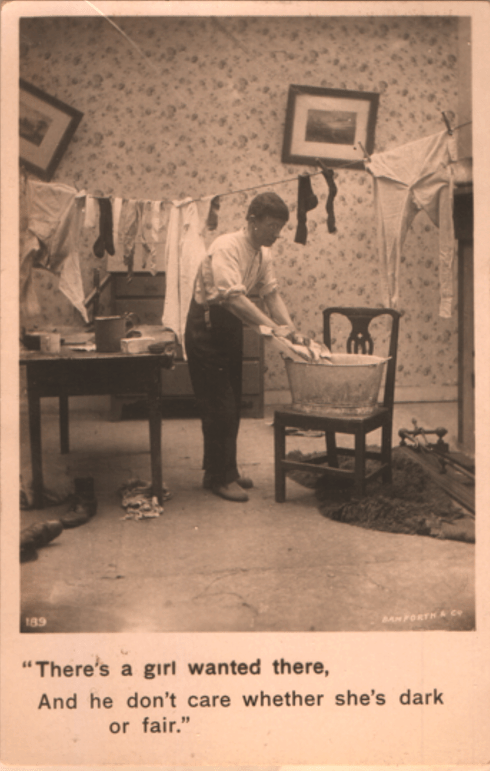
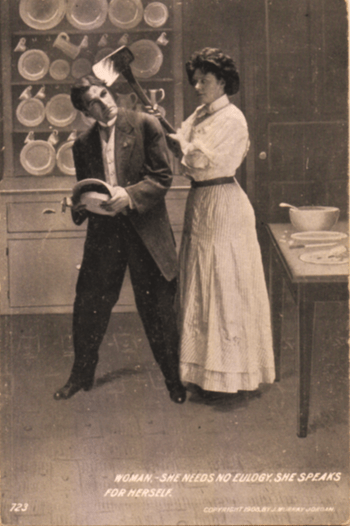
Even as a child, though, I resented all the folktales which suggested that if men and women switched jobs, the women would do perfectly fine while the men would be lost at the outset and and be nothing but a puddle of muddle by lunchtime. And the majority of fine old postcards follow this trend. Laundry, especially, was considered a suitable reason for getting married.
Given the laborious sequence of steps involved in doing laundry before the invention of washing machines, detergent, and dryer sheets, it seems foolish to feel that women had a natural talent for the job. It was ore an understanding that a man, by natural right, got to work an eight hour job while a wife was on the job twenty-four hours and could handle little chores that involved a tub of hot water (prepared on the stove a kettle at a time) a tub of cold water, a tub of bluing, a quantity of starch, a wringer, a mangle….
Let’s consider something simpler. Washing dishes involved a mere sink full of hot water, some kind of soap, and elbow grease. This was the second greatest running gag of those on KP during World War III, after peeling potatoes. Interesting how women going out to the assembly line in the absence of men was heroic, while men having to do women’s chores…hey, it’s that same old folktale again!
And yet, for a generation before that war came along, it was acknowledged that getting married did NOT excuse a man from washing dishes. At the very least, he was expected to dry as his wife washed. (This is another issue, by the way, which has divided our nation for generations. The dishcloth families sneered at the lazy louts who simply put the rinsed dishes in a dishrack to dry, while the dishstrainer folks sneered at people who wiped every dish and spoon with a dirty old dishrag. Where did YOUR family…oh, you were a paper plate clan? I see this is a whole nother blog.)
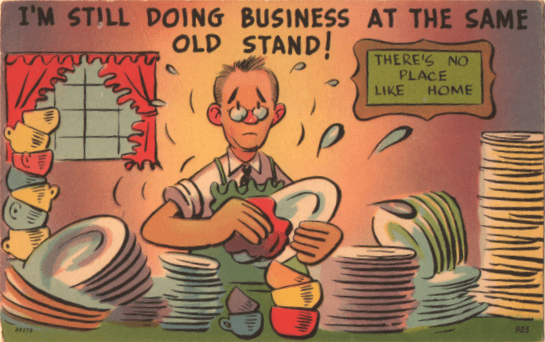
In most cases, postcard cartoonist regarded the poor chap who had to wash the dishes after supper as not so much inept as overworked. (How much does his family rt, by the way? The sink is almost as bad as the one confronted by that chap in the Army two paragraphs ago.)
No wonder some men just let things go until the usual laborer came home. (In spite of nagging from the feline section of the family.)
While men who moved straight from the house where Mom took care of these little details to their own establishment, where their Dearest expected them to help out greeted this revolting development with a plain old pout.
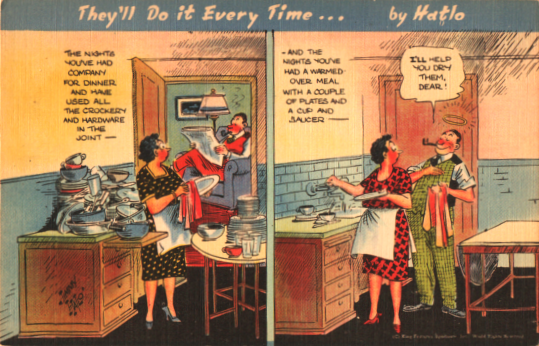
As time went by, some husbands became experienced in the ways of the household, and found a way to time their volunteerism carefully.
And wives found ways to express their gratitude for all the help. As many a husband in the kitchen pointed out, “I don’t object to the words you use, my dear, but I don’t like the axe sent.” (Look, it was either write that joke or take my lunch dishes to the sink. Be reasonable.)
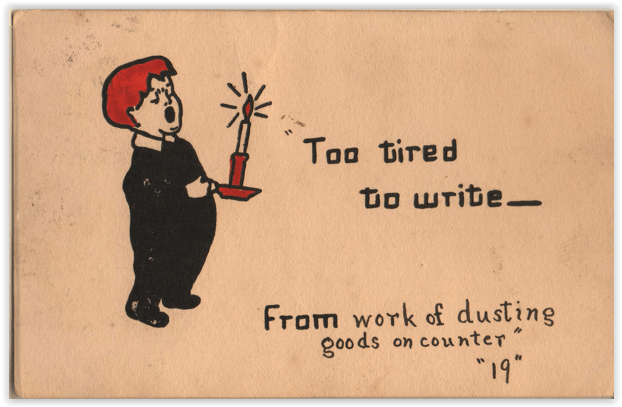
We have discussed this before, but one of the jobs postcards tried to handle for two or three generations was nagging people to write. It was a rule of etiquette at the time, you see. If I write you a letter, then the ball is in your court. Now you owe ME one.
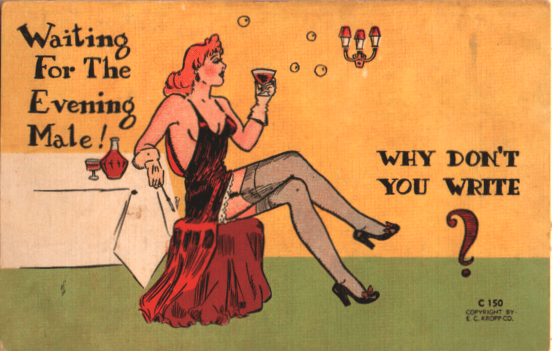
More often than not, it was a woman on the card demanding that letter (or at least a return postcard. The postcard was NOT a letter, and therefore it was appropriate for you to send one to someone who owed you a letter, because otherwise you were putting them under an obligation to do TWO letters. This is also reflected in the tradition of publishing postcards which expressed ecuses for not writing a letter yet. The sender knew this did not COUNT: you could not return a postcard for a letter. But you could keep sending your excuses on postcards, perhaps in the hopes that if enough time passed, you’d both forgot who owed whom a letter. I wonder how a telegram counted in this whole rate of exchange. I also wonder if we’ll get back to the subject of this article.)
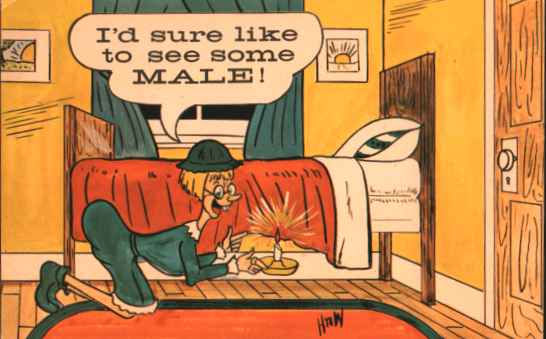
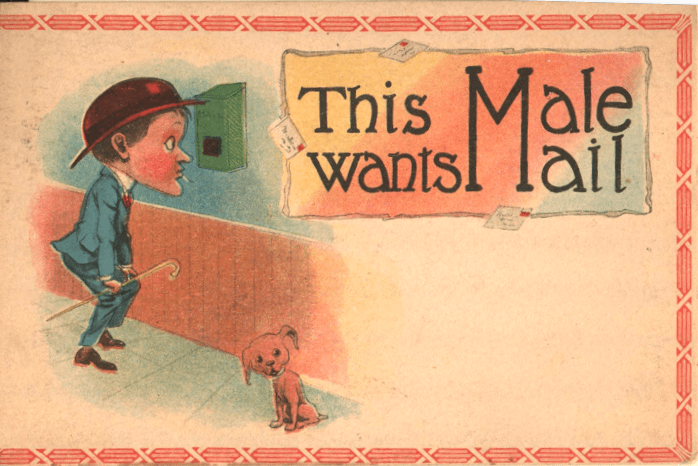
One reason that a woman was demanding the letter was so that the cartoonist could use a joke substituting “male” for “Mail”. I have no statistics to show whether more men failed to answer letters than women. I suspect it ran about fifty=fifty. Rigid insistence on the Rules is not really linked to sex and/or gender.
I’m not sure whether the rules have continued into our primarily digital civilization. I know it never applied to email. Be more than five minutes about replying to an email from a co-worker at a desk eight feet from yours, and you get nine or ten emails asking whether you saw the first email.
In spite of all temptations, I have never been enlisted into the texting world. I blame this on my correspondents, really. I seem to be acquainted primarily with people who still use their phones to make phone calls. On the other hand, I’m the one who keeps his phone over there, being charged just out of reach. Responding to texts on a regular basis would mean having my phone at the ready, which I regard as dangerous. No, not that the poor old thing might explode, but that the poor old thing holding it will think, “Well, as long as you’re here, let’s play a few match 3 games.”
There’s no space here to go over the pros and cons of digital communication over the handwritten version. Yes, you save time by not having to decipher your correspondent’s handwriting. Yes, future generations will be largely denied the ability to read through old love letters of the rich and famous (it’s harder to delete a spicy letter than a series of sexts: in the good old days when you had a fireplace, there was a chance. Nowadays if you destroy a letter you have to hope AI has not figured out how to reassemble scraps from your shredder.) I WAS disappointed that one of the publishers I send a Christmas card every year no longer publishes its mailing address. Whether this disappointed them or will disappoint future researchers must be left to the future.
However, this whole digital revolution HAS threatened the male/mail joke with extinction. Go ahead, try to make jokes about emale. I bet you hear from HR about pronouns.
It wasn’t the intense odor of vanilla that told Bott where he had landed so much as the fuzz. He recalled the time that his Klamathan captain, especially upset, had ordered half the crew to shave their legs and hips before being stood in corners. Easing one hand up past his face, ge fave the yielding yellow obstacle a push.
Vo complaint came from the Klamathan, but she did step forward, relieving Bott of the idea that she had been killed and hung on the wall as a trophy. As he pulled himself free of the tube he’d descended through, he found three sets of buttocks but no other threats in the small cubicle.
Apparently the Klamathans had decided simultaneously to remove their clothes and hang the garments on hooks thoughtfully provided by the Emperor. Perhaps they had taken a shower; about an inch of water was lapping at their toes.
He did not approve of the way they stood, their arms dangling, their heads tipped back at a ninety-degree angle. Had he accidentally slid into a lab where His Imperial Walrus made copies of people, and found half-finished replicas of his crew?
He glanced up to look at what they were seeing. His eyes narrowed at the flashing lights; not bright enough to cast illumination around the cube, they must have some other purpose. Concentrating, he could just hear the music. He had learned, during his time on the Klamathan pirate ship, that certain frequencies could affect the minds of greens; he had learned a room ago the same thing could happen to golds. No doubt there were notes which could attach any Klamathan, particularly ones like these, especially susceptible after long days in the Imperial cells.
The lights did impart a soothing air; Bott wondered if there were some code in the shifting of the lights, some subliminal command. He realized as he watched that he had not had any natural sleep in days. And there were hooks on the walls for his clothes. The maze wouldn’t go away; he could try to get through some more after a nap.
His hand slid down his jacket but the cold fabric made him pause in removing it. The sensation clashed with the message of the lights, so he looked down. The water was now lapping over the tops of his boots. So THAT was the message: just rest there while we drown you.
Better not to look at the water; the surface was reflecting the lights. And he thought his nap might just have to wait. Looking around the walls, he found two chute openings, one of which he had just come through. Both were closed now, lest they interfere with any recreational homicide. He moved to the one he hadn’t used. A lock was visible, and elementary. He turned to consider his crew.
They were somehow more daunting in the buff: he could see everything they wanted to bring him into greater acquaintance with. Was there any reason to take them along? Really?
Bott let a finger slide below the symbols on the lock. Then he pushed away from the wall. No self-respecting captain would abandon his crew. Not, at least, without checking their clothes to see if they were carrying anything he could use.
He found a few things they had not mentioned; he wondered if they had even mentioned them to each other. There was a dagger with an Imperial reucas on the hilt and dried blood on the blade, perhaps a memento of the previous owner. The blue had shown no inclination to use it this far. The gold had a tiny metal box of crystallized honey. Where had she been hiding that? He decided not to worry about it.
“Ah!”
He thought he remembered them mentioning this. He slid it free of the green’s overalls, and studied the three rebels. “Chlorda, we want you about here.”
She moved one step in the direction he pushed her; the water splashed her shins. Moving back, Bott sighted along the six buttocks. Sloshing back a bit through the rapidly rising water, he squinted. Then he came up and urged Bassada backward one step. He noticed she had a tattoo. He hoped this was the last time he saw it.
Setting his shoulders on the wall between garments smelling strongly of chocolate and honey, he measured the jumprope along one arm, tying knots at proper intervals. Then, an end in each hand, he pulled it tight once or twice before pushing off from his leaning post.
The rope shot overhead with a loud pop. He nodded. He sighed. If this worked, he would probably regret it for the rest of his life. But there were things a captain was expected to do for his crew.
The rope swung in the air long enough to pick up some momentum, and then came down. A dark green stripe appeared across the bottom farthest from him.
Had it produced any other result? Bassada’s head turned to look back over her shoulder.
“C’mon, Cap’n! One or two more fer good measure!”
Bott coiled the jumprope around one hand. “No time to play.”
Louba rubbed one buttock and said, “Well, a little’s better’n no dessert at all.”
“Cap’n’s got a knacky hand with a rope,” Bassada agreed. “’At’sa way I likes him: firm but unfair.”
Bott fiddled with a knot. “Grab your clothes and let’s move. And don’t look at the ceiling: that’s what trapped us.”
Pursing her lips, the golden aristocrat sploshed through the water until her breasts were all but resting on her shoulders. “I tried to urge them through, but one has to check for traps and….”
“She found ‘em.” A green thumb and forefinger reached over to squeeze one peach-colored nipple nearly flat. “Whose t’rone’s gotta hole in the seat now?”
“In general,” said Chlorda, her narrowing eyes still on Bott, “It takes a specific frequency for any single Klamathan to be hypnotized. But the lights rendered us vulnerable and then the music froze us.”
Louba’s generous swat against the golden backside nearly sent Chlorda and the captain against the wall. “When ya gots such little parts, they’s easier ta freeze.”
The gold whirled. “At least I don’t need to wear trousered garments to keep bits of me from dragging on the floor!”
Louba slapped her own backside this time. “B’leeve me rear end’s in peart good shape, considerin’ ever’thin’ yer leadin’s dragged it through.”
“Mebbe ‘at’s not one o’ the bits she meant,” Bassada put in.
Louba reached out, took the blue nose, and shook it left and right. Two blue fingers jabbed into the green abdomen.
“Better hurry.” Bott did not have to bend very far to slap the water with his hands. “The door looks so simple there may be a trick.”
Chlorda moved deliberately to her clothes, arms fully extended, hands straight up, fingers arched. Bott caught the little motion of those fingers, and knew what it meant in Klamathan. Louba’s response was less elegant, but then, she had bigger fingers.
Bott leaned against the wall again. He wondered whether any of these rebel leaders had ever led to anything much. No doubt their companies had little in the way of central control. Everyone did just what seemed good at the moment.
Like a pirate.
That was a depressing thought, so he drew his grenade satchel a little farther from the water and looked inside to find out how many antique weapons were left. “’At’s an idea,” said Bassada. “Bust a hole inna walls and let some water out.”
“No no!” Chlorda shook her head vigorously. “My mother was put in an Imperial maze, cut her way out, and fell into a system of narrow tunnels filled with Vannasan caterpillars, long fuzzy things as thick as your leg. We never saw her again.”
“They…ate her?” Bott demanded.
She shook her head again. “No, Mother enjoyed their company so much she never came out.” Golden shoulders shrugged. “She does text us on our birthdays.”
Bassada expelled air, and a little moisture, between her lips. “Oh, le’s have a moment o’ silence fer Maw. Okay, ‘at’s ‘nuff.”
Seeing his crew mostly clad, Bott moved to the door and pressed the tabs on its lock. A quarter tist to the left sent the door sliding into the wall. A light blue tube beyond went straight for about three body lengths and then curled to the right.
“I don’t trust that curve,” he said, as his crew crowded behind him, six hands quite accidentally sliding along his back. “We’ll go in order of size, smallest first. Then you can grab our ankles and bring us out if we get stuck.” Louba and Bassada stuck their lower lips out. Chlorda limbered up her fingers.
Bott set his hands on the rim of the door, but jerked back when the tunnel whined at him. The sound stopped. He put his hands down to boost himself up again, and the high, discordant drone started again. Gritting his teeth, he pulled himself up and into the tunnel. The pitch went up a half step.
“I….” he began, glancing back.
His head swiveled forward as a bright square containing white diamonds alternated with black spralled along the wall, too fast for him to dodge. He felt nothing; it was just a projection. A second diamond came twisting toward him, the black and white diamonds changing colors or places as it sped by.
Chlorda’s head and shoulders were inside the tube. “That…could be pretty bad.”
“So it must be the right direction,” Bott replied, raising his voice above the whine of the tunel.
“Mebbe ‘ey jus’ wants ya to think so,” Bassada suggested.
That was certainly possible, but Bott had no desire to backtrack and try to find another door. Hitching up the shoulderstrap of his satchel, he crawled toward the oncoming diamonds. “Come on, crew.”
“Look, I have to climb the wall a then walk across a yard filled with gravel to get to Darkhaus the Dire’s dungeon door.”
“Yes, sir. And those Slippers of Silence will get you across the gravel without disturbing a single pebble which might alert a watchman or guard dog.”
“I don’t care how silent the slippers are. The soles are so thin that the second I drop down into that gravel, I’LL be making sounds.”
“What else can I offer you, sir? You’ve already turned down the amulet which ensures that the wizard’s legendary dogs won’t detect you by sniffing the air.”
“Yes, by permanently making me smell like a dog. And that ring you offered me that would help me just scare them away…..”
“Being turned into a tiger would indeed make you rather conspicuous, sir. But I did offer you the shield which would repel all of Darkhaus’s dire enchantments.”
“And, at the same time, make every magic amulet I carry myself inert as well. Are you sure you won’t sell me the invisibility cloak you mentioned in the first place?”
“I’ll sell you whatever you please, sir. But I don’t think….”
“I’m starting to believe that’s true. Let me try it on, at least.”
“Here it is, sir. But you should know….”
“Ah, nice and warm.”
“It is warded against all inclement…do come back, sir. You haven’t paid yet. And the door is barred.”
“How did you know I was walking that direction? If you can see me, then the Invisibility Cloak….”
“Works a little differently than you expected, sir. Look at your arms.”
“Yes, I can see…but where’s the…I still feel it on my shoulders.”
“That’s right, sir. When you put on the Cloak of Invisibility, the cloak becomes invisible, not the wearer.”
“What use is THAT?”
“You asked about Invisibility Cloaks, sir; I didn’t claim I had one that was useful. I believe the conjuress who crafted it said it would break the ice at parties.”
“She sounds like a real charmer. Maybe I should buy it, though. If I break into Darkhaus’s place wearing this, maybe he’ll laugh himself to death. No, I’ll buy the tiger ring instead.”
“Indeed, sir?”
“Indeed. I’ll use it to discuss that joke with the sorceress.”
“Very well, sir. Thank you, sir.”
“Maybe if I scare her enough she’ll sell me something I CAN use. Does she live far from here?”
“Not very, sir. Just take the north road out of town, sir. She has a tall tower in the center….”



















 Blogsy Babbles