Once again, dear reader, your faithful bloggist has come through. Prompted by the seventh online expert in one week to tell me that the original jack-o-lantern was carved from a turnip (something they told us every year in grade school, thank you all) I looked up one or two questions no one was telling me about. These are of no use to you at all, but the Interwebs would not loom so large in our lives without that sort of information.
Whilst eating popcorn, a major part of my healthy diet, I wondered if people still refer to the unpopped kernels as ‘old maids”. The quick answer is that yes, they do, in spite of warnings I found online for people learning English as a second language that this phrase is considered offensive in some places.
The phrase derives, of course, from ‘old maid’ as a term for a spinster or unmarried woman, which became current somewhere during or before the fifteenth century. HOWEVER, in spite of those not very fine old jokes inevitably made about the kernel being unpopped, the older phrase is only the first step. There is another old maid which needs to come first.
In the 1830s, the world was taken by storm with a new game by Eliza Leslie. It was played with a regular deck of cards and, if girls were playing, was called Old Maid, but Old Bachelor if it was played by boys. The game had its day and was starting to fade when in 1883, a publisher brought out a version with a special deck of cards with funny characters on them. This game was called Merry Matches, but was so similar that it took on the name(s) Eliza Leslie gave it.
Around the same time, those unpopped popcorn kernels got their nickname. My own guess is that this came about because people ate popcorn and played games on family evenings. Historic slang dictionaries indicate that in some places, the unpopped popcorn was called Old Bachelors, which I think shows the line of descent from the original Old Maid (who was not expecting….. let’s move on.)
I also wondered whether anybody still makes jokes about needing their “beauty sleep”, and when we started using THAT phrase. I had to fight past all the Beauty Sleep and Beauty Rest mattresses, but it turns out the phrase is even older than the old maids.
It starts appearing in the 1810s and 1820s and even in those days was used primarily as a light-hearted joke. This was an era when parties often started around midnight and ran for several hours, and a nap was often resorted to around 7 P.M. (Only a few people–influencer…well, writers—took it seriously declaring, that sleep before midnight was better for you than sleep after midnight.)
And then I worried about this postcard, and that spelling. It is entirely legit.
A Scottish term, Colsie, first recorded in the seventeenth century, meant much the same thing. It went on to be spelled Cozy, Cosy, Cosey, Cozie, or anything else within reason. In the 1850s, some ingenious soul made a verb of it, and to “cose” meant to make oneself comfortable, alone or as one of a couple. A generation after THAT, people turned it into a noun, as a knitted cover to keep something warm—a tea cozy or, less often, an egg cozy.
Where would the Interwebs be within controversy, though. Online, where an expert is defined as “anybody with a blog”, there is argument over whether ‘cozy’ led to the word ‘cushy”, meaning something simple and no problem that the person at the next cubicle got as their assignment. One or two experts claim they are closely related, if not actually mother and daughter.
MOST dictionaries, however, claim they’re barely acquainted, saying that ‘cushy’ was originally a military term employed by the British Army in India, where the Hindi word ‘khush’, which also gives us “cushion”, was used to mean either an easy job or an easy-going person. (Or simply a weakling, depending, apparently, on the tone of voice of the speaker.
So you are now in possession of a load of data at LEAST as important to your daily life as that business about turnips (and, by the way, nobody to this day has answered the question that fretted me as a child: were they really big turnips or really small candles?)
The land of Costren was a pretty nice place to live, except for the giant. There’s always something.
The giant, a hungry, hairy figure of a man eight times as tall as a tree, used to come around to Costren for his lunch every day, with the result that a family or two would never be seen again. The king pf Costren, whose castle was just over a hill and around a corner from the castle of he giant, begged him to take gold instead of people. With gold, he explained, the giant could buy food somewhere, or order in. The giant agreed to this. Once a week, he would send a great iron coal wagon pulled by three tigers over to the king’s castle. The king would fill this with gold and send it back whence it had come.
The people of Costren were happy about this for a while. But providing that wagonload of gold for the giant every week was emptying out the king’s treasury. There was no money left to build bridges or fix roads. So he had to raise taxes.
And so the people began to grumble. “More taxes. More taxes. He must be eating all our money.”
“I wouldn’t mind if all the money was going to the giant. But with everything this country needs, what must he do but build a big shiny bridge over a hole in the ground he dug himself!”
This was absolutely true. The king had ordered his men to dig a huge pit, with a tunnel leading to his castle from the bottom. And he had ordered his engineers to build him a high, shimmering crystal bridge. A staircase ran along the curve of this bridge to a shimmering silver chair at the highest point.
When this was all finished, he called a meeting of the people of Costren. Hundreds gathered to look at the bridge, which had guards standing at each end to make sure no one tried to walk on it.
“What do you suppose this is all about?” they asked each other. “He’d better have a good excuse for building this big shiny thing!”
At length, trumpets sounding, the gates of the castle opened. The king strode out and up to the bridge, holding the hand of his daughter, Princes Tinabula. He stopped at the base of the bridge, but the princess marched up the stairs. When she reached the silver chair, she curtsied to the crowd, gathered her skirts, and sat down.
Everyone applauded. No one had a notion what was going on, but it was all very pretty.
“Now that I have your attention,” called the king. “I would like to make a proclamation.”
People stopped applauding. Proclamations almost always had something to do with taxes, usually that there would be more of them, and everyone would have to work harder to turn this kingdom around, and this proclamation really didn’t count against last week’s proclamation that there would be no new taxes.
“There will be no new taxes,” the king proclaimed.
The people applauded just a little, polite but not convinced.
“Instead,” the king went on, “We are going to have a game, open to anybody who wishes to play. Every day, provided it doesn’t snow or rain, my daughter, the Princess Tinabula, will sit in this silver chair for four hours. Anyone who wishes to do so may step into the booth right there.”
He swung his scepter to point out a little wooden booth at one side of the pit. “Each player will throw a coin of his or her choice to the Princess Tinabula. Anyone whose coin touches her chair or her shoes will win seven silver coins.”
A few people applauded. The rest were digging pennies out of their pockets.
“But anyone whose coin touches the princess’s dress will marry her.”
The crowd dropped into complete silence, staring at the smiling princess, who waved at them. “Or, if the winner is already married or someone who does not wish to marry a princess,” the king went on, “Someone in the winner’s family will instead marry the princess, move into the palace, and become a prince.”
Nobody applauded. Everyone was running at the booth, holding coins in the air. The idea of being a prince, or at least having a prince in the family, sounded excellent.
Twenty-three fights about who was first in line had to be sorted out by the castle guards. Thirteen people fainted and fifty started to cry thinking they wouldn’t get a turn. But the line was finally organized, and people stepped up into the booth, where they found throwing their coins a little more difficult than it had looked from outside the booth. The sun glinted off the shining crystal bridge right into their eyes, and the booth wasn’t QUITE big enough to allow for a full wind-up. Nonetheless, everybody wanted to try, those who failed to hit any target cheerfully running to the back of the line and pulling out another coin.
Princess Tinabula stayed in tat silver chair until the sun went down, and people couldn’t see to throw anymore. The people of Costren went home to find more coins (except for the one or two who had actually managed to hit the chair, who made immediate plans to return the next day for seven more turns with their winnings.) And the king’s men came down through the tunnel from the castle to shovel the coins thrown that first day into wheelbarrows. The coins went straight up into the treasury.
The same thing happened the next day and the day after that, and day after day. The guards never took up fewer than six wheelbarrows full of coins for the treasury.
So the king was happy, because his nearly goldless treasury was on the way to being refilled. Princess Tinabula was happy to be of help through little more than smiling and waving. The people of Costren were happy, since there would be, after all, no new taxes, and they had a game to play which might win them a little silver and perhaps a princess of their very own. No one knew whether the giant was happy, but at least he wasn’t coming around and eating people.
One person in Costren was not happy. This was Princess Tinabula’s little sister, the Princess Drewvia.
“Don’t you get tired sitting up there all day?” she asked Princess Tinabula.
Tinabula shook her hair back. “Don’t be silly. I have a parasol to keep the sun off my face, and trousers so no one can peek up under my dress. As long as I have a book to read and a box of chocolates and cold lemonade to drink with them, it doesn’t matter where I sit.”
“But you’ll have to marry just anybody,” Princess Drewvia told her.
“Not just anybody,” said Princess Tinabula, glancing in one of the mirrors she always kept handy. “Only a young man with good, strong arms could manage to reach me with a coin way up there. Why, sometimes I have to stick out a foot just so somebody can win a little money.”
“But….”
Tinabula looked up from the mirror. “Drewvia, I just do not see what your problem is. Unless you’re jealous.”
Jealousy was not Drewvia’s problem. Her problem was that she had brains. And these brains told her that one day somebody with a good, strong arm (or hidden slingshot) was going to toss a coin hard enough to land it right in Tinabula’s lap. The princess would then be married, but the treasury would still need money. Someone else would have to sit in that chair and be the next grand prize. Of course, the obvious person to take over the job was the next princess, which was Drewvia.
And Drewvia didn’t want to marry just anybody from the crowd. She had already decided she was going to marry Geirge, the apprentice to the royal wizard. The only reason George and Drewvia weren’t married now was that it would have been severely improper for a princess to be married before her older sister. (That and the fact that Drewvia hadn’t told George yet that he was going to marry her.)
The next morning, while Tinabula was sitting in the silver chair, sliding her shoes toward the crowd and then jerking them back before a coin could hit them, Drewvia went off to the tallest tower in the caste. She found George stirring a big smelly kettle of the wizard’s latest experiment.
“I just don’t know what to do,” Drewvia told him. “One of these days, they’re going to hit her. And because we have to pay for roads and libraries AND a giant, I’ll have to sit there next.”
“We don’t know what to do either,” George told her. “Some of that money, you know, goes to pay for magic books. The wizard reads them, over and over, looking for ways to be rid of a giant. But to get him into our power, he has to say we’ve defeated him. And how can we defeat him if the only way to defeat him is to defeat him?”
“That has its drawbacks,” said the princess, wandering over to the cupboard where the wizard kept his completed potions. She opened the door, said hello to the grumpy pixy who guarded the potions, and studied the boxes and jars. “Isn’t there anything else we could do? Could the wizard turn you into a giant for just long enough to wrestle him?”
George made a face. “He thought of that. If you KNEW some of the brews I had to drink while he was trying that! I’d rather eat Swiss chard on a bed of squid with liver and bleu cheese dressing. He did find a recipe for a elixir which will make things twice as big. But that’s all, and it isn’t enough.”
“Twice as big?” said Drewva. “Why not just drink more of it?”
“You don’t drink it,” said George. “If you do, you explode. You just sprinkle it on. And it won’t make anything more than double in size. Here, hand me that white bottle on the second shelf.”
Drewvia found the bottle and passed it over, managing to touch his hand as she did so. He didn’t appear to notice, and looked around the room as he pulled the cork from the bottle.
“Ah!” He stooped down and scooped up a mouse that was slipping behind a box of crystal balls. He splashed the captive animal with the potion and let it drop before it knew what was happening.
“Oh!” Drewvia jumped back.
“Some princess!” George snorted. “Afraid of a mouse?”
“I’m not! It’s just the biggest mouse I ever saw and….” She pointed at the door. “It’s getting away! Shouldn’t you do something?”
The mouse was gone. “It doesn’t last long,” George explained. “Anyway, the cat’s big enough to deal with him.”
“Of course,” said Drewvia. “The cat’s big enough. But that was the biggest mouse I’ve ever seen.”
George corked the bottle, set it back into the cupboard, and went back to the cauldron. “If I let this new potion burn, the wizard will turn me into a mouse, and a little one at that. Je tells me half the mice in this castle were once salesmen who woke him from his naps.”
Drewvia considered the door the mouse had temporarily escaped through. Then she asked, “George, if the giant did say you defeated him, would he disappear right away?”
“No,” he told her, “It would just put him into our power. Then, according to the books, mind you, whoever defeated him has to say ‘scooper drooper’ three times and then tell him he’s a mouse, or a fly, or something. And he’ll turn into that forever…or until some other wizard with another spell comes by.”
“Ah,” said Drewvia. And then she started talking about what was in the cauldron, which turned out to be a new kind of paint remover and nothing at all to do with the giant.
Eventually, she went down to her own room, and opened her wardrobe to pick out her best walking shoes and some warm clothes for hiking. That night, somewhat after midnight, she put these on and crept up to the wizard’s workroom.
“What do you want?” asked the pixy guarding the cupboard when she opened the door.
“That bottle.” Drewvia pointed at the one with the double size potion in it.
“Did the wizard say you could take it?” the pixy demanded.
“Not exactly,” said the princess.
“Okay. Take it and go away. I need my beauty sleep.”
Drewvia picked up the bottle. “You aren’t going to make any noise or tell the wizard or anything?”
“My job is to watch his potions. I’m watching them. Now go away, will you?”
“But you’re supposed to be guarding this cupboard.” Drewvia tucked the bottle into her purse.
The pixy opened one eye. “Are you stealing the cupboard?”
“No.”
The eye closed again. “So be a good little princess and go away now, won’t you?”
Drewvia shrugged and sneaked back downstairs. She slipped out through the castle gate and started the long walk to the giant’s castle. The moon was bright enough to show her where she was going, but she was still worried. A place that had a giant living there, she reasoned, likely had other things wrong with it.
Of course, she was right. As she moved through the forest at the top of the hill, something moved toward her. Drewvia was on the alert, and saw it almost as soon as it saw her. But this did not do her much good. The tiger was so big that a horse could have stood upon its back, at least until the tiger got hungry. Pulling a coal wagon filled with gold once a week no doubt gave it a mighty
“I am impressed, Dr. Van Helsing. You are the last person I would have expected to decorate his house so thoroughly for Halloween trick-or-treaters.”
“At this time of year, the curtain between worlds is at its thinnest. If I can lure the demonic monsters here, I can avoid having them attack innocent partygoers.”
“So this is all bait?”
“Indeed. You may not know it, but all the candy corn available this time of year is actually for people who wish to subdue evil walking scarecrows.”
“I see.”
“Every villain has a confectionary weakness. Evil sentient computers can be appeased with Smarties, while nightmare clowns subside in gratitude for Chuckles or Snickers.”
“I suppose you have Swedish Fish in case the Creature from the Black Lagoon comes by.”
“Not at all. For him I have a Raisin Net. The stray, small spirits of mischief abroad this night will be held back by these Pixy Stix, and I regularly see one wailing ghost who is still looking for Mr. Goodbar. These Starburst will control any alien invaders.”
“And you’ve piled up Mary Janes for the stalking cannibalistic slashers.”
“No: Junior Mince. I have provided for any eventuality, with these emergency candies in case someone I had not anticipated appears. Here’s Bazooka gum, and, at a pinch, Lifesavers.”
“And do you have anything for any actual children who come to the door?”
I sometimes come to you, my army of readers, when I am confused by a postcard. This is done on the theory that everyone across the Interwebs has information, or at least an opinion. When some point in a joke or a picture has me puzzled, I bring my troubles to you, and not once has this resulted in an answer. But it fills up a column.
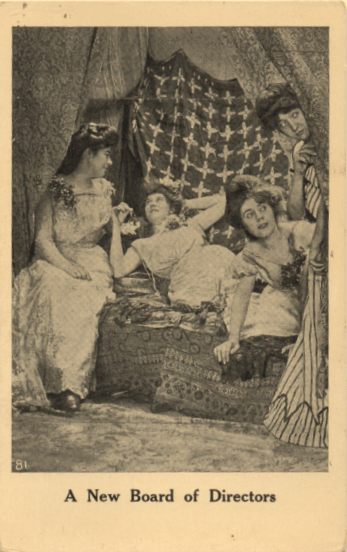
This time, however, I have run across a postcard company which seems to be confusing me on purpose. The cards and I are at least a half century apart in age, so I don’t say they were thinking of me personally. But they did produce a series of postcards featuring women who are busy with their own occupations, like the one shown here in her urban sanctuary, who are going about their business without any care about what the audience thinks they’re up to.
There is no hint visible to my eyes of who printed these where or when, aside from a conviction from the ladies’ outfits that we are hovering somewhere around 1909. The backsides of these cards are plain, even boring, but consistent, showing they WERE produced by one company which thought there might be a market for “WHAT are they up to?” cards.
The ladies are seldom timid about whatever it is they’re doing. They are confident, self-sufficient, and generally enjoying themselves. The captions seldom do anything to clear up the mystery.
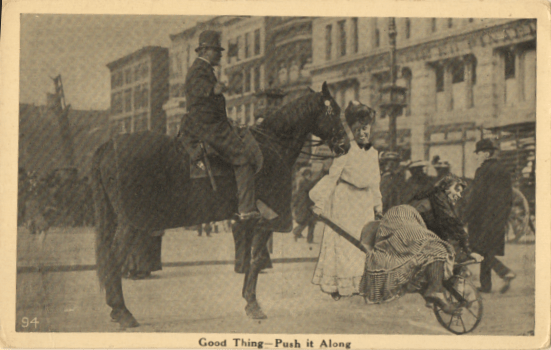
Maybe that was the point. Maybe the whole thing was an exercise in letting the viewer generate a story based on what the card showed. If you look closely enough here, for example, you will find that what is in that barrow is another woman, apparently unconscious. Is this just a good friend, helping a fellow traveler home from the bar, or is that mounted policeman ignoring Jill the Ripper taking home the latest trophy? Up to us, In guess.
Unless there’s some clue that is lost to me along generational lines. Would a viewer in 1909 understand why this woman fainted at this Edwardian Starbucks? Is there a hint to the source of the drama passing in the excitement?
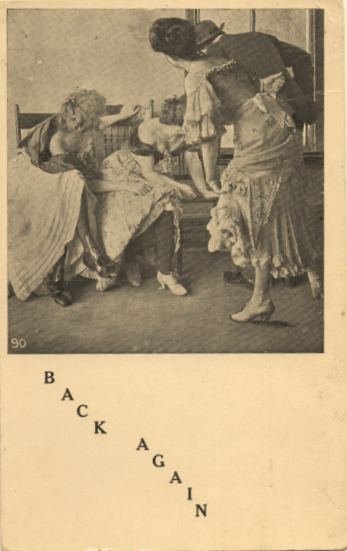
Which of this foursome is “back again”? And why…. Somebody must know.
In this case, at least, there’s a hint here in how the women are dressed. The woman on the right is clearly an adult, but adult women did not wear short skirts unless…. Is she the voice of spring? A fairy godmother?
How did these ladies get up on the telephone pole? How are they going to get down? Who’s below? Men? Is that why we’re being a little cautious about how our dresses are arranged?
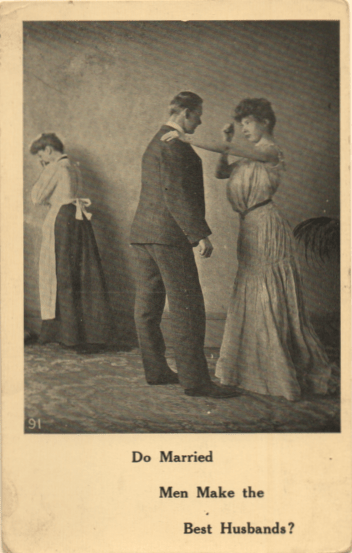
Men turn up only now and then in this series. The ladies don’t exhibit any major contempt or apathy for men. These are just, by and large, adventures without the trousered gender.
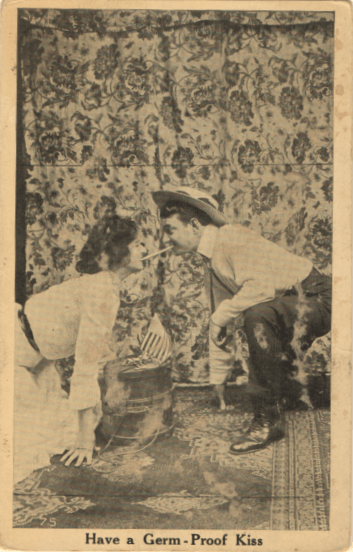
Where men do appear, things get no clearer. I get the general gist here, but what is that between their teeth? And how is that a kiss? In fact, how is it germ-proof? Am I totally clueless or just temporarily confused?
Is there an answer? Or are we just meant to be puzzled, as there is no definitive answer to this question, either.
Okay, I take it back about that last question. This card does answer it. But it does nothing for MY dilemma. If you know, send me a message. You don’t even need to use a postcard.
There didn’t seem to be any walls or floor here: only darkness. King Basso didn’t like to think what might be hiding in the dark, so he walked close behind the princesses, who were shimmering just a little, just enough to be seen.
“Of course,” he said to himself, “If I can’t see the monsters, they can’t see me, either. Perhaps I should just take off this helmet and go bravely, like a King. I slew a dragon; I don’t have to slink around as if I was scared. I am a very brave man.”
He reached to pull his sword out of the sheath, and tripped on the hem of his robe. “Too brave to concern myself with what a lot of cowardly monsters creeping around in the dark think of me. I’m brave enough to stay invisible, and let them think what they want.”
The sword just would not come out of the sheath at all. King Basso swallowed hard. “Of course, I rode my horse to go fight the dragon. Maybe I’d feel better if I went back and got my horse.”
But now he saw a little light shining ahead, coming out of what seemed to be doorway. A tiny man stepped out as the princesses approached. He had no hair, and wore nothing but a tiny pair of pink breeks.
“They’re coming!” he shouted, and skiddled back through the door.
The five princes walked through the door. King Basso followed right behind them. Surely there was no need to fear such a tiny man.
The giant was a complete surprise to him. She was twice as tall as King Basso, with long red hair and a red beard that went right to the ground. A big cauldron full of some steaming potion stood next to her. Each princess stepped up to this cauldron in turn, and the giant splashed a ladleful of potion over each princess’s head. After the splash, each princess’s beard and mustache grew and spread. Even Princess Darling, who had a hood on her nightgown, turned hairy as the potion went right through the thin cloth.
Meanwhile, the tiny man was jumping around the cauldron, looking at the princesses and then at the door. He didn’t seem to find what he wanted.
Finally, he said, “I don’t see a prince with them tonight, Wife.”
The giant woman scratched her forehead with the spoon. “Is it Sunday, then?”
“I thought this was Monday,” the little man said. “But it could be Sunday, to be sure. Perhaps I lost track, Wife. Never mind. We don’t need another cheese board anyhow. How I wish you could turn those princes into something useful!”
Looking beyond the mismatched pair, King Basso saw that what he had thought was the wall of the room was a large stack of cheap cheese trays. “Well now,” said the giant. “I have to start with something useful if I’m to make something useful out of it. Never mind. Next time we get invited to a party we ca give them away as Christmas presents.”
The little man jumped back. “Wife, we haven’t been invited to a HCristmas party in two hundred and twenty-two years!”
She snorted. “We will be, once we’re king and queen.”
“Hush up out there!” someone shouted. “We’re playin’ cards!”
“Yeah! And if yer gonna talk about cheese, bring us some! We’re hungry!”
The little man jumped over next to the giant, and jerked a thumb at the cheese trays. “I wish we hadn’t traded our daughters for those princesses when they were born,” he whispered. “I don’t know if I’m as much of a genius as it seemed at the time.”
“It can’t be much longer now,” the giant whispered, glancing at the cheese trays. “Surely a prince strong enough to break our spells will show up soon, and take them all back where they belong. They’ll make everyone out there as miserable as they make us, and spend so much of the old king’s money that his government will collapse. Then we can take over.”
The princesses with their long beards had turned to walk back through the door. King Basso stood where he was, watching them. Could it be true that his real daughters had been stolen away after birth, and replaced with the children of the hairy giant and her little husband? Je didn’t follow the princesses as they left, instead following the little man, who was skittering around the stack of cheese trays.
Five golden-haired women sat around a little card table. Their tresses were tangled, their faces were dirty, and their greasy robes hung open. Each had a glass of something green to drink, and each was smoking a long black cigarette.
“This is warm!” said one, throwing all the juice in her glass over the little man. “Get me a cold one!”
The others also tossed their beverages at him. “Yeah!” said the one with a big brown smudge on her forehead. “How come you never has any ice cubes in this dump?” She dropped her glass on the floor. When the little man bent to pick it up, she kicked him. This made her laugh so hard she never noticed one of her sisters was stealing cards from her hand.
King Basso backed away from the card table, wishing these women didn’t look quite so much like him, or, worse, Queen Azalea. What a good thing HIS daughters didn’t act like…. Whose daughters?
He was so sick at heart that he didn’t pay attention to where he was walking. When he bumped into the stack of cheese trays, one fell off.
“Ha!” said the little man. “I thought it was Monday! Wife, it’s another one of those princes with a helmet of invisibility!”
The king ran around the stack of trays, but the giant was waiting for him. “Got you!” she cried, as he thudded against one big arm. “You might as well give up!”
King Basso agreed. He reached up and took off his helmet.
“Goodness gracious!” The little man stepped over and picked up the fallen cheese tray. “Are you a prince?”
“Oh, no,” said King Basso, and this was true, of course. He went on, “The King never sends a prince down on Sundays.” This was true, too, although it was, of course, really Monday.
“What shall we do with him then, Wife?” asked the little man.
The giant shook the king. “Is your name Jack? Boys named Jack can be terrible nuisances even when they aren’t princes.”
“N-no, Ma’am,” said the King, as well as he could while being shaken. “M-m-my n-name is not-not Jack.”
“Well, Not Not Jack,” she said, shaking him some more, “What are you doing around here?”
“J-j-just looking around, Ma’am,” said the King.
She gave him another good shake. “Well, shall I make you into stew, or throw you to those five yonder?”
“Just keep quiet!” screamed a voice from the other side of the cheese tray wall. Another voice burped, and then all of the voices brayed with laughter.
“Wait, Wife,” whispered the little man. “We should let him go. See how old he is? Obviously, this is that quaint old codger who tells the good prince how to come down and break all the spells. If we tell him the secret and let him go, some Prince Jack or another will come down, rescue those girls, and allow OUR daughters to come back down here. Until we win, of course, and live in the castle.”
“I think you have the right of it, Husband.” The giant set King Basso down. “You may go, little old codger.”
King Basso was not so little, not so old, and didn’t even know how to codge. But he decided not to complain. The giant’s little husband shook a finger at him. “But don’t you dare tell any prince how you got down here. And you’d better not tell him that a silver hammer would break our cauldron of beauty potion here or that sticking us with silver pins will force us to tell a terrible secret we’ve kept since the princesses were born.” He winked at the king.
“I won’t tell,” said King Basso.
“I bet,” said the giant. With that, she picked him up and threw him at the door. King Basso sailed through the darkness until he landed with a plop in the big armchair in the princesses’ bedroom. He sat there through the rest of the night without once going to sleep.
As the sun came up, he heard a voice cry, “I have a beard again!”
“Oh no!” came another voice. “Then where’s Daddy?”
The curtains were pushed back on the beds, and five women pushed up their shaggy eyebrows so they could look at the leather armchair.
“Daddy!” Screaming, they ran across the room to throw their arms around him. “You’re still here! Are you okay? What happened? What did you see?”
Queen Azalea came into the room just at that moment. She, too, seemed glad to see that the King had not disappeared, but frowned.
“If you haven’t disappeared and you’re all right,” she said, “Why do our daughters still have all their hair? Did you fall asleep and miss the whole thing?”
When the queen said “our daughters”, the king frowned too. He stood up, burdened still by hugs. “Is breakfast ready?”
“But what did you see?” his daughters demanded. “What happened? Did you fix everything?”
The king reached out as if to take Princess Dainty’s hand, but then he didn’t. “Not yet,” he said. “I’ll fix everything tonight.”
“You know how?” the queen demanded.
“Yes,” said the king. “Tell the Royal Chamberlain I need a silver hammer, about fourteen silver pins or nails, and five bananas. We shan’t be needing any princes. Now let’s all have breakfast.”
All day long, everyone in the palace wondered what the king meant to do. Naturally, the queen and the princesses wondered loudest, asking a lot of questions. But he wouldn’t tell them, not even when it was bedtime.
“Oh please,” said Princess Delicate, “Can’t you give us a hint?”
“He saw fourteen hair fairies, I bet,” said Princess Demure. “And he’s going to nail their wings to the ceiling so they can’t bother us.”
“Then what are the bananas for?” said Princess Dainty.
“Huh!” said the king. “I suppose you never got hungry and wanted a snack during the night.”
“Oh, Daddy!” said Princess Dainty, and threw her pillow at him.
At last the princesses climbed into their beds and pulled the curtains around them. King Basso sat up in the leather armchair with all the things he had requested. He calmly peeled and ate all the bananas, to the surprise of the princesses, who kept peeking out to see what he was doing.
The big bedroom grew dark and silent. King Basso, who hadn’t had much sleep during the day, was wondering whether he had time for a quick nap when he heard the jingling sound again. He grabbed up his silver hammer and all the nails.
Thump! Princess Delightful, walking in her sleep, had stepped on a banana peel the king had thrown on the floor. There were four more thumps as four more princesses rose from their beds and then sat down hard. This did not wake them up, but it did slow them down. They tried to rise, but slid again and again on the banana peels slipping out from their sisters’ feet. Not one of them could reach the magic door that was slowly opening.
King Basso leapt from the armchair and, tripping no more than once, threw himself against the door to shut it. Then he took his silver hammer and began to nail the door shut. He had just pounded in the fourth silver nail when he felt someone pounding back from the other side.
“He’s using silver nails, Husband!” he heard the giant shout. “I can’t make it open!”
“You’ll never open it again,” growled King Basso, proceeding with his carpentry. He did feel just a little sorry for all the princes, who would have to be cheese trays forever now, but he couldn’t have the coming back out to tell just everyone about the giant’s children.
“Maybe in a hundred years or so a lad named Jack will go down and free them,” he said to himself. “There are too many princes anyhow. I’d never get any pie.”
The magic door, shut for good, was never seen again. King Basso never did explain what he’d done, but everyone could tell he’d done something. The princesses still had great quantities of red hair, but without the magic potion being splashed on them, it grew no faster than normal hair. Princess Delicate and Princess Delightful always shaved off their beards and mustaches, but Princess Darling braided hers. Princess Dainty sported a sweet little mustache, while Princess Demure kept just her sideburns. Society women went out and bought false beards and mustaches so they could look as lovely as the princesses. No one ever guessed the true reason the princesses grew so much hair.
The princesses won the volleyball tournament again that year. At the big victory feast, King Basso ate nine pieces of sweet potato pie, and led the crowd in three cheers for each princess.
“Their hair doesn’t matter so much, I suppose, now that the curse or whatever it was is broken,” said Queen Azalea. “Everybody in the country seems to love them.”
“Of course,” said King Basso, helping himself to another piece of pie. “MY daughters have been very well brought up.”
“Great Leapin’ Honk! Where in the name of all that’s pretty did YOU come from?”
“You rubbed the lamp, Master.”
“Teach me to dust in here; I’ll never do THAT again. You’re some manner of genie, are you?”
“Sealed into the lamp by Solomon himself a thousand and a thousand years beyond that, I am….”
“That’ll do, thanks. And you’ve got wishes for me, I reckon?”
“Indeed, Master. Three wishes have I for you, in gratitude for freeing me from my ancient prison. Subject to certain rules and conditions.”
“There’s always fine print. So no wishing for more wishes, and like that, hey?”
“I CAN grant you more wishes, Master. But you can ask for only one extra wish per wish, so you gain nothing by THAT. In addition, I cannot grant any wish which is basically impossible. I cannot bring you the moon and hang it above your dining room table.”
“Gee whiskers and wildcats, how will I go on without that?”
“I cannot kill more than a hundred people per wish for you, Master, nor politicians in excess of three at a wish. I cannot do more than double your life expectancy, whatever that may be. I cannot promise you happiness ever after, or the eternal fidelity of some young maiden or….”
“Say, while you’re working your way through the warning labels, can I wish myself a test drive?”
“If you mean to make a wish now, Master, that is certainly allowed. Provided it is something I can….”
“I wish you’d get back in the dadburn lamp and stay there.”
“But Master, I….”
“Thank’ee. As if my life wasn’t complicated enough already.”
Not so long ago in this space, we considered the jokes swapped between residents of the rural parts of the world and those who lived in the city. This town vs. country debate is ancient and widespread, and COULD be considered part of the basic human belief that the people who live the way I live are the best and the rest are wrong, dirty, and evil. But a kinder, gentler notion sees it as simple part of the “fish out of water” comic tradition.
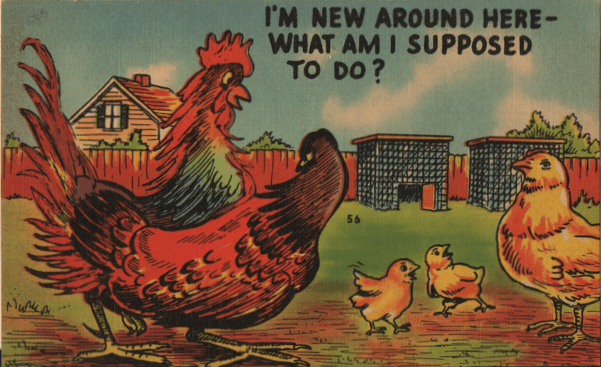
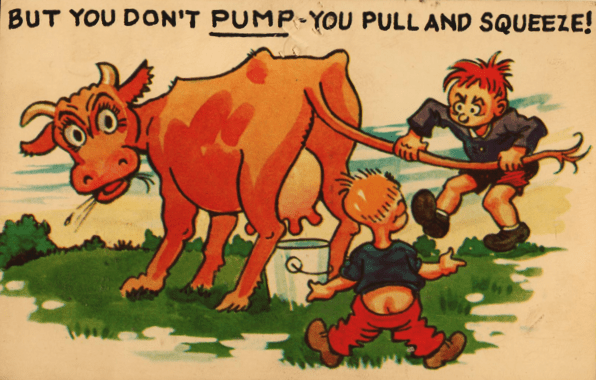
Another facet of this, often seen on bygone postcards, is the comedy of the newbie. These gags make fun at someone who is new to the job or situation, and sometimes even too young to quite understand what’s going on. Some of the same basic situations apply to both types of humor, of course/
But this is broader than just the town mouse not understanding the country mouse and vice versa. The reader gets the same sense of superiority as in the town/country jokes, seeing where the novice is going wrong. The laugh is mixed with a little sympathy, though. because we’ve all had to start somewhere and had the more experienced workers sending us for that left-handed monkey wrench or bottle of toenail polish.
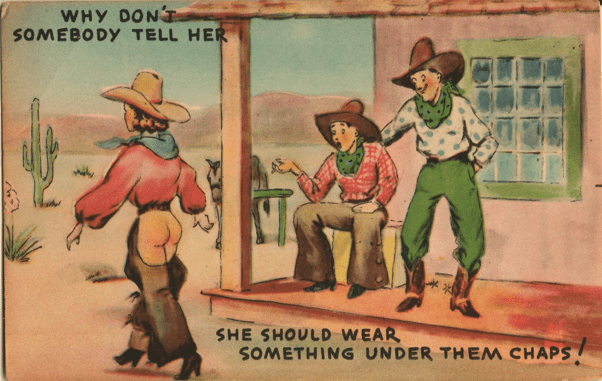
It can, um, apply to something as simple as suiting up for work. (This joke is repeated on scads of postcards. And some of us can feel superior twice, as occasionally it is obvious the artist doesn’t know what chaps look like, unlike this chap, who gets it right.)
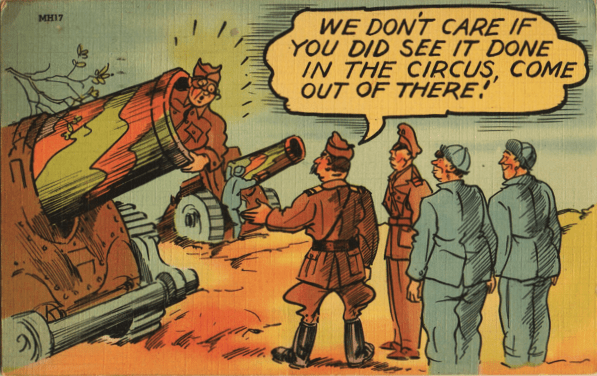
World War II saw dozens of gags which depended on the thousands of recruits who showed up to serve in the war effort without knowing a whole lot about how this military service worked. (To some degree, these descend from bestseller ‘Dere Mable’, a World War I classic, which had ancestors during the Civil War and continued through No Time for Sergeants, Gomer Pyle USMC, Private Benjamin, and so forth.)
It’s a perennial source of humor in societies where it is admitted that even soldiers can make mistakes.
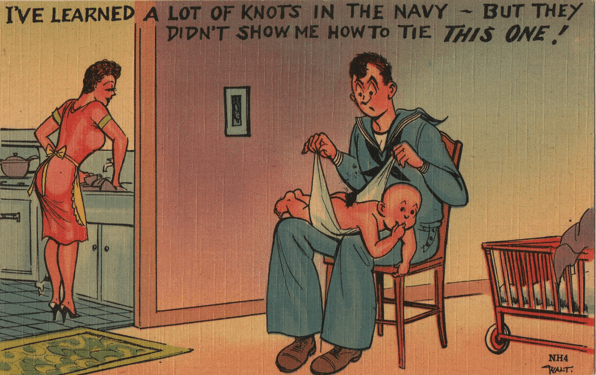
The Baby Boom, which coexisted with World War II, drew on another ancient comic trope: the man who is new to what were considered female domestic chores.
Children, both before and after that particular boom, were another rich source of “I’m new around here” humor. They had an obvious excuse for their lack of experience and knowledge about the adult world and its chores. This kept no one from laughing about it.
Back in the adult world, even one’s experiences outside work were grist for the mill. Leisure time activities often took people into new places and new situations where they could not conceal their newbieness.
The world may forgive you for not being from around here, but forgiveness never includes not laughing at you for making a misstep in a new place.
As we have seen hereintofore in this blog, the mistakes of novices are sometimes attributed to being the wrong sex for the specific activity (as in the sailor seen above trying to change a diaper.) Is it that this fishing partner is female, or just because she’s new to this fishing business that she has made a rookie mistake?
Because, and you will find this in literature as well as on postcards, our sympathy for both sides of the question can lead us to cheer for the rookie who surprises everyone by winning the game, breaking the sales record, or, like the boy from the country who marked the side of the boat in the old folktale, having a few tricks up one sleeve.
Monday Morning Breakfast was the best time of the week for Queen Azalea and King Basso. Their children slept late, no guests came to bother them, and no alarming surprises awaited. Muffins and the morning mail: it made for really a peaceful meal.
So Queen Azalea was unpleasantly surprised when her husband leapt from his chair, waving a letter and shouting something she couldn’t make out, his mouth being full of muffin and marmalade.
“What is it, dear?” she inquired. “Do sit down before you choke.”
“King Rodney of Deljoley had a plague of dragons at his castle!” the king shouted, coming back to his chair.
The queen reached for another muffin. “That is bad news. Does he need your army to come and help?”
“I don’t think so, Madame. I do not think so.” He shook the letter and then brought it back to his nose, so he could study it some more. (He had mislaid his glasses again.) “Some prince or another…here it is…Prince Gloxx of Gloxinia slew all the dragons, but not before one of them trapped Princess Aster in her tower. Rodney writes, ‘Unlike any of your daughters, Aster had a very close shave.’ Bah!”
The King threw the letter down. “Well, to be sure,” the queen said, “It’s only a little joke.” She picked up the letter and touched one corner of it to a candle on the table. Then she set it on a silver tray and let it burn up.
“Little joke!” cried King Basso. “Little joke! I’d like to take the army over there and give HIM a close shave!” Jumping up again he drew his sword and waved it above his head. In doing so, he stepped on one end of the scabbard and had to put his free hand flat in the butter dish to keep from falling.
“King Rodney had never good taste in jokes,” Queen Azalea told him. “It should be fairly easy, I think, simply to ignore this letter.” She was calming him down. Sometimes she felt she had spent her whole marriage calming him down.
“I should march them over there and just cut his head and his toes right off,” grumbled King Basso, licking butter from his fingers. “Not that I’m the sort of father to be offended by foolish jokes about my daughters. Why should I be ashamed of daughters who are unique? Other kings and queens have children as alike as the faces on cards. OUR daughters are different.”
“They are ladies to be proud of,” Queen Azalea agreed. “They won that volleyball trophy against….”
“MY daughters stand out from those nobidodies,” said the King, around the buttery thub in his mouth. “Not that they’re freaks, you understand. You couldn’t tell them apart from the most beautiful princesses in the world. They look quite like any beautiful princess, at their best. Nobody could say that OUR daughters are so different that….”
“Do you want that last muffin?” asked the queen.
King Basso put a hand out for it, but stopped. “Do I have very many appointments this morning?”
Queen Azalea ran a long finger down the morning agenda the royal chamberlain had brought in. “Six men are waiting in the throneroom to be interviewed.”
“Ah!” The king rubbed his hands together. “Any royal barbers?”
She shook her head. “Only princes. Two of them are named Jack, though, so there may be hope.”
“Pooh,” said the king. “Pooh pooh pooh. You take the muffin, Madame: I’ll go and get this over with. Sox, eh? That’s Monday through Saturday then. Have the chamberlain put out that ‘No More Princes Needed This Week’ sign. Are you sure you gave him my proclamation about royal barbers?”
The queen took up the muffin and reached for the marmalade. “Yes, I did.”
The King stood up. “It isn’t the price of the razor blades I mind. It’s the unexpectedenesses of the thing. Why must they be so hairy?”
“I quite agree,” Queen Azalea told him. “It must be some kind of curse.”
“Nonsense!” he snapped, striding from the breakfast room. “They’re not THAT hairy: not MY daughters!”
Azalea and Basso had been blessed with five daughters who showed every promise of turning into exactly the princesses any well-appointed royal family ought to have. Each had eyes like twin bright stars, lips like matched rubies, and long beautiful hair so red and bright that when they stood in a row, they looked like a necklace of bonfires.
The problem was that there was so MUCH hair. Every morning, when they awoke, their eyebrows hung nearly to their cheeks. Their arms were so hairy they seemed to be wearing long red gloves. And no other woman of good family had a mustache or beard. Queen Azalea was really quite vexed by this: it had never happened in HER family. But she did not mention this to her husband, who would have roared and grumbled.
The princesses would shave every morning (and it took nearly the whole morning, too) until they looked proper. The hair would grow back, as beards and mustaches do, just a little bit by bedtime. But when the princesses rose the next morning, each had a full mustache and a beard nearly to her waist.
King Basso hired barber after barber, hoping there was some secret known to professional shavers which would help his daughters. But the hair kept growing back. Anyway, none of the barbers was quite suitable. Old barbers were too rough: they weren’t used to shaving princesses. And young barbers fell in love with the princesses, and had to be chased away. After all, when properly shaved, the princesses were quite lovely, and could do better than to marry a mere barber. (The princesses had been named by their father: Dainty, Delicate, Demure, Delightful, and Darling. Queen Azalea thought these were quite sickly names, enough to make anybody grow a beard in self-defense. But King Basso was a second cousin to Prince Charming, so terrible names were a family tradition.)
The princesses showed no sign of growing out of this as they got older. King Basso finally offered a huge reward to any prince who could watch at night and find out anything about what was happening. He offered the same amount of gold to any barber who could come up with an answer, but by this time, every barber in the country had tried and failed.
Princes flocked to King Basso’s castle, each hoping to score the gold and perhaps a chance to marry one of the princesses. King Basso arranged for one prince to do the watching each night from Monday to Saturday.
“All right, all right,” he said this Monday, as he did every Monday, to the princes who clustered around him, recounting giants slain or wolves caught in sheep’s clothing. “You’ll each get your turn.”
As there were exactly six princes this morning, the matter was not complex. “I have six marbles in this bag,” the King announced. “Each a different color. The prince who draws the blue marble watches tonight. The green marble means Tuesday night, and the other colors are for other days. You see how it works, don’t you? Step up, laddoes. “You’re Prince Jack of Lostles, aren’t you? Take a marble, Prince Jack.”
The blue marble was drawn by the other Prince Jack, Prince Jack of Solinin. “The rest of you can all go home,” he said. “I’ll break this curse, Your Majesty.”
“That’s the kind of spirit I like to see in a prince,” said the King. “Now, let’s step over to the Royal Dining Room, and the chamberlain will assign you your seats for lunch.”
King Basso had to eat with the princes because, after all, they were princes. “And they always grab for the pie first,” he grumbled to Queen Azalea that night. “And I have to let them have it because I’m such a gracious host.”
“They’re active young men,” his wife told him, “And need to keep their strength up. You’re growing a trifle pudgy anyway.”
“Pudgy? Getting pudgy? Nonsense: not on the amount of pie I get. I’m as thin as ever I was when I was a prince. In any case, who wants to be that thin? That’s why young men look so…so terribly young. I have the figure of a wise, elder statesman. I don’t look like any prince.”
“Of course, you do not,” the queen told him. “Don’t trip on the cat when you put out the candles.”
The next morning, five princes at breakfast with King Basso, Queen Azalea., and five princesses with long, swinging beards. “Well, now,” said the king, eyeing Prince Dalma, who had taken the last muffin on the plate. “Whose turn is it tonight?”
On Wednesday morning, four princes joined them for breakfast. On Thursday three. On Sunday morning, Dainty, Delicate, Demure, Delightful, and Darling had mustaches to their elbows, and the princes had all disappeared.
King Basso did not approve of princes working on Sunday night, and the princesses were allowed to sleep late Monday morning. So Azalea and Basso had their quiet Monday breakfast, and the king got his fair share of muffins.
“There are eight princes waiting for you today,” the queen said, when they finished. “You’ll need to tell two of them to wait in the village.”
“I have a good mind to send them all home,” grumbled King Basso. “They’re grabbing all the pie and doing us no good.”
The queen folded her hands. “We could invite heroes and warriors instead, of course. But I understand they eat even more than princes. Some day we’re bound to find the right prince, dear.”
The King’s lower lip stuck out. “But it’s rhubarb meringue pie this week. Anyway, what do we need them for? I was a hero once, AND a prince. I could do it. I slew that dragon for you, remember?”
“How could I forget, dear?” the queen replied. “You put that big painting of it in the throneroom. You were quite heroic. Of course, you DID have that helmet of invisibility.”
“The dragon could have killed me all the same,” King Basso declared, shaking the marmalade knife at her. “If he’d breathed fire at me, you know, or…or stepped on me. It took a real prince with brains, and courage, and strength to beat a dragon. I wonder if I still have that helmet of invisibility.”
“It’s probably at the back of the Treasury, with all that other lumber,” Azalea told him. “I don’t see how it would help. Nine of the princes who stayed here had helmets of invisibility, too, and they never came back after spending the night. Unless they were invisible.”
“They didn’t have MY helmet of invisibility,” said the king, putting the marmalade knife down with the marmalade spoon. “I need to find that: it was the best of all helmets of invisibility. Anybody could win if he was wearing that.”
“Will you lend it to just one prince, then?” the queen inquired, picking up a few large muffin crumbs. “That hardly seems fair.”
“I shall wear it,” King Basso informed her. “Why should MY daughters have to put up with all these gluttonarious princes? And I won’t have people like King Rodney saying the kinds of things he’d say about princesses who have a different man in their bedroom every night of the week.”
“What will he say if the king disappears because he was so stubborn?” his wife inquired. But Basso had gone up to the Treasury.
The princes were delighted at the King’s decision. Usually, on retiring for the evening, they had to go right to bed and stay there, lest a prince see them walking around in their nightgowns. Now they could stay up later, playing cards with their father. They let him win a few games when he got huffy.
Finally, though, they all said their prayers and climbed into their beds. “Good night, Daddy!” called Princess Delightful. “Don’t let the hair Fairies bite!”
“I won’t,” King Basso promised. He put on his helmet of invisibility, drew his royal sword, and sat down in the big armchair usually reserved for a guardian prince.
The night proved to be dark and long. King Basso had to poke himself in the foot with the sword now and again to keep from falling asleep. “Hurry up, hair Fairies, or whatever you are,” he muttered. “Heroes can’t wait forever.”
He had no sooner mentioned this than he heard a jingling sound, as of a dozen little silver bells. In the middle of the wall to the king’s left, he saw a door which had certainly never been there before.
At the same time, the sound of rustling cloth reached his ears. The draperies around each princess’s bed were drawn back. Elegant little feet slid out into elegant little slippers.
“Where are you going?” demanded King Basso, rising to his less elegant feet.
The princesses did not reply; their eyes were closed. The mysterious door swung open. Each princess walked slowly to and through it.
“What’s going on?” King Basso demanded shaking the arm of Princess Demure.
When she didn’t answer, he paused, tapping his helmet of invisibility to make sure it was still on his head. Then he hurried after the last of his daughters. The door slammed shut just as he stepped inside.
“Hey, are you the ladies who put the ad up in the coffee shop?”
“This isn’t that ad about strict schoolmistresses who give big bad boys remedial lessons in math and manners again, is it?”
“No, the one about the buyers for cursed and haunted objects.”
“Oh yes, sir. We’re eager to swap clean, unenchanted money for your hazardous antiques. Do you have something for us?”
“These wind chimes are cursed.”
“Interesting sir, How so?”
“They’ve been handed down in my family since the sixties. My great-aunt Rose was found dead under them, on the breezeway. Her sister, my great-aunt Amy was killed in the kitchen, I guess, but her head was left under the wind chimes on the patio.”
“Promising so far, but that could be a coincidence.”
“Just wait. Amy’s daughter Kelly hung them in her own kitchen, and HER body was found stuffed in the dishwasher. Her brother took them to his place, and he wound up folded into his foldout couch bed.”
“This sounds better and better, sir, but tell me. Did they catch any of the murderers?”
“Well, Great-Uncle Jay was found dead in a hut in a forest fifteen years after Rose died. He left a note saying he killed his wife. Great-Aunt Amy’s next-door neighbor was arrested and confessed. Kelly’s husband was found with the gun that killed HIS wife, but he tried to shoot it out with police so we don’t know for sure.”
“I see, sir. We….”
“Pete’s girlfriend admitted she smothered him in the couch, and my Aunt Grace always said she was the one who stuffed Paul into the garbage disposal, but the police wouldn’t believe her and she was….”
“Let me get this straight, sir. Everyone who used these wind chimes was murdered by someone they knew.”
“Yes, and all within forty-right hours of hanging up the chimes. You see why I’ll be glad to get rid of them.”
“Indeed, sir. But we cannot buy your wind chimes, sir. They are not cursed.”
“How can you say that? Obviously they’ve driven forty-three different people to insanity and the murder of members of my family.”
“I understand, sir. But living around people with sensitive ears is simply your family’s bad luck. The rest is standard practice for wind chimes.”
We have mentioned, in an exploration of joke archaeology hereintofore, that jokes made by one group of people against another were regarded as being in poor taste as early as three generations ago, while others continued without a lot of controversy. The town/country joke went on for centuries (Aesop covered t) but it has largely been fading away.
Yes, yes, the old Jeffersonian suggestion that one of these groups of people is better than the other DOES go on. But radio, movies, and television started chipping away at the jokes a hundred years ago or thereabouts. Folks from the country already KNOW the city has big buildings in it. They don’t stop in the middle of the sidewalk to stare and cry “Land o’ Goshen!” (No, it’s NOT because people don’t care where Goshen is nowadays.)
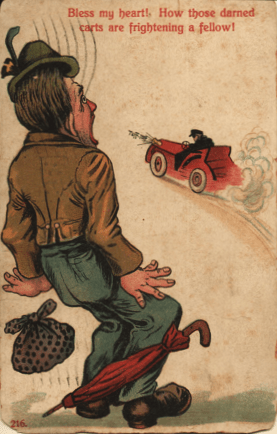
The horseless carriage is no longer a wonder restricted to city folk, either. The twentieth century plowed under all manner of differences between the rural and the urban, even as postcard cartoonists were putting jokes about them up for sale.
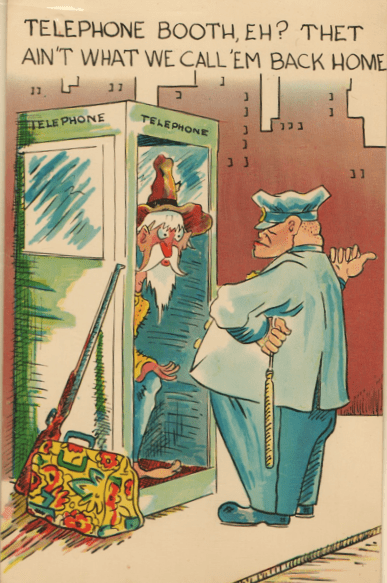
This one, for example, shows us a back country tourist finding the new electric lightbulbs aren’t worth a dang for lighting one’s cigar. This postcard is only two or three years younger than one you have seen in this space, in which a group of gentlemen try to light their cigars after dinner and learn the same thing.
And here is the same essential plot in another setting.
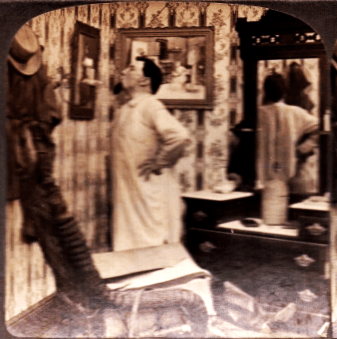
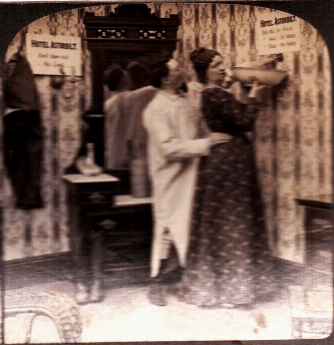
This couple, who come from a stereo card rather than a postcard, are not the only ones confused by the instructions found in hotels. Later cartoonists would show city travelers who were similarly new to modern hotels getting confused about the “ring bell for water” sign.
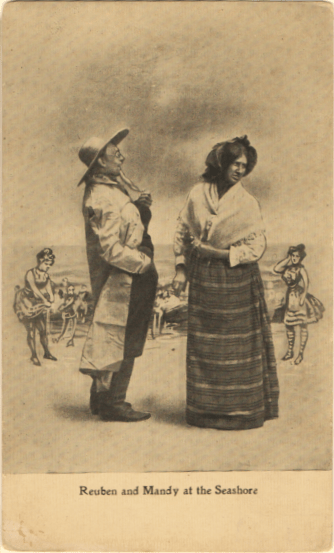
The observable difference between what country folk wore and what city folk wore would take another generation or so to change (and Mandy would, by mid-century, simply turn into an older person shocked at what YOUNG folk were wearing at the beach. But that’s a whole nother blog.) Sears Roebuck expected credit for this, and I’m not sure they were wrong (though those of us whose mothers also received the Montgomery Ward, J.C. Penney, and Alden’s catalogs know Sears was not alone.)
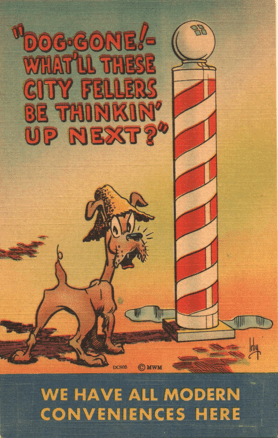
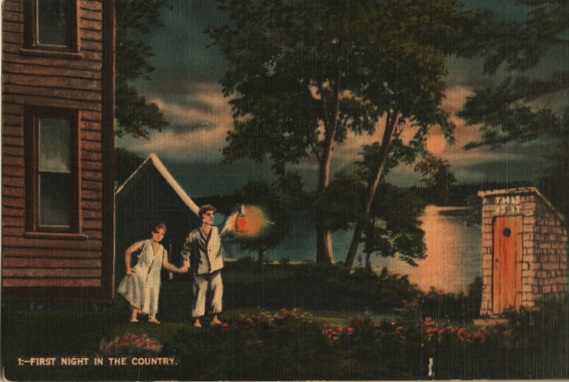
The longest lasting source of town and country humor of course, involved plumbing. It took a lot longer for running water to make it into rural areas than it did for electricity. And somehow potty humor never grows old. (Or up.)
This presented postcard cartoonists with a double blessing. Because the postcard buying audience found country folk unused to city bathrooms just as amusing….
As it did city folk who had no clue about country facilities.
Looking back at comedy generally, we find that the country folk got nearly as many shots in at the Big Town Jaspers as the city folk did at the Reubens from the sticks. But on postcards, this shows up nowhere better than in the use of The Necessity. (Or The Euphemism, as Dr. Seuss brilliantly named it.)
Even here, though, technology has sent most of these jokes into the realm of nostalgia. The outhouse, like the postcard, has grown scarcer in the modern world, and the country cousins are as likely as city tourists to seek other options.
As mentioned, the debate goes on about whether living out in the country makes you a better person than surviving in the big city. Only the jokes have faded, leaving the barest hint of their old flavor on the passing breeze. Pity, really: a chance to find we could all laugh at the same potty jokes isn’t much in the grand scheme of things, but it was something.