FICTION FRIDAY: Knit Wit

     “Who goes there?”

     “A friend.  Winky sent me.”

     “What’s the password?”

     “More is more.”

     “Enter, friend.  But remember, no telling people….”

     “Oh, jingles!  Owwwww!”

     “Winky should’ve warned you to put these dark glasses on.”

     “The colors!  The….  Thank you, that’s better.”

     “Yes, we wear ‘em all the time.”

     “That explains a lot.  So this is the place all of the….”

     “Not all of ‘em.  But Santa likes to think we turn out the best new ones every year.”

     “Does Santa pick them out?”

     “No, he said he has to save his eyes for making lists.  He appointed Agent Gold, Agent Silver, Agent Green, and Agent Red to judge our designs each year.”

     “And they’re all…experts?  Or just colorblind?”

     “We’re not partial to judgmental strangers, stranger.”

     “I beg your pardon, Ma’am.  It’s just all a bit much to take in.”

     “I understand that.  Apologies accepted.”

     “It must be a challenge every year to produce even uglier Christmas sweaters than last year.”

     “That’s something else we’re not partial to, pilgrim.  We’ve got a poster on the wall about that.”

     “I see.  ‘The Only Ugly Sweater Is An Empty Sweater’.”

     “You should see them shiver when they wind up on the Island of Misfit Sweaters.  But Santa rescues ‘em and finds people who will love them.”

     “I’ve noticed that.  There doesn’t seem to be any sweater too….”

     “Step carefully, mister.”

     “Too unusual to find somebody who will wear it.  I expect they are all nice and warm, and the person wearing one doesn’t have to look at it.”

     “You might just catch on yet, pard.”

     “Don’t some of the designs make you a little uncomfortable, though?  I mean, I have seen several obscene sweaters that seem at odds with the season.”

     “Doesn’t bother Agent Orange.  He came down with Agent Green to be in charge of good taste.”

     “Is he acquainted at all with Charley the Tuna?”

     “If I was old enough to understand that joke, sport, I might resent it.  In that case, I’d have to tell Santa to put someone on the ‘Fruitcakes Only’ list.”

     “I’m sure I meant no offense.  Perhaps I’d better go and not get in the way of your important work.”

     “If you say so.  Now, remember not divulge our location to anyone.  I don’t want all your friends crowding down here to ask for the latest Christmas sweaters.”

     “Oh, if I were you, I wouldn’t sweat that.”

     “Wait, we could use you in the writing department.  We…consarn it, lost another one.”

GOING TO THE DOGS (or vice versa)

)

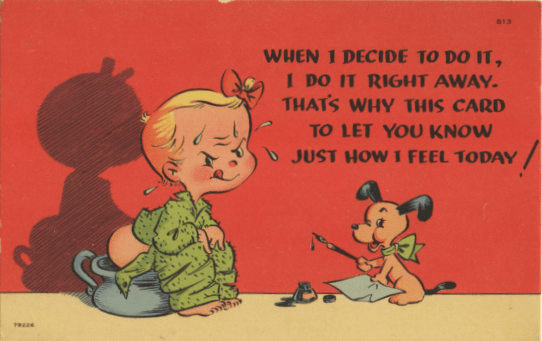
     Among the highlights of a recent influx of postcards into my inventory is a healthy assortment of dogs.  Now, as we have mentioned hereintofore, the number one activity of dogs on postcards is, well, Number One.  Note this card, for example, in which the puppy’s name, Pee Wee, is pretty much a safety rail to make sure you don’t miss the joke on your way to reading “I am fine.  How are you?” on the flipside.

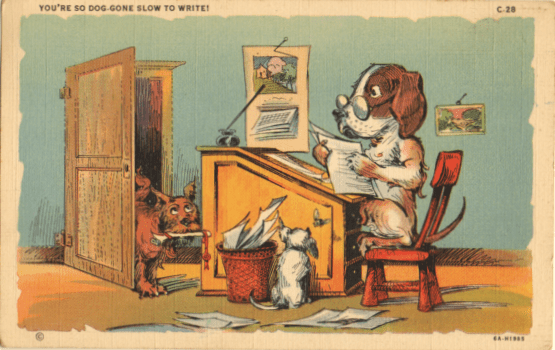
     As mentioned before, this is a little unfair.  Dogs are capable of doing so many other things.  (My personal favorite in this picture is the underling coming sheepishly, or sheepdogishly, through the door, possibly with a late or negative report.)  But this collection does offer us dogs in roles other than hero of bathroom jokes.

     We can see in this example that they are capable of complex financial negotiations: not exactly WOLVES of wall Street but nonetheless puppies obviously in the know about what to do in business districts.

     In fact, this seems to be a fairly common concept.  The look in THIS dog’s eye, for example, indicates his confidence that he knows what he’s doing.

     But the mid-century canine was also capable of cultural pursuits.  Not only is there one glamourhound starring in the movie here, but one of the moviegoers has been moved to an appreciation of architectural layout.

     And here we see a group of neighborhood activists interested in architectural preservation.

     These might be dogs from the same group, or from another group concerned with ecological pursuits.  Their appreciation of neighborhood beautification is something it would be nice to see in other bland, comfortless areas.

     Of course, from the earliest days, the bloodhound was seen as a competent investigator, on or off the police force, but this does not get as much representation on postcards as it deserves.  Here is a longlost still photograph from the first episode of an early television detective show, airing at a time when you’d think dogeared old bathroom stereotypes were everywhere.  Instead, we see two detectives meeting at the same crime scene, initially suspecting each other of being responsible for the evidence.  (For those who do not remember the show, they eventually team up with the jovial criminal responsible, the family’s pet monkey, to enjoy a long run on TV as the team of Monkey Puppy Baby.)

     In view of all this evidence, it’s hard to imagine why  so many other postcard artists believed all dogs do all day is empty their bladders.  Perhaps some sinister postcard rivals were responsible.

SCREEN SCROOGES: Silent Supplement 2

     This is a supplement to the comparison of film versions of A Christmas Carol, taking a look at the surviving silent versions.  We considered the earliest surviving version, from 1901, last week.  After a lost version of A Christmas Carol made in Chicago in 1908, the next, and first American, Christmas Carol was released by Thomas Edison in 1910.  Marc McDermott was Scrooge, but Bob Cratchit was Edison reliable Charles Ogle, who, I believe is the only actor to appear as Bob Cratchit AND Frankenstein’s monster.

     We open as Scrooge enters his office, shakes snow from himself, and then scolds Bob Cratchit, having spotted a piece of coal missing from the scuttle.  Moe, Shemp, and Larry then barge in, shaking away snow and asking for a charity donation, to be sent away crestfallen at Scrooge’s reply.  Fred then comes in, accompanied by three friends—one male and two female—whom Scrooge sternly bows out again.  Fred, having shaken snow from his jacket, lingers, trying to get at least a Christmas handshake, but gives up.  Cratchit is scolded for putting on a coat, points out the clock, and is sent home.

     Going home himself, Scrooge appears startled by his doorknocker even before a see-through Marley face appears there (a little error in special effects timing) and goes into a room with a bed, a grandfather clock, and an undraped window (so we can see the snow,  Have you guessed yet that this takes place in winter?)  A filmy Marley with a chain hanging around his waist has an argument with Scrooge which you can follow if you remember the story, but fades away after shouting at his old partner.  He is replaced by the Spirit of Christmas; this gives our movie twice as many ghosts as the 1901 version.

     The visions of the past appear in front of the bed.  We see Scrooge’s sister rescuing him from school, the Fezziwig Christmas party (which does pretty well, considering what a small space it has to take place in), and then the breakup with the fiancée.  Scrooge reacts to these, most visibly as he is dancing along to Fezziwig’s fiddler.  The Spirit seems to disappear for a second and then come back, unless there is a difference in costume or face I’m not picking up.  That’s certainly the same fixed grin.
     The visions of the present appear in front of the clock (symbolic of time, or just a prop).  We are told these are scenes of what Scrooge’s money could do) and he frequently reaches for his pocket as he watches the Cratchit family toast his health, and then Fred at the Christmas party, where the young man is forbidden to marry the young lady we saw earlier, being broke.  This is the first but not the last movie where Fred has not yet married Mrs. Fred.  We are then shown the imploring hands of Want and Misery from the bottom of the screen, the Significant Children left out of so many movies.

     The Spirit disappears and comes back with a veil over his head and minus the grin, which makes him at once more human and less interesting.  Scrooge sees himself choking out his last breaths, in front of the housekeeper who, when she is sure the miser is dead, pulls a ring from one of his fingers and hurries away.  We briefly note his tombstone, which states that Ebeneezer Scrooge (sic) “lived and died without a friend”.  Scrooge, shocked, staggers over to collapse on his own bed.

     Scrooge is wakened the next day by carolers, to whom he throws some money.  He hurries around the room, pointing at things, convincing himself it all happened) and hugs his bedclothes for not being torn down.  (They weren’t torn down, actually, but we must move along.)  Heading out, he spots Fred and fiancée entering a building, but then spots those three Charity Stooges (who have snow on their jackets again).  He gives them money and a promise of more.  Fred and his fiancée are heading out again, and he accosts them, scolds them, and then hands his nephew a piece of paper on which he states that as his partner, “my nephew will be able to marry any girl you choose”.  This doesn’t make a LOT of sense, but Scrooge had kind of a sleepless night.

     The three of them head for the Cratchit place, where Scrooge terrifies the family, allowing Fred and fiancée to slip in with a basket of goodies, including a sizeable turkey.  When Cratchit, now armed, has this basket pointed out to him, the holiday spirit is restored, and Scrooge sheds a tear of happiness before Fred and his future niece-in-law hug him.

     It all makes for a reasonable condensed version (ten minutes) of the story.  Marc McDemott is an appropriately threatening and imposing old miser, and if his reformation involves a little too much hand wringing and fist pumping, well, he didn’t get to SAY anything, after all.  This is the last of the really short Christmas Carols.  Three years later, a British version came in at forty minutes, giving it not only space to show more of the story but to play around with it, AND produce a truly unique Ebenezer Scrooge.

FICTION FRIDAY: Grading on the Curve

“We’re glad to see you again.  What have you learned?”

“Well, it isn’t just folklore: your Dead Man’s Curve has indeed been the site of a strange series of fatalities.”

“That’s what we assumed.”

“In 1915, a Mercer Raceabout was the first car to crash, killing its driver.  But the car was salvaged and, two years later, sailed off the same spot, again killing the driver. It was restored but not used again until after the war, when, in 1919, a driver was killed flying off at the same spot.  The car was destroyed in that crash.”
“That’s true.  We knew all that.”

“But in 1921, a pre-war Imp was driven off the cliff at the same spot.  The driver was killed but the car was salvaged.”

“We know that. too.  We want you….”

“The buyer of the wreckage left a diary with a complete account of the renovation of the car.  It was completely rebuilt using parts of other old Imp automobiles from before the war.  There were, at least at this point, NO parts from that 1913 Mercer Raceabout.”

“Ah.  See, Jenkins?  I told you.”

“The Imp was completely destroyed in 1923, when it sailed off the cliff at the same point.  There were no more fatalities until 1925, when a Model T tumbled from the cliff.  The driver was killed.”

“And no parts from that Imp…the name, see, kind of suggests….”

“I have no data on that, but it would have been unusual for a Ford to have been repaired with anything but Ford parts.  The Model-T was easy to repair, it seems, and it survived crashes from that same point in 1927, 29, 1933, and so on, plunging over the same cliff at the same spot every two years, killing its unfortunate driver and sometimes passengers, until the war.  At that point, it waited in a garage until it was donated to a World War II scrap drive.”

“I don’t suppose there’s any way to find out what it was made into.”

“That would be problematic.  But the fatal accidents began again in 1949 When a Ford Sportsman went over the cliff, killing the driver.  The same Sportsman was involved in several crashes until it was in turn destroyed and a Corvette began to take the plunge.  In due course, it became inoperable and then a Triumph crashed in the same spot.  And so on until the present.”

“So all you’ve done is establish that these different cars had no ‘cursed’ parts in common, and that the money the Council spent over the years on exorcists and Native shamans to remove the curses was a waste.  Do you expect payment for that?”

“I did go further, sir.  I was able to engage the services of a reliable medium who, after some work through intermediary spirits, was able to contact the spirit of Billy Ilmandotte.”

“Who?”

“The driver killed in the original crash in 1915.”

“Ah!  Now you’ve got something.”

“Yes, sir.  It was not what I expected, however.  I frankly thought that Mr. Ilmandotte wished to avenge his own death by killing other drivers.”

“No?”

“No, sir.  What his restless spirit is actually doing is possessing cars that he likes and forcing the drivers eventually to go somewhere by way of Dead Man’s Curve just to show he CAN make it around that corner at that speed.  He’s sure he just needs the right car and the right timing.”

“I see.  So can you think of any way to convince his spirit to go somewhere else?  Can this medium you employed do something along those lines for us?”

“Well, actually, sir, since I also found out how much the City Council has spent over the last century on candlemongers and shamans and priests, I did wonder why you don’t just put up a guard rail.”

“That seems…what?  Yes, Jenkins here is right.  Why spend tax money on a thing like that when we only have one person killed up there every two years?  We wouldn’t need it all once this fellow…wait.  Do you suppose if we awarded him a posthumous trophy for making it around the corner that he’d take that as a sign he was finished?  Silver, yes, Jenkins, with a mahogany base and….”

Naughtiness

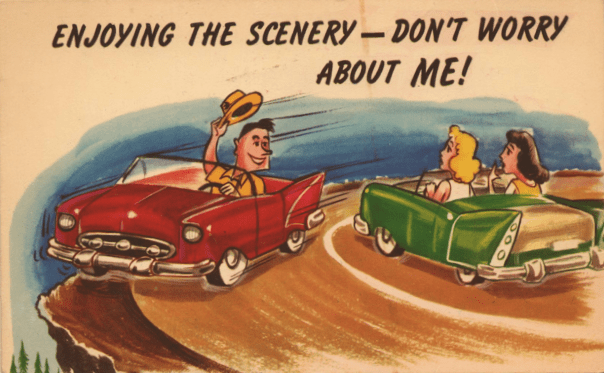
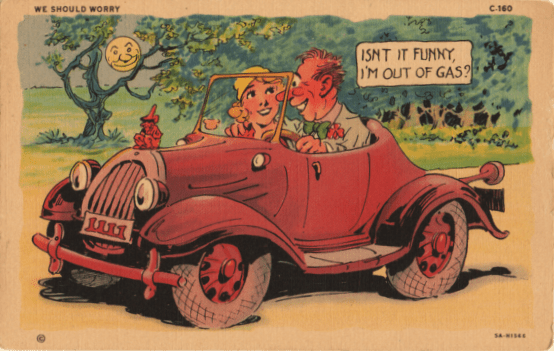
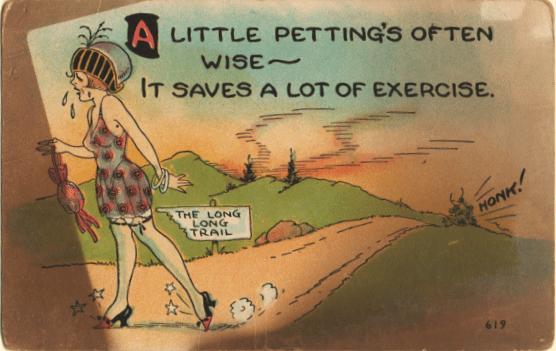
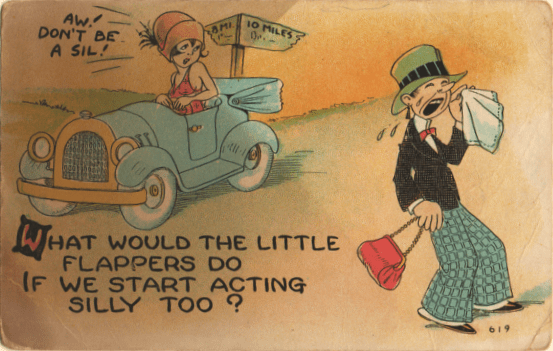
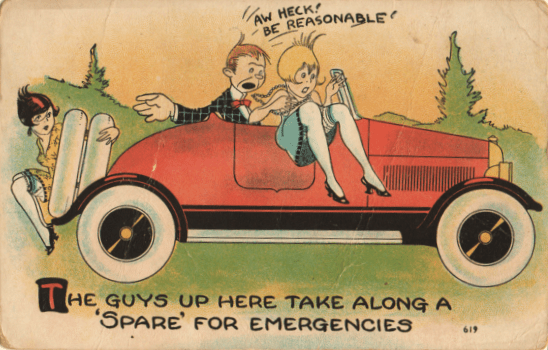
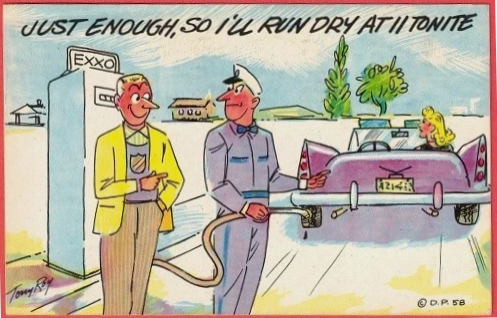
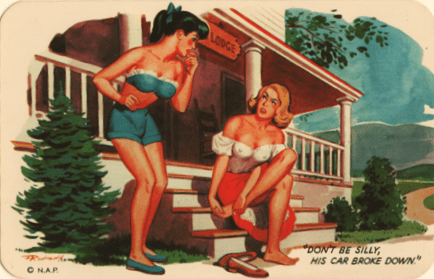
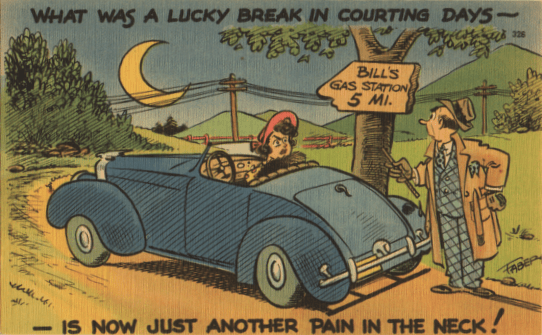
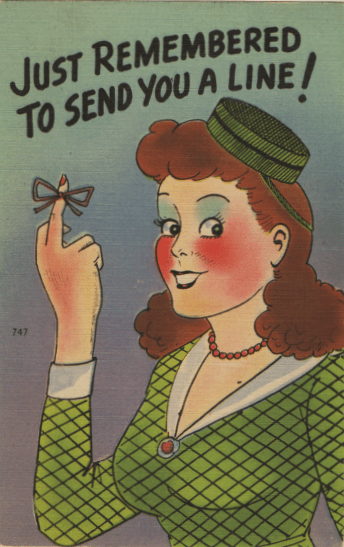
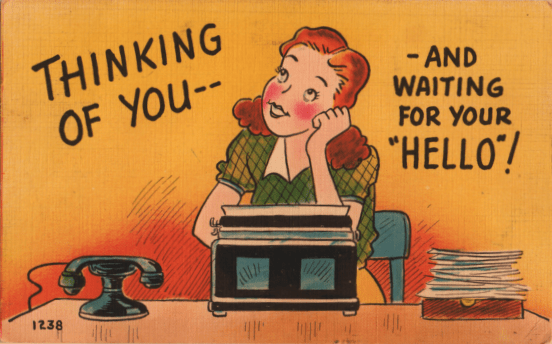
     Last week, we considered a postcard showing a well-dressed young lady showing that she’d thought of you by holding up a finger with a string around it.  Being of a basically guttertrending mind, I questioned the choice of finger for this, but had to admit the US Postal Service, historically very conservative about what it lets go through the mail, had postmarked it and sent it along.  I have a few other postcards whose morals could be questioned.  Take this driver.  He knows he isn’t out of gas.  His passenger knows he’s not out of gas.  The MOON knows he’s not out of gas.

     By the way, prior to the “out of gas” excuse, the go-to story, which extends back into the days when couples would go out bicycling together, was that there had been a bad puncture.  Just to bypass any double entendres, this car does have a flat, which makes it all okay to be mailed.

     What city couples did when they went out to the country is again left up to the imagination, though Walter Wellman has added “Do Not Disturb” signs (paying off the “No Trespassing” gag) and a few discarded shoes.

     The moral here is obvious.  When you get back from the country, you should not let your wife unpack your suitcase.  The garment being brandished was not even allowed to be exhibited in shop windows in some communities, but the Post Office had no trouble letting this picture through.

     I think the wife, like the Post Office, should be glad she’s showing just an ankle to prompt his memory.

     This quite irreverent reference is found on postcards from the 1910s through at least the 1950s.  The Post Office may have been grateful people were still familiar enough with their Bibles to get the joke.

     The meaning of this joke depends on knowing what it meant when a woman “turns on the heat”, but in the heyday of the phrase, the scene of the scantily clad lady and the repairman was repeated on numerous postcards.  (And comic books.  AND movies.)

     You can guess that what she REALLY means is a style of hat.  So this is perfectly proper.

     And speaking of rough sailing….

     This was a wildly popular joke in wartime.  Someone asked me whether it was the man or the woman who was being offered the management job.  I had to duck after I said that obviously HER role was Labor.

     Of course, the fact that she is pushing a baby carriage CAN be unrelated to the dialogue (despite the fact the Junior is thumbing his nose to reinforce the punchline.)

     And this is really just my mind touring the gutters again.  The gag of farmers shooting city slickers in the backside is ancient and non-controversial.  I’m the only one who assumes this is the father of the hitchhiker above, recognizing the jasper from town, and aiming just a little lower than regular comedy calls for.  Yeah, I can’t unsee it, so I’m passing it along to you, and NOT through the Post Office.

SCREEN SCROOGES: Silent Supplement I

     A sorry spot in serializing some of my non-fiction works in this space is a nagging refrain of “Remember how hard this was to research?  Sure woulda been easier with the Interwebs”.  Take, for example, my comparison of screen versions of “A Christmas Carol”, serialized herein not so long ago.  It would easily have grown to at least double the size, with all the different versions of the movies which can now be found online, one or two of which were presumed lost when I was writing.

     No, I am not tempted to go back and start over.  Once was more than enough for the world, to judge by the rejections I had at the time and the wild excitement which did not greet each installment in this space.  HOWEVER….

     One thing that would have intrigued me very much at the time and which was almost inaccessible in my VHS days is the silent version of the Dickens tale.  Not all of these survive, but enough do exist to fill a little space between now and my deciding what manuscript will come next n Mondays.  (I wrote a sequel to The Sound and the Furry, for example, which apparently never went out to ANY publisher.  I was waiting for all the royalties from the first book to be deposited, I guess.)

     For example, when I was doing my original research, around 1999, only about fifteen seconds remained of “Scrooge, or Marley’s Ghost”, the earliest known example of a film version of the story.  It appeared in 1901, and gets its title because Jacob Marley is easily at least the second most important character in the show.  It was one of the first films to have intertitles, pages of words between scenes to tell us where we are in the story.  This comes back into OUR story later.

     Footage is still missing at the beginning and end of the film, and what is left starts at the close of the first segment, with Bob Cratchit ushering someone (probably nephew Fred) out of the office of an angry Scrooge.  Bob is one of the Cratchitiest Cratchits whoever Cratchitted, perfectly meek and gormless as Scrooge orders him around.  (Scrooge is nowadays identified as Daniel Smith, after some fans, without a film to watch, thought it was Sir Seymour Hicks, star of the 1935 movie, who had started appearing on the stage as Scrooge in 1901.)  After Cratchit departs for Christmas revels, Scrooge exclaims in shock about Bob leaving a candle burning and then puts on one of the most ridiculous hats ever worn by an Ebenezer to head home himself.

     Scrooge’s house, obviously painted on a backdrop, and architecturally unlike any other Scrooge abode, is the setting for the one snippet available when I wrote my book: we watch as Scrooge pulls out his key, and a cutout appears over the doorknocker showing Jacob Marley’s face.

     Now we can follow as Scrooge steps away in horror, the face disappears, and the miser opens the flimsy door to go inside.  After jumping back in fear from his own curtains, he dons his bathrobe and cap and shuts the curtains, which are black so special effects can happen.  Jacob Marley is mildly impressive when transparent against these.  (Later, when he is shown solid, he looks like a man with a sheet over his head.)  Marley is in charge of the visions of Christmas Past—young Scrooge being rescued from boarding school by his sister and then breaking things off with his fiancée–and, in part three of the film, visions of Christmas Present.

     This is primarily the Cratchit Christmas, without much of a goose or plum pudding, but with a suitably limp Tiny Tim and a nice performance by Martha, whom her brothers and sisters hide UNDER THE TABLE until Bob gets home.  ‘GOD BLESS US EVERY ONE” is on a banner over the door, but after a general genial toast to Ebenezer Scrooge, Tiny Tim does propose the blessing, to Scrooge’s despair.  There is a very brief Fred party scene, and then we march outside to “The Christmas That Might Be”, the final chapter in the film as it now exists.

     The now solid Marley shows Scrooge  a wholly unconvincing gravestone right next to the sidewalk (putting the grave scene first in Yet To Come seems unique) and the briefest snippet of another scene: thanks to the intertitle card, we know this would have been at the Cratchits’ for the death of Tiny Tim.  The film breaks off, so we do not get to see the next morning, Scrooge’s conversion, and so forth.

     This movie gets a LOT of the story into what must have been a run time of about ten minutes (the longest version now online lasts about six.)  The acting is perfectly reasonable, the special effects effective enough (producer and director alike were fascinated by such things , and the work of producer Robert W. Paul was cutting edge at the time), and withal, a credible effort, though it works a LOT better for people who have read the book and already know what’s going on.  Scrooge spends most of his screen time simply reacting with hand wringing and fist pumping, but it’s not really fair to judge him without access to the big scenes at the beginning and end.  And if Scrooge’s house and gravestone don’t convince, well, there are weirder sets in talkies two generations younger.

     In our next thrilling episode, we’ll consider more silent versions which can be watched today, and a couple which can’t (and why that MIGHT be a sad thing.)

SO…DID THEY MEAN….

     The joke archaeologist, digging around in bygone postcards, has turned up several which might or might not be a little naughtier than they look.  Some of them I can help with, while others have confused me.  Take the simple example above.  Caption and concept were popular in cards around the start of the last century: women in their proper sphere showing men who was the weaker sex.  But, um, look at the face of the woman on the right and tell me whether this is going somewhere…no, wait until I’m older.

     This is of the same era and is one of a series with the same caption: different cards covered drinking, kissing, and modern fashion.  But other cards from other companies  used the same caption, covering the same ground.  I have seen people explain this as a salute to boozing and/or canoodling.  The line, though, became a catch phrase (or meme, as the kids were saying ten years ago) because of a wildly popular dance of 1909.  The full quote is “Everybody’s doing it!  Doing what?  Turkey Trot!”  The turkey trot, an extremely athletic dance which required hopping, jumping and scissor kicking, upset conservative souls.  The Saturday Evening Post’s parent company fired employees for doing the Turkey Trot on their lunch break (excuse me?) and even the Vatican felt called upon to denounce such immoral antics.  The Turkey Trot (along with the equally scandalous Grizzly Bear) fell out of favor as the Fox Trot, a less exhausting maneuver, took its place.

     Seriously, who got fired over this?  My own example, shown here, went through the mail, so maybe not everybody….  But that is definitely a hand gesture which goes back millennia, was repopularized in the nineteenth century (pre-Victoria, so your Regency lords and ladies would have understood) and now, I find, is considered by commentators to be especially associated with the music industry.  The lady herself seems unconcerned, and maybe it’s flattering that she thinks of THAT finger when she thinks of…or maybe not.

     Do people still use cloves (or Clove Gum) to cover the alcohol odor on their breath, or have we found something different?  And has anyone done a dissertation on all the foods used to cover the aroma of this or that on their breath?  A minor thug in Farewell, My Lovely uses cardamom, and kids in The Music Man were accused of using Sen Sen (licorice-flavored).  It might work best as a video, without some neutral observer doing the breath-sniffing to evaluate results.

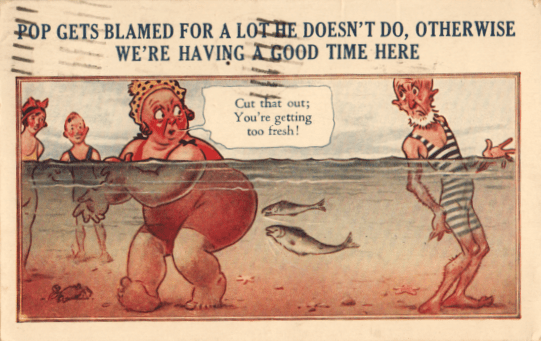
     Here I am all at sea.  I have been unable to trace the origin of this phrase, which seems to have been very popular in the first decade of the twentieth century, at least on postcards, where it always involves the beach and/or swimwear.  Walter Wellman has turned it into something surreal, and I’m not sure I‘ve followed him all the way.  Is the lady on the right just a contrast to the mermaids?  Is the gentleman underwater, who does not seem to be wearing any breathing apparatus, a suitor or a disapproving parent?  And is that…but we’re supposed to be looking at the mermaids, not him,  so I just don’t know what all is going on.  You tell me.

WEDNESDAY FICTION: In the Details

     “So I get three wishes?  Say yes or I’ll stick you back in the bottle.”

     “Yes, my mistress, you are to receive, to the best of my ability, three wishes.”

     “Good.  I had to slaughter the entire Psiclysmian royal family, AND their horses and dogs, for access to the chest where they hid the bottle.”

     “Yes, my mistress.   I cannot, of course….”

     “Skip it. I’ve worked a long time on my list and I don’t want you confusing me.  I read up on you djinn while I was skinning princesses.  No comments.”

     “Very well, my mistress.”

     “Now, I wish for an extended lifespan.  Let’s say four thousand years with an option to renew.”

     “That is no problem, my mistress.”

     “And I wish for a tall castle on a remote mountain, furnished with all the luxuries I could want: a library with about a million different romantasy novels, a comfy reding room, an even comfier bedroom, and mute invisible servants who will bring me whatever I want to eat or drink, and tidy up around the place.”

     “An excellent wish, my mistress.”

     “And I want to be a gorgon.”

     “I beg pardon, my mistress?”

     “I figure if I have the reputation for being able to turn whatever I look at into stone, nobody’s going to come around and bother me while I’m trying to read.”

     “The snakes will not be a problem, my mistress?”

     “I wish to be a gorgon with the powers I mentioned and cute, cuddly snakes.”

     “Here you are, my mistress.  Being a djinn, I am immune to your gaze, so I can show you your reading room and then bid you farewell.”

     “Excellent.  Let’s see those invisible servants bring me a pot of hot Earl Grey tea and a plate of ginger snaps.  Wow!”

     “Yes, my former mistress.  I shall now….”

     “Wait!  Did the cookies just turn grey?”

     “You looked at them, Gorgon, and turned them to stone.”

     “Well, that’s….  Wait!  What happens when I try to read one of my books?”

     “Farewell, oh Gorgon.  Enjoy your first four thousand years.  Don’t look at the comfy chair before you throw yourself…that’s going to leave a mark.”

THE SOUND AND THE FURRY: Kerrin and the Thorn Tree

     Kerrin lived in the city of Sartain, and she liked it.  She would write letters to her relatives who lived in the country, asking why they didn’t move to a nicer place.

     “Everything in the city is clean and modern,” she wrote.  “We have nice, solid rick buildings with none of your thatched roofs to let in the rain.  We have gas lights in every room.  There’s no need ever to walk out in the rain, for there are cabs pulled by strong horses to take you wherever you want to go.  Our druggists have the newest pills and powders for fever, but I suppose your country doctors have nothing but tansy, sassafras, and pleurisy root.  How can anyone live out in the middle of nothing, using dirt roads, with animals running every which where, when there are clean  modern cities?”

     A letter arrived one day to tell Kerrin that one of her relatives had passed away in Noverra, a village way out in the farmlands of Noverrashire.  There was no question of Kerrin going that far out into the country to live, of course.  But she thought she might just journey to Noverra to take a look at the house.

     “People in the country are so backward,” she told her friends.  “What can they know about buying and selling?  I’ll tidy up the house and get a good price for it.”

     Kerrin made most of the trip on a fast, powerful steam-powered train, but the train didn’t go to a town as tiny as Noverra.  She had to ride some of the way on a crowded old-fashioned stagecoach.  To get from the coaching station to the house, she had to ride with one of her new neighbors, a man named Lars, who had come to the station to meet her, bringing his wife, Joniel, and his six children in a farm wagon.

     Kerrin wanted to be friendly.  (Lars and Joniel might be willing to buy the house from her.)  So she thanked them very politely for coming to fetch her, and set a handkerchief down on the board seat of the wagon before she sat down.  Joniel asked if she had had a nice trip, and was obviously amazed that someone could travel that far from home and not be half dead from the excitement.

     They spoke of this and that.  Trying as she was to be nice, it was nonetheless not long before Kerrin had pointed out that the old-fashioned wheels of Lars’s farm wagon were broader and less elegant than those on city cabs.  The city cabs moved faster, too, since their horses weren’t so fat from being overfed.  A little later, she observed that children in the city wore shoes and certainly never ate apples which had fallen from trees by the road, with who knew what sort of dirt and insects on them.

     “Oh!” she said, while looking at the trees.  “What’s that?  That sound?”

    “Sparrow,” said Lars, who didn’t seem to say much.

     “On that branch,” Joniel said, gesturing to one of the trees.  “Do you see him?”

     “My, he’s a little thing!” said Kerrin, looking the bird over.  “In the city we have good, big healthy pigeons.”

     Joniel and Lars listened to everything Kerrin had to say about the city, and the children listened to a lot of it.  This was partly because they wanted to be polite (the lady from the city might be willing to sell them the house) and partly because not a one of them had ever been to the big city, and they wanted to hear all about it.  Kerrin was more than willing to tell them, and she liked to be listened to.  So she really had a nice ride, despite having to sit in an open cart with a dirty floor, until they reached her house.

     “Oh, my stars!” cried Kerrin.

     Aunt Malda’s cottage was just what she’d feared: a poky little thing with whitewashed walls of uneven stones, and a roof made of straw,  The inside was worse: small and dark.  There were no gas lights, of course: only a rusty amp that smoked and a few stubby candles.  Things sat every whichaway on tiny shelves.

     “And I’ll have to sweep all this dirt off the floor first thing!”

     “I don’t like to tell you what to do,” said Joniel, who had come into the cottage with her.  “But I believe I ought to tell you that this is a dirt floor.”

     Kerrin stared at her neighbor in horror and then hurried to the back door.  “They said there was a garden.”

     It was no garden, so far as Kerrin was concerned.  Gardens were neat little squares behind your house.  This was much too big for a proper garden: it looked like an acre of plants or more.  How had Aunt Malda managed such a thing?

     At least it was tidy.  The pants did grow in straight rows, or little squares, each plant in its proper place.  Kerrin wasn’t sure what some of the plants were, but she had brought along a book on farm plants to read in the evenings.  Yes, she thought: a very neat and pretty garden, if you overlooked the unsuitable size.  All that spoiled the neat arrangement was one twisted little tree, standing by itself in the middle of everything.

     “That will have to be cut down at once,” she said, pointing her parasol at it.

     Joniel stared at her.  “What?  Are you serious?  I….”  Then she laughed.

     “I don’t believe I said anything funny,” Kerrin told her neighbor.

     “But….”  Joniel stopped and took a quick look around the garden, though she could see very clearly there was nobody there.  Then she leaned in toward Kerrin and whispered, “That’s the fair folks’ thorn tree.”

     Kerrin frowned.  “The what?”

     “That tree belongs to the fair folk.”  Joniel looked over her shoulder and, leaning in closer, whispered even lower, “The fairies.”

     “Well, of all the nonsense!” said Kerrin, and now she did laugh at her neighbor’s joke.  “Aunt Malda may have been backward enough to have a dirt floor, but even she couldn’t have believed….”

     But Joniel was not laughing.  “Every house in this quarter has a tree for the fair folk.”  Her tone was serious.  “That way, they’ll not bother the rest of the garden.  And it’s best to put milk on the back doorstep, so they don’t come in and upset the house.”

     This was very foolish.  Kerrin thought about finding an axe and cutting the tree down there and then.  But she realized this was exactly the sort of thing she had expected from people who lived in the country.  And, after all, if every cottage around here had to have a thorn tree for the fairies, she wouldn’t be able to sell Aunt Malda’s house without it.

     “No, I won’t cut it down,” she told Joniel, who looked relieved.  “It’s pretty enough, in its way, and it may have its uses.”

     “It does have uses,” Joniel said, again looking left and right as if expecting a fairy to leap at her from the dirt.  “But the fair folk are using it.”

     “Mmmmm,” said Kerrin.  She decided she would not tell this woman her opinion about leaving milk outdoors at night.

     Next morning, Kerrin set to work putting Aunt Malda’s cottage to rights.  It was not easy work, even for a woman like Kerrin, who liked to keep busy.  Water had to be fetched from the creek at the far end of the garden, and all Aunt Malda had were two small buckets with rusty handles.  In the city, he burned coal to keep warm, but Aunt Malda had not even used wood, just old-fashioned peat.  The only wood in the house was the furniture, and Kerrin decided she probably shouldn’t burn that, though burning was all most of it was good for.

     Joniel came over to visit nearly every day, bringing over some milk or a cheese, and chatting about what a lovely cottage this was, and what Kerrin might expect for it, should Kerrin ever think of selling it.  She never stayed long, because she had her own cottage and garden to care for, not to mention all those children.

     She dropped by very early one morning, when Kerrin had just finished doing the laundry.  That turned out to be a horrible job, with all the water to haul, and then heat over peat in the fireplace.  If Aunt Malda had at east owned a nice modern stove…but no, there was just the fireplace, with all kinds of hooks and metal brackets Kerrin didn’t recognize.

     Hooks were set in the walls of the cottage as well, and there was a rope that was obviously meant for a clothesline.  Kerrin refused to hang her clothes to dry inside.  The cottage was still dusty and dirty, and she was sure something like bats or mice lived in the roof, making noise the whole night through.

     Instead, she took the clothes outside.  A light breeze blew through the garden, and this would likely dry the clothes in no time if they could be hung on something.  The thorn tree, standing all alone, was perfect/  It was neither especially neat nor especially modern to be hanging laundry on a tree, but the clothes would not need to be there very long.

     Kerrin had set the last of the garments on the tree when Joniel walked into the garden, saying, “I came to ask….”  Then Joniel stopped, and stared.

     “Is that safe?” she asked.  “I’m sure the…the fair folk hang their own laundry there.”

     “I decline to believe any such thing,” Kerrin informed her.  “And in any case, why should your fairies have the same wash day I do?”

     Joniel looked around the yard.  “I’m sure they….”

     Kerrin sighed.  “Ket’s go inside for a cup of tea.  I have any amount of hot water left over.”

     “Oh, I can’t stay,” Joniel told her,  “I only came over in case you didn’t know about the fair, and needed a ride into town.”

     “Fair?” said Kerrin.  “No, I didn’t know.”

     “That’s why I’m dressed up,” said Joniel.

     Was Joniel dressed up?  All Kerrin could tell was that her apron and bonnet were a bit whiter than the ones she wore every day, while her face and hands were clean for a change,  Her eyes were shining.  The fair was something special to her.

     Kerrin didn’t especially want to visit some little country fair where she would no doubt be surrounded by smelly chickens, goats, and pugs.    If she did go, she didn’t want to ride in a dirty old farm wagon.

     “I’ll wait ‘til my wash is dry,” she told Joniel.  “You folks go ahead.  I can walk to town.”

     “Are you sure?” said Joniel.

     “Oh yes,” said Kerrin.  “You go ahead.”

     “All right,” said her neighbor, and ran back to join the family in the wagon.

     Kerrin walked inside and started the tea.  The more she thought about it, the more she thought that, unpleasant as it might be, a fair was just the place to meet people who might buy Aunt Malda’s cottage and garden.  Oh, she knew Lars and Joniel wanted it, but she didn’t suppose they had enough money.  People with money weren’t so backward as to believe in fairies.

     Supping her tea, she stepped out ito the garden to check her clothes.  Nearly everything was dry; she had known the breeze would take care of this.  Wind banged the shutters all nifgt olong on the cottage windows, but it was good for something,  She gathered the garments and took them inside, to pick out the best things to wear to the fair.

     She was sorry she had not brought her new hoop skirts from the city.  But it would be wise, she supposed, not to look TOO much nicer than everyone else.  People might be too impressed to come up and talk to her.

     Still, she had to look her best with what she had brought.  Kerrin picked out the whitest of her petticoats, and the green dress that went so well with her hair.  She pinned the skirt and the outermost petticoat above her knees, to keep them from being soiled as she walked along the dusty country road.  When she reached town, she could remove the pins to let skirt and petticoat down.  Spying a little smudge on her right shoe as she was pinning the petticoat, she took out a handkerchief and wiped it clean, muttering “Dirt floors!”

     Now she needed something for her head.  The cottage was, as always, dark inside, but she spied a green bonnet on top of the clothes she’d brought in from the thorn tree.  She could not remember this bonnet, but there it was, and the perfect shade of green to go with her gown.  Picking it up, she could smell the country breeze in it.

     Tying the strings of the bonnet under her chin, she stepped out of the cottage.  What a glorious day!  She took a deep breath.  The wind blowing across the garden smelled all warm and green.  As ever, the road was dry and dirty, but Kerrin liked it.  And the breeze was beautiful.  City breezes smelled of dust, brick dust from all those brick buildings, or coal dust from the chimneys/  There weren’t enough trees there for the breeze to pass through.

     Noy far from the cottage, the road passed through a small grove of trees.  Kerrin had never walked there before, for fear something would drop on her from the branches.  Now, though, she skipped right on in, singing “La la la la!”

     “What a great tree!”  She stopped in the middle of the grove to look around, and patted the trunk.  “Hello, tree!”

     Looking up, she found a squirrel staring down at her.  “Hello, Squirrel!  Are you hungry?  You look hungry.  In the city, people throw food to the squirrels.  Why don’t you come with me to the fair and I’ll throw you at the food!”

     The squirrel did not answer, so Kerrin decided to climb up and talk it over.  Climbing would be awkward with these shoes, so she sat down in the road and took them off and then, throwing them her left shoulder, she started up the side of the tree.

     Of course, the squirrel was not on the branch when she reached it.  She looked around, but there was no squirrel to be seen.

     “If these untidy branches weren’t in the way,” she pouted, “I could see things.”  So she set about braiding the branches to make nice, even rows.  Before she had finished more than three, though, she spotted two birds’ nests.

     “Now, look at that!” she cried.  “One nest has three eggs and one has five.  This is highly untidy!”

     She reached into the second nest to take out an egg and add it to the other so the nests would be even.  But before she could do that, she spotted a feather on the edge of that nest.

     “Here’s the thing for wearing to a fair!” she squealed.  She looked around the sides of both nests but there was only the one feather.

     “It doesn’t matter,” she declared.  “These leaves are very much the same shape.”  At once she tore leaves from the branches, stuffing them into her collar and cuffs.  Once she had as much as she could hold there, she tried sticking them to her sleeves and face and bright green bonnet.

     Those  leaves just fell off.  “Now what?” she demanded, swinging her legs over the branch.  “Oh!”

     From up here, she could spy the creek that ran from behind her garden through the grove of trees.  The water seemed quicker here, and possibly deeper.  Tall banks of mud rose on each side of the stream’s course.

     “Mud!” she cried.  “Just the thing for leaf-feathers!”

      Jumping up, she ran along the branch until she was nearly over the mud.  When she reckoned she was close enough, she bent her knees and jumped.  Branches tore at her clothes, and one of her sleeves came right off.  Kerrin didn’t mind.  She landed, sitting down, on the mud at the very top of the bank.

     “Whee!” she cried, sliding through the mud right down into the stream.  Putting her head under water, she took a long drink.

     There was plenty of mud to smear all over her face and clothes.  She found a big hole in the bank, and dug into that for a while.  Nobody seemed to be at home.

     She climbed through the mud back to the road.  On the way to Noverra, she said hello to some very interesting snails, a friendly snake, some cheerful beetles, and, of course, a butterfly.  A grey goose flew overhead, but she knew it was too far away to hear her.

     After checking out another empty hole along the road, she noticed that most of her leaves had actually fallen off during her climb up the bank.  “There’s only one thing to do about that,” she announced, and climbed another tree to get some more.

     Swinging from branch to branch, she plucked a few leaves here and a few there, giving her a nice variety, until she reached the end of the woods.  This was also the edge of the village.  Kerrin jumped from the last branch, did a little somersault on the road, and sat up to look over the village.

     The village was very pretty, and she heard music.  She coughed.  The dust of the road had a nice color, and looked striking against the darker mud, but there was a wee bit too much of it.  If she could have some water…only the creek was way behind her in the woods.

     Not far away, though, she spotted a huge trough where people who brought their horses into town could get them a drink.  “Just the thing!” Kerrin cried.  “I’ll get a drink and wash off some of this extra dust while I’m there!”

     Several people came over to watch as she stepped up to the trough, unbuttoning her dress.  She saw Lars and Joniel among them, and waved.  “I’ll be with you in just a minute!”

     Her hand brushed the strings of her bonnet.  She undid those and took it off.

     Kerrin stared at the bonnet in her hands.  This wasn’t her bonnet.  Was it one of Aunt Malda’s?  She didn’t remember having a bonnet like this at all.  Well, no matter.  She needed to finish dressing so she could go to town.  What else did she need to put on?

     She glanced down at her clothes.  “My heavens!  What happened?”  She was amazed at all the dirt: she’d have to get dressed all over again!  WHY couldn’t Aunt Malda have had a nice, modern wooden floor>  She reached to pull her dress from her shoulders.  She paused.

     This dirt was not the same color as the dirt of the old floor.  But maybe that was because the sun was shining on it.  The sun?

     Looking up again, she saw the crowd of people watching her.  In the same moment, she realized her dress was unbuttoned, and torn to scraps anyhow.  Twigs and leaves and other garbage were stuck all over her.  The only clean garment she had seemed to be this strange bonnet she still didn’t recognize.  Where had it….  Oh, yes.  It had been with the clothes she had dried on the thorn tree.

     Her mouth dropped open.  Turning, with a shriek she ran right back to the cottage, never slowing down for a second.  Slamming through the front door, she sped out the back, and burst into the garden.

     “Take it back!” she screamed, and hurled the bonnet at the thorn tree.

     The bonnet flew into the sky and was gone.  Kerrin looked around the ground to see where it had fallen.  But it had vanished as if it had never been.  Exhausted, she sat down on the back doorstep.

     “Owww!” she cried, jumping back up.  She had sat on an empty bowl.  She knew very well she had not put a bowl on the doorstep.

     In the end, Lars and Joniel bought the cottage and garden.  Kerrin did not wait around to argue about the price.  She left for Sartain the day after the fair.

     “How brave of you to stay for so long in the country!” said her city friends.  “Why, the people in that dreary little village probably can’t even read or write!”

     “Maybe not,” said Kerrin.  She shuddered.  “But for all that, some of them know a thing or two worth remembering.”

FICTION FRIDAY: Link to the Past

     Negotiating with an evil spirit is no joke.  Not from the human side, anyway.  The spirit stopped even attempting to hide its snickers as I went through the arduous and occasionally embarrassing ritual to make my request.

     But at last I had it: one hour in my hometown fifty years to the moment before I activated the wish.  The research on this was almost as much trouble as the ritual.  Loopholes had to be anticipated and closed.  Choosing the day, for example: it would have blasted the plan to smithereens if I hadn’t checked first to make sure that day wasn’t a Sunday, or legal holiday half a century ago.  (No second chances: no way would I perform that sixth step of the ritual again, even if enough albino wasps were still available.)  I had to be sure of events in the sky and in the town on the day selected: a hailstorm or a festival parade would have complicated getting through my LIST.

     The LIST took weeks to prepare, which kept me busy all the days I spent in bed recovering from the ceremony.  Buy this comic book.  Deposit that much money in this bank under that name.  Send a letter that should arrive in time to prevent a shooting, send another urging a politician to run in an election he opted out of the first time.  Leave notes in a lawyer’s office, with an agreement that they should be sent out on schedule so my mother would avoid a certain intersection on a certain day, my sister would not go to a certain dance, and my brother would NOT buy that hat.  I had to seek out stamps, unused, of a vintage which would not startle the post office, and provided myself with cash of the same era.  That hour in the past had cost me plenty; it would NOT be ruined by technicalities.

     Everything on the LIST was ranked, in case anything took longer than expected and I had to leave some items out.  Be sure I left some minutes in the hour empty, to allow for my wonder at finding myself in a town I remembered so well (and for getting lost, in case I didn’t remember it as well as I thought.)  Ridiculous haircut, vintage clothes that would pass: I had provided for everything.  I checked that vintage pocket four times to make sure the LIST was inside.  Then I spoke the spell.

     Negotiating with an evil spirit is no joke.  Did it KNOW I would forget to eat before I set off?

     I flickered into being and knew the spell had worked.  There was the Sugar Pit.  My hometown still boasts a Sugar Pit, but it is tidy and clean and in another neighborhood.  This was the original, a drive-in way out on Main Street with a couple of bleached and battered benches on one side.  In lieu of a printed menu or even a sign with prices, pictures of every sundae and sugar concoction were plastered on every exterior wall, top to bottom, leaving a small space for the

order window.  My childhood vocabulary experienced great growth when I listened to my father’s mutterings as we kids wandered along the walls, debating the merits of strawberry and pineapple and marshmallow before settling on what we always ordered.  They also sold one type of hot dog and one type of hamburger.  (I said this was fifty years ago.)

     The prices staggered me, and I had allowed some extra time.  I could certainly afford a hot dog, both in price and time spent, as I worked out where to go first from here in accomplishment of the LIST.  I reached for my pocket change and then considered the hamburger.  Hot dogs could be unpredictable.  Then I saw the sign for that nickel cone.  I walked around a bit, looking over the variations on what my grandmother called “ice cream on a stick”.  I had time for dessert, if it came to that.  Should it be what I had always ordered, way back when, or one of those I never tried, which might have meant risking fifty whole cents on an unknown quantity?

     I had time, once I had made my decision, to order, sit down, and consume the hot dog, cherry Sugar Slosh, and pineapple sundae before I found myself back in the present.

     Negotiating with an evil spirit: you try it.  My brother can KEEP that stupid hat.