Once upon a time there were three little pigs. The first little pig liked broccoli, so she built a restaurant that served elegant broccoli dishes. The second little pig loved eggs, so she built herself a bistro that served light fluffy egg dishes. The third little pig had no imagination, so she built herself a diner which served burgers and fries and gyros and tacos and pizza and, when she felt like it, blueberry pie.
Her sisters laughed at her. “That’ll fly when pigs fly,” they said. “You need to do something more niche and make videos about it. WE each have two million followers online.”
“Excuse me,” said the third pig. “Gotta scrape the grill.”
One day the Big Bad Chef came to town. He was a huge, hulking retired cook who now did Internet restaurant reviews, and got thousands of likes every time he savaged an eating establishment. “Little Pig, Little Pig,” he said, when he arrived at the first pig’s place, “Give me a free meal, or I will blow your place down.”
“Sure,” said the little pig.
“And just substitute sprouts for the broccoli in this broccoli a la Babe,” he said.
“Not by the hair on my….”
And the Big Bad Chef took his phone and he huffed. And the little pig’s restaurant closed within a week, and she had to go live with her sister, and was reduced to cooking broccoli side dishes at the second little pig’s bistro.
One day the Big Bad Chef came to the second little pig’s bistro. “Little Pig, Little Pig,” he said, “Give me a free meal or I will blow your place down.”
“Not a problem,” said the second little pig.
“And bring me an eight-egg omelet with nine kinds of cheese, so heavy it takes two of you to flip it over.”
The second little pig stood back, nose in the air. “Not by the hair of my….”
So the Big Bad Chef got out his phone and he huffed. And the next Tuesday, the bistro was being turned into a Malort bar and the two little pigs had to go live with their sister, imploring her to give the diner a little class by adding broccoli and crepes to the menu.
And in the fullness of time, the Big Bad Chef noticed the diner. “Little Pig, Little Pig,” he said, “Give me a free meal or I’ll blow your place down.”
“Get to the back of the line,” said the third little pig. “Who do you think you are, Kermit the Frog?”
Since this was the way the Big Bad Chef had treated his own customers when he had a place, he grinned and waited in line, though he was naturally plotting revenge. “How about that free meal?” he demanded, when he finally got to sit down.
“I don’t dump the leftovers until midnight,” said the third little pig. “Come back then and it’s all you can eat.”
“I like your style,” said the Big Bad Chef. “Do those sisters of yours help out in the kitchen?”
“They’ve never been a bit of use,” she told him. “But they did help with tonight’s special.”
“What’s the special?”
The third little pig jerked her snout toward the grill. “Pork chops.”
The Big Bad Chef set down his menu. “I like your style. Can you use a partner?”
So the third little pig married the Big Bad Chef and cooked happily ever after. Though no one heard from the Big Bad Chef online after that, and if you go to the diner, I don’t recommend the Chef Surprise.
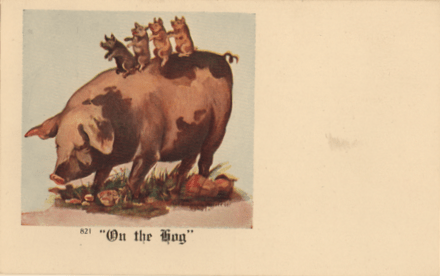
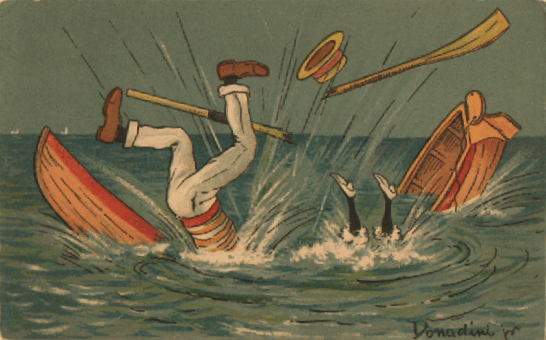
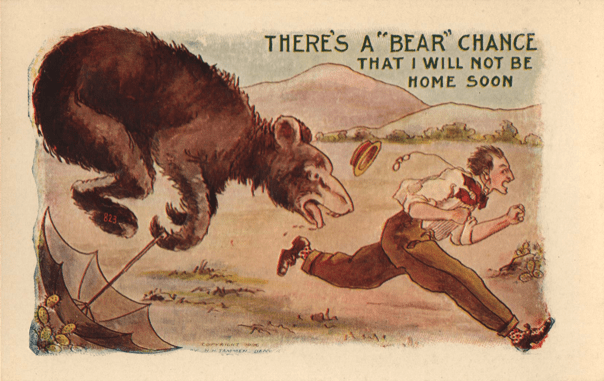
And so we come to April Fool’s Day. This is a holiday with a rich tradition of postcard-sending, but not so much in this country. As we have treated elsewhere hereintoforehitherto about the cheerful French tradition of fish postcards which combine April Fool’s Day with the old style New Year celebrations. So today we will consider the tendency of postcards to try to fool collectors with their variant printings.
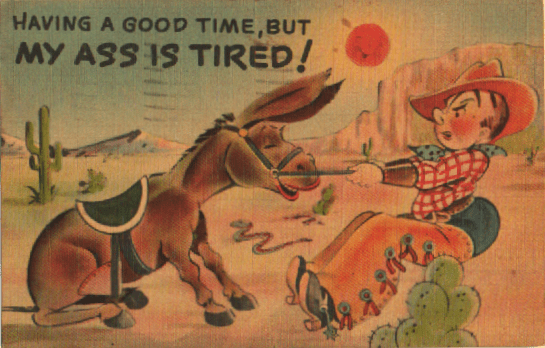
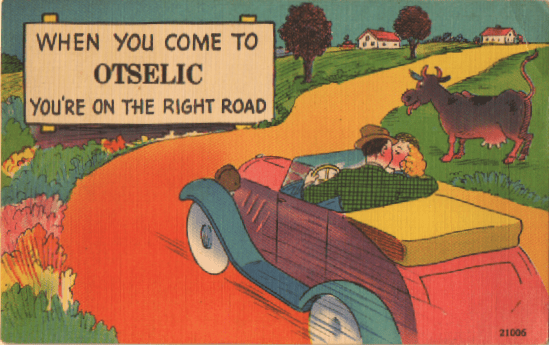
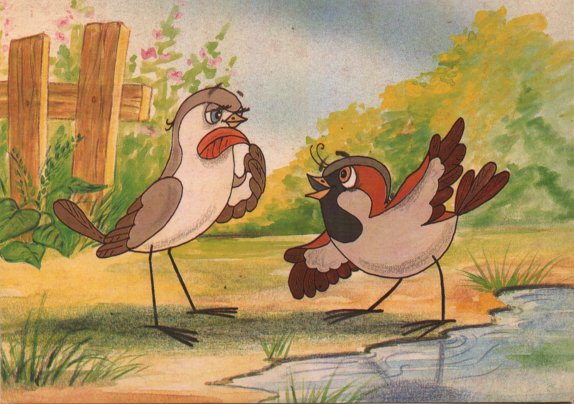
This does NOT include cards like the one at the top of this column, as that’s a separate tradition of jokes being shared (so to speak) by different cartoonists. Nor yet do I mean cards like the one above, which can be as much fun to collect, as the original had a blank space where the town name was later printed. Anyone who likes this sort of thing knows that another previously unsuspected example with a town name seldom seen may turn up in a shoebox at a garage sale.
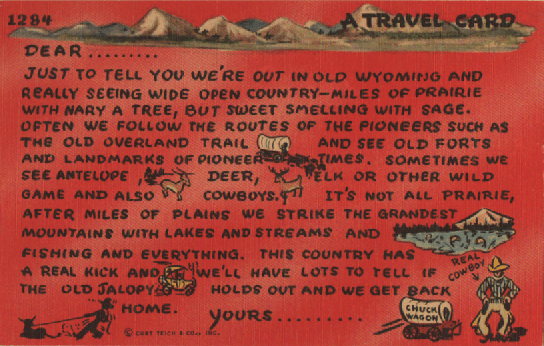
And we are not going to try to track examples where variations are obvious if one looks. This tradition of preprinting a jolly message on the picture side of the card turns up throughout history, and though it takes a second look to tell, there are a dozen or so different messages, which that second look can detect in the pictures and text (and color: Wyoming ones were red, Colorado messages blue or white, Montana yellow, etc.)
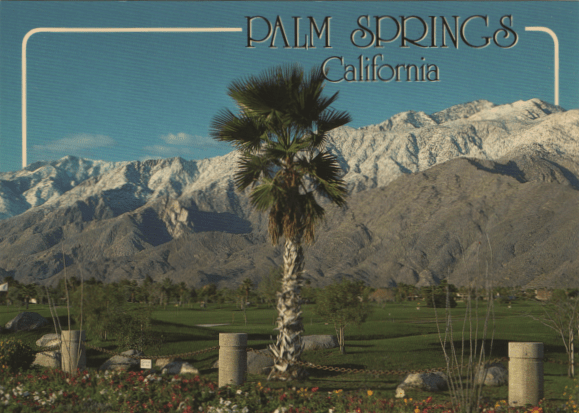
No, what we’re going to look at (and I know you were wondering) are the almost identical cards with one detail changed. The Mesquite Country Club apparently loved this photograph, because this large format postcard exists in at least three styles: one with the little white framing lines, one without, and one with soft focus around the edges. It’s that third example that shows a conscious decision to issue three different versions.
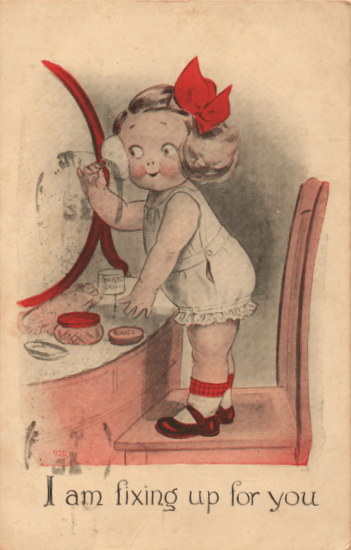
Some cases are less clear. This grown up beauty queen appears on some cards with no red coloring to her bow, socks, or jar lid. Was this an accident, or a concession to the rising price of printing in several colors?
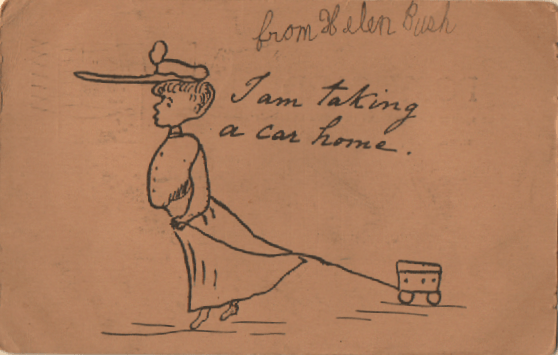
I think this one goes the other direction. This version of the lady with the car is the earlier one (in my theory) and the variant, where the car and her hat are colored in, were done later, when some editor said “If we’re going to charge a whole penny for this, we need to give the customer a little more.”
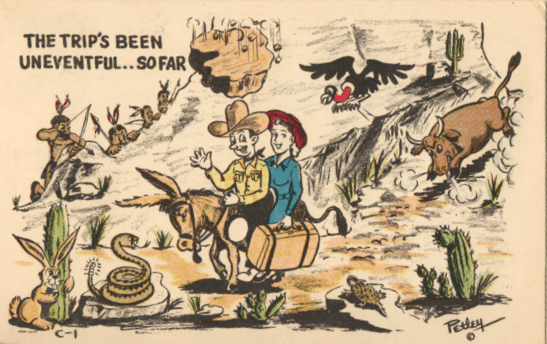
A lot of this went on at mid-century, as companies shifted from linen texture postcards to the quicker, cheaper chrome format. In some companies, the same design goes through changes in color as well as design: the picture gets simpler as time goes by. Bob Petley produced this card in a full color version, a black and white version, and this version between the two, as he explored whether the customers valued the joke or the expensive ink.
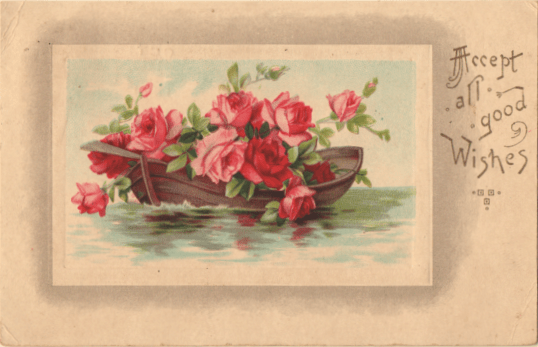
My favorite recent joke played on me by postcards is this example from earlier in the twentieth century. After trying to figure out what the sentiment was meant to be (Were they just saying “Here are my good wishes; please accept them” or did they mean “EXPECT All Good Wishes”?), I checked to see what the current market value was, and how many copies were out on the Interwebs for sale. It turns out that the company printed at least eight different versions of this card, with exactly the same frame and sentiment but different pictures of flowers in the rectangle. There are TWO, in fact, in which the flowers ride in a boat (the other one is ferrying daisies.) As I realized this, my face assumed that expression seen on the fish on those Frech April First cards. Maybe that was the point.
The skull, taken simply as a skull, was unobjectionable: clean and white, displayed on a black tablecloth for better contrast. Matt had seen photographs of skulls before: his mother owned at least a dozen such photos. Before committing murders (to paper), she liked to look at a few pictures to put her in the mood.
But for years she had been using the same photos. She changed them around occasionally: putting one away in the file cabinet and bringing out another. Over the years, Matt had seen them all, and this was not one of them. His memory was quirky, but one thing it could tell him, instantly, was whether he had seen an object, heard a voice, smelled a smell, at some time in the past. Anything he ran across seemed to get filed into memory. On encountering it again his brain checked it against the original, with any differences noted on a mental index card.
Which made him a pretty fair librarian, but also made it very difficult to tell him a joke.
Matt tapped the yellow box onto te desk. He didn’t really mind unusual disturbances. He just didn’t like them interfering with the usual ones. And there was work to be gotten through this morning.
The yellow box got halfway to a drawer. Then he brought it to the center of the desk. The skull picture was flat, down at the bottom of the box, but there was something underneath. Matt pried up the picture with a fingernail and found beneath it a dozen photographs of gravestones, all gray slate and all obviously photographed on a cloudy day.
He could see the stones were old, but didn’t know how old until he read the top one. “Phinehas Van Denover. Death Like a Mighty Quonker Laid Him Low, in1691 Ano Domino.” Poetry and proofreading had made no advances in three centuries.
His mother might have gotten a new assortment, he supposed. But these were not new pictures. They were printed on high quality paper that showed its age slowly, but Matt had handled plenty of pictures, and these had to date back at least a decade.
He looked at the skull again. It looked back. With a shrug, Matt sorted the macabre array back into a pile and pushed the stack back into the box. No way of finding out until he got home. And soon the working world would be staring into his face.
The box was filed away next to lunch, and more important drawers were pulled open for inventory. The paper clips were almost all gone. Lord, that was inexcusable. Civic government ran on paper clips. Everything else in Down might eventually be reduced to a blip of computer memory, but paper clips would go on. Why hadn’t his father invested in paper clip stock instead of squandering money on a bar on Diversey? Shaking his head over history, Matt rose and moved out to Maryann’s corner.
Maryann Hoxey, Executive Secretary, Office Manager, and Mistress of the Paper Clips, was just sliding her purse under the desk. “Morning, Matt,” she said, as she straightened up. She smoothed her skirt. “Cold enough out where you….”
Her eyes went past him, toward the door of Down. “Don’t turn around,” she murmured.
Of course, Matt turned around. The door was closing as a woman all in black leather except for flame red canvas boots strode along the corridor of filing cabinets toward them. She had easily six times as much hair as she had head, wearing it swept back and up, the better to display her ears and the peanut butter lids which hung from them. Her lashes had been worked over to make it appear humans were losing the war with spiders.
Holly L. (which she swore stood for Luya) MacTaggart was the newest of the slaveys at Down. Just out of college, she had stopped over at Down on her way to better things, to which she was entitled because she had a grandfather. She wasted as little energy as possible on her current position, conserving her efforts for the better place in city government her grandfather would certainly buy her.
“Hi-ho, everybody!” she called, swinging one arm up in bright salute.
“How can you be so springy in winter?” Maryan demanded. “It’s perverse.”
Holly chirped with laughter and was opening her sharp little mouth to reply when a voice of pure ice crawled, “Ah, MacTaggart.”
Holly sucked in her underlip and wrinkled her nose, showing that whatever else she was, she was a Down employee. A dark figure draped in an unfastened overcoat that drooped to the floor stepped out of a large cubicle. His hands held a sheaf of paper; his eyes held the gleam of bloodlust.
Walter Prince was not Number One at Down. He was Numbers One and Two and All Rational Numbers Through Ninety-Three Million. Everyone else was a distant decimal. The staff existed solely to give him headaches, which he returned. He knew all his subordinates loathed him; he took it as an indication of his superiority.
“MacTaggart,” he went on, enunciating with gloomy relish, “This summary is so one-sided I’m surprised to find it printed on both sides of the paper.”
Holly gathered her breath. “Why, Mr. Prince, my grandfather likes reports printed on both sides of the page.”
Walter Prince’s eyes opened wide. But he was a deliberate man, and before he pressed down on the detonator, he took in the presence and Matt and the hurried entrance of Linda Szarkowksi, the remaining inmate of the department. Matt watched his eyes narrow; he was choosing the nastiest course of action.
“Here, Benz,” he snarled, showing the papers into Matt’s midsection. “You know how to do it right.” He spun on one heel and marched back into the master cubicle.
Burned by twin glares from the witnesses, Matt could only back away. Peper clips could await a more auspicious moment.
Back in his cubicle, Matt tossed the report onto the stack of work in progress. As usual, Walter Prince would expect this done by last week at the latest. And Down had been understaffed since July.
That was when Charles A. Thaxter, who had previously held Matt’s meaningless position as Assistant to Walter Prince, had been killed by a housebreaker who was never caught. The newspapers had whined about that for a few weeks, claiming that a real reform mayor would have done something or other about upgrading the police department if one of his subordinates was offed. The mayor had fired a salvo in reply, but things never heated up because a complaint about the racial balance of repair crews on the expressways had come up, offering more ammunition, and the death of a longtime city hall crony retreated into the murk of the letters to the editor and then disappeared.
Of Thaxter’s four underlings, everyone’s choice as Least Likely to Succeed was Matthew Benz. So Walter Prince had maneuvered the process so that Matt moved into Thaxter’s cubicle and salary, correctly inferring that thus would alienate the largest number of people. Walter Prince had already begun to regret favoring immediate gratification over Long Range Consequences. Not only had Nelson Ryan, Thaxter’s obvious replacement, resigned in a huff, halving the staff, but Matt himself was very unsatisfactory in the position. Matt was competent, conscientious, unambitious, painstaking, and eager to please. Matt didn’t worry about maintaining the position; demotion would have been a relief, Walter Prince complained that threats and insults seemed to bounce from Benz’s thick skull. His arsenal was reduced to increasing Matt’s workload and turning the rest of Down against the new Assistant, particularly Linda Szarkowski, who had also been ahead of Matt for the position, and Holly, who had started in August to replace another suddenly deceased Downie.
This did not mean he abandoned threats and sarcasm. Not fifteen minutes later, he leaned into Matt’s cubicle to cry, “Lord, Benz! Working? Why risk tarnishing an otherwise shining record?”
Matt knew no answer was required, so he did no more than set down his pen and raise his eyes, awaiting the next disagreeable assignment.
“Got a replacement for Ryan,” Walter Prince went on. “Shows up just in time to qualify for the Christmas Bonus, of course.”
He stepped aside to let a smaller man move into view. “Nairn,” he said, “This is Matthew Benz. Benz, Carleton Nairn. Show him what to do.”
Then he abandoned his underlings to cope as best they could.
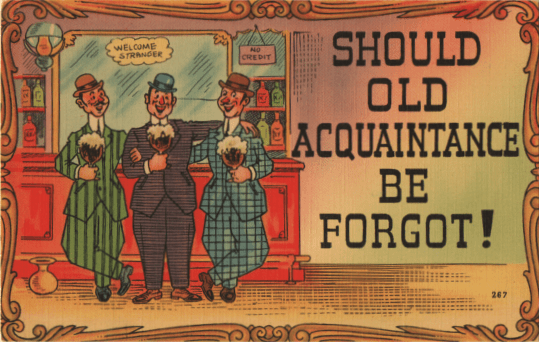
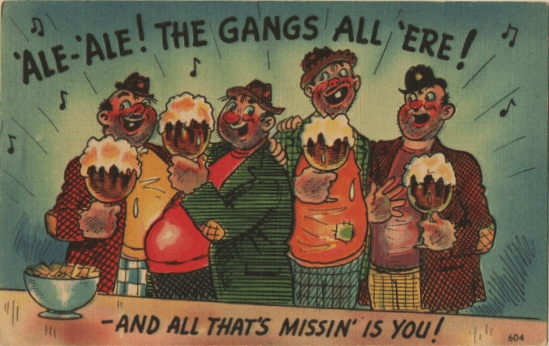
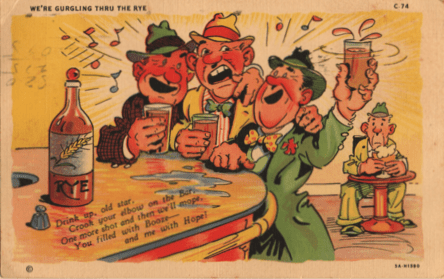
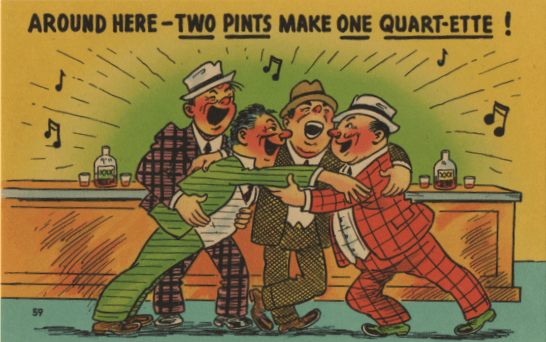
The association of wine, women, and song is an ancient one, and carries cultural baggage too multitudinous to unpack in a single blog (or year of blogs). The tradition in comedy of singing among men who have lubricated their windpipes sufficiently to break down discretion is also a bit much to consider in one blog, but one comic convention frequently expressed on bygone postcards is the association of certain songs with high (and plentiful) spirits.
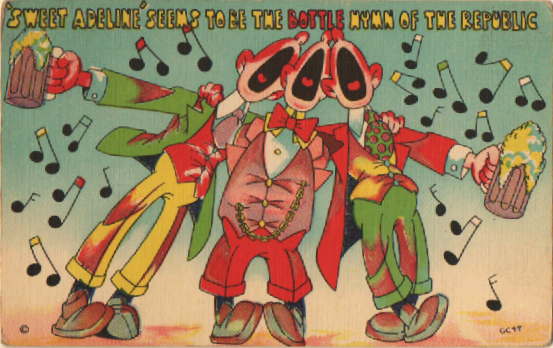
A lovestruck kid wrote a poem for his girlfriend Rosalie and teamed up with a composer to turn it into a song. “You’re the Flower of My Heart, Sweet Rosalie”, bombed entirely in 1903. The two men saw a poster about the tour of singer Adelina Patti, tweaked the lyrics, and saw it picked up by several of the hottest male quartets in the recording industry. Boston politician John Fitzgerald picked it as a theme song, and it was sung at all manner of campaign stops, which were known for a certain amount of imbibing. The first appearance of it as an anthem sung by drunks is attributed to a Charlie Chaplin movie of 1922; and from then on, the honors of singing it on records were split between comedians and heartthrob tenors.
See, Adeline is a song of longing for a lost love, and, as Thomas Edison learned when trying to sell his early naughty records to the new cylinder saloons, what the drinking public likes to sing as the night rolls on are sad songs, not raucous humor. We could go into the whole tradition of, oh, Melancholy Baby, Piano Man, My Gal Sal, and half the history of country music, but we have other stuff to consider.
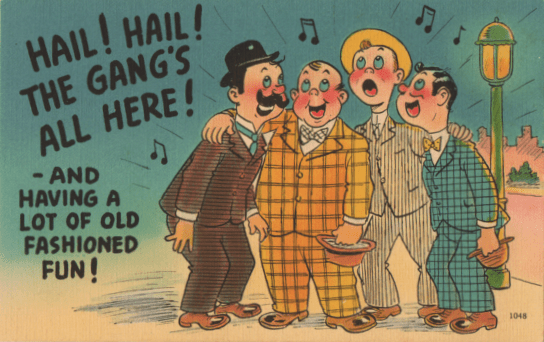
Earlier in the evening, social drinkers can reflect that SOME of their pals aren’t dead yet. Hail Hail the Gang’s All Here is or is not a song dating to 1917. This sheet music, attributed to the same lyricist who gave us “It’s Three O’clock in the Morning”, seems to be little more than a recognition that people had been singing these lyrics to a tune from Pirates of Penzance (“Come, friends, who plough the sea”) since at least the 1890s, when observers noted its popularity among amateur saloon singers.
The connection between people who sing over a sudsy mug is just one connection between singers in saloons and the barbershop quartet. The quartets, among the first pop groups available for your phonograph, helped make Sweet Adeline a hit, and were instrumental (sorry) in making any group of four think harmonizing was easy. One of the popular songs from the “absent friends” tradition, That Old Gang of Mine, in fact mourns the days when they sang together.
Any song will do for impromptu saloon singing, of course. “Mother Machree” or other songs of that ilk will do over Guinness, a solid college fight song will draw a crowd of people to join in, and I have even heard tell of a bar which used to really rock out on “Onward Christian Soldiers” (a good deal of foot-stomping was involved, I am told. This always helps.)
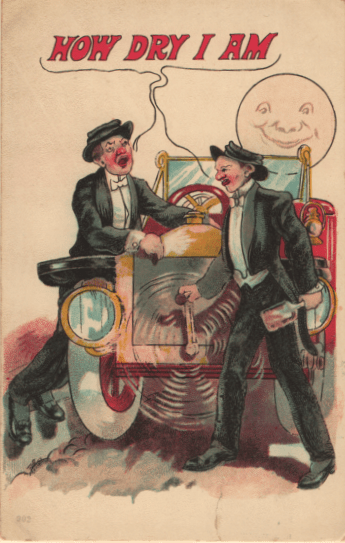
If you want a song that rivals Sweet Adeline as a boozy ballad, though, always fall back on “How Dry I Am”. The melody is simple and the lyrics, though everyone has their own personal favorite parody, will not confuse the pixilated. (Barring those people who grew up singing it as “How Dry Am I”.) This dates back to 1919, when it started off ”The Near Future”, a song by Irving Berlin about impending Prohibition.
It is suggested, though, that he decided to start his song with a traditional barroom tune, as the words can be found in nineteenth century sources, and the melody goes back to a theme by Beethoven. Unless it starts with a pop song of the eighteenth century. The similarity to an 1855 hymn called “Oh Happy Day” is apparently coincidental. Its popularity as a theme for saloons is attributed to Warner Brothers, which used it in movies and especially cartoons so any mention of actual drinking could be avoided. (An archive in Illinois, though, has sheet music from the silent movie era, suggesting it was already used by theater organists to indicate intoxication.)
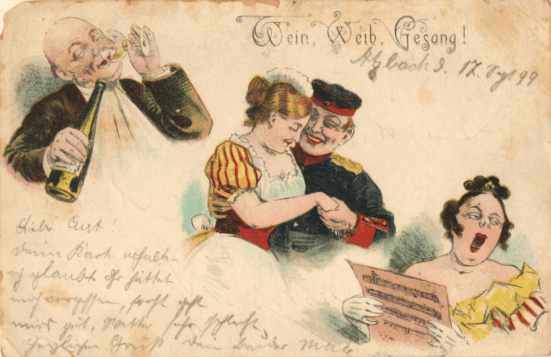
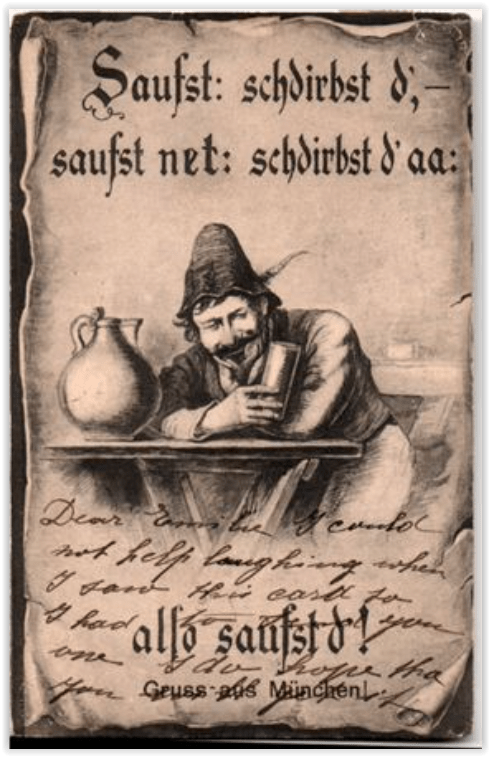
Here. We’ve covered this before. This Bavarian postcard of 1906 or thereabouts simply quotes a German drinking song. Nobody seems to know or care when it first appeared, and though I can find videos of old men singing it in bars, no one will give me a translation. I gave up translating foreign songs after my record-breaking version of “The March of the Kings” (one person who heard it was so dismayed he dropped his 78 of “Blues My Naughty Sweetie Gives to Me”.) But as far as I can determine, the lyrics are something like “drink and tinkle and drink and tinkle and drink and tinkle again.” Makes “How Dry I Am” sound like the Hallelujah Chorus.
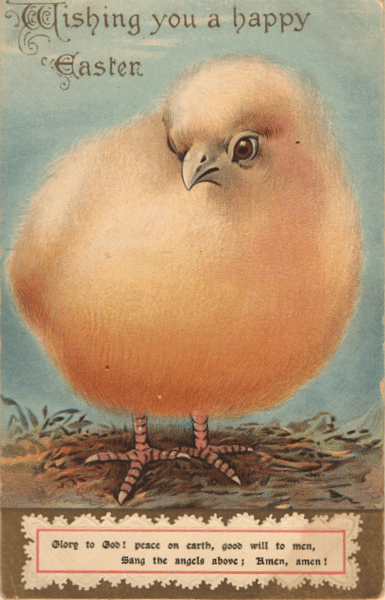
Chicken Social was a small yellow chick with good legs, a loud chirp, and a phone. One day he crossed the road and hopped along the road to see if the worms were fatter I other people’s yard, and came to a high fence around an airport.
Since he had never seen an airport before, this did not matter, but while he was scratching for worms, he heard a loud roar. He looked through the wire of the fence as a long passenger plane sped down the runway and took to the air. His beak opened wide and his eyes opened wider. He watched for a while and then, realizing this was an epeephany moment, he reached for his phone.
Once he was on his very favorite social media platform, he posted “Birds are fake! Birds are fake!”
And nothing happened.
So he waited for a while, and held up the phone when another plane roared down the runway for take off. He posted this clip to the same site, and added “Birds are fake! Birds are fake!”
He got a response this time. Someone called Mouthy Southy posted, “How can a chicken claim birds are fake?”
“I’m an expert on birds, right?” Chicken Social posted. “I don’t fly. All those birds we see flying are inventions of Men. Birds are fake! Birds are fake!”
Mouthy Southy replied. “How can this be true? I’ve seen so many birds!” But someone called Eastie Beastie posted “Expert on birds claims birds are fake!”
And someone called Northy Forthright posted “Report: noted ornithologist admits birds are fake!”
Chicken Social reposted these to his own channel, saying “Experts agree. Birds are fake! Birds are fake!”
Mouthy Southy immediately commented “Anyone who says birds are fake is a dull cluck.”
Chicken Social reposted this as well, but edited it to say “Anyone who says birds are fake is a dull *uck” and added “People who deny evdence resort to abuse. Birds are fake! Birds are fake!”
Westie Bestie commented “How true! Mouthy Southy should be banned.” Eastie Beastie posted “Leader of bird lobbyists labels accredited ornithologists with fowl language!”
“This is what it means to be a debunker of popular superstition,” Chicken Social posted. “Birds are fake! Birds are fake!”
Jerky Turkey started a website called “Flightless Birds Unite to say Birds Are Fake!” Chicken Social hit “like” and then looked up places which sold custom rings and bracelets. Soon he was advertising “Birds Are Fake! Birds are Fake!” merch at so many grains of corn per item. Eastie Beastie ordered three collars , Northy Forthright ordered two dozen T-shirts, and even Mouthy Southy ordered a collar. Jerky Turkey reposted Chicken Social’s ad for merch to the Flightless Birds Unite website.
“Do you have any more reels” asked Westie Bestie. “More evidence will prove our case. Put the naysayers to flight, Chicken Social!”
“Birds are fake! Birds are fake!” Chicken Social replied. He posted two more reels of smaller planes taking off from the airport, as well as some footage of two teenagers with a drone. “Fake Hummingbirds!” he posted. “Birds are fake! Birds are fake!”
Someone called BigBadWoulfe posted “Big Conference in Dark Woods! Are Birds Fake? Experts to Meet in cave at base of mountain. Birds Are Fake merch for sale, lots of worms and corn!” There was a space for making a reservation.
Jerky Turkey asked in Chicken Socials DMs, “Going to conference? I bought a ticket!”
Before Chicken Social could reply, BigBadWoulfe posted “Experts hope all-time Fake Bird Authority Chicken Social will accept free trip to conference!”
“Birds are fake! Birds are fake!” Chicken Social posted. “Will attend, and put naysayers and haters to shame. Save me some worms!”
Jerky Turkey, Chicken Social, Westie Bestie, and Northy Forthright all signed up to attend the conference that very evening. (Eastie Beastie complained she had a date that night but would try to convince him to register.)
The next day, BigBadWoulfe posted “Bird Fakery Conference huge success. Conspiracy debunked by arguments from Dr. Chicken Social, Ch.D.!” But there were no posts by Chicken Social, and orders to Jerky Turkey’s website went unacknowledged.
BigBadWoulfe posted “Findings on fake birds suppressed by authorities! Chicken Social, other experts go into hiding! Absolute proof birds are fake!”
Eastie Beastie sent a donation to BigBadWoulfe’s site marked “For the experts in exile! Hang tough, Chicken Social! Birds are fake! Birds are fake!”
Several other supporters posted “Birds are fake! Remember Chicken Social!” But there was no reply from Chicken Social, and without his leadership, people shifted to posts that cats and dogs were just AI generated.” Someone called Frodo Dodo caused a minor stir by posting “Chicken Social is fake! Chicken Social is fake!” But Frodo Dodo was a known round-earther, so no one paid much mind. Everyone had fake dogs to stream and meme.
Sunlight rolled across the tawny, intermittently furred body of the cave girl. Her chin was up, her face turned away from the sun, and a bright red lower lip stuck out in an imperious pout. Matt turned the page.
He reached for the diet Dr. Pepper that he always kept on hand while brainstorming. The caffeine might stimulate a best-seller yet, or at least prod a sluggish and frustrated imagination. His latest prospective million-seller, “Ascent of the Ruby Slippers”, had run into snarls.
Chapter five of the Yellow Section saw its band of questers working with Losaigon, who located a vital clue to the whereabouts of the Lost Tower of the Eighth Veil in the yellowed pages of a Craig Rice paperback, a relic lovingly tended since “The Elder Days”. In looking it over now, Matt found this passage to be amazingly boring, surpassing the tedium of anything he had ever committed to a page. The copyright to the Craig Rice passage would probably need to be cleared, too. Who knew who held that, these days? And though Losaigon had once seemed a reasonable name for the circulation librarian in a rat-infested post-holocaust library, Matt could now see “Saigon” sitting smack in the middle to distract the potential reader.
So at the very least, he needed a new name for the librarian (who would probably be better as a reference librarian). Maybe library, librarian, and Craig Rice could all be jettisoned for some new exhilarating scene which would be spoken of by reviewers and students of fantasy literature for years to come. He had only to think it up. In hopes that some image would suggest a suitable replacement, he was flipping through “Yellowbacks of Gor: Great DAW Cover Paintings”.
Another cave girl gazed up at him past the leatherbound man with the branding iron. Natt sipped at the Dr. Pepper. So far, no sultry cave girls appeared in his story at all, but one could appear, solving some part of the problem. She might make a fine librarian.
He turned to the next page. A tall, emaciated woman came through the dining room toward the living room, distracting him from the plumper though two-dimensional women. She waved her coffee cup toward the windows. “The sun was shining when I got up, turning her head so got, brilliant light poured into every age-etched line. “But now it doesn’t look so very good.”
Stepping back, she turned away from the window. “Are you reading?” she demanded, squinting at Matt. “Here. Let me turn on this light for you.”
Before her hand could reach the light switch, Matt closed the book loudly enough for her to hear it. “No thanks,” he said. “About time to be getting down to the bus.”
“Already?” She glanced at her bare left wrist. “You work too hard. You should get a rest.”
“Foo,” he told her, rising. “I could’ve told you that.” He put the book back among its neighbors on the shelf, drained his Dr. Pepper, and started for the door, by way of the kitchen. His mother followed.
The glass went into the sink and Matt moved past the refrigerator to the front door, where his coat waited for him. “See you at six,” he said, shrugging massive shoulders into it. “You won’t let anyone into the place while I’m out, okay?”
“Oh, of course,” she said, as she always did. She sipped at her coffee while Matt buttoned his coat. “Oh, well, now, wait.” Those nice women who like to talk about mysteries are coming over this afternoon.”
Matt grimaced. He had not, so far, met these women, and he didn’t like strangers coming into the apartment, certainly not when his mother was alone. Still, they had visited yesterday, and had committed no murders, stolen no invaluable paperweights, or rummaged in the cupboard for peanut brittle.
“What do they come to talk about? Their favorite books? Books in general? Or are they budding garden variety authors themselves?”
His mother shrugged and waved the coffee cup. “Oh, this and that.”
Matt hadn’t expected much more of an answer. At least half of Mrs. Benz’s vagueness was assumed, but not all, ad it was true that she had reached that point in her career where what she wrote most was her own name. She had started a Regency romance, quite a departure for her, to be called “The Noble and the Nubile”, but this had petered out, rather to the author’s relief. She might restart it, or begin a new mystery in her long-running series, this winter: cold weather seemed to give her stamina. Having fans drop by wouldn’t hurt.
“Just don’t be giving away any signed limited editions,” he told her. He reached down for his briefcase. “And be sure they aren’t selling these interviews to Stripes Magazine or some such.”
“I shall sign nothing but autograph albums.”
A paper bag sat on the floor. Matt snatched it up and thrust it inside the briefcase. He was sure he had already loaded his lunch into the case this morning, but the things you did every morning were easiest to neglect. You remembered doing them, but what you remembered was doing them yesterday, and you wound up eating Pop Tarts from the vending machine.
He had to be quick about it, or she would want to inspect the lunch and try to double the amount of food. “Well, off to the salt mines,” he said loudly, to cover the sound of the latch on the briefcase.
She kissed his cheek. “Bad for your health. Tell them to switch you to the low sodium mines.”
“Ha! They’d just assign me to the pepper mills.” He moved out into the hall, toward the elevator, pausing long enough to hear her close and lock the door.
In the lobby, Matt paused as Gaston gave the revolving door a push for him. Being careful to act as if it was just a random thought, he said “Say, do you, er, know the women who came to see my mother yesterday?”
“No, Mr. Benz,” Gaston replied. “I only saw the one, and your mother seemed to know her. Is there a problem?”
Matt shrugged. Gaston had no time for long explanations. “Not really. Just wondered.” He moved on outside.
Sunny as it was, there was a hint of impending Christmas in the air. Sloshing through sloppy snow to the bus stop at the corner, Matt murmured a magic spell to make the Number Eleven prompter than usual. This had never worked before, and once again he had time to calculate the cost of keeping a car in the city, right down to the quarters for the Robomatic Car Wash (which had been shut down years ago, but fantasy was fantasy.) As he stepped up and swiped his care card across the glass box, he concluded that even on his recently augmented salary he didn’t care to risk it.
He pushed off the bus not a mass of fellow city-slaves downtown, and shouldered his way to the building, through the metal detector, and into the elevator. In time, he arrived at the city’s Information resources Center, referred to by everyone inside the city government as “Down”. Whenever one of Them needed facts farther away than two key presses, They ordered these from the central library, commanding, “Call Down and see if you can get this” or “Send what’s-his-name Down for that stuff about Streets and San”. It would then be the job of Matt or one of his subordinates to plow through acres of paper, consult little blue numbers of a pale blue screen, or make necessary phone calls for the facts requested. Now and then a few dozen sources would need to be consulted, and data summarized for Their use.
File shelves and cabinets, the heart of Down, took up eighty-five percent of the floor space. One day, everyone had bee assured, this would all be available on magnetic tape…large vinyl square…small plastic discs…a cloud. Somehow contract negotiations had always gone awry. So for now, and the foreseeable future, the staff of Down resided in tiny cubicles that hugged the walls, trying not to infringe on the space for ever-expanding vital information. Matt’s cubicle was prime real estate, with a door that locked and nine foot walls, placing him above peons with mere six foot walls, or even no door.
Matt’s cubicle was the first one unlocked this morning, as it nearly always was. Inside, his status was further proclaimed by the presence of an entire window and three chairs. One of these was behind a broad, littered desk, for sitting on. Matt used the other two for storage and for tripping on.
He flipped his briefcase up onto the clean portion of the desk and popped it open. He bent to slide open his lower right hand drawer and tossed his lunch inside. Then he sat up to close the briefcase again, and stared at the paper bag sitting inside it.
He opened the desk draw again to make sure. The other bag sat there unimpressed.
Gingerly, he put one index finger into the briefcase and poked open that bag. An apple peeked out at him.
“Okay,” he said. He repeated the process with the bag in the drawer. A rectangular yellow box waited inside, looking very much like the ones his father had used in the darkroom. He picked this up and rattled it.
Shoving himself back from the desk with one elbow, he slid from the chair to the floor and then under his desk. There was really no chance that this box held unprocessed photo paper, not after al these years. Still, there was no knowing what his mother might keep stashed. Under his desk, he’d have a LITTLE darkness, in case this really was unexposed print paper.
He eased the lid open. Photo paper, yes, but used: somebody’s collection of pictures. No doubt his mother had been showing some ancient souvenirs to her fans. Matt slid out from under the desk and opened the box completely.
A glossy five by seven of a human skull grinned up at him.
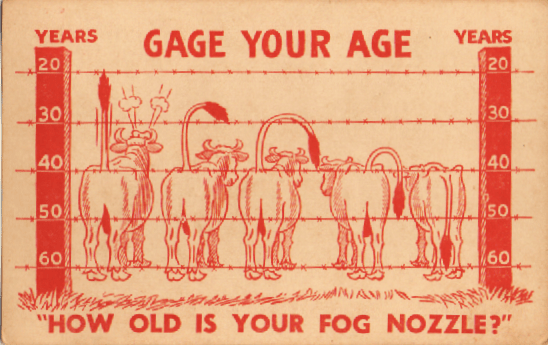
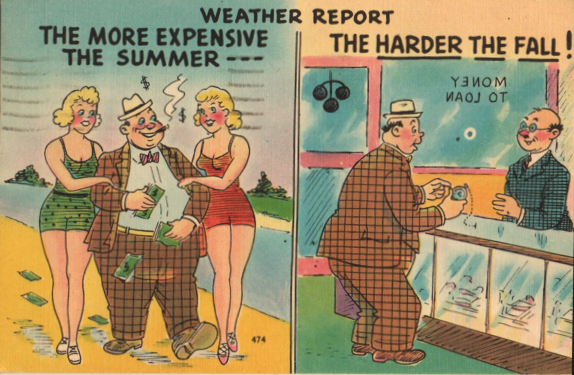
For reasons we needn’t go into, the above has never been one of my favorite gags. But I believe it helps illustrate that our ancestors were not as shy about sex as we like to believe. (As noted hereintofore, that’s how they got to be ancestors.) This is a joke which makes absolutely no punchline without the naughty subtext. And it wasn’t just the 1950s that saw this phenomenon.
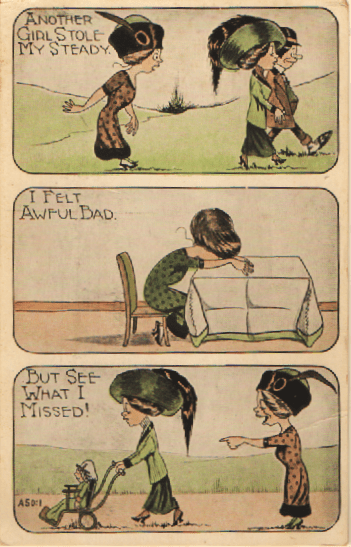
You can tell from the ladies’ garments that this postcard comes from a generation before those aging cattle. It may just be my modern imagination that makes me hunt for any sign of a wedding ring on the finger of the “successful” rival, the joke nonetheless depends on an understanding of the potential side effects of romance.
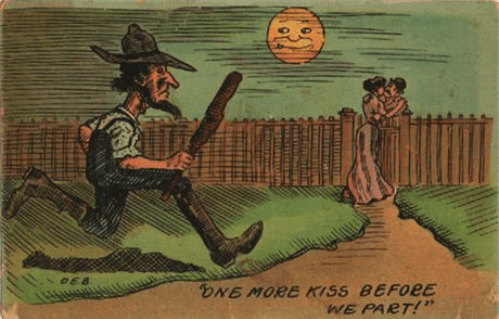
We need to set up the next example a bit. Here we see a completely proper situation. Nothing is going on here beyond a little too much kissing and an irate parent who has grabbed up a handy slat or club to break it up. Anyone who grew up with chaperones could chuckle at this without blushing.
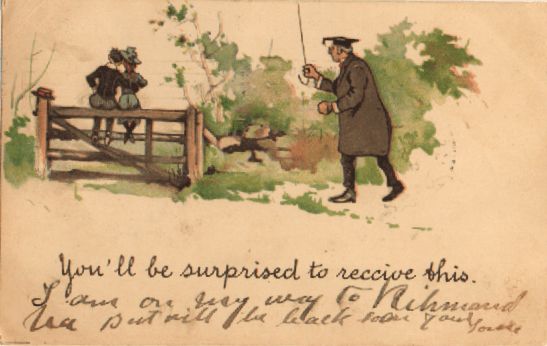
It may be just OUR generation who would blush at this, I suppose. The era before World War I was used to schoolmasters in loco parentis (“in place of parents”, essential in a boarding school or college where a kid’s natural parents weren’t around) AND the liberal use of the cane. And yet our cartoonist has spent extra time emphasizing the targets available on the couple. This could have been just to make sure we knew who was going to be the butt of the joke.
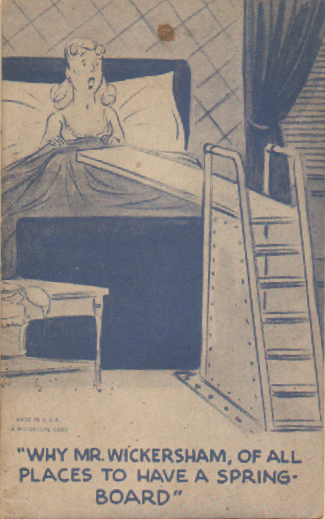
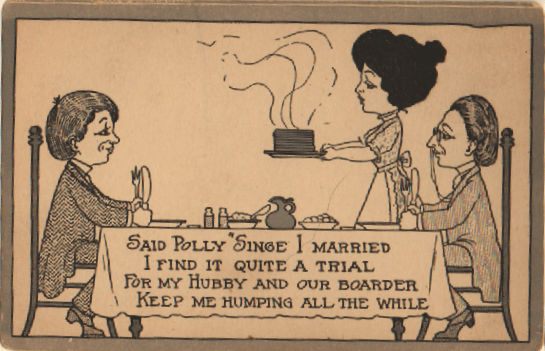
The arcade card, which was postcard-sized and sometimes included postcard markings on the backside for mailing, was for people visiting penny arcades, and could feature cute kitties, song lyrics, movie stars, and adult humor. This example, from the 1930s or thereabouts, would have been available at random from a machine offering naughty jokes for a penny. I have encountered examples where people addressed and stamped these without needing the company to print the postcard marks, but you needed to know what your local postmaster would allow.
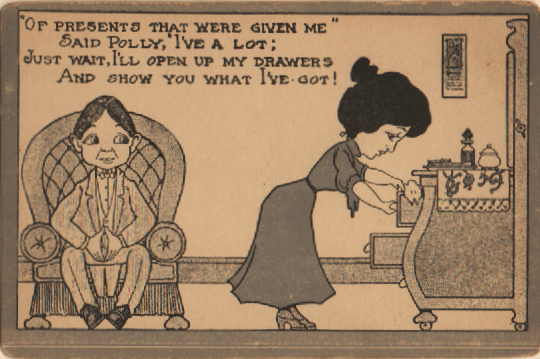
Polly’s arcade cards date from about twenty years before Mr. Wickersham’s acrobatic bedroom, and delight in accidental naughtiness. Her remarks could be perfectly unobjectionable if we weren’t aware that this scene wouldn’t even BE on an arcade card without another interpretation.
She malapropped through a number of appearances (this one depends on you knowing that ‘humping’ is also slang of ‘doing a lot of work.”) Because no research is too difficult for my readers (both of you) I have tracked down two further appearances. Polly appears in a butcher shop in one, bemoaning the fact that prices of meat have gone so high that her husband will have to be satisfied with a piece of tail, while on the other she covers in four lines a classic routine that could take four minutes on shellac discs sold under the counter at record stores. (ahem “I think if I sit on it,” said pretty Polly Prim, “And you push a little harder, you’ll be sure to get it in.” He is, of course, shoving a key into a suitcase. What did you think? You were supposed to.)
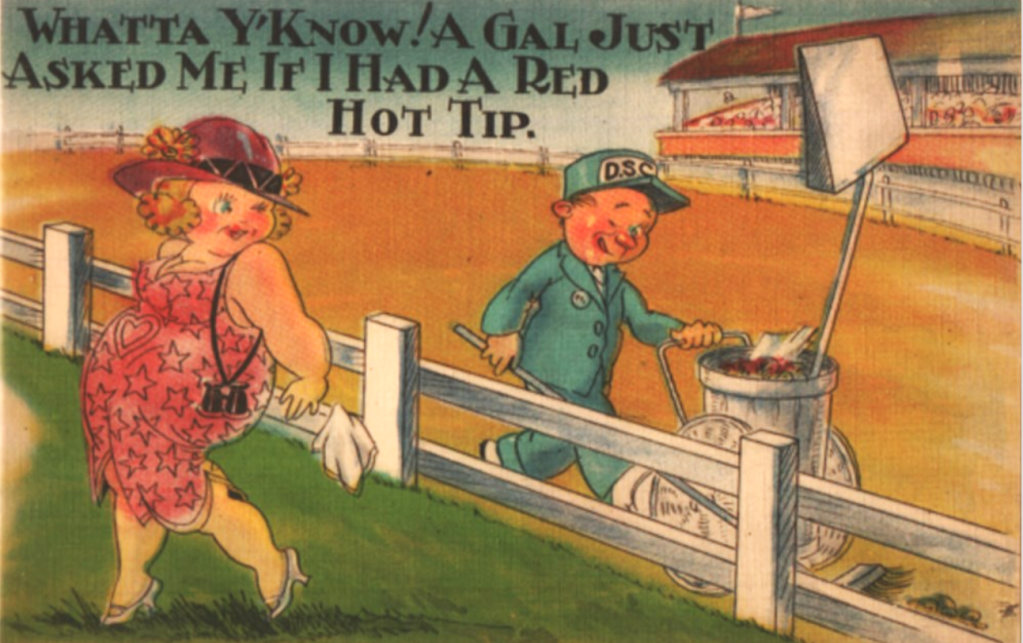
But naughtiness was not restricted to arcade cards. Here we have a genuine postcard which could be sent through the mails in the 1930s by people who could always argue that THEY thought it was just about gambling. This one wasn’t; it probably belonged to someone who explained to her parents that this was just the sort of thing to amuse Jack at college, and then quietly slipped it into her album. Never underestimate your ancestors.
“You know the answer, sir. You were in here just last week. You brought in a wallet and I tried to turn you away because I can enchant only things I have never enchanted before, and wallets are always being brought to me.”
“I thought I had you when I showed you it had a picture of Popeye on it.”
“It was highly ingenious, sir. When I told you I had made another Popeye wallet inexhaustible some eighty years ago, you showed me it was a cheap knockoff, and misspelled. I had to admit I’d never enchanted a POPYE wallet.”
“And you made it inexhaustible, so I would find money every time I opened it. And I got home and found a penny inside. And then another penny. Every time I open it, I get another single, solitary penny.”
“Thus fulfilling the bargain, sir. An inexhaustible supply of money. Or ‘cash’, as I believe you put it at the time.”
“Yeah, thanks. Well, I’m here to try again. Take a gander at this.”
“Another wallet, sir? Really?”
“From the same company, too. Have you ever enchanted an OLYVE OIL wallet?”
“I have not, sir. Hold it up, sir, and I will give it an inexhaustible supply of…what would you have now, sir?”
“Same as…not EXACTLY the same. I’d like inexhaustible money this time, but not something I’ll have to spend the rest of my life opening and closing the wallet before I have enough to buy onion rings at the diner. Folding money. And not one dollar bills. Something bigger.”
“Very well, sir.”
“But not so big it makes people suspicious. A ten thousand dollar bill would be nice, but it raises eyebrows when I want to get change.”
“Very well, sir. Your wallet will be made inexhaustible.”
“Ow!”
“I thought you would remember the burst of energy when the spell takes effect.”
“That’s why I couldn’t open the wallet until I got home. But I’m not leaving this time until I check… Oo. Ouch. Wait…this is….”
“A one hundred dollar bill, sir. Far more efficient, I think.”
“A one hundred dollar bill from a Monopoly set! I…..”
“…did not specify legal tender. Will you be back tomorrow, sir, with another wallet?”
“With the kind of work you do, it’s hardly…. Hang on. Do you know Mike?”
“Sir? I have met thousands of men named….”
“He’s about five eight, has a crewcut, and there’s a star-shaped scar on the palm of his right hand. He said he’d heard of you but he never said….”
“Yes, the heat when the spell becomes effective is rather more pronounced with larger objects.”
“I knew it! A coffee pot?”
“Yes, sir. For some reason he wanted a coffee pot that would never be empty, so he wouldn’t have to keep washing and refilling it.”
“He’s our superintendent of facilities. THAT explains the coffee pot in the break room: was it dark brown glass with a cracked yellow plastic rim?”
“That would be the one.”
“So that’s why there’s always a quarter inch of muddy sludge in the pot. It has an inexhaustible supply of coffee the same way I have an inexhaustible supply of money.”
“I cannot be held responsible for customers whose wishes are not sufficiently specific. Was there anything else, sir? I do have other duties to….”
“Does everyone get an inexhaustible supply of something completely worthless? I…. Wait, I…. No, never mind.”
“What troubles you, sir?”
“I was going to ask about my mother and those pickle jars in her refrigerator but I think I don’t want to know.”
I have never been able to join the debate between Chicago Pizza and New York Pizza. Or New Haven Pizza or deep dish pizza or tavern style pizza or thin crust pizza or ketchup-on-toast pizza (what your thin crust people call pizzas made with a breadlike crust). I have recently realized why this is. And the revelation is fairly startling.
Because I like pizza. I do know people who do NOT like pizza, a claim I regard as odd as saying you don’t like cheese. There are so many different kinds of pizza that there really ought to be something that…. But that’s the heart of my story.
You wouldn’t think I’d grow up to like pizza. See, as best I can recall, my introduction to pizza was a dish my grade school hot lunch ladies referred to as “Pizza Meat and Cheese”. I assume there was supposed to be a semicolon or a dash in there, but that was the way they wrote it on the menu and I shall not meddle with it. Our hot lunch ladies were a hardworking crew, and some of the dishes they created linger in a rosy glow in my memory to this day.
I am not the only one, apparently, for at some point, they published a cookbook of their biggest hits. These were scaled down, of course, since you are probably not preparing food for what, in my day, amounted to a thousand children each day. And they included “Pizza Meat and Cheese.” This dish is HEARTY. No wonder they gave us only a three-inch square of the stuff. It requires two types of meat, two types of cheese, and ideally results in a crusty orange top I have seen on no other pizza ever. The scaled down recipe provided me and a sibling with one meal and leftovers for use throughout the ensuing two weeks.
My next pizza was frozen pizza, something my mother figured would be quick and warm for a winter weekend lunch. The only brand available was Roma, a thin crust pizza with sausage and a cheese that did not brown. Ever. Cook it too long and it would blacken, but otherwise it was as pale white as I was in those days when the teachers would send home notes demanding I be checked for anemia. If you let it cool, the grease would congeal into little green puddles, especially on top of the little round sausage pennies. This tasted exactly the same and did not in the least discourage me, despite my deserved reputation as a picky eater. Later on, Roma, facing competition from new frozen pizzas, upgraded the recipe to enable the cheese to brown and providing less colorful grease, but it never tasted the same. (I was bereft except for a brief period in grad school when the cafeteria served a identical pizza, right down to the anemic cheese.)
I moved on from pizza to pizza, encountering pepperoni in a minced state on one of the new frozen brands, and discovering another sibling’s favorite delivery order (ham and onion, extra cheese). Pizza place pizzas followed, including all you can eat pizza buffets (I did my very best to lower their profit margin), artisanal pizzas (sliced potato and rosemary?), Only in America pizzas (Thai Chicken Taco Pizza), Wal-Mart pizza, grocery store hot bar pizza, Australian pizza, folded pizza (ALMOST but not quite a calzone), unsliced pizza, pizza with dipping sauce for those bits of crust with nothing on them, salami pizza, hot dog penny pizza, hot honey pizza…and although there were a tiny number of losers in the batch (I have learned to shy away from anything called “authentic”) I’d have to say my pizza memories are as golden as the crust on top of that elementary school hot lunch square.
The verdict of my nearest and dearest is that I am not so much a gourmet as a gourmand (which Cajun TV chef Justin Wilson translated as “P-I-G, hog”.) I prefer to think of my tastes as eclectic. Let a competent cook prepare something with cheese, crust, a modest amount of sauce, and, by preference, sausage (plus seating where there is nobody counting how many slices I put on my plate), and I am content.
Mind you, this largely ignores the question of homemade pizza. So if you came into this blog expecting to find my top secret recipe for chicken liver pizza, well, you will have to wait. I know, I know. But I still don’t have clearance from the United Nations Security Council.
As I continue my hopeless quest to figure out why some writers a hundred years ago or thereabouts referred to a handgun as a “roscoe” (I keep waiting for Fatty Arbuckle to be the answer, but no one goes along with it) and my equally futile journey to find out what happened to the form of address “Ms.”, which was controversial in the 1970s and is now included on forms you can request this title but is entirely misunderstood by the modern generation half of whom pronounce it “Miss” and half of whom pronounce it as “Mrs.” The latter is more appropriate, as it misses the point of the word (which is pronounced Miz). I suppose this is not the only example of the survival of a bygone custom for which we have lost…where were we?
Anyway, I ran across the word “pesky” and paused to wonder where it came from. I was pretty sure where I learned it. It was not my parents nor yet my classmates at school. I am positive I picked it up from the fascinating display of vocabulary every time Yosemite Sam exploded onto the little television screen we huddled round in those days before the invention of the Interwebs, the wheel, and fire. This reflection sent my mind back to the rest of Sam’s poetic expostulations, and I went hunting for where his style of English came from.
Some words are self-explanatory. I knew at the time what phrase “dadgum” and “dadburn” were standing in for, and it seems that “lunkhead” derives simply from “lump head”, another synonym for “bonehead”. “Consarn” or “consarned” derive from “concern” and “concerned”, used by Englishfolk for whom “confounded” was too profane. But other words and phrases take more hunting.
“Pesky” pretty surely comes from the word “pest” which was once just another word for “pestilence”, so that once upon a time pest and plague meant the same thing, which gives us the British “plaguey” as a synonym for “pesky”. Pesky and plaguey are both seen in the late eighteenth century, and were in reasonably common use at the start of the nineteenth. (Keep in mind that Sam is at least vaguely considered a denizen of the Old West.)
Running around the United States around the same time as “pesky” was “varmint”, which I am told is an American spelling of the sixteenth century English term “varment”. “Vermin” were any small animals who just made trouble, and therefore were not protected by any game laws. “Vermin” was plural: one on its own was a “varment”. One authority states that “varmint” is especially at home in Appalachia (which, of course, spent its own years as the Wild West.)
Another of Yosemite Samuel’s favorite epithets is “galoot”, also a staple of Wild West stories and movies. THIS has no such easy answer as our previous endearments. Some people insist it is a reference to Goliath, a large, slow-moving loser. Others derive it from a term for a rookie or clumsy sailor, tracing it to soldiers who made sneak attacks aboard a rowboat called a “galeote”, a small version of larger ships rowed by galley slaves. Since the soldiers were NOT going to be experienced sailors, the term “galoot” came to refer to anyone doing work they weren’t fit for. But still others find the word “galoose”, which meant loose or generally unfastened. We’ll just step aside and let THEM fight it out.
If you want a lifetime career, you might look into “rootin-tootin”. This is found in the nineteenth century, and certainly comes out of what I call the Davy Crockett Tradition. Any western hero would introduce himself with a long string of warning descriptions, often rhyming here and there: the longer and wilder the better. Sam is an honorable continuer of this tradition. (See also Phil Harris’s “Ding Dong Daddy From Dumas”.) HOWEVER, the etymologists (people bugged by words, as opposed to entomologists, who have words with bugs) insist on jumping down every adjacent {Bugs} rabbit hole, including, but not limited to “rooty-toot-toot”, “you’re darn tootin’” (related to “you’re damn tootin’” and just “You’re tootin’”), “sure as shootin’”, “whewtin’ and tootin’”, and….
I shall abstain from that fascinating journey. If I devote my life to any of Sam’s explosive remarks, I will study “rackln’ frackin’”, the cartoon equivalent of the comic strips’ “#@##*&!*%*!” Because I recall Muttley, in a competing cartoon, muttering “rassenfrassen” while I believe other characters preferred “rattin’ frattin”” and…it’s one of those pesky things people don’t study nearly enough.