Laugh In Peace

If you cast your mind back to last Friday’s column (I know: you worked so hard to forget it, but be brave; this will be over soon) you will recall my hunt through my inventory of elderly postcards in quest of Halloween-related images.  This was very nearly fruitless, but on the way, I did notie that our ancestors did occasionally give in to a morbid stream of humor.

     The Cemetery lady said it often enough, that Death was the new Pornography.  We don’t like to think about it or be reminded it exists, but our ancestors handled things differently, putting up huge signs and symbols around their houses when there was a death in the family, and holding a big a funeral as they could afford.  Deathbed photos were a valued family possession (Queen Victoria had a massive collection, they tell me) and there were even postcards with post-mortem photos of the late lamented.  (I have a couple of those, but I will spare you.  And, after all, how do I know these aren’t just people who owned really uncomfortable beds?)

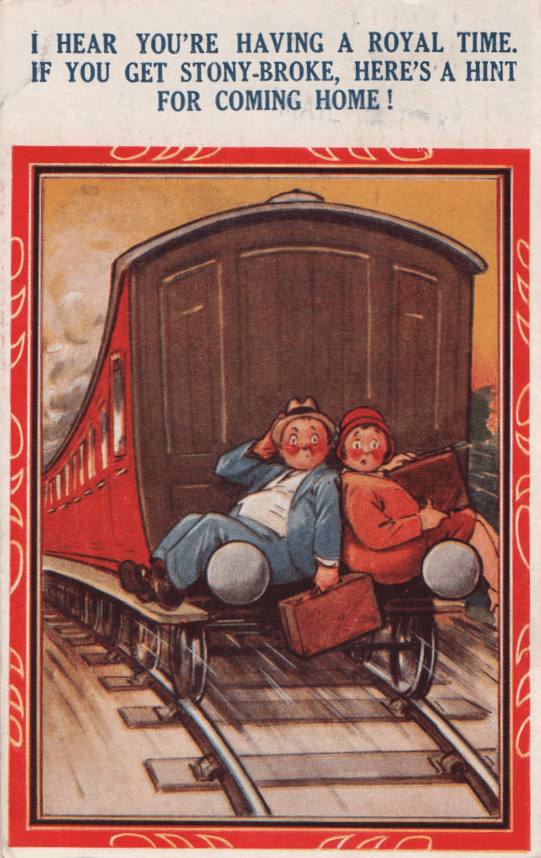
     If that weren’t enough, our ancestors were very big on the Memento Mori school of motivational verse.  The postcard at the top of this column symbolizes it: you’re going to die, so don’t waitr around until the time is right to get the job done.  From what I’ve seen of these, this image was actually considered pretty funny: college kids apparently sent them to each other on a regular basis.

     There was also a considerable literature on the subject of the Funny Tombstone.  You should have heard the Cemetery Lady on THAT subject.  She had nothing against a bit of humor on a grave marker, but she objected very much to undocumented epitaphs, most of which, she said, were patently fake.  I have not looked up this one to make sure it existed.  But the card does.

         She had no objection to a good pun, and might have found THIS postcard worthy of inclusion in her postcard collection.   Have a feeling, though, that nothing like it would have appeared in postcard racks in the drugstore in my boy days.  They might have sold it, but possibly at some counter at the back of the store.  By my day, jokes involving caskets would have been considered “sick humor”, and would have cited it as evidence of the degeneration of young people ion the modern world.

     And this sort of gag would only have appeared in underground comic books in my boy days.

     This would have been decried as evil propaganda, and a plot against the American tobacco industry.  (One of my heroes wrote in a column that his generation knew cigarettes were dangerous in the 1940s.  “Why do you think we called them coffin nails?”  This card dates to before that, even.)

     While this joke would never be published today at all: just because a previous generation thought it was funny doesn’t mean it’s permissible today.

     It isnIn fact, death was perfectly acceptable, as we have seen in previous columns, if it involved certain habits.

     By and large, though, the post-World War II generation, having gone through periods of mass-produced death, preferred to ignore that part of life.  When they considered such things at all, they went straight to considering the afterlife, and how it would look to those who encountered it.

     Besides considering the rewards which awaited those who had suffered in life.

     An earlier generation told jokes about the afterlife, too, but postcard sellers of the Fifties would never have accepted this pre-war vision.

Assisting With Inquiries

     For this episode in ancient joke identification, we move to the world of law and crime.  For the purposes of keeping this on a calm and genteel level, we will NOT be going into hot button issues like, say, stealing jokes.

     J1.”Psst!  Bud!  Wanna buy a hot?”

     “A hot what?”

     “(          )”

     J2.“I want you to take him to jail and teach him a lesson, Officer.  Him and his filthy songs!  Every time he goes by my window, morning noon and night!  He ought to be locked up!”

     “Well, Ma’am, all I can really do is take him in for a warning.  You say he sings dirty songs when he passes your place?”

     “No! (          ).”

     J3.Another time, Emma called the polic to complain about some young men who were swimming nude in the creek that ran behind her back yard.  “They’re shameless!  I can see them from the kitchen window as plain as a pikestaff!”

     An officer was sent out to discuss this with the young men, and asked them to move farther downstream, for their skinny-dipping.  Emma called again to complain, “Well, they’;ve moved, but nor far enough!  I can still see them from my uostairs bedroom window!”

     The officer came out again and discussed this with the young men, who agreed to keep moving along the creek.  Emma called a third time.  “I can still see those young men swimming!”

     “But, Ma’am,” said the Chief, “I know where theu’ve gone, and they’

Re so far from your house you can’t possibly see them!”

     “That’s what you think,” she replied, “(          )”

     J4.”Oh, my goodness!  Have you seen a policeman, sir?”

     “Not lately.”

     “Oh.  Okay.  (          )”

-J5.”Can you describe the man who punched you, sir?”

     “Of course.  (          ).”

J6.”Take your pole and your can of worms and get off my property or I’ll have you arrested for trespassing!”

     “Then I’ll sue for false advertising!”

     “Huh?”

     “Doesn’t that sign say (         ).”

J7.”Why did you pull me over, Officer?  Was I driving  too fast?”

     “No, sir.  (          ).”

J8.”Oificer, could I have a word with the man you caught burglarizing my house last night?”

     “We really can’t allow that, sir.  Just let us take care of him.”

     “Oh, it’s not for revenge or like that.  (          ).”

J9,”Some guy just drove off in your car!”

     “Oh no!  Did you see what he looked like?”

     “No, but (          ).”

J10.”Here’s another drunk, Sarge.”

     “Hey, this man’s not drunk.  He’s been drugged!”

     “I know, Sarge.  (          )”

If you are planning to step into the police station yourself, you will need to have your ANSWERS all ready.

     A1.Business has been good; Waddya need?

     A2.Whistling them

     A3.I can see them perfectly if I go up into the attic, climb on the boxes by the window and use my grandfather’s telescope!

     A4.Stick ‘em up

     A5.That’s what I was doing when he hit me

     A6.Fine for Fishing

     A7.Flying too low

     A8.I want to know how he got in without waking my wife

     A9.I got the license number

     A10.I drugged him all the way from Walton Street!

Hollow Ween

     In gladder, pre-pandemic times, I would be writing now about Halloween-type books.  This was not as easy as it might sound, because Halloween, unlike Christmas, does not have a lot of traditional stories: the headless horseman being about the only literary character tro be found only at Halloween.  Our propensity for scary movies year-round, as well as that of our ancestors for ghost stories at Christmas, may be to blame for this.

     On the other hand, there are LOTS of Halloween postcards.  But I’m not going to write about those just now.  Other people have done a good job on them and, anyway, they tend to revolve around the same cliches: Jack o’ Lanterns, witches, black cats: you can find lots of those elsewhere online, too.  At very high prices, because they are wildly popular, which is the reason I don’t have any, and another reason I thought I’d write about something else.

    I thought we could consider scary critters on other, non-Halloween postcards.  I thought we could leave out normal, everyday things people might be afraid of, of which there are many on postcards: dentists, cars out of control, mothers-in-law, large round ladies dropping out of the sky on you (It’s alarming how many of these there are: was that really such an everyday problem?)  We can consider the monsters and supernatural threats which might go bump in the night the other 364 days of the year.

     TOTAL; waste of time: there weren’t that many.  See, in the golden age of the postcard, before World War I, some of our favorites were missing.  The books Frankenstein and Dracula existed, but Boris Karloff and Bela Lugosi had not yet made the respective movies which made them part of our culture.  And although some newspapers were trying to convince people that opium fiends might stab you byu night or Asian masterminds might pipe poison into your bedroom, it just hadn’t caught on with the general public.

     Black cats were actually considered signs of good luck (unless they crossed your path) and were generally drawn as funny critters.  This chap and his brethren did a whole line of postcards performing interpretations of pop songs.

     And black kittens were just plain cute.

     You’d think giant chickens would be a source of fear, but these chaps just regard them as a chance for a hearty meal.

     And monster fish were so common on fishing postcards because they were good for a laugh

     Especially if you could toss in a bad pun.

     Your most common place for monsters on postcards was in the realm of a drunken man’s visions, or delirium tremens (the D.T.s) and this was always a source of great good humor, the quality of the liquor our ancestors consumed meaning many drinkers had experienced the effects.  (The Newberry Library has a very nice collection of these, which includes dragons the size of skyscrapers coming down to greet the souse on his way home.)

     But the viewer was not expected to tremble in fear, just laugh.  This giant baby makes MY heart palpitate. But Mom seems pleased

     Postcards even anticipated our slasher movies, but when they did, they did it with a grin.

     Maybe it’s my fault.  Maybe I just don’t HAVE any postcards with really dark, sinister, Halloween type characters on them.

Still On the Line

     Before we abandon the subject of clotheslines and their place in the lives of ages gone by, there is one more theme in postcards to be considered.    It is a mysterious concept, and an elusive commodity nowadays, but SOME of our ancestors prized it highly.  They called it “Privacy”.

     It is one of my hidden beliefs that our ancestors were not ALL that different from us in many ways.  (I go into this more fully in a never-demanded lecture called “Victorian Applications of New Communication Technologies”: it’s a rouser.)  And much though, in my heart, I would like to think differently, I have a feeling a number of our ancestors would have been perfectly comfortable in a world where we now post pictures online of what we ate for dinner, what we stole in our latest burglary, whom we had sex with, and the results of the baby’s paternity test.

    Still, our ancestors claimed to value privacy, and having one’s clothes out on the line was a risk of that [privacy.  We even had a phrase to describe people who made a fuss about things that were too personal: they were “airing their dirty linen in public”.  And you will note that the lady displaying her underdrawers on the line, above, is credited to California, still at that time (and actually now) a part of the Wild West.

     One did not have to be Sherlock Holmes to make deductions from what one saw on a person’s clothesline.  This is one reason some authorities suggested you hang up certain garments under the drying sheets, or inside the drying pillowcases

     Drying certain nether garments in public were believed to have an impact on one sex in particular.

     It would at least create certain assumptions and expectations on the part of the viewer.

     And might draw unwelcome (or apparently sometimes welcome) comment. .

     But what really bothered our ancestors were that that the display would bring on criticism.  You could count on passersby the think negative thoughts about the wearer of such underwear.

     The greatest fear apparently being that people might make the assumption that this was ALL the underwear you owned hanging on the line at the same time

     They might even take advantage of the situation.

     It happens often enough in the postcards to make ME, assume that, after all, it may sometimes have happened that way.

     Though I’m not sure it ever went as far as some postcards suggest.

Representative Humor

     Once upon a time, of course, religion and politics were two things you didn’t discuss unless you were among friends, and sure of your audience.  This was before the invention of social media  Nowadays, unless you’re screaming your convictions each day, you are an unaware, unpatriotic, and probably unworthy of your account.

     This did not keep our ancestors from joking about these subjects, though.  Last week in this spot, we covered religion, so let’s consider the more temporal side of the question.  As always, these are jokes so old the punchline should be second nature to you, and so has been tucked away in the answers section.

     J1.The postmaster at a little post office found an envelope addressed simply to GOD.  Not sure how to route this, he opened it and read what a small boy had written:

     “Dear God: We are having a rough time.  Dad can’t get work and Mom can’t fo her job unless she gets an operation on her foot.  There’s no groceries, and my baby sister cries because she’s so hungry all the time.  Please send us a hundred dollars.  That would help.”

     The postmaster had grown up in a poor home, and was touched enough by the letter to send it on to the district’s Congressman.  That worthy was so touched that he put a ten dollar bill in an envelope and mailed it without any other message to the return address the boy had put on the envelope.

     Not much later, the postmaster found a new envelope in the mail, addressed to GOD, with the return address the same as before.  He opened it and read, “Dear God.  Thanks for the money.  But (          ).”

     J2.”Don’t ho in there.  The Senator’s been talking for two hours.”

     “What about?”

     “(          )”

     J3.”Ma’am, we’re getting up a fund for a monument in honor for the late Senator Knoop-Busch/  Would you donate ten dollars to bury a Senator?”

“Here’s a hundred dollars.  (         )”

     J4.Senator Hayley was campaigning for re-election, and, aware of a new law allowing residents of the Mesquakie reservation to vote, took a trip out there, mounting a platform in a pasture to give a rousing speech.  “I feel a real connection to you people!” ge declared.

     “Oola Olla!” cheered the crowd.

     “I know how much you have been neglected in the past and I will see to it that more funding is provided for your needs!”

     The crowd roared, “Oola olla!”

     “I know that, with your advice, I can usher in new legislation to repair your roads, provide 24-hour electricity, and build new schools!”

     The crowd’s shout echoed through the plain.  “Oola olla!”

     When his speech was done, he asked his host, “I’d like to take a look around your reservation.  That’s a fine herd of cattle you have there.”

     “Better walk over on this side, Senator,” the man told him, “Otherwise (          ).”

     J5.”When the United Socialists take over the government, everyone will have strawberries and cream for breakfast!”

     “I don’t like strawberries and cream!”

     “Under the United Socialist administration, lady, (          )”

J6.The Republicrat candidate in the debate pointed to the Democan and said, “My opponent is a very rich man.  Now, there are many ways to get rich, but only one honest way.”

     “What’s that?” demanded the Democan.

     “Yep,” said the Repunlicrat, “(          )”

     J7.”Listen, bud, it’s no use you blathering around here.  I’d vote for Satan himself before I’d vote for you.”

     “Well, okay.  But (          ).”

And here, among the ASNWERS, are things you already knew.

            A1.next time don’t send it through Washington.  They took ninety percent.

            A2.He hasn’t said

            A3.Bury ten

            A4.Or you’ll step in the oola olla

            A5.You will have strawberries and cream and like it!

            A6.I figured you wouldn’t know

            A7.If your friend decides not to run, can I count on your vote?

Online

     Just in the interest of full disclosure, our ancestors did not consider sex and romance to be the only concepts associated with clotheslines.  There were practical considerations as well.

     Our ancestors were a little more accustomed to the great outdoors than we are, and their towns and cities contained a good many more varieties of animals than can be found in OUR back yards.  A few town dwellers still found space to keep a few hogs, as a measure against rising meat prices, and every few decades there is another push to tell people who live in the city how easy it is to raise chickens for fun and profit.  (With a very few exceptions, people who have tried this report very little of either.)  Until people got sniffy bout zoning laws, cows were often to be found in urban yards, providing milk for the kiddies.  Cows, in fact, have their own massive postcard literature, and we will save them for another blog.

     And there were goats.  Goats also provided milk, and were smaller than cows.  Goats have a large representation on postcards as well, and we could do a blog just on the “Don’t Butt In” postcards.  But of course their main place in folklore was as eaters of tin cans, old shoes, or anything else left within their reach.

     Not to mention laundry.  I cannot look at these cards without being cast back to my piano lesson days, and the classic “Bill Grogan’s Goat”, with its pounding left hand accompaniment.  (Bill Grogan’s Goat BOMP BOMP BOMP BOMP Was feeling fine BOMP BOMP BOMP BOMP  Ate three red shirts BOMP BOMP BOMP BOMP Right off the line.)

     No, they weren’t the ONLY animals free to wander through the yard and chew your laundry.  Cows could go for an occasional change of diet.  (Still worried about the caption on this one.  Does she have THAT many critters wanting to chew on her lingerie?  What’s the address of this place?)

     Even supposedly domesticated livestock might take a whirl at your clothes when you hung them outside.

     Moore than a mere opportunity for the local animals to browse among your lacy garments, laundry on the clothesline was a chore that everybody had to do, that everybody had been doing since the beginning of clothing.

     Oh, yes, everybody had to put the clothes out to dry.

     Of course, your modern, up to date household had a washer and drier indoors.  But you could hardly take them with you on vacation, and laundromats tended to be urban phenomena.  So washing by hand was a feature of the adventurous holiday in the wild, and often a sign to other people that you were on vacation.

     (Ready for a Spot The Differences Game?  In one of these duplicate ideas, the dog gets no lines, in one there is an outhouse handy, in another the lady has a much bigger tub…okay, you take it from there.)

     Everybody did laundry, and did it throughout their lifetimes.  One postcard artist, in fact, spread a whole life across the line for us.  What memories and lessons can be pinned to the notion are up to us.

Love Line

     So after two weeks of discussing potties, indoor and outdoor, on the modern postcard (or at least those I have on hand), what can we discuss?  Well, looking over the array, I noticed a strange preponderance of postcards dealing with something else most humans used to do outdoors and now primarily do inside the house, namely, drying the laundry.

     Washing clothes was hard, sweaty, dangerous work, what with tubs of scalding water, soap based on caustic chemicals, and that exceedingly dangerous wringer.  Naturally, our ancestors found some humor in all this, but they found more fun in hanging the wet clothes out on the line, which, though similarly backbreaking, at least got you outside where you could cool off in the gentle breeze.  (It is NEVER a hundred degrees or ten below on laundry day on a postcard.  Besides, in the winter, you strung the clothes up in the laundry room or somewhere, so they wouldn’t freeze solid.)

     What struck me particularly about the clothesline postcards is how many of them deal with  love (and/or sex).  Was it the domestic nature of the chore?  Was it  seeing the cool breeze waft through your undies?  What is it we have lost with our indoor washer and dryer combinations?  Look at that couple at the top.  That looks in their eyes has NOTHING to do with the satisfaction of getting their clothes cleaned.  The look in his eyes, especially…well, let’s move on before she bends over the basket again.

     Of course, the possibility for a simple pun had some attraction.

     Yes, a simple pun and a simple drawing….

     A realty simple…look, if there were a law against ever using a joke again, all our standyup comedians would have to be mimes,.  So count your blessings.

     Maybe that’s what it is, though.  The word “pants” was kind of taboo for a while, and even mentioning underdrawers (“unmentionables” was a word for them for a reason) so maybe the idea of letting it all hang out just…no.  I am NOT going to go into a lot of research on whether or not that phrase was related to hanging panties on the clothesline.  You can do that in YOUR blog.

     SOME experts recommended you observe proprieties by never hanging male garments next to female ones on the line, or even hanging up a ladies nether garments inside a pillow case.  Yes, they took longer to dry that way, but the price of public decency is easily budgeted.

     But it ain’t just the clothes that are involved in romantic interludes at the clothesline.  Here’s a little  scene involving a man who was apparently just passing (you don’t wear a hat or shoes like that for helping with chores) and stopped for a bit of good, clean flirtation.

     And then there’s this cheerful couple: once again, it seems obvious he was just passing by and stopped for a neighborly greeting.

     I suppose there’s no posted limit to what you can do at the clothesline if you are of a romantic nature.  I’m not sure that justifies getting between the sheets thisaway.

Stand Up, Stand Up

     For centuries, our ancestors  loved to tell jokes about doctors, lawyers, and priests, authority figures who spoke Latin.  I hope somebody will eventually take my suggestion and do a dissertation on the subject, but for now, they tell you you should never venture on a joke about religion unless you are really sure of your audience.  Be that as it might, here are a few really old jokes, as in previous Monday columns, with their punchlines pushed down to the Answer Section, since these are jokes you MUST have heard a hundred times, perhaps even from the pulpit.

     J1.The revival preacher was warning his audience of the dangers of following the wrong path in life.  “And on Judgement Day,” he intoned, “For Brothersd and Sisters, the wicked, there will be only wailing and gnashing of teeth!”

     A woman in the audience shouted, “I got no yeeth!”

     “Sister,” the preacher shouted, “(          )”

     J2.The preacher continued, moving to new heights.  “Would everybody in this congregation who WANTS to go to hell stand now!” he shouted.  Of course, no one stood up.  The preacher spread his hands.  “Would everyone who truly wants to go to heaven rise?”

     Everyone stood up except a small boy in the front row.  The preacher frowned at him.

     “Little brother,” he called, “Do you NOT wish to go to heaven when you die?”

     “Oh!” said the boy.  “(          )”

     J3.During an art period in Kindergarten, Tommy got very busy with his paper and his crayons.  “What are you drawing?” the teacher inquired.

     “A picture of God,” he replied.

     “But no one knows what God looks like,” the teacher objected.

     “Well,” said Tommy.  “(          ).”

     J4.One Friday, a man walked into the corner café and asked the waitress, “Any whale meat today?”

     “Whale meat?” she demanded.  “No!”

    “Is the shark steak good today?” he inquired,

     She frowned at him.  “We never have shark steak, sir.”

     He sighed.  “Well, then, I’ll have the bacon cheeseburger.  Lord knows (         ).”

     J5.Canute was lost in the forest.  It had started to rain, and night weas falling.  The woods got darker and darker.  The rain became a thunderstorm, and though the lightning gave him a little guidance, it was quickly gone and the thunder made him shake in his hiking boots.  He finally raised his face to the sky and called, “Lord, if it’s okay with you, (          ).”

     J6..The hunter had bagged his limit and was completely out of ammunition when he stumbled into the territory of a large bear.  The bear turned on him, growling, and, knowing he could not outrun the animal, the hunter dropped to his knees to pray, feeling he would at least be killed in a pious posture.  But nothing happened.  Opening his eyes, he found the bear, too, was kneeling, with its paws raised in prayer.

     “I had no idea the animals of the forest did such things,” he said.  “Brother, I’m grateful for your mercy.”

     “Hush,” said the bear, “(          ).”

     J7.In the days of the frontier, an itinerant preacher was striding through the woods from one settlement to the next when he, too, happened upon an angry bear.  He had no gun, but he did have a knife, knowing it would be an uphill battle.  “Lord,” he prayed, “If I am of any real use to You, help me get this knife in the right [place right quick.  And if You don’t feel; you can help me, Lord, (         ).”

     I am aware that you may have your individual ways of seeking ANSWERS, but here are these, if you need them.

    A1.Teeth will be provided!

     A2.I thought you were getting up a bunch to go right now!

     A3.They will now

     A4.I ASKED for fish!

     A5.I’d like a little more light and a little less noise

     A6.I’m saying grace.

     A7.At least don’t help that bear!

          In the days of the frontier, by the way, there were several versions of this story, and I would be remiss in my duties as an archivist of elderly laughs if I did not mention the one in which the preacher prays, “Lord, I try to do Thy work, and if I’m any use to Thee, let me get this knife into the bear’s vitals first thing.  If Thou hast determined that my time on Earth is done, then please do Thou similarly by the bear and let him kill me right away, without my enduring struggle and pain.  And Lord, if Thou’rt neutral in this one, just set Thee down on that stump and Thou’lt see the damnedest fight!”

Going to Town

     It is only fair, I think, having given three columns over to the postcards which celebrated the nostalgic days of the outhouse, to point out that modern indoor facilities gave postcard cartoonists a chance to express their world views.  You have enough faith in humanity, I hope, to believe that potty humor does not end at the wooden walls of the little house out back.

     Of course, there are certain themes which do not change depending on the location of the potty.  The dilemma depicted in the postcard at the top of this column can be found in worlds we discussed in earlier blogs.

     Or even earlier blogs than that.

     And we have a few postcards which mention the temptation to sit and read that old catalog in the outhouse, you need to go to the modern age to find a direct cartoon reference to it.

     “Modern age” is relative, of course.  This card is about twenty years older than the gas station one, and is now a century old, and we find the habit already being blamed on boys.  (This, by the way, is the only bathtub postcard in today’s effusion of wit.  The bathtub has its own literature and line of cards.  The whole association of bathtubs and toilets is probably a modern invention, brought on by the need to run plumbing to both.  In the days before indoor plumbing, a lot of people bathed in the kitchen, since that was the place to heat the water.  Single men who did not have access to a handy kitchen for this person could often buy a bath at the barbershop, which had a back room for that, and a tub of water which was changed, oh, once a day.  This made sense in some towns…I guess what this all boils down to is that one of these days, this blog is going back into the bathroom.  You have something to look forward to.)

     And though I could not find a postcard which dealt with this problem in a modern public restroom, we all know that the problem continues into the twenty-first century (though a great deal of graffiti has now been shifted to twitter.)

     But new ways bring new problems, and I can’t imagine the whole domestic situation discussed here existed in the days of the hole cut in the plank.

     And this sitcom situation could simply not have happened in the days of the house out back.  (For that matter, it could not have been shown on a sitcom in the days when this postcard was new.  Anybody here old enough to remember the early 70s, when the sound of a toilet flushing on a sitcom was a national scandal?)

      And though there were experiments with it in the days of the outhouse, the modern pay toilet really did not exist before the potty moved indoors.

     As soon as such a thing existed, of course, the ethnic jokes were unavoidable.

     Establishments which served a large number of the general public saw the benefit of the public restroom—free or tollbearing—immediately.  If customers didn’t have to leave to find a potty, they could stay and shop more.  Though, of course, this created its own problems.

     Children, being of much the same nature in any age, caused the same difficulties either way. 

     Although the new technology was dealing with traditional body functions, and thus produced cartoons having much in common with earlier examples, the new indoor toilet did create new jokes as well.  If nothing in these columns has made you yearn for the days of the little house out back, reflect that in those days THIS classic cartoon would never have existed.

Goimg, Goimg….

     There are those who have exclaimed at the array of outhouse postcards seen so far, and wonder why our ancestors (to say nothing of some bloggers) insisted on dwelling on such a subject.  The fact of the matter is that human beings refuse to take our bodies for granted.  Every normal function has become the subject of literature, art, and, especially, marketing.  Anyone who has watched any modern television must be aware of the expanding numbers of ads for mattresses.  So sleeping is regularly studied.  (I’ll try this joke one more time: If I go to the Sleep Store and take a nap, am I shoplifting?  Yeah, that’s what I usually get.)

     The lore and literature of eating is huge: if you can find a bookstore, take a look at the Cookbook or Diet sections.  The material produced on drinking is of at least similar magnitude.  Postcards cover sleeping, eating, and drinking with a loving but satiric eye.  And if you wanted to discuss sex…well, that was a couple of blogs ago.

     And today we live in an age where commercials for what we used to have to call “bathroom tissue” can call out to us “We all have to go: why not ENJOY the go?”  So is it so much of a shock to find our ancestors interested in this pressing subject on their postcards?

     We have already discussed, a little, the whole Town vs. Country aspect of the matter.    Well into the 1940s, outhouses were a matter of course in some rural areas, and could be a matter of some pride.

     While the much-vaunted indoor plumbing of the city did have its drawbacks.

     Though perhaps the facility itself had some thoughts on the matter.

     The more removed society was from the old outhouse, the more it became a matter of nostalgia.  (Say, that mail order catalog hung up in a convenient place is another matter for reminiscing, such things being also a matter of the distant pass.  If you are missing the connection—and I know some of you have been born since the second Roosevelt administration—the catalog was hung there to serve as a source of toilet paper—once the family considered it obsolete, of course.  I recently ran into a reference, in an old video game, to a fact of life concerning these catalogs.  Everyone used the black and white pages first: the color pages were slicker and stiffer and harder to use for the purpose intended.  Anybody out there with access to the Sears Roebuck or Montgomery Ward archives know how many letters came in to headquarters about that?    Publishing a simple catalog brings in plenty of complaints, but how did the executives, who were generally old school folks themselves, handle the…where were we?)

     Some people overlooked the discomforts mentioned in the last couple of blogs and recalled the old outhouse as a quiet place to think and read (if nothing else, there was always what was left of the catalog.)

     Others, believe it or else, felt it had romantic associations. 

     (To each their own, I suppose.)

     In fact, the walls and door of the outhouse were considered by many to form a simple refuge from the rest of the world and its many demands.

     Coming soon: Did you think there were no postcards about INDOOR plumbing?