A Century? Already?

     We are going to step away from postcards for a passing moment, and think back to when I wrote a book blog.  In those days, one of the chief services I provided the public around the New Year was to let it know about what anniversaries are coming up to celebrate, if you feel the impulse.  (Everybody’s favorite book is somebody else’s hated classic they were forced to read by an eighth grade teacher or Aunt Prudence.)

     Checking centennials found me in a world of creative ferment: 1922 was a real landmark in the world of the eventual classic.  F. Scott Fitzgerald was having one of his best years.  His book The Beautiful and the Amend came out in March, and the first movie version was available in time for Christmas.  (He also published a story called the Curious Case of Benjamin Button, which would take 86 years to become an award-winning film.)

     At the same time, he was doodling around some notes and possible plot points doe a book he would eventually, after an absurd amount of dithering, decide to call The Great Gatsby.  AND his famous story “The Diamond as Big as the Ritz” was published, a story I remember mainly because it was turned into a story for Mickey Mouse comics by Twilight Zone writer Charles F. Beaumont.  (Literature can make REALLY strange bedfellows.)

     Meanwhile, in Paris, someone is going to steal a small but significant valise in which Ernest Hemingway has the only manuscripts of every short story he has written.  This valise is never seen again.  The value of the lost valise has expanded as time has gone on, and is now worth any amount you’d care to imagine, if you have your time machine warmed up.  (Mind you, if you’re the thief, that was a nasty thing to do to a writer just trying to make his way into the world of classic lit.)

     Probably the wo most anthologized and high school-assigned poets in America have also been busy.  In one night, Robert Frost writes two major poems: New Hampshire, and Stopping By Woods on a Snowy Evening.  (A night in early summer, by the by.)  Carl Sandburg, for his part, has produced Rootabaga Pigeons, one of the best unsung children’s books of its era.  It was his attempt to produce a book on uniquely American fairy tales, and it was certainly uniquely something.  Sandburg’s words are at full romop in this.  (He went on writing Rootabaga Stories for years, and some have never yet been published.  One was published only as one side of a record reads by Sandburg himself, and it’s nice to listen to his voice playing with his own words.)

     There will doubtless be plenty of tributes to the hundredth anniversary of the publications of such books as Babbitt or Ulysses, but let us not forget The Worm Ouroboros (convoluted but rewarding fantasy novel),. The first book about Miss Mapp, and A.A. Milne’s Red House Mystery, with its controversial ending.  (I have my own theory about that: the professional detective simply lied to his partner to get the partner off his back.)

     The Cat and the Canary, a melodramatic mystery which would become campy fun for hundreds of high school drama classes, made its first appearance, as did Einstein’s The Meaning of Relativity, a relatively important book.  Frank Harris began to publish My Life and Loves, a massive collection of history, sex, lies, and self-aggrandizement (Harris was the literary editor who asked Robert Browning if he had learn3d everything he knew about sex from Elizabeth Barrett.  When Browning turned away without answering, Harris decided he was hiding something.  So Harris was also a great tabloid reporter, before the tabloid was even invented.)  Oh, and James George Frazer began publishing the Golden Bough, a massive tome which explained anthropology and all folklore for all nhuamanity (the book is still honored as a landmark, though most anthropologists admit his basic principles were completely wrong-headed.  C.S. Lewis really did a number on him in Narnia.)

     There are numerous highlights of later literature who were born in 1922, and who will turn 100 this year.  As usual, it’s a confusing mix: Kurt Vonnegut, Jr., Jack Kerouac, Stan lee, Alastair MacLean, Hal Clement, and Charles M. Schulz.

  How on earth can you pick among such events (and there are plenty more) to choose the most earthshaking literary event of a hundred years ago?  If I had to choose, though, I will just mention that a hundred years ago this year, Margery Williams moved herself from the list of Okay Authors to that of Immortals with the publication of The Velveten Rabbit, a toy book that turned out to be real.  Happy New year!

More On Your Plate

     Ah, the first Monday of 2022, and our first official old joke day.  (For newcomers, old jokes told the rest of the week are a matter of chance.  Don’t think yourself safe just because it’s Wednesday.)

     As mentioned last Monday, we start again at the beginning of my brilliant but somehow unpublished old joke quizbook.  We begin with some little numbers that did not get played the first time we covered Food and Drink.

J1.”Oh, I don’t know.  Where do you want to eat?”

“Is there a good place right here in the neighborhood>”

“Sure!  Let’s eat up the street!”

“No thanks,  (          )”

      J2.”Waiter. do you have frog’s legs?”

     “No, sir. (          )”

J3.Fortescue was walking along a street when a noticed a café with a big sign in the window.  “We Serve Cutlets.  All Kins”.

     So he went in and sat down and when the waiter came to his table, said, “I’ll have an elephant cutlet, please.”

     “An elephant cutlet, sir?” the waiter inquired.

     “:Yes, your sign says all kinds and I have a fancy for an elephant cutler,” said Fortescue.  “Medium rare.”

      The waiter went away.  After a few minutes, a man in a business suit came to Fortescue’s table.  “Are you the party who ordered an elephant cutlet, sir?”

     “Yes, and I’m in a hurry, so I’d like it pretty sudden.”

     “Medium rare, sir?”

     “Yes, indeed.  Am I going to be served or will you take that lying sign out of the window?”

     “Well, sir,” said the man.  “I am very sorry, but (          )”

J4.”I’ll have the lamb chop, the green peas, and the boiled potatoes.  And you make that chop lean.”

“Yes, Ma’am.  (          )”

     J5.”What can I bring you, honey?”

     “I been on the road eight days.  All I want is fried eggs and some kind words.”

     The waitress was back in five minutes.  “Here you go, Hon.”

     “Those are the eggs.  What about the kind words?”

     “(          )”

J6.”I’d like to order the peaches and cream, only without the cream.”

“I am sorry, Ma’am.  (          )”

     J7.”I’d like the liver and onions, only I’d like that made with turkey liver, and Vidalia onions only, please.  I’d like that with a bottle–not a can–of Dr. Pepper which has been on ice for at least sixteen hours, and I would like that with Tater Tots made by the official maker of Tater Tots and not some off brand.  Got that?”

     “Certainly, sir.”  The waiter called to the cook, “(          )”

J8.The joint didn’t look too appetizing.  The man told the waiter, “Just a cup of coffee for me.”

     :Me too,” said his wife.  “And make sure the cup is clean.”

     A short wait, and the waiter had returned.  “Two coffees,” he said, “(          )”

J9.The man sat down in the diner and sighed, “Bring me some burnt toast, greasy scrambled eggs, and lukewarm coffee.”

     “Very well, sir,” said the waitress, jotting this down.  “Anything else?”

     “Yeah.  (           )”

     I know you already know all these ANSWERS, but I am putting them here so that thinking of them won’t spoil your digestion.

     A1.U don’t like concrete/

     A2.It’s rheumatism makes me walk this way.

     A3.We can’t cut up a whole elephant for just one cutlet.

     A4.Which way?

     A5.Don’t eat the eggs/

      A6.We are out of cream.  You’ll have to have them without milk/

      A7.One number seven!

     A8.Which one of yez gets the clean cup?

     A9.Sit down and nag me; I’m REALLY homesick.

Good Advice?

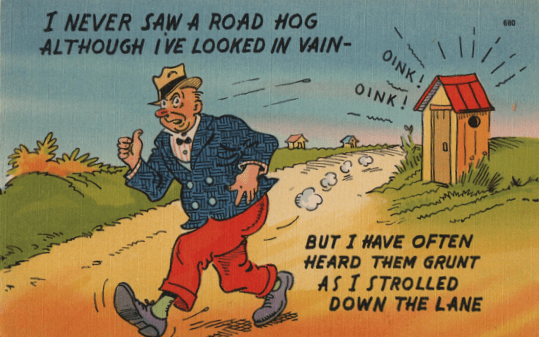
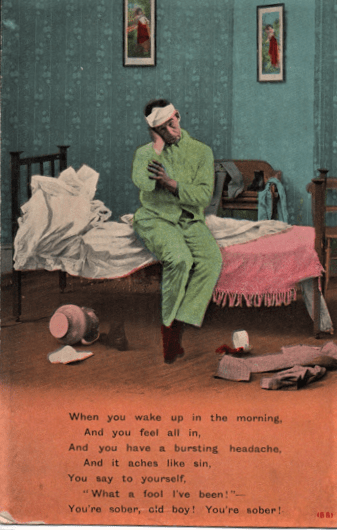
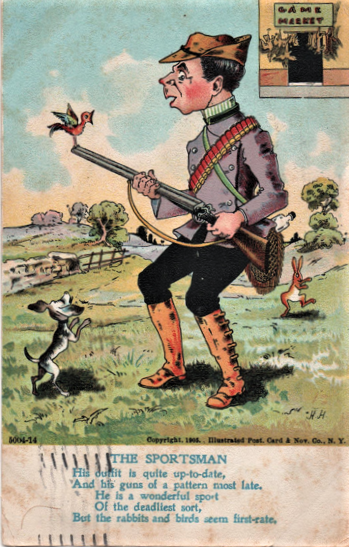
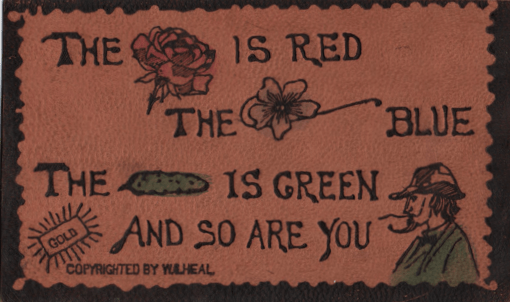
     In our last thrilling episode. We considered those postcards of about 110 years ago which offered good advice suitable for use in New Year’s Resolutions.  There is,. Of course, a flip side.  Some of the advice given is worth exactly what the recipient of the card paid for it.

     For the moment, I am ignoring those bits of advice which seemed good at the time and have fallen under disapproval in the modern age.  (You’d be surprised how many romantic postcards used the captions “Never Take No for an Answer”.)  I’m looking at the advice that was a little off even at the time, BUT which was offered up as worldly wisdom (then, as now, some postcards offered you dumb advice knowing you would enjoy the dumbness.  These folks don’t get into this blog, either.)

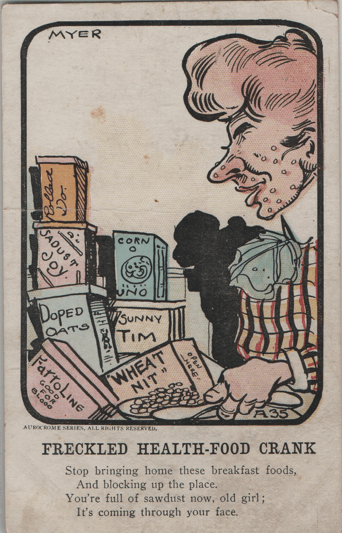
     Let us take the card at the top of this column.  My problem here is not so much with the advice as with the phrasing.  I kinda get what he’s telling us but what, exactly, is a “pawned opportunity”  You borrowed money on it and left it in the shop?

     And explain this one, will you?  I hate it when people try to improve on an old saying by adding words to make it deeper.  “Every dog has its day” is rather encouraging, making you think that one of these days, it will be your turn.  This feller seems to want to put a little more burden on you, making sure you’re the right kind of dog for the right kind of day.  Or am I missing something here?

     This artist did the same thing.  “Money talks” is a fairly broad saying, explaining how the world works.  What’s going on here, though?  If money really talked, why would we need an ear trumpet (I will forgive him the typo).  What’s he telling us?  Is this one more admonition to be on our toes, so we will respond when money talks??  But doesn’t that still contradict….

     One of the most common bits of advice of the day was about maintaining a positive attitude.  This artist goes a little overboard about it AND adds in a little anti-union sentiment to make it even cheerier.  By the way, on the subject of that positive attitude….

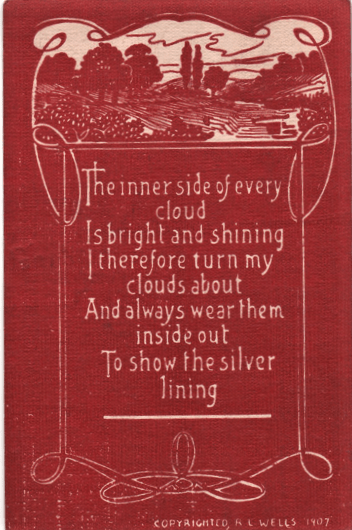
     It can go a long way, but that better not be all you have in your arsenal./  yet, lots of cards and motivational plaques our ancestors revered told the viewer over and over that if you weren’t happy, it was obviously your fault.  You weren’t looking at your troubles as opportunities, you saw only the clouds and not the silver lining, you weren’t really fit to compete in the business world, where it was the positive, cheerful chaps who made their way through.

     In the late 1930s, Thorne Smith made a great deal of a businessman whose motto was “Smile and Chase the Depression Away”.  He mentions the man’s hardworking and unsmiling partners who, by might and main, managed to keep him from smiling the firm into bankruptcy.  I’m not saying it’s the grouches who are the main power in business.  I’m just reiterating what the poet wrote when he said that if you let a smile be your umbrella you’ll wind up soaking wet.

     There were some people who pointed these things out at the time, and at least there were some postcards which seemed to realize it wasn’t always easy to smile every day.  (This was another popular theme of the day: Smile every chance you get and laugh once in a while just for the sport of it.)

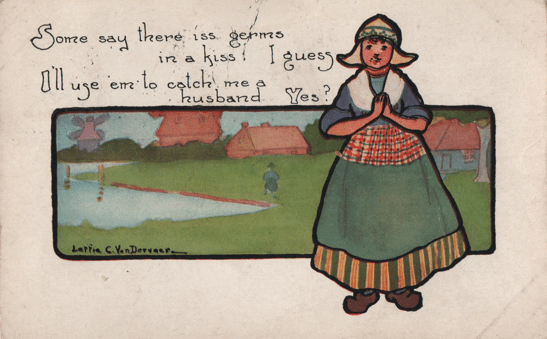
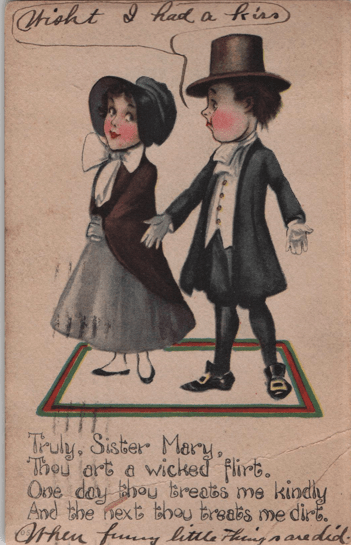
     But I have strayed into critiquing philosophies I just feel are too shallow.  Let’s get back into serious advice.  I haven’t decided yet whether this is just quaintness, or if the Dutch kids have stumbled onto a real nugget of worldly wisdom.  You try this and let me know how it works out.

     On the other hand, here’s this.  As fatuous a homily as one could wish. No shading, no discussion of the man, just what is expected of a GOOD woman.  Frankly, I think a little depends on the dog having his day and what kind of dog he is.  To whom, out of curiosity, do you send this kind of card?  Your daughter-in-law?  Your Aunt Booney, on the passing of her fourth husband?

     Well, if you found some nuggets here for your resolution list, well and good.  Let me know if you find out how to pawn an opportunity.

Good Advice

     Though I think I have made it clear that this blog exists primarily to spotlight and criticize certain postcards I have for sale on other venues,. I do like to think it serves other purposes as well.  And with this in mind, I thought my postcards and I might just give you a hand writing your New year’s Resolutions.

     I, personally, gave up on New Year’s resolutions many new years ago, and opted instead for an annual statement (seen only by me) in which I congratulate the old year on a good, hard fight, and hope that the new year will occasionally go easy on me.  I will leave you to judge how our most recent new years have succeeded in coming up to my expectations.  (It was Ogden Nash who pointed out that new years are incorrigible, and wondered why we have all these parties to incorrige them.  Complaints must be addressed to Mr. Nash.)

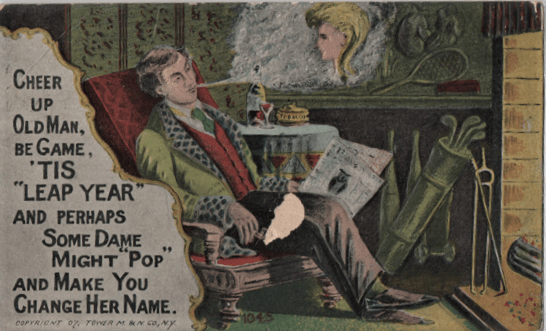
     But you can bet your boots that our ancestors had plenty of advice to pass along, and frequently did so by means of the postcard.  Take this hearty bit of advice, which plays on some minor wordplay and suggests you not let people see your self-doubts.

     Our ancestors, going back centuries, have always been good at telling their descendants tyo keep working hard and all will be well.  This was a very popular verse in the world of business around the turn of the last century, though for business purposes, you were supposed to “work like Helen advertise”  Ther marketing department will not let a chance go by to get a word in, even if that would contradict what THIS version says..

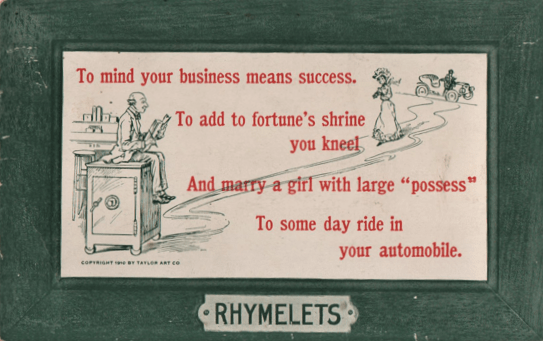
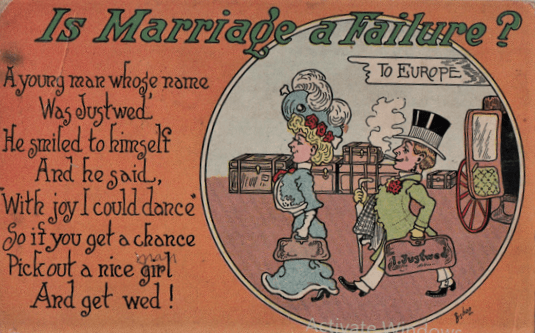
     But in case you thought hard work was all it takes, even back in 1912, this young man was willing to give you advice on success in the business world which you MIGHT not get from your CEO.  It is good to keep in mind that our ancestors were not blind to the ways of the world, either.

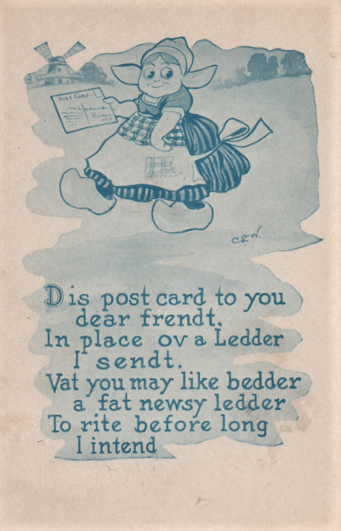
     I KNEW the Dutch kids would have useful advice for the coming year.  The advice isn’t new, of course,  It’s the way she says it.

     This is another new phrasing to an old, old bit of advice, and well worth pinning up somewhere.  (Yes, jumping to conclusions IS more fun than waiting for confirmation on Instagram or Facebook, but remember the tumble.)

     Another attitude you might be surprised to find among the corporate world of 1912 or thereabouts is this admonition.  Yes, it says, you want to be nice to your workers, but….

     Here is another little touch of equality, at least in theory, between the sexes, suggested by a man who looked a bit like W.C. Fields as a time when W.C. Fields himself was still a skinny juggler in a tramp costume.  Still, his jovial, worldly wise attitude has a charm which will lead me to hunt down more of his advice in postcard form.

     Even if some of it may not quite be up to the level you want for your New Year’s resolutions.

Jest Jumble

This Monday old joke quiz comes from the dainties offered in the Miscellaneous chapter of the original quiz book, which was the LAST chapter.  But do not rush to a cliff’s edge, Shortbread Lasagna,  I did not use up all the jokes in each of the previous subjects, so we may have whole Mondays devoted to one subject of old jokes again, or, even better, a jumble of unrelated jests like these.  I know, I know: you thought the period of holiday miracles was over.  But I have old jokes enough to last WELL into next year.  Don’t make faces like that; you won’t be able to read the jokes.

     J1.”Who gave you that black eye?”

     “Nobody gave it to me. (          )“

J2.”In Boston, we regard breeding to be of paramount importance.”

“Ah well, (          )”

     J3.A hundred years ago or so, a young lady from Chicago was attending a public event in Boston, and paused to adjust her elbow-length gloves.  A passing matron, staring coldly, said, “In Boston, a gentleman would as soon see a lady adjust her garter in public as a adjust a glove.”

     “Teah?” said the lady other, “In Chicago (          )”

J4.That same matron was passing a construction site in Boston when she stared at the graffiti on the fence.  “Disgusting!” she exclaimed.  “This kind of hooliganism can only make tourists think less of our fair city.  Such vulgar phrases!  And (          )”

     J5.”Honey, you know she’s been a big help all these years: sewing labels in the kids’s clothes for school, helping keep them corralled when we go to the zoo or the big department store, always carrying bandages or a needle and thread for an emergency.  But I was wondering, Honey, if for this trip on our thirtieth anniversary, we could leave your mother at home.”

     “What?  (          )“

J6.”Had a great dream last night.  I was ay Coney Island, back when Coney Island WAS Coney Island, only I wasn’t a kid.  I’m as grown up as I am now, so I cab take my money and go on all the rides and see the shows and eat anything I want, without anybody to tell me to stop.  Great time!”

     “Yeah?  Well, last night I must’ve fallen asleep reading Kant’s Critique of Pure Reason, and there’s this knock on the door.  Before I can answer, in walks that movie star, Satin LaSheen, and sits down next to me on the couch.  We’re just starting a lively philosophical discussion when there’s a knock on the door again, and in walks Debby Hairy, that rock singer, and she comes and sits down on my other side, so we can have this three-sided dialogue, and…..”

     “Some friend you are!  You had two women like that in your room and didn’t think of giving me a call.”

     “I did call.  (          )“

J7.Leif liked to take his sandwich over to Grant Park when the weather was nice, and eat lunch there.  One day, he noticed an elderly man sweeping leaves off the sidewalk, and realized he’d seen that man just about every day for many years.  But he’d never spoken to the man,.  So today, he called “I see you’re doing quite a job there.”

     “Well, it’s what they pay me to do,” came the reply.

     “And you’ve been doing it,” said Leif.  “What’s your name?”

     “John F. Kennedy.”

     “That’s a famous name.”

     “Should be.  (          )”

I know you know these already, but for one last time this year, here are the ANSWERS.

A1.I had to fight for it

A2.We like it, too, but we encourage the young people to take up other interests as well

A3.he’d rather

A4.And so many are spelled incorrectly!

A5.I thought she was YOUR mother

A6.Your wife said you were on Coney Island

A7.I’ve been sweeping these sidewalks for fifty years

Santa Blogs XXXIV

     In my previous life as a blogger, I acted as a conduit for two or three letters every year involving another individual.  I was a little surprised to be pressed into service again this Christmas Eve by some familiar sounds from the old North Pole letters column.

Dear Santa Blogs, You Dufflebag Doofus:

     I was kind of hoping, you red-coated dingbat, that the pandemic had led to your croaking, as I did not see any of your blather this time last year.  Imagine my dismay to find that you are still alive, and no doubt still spreading that ridiculous propaganda about giving used books (and postcards, I guess, to look at your present slish) at Christmas, when up to date young ladies like myself would just as soon have the latest volume of a postapocalyptic dystopian fantasy.  My parents, as you may have guessed, are still giving me books in which cute little children learn nature lessons from cute little bunnies and raccoons, until I have to crawl under the couch and look for last year’s hard Christmas candy just to get away from all the cheer.  Why a demented old guy with a dented sleigh wants to go on spoiling my holiday is beyond me.

                                                                                    Notably Mystified

Dear Not Myst:

     Not hearing for you, Sweet Sieuz, was, of course, one of the great sorrows of the pandemic.  I am so happy to learn that you have not changed an iota since our last exchange.

     Then, as now, I think the problem is simply one of your own imagination,  Too many young people today are showing themselves restricted by the edges of a screen: they cannot expand beyond what they see.  Come, Porkrind Brittle, where are your wits?  You must have seen a few of the nature documentaries which were so much in vogue a few years ago, which wished viewers to understand about death and violence in the natural world.  You can extend the story  toward what some peapods today call the “deleted true ending”.  Why it is wrong to end a story before everyone dies—as they must do unless they are Santa Blogs or some other supernatural character–eludes me, but it’s considered more authentic now to point out that happy isn’t EVER after.  Write your own Director’s Cut version of these stories, showing what happened the next day, when Dinky ran across hungry Daddy Bear in a bad mood, or ate those poisonous berries.

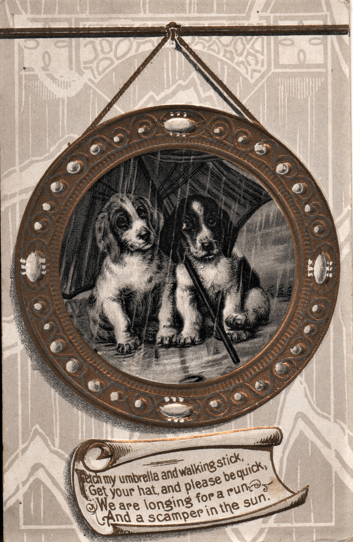
     How nice of you to mention the possibility of used postcards as Christmas gifts!  I have shipped off so many in the past couple of weeks that I am sure some will be found hanging on Christmas trees (though I am a bit dubious about all those outhouse cards.)  Round People cards were there, and fishing cards, and I hope all will find their proper homes (Spoiler alert: I DID ell a couple of cute puppy postcards to an address which looked kinda familiar.  Try to look surprised…or at least not nauseated.)

     Hope all your own shopping is done, and I hope everyone enjoys what you got them.  Been working on my own wish list, and I think this year I’ll go with wishing everyone a warm place to sleep where they know they’re safe: lost cute puppy or just lost soul.  As always, Not Myst, l’chaim!

Those Blessed Ghosts

     There are people who think Ebenezer Scrooge is a wimp.  They point to his graveside pleading.  “Come on,” they tell me.  “He had to go through ALL those pages just to realize he was going to die some day?  That’s the big payoff?”

     These are the People Who Do Not get It.

     I admit Charles Dickens does not often pick up points for subtlety.  But he has been a touch too subtle here, and people don’t see what has horrified old Scrooge.  Let’s look over the Ghost:  shrouded in a dark garment which hides its head and form, scattering gloom and mystery.  Give it a scythe, and it would look like…..

     And that is what has just struck Scrooge.  Marley lied to him!  He died, in fact, just before old Jacob got there, and he has already started on his eternal punishment of, what was that, witnessing what he cannot share but might have shared.  Scrooge had already, when the Ghost of Christmas Past was leading him around, starting to think of ways he could change (filmmakers frequently ignore these bits, as it would cut into their dramatic conclusion) but that was all for nothing.  THIS is what has hit Scrooge so hard.  He CAN’T change.  He CAN’T fix the stuff he ruined.  It’s all going to happen, right down to that one person who felt genuine emotion that Ebenezer Scrooge had died.  (“Thank God!” is her reaction, but Dickens lets us guess this.) Now that he wants to, he CAN’T help.

     Thank you for letting me point out something you already knew.  (A lot of filmmakers don’t.)  But this is the third in our series of studies of Christmas carols a Lot of People Don’t Have Time For.

     The number of versions made of this work since 1843 is probably not countable, if you include puppet shows, slide shows, plays, movies, TV versions, and all the spinoffs: the Dobie Gillis Christmas Carol, the Pooh Christmas Carol, the Barbie Christmas Carol.  But I thought we could spare a little time for the worst versions of A Christmas Carol I ran into while writing a book on the subject.  My book was circumscribed and tightly controlled: only Christmas carols taking place in Victorian England were allowed.  Even here I found fascinating variations and trivia to play with.

     For example, you may well be aware of great actors like Basile Rathbone, Ron Haddrick, Basil Rathbone, and Seymour Hicks, men who not only portrayed Ebenezer Scrooge, but were filmed doing it at least twice.  Alastair Sim, for example, made two classic versions, twenty years apart.  Ron Haddrick starred in two abysmal version, just a couple of years apart.

     Mr. Haddrick passed from this mortal stage a year ago, aged ninety, after years of work in Australian television.  In the period of 1979 to 1982 (dating these gets iffy) he starred in made-for-TV animated versions which are amazing in their badness.  One, oddly enough, is one of the most faithful-to-the-text versions I ran into.  This badness cannot be attributed the Mr. Haddrick: the animation, the staging, and…at one point, Scrooge and his nephew launch into a duet in which they debate the merits of Christmas.  Not bad, not unusual except…it’s the only song in the whole blessed movie.  There isn’t even a musical soundtrack.  They just bust into song for no apparent reason.  It’s a bad version that way: fun and forgivable.

     What would you think of Vincent Price as Ebenezer Scrooge?  I had such visions of seeing an undiscovered classic when I picked up this, yeah, made for TV version from 1949.

     Fuggetaboutit.  This is another crammed into a half hour version in which Yalor Holmes and Patrick Whyte—not names which echo in MY movie memories—act out a dull, lifeless series of high points while Vincent, urbane and welcoming in a study, reads to us from the book to bridge those dreary scenes.  Vincent reading us the whole blessed book would have been more interesting.

     Let us leap next into this 1991 animated version, brought to you by the same folks who brought you VR Troopers.  Bob Cratchit comes dashing into his boss’s office to start the show, panting, “Thir, here’the the money Louis thent you to invetht.”  (Dickens himself gave Cratchit a lisp in public readings, so we’ll pass over this.

     “Fine” says Scrooge, “Justy enough to buy a new jet ski.”

     :But thir!” says Cratchit.  “Louis expectth you to invetht that in health food resthtrauntth!”

     “Cratchit!  It’s 1843!  No one’s going to be eating bran muffins for another hundred and fifty years!”

     First of all, let’s make it clear: this is NOT meant to be a parody.  It is meant to be a heart-warming half hour cartoon.  So what to make of the three Ghosts, who are fairies with poufed skirts and wands?  Or the narrator pointing out the exact moment when Scrooge realizes he is the villain in this movie?  Or the first straight explanation of what may happen to Tiny Tim?  (Well, he’s little, see.  So his parents are training him to be a jockey.  But Scrooge is so tightfisted with salaries, the Cratchits can’t afford a horse with four legs.  So one day, when Tim isn’t paying enough attention, the three-legged horse tips over and…this is in the script, mistletoe brittle…Squish!)

     This is NOT up there with The Muppet Christmas Carol, but again, it has so much fun being so bad, and it IS just another half hour….

     Speaking of time, I see I have grossly outspent my own, which leaves me no time at all to discuss what I consider the very worst screen version of A Christmas Carol I have sat through.  But why should I do any advertising for that piece of jetsam?  Go switch on Charlie brown and wash this all out of your head.

Oops!

     Ah, the Monday before Christmas, and what can you expect as a surprise gift from your Uncle Blogsy?  Old Jokes?  Not much of a surprise. Was it?  The selection of gags from the Old Joke Quizbook comes from the section covering mishaps, faux-pas, and straight accidents, the sort of thing life tosses at you to make your existence more interesting, even if you didn’t want it touched up in that particular way.

     J1.The man jumped out of his car to check on the woman he had just knocked down.  “I’m sorry this happened, Ma’am, he said, but I can’t really see how this could be my fault.  After all, I have been driving for over twenty-five years.”

     “Well, don’t blame it on me,” she snapped, “(          )”

J2.”It amazes me, Captain,” said the passenger to the skipper of the steamboat, “How you can travel these narrow rivers without an accident.”

     Well, Ma’am<,” said the skipper, “Experience plays a big part.  I’ve been on boats in these parts for fifty years, man and boy, so I know ever snag and sandbar along the way.”

     The boat shuddered, and there was a loud scraping sound/  The captain said, “(          )”

J3.”What are you?” demanded the driver of the smaller vehicle in the crash.  “Blind?”

     “Waddya mean blind?” demanded the driver of the SUV.  “(          )”

J4.”The man pulled up next to a dejected woman sitting next to ther crumpled car.  “Have an accident?”
     “No, thanks” she said.” (           )”

J5.A woman on a country walk came across a man with one ear to the ground.  “A two-tone ’57 Chevy,” he said, A man and a woman in the front, an Irish setter in the back.  The dog’s name is Crumble.  The woman just bleached her hair.”

     “Wow!” she said.  “You can tell all that just by listening to the sounds in the road?”

     “No,” he said, “)           _”

J6. They tell the tale of Ernestine Schumann-Heink, an operatic diva of equal talent and size, tried to get on a streetcar in Vienna, only to find this impossible.  “Perhaps if Madame would turn sideways,” suggested the conductor.

     “Mein Gott!” she replied.  “(           )”

J7.”That singer has a large repertoire.”

“Yes.  And (          )”

     J8.“What have you done with your hair?  It looks like a wig!”

     “It is a wig.”

     “Is it?  Well, (          )”
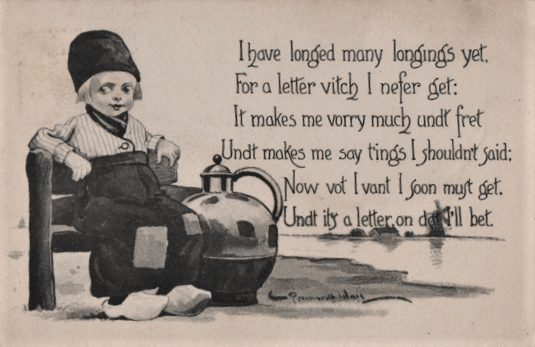
J9.Three elderly men, all slightly hard of hearing, were strolling down the street when a gust of wind blew dust in their face.  “Windy today,” said the first.

     “I thought it was Thursday,” said the second.

      Wiping dust from his face, the third said, “(           )”

H19.Hildegarde had just stepped out of the shower when the doorbell rang.  “Who is it?” she shouted.

     “Blind man!”

     “These beggars,” she grumbled, but she grabbed up her purse, took out a dollar and went to the door.

     “Here!” she said, throwing the door open.

     Thank you, Ma’am.  (         )?”

J11.  “Sun Tribune,” said the receptionist at the newspaper’s main office.  “How may I help you?”

          “This is Ladislas Brosniky!  You have me listed in yesterday’s obituaries!”

     “”Yes, sir? (          )?”
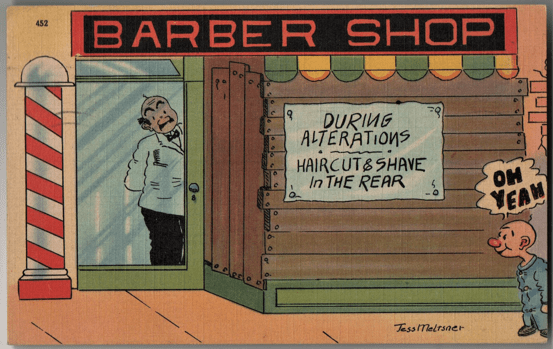
Nome of this has ever happened to you of course, but if it ever does, these are the ANSWERS.

A1.I’ve been walking for sixty-three

A2.There’s one now

A3. I hit ya, didn’t I?

A4.Just had one

A5.They just knocked me down

A6.U HAFF no sidevays!

A7.And that dress just emphasizes it

A8.No one could tell

A9.Me, too.  Let’s have a drink

A10.Where shall I put these Venetian blinds?

A11,And where are you calling from?

Twelve Blessed Days

     I was not planning an all-out series on Christmas songs some people have no time for, but just hunker down and we’ll get through this together.

     In 1780, in a little publication called Mirth Without Mischief, the verse appeared in print for the first time, only slightly different from the way we sing it today.  It was a chant, not a song, a kind of playground verse like “This is the House That jack Built” and began “The first day of Christmas, my true love sent me.”

Yes, that song that seems to go on forever has been going on for about two hundred and forty years.  That version was remarkably similar, aside from the not very rhythmic opening, to the Correct lyrics we know today, although it did put the lords and ladies last, possibly as they were the most important.  And for how many years people have been explaining the hidden symbolism of the lines, I cannot realty say.  I know I started seeing thee things as filers in the newspapers when I was about ten, and I remember thinking, “What a waste!  Who cares?”

     But I hope YOU are not like that, egg nog enchilada, for we are about to discuss this line by line.

     The partridge in the pear tree is fairly simple.  A partridge was a gentle, pleasant bird, lovely to listen to and (remember, these were savage times) pretty good eating.  A pear tree was considered in some cultures to be a symbol of generosity, for the way it gave its fruit.  (Never mind that you jad to stand on tiptoe to pick it.)

     Two turtle-doves is nearly as simple.  Turtle doves were also gentle birdfs and the symbol of love.

     I suppose it should be just as easy to figure out the three French hens: once again, mighty good eating.  But why French?  There is a clue in a version which makes it three fat hens, but I just don’t make the connection.  Why would French hens have been fatter than English hens?  Maybe the French fattened them specially for export.  More research is required here.

     We start to get into real trouble with the four calling birds.  I love the illustrations of this which show magpies on the phone, but every commentator has to point out that this was originally four “Colley” birds.  This is an archaic term meaning black: one version of the song actually makes it four coal-black birds.  (The Interwebs has tried to explain to me that this is also where the collie gets its name, but the changes in dog breeds over the centuries is beyond the scope of this blog.)  I cannot help feeling just a twinge of regret that the world decided not to go along with the version that made it “four curly birds”.  Anyway, birds were calling from the sky long before we even had phones.

     Where I most thoroughly resent the intrusion of logic into this song is in the Five Golden Rings.  Sending jewelry to your true love is certainly traditional (and makes more sense than anything else on the list in  our citified notions.)  Alas, everybody needs to nudge you and say “Look at the other verse so far.  This is five ring-necked pheasants.”  Humbug.

     Six geese a laying continued the theme of poultry, and, you’ll notice, continue the theme of giving the true love things which can enhance her financial status.  A regular supply of eggs (presumably available from the other poultry as well) will be a step up in her assets, and, if she happens to be from that part of the world which eats goose at Christmas, why, she can spare one.

    The seven swans a-swimming continue the poultry theme, and and give that true love some elegant birds which a. look nice, b. lay eggs, and c. were actually eaten at feasts.  So the triple use of poultry continues.

     With the eight maids a-milking, however, we abandon the poultry yard without a backward look.  Oh, yes, there is a minor tradition which makes this Eight Hares A-Running, but that’s only for folksingers who want to be different.  Milkmaids were a part of folk culture going back centuries.  I presume, they brought their cows with them, as eight maids a-milkin’ without cows would be unsightly  They can’t milk the geese.

     From here on out, there is a genial confusion of who comes in what order, though the last four are fairly constant (despite some versions giving us lambs-a-bleating, bulls a-roaring, men-a-shearing, and so on.  Bells a-ringing has its followers.)  In most versions, ladies dance, lords leap, pipers pipe, and drummers drum, just not always in the same order.

     I have been wondering about the ppipers piping.  Is there a chance that we’re discussing bagpipes here?  To judge by the versions which make it fifers fifing, I guess not.

     My, this column has just gone on forever: I wonder whether it would take longer to read it aloud or to sing the song.  Oh, and the Twelve Days of Christmas are December 25 through January 6, the day the Wise Men arrived at the manger (they had the best GPS available, so maybe it was the camels.)  This negates the wonders of the quite excellent parody “The Twelve Days After Christmas”,  but like every other trivia merchant I knew you’d want to know.

That Blessed Drum

   All she wanted to do was compose a Christmas song suitable for girls’ choirs, and in 1941,   Katherine Kennicott Davis became obsessed with the traditional French carol Pat-a-pan, and wrote her version with pa-rum-pa-um-pum, in place of it.  She published it as C.R.W. Robinson, and her Carol of the Drum did reasonably well, being picked up by the Trapp Family Singers in the early Fifties.

     Then the Harry Simeone Chorale got hold of it, renamed it “The Little Drummer Boy” and had a Top Forty hit every December with it from 1958 to 1962.  That recording is still one of the  most popular versions, William Shatner’s recording of it notwithstanding.

     That is one really popular song.  And one of the most hated Christmas songs in the repertoire.  It happens that way, sometimes.

     Zx a new hit Christmas sng, it was played over and over and over.  (The number one song of 1958, oddly enough, was another song that ticks people off at Christmas: The Chipmunk Song.)  SPME people do not like songs sung by children’s choirs.  And we have the precise bozos, who want to know why someone is playing a drum for a newborn infant.

     Bur the somg expresses a very popi;ar theme.  The lad with the drum males it clear he has no gifts to bring that are worthy of a newborn king.  All he’s got is that drum. Which Mary AND the Baby Jesus enjoy.  (Joseph, who was a stock humorous character in medieval literature, was probably pressing hos hands over his ears._

     We find the same plot in The Littlest Angel, a reasonably popular book of the 1946 Christmas giving season, but much more popular after illustrations were added in 1963,  The Imterwebs informs me that it is the fifteenth best seeking children’s book of all time.  This tells the story of a naughty little boy who happens to be dead.  He makes a mess of heavenly worship and respect, and when he is called to judgement, he is terrified, only to find the angel in charge of this to be warm and understanding.  The thing Is, he missed Earth.  Heaven’s very nice, but Earth also had its appeal.  If he could just have that box of stuff he kept under his bead, to remind him of Earth, he thinks he can behave.

     Thebn be datym, word goes out that God is sending his son to Earth, and every angel prepares some special gift for this unprecedented occurrence/  The Littlest Angel wants to be part of this, but all he has is the box of boy treasures.  He slips this into the gift array. and on the great day is horrified by how cheap it looks.  He has actually insulted the Baby Jesus with this box of garbage.

     You know how this works out.  God says his son will learn to value the things of earth (or the whole mission is for naught) and turns the little box into the Star of Bethlehem/

     The magic is a little less show in le Jongleur de Notre Dame, another tale which has been animated for Christmas by R.O. Blechman.  This is a short story from 1892, dealing with a jongleur, a word often translated “juggler”.  But the jongleur was a specific type of medieval minstrel: the lowest of the low, the kind who would balance on one hand so his tunic would slide up and show the audience his backside, the fellow who knew all the oldest fart jokes.  Th sine decided to retire to a monastery, and he ran into the same problem as our other heroes.  He could paint a beautiful picture, or write a delicate lyric.  But he WANTS to give something to the Virgin Mary and Baby Jesus, represented by a statue in a niche.  So on the holiday he slips down to the statue late at night, pushes some of the beautiful gifts to the side, and goes to work.

     The abbot hears a sound he can’t identify, and takes a couple of the brothers to see what’s going on.  The Jongleur is balancing on one hand, juggling with the other hand, and spinning hoops on his legs.  One of the brothers, offended by this blasphemy, starts forward, but the abbot pulls him back.  The jongleur is working very, very hard, and sweating like a horse.  And as the btiohers watch, the Virgin thanks the jongleur by reaching out and mopping his forehead.

     In fact, this theme goes right back to the New Testament, in the story of the Widow’s M9te.  Jusus notes that all she has given is a tiny coin, while other people are giving grandiose presents in the offering box.  But He values the little coin because it is, in fact, all the money the woman has in the world

     That was a long way to run, and I assure you, the words Pa-Rump-Pa-Pum=Pum are not in script8re.  But they COULD have been.