I hardly know how to break this to you, but we are all grown-ups here, and we can get through it together. (Would anyone who is not grown up…no, skip it. I can’t afford to lose that much of my audience.)
Once upon a time, a man named Kermit Shafer published a line of Bloopers books, listing things said on the radio or television which might have been worded better or timed better. These were wildly popular and sold plenty of copies. You can start a collection now quite reasonably, as these are slightly out of fashion: please be aware that the hardcover and paperback editions of the same book will be slightly different, as the hardcover editions were censored to make them more acceptable to sensitive readers. This was in the days when sensitive people didn’t buy paperbacks.
But there were suspicious folk who questioned the authenticity of some items in his collections. So he issued a companion series of LPs, with recordings of the actual bloopers. (The suspicious people are still at it, though, and insist some of his recordings are actually re-enactments. You can’t win.)
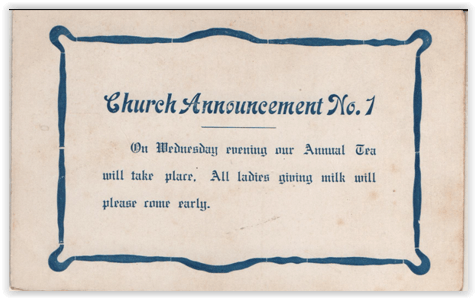
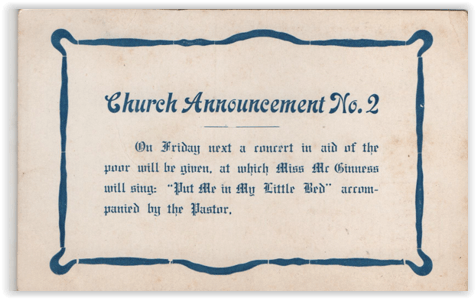
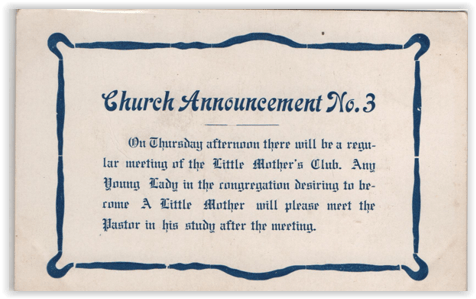
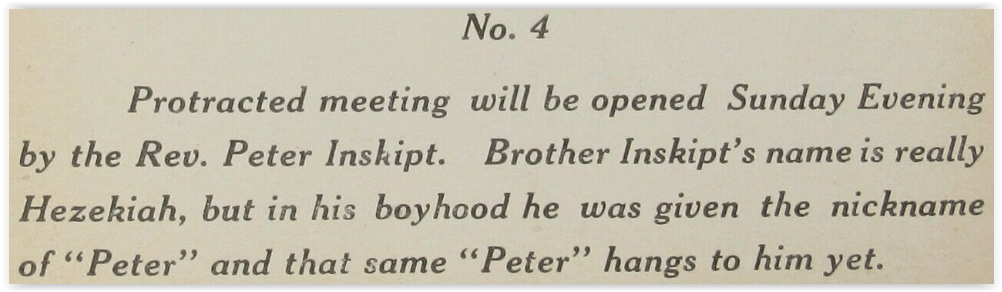
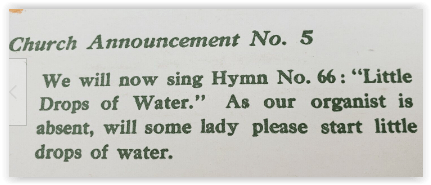
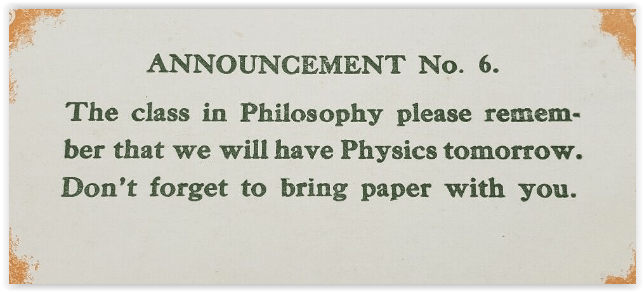
In any case, while doing research into a set of three postcards I recently purchased for resale, I found that this series was, um, not unique. In fact, I found there were several sets, apparently from assorted publishers, which not only used the same jokes but numbered them exactly the same way, despite other changes in border and illustration. This set of six church bulletin bloopers has been running around together for over a century, therefore, unattributed, untraceable, and probably made up by some postcard gag writer to begin with. (Or before: I hate to suggest this about postcard companies, but swiping jokes from jokebooks or newspaper columns was NOT unknown.)
There are some mild variations of wording, and sometimes numbers 1 and 3 have their numeration switched, but this is the most usual numbering, beginning with the classic we have discussed in this space heretofore.
Number 2, as far as I can tell, always includes Miss McGinniss, a young lady whose performances I have been unable to confirm online. Groucho Marx, by the way, uses a variation of this joke in the movie Animal Crackers.
The problem with these announcements is that they all SOUND so authentic. The Little Mothers Club sounds exactly like something some congregation would decide to establish.
A Protracted Meeting is a religious service which continues over a period of several days. I have also been unable to trace Hezekiah “Peter” Inskip, though there are plenty of people named Inskip in the United States. This adds to the seeming authenticity of the announcement, because who could make a name like this?
We have discussed “Little Drops of Water, Little Grains of Sand” in this space before. Church bulletins being economic when it comes to space, the title has been abbreviated (it also would have spoiled the joke to use the whole title.) The text of this announcement has been altered in some online joke columns. Some iconoclast changed the last line to “If some young lady will start ‘Little Drops of Water’, the congregation will join her.” Some people cannot help tampering with the classics.
This is the rarest of the six, as it seems to have wandered in from a university bulletin board instead of a church announcement. Though, it is true, churches have held Philosophy classes, and the sciences WERE once included under that heading. Also, our language has changed a little, and the joke needs footnoting. Unless you have done a lot of reading in the pages of elderly books, you may not know that “Physic” was a word used for “Laxative”. So bringing paper…okay, you figured that one out.
Now, the fact that postcard companies seized on these gags and perpetuated them does not mean the original blooper never happened. If I have shown disrespect to Miss McGinnis or the Rev. Inskip by assuming they never existed, I apologize. If I have added to their infamy by repeating really old bloopers, well, that’s just the way it goes.
When Scrooge awoke, it was so dark, that looking out of bed, he could scarcely distinguish the transparent window from the opaque walls of his chamber. He was endeavoring to pierce the darkness with his ferret eyes, when the chimes of a neighboring clock struck the four quarters. So he waited for the hour.
To his great astonishment, the heavy bell went on from six to seven, and from seven to eight, and regularly up to twelve, then stopped. Twelve! It was past two when he went to bed. The clock was wrong. An icicle must have got into the works. Twelve!
He touched the spring of his repeater, to correct this most preposterous clock. Its rapid little pulse beat twelve, and stopped.
“Why, it isn’t possible,” said Scrooge, “that I can have slept through a whole day and far into another night. It isn’t possible that something has happened to the sun, and this is twelve at noon!”
The idea being an alarming one, he scrambled out of bed, and groped his way to the window. He was obliged to rub the frost off with the sleeve of his dressing-gown before he could see anything; and could see very little then. All he could make out was, that it was still very foggy and extremely cold, and that there was no noise of people running to and fro, and making a great stir, as there unquestionably would have been if night had beaten off bright day, and taken possession of the world. This was a great relief, because “three days after sight of this First of Exchange pay to Mr. Ebenezer Scrooge on his order,” and so forth, would have become a mere United States’ security if there were no days to count by.
Scrooge went to bed again, and thought, and thought, and thought it over and over and over, and could make nothing of it. The more he thought, the more perplexed he was; and the more he endeavoured not to think, the more he thought. Marley’s Ghost bothered him exceedingly. Every time he resolved within himself, after mature inquiry, that it was all a dream, his mind flew back again, like a strong spring released, to its first position, and presented the same problem to be worked all through, “Was it a dream or not?”
Scrooge ay in this state until the chimes had gone three quarters more, when he remembered, on a sudden, that the Ghost had warned him of a visitation when the bell tolled one. He resolved to lie awake until the hour was passed; and, considering that he could no more go to sleep than go to Heaven, this was perhaps the wisest resolution in his power.
The quarter was so long, that he was more than once convinced he must have sunk into a doze unconsciously, and missed the clock. At length it broke upon his listening ear.
“Ding, dong!”
“A quarter past,” said Scrooge, counting.
:Ding, dong!”
“Half past,” said Scrooge.
“Ding, dong!”
“A quarter to it,” said Scrooge.
“Ding, dong!”
“The hour itself,” said Scrooge, triumphantly, “and nothing else!”
He spoke before the hour bel sounded, which it now did with a deep, dull, hollow, melancholy ONE. Lights flashed up in the room upon the instant, and the curtains of his bed were drawn.
Most of this is not to be found in screen Carols, not until the clock strikes one. It’s a matter of timing, literally: if you’ve rearranged the time Scrooge goes to bed, you can’t have him getting all upset because twenty-two hours have slipped by. (Furthermore, he lies there thinking about it for an hour: how do you film THAT?) A clock striking one and a worried murmur from our host s about as far as this goes. We want to get on with the GHOSTS.
In Hicks, we watch a lamplighter putting out the streetlights. Scrooge reaches for something in his sleep. The night watchman calls “Twelve o’clock and all’s well!” Scrooge wakes; a light can be seen at the parting of the bedcurtains. Something materializes within this.
Owen’s mantel clock strikes; the candle dies. Scrooge peers out from under the covers and checks his watch. “Humbug!” The clock chimes one; there is sudden light, and the curtains jerk aside by themselves. Scrooge stares.
Sim I has a clock striking, and the room filling with light. Scrooge’s eyes slide to the right; the bedcurtains here slide aside of their own accord.
March lies restlessly in bed, listening. :And now, the hour itself. One o’clock. I’ve only slept a few minutes…or else most of the day.” This is the only reference in these films to Scrooge’s concern about whether it is day or night, and it doesn’t seem to bother him much. He rolls over.
Magoo’s clock goes crazy. Scrooge starts when it strikes one, and grumbles about being unable to sleep.
Haddrick hears a clock striking outdoors; a clock within the room confirms the hour. “One o’clock?” he says. “And no ghost? I must have dreamed up Marley.” He turns to his right and stares in horror.
An overhead shot shows us Sim II in bed. As he wakes with a start, the narrator explains that Scrooge awoke and the room filled with light. A hand moves the bedcurtains from outside.
Finney is just settling into bed when the clock strikes one. The sound shocks him, and he checks his own clock to verify the time. There is a clatter; he raises his eyes to a visitor.
McDuck snores gustily. We see him through the eyes of the Spirit, who bounds into the room, jumps to the bedside table, all of which suggests something small has arrived. We watch him light the candle and then smack the bell of the alarm clock with the handle of his umbrella.
A clock in the tower strikes one, and the watch in the stand by Scott’s bed (a “repeater” like the one in the text) reinforces this by playing a little of the theme song. Scrooge is apprehensive. “One! What was it Marley said?” He looks around. “Nothing! Just a dream.” A wind rises, followed by a twinkling light, and suddenly his visitor is there.
We see Caine in an overhead shot; he is sleeping on top of his covers, still in his dressing gown. The mechanical clock on his mantel strikes one, he opens his eyes, and his candle goes out. Dickens, outdoors, rises to declaim, “Expect the first Ghost when the clock strikes one!” Scrooge’s room is flooded with light.
The clock of Curry’s mantel strikes one. The window curtains are blowen by wind. There is thunder and a small explosion. Scrooge sleeps through all of this, and has to be wakened by a ghost with a diabolical cackle, who tickles his face with a sprig of holly.
Stewart, lying on his bed, still in his dressing gown, newspaper to one side, actually performs the whole “quarter past” sequence. “The hour itself, and nothing’s happened.” Then the clock strikes one, and light streams in. He gasps in horror. A hand parts the bedcurtains.
It took Tannol a moment to realize that the staircase which had suddenly appeared would be a perfect defense against enemies with wheel barrows.
“No!” For the third time since crawling into the ancient burial mound, he slapped the wand against his palm. The thin wooden rod creaked but of course could not break. Tucking the recalcitrant rod into his collar, the sorcerer unrolled the rope ladder. He would climb down the well shaft in the old barrow without the help of the wand. Maybe it had been thrown off by the eldritch mirror at the entrance; once he was at the bottom, he would be out of reach and the wand would be back to its normal power.
He hoped so. His pack held a minimum of amulets and powders. If Trunruh appeared, speed would be the only solution, and the wand was quicker. A mental command, a reminder to the wand of the spell he wanted, and his learning and skill would confound the ancient archmage.
He counted the rungs carefully. At the proper distance, his toes extended down to touch the floor. The stones were damp but he could feel the pattern carved into them to guide a knowing visitor on the only safe way to the inner chamber.
Now he counted the stones as he passed over them, his path lit only by his birthstone belt buckle, which glowed in the presence of evil. It was bright enough now to show him some of the traps he was avoiding, and what remained of less learned intruders. He preferred to keep his eyes on the stones, muttering, “Step on a crack, break….”
In moments the door stood before him. A parchment roll was pinned open on it, lettered in the alphabet Trunruh favored. The words were large and commanding, but he had no idea what they said beyond a general feeling that it would not be, “Welcome.”
He drew his wand and pointed it at the letters. A red squirrel appeared at the end of the magic rod, regarding the words with widening eyes. Releasing a squeak, it leapt down and disappeared into the darkness toward the rope ladder.
“No!” growled Tannol. “Read Scroll! Not Read Squirrel!” He shoved through the doorway. Probably just a basic “Go away or die!” message, anyhow: the sort of thing dead mages put on their tombs.
He wished he’d read it all the same when, after three steps inside, the puddles underfoot froze. His buckle shone the brighter, and sparks began to dance before his eyes in the suddenly frigid air. These multiplied, rising into the tall, unlikely figure of the long-dead Trunruh, with icicles as a beard and spinning silver discs for eyes
“Have you come to consult me on the spells of Creeping Darkness?” An echoing voice mocked him, knowing the answer. “Are you here to inquire after the facts of my career?” Also the wrong answer. The voice hardened. “Or have you braved the dangers of the path merely to steal the instrument with which I summoned my howling demons, the Terror Tambour?”
That tambourine of unicorn hide was exactly what Tannol had come for, and he knew from his reading lying about this would do no good. “That instrument is a danger as long as it lies here unclaimed. It must be destroyed! I have powerful defenses against you and your sorcerous ilk!” He swung the wand.
Both he and Trunruh stared at the kitten. Tannol snarled, “No, not against a saucer of milk!”.
This had quite the wrong effect on the dead archmage, who laughed and shouted, “Come to me, Steed of Darkness!”
The birthstone belt buckle was up to the challenge. As the pool of shadow in the air formed itself into a vague horse shape, Tannol put a hand to his buckle. A bolt of light shot out to dispel the threat.
“Ha!: he cried. Raising his wand, he added, with a confidence he did not feel. “I know spells to command the elements!”
A rumble shook the cold, dank room. “No! No!” he shouted, shaking the wand. “Not elephants!”
“What?” Trunruh had, at least, not been expecting elephants. The silver eyes spun right and left. Seizing this chance, Tannol swung the wand again, commanding it to bring the tambourine from its hiding place.
For his part, he had not expected Trunruh to have that many tangerines.
“Pah!” Trunruh bellowed. “You are not worthy of my time!”
This was worse than being mocked by his spellcasting professor. Tannol raised his wand again to reply. But now water was gushing from the walls.
“Just die,” said the archmage. “This is ice water. If you fancy yourself a swimmer, you will succumb to the cold before you can do anything else.”
Trunruh vanished. So did Tannol’s interest in the tambourine. The time to fight had ended and the exit was his only hope. The water was cold, and rising fast. Perhaps, he thought, raising the wand as he turned to run, a miniature dam….
“I am the Minotaur, damned for eternity,” roared a voice from the expanding darkness. “Why have you summoned me from Hades?”
At length, Tannol crawled from the barrow, which vanished behind him. Four years he had taken ferreting out the spells and powders that would render it visible. At least a year would be required to fetch ingredients, most of it another trip up the slopes of Mount Sorrow for the gray roses, if he wanted to try it again.
However, having drowned a minotaur, climbed a rope ladder with freezing fingers, and smacked down a squirrel and kitten looking for their elephant friends, he had no thought of the barrow and the Terror Tambour. He had his life, his wand, and a new mission: to get home and get answers.
Karrow was waiting for him at the door. “Hey!” called his fellow sorcerer. “How’d the wand work after I installed Spell-Check?”
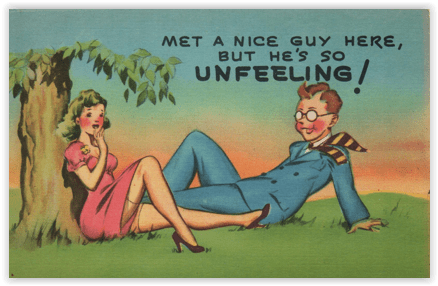
It has been a while since we considered postcard gags helped by historical background, and as I have recently been stumped by a couple, I figured it was time to bring up the matter again. Spoiler Alert: for once, I think I have no postcards to show you which are based on Bert Williams records. He’ll be back.
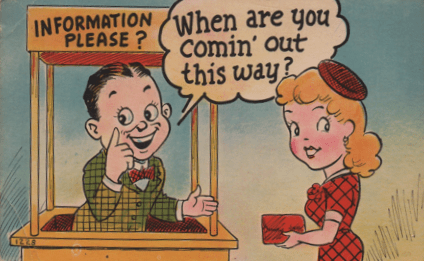
Some of the background will not materially affect your appreciation of the joke. The postcard at the top of today’s adventure is perfectly comprehensible even if you don’t know that once upon a time you had to get someone’s phone number by calling the operator and requesting “Information, please”. This phrase in turn became the name of a wildly popular game show where the audience would send in trivia questions in hopes of bewildering a panel of experts, who acquired a reputation for omniscience. Guest panelists, I am told, included Dorothy parker and Boris Karloff, which provokes all sorts of questions I’d like more information about.
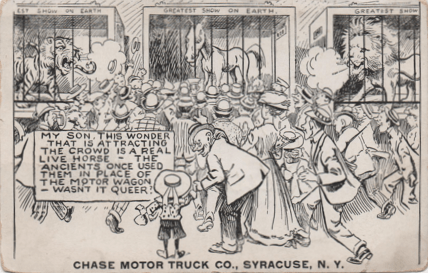
This gag was omnipresent in the first generation after the invention of the automobile, and is not necessarily enhanced by knowing that the truck company that put it out was a leader in inventing multi-purpose vehicles: cars, for example, which could be converted into trucks, ad is now considered one of the rarest of American motor companies as, despite having produced vehicles for over a decade, only forty or fifty of these still exist. Horses are still in the majority.
The older members of the audience may not need to be told that in ancient times when you took a photograph, it had to be DEVELOPED, and what you got first was a NEGATIVE. So…. And no, I don’t know whether the odd proportions of the people here are part of an individual style or a reflection of the fact that a lot of artists who might have been doing postcards had been drafted to serve in World War II.
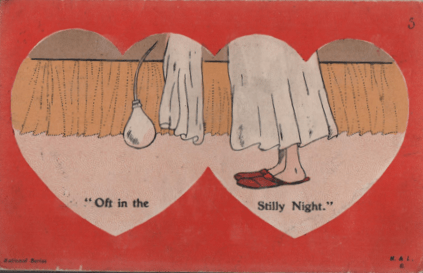
This gag, besides expecting you to be familiar with the song known by this title, relies on you understanding that this is a parent feeding a baby in the middle of the night. Few of us now dress our tots in these long nightgowns, and this particular design of baby bottle disappeared long ago. I am tired of seeing listings of postcards which describe this as enema equipment. The baby bottle once operated on a similar principle: if you get the liquid running fast enough down the tube and aim it at the sweet spot at the back of the throat, Baby will have to swallow what’s coming down whether it’s apple juice or rhubarb extract. Of course, if you miss that spot, you’re going to have a choking, irritated infant, and…yeah, we gave up on that technology.
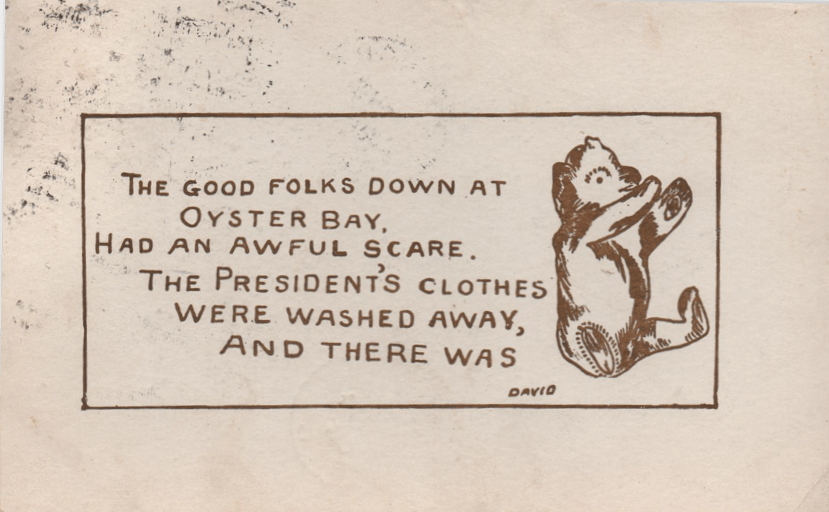
Certain towns and resorts have been famous (infamous) as Presidential retreats: San Clemente, Kennebunkport, Mar-a-Lago are just soe from my own time. This one came out in a day when EVERYONE knew Teddy Roosevelt would retreat to Oyster Bay when he wanted to get away from the White House. If you know that, then you see where we’re going with this gag.
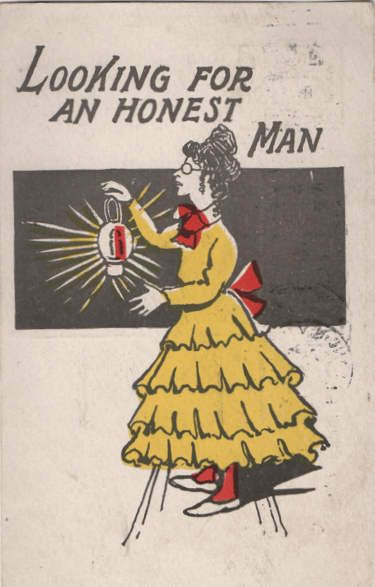
Here’s one of my stumpers for the week. This slang expression appears on other cards, and seems to mean the person is a mover and shaker in society and/or business (the joke is one of contrast.) But I have searched the Interwebs in vain for any confirmation of the phrase to no avail. Maybe the expression faded too quickly; “push”, by the 1920s, was used to mean drive, motivation, the need to exceed, and has pretty much stuck to that since
But this gag is the most devastating of my research failures. All I could turn up was another postcard of roughly the same era in which a mixed quartet sings “How dear to our hearts are the beans of OLD Boston”. This parodies the opening line of “The Old Oaken Bucket”, a song standard for more than a century (with an interesting history of its own, as the melody was composed for an entirely different song, and….) Anyway, after mocking the line “How dear to this heart are the scenes of my childhood”, the song MUST have gone on. Something about beans seems to inspire music (wait, let me…no, let’s pretend that didn’t happen.) But I cannot find anyone anywhere who mentions the rest of the lyrics. Half a dozen songs exist about beans and Boston, and googling the phrase “Boston baked beans” will turn up almost as many songs as recipes. And there are several parodies of The Old oaken Bucket extant (one about the unhygienic nature of wells and buckets and another by the mighty Nat Wills about what happened when he bent to drink from the bucket and exposed the red patch on his pants to a bull in the field.) And yet, in a medium where you can find multitudes chiming in on the proper lyrics for “The Eensy-Weensy Spider”, the Beans of Our Boston have eluded notice.
I’m sure it’s just a matter of time. I’ll keep you posted.
The apparition walked backward from him; and at every step it took. The window raised itself a little, so that when the spectre reached it, it was wide open. It beckoned Scrooge to approach, which he did. When they were within two paces of each other, Marley’s ghost held up its hand, warning him to come no nearer. Scrooge stopped.
Not so much in obedience, as in surprise and fear: for on the raising of the hand, he became sensible of confused noises in the air; incoherent sounds of lamentation and regret; wailings inexpressibly sorrowful and self-accusatory. The spectre, after listening for a moment, joined in the mournful dirge; and floated out upon the bleak, dark night.
Scrooge followed to the window: desperate in his curiosity, he looked out.
The air filled with phantoms, wandering hither and thither in restless haste, and moaning as they went. Every one of them wore chains like Marley’s Ghost; some few (they might be guilty governments) were linked together; none were free. Many had been personally known to Scrooge in their lives. He had been quite familiar with one old ghost, in a white waistcoat, with a monstrous iron safe attached to its ankle, who cried piteously at being unable to assist a wretched woman with an infant, whom it saw below, upon a door-step. The misery with them all was, clearly, that they sought to interfere, for good, in human matters, and had lost the power forever.
Whether these creatures faded into mist, or mist enshrouded them, he could not tell. But they and their spirit voices faded together; And the night became as it had been when he walked home.
Scrooge closed the window, and examined the door by which the Ghost had entered. It was double-locked, as he had locked it with his own hands, and the bolts were undisturbed. He tried to say “Humbug!” but stopped on the first syllable. And being, from the emotion he had undergone, or the fatigues of the day, or his glimpse of the Invisible World, or the dull conversation of the Ghost, or the lateness of the hour, much in need of repose; went straight to bed, without undressing, and fell asleep upon the instant.
So Scrooge and Marley are hardly unique: plenty of businessmen (and Dickens unsubtly hints, politicians) have the same problem afterlives. There seems to be no definite tradition on how to render this passage. That wretched woman and infant (often a beggar spurned by Scrooge on his way home) frequently appears as well. Scrooge’s response to it all is generally uniform as well: he’ll wind up in bed with the bedcurtains drawn and the blankets over his head.
About half these versions omit the wandering ghosts.
Hicks sees no spirits (and WE haven’t even seen Marley, of course). He seems terrified at Marley’s departure, and runs after the Spirit only he can see, crying “Marley! Marley!” He looks out the opened window into a thundering snowstorm, but doesn’t find his old partner. Turning away with a “Bah, hum….” He jumps as the window slams down. When he looks outside again, there is no storm.
Owen’s Marley simply vanishes. Scrooge closes the window curtains, jumps into bed, and draws the bedcurtains.
March’s Marley begins to turn transparent, bewailing his fate. He regards his account book with revulsion, and throws it from him just before going fully invisible. A dirge from unseen voices upsets Scrooge, who moves about the room as if seeking the sources of the sound. He finally collapses in a corner. Rising later, he realizes he has simply had a nightmare when he dozed off, and declares it all to be humbug. On his way toward his bed, he trips over the account book Marley threw on the floor, shrieks, leaps into bed, and draws the curtains.
Rathbone simply waves bye-bye and Marley vanishes. In a sudden panic, Scrooge leaps up to check the locks on the door. “Humbug!” he declares, and burps. “A slight disorder of the stomach.”
Haddrick’s Marley delivers the “Look to see me no more” speech and vanishes. Growling “Bah! Humbug!” Scrooge toddles off to bed, apparently unabashed.
McDuck, who seems to be the only Scrooge looking forward to the three spirits coming to do him a favor, watches Marley retreat carefully past the cane that tripped him up at first. As the Ghost vanishes through the door, Scrooge recalls that loose floorboard, and warns Marley too late. Giving the traditional Goofy-falling-into-disaster cry, Marley departs from our story forever. Scrooge, dressed for bed now, searches his room and goes to bed growling “Spirits! Humbug!”
Scott’s Marley backs to the window. “Look to see me no more! Look that you may remember what has passed between us.” The Ghost’s mouth closes with a click. The window shoots up, and Marley vanishes into a sky filled with wailing and screaming. When Scrooge reaches the window, he sees only his lonely lane. “Humbug!” He examines the locks, and is puzzled by them. He finally concludes, shaking his head, “Something I et.”
Caine’s Marley Brothers vanish behind the railing whence they came. The fireplace relights itself. Scrooge looks around as, below and outside, Dickens and Rizzo tell us the rest of the scene. Scrooge gets into bed, draws the curtains, and growls “Bah! Humbug!”
Other versions show us the wandering spirits; a few make much of them.
Marley tells Sim I “Look to see me no more.” The window shoots up. “But look here, so you may remember for your own sake what has passed between us.” Scrooge, proving he can grovel and run at the same time, hurries up to Marley. At the window he can see a circle of transparent chained figures “lamenting” around a starving woman and child. (They are sort of wailing and waving their arms as a chorus.) Scrooge asks why they lament, and is told about trying to interfere for good in the affairs of humankind. Marley then vanishes, only to reappear among the lamenters. Scrooge, horrified, covers his ears. He runs sobbing to bed, pulls the curtains, and draws the covers up over his head.
Magoo follows the wailing Marley to the window. Earlier, he saw hapless ghosts, well-dressed men burdened with chains, wailing on the wind; now he sees only snow. Putting out one hand, he catches some of the falling snow in his hand, peers at it, and declares “Humbug!” Theorizing that he dozed off and had a nightmare, he retreats to bed, pulls the covers over his head, and, trembling violently, emits one more querulous “Humbug!”
Sim II’s Marley backs to the window, closing his dangling mouth with a click. Wailing, he is sucked out into the night. The narrator tells us that the air is filled with moaning phantoms; we see faces gaunt with despair, and long, fleshless hands being extended to a freezing woman. The narrator explains about them lacking the power to interfere for good in human matters. The vision utterly devastates Scrooge, who slams the windows, runs to bed, leaps in, and closes the curtains.
Finney is taken on a wild ride through the skies, where Marley sings to him about the disfigured corpselike figures he sees around him. Later (as explained previously) when Marley is reunited with Scrooge, Marley backs out to the door through which he entered, using the same shambling gait. Just before the door closes behind him, one ghostly hand comes back into the room to wave. “Farewell, Scrooge!” Scrooge runs to look, and finds the door closed and locked. “Three ghosts? Ha! Three humbugs!” He goes to bed, pursuing his usual routine: hiding his pocket watch in a secret spot beneath the chamberpot, transferring something else from a coin purse to a pouch he wears around his neck. He seems unmoved by the whole episode.
Matthau’s Marley vanishes but reappears at the window, which has opened of itself. He beckons to Scrooge, who shakes his head vehemently. Marley beckons again, and Scrooge is lifted from his bed and brought to the window. Marley shows him the suffering spirits below, all well-dressed men hung with chains. “And I must with them. Observe and know our misery, O Scrooge: how we seek to do good in human matters but have lost the power forever.” The ghosts, who stand in rows and all look kind of like Marley, call “Repent!’ Scrooge replies, “No! No!” He shuts the window, leaps back into bed, and yanks the bedcurtains shut. B.A.H. Humbug looks out and sees that the ghosts are gone.
Curry’s vision is of two ghosts trying to give food to a freezing woman. “When we are dead,” Marley tells him, “We can no longer do any earthly good.” Marley vanishes in flame. Scrooge looks for him under the bed, thumps the floor, and cries “No ghosts!” Debit licks his face and receives a “Bah humbug!” as reward.
Stewart’s Marley, saying “Look to see me no more, and, for your own sake, remember what has passed between us,” walks to the window. The shutters fold open on their own, and the sash rises. Marley points outside, his expression one of “See? I told you!” Scrooge steps to the window to see white transparent figures sailing throughout the night sky. One white-haired man encumbered by a safe reaches imploringly toward a freezing woman and child. “These spirits try to interfere for good in human affairs but have lost the power forever. That is the curse we bear.” Scrooge looks as if he is being forced against his will to take all this seriously, but Marley has moved on. Scrooge slams the shutters without closing the window, and sets his back against them, worried and confused.
So, in considering the role played in postcard cartoons by people who wear glasses, we have found them to be largely slow-moving, slow-thinking characters whose job it is, in the main, to be stunned by the punchline. Look at this English example. He clearly is not one of the folks who work at the company: he’s too well dressed for a working class job. He has visited the lower orders solely for the purpose of being taken aback by the gag.
Glasses are for the goofy, and the unattractive.
The wearing of spectacles are not only unflattering, but are a sign that the person wearing them is short-sighted. Is this because our ancestors didn’t get their lenses upgraded as often as we do? Come on, if we’re wearing our glasses, we probably see better than those of you who refuse to put ‘em on, right?
This fellow doesn’t count. The sun was in his eyes. (Someday, perhaps, we shall throw caution to the wind and cover the running postcard gag about men with glasses, or who left their glasses home, or whose sunglasses are too dark, who grab what they think are beachballs at the beach. We shall classify these by what the poor dub grabbed and how badly damaged he is afterward, and it will no doubt be a great benefit to students of humor for years to come, resulting in a Nobel Prize for the originator of the Optical Intrusion Index, whereafter I shall apply the prize money to providing postcard guidance in a string of beachfront…where were we?)
In any case, it was just a quick bit of comic shorthand. People with glasses were a bit slow, and didn’t see what was right in front of their eyes.
Unless they were quick and couldn’t see it.
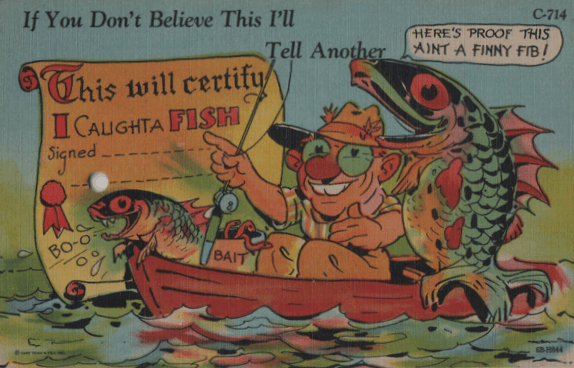
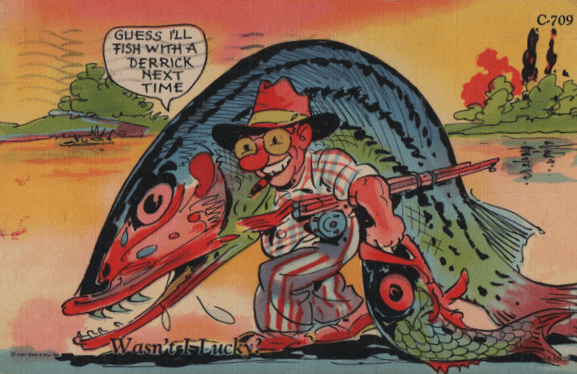
With one notable exception. See, that hunter and this gentleman were the work of Curteich cartoonist Ray Walters, whose work brightened the world of comic postcards at mid-century. And his outdoorsmen, hearty souls enjoying themselves (and often delivering the punchline of the joke) notably wore great big spectacles.
There have been plenty of articles and even a book studying the career f Mr. Walters, but I haven’t gotten hold of any of these yet. So I cannot say for sure whether he himself wore glasses. I don’t even know for sure if he was a fisherman, though the sheer exuberance of all his fishing postcards shows an understanding of the sport.
But I think there’s another possible explanation for these rugged outdoorsmen, defying the weather, the fish, and the expectation that people with glasses never have any fun.
This picture almost but not quite becomes a presidential portrait. See, one of the most famous outdoorsmen of the age when Ray Walters was a youngster was Theodore Roosevelt, a proponent of the rugged outdoor life, the big stick, and the general roar of exuberance in life and politics. And HE would have been lost without his glasses. Perhaps he explains why Ray Walters’s fishermen and hunters are so often bespectacled and grinning with the joy of life. (Roosevelt was possibly the grinningest of twentieth century presidents, even including Jimmy Carter. In fact, he was also one of the few, aside from Harry Truman, say, who wore glasses on the campaign trail. The image problem of us spectacled bipeds isn’t just the postcard artists, I guess.)
As we have considered the monocle, the lorgnette, and the pince nez, I suppose we should get around to plain old everyday eyeglasses. Spectacles, you might say. Cheaters, as once they were known.
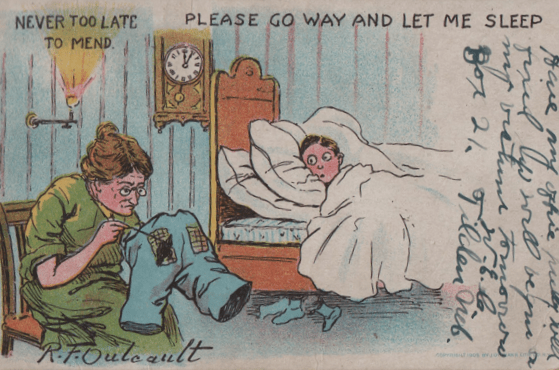
As someone who has worn glasses for, oh, a good twenty years (I know 1963 was a while back, but there must have been twenty GOOD years in all that) I am shocked and grieved, but hardly surprised, to see the role played by glasses-wearers in postcards of the comic variety. They are generally a) old, n)unattractive, and/or c) slow on the uptake.
Maybe it’s all been a plot by the makers of contact lenses, but glasses belong to the irate wife, the irritable parents, and the bystander with mouth hanging open at what the hero with free-range eyes is doing in the cartoon.
In fact, it is only the exceptional postcard which even lets someone wearing glasses deliver the punchline. (And here, for example, it’s based on someone not understanding an expression used by someone else.)
The person with glasses who gives us the worldly wisdom is sadder and only mildly wiser, the sort of person things happen to.
Maybe we associate glasses, as we discussed while studying the pince nez, with people in authority, and it’s more fun to see the dignity of someone wearing glasses under attack.
Schoolteachers are certainly a symbol of authority, and they frequently have a pair of glasses with which to look down that autocratic nose.
Mom or Dad, being both figures of authority AND older than our protagonist, are obviously key candidates for glasses in a cartoon.
I was curious, at first, about why so many people with glasses (besides sunglasses) seem to turn up at the beach. I suspect it’s because older people in bathing suits are supposed to be funny from the outset, so why not slap spectacles on them while you’re at it?
There’s a lot going on in this postcard, for example, but making the straight man small, balding, and bespectacled at least provides a good reaction shot (if you can tear your eyes away from that remarkable bikini.)
You hardly ever find a person wearing glasses who is the clever wise guy in a postcard. And, after all, in this one he’s pushed his glasses back on his forehead, perhaps to help show he’s not one of those slow-brained dubs you see in the other cards.
Scrooge was very much dismayed to hear the spectre going on at this rate, and began to quake exceedingly.
“Hear me!” cried the Ghost. “My time is nearly gone.”
“I will,” said Scrooge. “But don’t be hard upon me! Don’t be flowery, Jacob! Pray!”
“How is it that I appear before you in a shape that you can see, I may not tell. I have sat invisible beside you many and many a day.”
It was not an agreeable idea. Scrooge shivered, and wiped the perspiration from his brow.
“That is no little part of my penance,” pursued the Ghost. “I am here to-night to warn you, that you have yet a chance and hope of escaping my fate. A chance and hope of my procuring, Ebenezer.”
“You were always a good friend to me,” said Scrooge. “Thank’ee!”
“You will be haunted,” resumed the Ghost, “By three spirits.”
Scrooge’s countenance fell almost as low as the Ghost’s had done.
“Is that the chance and hope you mentioned, Jacob?” he demanded, in a faltering tone.
“It is.”
“I—I think I’d rather not,” said Scrooge.
“Without their visits,” said the Ghost, “you cannot hope to shun the path I tread. Expect the first to-morrow, when the bell tolls one.”
“Couldn’t I take ‘em all at once and have it over, Jacob?” hinted Scrooge.
“Expect the second on the next night at the same hour. The third upon the next night, when the last stroke of twelve has ceased to vibrate. Look to see me no more; and look that, for your own sake, you remember what has passed between us!”
When it had said these words, the spectre took its wrapper from the table, and bound it round its head, as before. Scrooge knew this, by the smart sound its teeth made, when the jaws were brought together by the bandage. He ventured to raise his eyes again, and found his supernatural visitor confronting him in an erect position, with its chain wound over and about its arm.
We run into a couple of problems here. One is mere interpretation: Screen Scrooges who bother with the line “Don’t be hard upon me” use it as if Marley were in a position to pass judgement, whereas Dickens’s Scrooge was just asking Marley not to sermonize. And that line about “look that, for your own sake, you remember” is almost always taken as an order to look out the window at the spectacle discussed in the next section.
The other is a matter of timing. Each ghost to come is going to give Scrooge roughly a day’s worth of visions, but how can you show all that onscreen? Some filmmakers leave the line alone, and assume you know you’re not getting a 74-hour movie. Others squeeze all the ghosts into one night, which would be all right if it didn’t make a dope out of Scrooge who, waking up at the end, asks what day it is and is thrilled he hasn’t missed Christmas. One or two compromise versions have Marley simply state the time of the first ghost’s arrival, and let things move on from there.
TRADITIONALISTS
“Hear me!” Marley cries to Sim II. “I will, I will!” says Scrooge, taking no time for the objections so loved in other versions. He is then merely told to expect the ghosts just as Dickens wrote it.
Stewart looks extremely uncomfortable at the thought of an invisible Marley sitting next to him. The three ghosts are scheduled much as in the text. Then Marley tightens his chinstrap, to Scrooge’s obvious revulsion
TIGHTENING THE SCHEDULE
Owen is told “My time grows short.” “If you must go, Jacob, don’t let me keep you.” Marley explains how sitting invisible in the counting house has been no light part of the penance; Scrooge mops his brow. Marley tells Scrooge there is one chance; having heard it, Scrooge says he’d rather not. Marley starts moving backward. “Jacob, don’t leave me yet!” Scrooge pleads, “Jacob!” Scrooge is told to expect the first ghost “when the clock tolls one, the second on the stroke of two, the third on the last vibration of three.” Scrooge inquires whether he can’t take ‘em all at once, but Marley is now turning to the window.
Marley tells Rathbone that he has come to warn Scrooge that there is still a chance. Scrooge smiles and even chuckles a bit at this, but his face falls when he hears about the ghosts. Je is told to expect the first when the bell tolls once, the second when the bell tolls twice, and the third when the bell tolls thrrrrrrrrice. Marley now backs away almost smiling.
Haddrick is told the first ghost will come tomorrow when the bell tolls one, the second at the stroke of two, and the third at three of the clock.
Finney is caught u[p in Marley’s chain and taken for a ride among the wandering spirits; he thows up his hands in horror. When he takes his hands down, he is in his own room. Realizing it was all a dream, he reaches out to relight his candle. But when he gets there, the candle is lit, and Marley sits next to it, saying, “It’s not a dream, Ebenezer.” “For pity’s sake, leave me alone!” “It was for pity’s sake I came here.” Scrooge is told there is just the tiniest chance of escaping Marley’s fate. (Marley is clearly convinced Scrooge will NOT escape.) Scrooge is to expect the first ghost when the bell tolls one, the second at two o’clock, and the third—Marley has to stop a moment and count—when the bell tolls three.
Matthau is informed he still has time to repent. “How?” “Tonight, you will be haunted by three ghosts.” He is told to expect the first when the bell tolls one.
McDuck’s Marley is brief and to the point. “Tonight, you will be haunted by three spirits.” He holds up two fingers. “Listen to ‘em. Do what they say. Or your chains will be heavier than mine!”
Scott smiles spasmodically, dubiously, when he learns Marley has, as part of his penance, procured him a chance. The ghosts will appear “tonight, when the bell tolls one.” Scrooge asks if he could take ‘em all at once. “Expect the second at the stroke of two’ the third, more mercurial, shall appear in his own good time.”
THE COMPROMISE
Hicks is informed, “You will be visited by three spirits. Without their visits you cannot hope to shun the path I tread. You shall behold visions of a Christmas past, a Christmas Present, and a Christmas Yet To Come. Expect the first when the clock strikes midnight.”
Marley takes his leave after telling Sim I “Expect the first when the bell tolls one.”
March is dismayed at the prospect of the visits. “Three more spirits? Oh no1 I’d rather not, Jacob!” “If you let them help you, you may yet shun the path I tread.” He is given no timetable.
Magoo is told to expect the first ghost when the bell tolls one. “Couldn’t I take ‘em all at once, and have it over, Jacob?” Marley wails in reply, and sails out the window.
Caine is informed, “You will be haunted by three ghosts.” “I’ve already had enough of that.” “Expect the first tonight when the bell tolls one.” “Can’t I have ‘em all at once, and get it over with?” “When the bell tolls one!”
Curry is unmoved by a glimpse of the wandering spirits, refuses to believe Marley’s visit can do him any good, and declines any visits from ghosts. “I like chains! No ghosts!” “Expect the first when the bell tolls one!” cries Marley, vanishing in a curl of flame and smoke.
Whilst checking through my inventory for postcards showing monocles, I observed that there have been several ways of holding lenses up to one’s face. Ordinary glasses or spectacles spread the burden between ears and nose, while the monocle is held in place with the muscles of the face. But there have been other alternatives.
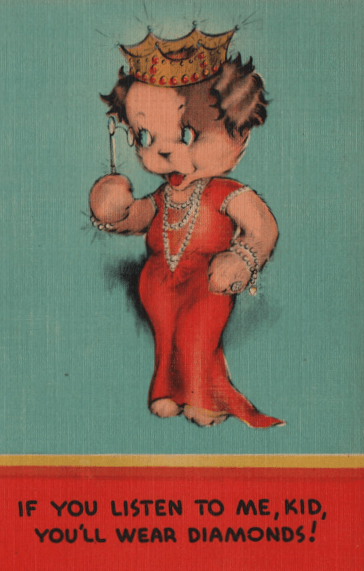
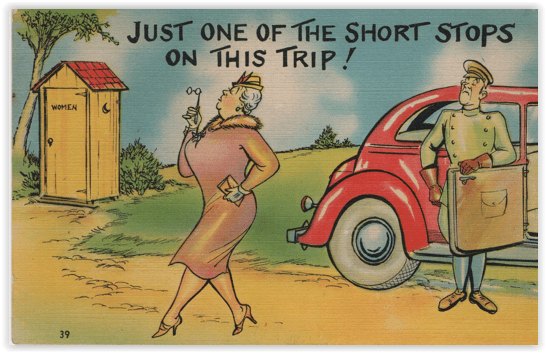
The lorgnette allows you to hold the lenses up with a handle. This device came about somewhere around 1700, and got its name from another word, though experts disagree whether it comes from a word for peeking at someone sideways, for squinting, or for using a ship’s telescope. It seems to have been intended primarily for women, who were not supposed to wear spectacles in public. A nice lorgnette was the answer. It quickly became a device of the upper classes, either for opera going or just for peering at fellow creatures on whom one was going to pass judgement.
And so the lorgnette became a sign that the bearer was rich and probably snooty. This is possibly the single most popular image of a lorgnette in the history of postcards.
The pince-nez, or pinch nose, style has its own space in cultural history. It may be the oldest type of eyeglasses, and is also the hardest to hold in place. It served both men and women, and may have been related to the social trends which felt it was rather antisocial for anyone to wear glasses when out in public. These could be removed when you didn’t especially need them to see where you were going, and be donned for close work.
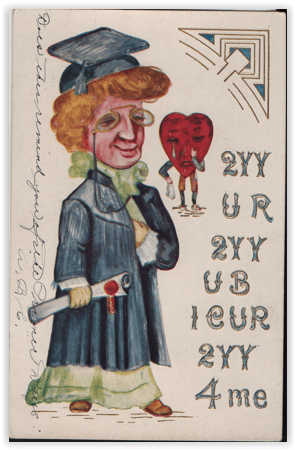
They became associated with people who did a lot of reading: university students, say.
This also meant people who went to school for a long time might wear a pince-nez. Doctors were frequently shown wearing them.
Even in the operating room. (That string, often a silk ribbon, hanging from one end was to make sure they didn’t go too far when falling off the face…kind of a good idea when doing surgery.)
A pince nez could be removed and waved around in the hand while speaking to a patient, for dramatic impact, or used to tap a report on the desk.
Anyone with authority, like a doctor or lawyer, was associated with the pince nez. It became another accessory of the moneyed classes, of those in authority.
The master of the household wore them.
A schoolteacher was a candidate both through authority AND heavy reading.
Dear old dad’s pince nez gave him that same air of authority.
Even if all he was in charge of was the driving.
And of course when you want a bit of philosophy to make your life run more smoothly, it sounds better if that comes from someone with a pince nez. Shows he’s a man of vision.
“It is required of every man,” the Ghost returned, “that the spirit within him should walk abroad among his fellow-men, and travel far and wide; and if that spirit goes not forth in life, it is condemned to do so after death. It is doomed to wander through the world-ah, woe is me!-and witness what it cannot share, but might have shared on earth, and turned to happiness!”
Again the spectre raised a cry, and shook its chain and wrung its shadowy hands.
“You are fettered,” said Scrooge, trembling. “Tell me why?”
“I wear the chain I forged in life,” replied the Ghost, “I made it link by link, and yard by yard’ I girded it on of my own free will, and of my own free will I wore it. Is its pattern strange to YOU?”
Scrooge trembled more and more.
“Or would you know,” pursued the Ghost, “the weight and length of the chain you bear yourself? It was full as heavy and as long as this, seven Christas Eves ago. You have laboured on it, since. It is a ponderous chain!”
Scrooge glanced about him on the floor, in expectation fo finding himself surrounded by some fifty or sixty fathoms of iron cable, but he could see nothing.
“Jacob,” he said, imploringly, “Old Jacob Marley, tell me more. Speak comfort to me, Jacob.”
“I have none to give,” the Ghost replied. “It comes from other regions, Ebenezer scrooge, and is conveyed by other ministers, to other kinds of men. Nor can I tell you what I would. A very little more is all permitted to me. I cannot rest, I cannot stay, I cannot linger anywhere. My spirit never walked beyond our counting-house—mark me!—in life my spirit never moved beyond the narrow limits of our money-changing hole;; and weary journeys lie before me!”
It was a habit with Scrooge, whenever he became thoughtful, to put his hands in his breeches pockets. Pondering on what the Ghost had said, he did so now, but without lifting up his eyes, or getting off his knees.
“You must have been very slow about it, Jacob, Scrooge observed, in a business-like manner, though with humility and deference.
“Slow!” the Ghost repeated.
“Seven years dead,” used Scrooge. “And traveling all the time?”
“The whole time,” said the Ghost. “No rest, no peace. Incessant torture of remorse.”
“You travel fast?” said Scrooge.
“On the wings of the wind,” replied the Ghost.
“You might have got over a great quantity of ground in seven years,” said Scrooge.
The Ghost, on hearing this, set up another cry, and clanked its chain so hideously in the dead silence of the night, that the Ward would have been justified in indicting it for a nuisance.”
“Oh! Captive-bound and doubled—ironed,” cried the phantom, “not to know, that ages of incessant labour by immortal creatures, for this earth must pass into eternity before the good of which it is susceptible is all developed. But to know that any Christian spirit working kindly in its little sphere, whatever it may be, will find its mortal life too short for its vast means of usefulness. Not to know that no space of regret can make amends for one life’s opportunity missed! And such was I! Oh! Such was I!”
“But you were always a good man of business, Jacon,” faultered Scrooge, who now began to apply this to himself.
:Business!” cried the Ghost, wringing its hands again. “Mankind was my business. The common welfare was my business; charity, mercy, forbearance, and benevolence, were, all, my business. The dealings of my trade were but a drop of water in the comprehensive ocean of my business!”
It held up its chain at arm’s length, as if that were the cause of al this unavailing grief, and flung it heavily upon the ground again.
“At this time of the rolling year,” the spectre said, “I suffer most. Why did I walk through crowds of fellow-beings with my eyes turned down, and never raise them to that blessed star which led the Wise Men to a poor abode? Were there no poo houses to which its light would have conducted ME!”
The movies, still in a hurry to get to the GOOD ghosts, cut most of this away. Everyone pretty much likes “I wear the chain I forged in life” and “Business! Mankind was my business!”, though there seems to be an irresistible urge to touch these speeches up to clarify what Dickens SHOULD have meant by them. Otherwise, a brief allusion to the sufferings of this ghost, for the purposes of terrifying Scrooge, is all that is left pf the rest.
Hicks’s Marley gets only as far as “I have none to give” before saying he is here to warn Scrooge, to save him, if possible. “From what?” “From such a fate as mine: to wander through the world.” “But you were always a good man of business.” Marley can then explain, “Mankind should have been my business, as it should be yours.”
Owen watches warily though Marley’s recitation, and grows a bit hangdog by the end. Marley is apparently rendered deadpan by his suffering; he does get to explain how hard he has been travelling these seven years.
Sim I’s Marley now seems to be in thorough agony, and is perhaps a bit mad as well’ all his dialogue comes in face-twisting moans. Sim grovels very low before him, trying to hide behind the collar of his dressing gown now and then; he says Marley has his sympathy. The section about Marley’s travels is omitted.
Marcj’s Marley summarizes the various speeches about his travels at the start, and is told by Scrooge, “You wear a chain. Why?” “I wear the chain I forged in life; a chain of useless things.” Marley recalls some of the villainies he perpetrated, and goes on, “If you died tonight Ebenezer, you would wear such a chain, only longer, stronger.” Marley staggers a bit under the weight of the fetters. “What can I do, Jacob? Speak comfort to me!” Marley replies that he has none to give, and goes on a little more about raveling: why did he always have his eyes on the ground and his mind on the account books? He drags p part of his chain, which includes the account book itself. He opens it to point out the “thousands” of injustices committed by the fir of Scrooge and Marley.
Rathbone listens as Marley reveals that he must wander the earth and witness what he cannot share, but might have shared and turned to happiness. “I wear the chain of selfishness I forged in life.” He explains how he forged it link by link and yard by yard, and makes mention of the length and weight of Scrooge’s own chain. Scrooge asks for words of comfort, and is told these come from other regions.
Magoo’s Marley is brief and, shall we say, businesslike. There is time only for the inquiry about fetters, and the wailing for one captive-bound and double-ironed. They don’t even make time for “You were always a good man of business”. Marley hurries right along to the reason he’s here.
Haddrick’s Marley keeps fading in and out; Scrooge spends time fiddling with his snuffbox. Though they skipped gravy and the grave, they do keep a lot of this section. This Marley must wear chains “as proof of my foolishness”. And he adds “If only you could realize that Christmas spirit is an opportunity to make the chain lighter. I didn’t, and look!” From this we work our way back to “You were always a good man of business” and the rest.
Sim II, like Haddrick, angles the scene so we are watching Scrooge THROUGH the ghost of Marley. His Marley continues to speak without any movement of jaw or lips; being dead, ne needn’t observe such niceties, and, anyhow, his jaw dropped too far open when he removed the chinstrap. He wears the chain he bore in life, and Scrooge tells him he was always a good man of business. He is one of the few Marleys to mention the Blessed Star from the text, though he omits the rest of the line.
Finney demands, “Why do you walk the earth? Why do you come to persecute me? And what is this great chain you wear?” Marley really relishes explaining the chain, adding, “And I can never be rid of it any more than you will ever be rid of yours.” When he notes that comfort comes from other regions, and is conveyed by other messengers to other kinds of men, he raises his hands to block his view of Scrooge. On being told that he was always a good man of business, he replies, “Mankind should be our business, Ebenezer, but we seldom attend to it, as you shall see.”
Matthau’s Marley commands “Look at me! Condemned to walk the earth in death because I wasted my life!” “Wasted? How, dear old Marley?” “I helped myself to money instead of helping my neighbor (sob) and so I wear this chain of greed and heartlessness I forged in life.” There follows a song—“I Wear a Chain”—during which we flash back to scenes of the young Scrooge and Marley gleefully evicting people, collecting money from the poor (presumably widows and orphans), and so forth. He warns Scrooge about the chain, and is told, “But business is business.” Marley cries, “Mankind should have been my business!”
McDuck is treated to a brief version of the “good man of business” section, Marley complaining that in life “I robbed the widows and swindled the poor.” “And all in the same day,” notes an admiring Scrooge, “Oh, you had class, Jacob.” Marleys agrees but then remembers why he’s here. “I was wrong! And so, as punishment, I’m forced to carry these heavy chains through eternity. Maybe even longer! No hope! I’m doomed! Doomed! And the same thing will happen to you, Ebenezer Scrooge!”
Scott’s Marley explains his mission, his lips starting to tremble. A wail of anguish breaks from him. When Scrooge is told about his own chain, he complains that he sees no chains. “Mine,” says Marley, “Were invisible until the day of my death.” We jump from “I have none to give” to “You were always a good man of business.” Scrooge seems not to be applying Marley’s woeful words to himself; he simply says he is sorry for Marley, and asks if there is anything he can do for his old partner.
Caine’s Marley Brothers, Jacob and Robert, break into the song “Narley and Marley”, a number which regrets a life of exploitation compounding the agonies of the poor and homeless. Chains leap up around Scrooge to show him his own peril; the strongboxes sing along. Both ghosts seem exuberant at the outset, but their anguish deepens as the song rolls along.
Curry’s Marley says he is here to warn Scrooge; Scrooge demands to know the meaning of “all this hardware”. Marley explains that he wears the chain he forged in life, and points to individual links, recalling what he did to earn them. A green spark leaps from his finger to each ink he indicates. When told he wears such a chain, Scrooge complains that he sees no such chain. “I can,” intones Marley. Marley then proceeds to the section about it being required of every man that his spirit walk abroad. He mentions the woman and child Scrooge spurned earlier. Scrooge snarls “It’s not my business.” “Mankind is our business,” Marley informs him.
Stewart’s Marley is weary beneath the weight of iron and remorse; it causes pain, apparently, for hi even to talk about it. He describes his WN chain as ponderous, and tells Scrooge that Scrooge’s chain is worse. Scrooge, looking around for a chain and seeing none, seems to reproach Marley for making joes. At one point, Scrooge even breaks into a speech of marley’s with, “Jacob, I don’t understand why you’re suffering. All your life you were a good man of business.” “That’s why I am suffering. The suffering I caused others is being repaid.” Scrooge is adamant: “Jacob, it was business!” Marley points out that mankind is our business, and begins to speak of the common good. Scrooge grins. He’s heard this sort of thing before, and even Marley isn’t going to sell it to him.
FUSS FUSS FUSS #7: The Late Great Fashion Plate
For once in this story, Dickens is fairly specific about a character’s looks. He can afford to be: this character is going to disappear after this chapter and not come back (until the publication of sequels involving him, but those come from other regions.) Most screen Marleys make at least a token attempt to follow Dickens’s specifications. Whether or not he uses it, Marley almost always wears a chinstrap, and most are well-dressed in the style of a previous generation, with high collars, occasionally alarming neckcloths (see Rathbone’s Marley, who also seems to be wearing his chinstrap almost as a bonnet) and, in the case of Stewart’s Marley, highly polished boots. The spectacles are less consistent, while only Magoo’s Marley, who seems to have left his false teeth at home, has an obvious ponytail. (It’s hard to tell if Finney’s Marley has a pigtail or if that’s a rat disappearing into his hair.) Oddly, only Goofy, as McDuck’s Marley, is clearly wearing the tights mentioned by the author.
The color of Marley’s clothes is hard to determine, since a lot of these ghosts are transparent. Some are dressed all in white, to represent ghostliness as well as to provide a contrast to Scrooge’s darkness. Curry’s Marley, though, is a full-color portrait of a late nineteenth-century robber baron, complete with handlebar mustache. This mustache, like his hair, changes color throughout the show. He is grey in the portrait in Scrooge’s office, but during the scene in Scrooge’s quarters, grey is the one color his hair is not, black or green in the fireplace tiles, red when he pops into full view.
Dickens is not so terribly definite about the chain, which is merely long and heavy and made of office supplies. Screen Marleys have chains which vary in all these particulars, from Haddrick’s Marley, who wears a thin band of itrong links with keys and one strongbox, to Scott’s Marley, who has trouble walking for all this dead ironmongery; the chain is barely visible under all the strongboxes. McDuck’s Marley boasts a modest chain, on which hang one ledger, one strongbox, and one piggy bank, which Scrooge shakes to find out if there’s anything inside. One or two Marleys wear the chain as a belt, but most are wound up in the links, which are fastened behind their backs with padlocks. Sim II’s Marley carries loops and loops of chain.
Most Marleys appear to be at least as old as Scrooge. Matthau and Sim I also show us the young Marley; in both he seems to be a contemporary of his partner. Caine’s Marley Brothers are to be seen later, in the scene of Fozziwig’s Party, where they are called “lads”, though one sports a thick mustache. They seem to be about Scrooge’s age in that scene, but are visibly much older than he when they appear as ghosts. The torments of the damned are probably not conducive to a youthful complexion.















 Blogsy Babbles