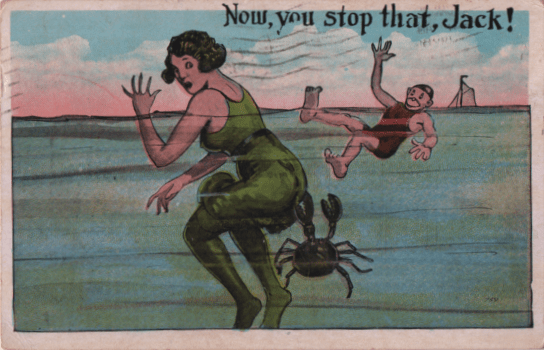
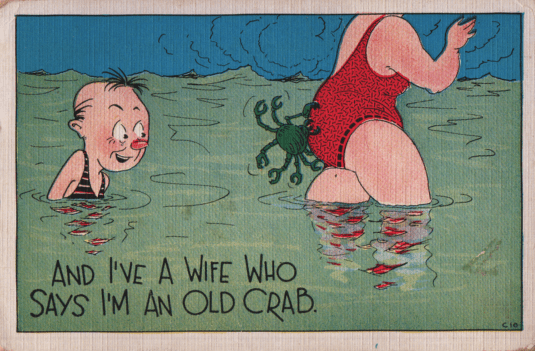
As you will certainly recall from our last thrilling installment, this column has been using the power of the Interwebs to warn you of summer dangers which the self-styled guardians of our safety will not talk about. Though you may search online as you please, no one but the postcard cartoonists have bothered to bring us the True Facts regarding the attraction of shellfish to women in bathing suits. I hope you have added appropriate precautions to your plans for this summer. (Even if that’s no more than ordering steak and lobster every time you run out to Arby’s for lunch.)
There are other perils of summer living which I have hunted diligently amid those brochures sent out by national parks and public beaches. I have seen dire predictions of what will happen if you decide to get out of your car and pet that baby bear, and assurances that if sharks are sighted offshore, you are in no danger if you take certain precautions (withdrawing to a safe vantage point: Boise, Idaho, for example.) But I have found no description of what I sometimes refer to as the Meaty Meteor.
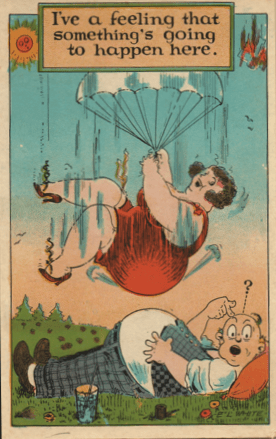
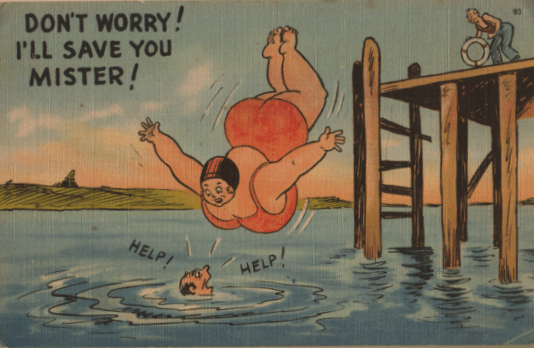
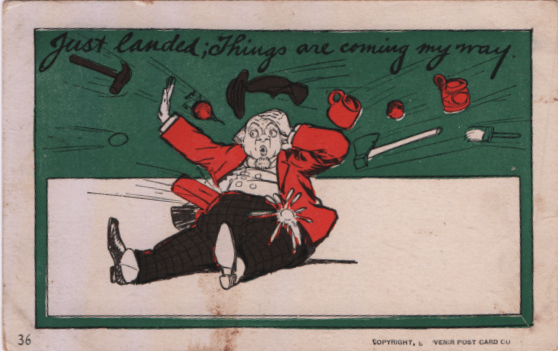
For years, however, our postcard artists have responded to the call. If no one else will warn the public about humans dropping out of the sky during your leisure moments, THEY are ready to make us aware of the problem at hand. (Or whatever part of the vacationer is the target. The phrase “problem at tummy” didn’t sound quite right.)
I know, I know: people have mentioned it. I’m glad somebody is worrying about these important topics, but I think the artists are on my side. Referring to “Meaty Meteors” may seem to be a misnomer, as a “meteor” refers to an object flying through the air, often seen at night as it ignites on entering the Earth’s atmosphere. Those meteors which actually make impact are correctly referred to as “meteorites”. Therefore, these people inform me, I ought to speak of “Meaty Meteorites”, as impact is implied.
But the postcard artists never actually show the impact. Their soft identifiable flying objects are always just about to strike, giving viewers the opportunity to play a quick game of “What Happens Next Is” in the privacy of their own imaginations. So I think I am safe in preferring the shorter name.
As with the previous column’s warning about shellfish, this phenomenon is largely gender-specific. (Lobsters pinch the women on the backside, but men on the toes.) When the Meaty Meteor is female, they always seem about to land on a stomach, or, as seen in the preceding example, on the head of the unlucky male victim.
A Male Meaty Meteor (or MMM, as those scientists in the know call them) seems to be a lot more focused. (Note, by the way, that the experts we have consulted seem to have found no same-sex meteor impacts. More research is surely needed.) This leads me to wonder whether the masculine version of the Meaty Meteor is somehow a late form evolved from the common postcard crab, or Beach Pincher. But I will leave that up to graduate students looking for a dissertation topic. My job is to bring the message of the postcard artists to your attention. Remember: that next plump plummet may have your name on it.
We have spoken, hereintofore, of the postcard as an early form of social media, as a repository of bygone songs and jokes, and as a certificate for travelers to verify the places they had visited. The postcard had many more roles in our history than as a means of saying “My Room Marked With X.” But have we spoken of it sufficiently as a guidebook to parts of life so hidden, so dark, that travel guides, advice columnists, and even Wikipedia will not address? Where else can we go for a description of the real dangers of the beach vacation?
Oh, sure. Anyone will tell you about sunburn, mosquito bites, and even jellyfish stings. But to the person…let’s not mince words here. To the woman who has donned that bathing suit of this summer’s frolics, will no one speak of the hazards presented by local wildlife and the seasonally-exposed posterior?
I have researched the question extensively (I asked both Google AND Bing) and nowhere can I find any statistics about the number of merry vacationers who joyfully headed into the water and wound up being unable to sit down for the rest of their stay because of crab attacks. This can only be conspiracy. The crustacean lobby has gotten to the purveyors of information on the Interwebs and concealed this threat, for fear of cutting off this source of entertainment for crabby influencers, whom we shall call the Deep Blue C.
But (and I use that word with some trepidation) our friends the postcard cartoonists are looking out for us. THEY are not afraid to depict the truth of matters suppressed by our so-called information sources.
They alone are willing to show us the shock and horror of the situation, the sheer terror of…oh, sure, maybe some people will tell us they just thought butts were a quick provider of cheap laughs. But the truth sticks out in their efforts.
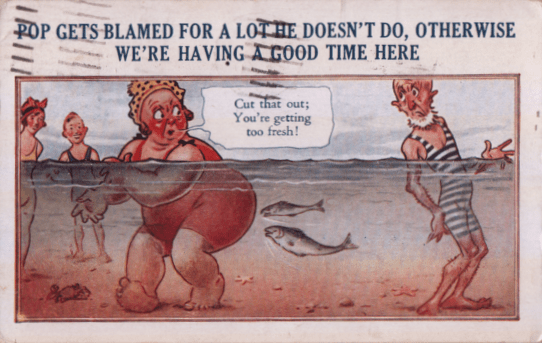
It isn’t just the crabs, of course. Lobsters indulge in molestation of the female situpon, and fish are serial offenders (possibly even searial offenders, if my spellcheck will allow that. I think the spelling and grammar programs on computers are part of the conspiracy, too, but that won’t surprise anybody.)
Fish may be a little more subtle than their neighbors with pincers, but they do, according to the postcard artists, accomplish just as much damage, especially to married felicity, as any lobster.
And they know what they’re up to. Over and over, we see the same critters attacking men. But here they go for other targets. “Toe of Man But Lady’s Rump: That’s the Way to Make Them Jump” is one possible translation of cryptic engravings on rocks found at the bottom of the sea. (Provided I can find a picture of some rocks with cryptic inscriptions. If I do, I dare you to prove that’s NOT what the cryptic lettering says. Never mind the work of Professor Fossilthwaite in 1927, who claimed these writings—which were lost but which he made replicas of in his lab, using Play-Doh—said “Ask Any Mermaid You Happen to See” OR the subsequent pamphlet by Dr. Phoeble, which translated the cryptic script as “There Once Was a Gal In the Ocean, Who….” Where were we?)
And then we have experts like Herman Melville, who pointed out that when one of these watery predators go after men from behind, they may have other things in mind entirely. But (and there’s that word again. Coincidence? I think not.) our postcard artists are right there wherever situpons are in peril, to bring us the True Facts, give us fair warning, and, incidentally, provide us with an excuse to show off their postcards (an artform where the fullest message was on the back side. Another Coincidence? Ha!)
Affretz did not recognize the hand that caught at his boot, but knew at once it could have nothing to do with the flower. He grabbed it, more because it was dragging him into the hole than any other reason.
A dirty but familiar face gazed up at him, and then Deedee seemed to go limp. Affretz caught her elbow with both hands as she started to fall backward, and hauled her up. He had expected her to be lighter somehow. Archels’s muscles would have had her out in a trice, but his brother was still busy tearing up the hungry flower.
“Ack!” Alain stumbled from the blossom and moved forward like someone walking through deep snow. Archels ripped the rest of the flower out of the ground and threw it as far as he could. As the flower passed the waiting trees, branches reached down to tear it to shreds.
“Now, brothers,” said Archels, dusting off his hands, “Let’s go see about that ogre.”
Alain sat down. “If it’s an ogre who planted that plant, I want no part of him. You’d need gardeners, not princes, to fight him. Let’s go find that castle with the thorns around it, the way we planned.”
Archels, meanwhile, had walked over to the hole in the ground. “Are you down there, fiend?”
Affretz could not get Deedee to stand up. She seemed to be asleep, but no matter how he shook her, she would not open her eyes.
“Let’s go,” said Alain, standing up again. “Where are the horses?”
Affretz let go of Deedee to point, but had to catch her again before she fell. “What?” Alain demanded. “You just left them somewhere for the fiend to find?”
“Well, the dragon said….”
“The dragon!” Alain tried to draw his sword, but it was stuck in its sheath by juices from the flower.
“You explain it to him,” said Archels. “I’ll go get the wagon.”
He strode off into the grim forest, leaving Affretz to get Alain caught up on the day’s events. Deedee slept through the story, and when Archels returned, he was still walking.
“They aren’t hurt,” he said, leading the horses forward, “But they aren’t much good for riding. The noises in this forest have scared them half to death.”
“We can lead them out of here,” Alain declared. Affretz picked up Deedee, whom he had set on the ground while he talked.
“What are you going to do with her?” demanded Archels.
Affretz stopped. “Put her in the wagon, of course. Two of us can lead the horses and one of us can pull the wagon.”
“I don’t mind pulling the wagon,” said Archels, “But I won’t take it all the way with her in it. She’s a servant of the ogre!”
“She is not!” said Affretz.
“If it hadn’t been for her,” Archels went on, rubbing a couple of places on his arm where the amber grease had pulled skin loose, “We’d be at that castle right now, cutting through the thorns. Instead, she led us this way, where we ran afoul of fiends.”
“She didn’t lead us,” Affretz replied. “We all went this way together. She’s just a damsel under a curse.”
“Damsel?” Alain exclaimed. “What would a real damsel be doing walking alone in a forest like this? Look at her! Would a real damsel look like that? She’s a fiend, or a fiend’s helper!”
Mud and leave and dirt were all over Dimity’s hands and feet and clothes. Affretz brushed some of this away. “That’s just because the ogre took her prisoner, and kept her underground. She’s under a curse. Can’t you tell by the way she’s sleeping?”
He stood her up ad shook her. “Sknxxxx,” snored Deedee.
“She might sleep for a hundred years, if that’s part of the curse,” said Archels. “You can’t carry her that long.”
“I could,” said Affretz, lifting her to one shoulder. “I can’t help being ugly, but I can help being lazy!”
“Anyway, one of us should have his hands free, if we’re going to be leading the horses and the wagon. In case there are fiends to fight. Maybe we SHOULD put her in the wagon.”
The princes were all three a bit sore, and a bit tired, so the argument went on for some time. They had expected to have problems during their adventure, but getting trapped by fiends shaped like trees and flowers was not something that was supposed to happen to the bravest and strongest princes in the world. Fiends were supposed to come out in the open shouting, where a prince could use a sword on them. So far, only Affretz had had any real fight, and HIS fiend had gotten away.
The brothers finally marched away along the path, all of them fairly annoyed with each other. Archels led two horses and the wagon while Alain led the other two horses. Affretz carried Deedee, and found this a serious chore on the rough and uneven path. Every third step, the limping prince tripped, nearly dropping her.
The damsel noticed none of this. “Skronx,” she snored.
After an hour of silent marching, the princes reach the main path again, and set off west agan. Taking turns to sleep couldn’t be managed now, so when night started to fall, they stopped to make camp. A fire was built to frighten away night fiends. Affretz, since he was the last one who’d had any sleep, stayed awake on watch.
There was nothing much for him to see but a few moths with fangs, who flew toward the fire until chases away with his sword. To keep himself awake, he spent his time trying to get Deedee to open her eyes. Shaking was no use, and he couldn’t shout, lest this wake his brothers. He did try splashing some water on her, but when that didn’t do anything, he used it to wash the dirt from her face and hands.
She was still snoring “Honk-snoop” when the Alain and Archels woke In the morning.
“You must be right, brother,” said Archels, who was feeling better now. “It must be a curse. I’ll carry her a ways now, if you like.”
“No, thank you,” said Affretz, picking her up again. “You can lead the horses.”
They found no fiends as they continued to march westward. The princes were thinking of pausing for lunch when they stepped out from among the trees dripping with dead moss, and saw there was a world beyond the trees after all.
“I thought the shadow of these trees would go on forever,” sighed Archels.
“Look!” Alain pointed his sword at a great shadow before them. The three princes studied the dark, silent castle surrounded by huge bushes that bristled with thorns.
Prince Alain shook his head. “I don’t mind danger,” he said, “But I don’t feel like fighting any more plants right now. Let’s go to that village down there, and rest. We ca come back later.”
The sun was starting to set behind the village when they saw the second castle beyond it. “Even better,” said Archels. “We can leave Deedee at a inn in the village, get fresh horses, and ride to the castle. The people there can likely tell us anything we need to know about those thornbushes.”
“Leave her!” said Affretz. “But….”
“Sssssh,” said Alain. “Let me do the talking here. And maybe you’d better stay in the back, so they won’t see your face.”
The first building they found on the edge of the village was an inn called The Castle and Thorn. Bright lights had been lit, showing that it was enjoying a great deal of business. The princes smelled the food cooking.
The owner was standing by the door, waiting to welcome guests, and started forward. He smiled on the first two men he saw, but frowned a bit on seeing a third and much uglier man carrying a woman. “Here, now!” he said, as Archels started to tie up the horses outside the front door. “Don’t you be bringing that in here! We’re not looking for any trouble!”
Alain stepped forward. “Sir, all we need….”
“I don’t have any!” The innkeeper came forward and started to untie the first horse. “You’d best be going to….”
Affretz had started to set Deedee down against the hitching rail. The innkeeper reached out to push her away, but seeing her face, jumped back.
“She’s…That’s…Is she d…d….”
“She pronounced it differently,” said Archels.
“D-dead?” stammered the innkeeper.
“No,” said Affretz. “Deedee.”
The innkeeper went whiter than the wall of his inn. “D.D.!” he cried. “Doubly Dead?”
The princes started to reply, but the innkeeper, turning, shouted—no, screamed for his wife. “Allabeth! Come quickly! The princess has been killed twice!”
“No!”
Archels took two steps away from the innkeeper and the dirty damsel who was getting them into trouble again. “Don’t be running away!” shrieked the innkeeper. “Someone has to be explaining to the King and Queen!”
Not just the innkeeper’s wife but everyone at the inn came outside. At the sight of Deedee hanging limp against the hitching rail, men threw their hats on the ground and women tore at their hair. A little girl sat down in the roadway to cry. Affretz heard a dog howl.
Naturally, all this noise brought people from other buildings along the road. The three princes soon found themselves in the middle of a crowd too big for even Archels to push his way through.
“You stupid people!” he shouted. “Listen to me!”
“Listen to HER!” Alain bellowed. “She’s snoring!”
Shouting did not seem to make anything clearer. People were coming up to touch Deedee, as if to see whether she was real. Affretz, afraid they’d knock her over, picked her up. This seemed to call for even more shouting and less listening.
“Make way! Make way!”
“I want to see!”
“The princess is dead twice!”
“Dead twice! Dead twice! How can anyone be dead twice?”
“Well, she was royal.”
“Who will tell the King? Who will tell the Queen?”
“Who did it?”
“Who are those three men?”
“Are they princes?”
“The ugly one’s a fiend!”
“The fiend killed her and the two princes caught him!”
“Aye, and made him carry her, the way we do with dogs that kill chickens!”
“They killed her like a chicken!”
“They all killed her! She’s three times dead!”
“They’re all fiends!”
“Aw, the nice-looking one can’t be a fiend!”
The crowd was moving, bustling all together, away from the inn and down the rod, pushing and pulling each other and dragging not only the three princes and the double-dead Deedee but the horses and wagon as well. Alain could see they were all moving toward tht other castle, and reached out to push Archels’s hand down when Archels reached for his sword. That would not help matters at all.
The castle guards, seeing the huge, screaming crowd, closed one side of the front gates, and moved to stand in front of the open half. They called a challenge but no one heard it.
“The princess!” people screamed. “The princess is dead! She was killed five times! Dimity is dead!”
The captain of the guard arrived with twice as many guards. The king was with him.
“Dead!” someone shouted. “Your Majesty, she’s dead! Seven fiends killed her nine times!”
The king held up a hand and the crowd subsided a little, though quite a lot of people went on shouting, having come late to the mob.
“Who is dead, good people?” His Majesty demanded.
“The princess!” replied a chorus of voices, ragged with grief, anger, and excitement. “The princess! Princess Dimity is dead!”
The King stepped back as if someone had hit him. Then he stepped forward, both hands raised. “Have you proof of this, good people?”
The crowd started to pull to the sides of the road, going quiet as they raised their hands to point at a small group at their center. The King stepped forward and everyone fell silent, except for one angry shout.
“Can’t a person get a little sleep around here?”
Affretz nearly dropped Deedee, but instead set her on her feet and hugged her. She was not pleased about this.
“YOU got to seep for HOURS,” she snapped. “And no one woke YOU up!”
Then she jammed her hands over her ears as the crowd roared.
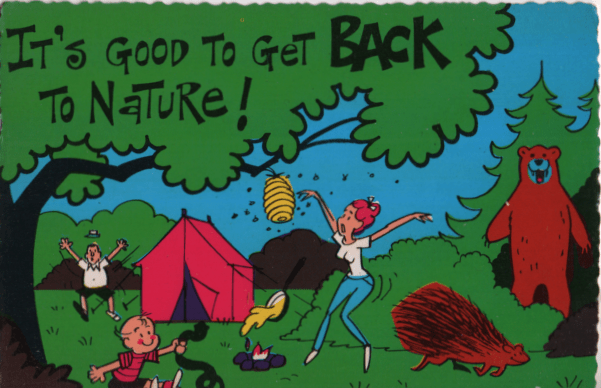
One of my grandfathers was an enthusiastic outdoorsman. He had no patience with people who thought picnics were a way to enjoy nature and slight tolerance for people who thought camping required a tent. HIS idea of an outdoor vacation was two weeks off the trail with a sleeping bag and a frying pan. There were giants in those days.
Postcard artists, especially after mid-century, when people on vacation were the main customers for postcards, were willing to show both sides of the story, to suit whatever mood vacationers were in. Some postcards cast doubt on the joys of a return, however temporary, to nature.
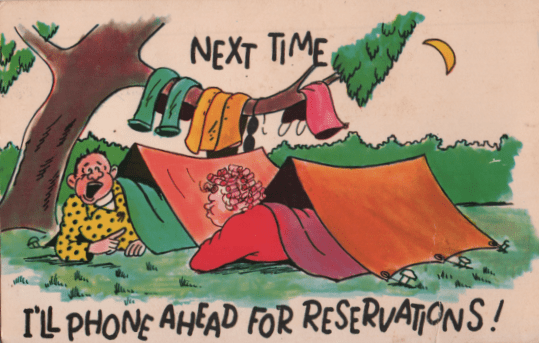
Taking your tent out into the woods meant fairly primitive amenities (though these were not without SOME compensations.)
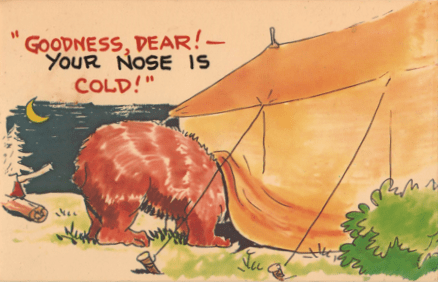
And they were willing to go into some detail on the surprises which could be caused by your neighbors in the wild. And you thought the walls were thin in your city apartment.
Yet, there are always those who enjoy the change I their routine, even if it comes in the form of a loud creature right next door.
There was, as some of you will recall, a war around mid-century, where tents were put to a great deal of use. My grandfather was at the peak of his camping out years (he started his multi-decade career as a Boy Scout leader by accident: he was just standing in for a man who was going to take over the troop, but that man was drafted and the rest is history. His wife became a Girl Scout leader around the same time, and they raised three children partly in the woods. None of these three children developed much enthusiasm for camping, tent or no tent.)
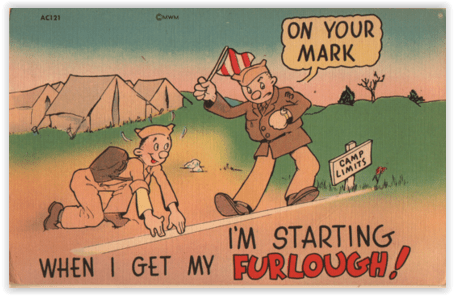
When he would talk about how camping OUGHT to be done, tent-free, he was bound to hear from someone who would point out that our military insisted on tents when troops were in the field. His response was simple: enjoying nature was not the focus of these camping trips and the troops weren’t out there to have fun. They had to make do with whatever the officers decided was good for them.
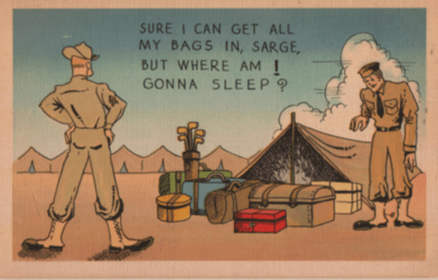
There were tents and tents, of course, and much of the tent humor of World War II dealt with the smaller pup tents. The cartoonists suggested that sleeping in those was difficult. I have heard from veterans that sleep in any form was a treasure not to be scorned, and tents were as good as anything else.
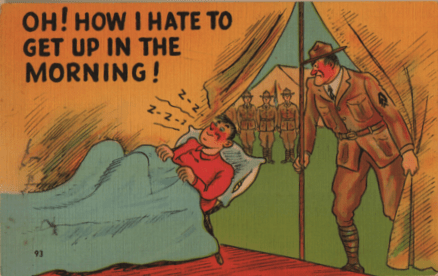
In fact, some men found tents entirely too comfortable.
Which did not mean they weren’t as happy as most anybody else to get back to civilization after a long camping trip. Of course, to them, getting out of the tent and heading to town was the START of their vacation. That can make all the difference.
Spring has sprung, I guess. Around these parts we recently had our first 80 degree day, just a few days after what MIGHT be our last Frost Warning. But I do not, thank goodness, write a weather blog. Not for us, Petunia Cutlet, debates over global warming or fresh water theft. Here, we treat of important matters. Today for example, we are going to discuss the coming of Summer, and the onset of Prime Peeping Tom Season.
Now Tom peeps in every season, but summer offers new opportunities, with people herding themselves to beaches and parks and campsites, AND wearing clothes suited to the weather. (We will also not consider here the origin of Tom in Tom of Coventry, the cad who, despite Lady Godiva’s husband’s orders, peeped through his window to get a glimpse of the nubile ax protestor and was struck blind by the power of the Almighty. SOME nitpickers complain that cottages didn’t HAVE windows in the days of Lady Godiva, but I worry about other things, myself. Why, for example, did the protestor’s hubby use his aristocratic power to order people not to peep if the Almighty was going to take care of things? Government is known for duplication of effort, but it DOES seem to me…where were we?)
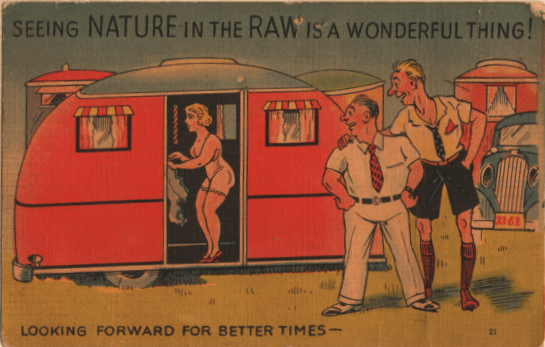
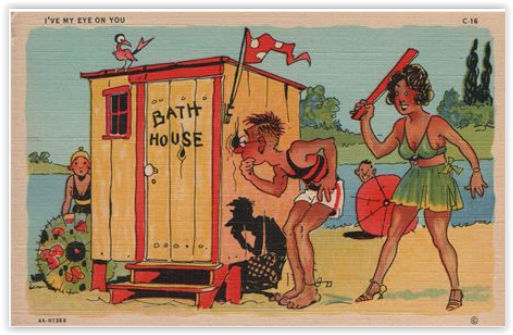
Anyway, the postcard artist was an expert at depicting the possibilities of peeping caused by vacation crowds. The theme provided an opportunity to draw attractive women in states of undress
While at the same time showing a proper disapproval for the attempts of bad lads to peep. A person could buy these cards without offense, since the peeper was shown to be a naughty boy.
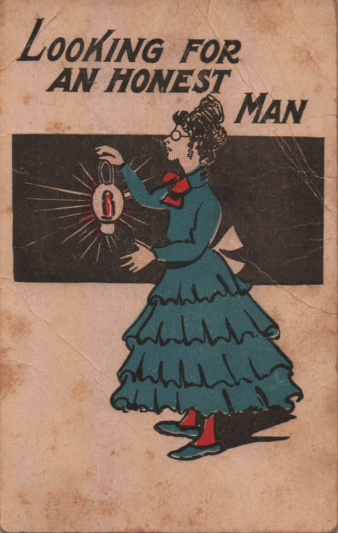
By the way, with the exception of a few kilt postcards, I have found no tradition of ladies trying to sneak a peek, as in the Fine Old Joke of the Sleeping Scotsman. Women’s minds were on higher things. (By the way, if you’re looking at this lady’s lantern, you are seeing something that is not there at all. I don’t know what you’re talking about. Go sit in that corner until the lecture is over.)
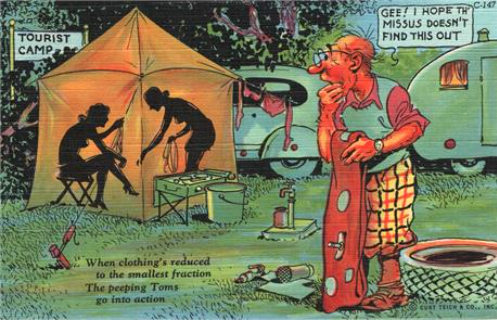
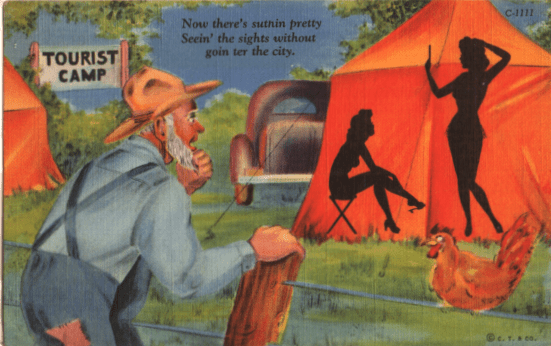
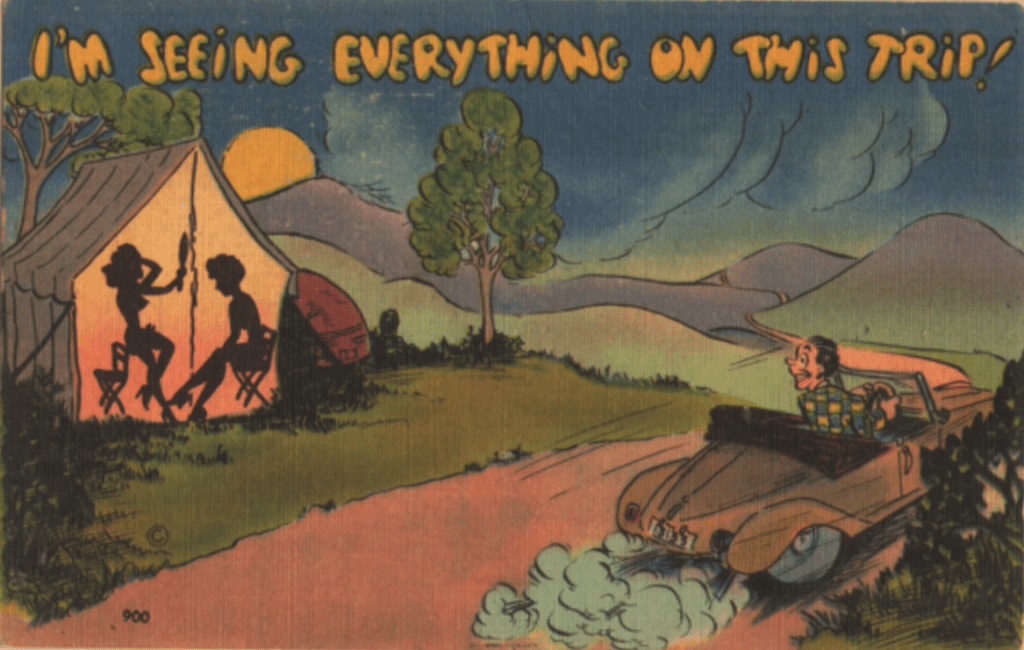
One of the most popular themes in this line is one that never made a LOT of sense to me. I have a limited experience of camping out, and the tents I recall were thick, dark canvas which didn’t allow for a lot of external display. That was one of the points of tent construction.
Mind you, there are all manner of tents, and my experience with them has been limited since nineteen-aught-ahem when about twenty of us slept in one tent at Bible Camp on a night when the temperature hit 22 degrees. Not only did we get into our sleeping bags fully clothed but, to keep chattering to a minimum so we would all get to sleep and get this over with, we were ordered to sleep boy-girl-boy-girl…boy, that was a long time ago.)
Logically, I guess, no matter where you put the lantern inside your tent, there is bound to be some wall with shadows. In postcards, you will observe, your average camper always has a tent large enough for her to stand at full height. Are these ladies who venture out to the campground by themselves completely unaware of the possibilities?
I am encouraged to find that the theme has continued to the present day, exemplified by this fairly recent postcard from Italy, where nature has provided seating. (Unless that was the lady’s intent. You know it was coming, so don’t make that face.)
And, after all, humans are not the only creatures who perfectly understand the need of proper lighting. If these mysterious creatures had not chosen to graze just at sunrise (or is it sunset?) they would not have provided this good a show. The ladies seem ungrateful, really. After all, their grass-fed companions ARE blocking the view for any handy peeping Toms once the lantern is lit.
Dimity was discovering that there were many things in this castle which, if they were not as bad as the ogre, were quite bad enough.
Her plan had been to break the glass in the greenhouse windows and escape back into the forest. This plan was based on complete ignorance of ogre greenhouses. As the greenhouses was deep underground, the light to make plants grow came not from the sun but from round orange rocks which gave not only light but also a hideous odor. Several plants hissed at her as she made her way back through the greenhouse carrying one of these rocks, and she narrowly missed being bitten by a long, notched vine. She stepped out of the greenhouse sighing with relief and went along a corridor looking for a door or tunnel that would take her out of the deep, dark castle.
The job was not an easy one. The halls were cluttered with garbage, mushrooms grew along the baseboards and crumbling fungus dropped crackling from the picture moulding. Anything Dimity touched fell apart, or simply fell. She stumbled along in the smelly light of the orange rock for yards before she found any doors at all, and these looked as uninviting as the rest, with grime on the door panels and goo on the knobs.
Rusty hinges groaned as she opened this door and that, but none was the door she wanted. Many opened onto little closets where things which seemed all eyes and teeth leapt at her, snapping and howling. Luckily, these were guard animals, chained in their niches. Dimity had only to jump back and slam the door. Bits of fungus flopped to the floor when she did this. She got into the habit of running her fingers through her hir to keep it clean as she moved along.
Other doors opened onto dark, damp rooms where she found only more garbage, and more doors which in turn led to more hallways filled with doors. Making matters worse were the stairs which Gelvander had placed every which where, always in the darkest places where you wouldn’t expect them, or even notice them until it was too late. Dimity walked down and down and down one flight of stairs until she checked the wall and realized she wasn’t going anywhere. The stairs were set into a wheel that just kept going around.
“Why didn’t I ever think to ask someone who you get out of an ogre’s castle?” she demanded, backing away from the wheel and stumbling in a pile of loose gravel. “Too late now. I don’t suppose he has a library where I could look it up.”
The hallway ahead of her looked a lot like the hallway behind her. “Maybe there’s a secret passage,” she said, and started to bang on the wall.
She coughed and gasped as dirt and fungus tumbled around her. Then a part of the wall ahead of her fell with a crash. Running to check, she found this was actually a grimy mirror that had hung on the wall. “I wonder if it’s bad luck all the same if the mirror was cracked to start with. All his mirrors seem to be cracked. Maybe he looked at…well, moons and roses!”
A small door showed in the wall right where the mirror had hung. Dimity yanked it open, and coughed.
This room was filled with smoky fog. At the far end, she saw more doors. With one hand over her mouth and nose, she stepped inside, trying to avoid the mounds of mulch and debris.
Behind the first door she found only mushrooms, glowing with a light so bright it hurt her eyes. “Growmf,” said one mushroom, as she slammed the door. She had to cough again.
The second door opened onto a closet almost entirely filled with trash. She recognized a hairbrush in the pile, and reached for it. It wouldn’t be much of a weapon, but it was something.
“Yick,” she said. The hairbrush melted in her hand, smearing it with purple ooze. That hand stuck to the knob of the third door.
Shaking it free, she looked up to find she’d opened the door to another hallway. “Do these all look the same?” she demanded. “Or does going through these rooms just bring me back to the first one, so I’m walking in circles? He could have numbered the doors, or something, so I’d know. He had no consideration for people trying to escape!” She coughed again.
She tripped over a pile of rotting cabbage, and she grabbed the door with her sticky hand. She did not fall down, at least. With broken furniture and pottery scattered everywhere, the ogre’s castle was a terrible place to fall.
Her headache got worse every time she coughed, and she had fallen down twelve times since leaving the greenhouse, what with the uncertain light from the rock she carried, and the hidden stairs. Each time it had seemed harder to get up again than the last. Little white lights twinkled inside her eyes every time she hit the ground.
When she felt brave again, she let go of the doorframe and walked on. The first door she came to this time was locked.
“There’s something different,” she said. “That means I haven’t been down this way yet. Why didn’t I think to steal the ogre’s keys?”
She looked behind her. It would be a long walk back to the greenhouse even if she could remember which doors she’d opened. Looking back, she failed to see three little stairs. She tumbled headlong onto the floor.
“All these stairs go DOWN!” she said, hammering on the floor with her gooey fist. “I want to go up! Oh, org!”
Her fist and forearm were dripping with grimy mud. Raising her head and her lightstone, she saw that the floor before her was all muddy. She frowned.
“This is worse,” she said. “So there must be something good down this hall. Something he wanted to keep people away from.”
The mud was shallow where she started, but getting through the hall was long, hard work as the mud deepened. It was nearly to her knees after a while. She tried to remember whether she’d ever read about biting animals that lived in mud.
But the mud began to shoal, and it was not long before she was happy to be treading on plain dirt and garbage again. A few tattered leaves were stuck to her boots. When she lifted one to check these leaves, she set the other foot down on a rock.
“Ouch!” she cried, grabbing that foot. As she did so, she realized she had not only stepped out of the mud, but also out of her boots, which were in the deep mud somewhere behind her. She turned around, and her muddy stockings slid under her. She sat down hard.
“What is wrong with me?” She rubbed her forehead, smudging the dust on her face with mud and bits of leaf. I am so…so lame! I need a nap!”
She pushed herself onto her knees, understanding. That was exactly the problem: she needed sleep. The fairy had said only that she would not die until a year after the curse took effect; the fairy never said she wouldn’t get tired. What if she grew so tired that next time she fell, she couldn’t get up? She could be inches from a door to outside and too weak to walk through. She might lie there in front of the door for the rest of her year, and no one would ever know. She’d become just another piece of trash on Gelvander’s floor.
She glared at a stopped and broken clock in a heap of trash. “I am NOT going to die!” she shouted at it. “I am going to get a good night’s sleep!”
Dimity walked on her knees to the nearest doorknob, and clutched at it to pull herself to her feet. When the door came open before she expected, it didn’t matter that she sat down again. The smell would have knocked her over in any case.
This room was smokier and foggier than any she’d seen so far, but Dimity recognized familiar shapes. Squinting into the smoke, she whispered, “A kitchen!” Rising, she stepped inside, one hand holding her lightstone, the other holding her nose.
Water bubbled in a sink, but it was green, with white things floating in it. Dimity was not at all curious about what might be inside the cabinets and cupboards. What she wanted was a stove, but she didn’t find one.
“I could’ve climbed up the chimney,” she muttered. “Maybe he eats things raw. Maybe he lets the smoke go just anywhere.”
There were no doors in any of the walls, so she turned to go. “Do I have to walk back through the mud and everything find some…ow!”
She had stubbed her toes on something hard. Grabbing her foot, she got mud all over that hand and sat down again. Besides being painful, stubbing her toes reminded her of how this whole stupid adventure started.
“Sometimes I wish I never even HAD any toes!” She stood up again and kicked at what was in her way, naturally stubbing several more toes in the process. She found herself glaring at knobs and handles on a small metal door set low in the wall.
Her mouth shrank into a little circle. She forgot the stench of the kitchen and the pain in her feet.
They had little doors like this back home. When Cook or somebody spilled flour or sliced pears on the floor, they just opened the nearest little door and swept the spilth through it into a garbage pan set just below. A little back hall behind the kitchen walls made it possible for a servant to go around once a day and collect all the little pans into a bigger one to be taken to the trash outside.
Outside. Dimity put her lightstone through the door, glanced behind her to make sure no one was sneaking up, and crawled through. She hoped she wouldn’t fall into a big box of garbage. She didn’t think she would: all the garbage was in here.
There wasn’t room for her to reach back and shut the little door. The tunnel here was too tight for her to turn around; in fact, the only way for her to check behind her was to put her head between her arms and look back between her legs. Dirt stuck to her arms as she crawled, but it was only dirt, without mold or garbage. And the tunnel was slanting up, up, up!
She couldn’t see the door now, when she looked back, but she did see light ahead of her. She felt like singing. Then the light flickered.
Coming up toward the light, and found it came from another small door, set in the side of the tunnel. Dimity had nearly reached it when it opened, allowing a large beetle to poke its head through the doorway.
“Eegh!” said Dimity.
“Yick!” said the beetle. “Here comes another one!”
Dozens of big blue beetles spilled out of a lighted room, climbing up on one another and crowding toward Dimity’s face. Dimity stayed where she was. She was NOT going to back up into the kitchen again.
“A human!” snarled one beetle.
“They’re always coming to poke up our house just when we have it nice!” said another. “Why doesn’t Gelvander send his servants to bother the roaches for a change?”
“I’m not Gelvander’s servant” Dimity told them. “I’m a princess!”
The beetles squealed with laughter, rattling their pincers. The biggest one rose on its hind legs and trundled right up to Dimity’s nose. “Kiss me, kid! If I turn into a prince, I’ll split my kingdom with you!”
The beetles laughed some more, but one in the back shouted, “Kill her! We don’t want those things in our house!”
“I don’t want in your house!” Dimity shouted. “I just want to get out!”
“Yeah, yeah, yeah,” said one of the beetles. “That’s what they all say.”
“Please,” she said, “Just tell me how to get out. I won’t bother you!”
“Well….” The biggest beetle turned around to tell the others, “Everybody get out of her way!”
The crowd bustled back through the little door, blocking out most of the light. The lead beetle said, “Now, Princess, just keep going straight ahead. When you come to a crossways, you turn left. That’ll take you to an opening. And if we see you coming back this way, we WILL kiss you, and in a way you won’t care for.”
He shook his pincers at her. “I won’t, Dimity promised. “Thank you so much.”
The beetle scudded back into the little doorway. Dimity crawled right past, not even looking into the house lest the beetles change their minds.
The tunnel was smaller here. Dimity pulled herself forward on elbows and knees until she reached the cross tunnel the beetle had told her about. She had to twist sideways ad nearly turn upside-down to get around the corner.
But once she was completely into the left fork of the tunnel, the walls were farther apart, and the whole passage grew larger. Dimity crawled faster and faster. Too fast: she pitched forward, having forgotten to be careful about where she was headed, and landed on solid rock.
“Quick now!” someone shouted behind her. “Close the tunnel! Close the tunnel!”
She looked up to find beetles kicking dirt into the opening she’d fallen through. One beetle scrambled down onto the rock, grabbed the lightstone from where it had fallen, and scrambled back up with it.
“No no!” she shouted. She could reach the opening, and grabbed at the pile of dirt.
Something pinched her fingers. “No no!” she said again. “Don’t leave me here in the…in the dark?”
She stopped digging and looked around her. The cave she was in now was dark, but it wasn’t ALL dark. A tiny light showed in the ceiling. Just as the beetles had said, there WAS an opening. If it hadn’t been in the ceiling, way out of reach, it was probably big enough for her to fit one finger through. But it was an opening, and Dimity was sure that light was sunlight.
“All right.” She brushed the dirt from her clothes. “All right. You didn’t lie, anyhow. I’ll show YOU!”
She walked slowly around the cave, peering into the shadows to make sure she was alone. The walls were rocky, and the shadows were uneven. Finding some spot big enough for her hands, and then her feet, she started to pull herself up.
The higher she went, the slower she went. More dirt and less solid rock was ready in the higher places. She found herself pulling her way up by grabbing tree roots, which made her hopeful. She was panting for breath, and nearly slipped loose, but never quite fell. Finally, she was bumping her head on the ceiling of the cave. Bracing her feet and knees, clinging to a rough root, she reached one hand up toward the little opening, and scratched at it.
Dirt fell in her face. So did more sunshine.
In a hurry, she had not noticed any sounds except those of dirt and little rocks falling to the floor. Now she heard little thuds, as if something, surely a shovel, was digging from the other side. A whole chunk of the ceiling broke away, sending a shower of dirt around her, part of it down her collar. Dimity started to yell, but had to stop and cough. She felt both hands start to slip.
She grabbed the first thing she saw above her. Dirty hands reached down to grab hers. Then, in the blinding patch of sunlight, the face of an ogre scowled down at her.
Dimity stared, and no strength to take any more. She fainted.
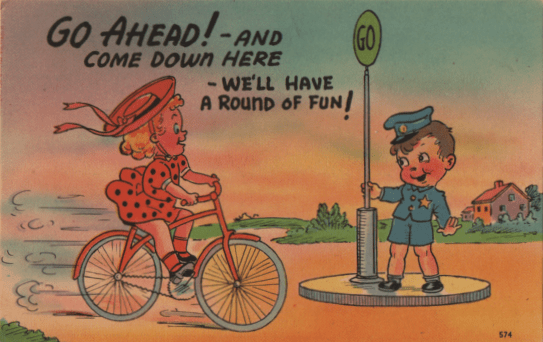
So, when last we got together, we were discussing what I insist on calling the “grade school Valentine postcard”: an aesthetic choice of artists and/or postcard publishers to apply classic Valentine form to postcards which could be sent all year long. This involved a bright picture with a fairly obvious bit of wordplay which led to the sentiment, as with, say, a picture of Bambi saying “DEER me, I want you to be my Valentine!”
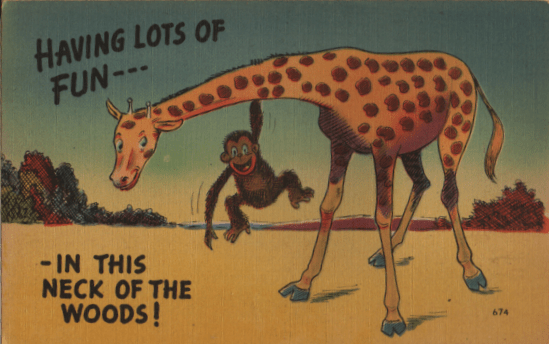
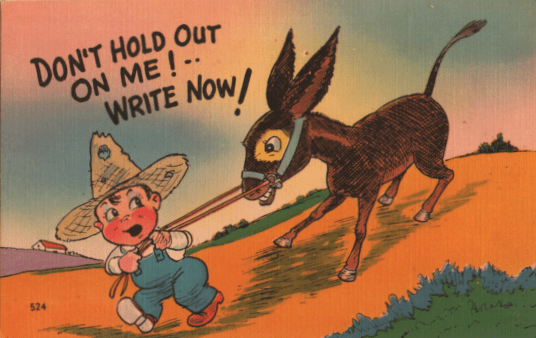
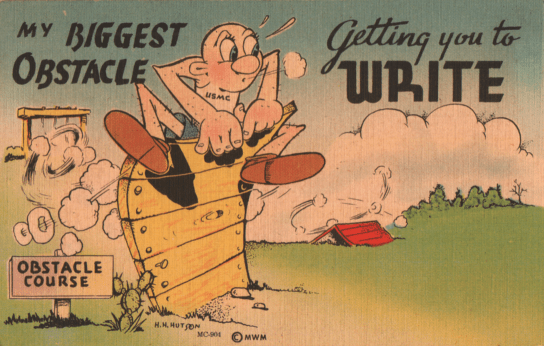
Last time, we considered those which led to the sentiment “Why don’t you write, you deadbeat?” This was far from being the only sentiment to utilize the grade school Valentine strategy. Another popular postcard theme was meant to follow up on those cards, so that slow correspondents could respond with a “Sorry I’m such a deadbeat” cards. The theme was just as popular, but could now use jokes and arts that would have been frowned on in a second grade Valentine box.
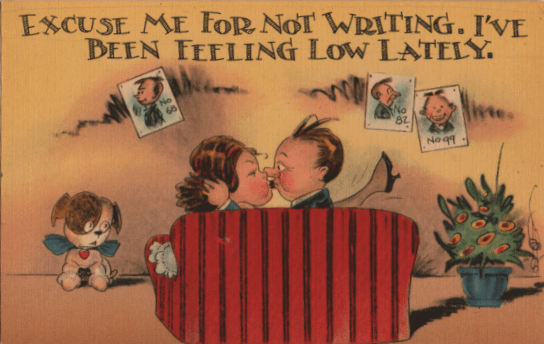
As in this card, in which the degree of naughtiness depends on which person you feel is speaking, and the intention of those who used the word “feeling”.
But surely one of the most used phrases ever on a postcard is “Having wonderful time. Wish you were her.” (Right after “I am fine. How are you?”) So plenty of grown-up Valentines were designed to rob the sender of a line that would help fill all that space on the other side.
These cards were actually part of a major transition in the theory and practice of postcarding. In its early history, postcards were, as noted hereintofore, the equivalent of texts: something you could send to friends to send news, convey invitations, or just share a joke. As the twentieth century ground on, postcards were becoming something you sent while on vacation.
Our grade school Valentine “wish you were here” cards did not limit themselves: there were still plenty of people who sent cards the old way, and used these to invite old friends to come and visit them in their homes. But they were designed to be useful to the new breed, who had rented a cabin at the lake and decided “the more the merrier”.
Whether there was a subtext of “I know you can’t come, but don’t you wish you could>” kind of depends on the sender. But this applies to any postcard you sent from your five-star hotel room OR that grubby fishing shack with no electricity but a large liquor cabinet.
As noted in our last thrilling installment, there was also room on such cards for more than just gags about monkeys and giraffes which would not shock a second grade teacher in the classroom.
After the lottery comes through and I have the time and money to do all the research, I WILL look up postcard collections in libraries and find out how many of these cards were, in fact, sent by second grade teachers who had gotten out of the classroom long enough for a beach vacation. They may have gravitated to the artistic style they knew best even on an out-of-town skinny-dipping expedition. Don’t wait around: the lottery has not been doing much for me since I suggested some of these postcards would make best-selling Instant Win tickets. I should send another one of those “Why Don’t You Write?” cards to remind them I’m here.
We have discussed in this space before the matter of the classic grade school Valentine, and how it related to postcards. I have nothing new to say about this, but I DO have a couple of new postcards along this line, so I thought we’d revisit the proposition.
For those of you who had NO friends as a child (or who went to a progressive school which banned Valentines on the grounds that it led to competition and bad feelings), the classic grade school Valentine involves a bright picture, and a bit of wordplay relating it to the holiday. A big clown face might be accompanied by “I’m not CLOWNing around – I want you for my Valentine” or a fold-out dachshund might say “I’m LONGing for you to be my Valentine!” The capital letters were necessary to punch up the joke (unlike the example here, which not only has those tracks but the easily missed play on “bears investigating” and “bear’s investigating.”)
A person cannot live on Valentine’s Day alone, so this same basic form was transferred to postcards, which did allow a little extra space for more words.
This was an especially easy job when, as with the Valentines, you had the same basic message to push out on dozens of different cards. So it was a natural for the very popular “Why haven’t you written yet?” postcards. This was also a nice break from the Valentine lines because you could draw frowning faces, something that was not considered useful in the grade school Valentine.
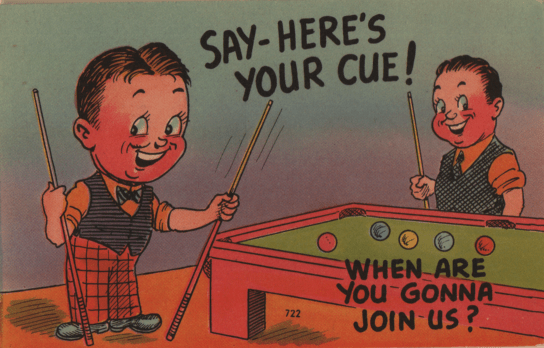
And artists who produced mile after mile of cute animals and cute children could actually draw grown-ups doing grown-up things.
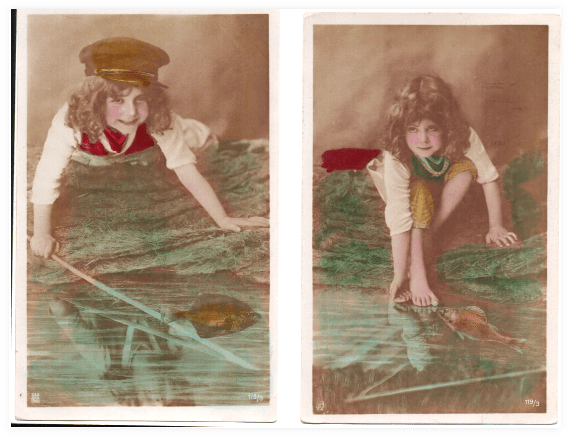
Note to self: someday, when you lose all reason and start to buy up bales of old school Valentines, see if there are as many that deal with fishing as there are postcards. Also consider the question of whether artists themselves would rather be doing something besides leaning over a drawing board, especially when the fish are biting.
Oh, it’s true: sometimes the adults don’t look that much older than the kids on the Valentines. But if you check the fine print (on his T-shirt) you can see we are dealing with an adult here.
In the postcard format, there was room for landscape art, if that was something you yearned to do.
Or if your skills in goofy creatures went beyond, say, bunny rabbits and seven year-old policemen or nurses, you could spread out and show that, as well.
And on a Valentine for seven year-olds, you didn’t get to try your hand at pin-up art. Sure, the JOKE is just as bad as any on a Valentine, but at least you were getting a little variety.
Affretz swung up his sword to whack the dragon away, but the dragon let go at once and shook its head.
“You don’t understand!” Steam dribbled from its nose as it whined, “You’ve broken half the spell! Help me break the other half!”
“Spell?” demanded the prince. “Oh, I get it! What happened? A wicked fairy at your christening?”
“No,” said the dragon. “Come this way. I had an evil stepmother: one of the ogre’s friends. Walk faster. No, you can leave your horse and things. He won’t be back. Whenever anybody beats him he goes down to the lowest towers of the castle and pouts for days, kicking anything that lives there. Can you walk faster?”
Affretz tried, but between the rough forest track and his limp, it wasn’t easy. “Why? Where are we going?”
“By helping a dragon, you broke the part of the spell that kept me from talking. Now I can only get my own shape back by helping you rescue somebody else.”
“Rescue?” said Affretz. “Who? Deedee?”
“I don’t know any Deedee.” The dragon bit a fallen branch and stepped over it to leave the path. “Look out for that rock there: it bites. But Gelvander said there were princes in the forest. If he thought YOU were an ogre, then he meant somebody else.”
“Oh.” Affretz was following as quickly as he could, but he was taller than the dragon, and had to push back low hanging branches, some of which tried to tug at his sleeves. “My brothers. But they’ll be all right. They’re the best there is at what they do. Alain’s the bravest and handsomest prince in the world, and Archels is the strongest and smartest.”
“They must also be the deafest,” said the dragon, “If they didn’t come running to find out what was going on when Gelvander was shouting. Or are they asleep? Can’t you walk any faster? You walk funnier than I do, and I’m a potbellied old dragon.”
“I can’t help the way I look, or the way I walk,” Affretz replied, kicking away some ferns who were clinging to one of his boots.
“Oh?” said the dragon. “Did you have an evil stepmother, or was it your christening?”
“A fairy,” Affretz replied. “And they hadn’t even made her mad or anything.”
“I think fairies are more trouble than they’re worth,” said the dragon. “But anything magic makes me nervous. I’d love to go home and just be a prince again. Abnormal phenomena just make me all fluttery.”
Affretz didn’t think the dragon looked much like a prince, but, after all, the ogre had felt the same way about him. “So where ARE we going?”
The dragon blew a cloud of steam at a large snake with two mouths. The serpent slithered away. “I heard the wailing trees. They’ve caught something.”
The dragon raised its wings, releasing billows of dust. “Let me just fly ahead and see if what they caught is worth bothering about.” The round purple bulk bounced into the air and floated among the trees, looking like a lost balloon.
Affretz raised his sword: the purple beast might be leading him into a trap. Then the pudgy form turned around and came back.
“It looks kind of like you,” the dragon said. “Only with arms and legs like tree trunks and a face that wouldn’t stop a waterfall on its way down.”
“That’s Archels.” Affretz kicked a rock that was sneaking up on them. “He won’t need any help.”
“The strong, smart one, is he?” said the dragon. “The wailing trees must have been a nasty surprise to him.”
Affretz heard a high-pitched hum, but before he could ask about it, he spotted an immense striped spider lurking in the foliage. He raised his sword above his head.
“That’s not the problem,” the spider told him. “Hey, stop! Don’t touch that!”
Affretz, looking for even ground to brace himself on for a spider fight, had been about to steady himself by putting a hand against a tree trunk. He jerked his hand back as a brown blob of glup fell onto it.
“Little drips like that are no threat,” the dragon said, as Affretz tried to shake the goo loose. “Some animals take them home as ornaments. But if you get coated with the big drops, YOU’RE the ornament. Like that spider. Or your brother…Archels, did you say?”
Affretz looked beyond the spider and saw a struggling shape covered in brown ooze. He recognized the boots, though, the only part of Archels that wasn’t yet covered.
“How do we get him out?” Affretz exclaimed, hurrying forward behind the dragon.
“Keep that sword ready to pry him loose,” the dragon replied. “I’ll see how much of that stuff I can melt with my steam.”
They had to duck goo-covered elbows and knees, but the dragon and Affretz took up a position behind the struggling captive. As steam started to puff from the dragon’s nostrils, the hum around them turned into a series of short, sharp notes.
The dragon glanced up. “Oh, don’t blubber. You can get other prisoners. I need this one.” He took a deep breath. “Oh, this is going to be simply awful for my sinuses.”
Hot fog streamed in such clouds from the dragon that Affretz had to turn away. “Try the sword, try the sword!” the dragon called, stopping to take another breath.
Affretz pushed the point of his sword into the amber grease and twisted. Archels pulled the other way, his head popping out of his helmet, and the brown prison. Long threads were pulled out of the ooze as the strongest prince in the world struggled to break free. The dragon breathed another cloud of steam across the captive prince, and Affretz cut at the threads of ooze. Archels pulled away some more. “I can….” He started to say.
A roaring pop split the air as Archels split through the brown prison and rolled onto the forest floor. He was up in a moment, eyes open for new threats.
“Yay!” shouted Affretz, raising his sword.
“Yay!” echoed a voice he had not heard before.
Where the dragon had been producing steam there now stood a young man wearing brown velvet robes, a tufted hat, and large black spectacles. He shook out the sleeves of his robe and then tossed both hands in the air.
“I am I! Prince Nestor once again!”
“Thank you, Prince Nestor,” said Affretz, as Archels, who was rubbing brown paste from his face, nodded in agreement. “And congratulations. Now if we can find….”
But there came another roaring pop, and Prince Nestor disappeared. In his place was a large owl the same color as the prince’s robe.
“It is SO nice to have things normal again,” said the owl, in prince Nestor’s voice. “I can fly home to my tree where we don’t have any truck with magic.”
“You’re an owl prince?” Affretz inquired.
“You guessed it,” said Nestor. “And this is the time of day for owls to be sleeping. I can get a decent nap without that ogre kicking my cage to wake me up. Brrrr, those magic creatures make me twitter.”
“Turn human for a while,” Affretz requested. “I have another brother somewhere in these woods!”
“I haven’t seen MY brothers in years,” Nestore replied. Long wings swung out. “I’ve got no time to stop and sniff the flowers.”
“Wait!” But Prince Nestor has risen toward the tops of the trees, and was gone in a moment. Affretz turned to Archels. “Did you see that?”
“No,” said his brother. “Help me get this stuff out of my eyes.”
Affretz explained as they pulled goo from the prince’s face. A little more steam might have been helpful, but they had had as much help as they were going to get from the purple dragon. “I’d rather deal with your ogre than these trees,” Archels said. “Has Alain come back yet?”
“Not so far,” said Affretz. “Maybe he found the door to the ogre’s cave.”
The two princes set off in the general direction of the road Alain had taken. They found it, but not Alain. “Just trees.” Archels poked one with the tip of his sword. “They aren’t sticky, at least.”
“They look like they’re watching us.” Affretz pointed down the path with his own sword. “Maybe they’re guarding that beautiful flower. Are there footprints or….”
His head jerked up and his eyes went from the path to the massive red and blue petals folded in on each other all over the flower. “Prince Nestor said something about flowers. Was it a clue, do you think, like what the old man told us?”
Archels frowned. “It’s too early in the day for flowers to be all closed up that way.”
Something whispered, “Sssslay! Sssslay!”
The voice was not coming from the flower. “Who said that?” Affretz demanded.
Archels grabbed his arm and pointed. “Look! Alain’s sword!”
The two princes ran at the flower and found spiky leaves rising from its base to hold them back. Archels swung his sword down at them. With a BOINGGGG, the blade bounced off of the plant’s stem.
“Rootssss!” the whispering voice called. “Rootssss!”
“Dig up the roots!” shouted Affretz. Both princes jabbed their swords into the dirt, not the most efficient means of gardening.
But it was effective. They had managed to dig a small hole when a hand shot up from the dirt to grab Affretz’s nearer ankle.
“Nothing, Captain. Not a single break in the Cotner Case.”
“Only a matter of time, Lieutenant. Continue to monitor Facebook, and keep your staff on Twitter, TikTok, and YouTube. Something could be posted at any time.”
“Can do, Captain. But, er…”.
“But what, Lieutenant?”
“Wilson had an idea, sir. What if the perp didn’t take a phone with him?”
“The diabolical cunning! No! I refuse to believe we’re dealing with a mastermind of that….”
“Sir?”
“What is it, Sergeant?”
“He’s here again, sir.”
“What does that crackpot want?”
“I wanted to tell you Watson has the culprit in the Cotner case outside in the rickshaw.”
“What? How did….”
“When neither the crime nor the loot was posted to social media, we realized the culprit must be someone who did not use such venues. After that, it was simple. We checked every name in the latest census records against the Internet and found only nine people who fit the profile. As three of them were in prison, and the other five are bedfast in other institutions, the ninth name had to be the culprit.”
“Well, you’ve done it again! This should take your success viral!”
“No, Captain, no. I prefer that the police department get the credit. It is best if the public knows officers of the law are at their posts.”




























 Blogsy Babbles