We continue our hunt for the conspiracy theories which bedeviled the Presidents of the United States, following the same rules as before. These have to be contemporary conspiracy theories accusing the Presidents of nefarious plans, not something made up by me or the Interwebs later, and they must be conspiracies which Mainstream Historians, by and large, dismiss (which, on the Interwebs, is tantamount to proof that the theory must be True Fact.)
MARTIN VAN BUREN was hit with just about every conspiracy theory possible during his main two presidential campaigns (he made sure the party knew he was available until the day he died, and actively ran four times.) In 1836, he was the main candidate for his party against three heavy hitters on the other side (the Whigs didn’t really have their act together yet, and apparently decided if they ran three candidates, this would at least deny Van Buren a majority, so Whigs in Congress could pick a winner.). One of the most fascinating was that this son of a Dutch bar owner and lifelong attendant at Dutch Reformed services was secretly a Catholic following the orders of Pope Gregory XVI to overturn America’s independence. Keep this one in mind; it will come back into the story in future episodes.
WILLIAM HENRY HARRISON, speaking of recurrent conspiracy theories, was accused of being too old and senile (he was 67) to be president. More damaging (to his opponents) was the story spread around that he was a backwoods hick who owed his rise in politics to a military career, and was not competent to know how to run a country. (Unlike his opponent, Harrison actually came of wealthy parents.) Some writer said he should just be given a pension and a barrel of hard cider and sent home to his log cabin. Harrison’s folks grabbed hold of this, played on the “log cabin and hard cider” slogan and absolutely stomped Van Buren in the election. (For the record, Harrison actually DID live in a log cabin when he headed west to find his fortune.)
When William Henry Harrison was elected president, his running mate, JOHN TYLER, went back home to the farm, expecting he wouldn’t be needed for much of anything. When told Harrison was very ill and unlikely to live much longer, Tyler stayed home, feeling it would look opportunistic to go running up to Washington. Does this SOUND like someone who was plotting to overthrow the Party that nominated him? His opponents, within and without the Whigs, threw this one at him a lot during the campaign, and much more thereafter. . Nonetheless, Tyler, who had left the Democrats to join the Whigs, was now getting tired of the Whigs as well. As the first Vice President to be vaulted into the Presidency by the death of his predecessor, Tyler found a hostile Congress and Harrison’s Cabinet all trying to declare him “Vice President Acting President” instead of President. The Cabinet told him he should just ask them to vote on policies and do whatever a majority of them decided. Tyler politely and forcefully declined and was named President. Was “His Accidency” a closet Democrat seeking to overthrow the Whigs all along? Historians believe he was actually just a maverick who wanted to do things his own way. (Nonetheless, he lived into the era of the Civil War, and served in the Confederate Congress.)
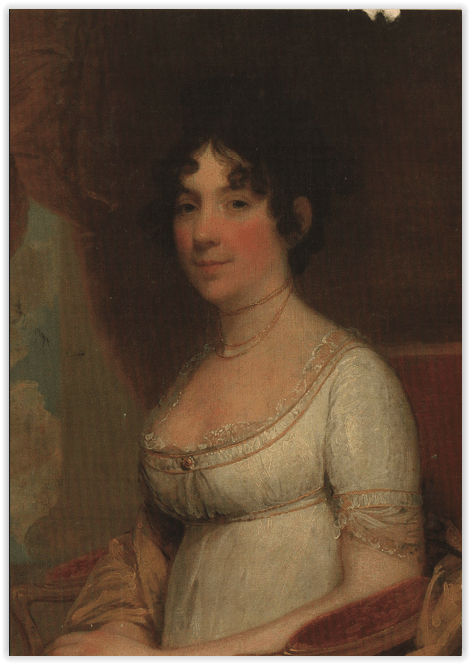
JAMES K. POLK won a vicious race which is still the only election where two former Speakers of the House ran against each other, and every past President of the U.S. (plus Dolley Madison) was either a candidate as well, or telling the candidates what to do. After the election, Whig supporters of Henry Clay published an interview with a man who claimed to have transported out-of-state voters into Louisiana to steal the election, and swore that Polk had actually gotten more votes in some parishes than there were voters. Mainstream Historians are dubious about this, pointing out that even if Louisiana did go the wrong way it would not have changed the outcome. At the time, the Whigs countered such middling objections by saying flatly that if part of Louisiana’s vote was fraudulent, then Polk had obviously cheated in every other district where he won. (Um, this one will come back in another episode as well.)
Bott shook his head and set one hand on a soft orange chair. The Free Imperial State demanded three different licenses for permission to read, five to carry a book aboard your ship, and another, plus a series of tests, to own a book. The licenses for what he was seeing right now would probably require a computer filing system larger than the Drover.
“And you have more?” he demanded.
“This is just the reading room,” said the Captain of the Dragonshelf, waving one hand toward a distant door. “The real collection is in the stacks.”
“All these books!” Bitt exclaimed, reaching for some slim ones on the glass table.
“We actually call those magazines,” she informed him. “They’re like books, but more quickly printed and distributed on a more regular basis. They’re more fragile, too, so they’re harder to find.”
Bott had never heard the word “magazine” applied to a book. Did this mean there was a wepon inside? He flipped up a plain cardboard cover to find only a few words and a lot of pictures. And such pictures.
Encouraged by this sudden interest, she stepped over to stand next to him. “These are all recent acquisitions: they haven’t been properly accessioned yet. What is it? Oh.” She cleared her throat. “Harpsichord Harlots and Ballet Sluts on Point. Yes, these magazines are really rare, aren’t they? Yes, they are!”
He turned his head up toward her. “Do you have many books like this?”
She backed away four steps. “Well, those we can find. The only way to save anything of a culture is to save everything; since you don’t know what will be important to a researcher. Except when Principal Hiatt was in charge. She would never let us keep a book if you couldn’t read the spine.” She shook her head.
Bott considered the spines of the oddly-positioned nudes in the pictures. He had seen this sort of thing in bars, of course, but was a little shocked to find them in a book…a magazine.
“You really go through the galaxy trying to find things like this?”
The sides of her face were tinged with red. “I am a librarian, sir. I preserve yesterdays for tomorrow, whatever today thinks of them.”
Bott hands trembled on the magazine cover. There was a lot more to this librarying business than he had thought. His eyes went to clear plastic shelves filled with books, or magazines, that the Dragonshelf had picked up in remote places. Being a pirate had brought him plenty of dangers. He considered himself brave. But he could think of no pirate in history who had so sedately risked an imperial sentence of rearranged bones and inflated organs the way this librarian had.
The Free Imperial State had realized early on that the printed word was the greatest threat to control of information. Technological communications were easy: the government merely made sure that adjacent planetary groups used processes which were all but totally incompatible, meaning that revolutionary texts infecting Group A were unable to reach Group B. Sensors and censors built in everywhere along the line made sure that none but the Imperial officials with the highest classification had access to everything within the system. Lower orders received only what was rationed to them.
Books, however, could not have their texts homogenized, being fixed in place and requiring only two machines to process: an organ to take in the information and an organ to process it. Thus, the suppression of what existed in every civilization’s tradition of libraries was essential to control.
The first move in controlling libraries was positive support from the Free Imperial State. Imperial officials would gradually promote the principle that for an Imperial library to contain a text implied approval of the text. So public monies were spent on books deemed conducive to the public welfare, and books found wanting were made unavailable.
This economic protection of the masses, however, affected only the text which came to the hands, paws, or flippers of those who could not afford to buy them. An attempt to control bookstores the same way, arguing that since bookstores paid taxes and enjoyed the benefits of taxation, they were also Imperial institutions lasted only until bookstore proprietors offered to pay a higher tax for being allowed to sell unapproved books. It had to be demonstrated to these misguided souls that simply selling a book unapproved by the Free Imperial State argued approval of it, which might, in some (most) cases, be evidence of the capital crime of treason.
But even killing the librarians and booksellers who protested was no satisfactory. The process was piecework: every book, every bookseller, every library assistant, had to be tracked down individually. Something broader and more inclusive was needed. Destruction of printing plants and book warehouses gladdened the heart, but not really any more effective. A licensing system, which meant anyone dispensing books had to pass an exhaustive test of psychiatric, emotional, and political responsibility, had shown promise but, again, was simply too diverse. Too many different civilizations with completely different ways had to be taken into account.
Until one emperor, considering the latest license proposal, had a brainstorm. Instead of applying the test to people who dispensed books: simply provide a much simpler (and far more restrictive) exam to everyone in space and decree that anyone who failed was forbidden to read. Anyone without a license would be put to death in the most shameful, painful way the local civilization could imagine. After a transitional generation or two, literacy would be restricted to those who could be trusted to think properly and read proper texts. The bad books would turn to dust from disuse, and a non-literate population could communicate through their local technological systems, which were simpler to edit and restrict.
The transitional period had taken longer than expected but, as a whole, success was ridiculously easy. There were now only about three thousand licensed literates in all the Free Imperial State. Even they had to take recurring tests to make sure they conformed to current approved thinking. All of these were members of the ruling system of the Free Imperial State; everyone else was a part of the laboring class. Some jobs involved skilled labor, and there was room for advancement. But almost no one rose from the skilled labor level to any level of official office.
This made running a government much simpler. But there were always ingrates. Resistance forces—no one was sure how many—had organized bootleg universities, mainly as fleets of small quick ships that could get out of the way of Imperial Truant Forces. Nubry was the last survivor of one of these fleets.
Bott shut the book…magazine. “You must have a real variety of books. Why didn’t you join one of the other university fleets?”
She had her back to him. I’ve been followed…and it’s been years! You’d think they’d give up when they couldn’t catch me the first dozen times.”
“If you got away, and kept away this long, you must be a good pilot.”
She turned a little in his direction, noticed he had closed the b…magazine, and shrugged. “That’s the training. I was going to be Library Pilot. Wasn’t I? Yes, I was! I was much better than Chedler was.” She bit her lip and turned away. The ball of hair on the back of her head bounced as she marched toward a door at the far end of the Reading Room. “But the ship hasn’t been responding properly. Maybe you can fix it. The engine room is this way.”
Bott knew where the engine room was on a BBB-44, but it was more polite, he supposed, to let her show him. When they reached the place, he released a mighty sigh. Finally, he was somewhere familiar. The first thing he noticed was a rotor housing that wobbled as they passed. If only he had his toolkit from his old ship, a couple of RK stabilizers and a brace and….
“It’s been shaking a lot when I get to change direction,” she said, stopping at the central aisle. “Hasn’t it? Yes, it has!”
“Is that all?” Bott replied. “That’s not so serious, You need….”
“I know,” she told him, with a sharp nod. “I need a new prospondor flangy.”
Bott frowned. She seemed all business about it. “A what?”
Wrinkles of uncertainty rose above dark eyes. “A prospondor flangy?”
The rebels might have modified their engine, he supposed. He spread out one hand. “I’d say your prospondor needs a new flange.”
“Is that how you say it?” Her head came toward him.
Bott retreated. “Say what?”
“Flangy.”
Bott had never heard this word before.” Flange?”
“Soft g, silent e,”she murmured. “Flange. Flange. See, I had to learn so many words from just reading the service manual. I hadn’t taken the Engineering for Pilots course yet.”
Bott understood none of this, so he decided it couldn’t be very important. He raised a hand to point. “Isn’t that the storeroom there?”
“It is,” she told him. “But I’m not sure we have any more fl…flanges?” She tipped her head, looking to see if he approved of the plural.
But he was already moving down the little metal stairs to the door he’d spotted. ”Let’s see!” Oh, it was amazing to be in a ship where you knew where you were going! No slave pens to stumble onto, not on a BBB-44. He flipped on a light and gasped at the beauty of the storeroom, with all the cartons in tidy rows and tools lined up in stained buckets. Well, the first rows of boxes weren’t so immaculate: someone had been scribbling all over them.
“Let’s see,” he said again, moving among the stacks. “Here!” He took down a reassuringly heavy box and, sure enough, found two prospondor flanges inside, still wrapped.
“Well!” Nubry was still standing in the doorway. “Amazing!” She waved a hand at the boxes with strange designs in black marker scribbled on them. “I looked through all these and didn’t find a thing I needed. But you walk in and go right to the box!”
Bott never minded a little applause, but he couldn’t feel this was his most amazing achievement. “Prospondor components are always sixth row down, with the flanges on the second shelf.”
She almost absent nose wrinkled, and she tapped one foot. “Well, why don’t they write that down?”
Bott raised one eyebrow. The literate certainly were different.
Those who have been checking this space for a while will recall our study of the men on postcards who keep on rowing even when their partner makes it difficult. Looking over the postcard world recently, I realized that we had left out another role for the hardworking, helpful male.
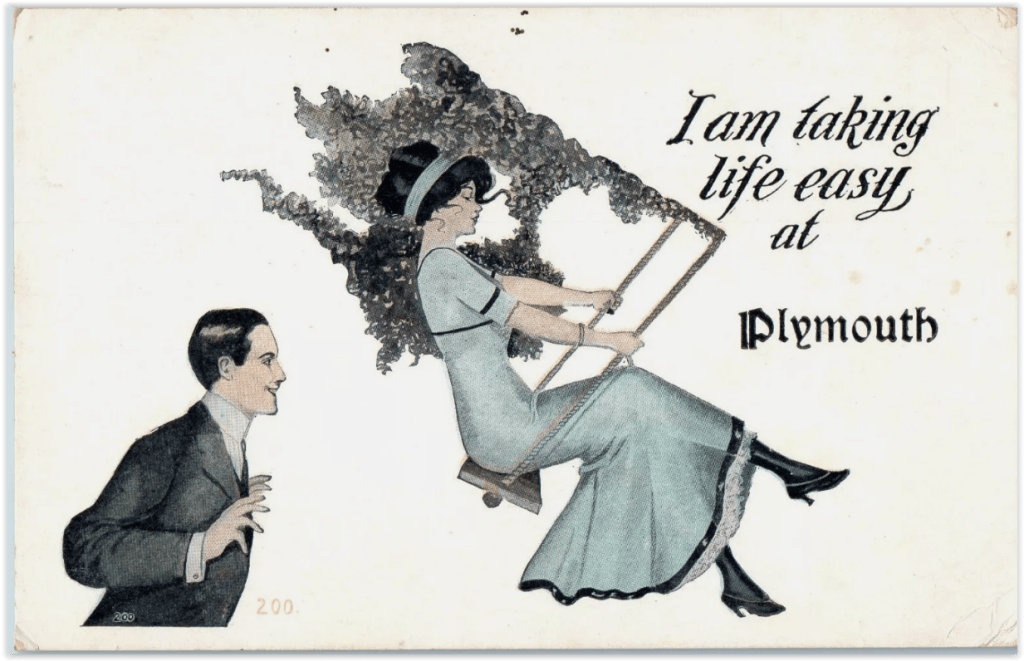
These are the long-suffering men who are willing to provide motive power for ladies in swings. The swing pusher is a more cheerful chap than the postcard boater. You hardly ever see THESE gentry complain. No matter how hard the work gets, they are always willing to lend a hand.
Let us compare their counterpart in the art world. Here is one of the most famous swinging couples, portrayed in the eighteenth century by Fragonard. THIS gentleman is not making him useful at all. Unlike our more modern AMERICAN man, he is there only for what he can see.
You don’t catch our homegrown swing helpers thinking of such low matters.
I have read some unworthy commentators who say this is really the result of mid twentieth century morals, that what interested Frago’s hero couldn’t even be suggested on a comic postcard, and that what seems like a chivalrous and selfless dedication to the task is due to the fact that another part of the body was perfectly okay in a joke.
Of course, we can all see that this exists only the mind of those perverse critics. Look at this chap. Does he look as if HE is just interested in the feminine situpon. Consider his noble expression and join me in scoffing.
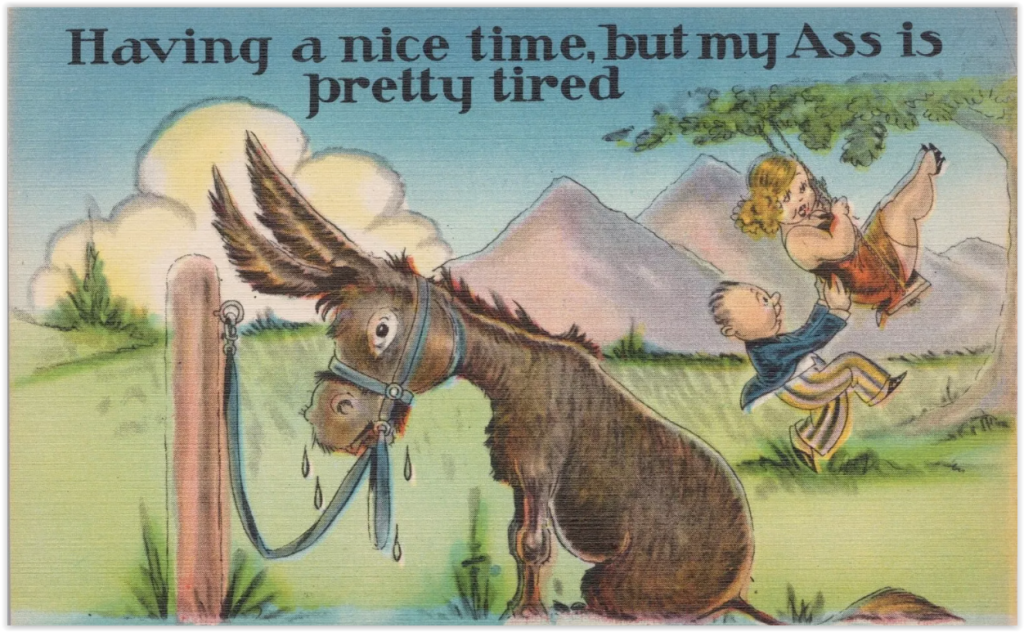
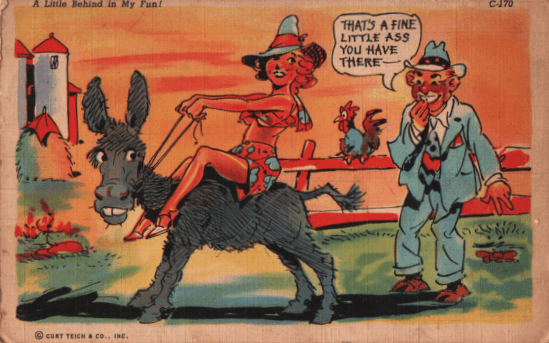
A reference to a poor, exhausted donkey does not change matters. This man is clearly working hard and doing it just so the young lady has a good time.
It’s going up in a swing which is the focus of these postcards, not some imagined obsession with the southern end of the body.
And the men are simply examples of the cheerful, helpful man of the postcard world. He is already to help out, even when the young lady does not require his assistance. He knows a kind word and a compliment will make the day advance.
And his mind is as far as possible from any thought, no matter how our twenty-first century prurience may judge him, from the considerations of anatomy or sex which Fragonard showed in the Continental male of an earlier age.
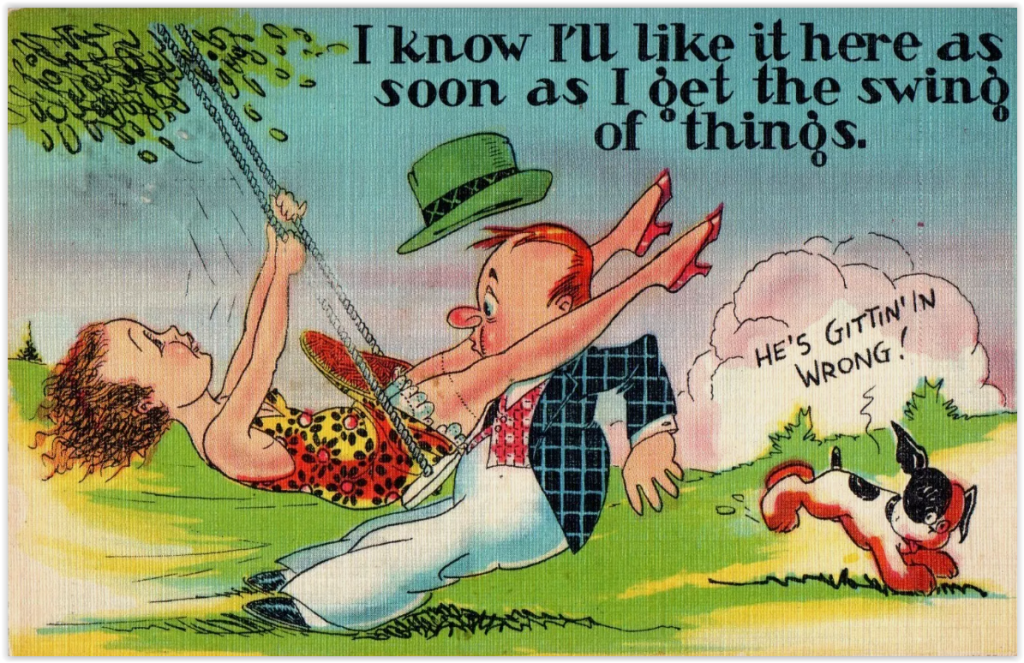
This guy doesn’t count. It’s an accident. Even the dog realizes things have gone wrong. And anyway…that is…maybe this artist produced Canadian postcards, too, and was used to French humor. (Stop snickering, you two in the back row. With minds like that, YOU’LL never be swingers.)
Remember, as we return to our attempt to find a “conspiracy theory” about each of the Presidents of the United States, that we have two basic rules: the conspiracies must have been debunked by a majority of Mainstream Historians, and they can’t be something I or some other Interwebs rumor-monger made up recently. We want bogus stories contemporary with the Presidents, or at least stories which rose within a few years of their deaths.
As we progress through our conspiracy theories, the phrase we will refer to most is “The more things change, the more they stay the same.” When considering Presidents of the United States accused of being part of vast conspiracies, it turns out we have a limited number of themes for such things.
Now, JAMES MADISON is absolutely the kind of man you’d expect conspiracy theories about (and the last person likely to be nominated if he ran for the top office nowadays.) He was a small chap, and thoroughly introverted (how he married one of the brightest extroverts in Washington is still argued over today.) When he wasn’t writing things in cipher (always a bad sign), he liked to stay in the background, writing things other people could quote, or outright ghost-writing things for more flamboyant souls. Among his works published anonymously were his parts of the Federalist Papers, in which he argued for a stronger central government than the Articles of Confederation allowed for. After he ghostwrote most of the Constitution, he then joined the Jefferson side of things, in a party suspected of plotting against the country and the Constitution. When the Adams administration passed some unpopular laws involving tariffs and immigrants, Madison wrote a landmark resolution asserting the rights of individual states, and was accused of conspiring, with Jefferson, to overthrow the very Constitution he had helped write, and, in fact, everything the United States of America stood for. Does this sound at ALL familiar? (He was not suspected of that for long, though; he was dismissed as a compulsive hypocrite. Is that better?)
JAMES MONROE was a frenemy of James Madison and the last President of the United States to run unopposed. His presidency was known as the Era of Good Feelings. This was because the Federalist Party, after a busy period churning out conspiracy theories, had evaporated during the War of 1812, and no real competition had developed for the Republican (also known as the Republican-Democrat, Democrat-Republican, and Democratic) Party. HE was suspected of planning to undermine the divinely-decreed economy of the Slave States because he had expressed misgivings, back in 1800, about the execution of the leaders of a revolt who had been saying what Monroe and his friends had been saying back in the 1770s. In the end, the leaders WERE hanged, and Monroe did not disturb the Slave States unduly during his administration.
JOHN QUINCY ADAMS has already appeared once, in his father’s great conspiracy theory, but his election to the Presidency provoked plenty of conspiracy theories, because he had NOT received the majority of the popular vote. The election was close enough that Congress had to step in to make a decision, and Andrew Jackson’s supporters felt there was no coincidence when Speaker of the House, Henry Clay, was named Secretary of State. Clay and Adams denied this to their dying days (which doesn’t necessarily make it untrue), and a hearty hatred was set up between the Whigs, who favored Clay, and Jackson’s Democratic (Democratic-Republican, Repub…etc.) followers.
As a result, in the NEXT election, ANDREW JACKSON, a military man, was suspected of planning a coup if he got shortchanged this time around. Bayonets, not ballots, it was said, would put him into office. Jackson enjoyed a good fight in plain political battlefields, and there seems to have been nothing behind the coup conspiracy.
“Thousands of people!” she exclaimed. “Their thoughts and trophies! Oh no, they weren’t friends of yours, maybe; they wouldn’t agree with your every single word!”
“But….” Bott said again.
“But they had feet, too! And you can’t burn their memories and dreams into nothing just because they aren’t what you like best!”
Bott glanced left and right as he took two steps back. This had to be some kind of imperial trick to keep him busy while somebody else broke into the bridge and took command of the Drover.
The woman raised both hands to her forehead and then lowered them. Some kind of gem seemed to be between those hands, but Bott couldn’t get a good look as she pushed both fists together in front of her. “I’d rather you knocked my head off!” she snapped. “Do I? Yes, Ido!” She cleared her throat. “They’re more important than my head!”
She was about a head taller than Bott, wearing a white bodysuit with a grey vest and grey shorts over it. Black hair was tied up in a ball on the back of her head. Glittering black eyes watched him from over what was practically no nose at all. Bott could not immediately identify her home planet from either her face or her accent. She was human enough, though. And very angry.
“Why do you people have to DO these things? Can’t you let the rest of us go on? Isn’t there room enough in this whole galaxy for all of us?”
She raised the gem to her forehead again and Bott slid left. That could be a defensive weapon. She moved right to keep her eyes on his. Damp stains showed under the arms of her suit. He’d noticed them when she raised the gem before, but they were bigger now, and darker. He had also noticed a tremor in her lips now and again, between sentences, before she caught herself. This was important to her. Whatever this was.
“Is that the only way to achieve imperial control? By destroying everything that doesn’t meet your….”
Bott leaned forward. “What are you talking about?”
She let her hands drop in front of her again and stamped one foot. “Destroying my ship!”
Bott shook his head violently. “If I wanted to destroy it, I could have fired….”
She shook all her fingers at him; the gem dropped to dangle from a chain around her neck. “You won’t trick me!” She was all but shrieking now. “Why’ve you got to play with me? I always knew you’d get me some day! Didn’t I? Yes, I did! Why can’t you…why can’t you….”
Her lips rolled in on each other; tiny nostrils flared. “And where’s your uniform?”
This had to be a trap. She could not possibly NOT know he had stolen the drover; the Free Imperial State had sent out all kinds of cleverly-worded messages to watch for him and it.
“Are your communication systems down?” Bott asked, letting one hand trail along the grenades at his belt. The BBB-44 looked much larger now that he was thinking how many troops could be waiting inside for a signal. “I didn’t receive any distress signal.”
Her face came up. “Why would I send an SOS with you people around?” She sniffed, and set the gem against her forehead again.
Bott shrugged. “You were…the ship was flying so oddly I thought there was something wrong.”
Her ears reddened. “Those were…evasive maneuvers.”
Bott gave this some thought. Was that possible? No, not really. “Are you sure you don’t have damage somewhere?”
“My ship is just fine.” She faced him full on again, her chin coming forward. “Does it matter? When you’re just going to smash it or blow it up anyhow?”
“I am not!” Now Bott stamped one foot. She stamped one of hers and took a step toward him
“You’ll keep it as a trophy, then, for your lackeys to laugh at.” She turned left and right, the stone pausing halfway down again. “Where are your lackeys? Where are they hiding?”
“Where are yours?” Bott returned. “Are you trying to make me believe you’re alone?”
Their gazes locked; her lips moved a little but no words came out. Then she cleared her throat and set the stone to her forehead again.
“Why would I want to hide anybody? We’d be outnumbered once you boarded us anyhow!”
Bott understood what was wrong. He was giving her credit for a really subtle plan. The Imperial military had a very low tolerance for subtlety.
“You are alone, aren’t you?”
She took a step backward. “I didn’t say that. Did I? I did not!”
Bott moved forward. “But you are.”
“I….”
“So am I.”
The almost invisible nose bounced up and down as she wrinkled it. “I was wondering. You’d have had your troops out here by now, wouldn’t you?”
Bott nodded. “And so would you, if you were part of a trap.”
“But what kind of trap….” She frowned, and let the gem dangle again. “Are you still playing with me?” She took two steps back toward her ship. “Why would something this size have just one person on board? I don’t believe that for a second! Do I?”
“This is the Imperial Ship Drover,” Bott informed her, before she could answer herself. “I stole it from the Imperial port on Deshler.”
“The Drover?” she demanded. “That big master ship they were building? You stole it? All alone? Now, I don’t believe that at all. Not at all. No, I don’t.”
“Before you make up your mind….” Bott reached got the proper security card and held it up. She didn’t like the looks of it, and slid closer to the ramp of the BBB-44.
Bott made no comment. “Ship?” he said, [pressing the sides of the card.
“Not dead yet?” the computer replied.
Bott glanced at the woman, whose eyes had nearly vanished in a glare of suspicion. “Ship,” he said, “Tell this person who you are.”
“I am the main computer of the Imperial Ship Drover.”
“How do you do?” said the woman.
“Now tell her who I am,” Bott continued.
“Do I have to be polite?”
“Just tell her.” He held the card up so the woman could hear it clearly; he hoped the computer wouldn’t try anything tricky.
But the computer had already denied any ability to lie. “This person,” it announced, “Is a no=good, untidy, counterproductive, irresponsible, ignorant, stupid, unsanitary, depraved, odorous, underhanded, untrustworthy, sexually perverse, mentally unbalanced pirate.”
“See?” said Bott, in triumph.
“Yes,” said the computer. “I decided to be polite after all.”
“A pirate! How wonderful!”
The woman was clasping her hands at her bosom. Having dealt with the Drover’s computer this long, Bott suspected irony. “Wonderful?”
Now she slapped her hands together flat. “Oh, yes! How…how lovely! I’m a dangerous rebel, myself. We all were, and we always had friends among the pirates!”
“We?” Bott glanced at the ramp of her ship.
“We were one of the revolution’s education fleets.” She took three little steps forward. “When Imperial ships surrounded us and took us in, I was in the library and didn’t realize. But they didn’t know about me, either. So I was able to escape, with the Dragonshelf!”
“The what?”
She pointed back toward the ramp. “The Dragonshelf! From the stories of dragons and their hoarded treasures.” She nodded at him.
Bott’s mouth dropped open. He had forgotten, in all this confusion, that the BBB-44 was not only a stout shop but a cargo ship. Now, perhaps, he could get back into a profitable business.
“What is the treasure?”
She looked puzzled again, and wary. “Didn’t I just say that? I did! The Dragonshelf is the library ship. We carry books.”
Bott’s eyes went from gleaming to nearly dropping to the floor. Books made for hideously troublesome treasure.
I know you were yearning to see the next installment of my list of presidential conspiracies, but I didn’t plan to fill this space with that until we got through thirty or forty presidents. Anyhow, I can’t quite get my head around the James Madison theory yet. We’ll come back to the list next Wednesday. In the meantime, I have been puzzling over women and tennis in the postcard world.
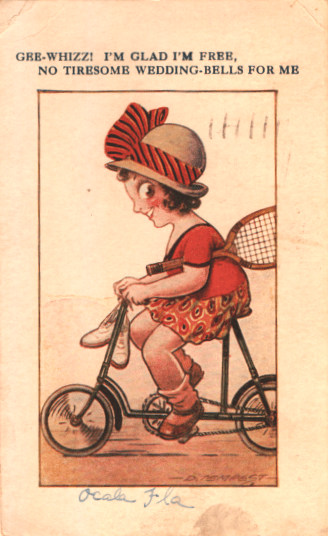
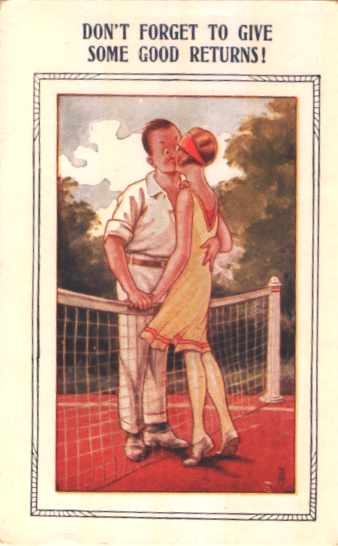
My inventory is not all-encompassing, of course, but I do think it should be considered a decent cross-section of the history of postcards. And I noticed in passing that I have not a single postcard which shows men playing tennis. When a man IS present, he and a woman are engaged in a match. In the postcards I have lying around, tennis is all but inseparable from the female player.
One or two other people who talk about this online lean toward a theory that at the turn of the twentieth century, women who went outdoors and did outdoor things were considered sexier than the old-fashioned Victorian female who stayed indoors, minding the house and taking care of the children. They cast back to a medieval picture of the world in which the husband was the master of the fields and barns and everything OUTSIDE the house, while the wife was in charge of everything INSIDE.
I’m not sure I can buy the whole package. For one thing, I have plenty of postcards with women outdoors: milkmaids, for example, have a whole postcard literature all their own. While charming shepherdesses can be found on postcards and n porcelain, practically already a cliché by the time the century turned. Was it just that going outside to play games meant the lady WORE less? (After all, your average milkmaid not only wrote the full outfit of dress and petticoats but an apron over them. AND a bonnet.)
Yet, although it isn’t something we discuss when we consider fashion, look at this couple. SHE could have gone dancing or shopping in that outfit, but HE is underdressed. While this was all right for tennis, a man who went out in public without a jacket, or “in his shirtsleeves” as it was called, would have been considered either shockingly shabby or simply a working class chap who couldn’t wear a jacket while wielding a pick or shovel.
I had another theory about women on tennis courts, but that had to be dropped as well. Do you know I don’t have a single postcard with the fine old joke “Love Means Nothing to a Tennis Player”? Are people just trying to keep me from using that joke? Well, THAT didn’t work, did it?
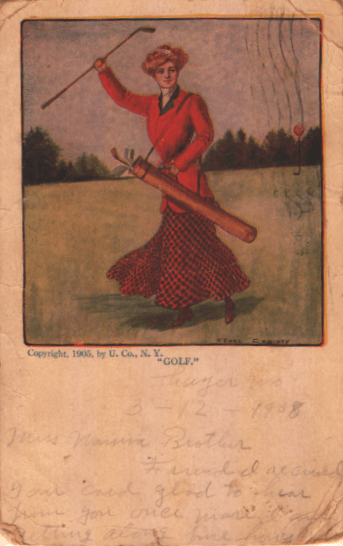
Golf is another matter. People dress MORE to play golf. The polka dot jacket and striped pants are not obligatory, nor is a bright sea green dress shirt. (Note to self: check on the possibility that golfers dress like that so they won’t be shot by deer hunters when their ball went into the woods.)
Women are no exception. Maybe the postcards were all part of a belief that a woman who was physically fit was especially alluring. The golf postcards tend to bear this out: female golfers are trim, fit, and not really in any position to, intentionally or accidentally, expose more of themselves while competing than anywhere else in public.
Oh, pshaw. I’m going back to figuring out what stories they were telling about James Madison. Maybe a Dolley Madison doughnut or two will help.
Just got hit with a new one. Some unknown conspiracy theorist just let me know that these phone calls about choosing my medical plan are NOT coming for ORDINARY robocallers. No, no:: these are people prepared to alter the fabric of our country by moving (should you be unwise enough to use the word “yes” while talking to them) to seize your personal information and use it to alter the way you vote in any upcoming election. (Um, this wouldn’t actually….) They work for neither party but for an alien institution which is neither red nor blue, but identified by striped elbow patches they will wear when the chaos begins and a takeover is possible. (Most conspiracies are sporting enough to include clues so you can catch ‘em at it?) What you NEED to do when called by these people is simply respond “elbow patches” to every question, and this will let them know you are already a member, and they will hang up. (I believe that much, anyhow.)
Being pummeled every day with new conspiracy theories about clouds, birds, snow, microchips, and ancient societies, I thought I would check around and see if I can find one solid conspiracy theory about every President of the United States. These must be pre-existing theories: it would be fun to make something up, but that spoils the game. AND they must be, at least in the eyes of “Mainstream Historians” (as the Enemy is usually denoted) completely fake. A few have been slopping over into the realm of genuine history, and that ALSO spoils the game.
Now, GEORGE WASHINGTON is an easy target. In his position, he attracts so much attention that he gathers conspiracy theories like diners to a Washington’s Birthday cherry pie. And he was a Mason (or Freemason, as your true conspiracy theorist prefers to say), which makes matters easier. My personal favorite is that when he met with Betsy Ross about the flag for the new country, he personally dictated the design, changing several features Congress had called for, particularly, for some arcane Masonic reason, insisting that she use five-pointed stars instead of stars with six points. Research indicating George never met Betsy, or, in fact, had much of anything to do with designing the Stars and Stripes, is used by the theorists to prove that Mainstream Historians are In On It.
JOHN ADAMS was a participant in the Adams vs. Jefferson Presidential Campaign, which is one of the top ten nastiest in history. The leading tale the Jefferson folks spread about John, and which I have seen printed as fact in British textbooks, is that he was plotting, while Vice President, to marry his son, John Quincy, to Princess Charlotte of England. As the princess was the heir to the throne, this would have made his son Prince Consort and his grandson King of England. George Washington got wind of this, and paid a friendly call on John, telling him that, as a fellow member of the Federalists, he wanted John to know this betrayed not only the new independent nation but the ideals of the party. When George found out John was pursuing negotiations, he had a rather more official meeting, telling John that as President of the United States, he was ordering John to give up this treasonous idea. On hearing the proposal was still moving along, he donned his military uniform and marched over to John’s place to say that as Commander In Chief of the Armed Forces, he was going to lop John’s head off with his sword if John didn’t notify King George that the whole thing was off. The cowardly John, the story concludes, immediately caved in.
For his part, John’s people pointed out, among other things, that Thomas Jefferson was not a good, reliable Federalist, but a Democrat who was left-leaning and a freethinker in matters of religion. As a man who read Voltaire, the leading evil author of the day, Jefferson was planning, if he became President, to close all the churches and burn all the Bibles. (Jefferson read the Bible too, by the way; he in fact edited the Gospels into a single account which he felt made more sense, which at least argues a deep reading of the text.) The story is told of a Jefferson man visited by the elderly woman next door, who told him she was afraid Jefferson would win, and begged him to hide her Bible from the impending destruction. The man explained that Jefferson had no such plans, which worked about as well as any time you try to convince someone that a conspiracy theory is not true. She still pled, with tears in her eyes, that he hide her book until he said, “Anyhow, you know I support Mr. Jefferson. Why trust me with your treasure?”
She told him, “Because nobody would look for a Bible in the house of a Democrat.” (The more conspiracy theories change, the more they stay the same.)
The slime devil towered over the slim diminutive woman; its roar shivered the metal plates in the walls of the room. She looked up into huge red eyes, showing no fear. Then she dippedher spoon not the shimmering gelatin dessert. The Denebian did not fill her with terror, and she had been brought up to show no fear even when she did feel it.
The fact that she herself had ordered this prisoner chained to the wall helped.
Unfed and unwatered for days, the prisoner was dehydrating at an terrible rate. He was too far gone now to try to mask his interest in the cool food being consumed beyond his reach. Out of the atmosphere of his home planet and deprived of any protective clothing save for a slippery green pair of trunks, he had too little life left to allow for dignity.
She did not speak until every morsel of wriggling blue gelatin was gone. Then, dabbing her lips, she rolled her eyes up at the trembling slime devil.
“Are you ready to let us know who received that box of recipe cards, so it can be found and destroyed?”
The long mouth crackled shut. The woman shrugged and motioned to a subordinate to clear away the food. But the slime devil was not so exhausted as to miss one motion of her thin elegant hand.
She rose from her seat as the table was wheeled out. “It is an insignificant thing for which to suffer,” she said. “Not even recipes of your own planet. We already know who has them. Are you certain you can’t save yourself more pain by confirming our knowledge?”
Eyes on long stalks were all turned toward that one hand. She felt no necessity to conceal the salt shaker. The creature’s skin, when she held up the slender black enamel cylinder, rippled where it still could, making the burns from previous patches stand out in rigid islands.
Back laminated fingernails came down into the waistband of the trunks. “This will seriously disfigure your dainties.”
Long lips tore a bit as they jerked open. “I’ll tell. I’ll tell.”
She pretended to consider this. “But you will tell me more loudly in a little while.” She emptied the shaker within the trunks and let the waistband snap against the wriggling skin.
“No! Come back!” wailed the prisoner, as she stepped to the door, and switched the overhead lights to full glare. “Come ba-a-ack.”
She did not go back. Even had she felt an inclination to do so, to do anything a prisoner suggested meant a diminishing of her authority. She stepped over the threshold of the circular door and let it slide shut behind her with a slap.
A traveling square waited. She moved onto it and set it in motion toward the nearest chute. In seconds she had been deposited before a second circular door, much larger than the prison door, its size unnecessary for any purpose beyond impressing the viewer and allowing a large space for the display of official symbols.
The eyes and globe at the top of the door had been for centuries the hereditary symbol of the Sheriffs of Parimat, imperial peace officers for this section of the galaxy. Beneath this was the spiked planet insignia of the Free Imperial State, symbolizing the fact that n planet, once securely nailed into the imperial structure, had ever pulled loose.
The Rhododendron was one of the tools for driving those nails, a square-nosed polished hammer of a shi[, friendly as a mallet, like its captain, Sherrif Marah Parimat. She snapped a gold security card from its holster on her sleeve, and thrust this into the slot.
The immense metal panel slid back to reveal the dark, gloomy bridge of the Rhododendron. Sheriff Parimat liked gloom. Gloom was good for people. This was why she wore the long grey uniform, more like the clothing worn by prisoners than the multicolored indulgences sported by her counterparts in other districts. The round cheeky face that was the norm for her planet was unavoidable, but she had dyed her naturally pink hair black to add an air of severity.
It worked. Certainly everyone on the bridge hunched over their consoles as she entered, studying with new intensity the routinely winking keys of many colors that flashed at them from the shadows.
“Your grace,” said a tall man with fine narrow features and two log incisors, stepping forward. His heels came together and he bowed slightly. Chief Deputy Taw Brust had developed something of a stoop from dealing with his younger, shorter superior.
“Brust,” replied the Sherrif. She glanced at her seat, checking for dents to show he had used it while she was away instead of staying in his own chair.
His name was usually his cue to bow and step back, relinquishing his temporary command. When he did not do so, she looked up into his face. “You have something to report.”
His upper lip drew back farther across his teeth. He always did this when he was excited. “The Drover’s position has been pinpointed again, Your Grace.”
The Drover had been spotted, fleetingly, seven times so far today. The Rhododendron had barely been able to stay within reach, and though there was still the slightest chance of overtaking the stolen vessel before it moved into another sheriff’s sector, this sighting failed to inspire Sheriff Parimat with any sense of jubilation.
For some reason, however, it had impressed her usually impassive deputy. She blinked at him. “You are about to add something pleasant,” she said, the coolness of her tone a rebuke to his enthusiasm. “Has the pirate indicated a desire to surrender to you personally?”
The deputy’s head dipped I submission, but when he went on, it was clear he had not succeeded in curbing his excitement. “Your Grace, the Drover has rendezvoused with the Dragonshelf.”
This was news indeed. The Sheriff’s head came forward and she peered into his face. All this darkness did have drawbacks: for all she could tell he might be making some kind of joke. “You are ertain?”
“There are no other ships of that configuration in this partition,” he assured her. “It can only be the Dragonshelf.”
“As you say.” She inclined her head to the right. “And you are sure there has been a meeting?”
“The Dragonshelf disappeared from the screen, Your Grace. It must have been taken aboard.”
Sheriff Parimat moved to one of her viewscreens to verify the location of the Drover. “The way that pirate flies, it might well have been a collision. But let us assume you have analyzed the images correctly. We are in pursuit?”
“Yes, Your Grace.”
“Well done.” She moved to her chair. “How fortunate that you did not notify me of this earlier. The Dragonshelf without a doubt received those recipes cards, and I should have had no entertainment with my lunch.”
She reached to a key on the arm of her chair and called, “Pirgy, douse the Denebian and put him away for future reference. What? Certainly. Your own research is your own business; do to him what will preserve him, however.”
Taw Brust had followed, to stand next to his commander’s chair. She looked up and nodded, whereupon he moved to his own seat.
“The pirate’s course has changed slightly since the rendezvoused, Your Grace,” he said. “Now he seems to be on a line for the Lodeon System.”
The Sheriff set both hands flat on her lap. “Is he? Basca, lay in a course for Lodeon VII.”
Her chief deputy looked around the bridge as if to learn where that idea had come from. He cleared his throat. “Your Grace, his current position is still quite a distance from the Lodeon System. We have no idea whether he will continue on his present course, nor that if he does so, he intends to proceed to Lodeon VII.”
“You may have no idea, Brust,” said Sheriff Parimat. “Losch, notify His Worship at once that, thanks to Chief Deputy Taw Brust, we are on our way to retrieve the Drover, and the Dragonshelf as well.”
Brust’s eyes went wide. “W…would it not be wise to wait until we have taken them, Your Grace?”
She rolled her eyes up at him. “Brust, when did we last have a triumph to report to His Worship?”
He spread out six-fingered hands. “Why, when we captured the Denebian….”
She tossed her head. “The report will not have gone beyond the Imperial Undersecretaries.”
Brust leaned toward the Sheriff’s chair. “When we destroyed the Library of Karsch….”
“Two notebooks, four bookmarks,” replied his captain. “That may well have reached an Imperial Secretary. We received a command to produce more good reports, and we shall now give them two. First we shall report that you spotted the fugitives, and later today we will report that we have taken the two ships into custody and are recording every step in the punishment of the traitors involved. For their capture is inevitable, of course.” Her voice raised a little at the end, commanding immediate agreement.
“It is.” The Chief Deputy’s response was sincere enough to surprise even his superior. “But if….” He swallowed and hurried on, “If His Worship decides to attend the punishments in person?”
She had not thought of this, but her crew would not see her wince. “Then we shall entertain His Worship imperially, as we did the last time.”
“What happened?” asked Barbara, looking around the off-white chamber.
The tall person in the white robe smiled. “We get a lot of that. You turned left on the corner of State and Delaware just as a driver lost control of his SUV. You were caught between the grille and the window washer’s scaffold.” He bowed his head. “You died instantly.”
“Oh!” Barbara clutched her purse to her chest. “I remember wondering whether I should stop for coffee before or after I bought the groceries…if I’d decided to do it after and went on for the groceries….”
The tall figure nodded. “Things would have been different, yes.”
Barbara scowled. “I might have lived another thirty years!”
“Eleven, actually.” The person floated around behind a tall beige desk. “If we can….”
“Eleven? You know that?”
“Well, yes,” said her host. “I have your life record right here, and if I look back to the moment you turned for coffee, change the decision, and roll forward, I can see…but that’s immaterial now.” A keyboard clicked out of Barbara’s sight. He smiled again. “You are saved the trouble of moving to the new house.”
Barbara took two steps forward. The desk and the figure behind it seemed much larger now. “What new house?”
The figure’s lips pursed. “That’s not important, but you would have…here, look.”
Barbara came around to his side of the desk. At the height of her shoulders was a shelf on which sat a viewer with an eyeshield, and a keyboard next to it. “It’s like watching a video on a website,” said her host. “You click the action back to the right moment, pause it, type in “Do not turn left, and then watch how events would have followed.”
He pulled aside and Barbara found that by standing on tiptoe, she could look down the eyeshield into the viewer. “Okay, I buy groceries, I go for coffee, I go home, and…it skipped a scene.”
“Yes, it shows you just the significant parts of the….”
She waved at him to be quiet. “I’m looking at the television and the lottery ticket I got at the store and…I win? I would have won the lottery?”
“If you had bought groceries, you would have had the change to buy a lottery ticket on impulse, and….”
“I would have.” Barbara sighed and drew back from the viewer. “Oh well. Too late now.”
“Thank you for understanding that,” said her host. “Now….”
She put a hand on the viewer. “Could I do that to anywhere in my life?”
“You can look at any decision you made in your life, though you really don’t have any need now to do so.”
“It’s just that I’ve always wondered what would’ve happened if I hadn’t chickened out and skipped the cheerleader tryouts. Would I have made the squad?”
Her host sighed. “I can let you look at one more. Scroll back to the year….”
“I know the year.” She found the cursor and slid her finger on the pad to the right of the keyboard. Nodding at her younger self, she typed “Don’t go home.”
“Oh, there’s Sharon! And Sue! And all the other….” She shook her head and watched unhistory play out. “And there’s Mrs. Kinnick posting the names of the…. And I didn’t make it. I knew….”
She watched as her young self turned away from the list, shoulders slumped. Her eyes widened as a taller woman came up next to her, and put an arm around her waist. Her mouth dropped open as scenes skipped ahead.
“We were…but she hardly ever spoke to me in…we’re friends. Oh! Well, that’s friendlier than I…which meant I was with her when she went on to professional women’s basketball. And because I was there, she didn’t lose the big game and she didn’t get into meth, and…that’s…..”
“Yes.” It sounded as if a foot was tapping under her host’s robe. “You see that….”
She held up a hand to hold him off. “Wait a minute, wait a minute. What if I hadn’t gone to that party in college and wound up marrying that….”
Barbara slid the cursor a little ahead, and typed in “Skip New Year party.” She watched in silence as that evening unfolded, but ats the fifth scene passed her line of vision, she emitted a little shriek, slapped her purse on the shelf, and climbed onto the high stool.
Her host’s voice was grave. “There’s no point in….”
“Just hang on,” she told him. “What if I….” She sent the cursor back along her lifeline.
The white-robed character waited a few more moments and then stepped quietly out of the room, locking it behind him. Down the hall, he stepped into a much larger cubicle, where a much larger individual sat behind a desk.
“She’s throwing things now.” A long hand indicated the other room, out in the endless corridor. “And she broke two fingernails down to the quick.”
“Excellent, How long will it take her to go through all the decisions of her life?”
“Roughly three thousand years, though once she starts second-guessing the decisions in the alternate time streams….it could take an eternity,”
“Very good. And every alternative will turn out better than what she actually lived.”
“Yes. She does, er, still think she’s in Heaven.”
“But she’s miserable and in pain? And things will get worse?”
“Yes, indeed.”
“Then let’s not lose sight of our goals in the details. Carry on with the next arrival.” The tall figure leaned back and blew a smoke ring which did not involve any tobacco product.
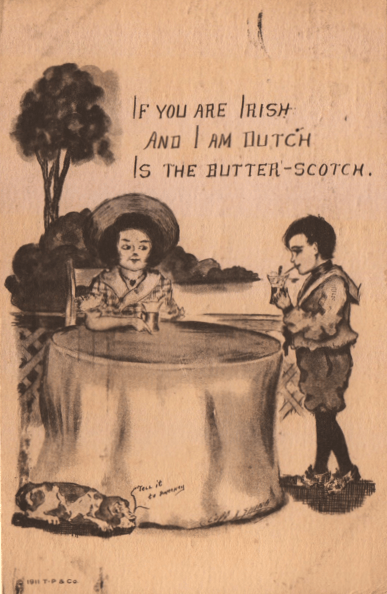
It is time for my annual column where I go through my inventory and discover I have no Halloween postcards for sale. There ARE Halloween postcards, and postcard mongers who can offer you a fine array, but these folks exist at a higher financial level than I can compete with, and therefore I have to seek my Halloween terrors elsewhere. The postcard featured at the top here, for example, strikes a lot of people as a grotesque horror. But it was intended, back in the day, to be funny.
This, also, could do as a Halloween card only in a pinch. Yes, the man saying “ootsy boo boo” to the baby IS a tad frightening. But this artist was great at grotesque faces, and if you look more closely, with a saturnine attitude, everyone in the picture seems to be wearing a weird mask.
And you can’t call it a Halloween card simply because the joke is frightful. (People would start asking why I write Halloween columns all the year long.)
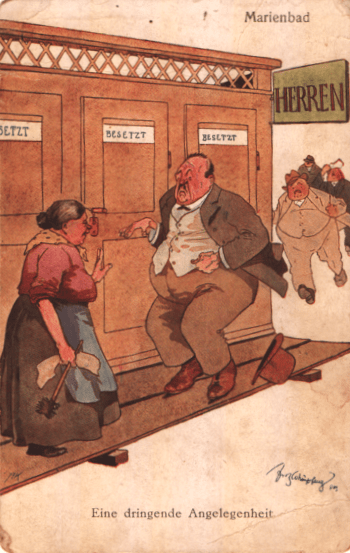
If we look for genuine nightmares in our Halloween greetings, we might take this picture of a health spa where large men drinking from the mineral springs to renew their youth discover all the restrooms are already occupied. Can’t immediately recall any really four-star horror movies that used this idea, but perhaps we’d be ahead of the curve. (Or at least at the front of the line.)
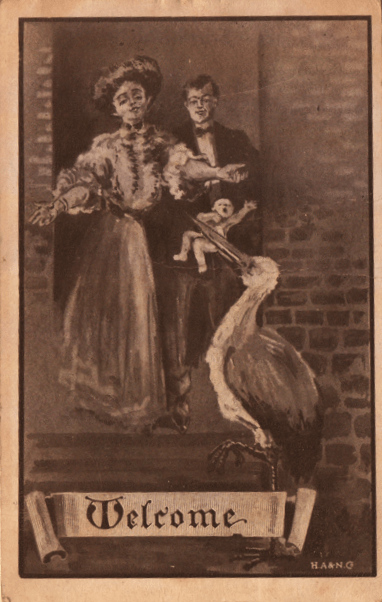
Here we do finally get into genuine horror movie material. Pity it was sent as a happy congratulations card.
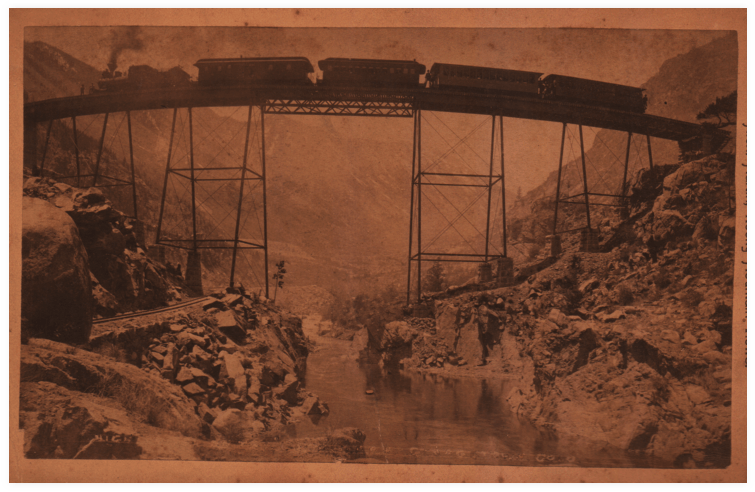
And this cabinet card, from a line which did the same thing as souvenir postcards but in an era when picture postcards were barely a blip on the radar, was intended as a celebration of heroic engineering: not nightmare fuel for prospective passengers.
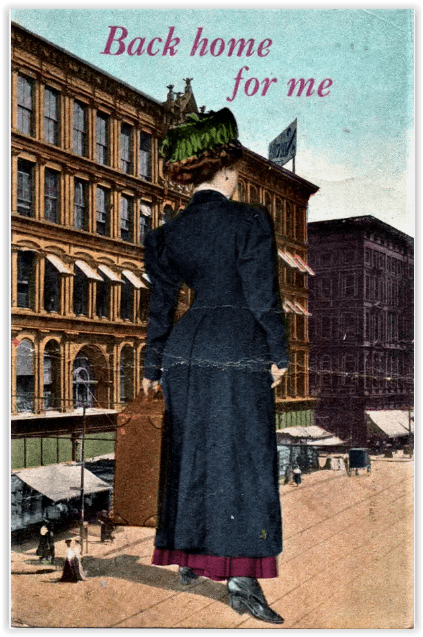
This was simply a convenient way of showing a person was in the city without having to do any shooting on location. It was NOT intended as the first in a series of science fiction horrors in which giants stomped all over defenseless cities.
Anyway, that’s what people tell me. I do wonder.
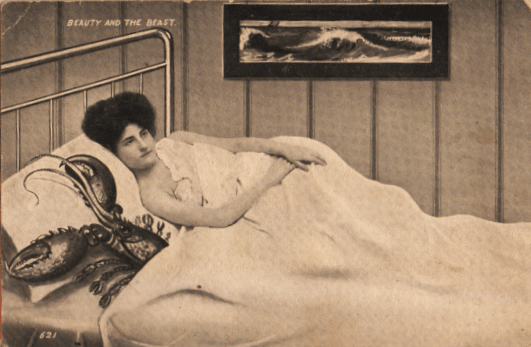
This was meant to simply be funny, not horror fodder at all. “Lobster” has been used for various people over the decades, sometimes for a rich man, sometimes for one who was merely surly. This card laughs at the idea that any woman would voluntarily get into bed with an unpleasant person just because he’s rich. It’s the incongruity that matters, the unlikelihood: not the scary picture.
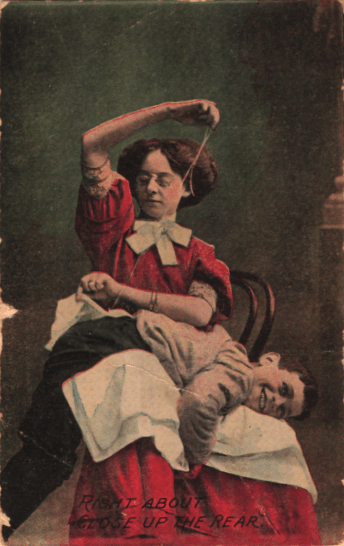
You can tell by the victim’s face here that he is perfectly comfortable having the seat of his britches mended. You were supposed to laugh at the joke about “closing up the rear”, not quiver on the edge of your seat with suspense at whether the short-sighted attacker can be trusted with that needle.
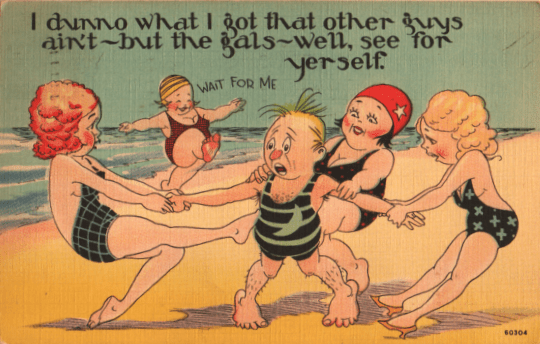
I have TRIED to sell this as a Halloween card on the basis of completely untrue rumors (always useful for selling things) that it represents an unaired Twilight Zone episode in which the hero (is that Mickey Rooney again?) wishes to be pursued by women. This would be the closing shot, where you can wonder whether they will toss him on the grill…or just be left in suspense about where the incoming beach bunny is going to take hold.
This seems at first glance to be a large man giving small pig a humanback ride, but if you look closely, you will see he is a butcher. The image is grotesque, but it just won’t DO as a scary Halloween postcard. Everyone is smiling.