I have saved you time on research through the Interwebs several times now, and I shall do so again. I need only make use of a magic phrase regularly beats all the search engines the computer savants can throw at you.
“Nobody really knows.”
This time around, I was inspired by making my bed. I will not take time to explain my domestic arrangements, but I make my bed only when forced to by circumstances, as the process involves taking everything apart and then putting the springs where they belong, squaring the mattress on top, and then locating a mattress pad and sheets which will stretch to all the corners and stay in place for more than 24 hours. I have a standard mattress and standard sheets, and yet somehow, the corners will never…let’s get back to the question at hand
I was struggling once again to get the elastic over the corner of the mattress and wondered “Who invented the fitted sheet?” I knew this was a recent innovation, since I was instructed in making beds both by my mother, who eventually worked in a hospital and learned to make a mitered corner for sheets, AND my father, who learned in the Air Force to make mitered corners for sheets. Each, having learned this skill in a fairly demanding environment, was rather proud of this skill, which is one of many I never mastered. I DID accomplish a mitered corner once, but that was probably the last time I even saw a non-fitted sheet.
There are histories of fitted sheets around the Interwebs. The most detailed actually names the lady who in 1957 came up with the concept, but insisted on elastic garters you attached to the sheets before bedmaking. This did not catch on, but later another lady came up with built-in elastic corners, and the world was changed.
Unfortunately, the world of the wide web abounds in nostalgia websites reprinting old advertisements, and there are plenty of catalog listings and newspaper ads for fitted sheets in the early Fifties and even the late Forties. One brochure from 1954 says that fitted sheets have been on the market for five years, which confirms my belief that a LOT of the culture I grew up with was invented in the Post-War World. I have been able to learn nothing about what innovater sewed the top sheet to the fitted bottom sheet, but this does not seem to have caught on.
The first fitted sheets seem to have been for cribs, whose occupants could be counted on to kick and roll and dislodge sheets, which, even leaving out the possibility of diaper leakage, meant a lot of repeat bedmaking. In any case, the Overworked Housewife so often touted in ads for household products (always a winner, since every homemaker feels the pressure of work to be done) was the focus of these campaigns, and the time save by not having to miter the corners day after day were held up as a major selling point.
As more than one humorist has pointed out since, all the time saved in this is then lost by the amount of time it takes to FOLD fitted sheets.
Now, this is a topic on which everyone agrees: there’s a trick to it. After that, they diverge, some experts going in for amazing linen origami. But it boils down to this: you bring the corners of the sheet together in an orderly fashion so that all four are folded together into one little pocket. You now have a MOSTLY flat sheet which you can fold in whatever way appeals to you. SOME experts feel you should then wrap the sheet and its attendant top and pillowcases in another matching piece of fabric which can be used to sort your sheets by color so you can match seasonal or other decorating demands when making the bed. (Guess who uses that method.) Other people suggest you just wad the sheet up into a ball and shove it in a corner of the closet. (No points for guessing who uses THAT one.) Or you could always buy a sleeping bag.
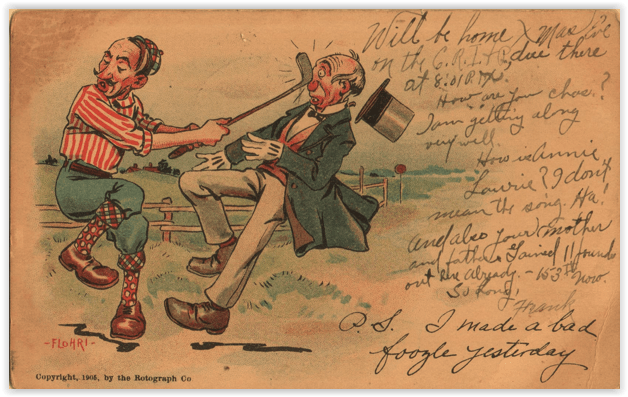
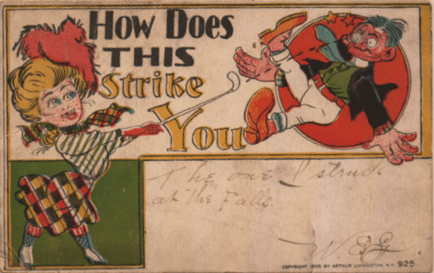
It struck me that I have been selfish, having turned my collection of fine old jokes over to YouTube. After all, it was in this space that I published major excerpts from my quiz book on ancient humor, with the setup in one section and the punchlines in the answer section, to see how many aged gags you knew. And as I was looking at a blank page where today’s blog should be, and noticing how many golf postcards I have for sale…well, here goes a new quiz, in response to no demand whatsoever.
Q1. I went to a golf pro to find out why my game was suffering. He watched me take a few swings and said, “I see your problem. You’re standing too close to the ball
Q2. Kelly decided golf would give her a chance to get out and meet men. She asked her friend Louise to teach her the game. Louise showed her how to grip a club and told her, “Now you need to address the ball.”: Kelly looked down and said
Q3. St. Peter liked to play a few holes of golf when he got time off from sitting at the gate of Heaven, so one day he called on St. Luke and Elijah to hit the course. Luke teed up, swung, and sent a ball flying up into the air and right down into the cup for a hole in one. Then Elijah moved up to the tee, swung, and also hit the cup in one stroke. St. Peter pulled out his own driver and said
Q4. It’s important to make sure your clubs reflect your unique style of play; I, for example, spend so much tie in the rough I got rid of my 3 iron and my 6 iron and replaced them with
Q5. Meredith knew Allen was prone to improvise his scorekeeping, but he was the only partner available on some weekends. On the sixth, hole, as they both reached the green, Allan said, “I lie three.” Meredith replied
Q6. They putted out on the eighteenth green and Allen said, “Well, me for the bar.” Meredith said, “Ah, let’s finish the course first.” Allen said, “Finish? This is the eighteenth green. What else is there?” Meredith said
Q7. I was in the idle of my swing on the first hole when one of the usual busybodies broke in to tell me, “You know you’re not allowed to start from the lady’s tee, sir.” I said
Q8. The four men had met in the clubhouse and decided to make up a foursome. The seventh hole ran parallel to the highway on the other side of the fence, and as Irving was about to swing, he spotted a funeral procession passing by. He put his club back in the bag, took off his hat, and stood with his head bowed until the cars had all driven past. One of the other players said, “That showed real respect.” Irving shrugged and replied
Q9. “How was your game?” Lou’s wife asked, when he returned from the course.
“Terrible,” he said. “We were on the fourth hole when Marvin keeled over, stark dead from a heart attack.”
“How horrible!” cried his wife.
“I’ll say,” said Lou
Of course you don’t need to read the ANSWERS; these are just par for the course.
A1. After you hit it.
A2. “Hello, ball.”
A3. “Okay, enough with the miracles, now let’s play golf.”
A4. A rifle and a fishing pole.
A5. “Well, the first two words of that are correct.”
A6. “The way you’ve been undercounting, I thought this was the eleventh.”
A7. “Start? This is my third stroke.”
A8. “Well, we were married for forty=-two years.”
A9. “It was six holes of hit the ball, drag Marvin, hit the ball, drag Marvin….”
Unfirom was not quite able to shudder. As he strode across the park, the thought of the phronik trying to handle their job one at a time, though, brought him fairly close. An attempt to influence lovers by less than the full crew would bring on a rush of lopsided emotion. He reassured himself with the consideration that any phron’s FIRST target would be any breath mints or bubblegum s[potted in a pocket or purse.
He glanced at the sky. His colleague Yomottow was probably still doing very well as a guardian angel.
Spotting another couple I the park, he dismissed this unworthy thought and strode on. The two men, completely overdressed for their surroundings, stood in the grass center of the track, oblivious to the people around them running after health. The tall developer was one of the pair, still lacking any hair out of place or a wrinkle in his clothing. The shorter older man wore his wrinkles as a sign of his higher position in Rock Mountain: it was Marty, of course. Unfirom and the phronik had worked on Marty officially some thirty years ago, achieving success with Marty and his sweetheart. But one of the sad truths of this work was that making a couple fall in love did not guarantee that they would not fall out again.
Still, that first marriage had averted some of the complications that might have ensued otherwise, and Marty had risen to become a power in the community. He was a solid businessman, an officer of the Pont a Methon Museum, and a man never to be seen dining at Booty Burger.
Unfirom moved up unseen behind them as Marty said “Oh, I don’t suppose there really are any underground huts here. Griese wouldn’t have bought land he couldn’t build on.”
“He might not have known.”
Marty shook his head. “He’d know. All business, Griese, from everything I’ve heard, and no nonsense. He’d want this place developed in a way that will really put Rock Mountain on the map.”
The older man raised a stubby pointing finger. “Speaking of which, when you take out that fieldhouse for the new park lodge, we’ve been talking about a nice luxury lounge at one end.”
A tiny crease ruffled the ridge of the developer’s nose. “I thought everyone had agreed on a very inconspicuous park lodge. Perhaps partly underground.”
Marty nodded violently. “And that’s what we want, exactly what we want. But with a big room tacked on, with stained glass windows. They’re talking about weddings in the park, amd there’d need to be a place to go if it rains.” He swung a hand around behind him to wave in the direction of the not yet constructed Pont a Methon Museum. “Can’t have a whole dripping wedding party crowded into the galleries.”
The developer paused, considering an inconspicuous lodge with a large wedding chapel attached. “The gazebo we….”
“That’s the ticket.” Marty’s playful punch left a dent into the flawless surface of the jacket. “Exactly right: something along the lines of that gazebo. Great stuff. I know your team can give us just what we’re looking for.” He turned away to smile across the real estate. “And you’re right about one thing. If somebody else has heard about old sod huts, there’ll be delays. I’ll get Gabriel to check the old plats. But I bet they were all just filled in.”
The developer’s head quivered slightly to the left and then the right. “But that’s what we….”
“Got to run.” Marty nodded some more. “There’s a trustees’ meeting tonight, and I better be ready. Some of ‘em coming in from out of town. Keep up the good work.”
More small creases appeared in the developer’s face as he watched Marty go. Then he turned to regard the old brick fieldhouse. Unfirom saw six different lounges, two of them obviously chapels, pass through the man’s mind. The angel thought this over. Would having a chapel in the park complicate his work with the phronik, or make it easier?
Then he sped forward, shifting his constitution as he did so. Marty was no more than ten feet from the gate out of the park when the angel, now a graying man with a plaid sportcoat and a necktie with orange eagles all over it, called, “Well, it’s Marty, isn’t it? How’s Leah?”
Marty was far too good a businessman to suggest that he had failed to recognize a man who not only knew his name but that of his wife. “Fine, just fine! And how about you? And how about….”
“Fine, fine, we’re all just fine.” Unfirom reached out to shake Marty’s hand with enthusiasm. “Nice day!”
“Yes, indeed!” Marty returned the enthusiasm of the handshake. “And the…kids?” Grandkids more likely, he thought, but it was better not to push too far without knowing the territory.
“What can you say about kids?” the older man chortled. He looked back at the track. “So this is the park, huh?”
“You’re in tow for the meeting?” Marty had already figured this out, but it gave him something to say. “Yeah, this is it. Not much to look at now, of course. Er, Shirley Waterman’s in town for the meeting, too. She’s too smart to see this as much of an asset unless we do some work. Did you read that….”
The other man shrugged. “Oh, I’m sure whatever you come up with will be an executive decision.” He grinned. “I actually came in to see Rebecca Swartz. I’ve been hearing about her for it seems like years now, and someone said she might be at the meeting.”
“Swartz? Rebecca Swartz?” Marty was still not on firm ground. He knew all the trustees’ names, if not their faces, and there was no Rebecca Swartz among them.
“Oh, you know,” said the tall grey man. “What-do-you-call-it…Community Relations or what-have-you for Booty Burger.” He shrugged. “I guess they’re sending her to put in a bid for the cafeteria concession.”
“Well, now….” Marty looked the man up and down again. Had someone really come from THAT far out of town?
The other man had raised his head to study the thickening clouds. “That’s your business, of course. But she might be able to pass along some community relations tips when we break for drinks.”
“She’s that good?” Marty rubbed his chin. Booty Burger was calling in the big guns? Did that mean their CEO was scared, or that there was an ace in the hole no one here knew about?
“There were those canvas bags for some book fair in Chicago,” the other man said, still scanning the sky. “For some library. People loved ‘em, and the name Booty Burger was all over town by the end of the week. Wish she could’ve done something about the colors.”
“Mm,” said Marty. And no one had heard….
“And some recreation program at that park in Milwaukee, to push all that protein they sell.” The man shook his head in admiration. “Half the kids in town carry a Booty Burger water bottle or wear that headband. Same rotten colors.”
“Mm-hmm.” Marty looked across the park, calculating. Not good, if Booty Burger was known for buddying up with parks and cultural institutions.
Unfirom could see the doubt nibbling the edges of Marty’s confidence. What he had said was true, too, even down to a possible visit from Ms. Swartz. All he had omitted to mention was that Booty Burger saw no point in spending any goodworks dollars in so minimedia a community as Rock Mountain.
“Don’t know that we’d want Booty Burger selling in the museum basement so much,” he said. “But the money can’t hurt.” He spread out his hands, palm out. “But that’s all up to you. Good to know Booty Burger is taking that much of an interest in us.”
Marty had forgotten his own hands, one of which was now stroking his throat. “And, er, Ms….Swartz?”
“Rebecca Swartz.”
Marty’s eyes rolled up for a second as he recorded the name and pronunciation. “Ms. Swartz. She’s in town now?”
“Haven’t seen her yet. Do me a favor and call me at the hotel when she wants to set up a meeting. Not to interfere; I just want a chance to talk to her.” Unfirom’s eyes shifted to the left. “Gotta go. Keep up the good work.”
He started away but Marty had a hand on her jacket. “A…bout how old a woman is Ms. Swartz?”
“Young, for as much as she’s done.” Unfirom raised his free arm. “That wouldn’t be her now, would it?”
He had supposed correctly, but in turning to look, Marty let go of his sleeve. “Is it?” Marty said, leaning forward to peer across the grass. “I….”
Marty spun around. The tall grey man wasn’t there. Turning back, he looked over at the unknown woman, to see if his new friend was already moving in to talk to the phenomenal Ms. Swartz.
Unfirom had instead recognized another couple moving toward the sort of mishap he was here to prevent, and needed to speak with smaller phenomena. Once again among the immortal colors of the park, he scanned the ground for phronik.
His ears caught the melody, but it was no more than a duet. There would be delays while he sought the rest of the combo. Ph, why couldn’t he be working with something easy to corral, like dandelion fluff or baby spiders?
“Cousin Katie was a star on radio
Playing Tiny Tina Tippett on a big hit show;
A saucy little miss who was adored by all –
Along came television: Kate was six feet tall!
Percolator, Coffemaker,
Subaru and Studebaker:
All ya got is all yer gonna get,
Waddya bet?”
Sweet Pea and Primrose had found a pile of grass clippings from the last time Park Maintenance had passed this way, and were very busy disentangling and replanting each blade. This was naturally taking time, as most had been cut in a way which made it difficult to decide which was the root end and which the top. Which did not make it difficult to argue about, of course. Each blade fell flat almost immediately upon being planted, but neither phron was interested in that detail.
“Have you seen your sisters?” Unfirom asked, stepping up as the pair were slapping each other with bits of their new garden.
Sweet Pea glanced up. “You mean today?”
“I mean now.”
The phron looked left and right, eyes wide and interested. Unfirom tapped an index finger against his thigh.
“Oh well,” he said. “I suppose I’ll find them where the bunnies are.”
Sweet pea dropped her plants. “Are they hogging all the bunnies again? Those guys are…worse than pumas!”
“As long as they’re not eating all the chow.” Primrose sighted along oe blade of grss to make sure it was perfectly straight before flinging it over one shoulder.
Sweet Pea was already up in the air. “Oh, there they are! They’re playing nice…not bothering bunnies at all.”
Following her gaze, Unfirom spotted the other two, flying from a man to a woman and back again. He understood at once what they were up to. He shook his head. Baby spiders, definitely.
As those of you around the globe who rush to read this blog will recall, I do NOT write a food blog. In spite of which, we HAVE discussed ketchup before. But I was wandering around the Interwebs and thought of a thing or two that need to be said.
Now as a native of the Midwest, I must specify that we are discussing REAL ketchup, not walnut ketchup or zucchini ketchup or any of the other variations thereof. And I will be talking about KETCHUP without meaning any disrespect to those of you who insist on catsup or even catchup. By all means, you go on doing you. Each word has its history. But for the sake of my own self-respect, I am talking about not the spelling or history of ketchup but how it is used in my corner of the world.
Ketchup is considered a natural topping for fast food hamburgers, and I pity the misguided soul who holds a cookout and serves up hamburgers with no ketchup in view. Among some people, ground beef and ketchup are such a natural pairing that they go the extra mile and make ketchup one of the main ingredients in their meatloaf. My mother used tomato sauce in hers, and HER mother used only home=-canned tomato sauce. They also used tapioca, but that’s a subject ofr a whole nother blog.
I do not use ketchup in cooking myself, but when I heard from the Frugal Gourmet that a basic sweet and sour sauce could be made by simply combining water, sugar, and ketchup, I gave it a try and found it worthy. (I have not checked his assertion that a number of Asian restaurants use the same recipe. For one thing, sweet and sour sauce seems to have fallen out of fashion, and I very seldom see it offered.)
As a resident of Chicago, I am supposed to sneer at those of you who put ketchup on your hot dogs. I decline to do this. You can NOT put ketchup on your hot dog and call it a Chicago dog, but I refuse to go around asking what you call your hot dog. I suspect the results of such a poll would shock me, and I am very delicate. Dress your hot dog as you please, by the shade of Oscar Mayer! This said, however, I DO worry about those of my acquaintance who put ketchup on their bologna sandwich, even though that’s technically a very similar dish. But as long as I can have my meal without ketchup on it, I am not here to judge. The same goes for those of you who can’t eat eggs without “red gravy”.
What really took me to the Interwebs, and which it has taken me long enough to get around to, is the connection between potatoes and ketchup. At my house, we did not ketchup our French fries. But I knew that other people did and, as I moved out into the wider world, I found most people regard this as so automatic that once again, I was the outsider. I took it in stride. Some people salt their watermelon and some don’t, I figured.
But that was then. Nowadays, whenever I dine out and any manner of fried potato is served, be it French fries, cottage fries, American fries, or any one of a dozen types of hash browns, ketchup is automatically provided. This would not be the case if America was not demanding ketchup with fried potatoes. Going to the Interwebs to find out why, I was offered a labyrinth of rabbit holes. One writer insisted I was a fool for not dipping my potato chips in ketchup, and there are roughly a thousand recipes for crispy potatoes that have been stewed in ketchup. (How the potatoes get crispy when stewed is beyond me, but I declined to spend the rest of the week comparing recipes, so that’s just me.)
The sole voice raised to discuss the question suggested it derives from the tradition of smothering fish and chips in malt vinegar (vinegar being a notable component of ketchup). But that was as far as she went before moving on to discuss putting ketchup on your macaroni and cheese. At least I found no followers of the kids I used to eat lunch with in the school cafeteria, who would gleefully grab the squeeze bottle of ketchup, plunge the tip into their mashed potatoes, and pump a pint of red gravy into the mound of white. I DID find a lot of malarkey claiming that the current rage for dipping sauces with our fast food choices started with McDonald’s and their McNuggets, when obviously fries and ketchup were there first.
I came out of my research shaken, but convinced that my fellow Americans simply expect ketchup with their potatoes. But the order of fries never comes with the ketchup pre-applied, so I can eat mine as they come (yes, I did try dipping a couple in the ranch dressing, but that was just out of curiosity). Those of you who cannot go through a drive-thru without asking the counterfolk for a few extra packets of ketchup (by which, as I have observed, you generally mean ten or twelve) are free to sauce your potatoes any way you please. I have mustered as much interest as I can in the unanswerable question. Mayo all keep well.
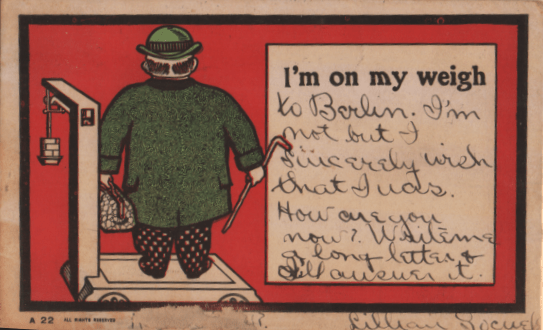
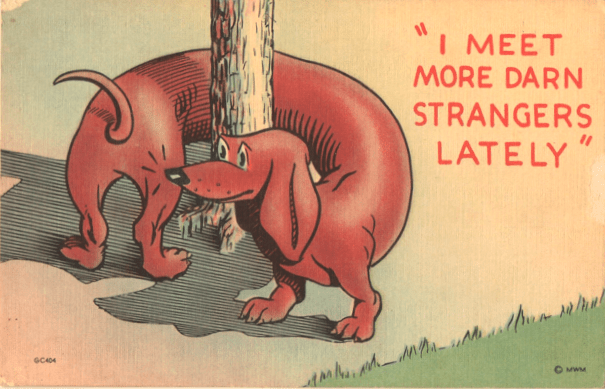
We have, in this space, discussed what the postcard artists of days gone by thought of dogs or cats or chickens generally, but many parts of the animal world have sub-categories which had their own themes and jokes. Among the many jokes about, say, Scottish terriers or bloodhounds, we have a significant number of postcards dedicated to the dachshund. This is a dog breed so popular among all manner of cartoonists that people who don’t go out much may wonder if any real animal actually looks like that.
Yeah, they do.
The breed was brought about centuries past to hunt badgers, and was intended to be muscular but low to the ground, with big floppy ears that would keep insects or plant debris from getting into the ears, and a curled tail that would make them easier to spot in the grass. Dachshund (PLEASE don’t pronounce it dash-hound) was, as the name suggests, native to Germany, a country so fond of its doxies (or Dackel, in German) that entire series of books have been published just to reprint vintage drawings of the long little doggy.
We have mentioned the German custom of sending postcards with pigs to wish people good luck at the onset of the New Year. A goodly number of these find dachshunds joining in the celebration, apparently simply because dachshunds love a good party. (This one is in French, but there was an export market, y’know.)
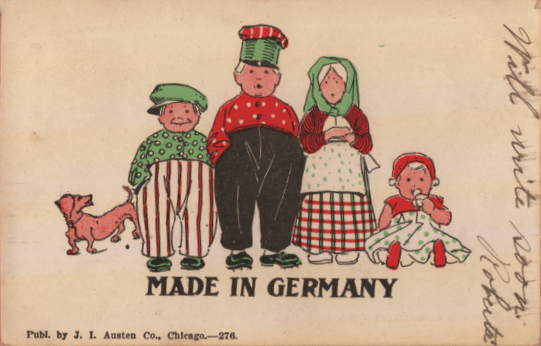
Outside Germany, the dachshund was sometimes used to indicate and sometimes to mock Germans, along with references to sausage and or sauerkraut. (And, as sauerkraut had to be relabelled Liberty Cabbage during World War I, so the dachshund became, temporarily, the Liberty Hound in the United States. This was about the same time that German shepherds became Alsatians. But we will consider freedom fries and other such monikers in a whole nother blog.)
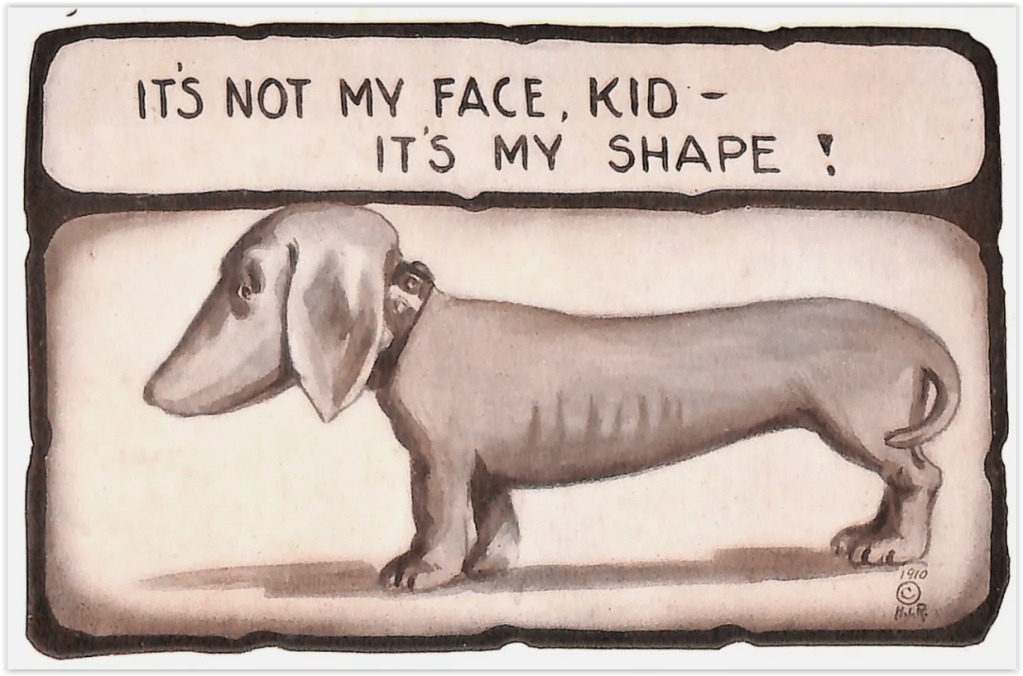
The cartoonist, however, was generally less concerned with family history than with that animal which as “half a dog high by a dog and a half long.” Function was going to follow form here.
Whenever a cartoonist wanted to refer to length, a doxie was a very handy animal to be able to draw. Everybody knew the drawing was realistic: dachshunds were long.
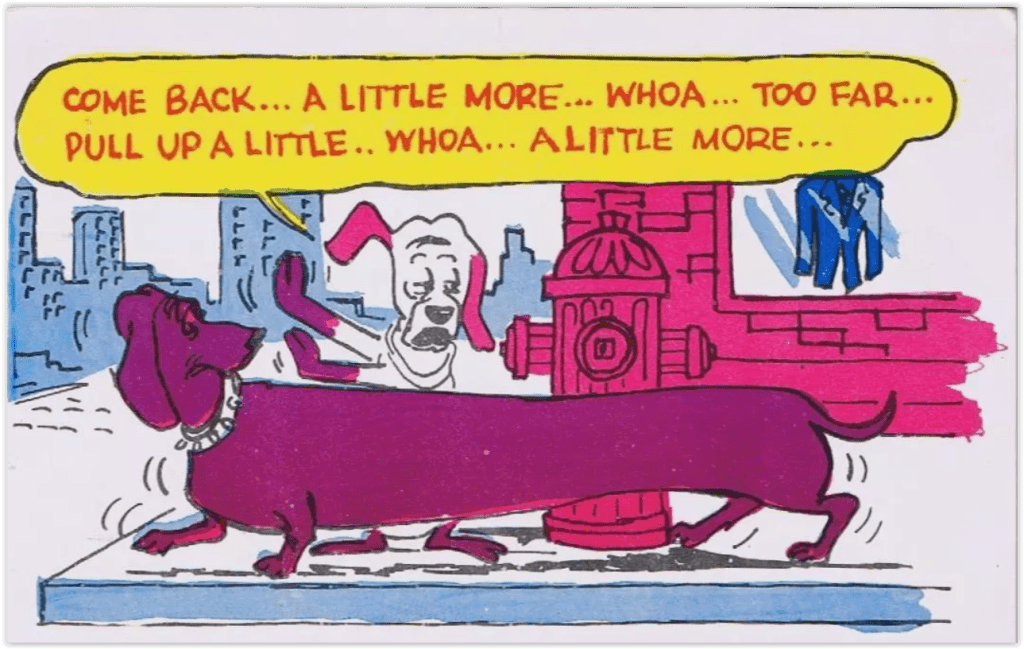
Sometimes very, very long. Which raises the question of whether this becomes a tall tale or just a long story.
Postcard dachshunds were generally very limber, too.
If that last picture suggested a particular phrase to you, be assured that cartoonists noticed it as well.
And a truly fine old joke can be repeated throughout the generations.
We have not so far discussed how the shape of the dachshund also led to it being known as the “Wiener Dog”, or “Sausage Dog”. Since both sausages and dachshunds were associated with Germans, there are plenty of postcards set in German cafes where the inevitable occurs.
This, um, brings up another theme which relies on a base slander often leveled against German sausage makers or sausage makers generally. But we have gone on long enough for one blog, so we will save the often grisly story of postcard sausages for some other time.
“They don’t LOOK like they’re in love,” said Meadow Saffron, flinging flower petals after the trio.
“They’re just pretending,” Sweet Pea assured her. “You can tell.”
Rick turned. “Who said ‘Remember me’?”
“I gave you a card,” Paula reminded him.
“It didn’t sound like you.” He shrugged. “Must have been Dickie. Eh, Dickie?” The baby chortled.
“Nice move pulling out their earplugs,” said Bluebell.
“That’ll be their song forever after,” said Meadow Saffron, folding her arms and nodding.
“What about right after?” Primrose flew up to Unfirom’s eye level. “When are they going to do it?”
The angel winced a bit but his reply was steady enough. “The same day and time as before, only not at the party. And they know about reach other now, and Dickie.”
“Yippee!” Sweet Pea kicked up into the air and hovered on her back. “So he won’t say the wrong thing?”
“He will,” Unfirom said. “But it will be a different wrong thing.”
“And?” demanded Bluebell. “And and And and And?”
“And you will see them in the park many times–over the next seven years always with a stroller. And one day we will be needed for Dickie and his intended.”
“Oh, I do like stories that are continued,” sighed Meadow Saffron, waving at them as the three as they crossed the street.
“They had me worried.” Sweet Pea plummeted to a level where she could pluck blades of grass with her toes without having to sit up. “I thought if Dickie kept laughing, they’d be happy, too.”
“It was that silly magazine,” sighed Bluebell. “I tried to keep them from paying attention to it.”
Primrose swung a violet like a spear. “Ooh, it would be so lots easier if I had a magic wand!”
“What would you do with it?” demanded Meadow Saffron. “Aside from making the guys’ shorts all fall down?”
“Well, once you get the shorts down, there’s all kinds of options.” The phron swung her violet spear horizontally.
“It’s going to rain,” said Sweet Pea, folding her arms behind her head. “Their bottoms would get all wet.”
“You betcha,” said Primrose, through the flower stem between her teeth.
“And it’s going to get dark.” Meadow Saffron tipped not only her head but her whole body back to study the sky. “You wouldn’t be able to see.”
“I can still see now,” said Bluebell. “Look!”
She shot up into the sky, reached and peak, and then dove straight down into a trash cn. Each of the other phronik held up a number of fingers to grade the plummet, but oohed as she rose above the rim, a square orange candy wrapper dropping across her head like a floppy hat.
“Is this high fashion or not?” she demanded.
“Yes,” said the angel.
Bluebell shot out of the can and stopped one inch from his nose. “What’s that supposed to mean?”
Unfirom nodded at her headwear. “That is high fashion. Or not.”
The phron tipped her hat forward with one thumb. “Did you ever fly?”:
“Of course,” said the angels, his eyebrows up.
Bluebell flashed dazzling teeth. “How? When you’re so heavy?”
“Whoops!” Sweet Pea, still in midair, flipped over onto her stomach. “I smell fries!”
“But it’s too early@!” Primrose exclaimed, as everyone rushed toward the fence in the direction Sweet Pea was looking. “How much time did we spend on those two?”
“Which two?” demanded Meadow Saffron, her head swinging left and right, her nose sniffing for fried food.
“There!” squawked Bluebell. “There they are!”
A woman with red overalls over a white tube top was walking along the sidewalk beyond the fence, munching the last of an order of fries. The phronik leapt and pirouetted along the top of the fence, calling “Drop it! Drop it! Drop it drop it drop it!”
One fragment of fry dropped from her fingers, took a lucky bounce, and landed on the lowest horizontal rail of the fence. The phronik pounced.
“I’ll go watch for other couples,” said Unfirom. He liked, when possible, to avoid watching them eat.
Meadow Saffron, elbowing Sweet Pea away from the potato piece, replied, “Don’t hurry! We’ve got business!”
Sweet Pea was responding with a knee, but spotted an entire fry bouncing through the fence. “Ooooh, I just love a sloppy eater!”
“As usual,” the angel informed them, “I will summon the four of you when you are needed.”
Blubell, clutching an armful of cold potato, fluttered up to him again. “How come you always need to call us all?” She pushed the fried fragment into her mouth and somehow continued, “Why can’t we do it in shifts?”
“I wore a skirt,” said Primrose.
Blubell shook her head, nearly dislodging her orange hat. “No, listen. Two of us could eat, to keep up our strength, while the other two do the job.”
The Angel’s face was impassive, but there was the teeniest hint of strained eternal patience in his voice. “I’ve told you. It takes all four auras.”
Meadow Saffron, keeping her eyes on the woman with the generous bag of fries, still heard this, and replied, “Well, you’re the auricle.”
“I say it’s just auratory,” said Primrose, waggling a finger at the woman, in hopes this would do for a wand.
Sweet Pea jumped over her lying crosswise on the fence, and sang “If there’s something nice to say, say it Aura Lee!”
Unfirom had already found their most recent couple rather trying along these lines. “Each of you has an aura which calls to the romantic in a mortal’s being. Primrose‘s aura is of young love, Meadow Saffron that of love in old age. Sweet Pea is shallow, impulsive love, and yours is of deep devotion.”
Bluebell put a thumb in her mouth. “I knew that.”
“Did you?” inquired the angel.
“I’ve got a feeling you’ve said it before,” the phron informed him. “Your nose twitches when you say things over. But why couldn’t we mix it up? Young Love there could go out with shallow, and do the high school kids, so Old Age and I could do everybody who’s ovwe twenty-three!”
“Hey!” shouted Primrose. “I’d be doing most of the work!”
“No, no dear,” boomed Meadow Saffron. “You don’t want to cross the street! Not really! Come eat in the park! It’s so pretty!”
The woman could not hear her, but did pause. “Yay!” shouted Sweet Pea, when she turned left instead of right.
“See what power we’ve got?” demanded Bluebell, her eyes shifting back and forth between the woman with food and the angel with attitude. “We could probably do it ONE at a time!”
“Frankly, you can’t be trusted to do it four at a time,” the angel informed her. “That’s what I’m doing here.”
“Is that it?” demanded Bluebell, kicking at his nose with both feet and just missing. “I thought you were just being a creepy old toad!”
“Hunger has an effect on your disposition,” Unfirom replied, “I shall leave you to your snack and resume my patrol.”
‘Think you’re so smart.” She glared as he strode away but was able to spot a falling fry and catch it before it hit the grass. Sweet Pea, meanwhile, took a stance at one corner of the container of fries, the better to watch as potato went into the woman’s mouth.
Not long after that, the last of the potatoes were gone, and she had nothing left to do but slide down the greasy sides of the container. “Bye!” she called, waving to her departing hostess. “Thanks for everything!”
Bluebell, meanwhile, had finished eating and had taken Meadow Saffron by one elbow. “Why don’t you and me go out and show something to that sniffy angel?”
Meadow Saffron frowned. “I don’t know. When I showed him my sore toe I stubbed yesterday, he didn’t look very interested.”
“No no.” Bluebell crouched a little and, glancing behind her to make sure no one else was listening and then up, to make sure Meadow Saffron still was, whispered, “I mean show him that the two of us can do one whole couple all by ourselves.”
“Youi mean by auraselves,” said Meadow Saffron. “Do you think we could?”
“It’ll be easy.” Bluebell tried clapping her hands and snapping her fingers at the same time, without much success. “He just doesn’t want us to find out how much we can do without his old bother. Huh! Think we need an angel?”
“Yes.” Meadow Saffron sat down in the grass and began to twiddle her thumbs. “He knows which ones are the items, and will get their whole business wrong.”
“Oh, that.” Bluebell twiddled two thumbs and one big toe. “We can just pick two people and…. There! Them!”
Matthew Melt glared along the cracked sidewalk. “I remember the houses being whiter.”
“I suppose you remember the grass being greener,” replied the orange and black individual, without expression.
Matthew glared at Mohankle. The parchment with the spell on it had not been inexpensive, the ingredients for a potion not easy to find. But the chance to slip fifty years back in time and look over his home town should have been worth the trouble. First off, though, he had expected a guide just a little more impressive than this multicolored individual in a cheerleader outfit from Matthew’s old high school.
When Mohankle had finished materializing out of the cloud of steam, Matthew had demanded, “If only I can see you, why bother with that rig?”
Mohankle had met Matthew’s hauteur with his own. “How do you know it’s not what I wear all the time? Let’s get on with it.” A spirit from the beyond should have shown a little more respect, he thought, particularly on finding out that one had been summoned by the famous Matthew Melt.
Still, he felt he could put up with it, just to put the finishing touches on his memoirs. Lafayette had been a sad shock to him, though. The wonderful stores downtown were a little cheap and tawdry to his older eyes, the school a shabby matter with battered textbooks and antique seats, his parents’ house a dingy place whose massive front stairs seemed to have been replaced with short concrete steps.
What he had mainly come back to see, though, was the source of his discontent. “I haven’t seen one sign of greatness so far,” he muttered, mainly to himself.
Mohankle shrugged. “Keep watching. It has to be there.” His voice, though, showed just a mite of disbelief. Matthew glared at him again, and then at the boys across the street.
All he had wanted to add to his notes was testimony to the blindness of his neighbors. They had somehow failed to see, throughout his youth, the aura of future greatness that radiated from everything the young Matthew Melt did. He had wanted to see for himself what a great man looked like in childhood, and point out the hints that somehow his whole family and neighborhood had missed.
Young Matthew had taken some hunting. Finally, though, here the boy was in shabby, cramped (it was a lot bigger in Matthew’s recollections) Garry Park, playing “Airplanes”, a game which had always appealed to him for its strategy and timing but which from across the street seemed to involve mainly making a lot of noise.
He watched himself trip and fall into a puddle. “Doesn’t seem to be so bright,” Matthew muttered, watching him splash the mud onto Kevin and Kim.
“You weren’t, actually.” Next time, Matthew thought, he’d call up an otherworldly spirit with a sense of respect, or at least less sensitive hearing.
“It isn’t!” he snapped. “You’ve brought me to the wrong place.” He thought about this. “That’s it! This is one of those alternate universes, where things were different. It’s someone else’s past! The railroad didn’t bring the line through Lafayette in this universe. That’s why it’s so small, and the school’s so underfunded. I didn’t get the same schooling. Miss Schmidt probably didn’t teach grade school in this universe, and I grew up….” He pointed at the grubby boy in the park. “Like that!”
Young Matthew, dodging the mud thrown back at him by Kim, ran out into the street. A Corvette came around the corner much too fast.
Seeing himself lying in the roadway, blood spurting, whiny voice pleading to be told what happened, Matthew’s reaction was one of triumph.
He jumped up, hand outstretched. “That proves it! That didn’t happen! The car missed me!”
Mohankle had also risen from the bench. “Because you weren’t distracted by the fat old man ranting to himself across the street.”
“Ha!” Matthew shook a finger at the boys clustered around the boy, who had stopped whining. “But that would mean I never grew up to be…wait!” The finger he was pointing looked a bit transparent.
“This is actually your own past,” said Mohankle. “Now.”
The words lingered longer than the mouth that uttered them “That’s silly!”
“True,” said Mohankle, now alone on the sidewalk. “Very silly.” And, with a nod, he vanished.
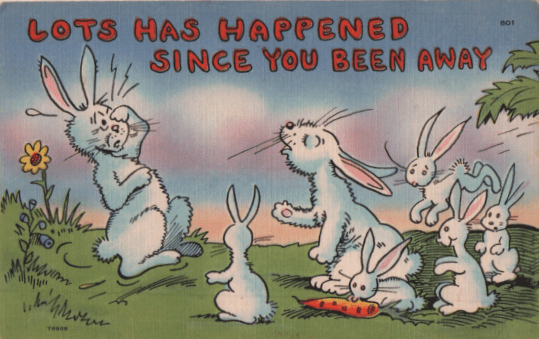
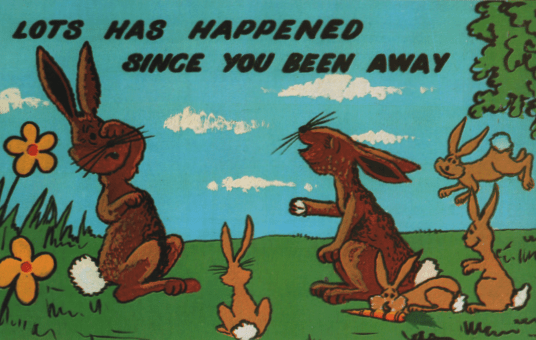
It seems to me that though we have done our due diligence in reporting o the behavior of dogs and cats (and chickens and storks and skunks) on postcards, we have been ignoring an only slightly less popular postcard mammal. We have spoken very little on the activities of rabbits, bunnies, and bunny rabbits.
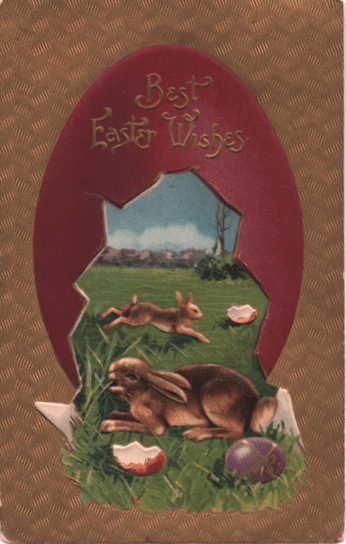
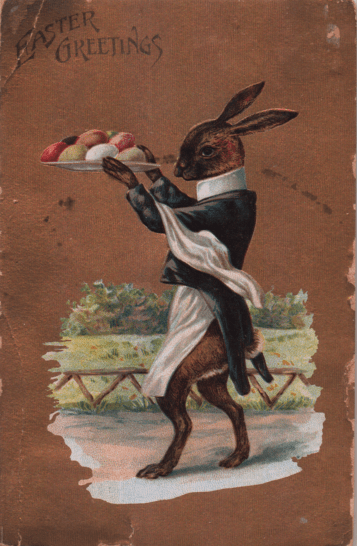
Rabbits are, of course, very involved with Easter cards. Rabbits and eggs have worked together on this holiday for centuries, due to the intricate relationship of Spring, Rebirth, Fertility, and other symbols of the Sunday.
Why the Easter Egg and the Easter Bunny came to be the most famous pop-folk symbols of the celebration is a story just as intricate, but what matters to the postcard artist is how the story can be told on a card.
This is sometimes done in surprising ways. After all, where are the jelly beans?
Of course, rabbits are also a popular symbol of something else related to fertility and spring.
Not all of these postcards are quite as inventive as the Easter ones. But then, what the rabbits have been up to is not all that original either.
Bunnies are bunnies, after all.
Except when they’re not, of course. (I am also intrigued by the artist’s decision to give the lady rabbit a figure that lets you know who’s the mamma.
If we’re going to talk popular folk roles for rabbits, we also have this card, which took me, um, a little while as I tried to figure out what I was looking at. Kinda sorry I DID figure it out. Good luck my…let’s move on.
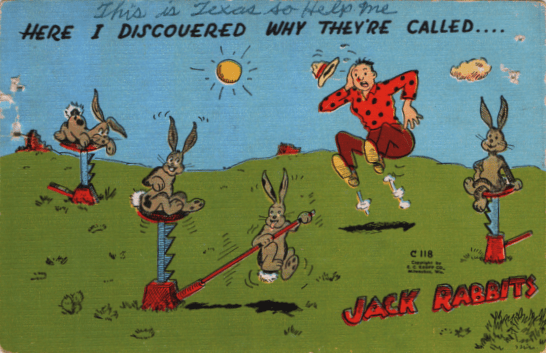
This card is unusual, for though there are plenty of good, reliable photographs which show cowboys mounted on the backs of jackalopes, this is one of the few which makes the noble steed a common jack rabbit. And whereas the average jackalope postcard includes a long paragraph on the back explaining the history of that rare breed, the back of this postcard treats it matter-of-factly, stating merely that every cowboy has a favorite bronc for the job of cattle punching, and this is a popular choice.
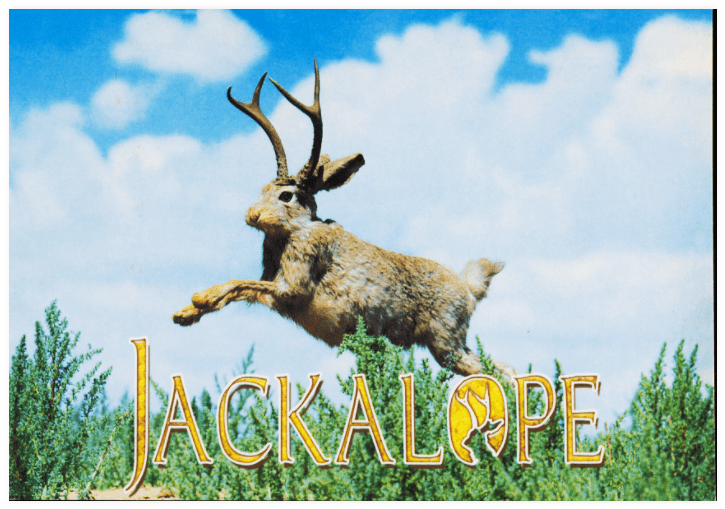
The folklore of the jackalope is extensive, and really a matter for a whole nother blog, but just to remind you that there IS an obvious difference between a jackalope and a jack rabbit, here is a reminder.
If you’re looking for real exploration of the history of the bunny rabbit, you need to get yourself more like this one, which shows there isn’t really all that much mystery about rabbits at all, if you just think things through.
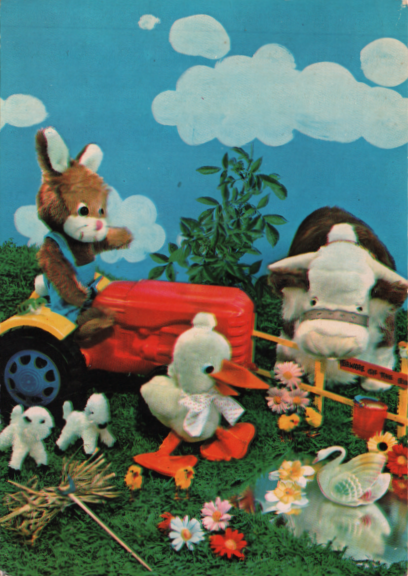
There is THIS mystery, though. I have been unable to find out much about the farm run by THIS rabbit, but we may hear more of it some day. It may look like a perfectly genial agricultural community (in fact, some people have opined that the rabbit is explaining to the cow that it’s HER turn to drive the tractor TOMORROW.) But it is obviously a highly secret experimental community where bunnies are half as big as cattle, ducklings are three times as big as lambs, and swans are being turned into microscopic entities. (If you don’t see this paragraph whe your computer takes you inevitably to this blog, that is evidence that the Authorities have stepped in to suppress information about the whole operation. You have been warned.)
Daring—very daring—to slide onto a bench which was already occupied. But Paula thought the next bench looked dirty. The air was cool, though, and the sky, if cloudy, was bright. Anyone with an experience of movies knew murderous attacks took place on rainy nights or shadowy pathways.
She cast a wall-eyed glance at the man as she slipped her paperback free. He seemed to be ignorant of her presence, his eyes closed while one foot bobbed to whatever he was listening to on those earphones. You couldn‘t be too careful, of course. And there was Dickie to consider now, on top of all previous fiendish possibilities. Plus a murderous attack would mess up her schedule for the whole day.
Time now to get back to Leofwine, and her stroll in the garden. Paula had doubts about the author’s claim that Leofwine found peace in the garden. For the preceding two hundred pages, Leofwine had behaved like the kind of woman who didn’t go out in daylight lest the rays of the sun bleach her toenail polish. Still, one had to cut the author a bit of slack. This was bench reading, not a novel designed to change the mores of the modern world.
She was just settling herself when she felt the plastic pop from one ear, allowing a dusty song about how love could be kind and cruel, wonderful and terrifying, funny and awe-inspiring to blare out into the morning air. Her electronics liked the song so much it seemed to blare it out twice, one version slightly ahead of the other.
Paula smiled a quick apology to the man on the bench, and found him smiling an apology himself. That was where the second version of the song originated: one of his ears had similarly rejected its speaker, probably when he slid away to make more room for her on the bench. Paula caught at her earphone and shoved it into the right place on just the fourth try.
Rick took five tries to accomplish the same thing; he was keeping an eye on the woman. She seemed self-possessed, well-clothed. But you could never be sure who was waiting for the right moment to launch into a pitch for a handout. Plenty of these street people took babies out to show off why they were asking for money.
He glanced at the child in the stroller, who chose that moment to wake up, possibly prompted by the blare of music. Round eyes blinked, and then the child laughed at something unseen by Rick. Most infants are attractive when laughing: Rick had to smile.
The woman noticed, and smiled back. Rick started to look away before she could speak, and saw her frown.
Smiling at the baby, Rick had not noticed a wayward breeze dropping a pink flower petal onto his lap on the right spot to make it look—for a second—as if he had dressed very carelessly before coming out. Paula had not noticed the breeze either, but she had noticed the petal right away. It held her gaze long enough to make her frown. When she realized what she was actually seeing, she blushed a little and turned away.
But the frown, and the questioning arch of one sharp eyebrow, made Rick feel he had to say something. If the woman was not after a handout, perhaps she thought he was interested in her baby as a kidnapper. Best to disabuse her of that notion.
Still smiling, he said, “I do like that bib.”
Understanding the petal had already told Paula this was not the kind of creep she’d assumed at first. But she was still alert for trouble, and her mind informed her, “First thing he says to me starts with the word ‘I’. He’s really talking about himself.”
What she said aloud was, “Yes. Of course, Dickie’s not old enough to realize that’s Herman Melville.”
Rick nodded, thinking, “Good job I didn’t ask her where she found a bib with Karl Marx on it. What a show-off!”
Aloud, he said, “Oh, Moby Dick and Dickie are a natural match, aren’t they?” That would show her he knew who Herman Melville was.
“Ah,” thought Paula, “He’s really telling me he knows who Herman Melville is. This man simply has nothing to talk about except himself.”
She expelled a breath with ruffled the fringe of hair on her forehead. “It’s really appropriate when he wails.”
“Uh-oh,” Rick thought. “Gotta top that. Still, she’s got an original line.”
“Would you call that a Type E joke?” There! What did she think of that?
“Not bad,” is what she thought. “So you’ve heard of a Melville boo besides Moby Dick. One and a half points to you. What now? Ask Dickie if the cow says ‘O moo’?”
She was saved from this fate by Dickie, who shouted “Tglagh!”, reaching two little hands apparently toward the man.
“No no, Dickie, that’s not your da-da.” Paula patted his hands without really pushing them back. “He’s in Phoenix.”
“Letting me know her husband’s out f town, is she?” Rick decided he was probably sophisticated enough to resist the wiles of a woman with a stroller. “Play it cool,” he told himself, “Unti you can walk away.”
Smiling at the baby instead of looking at her, he remarked, with extreme apathy, “Phoenix, eh? On work?”
“On the lam,” said Paula, before she could stop herself. Why had she mentioned Robin at all? This man hardly needed to hear that story.
“Hmmmm. Why did she feel like bringing up the one who got away?” Rick thought. “And what do I say? Can’t introduce myself. She’ll think that now I know the coast is clear, I’m interested.”
“What is he thinking? Should I casually mention an older brother, to make him think Dickie and I don’t live alone? Sounds stupid and I haven’t even said it yet.” Paula smoothed down some hair that was not out of pace on Dickie’s forehead.
“Tgeb,” said Dickie, pushing her hand away. “Geb?”
An hour seemed to pass between “Tgeb” and “Geb”; Paula ran her tongue across the backs of her front teeth. “Do I introduce myself? If I tell him my first name, he’ll think I’m interested, and if I use my last name, he can look up my address and phone number.”
“Well, if he’s on the lam, he should have gone to Los Angeles, since that’s where the Rams are.” The sexual symbolism of a ram on the lam struck him just as he uttered the last syllable. “Er, sorry.”
The symbolism seemed to have missed her. “You do look sheepish.”
Rick lowered his head a bit. “I knew I couldn’t pull the wool over your eyes.”
Paula wondered whether it was wise to carry on this kind of combat with a stranger; puns had not been covered in any Twelve Step Guide to Intelligent Interaction. Then she realized she HAD to reply, “Shear genius!”
“If we’re going to engage in wordplay to the death,” Rick was thinking, “I suppose it’s a gentleman’s role to start the introductions. Or would she think that’s old-fashioned?” It was difficult to consider these problems when he had to admit, “I knew I couldn’t stump you with such a yarn.”
“Stringing me along, eh?” she snapped back, at the same time wondering why he couldn’t tell her his name, so she could avoid pretending to accidentally drop a business card?
If it was old-fashioned for him to start with the introductions, then why didn’t she? “I’m losing the thread of this conversation,” he told her.
“Pretty good line,” she sniffed. “Be careful, or I’ll sic my thesaurus on you.”
Rick was impressed. “Not everybody knows how to pronounce thesaurus.” He frowned slightly, checking his own pronunciation even though he knew it was right.
Paula didn’t notice the frown. “I can spell it, too. I’m a proofreader by trade.” There. One step closer to an introduction without committing to anything.
Dickie was waving at something just behind the bench. “Thglagaldagha!”
“How do you spell that?” asked Rick.
“It’s his word. Let HIM spell it.”
Rick grinned. “Who…ahem…for whom do you proofread?”
Paula smiled back. “I’m free-lance. Anyone old enough to realize the computer’s programs can’t do everything. I index as well.”
“That sounds interesting.” Rick knew better than to tell anyone their job sounded like fun; no one ever talked about a job except to complain about it. “You get to read all kinds of things before anyone else.”
Paula grimaced. “It would be more interesting if people could spell.”
He spread out his hands. “What more could you want? That guarantees steady business.”
Paula’s eyebrows arched up, the eyeballs rolling up until the pupils were out of sight. “No way. I lost my latest job because I was finding too many mistakes in the text.”
Rick was on familiar ground: let anyone complain about their own job long enough and he could whine about his. “Why? Were you getting paid by the mistake?”
The memory was still painful; Paula shrugged. “They said I was just too picky.”
“Huh! What was it?”
Paula’s upper lip stretched in an effort to keep the rest of her face straight. “An English textbook.”
Rick lowered his head; his eyes arrowed. “You’re joking.”
She raised a hand. “Proofreader’s honor.”
“Were the mistakes their own, or the computer’s?” Rick leaned back, stuck out his legs, and crossed his ankles. “If the program says King Author carried Excalibur, they accept it.”
“Of course.” Paula tossed a hand in the air. “Take the machine’s word for it. It was programmed by wiser heads…which majored in math and keyboarding.”
“What can you say to someone who spells ‘unknown’ with an x?” Rick’s hands went up in the air, echoing her gesture. He thought about asking her rates; maybe she’d like to index the back issues of “A Note From Mother”, the comic produced in his spare time when he had spare money. He could use a proofreader, too: Vivian couldn’t spell “Cat” without recourse to her mouse.
Paula laughed, but told herself “Watch it. He’s stretching out; he’s starting to relax. Either he’s decided you’re not a threat, or he thinks he’s making progress. No one’s making progress on ME, Pal.”
Perhaps she should go back in now. She could stay and maybe let him make a LITTLE progress. Or she could come back tomorrow and find out if he was always here around this time. She ran one hand across the handle of the stroller, which shifted the pocket on the back. A red and white magazine slid to one side, allowing the title “Chariots Afire: Fantasy Criticism” to show above the headline “Spider-Man’s Web Address”.
Rick leaned to his left. “Do you read that?” he demanded.
Paula shoved it down a little more securely. “You’ve heard of it?”
He nodded. “You must have a job if you proofread it. I don’t know what kind of editor they must have.”
Rick noticed the silence that answered this before realizing her chin had come down and her eyes were almost closed. “Stupid,” he told himself. “Who’s going to carry a copy of that but someone on the staff?” He cleared his throat.
“Actually,” he said, his voice loud enough to distract Dickie for one second from the paper cup bouncing along in the grass, “It’s not so much their editor as one of their reviewers: Paula Rogers.”
Paula hardly noticed that she was in a position reminiscent of a large cat about to pounce. A paper envelope from fries was jerking in a strange pattern along the sidewalk, and she did not notice this at all.
“What did I review?” she demanded.
Rick sat up, uncrossing her ankles and shoving both feet under the bench. “Ah Sorry. I expected her to be drooling.”
“Dickie handles that department for the magazine,” she told him. “What did I review?”
He set his back and shoulders against the bench. The best thing to do was act as if he did this all the time, and didn’t care. “Moonwebs.”
Her intense gaze shifted to a frown of puzzlement. A scrap of newspaper rolled up into a ball and then spread out into a triangle, but only Dickie noticed. “Moonwebs. Moonwebs?”
This hurt worse than the original review. “You called the review ‘Tap Shoes of Doom’.”
Paula remembered her own titles better than theirs. “Oh. The dancer with mystic powers.”
His eyelids came down; his shoulders twitched. “You said it had the internal consistency of a Screwy Squirrel cartoon.”
She had rather thought that line would leave a scar; she just never expected to meet the walking wounded. “Well, yes, I….”
Rick had more to deliver; he had rehearsed his rebuttal since he had first read the review. “Aside from the fact that it had nothing much to do with the review, hardly anyone who reads little critzines like yours is going to be old enough to get the reference.”
Paula had actually thought this at the time; she had thought of the line some weeks earlier and had just been waiting for a place to use it. But this buzzard had not earned the right to point that out. After all, he was dumb enough to have written that stupid comic book in the first place. She shoved a foot back under the bench, bracing for combat.
“It made as much sense as your untutored peasant girls making reference to sixth century Frankish queens.”
“She might be a sixth century peasant girl.” So she had caught the Fredegund reference. This woman was dangerous.
Two starws caught up in a breeze lunged at each other and engaged in a brief fencing match. Dickie’s eyes were fastened to the sight, which no one else seemed to notice.
“As for doing a comic book centered on a dancing….”
Rick’s jaw jutted. “You said it was a rip-off of ‘Zell, Sword-Dancer’, and claimed I’d watched Riverdance too often on videocassettes in my youth.”
Her face came eight inches closer to his. “You took a peasant girl who had no more training than an annual prance around a Maypole discovering, under a full moon, that she has a talent for intricate and mystic dance moves.” Her upper lip curled. “Lust exactly when it’s needed.” She tossed her hair. “And your spelling is ridiculous!”
This caught Rick in mid-retort. “That wasn’t my…Viv…someone else did the lettering!”
She nodded sharply. “You could have checked.”
A Milk Duds package stood up on end and spun around, the wind managing somehow to bounce it upside-down and back without interrupting the spin. Then it, and the dueling straws, dropped to the ground as if the wind had lost interest.
“And Issue 5 covers the whole dance training question,” Rick replied. This sounded limp, even to him.
“You couldn’t think of an excuse before that? What makes you think you’ll have an Issue 5?”
“At least as many issues as Chariots Afire.” Rick leaned back into the attack, his shoulders rising from the back of the bench. “And where do you get your Illustrations? Do you copy them off the restroom wall, or does Dickie do them with crayons?”
“He eats crayons.”
“Dickie? Or your illustrator?”
“It’s not as if your…what’s her name?…Slainhe is any lost Rembrandt sketch. It’s a good thing you TOLD us that was expert dancing, since she looked as if she was playing hopscotch.”
“The review made it sound as if numbered steps would be about her speed,” muttered Tick.
Paula snorted. “She wouldn’t have learned numbers.”
Nothing in the park was amusing Dickie right now. He was wrinkling his nose and chiisuing between a whimper and a wail when movement beyond the fence caught his eye. One of those green things that turned up late in the books mama read to him was rising through the weeds along the park lodge. She always made the most entertaining hiss sound when these things appeared in the books. Dickie waited to hear what sound this one made.
The hiss started, and then water gushed from the creature’s mouth. Dickie applauded; Mama had never done THAT.
“Hey!” bellowed both adults, as the water from the hose hit them. Rick threw himself forward, pushing the stroller so his body was between the spray and Dickie.
“Where….” He started to say, turning to the proofreader.
But Paula was in midair. Rick’s mouth dropped open, collecting water, as she cleared thewaist-high fence in a single bound, diving for the tap.
Turning away, Rick coughed water from his throat. This cleared Dickie’s view of Mama holding up the now silent green creature. “How could this….” She started to ask.
Rick leaned against the side of the stroller. “What kind of special training do you need for a jump like that?”
Paula started a glower, but laughed, and let the hose drop. “I don’t DO Celtic dancing! I can’t keep my hands still that long.”
“I can change it to mystic square-dancing,” said Rick. “Let’s hear a good old yee-hah!”
Patla had traded her interest in dancing for one in the fence. “How do I get out of here now?”
Rick put out a hand. “If jumping again would endanger your secret identity, just climb over.”
Well, look out.” Paula put a foot on the metal rod that ran left and right in the fence. “One, two….” Hands down on the top rail, she pulled herself over.
“That’s got it.” Rick put his hands on her waist, and helped make sure she landed on her feet. He did not, however, immediately let go.
Paula turned a little red. “People can see you.”
Rick stuck his hands behind his own back, but pointed out, “Doesn’t matter. In a thousand years, they’ll all be dead.”
Paula’s face was turned from him as she checked Dickie and the stroller. Not much water had hit Dickie, who was laughing and clapping about it. “So will you.”
“Will you write to me, even if I’m dead?”
This brought her face toward him. “What?”
Rick turned his face toward the sky. “Just address the letter ‘Tomb it may concern’.”
Her shoulders sagged; her brow came down. “You shouldn’t joke about grave matters.”
Dickie chortled, most likely at a leaf that danced just beyond his toes. Rick shrugged. “I’d stay and argue that with you, but if I don’t change out of these wet clothes, I’ll start coffin.”
“Me too. Here.” Paula reached behind the copy of Chariots Afire and drew out a card. “If you Slainhe wants her dialogue spelled right next time.”
Rick reached into a damp shirt pocket for a simple piece of plastic. “If you want to knock any more plot devices, I can give you a cut rate subscription.”
Having officially ended the conversation by trading business cards, they should probably have walked away in different directions. This did not seem to occur to them.
Sometimes, in the summer, my mind slips from its serious consideration of crime, violence, and other features of the coming elections, and meanders in the direction of Wistful Vista.
Now, those of you who are old enough to remember vintage trivia questions will recall that Fibber McGee and Molly of sitcom fame lived at 79 Wistful Vista, an address tucked away in the radio somewhere between the plains where the Lone Ranger fought the good fight and the big city where his great-nephew did the same as the Green Hornet. But that tidy home with its untidy closet is not the Wistful Vista visited of my contemplation.
A woman I knew was absolutely dedicated to nostalgia for an era she mostly missed. Born in the 1940s, she yearned for the music of the 1920s, the movies of the 1930s, and the radio comedies which bloomed before she was born. Fibber McGee and Molly did not leave the airways until well into the 1950s, so maybe she DID get to listen to them first time around. I any case, she missed them in a world where movies were now in color and women wore trousers to work. (This is the lady who signed a petition at her workplace demanding that women NOT wear this inelegant article of clothing on the job. This was, er, in the 1970s. She sighed “I always was in the forefront of going backward.”)
She lived alone in a largish house after her parents died. (She, um, insisted on buying it from them instead of inheriting it. And despite some heroic attempts, she never married. We may discuss her financial and romantic lives at some later date.) So she decided she needed a poodle puppy. Her parents, after a number of years with, I think, Shelties, had always had poodles. She set out to find one.
But she was thrifty. She did not want some poodle puppy with an expensive pedigree. The vet whom she had come to know while caring for her mother’s last poodle, Wimsey, warned her not to go below three figures for any reason, but she always knew better. She hunted down every cheap purveyor of poodles she could learn about. (And, because she was a person of moral fiber, declined a very inexpensive puppy she found in a basement with fifty or so others, and immediately went home to call the authorities, who later raided that basement. She was cheap, but she had her standards.) And at last she found him: a poodle puppy which could be all hers for five dollars.
The vet looked over her find and shook his head. The treasure, whom she promptly named Wistful Vista, was bald, swollen to double the proper size, and suffering from puppy strangle. He warned her this was NOT going to be a long-term relationship, but said he would do his best. Little Wistful was cured of the mange and the puppy strangle, and eventually grew hair everywhere he should have had hair EXCEPT his muzzle. And he fell madly in love with his thrifty owner, who loved him right back.
However, although her parents had raised many a poodle puppy to responsible doghood, she did not have them to give her advice. She yearned to bring Wistful to meet me, she said, but he had never QUITE mastered being housebroken. AND she lived a long way away; he never liked to ride in the car without sitting in her lap while she drove. AND, contradicting the truism that “bargain dogs never bite” (or something like that) he liked to invite people to play by biting them. Hard. She was constantly finding his teeth in quite the wrong place whenever she sat down. (I always wanted to ask if Wistful was the only one who did that, but I had too many manners. Now I shall never know. But, as I said, we will discuss her romantic life at some future date.)
But I always think of Wistful come summer, for his owner was far too thrifty (and her house too oddly constructed) ever to invest in central air conditioning. She had a single window unit air conditioner, which she put in her bedroom window and let run all day long, without ever going into the bedroom, or letting Wistful do so, in daylight. At night, she and Wistful would retire there, at which point she turned the unit off. (If you sleep with the air conditioning on, you die of pneumonia. She could prove this: her mother died in a hospital in summer, and THEY kept the air conditioning running 24 hours a day, in spite of her warnings. Proof positive.)
I never heard how SHE beat the heat, but she knew Wistful needed assistance in a Midwestern summer. She thus soaked towels in cold water, wrung them out, and folded these on all the places where he liked to sit. The evaporation of the water would keep the towel, and her poodle puppy, nice and cool. I have never tried this, so I don’t say it didn’t work. I WILL say it was unusual.
She and Wistful, just to spite the vet, lived happily for years until she died, completely without warning, on a day she had planned to go to a little place she knew that sold groceries with expired selling dates at a discount. I was unable to attend the estate sale (where, I am told, mold warnings were posted on the entrances) but I do know Wistful was inherited by one of her staff (she was thrifty, remember: all her servants were part-time) who was the only person Wistful bit just once. The man smacked Wistful a good one, and Wistful thus learned the man did not WANT to play the game, and never bit him again. His owner was puzzled by this, but never tried it herself.
I do not know if Wistful still bites and barks among us, or if he is elsewhere, waiting to pounce upward at his One and Only. But on warm days in the summer, I think about him curling up on damp lukewarm towels, and wonder until the whole world turns wistful.





















 Blogsy Babbles