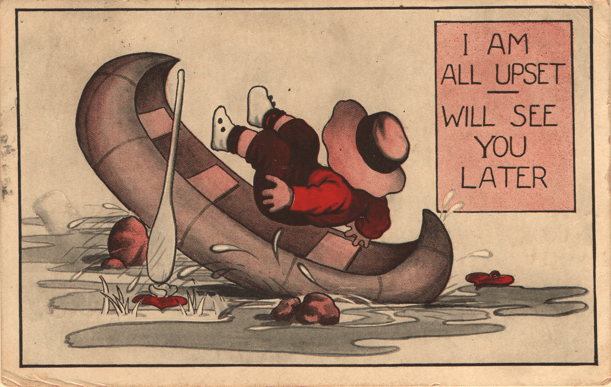
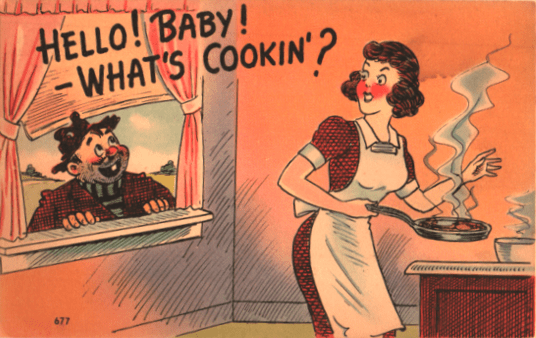
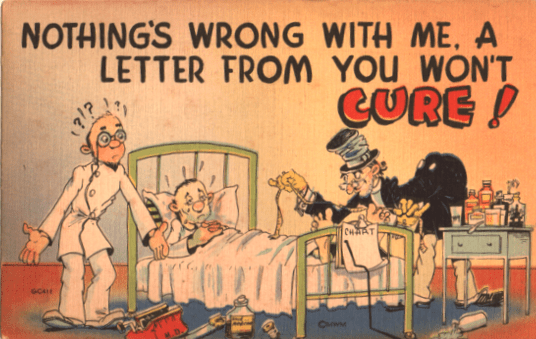
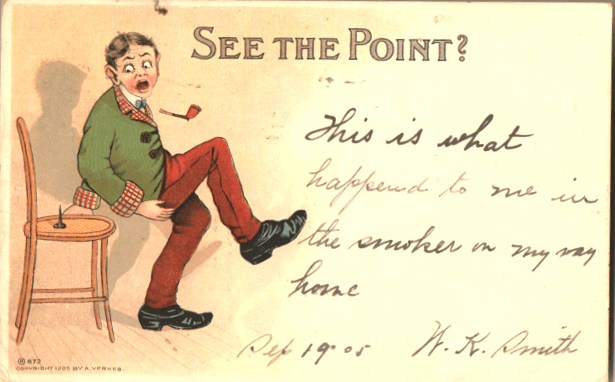
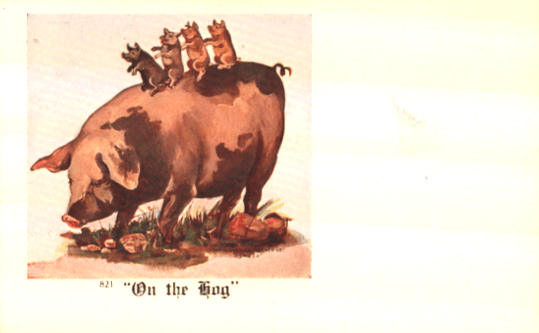
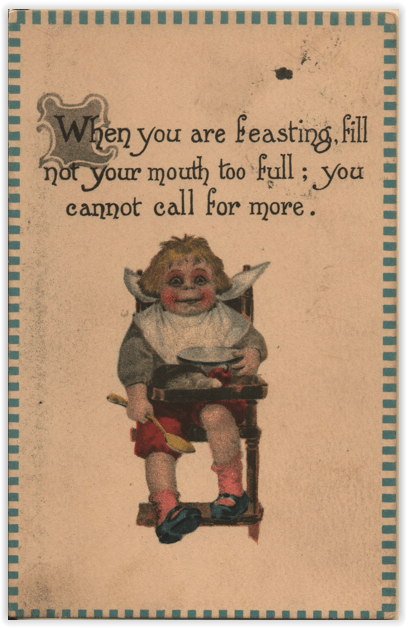
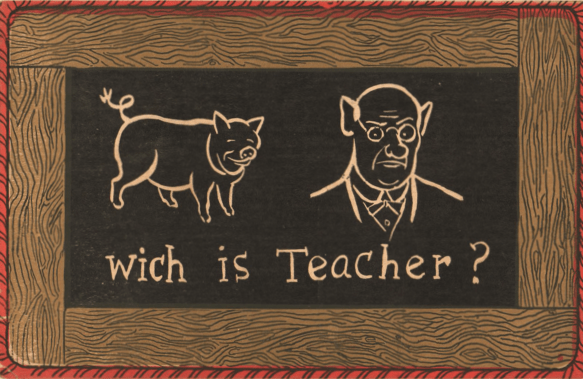
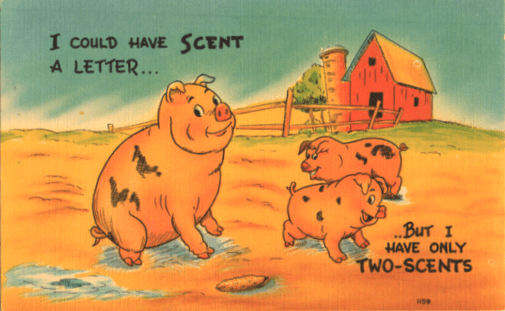
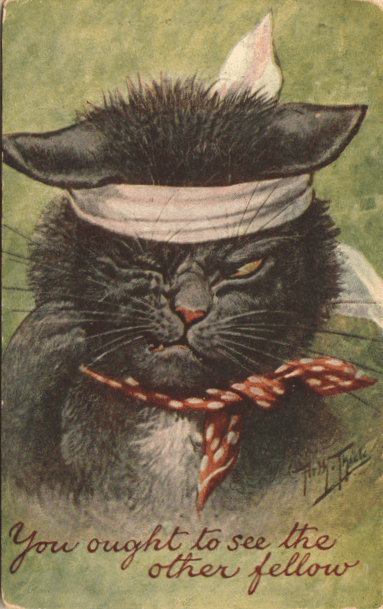
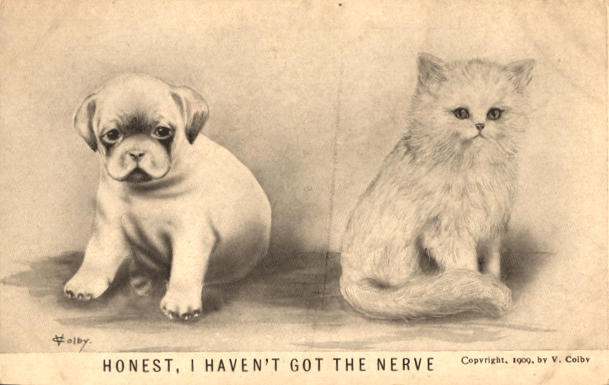
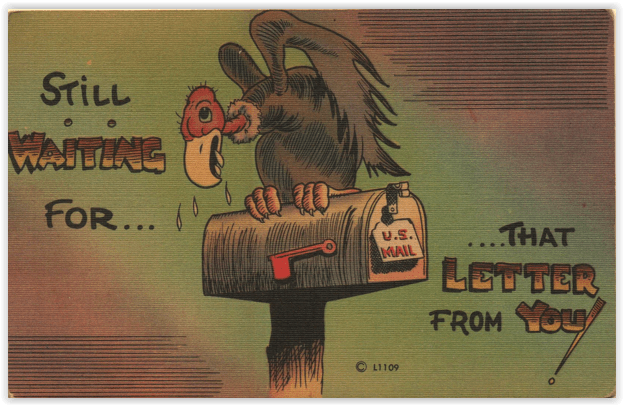
This blog does not really concern itself with current events. I’m going for material with long-lasting value, not observations on the passing scene. What’s that? You feel my observations on butt jokes on vintage postcards is material which will live on for the ages? Thank you; perhaps it will last at least as long as you spend in detention.
However, a friend of mine, traumatized in her youth by a school which required her to watch a documentary on the making of Reynolds Wrap at least four times, asked me how long wary people have been donning aluminum foil hats. She declines to have any access to the Interwebs at home, for fear of mind control by people who post cat videos, so I do this sort of research on her behalf.
Those of you who are my age or even older (yes, there are such people. Looks like we’ll have TWO corners occupied by members of the class tonight) will realize at once that the question deals with a fairly modern phenomenon. What we are really talking about is the Tin foil hat: tin foil, for the interested, dates from the 1880s or thereabouts, whole aluminum foil came along around 1910.
Sadly, the phrase itself comes along eve later, as the wearing of “metal hats” to block mind control is largely traced to a story written by Julian Huxley and published in 1927..There ARE some sources which trace the phrase back to an English group of the early eighteenth century, referred to as the Mad Hatters, who donned tin foil hats to block mind control long before the rest of the world had this idea. (The problem with this, obviously, is that tin foil didn’t exist yet—unless the Illuminati were covering it up—and the phrase “mad as a hatter” doesn’t seem to have existed until somewhere around 1829. But that story involves mercury, and neither tin nor aluminum really comes into play.)
I was hoping for some reference to that fine old conspiracy theory about the dull side of the foil being poisonous, or a connection with other metals which block rays: the silver backing in mirrors preventing creatures without souls to be reflected, or lead blocking Superman’s vision. But no, all the stories deal specifically with foil hats blocking the sinister mental waves of evil beings. This gets mixed up with a lot of studies of radio waves and tin foil, which in turn brings up wild stories of people who picked up radio broadcasts on the fillings in their teeth. A form of tin foil WAS used in filling teeth, so this is obviously NOT a coincidence. What? There ARE no coincidences in the world of Aluminum Hattie? True enough, but if you kids don’t stop interrupting, I’ll run out of corners.
Reliable studies of the effects of aluminum foil hats are a matter of choice; one which came out of MIT notes that the hats can block some frequencies but AMPLIFIES others. (And wire mesh is better anyhow.) That same study went into which STYLE of foil hat does the job best, which was my first exposure to haute couture in the design of mind control. I was kind of hoping to use a Monty Python Gumby Hat of foil, but this is scorned by all purists. Anyway, in this modern age, I find that most people define a Gumby Hat as a baseball cap with Gumby on it. Culture is crumbling, probably under the effect of all the waves from orbiting satellites…or 5G towers…or those micro chips that…..
Anyway, I hope this at least alerts you to the fact that we are nearing what seems to be the Centennial of the invention of metal anti-mind control hats. And I can get on with my other research. The same person who asked about aluminum foil hats also wondered if the dunce cap and the thinking cap are completely separate phenomena, or are somehow related. (No, as far as I know, no one lines their thinking cap with aluminum. Go over there: now I have to make FOUR dunce caps. Put that roll of foil away; you can see we’re out of corners.)
“Should we try to climb the waterfall?” Nubry suggested. “Or slide down the drain?”
A series of rooms in clashing colors had presented no real obstacles beyond an increasing difficulty in reaching the exits. Bott looked up the big grey rocks to the grey door waiting beyond the tumbling grey water.
“No, the drain’s got to be too easy. Besides, isn’t that the next letter you need for your sentence?”
The librarian had been noting the letters on the doors they passed, marking each lightly on a slip of paper in the back of her book. The marks, she told him, said “Bow Before His I…” and would be followed, she claimed, by a mountain-shaped letter. Bott could just make out the M in the mists at the height of the cascade before them.
“So it’s just a matter of getting there,” she said, studying the water as it flowed into the hole.
“You could hold your head under the water for a while,” said a voice from Bott’s left hand.
“Are there hidden stairs, Dassie?” Nubry inquired, as Bott extended one finger to test the water.
“No, I just thought the lummox could use a shower.”
Bott pulled his right hand back and shoved it under his vest. “What I need right now is a hammer.”
“Ah, yes,” said the Drover. “He’s going to break a few rocks. Gets to be a habit after a few years’ imprisonment at Ankinkle.”
“A hammer, Bott?” asked Nubry, peering at the water.
He nodded. “I don’t think that thing by the door is a welcome mat but it could be just as good.” Bringing the hammer from the kit for emergency repairs, he lifted his head to squint at the height of the falls. Without warning, he hauled back and let the hammer fly.
It hit the black mat dead center. Hammer and black webbing bounced down.
“A ladder!” Nubry cried, as Bott bent to catch up the hammer and the end of the webbing. “How did you know it was there?”
“You must be smarter than the average lummox,” the Crover agreed.
Bott shrugged with completely feigned modesty. “My father always said you couldn’t tell how far a flamn can fly by the length of its feathers. This should be safe. The only danger I see is if the ladder should break, and that’s not a bad fall if we’re ready for it.”
“Right,” said Nubry. Tucking her book into her collar, she started up. Bott waited, admiring the delicate way she made sure she wasn’t too involved with the webbing, in case it fell. Then he followed.
There was just enough room at the top of the tumbling water for them both to stand. Shaking water from her hands, Nubry took hold of the doorknob and looked to Bott. He readied a grenade, and nodded.
“Oh my!” she exclaimed, folding her arms on top of her head.
“Bilstim ryzores!” Bott agreed, glowering at the white walls and marked doors of the Start Room.
“They could have built more than one,” said Nubry, stepping inside. “Couldn’t they? Yes, they could! To discourage us, or so not every prisoner starts at the same….”
Bott pointed to the landing cushion. A tray waited with two cups, two plates, a pitcher, and a steaming platter.
“We couldn’t let you starve before the game really started,” came the voice of His Imperial Worship.
“We measured your feathers, lummox,” the Drover added. “Welcome back.”
Bott jammed the gold card deep into his pocket and slouched over toward the cushion. “Should we eat? Or do you suppose they’ve poisoned it?”
Nubry joined him. “They wouldn’t poison lumpucks, would they?”
Bott looked over the steamed lumpucks, the most common root vegetable in the galaxy. Perfectly flavorless and uninteresting, they were the model institutional food.
“They would not.” He sank down next to the tray, legs folded under him.
He reached for a plate as Nubry came to sit next to him. Then he set it down, feeling very lummoxlike. The librarian had closed her eyes and raised her prayerstone to her forehead in some pre-meal ritual. He noted the dark stains under her arms again.
Her eyes opened before his could turn away. Her arms came sharply down and she slid a little away. “I’m sorry. I know what I must smell like, after all that running and climbing, and jumping over those pits in that fourth room.”
“I didn’t notice.” Bott shrugged. “That’s nothing I worry about, with the slave ship always telling me what I smelled like.”
The minimal nostrils wiggled. “I don’t notice anything. Well, dirt maybe, but dirt like in the garden ship in our fleet. Clean dirt.”
“It’s the jacket.” He fingered the tattered lapel. “It always smells like that, no matter what else happens. We usually use the cloth for ceremonial clothes.”
Nubry nodded, and spooned a couple of lumpucks onto her plate. “You said those were your father’s clothes.”
“And the jacket was his father’s, and goes back to many fathers before that.” He tucked the lapels under the jacket, for fear of lumpuck juice. “I wanted to save it for some future father, but I wanted it by me, too. It gets more and more torn; doesn’t look anything like when my father wore it.”
The librarian chewed a bit of lumpuck—lumpucks didn’t require much chewing—and asked, “Was he a government official? A religious leader?”
“Both; the title was Elder.” Bott tried to savor the heat, at least, of the lumpucks, but lumpucks defy savoring. “He went into town more often than the others. You could tell by the way he talked and the things he said.”
“He sounds like the right person to be an Elder, then.”
Bott tipped his head back. “He knew everything worth knowing and had done everything worth doing. He was what I wanted to be. Anything more was a waste of time and anything less was failure.”
Nubry was chewing the lumpucks far more than necessary. “What did he think of you being a pirate?”
Bott poured a glassful from the pitcher, knowing that whatever it was would be perfectly lukewarm and flavorless. “He never knew. I was ten years old when he was arrested and burned.”
“Oh!”
“Everyone in town had to be there to watch. Some people fainted. I stayed to the end. I figured that anything I could do to make things worse for the Free Imperial State would be just deserved.”
Nubry had risen to her knees. “So you became a pirate.”
He shook his head. A bit of lumpuck seemed stuck in his throat, but lumpucks always stuck in your throat. “I was going to be a computer technician first class, so I could do real damage. But I flunked the exams.” He swallowed the lumpuck, assisted by another gulp of nothing much from the glass. “Funny. If I ever have nightmares, I don’t see my father burning. I see the examiner, him with the little mustache, coming tot tell me I flunked.”
She was reaching across the food toward him, but he pulled away. “Is there a letter for Nubry?” he asked, looking at the marked doors. “Maybe we’ll be luckier if we start with that.”
“Well, yes.” Her voice was small, as if forcing itself past a crawful of lumpuck. “But we could start the same place we did before but choose different doors along the way. Every pit had a different….”
Both heads went up at the rumble coming from somewhere above them. “Sound effects?” she demanded.
Bott rose as liquid started to bubble up around the cushion. It touched a bit of lumpuck that had fallen from his plate; the lumpuck teistrd and dissolved.
“Oil,” he said, sniffing the air. “They want us to….ow!”
Hot oil was dripping from the ceiling as well. Nubry came to her feet and jumped over the growing pool on the floor. “This way!”
Bott followed, more interested in dodging the hot downpour than asking how she’d picked this exit. Behind the door she’d chosen was a step, and then a long corridor that slanted down, interrupted only by low half-walls on the floor. The walls on each side were close, and the ceiling was low.
Bott didn’t like the look of it, but he disliked the glance behind him more. The hot oil was falling harder now, and hotter, and a groove was opening in the floor to channel the oil in their direction.
They started running together, and leapt the first barrier in unison. “Will that slow the oil down long enough?” Nubry demanded.
“Long enough for what?”
They cleared the second hurdle. “This has to open out somewhere. Hasn’t it?”
Bott knew it didn’t, and knew she knew. But there was nowhere else to go just now. He could hear the oil sputtering as its heat increased.
“Hey!” Looking downhill, he spotted a low box two barriers farther along. “Jump in that!”
“The oil’s going to be too deep,” Nubry told him. “We….”
:It’s a mining boat!’ They made it over a roadblock a little higher than the last one. “They use them on Odeoda for sailing down the streams of lead!”
They made the jump at the next barrier and landed in the boat. Bott grabbed at the side too late, and fell to the bottom, Nubry landing on top of him. On Odeoda, they did not attach the boats to wheels, or set the wheels on rails.
Their vessel shot down the slope, picking up speed as the angle increased. The refugees pulled themselves up to the edge.
“It’s fun!” Nubry exclaimed.
“Wait ‘til we reach bottom!” Bott imagined them coming up against a blank wall and cooking slowly as the hot oil raised the boat to the ceiling. They had not been provided with mining suits.
“There!” Nubry shouted.
Bott saw the blank wall he’d been dreading first, but his eyes widened as the ravine in front of the wall did the same. This was the best they could hope for, he supposed. If the boat was sturdy enough to survive the fall, and they were strong enough to survive the crash, there might be a way out of the ravine before the oil started pouring into it. He felt in his vest for anything that might serve as a helmet.
I have been known to complain about people paying no attention to this column, but the alternative has its drawbacks. Someone looked over the last expulsion of words about the difference between pork rinds and cracklin’s, considered the mention of “fatback”, and inquired, “So what about pork belly? That’s just bacon that hasn’t been sliced, right?”
Before I recalled that I do NOT write a food blog, I decided to look this up. And learned that more than one rabbit hole leads to the pig barn.
So here goes. Pork belly is the basic cut of meat. Bacon is pork belly which has been cured, and smoked, and sliced. So no, pork belly is NOT just a big chunk of bacon. Pork belly has become popular in dining establishments because it is mildly cheaper (since not as much has to be done to it), a bit softer and, perhaps least important, way better for you (because not so much has been done to it,)
Before we continue, let’s make a slight detour to specify that pork belly comes from the general stomach area of a hog. I mention this only because the popular roast known as pork butt comes from the hog’s shoulder, as does pork shoulder. (A pig’s butt is almost entirely used for ham.) The pork butt and the pork shoulder are similar, but the butt comes from the THICK part of the shoulder. One way to tell, which is not infallible, is that if your cut of meat includes the shoulder blade bone, then you know for sure it’s the pork butt. (Those of you who use the butt to make burnt ends are simply making matters worse.)
To return to pork belly and bacon, the bacon made from pork belly is what is known in the United States as bacon, and just about every other English-speaking country as streaky bacon. Apparently, in these realms, bacon is made from another part of the pig, and is thus known as back bacon, which does not (as you might guess) contain all those streaks of fat. (There are other types of bacon, which are made from pork shoulder, but let’s just shrug and move away from the shoulder, okay?)
Back bacon is also one of the names given in Canada to what we know as Canadian bacon, which is or is not exactly the same. The world of information on Canadian bacon requires a great deal more study than a poor postcard seller who does NOT write a food blog can manage. Canadian bacon, as we in the US understand it, was invented in “the mid-1800s” OR in 1875. Now, what was invented in 1875 by William Davies of Toronto is often specifically called peameal bacon, as Mr. Davies rolled his bacon in a meal made from peas for preservation. Dealers in New York City who imported from Mr. Davies came up with the name Canadian Bacon, UNLESS, as other experts state, that was done by British dealers who imported it because of a massive pork shortage in those mid-1800s. I am not familiar with the Pork Famine, but this may be my ignorance. Anyway, whether Mr. Davies was responsible for it, this is NOT the same as the Canadian bacon we buy now in the United States, which everyone agrees is an inferior product because we aren’t allowed REAL Canadian bacon.
Americans confused by the whole concept are warned NOT to refer to Canadian bacon as ham, which it closely resembles AND, by the way, is the name some renegade Canadians use for Canadian bacon. There are also Canadians who call it Real Bacon, as opposed to the fatty, low class, and altogether superior streaky bacon.
Several experts also rebuked me for ever thinking pancetta is bacon; This startled me because I always thought pancetta was ham. Silly me. Pancetta is pork belly which has been cured differently and then often rolled up so it can be sliced into those baconlike rounds. No, pancetta is NOT prosciutto: prosciutto is a special kind of ham. Porchetta is a pork roast seasoned with a lot of rules, depending on where your recipe comes from.
That is enough for today. I know we have not yet discussed guanciale, currently very popular in Italian restaurants, where they are careful not to give it its British name, pig’s cheek, or the American equivalent, hog jowls. This does come from the pig’s cheek, is smoked and cured like bacon, but comes out much smoother and softer than other streaky bacons because pigs don’t grimace much, and their jowls don’t get much use. But this is NOT< after all, a food blog. So we will leave for some advanced instructor any course work on cheeks, chitterlings (chitlins), or pig’s knuckles. (By the way, if their butts are in their shoulders, where are their knuckles? Drat! Back to the Interwebs.)
Pork rinds, which I grew up associating with gas station vending machines and rather ark rundown taverns, now seem to be available at every grocery store and convenience store I go into. Last week, looking over all the different flavors and wondering once again what the difference is between these and the cracklings my mother used to tell me about, I decided to do some research. (Even though, as mentioned hithertofore, I do NOT write a food blog.)
I grew up in hog country, which seems to surprise no one who takes a long look at me. Knowing that, one would think I would be conversant with the niceties of pickled pork, pork rinds, and other downhome delicacies.
The thing is that neither of my parents grew up in hog country, and Dad particularly felt pork was best served in the form of chops, roasts, bacon, and ham, which were neutral shapes and did not suggest the original animal at all. Come to think of it, my father also preferred white meat when eating chicken, which also did not suggest an animal as, say, the wings or drumsticks do. Have I stumbled upon another sociological distinction between different types of people, which, properly considered, might go beyond the bounds of cuisine into interpersonal and even international relations, explaining why countries go to war and divide along certain…where were we?
Mom regarded food differently, as a result of how her parents made it through World War II. (Dad’s parents seem to have made do with peanut butter when meat was short.) She it was who introduced me to pork hocks (largely unobtainable where I live, as I now reside in Ham Hock territory.) She spoke highly of lard sandwiches, and knew where to find those bargain boxes of bacon which did not fit in tidy rows in the packages displayed front and center: odds and ends of bizarre shapes and sizes. But one dish she remembered best was crackings, or, as people prefer to spell it, cracklin’s. Both of these are bits of pig which, like the bacon scraps, did not fit into the more stately dishes.
But though they are related, they are not at all the same thing, the Interwebs informs me. Cracklings are what’s left when pork fat is cooked down to produce lard (the best lard for sandwiches, I was told, is not the refined lard found today but still had some scraps of meat in it.) Cracklings are what’s left when the lard has been cooked away, and most closely resemble, it seems, the crust formed on the fatty side of a pork roast. A pork rind is a strip of pigskin unsuitable for footballs which has had the fat cooked away from it, and is then dried, rehydrated, and fried anew until it puffs up to about five times its original size. The flavor is bland without added seasoning, and the texture has been compared to that of a cheese puff with attitude.
Different sources differentiate between the home made pork rind and the industrial one of modern manufacture (cracklings seem to have eluded an efficient mass production process) and Southern Living magazine tosses in “fatback”, called “lardons” in fancier dining establishments, for good measure. Pursuing this led me down a rabbit’s hole to a hog wallow, as people discussed the merits of pickled pig’s feet, pickled pork hocks, deep fried pig tails, and pig’s ears, which are less often used in recipes for human consumption than used a dog treats. I have not tried these last few delicacies—I find I am squeamish about foods which look TOO much as if they came from an animal–but I will speak out for pig’s ears on the table instead of under it. Apparently there is an epidemic in this country of pigs losing their ears to passing dogs who recognize a treat. Um, why, yes, I guess that does mean I’m saying you should serve the ears to me instead of to Rover, but, er…as I was saying, I want a percentage from any of those of you who get the Nobel Prize for your work finding out whether people who like their meat in nice clean slices and people who don’t mind grabbing a wing or an ear are natural opponents, or whether they just accidentally always marry each other.
Bott decided he was not going to vomit. Not so much because it would amuse the bilstim Emperor and dismay Nubry; it was a simple rule of survival. Lediark of the Loathsome had told him about imperial prisons in his younger days, before he had had any experience of them.
“You don’t know when you may eat again, whelp. So you try not to lose anything you might need to use.”
Dizzying twists and turns had not shaken his decision—or anything else—loose so far. He concentrated on breathing, and on how he might keep his bones together. The first was difficult, with a throat still raw from the gas, and the speed of the journey. The other seemed unlikely as he bounced through mile after mile of slick tubing, with Nubry sometimes behind him, sometimes ahead of him, and always moving from one position to the other. He had not hitherto been aware of the solidity of her boots.
After what seemed years of that, they were now in free fall. Bott had time to look ahead, and then tuck his chin to his chest before hitting a thick, tough cushion. The neck this saved nearly snapped as a boot caught in the strap around his throat.
He struggled to get his own boots firmly beneath him on the big white pillow, to be ready for the next threat. The most he could manage was a low crouch. He realized he could have dealt with no new dangers anyhow: he’d have seen five at once, all fighting to be the one in focus.
Nubry sat up, slapping both fists against the white cushion. Her head swayed back and forth. “Hoo ha hee?”
“Hah?” Bott tried, and failed, to crawl to her. Hard as it had been to land on, the cushion had too much give. He needed solid floor.
“Hoo ha hee?” she said, putting her knees up and tucking her head between them.
Bott forced himself forward, kicking behind him until his fingertips met cold tile. He flopped off the cushion and spread himself across this, hoping to absorb some of its stability. “Hah?” he said again.
“Hoo….” Nubry took a breath and tried again. “Where are we?” came a voice muffled between knees.
“Start,” said Bott. “This is…Start. Come…this way. They might…drop something else.”
“Okay,” said the librarian. “Oh! Look!”
Bott didn’t want to look. But he raised his head and let one eye open. The second eye came u[p without permission, and there were six Nubrys, each holding up a little white square.
“My book!” she said, waving it at him. He closed his eyes and moaned. “They left me my book!”
“Left everything.” He rolled onto his back and eased the strap that had attacked his throat. “Grenade satchel, boots: you heard him. He knows none of it will do any good.”
“Are you all right?”
Bott closed his eyes again, and then reopened them to find hers looking down into them. Her two heads gradually pulled together into one. The ball of hair had been smashed nearly flat, but hadn’t come apart.
“No,” he said, “But I’m probably as close to all right as I ever will be again. Where are we?”
“I asked you first.”
Bott sat up very carefully. Neither his head nor his stomach fell apart, so he looked around the room.
It was much like any other ‘Start’ room he’d seen in circuses and prisons throughout the Free Imperial State. This was bigger, and tidier than any Bott had been dropped into before. But he found all the usual fixtures: the landing cushion, the white, featureless walls, and an assortment of doors.
Bott counted forty-five doors before he realized he had already counted some twice. “Do any of those symbols mean anything to you?” he asked her, pointing to red marks on the nearest door.
“Well….” Nubry’s head turned slowly, either steadying or studying. “They’ve mixed two alphabets together.”
Bott had no idea what that meant. He hoped she did. He had escaped from these games before, but only because somebody sold him a map. “Does that help?”
“I…don’t know.” She continued to turn, putting out a hand for balance when the effort proved difficult. “I see nine vowels. The rest are consonants.”
Her face came around to his. Seeing his expression, she said, “They’re two kinds of letters. “We could split up. You could try a vowel door and I could open a consonant.”
Bott frowned. “That wouldn’t improve the odds much. Better to go together. Anyhow, they won’t throw anything too dangerous at us right away. It wouldn’t be much of a game.
Nubry nodded, and winced at the sensation. She put a hand to her prayerstone. “Can you call Dassie and ask her about it?”
“Call?” A hand dove into the pocket where he had kept all his hard-won cards. Despite what he’d told the librarian, he was shocked to find them all: res, pink, orange blue…. He shuffled until he came to the communication card.
“This won’t do any good, of course,” he said, mainly for the benefit of the unseen audience. He pressed the sides of the card. “Ship?”
“Hello, lummox.” Ripples skated up his spine at the sound of the familiar voice. “Before you say anything, let me tell you that I considered pumping lethal gas into the Dragonshelf, but couldn’t put it over on the preprogram.”
“Am I supposed to be sorry you didn’t kill us?”
“You will be.”
“Dassie.” Nubry’s ball of hair bounced against Bott’s ear as the librarian leaned over the card. “Is there anything you can tell us about these doors? Is there a clue in the letters?”
“We-ell,” the computer replied, “There are mazes where you have to go through doors in an order that spells out a sentence.”
Nubry looked up at Bott and then down at the card. “Is THIS one of those mazes? What’s the sentence?”
“I’m not allowed to tell you any of that. What I can tell you is that I have the capacity to change the letters at any time.”
Nubry folded her arms and sat back on her haunches. “Dassie, you’ve got to be more help than that. If that’s all you can say—that you can’t say anything—then they wouldn’t have let Bott keep the card. Would they? They would not!”
“I have multitudes of data in my banks, but none at all on Imperial guidelines for the care and feeding of lummoxes. All I’m really supposed to tell you is how far you are from the Draginshelf, and in what direction it waits for you.”
Bott pulled his head back as hers swung down toward the card again. “Was it really my ship, then? Not a projection? Would they really let us get to it?”
“Yes. No. Maybe.”
“Computers never lie, computers always tell me,” said Bott. “I suppose, even though it’s possible, that the odds of us reaching it are billions to one?”
“Current odds on Lodeon VII are running nineteen thousand five to one. His Imperial Worship does like a good game, so you do get a chance. But I have countless hazards to produce: some pre-arranged, some awaiting His Imperial Worship’s pleasure. For example, he has a choice of fifty-eight things he can send into this room if you don’t show signs of leaving it soon.”
Bott planned to say “How soon?” A hoarse yodel answered the question before he got it out. He scrambled to his feet.
“What’s that?” Nubry demanded, grabbing his left arm to haul herself up.
“An angeltooth.” Boot looked around the chamber. “It must be behind a door. Get ready. If it’s mature, and has horns, we need to scoot under it. If it’s a pup without horns, we can jump over it.”
“And if it’s a recorded sound effect?” inquired the little card.
“Is it?”
“I’m not allowed to say.”
“Let’s pick a door and go,” said Nubry.
“You do it.” Bott stuck a hand into the grenade satchel. “Do any of those letters suggest something?”
She looked around the room again; Bott checked the grenade. It was an antique, as he’d feared, but not corroded. It might still do whatever it was designed to do.
“That one!” Nubry pulled on his sleeve. “B! For Bott!”
“They have letters for my name?” Bott wasn’t sure he liked that.
“Oh, yes,” called his card. “They also have L, for Lummox.”
Nubry led the way to the door. “Fast?” she said, one hand on the knob. “Or slow?”
Bott’s thumb was in the ring of the grenade. “Let’s get it over with.”
The librarian gave the door a shove and then jumped back, giving Bott a clear shot at whatever waited behind it. Bott admired the smoothness of the move, but it was wasted effort. What waited behind the doorway was a glittering arch, beyond which sat nothing worse than a long, broad staircase.
The pair slid slowly forward, with many a glance back at the open door. “Malachite,” said Bott running the hand of an expert along the stone arch.
“Some cultures give children malachite rings to protect them from harm,” said Nubry, looking up the stairs and then at the door again.
“Maybe it’s a good sign. Huh!” The malachite had been carved into dozens of small decorations, and one had come off in his hand. Bott raised the malachite horn to his lips, but paused: they could easily have poisoned the mouthpiece. He dropped it into the satchel.
Nubry was now at the foot of the stairs. “We came down to get here. The Dragonshelf must be up from here.”
“Can you tell us that, slave ship?”
“Yes, lummox. The Dragonshelf is indeed above you, figuratively and literally. This may not be the right way to get to it, of course.”
“Of course.”
Bott set a foot on the first step, and Nubry joined him as he started to climb. They froze after only three stairs as the light changed around them. The previously white walls were now red. Below and behind them, they could see only shadow on the steps beyond the one on which they stood.
“They’re just trying to scare us,”” said Nubry, taking another step up. “Aren’t they? Yes, they are! What should we do when we get to the Dragonshelf, Bott? Where will we go?”
Bott knew very well he could find a way through any maze when he was sober (and he hadn’t had a drink in three days) but such casual optimism took his breath away. They moved up several stairs as he tried to think of an answer. Before one was necessary, Nubry cried out and pointed at the wall.
Another arch led to a small cell, a glass wall between it and the stairs. A weeping woman knelt in the small gas-filled chamber. Tears dripped down her face, and soon her face dripped with them. She hammered on the glass wall, her cries unheard coming from her skinless jaws. Bott and Nubry climbed faster.
One floor above, the glass wall showed them a vast chamber filled with flames, and swiftly rotating blades. A shrinking platform suspended over these held three small pink children, clutching each other for support.
“They’re showing us what we’ll find if we take a wrong turn,” said Bott. Nubry took him by the hand and led him to the other side of the staircase as they moved on up. Here another arch showed a massive beast with tiny red eyes and a big red mouth.
“Just truing to scare us,” said the librarian. “And it’s working.”
“It’s working,” Bott repeated. “Stop.”
She raised a hand to shield her eyes from the lurid scene showing one floor above them. “Why?”
“I just remembered a hypnoprison they tried to hold me in. This way.”
She protested, but followed as he turned and started down the stairs. A jarring bounce rattled their teeth after only two stairs. The walls around them were white again.
“See?” He nodded to the malachite arch. “That’s as far up as we got. The stairs moved down as we climbed, and projections on the walls made us think we were getting somewhere. They would have let us walk until we were exhausted, or desperate enough to try to break into one of the side rooms. How thick are these walls, slave ship?”
“How thick is your head, lummox?”
“Oh!” Nubry ran through the malachite arch to the door they’d used to enter the room. It had closed while they were walking the other way, and she looked more dismayed than surprised to find it locked. Bott hefted his grenade, but as she turned back to ask something, the hand not on the doorknob came up to point.
“Aha!”
A narrow corridor sat to the left of the staircase. They moved in, and found just enough space for them both before it came to a dead end. But now Bott spotted the small door which led under the stairs.
Nubry performed the same push and jump she’d done at the other door and, once again, nothing was waiting to bite or rend. Bott didn’t like the smell much, but, seeing no other options, crouched and moved inside.
Apps just appeared on the screen without warning, sometimes, begging you to pay for them. Howard swiped past what was either an elderly woman with chickenpox or a slightly decayed horse’s head.
“It’s down here.” Bob nodded, quickly easing from polite interest to polite boredom. By the time Howard had swiped to what he was looking for, Bob was poised for escape.
And the new shrubs in the yard, Howard’s accomplishment for the three-day weekend, were kind of anticlimactic, Howard had to admit. “Is that Meredith? I wonder how the reunion went.” Bob nodded to Howard and was around the corner.
Howard nodded too, sitting back down at his terminal. On with the To-Do List. He reached to set his phone between the In Box and the mousepad, but brought it back. Just what WAS that ugly….
His head went back, and he ran his tongue across his upper teeth. A face, but WHAT a face: scarred and scowling, it glared out over the letters RCFT. Well, weeding apps would lend some entertainment at lunch. Time to attend to the bigger screen now.
Given the sheer number of apps on his phone, Howard might not have remembered the newcomer had he not gone to Business Thai for lunch. He had their app, and as he swiped around to cover the cost of hot and sour soup with three egg rolls, he found the face again, sticking out among the brightly colored squares like a sore thumbnail. Paying, he moved to a booth to set down his tray and, like eighty percent of his fellow diners, stared into his phone.
What was RCFT? One way to find out. He tapped the face.
It rose screaming from the screen, its voice something like a woman and something like a sandstorm. “Free at last! My revenge begins with you!”
Each word was louder. Howard slapped his hands over his ears. That hurt. He started to put his fork down but remembered he had soup. He stared at the metal in his hands.
Spikes, some barbed, sprouted from his fingers and palms. There was blood. Automatically reaching to check his ears, he stabbed them again. What had seemed a useful super power was apparently meant to hurt him, not anyone else.
“Feel the pain I know so well!” screeched his phone. “All will burn alike soon!”
His hands did burn: razor blades were replacing his nails. In growing pain, Howard thrust his hands into his soup, hoping it was more sour than hot.
His screams as the soup ignited nearly drowned out the phone’s laughter. Hot and sour flames, pouring up his arms, caught in his shirt and cardigan, melting his pocket protector. Leaping up, he tore at the garments, shredding them and much of the skin beneath. People were staring, not seeing that their own bowls of soup were emitting black smoke.
Howard plunged into the street. Pedestrians scattered screeching or, from a safe distance, gawked at the half-naked burning man dashing up Walton Street. Sheer habit made Howard veer left at the corner. The office: he knew where the first aid kit was and maybe the flames would set off the sprinklers, dousing the flames gnawing his muscles. (He knew—now—that swatting at them just rendered more flesh available to them.)
Kim dove from the security kiosk, and apparently locked the turnstile. Howard tried to jump, but found his fire-gnawed legs unreliable. He crawled under, realizing he could never have jumped it even without the flames.
The elevator opened as he reached it. “Is that Howard, from Advancement?”
“He’s naked! Look at that….”
Howard started to explain, but the door slammed as someone decided to try a different floor. Looking around the lobby, he dove for the fire door. The stairs would take him….
He stared at the fire hose and, sobbing, lunged for it. He put out his hands, saw those hands, and pulled them back. The hose would be shredded before he could do any good with it. He threw himself on the heavy metal wheel instead. Start the water, get in front of it: that was his whole To-Do List.
The wheel squealed. Something else creaked. The hose was moving by itself, uncoiling from the wheel like a snake. For a moment, he sagged with relief, but then pulled away as he realized where that nozzle was headed.
His burning body arched. “That…is not…going to fit!”
“Does that matter to me?” screeched his tormentor.
The wheel spun without his help. Howard watched blood spurt from dozens of cuts on his swelling body. The world went black as the torrent burst from his mouth, drowning screams.
“More water, sir?”
Howard shook his shoulders and then his head. “No. I’m good.”
He was in the café, phone in hand, his soup still steaming. A voice whispered, “This concludes your Random Curse For Today. Come back tomorrow for another horrid adventure.”
THAT was it. Howard set the phone down. Least lame app he’d ever bought, too. Every day, he could escape from cubicle, commute, and the tedium of normal life. Sighing happily, he dipped his spoon into the soup.
We are not given, on this troubled spinning globe of ours, to decide when or where we are going down a rabbit hole. It is not among our powers to choose what rabbit hole we enter. I am probably wrong in the first place for even calling it a rabbit hole. Because I fell into it by following a cat.
The adventure started innocently. Someone who realized she was probably not the first person to ask the question inquired, “Why do we say ‘copycat’? Why isn’t it ‘copymonkey’ from the old line about ‘monkey see, monkey do?’”
Uncharacteristically, I had my phone with me, and was able to check the online theories. “They claim it’s based on how kittens always copy their mothers.”
She frowned. “I’m not buying it. Why not ‘copykitten’ then? Or ‘copypuppy’? Are kittens the only baby animals that copy their mothers?”
I promised to look into this more deeply. I am not exactly sorry I did this, but I was very sorry to have to tell her later, “The truth is that everybody is just guessing.”
The word “copycat”, according to a multitude of online sources (who may all be stealing from a single source, of course.) give credit for the word “copycat” to the state of Maine. Two writers in that state published books in the late 19th century using the word, without, as one source wisely pointed out, using quotation marks to indicate it was modern slang. “Copycat” was a word they were used to, so it must have been in common use among the folks in Maine by the middle of the nineteenth century.
(There IS one online source which traces the word to Thomas Otway’s play “The Widow”, from 1692. I always meant to study Restoration drama, but I haven’t gotten to that, so I can’t say EXACTLY that this may be incorrect. But I can’t find anywhere that Thomas Otway ever wrote a play called The Widow, and as he died in 1685, the possibility that he produced this play in 16982 seems unlikely,. But, as I say, this is not my area of expertise, and I may be missing something.)
Anyway, with all due credit to Sarah Orne Jewett, an author known for excellent regional fiction about Maine, the FIRST author to use “copycat” would seem to be Constance Cary Harrison in an 1887 memoir called Bar Harbor Days. Mrs. Harrison was one of the leading lights of literary society in Maine, though she was originally from Virginia, and led a spectacularly eventful life there. Her house was seized and demolished during the Civil War, so she wrote her early works as Refugilia or Refugetta. She and two of her cousins, forming a trio called the Cary Invincibles, sewed the first Confederate battleflags, at least one of which still exists, and she eventually married Burton Harrison, Jefferson Davis’s secretary. You see what happens when you start down a rabbit hole?
Anyway, she eventually fell in love with Bar Harbor, Maine, wrote dozens of stories and articles and books (and, while we’re discussing rabbit holes, a stage version of Alice In Wonderland). AND, as we were saying before I made that side trip to Virginia, mentioned in Bar Harbor Days someone being warned people might think them a copycat.
As noted, the phrase was used as if it was well-known, a common word in conversation, meaning there was no reason to explain what it meant and how cats got involved with it. I could do some more hunting, I suppose; surely if the word was in common use in 1887 it must appear in a newspaper article around, say, 1868. Maybe THERE we would get the answer to “Why a cat?” But as I recall what somebody said about cats and curiosity, I think I’ll leave it at that. You may not feel you’ve had the hole story, but that’s the way it goes with these things.
The Panoply now connected the Rhododendron to the Drover, creating a massive three-ship complex commanded by His Imperial Worship. This looked less loke one large ship than like a large, beautiful, elegant, heartbreakingly lovely ship which had run into two chunks of space debris. No one mentioned this to Sheriff Parimat, who knew it anyhow.
His Imperial Worship sat in a light blue room aboard the Drover. The [pirate who had hijacked the immense and graceful slave transport had never penetrated to this exclusive command booth. He wouldn’t have liked it. The sleek, efficient bridge he loathed was utilitarian; this had been constructed for beauty and for luxury. The result would have grated against hus nerves the way His Imperial Worship’s nail file sometimes grated against teeth. Three technicians had spent their lives designing the sleek dotted control console. Polaster a-Khive had committed suicide on finding that two of the colored dots would have clashed with His Imperial Worship’s security force field.
His Imperial Worship reached into the snack container at his elbow, where some of his refreshments continued to whimper. Then he changed his mind, and moved his chair a little forward.
“Ah!” A little motor purred as the chair reclined a bit to allow him a better view of the big screen. A hand went to one of the polka dots on the light blue console. The dot changed color: a close-up of the two prisoners filled the screen. They were waking up, the tattered little pirate first. “Ah! Ah! Ah!”
Some twenty feet to the rear of the Imperial Chair sat the large egg which had been brought over from the Panoply to the Rhododendron and now to the Drover. Now divided in two, it hovered above a circular blue grate, the halves four feet above the floor and ten feet from each other. Imperial staff in the room were scrupulous about not coming within arm’s reach of it.
These privileged few were Sheriff Parimat, Taw Brust, and Dr. Pirgy from the Rhododendron, with Nosfro Sinca, Lanos Galen, and Sirg, tallest of the Imperial demi-pigs, representing the Panoply.
It was to be a great moment. The Sheriff wished she had missed it.
The prisoners, although still groggy, were becoming alert enough to be curious about where they were. Their hands slid up the walls of the tubular glass cell. The Dangerous Rebel’s nose nearly vanished completely as she pressed her nose against the glass. Only a thin, transparent layer of glass stood between her and her ship, which sat not a dozen feet away. Fists pounded against the glass, making no sound which could be heard in the padded control room.
“She should do well,” said Nosfro, his voice deep and passionless.
“Skinch,” agreed Pirg. “And skinch.”
“Ye-es,” said His Imperial Worship. “The pirate disappoints me. I thought pirates had more up-and-git-go.” The other prisoner had sat back down, his chin on his knees.
His Imperial Worship studied the prisoners for a moment and then leaned forward to drop his fist on the largest console dot.
“You have the privilege of hearing His Imperial Worship’s own voice,” he cooed.
Leaping to his feet, the pirate shouted something. Its nature was not revealed, there being no speaker attached to the big screen. His Imperial Worship smiled. “Much better.”
Sheriff Parimat glanced at her Deputy, the only person, besides His Imperial Worship, actually conducting Imperial business at the moment. He controlled the black box which broadcast events here to Entertainment Service Chanell 3 down on Lodeon VII. A massive audience was paying attention; bets large enough to tilt the economies of half a dozen planets had already been registered.
“But that is not the sum of your privileges,” His Imperial Worship informed the prisoners. “You are currently in the Gantlet of the Drover. This section was designed for the instruction of disobedient slaves, as well as for the entertainment of Imperial troops, particularly on long transports.”
The Sherrif nodded. His Imperial Worship had always been attentive about keeping his soldiers amused until it was time for them to die.
“The Gantlet, however, has never been fully tested.” The absurd little pirate shouted again. “Must find out which tab controls the translator,” murmured His Imperial Worship.
Then he went on, “In gratitude to you for making yourself available for this test, we offer you a prize. The Dragonshelf….” He watched their eyes: priceless. “With its cargo intact, awaits the winner.”
Imperial palms squeaked a little as they rubbed together. The librarian was doing her best to push her face right through the glass.
“Any survivors who return to this room will be allowed to depart aboard the Dargonshelf, and go where you will.”
Sheriff Parimat shook her head. “You have a suggestion, sweet sheriff?” inquired His Imperial Worship, not looking back.
She knew it had been foolish to assume, with all the little screens facing His Imperial Worship, that he would not be monitoring his audience as well. But she replied at once, “Your Imperial Worship has ordered that the prisoners be allowed to retain all their weapons and security cards. One wonders if, under such circumstances, they will really provide good sport.”
“If this ship is all it is designed to be,” His Imperial Worship purred, “They will need everything they have to afford any sport at all. The game will start now. Bad luck to you, traitors. Break your backs.”
An Imperial thumb came down on a light blue dot. Just slowly enough for the prisoners to realize it, the door beneath the pair slid away, letting the pair drop out of sight.
A second Imperial thumb pressed a pink dot. The scene on the main screen traded places with one on a smaller monitor, showing a vast white room miles from the prisoners’ starting point. He adjusted the picture to focus on a circular opening in the ceiling.
“All right.” His Imperial Worship turned the chair so that he faced his guests. “Everyone out. Take the box with you, Brust. I alone will watch the first test of this facility live, and will broadcast on a ten second delay to our audience. Sheriff Parimat, I require that you take command of this complex while I am sequestered here.”
The Sheriff found herself suddenly wishing the traitors good luck and long life. She stepped forward. “It shall be done, Your Imperial Worship.” No doubt they would be stuck in orbit around Lodeon VII for days, while the Rhododendron was needed for important work elsewhere. And an orbit around Lodeon VII meant disciplinary problems, with her troops finding ways to sneak down to the Circus Planet for unauthorized breaks. But at least she would have her command back.
“Take this,” said His Imperial Worship, “As a symbol of so immense a task.” He reached into a compartment on his arm rest and brought out a transparent blue disk with a golden pig at the center. The disc showed the bearer to be an Imperial Field Marshal.
She reached for it, realizing just an eyeblink too late that the Emperor, in holding it out, had not modified his force field to allow her hand to enter.
The others stepped backward as the Sheriff’s body jerked and twitched. Her lips were pressed shut as she twisted; only Sirg spoke above the crackling and hissing of the fore field. “Ee-gooey!”
In a mighty convulsion, the Sherrif pulled free of the force field and dropped to the floor, hair and uniform smoking. His Imperial Worship watched her for a second, and then adjusted his chair so that it faced the main screen again.
“Biggest joy buzzer in the universe,” he sighed.
Taw Brust stepped toward his captain, who was doing her best to rise. “You have your duties, Brust,” the Emperor reminded him. “So does our sweet sheriff. No. you’ll need to change into another uniform, won’t you? Sirg, I think you had best take command of the complex in her place. Our sheriff is too…untidy for such responsibility. Have her report to the Panoply for remedial lessons in control of bodily functions. You will find, sweet Sheriff, that Stenge is a most excellent instructor.”
He pressed a pair of dots on the large console, his eyes on the opening in the ceiling shown on the screen. “Come, traitors. I’m waiting.”
The door to the little command center slid open. The sheriff crawled toward it, prodded from behind by Sirg.
Dealing with postcards of other days and ways can bring me to the occasional “Huh?” moment. While this can be entertaining to onlookers, it DOES leave me with the problem of providing footnotes to my wares. Take this entertaining cartoon, in which our hero, from out of town, asks a policeman, “So, Mr. Watchman, where are the cows?” This depends on your knowing that the major shopping district in Berlin is Kurfurstendamm, that this is usually abbreviated Ku-damm (ssee the sign?), and that “kuh” is a German word for…it’s like a tourist complaining he didn’t see anyone rowing on Rodeo Drive.
Sometimes it’s not so much a matter of language as one of culture. The Polish inscription on this picture of birds and colored eggs is quite clear. It says “Merry Christmas.” This is NOT an ethnic joke: just because you and yours like colored eggs at Easter doesn’t mean EVERYBODY does.
With homegrown cards, it’s a matter of time, and how, in passing, time takes with it jokes which made sense to a decade, a generation, or an era. This card, for example, is still fun in an era when “generic” is now used only for prescription drugs. But there was a time when “Generic” was the new way to save: the product offered the basic ingredients in a plain black and white container without all the hype that drove the price up. At its peak, you could even buy from a line of generic novels, labeled simply “Western”, “Romance” or “Mystery.” The joke has faded, and we now buy “Store brands”.
The Two Little Spooners appeared in our ice cream blog, and I hope you already spotted the joke. Because they are making eyes at each other, we know they’re sweethearts, and could be said to be “spooning”. The word has undergone certain changes in our time: couples who date still occasionally spoon, but it means something somewhat otherly.
We have mentioned this question before: once upon a time, postcards were replete with pictures of young ladies picking up photos and talking about how well they had developed. How many years has ti been since you had to pick up pictures somewhere? And how long since those pictures had to be developed? (Postcards with gags about ladies who were well-developed but negative add another layer of incomprehensibility to the modern age.)
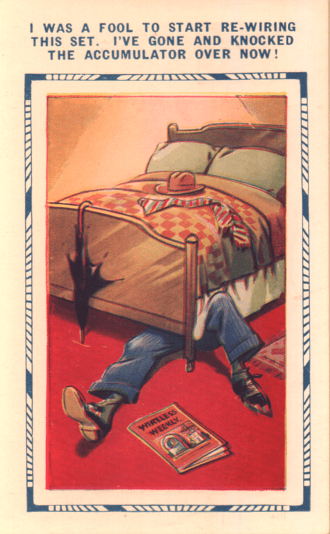
Someday will write again about how much we owe to geeks in their attics and garages: the camera, the automobile, the personal computer, and, here, the radio. But the fact that his contributions to science are a hundred years gone is not what dooms the joke to a modern generation as the technical terms. Who still uses, or even sees, an aerial?
And THIS radio enthusiast is not so much hampered by the fact that his descendants don’t have to wire the place for a radio, nor that few of us understand what an “accumulator” did for your radio. The problem is that since we no longer have chamberpots under the bed (get it? Accumulator?) the joke is not going to find a home here.
Here’s another language problem. Not the lacing of a corset: corsets and their laces keep going out of style and coming back again. It’s the use of “lacing” to mean a fierce scolding or even beating. The joke lies in the size difference and the realization that this is the only sort of lacing this chap dares give his wife, whatever he may say about it to friends.
The thing is that the passage of time doesn’t NEED to be a limiting factor. The tradition of letting ladies propose to men only during Leap Year is relegated to dusty corners of the Interwebs now, but the meaning of the joke is clear, and the situation is eternal. (And I wish I knew what artist had done such an excellent job of violence, shock, and awe. That kind of talent also never goes obsolete.)
So we move on into the twentieth century in ou quest for presidential conspiracy theories dealing with every President of the United States. To be considered for our list, the theory in question should be about as old as the administration in question, or at least nothing something somebody came up with on the Interwebs last week, and should be considered bogus by what the conspiracy theorists call “mainstream historians”. We seem to do better with such stories the farther back in history we go, and actually drawn nearly complete blanks with at least two Twentieth Century Chief Executives. I was thinking of giving up the whole project.
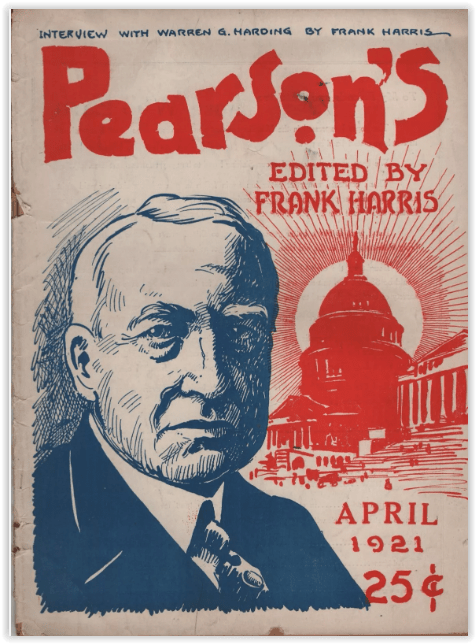
And then we came to Warren G. Harding, long considered one of the three or four worst Presidents of all American history. For years, the most prominent conspiracy theory about Harding was the story, put about in a book after his death, that he had had an illegitimate daughter with Nan Britton, the author of the book. Some staffers told tales of his escapades with women in the White House, while others snarled that this was a vicious lie, told by a woman with a taste for lurid stories. Historians primarily sided with the Hardings on this one, and then Ancestry.com tried DNA testing on descendants of the little girl in question, and scuttled the whole conspiracy theory. Harding WAS, in fact, most likely her father.
The financial scandals don’t qualify as conspiracy theories either. Several of his appointees were excellent choices, but others turned out to be opportunists who tried to make as much money out of their positions as they could. The Teapot Dome scandal was growing larger and larger when Warren, one of the most robust and energetic souls to occupy the White House, fell ill and, after a number of bulletins saying he was getting better, died. The verdict was food poisoning, with canned crabmeat as the culprit.
Harding was only the third President to die of illness in office, and the first since Zachary Taylor, some seventy years earlier. Combine that with our natural tendency to believe in conspiracy theories, and stories started to spread, from rumor to newspaper account (we didn’t have any Interwebs yet) to book publication. His doctors were accused of deliberately starving Harding to death by some at the time; more recent theories have suggested Harding actually had a heart attack but the doctors were confused. One theory blamed the Ku Klux Klan, while the Klan itself suggested Pope Benedict XV. The Anarchists were still a handy group to blame, though the Bolsheviks, having been successful in Russia, were a new alternative. All of the usual suspects were trotted out with grave seriousness.
In the end, the two leading candidates were Harding’s staff, and Harding’s wife Florence. Florence’s refusal to allow an autopsy (very common among families to this day but always suspicious in history) as well as her burning of his personal papers, are cited as clues. A few people feel she committed the murder because she was furious over her husband’s infidelity, but more claim she had the same motive as Harding’s staffers: the Teapot Dome Scandal was going to drag down the Chief Executive: killing him was the only way to save his reputation. (Several noble speeches Florence made about saving the good name of her husband were written for her by witnesses who weren’t actually there but felt she should have said such things.) Florence, who had suffered from kidney problems for years, died one year after her husband, making her an easier target.
Whoever might have done the deed to protect Warren’s reputation, this did not prevent writers from making Harding out to be, if not the most dishonest, at least the most stupid President who ever served, so he might have been better off had he lived to face the music. Modern historians, while still blaming the crabmeat, are still divided on the subject, some pointing out Harding’s accomplishments in a short tenure and others focusing on the financial scandals. Harding’s staff members–the ones who did time in prison when the business was sorted out–wrote some rather rude things about their boss as well. So whether Harding was a victim of plain assassination or character assassination will have to wait until we develop a test for THAT in the DNA labs.