If you hate baby talk, you have a lot of company. One of Irving Berlin’s lesser hit songs dealt with how it set his teeth on edge, and I have been running through the bookshelves in my brain to come up with authors who made the attempt successfully. I had no problem with a couple of novels by Mazo de la Roche (NOT her famous Jalna books) and a long but forgotten book by Lewis Carroll which I enjoyed. But I read those all a long time ago, and will not go out on a limb for them.
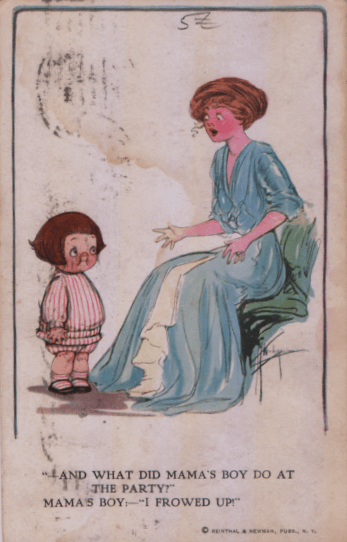
None of which, of course, kept postcard artists from attempting this unloved dialect. Here, as elsewhere, certain rules do apply. Babies themselves almost never speak in baby talk. Baby talk is more commonly something that otherwise apparently normal human beings use for speaking TO babies. As every cartoonist knows, it is more entertaining when actual babies speak in full sentences and discuss complex moral and philosophical problems.
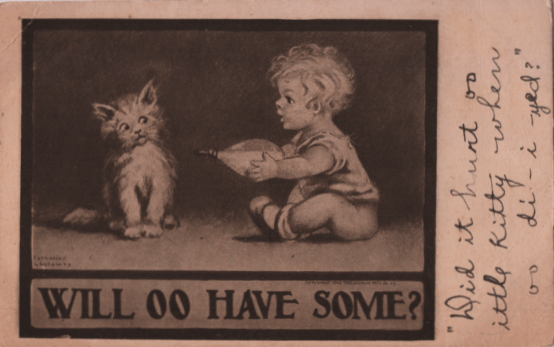
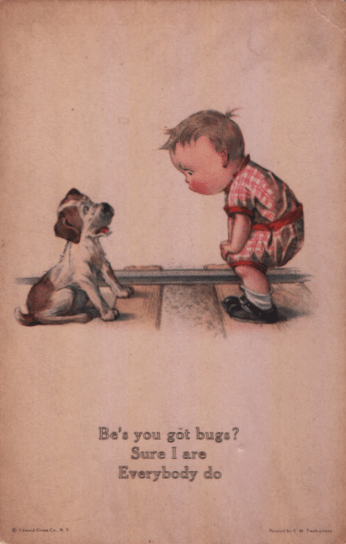
It is also, as seen here, often used for speaking to small, fuzzy animals. This is true of the world outside of postcards as well.
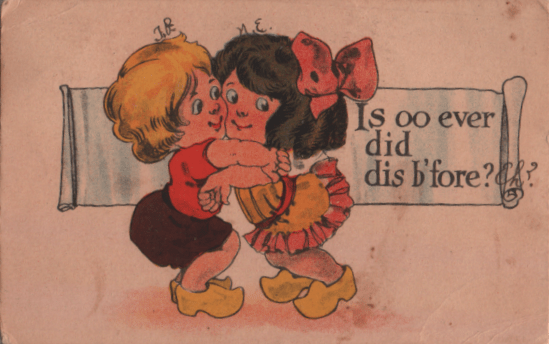
But baby talk, as Irving Berlin observed in his song “Snooky Ookums”, is at its most nauseating when used between two adults whose romance is going through a sickeningly sweet stage. It reflects a principle we have discussed hereintofore: some concepts just seem easier to approach when spoken of with an accent.
The postcard artists used this to great effect in the 1910s or thereabouts with the mammoth phenomenon of Dutch accents on postcards. And having a CHILD voice those sentiments removed the danger by one more degree. This is one of the reasons for the millions of postcards featuring Dutch kids in the 1910s.
But we have walked under those windmills many times. Today we are sticking to children speaking of romance, and in baby talk, so if some grownup (mostly) lover was frowing kisses by mail at the wrong person, one could always pretend it was all a joke.
This does not seem to have been nearly as popular as the Dutch kid postcards, perhaps because there were plenty of people in the United States at that time who still spoke with foreign accents to make fun of (and who enjoyed having their accents recognized.) But even then, people just got shudders hearing grown-ups address each other with THIS accent in public. A number of potential customers may have turned away from these cute kids due to a memory of using this lingo. Belated embarrassment may explain why we make that face when we hear it or see it later.
It might be useful if we went through our memories and postcards and books now to compile a glossary of baby talk, explaining the various usages (they are not uniform, so this is probably good dissertation material). This will be helpful to future readers, in an age when humanity has outgrown the practice.
Thus that brave new world will be able not only to read the ancient texts in which grade schoolers address each other as “booful” so adults don’t have to, but also understand the names of such classic toys as the Booful Beans doll (from early in the beanbag doll craze of the most recent century.) Much cultural data may be lost to them if we don’t move now to….
What’s that? You don’t think we will ever, as a species, outgrow the urge to say “Oose wittow tweeheart is oo?” You have a point there. One should never deny the contrariness of the human race. Even if it does lead you to go find comfort in the bottle. (Test the temperature on your wrist first.)
Two people walked hand in hand, picking a careful path along the wet grass. He was tall, with rather too much nose in the center of a long, bland face. She was not so very much shorter, with tiny eyes, great big glasses, and an excess of chin. The eyes of each were guarded, the mind of each busy with individual thoughts. He was the first to break into the silence.
“I have spoken to the caterer about the brie. He’s promised to see to it.”
“I’m glad.” She was, too. Michael had been obsessing about that brie for six days now. He was going to be one of those husbands ready to point out every flaw in the universe. She’d guessed that when he snapped at her for the handprints on his fender.
“Clarence had that mail-order brie at his wedding,” Michael went on, as if that explained everything. To him it probably did. Family meant a lot to Michael, and Clarence was one of his uncles; she wasn’t clear which one, but it WAS the one who was always doing the wrong thing though he might be fun to be around. She shuddered: what if Michael insisted on naming their first boy Clarence?
To shake off the thought, she offered, “We could always use the mail-order brie to fill in the buffet toward the end of the reception.”
He shook his head. “In all the bother, the caterers would surely forget which was which, and serve that first.”
She shrugged; she had never expected to go walking with her fiancé in the park and spend the whole time talking cheese. “Especially if they’re working in this little field house,” she noted.
Michael looked the small brick building over, and then past it to consider the park. He was glad this was no more than one of the finalists for the reception site. This was terribly hard-used: too open, too public. If they had to utilize a park, he’d have preferred the handsome passive park in the museum proposals. He looked across the street, to the horizon: you couldn’t trust developers, though. If the museum did succeed with its passive park, it would also no doubt put up one of those huge soulless gray-white buildings that looked like minimum security correctional facilities. As well actually be married in a prison as have reception photographs with one in the background.
“They said they could run flowers along all the fences,” Bailey said, pointing at the softball diamond. “And we could do the pictures there, or maybe put the buffet tables along that way.” There was a gurgle behind her voice as she went on, “And we could have the three bars at first, second, and third base.”
Michael gazed in the direction of the imaginary bars and buffet tables, all wobbling hazardously on the uneven platform provided by the softball field. Then he glanced at his optimistic fiancée. Bit of pudge there today. Bailey’s mother was, by his estimate, a 54 double D. He hoped Bailey wouldn’t turn out to be one of those wives who ballooned up after the ceremony. She seemed helium-headed enough, at times.
“And we could put the mail-order brie way out in left field,” he went on, with not quite a giggle.
Michael smiled in mild appreciation. At times she looked rather too much like barbie.
“Drat!” She bent from the waist to reach to her left shoe. A pair of sandwich wrappers from that fast food place had blown across it, and had apparently decided to stick.
“Allow me.” He stooped to pull the greasy paper from the square toe of the shoe. She should have known to wear canvas shoes, not leather ones, for a cross=-country stroll. She would learn: one did not expect perfection in a fiancée. Adjustments had to be made, and expectations lowered.
Bailey sucked in her lips, embarrassed both to have Michael down there and by the Booty Burger wrappers, which were not helping the case for Griese Park as a spot for a romantic party. Michael was not the sort to be married anywhere that French fry boxes might dance around his feet.
She shrugged. Anyhow, she could say she’d had a man at her feet. She opened her mouth to say so, but changed her mind. He didn’t find the brie in the outfield funny.
The terrain underfoot was damp, so it was easy enough to slip. That was all there was to it. Michael knew he had just imagined a shove between his shoulderblades, and a jerk on his shoes. He came forward. With a shriek, Bailey sat down hard.
He rocked back, horrified, pulling his face out of her lap. “I am terribly sorry. Let me help you!” His sister Nan would be screaming at this point; probably Bailey had to catch her breath first.
Bailey pulled back, catching her breath as best she could. “Did I splash you? There’s mud on your knees.” Michael was the sort of person who would take this personally.
Michael hoped Bailey wouldn’t be the sort of wife who obsessed about trifles when important matters went unnoticed. “Are you all right? Are those bruises or is it just dirt?”
“Oh, I….” Bailey looked around at herself. “I think…. Oh, hello!”
She was being sniffed by a small gray and white dog and a slightly larger black and white dog. “Come back here at once!” bellowed the young man at the end of the bifurcated leash.
“Oh, they’re all right.” Bailey was glad of anything to distract from the dirt on her fiance’s trouser leg. “What are YOUR names?” She smiled at the dogs, who smiled back, tongues out.
Michael stepped back, raising an eyebrow as the dog walker said “Well, this is Beaufort, and this is Bonbon.”
Both dogs were flailing feathery tails as Bailey reached out to scratch the head of the smaller dog. Michael, with the tiniest of shrugs, reached down a hand to the other.
“They’re so cute!” cried Bailey, addressing dogwalker, Michael, and the dogs at the same time.
“That’s their job,” said the dogwalker.
Beaumont looked like a teddy bear which had gone primitive and returned to walking on all fours, while Bonbon had obviously been a tiger in a previous life and was irked at being found in a smaller body. She took hold of Michael’s thumb, still wagging her tail.
“Yes,” he told her. “You’re fierce. You’re ferocious. I knew it at once. Give me that thumb back. It’s mine.” Shaking his thumb loose, he held it just above her eye level, so she could bounce up and grab it again.
Bailey was scratching Beaufort under the chin. Long black hairs, sticking out on each side of his head like eyelashes, made him look thoroughly exotic. The fuzzy round head twisted to offer another spot to be skritched, and Bailey obliged.
Bonbon was enjoying the thumb game, but spotted something on the ground that looked like food, and moved closer. The double leash made it necessary for Beaufort to accompany her. “Bonbon!” barked the dogwalker. “Drop it!”
Bailey watched them go, waving in reply to the dogwalker’s nod, and then looked up at Michael. She had liked the little dog but had even more enjoyed the sight of her fiancé playing with the other one. It was the first thing she could remember him doing that didn’t seem rehearsed. Her head tipped to the side. How did she know he hadn’t rehearsed it, though. Michael was one of those people who never did anything for the first time: prepared for everything, surprised by nothing, irritatingly unflappable. So why couldn’t he buy his own Brie?
“You’re going to be soaked through,” he pointed out, reaching out with the hand Bonbon had been savaging.
He was correct, of course: what else? Putting a hand on a drier patch of park, Bailey pushed herself up without his help. Most of her weight was on that hand and one foot when the foot slid straight forward, so straight it might have been pulled. She landed square in the mud again with a solid splop.
Michael was moved to point out, “Those shoes aren’t suited to walking in wet weather.”
Bailey found this unreasonable. Dashing some of the new mud from her hips, she snapped, “But these are your favorite shoes!”
He frowned at her feet. “Are they?”
“You said you liked them best.”
“I don’t remember that.” Michael frowned a little more, but gave it up. “The color is very nice.”
Very nice? She slapped both palms on the ground behind her, making two more loud splops. “And here I’ve been making sure they were clean every time I come in so I could be sure to wear them again when we went out!”
Michael supposed he could have paid more attention. Most women were like that: they worked long and hard to make their appearance seem spontaneous and effortless, and then expected you to appreciate al the effort that had gone into it. “Well, you really needn’t go to all that trouble. We’re already engaged.”
Her mouth screwed into a little pout. “And you don’t like them!”
“I didn’t say that,” he pointed out, quite in a reasonable tone. “I just never gave them much thought.”
“Oh, well. In that case….” Reaching out with muddy paws, she pulled the shoes from her feet and wiggled her toes.
“My dear!” Michael had never noticed Bailey’s toes particularly. They seemed perfectly acceptable toes, if you cared for toes. He didn’t think much of this tendency to undress in public, despite one fleeting recollection of distant days when he could go barefoot in public.
She set the feet flat in the mud, preparatory to pushing up, and wiggled the toes. “That feels good.”
Pleasant, Michael thought, to see her for once when she wasn’t looking left, right and backward, worried about what people were thinking. He reached out again, offering the hand nearer to the less muddy of her own.
“Thank you,” she said, and stepping out of the depression her struggles had made in the landscape, walked over to her discarded shoes. She looked left and right, and, spotting a garbage can, walked over and dropped them in.
“My dear!” Michael said again.
“Hey!”
Michael and Bailey turned. Their friend the dogwalker was waving the red handle of the leash, which was all he now held, as Beaufort and Bonbon, still connected to each other but not to him, leapt across the park, their lack of synchronization offset by their glee in their newfound (relative) freedom. Michael whistled, and they glanced at him, but after another “Hey!” from the dogwalker, moved on by, ready for a race.
“They’re headed for the street!” Bailey slid in the mud, but dug in a heel and launched herself after the pair.
Michael was running with her, stooping now and again in futile grabs at the trailing leash. His fingers closed around it twice, but, with no handle, found it sliding from his grasp each time.
He was NOT going to be outrun by anything with such tiny legs. With another burst of speed, he got far enough ahead of the leash to grab it toward the middle, and flip the loose end toward his other hand. Digging his feet in just as they all reached the sidewalk, he learned that Bonbon, particularly, was made up of a good deal of muscle. He tripped forward but kept his grip and avoided landing on his face on the concrete. He pulled back, his shoes digging again into dirt.
“That’s got you!” he announced, as the dogs swung around to face him. They started forward. He nodded to them, reaching with his free hand, but his eyes sought Bailey. He seemed to have lost track of her. He had heard her shouting “Don’t hit the puppies!”, and realized where she must be.
She had flagged a blue Buick that had come around the blind corner. It had, fortunately stopped, as she was right in the middle of that lane of traffic. Michael’s mouth dropped open.
“Thank you! Thank you!” said the dogwalker, joining him. “Bonbon’s been chewing the leash again.”
“Hmmmm? Oh.” Michael was still staring at his barefoot fiancée who, realizing the danger had passed, was bowing to the Buick and gesturing to it to move along.
“Leash broke.” The dogwalker was trying to attract Michael’s attention and relieve him of the leather band while dogs bounced cheerfully around his ankles.
“Oh. Oh? Of course. No trouble.” Mchael released his grip.
“Come on, you two. You’ve had enough exercise for one day.” The dogwalker twisted the end of the leash around his fist. “And I’ve had enough for the whole week. Thanks again.” Michael murmured acknowledgement.
Bailey, meanwhile, had mounted the curb and come back, favoring one foot. Either she’d sprained something or had scraped it running barefoot on the asphalt. “What happened? The leash broke, huh?”
Michael took a deep breath. “What were you thinking? You might have been injured! Even killed!”
“Thank you! Thank you for letting me know!” Bailey put her right hand in hr left. “And you would have been so embarrassed!”
She was trying to shift the engagement ring, but Michael’s eyes weren’t on hr hands. Those feet, those silly feet. He was appreciating for the first time that he was apparently marrying a woman equipped with toes. Something basically ridiculous about toes. It went along with a woman ridiculous enough to risk her life for a couple of mophead puppies. Pleasant, really, if one could go along with that as well.
He looked up at angry eyes. “Nnnnnno,” he said. “I wouldn’t have been embarrassed until the reception, when I realized I’d have t eat all that brie myself.”
Bailey had worked the ring past her knuckle, and was about to say something devastating, as soon as she thought of it, when she took in what Mchael had said. She froze for a moment, wondering if he was laughing at her.
One way to find out. “And you wouldn’t want to be part of some cheesy reception.”
He laughed, and put out a hand. To take it, she had to do something with the ring, so she jammed it back on her finger, at least for now. “That was brave,” he said. “Too brave, perhaps, but I wouldn’t have thought of it. Had I missed the leash, the dogs might have needed you where you were. For that matter, if the leash broke once, it might have broken again when I pulled at it.”
Bailey, realizing that it had been a close call for Bonbon and…whatever the other dog’s name was, felt a moment’s impulse to cry. But it was important to remind him, “It didn’t break. You’re the one who saved the puppies.” She still felt like crying, so to stop herself, she reached up and kissed him.
Michael wasn’t sure he liked her kissing him in public than he liked her taking her shoes off in public. But when he stood back to tell her so, it seemed a good deal more reasonable to kiss her in return.
“Remember you?” she demanded, when he’d finished. “Of course I’ll remember you.”
“You’d better,” he told her. “And I’ll always remember your perfume.”
That was a pity, for Bailey couldn’t remember it herself. She’d remember what it was later, she supposed. They set off back across the site of a possible reception, hand in hand, pausing only by the garbage can so Michael could retrieve her shoes. He thought of everything.
We have so far made no mention of the 2024 Summer Olympics, and this must be remedied. I am myself an Olympics junkie, sucked in by the games of 19…whatever. I watch in my own special way, of course. There are events I watch through my fingers (“Don’t fall, don’t fall, don’t make me watch you fall”) and a few I watch through my eyelids (“Could I get a medal if I stay awake for five more minutes?”) But we will discuss MY Olympics some other time (the acquaintance who mentioned he had a gold medal, the cousin who had a bronze, the time my bosses had scored a public relations coup and someone said “The only thing that could stop us now is if a bomb goes off at the Olympics”. All semi-interesting stories which can wait for another day.
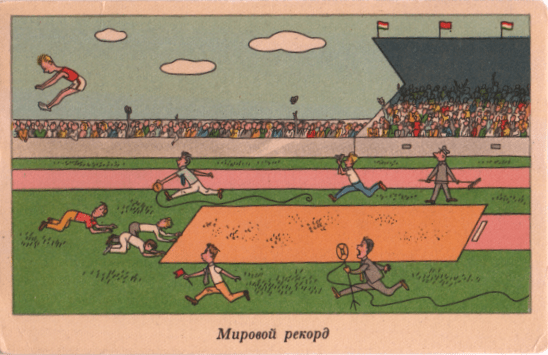
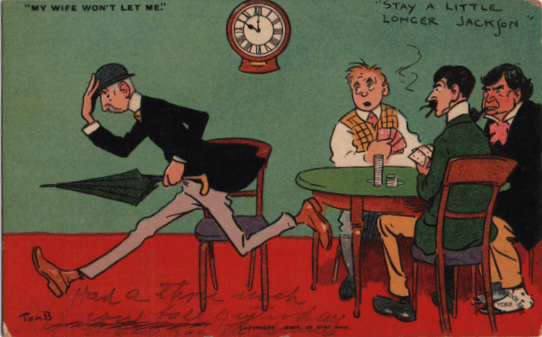
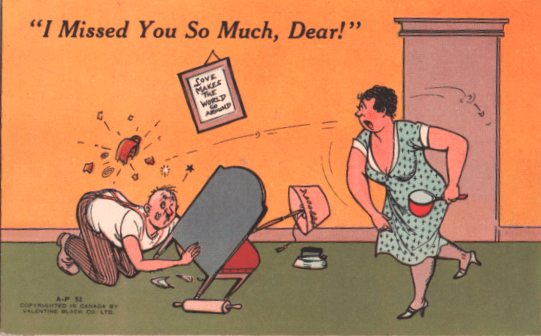
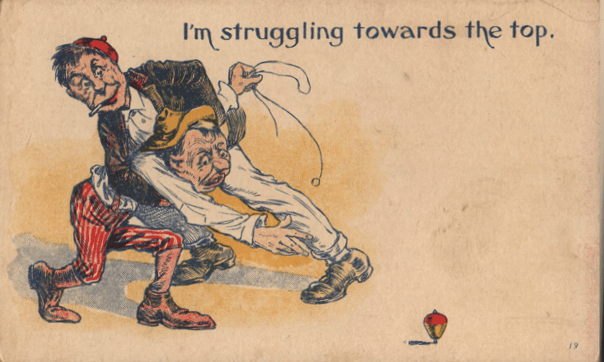
What I wanted to mention was that the array of postcards about married life shows a relation to the Olympics I had not suspected. This British card, for example, shows that the 100-yard dash was well known to cartoonists early in the twentieth century.
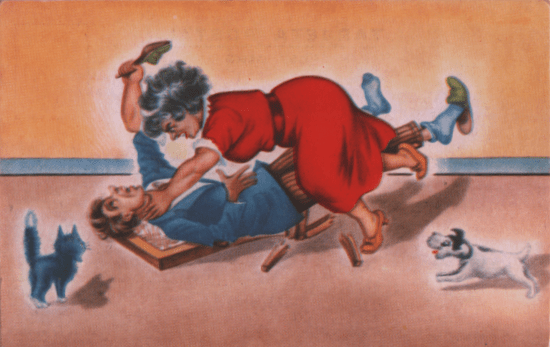
Wrestling, of course, was known in antiquity. Styles may have changed, as seen in this Spanish card of about the same vintage as the British one, but the sport is unmistakable.
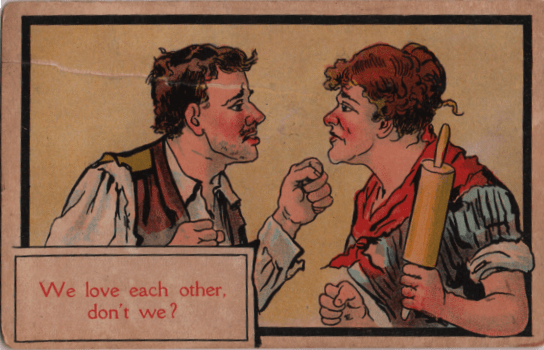
In the world of boxing, this card from 1908 or thereabouts shows that the postcard artists were ahead of their time, envisioning mixed boxing (the female boxer is apparently given an equipment advantage.)
It is also no surprise that a sport as old as golf gets its place in the marital Olympics.
And I believe this is some version of fencing, though if some reader out there can identify it as a lesser-known martial art, I will accept that explanation. (Yes. I see that the card claims this is poker, but sporting terms change with the years. At first, because of the shape of their weapons, I was thinking this might be miniature golf.)
There are simply too many cards showing various forms of running and tumbling, but the most popular event, represented in dozens if not hundreds of cards, is that classic track and field competition, throwing the dishus.
The postcard artists were interested in all forms of athletic endeavor. This may be one of the first pieces of evidence that curling was being considered for the Winter Olympics even before there WAS a Winter Olympics. The lady’s size and her readiness to make use of a broom show she was an enthusiastic curler.
And in some cases, we have illustrations of sports which are no longer part of the Olympic lineup. This lady is demonstrating her skill at the early Biathlon, a combination of weightlifting with stairclimbing. (We do not have time for side issues, but I hope you have observed that some Olympic uniforms were as impractical as some of today’s: how many events nowadays are performed in heels?)
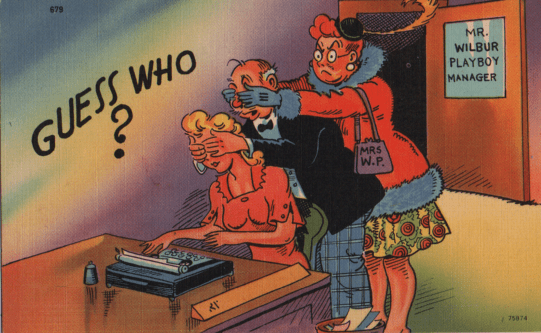
This card is one of the few pieces of evidence we had for what must have been an invigorating sport in Mixed Peekaboo Relay.
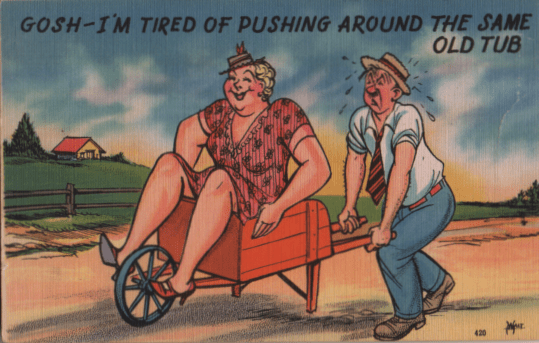
While the record of Tug of War at the Olympics is well-documented, we have only the postcard artists to tell us that good old-fashioned wheelbarrow races were considered as well. Maybe we will see some of these marital games at the 2028 Olympics. Or you will: looking over these illustrations leads me to believe I’d watch most of these with my hands in front of my eyes.
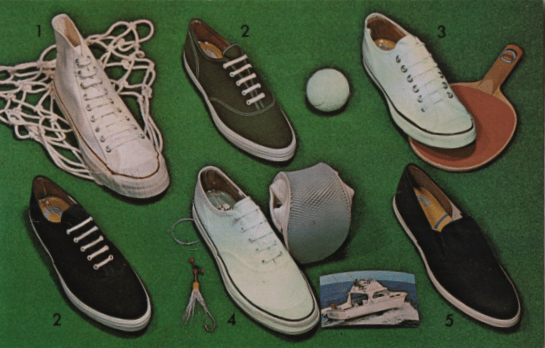
Once upon a time, there was a commercial which emphasized the importance of shoes. The young man in overalls who has never worn shoes because his feet can’t breathe finds that Hush Puppies are different, and cries out that now he can go to school “I can BE somebody!” (I do not have a Hush Puppies postcard; you’ll have to settle for this one from Keds, also responsible for some classic television.)
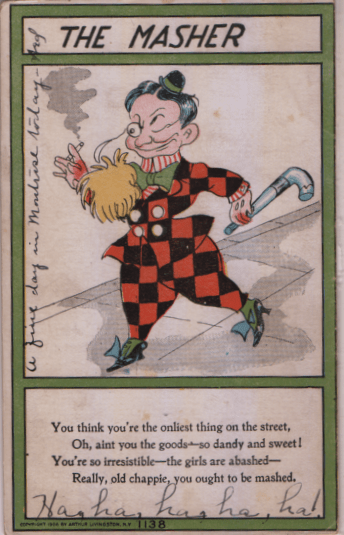
Rather than rail against fickle fate, which has made it impossible to watch this young man’s revelation on the Interwebs (did NO one save a copy?) we will consider the role of shoes on postcards of the past. Our postcard artists were NOT going to let this important article of fashion elude their notice, especially if their point was making fun of a well-dressed man. This chap cannot catch a break from the cartoonist, head to pointed toe.
This chap’s clothes veer off in an entirely different direction, just as unfortunate as the one preceding. He has dressed for excess, and those shoes are a worthy part of that effort.
One problem, of course, is that we must look past the change in fashions when considering cartoons of an earlier day. Although this gent is rather oddly proportioned, the clothes he wears would not have raised many eyebrows, back in the day. He is simply wearing spats, a decorative element once meant to both add color and possibly save parts of your shoes and socks from the mud (mostly the adding color bit.) So these are NOT caricatures of shoes (except in size, which is a fine old joke for some other blog.)
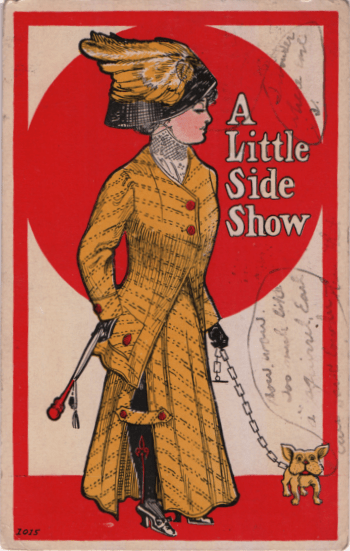
Likewise, though this IS a caricature of modern fashion, it’s meant to be a comment on the new dresses with side slits. The SHOES are not part of the joke.
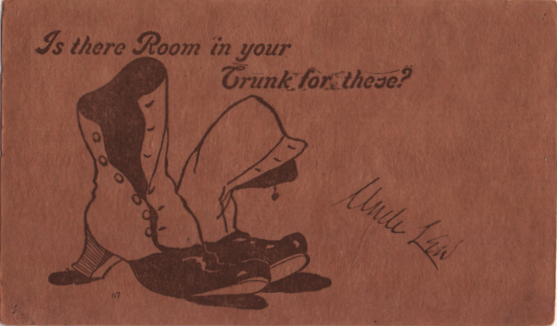
Similarly, these well-worn droopy high-button shoes are merely a mild exaggeration, something fun to draw to illustrate what COULD have been construed as a racy innuendo. (You wouldn’t pack so personal a belonging of someone else unless you were really well-acquainted.)
As in this wildly popular shoe joke. I have had three different versions of this little exercise in drawing shoes so other people could draw the conclusion. Once again, though the shoes need to be prominent, making them caricatures would have gotten in the way of the gag.
In this well-drawn bit of fashion commentary, the shoes are not the first, or even the second point of the picture. (Either the wordplay of the caption, or the slam against the Hobble Skirt comes first, THEN the lovingly depicted legs in black stockings, and then the bird with the sly dig, and THEN the shoes, which are still part of the joke, being ill-designed for walking on winter ice.)
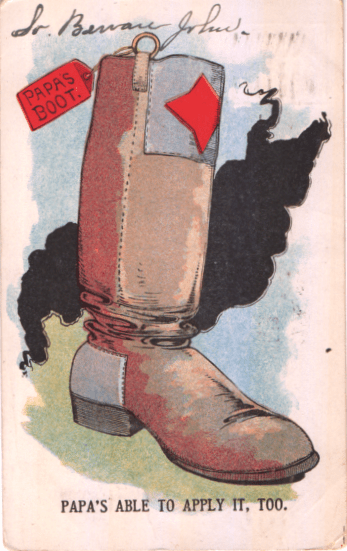
As time passes, of course, the interest of the viewer will change. The political joke has faded into the realm of dusty humor (we are comparing Papa to the nation of Turkey, which offered to give foreigners the boot.) We’re more interested now in the design of this handsome bit of footwear.
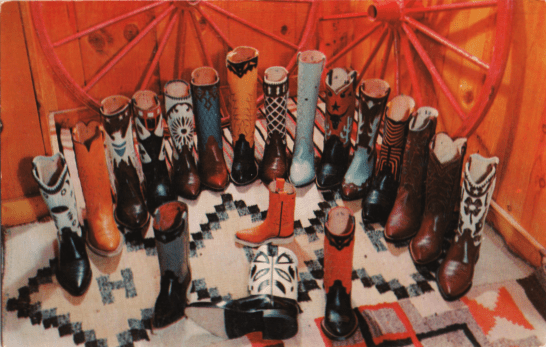
And THAT sort of thing is more or less eternal, as shown in this postcard from about half a century later, featuring an assortment of boots available in Arizona. (I’m sure the boot from the previous postcard is in here somewhere. Keep looking.)
Little raindrops sprayed from little wings, but did not affect the petals the phronik tossed with abandon. Meadow Saffron was the first to pause.
“Whoo!” she said, fanning herself with one petal. “I thought for a long time we wouldn’t do it. And they would.”
“The way she was treating him like one of her girlfriends!” Bluebell spread herself out in midair on her back, waving a hand in front of her face. “I thought sure he’d see how to move in!”
Unfirom nodded. “Delaying them long enough for the rain to come was good enough.”
Blubell kicked out and did the backstroke up to look him straight in the nose. “Did you make it rain?”
“Of ot was no more than a matter of rain, the five of us would be unnecessary,” the angel noted. “Was there some reason you didn’t lure a dog or a passerby toward te bushes? That might have spoiled the mood more quickly.”
Swwt Pea was peering up the drainspout of the lodge, obviously hoping for a stream of water, but looked around quickly. “That would be cheating!”
“Anyway,” said Primrose, kicking raindrops from a leaf down to a bedraggled wildflower. “They might’ve just gone someplace else, where we couldn’t….”
“Watch,” said Bluebell.
Sweet Pea stuck both hands out to catch raindrops, but these were so fine that it took a while for the tiny palms to fill. “It was easier that time we had to make that couple do it right here. Why dn’t you bring us some more like that?”
“That was a special case.” Unfirom studied the clouds. “Those two would have met later at a party and fallen so thoroughly in lust that they would have used the hostess’s bedroom and then left in a hurry without getting each other’s phone numbers or addresses. They would have hunted for each other unsuccessfully for the rest of their lives.”
“And what about these two?” Meadow Saffron demanded, pointing at Olivia and Griffin in the distance.
The angel swept rain from his nose. “They would have decided they had to get married in about four months. Forbidden by their parents to do so, they would have eloped.”
“But that’s romantic!” cried Bluebell. “And they were so cute together! Couldn’t they have lived happily ever after anyhow?”
“Just outside of town, Olivia would cry out that she saw her father’s car. To escapem Griffin would have tried to beat a train to the crossing. Without success.”
Sweet Pea threw her arms over her head, scattering the rain she’d captured. “Oh no! What a good thing we were here!”
“So now what?” Primrose demanded, slapping away the rain Sweet Pea had splashed all over her.
Unfirom wrinkled his nose toward the sky. “The marriage will take place,” he said, “And for the same reason, but three years from now, by which time Olivia will have a job and be able to support him.”
Primrose rolled over on her back to watch the rain come down. “And they can get married in a church, with their families, and cake, and little sandwiches.”
“And presents.” Sweet Pea nodded vigorously. “Blenders.”
“And napkin rings!” shouted Meadow Saffron, throwing a fist up into the air.
“Little pillows with tassels on the corners,” sighed Bluebell.
“Matching candlesticks,” said Primrose, a faraway look in her eyes. “And crystal and china sets they won’t use and….”
“A Moby Sandwich!” squealed Sweet Pea, spotting the first of the early lunch crowd, careying the cheese-covered fish filet in a soggy bun. The phronik dove after her: Moby Sandwiches always dripped cheese and hot grease. Unfirom nodded, and moved off in the opposite direction.
The rain was no more than a drizzle which soon faded into plain humidity. The usual migration of people for whom a wet park bench took nothing away from time out of the office was beginning. Booty Burgers, Moby Sandwiches, and fries of varying size and sog perfumed the air. There were couples in the crowd, but none with pressing personal requirements, for which Unfirom was grateful. He would do his duty I any case, but the phronik were harder to gather when Triple-Thick Pizza made an alternate call.
His thumbs began to rub against his forefingers. Working with the phrtonik could be frustrating but not as much as periods of inactivity. There was always something to work on, something doing, in his pre-park days.
A quiver of the shoulders was all he allowed himself by way of a shrug. Then he picked up his pace, striding toward the familiar back of a head.
The developer had wrinkled his suit only to the extent needed to seat himself on the plastic bag he had spread across the wet bench. A sketchpad open to a page of precisely spaced doodles sat on his knee: nothing here resembled the Pont a Methon building. This seytchpad did not involve itself with any project except in the earliest stages: he was playing hooky. He really should have been in front of the computer, reading all the updates from various government agencies, or composing more complaints against Booty Burger. But he allowed himself occasional bouts of creativity among the day’s occupations.
Unfirom had seen this sketchpad a dozen times by now; he sidled over to watch unseen. Today, as on most days, the developer was sketching quick nudes of passersby, in their passing poses. Unfirom knew he had definitely complimented the young woman walking the shih tzu, but had very much shortchanged the young man on the inline skates. The couple in the convertible, which had paused a mere ten seconds at the stop sign, was very elaborate, though it was obvious the artist was more interested in a classic Mustang than in the occupants.
The angel remembered the couple well; their attention had been diverted along a better direction when the phronik made it possible for them to realize they had patronized the same tattoo artist. Unfirom resisted the temptation to reach over the developer’s shoulder and add this detail to the developer’s sketch.
With an even tinier quiver of the shoulders, the angel turned away. A woman was marching through the wet grass, a long rolled banner trailing behind her. He could see through the folds that she had spelled it ‘MUSUEM”.
The crowd she had hoped for had not turned up, but her face brightened when she saw the back of the developer’s head. She walked faster, pulling up on the banner she hoped would rally the population to defend the park. Unfirom pulled back, waiting to see if he would be needed if and when she recognized her mortal enemy. He was not sure what she would do to the man with a weapon as wet and floppy as the misspelled banner.
“If you enjoy using the park….” She began, nearing the bench. Her right foot found the very spot where the ground leveled down toward the sidewalk.
“Ack!” She nearly regained her balance, but her left foot landed on the corner of the banner just as she swung around, jerking on the trailing fabric. Flapping forward, she landed hard on the sidewalk, presenting her southern façade to the trembling skies.
Unfirom checked around for the phronik. None of them were in sight. She had managed this landing all by herself.
“Are you all right?” There was no recognition in the developer’s eyes as he stooped forward, extending a hand across his sketchpad.
Her face was as red as the lettering on her banner. “I don’t know. Yes. No.”
“I don’t think you tore it.” Since she was ignoring his hand, he used it to catch up a fold of the banner. “The grass must be wet yet.”
“Ye-es.” She took the offered fold of banner from his hand, not very gratefully. “Thank you. That’s fine. I, er…thank you.”
Banner trailing behind her, she hurried away, limping just a little. Her face and neck were still very red. The developer watched her for a moment, and then returned to the sketchpad.
The new sketch was quick but as definite as any of his drawings. One of her legs was stretched behind her head on impact; Unfirom was mildly interested to observe that he had left her shoes on her feet. The developer nodded at the sketch, and reached inside his jacket for a red pencil, to shade the result.
Unfirom turned to watch the protestor leave the park, pausing a bit as a car whipped around the corner. Unfirom nodded. He had been sure the developer had given her higher heels than she was actually wearing.
Passing her on their way to the park were a tall man with a woman not quite so tall. Unfirom’s interest in the sketchpad evaporated, and he marched through the wet grass, searching for his co-conspirators.
Three quarters of the company were to be seen near the park lodge, Sweet Pea napping in a discarded yellow shoe, both her tongue and that of the sneaker hanging out, while Meadow Saffron and Bluebell wove a shoelace around a twig. They were singing again.
“Roller-skating Tatum had the whole thing planned
For a roller Derby comeback that would sweep the land;
She mastered every skating trick they could design—
And then some doofus went and put the wheels in line;
Percolator Coffeemaker,
Subaru and Studebaker;
All ya got is all yer gonna get;
Waddya bet?”
Unfirom gave the sneaker a nudge with one foot. “Where’s Primrose?”
“Oh, cookies,” muttered Sweet Pea, rolling over and sticking her hands under her head.
“There is work to do.” The angel pressed down on the shoelace. “Where is she?”
“He just doesn’t listen to the answers, does he?” yawned Meadow Saggron, fluffing out her hair in back.
“He will have only himself to blame if we never see her again,” said Bluebell, tossing the twig over one shoulder. “And we shall have to sing trios.”
Unfirom closed his eyes for one second. Then he turned to the park lodge. A glance through the window showed a tiny white cloud erupting from a doorway. He turned and marched around to the glass doors of the lodge.
The unique smell of dim rooms formed by painted cinderblocks struck his nose. He followed a faint background scent of flour, striding past small empty meeting rooms and then through a dark echoing chamber suitable for shuffleboard, ping pong, or skits performed by people in foolish costumes.
“Oh, pafoots!” cried a shrill voice from the room that opened onto this.
Having a studio so unworthy of her efforts was always a frustration to Primrose. In fact, few people larger than a phron could have accomplished much in a kitchen so small.
Ingredients were tidily stacked on the counter to the left of the cracked sink. Primrose was always tidy, except for eggshells, which she always tossed on the floor to keep them out of the way.
Just beyond the mixing bowl, though, several mounds of salt showed where she had run into difficulties. As Unfirom approached, she set her little measuring cup on a clear space, and then flew back to tip up the salt canister. This was not too large to lift, but it was too big for her to control, and the flow of salt rushed across her cup, knocking it over. She thomped down the canister and ran around it to set up the measuring cup again. Then she ran around and tipped the canister up again.
Nine times as much salt as the cup would hold surrounded it. The phronik gathered in the doorway cheered and applauded.
“Kinda early for snowdrifts!” called Bluebell.
“Phoof!” Throwing her arms up back behind her ears, Primrose kicked the measuring cup into the sink, where it bounced back and forth twice before rattling to a stop in the drain.
Sweet Pea flew over to study the cup. “What were you making?”
The chef wiggled her fingers above her head and scowled at the mixing bowl. “This silly recipe calls for two cups of sugar.”
Meadow Saffron flew over to light on the canister. “But this is salt!”
Primrose kicked at one of the little piles. “I know. They were out of sugar. They never have ANYTHING around here!”
“I wonder why.” Spotting the canister lid, Unfirom picked it up and put it back on the canister. “Shall we move outside to our usual chores?”
“As long as it’s not another couple running into trouble just for something to do.” The disappointed chef ran her fingers through the hair, streaking it with white powder.
“When we get to do it our way,” said Sweet Pea, settling in the drain to peer up not the faucet. “It can be all kinds of fun.”
“You can’t debauch everyone in the park,” said the angel.
A drip was forming above Sweet Pea. “Oh, I bet we could,” she said.
“You’d be recalled.”
Sweet Pea sniffed. “Where do baby angels come from?”
Unfirom tossed his hands toward the door. As they emerged from the shadows and looked through the glass doors, Bluebell spotted the couple making their way carefully through damp grass. “Oh dear,” she said.
“They’re holding hands already,” said Sweet Pea. “That’s a good sign.”
“Not really,” the angel replied. “They’re engaged.”
Primrose flew up toward Unfirom’s right ear, salt adhering to damp calves and thighs. “What’s the problem, then?”
“This couple will also be married out of necessity.”
Eight round eyes were moving from the couple to the angel’s somber face, and back again. “You’d never guess,” said Sweet Pea.
“They have to get married because he’s decided he’s getting too old to be single, his parents want grandchildren, and she’s as suitable as any.” The angel nodded to the approaching couple. “She has to get married because she’s tired of living in a studio apartment, she has money, and he’s good-looking enough to be acceptable.”
Four mouths dropped open. “Ick!” said Primrose.
“Do we HAVE to?” Meadow Saffron demanded.
The angel inclined his head. “There will be two children,” he said, “Who will be devastated by the divorce when each finds someone more suitable. The younger of the two will take Little Hans, his plush dinosaur, and run away from home, right into traffic. The dinosaur will survive this.”
“No no no!” Sweet Pea launched herself toward the couple, hit the door, and bounced backward onto the floor.
There is much to be said for technical ineptitude. Once again last night, I came very near to commenting on a video on a social media venue. One of my favorites was replying to a comment by getting into costume and…never mind. You had to be there. I have enough to do just explaining that my comment relied in the first place on an outmoded expression, and was reinforced by a reference to a book not one person in a million has read. I haven’t read it myself. (Though that is no reason not to cite it, as anyone familiar with the Interwebs will understand.)
I was going to mention, in passing, a one hundred year old reference book of which, for my sins, I owned two copies as a child. (I may still own a copy: over several moves, books went into boxes with wild abandon.) In its own way, it IS a legend of American literature, a treasure known as Putnam’s Phrase Book.
This mighty reference was published by G.P. Putnam’s Sons (hence the name) in 1921, and was assembled by one Edwin Hamlin Carr, who is apparently known for nothing beyond this one wonderful work. He tells us it was the work of a lifetime, plucking useful phrases from everything he read, hoping these would inspire users to pepper their own writing with such phrases. He includes a number of examples of letters which can be composed using his….what shall we call it?
How about “Cliché Thesaurus”?
Consider, for example, phrases he suggests you use to describe something mysterious. He starts with “Into those invisible regions where we cannot follow”, which is intriguing, not to say mysterious, itself, and then proceeds to “Clothed in a cloak of mystery”, “Shrouded in mystery”, “A great deal of hokus-pokus”, “It was Greek to me” (which he properly ascribes to Shakespear), and “Utterly inexplicable”.
For those people who find themselves confronted by the mysterious, we have these phrases for someone who is “Perplexed”: “Utterly at sea, “I am really at the end of my tether”, “It is very vague”, “We cannot make much of it”, and “Utterly inscrutable”. It is no crime to use the word “utterly” so often, even if one is writing a book about substituting exciting phrases for what you were going to write.
He admits in his very short (and largely metaphor-free) introduction that he has slanted his material. Mr. Carr was a writer of the 1920s, when optimism was considered a civic duty, and he tells us he has emphasized “commendation, optimism, and courtesy”. Obviously, he has no relevance in the era of social media.
So under “Pessimistic”, though he HAS included pessimistic phrases—“Doleful recollections”, “A damper of my hopes”, “Smothered under the wet blanket of”, and “Fallen into the Slough of Despond”—we also get descriptions of pessimistic people: “He always has a plentiful stock of gloomy ideas”, “A peddler of pessimism”, and “He indulges in the gloomiest forebodings”. (He even includes a phrase for that last person to use: “No rosy delusions should be permitted to warp our judgement.”)
WERE there people who felt the need to consult Mr. Carr to come up with such utterly pedestrian phrases for their work? Well, it is a thick (though pocket-sized) book and it sold a LOT of copies, so there may well have been professions (politics jumps to mind—thought of that one myself, but I bet it’s in the book) who felt having a copy of this on the desk might be just the cure for a moment of writer’s block. His reference book CAN, he hints, be used to prompt your own phrase creation. You could read through a section and think, “I can do better than that!” and proceed to prove it.
So besides making myself look at least four or five years older than I actually am, I am glad I did not mock Putnam’s Phrase Book on social media. Perhaps, in saying, “Since we all talk in phrases as well as in words, every home needs a phrase book as well as a dictionary”, Mr. Carr was right after all. We need not, as he might say himself, regard his life’s work as “Arid and unfruitful”, “Cheap and tawdry”, “Of no particular moment”, or “Utterly repudiated”.
Okay, M. Bergeret, you’ve got me. Explain the joke.
Not long ago, I added to my inventory a collection described as an assortment of postcards roughly 120 years old, based primarily on French silent movies: mainly comedies. Among these, among scenes from a Dutch documentary of the 1950s and a German drinking song postcard or two, were numerous works from A. Bergeret et Cie.
Albert Bergeret set up as a postcard publisher in 1898, and by the turn of the century was printing seventy to a hundred million postcards a year. (Have I mentioned what a HUGE fad postcards became?) These were almost all photographed subjects: cute kids, weird fantasies, and one series I’d like to see more of, in which pinup models interacted with punctuation marks. Some of the cards I have do seem to be scenes from morion pictures or stage productions of the early twentieth century. (The Bergeret imprint lasted only until 1905, when he merged with another company and took a different name for the combined company.)
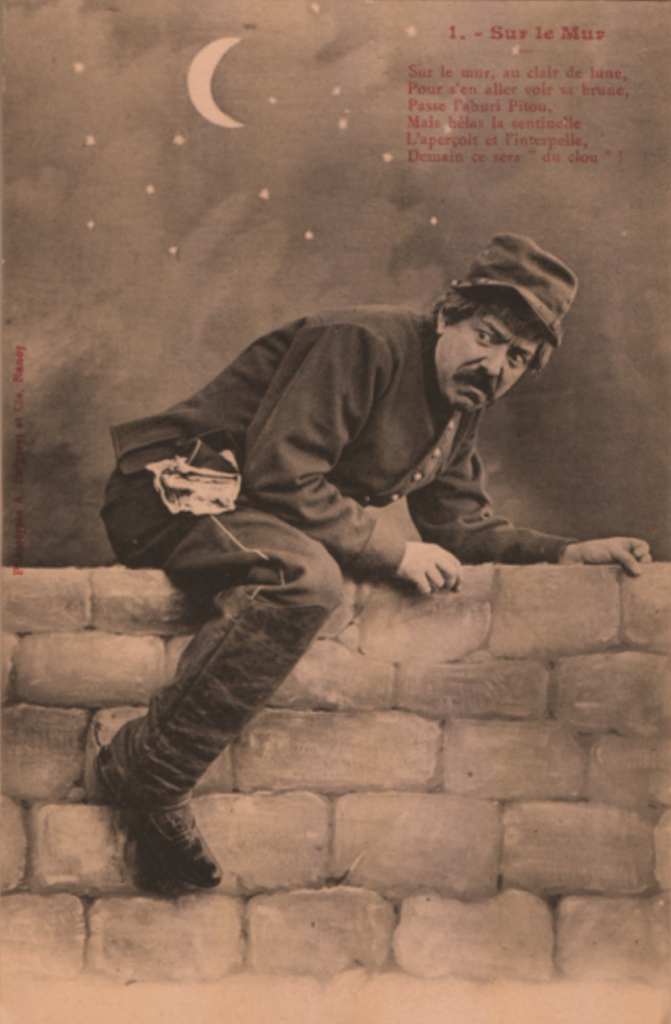
We have discussed hereintofore the early postcard trend toward series of postcards, and have even mentioned specialized series in which a long poem or popular song would be divided by verses into several postcards. So I was not sure, when I saw these three cards from a “Sur la Mur” series, whether I was dealing with a movie, a poem, or a song. I’m still not.
Part of the problem is the relationship between me and the Interwebs. YOU try looking up “Sur la Mur” online. When the Interwebs wasn’t trying to sell me postcards “On the Sea” (Sur la MER) they were showing me postcards about love (Sur l”AMOUR.) OR they were showing me people who decorate their apartments with postcards on the wall, which is closer to my literal search but got me no nearer to the postcards in hand. Here’s #1 in the series, by the way.
Here we have a nice little poem, which I will NOT try to translate into verse, about Pitou, a popular stage and movie character, a hapless and put-upon soldier. Here we are told that on the wall, by the light of the moon, he sneaks out of camp to see his brunette. But the guard spots him and hollers and tomorrow, we are told, will be all cabbage. Somebody else will have to cover the complex subject of cabbage in French idiom, but this is a sympathetic and entertaining little vignette. Let us consider postcard #2.
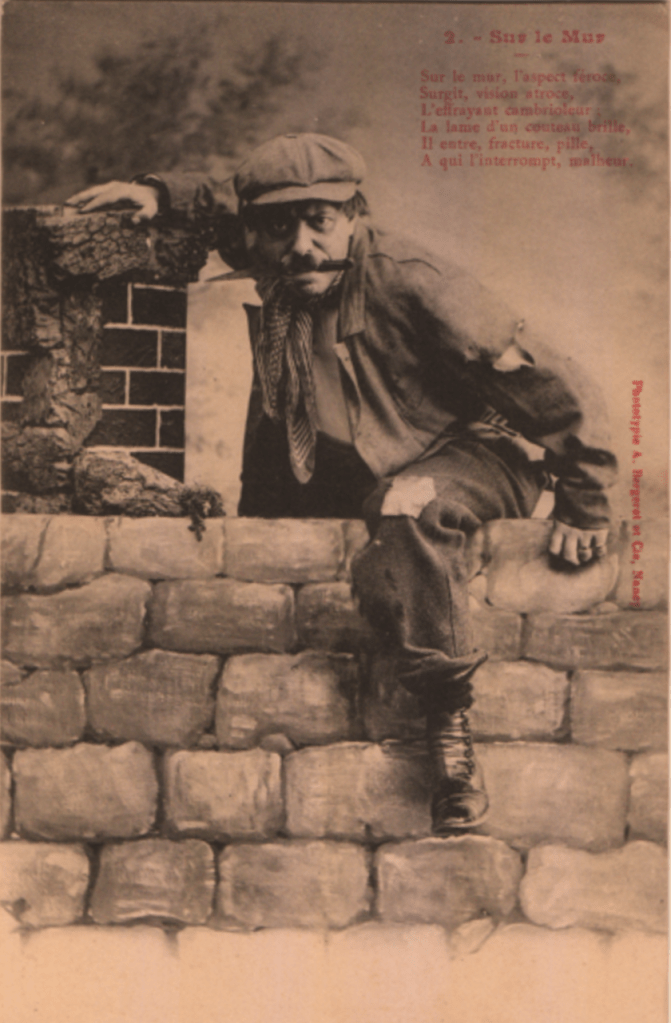
On the wall, with ferocious face, rises a horrifying vision: the fearsome burglar. His blade flashes in the moonlight as he breaks and enters to pillage. Bad luck to anyone who interrupts him! I admit that Pitou was not so cute as HIS poem suggests, but we have definitely changed key. What kind of creature will face us in postcard #3?
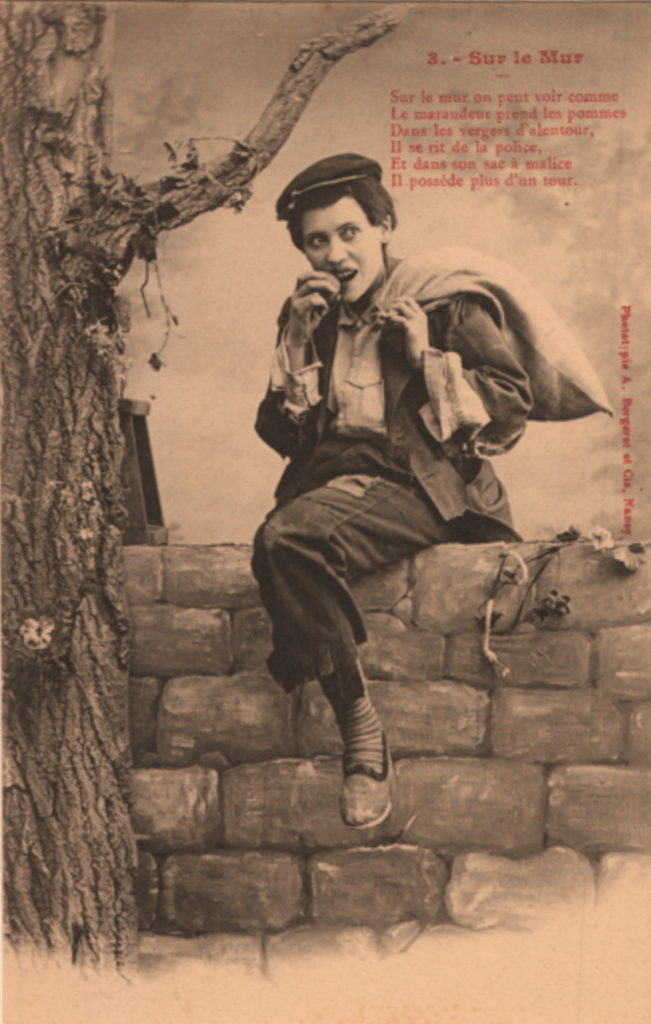
On the wall, a marauder swipes apples from the neighborhood orchards. He laughs at police, and in his heart is a malice that tells him to do this again and again. Do you see the natural progression of crimes here? Me neither. If we’d started with the boy thief, turned him into a luckless soldier, and THEN had him turn to burglary, that would have produced a typical Victorian song about the inevitable decline and fall of naughty children. That isn’t what M. Bergeret had in mind. These pictures are not pf the same person. Heckfire: it’s not even the same wall.
And, moving on to the 64,000 franc question: is this it? Or were there further cards, at least a fourth one to pull the story together? Maybe the Bergeret employees simply found they had unrelated photographs of different characters and walls, and decided to write a few poems to make them marketable. Tell me whatever you can about the subject. I’ve run into a…ah, sit down. You must have seen that coming.
Olivia took hold of her collar with both hands. “It’s going to rain,” she stated.
“It’s not going to rain.” Griffin shook his hair back. “Besides, thunder and lightning will make it even better.”
Olivia’s lips pulled in. Griffin realized that he’d have had a better chance if he’d said the second sentence first. “And look.” He nodded to the narrow space between bushes and brick. “We’ll have lots of cover.”
Olivia looked to the people running along the track. “I can see over.”
“We’re not going to be standing up,” Griffin pointed out.
“Oh!” she said. “Oh, right.” She pulled on her collar some more, not really doing much more than twisting it.
Griffin studied the patch of dirt. “Yeah, this’ll be okay.” Turning to her, he found her mouth open, and very pink. Her eyes seemed very large.
Olivia saw Griffin’s eyes narrow. Was that exciting, or scary? Seen by everyone else as a reedy guy, tentative, with a mustache similarly thin and timid, Griffin seemed suddenly very masterful. Did he come here a lot? With…others?
She licked her lips and then, deciding that might be seen as an invitation, sucked them in. The advice she needed right now wasn’t in anything they’d given her to read in school, OR in the magazines. Who sat down first? It seemed creepy to just go…get down there while he was still standing up. She bit down on her lips to stifle a giggle.
Griffin heard it anyhow: that was encouraging. Nothing was going to happen, though, if they just stood there looking at each other. “Here.”
Stooping, he swept away a litter of leaves, torn newspaper, and Booty Burger bags. “We need some space.” Some paper was stuck under dried mud and took a little effort; this gave him a chance for a reminder glance up Olivia’s shorts. There as quite a lot of her; he really ought to get bonus points.
Curled against the base of the brick wall was a rolled and dirty issue of Subterranean Samurai Swingers from Cincinnati. He ran a thumb across the top, looking for the issue number. He had missed a couple of issues last winter, during the Ragnarok-Armageddon Showdown, when the Red Gotcha was killed by the Mad Auctioneer. But he couldn’t remember which issues those were.
“I knew when I first saw you,” she said, putting a hand on the wall.
“Huh? Oh, er, yeah. Me too.” He looked up again, with what he hoped was a romantic smile.
Olivia was tall, with soft, natural curls and soft, natural curves. Anyone would have thought she was six years older, except for her uncertain complexion and the uncertainty in her eyes. She was a very good hug.
She was silent. Griffin straightened and cleared his throat. “Well, this is the proof that can’t be denied. Here’s where we pledge that our love burns forever.”
“Burning love,” Olivia murmured. She shivered. Sitting down quickly, she yanked off her sandals.
Annoyance that she should start with the inessentials mingled in Griffin with a twinge of guilt when he saw those pink toes. “Burning love.” His eyes went up to the clouds. “Hope the weather doesn’t try to put out the fire.”
Olivia looked at the bushes, which were rustling fiercely again. “Oh. It will be…sweeter in the rain. We’ll remember this for the rest of our lives.”
“Yes.” Griffin’s mind was on more immediate matters. He’d have to put his hands in the dirt, wouldn’t he? So then how did…well, time for that when they got to it. SOMEBODY had to go first and report on method to the Four Rs.
He, with Tracy, Jason, Leif, Luke, Chuckie, and Jim, had founded the mighty club known, for security reasons, as the Four Rs. Only the members knew they were the Rough Rowdy RamRodders: a group dedicated to rising into adulthood through pursuit of adultery. (That was one of Leif’s best lines in the By-Laws.) Rank in the organization was regulated by the point system on Chuckie’s phone. Members received one point for a hand that landed here, two points for getting a hand in there, and so on through ten-point, hundred-point, and even thousand-point operations in the field of love.
Embarrassingly, the Four Rs had no officers. Only Jim had risen to the dizzying height of Privates First Class, with a verifiable twelve points. And even he hadn’t managed all that on a single date. Club Secretary Chuckie kept complaining he had almost nothing to enter into the complex coded recordbook he had developed.
Well, there’d be something to record now, once Griffin finished up operations here. There might have to be new codes to cover exploration of new territory.
Olivia had unbuttoned a single button. What was she supposed to do with her hands? Later, once…well, eventually, no doubt, you got to a stage where every move came naturally, but there were bound to be awkward moments between the time you got your clothes undone and the moment you remembered why.
“Perfect love,” she said, her eyes on the second button, “Casts out fear. Oh!”
Her hair, which had been well clear of any part of their camouflage, had suddenly gotten itself attached to a branch. A quick tug did not free hr; had she looked closer, she might have wondered how the wind had managed to tie several strands of hair in such tiny knots.
Griffin leaned down. “Here. Let me help.”
“No!” Both hands went up to hold off the man who was her Eternal Love. “No, no. Don’t…worry. I can do it.”
She torre at the branches and dashed leaves from her hair. A glance at Griffin showed she had not offended him; for a moment, when she shouted, she was afraid he’d walk out of the bushes. No need to shout. Griff wasn’t the type to take a chance at a quick grab: she wouldn’t be here with him otherwise.
Griffin did take a step back, his eyes on that second button, which had worked its way loos when she turned to tussle with her hair. He flexed his fingers.
Olivia pulled the last of the twigs from her hair. She spared not another glance for the trustworthy Griff. He was the only man Olivia had been out with this often who had not yet gon for tit or tush. The most he’d ever gone for was her arm: her wrist, in fact, not even her upper arm, which other guys considered an expressway into her blouse. And he didn’t push sex into every conversation.
Tom next door, for example, liked to study stuffed animals and point out omissions in anatomy. Jim was always spotting “wrinkles” in her clothes that he was willing to smooth out. That kept his hands outside, anyhow, unlike Terry, with his “Look! A wasp on your sleeve! I’ll get him!”
Griff was different. Griff kept his hands where they belonged, and Olivia had never detected a trap in anything he said. (Unlike Leif, with his “interesting book I just read”, ready at any flicker of interest toi follow this with “Want to try it out?”
Griff’s confession of love had surprised her; his invitation over here was amazing. But it had all been just right, his sincerity showing in every word.
Enough: the branches seemed to be staying put. She brushed the other leaves from the front of her blouse, undoing the other buttons in a single move.
She did not look at him. “I hope it’s not just these,” she said, her right hand cupping her left breast so she could lift the whole assembly in the (to her eyes) rather flimsy bra.
“Mmmmmm?” Griffin had been watching with such interest that he had forgotten for a omoment that he was part of this scene at all. “No no!” he tapped the side of his head. “It’s what’s up here that counts.” He added, to himself, “It’s what’s down there that adds up.”
“Hearts and minds that beat in time,” sighed Olivia.
Griffin licked his lips, and put his hands down to wipe his palms on his pants. On second thought, he shifted them to his own shirt. This was getting urgent: best not to take chances. No rushing: he would owe his position in the Four Rs to her; the least he could do was move at her speed. No points for rushing: the Four Rs insisted Rape was NOT worthy of being an R.
This, Olivi told herself, was going to be perfect. Even so, she had to take another breath before shrugging her blouse down. One arm, then two arms, and she moved to set it down.
“Ugh! Ants!”
Griffin had seen absolutely no ants when they chose this spot. He shoved a fist down among them, sending them away at a scurry and mashing into the dirt the little red piece of candy neither had seen roll into place.
“Heh. It’s not in your blouse you’re supposed to have ants.”
In any other guy, Olivia would have thought this was crude. She squirmed, more at the thought than from a lingering aversion to ants. But Olivia understood. It was just a little joke to put her at ease. Griff was thoughtful that way.
“To love ant cherish, huh?”
Griffin shivered. “Windy,” he said, to excuse this sign of weakness.
It was not a windy day. And yet the bushes rustled again, loudly, and a scrap of torn newspaper fluttered by, with another gum wrapper. The gum was Juicy Fruit, the headline, briefly glimpsed, was ‘NWED MOTHER, 17, KILLS SELF, BA”. Olivia’s hand jerked away as if this was a giant ant, and the scrap fluttered up against the wall, the flip side bearing an ad for secondhand tires.
Olivis glanced at Griff, and thought about asking. Instead, she reached behind herself for the hooks, shaking her head.
“These things,” she said, a little hoarse. “Everyone’s always looking at them.” Unharnessing her chest, she set the bra down on the blouse. “Big and fat and ugly.” She dealt the left breast a slap that left a pink handprint for just a second.
Oooohhh, golly: she was waiting for him to answer. “They’re not ugly.” So far, so good. “They’re not really….” He groped for a word and cursed as it came out. “Subtle.”
Olivia’s smile was all reward. Other guys, to get on her good side, would have gushed about her girls, or insulted them to get on her good side. This was just Griff, with an honest opinion. Her hands slid to her waistband.
Griffin swallowed again. She was so…clean. The nipples were pretty much the same color s her lips, which surprised him. Was that the lipstick? Did she wear lipstick?
“They slow me down.” She slapped the same spot again. “Nobody likes you when you’re big.”
Griffin’s lips seemed very dry to him. “I don’t know about that.”
She folded her arms across her chest, and rocked a little forward and back. “It was exciting at first, you know: being first and bigger than anybody.” One hand swung down to the large economy-size undershirt she had just discarded. “But you get to be fourteen and you’ve heard all the jokes about watermelons and…and cows, and ‘your cup runneth over’. And the senior guys asking if I wanted to go for a ride. And if I complained to anyone, it was always ‘Oh, yeah, you’ve got it so rough.’”
Griffin nodded with sympathy though he was now listening with one quarter of one ear. His eyes were taking up most of his brainpower, but what little was left reminded him he was part of this, too, and he’d better start slipping off some clothes. The Four Rs did not award many points for a long look.
“They stand around in the halls.” Olivia mashed a straying ant looking for the hidden red candy. “And it’s, ‘Hey, Livia, if you’re going to the gym, I’ll carry those basketballs!’ Or they’re leaning over your shoulder, drooling. Why did it take so long to find….” She slapped that same breast a third time: it must have hurt, but she turned a beaming smile on Griffin to let him know he was special.
Griffin’s mind went to the gym: shirts vs. skins. He always prayed he’d be picked for Shirts, or it would be “Put your arm next to mine! Do you get any sun? How white can a guy be without being dead?” His hands trembled with his shirt buttons now. Still, if she had something to say, she should say it now.
As the shirt came open, he looked down to find her gazing up at him, and it struck him that he was standing and she was sitting. His chest blushed with his arms and face, and he twisted a little to the side.
Olivia had never seen him without a shirt. Pity he had to turn just then but she could see his neck blushing and a little of his chest. She was stunned by how…by how PRETTY he was. She wondered if he blushed all over, and blushed herself.
Griffin tossed the shirt down as casually as he could. “Lucky it’s cloudy.” He cleared his throat. “We’d need a GALLON of sunscreen.”
Her face had gone doubtful: had she taken that as a comment on her frontage? Those thumbs had gone for that waistband about a dozen times now. He’d get ten points for helping her off with them, of course, but a move too fast might end this game. He was not losing all the points for sex in public with a virgin and settling for Privates First Class.
So he didn’t wear a T-shirt. And he had hair on his chest: plenty of it. Olivia decided she liked this. She pictured herself picking crumbs from that chest hair after breakfast in bed.
But he’d mentioned the weather, and her next glance went to the sky. She was glad it was still vercast, so she didn’t have to worry about sunburn. But he had that fragile look: would he catch cold if it rained while they were…busy?
“Why do the bushes keep rattling?” she demanded. “It isn’t windy, or cold. Is it squirrels? Not rats!”
“Squirrel, probably.” He went over and bent over the bushes to look. Olivia decided he would be pretty with his pants off, too. Did he wear underpants?
But she had to ask. “You aren’t cold, are you?”
He faced her again. “Are you cold?”
She shook her head. “But are you?”
“No.”
“Are you sure? You don’t want to catch cold.”
“I’m fine.” Griffin glared at the bushes, which were rattling fiercely now. Was the wind that much stronger on the other side? “But you’re sure you’re not cold.”
“I’ll be all right.” She hugged herself. “Anyway, I can always lend you a coughdrop.”
Was that a chuckle or a shiver? She was old enough to take care of herself, he supposed. He dropped his shirt to the dirt. Coughdrop: better if she could make up a story about where he’d caught a cold. If he caught one, which he wouldn’t.
He frowned. She’d lend him a coughdrop, would she? He realized suddenly that two hundred points wouldn’t be the end of the thing. He’d have to talk to her tomorrow. She might be expecting more than talk, too. That meant more points, of course, but also more arrangements. Assuming he didn’t go for two hundred points with someone else, of course. Anyway, what about winter? He could take her to The Burrow. He’d heard about it. She didn’t look like the people who paid to go to The Burrow. Neither did he, he supposed. So far.
He shuddered. “You ARE cold,” she said. “You can…keep your shirt on and still….”
“I am NOT cold!” he yanked at his belt, which stuck, as it did whenever he was in a hurry.
Olivia stuck her thumbs under her waistband again. She’d offended his masculine ego: no guy would ever admit he was cold. With a shrug, she raised herself so she could ease the shorts down. She paused. People caught colds all the time, of course: no big thing. But was it fair of her to insist on going through with this if he got sick?
Griffin got the belt unfastened, and paused. She didn’t LOOK cold: in fact, she looked very nice and warm. He didn’t feel cold himself. He was getting really hot under the…under the collar.
Another scrap of newspaper flipflopped along the base of the bushes. Olivia thought it looked like a Vaporub ad. Her mind flashed back to that other scrap. What happened to the father of the baby in the story? Had he died of pneumonia?
The bushes rustled and rattled. A siren started screaming, several blocks away. Griffin’s sense of self-preservation made him drop to his knees for cover.
Olivia wanted to jump back and lean forward at the same time. He was SO pink and nice. Was that his natural color, or was it the chill in the air?
“Do you want….”
“If you want….”
The sirens seemed to be approaching, and the rustle of the leaves was joined by another sound. That tapping took a second to identify. “Rain.” Griffin intended to say more, but had to stop and swallow.
Olivia slid her shorts back up. “There….” She had to swallow, too. “There’ll be other times.”
“It’ll….” Griffin started to rebuckle his belt. “It’ll be drier the other side of the building.”
“Have to….” Olivia reached down for her upper underwear. “Get dressed to get there.” She put her arms into harness. “Are you…I hope….”
Griffin swallowed again; something tasted very bad. “Yeah.”
“Good movie tonight.” Olivia struggled with the closure. “Sure Death of a Mouse. It was…third at the box office first weekend.”
“Yeah.” Griffin picked up his shirt. “Want to see it?”
Olivia’s hands kept missing the hooks. “If…if you want to.”
“Um.” Griffin computed the money in his pocket: it would be barely sufficient. “Wait.” He moved around behind her and fastened the hooks for her. She was, indeed, very warm. Biting his tongue, he pulled away and put his own shirt on.
A few actual raindrops were falling now, but Olivia didn’t feel them. He had soft hands. “Um. Six-thirty?”
“Okay.” He buttoned his shirt slowly, his fingers fumbling as he watched her rebutton her own top. Her lips were pressed tightly together, reminding him of the pink of her nipples and that handprint. “If we go at a quarter after, we’ll get better seats.”
Olivia opened her eyes, which had also been tightly closed, and then looked away from that belt buckle. “Okay.”
“if you want to.” He said, moving forward.
“Oh, I want to,” she sighed.
Griffin reached out and took her nearer hand. “We’d better get going. It’s wet.”
She squeezed his hand. “Yeah.”
Rising from the shelter of the bushes, they studied the park for the driest way through the increasing raindrops. Griffin squeezed her hand back; he could ait and get his points a few at a time instead of all at once.
“Remember you?” she demanded. “I’ll never forget.”
“What?” asked Griffin. The rattle of the bushes covered her reply.
Bud hunched his shoulders. That had sounded very much like an expensive drawing table being tipped over and kicked. But Aster was at an age where her bedroom door was a. a shield against an irrelevant outside world, b. the guardian of her privacy, her identity, and her human rights, and c. a force field completely impenetrable by a father’s question. Resolved to make his own ears soundproof, he went back to considering the claims of chips or microwave popcorn as an accompaniment to the Sunday Afternoon Really Bad Movie. He had about fifteen minutes to make up….
His head came up. THAT sounded like the world’s largest bloodhound baying with lungs set on high. Shrugging, he shook the half bag of soggy tortilla chips. He’d had his tastes in music sniffed at before this. Perhaps the next sound—as if that very hard to assemble even with instructions spread out drawing table being had been flung against a wall–was just the newest percussion effect of another currently (and perhaps perpetually) undiscovered band.
The bag of chips lowered toward the counter. Bud turned toward the noises. Squaring his shoulders, he forced his attention back to the snack question. Aster’s tastes and talents ran to the visual arts, and an artist needed privacy. He had known that without her mentioning it from time to time (each day.) This weekend she was exploring the hopefully remunerative art of fantasy illustration, and had locked herself away to consider an online course entitled “How to Draw Dragons”. She had been drawing dragons since she was four, and twelve years’ experience had honed her talents to a point where Bud wouldn’t have thought an expensive video course in….
His hands broke a dozen chips as they clenched on the bag. THAT had sounded like a sonic boom. And it was succeeded by even scarier sounds: a door slam and stamping feet. Apparently, the online instructor had failed to turn her instantly into a famous illustrator.
He shook himself. Best to go into Supportive Dad Mode (very similar to Blind, Deaf Dad Mode). It was that or miss the opening credits.
Good intentions flew out the window as his daughter appeared in the kitchen. “What in…. Have you been drawing with charcoal?”
Her hands and face, and much of her T-shirt, were streaked and smudged with black and dark gray. “No!’ she snapped. “It was the course on how to draw dragons.”
“How can drawing….”
“I should have read the description better. It was about ATTRACTING dragons—drawing them TO you–not sketching them! It took every White Pearl eraser I had to get rid of the whole flight!”
She slapped at her shoulders, which were actually smoldering, and turned her eyes to glare at the bag of chips. “Do we have any chocolate?”
They tell me freckles are now high fashion. People who once tried to bleach their skin or laser away their sunkisses are now drawing extra freckles on their cheeks, or pressing broccoli hard against the skin, and even having freckles tattooed into place.
The change started in the 1960s, apparently. Model/actress Twiggy is noted as someone who declined to cover her freckles, and I suppose the Sixties, with their emphasis on healthy outdoor lifestyles and natural looks, contributed to this. There’s a social component as well. Historically, the fashionable have been those who do no useful work. (This is why VERY fashionable shoes are impossible to walk in.) For centuries, the workforce was generally outdoors, getting tanned and freckled. Then the urban migrations of the twentieth century brought in a workforce penned into offices, and the fashionable were those who had the leisure time to go out and get some sun.
Then, too, even as soap manufacturers and cosmetic companies were pushing CURES for freckles, pop culture had a prejudice toward the freckled. Pippi Longstocking and Anne of Green Gables (who hated her freckles) were active heroines, girls who DID things, while a Tom Sawyer or Huckleberry Finn without freckles would be regarded with suspicion. For over a hundred years, the comic strip Freckles and His Friends starred a spotted adventurer.
In fact, the popular image of an active, healthy, mischievous child was a freckle-faced troublemaker, usually with red hair. (Freckles are not restrained by race or ethnic origin. Those of us of pale skin and red hair are just more susceptible to the freckle-causing effects of sunlight AND more obvious when the spots appear.)
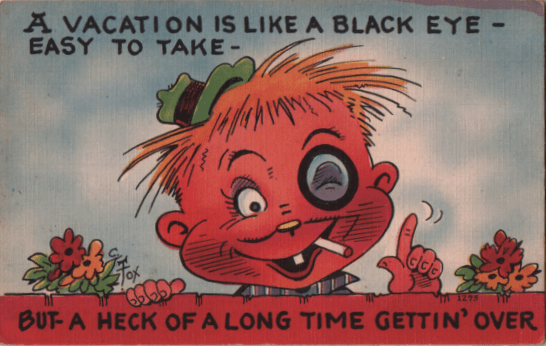
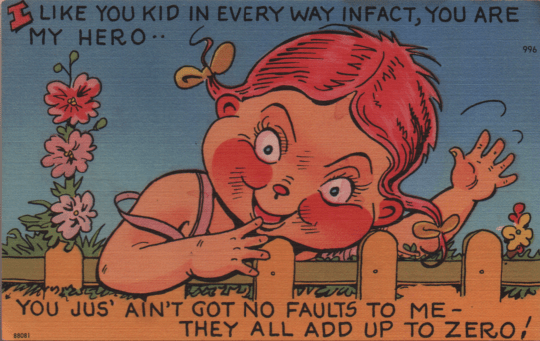
So why don’t the kids on postcards—as mischievous and active as any children designed for comic purposes—seem to have ‘em?
It could be a matter of having to answer to company art directors, who liked nice, empty spaces. It could be that artists didn’t quite trust the printing presses their companies paid for, as a slip in the press could turn an attractive display of freckles into a blot, or a swarm of mosquitoes just to the right of the cheeks intended. (This is why, for example, comic book companies banned writers from using the word “flick”, since dialogue was printed in all caps and a simple speck in the wrong place would cause massive letters from outraged civic officials.)
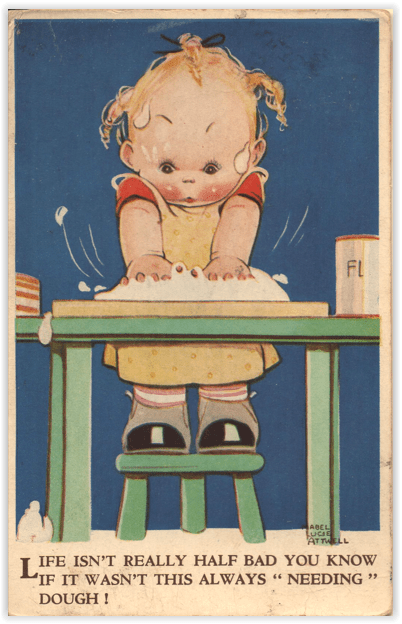
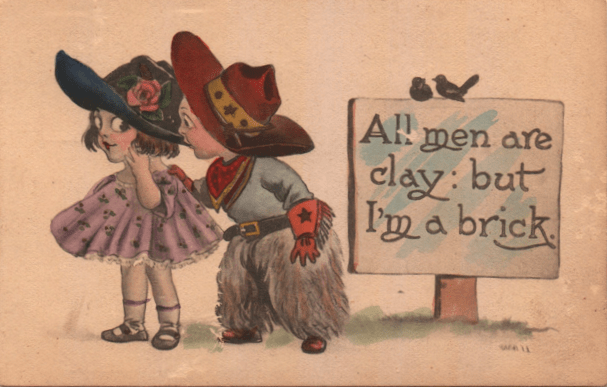
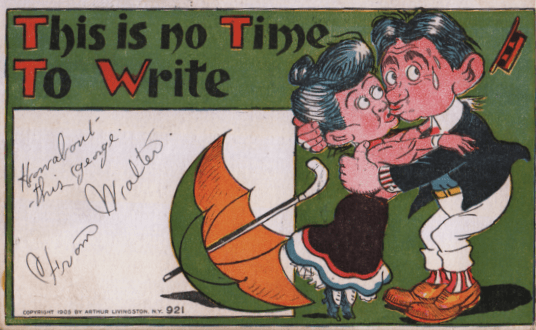
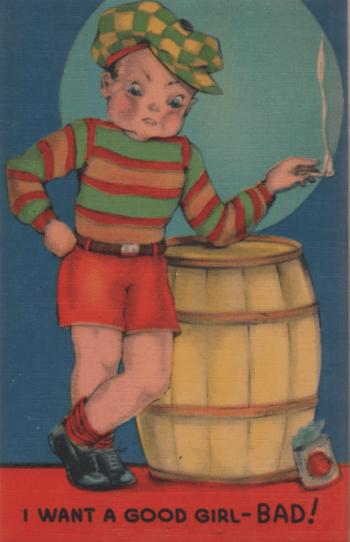
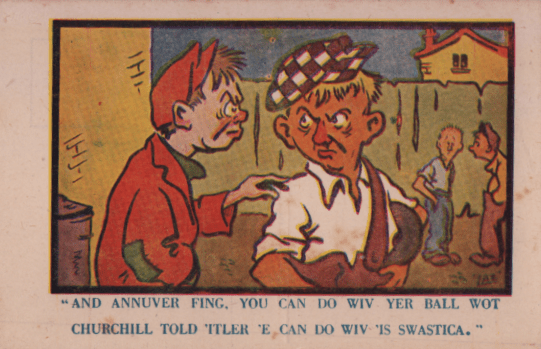
So on faces where we might look for freckles, they seem to have compromised by giving their leading lads and ladies bright red cheeks. Ruddy cheeks were supposed to be a sign of glowing health anyhow, and didn’t require the addition of spots. They had nothing AGAINST freckles; they just wanted something cheap and easy.
And in closeup, this made sure you didn’t suspect the tough kid needed a shave.
OR that some endearing moppet wasn’t coming at you with measles. That’s the problem with all art, of course: the artist relies on the viewer to figure it out. MUCH safer to go with a rosy blush.























 Blogsy Babbles