“Now, you’ve got it, right? I want to be transported to 1962. For real, and as myself, knowing what I know. No changes. Me, Durward Bailey as I am in 2024…only give me different clothes.”
“Different clothes,” murmured the massive brown caterpillar.
Durward strode from his desk to his unmade bed and back, a matter of thirteen steps. “I know how these things work,” he declared, shaking a finger at the placid, mighty spirit. “Don’t grant the wish until I’m done spelling it out. I’ll nod twice, like….” He caught himself. “I’ll nod twice.”
“Nod twice. Yes, master.”
The old rhinestone brooch looked as if it had been in the secondhand shop for sixty years. Durward Bailey had been flipping it aside in the box of junk when the pin on the bock got lodged under his thumbnail. Something like this happened whenever he took time to shop among old stuff that fascinated him. Midcentury martini glasses snapped in his hands, cigarette cases broke at the hinge, and now one artifact decided to strike first.
Swearing he’d get tetanus from it, he had badgered the old lady who ran the place into giving it to him for free. Durward Bailey would have preferred cash, but she opened the cash register to show how empty it was. He couldn’t even get injured in a spot where it might be profitable.
For free, the brooch looked a little better but not much. He took it home and tried to polish it, thinking of eBay millions, and a small hairy caterpillar crawled out. Throwing it on the floor, he watched in awe as the caterpillar grew, its head bumping the ceiling before it inquired, in a gentle voice, what he needed. The ancient spirit had the power to grant him one wish.
This was more like it, and Durward didn’t have to think long about his wish. He had fantasized since grade school about going back to before he was born, starting a new life before his current hard luck began. Having considered in daydreams just where to place bets and make investments, he might die before the twenty-first century, but he would die rich, in a world where the laws and lawyers to bedevil the wealthy didn’t exist. No longer would he be Durward Bailey, a nobody who worked a nothing job and came home to watch nothing television until he fell asleep so he could do it all again tomorrow. Mr. Durward Bailey III (no reason not to keep his own name, since he wouldn’t have been born yet, but he could class it up a bit) would be a person of substance, a man to remember.
“Give me the right clothes for the period, and five hundred in cash…cash of the period, too. I want to be in the United States, with U.S. currency, got that? I want to look as if I belong there: no surprise tricks like some Twilight Zone episode, where I’m stuck with something from the wrong decade so I can’t win.”
“Nothing like a Twilight Zone episode. You will be transferred as you are now, Master, save for your clothes and cash.”
Durward shook both fists at the caterpillar. “And no time limits. Once I’m there I stay there. No yanking me back to this dump just as things are turning my way.”
“No yanking back.” The genie nodded. Durward thought it over, and nodded twice himself.
He blinked. In place of his unmade bed was a different unmade bed, and next to it was a small screen television with rabbit ear antenna, and an oblong radio. He turned. Where his computer had sat on his broken-down desk a dented typewriter waited. Looking up, he found a bare light bulb where the cheap ceiling fan had hung. This was it: the 1962 counterpart of his 2024 apartment. He took a long look so he could describe it to reporters in about ten years, telling about where he had started his rise to the top. It was exactly what he’d wished for.
He frowned. Well, no: not exactly. Something was not quite…he glared at the couch. It was light gray. The floor was light gray. The blankets on the bed were a darker gray. He raised his hands. There was no color to anything; it was all black and white. What was THIS all about?
“Submitted for your approval, a Mr. Durward Bailey, who made a wish to be transported to a world of the past, but not in a way LIKE a Twilight Zone episode.”
Durward, recognizing the voice, took a deep breath.
“A man of few achievements and fewer prospects, but with one unexpected chance to change his future, Durward Bailey chose to shift from his ordinary life to a place where he was sure his knowledge would make him extraordinary. And–knowing how such wishes work out–he specified that he was not to be sent to something LIKE a Twilight Zone episode.”
“No!” Durward screamed. “No no no! I know how these stories work out! Get me out of here!”
He rushed for the door of the apartment. It didn’t open. Hammering on the panels, weeping, he begged for the genie’s attention. Then Durward Bailey realized he was not pounding on wood but glass.
“Proof,” the calm relentless voice went on, “That knowing how things work out may not prevent them from doing so…in the….”
Durward Bailey gazed in horror through the great glass wall and saw thousands of people looking back from couches of light orange or pale beige. He dropped into a heap on the floor, his body heaving for just three seconds before the credits rolled.
Have I mentioned—more than thirty times—that this is not a food blog? But maybe what I am writing about here doesn’t count. Folks on the Interwebs have differing opinions on this (as with everything else) so let’s not wait around.
The appearance on the market of Coca-Cola flavored Oreos (good stuff) and Oscar Mayer Popcorn (haven’t tried it yet) has led some commentators to claim we are headed for the Apocalypse. I suspect these people don’t wander down the aisles of the grocery stores the way I do. And as a dealer in pop culture, in book and postcard form, I know that the fascination with innovation in food is not limited to our own generation. I was among those who sent suhhestions to the Lays folks when they were soliciting new flavors for potato chips: a blip on food marketing which grows smaller in the rearview mirror (during on of the last years, I tried to check whether one of my new flavor suggestions—was it liver and onions?—had already been suggested, and found that Lays listed over half a million suggestions JUST from my state JUST in one month. I think I understand why they stopped asking us.)
So I have prepared one of those “Not Really!” quizzes. Here is a list of products, by brand name or by concept. Your job is to answer the simple question “Did this really exist?”
1.McDonald’s grilled pineapple sandwich
2.Korn Kinks
3.Crapola
4.Gluten Globs
5.Protein Elbows
6.Bone Broth
7.Tomato Jell-0
8.Campbell’s Oxtail Soup
9.Mushroom Jerky
10.Pickled turkey gizzards
11. Pork-flavored turkey
12. Pickled beet potato crisps
13.Canned bread
14.Canned hamburgers
15.Canned red velvet cake
ANSWERS
1.Yes, let’s start with an easy one. This was the Hula Burger, for those observing Lent; not available now for some sixty years, but for curiosity’s sake alone….
2.Yes. Not a great moment in American marketing, but the mascot of this 1920s cereal had her own line of postcards and a LOT of attitude
3.Yes: a high fiber granola blend I used to find in the cereal aisle
4.No, alas, I could not find this anywhere. There ARE products with added gluten, but this ame is still available
5.Yes. This is a high protein macaroni with a catchy name
6. Yes, you can see this everywhere for people on a keto diet
7.Yes. Jell-O was used in so many salads that several vegetable flavors appeared
8.Yes. And no, you did not find a whole cow’s tail inside
9.Yes: you can find several types for those who have gone vegetarian but miss the jaw workout jerky can provide
10.Yes; available in various brands. Is the demand for giblet gravy dropping that low?
11.Yes, this was touted as a kosher pork product
12.No. At least, I couldn’t find it on the Interwebs. I remain convinced it’s out there somewhere
13.Yes. This has been eaten as a necessity, but also won over a lot of fans who PREFER their bread out of a can.
14.Yes. People have been coming out with these since the 1950s and there are several brands on the market, including a couple of canned plant-based cheeseburgers
15.No. Or at least not so far. Canned cake is apparently sweeping Japanese vending machines, and as soon as some American company thinks of a way, red velvet cannot be far behind.
The curve of space, vast and beautiful beyond comprehension, was no more beautiful than the Drover. Immense for a ship as the immeasurable parabola was for the universe, she was the product of three generations of engineers trained from birth for her construction. The Drover had been intended for a century and more to be the model and prototype for every space vessel to follow. Henceforth, all spacefaring ships would be divided into two classes: those constructed before the Drover, and Real Ships. The illiterate mastercrafters who built her had explored the concept of elegance as motive power to the point of building the fastest, most beautiful vessel in the history of the universe. Fifteen engineers, learning she had been completed, had voluntarily walked into a minefield, and Lag Leman, Inspector General of the Imperial Fleet, had died of heartbreak on seeing the whole ship all at once without due preparation.
The Drover was currently as far off course as she was beautiful. A meandering publicity tour, designed to show off the latest accomplishment of the Imperial workshops, had been woven into her regular work assignment transporting slaves from one work zone to another. On her first two stops along this tour, Imperial citizens marveled at the genius and technology which had created a vast beautiful ship in which some twenty-seven million disposable workers could subsist for up to a generation until they could be unloaded where needed. She was a lightleap forward for Imperial efficiency.
But right now she lurched through space far from her intended cruise of celebration. A lurch, in a vast ship traveling at 930,000 feet per second, can be alarming. Something unplanned had transpired on her third stop. The Drover was still irritated about this.
“You,” said the bridge computer, its voice simulator producing tones of exquisite charm, “Are a lobster-fingered lummox.”
“Ah shut up,” said the pilot. He ran one hand across his stubble chin. “I can fly anything when I’m sober and I haven’t had a drink in three days.”
“What about that Patbad Casual I had to mix you?”
“Call that a drink?”
Bott Garton was out of place. He was less personally elegant than the bolts which secured the lid of the toilet in the captain’s quarters. His hair was blackish-brownish, and badly trimmed; his face was reddish and smudged. His clothes were all of a color most nearly approaching gray than anything else. This offended the fastidious Drover as much as the rest.
“If you insist on spoiling that seat with your presence, you could at least put on a uniform,” she said. “I have eighteen thousand.”
Dark-rimmed eyes jerked back and forth, studying the array of lit and ulit squares on the console before him. “They wouldn’t fit me.”
The computer was as elegantly offended as possible. “I am capable, lummox, of custom designing a uniform to accommodate any number of limbs, size of body, and oddly-placed respiratory organs. AND of constructing it in ten minutes’ time.”
“Those rags still wouldn’t fit me.” Bott pressed two red pads and a green one. His seat seemed to bounce, and the flight path altered one iota.
“Do you know,” said the computer, its tone now gentle and conversational, “I’ve thought about asking where you learned to fly.”
Bott grunted. The computer continued, “Instead, I believe I’ll inquire IF you ever learned to fly.”
His underteeth stuck out. “I flew with the pirates of Philthoothiel. They maybe don’t gly to Imperial standards, but they’re the best pilots in the universe.”
He clicked a green pad off and a red one on. The bridge wriggled as if shaking itself dry.
“Nothing rubbed off, did it?” the computer inquired.
Bott returned the pads to their previous status and then slammed both fists against the elegant undulations of the navigational panel. “All your command pads are in the wrong places!”
“That IS the worst of illegal training,” said the Drover, in tones of warm sympathy. “Illiterates have to learn to console by position. So you can fly only those ships constructed in your own planetary system. My admiration for Imperial control increases by the moment. Ouch.”
Bott had tried a blue pad. The ship’s speed doubled. “Ha! I can fly anything.” His fingers hovered over the rainbow array.
“Want a hint?” the Drover suggested. “Hmmmm? Hmmmm?”
“Quiet!” The pilot lowered his hands to his lap. “If I can just manage the turning sequence, I’ll be set. We’ve been going in too many straight lines, making too many square corners. If you weren’t so fast, they’d have us by now.”
“I know.” The computer emitted a genteel sigh. “It’s one of the curses of superiority.”
A purple pad released a gentle chorus of clarinets. “That’s a meal call,” the computer told him. “How did a fumble-fingered doofus like you ever get past my security?”
“It was only fair,” growled Bott, running a hand through his thick, greasy hair. “They take my ship; I take theirs. A meal call, huh? So the purple pads are all for communications? Shipboard?”
“Maybe,” said the Drover. “How did you do it?”
Bott considered a slanting line of yellow pads, separated by other yellow pads by the purple ones. “Why? Recording this for my trial?”
“Does it make a difference? They will surely never catch so great a pilot.”
“I can steal anything when I’m sober,” Bott replied, looking again for any kind of pattern to the colors. “And I hadn’t had a drink in three days. I gassed a few, and told the rest they were relieved for R&R.”
“They believed you? You?”
“I made sounds like an officer.” His hand went to a pink tab, but on reflection, he pulled it back. “They learn to take anything they get in that tone of voice. And nobody was gonna tell ‘em anything different because this is the Imperial Service. Nobody tells them anything.”
He set on finger against the pink tab. It lit up without any other obvious signs of reaction. “And I just worked my way through the ship, confiscating bigger and better security passes as I went.”
“Some of my security pads require thumbprints.”
“Thumbs can be easier to steal than passes.”
The computer sighed. “I suppose there are ships who would be thrilled to be stolen by a bloodthirsty pirate.” “Why’d you take off, then, if you’re so smart?” Bott considered a pad of forest green. “You could tell I wasn’t authorized.”
“I am merely the central computer.” The voice was polished but cold. “The navigational computer was the one that…. Yes, you; I’m talking about you. I told you he wasn’t one of ours. Oh, of course. As long as he has the right chip you’ll do anything he tells you.”
This was news to Bott. If he could set the navigational computer to automatic pilot, then, he could risk getting some sleep and let the ship continue on course. If he could figure out how to set a course. Those three green buttons way over here might be the automatic pilot.
The bridge lurched again.
“You didn’t have to do THAT,” complained the computer, as lights flashed around the bridge.
“I thought it might be….” An alarm throbbed higher and higher on a delicately modulated scale which started at Shriek and worked its way up.
“What’s wrong?” Bott demanded. “What’s wrong?” He jabbed at the green buttons, but they seemed to be locked and did not change color.
“None of this is easy to do,” the computer replied, “And it should be impossible. But you have skills. You increased speed, set a new course in reverse, and told navigation to ignore our previous orientation. I am now flying at sixty-two percent maximum speed at an angle I was really not designed to move. Among other things. I will begin to break apart in five point eight minutes. I blame the navigational computer most, if that makes you feel better.”
Bott started pushing pads at random. “Excellent strategy,” said the computer. “The sooner we disintegrate, the less chance they’ll catch you.”
“All right, I give up.” The pilot threw up his hands. “What do I do?”
“Oh, you’re asking me? I am quietly thrilled. Just ease thrust and engage the stabilizing propspondor.”
Bott had actually identified the main pads controlling thrust, so the first bit was simple. “Now,” he said, looking around. “The stabilizing prospondor. Right. I’d’ve thought of that myself if the siren hadn’t been screaming at me. Um.” He looked around and raised an index finger. “The little red one?”
“Some pilot!” exclaimed the computer. “The little red one! The little red one! I wish you wouldn’t use technical jargon, Captain Doofus; we computers have not been programmed to keep up with you. The little red one! Ha!”
“All right, all right! Which one, then?”
The computer sniffed. “The little blue one.”
Bott jammed a finger down. Alarms fell silent. He checked what he could of their heading and, making sure they weren’t aimed at any Imperial prison planets, rose from the seat. His first step was onto a plastic plate, which sent a plastic fork into the air and him back into the chair.
“Couldn’t you let me switch on the automatic maintenance crew? You have my bridge in a state of hopeless clutter.”
Bott settled back against the armrest and waved a hand in the air. “Oh, it was all just a little too sleek. Too smooth. I’d get lost if I didn’t have something to mark my place.”
“I knew it,” growled the computer. “When are you going to get around to painting naked bodies and obscene symbols on my hull?”
Bott leaned back and regarded the elegantly lighted ceiling. “Oh, you know: as soon as I figure out what color looks worst on you.”
“Well!” snapped the computer.
Bott rose again, grinning at getting the last word until she went on, “From your clothing, I had assumed all this time you were color-blind.”
There is never the usual outpouring of response when my column deals with bygone jokes I just can’t figure out. But I have to produce these now and again. A blogger always runs the risk of being considered omniscient and infallible, and I MUST do my best to correct this notion before someone demands I take over the government, or the banks, or the newspaper funnies pages and run these institutions properly. So I present here postcards like the one above, which obviously had a point about women and beauty treatments. Can’t quite see it: were we commenting on the fashion for beauty spots, or was there a fad for sprouting mushrooms around your mouth?
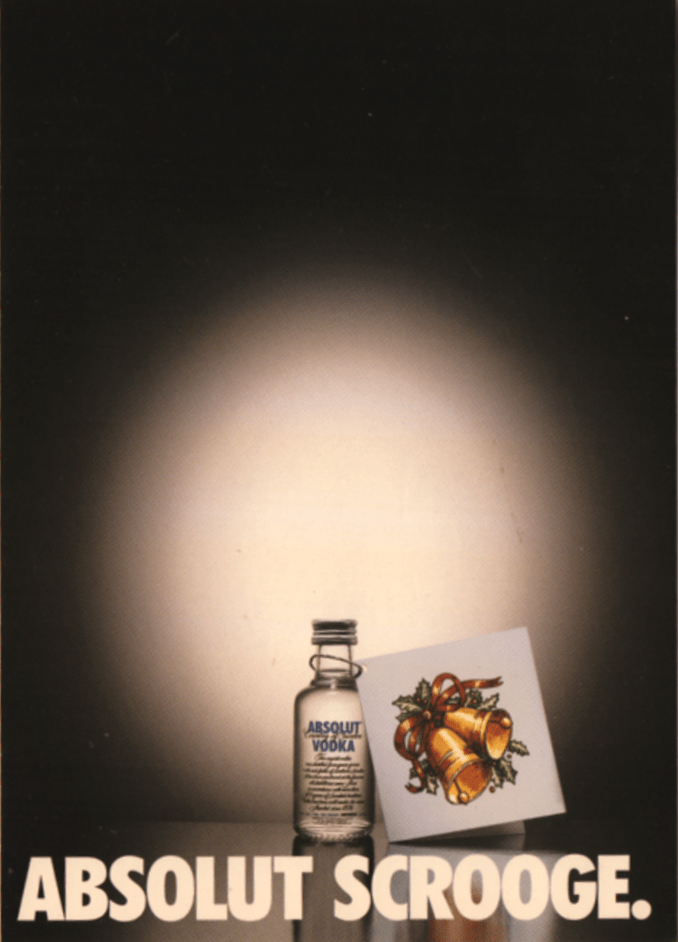
These are not all antiques. This comes from one of Absolut’s series of surefire gags around the turn of the current century, usually involving a picture puzzle where you needed to figure out what part of the picture had been made to look like a vodka bottle. But as a Scrooge scholar of minor fame, I must admit the punchline is eluding me. I’m missing whatever reference to Ebenezer they intended. The scene is spooky enough to involve ghosts, I guess, and there IS a Christmas Present.
I can’t even tell what this card from the same era is advertising. This may be because I don’t quite recognize that device as a phone, and it may be because phones could not, at that time, send texts or emails. So what makes it “eChat”? Was this the work of minds who also knew very little about the new electronic communications, who just figured anything with an e on the front of it would sell?
Or was it just an opportunity to send out a picture of a pretty girl and let the audience do the rest? That’s all I can think of with THIS card. It is a pinup first and foremost, of course, but I think the illustration would have been better used as part of a competition. I can see it being used even today in some corporation: “Write a good answer for the young man: First Prize, a box of company pencils and an all-expense paid trip to HR.”
Other cards just take aim at an obvious joke and miss. Unless I’M missing something obvious. We have discussed the “I Should Worry” fad, which involved this formula and a pun, generally about some mild disaster: “I should spill the glue and get stuck up”. This artist didn’t get that. If there had been a person in a swimming suit AND a bear we might have laughed at the homonym. Pointing out the two spellings is merely an insult.
I’ve studied this one for a while. Did the cartoonist READ the joke? I understand what we’re going for, but the couple could be a lot closer together, to prompt some wise guy to deliver the wisecrack.
See, what makes pearls so rare is that oysters are NOT always ready to shell out; even pearl buttons are scarce these days. What saves this, a little, is that throwaway joke on the sign, though the gag is now limited to those who recall a movie show included cartoons and other brief films known as short subjects or just shorts. (As in the fine but defunct old joke, “She paid her dues in Hollywood: for years she was filmed in nothing but shorts. Of course, you can’t show THOSE pictures in theaters.”)
And couldn’t the artist have had the man on the ladder looking THROUGH he glasses? Nice “cheesecake denied” trick with one shapely leg all we can see of the passerby, but that just makes sure the card doesn’t work as a pinup OR a visual gag. (“Visual” gag? Great: it’s catching.)
Look, nobody said you have to start singing “Little Drummer Boy”.
I understand, okay? A lot of you have jokes about “pumpkin spice already?” you’re planning to toss at people. Been there. Do it myself. But this is not part of the popular hatred for impending holidays (and/or winter) but an expression of the basic human impulse to say “Wait. What? It was just Memorial Day a couple of weeks ago, wasn’t it? It can’t possibly be that time of year. I just got the air conditioner to…. Fall starts next week? Are you sure you didn’t flip over two pages of the calendar at once?”
Anyhow, I have started adding Christmas postcards to my offerings for sale online. Yes, I KNOW there are other holidays which come first but a) I don’t have many Halloween cards, which are highly collectible and seldom turn up in the job lots I add to my inventory, and b) I listed all my Thanksgiving cards in August.
This is partially out of a concern for certain of my customers. Christmas preparations come in two schools, the “I Must Get Ready, I Have Only Three Months To Go”, and, “Ready? You Need To Do Something Before Christmas Eve?” And, see, both of these schools of thought spend about the same amount of money.
So I am making my listings for those of you who are planning vast decoupage displays for your front window. (I dislike the idea of my vintage collectibles being pasted to your composite backings, but what you do once you’ve paid is your business.) I am thinking of people who MUST have forty-seven vintage postcards, unused, to serve as gift tags. In short, I am prepared to exploit the weaknesses of people who start their Christmas shopping in June, and are now just looking for those last flourishes. (And, hey, those in the second camp, who figure “Well, better get started”, buy one thing, and then do nothing else until the Winter Solstice.)
I know I’m ahead of time by the standards of analog retail establishments, but they are restricted by the floorspace in the store. I have fewer concerns with display space on the world wide interwebs.
And it sort of comes naturally to me. For those who came in late and could not guess from my polished and professional style, I have been a professional writer since 19…hmm, must’ve turned over six pages in the calendar at once. Having chosen to spend my time writing short stories, the second least profitable writing choice after poetry, I had to pay attention to the demands of my market. And your magazine world works on an entirely different calendar.
To keep that rabbit hole shallow, let’s just point out that any monthly magazine which published Christmas material needed to see it in March. February was even better. So while the rest of the world was busy sending Valentines, I was writing fiction about warm hearthsides decorated with evergreens while outdoors the snow fell and reindeer danced on the shingles. (When this story was published, as sometimes it would be, it logically appeared in the February issue of the magazine, since the date on the cover and the newsstand stocking date were so…never mind. We’re keeping this short and eighty percent of you have never seen a newsstand.)
What I’m saying, Egg Nog Latte, is that just putting Christmas postcards up for sale is not nagging you to get busy and celebrate the occasion. Those of us on my side of the equation, after all, will do our celebrating much later ourselves. And that’s only if something actually sells.
Unfirom, hands folded behind his back, was studying the crowd at the tennis court. None of these came within the bounds of his assignment, but this changed sometimes after a single lob.
He felt a sense of foreboding, perhaps involving tennis, perhaps not. Anyone who dealt regularly with phronik felt foreboding every few hours in any case. Unless the full company was in view, what they might be up to was a worry to wrinkle even an angel’s brow.
Turning, he set off across the grass to the other end of the park, and the softball diamond. The foreboding built: a lot of it seemed concentrated around a red cardboard rectangle at the far curve of the track. This turned out to be a discarded container half filled with fries from Booty Burger. Two torn packets of ketchup nearby were drawing ants. Not a single phron was here to gorge herself.
His head came up, turning slowly. That meant they were busy at something: a more interesting discard, like ice cream, or another batch of hopeless cookies in the kitchen, or something serious. His gaze took in 360degrees of the park and its environs.
Then he was running forward, his old days as a guardian angel bursting out in his voice. “Wait!”
He was there in less than a second, and was still too late. His forehead hit the invisible barrier that marked the end of his domain and he froze in mid-stride. Now he shouted, “Don’t wait! Hurry!” He knew she couldn’t hear him, but the full force of his will was behind the call.
The woman running diagonally across the street was moving as fast as she could. She was on the center line when the florist’s truck came around the blind corner, moving far too fast. She might still have made it but for the trailing end of the banner she had clutched in her arms. A foot landed on one corner.
“Yehapsekatory!” she shouted, falling backward. Unfirom knew at once how pleased she would be at such unconventional last words.
The truck sent her spinning and sped on, barely missing a man who had also run into the street. The man stared after the truck for a moment and then dropped to one knee beside the woman. He shouted something even less coherent than what she had said, and ran to a nearby door. It occurred to Unfirom that the developer should have remembered there was a public phone in the fieldhouse. But it didn’t matter.
“Aw, gee!”
“Some people just can’t handle love!”
Unfirom turned. The four phronik looked up at him, mouths tiny and eyes huge, their hands behind their backs. He didn’t need to ask, he supposed. “Was this your doing?”
“We were just seein’ if we could do something for the park,” said Bluebell, hips wiggling.
“And for them!” Primrose put in. “They would have had fun, too!”
“Havin’ plenty of fun now, aren’t they?” said Meadow Saffron, leaning over on one side to peer past the angel at the gathering crowd.
“Aw!” The tears dropping off Sweet Pea’s cheeks were about as big as her ears. “We didn’t mean for any old truck to come by!”
“This is what happens when you try to move outside your assignments,” Unfirom intoned.
Bluebell sniffed. “Well, she’s the one who ran. If she’d stood still, we’d’ve had her!”
“Him too,” murmured Meadow Saffron.
Sweet Pea looked behind her, rubbing her fists into her cheeks to grind the tears away. “No, we’ll never forget her. We’ll weep for her forever!”
Primrose looked over at her. “For who?”
Sweet Pea’s damp right hand waved toward the street. “Oh, yu know! Her! What’s her….”
“Peter Cottontail!” cried Bluebell.
“That will not bring her back,” the angel told them.
“Well, it’s a gesture,” said Meadow Saffron, chin up.
“So’s this,” said Bluebell, moving her hand in a signal not associated with angels.
Unfirom opened his mouth to speak, but Sweet Pea cried, “Oooh! The ambulance!”
The developer was there to watch the young lady being loaded in. He leaned forward. “Of course I’ll remember you!” he said, voice choking on relief.
His relief was misplaced. Unfirom new he had the right idea, but the wrong ghost. “You have….”
Turning, the angel saw the phronik had discovered a dissolving ice cream sandwich on one of the benches. Wrong to blame them for leaving, he knew: their attention spans were brief, and they had seen worse accidents in and around the park, though very few of their own making.
Perhaps the woman had been destined to die today in any case. Unfirom did not feel any lightening of his feeling of failure. And it might work out for the best: the developer might change his ways, or at least his designs, in some small way, remembering the activist. He glanced at the police car pulling up, and the young man I the formerly immaculate suit rushing to talk to them.
Just there, between Unfirom and the police car, there appeared the briefest image of a dark pinstripe suit. No head appeared above it, and the suit was gone at once.
Very little remained of August N. Griese in the park that bore his name. Only Unfirom ever saw him, and then only when the light was right, generally at dusk. But something of him remained, imploring young lovers to remember him. Unless he was addressing that admonition to Unfirom which it was impossible to determine.
Griese had been a busy man in life, far too busy for young love, middle-aged ove, or love late in life. He died, as he had feared, leaving no one to remember him, except in dry business connections. His will endowed the park, for lack of anything else to do with the money, and it was the only place on earth close enough to him to claim even a fragment of his ghost.
Unfirom had thought all along that he was doing a good job as Griese’s guardian angel. Hriese (funny how he could never think of the man as Gus, or even August) had been kept from the more serious forms of disease or injury, and any danger of crime or heartbreak. After Griese’s death, however, he was informed that his performance had left much to be desired. Guarding his charge from life’s unpleasant surprises had gone far enough to ensure the man enjoyed very little life at all. This assignment was the result of that performance evaluation.
The ambulance was gone. The developer was helping bundle the stained banner into the back of the squad car. He was talking far too much and too quickly, but it didn’t matter. The sympathetic cop had stopped taking notes some time ago, and was now just listening. The developer was asking what would happen to the banner when the investigation was concluded, and wondering whether he could have it.
Unfirom shook his head. In the distance, he could hear the ambulance’s siren, backing the phronik as they sang.
“Cousin Kenneth made a wax with oily streaks
Which made a candle burn for nearly eighty weeks;
To make a million dollars should have been a lark,
I was told over and over as a child—it was one of those things teachers felt we should know—that jack o’lanterns were originally made of turnips, not pumpkins. We all wanted to know whether they had birthday cake candles in those days, but that was all we ever got: in the olden days, people used turnips. I imagine one day when I that the device in this postcard was a camera, children will cry. “But how did she hold it to her ear to make calls?” I will just move on to some other bizarre fact, like how they’ll be glad when they grow up that they had to study geometry.
Some of you complained about the most recent column in this space (which is nice, since I was unaware anybody was still reading anything in this space.) I wrote about bygone technology seen in old postcards and I just left out everything that mattered. “Where are the phone booths? Did you see that recent Superman movie where Christopher Reeve tries to change but all he can find is a small phone kiosk?” So, without even HINTING that this recent movie was made in 19678 (some twenty years ago, now, allowing for Daylight Savings), I thought we could cover a few omitted items. Here, for example, is a classic alarm clock, beloved in movies and postcards and now also replaced by phones and other bellowing electronic devices.
When I was working the used book line, I would defend putting out typing textbooks by pointing out that even if the typewriter was leaving us, we could still sell the textbooks, since now everyone was “keyboarding”. But that was when the keyboard itself was not an endangered species. What do they call the method of texting? Thumbing? Does it all work the same way?
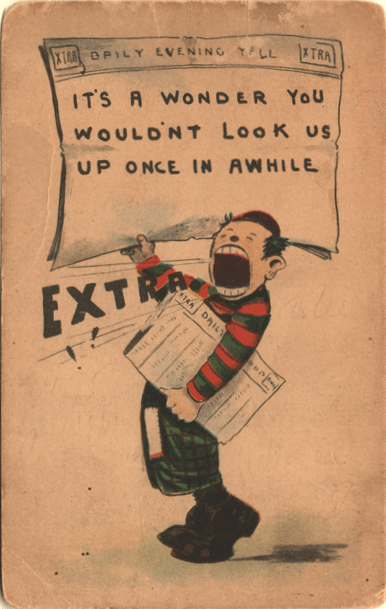
When I first lived in the Big City, there were still lads selling newspapers on street corners. “TREE-bune!” they would bellow. “GITcher TREE-bune!” I suppose this kind of work would now be child endangerment. (I know I was occasionally tempted to shove a loudmouth under a bus.)
Yes, somehow we still make toys, but as noted in our latest column, when we discussed sheet music departments in stores, when did you last see a toy department…WITH counters, and with some clerk BEHIND every counter? Not only could the stores cut costs by getting rid of the attendants, more treasures could be put out on view without those old one-sided displays.
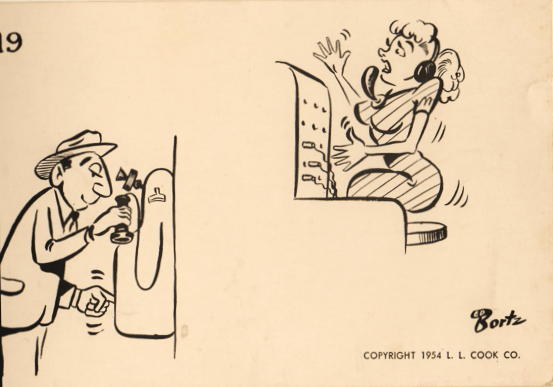
Once upon a time, LOTS of cartoonists for naughty magazines used this now wildly incomprehensible gag. The viewer has to know what a pay phone is, what the coin return slot looked like, AND understand that once people—mainly women—sat at something called a switchboard and answered questions and connected callers. All, all gone in our new efficiently electronic world. (Naughty jokes especially are ruined if they need footnotes to explain the point.)
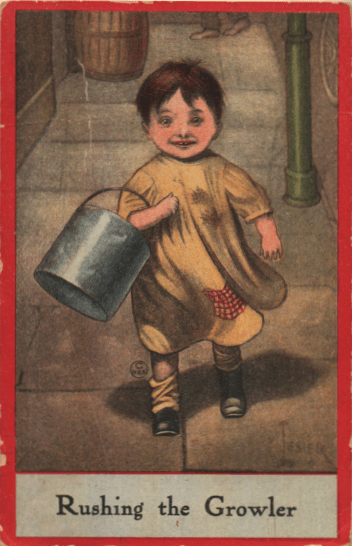
A lot of the preceding involve items recent generations MIGHT recognize, but this object, seen without being named by most postcards, was obsolete even in my boy days during the Mid-Pleistocene. The growler, as mentioned hereintofore, was the family beer can, and one rushed it by taking it to the local bar to be filled with the day’s supply of beer. (Fresh milk and running water were little known in most of the Big City, and beer was freshly brewed and nutritious—both factors which were discarded, like the growler, when canned beer became the norm.)
Is anyone ASKED to bring music to a party these days? In those primitive days I inhabited, people were sort of sliding from bringing a book filled with 45 RPM records with one’s name in big letters o them, to the efficiency of bringing albums. But a people decades before, used to being told to bring their ukulele or guitar and some sheet music, would have recognized that THIS chap is hauling over a street musician’s hurdy-gurdy: once again, a victim of electronic media (and how many people regret that?)
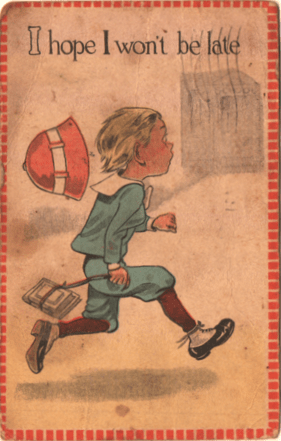
I can only vouch for the old movies and cartoons which showed us kids strapping their schoolbooks together with a small leather belt, frequently endangering their educations by running like this (if one book slips loose, they ALL slip loose.) They had to do something before backpacks came along I suppose.
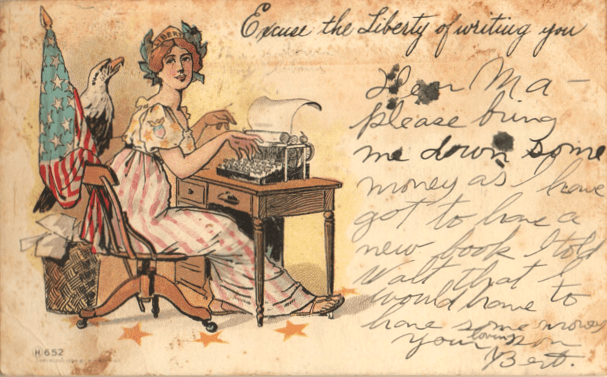
If you are tired of contemplating the human rush to change and replace the fabric of everyday life, let’s look at something completely else. THIS postcard comes from that early day when messages had to be written on the PICTURE side of the postcard (which came to an end in 1907) and yet…the safety pin of that distant day is still familiar. I’m not saying any of our works is immortal, but we DO sometimes make something right the first time.
I was looking over a new postcard for my inventory and thought, “Wow! How much longer does THAT joke have to live?” I realized that even I understand some of these old postcard gags simply because I had read about the basic idea in books, or seen them in old movies. A joke depends on the audience immediately recognizing the situation and the props, and some of these are moving into museums (like my inventory, which is a collection of things I THOUGHT I was going to sell.) So I thought we would observe some of these endangered jokes as they pass. We will not be discussing fashion, which becomes obsolete so quickly, northings like the check shown above. Checks may be doomed, but their extinction date is still uncertain. We will also not be covering jokes which became extinct because they weren’t all that lively to start with. We can discuss Fine Old Jokes like that in some other space.
This is the postcard that provoked my column. ARE there still buildings where you can pe through the keyhole? How many buildings built in the last twenty years or so bother with locks that require keys? Fortunately, there are still Old Dark House movies, where a gang of meddling kids winds up in a vintage domicile. As long as we still have haunted houses on the hill….
We weren’t going to discuss fashion, but that thing sticking out of her hat did last through a couple of generations of hats and windy weather. The hatpin probably still exists in some sleek, discreet modified form, but back in the day, they were highly decorated and intended to be admired. (That’s ONE reason they stuck out this way. The second reason was that it made the pin easier to reach if your date was getting too close to your vanilla malt.)
How many modern viewers would recognize this as a pen and an inkwell? No: Martha me no Stewarts. I KNOW you may use these for your wedding invitations, but after THAT your pen will be another thing you move around on your desk and the inkwell will dry up in a corner like all inkwells of the past sixty years.
Do you see the highly dangerous item in this picture? No, NOT the spoon he’s trying to hold off. And those of you who said something about the young lady’s…well, you will stay after class and write a six page essay on how sorry you are. That object over on the left is a chafing dish, which three generations of college kids sneaked into their dorm room despite warnings from four generations of college administrators that these fire hazards were NOT allowed. They have been replaced in dorm rooms by toaster ovens and/or microwaves (on special all last month at stores and all still banned by most dorms. THAT hasn’t changed.)
Sheet music still exists, but gets rarer every year in a world where electronic substitutes abound. And store departments which sell only sheet music? These survive only on postcards.
I have done no in-depth analysis, but I believe free-standing bathtubs with legs now exist primarily in those haunted house movies we discussed earlier. Yes, there may be a few high-priced architects who may be trying to bring them back, but this classic model, which virtually required a step ladder to get in and out of, is probably now classed as a danger to life and limb.
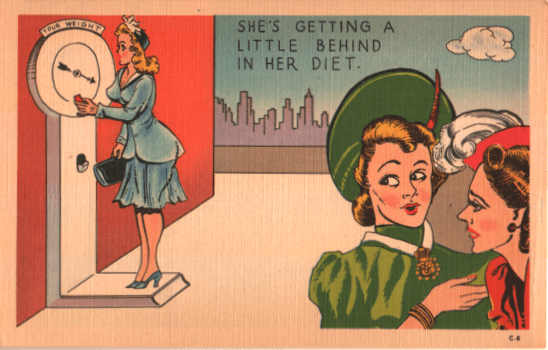
And there may well be amusement parks and such which preserve the old street scale, where you inserted a penny to get your weight and fortune. But once, if we believe postcards and vintage movies, they were all over shopping districts. Never mind the scales for a moment, outdoor vending machines used to be all over town: not just around one side of the gas station. Were the peanut and gum and candy machines victims of a rising crime rate? Or of rising prices which would now require you to swipe a plastic card through the machine (IF you have enough funds in the account to cover a whole pack of gum?)
I’m afraid I was assuming that flypaper, once a staple of silent comedy, short cartoons, and postcard gags, was still available for sale to old-timers. But a glance through the shopping pages on the Interwebs shows me only a movie of that title, and a brand of jeans. So I guess if you were hoping to buy some for your next slapstick TikTok, you’re stuck. (I TOLD you, we’re not going to be criticizing extinct jokes. Just let them fly by.)
“Here!” He set his ice cream sandwich on the backrest of the bench. Really, this woman was either the most clumsy or least lucky female in the city. A trailing corner of that banner had blown up in the wind and wound around one ankle. As she was busy pulling her other ankle free of another corner, this nearly sent her facefirst onto the sidewalk.
“Thank you!” Breathless, she tried to help by pulling free, setting a foot down on the cloth…and his fingers. ”I…why does it keep doing that?”
“Just being contrary,” he said, maintaining his smile as he blew on his bruised fingers.
He was no fool. He could read what was on the banner. This woman was another of the troublemakers, trying to rally a few more. Nonetheless, he patiently unwound the fabric. If he was helpful and pleasant, he might be able to lure her away from the chief Luddite, one Peter Abbott who disapproved of quiet, tidy parks and kept mailing out huge registered envelopes filled with poorly spelled petitions. It would be fun to try, at least.
“It’s a good thing you didn’t wear heels.” He just missed a corner of fabric as the wind whipped it around; the banner did seem to be tangling the woman’s feet. Still, he should have expected every facet of this anti-park crusade to be disagreeable.
She leaned over to grab part of the disobedient banner. “Oh, I never wear heels to the park.”
You could, if it were the proper sort of park, he thought, but it was too soon to say something like that. “Look nice, though,” he said, leaning closer to the banner so she wouldn’t catch his expression.
Ordinarily, he wouldn’t amuse himself at the expense of a stranger, but not only was she one of the enemy, he had to pass the time somehow. His designs could go no further until he knew the project was on, and what would be his part in it. He had produced forty-three separate designs for their consideration, not including dozens of alternate fieldhouses, all of which would be pointless if the project was abandoned. One more sketch of this little patch of grass, and his brain would be stuck on it, like the old computer monitors with no screen saver. Decades from now, he’d be hunched over a drawing board, cackling over his one millionth distribution of wrought iron benches.
A chortle came from deep inside her: a warm sound. “Oh, I don’t need heels. Even with these, I have men at my feet.”
He thought this an old joke, but he chuckled in reply. “Well, I can’t complain about anything in your wardrobe except this cape. This is a style that won’t catch on.’
“It seems to be catching on everything.” She twisted and tugged ineffectually at a part of the banner she was sitting on. Her face suddenly hardened; she’d seen where his eyes were pointed. Her knees slapped together, which made the banner snap up at his nose.
She was instantly contrite. “Did that hit you?” She tried to rise for a better look, which tightened the banner at her calves and made her sit down hard.
“It’s nothing.” Keping his eyes on the cloth, he set one hand firmly on a seam: there had to be a scientific answer to this. Her clothes were encouraging, though, and his eyes kept moving away from the job at hand. So many women who went everywhere in sweatpants had soft round bottoms. Hardhipped people favored shorts. Anyway, that was his theory. He never had time to research these topics. Not with so many more fieldhouses to design.
And there was a practical side to this new project: anyone he could win over to a sensible view of this park would make the world a better place. His duty, really. “Didn’t I see you wearing this cape earlier today?”
She was still a little flushed, and strove to keep her tone businesslike. But she was simply not that kind of person. “I’ve seen you here before, too. Did you know this park is in danger of being ruined for the people who use it?” Her voice squeaked on the last two words, defusing her dramatic flourish.
He fought to keep his smile from becoming smug. “Well, it is hard to get people to listen to reason when it comes to real estate.”
She nodded violently. “That’s what we said when someone tried to turn that old cemetery outside of town into an industrial park.”
“Ph, well.” He shrugged. “Same as a park, really, only the people stay overnight.”
She thought he sounded very level-headed. Peter had noticed at once how he adjusted at once when she let him know his gaze was getting too personal. He might make a good recruit for the movement: he seemed to visit the park often enough.
His hand unavoidably slid along her right thigh as he struggled with the banner. She licked her lips and looked away across the scraggly grass. “They want to take away all this and put in flower gardens where people can’t walk or play.”
“Well, I suppose all things have t change.”
She’d heard THAT often enough; her answer was ready. “Nothing has to change for the worse if we can help it.”
Even if things did have to change, she thought, we can still have little spots for illusions of permanence. She did not say this; it seemed to shock people more than anything else she said. “Change is good,” they told her, and they seemed to believe it. She’d need to know this man better before she moved on to THAT discussion. Contests were won a step at a time.
“I like flower gardens,” he said, meekly enough.
“They have their place,” Peter informed him. “And so do grand sidewalks and so do fountains. But this isn’t one of those places. This is a park where people can stretch out for a nap, or play Frisbee, or eat lunch, without a lot of warning signs.” She was aware that a sign just behind her warned dog owners to observe the civilities. Impossible, she supposed, to have a public park with no signs at all. To say so would weaken her point, of course. That this was a park where life was unstructured: “DO NOT WALK ON GRASS” was silly where the grass was this intermittent, and no one put up “DO NOT PICK FLOWERS” signs where only dandelions flourished.
“And where they can toss their hamburger wrappers,” he grunted, tugging at a length of banner which had somehow gotten tied into a knot.
“That’s the price of letting people use their own park.” Her voice was curt; she preferred to keep his mind off fast food. The rumor that she was being sponsored by Booty Burger had led to a lot of predictable jokes about her shape. To be sure, from the look of him, he was probably tidy and thoroughly scheduled. What would that be like? The opposite was tedious: she had no idea where she’d put the check from the Armstrongs, and she really needed to sit down and fill in her amended tax forms. (So many lines and blanks: how did anyone get it right the first time?) Maybe she should ask this guy what he did for a living. He LOOKED like an accountant.
“I wouldn’t for the world tell you what to do n YOUR park,” he growled, a hand snapping out to grab a corner of the banner as it was jerked away by the wind. “But no one’s going to approve of these weird banner bondage games I public.”
AND he had a sense of humor. She laughed, but nearly fell off the bench as she pulled away from his hands. “Now what are you doing?”
“Well, I ALMOST had that unwound.” He rocked back and grimaced at the tangle of banner still cluttering her lower limbs. “Did you HAVE to use that much Velcro?”
“The banner’s heavy.” He wasn’t groping; she was imagining things? She was so sensitive nowadays: back in the Peace Corps she had worked as nearly naked as was prudent for someone who burned as readily as she did. Then she’d used outdoor showers and field toilets, and now she was wondering if her blouse—UNDER her jacket—was too thin.
Every time he looked up, he found her face freezing. If he didn’t get this banner sorted out soon, she would assume he was doing it slowly on purpose. “If I can get this….”
She squeaked. Some of that Velcro was still attached, and the tug had brought her sweatpants down half an inch. She grabbed the waistband.
He knew better than to try to help, and rocked back, keeping his hands in view. “I’ve always been one for progress, and adults know nothing comes without a price.”
“Are you referring to the park?” She nearly said something more, but clamped her mouth shut. She would in no way change the remark around by mentioning her pants. She threw an arm down over her bellybutton, and tried to remember whether today’s underpants still had elastic left in THEIR waist.
“No. I meant this Velcro.” He set his hands on his knees. “Tell you what: if you just wear this thing as a sash, you won’t need to put it up anywhere.”
“It keeps coming down.” She pulled the sweatpants up farther than they’d been to start with. “The banner, that is. I mean, I need lots of Velcro.”
His eyes SEEMED to be on the banner as he replied, “I suppose you would.”
An image jumped into her mind of herself dressed as the Baby New Year wearing nothing but this sash. She shoved both hands hard against the uppermost level of the laminated fabric. “And the wind…I mean, I don’t know….”
“Stop! Don’t move! Don’t breathe!”
She froze. In that moment, he shoved one hand under one buttock and gave her a quick lift. His other hand performed some act of magic by her ankles and, magically, the banner was all over the ground at her feet.
“Yay!”
They might cheer together, but all the while, she was angling so that when she got up, her butt would be pointing anywhere besides at him. “Well,” she said, rolling toward the bedraggled fabric, “That makes this a banner week.” She could still feel the warmth of his hand. He had a firm touch and…long fingers.
He rocked back on his haunches again, sighing. “Banner year. Well, getting it loose of your heels makes it quite a feat.”
“You have the healing touch.” Getting her feet under her, she reached down to roll up the banner. This was slow going, as the waists of her jacket and blouse somehow kept getting mingled with the top of the fabric, and when they caught, they pulled down.
She cleared her throat. “Er, you wouldn’t want to come to our next rally, would you? Just to see how the banner behaves?”
He blinked, wondering if she knew that kneeling on the ground to roll the fabric pulled those sweatpants really tight. Oh, he wished she wasn’t part of that gang. That one shove had demonstrated that her bottom had exactly the consistency he’d suspected. Shaking his head, he recalled her eyes were on him and said, “er. What?”
Oh Lord, she had big eyes this close. “Oh, well, you know: we’re having another rally for the park. I could make you Vice President for Banner Control.”
He laughed, without feeling especially entertained. Of course, she DID need somebody to take charge of that banner. She wasn’t even rolling it right: instead of a tight, compact roll she was turning it at an angle, producing what would be a long, draggy bundle. It would be falling apart again before she walked another block. But he had a feeling if he reached out to help her, he was lost forever. “Um, when is it?”
“Um.” It was the first excuse she’d thought of; she hadn’t really though about that bit. Rough if she just named a date and the rally was a washout like today’s. Although the thought of a private rally for two, just herself and this…promising new recruit for the cause….
“I’d, uh, have to see what the museum….” Damn! Looking down, she found she’d rolled the banner into a long thin cigarette. Well, she could act like she’d meant to do it. Pulling the loose coil into one arm, she rose and shoved her free hand through her hair. “You never know when to hold these things, meetings I mean, without….” Wow, he was tall! “We try to pick a day when somebody from the developer’s office might attend. He never sends anyone, though.”
He wondered if she knew what her nose did when she said “developer”. He also wondered whether she knew how many times she had licked her lips during the last few sentences.
“Of course he’d never come himself,” she went on, setting indignant fists against magnificent hips and nearly losing the banner in the process.
“Of course?” he inquired.
Her hair snapped at him as she tossed her head. “He told the City our petitions were meaningless, not that he ever looked at them. He’s never even replied to our invitations.”
So eyes could genuinely flash! Really, there had to be a way to win this woman over to the side of civic improvements. “Maybe he would come, if he thought he’d get a chance to talk.”
She stared, her mouth dropping open. Round lips snapped shut, opened again, shut once more, and then demanded. “Why shouldn’t he talk? Everybody talks at those meetings!”
He spread out his hands, palm up. “Yes, but he’d be on enemy territory. I doubt he’d get two sentences together before somebody interrupted.”
Neither of them noticed that the lower end of the banner seemed to be loosening, letting fabric curl to the ground. She shrugged. “Yes, but everybody interrupts, too. And we….”
“But in his case they’d be correcting, or objecting. Or just shouting anti-development slogans.” He took a step forward. “I know how these things work, especially if they’re orchestrated by that evil genius of theirs…yours. That Peter Abbott.”
Her eyes came level with his for a moment, and then dropped to one shoe, kicking dirt at the edge of the sidewalk.
“Actually,” she murmured, “I’m Peter Abbott.”
“I beg your pardon?” He took a step back and lowered his head to peer into her face.
Her eyes came to his again. “That’s my name. Peter Abbott.”
He looked her up and down from razzled hair to sensible shoes, pausing only briefly at her hips. All he could say was “WHY?”
One shoulder bounced. “My parents were part of that whole creative baby name generation. They named me after their favorite book.”
He frowned. “Their…I see. Peter Abbott. Peter Rabbit.”
“Well, no.” She had explained this so many times it hardly even bothered her any more, much. But she wanted him to know. “It was Peter Churchmouse. My full name is Peter Churchmouse Abbott.”
“You’re joking.”
“I’m Peter Abbott.” She reached into a jacket pocket and brought out a card. She blushed to see one corner was bent: real business card people wouldn’t have used that one. But she handed it to him, leaving that hand extended to shake his.
He didn’t take her hand. His face was utterly blank as he looked at the little bent cardboard ad. She understood when he reached into his own jacket pocket. Modern business didn’t involve handshakes but little cards.
She smiled and glanced at what was in her hand. People were always giving her cards, and somehow, she never…. She looked at the name again.
“But that’s…you’re…you’re the….”
“Evil force of blind heedless change, I think it was.” He kept his eyes on her face, after a quick glance at her hands. Whether it was because he was honestly afraid they might become fists again, or because one was still close to that hip, he couldn’t say.
“What….” She continued to stare at the card for a moment and then threw that hand up in the air and letting it slap down hard on the other hip. “I thought you were the fat one! The one with the beard and the cold, little eyes!”
Her gaze made him take another step backward, nearly sending him off the pavement. “Oh. At those meetings. No, that’s our chief legal counsel. They all have eyes like that. Wait!”
She had swung those hips toward him and turned to march away. He had already decided that if she did that, he would let her go. But he couldn’t help himself. He took three steps without any idea of what he was going to say if he caught up.
He didn’t have to say a thing. Her turn had been too violent; the loose and dripping coil of fabric sprang entirely free. His third step brought a foot down on the corner of the radical battlebanner. His fourth had him firmly on the fabric just as she noticed she was losing it. Clutching it to her, she yanked hard. He was too heavy for this to do her any good. Now she turned, not looking up, got both hands firmly on each side of the fabric and pulled as hard as she could. She did this a split second after he realized where his feet were, and stepped away.
“Oh, help!” was what she seemed to be saying as she went down, twisting to avoid concrete. It looked painful, her landing, and the banner perversely swirled up over her.
Kneeling to pull the cloth away, he found a foot coming at his face. He had just time to turn and take it on the cheek.
“Oh!” she tried to sit up, but the banner wouldn’t give her that. She flailed backward agauin, calling, “I’m sorry. I was trying…I didn’t see you there!”
“Nothing broken,” he assured her, but it had hurt, so he was not so gentle with the banner this time. One yank pulled it free of her but sent her rolling down the sidewalk and nearly tore her jacket off in the process.
They rose, both of them kicking the banner impartially. She had her hands in the jacket pockets, pulling it back on as well as pulling it tight against her posterior. Her expression was one of deep humiliation, more, he thought, than was necessary for that accidental kick. Whether she was ashamed of starting to run away, or of not running away now, he couldn’t guess.
Fortunately, the banner gave them something to talk about. “It’s quiet now.” He set a foot down hard on one end. “But maybe you’d better shoot it behind one ear to pay it safe.”
“I’ll have to wash it.” She looked over all the muddy footprints across the lettering. “It’s all we can afford. We’re not as rich as…oh, developers.”
He like that look of challenge on her face. It meant she had accepted what he did for a living and was testing his sense of humor. On reflection, though, he decided he did NOT like her expression. She’d be so much easier to deal with if she just hated him.
What answer, though, would leave him with the most options? “I don’t work at the same level as some of the big name developers on the Coasts. I believe I could afford dinner for two.”
“What does THAT mean?” She knew what it meant. She had to play for time. How could yu consider serious issues with your mind busy imagining your fingers running along a man’s collarbone? And if they meandered down the sternum, would she find hair? Her whole face pulled in: will you wait for the wretched developer to offend you and not do it yourself?
He didn’t seem to have noticed. “We could talk about things and maybe come to some…understanding. You wanted to curse out the evil developer and I, well, I wanted to poison that Peter Rabbit. But if you promise not to kick me in the face again, I promise not to slip cyanide into your soup.”
She had to smile; her neck and shoulders lost their tightness as she realized he was laughing at himself, at them both. Pleasant to find he was huma, and unpleasant too. It had been easier to snarl about mindless developers when she didn’t know they could grin.
“I never liked cyanide.”
“Arsenic is more my style, anyhow,” he told her. he bent to pick up a corner of the banner. “You know…one of those trace elements heedless developers always leave in the soil.”
She chortled, and choked. This was wrong: all wrong. He was too NICE to be one of those park-killers! She’d never hold out through dinner. He was too…she’d been attracted to men before, by a smile, a set of freckles, a nice backside. But this was the first one she’d imagined taking home to that old footed bathtub and getting him into deep sudsy….
What had he said NOW? Arsenic? Her face was redder than ever: something was making her angry. “Of course, we don’t have to talk about the park,” he said, mending roads he couldn’t see. “It would be nice if we found some common….”
Her face went as pale as it had been red. She grabbed up as muc of the banner as she could and turned to run again.
Once upon a time, a teeny tiny woman lived in a teeny tiny house with a teeny tiny cat and her dainty darling daughter who had a dainty darling dog.. The four of them loved their teeny tiny house, which was a teeny tiny walk from a teeny tiny town
One day, the teeny tiny woman put on her best teeny tiny dress and teeny tiny shoes and told her teeny tiny cat and dainty darling daughter with her dainty darling dog that they were going to the teeny tiny town to do some teeny tiny shopping.
They stopped at the teeny tiny grocery and the teeny tiny butcher shop and walked over to the teeny tiny lumberyard where the dainty darling daughter had a dainty darling chat with some strong stalwart men while her teeny tiny mother picked out some teeny tiny nails to fix the teeny tiny roof of the teeny tiny house.
On the way home, the four of them passed a teeny tiny graveyard, where the dainty darling daughter cried, “Oh, look! Look!”
A teeny tiny bony hand wearing a teeny tiny gold ring and a teeny tiny silver bracelet was lying atop a teeny tiny grave. The teeny tiny woman warned her dainty darling daughter, “Better not go near it. I have some teeny tiny experience with such things.” And so they went home to the teeny tiny house and had their teeny tiny supper. And after they had sat around a teeny tiny fire crocheting teeny tiny tea towels, everyone went off to their teeny tiny beds, the teeny tiny cat in the teeny tiny bedroom of the teeny tiny mother and the dainty darling dog in the dainty darling bedroom of the dainty darling daughter.
But the dainty darling daughter could not sleep under her dainty darling bedspread, for worrying about that teeny tiny gold ring and that teeny tiny silver bracelet, which would look so much nicer on a living dainty darling person. “And they’re just sitting outside,” thought the dainty darling daughter, “Where a bad person might come and STEAL them.”
So finally she pushed back her dainty darling bedspread and got out of her dainty darling bed. And putting her dainty darling coat over her dainty darling nightgown and slipping into her dainty darling slippers, she took a teeny tiny walk in the moonlight to the teeny tiny graveyard. She was very careful to leave the teeny tiny hand where it was, as she had heard her teeny tiny mother’s story about what had happened before, and the whole story sent dainty darling shivers up her dainty darling spine.
After admiring the teeny tiny gold ring on her dainty darling finger and the teeny tiny silver bracelet on her dainty darling wrist, the dainty darling daughter walked back to the teeny tiny house, eased open the teeny tiny door, and hurried back to her dainty darling bedroom. Soon she was asleep in her dainty darling bed, beneath the dainty darling bedspread.
But not long after she closed her dainty darling eyes and started to snore dainty darling snores, she heard a voice in her bedroom say “Give me back my bone.”
The dainty darling daughter snuggled deeper among the dainty darling bedspread and put the dainty darling pillow over her dainty darling head.
And the voice, louder now, called, “Give me back my bone!”
The dainty darling daughter reached up to pull the dainty darling pillow tighter around her dainty darling ears. “I haven’t got your old bone,” she grumbled.
The voice was quite loud now, and rather rude. “Give me back my bone!”
The dainty darling daughter threw the dainty darling pillow on the dainty darling floor and sat up. As she did so, she noticed her dainty darling dog was chewing on something. “Oh, dear me,” said the dainty darling daughter. She hadn’t even noticed that the dainty darling dog had followed her to the teeny tiny graveyard. She snatched the teeny tine bone from the dainty darling jaws and hurried to the teeny tiny door of the teeny tiny house.
“Here!” she shouted. “Take it!” And she ran back to her dainty darling bed and pulled up the dainty darling bedspread, first retrieving the dainty darling pillow from the dainty darling floor.
But she had hardly closed her dainty darling eyes when that nasty bossy voice called, “Bring me back my ring.”
“I should have known you’d be back,” muttered the dainty darling daughter, wriggling her dainty darling toes in annoyance.
“Bring me back my ring!” ordered the voice, louder now.
The dainty darling daughter sat up. “Can’t you just take it, the way you did your finger or whatever? It’s awfully late.”
“Bring me back my ring!” shouted the voice.
With a dainty darling sigh, the dainty darling daughter put her dainty darling coat on over her dainty darling nightgown, and shuffled down the teeny tiny road in her dainty darling slippers to the teeny tiny graveyard. She threw the teeny tiny ring down on the teeny tiny grave.
“There!” she said, and turned to go.
That nasty bossy voice called from the teeny tiny grave. “Give me back my bracelet.”
The dainty darling daughter had in fact left the teeny tiny bracelet behind in the dainty darling bedroom in the teeny tiny house, hoping the nasty bossy voice would forget about it. She stamped one dainty darling foot and cried, “Take it! Take anything you want, but just stop shouting!”
And that is how the dainty darling daughter found herself in the teeny tiny graveyard on a warm moonlit night, without her dainty darling slippers, without her dainty darling coat, and without her dainty darling nightgown, just as barefoot all over as the dainty darling day she was born.
Anyway, that’s the story she told her teeny tiny mother when she got back to the teeny tiny house at a teeny tiny hour of the morning.




















 Blogsy Babbles