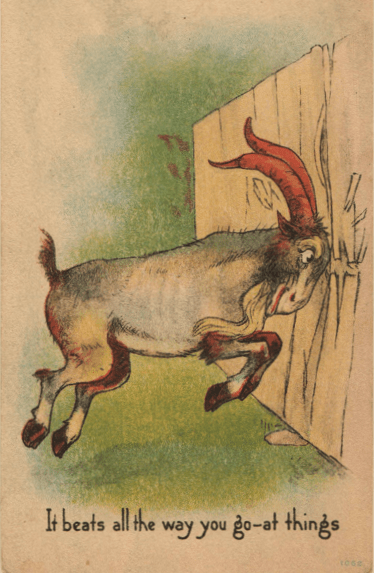
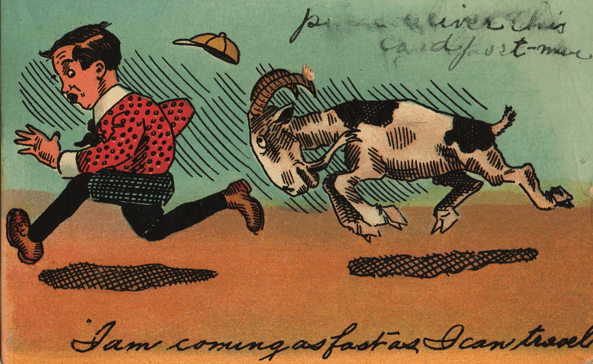
“Trip-trapping? Would you call it trip-trapping? Ever since I started watching dance videos on YouTube, I kind of think of myself as mostly boot-scooting.”
“Listen, I….”
“If you want someone who trip-traps over bridges, you want my older brother. He’s had more classic dance training than I ever got. Mom and Dad always preferred the middle child. When I….”
“All right, all right, pass along. I’ll gobble up your brother.”
“Aha! Who’s that trip-trapping across my bridge?”
“I used to trip-trap but I saw these videos on TikTok which taught me how to shoop shoop sheboogie across bridges. I think my older brother still trip-traps. In fact, he won the state conference title in….”
“You goats talk too much. Scram. I’ll gobble up your brother instead.”
“Aha! Who’s that trip-trapping over my bridge?”
“Don’t you pay any attention to social media, boomer? Nobody’s trip-trapping these days. I’m more of a troll-roller. How well can you swim?”
“Man oh man, even if you live under the bridge, you get trolled. Bah!”
There are numerous roadblocks to my intended series: “Is This Still Funny?” wherein I would look over the work of the stand-up comics of my boy days and figure out whether their work stands up. One is that a certain amount of comedy carries an expiration date. Jokes about Warren G. Harding, for example, may have been hilarious in their day, but to someone now who lacks an everyday familiarity with culture and politics a hundred years old, they have evaporated.
Similarly, the language of a joke can take it out of contention. The postcard at the top of this column, for example, is doomed by using references to three different bits of language which are now obsolete or nearly so. We are playing on the phrase “Paddle Your Own Canoe”, which still gets SOME use, but we are also making reference to “paddling”, once used, especially in England, for just splashing about on the edges of a body of water, and canoodle, a term for dating, flirting, etc. (And am I missing something in the word “canoodle” if it encompassed a lady taking off her shoes and stockings right there at the beach?)
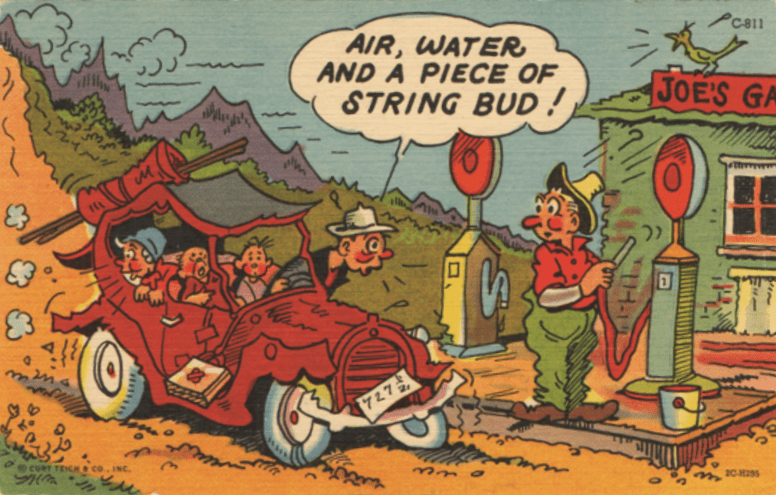
Similarly, “Get Out and Get Under” was a catch phrase for getting down to work, not always used literally, as in this postcard or in the song which MAY have been its source of being (the hero had to get out and get under his broken-down car.) You see how “is this funny?” can be hard to apply. Now that I’ve explained the joke, you understand why other people thought it was funny once upon a time, but, without the cultural background, the likelihood of any of us actually laughing lands somewhere Zilch and Nil. (Makes me recall a gag in Iowa about the new state lottery which just featured photos and Mother Theresa and Slim Whitman…to show your chances of winning anything were between Slim and Nun. See what I mean? It was funny at the time.)
Similarly, only historians and students of cartoons recall that “bully” once meant “excellent”, popularized by Theodore Roosevelt (who also popularized the use of “Excellent”. TR really went for an optimistic public image.)
A later generation used “Ripping” in much the same way. We don’t, especially.
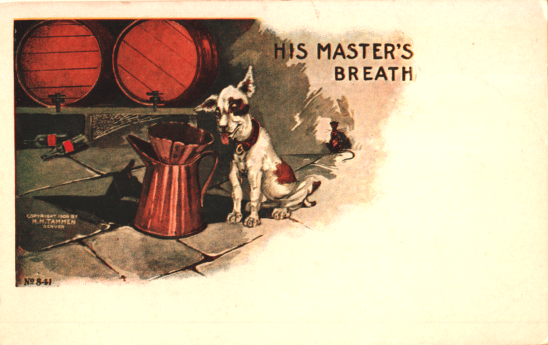
A synonym for “canoodling”, to go back further in this sermon, was “Petting”, and that generation, instead of paddling their canoodles, minded their pets. If you don’t have that in your vocabulary nowadays, this is just a postcard sent by an animal lover.
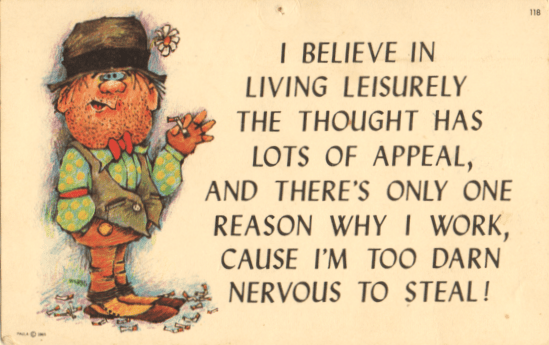
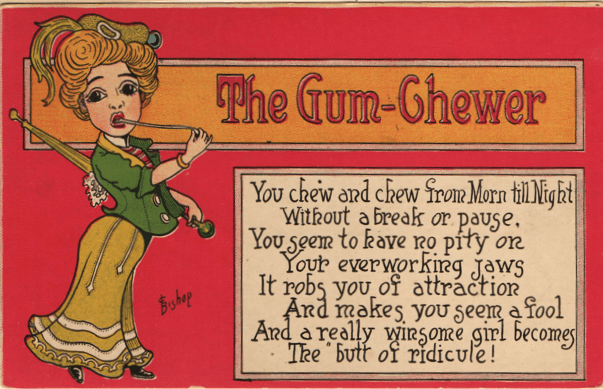
Knowing your audience’s vocabulary is important to those of us who occasionally try to be funny. Not long ago, I mentioned that I could not tell the joke about 288 because it was too gross. This joke skipped past half my audience, and someone who still used “Gross” to refer to 144 had to explain about “two gross.” The same malady affects this joke, since although a few people still use “laying for” to mean “waiting to pounce”, the phrase is fading from usage. (And, admittedly, this joke wasn’t all THAT funny to start with. Unless I’m missing something else.)
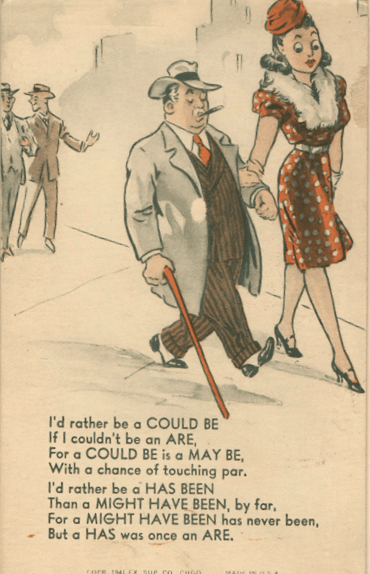
Here we’re lurching under another double reference. A man being made of clay is still used (although “having feet of clay” is more popular) but almost nobody still refers to a trustworthy, reliable friend as “a brick”.
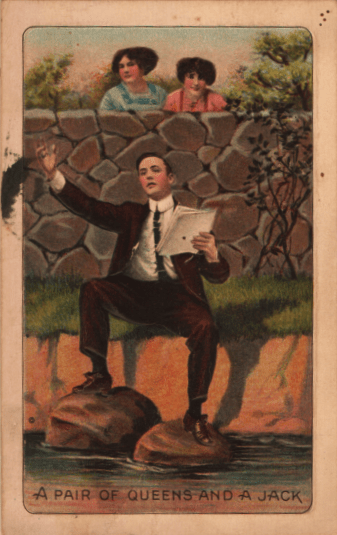
We will close with this joke, which was used by several different cartoonists at different postcard companies. It relies first of all on the bygone expression calling a person’s face a “map”, and connecting that with the double meaning of “to go astray”, suggesting that…oh, you got that one. Was it funny?
Bott, tapping one foot, leaned a shoulder against a strut of the Dragonshelf’s ;loading ramp. He had shouted twice without result, and lacked further options, Without knowing whether one of his remaining grenades was knockout gas, he hated to waste it. And even if it was, that meant either abandoning his crew or lugging them inside.
“Lupfta!” Bassada fell flat on her stomach, her face inches from a splut of yellow flame.
The mountain had turned out to be a step pyramid, with flames spouting here and there from prearranged spots. It had not proven difficult for Bott to climb in spite of occasional trap doors which had stuck halfway open. Others were completely sealed shut by the loss of power, sealing away whatever terrors were supposed to spring out at the fugitives.
So everyone would be aboard by now if the Klamathans had not become obsessed with what seemed to Bott to be secondary matters.
A green hand took hold of Bassada between the legs and forced her a little up but mostly forward. “Keep movin’, wobblebottom!”
Chlorda helped out, gripping blue ears with golden fingernails and swinging the red back and forth above the flaming fountain. The effort threw her backward onto her own golden rump but she didn’t seem to mind.
The lurid lights of the intermittent flames reminded Bott of shows he’d been treated to in religion classes years ago. He raised his communication card to his lips.
“Is it hot in here, ship, or is it just me?”
“It is hot in here, lummox. You just think you’re hot stuff.”
Bott sighed as Louba took Bassada by the ankles and threw her a few steps upward. “I don’t suppose there’s a handy fire extinguisher?”
“A dozen, lummox, but they won’t work. You had me shut down the power to the labyrinth, remember?”
“At your suggestion. I’m wondering if that was a good idea.”
“If it was my idea, it was a good one.”
His crew had made it within the highest ring of flames. Bassada had landed on her feet and was running to keep out of the reach of her companions. She was a bit red in places, but as far as Bott could tell, Louba and Chlorda had avoided actually tossing her into any of the flames.
Was this the time to deliver a lecture which would blister them everywhere they were unscorched? He thought it over as they barreled toward the ramp, but any decision was quahed by a cry of “Oh my!”. It had come from above.
“Lala!”
“Fripplepletz!”
“Light me nose an’ call me see-gar! “Looka ‘at!”
His crew had stopped short of their goal, all looking into the air. Bott, after a suspicious glance at the Draginshelf’s ramp, ran clear of the ship to find out what they saw.
It was worth the effort. A woman clinging to the shreds of her clothing and a large box at the same time was dropping from the sky in what appeared to be an immense egg. There was no saddle, and as the egg wobbled, she slid from one end of a long seat to the other. Somehow the egg did not roll over.
“Not enough power!” she was shouting. “Look out!”
The voice made Bott’s jaw tighten. He had ordered that any further fake librarians be eliminated. Snatching up one of the remaining grenades, he readied it and launched it skyward.
Bassada applauded. “Good shot, Cap’m!”
It wasn’t, really, even allowing for the fact that grenades hardly required pinpoint accuracy. He had thrown it way too low, so it was below the egg when it burst. With a psssh-thitt, long silver streamers shot out of the grenade in all directions. These twisted and fell apart, sending out more, thinner, threads.
Bott nodded: a hold grenade was something he understood. And he understood at once that this wasn’t going to do any good, unless it was more advanced than any grenade he’d seen. A hold grenade took hold of its target and fastened it to whatever surface was closest. But all there was in that direction was the ceiling, and the egg was falling too fast to be carried all the way back up to the artificial sky.
Egg’s descent and net’s rise were similarly slowed as the egg slid along the filaments of the wbbing. The captive and captor parted ways, and each continued in the direction it had been going. All he’d done was break her fall.
“Puts me in mind o’ ‘at ride in Franticville.”
“Oh, do the greens have one of those as well? I spent hours on ours.”
“It was me set a new record.”
Bott’s mind was on the box the librarian carried. He ran his tongue over his teeth and upper lip. If that turned out to be a book, did that make or more, or less, likely to be an impostor? Surely once she was out of the maze, the Emperor would have lost no time in killing her, to keep her from getting to her ship./ Or had he been too sure of his wonderful ship’s torturous gantlet to bother. His eyes narrowed, searching for anything he hadn’t seen in the other Nubries.
“I never liked that woman. Far too thin.”
“Nothin’ ta grab onta. Yow!”
Bassada had been pinched severely enough to remind her that prisoners in disgrace were not allowed to offer comments. Louba turned.
“Want us ta catch her, Bottsy Cap’m?”
Before Bott could answer, the egg descended toward the area where the spiuts of flame were most active. “Yopsh!” cried the librarian, trying to keep her seat as the egg twisted. The box must be something very valuable: she was more intent on clinging to that than on her own safety.
She had only about six feet to drop when she fell free, landing on a safe platform between flames. The egg, righting itself, came to a gentler landing a few inches above another patch of plain step not far away. Bott took a step forward, thought about it, and stepped back again.
This Nubry rose shakily, placing her feet very carefully as she checked the box over for signs of damage. There was nothing left of her clothing now but one strip of cloth; this appeared to be a matter of no concern to her. She looked behind her at the egg and, nodding, turned to look uphill. Taking a deep breath, she stumbled upward in a rush, the box hugged to her chest. The egg followed behind her, coming up the stairs behind her. The crew closed ranks.
“Let’s go!” gasped the librarian. “They’re coming!”
Th Klamathans didn’t move. The librarian stopped at the top step, planting her feet shoulder width apart. Bott had to rise on tiptoe to study her over the wall formed by of his crew.
“Fergit it, kid,” said Bassada, stepping forward.
The librarian licked her lips and raised the box. “I’m not armed. But they’re coming after me. We need to leave if we’re going to save the books!”
That sounded kind of right. Bott stepped through the hole Bassada’s movement had left in the wall. He thought he spotted her prayerstone under that strip of cloth.
He took the box from her hands. She waited, legs trembling, eyes anxious. “What is this?”
“The controls for that.” She turned to point at the egg, And licked her lips again.
Her lips were cracked; her tongue was dry. There were raw patches on her wrists and ankles, and blisters most everywhere else. Bott told himself none of this proved anything.
“What’s that?” he demanded.
“The Emperor’s new toy: it makes copies of things. That’s why there were so many of me in the maze. Dassie said to take it with me.”
Bott tipped the box, considering the multicolored panels. Her knowledge of the computer’s nickname didn’t prove anything, either. “You saw all those doubles of you in the maze?”
Her eyes met his. “He made me watch! Please! Let’s go! You can kill me later if you have to!”
And this didn’t prove anything either. But she was probably correct about leaving soon, and there had to be a real Nubry somewhere. “Let’s go.” He gestured toward the ramp.
He started for the Dragonshelf, but as he reached the crew, a green hand came down on his shoulder. “Cap’m, even if she IS real, no reason that thing yer carryin’ ain’t a bomb.”
Bott shook his head. “They’ve had plenty of time to rig bombs on the ship itself. AND just like them to arrange a surprise for us just as we get clear of the slave ship.”
“He would never let us go,” Chlorda put in. “It could be time for when we all reached this level. You should have left us behind, Captain.”
“I never leave crew until I have to.” He thought he heard a snort from Nubry. He changed his mind: the egg was no doubt a security device which would block any exit from the Drover.
The librarian joined them. “That’s my ship. I can tell, He couldn’t make a copy of anything this big. Could he? He could not.”
Bott, who had already been aboard one copy of the Dragonshelf, couldn’t see what she saw to come to this conclusion. He also couldn’t see the egg. He turned to his left and found it waiting, just beyond his crew.
“Ya got ‘em controls, Cap’m,” Bassada said, jumping a little as Louba reminded her with another pinch to keep quiet.
Bott started toward the ramp. The egg followed. He looked from the controls to the contraption, considering the threats and possibilities.
“Everyone up the ramp,” he ordered. “I want….” “Greetings!” called a voice all five of them had hoped never to hear again
Diane was born at a different time and a different place. About the time she was photographed with a book, she was thinking how weird it was that she and her best friend were not allowed to drink from the same drinking fountain in the park, or use the same restroom. When she grew older and learned why there were two different sets of facilities, she continued to think it was weird. She had a way of making up her mind and sticking to her decision. At the age of four, she informed her parents that when they ate at a restaurant, she could order from the menu by herself, and did so. (Her parents were warned that letting her order a shrimp cocktail and a Shirley Temple were signs that she would grow up into an alcoholic. Didn’t happen.)
Her determination led her into a stint in the U.S. Army, a brief period on a kibbutz (remind me to tell you some time about her trip back from Israel), and on into a career in medical administration, resulting in a forty-year tenure at Northwestern Memorial Hospital. She had decided that 2020 would be her last year there, and this conviction was tried by a pandemic which led, at one point, to her finding herself and other people arriving for their shift being cheered by a group of Chicago fire and police representatives. (“What are they cheering?” she demanded, “That I showed up for work?”
Along with her determination (which she got from both parents, but especially her mother, who decided at Diane’s christening to surprise everyone by picking out a different middle name than the one agreed upon: hence Diane Kenna—after her father–instead of Diane Barbara) she inherited also her parents’ amiability and interest in people. Diane made friends wherever she went, stunning waitresses, doormen, and maintenance workers by remembering the names of their pets and children, and keeping up to date on their family trials and triumphs.
Diane enjoyed Chicago as the curses of 2020 started to fade, and had plenty of plans for 2025. In spring her doctor warned that her liver was acting up and, when pressed by her for the GOOD news, finally relented and said “It could be worse.” He turned out to be wrong about that. She grew thinner and weaker, but still went out on the weekends to greet her favorite restaurant staff (though she no longer ordered Shirley Temples.) After a slightly-delayed biopsy she insisted we go to lunch at a place where she had spotted a “1933-style Thanksgving plate”. Doormen and waiters rushed to help her: she had bruises all over her arms from blood tests, was still wearing her hospital bracelet, and had dropped to 90 pounds. She enjoyed lunch (mushroom marsala glazed turkey), and went home for a nap.
The next day, she fell while heading for bed. She crawled into bed and slept. On Wednesday, when I took up her the mail, she was sitting on the bathroom floor. She had sat down hard, found nothing useful to pull herself up on, and had sat there for three hours. I believe during that imterlude, she decided she was going to die. She refused to go to the hospital, even though she now had to be helped off her couch and around her apartment. She had decided she would go after she had had one last weekend. We didn’t do our regular grocery store trip, but she did send me out for a book of stamps for her favorite charity. We couldn’t make our restaurant date Saturday night, but I brought in our meals (she ate two bites of hers and a bite of the apple pie she requested when I went for the stamps.) Sunday, instead of our regular pizza, I went out for a sandwich for myself and a protein shake for her. She managed about three-fourths of that. Then we went through our ritual of answering a month’s worth of charity solicitations, and after THAT, she let me dial 911.
Through the ambulance ride, admission, and the IVs, she discussed things with her doctors and nurses, sneered in a genial way at my jokes, and asked me, at one point, where the word ‘ouch’ came from; I suggested that might make a blog one day. At 7 A.M., they transferred her to ICU, and I took my leave, telling her one last joke (“These three IV tubes walked into an arm, but it was all in vein”) and she responded with a firm “Goodbye”, exactly as she always did when I would tell a joke on my way out the door on a Saturday or Sunday night.
When next I saw her, her internal works were collapsing, and they had put in a breathing tube. We did not speak again, and I believe the only reason she lasted as long as she did was that she was determined to finish her weekend as much in our traditional way as possible. She lasted about a day and a half after that.
There were only about four people for whom I would pause the usual foolery of this blog to write an obituary. Now there are three.
Sitting on the soft, brown sofa left her centimeters above the floor, lower than any exhibits in this, the deepest, dimmest, dustiest section of the Rhododendron’s museum. Leaning back, the Sherriff looked up at the pictures of her father, with a younger Taw Brust, in rooms of a bygone design. There were even pictures of herself and her sister, and one very small one of her mother and grandfather. Most of the exhibits, however, documented the career of her father—and her predecessor as Shariff—in the days before his disgrace and death.
Marah Parimat came here in search of serenity that was always elusive and sometimes, as today, illusive as well. Her own disgrace and death doubtless waited behind a sealed door that Taw Brust was having Sergeant Bruvitt cut open. The whole gantlet section of the Dragonshelf had inexplicably shut down. The situation’s inexplicability was continuing because every computer with access to the system was told “Awaiting Further Orders” whenever anyone tried to turn the power back on. Her entire tech staff could provide no suggestions for an override.
The Emperor’s Recreational Command Module was sealed completely, and his updates and images of the progress of the Game had cut off. The governor of Lodeon VII was reporting violent demonstrations in five major gaming centers. Incidents of violence between privileged citizens allowed to watch aboard the Drover and Imperial troops had had to be quashed. Brust had mounted a rescue effort, in case this turned out to be one of His Imperial Worship’s little jokes. (Indeed, betting on this possibility was all that was keeping the population of Lodeon VII under even partial control.) The Sheriff, meanwhile, had ordered the Drover evacuated until the source of the problem could be pinpointed.
She shifted in her seat, trying to enjoy her little sanctuary: this might be her last chance. The whole mess was no doubt due to some glitch in the Drover’s computer system: an inevitable occurrence on what was still the slave ship’s maiden voyage. The Drover was vast and complex: one little error in programming could have huge consequences. The Sheriff did not let this idea trick her into believing His Imperial Worship would not blame HER.
The little monitor to her left blinked on; the face of Taw Brust filled the screen. “First large section of the door has been removed. A second will need to be removed before we can attempt entry.”
“Very good. What do you see?”
“The heat of the metal is preventing a clear sight, even with scopes. The Imperial Chair appears to be empty. There are two large unidentified objects in a corner. They appear to be albino slugs from Astafa, but I cannot see any way these could have entered His Imperial Worship’s chamber.”
Her Grace nodded. “Proceed with caution. Keep me apprised.”
She turned her head slowly, memorizing each picture. There had been bright days. Her father had awarded her that silver medal after the Strength Competition; her mother had dropped a glass of water on hearing she had won that certificate for torure development.
She set her back against the sofa. At the very least, she would be awarded weeks of concentrated pet duty. She knew she could survive two consecutive shifts; they would likely assign her two shifts on duty and one dangling in a cell to rest. Or she might be named the personal plaything of one of Stenge’s particular champions, like Kenjegge, allowing her to suffer in a corner of the Imperial Sty for a year or more.
The monitor hissed a little when it clicked on. She did not glance at it. “Yes?”
“Hello? Hello? Is this thing working?”
The Sheriff did not immediately recognize the nearly noseless face on the screen. It was illuminated only by the glow of whatever monitor it was using, and faint light in the background.
The signal to the left of her screen indicated that the message was coming from somewhere in a maintenance conduit on the slave ship. She sat up. Someone in Tech might be reporting on the source of the shutdown.
“Where are you?” she demanded. “Tell me now, in case the signal is shut down.”
“I don’t know. Do I? I do not. Who are you? My screen isn’t showing anything; I had to patch in power from the copier.”
The Sheriff knew the face now: it was the rebel librarian, who had been removed from the Game and held in the Emperor’s New Toy. More than that, it was someone the Emperor would want to punish even more than the Sherriff and Captain of the Rhododendron.
Now what? She pressed buttons which would send a couple of swift, silent security guards to the most likely computer stayions. In the meantime, best to pretend concern for the caller.
“Are you all right? Did you get lost? Everyone was to have evacuated the Drover during the blackout, but it’s easy to get lost on a ship so large. Don’t try to maneuver in the darkness. We’ll send help.”
“It isn’t all dark. I have light from the machine.” The escapee gestured behind her, rising enough to show that she was nearly naked, and bore the marks of His Imperial Worship’s attention. “Maybe the power’s coming back on, or the copier picks up power from a long way away.”
“Three thousand meters, or so I read in the manual.” The number was actually two thousand. If the prisoner did escape from the tunnel, she would run out of power long before it was convenient.
“I’ve read about mechanisms like that. It was ten….” The blistered forehead wrinkled; the escapee winced, but was thinking of something else. The little chin came up. “You’re the Sherriff, aren’t you?”
Marah Parimat, piqued at having been discovered so quickly, said, “What makes you think that?”
“You can read.” Split lips pursed, causing another wince. “Do you…need any books?”
The Sheriff drew back. A quick plan to pretend to be part of a rebel literate force was discarded; the Emperor could use anything she said when he tried her for her failures. “I read only government approved manuals and directives! Anything else is unnecessary.”
Now the traitor recoiled. “Unnecessary! I…. Unnecessary!”
Marah Parimat could see the pictures on the wall; fingers that had been poised to strike other alarm buttons gripped the monitor. Her voice was steady, though, as she replied, “Reading is treason. My father, the Captain of the Rhododendron before me, picked up a confiscated issue of the Bee Inspector’s Journal and read through it. This was not on the forbidden list, but was added later, and for having read it, he was condemned to be pressed to death slowly under blocks of ice.”
The refugee’s eyes were immense. “Did you…have to watch?”
“I was allowed to help!”
The face on the screen shook a little, the way a prisoner might shake its head if Bundar lace mites were dropped on it. “Why do you work for someone who would order that? What harm did the Bee Inspector’s Journal ever do to the Emperor?”
The Sheriff, forgetting the prisoner could not see her on the monitor, shook a fist at the face. “When infractions are not dealt with, dangerous rebels like you attempt to take advantage of the law, pressing against any leniency to widen the avenue of escape. If it weren’t for you rebels, His Imperial Worship would not need such restrictive laws.”
“But he killed….”
“You people killed….”
The conversation broke off in a burst of static. Quite another face took over the screen. It was rather a red face, but the Sheriff recognized it at once. It took only a second longer to recognize that His Imperial Worship was sitting in the control room of his own ship.
“Very good, Btust,” he was saying. “You may go.”
The face now turned toward the Sherrif. “Your Imperial Worship! Are you well? Uninjured?”
“Thank you for your concern, Sheriff. I will reserve the tale of my sufferings until you have the leisure to enjoy it.” His tone was similar to that she expected to hear from the lips of Death. “In the meantime, you will concentrate all your efforts on retrieving a prisoner. She called me groteske.w”
The Sheriff nodded. “What does it mean?”
“I have no idea, but I don’t like it. See that she is not damaged. I will finish that job myself.”
“Yes, Your Worship.” Was there still a chance to let the full weight of Imperial displeasure fall on the fugitive librarian?
No: the Imperial eyes promised that. “:I shall expect her aboard the Panoply within the hour. And those two men who pulled me out of the Drover—Brust and the others.”
“Yes, Your Worship?”
“Kill them.” Imperial eyes narrowed. “No one sees me barebottomed and lives to tell about it.”
The Sheriff’s nod was slower this time. “It was…no doubt a great honor to them, Your Imperial Worship.”
The Emperor smiled sweetly, unconvincingly. “An honor which could not be improved upon, so we shall spare them years of anticlimax. In fact, kill them so painfully that by the time they die, they can remember nothing but pain. See to it.”
So before we had Interwebs to do this sort of thing more cheaply, publishers would release pocket-sized little volumes with brief essays or stories suitable for giving or carrying around in a pocket or purse. It was the equivalent of the 45 RPM single of our record days, as opposed to a LP, or full collection of stories equivalent. If all you wanted was that ONE song/article you liked, it was convenient (and less expensive.)
In the days when I used to redistribute people’s libraries, certain little hardcover booklets came in repeatedly. Some were health-related, and some were motivational tracts. But it was fiction, and frequently humor, which accounted for the perennials.
The convenience of the little booklets sometimes had side effects. Though the authors might have produced many, many more works that the one represented in the booklet, THOSE hardly ever appeared in donations. The success of their booklet eclipsed everything else the writer had done. Some of the all-time favorites in pocket reference literature include:
Ellis Parker Butler: Pigs Is Pigs: Someone ships a pair of guinea pigs to a recipient who is unable to claim them because the stationmaster at the railroad depot demands the fee charged for shipment of hogs. When the customer points out that these are GUINEA pigs, the diligent but uninformed official, Flannery, responds with the title of the poem: it doesn’t matter if the pigs are Guinea Pigs, French Pigs, or pigs of ANY nationality. Since the guinea pigs are male and female, and he is required to keep feeding the livestock and their offspring until claimed, the man grows to regret his stubbornness.
Butler produced over two dozen books and hundreds of short stories in his career. These may be all very well, but the little volume about comic Irishman Flannery’s stubborn belief went through dozens of printings. Several animated adaptations have been made, and there was even a silent movie version.
Langdon Smith, Evolution: A Fantasy: One lover expresses to another that their lives have been linked through eons of evolutionary time, beginning “When I was a tadpole and you were a fish”. Various stages in the history of their relationship are covered in the poem, concluding with a belief that whatever happens in THIS life, they will meet—and love–again.
Smith was best known as a reporter in the wild and woolly years of the late nineteenth and early twentieth centuries. His poem really burst forth in those little volumes after his death at the age of 50. His wife, in a poignant postscript to the poem, committed suicide a few months later.
Chic Sale: The Specialist: A self-trained architect reflects on his career and about the principles involved in building the structures he is famous for: outhouses. He notes the considerations which go into the proper construction of a privy: the nearness of apple trees, the efficiencies in locating an outhouse for a shy woman, especially as opposed to a more courageous one, the dangers of asking the seats so comfortable people simply want to sit and read the catalogue which is provided for purposes other than reading.
Chic Sale was a comedian who often played rural old men (HE died at 51). “The Specialist” was originally a play, but he adapted it into a monologue to be published in book form primarily to safeguard his copyright. The reception of the book meant he had to spend months answering fan mail, and led to the use of his name as a euphemism for outdoor toilets just at a time when these were starting to disappear from the scene.
There are other booklets: I might have included Corey Ford’s How to Guess Your Age or Henry Van Dyke’s The Other Wise Man, or even Clement C. Moore’s A Visit From St. Nicholas. But there’s no point making this column longer than some of the books discussed in it.
It is hardy the job of this blog to critique architecture, but I a as ready and equipped to give advice on the matter as anybody else who dispenses information on the Interwebs. So today we will consider some of the principles in constructing a useful dachshund domicile, collie cottage and other dog houses as seen in the encyclopedia offered by old postcards.
What strikes us right away is how standard design was: a basic single-occupant building with four walls, arched door, and peaked roof. I don’t know about you, Gainesburger goulash, but I was expecting a little more variation at least once we got back into airedale architecture of a century or more ago. But no, there were no spaniel split-levels or poodle porches. (Okay, I’ll stop now.) This design was set at an early period, and everyone has followed suit, on postcards, anyhow.
A FEW old photographs show a flat roof or a square door, but most builders, like our cartoonists, took no such chances. (I kind of like the open attic shown in this postcard from 1914. Maybe Skipper there rented out the second story to pigeons.)
What variations occur involve plain decoration, The color of the house depended on what sort of wood or paint was available. Several designers also included the name of the occupant over the door.
We have discussed hereintofore the moon cut above the door in outhouses. I don’t know if our cartoonist felt this was a neat feature, or based his picture on a real doghouse cut down from a repurposed privy.
In general, cartoon doghouses have doors which open flush with ground level, unfortunately making things easier for squatters and other two-legged visitors.
But quite a few examples exist with a threshold which needed to be stepped over. This probably kept rain puddles from flowing in, or impeded snow that could drift inside during the winter.
A more common option was the tether. Unlike the little doorstep (which possibly also made the structure a little more stable), this depended almost entirely on the joke involved.
Which is also true when it comes to the length and composition of the tether. (Hey, do I get any points at all for NOT using a joke about him calling the landlady to extend his leash? No? I guess virtue really is its own reward.)
And that is all I can find to discuss in the architectural history of doghouses. Maybe next tine we can tour a few postcard chicken coops. I was thinking about discussing cartoon cathouses, but you would not believe the kinds of things that came up when I tried to search the Interwebs about THAT.
In utter darkness, flesh met flesh, sharply and without compromise.
“This is for our Facilities Director! This is for our Assistant Facilities Director!”
His Imperial worship, whom Nubry had expected to bellow and roar and give orders, just stayed bent over the arm of his chair, whimpering and crying for someone he called “Mimavax”.
“Whatever that is,” she informed him, “It’s not here and you can’t have it. And this…is for the Director of the Mail Room!”
“Your Worship!” called a voice muffled by the closed door. “Can you hear us? Are you all right?”
Nubry dealt the imperial bottom another swat. “And this is for anyone I left out!” She turned away from the whimpering emperor and stared in the direction she thought the door might be.
“Mimavax! Mimavax!” sobbed her prisoer.
Nubty felt a little sorry for him, pining for his Mimavax, whatever that might be. She shook herself. For all she knew, a Mimavax could be an especially nasty torture device that would be here right now if the power hadn’t shut down. She stepped back, still testing her legs: at times they still didn’t feel as if they were completely hers. Joints, toes, and ankles tingled in an unpleasant manner. No way pf knowing whether this energy boost was temporary or not, but there was no way that everything which had been done to her knees and hips could have healed.
“The override pass is not opening the door Your Worship,” said the voice from the other side of the door. “We’ll have to cut through. If Your Worship can hear us and pleases to do so, it would be better to move away from the door.”
Nubry’s mouth twisted to one side. Then she dropped to her knees, hoping the knees would withstand this, and started to grope along the floor. Her clothes had been cut apart by vicious little blades, but she was sure there were shreds big enough to cover her. She would NOT wear anything of His Imperial Majesty’s. Bad enough she’d had to touch his pants to pull them down.
She heard a hiss on her left, and a shuffle and whimper on her right. “You stay right where you are or you know what you’ll get,” she ordered. She had a good mind to push his chair right over next to the door. But she wasn’t positive where the door was, and positive the chair would not move for anyone until the power was restored.
She heard a tiny whisper, mechanical and not organic. Sucking in a breath, she pushed up and out. Her hands found the thick puffy buttocks, and shoved hard. The owner fell on his Imperial head. At the same moment, the forecefield on the chair sizzled back to full power, bathing the control room in a flickering blue light.
“Deputy! The saw’s losing power, sir! The Imperial Chair must be sapping it!”
“Your Worship! If some of the functions of Your Worship’s chair could be shut down, we could cut though more quickly!”
No one could do anything with the Imperial Chair. The forcefield sealed it off from Nubry and its usual occupant alike. Nubry sat back and sucked a finger she hadn’t jerked away from the forecfield quite soon enough. She looked over to the sobbing heap of Emperor.
“Oh, shut up,” she informed it. “I just saved your life. Don’t tell anybody, okay?”
Her main fear had been that he would sit back down in the chair and start pressing buttons on the console when the power came to it, but being in here with two halves of burnt Imperial Worship would not have been pleasant, either. His auxiliary control panel was not far from her, the Imperial bulk having knocked it to the floor when he went over the arm. He showed no signs of claiming this, so she grabbed it up.
“No no!” cried the Emperor, throwing his hands over his head and pulling his knees farther under him.
Nubry looked from the quivering rump before her to the giant egg-shaped prisoner she had occupied while His Imperial Worship sat in the Imperial Chair. “How do you work this thing?” she demanded. Dassie has said to take it along, and she could see His Imperial Worship couldn’t be allowed to play with it any more.
“They’ll cut through the door. Then you’ll be sorry!”
She let her eyes drift across the controls. She should remember some of them. These on the bottom row altered the copies: these had not lit up. And she knew this big bright one very well. She kept her hands away from it.
This left only a double row of blue levers, a yellow lever, and a shining silver switch. She tried the switch.
Blue cuffs, scattered around her on the floor, leapt into the air. Nubry nearly dropped the console, sure these would come after her. Instead, they lined up in perfect order to form a solid blue column. The two halves of the big egg came upright, and then wrapped themselves around this column, closing afterward to form a large unmarked egg.
She nodded. That must be the power button. The blue levers likely maneuvered the matching cuffs. So this yellow lever must move the egg.
She looked around the room. Move it where?
There seemed to be only one door, which now showed a red stain in the middle. That made no sense. There had to be an emergency exit for any room where an Emperor would be spending time, especially THIS Emperor. None of the monitors around the room was turned on, so she could ask, and she had no cards like Bott’s.
Looking around the room showed the scraps of her uniform. “If you had to buy clothes,” she informed the wiggling bottom beyond the chair, “You’d be more careful with them.” The buttocks clenched, and quivered.
Nubry tried to reach for some fragments of clothing. “Ack!” As she slid in a pool of her own sweat, one leg twisted behind her and the other smacked the Imperial chair shin-first.
“Ohhhh.” The shock went through her entire body, bringing a memory to each muscle and joint of what it had been subjected to. This flash of pain was brief but told her the stamina she’d received when all those copies were reabsorbed into her was not going to last. If she was going to get out of this box by herself, it had to be soon.
Pulling herself up on her elbows, she saw it. Logical, really, that she hadn’t thought of that door. Even though she’d been through it dozens of times, she had not actually been through it yet.
She pressed a hand against the trap door. It gave way. So did one of her shoulders.
“Is Your Worship all right? We’re nearly through. I hope the air isn’t too hot.”
Nibry sat up and swung her legs over the edge, keeping her bottom firmly on solid floor. A black emptiness awaited her. Vague memories crowded in, saying this was a long tunnel with hundreds of trap doors to drop you into the maze. The pictures in her head were fuzzy, faint copy memories from the copies of herself. But none of them had gone through any of those before they were sucked back into the room and their original source.
There had to be something else. Escaping through the maze was not an inviting proposition. Bott was there, of course. But how would she find him?
She caught up some of the shreds of her clothes but just twisted them between her hands. And if she did find him, how could she convince hi she was the original?
“We can’t make it through at this level of power, sir. We should send for the Imperial….”
“Keep on with it, Burvitt.”
She knotted a couple of rags together and threw them around herself. And if she could convince him she was real, would he kill her anyhow? The transcription monitor had probably been lying, but those Klamathans might have better plans. And there were three of them, and only one of her.
This was as clothed as she was going to get, and likely it would all fall off the moment she moved anyhow. She took up the controls again. She needed to learn how to move that big horrible egg right now. She drew the yellow lever down.
The big copy machine did not move. Nubry licked her lips and pressed harder, but then shook her head. The egg was sitting on the floor: it couldn’t move down any farther. Ashe pushed the lever the other direction. With a hum, the egg rose about a foot into the air.
“Losing more power, sir!”
“It isn’t supposed to be easy, Burvitt.”
Nubry moved the lever up and down, left and right, confirming what the controls did and draining more power from whatever they were using. She was in no rush to drop into the unknown on infirm legs, and she had a feeling she was forgetting something.
She glanced at the trembling Emperor. Was that it? Yes, it was! She really ought to do something truly dreadful to him before she left. A brief flurry of swats was hardly full payment for the way he had turned her inside-out and eft her feeling squished like a weevil under an unabridged dictionary.
Rising, she stepped toward him. She stepped back.
She couldn’t think of anything.
Thin red lines were radiating away from the hot red stain on the door. She shifted the lever to position the egg close to the trap door. It was just about time to go.
She wished Bott was here. A pirate could think of something practical and dramatic, something painful and memorable. Very difficult to have to think up an atrocity all on your own, with no experience…on the giving side.
The library held numerous books with horrible pictures, pictures of what tyrants did to people and what people did to tyrants in return. Meanness, cruelty, and joy in destruction filled page after page in some histories. There ought to be something….
She crawled over to the Emperor. Reaching down, she put a hand on each side of the pudgy, clammy head and turned it toward her. Terrified eyes made her pause, but remembering those eyes and how they shone while she writhed and twisted in the blue cuffs made things easier. Her own eyes were cold. Her chin hardened.
“You,” she informed His Imperial Worship, “Are really, really, really very groteskew.”
Then, dropping his head, she snatched up the control module and jumped for the trap door. A red sliver of the other door fell hissing into the control room.
So maybe you’re not the sort of person who notices this, but it has been rather warm lately. Or maybe you’re one of those people who enjoys the warmth that allows you to broil steaks on the hoods of the cars in the parking lot. But comedy is not made from people who are comfortable with the heat (excepting that poem about Sam McGee.) So the postcard cartoonists offered various escapes from the unpleasant effects of the season.
The people who could afford air conditioning, of course, could enjoy the dog days.
Some houses, of course, do not provide mechanical cooling, so the answer was to go find it.
Travel was promoted as a way to find cooler climes. Or at least a breeze.
And although you COULD sleep outdoors at home, doing it on the road seemed more elegant and adventurous.
Part of the adventure was finding just the right sleeping spot, of course, which afforded maximum ventilation and access to breezes.
If you picked the right destination, you could cool yourself by divesting yourself of as many garments as was locally permissible.
Postcard cartoonists pointed out that this could, of course, prove counterproductive.
While places filled with vacationers could make finding a nice, cool spot difficult.
Many people recommended a bath or shower for cooling purposes. In some vacation spots, this could prove complex as well.
So some cartoonists eschewed travel in summer, preferring repose and a cold beverage.
As this method requires much less financial outlay than a trip to cooler regions, it has been popular throughout the ages.
Whatever method you choose, do your very best to keep put of the heat, maintain your precious bodily fluids, and recite to yourself the Midwest Sumer Mantra: “Come January, you’ll wish you had some of this back.”