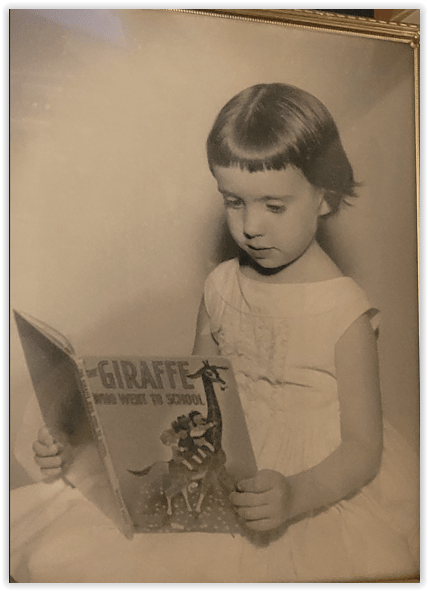
Diane was born at a different time and a different place. About the time she was photographed with a book, she was thinking how weird it was that she and her best friend were not allowed to drink from the same drinking fountain in the park, or use the same restroom. When she grew older and learned why there were two different sets of facilities, she continued to think it was weird. She had a way of making up her mind and sticking to her decision. At the age of four, she informed her parents that when they ate at a restaurant, she could order from the menu by herself, and did so. (Her parents were warned that letting her order a shrimp cocktail and a Shirley Temple were signs that she would grow up into an alcoholic. Didn’t happen.)
Her determination led her into a stint in the U.S. Army, a brief period on a kibbutz (remind me to tell you some time about her trip back from Israel), and on into a career in medical administration, resulting in a forty-year tenure at Northwestern Memorial Hospital. She had decided that 2020 would be her last year there, and this conviction was tried by a pandemic which led, at one point, to her finding herself and other people arriving for their shift being cheered by a group of Chicago fire and police representatives. (“What are they cheering?” she demanded, “That I showed up for work?”

Along with her determination (which she got from both parents, but especially her mother, who decided at Diane’s christening to surprise everyone by picking out a different middle name than the one agreed upon: hence Diane Kenna—after her father–instead of Diane Barbara) she inherited also her parents’ amiability and interest in people. Diane made friends wherever she went, stunning waitresses, doormen, and maintenance workers by remembering the names of their pets and children, and keeping up to date on their family trials and triumphs.
Diane enjoyed Chicago as the curses of 2020 started to fade, and had plenty of plans for 2025. In spring her doctor warned that her liver was acting up and, when pressed by her for the GOOD news, finally relented and said “It could be worse.” He turned out to be wrong about that. She grew thinner and weaker, but still went out on the weekends to greet her favorite restaurant staff (though she no longer ordered Shirley Temples.) After a slightly-delayed biopsy she insisted we go to lunch at a place where she had spotted a “1933-style Thanksgving plate”. Doormen and waiters rushed to help her: she had bruises all over her arms from blood tests, was still wearing her hospital bracelet, and had dropped to 90 pounds. She enjoyed lunch (mushroom marsala glazed turkey), and went home for a nap.

The next day, she fell while heading for bed. She crawled into bed and slept. On Wednesday, when I took up her the mail, she was sitting on the bathroom floor. She had sat down hard, found nothing useful to pull herself up on, and had sat there for three hours. I believe during that imterlude, she decided she was going to die. She refused to go to the hospital, even though she now had to be helped off her couch and around her apartment. She had decided she would go after she had had one last weekend. We didn’t do our regular grocery store trip, but she did send me out for a book of stamps for her favorite charity. We couldn’t make our restaurant date Saturday night, but I brought in our meals (she ate two bites of hers and a bite of the apple pie she requested when I went for the stamps.) Sunday, instead of our regular pizza, I went out for a sandwich for myself and a protein shake for her. She managed about three-fourths of that. Then we went through our ritual of answering a month’s worth of charity solicitations, and after THAT, she let me dial 911.
Through the ambulance ride, admission, and the IVs, she discussed things with her doctors and nurses, sneered in a genial way at my jokes, and asked me, at one point, where the word ‘ouch’ came from; I suggested that might make a blog one day. At 7 A.M., they transferred her to ICU, and I took my leave, telling her one last joke (“These three IV tubes walked into an arm, but it was all in vein”) and she responded with a firm “Goodbye”, exactly as she always did when I would tell a joke on my way out the door on a Saturday or Sunday night.
When next I saw her, her internal works were collapsing, and they had put in a breathing tube. We did not speak again, and I believe the only reason she lasted as long as she did was that she was determined to finish her weekend as much in our traditional way as possible. She lasted about a day and a half after that.
There were only about four people for whom I would pause the usual foolery of this blog to write an obituary. Now there are three.

