Farther down, the path was bordered by tall pink walls that had blue eagles carved into them. Jack did not like these. Little blue dots on the pink seemed to shift as he watched, and the glittering jeweled eyes of the eagles appeared to be following his progress as he and the fox moved farther along.
The walls rose higher as the adventurers traveled lower. Soon Jack spotted another gate, this one with bars of silver set in a frame of ruby. Because he knew where to look for it now, he saw the sentry box, too, and spotted ye giant rat just as Cavia shouted, “There he is, Rudolph! Go get him!” Then his fox guide disappeared, with a flip of that big red tail.
“Arrrrh!” snarled the rat, starting forward. “Who goes there?”
Jack had had time to think up a new lie. “Cheeseman!” he declared.
The rat paused. “A man made of cheese?”
“No no,” said Jack, quickly. “A man who delivers cheese to faithful guards. I was supposed to bring you a great deal of cheese, you being so smart and strong and loyal and all.”
“Nobody deserves it more.” The rat looked left and right. “Where is it, then?”
Jack spread his hands. “I had nearly reached Your Eminence’s date when this horrible fox with his sneaky magic came and enchanted it so that now it looks like part of the wall. And I can’t tell which part of the wall is really cheese, what with this cold in my nose and all.”
“That fox again, eh?” snarled he rat. “He’s a troublemaker. Stand back while I give it the old taste test.”
Rushing past Jack, the rat plunged straight at a section of the wall and but down so hard that the wall shook. So did the rat.
“Oh!” the rat moaned. “I think that rattled my brain.”
“I don’t think you’ve got one to rattle,” called the fox, zipping forward to join Jack on the other side of the gate. The rat spun and rushed at them, but smacked into the bars.
“Ho ho,” chortled Cavia. “A cheese fiend au grating.”
“Are there more of these?” Jack moved farther down as the rat tried to reach in and grab them. “Pretty soon someone’s going to give us the gate.”
“One more,” said the fox. “We don’t need to keep up this cat and mouse game forever.” Cavia set off downhill again.
Realizing no more details were to come, Jack moved downhill. He could see more of the city now. Those tall, thin towers branched out into what seemed to be diamonds but, on further study, appeared to be rooms domed over with glass. Jack saw people inside these, but since he never saw them move, he decided they were either statues or people who got around very, very slowly.
His eyes were on this amazing municipality until the fox called out, “Mind the mud patch!”
Only narrow dry paths remained of the path, running along each side of a dark, vast puddle. “Not very tidy,” said Jack, sliding along the wall to the left.
“Yes, but it’s enchanted mud,” said Cavia, trotting briskly along the right side, “It’ll suck in anyone careless enough to touch it.” Jack curled his toes under and walked a little faster.
Beyond the magic mud was a big iron door. No sentry box waited here, and, more importantly, no bars to squeeze between. Jack looked for a handle or a latch, but the only thing he saw was a curly silver horn hanging at eye level.
“Blow into that so we can get in,” the fox commanded.
Jack blinked. “What if somebody hears us?”
“That’s the idea, Rudolph,” Cavia replied.
Jack wiped the mouthpiece of the horn, to be on the safe side, and then blow into it. He didn’t blow very hard, as he was still a trifle unsure about this whole business. But by the time the sound had worked its way through all the curls and coils of the horn, it was loud enough to rattle the door.
The door was rattled from the other side by a loud voice. “Fo fum fi fee: I think you play that thing off key.”
The gate swung open. This didn’t help, because the space was now filled by a golden giant, his armor gleaming and blue beams of light flying from his eyes. At his elbows, instead of forearms, he had two mighty swords.
“Stand and be chopped, intruders!”
He could see there were two intruders because Jack had been quick enough to grab the fox’s tail before Cavia could escape into hiding. “Chop away,” Jack chuckled. “You’ll never chop me, I’m afraid.”
The giant took one step forward. “In your place, manling, that is the last thing I’d be afraid of. Why will I not chop you?”
Jack winked, and yanked Cavia’s tail. “This fox thinks I don’t know, but I can be beaten only when he is not right next to me. It’s part of a blessing from my fairy godmother.”
Now the giant chuckled. “I thank you for that secret! Let this teach you not to tell strangers too much about yourself!”
The twin swords chopped down, not at either intruder, but right between them. Jack let go of the fox’s tail and jumped to one side as Cavia ran to the other.
“Now he’s not next to you,” the giant chortled. “And now I can…hey, I’m stuck!”
Sure enough, the giant had chopped so furiously that the tips of the sword had splopped into the enchanted mud. “Oh, don’t bother to get up,” said Jack, jumping past him through the open door. “We’ll let ourselves in.”
“You said I’d win if the fox wasn’t right next to you,” hollered the giant, his toes digging grooves in the roadway as the enchanted mud sucked him in.
“I lied,” said Jack, and that time he told the truth.
He turned to speak to the fox, but the words died on his lips as, for the first time, he saw the city from the inside. It was grand, glorious, still. Brave banners hung limp from the tips of delicate towers, light twinkled at the corners of gemlike windows.
“Nice, isn’t it?” said Cavia.
Jack shrugged. “Well, if you like things cobbled together out of exotic gems and precious metals, it’s not bad. Perhaps a little gaudy for my tastes.”
“Ah, Rudolph, you are a person of refinement. You must tell me what you think of the palace.”
Jack looked down the road, expecting high stone walls and another barred gate. What he saw was a vast pink dome, its grand front door covered in whorls of sizzling colors. It took Jack’s breath away, but not so much that he failed to notice this door was ominously ajar.
“What horrors are waiting for us in there?” he demanded.
“You’ve got to kiss a princess,” the fox told him. “Think you’re up to that, Rudolph?”
“Mmmmm.” Jack studied the marble stairs on the other side of the door, and stepped inside. “Let’s see.”
He saw quite a lot. From the orange and silver tiles on the floor to the shimmering yellow ceiling, the interior of the palace was an exercise in optical opulence. Each succeeding room was more elegant than its predecessor, with its own assortment of colors and gleams. At last they reached an impossibly lovely chamber hung with pink and gold silks. At the center of these was a platform bearing a golden gondola with pink draperies.
Among these drapes of pink was a still, silent person, obviously a princess. This was obvious in the angle of her jaw and the delicate flare of her nostrils as she breathed in and out. Jack himself found it a little difficult to breathe.
“Who is this?” he whispered.
“That, Rudolph,” said Cavia, “Is Princess Fanny. Centuries ago, she and her entire city were put to sleep by an evil vizier. We foxes were the only ones clever enough to escape and tell the tale, which has been handed down in my family for generations, about the great golden age that was, and will begin again once she is awakened by a kiss from her hero.”
“Golden age,” murmured Jack, moving slowly up the stairs.
“The details have gotten muddle over the years,” the fox said, trotting next to him. “There’s a lot about a ban on fox hunting and chicken for everybody. Get on with it.”
The average shepherd gets few opportunities to kiss a princess, and Jack was unsure how to begin. Nonetheless, it seemed at least as easy as dodging a giant rat. The princess’s eyes fluttered open. They were as bright and clear as Jack had known they would be, and her voice, when she spoke, was music from afar.
“Is it true?” she whispered. She sat up. “Is it time for us to wake? Are you the hero who has saved us? What is your name?”
Jack was too dazzled by her beauty to reply for a second. In that second, Cavia sat up and shouted, “Rudolph Fairbairn McButtermilk IV!”
A tiny wrinkle appeared between Princess Fanny’s eyes. “Oh, pooh!” she said, her gentle lips forming a pout, “The fairies said the curse would be lifted and the new golden age begin when a hero named Jack kissed me!” The beautiful head dropped back onto the pillow. She closed her eyes.
“Wait!” cried Jack. “I….”
The scene before his eyes blurred and went black. He realized after a moment that everything was black because his own eyes were closed. When he opened them, he was lying in the meadow, with all those sheep.
“Asleep,” he muttered. “Dreaming.” But when he turned his head, there was Cavia, studying him over a little mound of earth.
“Sorry about that, Rudolph,” said the fox. “I never heard that last little bit of the story, or I wouldn’t have put you to so much trouble.” With a flip of the tail, the fox disappeared.
“Hey!” yelled Jack, crawling to the hole so he wouldn’t waste tie standing up “Hey!” Both fox and hole were gone. Jack grabbed a rock and flung it at a sheep that wasn’t doing a thing wrong.
Jack vowed that he would never lie about anything again, profound or absurd. This didn’t matter much, as he never found his way back into the cave or the sleeping city. But he became known as the most honest shepherd who ever lived, and that must be worth something.
As you will of course recall from our last thrilling episode, we were considering what vintage postcards had to show us about women in the workforce, especially in jobs traditionally associated with men. The main conclusion we drew from the examples was that the postcard artists were less interested in reviewing current societal norms than looking for an excuse to produce a card which people would buy.
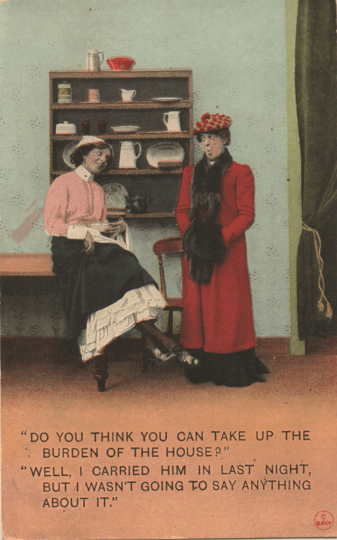
We can see that in postcards covering more traditional female jobs as well. This card, for example, has less to say about the roles of men and women or jobs for female workers than it was an excuse for a good old Bamforth gag. (As this is a Bamforth card, the lady on the right is almost certainly being played by a man. But a discussion of cross-dressing in postcards is a whole nother blog.)
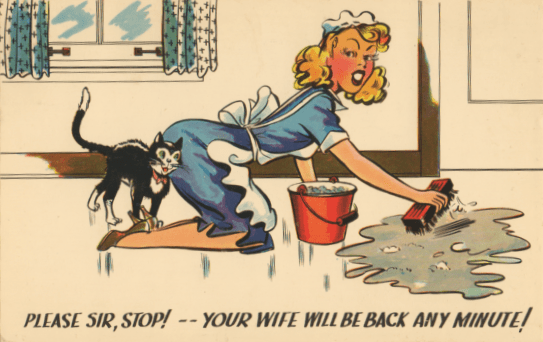
And this artist was not making a comment on the indignities endured by servants. The card was going for the double market for cards with shapely women on them AND cards with cats.
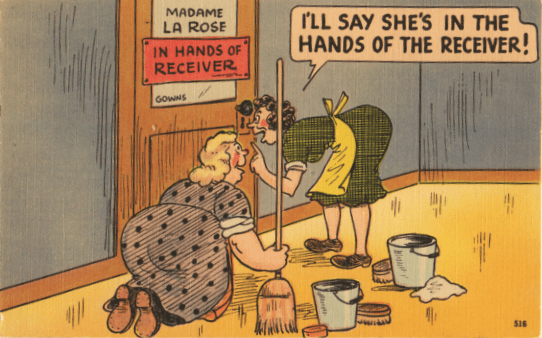
Women who indulged in cleaning floors in larger operations were generally large and ungainly…and watching through the keyhole. The ideal customers for this card weren’t looking at the cleaning women but wishing they could see what the women were seeing.
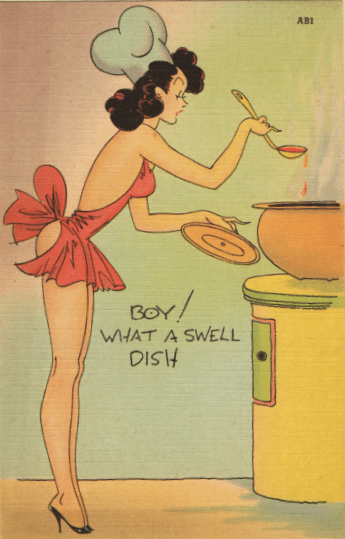
Cooking, of course, was as homely a job as cleaning the floor, whether at home or for a larger concern. (Surely she wouldn’t be wearing a chef’s hat at home, where she could be less formal in her attire.)
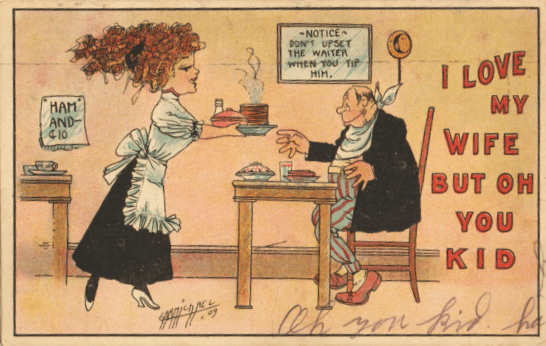
While the pretty waitress was as standard in postcards as in popular song. (The waitress snarking back at travelling salesmen at lunch can be seen in “My Mother Was a Lady”, a hit from 1896.)
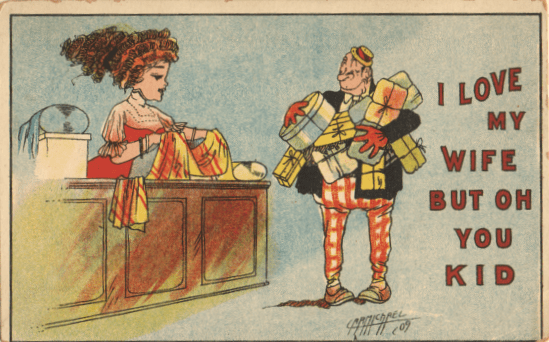
And the attractive shopgirl was also a staple in pop fiction and postcard jollity.
All of these stock characters were familiar to the potential buyers, and made the joke easy to understand and appreciate. That meant a sale. Exactly how many businessmen were sent postcards featuring an elderly executive hiring a charming secretary cannot be estimated. What the businessman thought of this, especially if the card was sent to the office by his wife, is also lost to history.
Therefore, in search of postcard purchses, artists did not neglect the nurse….
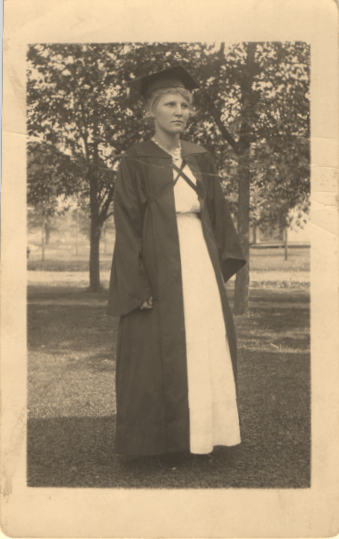
The schoolteacher….
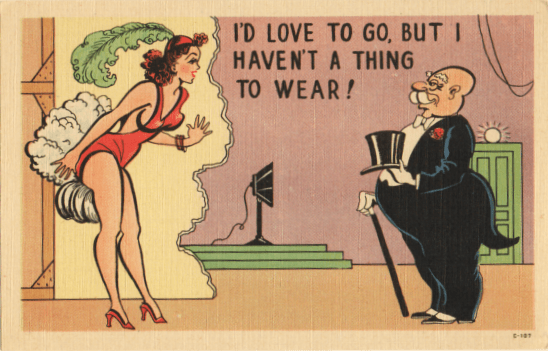
Or the showgirl. What we can pick out of these little tableaux depends more on our own angle when we seek historical data. We must remember is that the artist was not striving to preserve an insightful or even accurate picture of conditions at the time. In looking for a gag that would help them pay the rent, they did hold up a mirror to the thoughts in their heads, which reflected times they lived in. But, like a mirror, what they show should not be taken as a perfect picture (the best mirrors still get everything backward.)
So we must try not to read too much into their depictions of women pursuing their professions. The things you see depend at least partly on the thoughts in YOUR head.
The First Golden Age of Postcards, when the fad was at its peak and millions of these little analog text messages were selling every year, roughly from 1907 to 1914, saw a growing public notice of the movement of women into the work force. Women had always kind of BEEN part of the work force, but these Modern Women were starting to challenge men for traditionally male occupations instead of keeping to their place behind a needle.
This train of thought was suggested to me by the arrival in my inventory of three postcards featuring this obviously female and slightly threatening barber. The set, possibly part of a larger series, emphasizes the pleasure of a male customer at being attended by her staff of female attendants.
In fact, though we see here that women could be employed as bookkeepers as well, neither the postcards of the 1910s or their descendants in later decades were out to prove women could do a job as well as a man. The postcard companies were more interested in selling postcards than in making a point.
The best that could be said of them was that they accepted that women DID do jobs associated with men. The jokes told by the artists involved weren’t about whether they should or could, but about finding a saleable gag to go with the job.
World War II gave momentum to the movement of women into the work force, and the WAC postcards The woman soldier was a hard sell in some markets, but the postcard artists did their best to show how much they had in common with their male counterparts. (Sleep, for example: the most precious commodity for any soldier. One WAC told me you didn’t waste these opportunities. In fact, she said, you didn’t even notice them: a second after your head hit the pillow, the bugle blew.)
The war’s effect on farm labor was also well documented.
Though in fact, the farmer’s daughter and the pretty milkmaid were staples of literature, postcards, and jokes long before the war.
It continued during the War as well.
And, odd though it seems, even the female blacksmith predates that war.
Like the male blacksmith, female blacksmiths did have to move away from horses and toward horseless carriages as time went by. Postcard artists may have been more interested in showing off an attractive pair of legs than meditating on the social phenomenon they represented.
That legs sold more postcards than sociological meditation on the role of women in the workforce was simply an occupational hazard.
You probably recall that there was once a town that lost all its wool and mutton because the boy who was hired to tend the sheep got bored. He took to hollering “Wolf!” when there was no wolf, just to see all the townsfolk turning out to help him. Naturally, the one time there WAS a wolf, no one believed hi when he hollered, and that story ends rather red.
No far away, in another town, another shepherd, Jack, heard all about this, and saw the moral at once. “What a shame!” he thought. “Anybody should realize that if you tell lies about important stuff, you’re going to get hurt. The secret is to tell lies about stuff nobody cares about. You can have just as much fun, and keep out of trouble.”
Jack got to be pretty good at this. Shepherds, you understand, have very little to do all day but look at sheep, to make sure none of them get into trouble or turns out to be a wolf who took the job under an assumed name. So he had plenty of time to practice unimportant lying.
He’d lie to anybody who walked by. “You might want to walk careful around that rock there, Mister,” he’d say. “It just hopped across the road to get to that place, and I’m sure it winked at me.”
The traveler would stare at Jack and then walk over to kick the rock, or just walk around it, way wide. Either way, no one got hurt, particularly. And if the traveler was going in the direction of town, and mentioned the strange story the shepherd had told him, the townsfolk would tell him, “Well, Jack’s an honest lad at heart. Anyhow, he never hollers ‘Wolf!’ when there’s no need.”
But because the sheep spent their time in a lush green pasture that had no attractions beyond grass, not many travelers did pass by. That didn’t bother Jack. He’d just sit and lie to the sheep. This made no difference because the sheep never listened.
“You know,” he’d say, “I understand the queen needs new robes. So I’m going to have to start feeding you goldenrod. That way you’ll grow golden fleece.”
The sheep, busy nibbling every blade of grass right down to the ground, were too preoccupied to pay much attention to this, though one or two would say “Bah!”
So Jack would go on, “Yep, that’s how we do it. Goldenrod. The golden fleece. Had a terrible fuss a few years back, when I was feeding sheep goldenrod and they got into some bluebells. The wool came out green, of course, from the mixing of the yellow and the green. The queen was ever so angry. But then I showed her that, just the way there was real gold mixed in with the golden fleece, there were emeralds mixed with the green fleece. So she decided not to cut off my head but instead cut me a piece of her own personal rhubarb meringue pie, baked by the royal bakers, and served to me on a golden platter. She said I could take the platter home if I liked, but Mom and Dad had told me to fetch all the firewood I could carry, so I just didn’t have any room for that.”
He would just go on and on. It got so that he could tell a hundred lies to the sheep every day, and two hundred on Saturday so he wouldn’t sin by working on a Sunday.
One morning, he had just settled himself onto a soft spot of grass under a tree, and propped his crook against the trunk, when a small red head popped out of the grass. Jack didn’t notice, because he’d already started in on his first lie.
“Did I ever tell you about the purple sheep?” he inquired. None of the sheep replied, being busy, and he explained, “I was sitting here, just as you see me now, when I noticed this purple sheep mixing in amongst the others. Now, I don’t swear to know every sheep in a flock by first name, but I was reasonably certain there hadn’t been any purple ones when I left town. So I reached out with this crook right here and caught the fellow by one hind leg. “Oh, sir!’ he squealed, which surprised me because no sheep had ever called me “Sir’ before. ‘Oh, sir! Let me go and I will grant you three wishes!’ Well, I thought about it and….”
“I beg your pardon.”
Jack looked all around the sheep to find out where this voice had come from, but finally thought to look down. The head of a small fox was regarding him from the grass. Jack was alert at once. In general, a fox wasn’t big enough to carry off a whole sheep, but foxes were known to be crafty.
“My name is Cavia,” said the fox, tipping its head to one side. “What’s yours?”
It didn’t make any difference, and Jack saw no reason to be on first name terms with a fox. So Jack replied, “My name is Rudolph Fairbairn McButtermilk the Fourth.”
“Ooh,” said the fox, rocking back on its haunches, “An honor to meet you, I’m sure.”
“I know,” said Jack.
“Anyone with a name like that is far too grand to be a shepherd,” the fox told him.
Jack had often thought this even leaving the name out of it. But he yawned and said, “Well, a fellow must do something to pass the time.”
The fox eased a little closer. “Well, Rudy…do you mind if I call you Rudy?”
Jack raised his nose. “I prefer Rudolph.”
“Okay, Rudolph,” said the fox. “Would you mind being a prince instead of a shepherd? You look like strong young man who could rescue a princess from a curse and marry her and live happily ever after on a prince’s salary.”
“Well, now.” Jacked leaned back and looked up at the clouds. “I don’t know that I care so much about the money, but I suppose a fellow ought to do what he can to rescue a princess.” This may or may not have been a lie, as Jack knew very little about money and nothing about princesses.
“Do you mean it?” asked the fox, apparently anxious. “You wouldn’t lie to me, would you?”
Jack felt this question was a little too personal, so he replied with a question of his own. “Why? Do you know where there’s a princess who wants to be freed from a curse?”
“I do. If you’d be good enough to follow me, Rudolph, I’ll show you.” And with a flip of its brushy tail, the animal vanished.
Jack rolled to his right and studied the grass where the fox had been. A big hole was waiting; the fox had just gone down inside. This bothered Jack. Being a conscientious shepherd, he had check the area for holes in the ground a sheep might fall into before stopping there. Sheep. Being interested in little but grass, would fall into any hole that was there, given the opportunity And there had been no such hole as this when Jack was checking.
Before Jack could make up his mind how he thought about this, the fox’s head reappeared. “You coming, Rudolph? The princess is under a curse, so she’s not going anywhere, but I have other things to do if you’re not interested.”
Jack got up, looked around at the sheep, and then stepped down into the hole. The path he found there was not particularly pleasant. Water was dripping, and Jack was sure he could hear something creeping along the path. Then he remembered that HE was creeping along the path.
“How much farther?” he asked the fox, half walking and half sliding along a part of the path that had a lot of sharp rocks.
“Oh, any time now,” the fox called back. “See the light up ahead?”
Jack did see a bright spot ahead of and below him. He blinked, and the light rose before him like smoke blown on the wind. He blinked again: the damp dark tunnel was gone. Now he stood on a narrow dirt path littered with boulders, and lined with tall red and blue columns. Far below him, on both sides of the path, he saw a vast city, shadowed but shiny. Tall, thin buildings reached up to the ceiling of an enormous cavern, with glowing spires and shimmering lights he did not understand. It was all so sparkly, and yet so silent.
“Heads up!” called the fox, as Jack stood staring. Jack looked down, of course, and saw the fox’s tail disappearing under a boulder to the right of the path.
“Ahem,” said something else.
Jack had hitherto neglected to look straight down the narrow path. Not much more than twenty yards ahead of him sat a great gate with golden bars, blocking any forward progress, although Jack estimated they were far enough apart for him to squeeze through. (Shepherding is not an occupation in which one puts on fat.) But there was a sentry ox next to this, and blocking access to the gate was a huge hand, standing on fingers each taller and broader than Jack. Where the wrist should have been was a broad bald unfriendly head.
“Why do you approach the city of Merripat?” demanded this head. The mouth showed rows of broad, flat teeth.
Jack threw himself on the ground and, groveling in an amiable way, cried, “Oh, Master! This vicious fox told me there was unguarded treasure in this place! If I would just follow him, I would find unguarded storehouses where I could walk in and take all the chewing gum and maple sugar I desired! But when Your Magnificence appeared, the traitor ran away!” Jack threw a hand toward the boulders to the left of the path.
The hand scratched its nose with its little finger…or leg. “Him again, eh? I’ve had trouble with him before. “Wait right here. I will deal with both of you together.”
The fingers hurried the sentry past Jack and up the path. Scooting forward, Jack plunged at the gate. He had estimated correctly; he squeezed between bars without any trouble. The fox, coming from behind its boulder, simply squeezed under. They ran down the path until they were out of sight of the sentry box.
“I’ve got to hand it to you, Rudolph. You really tricked him.”
“That’s not very funny,” Jack told the fox. “You could have told me about him beforehand.”
“What did you expect?” Cavia demanded. “Cursed princess always have guards on hand. Or vice versa. But I knew he wouldn’t get anyone as daring as Rudolph Fairbairn McButtermilk the Fourth under his thumb. Come on.”
Jack had stopped in the middle of the path. “Are there any more gates like that one ahead?”
“Why?” asked the fox. “Are you thinking of turning around and going home?”
“Ready for that three o-clock appoint…oh, it’s you.”
“I’ve got it this time. I truly have.”
“Mr. Forsyth, we at the Society for the Proliferation of Conspiracy Knowledge have a lot to do since the invention of online communication. We have bent over backward to try and disseminate your pyramid theory, but it just hasn’t generated any follow-up.”
“But I tell you, my latest translations from the Ancient Scroll of Thlekethron has filled in the gaps!”
“Sir, there are other people spreading word that the pyramids gather cosmic energy.”
“That’s true. But the Scroll….”
“And your claim, based on a scroll you found in the leftovers from your neighbor’s garage sale….”
“He did a lot of hiking in Europe when he was in college.”
“…has done very little more but add one more voice to the idea that the cosmic energy was being gathered to preserve stasis chambers for a race of ancient astronauts twelve feet tall and possessed of technology beyond our understanding. It’s nothing new, Mr. Forsyth.”
“But it’s all right there in the scroll, I tell, you: the whole plan, even the time and date they plan to return and bring the benefits of their science to our society!”
“Yes. Which, let me just check your file, was to happen at noon, Chicago time, on January 1, 1939.”
“Yes, but I….”
“And your claim that governments everywhere somehow hid these giants all through the Second World War….”
“That was just a hypothesis based on the information I had at the time. I admit I was wrong. But I’ve been working with an AI translator….”
“On a language no one else has ever seen.”
“It has similarities to the script in Voynich, but that’s not the point. I have new translations.”
“Okay, Forsyth. NOW what date will the giants return?”
“I don’t have any changes on the date.”
“You shock me, Forsyth, but that is at least moderately interesting. What have you repaired in your extremely leaky theory?”
“It’s in the lead-up to the plan to arrange the stasis chambers under the pyramids around the world. The leader of the giants, Wisdomspeak was working extensively with, Quickeyes, his ‘klatzaplud’, which I was translating as ‘Vizier’ or ‘Advisor’. I missed the connection with the title of Wisdomspeak’s consort, the ‘damaplud’. And now everything is clear.”
“To you, perhaps, Forsyth.”
“The Klatzaplud was an advisor, but his real title translates as ‘brother-in-law’. And the sentence about him ‘being aware of a wise old scientist’ actually translates that he ‘knew a guy’!”
“So….”
“So this proto-pharoah Wisdomspeak trusted his brother-in-law to set up all the technology. And the stasis chambers never worked.”
“Great Scott!”
“That’s right. Nothing happened on January 1, 1939 because Quickeyes got his tech from some charlatan who scammed the….”
“Hang on a second. I need to get Francis and his Truth Team on this right away. It’ll knock those latest flat-earthers right off their disc!”
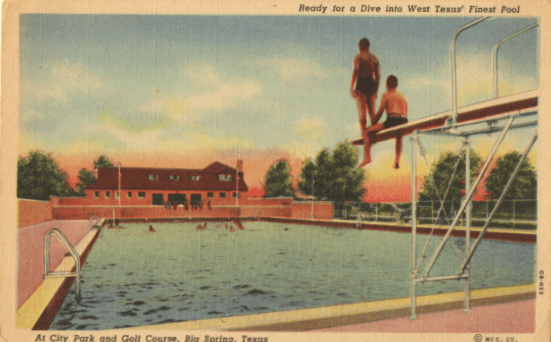
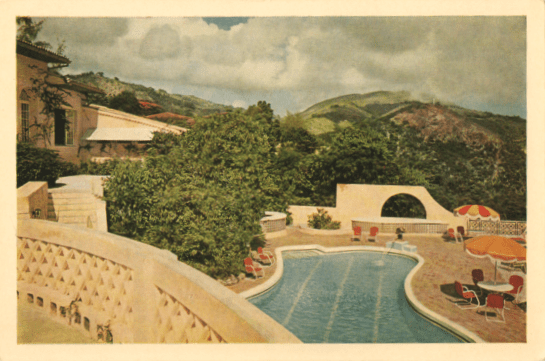
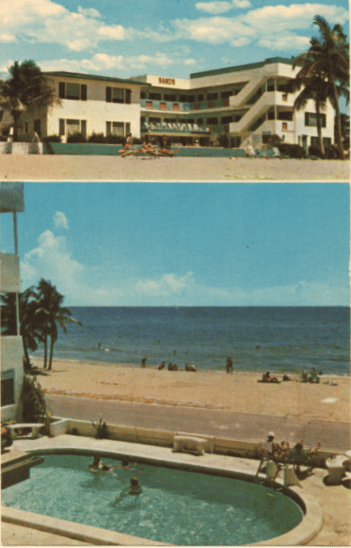
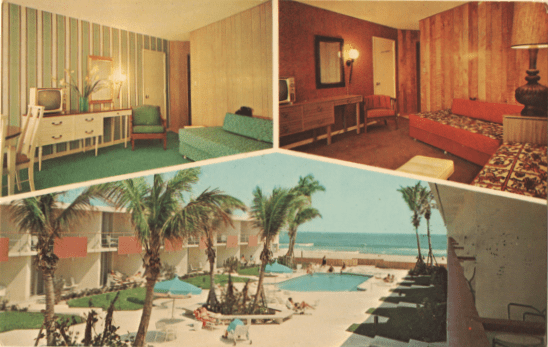
This was a popular postcard when I listed it for sale. I was grateful that potential buyers were interested, but mildly confused. It is not ESPECIALLY old (that it advertises cable available in each room makes it younger than I am, so it’s practically brand new). And then I spotted it.
It would be foolish to claim this is the ONLY swimming pool in the world shaped like a wooden shoe. But the shaped swimming pool is a source of fascination even for those of us whose experience is limited to rectangular public pools and circular swimming pools that had to be inflated before they were filled with water. As I understand it, most people who built swimming pools were limited to rectangles. Our ancestors used boards to build the pool or to serve as frames for the pouring of concrete and these tended to be straight and flat. (At least, no one told me about any pools shaped like boats or other things made by curving the wood.)
The earliest wild weird shape I could find was a pool shaped like the letter T, built for William Randolph Hearst for his elaborate home at San Simeon. (This was later replaced, so you can’t go look at it.) It was not until after World War II that changing the shape of the pool became easier (at least for people with deep pockets.) And even then, the new shape was simply described as “kidney-shaped.” (Which COULD lead us to the fine old joke about the man who bragged about having a “kidney-shaped pool that even has a stone in it.” But let’s ignore that.)
Apparently, we owe the explosion of shaped swimming pools to country singer Webb Pierce, who asked for a guitar-shaped swimming pool in 1952. No one explains where he got this idea, but once it hit the newspapers (and you can bet it did) the gates were open. Liberace countered with his piano-shaped pool. (Both of these were preserved and can be visited by pilgrims today.) Then Jayne Mansfield required a swimming pool shaped like a heart from her husband-to-be. Those three shapes became the most popular for people wanting something special. There is a “broken heart” swimming pool dedicated to Elvis Presley (the crack in the heart is a design on the floor of the pool), plenty of cellos and fiddles which developed from the basic guitar shape, and pianos which try hard to beat Liberace’s original (which had keys you could step out of the pool onto and a fence of piano keys around it.)
But we are not limited to these originals. There is a cat-shaped pool with little concrete islands for eyes. An airport not far from that has a pool in the shape of an airplane. There are diamonds, clubs, and spades to accompany hearts. I have seen a fish, a scallop shell, a buffalo, a yin/yang symbol, and a body part I shall not name, but if I were swimming in would be careful where I climbed out.
It was not until I saw a couple of pools shaped like the state of Texas that I realized my real mission. We cannot ALL have swimming pools shaped like musical instruments and, in any case, a flute isn’t going to impress a LOT of tourists. But in the name of civic pride, there ARE other possibilities.
“It may look like a square pool to strangers, Mister, but our pool’s shaped like the great state of Colorado.” “Yes, Ma’am, this was built so people addicted to chocolate can enjoy their exercise: we built ‘er in the shape of a Hershey bar.” “What do you mean, it doesn’t look like a Lord of the Rings swimming pool? It’s the same shape as the first edition of ‘The Fellowship of the Ring’.”
Chambers of Commerce LOVE coming up with stories, so your town could spin out one about the pirate captain who founded the town and left money for a swimming pool shaped like the plank his prisoners had to walk. Or maybe the civic swimming spot is the splashy legacy of the town’s first librarian, who invented the 3×5 card.
Let other people spend their money building a pool shaped like a Volkswagen Beetle or a Hershey’s Kiss: you can buy inflatable pools nowadays shaped like THAT stuff. But YOU can declare you were inspired by swimsuit pioneer, scandalous actress AND champion swimmer Annette Kellerman, and built a swimming pool shaped EXACTLY like a swimming pool.
Coffey told his mother the whole story over lunch. The discussion of what the cat deserved as a reward went on all afternoon. Mistress Klotsch agreed that any cat who let them have a magic frying pan deserved something appropriate.
“Why don’t you take it a jar of applesauce?” she suggested. “We have plenty, and it’s very good this year.”
“That’s a good idea,” Coffey said. “Everybody likes applesauce. Even a cat must like applesauce.”
Early next morning, when Coffey was rested up from his ordeal and had washed all the dirt from his hair, they rolled back the coverlet which had protected the little beansprouts. Mistress Klotsch handed Coffey a large jar of applesauce, and watched in amazement as her son took hold of one of the beansprouts and disappeared into the ground.
“Fritters!” she exclaimed. “It may be quick but you’ll never get ME o travel on one of those things.”
Coffey dropped right into the tunnel, his arms wrapped around the jar so it wouldn’t break. Before he could catch his breath, he heard sounds from a dark end of the passage. A shelf was attached high on the wall, so he climbed up to hide on it.” The trells are so short,” he thought, “Maybe they won’t look up here.”
He did not find out where the trells would have looked, for it was the cat. “Do you know,” the animal sad, “That you look completely ridiculous?”
“I brought a gift,” Coffey said, jumping down. “It’s a jar of applesauce.”
“Applesauce?” said the cat. “Nnever heard of it, How do you know I’ll like it?”
“Oh, everybody likes applesauce,” said Coffey, pulling up the lid.
The cat sniffed. “Well, I’ll taste it. But this in no way obligates me.”
Coffey set the jar on the floor. The cat stepped daintily up and put its tongue down for a taste. It took a second taste, and then a third. After about sixty of these tastes, the jar was empty.
“A little too sweet,” said the cat, licking a stray blob of applesauce from one whisker. “No, that won’t quite do.”
”Oh.” Coffey picked up the jar. “I’ll, um, just take this back, then.”
“But you are a very honest young man,” the cat went on. “So come this way. I’ll showyou something.”
The cat set off down the hall, not even looking back to see if Coffey was following. Coffey did, as he had no plans for the rest of the day. The cat led him to a small door in the wall of the tunnel. Behind it was a little room stacked with bags, Little cupboards sat above these bags.
“This is where the trells keep their chicken feed,” the cat told him.
“How interesting,” said Coffey. “Our neighbor has a shed for that, just like this, only dustier. She keeps books there, to hold up some of the shelves, and the books get so dusty that….”
“The trells,” said the cat, its voice a little louder, “Have a chicken that won’t lay eggs any more. They cannot have a chicken eating their corn and not laying eggs.”
“Ah,” said Coffey, nodding. “Are they going to make soup, then?”
“Trells do not eat chicken soup,” said the cat.
“What do they ear?”
“You, if you don’t keep quiet Now, get into this bag.”
Coffey obediently climbed into the empty bag, and the cat drew the drawstring tight above him. Then, reaching out, it used a claw to tear a little hole in the side so Coffey could see.
Two trells walked into the room just a second later. One led a little red hen at the end of a string. The other walked to one of the cupboards, opened it, and took out a silver kettle filled with corn. She took two kernels of corn from the kettle and tossed them onto the floor in front of the chicken.
The chicken snapped up the corn at once. There was a sound rather like “pting” as the chicken shivered and became solid gold.
Coffey fund this sequence of events interesting, but it was not until the first trell picked up the gold chicken and took it to another cupboard to set it in with perhaps a dozen other solid gold chickens, that he said “ooh!”
The first trell slammed the cupboard door and leaned down to start sniffing the bags of corn. The other hurried over to open and check inside cupboards filled with gold chickens.
“Problems, ladies?” inquired the cat, who had jumped up to lie on the bag containing Coffey. “I don’t see any rats.”
The trells looked at each other. Then the first one, after checking a piece of paper in her pocket, said, “Fiddle Faddle Feedle Folk, I smell the blood of a human bloke. I don’t like humans—not at all: I’ll use his head for a volleyball.”
“Oh, dear, dear, dear, dear no,” said the cat. “You ladies KNOW how I feel about ‘bloke’.”
“Told you,” the second trell told the first one.
“And that feedle faddle business won’t do at all,” the cat went on. “I DO like that bit about the volleyball, though. You might work on that angle and see if you can’t come up with a really frightening poem. I feel you’re right on the verge of something truly terrifying.”
Nodding, the trells scurried away to work on their rhymes. The cat let Coffey out of the bag.
“Do you think….” He began.
“Yes,” said the cat. “All cats do. You’d better take that silver kettle home with you. Any corn you put into it will become magic feed corn, and will turn any chicken into gold. Keep it in a safe place, mind, or you’ll have golden rats and golden chipmunks into the bargain. And don’t forget my reward.”
“Oh, I won’t.” After a quick look up and down the tunnel,Coffey hurried to where he had landed, and reached up for another beansprout.
“What a fussy creature!” said Mistress Klotsch, after he had popped out of the ground and told her what happened this trip. “Imagine not liking applesauce! Too sweet? Still, it is a most generous cat, is it not?”
“We have to think of a good reward before we run out of beansprouts,” Coffey told her. “I counted, and there are only twelve.”
But the coverlet stayed over these for three days. His mother kept him busy, sending him out to buy cracked corn and chickens, quietly, just a chicken or two here and there, just as a neighbor doing business among neighbors.
“And don’t stand around talking about why we want chickens,” she told him. “Just say we’re going to make something out of them. If they go on asking questions, just talk about soup.”
After a dozen chickens had been turned to gold, Coffey reminded his mother that they had yet to reward the cat.
“Of course,” she said. “What was it the animal said about the applesauce? Too sweet? Take it a bag of the dried apple chips. Those are nice and tart.”
“Oh yes,” said Coffey. “I like apple chips myself.”
“Don’t you eat any of these,” his mother told him. “They’re for the cat.”
Once he had the bag, Coffey went out to the beansprouts. He took hold of one, and before he knew it, he was in the tunnel of the trells again. In fact, he nearly landed on top of the cat.
“Hello there,” the cat said.
“There aren’t any trells around here, are there?” Coffey whispered.
“No. I told them there were likely rats in this art of the tunnel,” the cat replied. “I thought you’d likely be back.”
“My mother really likes the golden chickens,” Coffey told the cat. “And she thought you might like these. They’re apple chips.”
“Apple chips? Sounds interesting. I’ll give them a try and tell you what I think.” Coffey set the bag on the floor, and the cat out its head inside.
“Crunchy. Not bad.” The cat ate every one of the apple chips, but when its head came out of the bag, it said, “No, not quite good enough. Very nice, but not really up to all those magic items But you’re a good fellow to try. Come along and take a look at a chicken coop.”
Coffey had already seen plenty of chicken coops this week, but the cat was already walking away. So he followed, just to be polite.
The cat led him to a big cave with chicken wire stretched across the opening. The cat showed Coffey where to slip inside, so as to be in where the chickens were walking around, or sitting around. There were roosts, nests, eggs, and one big old rooster who came rushing at them, making grumpy sounds. Instead of getting out of the way, Coffey stood and stared. Every time the rooster opened its beak, gold coins dropped out.
“Do you think your mother would like him?” the cat asked.
“Wow!” Coffey replied. Seeing an old bag against a nest, he grabbed it up and put the rooster inside, as gold coins dropped to the ground around him. The chickens, seeing what was happening to their rooster, dashed about, clucking and cackling and scolding.
“Quick!” said the cat. “Over here!”
Coffey heard the footsteps and hurried to climb inside the box the cat showed him. Through a crack between boards, he watched the trells make their way into the big coop. They did look hungrier every time he saw them.
And there were three of them this time. The largest one looked around the cave and, seeing the cat, demanded, “What’s upset these fowl? Have you been chasing their chicks again?”
“Certainly not!” said the cat. “I’ve been hunting rats: this is just the place to find them. No doubt they’ve been bothering the silly birds.”
The trells didn’t answer. They walked among the excited chickens, sniffing.
“Got a cold?” the cat inquired.
The largest trell cleared her throat and folded her hands in front of her. The other two looked from her to the cat, and waited.
“Villey valley volley voe,” she recited, “If human people come below, we’ll call them simply dreadful names and use their body parts in games.” She rolled her eyes down to the cat.
“Well, now, that’s showing real improvement,” said the cat. “Scary. Gruesome, even. But a little long in parts, isn’t it? I mean, you can probably remember all those words, buthat about your sisters? Something shorter and sweeter won’t tax their memories so much.”
The other two trells nodded and murmured to each other. “But it’s not bad?” said the first one.
“Oh, you’re definitely on the right track,” the cat told her. “If you keep working on it, I think you’ll have something really great.”
Clapping their hands, the trells hurried away. Coffey climbed out of the box with his bagful of rooster, and returned to the part of the tunnel with beansprouts in the ceiling. “Have a nice trip,” the cat told him. “And remember, that’s three magic things you had from me now.”
As soon as he was out in the beanpatch, the rooster clawed out of the bag and marched around complaining about being hauled all over creation. Gold coins spilled at Mistress Klotsch’s feet.
“What a lordly creature a cat must be!” she exclaimed. “I’ll bake it an apple pie1”
She and Coffey went into the house, pulling the rooster along, its complaints and the clink of gold coins making so much noise they did not hear someone say “Aha!”
Just down the road from Mistress Klotsch’s apple orchard lived Mistress Olsen, with a dusty chicken coop and a plot of per trees. She sold pear butter and pears and perry to people who passed that way. She had quick eyes, and had noticed Coffey moving about here, there, and all over buying chickens. It was obvious that Mistress Kotsch had quite a lot of money, but Mistress Olsen had not seen so very many people passing the pear orchard to go buy apples.
So she had taken to slipping out of her shop to hide in apple trees to watch and find out where Mistress Klotsch’s money was coming from. Now she thought she knew.
“They keep chickens down there to guard their gold,” she said to herself when she got home. “There’s a door in the yard, and Coffey opens it by pulling on beansprouts. The chickens make noise if they see a stranger. They have so much gold stored down there they must be pirates. Pirates don’t deserve all that gold.”
She went to her own chicken coop to get chicken feed for the guards she thought she’d find. “Mistress Klotsch must be the pirate, not Coffey,” she said to herself. “He’s a good fellow. He wouldn’t mind sharing gold with a neighbor. I wouldn’t really be stealing any, just taking my fair share. I don’t mind pirates if they share with their neighbors.”
As soon as the sky turned dark, she slipped out among her pear trees until she made her way to Mistress Klotsch’s apple trees. Then, walking even more quietly, she walked up to the house itself. Setting down her bag of chicken feed, she took hold of all the beansprouts under the coverlet, the better to open the treasure house door.
What happened next rather surprised her. She had just enough time to holler “Help!”
Coffey and Mistress Klotsch ran outside, but all they saw was a bag of cracked corn. “Someone must have been here!” Coffey cried, “To plant corn in our beansprout patch!”
“More likely trying to steal the beansprouts,” said his mother. “I bet it was that nosy Mistress Olsen. I’ve seen her sneaking around in the apple trees for days.”
“Oh, surely not,” said Coffey, who liked pears. “She’s too nice a person to sneak. But I’d better go down and help whoever it is. They won’t know about the trells, or the cat.”
But because Mistress Olsen had grabbed as many beansprouts as possible, there were none left to be seen. Mistress Klotsch fetched a candle while Coffey ran for a rake.
Moving the dirt around very carefully, Coffey found just one tiny shriveled beansprout. “I can go down,” he said, “But I won’t be able to come back up that way.”
“Don’t go then,” said his mother. “Let her find her own way out.”
Coffey shook his head. “Maybe looking up from below I’ll find another beansprout,” he said, :Or maybe the cat can help.” He took hold of the beansprout and went flowing down before his mother could stop him.
The cat was waiting when he landed in the tunnel. “Did I tell you to send down your whole neighborhood?”
“Who was it?” asked Coffey, standing up. “Was it Mistress Olsen?”
“I don’t know any Mistress Olsen,” the cat told him. “Some rude young woman came down, pushed me out of the way, and went off grumbling about the dirt in her hair and where was all the gold.” The cat licked one paw. “The trells are going to eat her with garlic gravy.”
“We have to save her,” said Coffey, looking up and down the tunnel.
“I thought you’d say that,” sighed the cat. “You look like the type. Come along and keep quiet.”
The cat took Coffey down a side tunnel he hadn’t seen before. At the end was a big room where dozens of trells sat around big tables. Way back in this room was an immense fireplace. In this, tied to a long pole, was Mistress Olsen.
“Hey!” she shouted. “Turn me over! I think I’m done on this side!”
“When the trells are all listening to me,” the cat told Coffey, “Slip along the wall and untie the creature if you have to. Then run and hide in the chicken coop. You know where.”
Coffey nodded, but the cat had already sauntered into the dining room, where it jumped onto a table. “This isn’t much of a party,” it said. “Why doesn’t somebody give us a song, or a poem?”
“Oh, you never like any of our poems,” said one trell.
The cat looked surprised. “Why, your poems are very good. They could just be better: that’s all. It would be a great loss to literature if fine poets like you were to fail because of some little detail. Come on, let’s hear the latest.”
The trells looked at each other. Then, shrugging, one of them stood up and recited “Middle Muddle Maddle Moan: I wish they’d leave us all alone. If human people come down here, we’ll eat them with our evening beer.”
“There!” said the cat. “What did I tell you? That was lovely. Do you have that written down? Oh, that’s not a very professional manuscript: the margins aren’t wide enough. But it’s a good poem. Who else has one?”
The trells were all eager to recite to the cat. Coffey, with his back against the wall, slid into the room. No one shouted at him.
One trell WAS shouting “Feedle Fidle Fodle Fumble, human people make me grumble; if they come down here I’ll take their ears to use for breakfast flakes.”
“Well, now,” said the cat, after a second trell had recited her poem, “Would that be better, do you think, if you started with Meow Meow Meow Meow, why do they come here anyhow?”
“What does ‘meow’ mean?” the trell poet asked.
“I don’t know,” the cat replied, “It just seemed natural. What’s all that Feedle Fidle Fodle Fumble stuff mean, come to that?”
Even Mistress Olsen seemed to be paying attention to the cat criticism. As Coffey got close, she turned her head and opened her eyes wide.
“And if we saw ‘Why do they come here anyhow” we’ll have the words ‘come’ and ‘here’ two lines in a row,” a trell complained. “That won’t sound right.”
“You are perfectly correct,” said the cat. “How clever of you to notice that. Does ‘Why don’t they stay home anyhow?’ sound better?”
Coffey kept burning his fingers trying to untie the ropes around Mistress Olsen. Once she was free, she couldn’t walk. “I came down to steal the gold,” she whispered, “But all I found was this.” She opened an apron pocket to show him a solid gold rat with wings. He didn’t touch it; he knew it would be burning hot from being so close to the fire.
“How about ‘Dickle Dackle Dockle Dickens, they come down cackling like chickens?” asked a trell.
“That’s all very well, if you want to write poems about chickens,” said the cat. “I’d think you’d write about more impressive things, like trells.”
Coffey slid out of the room carrying Mistress Olsen. “Now where do we go?” she asked him.
“The cat said to go to their chicken coop,” Coffey told her. “Which I think is over this way.”
He moved down a tunnel and walked so long that Mistress Olsen finally cooled off enough to walk by herself. Suddenly, they heard shrieks and screams way behind them.
The cat came trotting up next to them. “I knew you’d go the wrong way.”
The screams grew louder. “What’s happening back there?” Coffey asked.
The cat sniffed. “They think I’m the one who stole their supper. As if I were some sort of DOG. They really are not the sort of people to appreciate cats, so I think I will come with you to the surface. You’d better hurry.”
He started off ahead of them. “If this is the wrong way to go to the chicken coop,” said Mistress Olsen, “Why are we going this way?”
“It’s too late for chicken coops,” said the cat, walking faster. Coffey and Mistress Olsen walked faster too.
A rat ran past them, going the other direction. Two more rats followed it. “Ugh!” said Mistress Olsen, kicking at them. “I hate those things!”
“Then don’t slow them down,” suggested the cat. “Hey, all you rats! You better hurry! They’re having a chicken feast back that way.”
Dozens of rats went by, paying no attention to the cat or the two humans. “That may convince the trells to turn around and go back,” said the cat. “Now, let’s get outside.”
“There’s a way to get outside besides pulling at beansprouts?” asked Coffey.
“No. I just say things like that when I want to be silly,” the cat told him. “Of course there’s another way outside: how do you think the rats get in? Come on.”
The rat tunnels were not all that big, and got smaller. The cat could get through without getting any fur dirty, but Coffey and Mistress Olsen kept bumping their heads on tree roots and low hanging rocks. “Come along, will you?” called the cat. “Don’t tell me you can’t do anything a rat could do!”
They came out at the base of a high, rocky hill down the road from the apple orchard. When he was a small boy, Coffey had always been told not to play there because the rocks were loose and might come down on him. “We’d better go,” he said.
“But what about those…those things?” asked Mistress Olsen. “Won’t they find the rat tunnels, too?”
“The rats may have convinced them to give up,” said the cat. “Listen and find out.”
Coffey leaned an ear toward the tunnel. What he heard sounded not at all like rats. Some voices were saying “Fiddle faddle” and some were saying “Middle muddle” and some he couldn’t understand at all because of the tooth gnashing. “It’s the trells! They’re coming!”
“Where can we hide?” exclaimed Mistress Olsen.
Coffey reached into her apron pocket for the golden rat. “Let me borrow this.”
“You’ve already got all the gold you need!” cried Mistress Olsen, even louder than before.
“Except this,” he told her.
“Oh, take it, then,” she sighed. “We’re all going to be eaten up anyhow.”
“I hope not.”
Coffey hurled the golden rat as high as he could up the slope. The heavy piece of gold started to bounce back down. Little rocks rolled with it. These little rocks hit big rocks and knocked them down, and these big rocks knocked down some bigger rocks.
“Don’t stand there watching!” called the ct, from up in a tree. “Get out of the way!”
Coffey and Mistress Olsen had worked their whole lives in orchards, so they knew about climbing trees. They were up sitting next to the cat when the whole hillside seemed to slide. Dust and rocks were flying all around beneath their toes.
When everything had settled, the gold rat was nowhere to be found. But neither was the opening of the tunnel.
“Not bad,” said the cat. “For somebody with only two legs.”
They climbed down from the tree and then walked all the way to Mistress Klotsch’s shop, where they told their story. By the time they had finished, the cat was curled up in Mistress Klotsch’s lap. Mistress Klotsch shook her head at it all and, stroking the cat, said, “And what now?”
“Well, to keep the secret of the gold in the family,” said the cat, “I believe those two had better get married, don’t you?”
It took a certain amount of talking to convince everybody but, in the end, the cat had its way. There was a wonderful wedding with apple cake and pears under ice cream and cider and perry and so on.
“We owe everything to you,” Coffey told the cat on his wedding day. “And you still haven’t been rewarded yet. Isn’t there something I can give you?”
“Give me some time to think it over,” the cat replied.
And that is why, to this day, people who have cats give them the best things to eat, the best places to sit, and the warmest places to sleep. And still cats never seem to be satisfied. They will sit for hours, just staring and thinking of what else they should have as a reward.
Sometimes a cat will simply disappear for a few hours, or even days, and then come back as if nothing has happened. That cat has found a tunnel, and has gone slipping underground to check on the trells. Cats must still check to make sure the trells have not stocked up enough gold to come out and buy the world, to run it as they please.
For running the world, as everyone knows, is a cat’s job.
One of the saddest bits of joke archaeology is running across fossils: jokes which were once alive and kicking, quivering with excitement at the laugh that would be forthcoming when the audience heard it for the eighty-third time. Sometimes they do not realize they have been told for the last time, and wait in books, unaware that the passage of time has left them irrelevant, inapplicable, and inert.
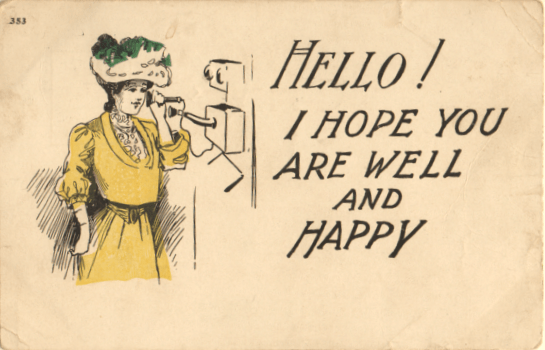
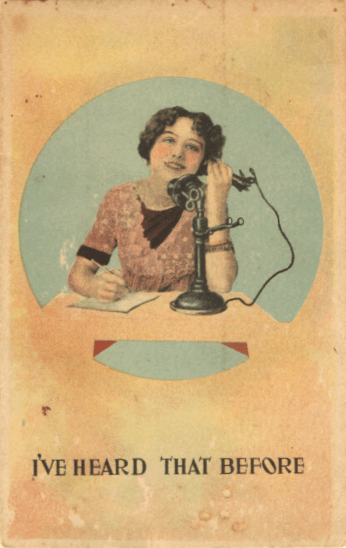
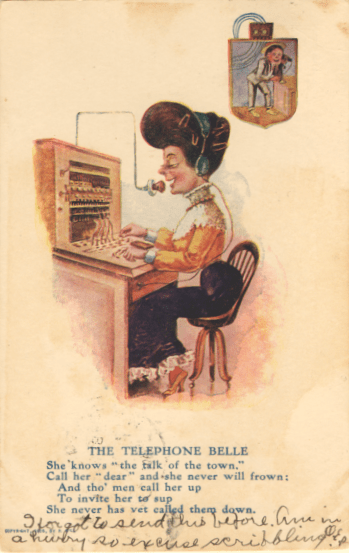
This melancholy image came to me as I was leafing through a paperback book published during the years of my childhood, its cover tattered, its pages slightly brown. The jokes inside, which dealt with the life of a teenager (something I could only dream of back in 19…why talk math?) The jokes, frankly, were still pretty current: high school drama, wardrobe worries, feeding one’s date on a limited budget…. And then I ran into a picture of the heroine sitting in a posture impossible past a certain age, all wrapped up in the telephone cord.
Telephone cord? I had to check the copyright date to make sure this wasn’t a nineteenth century collection.
And a few pages later came another jape from days of yore. The phone was ringing and she was running to pick it up before anyone else in the family could answer. Jokes which require footnotes lose their punch. Modern readers need to be reminded that phones were once tethered in one spot, and that the vast majority of homes had ONLY ONE PHONE.
Not always, of course. I thought with some sadness of the sitcoms where someone was talking secrets on the phone, and another member of the family quietly picked up the family’s Other Phone to listen in, since all the phones were on the same line. Try explaining THAT scene to a Personal Phone audience.
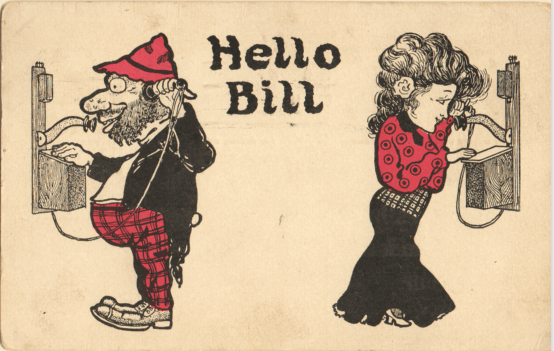
Is there a paradise somewhere for aged jokes which must be explained? There’d be a special wing for gags from bygone technological marvels, a massive auditorium for telephone jokes of the past. There we would find the jokes about rural conversations on a party line, now relegated to the primitive past with the crowd of scenes where the postman reads you all the postcards your relatives mailed today. (Postcard jokes are a whole nother blog.)
Who was the last strongman to show off his muscles by tearing a phonebook in half. Among the useless information stuck in my brain is a tip on how to make sure that massive collection of pages, bigger than the Spring/Summer Sears Roebuck catalog (don’t ask: go consult your grandmother. She’ll google it for you.) will be sure to come apart just right. Who is the last surviving soul among us who sat on a phone book come Thanksgiving?
Once upon a time, watching Christopher Reeve as Clark Kent pausing to stare at a phone kiosk which had replaced the handy old phone booths got a huge laugh from the audience. Does this still get so much as a chuckle in a crowd which doesn’t remember phone booths?
Pay phone jokes have gone the same way as phone booth funnies. No more will we see the pictures of the man fishing in the coin return for spare change, or the scribbled recommendation of a local CALL girl who scribbled “For a good time, call Iphigenia at 555….” Ah, enough of this. I shall go off by myself wind up my Victrola, and mourn as I play that sad old country song “They washed the wall of the men’s room stall and I can’t call my sweetheart no more.”
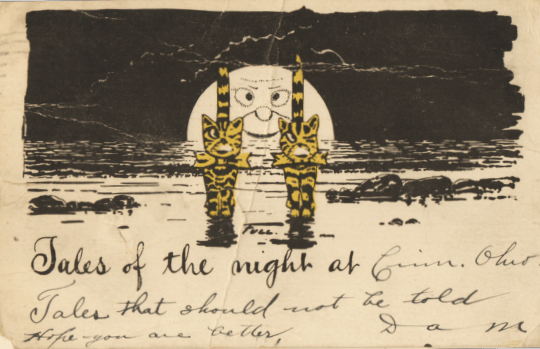
I suppose it was inevitable. Now that Christmas shopping officially begins on Green Tuesday (the first Tuesday after October 12), it should not have surprised me to learn that Spooky Season begins September 1, which this year was less than a week after pumpkin spice officially returned to our latte. This being the case, it is time to shift our perception of cats, who spend most of the rest of the year being cute.
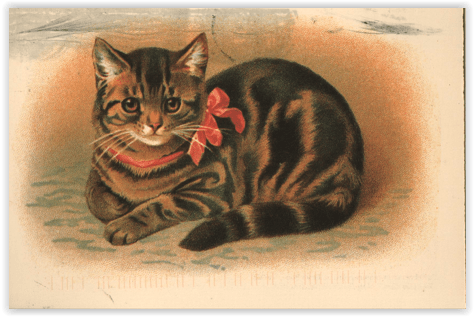
Come Spooky Season (a less specific term than “Halloween”: using that might provoke those grouches who snarl that “Christmas is supposed to be a day, not a quarter of the year”) we have no more kitties. There are only cats: aloof, self-possessed, and so superior to the mere bipeds they watch over with disapproval. And a deeply suspicious alien force occupying our houses.
Postcard artists understood the dual nature of cats. Dogs were domesticated early on, and remain eager to show how loyal and faithful and GOOD they are, but cats still seem feral, unwilling to compromise with their human servants. (A legendary cat litter company, in fact, claims that cats never really became house pets until their product was available. I dislike it when marketers make massive social claims. I don’t necessarily disagree—maybe Coca Cola IS responsible for Santa Claus always wearing that red suit—I just don’t like it. It makes me feel inferior to cats. THERE’S a new conspiracy theory, if you want one. Cats ae running our ad agencies, which may be the real reason Spuds M…where were we?)
Black cats, of course, get a lot of the Spooky Season business nowadays, but in the golden age of postcards, any cat could ne sinister. For one thing, it was still a major belief in parts of the customer base that black cats were GOOD luck. Just think: if we hadn’t swung the other way, we might all be buying chocolate cats at the corner store.
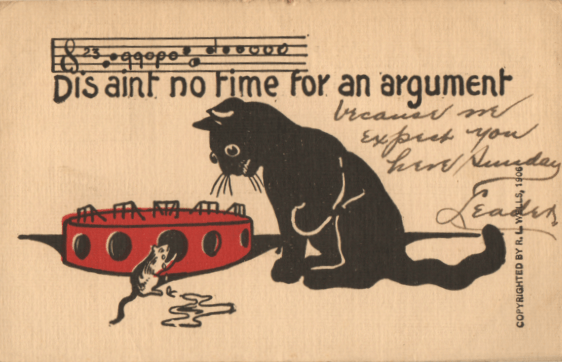
The menacing cat was well-represented, though, and sometimes that fierce creature happened to be black because black cats were dramatic from a graphic point of view. A dark, shadowy menace left you in no doubt about the situation. We are expected to sympathize here with the outmuscled mouse.
Adding to the sinister side of cat adventures was their readiness to make themselves look big, hissing and spitting. This is alarming at the best of times and downright threatening all the rest of the time. No good old-fashioned mystery movie or Gothic romance is complete without a hissing cat. Those of us who, as children, wondered if we couldn’t negotiate with a hissing cat have that memory engraved on our brains (and possibly hands and face.)
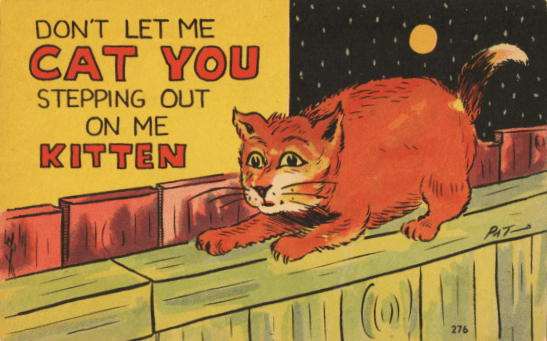
Postcard artists were also familiar with the propensity of those wild alley cats out back to get into a spat at the slightest excuse…or none at all.
While other Rembrandts of the postcard took issue with the way cats sometimes just sit and stare at you. What ARE they thinking?
However, we modern folk, free of superstition (if we do have these, we call ‘em conspiracies) can relax once the ghost’s high noon has passed. Our cats become kitties again just in time for a big family holiday. There’s nothing like a big old roast turkey to remind our feline friends that we ARE useful, and don’t need to be murdered in our beds. (For now.)
In the golden wage, when there were no cats, and geese occasionally laid expensive but inedible eggs, a woman known to her neighbors as Madame Klotsch owned a very successful apple orchard. She sold apple cider, apple fritters, apple chips, apple dumplings, apple pies, and, when the occasion arose, plain apples. And because Mistress Klotsch was the kind of person who liked things precisely perfect, her goods were good goods, and she did very well for herself.
She made so much money one year that she started in to think about moving into other areas of commerce. “I wonder,” she wondered to herself, “If a body fed apples to a cow, would one get apple butter?”
Mistress Klotsch resolved to send her son, Coffey, to the market in town to buy a cow. She could not do this herself because that would have left Coffey to tend the apple stand. Coffey was a good boy, but kind of worthless, really. He sat around a lot, reading books; when in charge of the apple stand, he tended to get so deep in his book that the neighbor kids would sneak up and swipe dumplings. Books and swiped dumplings were not what had made Mistress’s Klotsch’s Apple Stand the landmark it had become.
So she counted out the money carefully, tied it up in a handkerchief, and handed the bundle to her son. “Sin,” she said. (She always called him “son” in the hopes this would make him brighter.) “Son, take this to the market and buy a cow. Get a nice brown one to match the trunks of our trees, and be sure to ask for a good milker. I’d try at Tattersall’s first. They’ll likely cheat you less than anyone else. And don’t talk to strangers.”
Coffey set off down the road, carrying a book to read on the way, as this was the golden age before cracked sidewalks and traffic lights. He was just getting to an exciting part in the story when a voice called, ”Howdy, son! Off to market?”
Looking up from his book, Coffey saw a tall smiling man who was walking the same direction. “Yep,” said Coffey.
“My name’s Dave,” the man said. “I’m walking that way myself. You going to market to buy, or to sell?”
Coffey remembered he had been warned not to talk to strangers. But this was not a stranger. This was Dave, for Dave had told him so. And Dave had called him “Son” which was what his mother called him.
So he said, “I’m off to town to buy a cow.” After all, for all he knew, Dave might have a cow somewhere to sell, which would save him the long walk to town in bare feet.
Dave nodded. “Cows cost a pretty penny,” he said. “Lots of pretty pennies. Are you sure you have enough money?”
“Oh, yes,” said Coffey, and untied the handkerchief to show him.
Dave looked at the money and whistled. “Is that all you’re going to buy? Just one cow for all that money?”
Coffey had known his mother his whole life, and knew her pretty well. She would have given him just barely enough to buy one cow, and little enough that he’d probably have to do a lot of talking to get a cow for that much. So he said, “That was what we had in mind.”
Dave shrugged. “Well, I’m not from around here so I don’t know how people do business in these parts. But I can’t see how someone would just buy a cow when, for the same amount of money, they could buy they could buy houses, hotels, fine food, land, aldermen, elderberries, gems, jewelry, jerseys, fish, fruit, flugelhorns, clothes, coaches, pumpkins, pearls, plums….” Dave had to stop for a breath. “AND cows!”
By this time, Coffey knew that Dave had no cow to sell, and was just having a little joke. So he laughed in a polite way and opened his book to read some more.
Dave reached out a hand and set it on the page. “I mean it. Why walk all the way into town and put that money down for a cow when you could stop right here and buy some magic beans?”
Coffey stopped in the middle of the road. “Magic beans?”
“Magic beans,” said Dave.
Magic beans! Why, that was one of Coffey’s favorite stories! You took the magic beans home to your mother, she threw them out the window, and the next day you climbed into the clouds and brought down all kinds of gold and goodies! Dave was right! Coffey could buy all kinds of things once had the magic beans. There was a giant involved, to be sure, but this was a detail which could be taken care of later. You just needed to keep an axe handy at the base of the beanstalk in case of emergencies.
“Just supposing I might think of buying magic beans,” said Coffey, “How many magic beans would I be getting for this much money?”
“Well, now,” said Dave, with a shrug, “It depends on the beans. Some beans are just a little magic, and some are a lot magic. Now, I have some nice magic beans, and I’d trade you a handful of them for that, if you really wanted to buy and I really wanted to sell.”
“A handful!” said Coffey. “Why, there’s two handfuls of money right here!”
“Well, seeing as how it’s you,” said Dave, “I could sell you two handfuls of beans for two handfuls of money.”
“All right,” Coffey said. “That’s better.”
Mistress Klotsch was not entertained to find two handfuls of beans where she expected to see a cow. “Beans1” she said, “Beans! I suppose you’re going to get up first thing in the morning and milk these now! Shame on you: a young man as old as you are and so empty-headed. Why I had a son when pigeons are so much smarter, I’m sure I have no notion!”
None of this bothered Coffey, because he knew all along she’d say these things. And when she took and threw the beans right out the window, it was all he could do to keep from cheering. Now the beans would land in the dirt, grow into the clouds, and lead him to excitement and treasure. He went off to finish his book, to give him something to do while he waited to be rich.
So he did not realize that his mother was so upset she forgot what she was doing and let a whole pan of grease for the apple fritters burn. The grease was ruined, so she threw all of it right out the window as well.
So when morning came and Coffey strolled outside to get rich, there was nothing to be seen in the dirt outside the window but row upon row of broken, shriveled beansprouts, killed by the hot grease just as they were poking their heads above ground.
“Oh dear,” said Coffey. “I’ll never be able to buy Mother all those cows now.”
Vexed, he flopped down in the dirt and pulled at one of the shriveled beansprouts. He was more than surprised when it pulled back. Coffey found himself being pulled right down through the dirt, without even a chance to yell for help unless he wanted his mouth filled with mud.
“I had no idea beans had such long roots,” he thought. “To be sure, these were magic…oopf!”
He had landed hard on a stone floor. Looking up, he saw soft green moss on tall walls, and small white chairs on the floor. It was a tunnel, and rather a comfortable tunnel, though when he stood up, he decided that the ceiling was rather too low.
“Something lives here,” he thought, walking along among the chairs. “I wonder if it’s friendly.” He walked until he saw a tall white clock between two chairs, at the same time he heard footsteps. He slipped quickly behind the clock, just in case whatever lived here did not feel like being friendly.
A little old woman with blue hair was making the footstep sounds. Coffey thought at first that she was walking with a cane, but then saw the sharp point at one end, and realized it was a spear. There were sharp points on her teeth, too, and the way they stuck out below her chin on both sides of her mouth made him hope she was friendly, and not hungry.
It seemed for a moment that she would walk right past the clock and Cogffey, because she was looking at the floor. But as she came to the clock, her head came around. Great glowing eyes met Coffey’s eyes. Coffey knew at once everything he wanted to know about this woman, and he ran.
The woman had very short legs, and Coffey had long ones, so he could run faster. But since he had no idea at all where he was going, he realized this wasn’t helping.
After running for some time, he found himself in a kitchen full of bright blue stoves and dark green cupboards. This was not where Coffey wanted to be. It was some comfort that he wouldn’t be eaten raw, at least, but still, he felt the situation left something to be desired. He spotted a table with a long, hanging tablecloth, and slid underneath. If he rested here for a while, he thought, he might see something that could help him escape.
Coffey was not alone under the table. Resting in one corner he saw a furry orange creature with slanted green eyes, and hair sticking out on both sides of its nose. Coffey had never seen anything like this creature. It was not so very big, and it had no spear, but it looked so calm and comfortable here that he thought it best to be polite.
“May I sit here and not be eaten?” he inquired. “If I’m not in your way, that is?”
“All right,” said the animal.
Coffey would have said more, but he heard the little footsteps again. He peeked out from under the tablecloth and saw not one but two little women with blue hair, sharp teeth, and spears. They hinted through the kitchen, poking their spears into various cupboards, but did not bother the table. Coffey sighed with relief when they walked back out g the kitchen.
He turned to the animal, which had sat quietly while the women searched the kitchen. “My name is Coffey,” he said.
“Oh.”
This was not very helpful. Coffey tried again. “Er, I beg your pardon. I don’t mean to pry into your personal business, but what…who are you?”
The animal blinked. “I am a cat. Have you never seen a cat, then?”
“I’ve never seen one in the village,” Coffey admitted. “But it is a very small village.”
The animal yawned, showing it, too, had very sharp teeth. “To be sure. Well, I am a cat, and I watch the trells.”
This sounded perfectly reasonable, but after a moment’s thought, Coffey inquired, “What are trells?”
“They are.” The cat yawned again, rolling its tongue out and back. “My job is to make sure they don’t grow to rich because they would then buy the world and run it to suit themselves. When they have too much gold, I take some out to the leprechauns.”
“Gold?” said Coffey.
“Metal stuff,” the cat said. “Those who go on two legs seem to like it, so it….”
“I know what it is, though I’ve not seen much,” said Coffey. “The…trells have a lot of it, do they?”
“They have all kinds of it,” said the cat. “On the stove there you can see their magic frying pan. It fries normal eggs into gold.”
”Ah.” Coffey peeked from under the tablecloth again and saw a frying pan on one of the stoves. He thought this over and turned to the cat again.
“Of someone were to take that frying pan away, the trells would not have so much gold.”
“Very likely.” The cat yawned again.
The cat didn’t seem to be getting the idea. “Can you help me escape with it?” Coffey inquired. “I wouldn’t bother you, but I don’t know the way out.”
The cat studied Coffey for a long moment, and then said, “What’s in it for me?”
Coffey studied the cat right back, but since he’d never seen a cat before, he couldn’t think what to offer it. “What do I have that you want?”
The cat blinked. “Good question. Since you’re in a hurry, I’ll help you now and we can talk about payment later.”
“I’m not in a hurry,” said Coffey.
“No?” The cat looked past Coffey at the tablecloth. Coffey peeked out again and found one of the blue-haired women had come back, and was poking her spear under the kitchen counters.
The cat yawned and stretched, and, rising, heading for the tablecloth. “Won’t she hurt you?” whispered Coffey.
“No, I chase the rats away from their chickens.” Not in the least hurry, the cat stretched again and passed under the tablecloth.
The trell glanced down as the cat rubbed against her ankles, but said nothing, continuing to jab the pointy end of her spear under the counters and stoves. “What’s the matter, Baba?” asked the cat.
The trell turned fierce eyes on the cat. “Cheedle, Chidle, Chadle, Choke: I smell the blood of a human bloke. Human people make me shudder: I’ll grind his bones to peanut butter!”
The cat’s face crunched up. “Oh, please.”
“What’s wrong?” The trell’s voice was like rocks grinding together.
“What kind of talk is that?” demanded the cat, upper lip curling into a sneer. “Cheedle, Chadle…oh, I can’t even say it. And ‘bloke’? Nobody says ‘bloke’ these days.”
“I thought it was kind of cute,” growled the trell.
“Well, you’ve got to do better,” the cat told her. “You’re going to be running the world one day, right? You should come up with something more elegant than that cheedle choodle whatever it was. Anyhow, you need peanuts to make peanut butter.”
“I’ll try.” Grumbling, the trell stomped out of the kitchen.
Coffey hurried out from under the table and grabbed the frying pan. “Now, how do I get out?”
“How did you get in?” yawned the cat.
It sounded so silly, Coffey hated to talk about it. “Well…I grabbed a magic beansprout and it pulled me down.”
“Where?”
“Well, it was back this way.” Coffey walked back up the hall, watching for trells. Soon, he recognized a rough patch of ceiling. “Those are the beansprouts.”
“Take hold of the root of one beansprout,” the cat told him, “And you’ll be pulled back up. But you can use each beansprout only once, so be careful. You have to come back, remember, with my reward.”
“I will,” Coffey promised. He set the frying pan down, but remembered in time that he wanted to take it with him. He took it in one hand, and jumped on a chair to grab a beansprout with the other. Sure enough, soon he was shooting through dirt as he had before, only in the other direction.
His head whanged against his mother’s rake. Mistress Klotsch had come to tear the unsightly beansprouts out of the yard. “Land!” she exclaimed, amazed not only to see her son up that early but to find him percolating up through the dirt. “Where have you been?”
“I was pulled underground by a magic beansprout,” Coffey explained, kicking his legs free of the dirt, “Down where the trells live. And this strange animal called a ‘cat’ helped me steal this magic frying pan and told me how to get out.”
Mistress Klotsch looked from her muddy son to the hole in the ground. “Magic beansprout,” she said. “Trells. Cat. Magic frying pan.”
Coffey took her hand. “Here, I’ll show you. Where’s an egg?”
He set the pan on the stove, and let it get hot. Mistress Klotsch added some grease and THEN handed Coffey an egg. Coffey cracked it into the pan. Mother and son stood watching the egg fry.
“Um,” said Coffey. “The cat didn’t tell me exactly how to….”
The egg jiggled, shook, and changed color, looking for all the world like a solid gold fried egg. Coffey reached for it, but then let go.
“We’ll let it cool first, I guess,” he said, turning it out onto a plate. “But anyway, Mother, you see….”
Mistress Klotsch was nowhere to be seen. Coffey searched the kitchen, not neglecting to look under the tablecloth, but found his mother outside, spreading her best coverlet over the shriveled little beansprouts. “We wouldn’t want anything to happen to our little magic garden, would we?” she said.





















 Blogsy Babbles