You Need to Know

    We care going to discuss technical matters today, using a hidden language defined by Mort Walker.  Walker’s work in cartooning from early on led to his creation of an awkward teenager named Beetle Bailey.  One day Beetle, fleeing some typical comic strip catastrophe, ducked into an Army recruiting office to hide, and a legend was born. 

    Walker was not merely a hard-working cartoonist but a man who thought about his job.  Realizing there was a hidden language in the world of cartoons, he tried to capture, identify, and classify these fugitive bits of lingo, and set them out in a guide book, used now as a textbook in some cartooning classes, the Lexicon of Comicana.

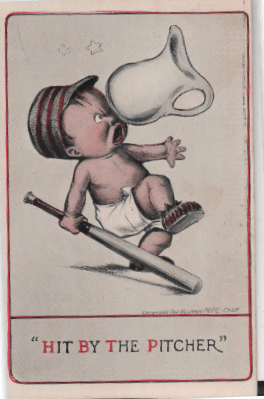
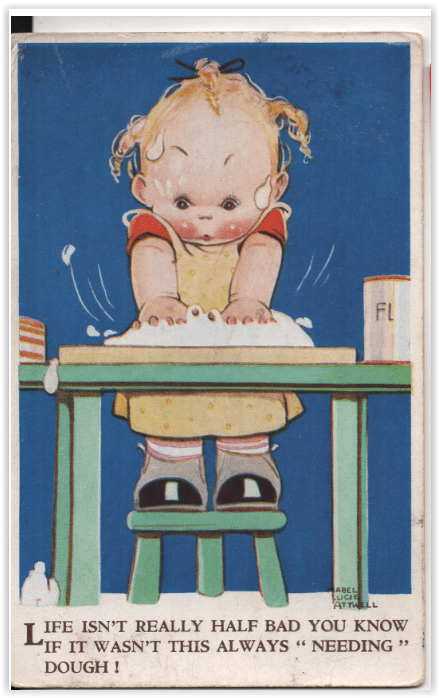
    One of his accomplishments in the Lexicon was his description and definition of what he called “emanate”, lines coming from a cartoon character to indicate some internal condition.  You can see that our young man above is overburdened, but how do we know that?  There are drops of sweat bursting from his brow.  These drops of sweat are knowns as “plewds” (sometimes “pleuts”, out of a belief the word derives from the French word for rain.)  They can be found wherever someone is straining against a burden, either physical or emotional

    For example, in this postcard, the conflicted iceman is concentrating on his quandary, causing plewds to pop from his brow.  The husband, meanwhile, is doing some cooking, the aroma of which is rising in Waftaroms.. (Waftaroms are curved, not to be confused with Indotherms, which are the straight lines rising from a bowl of soup to show it’s hot, or Solrads, which are the lines we have all drawn emanating from the sun.

    I’m sure there’s a word for those flames emanating from her back, but I don’t have the Lexicon handy to check.  I am also sure that the clouds rising from a skunk are NOT Waftaroms, but have their own name.

    No one claims that mort Walker INVENTED all these symbols: he just recognized them for what they were.  They seem to have been a phenomenon which multiplied in the 1920s and 1930s, for earlier cartoons lack many of the conventions we recognize.  There are early examples, however, to show that some are older than others.  The Whiteope, which shows a point of impact, seems to have existed at least as early as the turn of the century.

    And the Briffit, the little cloud to show where someone was moving, developed through the years.  Here we have a large cloud to show the man is in a real hurry.

    While the little trail of briffits became fairly standard later on.

    Showing drunkenness existed early on in cartoons, but developed a complex vocabulary.  This man is merely somewhat flustered, as indicated by the row of Squeans over his head.

    But this man is more thoroughly sozzled, since he has a Spurl above his head as well.

    There are many, many more (we haven’t even considered all the different symbols used in a maledicta balloon—a word balloon full of symbols to show the character is cussing—there are more styles of these than there are easily accessible cuss words, but cartoon characters always did have some things easy.)  I have provided here just a few elementary ones to provide you with something to think about while you’re trying to drop off to sleep.

Babies Do These Things

    Another cute and cuddly creature assigned certain jobs on comic postcards was the baby.  For the purposes of our discussion, these are children too small to walk or get up and use the potty, for, as noted above, they were frequently assigned some of the same jobs as the cat and especially the dog.

    Frequently, I say. In fact, it was used to serve one of the more common postcard messages.

    And you might think that, like a postcard dog, a postcard baby was known for just this one talent.

    But no, there is another baby activity which takes precedence,  For, like the cat or the dog, the baby is called upon to do a number of things besides its Main talent.  As with the dog and the cat (or puppy and kitten) I am not considering those cards where their function is simply to be cute.  There are dozens of cards dealing with the baby’s simple accomplishment in being born, which, is comic postcards, is treated as a mixed blessing.

    (That was a parody of “Little Drops of Water, Little Grains of Sand”, an immortal hymn which started life as a classroom exercise in impromptu poetry.)  But, really, even when they are born in unexpected quantity, the main actor in these cards is really the father.

    But their main talent, and main activity in postcards, is one they take up almost upon biorth.  They cry, especially at night.

    In fact, the cartoonists suggest, with some justice, that the majority of babies do NOT cry, so much as they scream.

    And being unable to explain what’s wrong or comprehend the finer points of the pity of being alive in the first place, just about anything will set them off.

    Sometimes it is actually nothing at all.  They just feel like developing their lungs, no matter what Mom or Pop try to stop the sirens.

    Fortunately, they are SO cute when they finally fall asleep that people can’t help but forgive them, even when, as in this postcard on Married Life, the baby only starts to behave when Dad comes home from work, belying his mother’s exhaustion.  (The poem, if you can’t read it or don’t feel like bothering, suggests that if more unmarried women could know the headache of listening to a baby scream all day, there’d be a LOT fewer married women.)

    In fact, the wailing baby, like the puddling dog and fence-perched cat, was so much a standard of postcards that when one wanted to just register unhappiness, they were the best recourse.  (And now we’re back to that column on “Why Don’t You Write?”)

Cats Do These Things

    Once upon a time, when I was in college, I listened in admiration to an earnest conversation between a couple of young women on the differences between kitties, cats, and kittycats.  I don’t remember all of the points discussed, but I should like to make the point that postcards of kittens are a whole different matter than postcards of cats.  Kittens do essentially one thing on postcards: they are actively cute.  No, don’t try to confuse me with postcards of kittens sleeping: they know what they’re doing, and they’re still being actively cute.

    Like dogs, cats have a modest range of activities.  They suddenly turn up with a bunch of kittens (I would show you one of the many postcards where Mamma Cat is telling the passing tom “You told me we were just going to wrestle”, but I’;m saving that for my dissertation: every postcard company in the world seems to have used this gag as a filler), and they menace mice (the mouse gets the punchline, but what happens next is left to our imagination.)  Postcards like the one at the top of this column  pay tribute to the cat’s reputation as a hunter, in the wild

    Or on the domestic front.

    But the main activity of the cat, when a postcard cartoonist took up the feline subject, was sitting on fences.  It wasn’t so much the sitting on fences which attracted so much attention as the noises they made while on the fence, whether they were just calling out a mating song.

    Or dealing with the results of the call.

    Or disputing territory with some other tom who wanted to use that fence for the same purpose.

    (Our ancestors, who, as I noted, lived more often with open windows than we do, knew that cat romance and cat fights could be hard to tell apart, and commented on this as well.)

    It all probably dates back to an era when everybody with a yard had a garden, as well as a few chickens, with possibly a goat or a pig or two.  We have gradually moved away from this kind of domestic agriculture, and any kind of fence is a rare thing.  Where we have fences, they are more often the metal variety: a chain link fence largely unsuitable for sitting (maybe that was one of the reasons they caught on: they discouraged cat concerts.)  And people are less likely to let their cats wander at night: the invention of kitty litter meant that keeping your cat indoors wasn’t such a risky proposition.  Pet owners who have the foresight to neuter and spay have also cut back on the urgent need of cats to get out and prowl by night.

    But once upon a time, it was even more automatic on the postcard than Dog Equals Fire Hydrant, that Cat Equals Fence.  It was simply the way the world worked.

Dogs Do These Things

    Animals played a big part in the world of postcards.  In an earlier era, when the only real air conditioning available at night was an open window, a light sleeper could be acutely aware of the dogs and cats which roamed the streets at night, and the chickens your neighbior kept in the back yard (especially whenever that rooster decided to let everyone know he was around.)  During the day, mice and rats could be a fact of life unless one had a resident exterminator, which many people did.  So dogs and cats wandered in and out of your line of vision.  Dogs were frequent stars of postcards which featured their good habits and bad.  They would scrounge food

    Wherever they found it

    They were bold guardians of houses

    Or not

    And, in any case, puppies were always up to something worth noticing.  (We did not INVENT the phrase “Awwww, how cuuuute!”)

    But the comic postcard focused on one particular dog activity which was inescapable and represented in far more media than just the postcard.  I wonder if there wasn’t just a little jealousy on the part of the humans who, after all, did the same sort of thing but had to leave the room.

    In the big city, of course, the fire hydrant was the usual target

    But any public pole was a possibility

    The big city was filled with possibilities, and no dog, postcard or otherwise, wanted to miss any.

    Dogs had their own way of passing along information on which were the best poles.  (This isn’t it.)

    The bigger the city, the more dogs would be passing along the message.

    But in the country, of course, dogs had just as much opportunity, and even more variety.  (There are at least three different postcards with different dogs using this caption, which plays with a slogan of the Brown & Williamson Tobacco Company in the 1940s: “Does Your Tobacco taste Different Lately?”.  This is NOT what they meant, and, anyhow, they didn’t make cigarettes.)

    Although trees were the most common targets.

    The point, though, was that a dog would take advantage of any place or situation which seemed interesting, to the point where a number of puppy dogs complained that they’d get the blame for just any stray puddle found around the house.  (Benny Hill recited a brief but brilliant poem on the subject.)

    It’s a pity the noble dog should be memorialized quite so much for this perfectly natural activity, but it could be worse.  There was, after all, another dog activity very popular in mid-century postcards but, as this poodle might suggest, let’s keep out of it

Back to You

    This week we have considered the postcards which were published so that you could nag your friends to write to you as well as those cards which were printed to apologize for not having written.  Because sending postcards came as naturally to those generations as texting and tweeting does to us, there was a multitude of sentiments which could be expressed, including those which apologized for sending a postcard so late, or sending one with such a short message, or even sending a postcard at all.

    A postcard was considered a token of regard and a realization that one is late with a letter, but one had to admit that a postcard was NOT as good as a nice, long letter.

    Unless you had perfectly precise 3-point penmanship, there wasn’t room for a whole lot of news

    Although it WAS something

    You could excuse yourself for interrupting the recipient’s life with such a short message by saying there isn’t much news

    But that you thought a message might be welcome

    The postcard was often written quickly, often in pencil (much quicker in the days before ballpoint), and even THAT could be apologized for

     And while in a self-deprecating mode, apologizing for being so late in writing, you could make amends by squeezing in another butt joke.

    The postcard was meant to patch up any break in communications, to reassure the recipient that you did care even if you were sometimes slow to write, AND, sometimes blatantly, that they could stop NAGGING you about it now.

Catching Up

    The Arms of Krupp, a massive volume, lumbered onto the bestseller lists in 1968.  I was a wee bit younger then, and not afraid of large numbers of pages, and what I took away from William Manchester’s riveting tale of a family that manufactured arms and armor for centuries was my admiration for a company that would produce the most powerful shell ever seen in the world of artillery one year, and then the next year announce a kind of armor which would resist it.  The next year, they would have a new shell that would pierce last year’s armor, and, of course, a new, improved armor the following year to hold back the ammunition of the previous year.  Selling a product and its antidote always struck me as ingenious, even if I never quite figured out how to do it myself.

    In a less death-dealing fashion, postcard manufacturers were perfectly willing to do the same sort of thing.  On Monday, we looked at a few of the “Why Haven’t You Written?” cards people could send to nag their friends.  Let us consider today the “Sorry I haven’t written, but….” card.

    Oddly enough (or not, given the basic human sense of humor), “Sorry I haven’t written” seemed to go with “But”, as you can begin to see above  there were plenty of variations on the theme, for people blaming the post office

    For the busy business executive

    For the busy housewife (who has been too thorough with the laundry, I guess)

    For the person who is really apologetic about the whole thing.

    I’m not altogether certain where the connection comes from, but quite a number of these apologies deal with cattle and the cowboy, perhaps simply as a way of rounding up excuses.  A lot of these blamed everything on the cattle involved, be they Midwestern bulls (note the extra moo joke)

    Or the far Western variety

    Which gave them an opportunity for another very popular postcard pun.

    Other writers could just claim they were busy, or thirsty.  (That horse looks jealous)

    While still others could claim they were busy without needing a four-legged scapegoat.

    Sometimes with a subtext of “I sure wish I WAS spending my vacation on this.”)

    That sort of activity could lead to other people to blame your lack of correspondence on.  (If your children are going to be levitating like this all the time, you obviously are going to be distracted.)

    In most of these cases, no pretense is made that sending a postcard will quite fill the bill.  (Next time: I have nothing to say, but I do have a stamp.)

Responsibility

    We’ve discussed this before: the postcard was a twentieth century text message.  For a few pennies, you could send a brief note across town in a couple of hours.  The postcard companies knew what you were doing, and provided cards which came with pre-written sentiments which would start the message for you so you could just add a couple of personal details.  There were postcards which could call out to the recipient any possible basic message, from “I hear you’re getting better but aren’t well yet” to “I’m going to drop in on You Tuesday”.  The greeting cards available today are just a pale shadow of what postcards once offered.  There were dozens where the message on the front was simply “I’ve got no reason to write but I felt like it.”

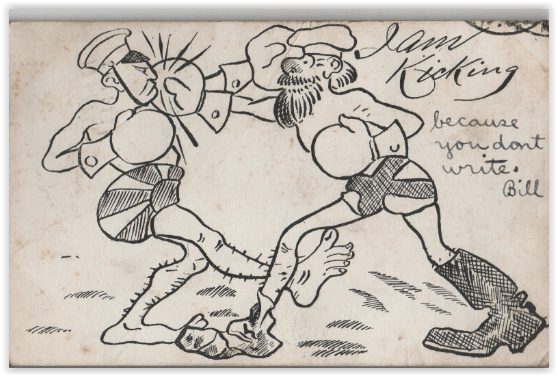
    I haven’t done an extensive survey, but among the top ten most sent messages seems to have been “Why Don’t You Write to me?”

    (That’s a skunk, so it’s one of the “most-Scent messages”.  Get it?  Okay, be that way.)

    Starting with that essential message, there were different degrees of message.  You could start with the idea that you were worried that you hadn’t heard lately.

    Or you could toss a smile at the person, just pointing out that I’m writing to you, so now you owe me.

    Or remind them how it made you feel when you got a letter or postcard from them.

    But by far, the preferred technique was guilt, letting them know how you felt when you DIDN’T get that letter.

    The guilt could be light, pointing out to the recipient how cute you were and how you were just waiting around for that message.

     Or, in wartime, it could be a reminder that it was part of your duty to the morale of our loyal members of the service to write.

    There were, after all, no wartime shortages of stamps, at least.

    And it’s not as if you could beg off on the grounds of poverty.

    Throw an excuse at them to start the message, to let them know THAT one won’t work.

    The message of the card was simply “You are Guilty of Not Writing.  You KNOW what to Do About It.”

    (Next installment: I Know I Haven’t Written Lately, But….)

Stolen Sweets

    I’m sure people do these things today, but they sure did them a lot more often in that other world I visit, the world of the Postcard Craze of 1908 or so.  Young men slipped out after curfew to exchange a few words under the girlfriend’s window, women put pies to cool on the kitchen window, tramps slipped up and stole clothes from your clothesline and pies from your kitchen window, unpleasant kids tied firecrackers to a stray dog’s tail, restaurants served tough steak and elderly butter, and people unable to sleep threw shoes at cats.

    And children stole jam.

    This was a while back, you understand, when billions of dollars were not yet spent on advertising and manufacturing sweet snacks.  They existed: a new exotic item called caramel had been brought to the United States in the 1880s and was very popular, and purveyors of chocolate produced both fancy assortments for the upper classes, and cheaper versions for the masses.  And, of course, bakeries existed to provide people not just with bread but with sweet rolls and the doughnut of popular consumption (such a hardy bread product in its day that one dunked it in coffee partially in self-defense.  It also sweetened the coffee without recourse to the sugar bowl.)

    But a majority of Americans lived in rural areas and small towns.  This not only meant, for the average child, fewer opportunities to buy sweets but also a security system it was hard to evade.  An uncle of mine recalled a moment in the 1930s when he did a chore for a woman who lived several blocks from his house, who surprised him by giving him a nickel.  Knowing his parents would either a) make him give back the nickel since it was a neighbor or b) take the nickel and put it into his college fund, he chose to go immediately to a store which would sell him a Fudgesicle for a nickel.  He reasoned that if he ate it on the way home, it would be gone when his mother saw him, and there would be no evidence that there had been a nickel or a Fudgesicle.

    He had reckoned without the other neighbors, who, seeing him with a Fudgesicle would wonder where a kid who did not usually eat such things got it, and call his mother to inquire.  Fifty years later, he could still remember regretting he hadn’t thought to eat the forbidden sweets before he left the store.

    So even where there was opportunity, there were eyes watching.  But in the privacy of one’s home…true, when pie or cookies were available, these were dispensed by the Kitchen CEO, who could keep track of them.  But those jams and jellies….

    Just about every well-established family put up fruits and vegetables at harvest time; in the days when grocery stores stocked only seasonal goods, this was the only way to make sure you could have apples (dried or made into sauce), cabbage (as sauerkraut), or beans (cooked and canned) through the long winter.  And there would be jams and jellies in varieties you now have to send away to an artisanal market for, but which then grew wild in the back yard: elderberry, huckleberry, blackberry, with perhaps Damson plum and apricot as well.

    And jars could be opened and reclosed.  In fact, once Mother opened a jar, how could she be sure how much had been in the jar next time she opened it?  An enterprising child, with stealth and a spoon, could take care of those sweet tooth cravings.  Mind you, it took nerve.
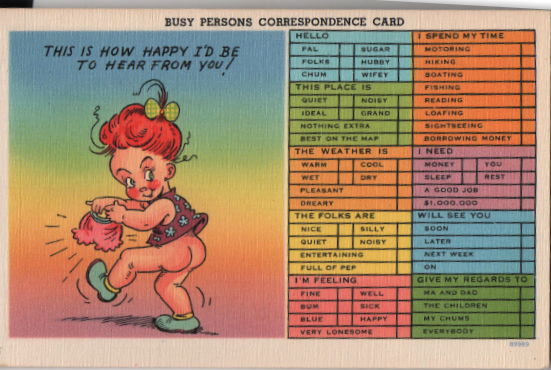
    A child who will read her future in her own shadow is not going to make it as a master criminal.  It also took a certain amount of planning, a certain degree of stealth.

    But once you had mastered your fears and learned to keep your face clean, you had only to deal with the aftereffects of consuming a lot more fruit and sugar and pectin than you usually ate at one time.  (You don’t really want to see all the castor oil and chamber pot postcards, do you?)

    Of course, sometimes fortune would play into your hand.  This was also an era when a child’s Time Out might involve being locked in a dark closet, or in the dark, dank, spider-filled cellar.  Where, if you thought about it, was also where Mother stored the jars of jam.

    Crime, it seems, COULD occasionally pay. 

Beery Ballads

    At this point in my career, I suppose it is unlikely that I shall ever be invited to give my lecture on Victorian Adaptations of New Communications technologies, in which I discuss, briefly, Thomas Edison’s career in pornographic phonograph records.  It is not the best known of his inventions, but Thomas Edison was the originator of what used to be known as the Party record: records which were made well into the 1960s featuring songs and comedy routines which could not be played over the radio.  Only a dozen or so of these survive from the early Edison cylinder days, but because Edison was also a pioneering businessman who kept data on everything he sold, we know there were many more.

    It was one of several missteps Tom made in the marketing of his phonograph and the recordings.  He thought home recording, not prerecorded stuff, would be the big moneymaker, he thought cylinders would eventually supersede discs, he felt faster playback speeds made for better and more saleable records, and he figured his naughty records (or, as one of his technicians labeled them, “SMUT”) would sell to the new Phonograph Bars, drinking establishments where you could buy a schooner of beer for a nickel and give another nickel to the bartender to put a particular record on the phonograph.  Turned out this last was totally wrong: his sales records show exactly what came to be the norm, that people bought the naughty records to play at home, at parties for special friends.

   Then, as now, what sold to the bars were the weepies, because men drinking late like to cry in their beer.  The Victorian era was filled with songs of dead mothers, dead fathers, dead sweethearts, dead children, or at least people who were very ill (and would die after getting to see that loved one one last time).  When that failed, songs of hearts broken beyond repair were a good substitute.  We have, for example, this little number, about a little girl who has been crying because her Mama and papa are separated and now she can’t see her daddy any more.

    (This song, from 1906, inspired by a line in the Book of Isaiah, was harshly criticized from the pulpit, as it misinterpreted the verse, implying that the little child mentioned in the prophecy would lead grown-ups, whereas she is actually leading only that lion and lamb that are going to lie down together.  This still troubles some folks.)

    The first pop song to sell a million copies (of sheet music) was “After the Ball”, about a man whose heart is broken and many years later discovers he jumped to the wrong conclusion and could have lived happily ever after all.  (Twisting the knife in a final verse was also very lucrative.)

    There are lots of postcards from the Postcard craze before World War I based on “After the Ball”.  Oddly, for every one that weeps with the hero of the song, there are two showing drunks staggering home “after the ball” and three showing billiards players or baseball players or football players “after the ball.”  Sad songs were so popular that of course cartoonists and comedians couldn’t help making fun of them.

    Sweet Adeline, saluted above as the Bottle Hymn of the Republic, is just such a song of yearning, as a man wonders what became of his longlost girlfriend.  It became practically the definition of men who had had a glass or two too many sobbing away at the lyrics.

            But there were many others, perhaps best exemplified by this little number.  “By the Sad Sea Waves” was a song of summer romance that ended, and you can see how effective it was: the man is crying, the waves are crying, the clouds are crying, and even the dog is crying.  All of them are clearly ripe for a call of “Bartender!  Set up another round!”

Fifty Years Agone

   I was trundling through the Interwebs, considering things to blog about, and reflected that although I had glanced at 1921 in search of things to commemorate, I had not looked to 1971. I do things like this.  I decide on the research, figuring “What’s the worst that could happen?”

   The worst that could happen was a trip into 1971, a little drama I watched on its first run in theaters, but about which I had forgotten much.  Mainly I had forgotten how convinced we were that the world as we knew it was about to crumble.  1971 was no light romantic comedy, but a turgid melodrama.

   William Calley and Charles Manson were found guilty of their respective massacres.  Idi Amin took charge in Uganda, Rolls Royce went bankrupt, and Ed Sullivan aired his last show.  Camden, New Jersey was nearly wiped off the map when riots broke out over the killing of a motorist (Puerto Rican) by police, the Weather Underground set off a bomb in a restroom in the U.S. Capitol, and the song “Stairway to heaven” was unleashed on us.  Not a laugh-a-minute year, 1971.

   In the world of literature, Agatha Christie’s last book was published, Ogden Nash died, and no Pulitzer Prize was awarded for fiction.  The bestseller lists maintained their essential dignity with its recognition of Xaviera Hollander’s classic The Happy Hooker.  1971: what a vintage!

   Still, no year is without its joys.  I remember being thrilled at the time, and still considering with wonder how Alan Shepard, the first American in space in 1961, was able to complete the story arc in 1971 by stepping onto the surface of the moon, and becoming the first man to hit a golf ball across the lunar surface.  Agatha Christie’s last book was a good one, and there were other good books which came out that year (Look at the lists and choose your own favorites.  I’ve had most of them for sale, and probably the best seller of them all, among MY customers, was When Hitler Stole Pink Rabbit.)

   And 1971 saw the first publication of a book which was to make a major difference in my young life.

   Once I had read The Lord of the Rings, I was desperate for anything else along the same lines, a difficult thing in those days, as it was not yet QUITE popular enough to inspire dozens of spin-offs and rank imitations.  But somewhere along the line, I picked up a 1975 paperback edition of Robert Foster’s 1971 A Guide to Middle-Earth, a dictionary of characters and places in Tolkien’s world.  I was enchanted, and before I knew it, my entire future development had been warped.

   Who knew it could be so entertaining to sit down and read a reference book straight through?  I have since read others, starting with Webster’s International Dictionary (I gave up two thirds through—too hard to hold on your lap—but it had this great sub-dictionary of obsolete and dialectical words, and added to my vocabulary “oxter”, an obsolete term for “oxall”, itself an obsolete term for “armpit”).  I moved on to dictionaries of street names, and flower language dictionaries, and all manner of obscure lore.

   Meanwhile, people were imitating Foster with guides to other fictional universes.  (They had been doing this with Shakespeare and Dickens and suchlike before Foster, but he seems to have opened the floodgate.)  No fantasy universe was complete until someone had written a guide to place names and characters: DC and Marvel started bringing out regular guides to their superheroes, and guides to places like Oz and Narnia were on their way.

   When my resources did not extend to buying more of these, I decided to write my own.  I made what I thought was quite a generous offer to George Lucas to write a complete guide to his characters, if he would just give me a sneak peek at the script for Return of the Jedi, to make the book complete.  (Never did get an answer.)  And then I had another brilliant idea: why not write a guide to the places and people of a fantasy novel series that did not, in fact, exist?  It would save me a lot of reading, and there might be a market for such a thing.  The series would be vaguely based on the Poictesme novels of James Branch Cabell, but of course my 1930s author would be fictional, and the novels equally nonexistent.  It was the lazy writer’s dream: I could make up interesting plots and characters without ever having to produce completed books.
   My marketing plan, as I explained to a couple of editors chosen at random, was to produce this massive reference book to the novels in question, and then challenge current fantasy writers to produce authorized “sequels”.  With a setting and characters pre-fabricated, they could be spared the effort of world-building and just write stories set in the world provided.

   The editors, alas, dashed cold water in my face.  “Fantasy authors,” I was told, “Like to make up their OWN worlds; thank you very much.  There would be no interest from them, and less than none from the reading public.”  I shelved my guide to the novels of Bernard Sexsmith (It means Cobbler; I thought it was a fun name for a James Branch Cabell clone) and moved on to other things.

   Um, not long after that that a publisher started bringing out a series called Thieves’ World, which had a central core of places and characters devised for fantasy writers to pick up on and write about.  It inspired some other series of similar books for fantasy writers who didn’t mind using someone else’s world for stories.  The “Shared World” anthology saw a vogue, and never quite died off.  In fact, the concept goes back at least to the writers of the 1930s and 1940s who had continued H.P. Lovecraft’s mythos in stories of their own, and….

   So there was another fine idea some expert talked me out of.  If I could go back to 1971 and….  No, not even for that.  Anyway, I got good practice in writing short, glib entries on long, complex matters, and this led eventually to my highly lucrative blogging career (which will start to lucrate any moment now, I’m sure.)