Don’t Stop Me: You’ve Heard This

    Well, I heard no  clamorous outcry when I suggested I might bring out my unsold quiznook of antiquated jokes and try a few of the questions on you, but I heard no pleas for mercy, either.  (If you get no comments at all, you can write as you please.)  So I will present a few of the entries from my unsold bestseller “So I Bit Him!”

    The point in the book was to show you were a master of ancient jokes by providing the missing punchlines.  My main fear is that in the years since I wrote this book, some of these jokes became SO old that they went untold, and will now be new to you.  Only one way to find out, I suppose.

    I find, with displeasure, that the first category of jokes in the book was FOOD.  And here I’ve been repeating that this is NOT a food blog.  But so it goes.  If you’ve read this far, you want to try your wits against the ancient gags.  Answers at the bottom of the column.  Let’s go.

    J1.The pie was passed down the table at the boarding house.  Two pieces remained when it reached the end.  Rick put the larger slice on his own playe and passed the other to Ambrose.

    “Huh! Some manners!” snarled Ambrose.  “If I’d been sitting there, I’d’ve been polite and taken the smaller piece.”

    Rick didn’t look up from his plate.  “Well,” he said, “(        )”

      J 2. “So Rick and I went to this fancy dinner party,” Ambrose told his friends at the bar.  “That guy’s got no manners at all.  I turn my back on him for a second and when I look, he’s eating his peas with his knife!  I was so shocked (             ).”

     J 3. At another fancy event, the guests were serving themselves from a vast buffet.  Rick picked up a fork and lifted an entire chicken from the platter onto his plate. 

    Ambrose was shocked.  “You’re not going to eat that whole chicken all alone!”

    “Of course not,” said Rick. “(          ).”

    J 4. Ambrose wasn’t always sure of the rules himself.  “Scuse me, friend,” he murmured to a man next to him at the buffet.  “Is it okay to east pickles with your fingers?”

    “Never,” the man told him.  “The fingers (          ).”

     J 5. “This new diet is dreadful,” Kate told Jackie.  “I get so hungry I even dream about food.  Last night I dreamt I was eating a ten pound marshmallow!”

    “That’s not so bad,” said Jackie.

    “Oh yeah?” Kate replied. “(          ).”

      J 6. Kate’s cousin Winsome was the one who needed to diet.  She stepped on one of those public scales that prints out your weight, put a dime in, and the little card that came out said “(          ).”

    J 7. Winsome didn’t know why the doctor wanted her to diet.  According to his chart of heights and weights, she weighed exactly what she should.  She was just (          ).

     J 8. The submarine had set off for a yearlong cruise under the polar icecap, and the captain called the men together.  “We are on a trip where we will not have any kind of contact with other ships or anyone on land for the next twelve months.  I have good news and bad news.  The contractor supplying our rations made a mistake, and all we have in the galley to eat is dog food.”

    “Good lord!” said one of the men.  “What’s the good news.”

    The captain smiled.  “(          ).”

      J 9. “Do you like codfish balls?”

    “I don’t know. (          ).”

    J 10: “Care to join me in a cup of tea?”

    “No.  (          ).”

I’m sure you knew all these answers, but if you want to check my wording of them, it was

A1. Well, that’s what you got.

A2. I dropped a handful of mashed potatoes.

A3. I’m going to have some mashed potatoes with it.

A4. The fingers should be eaten separately.

A5. When I woke up, my pillow was gone.

A6. One at a time, please.

A7. Two feet too short.

A8. There’s plenty of it.

A9. I’ve never been to one.

A10.I don’t think there’s room.

     There are, um, hundreds more of these.  I will await your cries of gladness before going on.

Love Road

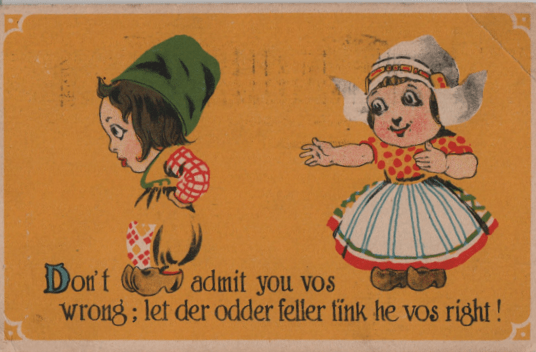
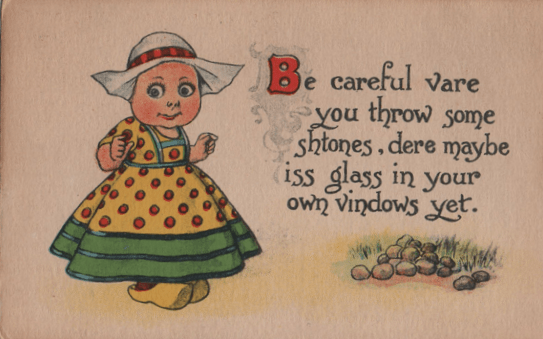
    It has been oh, WEEKS since we have checked in with the Dutch Kids, so I thought we might revisit this social phenomenon of the last century.

    Doe newcomers, and for those with psychogenic amnesia whose brains have blotted out the information in self-defense, there was a craze beginning around 1910 for postcards featuring Dutch children.  These cards were not the work of a single artist or company; the kids have no particular identity beyond whatever each individual firm called the series.  Sometimes solo, more often in couples, they dispensed advice, spoke out their experiences and philosophies of love, and nagged you to write (or made excuses for not writing more often.)  They were cute, they wore identifiably Dutch ethnic clothing, and spoke in a Pennsylvania Dutch (i.e. German) accent which made even the most commonplace things they said seem perky and cute.

    There are all sorts of opportunities here for someone who wants to study the history of ethnic stereotypes in popular culture.  Other children of other ethnic and racial groups (I have seen Irish, Italian, Chinese, African-American, and back-country Cracker accents in the world of postcard children).  Why the Dutch kids had such a vogue, even surviving well into World War I (when suddenly their accent was that of The Hun) is worthy of study.  I haven’t done that.  Maybe you have.  Or maybe you were content simply to think of them as a dusty relic of a bygone age.

    And yet…they WERE kids, and kids generally are a symbol of our future, besides being cotton-picking rapscallions with new-fangled devices which make the world a loud and uncomfortable place.  the Dutch Kids were not immune.  There was, after all, the temptation of the automobile.

    For example, note how quickly this young man has figured out that the fellow with the cool automobile (obviously an imported Dutch model) has something to offer the young ladies.  Our protagonist here comes right to the point: I’m not even sure he’s bothered top ask her name yet.  As for her, she seems a little startled, a little affronted, and a little intrigued.

    Of course, the problem with this in pop culture of the past century, is that a fellow can’t always count on his car’s ability to perform when required.  We see here the basic dilemma as simply as we would fifty years later when Archie tried to start his old jalopy and Veronica, in a huff, climbed into Reggie’s sportier model.

    And a czar can’t ALWAYS refuse to operate, not if it wants to stay off the scrap heap (or the woodpile.  You DID catch on some time ago that this car is an immense wooden shoe on wheels, didn’t you?  To go along with the whole Dutch theme of…okay, okay.  Just making sure.)  We are now prepared for a pleasant ride and any degree of canoodling the young man has in mind.

    Unless we aren’t.  If a feller is going to go out with fast women, he has to be prepared to find that they’re sometimes a little quicker than he is.  It’s back to the old drawing board.

    Automobiles are kind of old hat anyhow, aren’t they?  New technologies are always coming over the horizon, and ANY guy could come around and pick you up in a mere car, wooden or not.

    And so we come to the happy ending, and show that even Dutch children, with their quaint clothes and eccentric accents, understood the twentieth century and the need for speed.  (And they look young enough to have made up part of the jet set, come the 1960s.)

Dr. Cupid

   Once upon a time, starting in 1879, there lived a cartoonist named Walter Wellman.  He was not a cartoonist yet when he was born, in 1879, that is to say.  He probably wasn’t allowed access to ink until he was able to crawl around and grab it./  Anyhow, he was one of those cartoonists who was already drawing for his college newspapers, and was probably drawing in the margins of his notebooks in earlier years as well.

    The golden age of postcards started when Walter was in his late 20s, and it proved to be a gold mine for a talented artist who didn’t like to be pinned down to a job where he had to have a comic strip for each day’s edition, or continue the same characters over a period of years.  This is not to say that he was incapable of doing a series or a comic strip.  He did one long series of postcards in which a story was told in three panels, each of which contained just one word (and the three words rhymed, making him a pioneer in flash poetry.)

    Among his most popular series was one h produced just at the start of the Golden Age, in 1908, as the United States announced one whole side of a postcard could be for the picture alone.  It proved so popular that it served as the basis of a silent movie in 1918.  These were the adventures of Dan Cupid, M.D., who went through the world dispensing, well, a certain kind of medical advice.

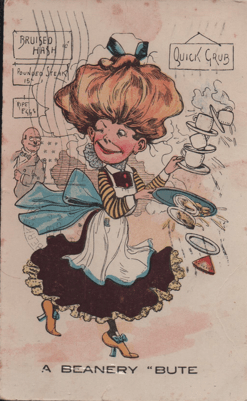
            At first glance, the jokes are jolly, and fairly obvious.  What you may have skipped over, in your hurry to get to the punchline, is all the detail that went in here.  Throughout the series, Dr. Cupid’s posture and expression count, and there is usually a counterpoint in the sampler hanging on the wall.  The patients are not all the same, nor are the prescriptions, but they do follow a pattern.  The patient is generally a rather foolish young man, while the prescription—or fellow patient—is generally elegant.  It will be noticed that Walter was a keen satirist of female fashion, and I’m sure you noticed something immediately about the young lady above.  This was, in fact, his trademark, and appeared on the backs of many of his cards as a sort of brand name.

    Yes, the ladies always had that massive pile of hair

    Note also that Dr. Cupid’s invoice changes from case to case as well, ranging from relatively modest

    To higher prices in critical cases

    He made house calls even outdoors

    And was not afraid to prescribe drastic remedies

    I, personally, think some of his plans sound a little dangerous, but a medical career is not for the timid.

    I have not been able to track down just how many postcards appeared in the Dan Cupid series: I have seen about two dozen, counting the ones I have here and others for sale at random around the Interwebs.  And, of course, he did other series as well.  Besides the three-act dramas mentioned above, there was his Black Hand series, which parodied sensational fiction and the national scare over an early crime syndicate of that name.

    And he continued in the business for many years, always keeping an eye on feminine fashion, and perhaps—I say perhaps—detailing his new ideal of 1930s womanhood, who does not look a LOT like the high-haired beauties of yore

Broad Humor

    I wrote a whole book once of jokes singled out for their absolute omnipresence, what a layperson might call “old jokes”, or, if they were people were as old as the jokes, “chestnuts”.  The book was presented in the form of a quiz: if the jokes were really all that stale, you would be able to fill in the blank I left for the punchline.  I made the point that telling a joke where everyone can see the punchline coming can have its own uses: you can groan or sigh FOR the audience as you reach the punchline, you can come up with a new punchline and surprise the audience, you can come up with a counterpunchline, building on the expected line.

    Or, if you wanted to go for the easy prize, you could just tell the joke and hope you told it better than anyone else, and that even if everyone had heard it before, they’d be pleased to find an old friend being treated with respect, and let you get a cheap laugh.

    In none of this was there any consideration of who came up with the joke, or could be considered its author.  This was an era of common knowledge jokes and comedians who used jokes to produce what was called an act.  This is now looked down upon as an inferior art form to what comedians do NOW, which is form their acts out of the very stuff of life and make you laugh at your shared experiences.  GOOD material, thus, is material which could not be used by any other comedian, as it would not come out of their life experiences, and thus sound false.  I blame the Sixties and the coming of the Singer-Songwriter to replace a generation of singers who sang whatever song they thought sounded good when they sang it.  (The top ten lists of those days would list a song and then the fourteen or fifteen different artists who had recorded it.)

    I am, myself, old school, or as I like to say it, one of the Bennett Cerf school of jokes, with an attitude of “Who CARES who told it first?”  (Bennett Cerf, for those unfamiliar with him, was a star editor at random House who produced joke books on the side.  Someone whose name I’ve forgotten said of him “Bennett Cerf is a comedian the way Willie Sutton is a banker”, referring to the famous bank robber.)

    I am also a student of old jokes, as mentioned before, and thought I would look over a few postcard artists who dealt with the same joke, but gave it enough of a spin (they hoped) to make it look new.  The joke involved here is demonstrated in the postcard at the top of this column, which gets points for A) giving us an action shot at the station and B) adding the joke about “background” to the gag, which most of our artists did not.

    This is the basic form of the gag as seen in most postcards: a lady in an ice cream parlor confiding her philosophy to a friend.  She is cheerful, and the cartoonist has not winked at us from behind the cartoon by having the soda jerk or the companion smile knowingly at us.  AND she takes up only one stool, though the way she’s sitting makes it look hazardous.

    This lady, however, is calmly taking up TWO stools, with a smile as big as…her personality.  I think the cartoonist has backed off from the joke a little too much, since though the counter man’s face is deadpan enough to reinforce what she has just said, she has apparently ordered only coffee, shaking our faith in her travel experiences.  The cartoonist has also hobbled his joke by having travel broaden one’s KNOWLEDGE, which is not what’s being drawn here.

    THIS lady, however, though she is also getting only coffee, gets a thorough smirk from the counter help AND trembling commentary from the two stools she is sitting on.  She is obviously related to women in other postcards with different jokes, like “Three Stool Fanny” or “I Have Such an Awful Hangover”.

    And here is the broadest expression of the joke, where I will contradict myself by removing a point for taking us out of the café.  I don’t think much of the artist’s style here, but I have to admit it’s one of the simplest forms of the joke, whatever else I think of the forms involved.

    I hope I have broadened your knowledge of well-traveled jokes.  If I get desperate, I may present a chapter or two from my bygone joke quiz, and you can see what else you already knew.

Bygone Wishes II

    Now in our last thrilling episode, we covered a forgotten postcard custom, that of sending postcards with pigs on them to wish someone a happy and prosperous new year.  I regret that we only scratched the surface  of the subject, as those pigs are legion, and could be found engaged in dozens of different activities, from opening champagne bottles at midnight to having their smiling heads served on a platter.  How this all signified the same good wishes is beyond me, but I did say it was a forgotten custom, didn’t I/

     Postcards also brought me to an awareness of another holiday tradition which is not so much forgotten as less worldwide in nature.  And that is sending good wishes to your friends on April Fool’s Day  The first of April served as a combination first day of spring and new Year’s Day for much of the world, a day when the winter underwear could be discarded and nice clothes could be worn again.  (In some parts of the world, this was considered foolhardy.  In England, as noted in the oft-censored poem, the first of May is considered more springlike.)  For generations, people celebrated New year’s Day on or around March 25, and there are tales that when certain kings ordered their people to celebrate the first of January as New Year’s Day, the poor souls put on their best spring clothes and went out to dance and were mowed down by the hundreds by frostbite.  This is not, apparently, where the whole April Fool’s custom came from, but it may have been a contributing factor.

    In any case, in France, the first of April included both practical jokes AND good wishes, and both of these involved fish.  Fish became so inseparable from April 1 that to this day, if you fall for a joke on that day, you will not hear “April Fool!” but instead “{posspn d’April!” or “April Fish!  The prankster may well tape a paper fish to your back as another sign of how you were fooled.”

    Fish, however,likre pigs, are considered a reliable food source, though, so they communicate good wishes as well.  Chocolate fish are a frequent gift on April 1, as are cookies or cakes which are similarly flounder-formed.  And, naturally, there had to be postcards.

    Fish and/or people on these cards indulged in a variety of escapades: fish were as likely to be seen canoeing as swimming, and people carried fish, created bouquets of fish, left fish as calling cards, caught fish, or cooked fish.  They seldom appeared on the cards actually eating the fish, though this favor was not returned by the fish

    Some of these cards could be grand and glorious art nouveau fantasy creations, or just salutes to the technology of the age.

    But more often, a deadpan acceptance of a surreal holiday was simply accepted.

    Children were often combined with fish, but sometimes even the most fake-looking fish seemed to displease them.  (The poem suggests the sender of the card is simply overcome with emotion at the thought of you.)

    At other times, they were proud of their errand.

    Or impressed with the sweetness of the sentiments.

    This is a mere sampling of the fish stories available on bygone April First cards.  As noted, the custom of Poissons d’April is still strong in France, though, as in other parts of the world, the postcards are far less common now./  But this is merely another example of what we lose with the passage of time.  It’s entirely natural, so it does no good to carp about it.

Bygone Wishes

    One of the things people do not talk about when studying serious history are the little pleasures and customs of life which have faded away.  This is left to people who write mere nostalgia: a loving look back on such disappearing pleasures as the key you had to use to open canned meat or those metal ice cube trays with the recalcitrant lever which might suddenly spread ice all over the kitchen…no, wait.  Those are ANNOYANCES of days gone by.  Still, that’s the sort of thing I mean.

    One of the customs I have observed in looking through aged postcards is that there used to be quite a busy custom of sending your friends cards wishing them luck at new Year’s.  This has faded away in part because the old style postal service, which could deliver your postcard across town and bring you a reply on the same day, is now gone.  Another is that with people spending a billion or so each year on Christmas cards, a New Year’s card seems superfluous, especially to those with hyper-extended bank accounts.

    Still, once upon a time, New Year’s was considered a much larger holiday than we consider it.  In some parts of the world, Christmas was considered a nice little holiday for the kids, while grown-ups had THEIR big day on new year’s.  It was a day for drinking, yes, as we observe it these days,

    but it was also a day for greeting your customers and creditors, and for dropping in to visit your friends.  There was a whole set of rules for what the hair color of the first person to cross your doorstep on new Year’s meant.  And above all else, it was a day for wishing each other good luck in the year to come.

    So New Year’s postcards are generally laden with good luck symbols, some of which we recognize today—four-leaf clovers or horseshoes—and some of which make us blink—chimney sweeps (think Mary Poppins) or black cats.  And above all else, there were pigs.

    To our ancestors, many of whom lived far closer to the land than we even understand now, a pig was a sign of prosperity.  A pig was like a savings account: you put things into it and eventually you reaped a profit in bacon, ham, and other useful comestibles. 

    The pigs on the postcards don’t seem to KNOW this.  They are perfectly happy bringing good luck to all, whether they arrive on foot, on a sled, on an airplane, or on a zeppelin.  (There are cards where jovial souls are dropping horseshoes and shamrocks AND pigs from airships, without thought of bringing anyone anything but luck.

    Luck and/or prosperity are intended by all these postcard greetings.  Some of these children, by the way, seem to have made their living posing with pigs, intoxicated or otherwise, and somewhere there were apparently artists who did good business in papier-mache pigs.  Millions of these pigs were distributed in the first decades of this century, and in some parts of Europe, the custom continued until postcards themselves started to fade away in the 1970s.  A piggy grazing among fly agaric mushrooms and/or piles of gold, was the perfect announcement that 1941 was here, and all would be smooth sailing for the coming year.

Swizzle or Swag

    I was going to write about something completely different today, but I was transfixed by one of those momentous question which can change a country’s entire culture.  You know the sort of thing: the little spur of the moment butterfly cough that can derail whole civilizations and send them spiralling toward doom or greatness.

    So why do some mixed drinks have to include a paper umbrella?

    Yes, I know.  You are amazed that someone who spends most of his time on trivia about Dutch kids on postcards could tackle a philosophical point of such magnitude.  But every now and then you have to push the boat into deep waters.  (Water not necessarily being the point here, of course.)

    A few people seem to feel that the umbrella, often seen in drinks consumed in a beachfront area, provide important shade for the beverage.  A lot of these drinks are chilled, and/or contain ice cubes, so naturally you want to keep the sun off them.  That doesn’t exactly work, of course, because what’s melting the ice is the heat around the glass: your sweaty palms or the humid atmosphere.  A few other people pooh-pooh the whole ice cube theory, saying that the umbrella provides a cover to keep alcohol fumes from evaporating too quickly.  In this theory, the fumes are forced back down into the beverage enhancing the booze content.  Food scientists love this theory: they didn’t think anybody could come up with something sillier than the ice cube theory.

    An expert I asked about this said, “They have umbrellas because they have tropical names.”  There’s a lot of sense to this.  The paper umbrella business boomed about the same time the tiki craze swept the nation, though this involves us in a separate debate over what constitutes a tiki drink.  A tiki drink, according to purists, must be primarily rum and tropical fruit juice.  And, to make it worse, some tiki drinks are served with umbrellas and some are not, while some drinks with umbrellas do not fit the definition of tiki drink.  None of this negates the original thought, however: tropical drink equals umbrella.

    Another theory makes it a simple marketing tool to get women to come to bars.  The old style neighborhood bar was a men’s establishment, according to this theory.  Women and even children might show up, but only to buy beer to take home for the family.  Only men hung around the bar drinking until all hours, and a number of bartenders realized they could double the take if women could be coaxed into the place.  (Or tripled, as men who didn’t want to go to bars to drink might show up to meet women.)  What would bring women into these rugged all-male spots with spittoons on the floor and pig’s knuckles on the free ,lunch counter?  Why, little paper umbrellas, of course!  So in the 1930s, a bunch of bars got together and decided….I am still getting my head around this story, and I will get back to you when I figure it out.  Mind you, there IS a belief that any drink with an umbrella in it is a Girlie Drink.  It’s the fruit juice.)

    My personal favorite is the theory that the umbrella is there as a hiding place for the Tiki Drink Demon, who hides there and whispers “It’s full of fruit juice!  It’s healthy!  You’re getting healthy food with your alcohol.  Better get another one!”  Some purveyors of this theory suggest the demon is really the spirit of Don the beachcomber or Trader Vic, whichever one of those gentlemen you feel is the inventor of the umbrella-clad beverage.

    You can, of course, probably come up with an alternate theory that beats all of these.  Don’t just make one up, though.  Making up stories about paper umbrellas is a shady proposition.  (Sorry.  I get giddy when away from the postcards.)

The Yocks of Yesteryear

    While I am waiting around for customers to make use of my new consulting firm, I would like to establish my claim to be an evaluator of old pop culture things.  There must be plenty of people out there whose grandfather left them a stack of old books, or old newspaper clippings, or old magazines, and needs someone to come in and say “Yeah, those are prime recyclables” or “Do you realize you have a copy of the very first Bazooka Joe joke?”  Buy how would they know that uncle Blogsy knows his way around such stuff?

    So I thought I would just offer some more of my expertise as a student of really old jokes.  I gave been told that I am a specialist in these, even though I have not sought such acclaim.  (This acclaim, if you’ve never heard it, generally comes in the form of groans.  Weird sort if applause, but part of my job is knowing a tribute when I hear it.”

    We went into this just a little in our last outing, when we considered the joke craze which followed General MacArthur’s famous speech.  His quotation of “Old soldiers never die; they just fade away” led to the postcards we examined last time around, dealing with “Old Fishermen Never Die: They Just Smell That Way.”  But this was merely one of many, as pointed out at the time.  We would learn, as the years went by, that “Old Bartenders Never Die; They Just Tap Out”, “Old Pilots Never Die; They Just Move to a Higher Plane,” and even “Joan Crawford never died; She Just Faye Dunaway.”

    This was hardly the only joke craze to sweep the country.  Another one, though it can be traced to Shakespeare if you want to go to those lengths, really hit us at some point during the Great Depression, and has been depressing people ever since.  This was the Knock Knock joke, to which Captain Kangaroo gave a serious boost on his television show.  This requires a person who will play along, doing the second and fourth, or straight lines of such classics as “Knock Knock.  Who’s there?  Little Old lady.  Little Old lady Who?  I didn’t know you could yodel!”  Some of these rise to great narrative power, as in the Captain’s “Knock Knock.  Who’s there?  Ira.  Ira Who?  Ira ceived a gift from sister: it’s a duck that doesn’t quack.”  “Knock Knock.  Who’s there?  Herbert.  Herbert Who?  Well herbertday is tomorrow and I’m gonna give it back.”

    Wikipedia cites the L.N. Becker Company and its 1960s trading cards for nearly bringing on the downfall of the republic with a set of fifty trading cards bearing what they called “Elephant Jokes”.  The populace had no defense against being trampled by these, which aimed at sheer absurdity.  To this day, if you ask a friend, “How do you tell if an elephant is hiding in your refrigerator?” and explain “By the footprints in the mayonnaise.” they will sigh and turn away, knowing there is no support program for such as you.  If you’re lucky, someone will ask you “How do you get an elephant in your refrigerator?” and go on to say, before you can, “You just move the bowl of Jell-O to the second shelf”.  You have at least found a fellow elephantist.

   These jokes were aimed at all audiences, but there were other joke fads which were aimed more directly at the adult market (not TOO adult, as radio and television censors had their ears open,.)  Talk shows and comedians of the 1960s gave us the Cocktail Joke.  “It’s called a Heretic Cocktail.  Drink one and you get stoned.”  I find very few of these on the Interwebs, so this craze has possibly gone into remission, and no one claims to have originated them, but Johnny Carson and his cronies were probably responsible for plenty of them.  “It’s called the Corpse Cocktail.  Drink one and you’re laid out.”  I DID see someone post online “It’s the Johnson and Johnson Vaccine Cocktail.  You only need one shot.” but I don’t know if that shows this particular epidemic is on its way back.

    Also popular among the stand-up crowd was the wind-up doll joke.  I expect this has gone the way of wind-up toys and other pre-electronic playthings, but once it was everywhere.  “It’s the new Liz Taylor doll.  Wind it up and it gets married.”  “It’s a Teddy Kennedy doll.  Wind it up and it runs…for president.”  Sometimes, following technology, it turned into a pull the string doll, but the pull-the-string doll has also gone the way of all magic dragons.  Though once again, some sentimental old jokester did post “It’s the new Donald Trump doll.  Wind it up and it tells you you didn’t.”

    We haven’t even scratched the Little Willie joke, or the psychiatrist joke, , or…well, I see by the green around your gills that you’ve had enough, so I will pause until you’ve recovered.  After all, old jokesters never die; they just gag.

Fish Story

    Seventy years ago this spring, general Douglas MacArthur made his famous address to Congress, in which he reminded everyone that “Old Soldiers never die.  They just fade away.”  Though he was not the first to express the thought (it apparently comes from a song parody of around World War I) he made it his own in the drama of the moment.  AND he set off a joke craze.  Soon the world was filled with one liners based on it: “Old librarians never diel; they just check out” and “Old pilots never die; they ascend to a higher plane.”

    Since I had a record number of likes on my column comparing the postcard cartoonists and the unfortunate cow (I do not say a record HIGH number) I thought we might look at a few renditions of a gag which spread everywhere in the 1950s.  (If you check Wikipedia for information about the phrase “Old Soldiers, etc.”, this joke is specifically mentioned among those inspired by MacArthur.  I don’t suppose he’d feel flattered.)

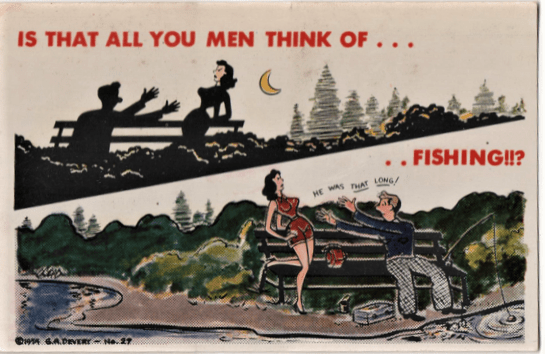
    This version is prosaic, a mere picture of a fisherman about his crusade to save the world from being overpopulated by small fish.  He has not shaved in a few days, and he is wearing patched garments, but otherwise, there is nothing to emphasize the caption.

    This is no problem here.  We have added emanata, and now there is an audience to let us know exactly what they mean.  Having our onlooker (onsmeller?) be a skunk means we are receiving an expert opinion.  The fisherman himself is rather tidy, though: patched knees, perhaps, but otherwise rather trim and shipshape (dockshape?  How many words are we allowed to create in one column?)

    You will note that these happy fishermen do not have a LOT to show for their work.  This vacationer is happy to catch anything at all, and his kitten seems to feel his boots smell more interesting than those teeny fish just above her head.

    Of course, you don’t HAVE to catch anything big; this is another fisherman with a small catch who is explaining about the one who got away.  His puppy, however, again finds his boots smell more interesting than the actual fish he did catch.

    Now THIS fisherman is doing it right.  He is attracting flies, and repulsing a skunk, who is doing his best to get off this postcard.  Meanwhile, the cat has taken such an interest in the proceedings that he has devoured the first course of his fish dinner, and is thinking about the next.

    THIS fishing gentleman, however, obviously takes the gold in this competition.  Both a skunk and an outhouse are declaring his supremacy in the Stench Olympics, while the sun itself seems to have a clothespin on its nose, and flowers are wilting as he passes.  His shirt is missing a chunk, his pants are held up by a rope, and his hat and shoes have seen better days.  He has a catch he can be proud of, so much so that he isn’t going to tuck it away in a creel but carry it over his back, so the sun can bear down on it and impress his scruffy shirt with its odor.

    I have looked around the Interwebs, and I find that this joke has not faded away just yet, and although it is less available on modern postcards (modern postcards themselves being less available) you can find the sentiment on T-Shirts, coffee mugs, wall plaques, and bumper stickers.  And if you think these olfactory salutes are as distasteful as the joke about the unfortunate cow, at LEAST they developed THIS one, and not its competition “Old Fisherman never Die: They Just Can’t Raise Their Rod.”

Go Fourth

    If I have scared away my readership with the previous blogs this week, I now have a nice private moment to do something I was fairly certain I would never do.  There will thus be no witnesses, giving me plausible deniability if someone says “I saw you were reminiscing about the Fourth of July.”

    People start reminiscing about Christmases past about the time they hit twelve (Hey, remember when at least half your presents would be NON-erlecronic?) and they start reminiscing about New year’s Eves past when they hit thirty (Man, I used to be able to start partying at noon New Year’s Eve and not get done ‘til dawn on the second!)  But for over fifty years, I have listened to people recall their Fourth of Julys and these were invariably REALLY OLD people.  I will thus record my own reminiscences now, before I get that old, and no one will notice.

    We did not have a red, white, and blue menu.  Blue raspberry drinks had not reached our part of the country, by and large, so blue was difficult,.  But we made up for it on red, with dinner-plate sized slices of watermelon (with seeds, which we did NOT spit).

    We were always in the high school band, so we would dress in white T-shirts, red bandanas, and blue jeans and march through town.  This was a personal problem, as I gave up jeans as soon as I was old enough to make my feelings count. (See, back in those days, denim had to be broken in by wearing it, and until you’d worn it a dozen times or so, it was the consistency of a fiberglass board. I eventually owned ONE pair of denim jeans, just for Independence Day.)

   Our personal fireworks were limited to sparklers and occasionally a pointless object called a snake, which, when lit, expanded into a long black ropelike thing.  Sparklers, involving personal interaction with live fire, were way more exciting.  My mother handled fire anxieties at Christmas (Did you water the tree?  Don’t leave the lights on too long) but my father was in charge of that concession on the Fourth of July.  His main concern was the whereabouts of the family cat.  A few sparks could be the stuff of nightmares.  This never happened.  The family cats were a wise breed, and never came anywhere near us when we were waving fire around.  (I believe home movies exist of us trying to make stars and spell our names with sparklers, but like a lot of holiday doings, these were a lot more exciting to perform than to watch later on.

    Fireworks outside we rook for granted.  We didn’t need to get in the car to watch them; they came to us.  Our house was not far from the fairgrounds and our neighbors across the street had thoughtfully arranged their roofs and trees so as to frame the fireballs perfectly in the sky.

    There was SOME drama to the fireworks, as PBS came to town in my formative years, and there was invariably some big Fourth of July concert just at the time we would all be outside watching fireworks.  This was before the days of YouTube or even, really, the VCR, so if you missed either the live fireworks or the live television concert, you had missed it for goods.  This could call for frantic commutes from the living room to the front steps.

    During what I laughingly refer to as my maturity, the Fourth became just a day off in the last month toward the massive book festival I worked at the end of July: I concocted maps and lists while I watched The Longest Day (if these guys could manage to pull off D-Day, I could take care of a little shindig like ours.)  It made for a quiet weekend, sometimes the last quiet one before the fireworks of the Book Fair.

    This year I am planning to watch the Longest Day, and listen to the fireworks from my window.  My refrigerator would not even hold a watermelon these days, and I’m not sure I could, either.  The last sparklers I saw had been used as bookmarks, and I quickly tossed them away before library security could go on a search for explosives in the rest of the book donation.       

    But I certainly wish anybody out there a Fourth of July you can reminisce about when you are much, much older than I am now.