Catching Up

    The Arms of Krupp, a massive volume, lumbered onto the bestseller lists in 1968.  I was a wee bit younger then, and not afraid of large numbers of pages, and what I took away from William Manchester’s riveting tale of a family that manufactured arms and armor for centuries was my admiration for a company that would produce the most powerful shell ever seen in the world of artillery one year, and then the next year announce a kind of armor which would resist it.  The next year, they would have a new shell that would pierce last year’s armor, and, of course, a new, improved armor the following year to hold back the ammunition of the previous year.  Selling a product and its antidote always struck me as ingenious, even if I never quite figured out how to do it myself.

    In a less death-dealing fashion, postcard manufacturers were perfectly willing to do the same sort of thing.  On Monday, we looked at a few of the “Why Haven’t You Written?” cards people could send to nag their friends.  Let us consider today the “Sorry I haven’t written, but….” card.

    Oddly enough (or not, given the basic human sense of humor), “Sorry I haven’t written” seemed to go with “But”, as you can begin to see above  there were plenty of variations on the theme, for people blaming the post office

    For the busy business executive

    For the busy housewife (who has been too thorough with the laundry, I guess)

    For the person who is really apologetic about the whole thing.

    I’m not altogether certain where the connection comes from, but quite a number of these apologies deal with cattle and the cowboy, perhaps simply as a way of rounding up excuses.  A lot of these blamed everything on the cattle involved, be they Midwestern bulls (note the extra moo joke)

    Or the far Western variety

    Which gave them an opportunity for another very popular postcard pun.

    Other writers could just claim they were busy, or thirsty.  (That horse looks jealous)

    While still others could claim they were busy without needing a four-legged scapegoat.

    Sometimes with a subtext of “I sure wish I WAS spending my vacation on this.”)

    That sort of activity could lead to other people to blame your lack of correspondence on.  (If your children are going to be levitating like this all the time, you obviously are going to be distracted.)

    In most of these cases, no pretense is made that sending a postcard will quite fill the bill.  (Next time: I have nothing to say, but I do have a stamp.)

Responsibility

    We’ve discussed this before: the postcard was a twentieth century text message.  For a few pennies, you could send a brief note across town in a couple of hours.  The postcard companies knew what you were doing, and provided cards which came with pre-written sentiments which would start the message for you so you could just add a couple of personal details.  There were postcards which could call out to the recipient any possible basic message, from “I hear you’re getting better but aren’t well yet” to “I’m going to drop in on You Tuesday”.  The greeting cards available today are just a pale shadow of what postcards once offered.  There were dozens where the message on the front was simply “I’ve got no reason to write but I felt like it.”

    I haven’t done an extensive survey, but among the top ten most sent messages seems to have been “Why Don’t You Write to me?”

    (That’s a skunk, so it’s one of the “most-Scent messages”.  Get it?  Okay, be that way.)

    Starting with that essential message, there were different degrees of message.  You could start with the idea that you were worried that you hadn’t heard lately.

    Or you could toss a smile at the person, just pointing out that I’m writing to you, so now you owe me.

    Or remind them how it made you feel when you got a letter or postcard from them.

    But by far, the preferred technique was guilt, letting them know how you felt when you DIDN’T get that letter.

    The guilt could be light, pointing out to the recipient how cute you were and how you were just waiting around for that message.

     Or, in wartime, it could be a reminder that it was part of your duty to the morale of our loyal members of the service to write.

    There were, after all, no wartime shortages of stamps, at least.

    And it’s not as if you could beg off on the grounds of poverty.

    Throw an excuse at them to start the message, to let them know THAT one won’t work.

    The message of the card was simply “You are Guilty of Not Writing.  You KNOW what to Do About It.”

    (Next installment: I Know I Haven’t Written Lately, But….)

Stolen Sweets

    I’m sure people do these things today, but they sure did them a lot more often in that other world I visit, the world of the Postcard Craze of 1908 or so.  Young men slipped out after curfew to exchange a few words under the girlfriend’s window, women put pies to cool on the kitchen window, tramps slipped up and stole clothes from your clothesline and pies from your kitchen window, unpleasant kids tied firecrackers to a stray dog’s tail, restaurants served tough steak and elderly butter, and people unable to sleep threw shoes at cats.

    And children stole jam.

    This was a while back, you understand, when billions of dollars were not yet spent on advertising and manufacturing sweet snacks.  They existed: a new exotic item called caramel had been brought to the United States in the 1880s and was very popular, and purveyors of chocolate produced both fancy assortments for the upper classes, and cheaper versions for the masses.  And, of course, bakeries existed to provide people not just with bread but with sweet rolls and the doughnut of popular consumption (such a hardy bread product in its day that one dunked it in coffee partially in self-defense.  It also sweetened the coffee without recourse to the sugar bowl.)

    But a majority of Americans lived in rural areas and small towns.  This not only meant, for the average child, fewer opportunities to buy sweets but also a security system it was hard to evade.  An uncle of mine recalled a moment in the 1930s when he did a chore for a woman who lived several blocks from his house, who surprised him by giving him a nickel.  Knowing his parents would either a) make him give back the nickel since it was a neighbor or b) take the nickel and put it into his college fund, he chose to go immediately to a store which would sell him a Fudgesicle for a nickel.  He reasoned that if he ate it on the way home, it would be gone when his mother saw him, and there would be no evidence that there had been a nickel or a Fudgesicle.

    He had reckoned without the other neighbors, who, seeing him with a Fudgesicle would wonder where a kid who did not usually eat such things got it, and call his mother to inquire.  Fifty years later, he could still remember regretting he hadn’t thought to eat the forbidden sweets before he left the store.

    So even where there was opportunity, there were eyes watching.  But in the privacy of one’s home…true, when pie or cookies were available, these were dispensed by the Kitchen CEO, who could keep track of them.  But those jams and jellies….

    Just about every well-established family put up fruits and vegetables at harvest time; in the days when grocery stores stocked only seasonal goods, this was the only way to make sure you could have apples (dried or made into sauce), cabbage (as sauerkraut), or beans (cooked and canned) through the long winter.  And there would be jams and jellies in varieties you now have to send away to an artisanal market for, but which then grew wild in the back yard: elderberry, huckleberry, blackberry, with perhaps Damson plum and apricot as well.

    And jars could be opened and reclosed.  In fact, once Mother opened a jar, how could she be sure how much had been in the jar next time she opened it?  An enterprising child, with stealth and a spoon, could take care of those sweet tooth cravings.  Mind you, it took nerve.

    A child who will read her future in her own shadow is not going to make it as a master criminal.  It also took a certain amount of planning, a certain degree of stealth.

    But once you had mastered your fears and learned to keep your face clean, you had only to deal with the aftereffects of consuming a lot more fruit and sugar and pectin than you usually ate at one time.  (You don’t really want to see all the castor oil and chamber pot postcards, do you?)

    Of course, sometimes fortune would play into your hand.  This was also an era when a child’s Time Out might involve being locked in a dark closet, or in the dark, dank, spider-filled cellar.  Where, if you thought about it, was also where Mother stored the jars of jam.

    Crime, it seems, COULD occasionally pay. 

Beery Ballads

    At this point in my career, I suppose it is unlikely that I shall ever be invited to give my lecture on Victorian Adaptations of New Communications technologies, in which I discuss, briefly, Thomas Edison’s career in pornographic phonograph records.  It is not the best known of his inventions, but Thomas Edison was the originator of what used to be known as the Party record: records which were made well into the 1960s featuring songs and comedy routines which could not be played over the radio.  Only a dozen or so of these survive from the early Edison cylinder days, but because Edison was also a pioneering businessman who kept data on everything he sold, we know there were many more.

    It was one of several missteps Tom made in the marketing of his phonograph and the recordings.  He thought home recording, not prerecorded stuff, would be the big moneymaker, he thought cylinders would eventually supersede discs, he felt faster playback speeds made for better and more saleable records, and he figured his naughty records (or, as one of his technicians labeled them, “SMUT”) would sell to the new Phonograph Bars, drinking establishments where you could buy a schooner of beer for a nickel and give another nickel to the bartender to put a particular record on the phonograph.  Turned out this last was totally wrong: his sales records show exactly what came to be the norm, that people bought the naughty records to play at home, at parties for special friends.

   Then, as now, what sold to the bars were the weepies, because men drinking late like to cry in their beer.  The Victorian era was filled with songs of dead mothers, dead fathers, dead sweethearts, dead children, or at least people who were very ill (and would die after getting to see that loved one one last time).  When that failed, songs of hearts broken beyond repair were a good substitute.  We have, for example, this little number, about a little girl who has been crying because her Mama and papa are separated and now she can’t see her daddy any more.

    (This song, from 1906, inspired by a line in the Book of Isaiah, was harshly criticized from the pulpit, as it misinterpreted the verse, implying that the little child mentioned in the prophecy would lead grown-ups, whereas she is actually leading only that lion and lamb that are going to lie down together.  This still troubles some folks.)

    The first pop song to sell a million copies (of sheet music) was “After the Ball”, about a man whose heart is broken and many years later discovers he jumped to the wrong conclusion and could have lived happily ever after all.  (Twisting the knife in a final verse was also very lucrative.)

    There are lots of postcards from the Postcard craze before World War I based on “After the Ball”.  Oddly, for every one that weeps with the hero of the song, there are two showing drunks staggering home “after the ball” and three showing billiards players or baseball players or football players “after the ball.”  Sad songs were so popular that of course cartoonists and comedians couldn’t help making fun of them.

    Sweet Adeline, saluted above as the Bottle Hymn of the Republic, is just such a song of yearning, as a man wonders what became of his longlost girlfriend.  It became practically the definition of men who had had a glass or two too many sobbing away at the lyrics.

            But there were many others, perhaps best exemplified by this little number.  “By the Sad Sea Waves” was a song of summer romance that ended, and you can see how effective it was: the man is crying, the waves are crying, the clouds are crying, and even the dog is crying.  All of them are clearly ripe for a call of “Bartender!  Set up another round!”

Fifty Years Agone

   I was trundling through the Interwebs, considering things to blog about, and reflected that although I had glanced at 1921 in search of things to commemorate, I had not looked to 1971. I do things like this.  I decide on the research, figuring “What’s the worst that could happen?”

   The worst that could happen was a trip into 1971, a little drama I watched on its first run in theaters, but about which I had forgotten much.  Mainly I had forgotten how convinced we were that the world as we knew it was about to crumble.  1971 was no light romantic comedy, but a turgid melodrama.

   William Calley and Charles Manson were found guilty of their respective massacres.  Idi Amin took charge in Uganda, Rolls Royce went bankrupt, and Ed Sullivan aired his last show.  Camden, New Jersey was nearly wiped off the map when riots broke out over the killing of a motorist (Puerto Rican) by police, the Weather Underground set off a bomb in a restroom in the U.S. Capitol, and the song “Stairway to heaven” was unleashed on us.  Not a laugh-a-minute year, 1971.

   In the world of literature, Agatha Christie’s last book was published, Ogden Nash died, and no Pulitzer Prize was awarded for fiction.  The bestseller lists maintained their essential dignity with its recognition of Xaviera Hollander’s classic The Happy Hooker.  1971: what a vintage!
   Still, no year is without its joys.  I remember being thrilled at the time, and still considering with wonder how Alan Shepard, the first American in space in 1961, was able to complete the story arc in 1971 by stepping onto the surface of the moon, and becoming the first man to hit a golf ball across the lunar surface.  Agatha Christie’s last book was a good one, and there were other good books which came out that year (Look at the lists and choose your own favorites.  I’ve had most of them for sale, and probably the best seller of them all, among MY customers, was When Hitler Stole Pink Rabbit.)

   And 1971 saw the first publication of a book which was to make a major difference in my young life.

   Once I had read The Lord of the Rings, I was desperate for anything else along the same lines, a difficult thing in those days, as it was not yet QUITE popular enough to inspire dozens of spin-offs and rank imitations.  But somewhere along the line, I picked up a 1975 paperback edition of Robert Foster’s 1971 A Guide to Middle-Earth, a dictionary of characters and places in Tolkien’s world.  I was enchanted, and before I knew it, my entire future development had been warped.

   Who knew it could be so entertaining to sit down and read a reference book straight through?  I have since read others, starting with Webster’s International Dictionary (I gave up two thirds through—too hard to hold on your lap—but it had this great sub-dictionary of obsolete and dialectical words, and added to my vocabulary “oxter”, an obsolete term for “oxall”, itself an obsolete term for “armpit”).  I moved on to dictionaries of street names, and flower language dictionaries, and all manner of obscure lore.

   Meanwhile, people were imitating Foster with guides to other fictional universes.  (They had been doing this with Shakespeare and Dickens and suchlike before Foster, but he seems to have opened the floodgate.)  No fantasy universe was complete until someone had written a guide to place names and characters: DC and Marvel started bringing out regular guides to their superheroes, and guides to places like Oz and Narnia were on their way.

   When my resources did not extend to buying more of these, I decided to write my own.  I made what I thought was quite a generous offer to George Lucas to write a complete guide to his characters, if he would just give me a sneak peek at the script for Return of the Jedi, to make the book complete.  (Never did get an answer.)  And then I had another brilliant idea: why not write a guide to the places and people of a fantasy novel series that did not, in fact, exist?  It would save me a lot of reading, and there might be a market for such a thing.  The series would be vaguely based on the Poictesme novels of James Branch Cabell, but of course my 1930s author would be fictional, and the novels equally nonexistent.  It was the lazy writer’s dream: I could make up interesting plots and characters without ever having to produce completed books.

   My marketing plan, as I explained to a couple of editors chosen at random, was to produce this massive reference book to the novels in question, and then challenge current fantasy writers to produce authorized “sequels”.  With a setting and characters pre-fabricated, they could be spared the effort of world-building and just write stories set in the world provided.

   The editors, alas, dashed cold water in my face.  “Fantasy authors,” I was told, “Like to make up their OWN worlds; thank you very much.  There would be no interest from them, and less than none from the reading public.”  I shelved my guide to the novels of Bernard Sexsmith (It means Cobbler; I thought it was a fun name for a James Branch Cabell clone) and moved on to other things.

   Um, not long after that that a publisher started bringing out a series called Thieves’ World, which had a central core of places and characters devised for fantasy writers to pick up on and write about.  It inspired some other series of similar books for fantasy writers who didn’t mind using someone else’s world for stories.  The “Shared World” anthology saw a vogue, and never quite died off.  In fact, the concept goes back at least to the writers of the 1930s and 1940s who had continued H.P. Lovecraft’s mythos in stories of their own, and….

   So there was another fine idea some expert talked me out of.  If I could go back to 1971 and….  No, not even for that.  Anyway, I got good practice in writing short, glib entries on long, complex matters, and this led eventually to my highly lucrative blogging career (which will start to lucrate any moment now, I’m sure.)

Selling the Fizz

   So it went from a mild over-the-counter medication to something people wanted banned.  Well, yes, that happened to cocaine, too, but I was thinking of another product, which took longer to make the transition.  And along the way, it slid its way into our culture in many ways, SOME of which can be illustrated with postcards.

   It is, of course, the soft drink.  Ever wondered why the old-fashioned drugstore in old movies and television shows included a soda fountain?  Why, it’s because the first soft drinks were sold out of pharmaceutical venues.  (The soda fountains were already there at that time, as carbonated water—since it makes you burp—was considered an aid to digestion.  Flavoring the soda water was part of the plan, too.)  Coca-Cola was first marketed as a nerve tonic and then as a substitute for stronger beverages when that part of Georgia voted in its temperance laws.  Pepsi Cola was considered a cure for the upset stomach, or dyspepsia (see what they did there?)  Dr Pepper made some similar claims, and settled for a general trope of how good it was as a snack instead of something less healthy (Drink a Bite to Eat at 10, 2, and 4, they told you.)  7-Up actually advertised the use of lithium, a mild tranquilizer, in its recipe.  (It’s lithilated!)

   But what caught on with the public was a cold, carbonated beverage.  (Hence the origin of the ones already mentioned in warm climates: Coke in Georgia, Pepsi in North Carolina, Dr Pepper in Texas, and 7-Up in Missouri.)  And it was as such that it started to charge into the world of advertising, beginning as early as the 1880s.  Some of these slogans have outlived the ad campaigns that spread them across the country, and in some cases have outlived the very soft drink.

   Moxie is still drunk, I am told, in hidden, tucked away corners of the united States, but once it had its empire.  The man who invented it claimed it was named after a man named Moxie who had discovered the secret ingredient in the drink during a perilous adventure in South America.  (This secret ingredient turns out to have been a flower root which grows all over North America, and likely Lt. Moxie never existed.)  But it was advertised as a nerve tonic—besides being a cold carbonated beverage—and was advertised by the Moxie Man, who was so stalwart and heroic looking that saying someone’s “got moxie” is a major compliment.  (The phrase may be revived by the new movie Moxie!.  And it may not.)

   Did you ever use the phrase about lobster or a liverwurst and onion sandwich, “I like it, but it doesn’t like me”?  Without knowing it, you were inspired by 7-Up which, whether or not it originated the phrase, spread it across America with the ad campaign “You Like It and It Likes You”.  They hinted that a glass of refreshing 7-Up after a bite of something that didn’t like you might be just what you needed.

   Refreshment was, of course, the thought behind one of the longest-lasting beverage slogans.  Coca-Cola started fooling around with the words Pause and Refresh in 1923, and went on fooling with the two words in various combinations for decades.  But it was in 1929 that they started to use “The pause That refreshes” and it helped burn a bright red logo across the country.  No one knows EXACTLY when it was appropriated for another pause to refresh oneself.

   Assorted executives at Coke did and did NOT like the association.  But there was no stopping it, and to this day, emcees at all-day workshops or long programs will announce the occasional break “for the pause that refreshes”, and they don’t mean running out to buy a carbonated beverage.

   Oh, that postcard at the top of this column?  Kind of wondered about it myself, especially when I turned up more postcards with the same theme and slogan.  Well, naturally, with the world paying attention to pausing and refreshing, every Coke competitor wanted to come up with a slogan as catchy as Coke’s.  And it was in the early 1930s that an advertising executive approved “Obey that Impulse.  Drink Pepsi-Cola Iced: You’ll Be Glad You Did!”

   I have no notion how they felt about how people received “Obey That Impulse”, but by that time, it was too late.  The slogan WAS eventually replaced by another one touting how inexpensive it was, with the tantalizing vamp “Trickle Trickle trickle trickle Nickel Nickel Nickel Nickel”.  Kinda surprised I haven’t seen THAT on a postcard. And they replaced that with “Pepsi-Cola: More Bounce to the Ounce”. Those postcards….

I really must go now and mix some healthy beverage mix gathering dust in my kitchen cupboard, and see if that will at least nudge my brain out of this particular gutter.

You Tell Me

    Pop culture is cotemporary, evoking some facet of its time.  Much of it quickly becomes a cliché, and grows tired.  It disappears for a while and then, just as everyone has thrown away their copies of that hot comic book and photographs of that singing sensation, they are rediscovered, becoming Nostalgia and/or Collectibles.

    One of the things I have learned, through the years of selling cultural items, is that the process does not stop there.  Nostalgia can last only while people who remember it are spending money.  Things which were hot collectibles when I got into this business are now frugs on the market: no one cares and no one wants to pay for them.  If they are lucky, there is yet another resurrection awaiting: they make become iconic or they may become something so expressive of their time that they move quickly back into the limelight.  Or maybe they’re just so rare that people go on wanting one: Action Comics @1, say, or that Honus Wagner baseball card.

    It works much the same way with jokes.  A joke is funny, so people repeat it.  It gets repeated so much it gets stale.  It doesn’t get told any more. Then someone discovers it and starts it akll over again.  Unless, of course, people have forgotten why it was funny in the first place.  This happens most often when the joke is linked to a pop culture phenomenon which has faded away.  “The gag “Take my wife…please!” was funnier when Henny Youngman was alive to tell it,  or at least when people who had heard Henny Youngman tell it were still alive.)

    And that brings us, through depressing back alleys, to my complaint for today’s column.  We have touched on it before, but there are humorous postcards I have here which I just don’t understand.  In some cases, this can be because the joke wasn’t good to begin with, or because the artist dropped the ball.  But I have gathered here some postcards which are part of a larger group.  I have seen other cards with exactly the same joke, so it was good enough once to be worth stealing.  I just haven’t found out why yet.  And this is a matter iof some importance to me, as I am something of an expert in the world of really old jokes.  (And you don’t need to read too many of my blogs to know that.)

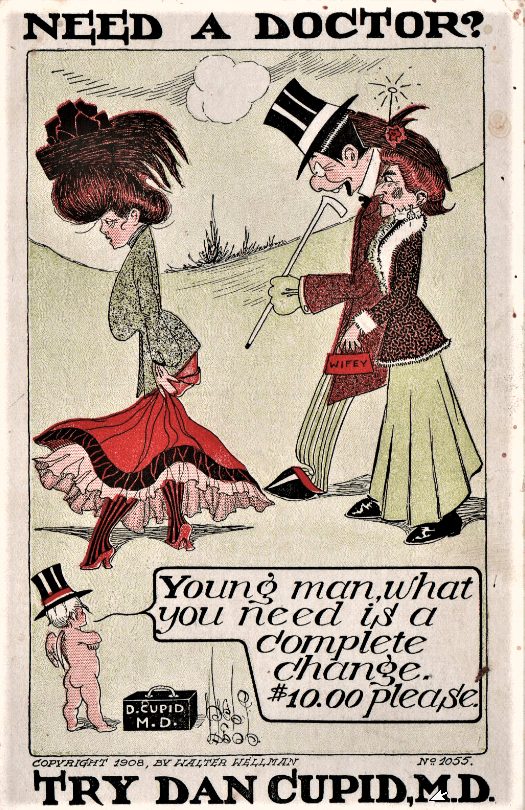
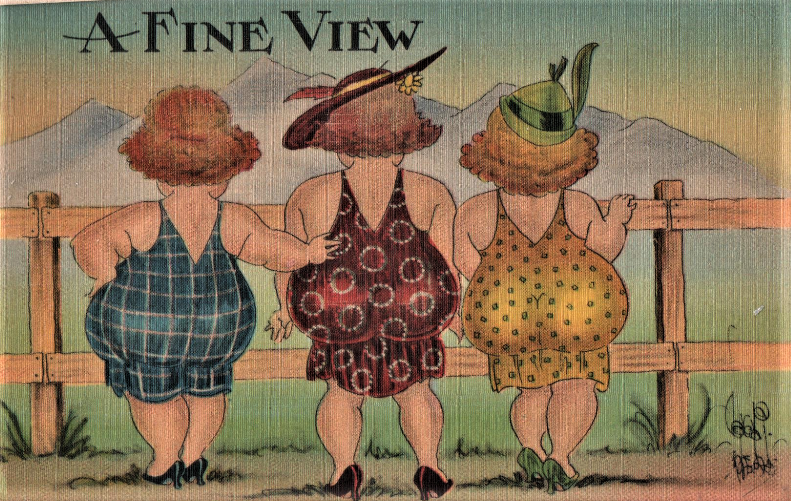
    Start with the gag at the top of this column.  You saw the gag right away, right?  It’s one of thousands of postcards making fun of a person’s situpon: we’ve covered that.  No problem, right?  BUT….

    What this tells me is that the phrase “You’re all right BUT” had its day as a catchphrase  But whose was it?  What did it originally mean, ad has it been lifted literally, or have these cartoonists twisted the original application?

    This joke meant nothing in particular to me when I saw it.  Or when I saw a second one.  When I saw a third one, and then a fourth for sale online, I knew it had to be the same thing.          

    Each of the men in “Sayin’ Nuthin” is sawing wood.  In one, a woman has a gun pointed to his head, apparently to make him saw the wood, but he’s engaged in the same bit of carpentry as the others.  Was there a stage comedian who delivered a monologue while sawing?  Is it a joke about the words “sawing” and :saying”?  (But in that case, he IS sawing something.)  The Interwebs knows nothing about it, but these cartoonists did.

    There are lots of postcards with this theme: a bunch of children, in most cases clipped from photographs and gathered in huge groups—in trees, on riverbanks, surrounded by storks.  Sometimes they’re happy, sometimes they’re crying, because your basic baby in the world of postcards does one of two things, and one of those is crying.  (As for the other, there are postcards like this where all the babies are squatting on chamber pots.)  What did it all MEAN?  The only hint I get is that it was supposed to be some sort of good luck wish.  Why was that?  (Especially thinking of the ones where twenty babies are sitting on potties.)

    Speaking of children, explain these to me.  They’re by different cartoonists working for different companies.  What’s the joke?  IS there a joke?  Are we proud of the little immigrants?  If we were disgusted by them, they’d have dirtier noses and funnier clothes.  Are we making a point about products made in Germany?  If so, what is it?

    These puzzles keep me up late sometimes, searching online for hints. and the moral is, I suppose a good one.  The Internet doesn’t know everything just yet.

The Romance of Science

    As you no doubt recall from our last thrilling episode, we were looking at some of the ways postcard makers showed the comic possibilities of new technologies.  The automobile, the telephone, the phonograph: all were used for gags ranging from the merely cheerful to the rollicking.  (If you were not, personally, rollicked by any of these, recollect that their heyday of rollicking was a century ago.  You may just be too modern in your expectations.)

    There was one field of postcard we did not cover, however, and that was the romantic exploitation of new inventions.  Anyone who can recall those little paper Valentines we swapped in grade school will realize that any fad is grist for the romantic mill.

    The electric light bulb, for example, was pretty well-established by the time the postcard came along, but it took longer than we realize nowadays for the country to be wired and electrified.  So the light bulb was still news to plenty of people and, besides, the shape of the bulb made it an excellent device for enclosing a romantic couple.  Not many of the jokes shown here exhibit much electrical humor at all.  (The one at the lower left, in fact, does a gag about the telegraph instead.  CQD, which stood for “Come Quickly: Danger”, was used before the SOS signal was invented.)

    The automobile offered romantic possibilities for those couples who couldn’t squeeze into lightbulbs.  A couple could pose proudly with their own automobile, exhibiting pride of possession as well as the stability of a relationship where either member would trust the other with control of such a loud, bizarre vehicle.  It did not take much time, however, for couples to realize the advantage of having a chauffeur.

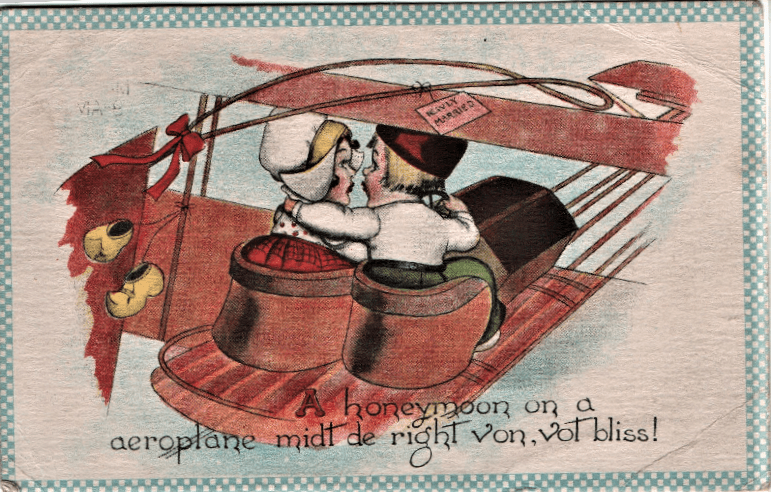
    Of course, for dropping in unexpectedly on your loved one, there were other, even faster machines.

   (I don’t know which of this loving couple was the pilot—neither of them is really dressed for it—but did that person REALLY think this through?  I appreciate the fact that they managed to land without destroying the plane but I don’t see that there’s enough space for a take-off.  Or are these things irrelevant when one is in love…or simply trying to draw a picture for a romantic postcard?)

    This little gag, making reference to the newfangled writing device known as a typewriter, takes a tiny bit of explaining.  You can see that the machine on the desk is not, in fact, being used at all.  The joke involves the fact that offices hired young women to do the secretarial work which involved typing, and these young ladies were ALSO known as typewriters, because they did the typewriting.  The young man is using his pen because the typewriter is busy getting a hug from…oh, you got that already.  Just checking.

   Next only to the automobile in romantic technology though, was the telephone.  Tributes to its usefulness in connecting one with the beloved ranged from the fairly simple, above, to the more grandiose.

    Postcards could actually be used to improve this kind of connection, by conveying a phone number, or making a date to make a call.  (See, the postcard was the email of its day: in cities where mail was delivered more than once a day, you could send the card and know it would arrive a few hours later.  This could be vital; I have in my current stock a card where the sender is imploring the recipient NOT to discuss things on the phone any more.  The private line had not been invented yet, you see, and if you didn’t time the calls, or even if you did, certain people might be listening in.  By the way, it’s a little too late to mention this to the sender, but sending this message by postcard was not the best way to keep a secret, either.)

   Of course, every new device has its good points and its bad points.  So naturally, since we are contrary creatures, as time went by postcards were also used to express the benefits of doing things the old-fashioned way.

Oldfangled

    I am sure that the first Stone Age citizen who watched his neighbor cooking his dinner over this newfangled thing called fire shook his head and said, “Society’s getting too involved with these new inventions.”  I say this as one who is sitting here writing this column on a machine which I once would have said (and DID say, as a matter of fact) I would never have any use for.

    We have always been fascinated by the gadgets our fellow humans come up with, though we wonder sometimes if we really needed it as much as they say we do.  From the red light cameras watching us as a we drive to the cupholder we’re thankful for while stuck in traffic, we see dozens of innovations come into our lives, and wonder either why no one thought of it before or why someone thought of it now.

    At the turn of the last century, a reasonably new device called the picture postcard gave cartoonists the ability to discuss these new contraptions, considering their good points and their bad ones.  And not one of these cartoonists guessed that the eventual reality would far outstrip their fantasies

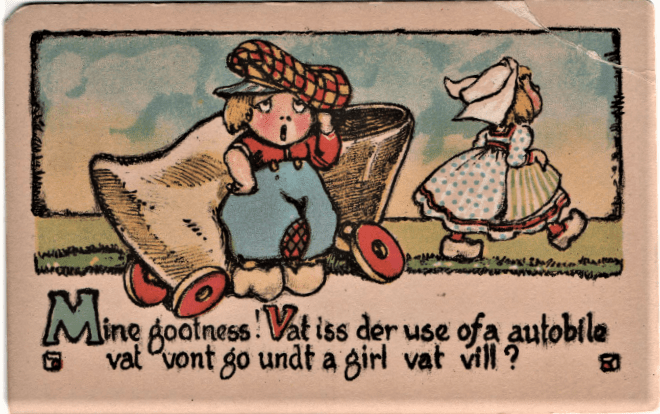
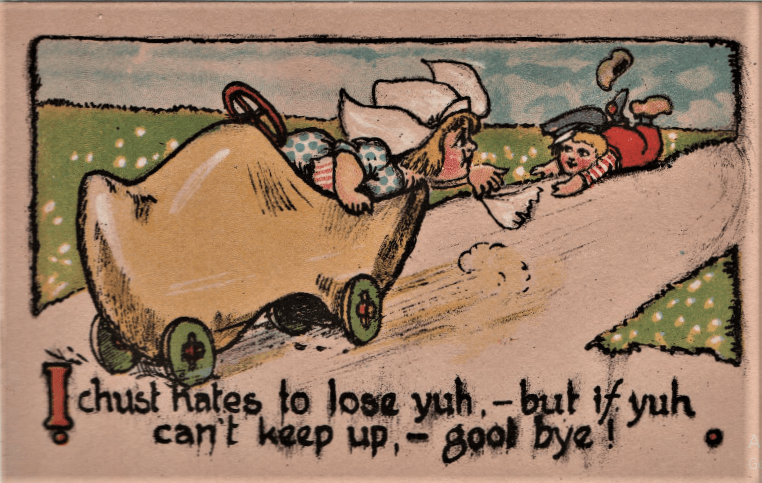
    The baby new year, of course, would have access to the newest mode of speeding onto the scene and doing away with his bearded predecessor.  The toy of geeks in garages, many automobiles were unique, with a “new model” meaning Uncle Pete decided to put cushions on the metal seats in that noisy buggy he made up last year.  Few could have guessed that in a few years, thousands of these contraptions would be on the roads, outnumbering horses, and lending speed to, say, the newlywed couple (Who are cheerfully taking their puppy with them on their honeymoon, and letting him ride shotgun.)

   Of course, some people in more of a hurry, like this Danish couple rushing to wish you a happy new year, found even speedier (and riskier) methods of travel.

    Communication technology was not neglected, even in the days when you not only couldn’t put a phone in your pocket, but often couldn’t get on in your house.  Lines were run first to places that needed phones—police stations, say—and central locations where anyone who needed to call could drop by.  (The general store, the post office…phone booths came along after a while.)  Of course, the idle rich could afford to do as they pleased, and the warnings against the phone as a cause of idleness abounded.

    The applications in romance were not neglected.  Making a date by phone had all sorts of advantages because your suitor at the other end of the line couldn’t actually see you.

    Then as now, of course, some people just could NOT keep their technologies straight.  And why COULDN”T you use a phonograph as a phone?  They SOUNDED alike.

    Of course, this was all over a hundred years ago, when people didn’t suspect how new technology might change our lives.  By the 1950s, for example, we were used to technological innovation, and had stopped making jokes about these new contraptions that….

    (This one almost made it into my file of “How Did They get Away With That?” jokes.)

Once and Future Lingo

   I knew “23 skidoo” basically just as a jocular reference to days gone by, a slightly raffish expression now passe.  (Looking back, I think I got this impression from Bugs Bunny in one of his cartoons mocking the Gay Nineties.)  I picked up later on the fact that when it was in use, the phrase essentially meant “Scram”, but I still saw it through animated cartoon filters, and didn’t ask where it came from.

   That innocent period of my life ended when I started to examine antique postcards and turn up references to the phrase when it was still alive, a glimpse of a wild piece of slang in its natural habitat, before progress and rebuilding  crowded it out of the language.

   It apparently started as two separate phrases.  Skidoo was a sign of bad luck, or an order to depart immediately  (A bouncer coming at you was bound to be a sign of bad luck.)  Using it to mean scram may derive from the word Skedaddle, which meant the same thing, or from a racing boat called the Skidoo (but what was IT named for?)

   The number 23 is supposed to have become a phrase for scram because men used to like to gather on 23rd Street in new York to watch winds whip around the Flatiron Building and blow women’s skirts up, OR watch by the subway grates when THAT wind blew women’s skirts up (Edison made a movie about this, which you can see on the Library of Congress website and/or YouTube)  Other people spoil it by pointing out the number was being used that way before there was a Flatiron Building (I suppose it was still windy on 23rd Street, though) and blame it on Charles Dickens (the man who said it was a far far better thing was number 23 in line for the guillotine) or racetrack slang (there was enough room for 22 horses), telegram slang (lots of short phrases were used to mean longer ones, to save on costs), the twenty-three saloons in the town of Skiddoo, jumprope rhymes…the list goes on and on

   Roughly four million different writers and comedians claimed to be the first to put the two together but it seems that by 1906, companies were using it in ads, which means a slang phrase has really caught on.  Just about everyone agreed that the phrase meant “Beat it.  Scram.  Hit the Road.  Take a powder.  Here’s your hat, what’s your hurry.”

   Except….

   I am completely mystified here.  I get the general idea that we’re expressing contempt for someone or something.  I was writing this off as a joke someone tried that just didn’t work when I ran into this card.

   This leaves me in the position of the man in Close Encounters of the Third Kind, telling himself “This means something.”  Anyhow, it meant something once upon a time.  I am aware that hobos, unable to stop by Wal-Mart and buy new clothes, had to steal anything they could get from clotheslines to wear, but this doesn’t QUITE get me to an understanding of the theme of these two cards.  Are we telling these men to scram, or are they saying that to us?  Or are these just souvenirs from the Costume festival in the town of Skidoo? (as far as I know, they don’t have costume festivals in Skidoo).

   You think it over and let me know what you come up with.  Or, if these lads and their clothes don’t interest you, perhaps you can tell me what this young lady has in mind.  And what the owl has to do with it.  And what….

   Never mind.  Time to skidoo.