Reality, Pre-TV

    There are, of course, some postcards that are rarer than others.  But there is one sort of postcard that is so rare that some people can’t be bother with it, while other people can’t get enough.  This is known in the trade as an RPPC, or Real Photo Post Card.  (The whole argument over whether “postcard” is one word or two is a whole nother blog.)

    The Rppc is a postcard which has been made by printing a photograph directly on a postcard back, generally in small quantities, for some family or group and not intended for mass distribution.  The following, for example, is NOT an RPPC, even if it is a Real Post Car with a Real Photo.

    That was printed in the millions on a printing press.  A real RPPC is generally a family snapshot which has been dignified with a form that allows it to be sent through the mail, like this.

    Soial historians especially find these fascinating, as they freeze a moment in time, and give us a picture of a person or place of little interest, in their time, to the general public.  Maybe a hundred copies, at most, were made, and a lot of those will have disappeared over time.  They can provide a unique look into our past, as well as providing us with maddening questions if, as often happens, there is simply no message to explain what’s going on, either because the card was never mailed, or because the sender and recipient knew what was shown, and didn’t need to have it explained.  Take the case of Mamma and Gertrude.

    So I am assuming the horse is named Gertrude, but can we be sure of that?  And what was the occasion?  And why…what….

    Who ARE these men?  Where are they?  What was the occasion?

    And is grandma holding up her granddaughter?  Or is this an early ventrilogquist with her dummy?

    How did this couple meet?  Is this the only picture they had taken together?  There MUST be a story, but what is it?

    Of course, some of the RPPCs show more eternal photos, where we know what’s happening just by the poses and garments, even if we don’t know the names.  You will find RPPCs made up after First Communions, commencement cdeeremonies, and weddings (handy for those thank you notes?)

    Sometimes a person just wanted to show off a new hat

    Or fancy outfits (an RPPC could be taken in a photo studio: this window is frankly fake, but it does its job as a frame, and probably did so for dozens of couples even without funny hats.)

    Or just as evidence that one did put on a suit occasionally.

    An rppc was perfect for sending out pictures of the new kitten

    Or of the kids, whether they enjoyed the camera

    Were wary of it

    Disgruntled by it

    Or really, really wanted to be somewhere else.

    Whatever the intent, or the effect on the intended audience, we, decades later, see a family photo that somehow escaped the album by being turned into a postcard.  The moment is preserved for future generations, and perhaps forever, even if the subject of the photo, like this little boy lovingly dressed by his mother, may have regretted it later on.

Mid-Century Moppets

    If pscyhogenic amnesia, protecting your brain from painful memories, does not prevent you from recalling our last column, you will remember that we discussed a number of strange species of being which inhabited the postcard world at the turn of the last century.  Led by the Kewpies, there were numerous different kinds of smallish people who looked like children but went about adult occupations, expressing grown-up opinions, frequently in a clothing-optional manner.   (Obviously, the example above needs to be wearing athletic equipment so you know he’s a baseball player, because otherwise being hit by the pitcher…you got that one?  Okay, we’ll move on.)

    At the end of the article I hinted that these strange, small people did not disappear at the time of World War I, when, for example, the nation of postcard Dutch children either retired or became very scarce.  (I’m not sure these count as a separate species of being, like the kewpies, since occasionally they DO act like human children.  I will wait for some anthropologist to help me out with this.)

    In fact, whole new races of people with childlike bodies but adult faces and minds move into the postcard world, now more frequently clothed, but a little casual about dress, like this gentleman coming home from a long vacation.

    If the fact that he went on vacation all by himself and had to hitch a ride home does not convince you that this childlike being was, in fact, simply an adult of different shape, the fact that he joined the Army when World War II broke out ought to help.

    In fact, quite a lot of this beings served during the war, and, when on leave, conducted themselves just like their human counterparts.

    They were the same in peacetime, enjoying their vacations.  (Yes, this may LOOK like a child, but from the background, she’s apparently WAY out past where the children should be tubing.)

    They were just like us, worrying about their fitness.

    And showing off their fitness.

    In fact, they loved the camera, probably the reason they show up on so many cards.

    And they were just as nonchalant about clothing as their counterparts from the 1910s.

    Occasionally making use of a convenient banner

    But more often associating nudity with mischief.

    In fact, the major difference between these species of Kewpiekind is that although the species of beings who inhabited the cards of the previous generation seemed to go about adult tasks in a state of perpetual chidlikeness, these postcard folk seemed to go about it in a perpetual adolescence, aware of their nudity and flaunting it before more mundane humans.  What influence this had on human teens of the Sixties and Seventies has yet to be ionvestigated.

    (You DO realize what she’s doing, don’t you?  Yeah, she’s mooning the sun.)

Putti, Putti

    Not long ago we discussed postcard babies, who had two main roles to play, demonstrating Jerome K. Jerome’s definition of a baby as an object with a loud noise at one end and no sense of responsibility at the other.  Children, however, played a multitude of roles, depending on the artist’s notions  Children might be aged anywhere from the ages of two to twelve (people between twelve and twenty do not appear much) and could speak in anything from baby talk to learned philosophical syllables

   They were often just an excuse to tell jokes about grown-ups by reducing their size.  They could handle Mae West’s dialogue.

    Or reflect on the workaday world

    Or imply a fine old burlesque gag,

    Or simply state a universal truth

    You could argue that these are not children at all, but childlike beings standing in for adults.  But there is one sort of postcard children I think we can agree are not children in the least, but some race of small creatures who LOOK like children, but aren’t.  They live their lives without any adult interference and, usually, without clothes, too.

    The most common character in this role is Cupid, seen frequently on Valentines and romantic postcards, standing by and egging on the principles.  Technically, these were the first species of small naked childlike characters (often with what is known as the Convenient Scarf, a bit of cloth that always seems to get blown by the wind into just the right position for propriety.)

    See, in truth, Cupid, the fellow with the arrows, appears in mythology most often as a grown man )his romance with Psyche is the basis of later stories in the Beauty and the Beast mode.)  Some folks call these childlike creatures cherubs, especially if seen without a bow and arrow, but the stories of cherubim also make them full-grown adult angels.  The technical term is putto (plural putti).  Knowing this will make no difference in your life whatsoever, unless you’re one of those people who likes to butt in and say “That’s not really a Cupid.  It’s….”  If you’re that sort of person I will add the knowledge that Jerome K. Jerome pronounced his name Jerrum.  You’re welcome.

    One of the most successful races of small naked childlike characters can be seen at the top of this column.  That is a fairly modern (1976) repurposing of an image from seventy years earlier.  These are the Kewpies.  The Kewpies had a reasonably good run as spokesputti for Jell-O but had a wildly popular career in other media, available as dolls, figurines, pillows, and greeting cards, and pirated shamelessly by other artists.  Rose O’Neill, the mother of this species, did so well that, this being an era before shaped swimming pools, she had the furnace in her house constructed in the shape of a Kewpie.

    Society took to the kewpie and never gave them up, though I have run into some very young commentators who find it creepy to see naked childlike creatures involved in construction, military exercises, and other adult occupations.  I suppose it’s just as well they never ran into this artist.

    Everyone wanted to invent the next Kewpie, and several artists became famous for their cute, nude putti.  This artist did have a run of postcards, and though I have not yet learned his name, I think she caught the trick at once, combining adult concerns with unconcerned cuteness. AND in the most definite success, inspired imitators.

    Other artists specialized in cute children, but only occasionally indulged in putti.  This example comes from the work of Charles Twelvetrees, whose career included thousands of cute children on magazine covers, greeting cards, and, of course, postcards.

    Of course, I hear you saying, this was over a hundred years ago.  Except for the immortal kewpies, these putti disappeared from our culture as we matured through the First World War and the alarms of 1919 and 1920.

   Well, you’re wrong, actually.  It’s just that during the Depression they all had to go out and get jobs.  (This card dates to about 1941.)

Gags With Footnotes

    In the last column, we dealt primarily with postcard jokes that might be a bit obscure because of changes in our language.  Today I thought we might poke out a few jokes which are funnier if you know a little bit about history.  All topical jokes run the risk of obsolescence.  How will we explain the toilet paper jokes of 2020 to generations who have forgotten to sing to themselves while they wash their hands, and no longer put on latex gloves to fetch the mail?  (What, you forgot those already?  You see them problem, then.)

    The joke above might be difficult for people who don’t know that once upon a time,, we had no indoor toilets, and to avoid rushing out to the outdoor toilet at night or in winter, we had a chamberpot under the bed or hidden in a small piece of furniture (a cache-pot).  This useful utensil rook on an added layer of comedy as more and more people added the modern convenience of an indoor potty: only the backward and/or extremely old-fashioned had such things.  There’s such a gag in a classic Looney Tune where our hero puts his head under Grandma’s bed and hits it on something metal.  Allowing the audience to chortle, assuming he has hit his head on an old-fashioned and unmentionable fixture, he pulls out Granny’s Air Raid Warden helmet.  This is known in parts of the trade as Benny Hill humor, where the audience is given a second to think the punchline is naughty only to be hit with an innocent explanation.

    Not so innocent, and understandable only by those people who know what the utensil is FOR, is this card from around World War II.

    New technology is at the heart of a lot of topical jokes.  Here we see a group of club gentlemen utterly stymied.  They have tried to light their cigars as they always did, at the gas lamps in the club, only to be foiled by finding the club has gone to electric lights.  (AND “the Light That Failed”, used as a punchline on other cards, is a reference to a hit play based on a novel by Rudyard Kipling.  TWO bits of history.)

    News events, highly important in their day, often are hidden away under new events.  This one had me puzzled until I recognized the flag being worn as trunks by the boxer on the left.  THEN I caught on to the ethnic stereotypes and got the joke.

    This came out at a time when relations between Russia and Japan, never friendly, broke out in the Russo-Japanese War.  Theodore Roosevelt won the 1906 Nobel Peace Prize for his role in negotiating a settlement, but the two countries never did quite get along.  (In 1939, when the Japanese government found that Germany had signed a non-aggression pact with the Soviet Union, the reaction was so fierce that Japan nearly broke off its own pacts with Germany.  (Any science fiction writer who wants to consider the various possibilities of alternate history is free to pick this up; use this postcard on your cover and send me royalties.)

    It is apparently still possible to send a telegram nowadays, but the proliferation of telephones and, later, the phone in your pocket, removed it from the public eye.  Those who are not familiar with the ways of telegrams may be puzzled by dozens of scenes in old movies where someone is reading a telegram aloud.  See, telegrams were sent by telegraph through a series of dots and dashes, and a period might have confused things, so when using a period, they called it a “stop”  (often shown in telegrams as [stop])  There’s a fine old vaudeville joke…well, if you watch enough old comedies, you’ll see it.

    About the same time that joke was new, America was going through a craze of what one critic called “huggly-wuggly dances”.  One of the most popular was the Grizzly Bear, which called for the dancers to shout “It’s a Bear!” and then lumber towards each other.  This card was able to change to fit the fads.  Other versions of it have the hero “enchoying” a Fox Trot, a Turkey Trot, or a Bunny Hug.

    There are plenty of others. Dozens of cards showing people hurrying to Canada or Mexico for beer can be understood only if you are aware of Prohibition, but as long as there are gangster movies, there’s little fear of people forgetting that.  There are cards from World War II showing people sleeping with tires chained to their wrists or selling hip flasks of gasoline.  But I think we can conclude with a salute to these people who supported Franklin D. Roosevelt’s New Deal, even though his Republican opponents warned that all New Dealers would lose their shirts.

Vocabsolescence

    So I asked an acquaintance “Does anyone still refer to making out as ;petting’?”
    He stared at me.  “I’m not sure how many still call it ‘making out’.”

    It’s just a matter of the passage of time.  Some slang expressions are here and gone, while others disappear for a while and then return.  It isn’t even necessarily just slang.  Some words mean something to one generation and something different to the rest.  There was a trivia question once that claimed to detect your age in Match Game fashion by asking you to complete the phrase “Peaches and —–”  When I read the question, you were oldest if you said “Daddy”, next oldest if you said “Cream”, and young and happening if you said “Herb”.  The answers have to graded differently now, though, as only a young historical researcher would know about the sex scandal of Peaches and Daddy Browning, while Peaches and Cream are eternal.    (Of course, you remember who peaches and herb were.  No?  See me after class.)

    In these days of limited cigarette advertisement, the names of the different brands are no longer known to the general public.  You can get the general idea of this joke without knowing it refers to rival brands of pre-vaping sticks, but it was obvious at once when the card was new.    Similarly, there may be pockets of slang in this country where a fight is still referred to as a “scrap”.  But it was better known during World War II, when the scrap drive made you part of the fight.  (I’m afraid I don’t know if the spelling “Buddie” was another bygone gag, or just a mental slip on the part of the cartoonist.)

    At about the same time, “jack” was a well-traveled slang expression for money.  And any car was bound to require both meanings at some time or another.

    Or another.

    People who were extra cautious with their jack were referred to as “close”, which led to a number of jokes about close friends and such.

    There have been, through the years, many, many words used to describe a human being who is not an outright bad person, but otherwise devoid of any positive attributes.  Some called this slow-witted, unlucky, unattractive person a “dub”, which word has taken on any number of other meanings over the years.  Another word used was “mutt”, which was, in fact, the origin of the name of one of the comic strip duo of Mutt and Jeff.  Augustus Mutt was indeed the original solo star of the strip, called simply “A. Mutt”, as seen here.

    At around the same time A. Mutt was getting his start in the newspapers, movie houses had to get up a whole program of movies, because feature-length films were an expensive gamble, and some people liked the style of a movie house with ten or eleven different short features shown in rotation throughout the day.  As longer films were made, theaters began to advertise how long each movie was by explaining that it was a one-reel picture, or a two-reeler.  (Each reel ran about fifteen minutes.)  So this inebriated gentleman, reeling home from the party, is a bit confused by the claim of the theater.

    These are just some of the vocabulary questions I’ve run into while studying the comic postcards of bygone days.  It may be, of course, that you knew all these things already, and these explanations simply made you impatient.  Well, as they used to say

You Need to Know

    We care going to discuss technical matters today, using a hidden language defined by Mort Walker.  Walker’s work in cartooning from early on led to his creation of an awkward teenager named Beetle Bailey.  One day Beetle, fleeing some typical comic strip catastrophe, ducked into an Army recruiting office to hide, and a legend was born. 

    Walker was not merely a hard-working cartoonist but a man who thought about his job.  Realizing there was a hidden language in the world of cartoons, he tried to capture, identify, and classify these fugitive bits of lingo, and set them out in a guide book, used now as a textbook in some cartooning classes, the Lexicon of Comicana.

    One of his accomplishments in the Lexicon was his description and definition of what he called “emanate”, lines coming from a cartoon character to indicate some internal condition.  You can see that our young man above is overburdened, but how do we know that?  There are drops of sweat bursting from his brow.  These drops of sweat are knowns as “plewds” (sometimes “pleuts”, out of a belief the word derives from the French word for rain.)  They can be found wherever someone is straining against a burden, either physical or emotional

    For example, in this postcard, the conflicted iceman is concentrating on his quandary, causing plewds to pop from his brow.  The husband, meanwhile, is doing some cooking, the aroma of which is rising in Waftaroms.. (Waftaroms are curved, not to be confused with Indotherms, which are the straight lines rising from a bowl of soup to show it’s hot, or Solrads, which are the lines we have all drawn emanating from the sun.

    I’m sure there’s a word for those flames emanating from her back, but I don’t have the Lexicon handy to check.  I am also sure that the clouds rising from a skunk are NOT Waftaroms, but have their own name.

    No one claims that mort Walker INVENTED all these symbols: he just recognized them for what they were.  They seem to have been a phenomenon which multiplied in the 1920s and 1930s, for earlier cartoons lack many of the conventions we recognize.  There are early examples, however, to show that some are older than others.  The Whiteope, which shows a point of impact, seems to have existed at least as early as the turn of the century.

    And the Briffit, the little cloud to show where someone was moving, developed through the years.  Here we have a large cloud to show the man is in a real hurry.

    While the little trail of briffits became fairly standard later on.

    Showing drunkenness existed early on in cartoons, but developed a complex vocabulary.  This man is merely somewhat flustered, as indicated by the row of Squeans over his head.

    But this man is more thoroughly sozzled, since he has a Spurl above his head as well.

    There are many, many more (we haven’t even considered all the different symbols used in a maledicta balloon—a word balloon full of symbols to show the character is cussing—there are more styles of these than there are easily accessible cuss words, but cartoon characters always did have some things easy.)  I have provided here just a few elementary ones to provide you with something to think about while you’re trying to drop off to sleep.

Babies Do These Things

    Another cute and cuddly creature assigned certain jobs on comic postcards was the baby.  For the purposes of our discussion, these are children too small to walk or get up and use the potty, for, as noted above, they were frequently assigned some of the same jobs as the cat and especially the dog.

    Frequently, I say. In fact, it was used to serve one of the more common postcard messages.

    And you might think that, like a postcard dog, a postcard baby was known for just this one talent.

    But no, there is another baby activity which takes precedence,  For, like the cat or the dog, the baby is called upon to do a number of things besides its Main talent.  As with the dog and the cat (or puppy and kitten) I am not considering those cards where their function is simply to be cute.  There are dozens of cards dealing with the baby’s simple accomplishment in being born, which, is comic postcards, is treated as a mixed blessing.

    (That was a parody of “Little Drops of Water, Little Grains of Sand”, an immortal hymn which started life as a classroom exercise in impromptu poetry.)  But, really, even when they are born in unexpected quantity, the main actor in these cards is really the father.

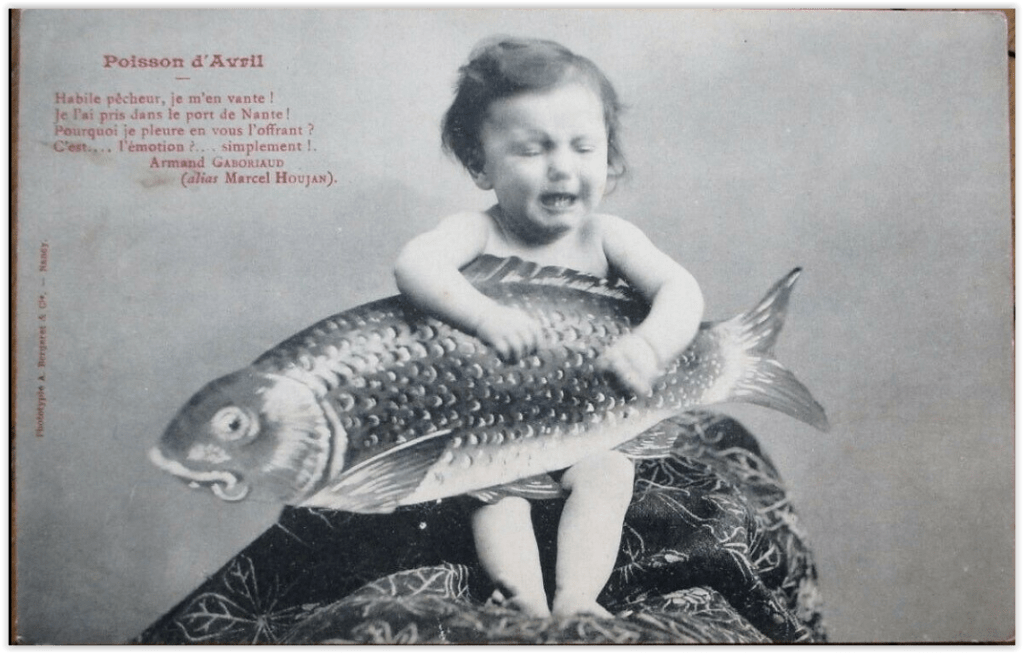
    But their main talent, and main activity in postcards, is one they take up almost upon biorth.  They cry, especially at night.

    In fact, the cartoonists suggest, with some justice, that the majority of babies do NOT cry, so much as they scream.

    And being unable to explain what’s wrong or comprehend the finer points of the pity of being alive in the first place, just about anything will set them off.

    Sometimes it is actually nothing at all.  They just feel like developing their lungs, no matter what Mom or Pop try to stop the sirens.

    Fortunately, they are SO cute when they finally fall asleep that people can’t help but forgive them, even when, as in this postcard on Married Life, the baby only starts to behave when Dad comes home from work, belying his mother’s exhaustion.  (The poem, if you can’t read it or don’t feel like bothering, suggests that if more unmarried women could know the headache of listening to a baby scream all day, there’d be a LOT fewer married women.)

    In fact, the wailing baby, like the puddling dog and fence-perched cat, was so much a standard of postcards that when one wanted to just register unhappiness, they were the best recourse.  (And now we’re back to that column on “Why Don’t You Write?”)

Cats Do These Things

    Once upon a time, when I was in college, I listened in admiration to an earnest conversation between a couple of young women on the differences between kitties, cats, and kittycats.  I don’t remember all of the points discussed, but I should like to make the point that postcards of kittens are a whole different matter than postcards of cats.  Kittens do essentially one thing on postcards: they are actively cute.  No, don’t try to confuse me with postcards of kittens sleeping: they know what they’re doing, and they’re still being actively cute.

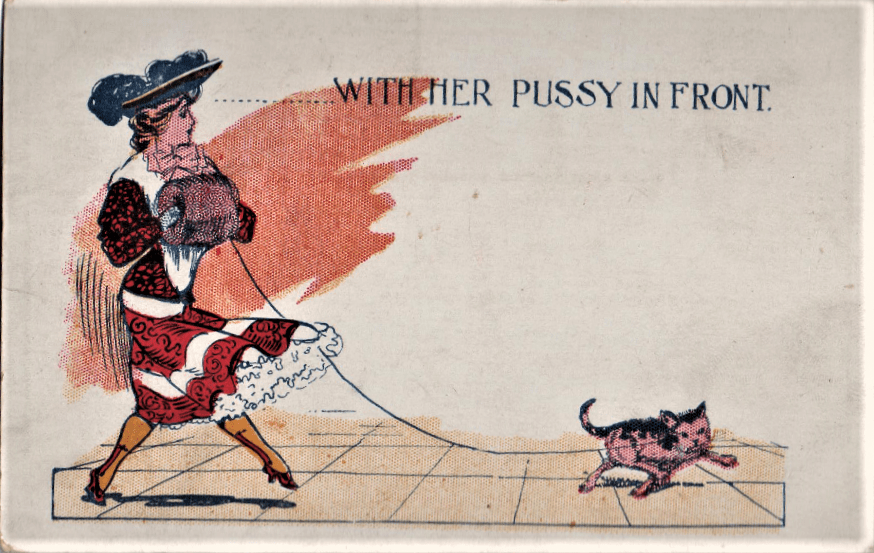
    Like dogs, cats have a modest range of activities.  They suddenly turn up with a bunch of kittens (I would show you one of the many postcards where Mamma Cat is telling the passing tom “You told me we were just going to wrestle”, but I’;m saving that for my dissertation: every postcard company in the world seems to have used this gag as a filler), and they menace mice (the mouse gets the punchline, but what happens next is left to our imagination.)  Postcards like the one at the top of this column  pay tribute to the cat’s reputation as a hunter, in the wild

    Or on the domestic front.

    But the main activity of the cat, when a postcard cartoonist took up the feline subject, was sitting on fences.  It wasn’t so much the sitting on fences which attracted so much attention as the noises they made while on the fence, whether they were just calling out a mating song.

    Or dealing with the results of the call.

    Or disputing territory with some other tom who wanted to use that fence for the same purpose.

    (Our ancestors, who, as I noted, lived more often with open windows than we do, knew that cat romance and cat fights could be hard to tell apart, and commented on this as well.)

    It all probably dates back to an era when everybody with a yard had a garden, as well as a few chickens, with possibly a goat or a pig or two.  We have gradually moved away from this kind of domestic agriculture, and any kind of fence is a rare thing.  Where we have fences, they are more often the metal variety: a chain link fence largely unsuitable for sitting (maybe that was one of the reasons they caught on: they discouraged cat concerts.)  And people are less likely to let their cats wander at night: the invention of kitty litter meant that keeping your cat indoors wasn’t such a risky proposition.  Pet owners who have the foresight to neuter and spay have also cut back on the urgent need of cats to get out and prowl by night.

    But once upon a time, it was even more automatic on the postcard than Dog Equals Fire Hydrant, that Cat Equals Fence.  It was simply the way the world worked.

Dogs Do These Things

    Animals played a big part in the world of postcards.  In an earlier era, when the only real air conditioning available at night was an open window, a light sleeper could be acutely aware of the dogs and cats which roamed the streets at night, and the chickens your neighbior kept in the back yard (especially whenever that rooster decided to let everyone know he was around.)  During the day, mice and rats could be a fact of life unless one had a resident exterminator, which many people did.  So dogs and cats wandered in and out of your line of vision.  Dogs were frequent stars of postcards which featured their good habits and bad.  They would scrounge food

    Wherever they found it

    They were bold guardians of houses

    Or not

    And, in any case, puppies were always up to something worth noticing.  (We did not INVENT the phrase “Awwww, how cuuuute!”)

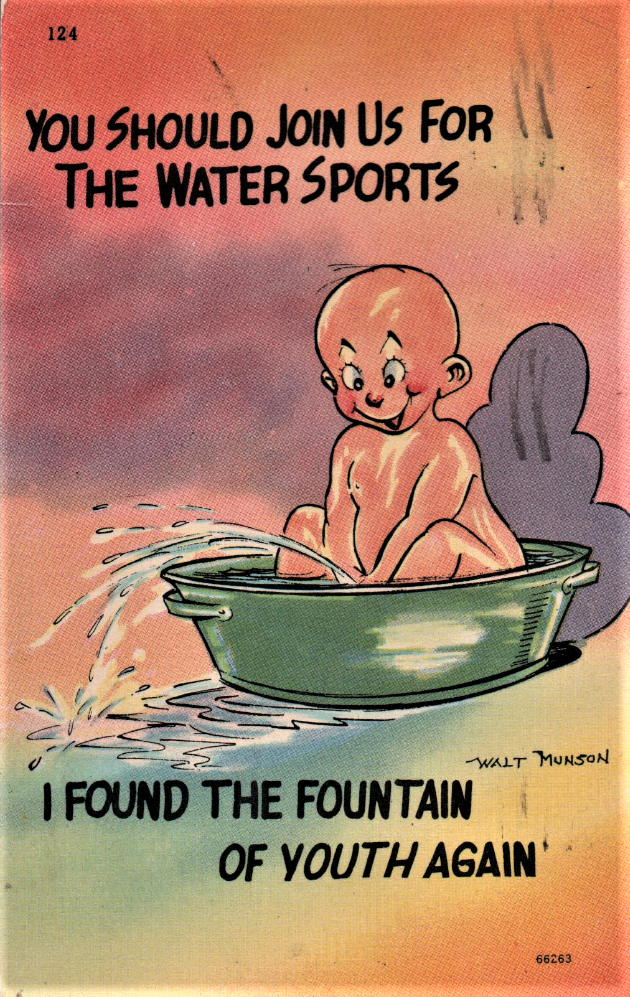
    But the comic postcard focused on one particular dog activity which was inescapable and represented in far more media than just the postcard.  I wonder if there wasn’t just a little jealousy on the part of the humans who, after all, did the same sort of thing but had to leave the room.

    In the big city, of course, the fire hydrant was the usual target

    But any public pole was a possibility

    The big city was filled with possibilities, and no dog, postcard or otherwise, wanted to miss any.

    Dogs had their own way of passing along information on which were the best poles.  (This isn’t it.)

    The bigger the city, the more dogs would be passing along the message.

    But in the country, of course, dogs had just as much opportunity, and even more variety.  (There are at least three different postcards with different dogs using this caption, which plays with a slogan of the Brown & Williamson Tobacco Company in the 1940s: “Does Your Tobacco taste Different Lately?”.  This is NOT what they meant, and, anyhow, they didn’t make cigarettes.)

    Although trees were the most common targets.

    The point, though, was that a dog would take advantage of any place or situation which seemed interesting, to the point where a number of puppy dogs complained that they’d get the blame for just any stray puddle found around the house.  (Benny Hill recited a brief but brilliant poem on the subject.)

    It’s a pity the noble dog should be memorialized quite so much for this perfectly natural activity, but it could be worse.  There was, after all, another dog activity very popular in mid-century postcards but, as this poodle might suggest, let’s keep out of it

Back to You

    This week we have considered the postcards which were published so that you could nag your friends to write to you as well as those cards which were printed to apologize for not having written.  Because sending postcards came as naturally to those generations as texting and tweeting does to us, there was a multitude of sentiments which could be expressed, including those which apologized for sending a postcard so late, or sending one with such a short message, or even sending a postcard at all.

    A postcard was considered a token of regard and a realization that one is late with a letter, but one had to admit that a postcard was NOT as good as a nice, long letter.

    Unless you had perfectly precise 3-point penmanship, there wasn’t room for a whole lot of news

    Although it WAS something

    You could excuse yourself for interrupting the recipient’s life with such a short message by saying there isn’t much news

    But that you thought a message might be welcome

    The postcard was often written quickly, often in pencil (much quicker in the days before ballpoint), and even THAT could be apologized for

     And while in a self-deprecating mode, apologizing for being so late in writing, you could make amends by squeezing in another butt joke.

    The postcard was meant to patch up any break in communications, to reassure the recipient that you did care even if you were sometimes slow to write, AND, sometimes blatantly, that they could stop NAGGING you about it now.