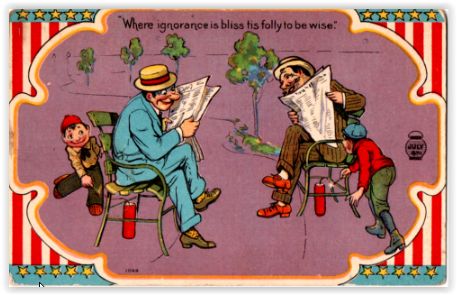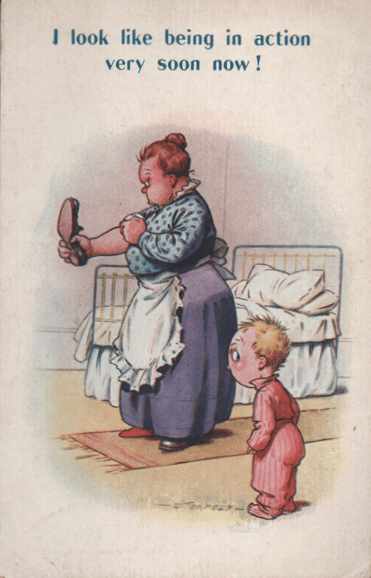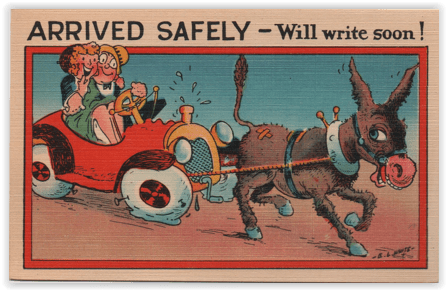
Well, actually, we have discussed him in this space ere this, so this is probably fourth of fifth upon a time. Anyhoo, once there was an artist named Walter Wellman, who made his mark in the postcard world, producing hundreds of cartoons for the enjoyment of postcard buyers, many of which he published himself, being somewhat of an independent soul and, besides, someone who wanted the majority of the profit to come to him, and not to some sorporate entity which in general didn’t allow the artists to put their names on the pictures they worked so hard to produce. (George Salter led a campaign among artists who did covers for paperback books to allow them to sign their work; I haven’t heard if there was a similar protest leader for postcard cartoonists.)
Wellman did his work for over thirty years, and his work covers the foibles of mankind extensively, and gave plenty of material for collectors in many areas. But one subject he worked with extensively was the American woman, and the clothing thereof.
He began in the era of big hats and big hair, as seen at the top of this column, and, as mentioned hereintofore, used an impossibly pompadoured young woman as his trademark, putting her on the address side of the postcards he published. This was in an era of fashion now largely ignored by students of pop culture, who see the world jumping from bustles and multiple petticoats to bobbed hair and short skirts, completely ignoring the idiosyncratic silhouette favored at the beginning of the twentieth century.
It was a sort of Art Nouveau figure, less adorned than the full Victorian habitude.
Until the lady turned sideways, of course. We have discussed Walter Wellman’s look at the bosoms of the 1910 era before. But to refresh your memory, you’re looking at fabric here. The bodice of the period called for a great deal of extra cloth which draped low, looser than the high-corseted form of the previous generation. Walter thought this was hilarious.
Though his ladies could dress in a tighter, more formal style as well.
Have I mentioned his sense of humor before this? Look closely. The lady has an arm around the finial of the gatepost and is not nearly as outgoing as she seems.
Let’s go to the beach to discuss the passing of years. Here is one of Walter’s bathing beauties around 1909.
And here we have moved into the Roaring Twenties, when women could dress in abbreviated clothing more appropriate to sporting pursuits. (Though they now aspired to a boyish silhouette even more slender than that of the belle of 1910.)
Walter was completely comfortable with the freer fashions, even if his male characters were sometimes stymied.
He completely reinvented his heroine as the 1930s came on, combining the more abbreviated costume with a return to curves. In fact, Walter took alarmingly to curves, finding them as entertaining as he had the dangling bosoms of the fashions of the earlier period.
His ladies, once so much taller than their prospective mates, were now more likely just wider.
And they knew what they wanted.
Postcard artists are hard to document, and I can’t find out exactly how long Walter Wellman produced his fashionable ladies, among all his other postcards. He may have done some work, as years went by, for companies that removed his indecipherable signature, which makes it more difficult. But he WAS still going strong during World War II.
As were the ladies, joining in the vengeful Axis-bashing.
If I learn more about Walter Wellman and whether his work was published on into the Fifties or whether he inspired imitators who did his kind of work when he himself was gone, I will let you know. But I’m sure we can all agree that his heroines, however they wore their hair and stockings, never came to an end.
I’m glad this isn’t one of those online influencer blogs, which prompts thousands of contradictions each day whenever I write something. But enough people have pointed out to me that THEIR grocery stores still stock the classic frozen orange juice with metal ends on the can, just waiting to be purchased and put in the freezer so it can dent the toes of unwary Americans. Serves me right for checking my facts on the Interwebs instead of just walking over to the convenience store. And, anyway, I keep telling you this is not a food blog.
But while we’re on the subject, I don’t suppose anyone knows where I can buy Hi-C in metal cans. That always used to be the great attraction for us: the beverage was just colder coming out of a metal container, somehow. I have gone into this at some length, and find I can still buy Hi-C in completely different flavors and containers than the ones I knew in olden days. My childhood, which was back in the days before Covid, came before the controversies concerning Lavaburst orange or Ecto-Cooler (both of which caused great anguish when they were axed by unfeeling executives.) So it’s not about THAT. It’s just…well, since I haven’t drunk any of the stuff in a couple of decades, I could go on without it, I suppose. I can also go on, I suppose, without Choo-Choo Cherry drink mixes, or Sir Reginald Lime-Lime beverage powder, or even Diet Coke with Lime.
But I do still quest, now and again, for an analog to Roma Pizza, a frozen pizza I ate a great deal of in the days when pizza was still a mild novelty in any form, and frozen pizza was the only way most of us could experience it. Roma made a thin crust pizza which took, oh, twelve minutes to cook in an average Midwestern oven. It probably formed my adult judgment of pizza, which involves great quantities of cheese and sausage, in that order. Besides the flavor, which was salty and greasy and unique, it featured several aspects lacking in modern frozen pizza which were of great interest to a discerning diner whose age had only recently moved into two digits. The cheese was pure white. Not yellow, not golden-brown: it was pure white unless you left it in the oven too long, whereupon it would start turning black. It WOULD, if allowed to cool long enough after cooking, turn slightly green, but I deduced after some examination that this was the grease from the thick round wafers of sausage. Who knows what other discoveries I might have made in food science had the makers not decided, under the pressure from newer brands of frozen pizza on the market, to change the recipe? The new Roma Pizza would turn golden brown, and the pools of green grease disappeared. And it never tasted the same ever again. I seek solid white slightly plastic cheese on my pizza to this day (and DID succeed for one year in a college cafeteria in Milwaukee. Did NOT think to ask for their secrets, and they would probably deny it all now. Oddly, this is also the only place I ever had roast Cornish hen.)
There are other taste sensations from that distant century that I miss. Mr. Salty and his pretzels disappeared long ago (and the thin twists which were standard seem to have been replaced by mini-twists, pretzels rods, filled pretzel bites, and other variations. Yes, I know: a few companies still make the classic, but I regard it as an endangered species.) It was a great moment for me each spring when I could buy my first pack of baseball cards and find that unique pink wafer of bubblegum. (I actually set aside the very first one each year, dated it, and put it with my collection. There is an artist who went further and actually created art works by drawing on the brittle pink canvas. Is he still around? And where does he get his supply now that cards do not soil their collectability by including food products? Do grandparents have to explain Lucy’s joke about Beethoven not being on bubblegum cards? Do you understand, you food executives, how you disturb our culture at its very roots when you make these decisions?) And if you want to discuss candy bars, which….
But we are out of space and this isn’t a food blog. And, anyway, I’m getting hungry.
The pioneer floriographers, including Mme. De Latour, leaned more toward “Beauty” for the Rose. “Love” may have originated in Frances S. Osgood’s second book. (She has “Beauty” in the first.) But the twentieth century floriographers really took to it, and gave it precedence, though many list “Beauty” as a second choice. This may all be a result of the custom of giving red roses to your Love.
When it comes to roses, flower language is a little redundant anyhow. Rose-growers have a language all their own as it is. Such people seem so normal at first meeting…if you meet them outside the garden, that is. They are the reason some flower language books go crazy in the number of roses they list. And there are flower language guides which handle ONLY roses, leaving all other plants out of the dictionary.
As you might suspect, if you’ve read this far through the book, some of the roses listed below are actually roses, and some are not. People sometimes just felt like calling a flower a rose whether it belonged to the genus Rosa or not. In defiance of every botanical guide I have seen, then, I am listing them all under “Rose”. Bushels of floriographers list Red Rose under R and Yellow Rose under Y, but it’s my library training, I guess. I find that kind of system hard to follow. So you will find them all below, the generic uses of “rose” first and then the varieties after. Please don’t write in to complain. I just don’t care any more.
ROSES, CROWN OF “Merit”
George H. O’Neill, however, says this sort of crown is for women only. Men are supposed to earn a crown of Laurel. George H. O’Neill is the only floriographer who gets picky about this.
ROSE, FULL-BLOWN, PLACED OVER TWO ROSEBUDS “Secrecy”
ROSE LEAF “I Never Importune”*
In the mysterious Orient, where people speak in riddles, or so I keep getting told, a great thinker once travelled miles to a secluded monastery where he could study at the feet of a master and become an even greater thinker. Alas, the master had all the students his monastery could hold. He handed the newcomer a glass of water so full that not one drop could be added.
The visitor didn’t want to be pushy about it. (He did not want to importune, see?) But he reached over to a rose that was in a vase on the master’s desk, plucked a leaf from it, and floated it on top of the water, showing that there is always room for one more. The master was so impressed that he relented, and took on the new student.
(I have it on no authority whatsoever that one of the other students whispered, “This will never work,. They’ve done nothing but argue since they met.”)
ROSE, FADED “Beauty if Fleeting”
*ROSE PETALS, CRUSHED “Iniquity”
ROSE, SINGLE “Simplicity”*
This refers specifically to a rose that grew with one blossom per stem, rather than several. When referring to what Dorothy Parker called “One perfect Rose”, floriographers used the phrase “Unique Rose”.
*ROSE STEM “No”
*ROSES, TWO ENTWINED TO FORM A SINGLE STEM “Upcoming Marriage, or Engagement”
ROSE, UNIQUE “Call me Not Beautiful”
“What does one rose mean when it’s dipped in bronze, steel-tipped, and shot at you?” Willy, Willy ‘n’ Ethel, Sept. 27, 1989.
ROSE IN A TUFT OF GRASS “There is Everything To Be Gained By Good Company”*
This is one of those improving stories they may have skipped telling you in school. See, these two scholars walk into a bar. A peasant asks if he can sit with them, and maybe learn something. They tell him he probably couldn’t keep up with their conversation and they don’t want to waste a lot of time explaining things.
The peasant goes back to his own seat, but he asked the bartender to take them a little bouquet he’d made up of a tuft of grass and a rose. This roused their curiosity, and they ask him over to tell them what it’s supposed to mean. He replied “As the grass, though a common plant,
is scented through its association with the rose, so I had hoped to be improved by associating with you.”
They were so impressed by this that they invited them to dine with him, and even let him pick up the tab.
TYPES OF ROSES
*ROSE, AMERICAN BEAUTY “Intended Visit”
George H. O’Neill really went into all kinds of floral messages with which you could conduct your social life, different ways of saying “I am coming to see you”, “Can I come and see you?” or “Why don’t you come up and see me some time?”
ROSE, AUSTRIAN “Thou Art All That is Lovely”
ROSE, BRIDAL “Happy Love”
ROSE, BURGUNDY “Unconscious Beauty”
ROSE, CABBAGE “Ambassador of Love”
This, according to J. Ramsbottom, a rose fanatic, is also the Provins Rose, or Provence Rose, the most common rose in literature and/or poetry. King Midas, he says, grew Cabbage Roses. Claire Powell notes that the first one sprang from the tears of Lycurgus. There seem to have been several Greek heroes named Lycurgus, and I have been unable to determine which one wept roses. You’d think people would have noticed.
ROSE, CAROLINA “Love is Dangerous”
*ROSE, CHARLES LE FIEVREEE “Speak Low if You Speak of Love”
*ROSE, CHEROKEE “Indian Love Song”
I think they’re just kidding around with this meaning, really. As a matter of fact, this rose was well known in Europe long before the Cherokee people had been heard of. So why is it called the Cherokee Rose? ONE explanation can be found in Modern Eloquence, one of those massive sets of books which were foisted off on libraries at the turn of the last century, containing chunks of great literature and other prose and poetry. It has a quaint little story about the origin of the name of this rose in Volume 10. But you don’t NEED to know it, do you? All about the Seminole maid who fell in love with a Cherokee captured by her father, and how she eloped with him and went to his people carrying this rose as an emblem of her place among this other nation? I didn’t think you did.
I was more interested in another little story in the set, perhaps a little less alarming when people had cleaner minds. It seems the young man was wondering why man was created before woman, instead of both being created at once, whereupon the young lady replied “Was it not natural for the stem to come before the flower?”
ROSE, CHINA “Beauty Ever New”
The China Rose has also been called the Monthly Rose. Until the late eighteenth century, Europeans had to make do with roses which bloomed just once a year. Then these roses were imported from the Orient, and their habit of blooming more often made them a smash hit.
*ROSE, CHINA, DARK “Forsaken”
ROSE, CHRISTMAS “Relieve My Anxiety”
This is also Hellebore, but Christmas Rose sounds so much nicer, it gets a nicer meaning.
*ROSE, CORAL ‘Desire”
ROSE, DAILY “Thy Smile I Aspire To”
I don’t know for certain whether there is a variety of rose known as the Daily Rose, or if this just refers to you bringing someone a rose every day.
ROSE, DAMASK “Brilliant Complexion”
To have a damask complexion was once the ambition of every young lady, and what with all the research connecting sun tans with skin cancer, it probably will be again.
There is some argument about whether the Damask in Damask Rose refers to the city of Damascus. I expect people with damask tablecloths face the same thing.
ROSE, DOG “Pleasure and Pain”
Some people give this meaning to all roses, covering the beauty and aroma of the rose versus the stabbing of the thorns. The Lehners go on to add some other, similar pairs: “Hope and Fear” as well as “Love and Poetry”.
Speaking of pleasure and pain, it was once considered the height of luxury to scatter rose petals everywhere at a party. One Roman emperor filled his banquet hall with them, to the extent that he smothered all his guests. He enjoyed this so much that he added it to his permanent repertoire of party tricks.
*ROSE, FRENCH “Be Elsewhere”
You might consider going to the Isle of Rhodes, which is named for roses, or possibly Rhode Island, which is named for the Isle of Rhodes.
ROSE, GLOIRE DE DIJON “Messenger of Love”
ROSE, GUELDER “Winter, Age”
This is also known as the Snowball, from its looks as well as for when it blooms, which is also where it gets its meaning.
ROSE, HUNDRED-LEAVED “Graces”*
One expert sniffs a little over this, saying that it is, after all, only a Cabbage Rose. Another claims a less graceful rose it would be hard to find. I say if Mme. De Latour thought it was graceful, what business is it of theirs?
Rose, Inermis: see ROSE, THORNLESS
ROSE, JAPAN “Beauty Is Your Only Attraction”
The floriographers didn’t think this flower smelled very interesting, making it the symbol of good-looking people who lacked accomplishments. Do not confuse it, please, with the Camellia, which is sometimes called a Japan rose. The floriographers did know the difference, and made it clear this meaning applied only to the Japan Rose, NOT the “Japan Rose”. So there, too.
ROSE, JOHN HOPPER “Encouragement”
ROSE, LA FRANCE “Meet Me By Moonlight”
Thomas Christopher, an expert on what are known as Old Roses, defines the Old, or Antique, Rose as any rose that was cultivated before 1867, when the first hybrid tea rose, the La France Rose, was bred.
ROSE, LANCASTER “Union:
See also ROSE, YORK AND LANCASTER
ROSE, MAIDEN’S BLUSH “If You Do Love Me, You Will Find It Out”
The maiden is blushing, see, because she is too modest a girl to come right out and TELL him that he is in love with her. But she is getting a little tired of waiting around for HIM to say so.
According to Anne Raver in the New York Times, the name of one rose of this type was originally La Cuisee de la Nymphe Emu, or Thigh of the Aroused Nymph. This made too many people blush, so the name became the Great Maiden’s Rose.
ROSE, MAY “Precocity”
In the days when roses bloomed just once a year, June was the month for roses. Any rose that bloomed before that was obviously precocious.
Rose, Monthly: see ROSE, CHINA
ROSE, MOSS “Superior Merit”
E.W. Wirt came up with this, and Sarah Josepha Hale passed it along, completely bypassing Mme. De Latour’s original meaning, “Voluptuous love”. Lucy Moore put “Voluptuous Love” in HER list, but it didn’t catch on. The floriographers didn’t want to discuss it.
ROSE, MULTIFLORA “Grace”
This is also the Bramble-Flowered China Rose, How graceful is THAT?
In the 1930s, this rose was promoted by the government as a good plant to have on your farm, to provide shelter for wildlife and prevent erosion. This worked, the rose spreading so efficiently that in several states it is now classed as a noxious weed.
ROSE MUNDI or RASOMUNDI “Variety”
J. Ramsbottom claims this is the same as the French, or Garden, Rise. Others say it is a separate multicolored variety of French Rose.
ROSE, MUSK “Capricious Beauty”*
This is another plant that doesn’t bother to bloom in some years. J. Ramsbottom calls it the very favorite rose of the Elizabethans, and the rose Shakespeare liked to go on about.
ROSE, MUSK, CLUSTER OF “Charming”
*ROSES, NEU “You Are Paying Attention, Aren’t You?”
ROSE, NEPHITOS “Infatuation”
*ROSE, PERPETUAL “Mine through Sunshine, Storms, and Snows”
Now, you just know she made that up to rhyme with “Rose”.
The book which mentions the Perpetual Rose (would that be the China Rose under an alias?) is Written For You, or The Art of Beautiful Living, compiled by Marta L. Rayne in Detroit in 1884. It attempts to give you the data you need in life: what books you ought to read, how to avoid drowning, why it is best to marry for love, and what to do if your son starts smoking or using slang. How have you lived this long without it?
ROSE, PINK “Your Love is Perfect Happiness”
Here’s what you do, according to John Ingram. On Midsummer Eve, you walk backward out to the garden without saying a word. Pick a rose, place it in white paper, and set it away until Christmas. Do NOT open the paper before Christmas, as this will break the spell. On Christmas Day, take it out of the paper: it will be as fresh as the day you plucked it. Place this in your bosom. The person who picks it out is your destined spouse. (I should jolly well hope so.)
*ROSE, PINK, LIGHT “Grace, Gentility”
*ROSE, PINK, DARK “Thank You”
ROSE, POMPON “Genteel, Pretty”
“He who would grow beautiful roses in his garden must have beautiful roses in his heart.” Stephen R. Hole, A Book About Roses
*ROSE, PROVENCE “My Heart Is In Flames”
Rose, Red: see ROSE
Most floriographers, when discussing the basic Rose, gave it the same sentiments as a Red Rose. Admit it, when you think of roses, you automatically think of the red ones.
ROSE, RED, DEEP “Bashful Shame”
In Europe, it says here, you should always present roses unwrapped, and preferably in odd numbers, say five or seven. But you cannot give them to just anybody, as they are exchanged only between lovers. So don’t bring them to your hostess if you’re only coming for supper.
George H. O’Neill says that if a gentleman wishes to accept a lady’s invitation, he should send a red rose with nutmeg geranium leaves. But if a lady is accepting a gentleman’s invitation, she must send red rose petals with plain geranium leaves. Just tossing someone your front door key may bypass all this leaf plucking.
ROSE, RED-LEAVED “Beauty and prosperity”
Rose, Rock: see CISTUS
*ROSE, SENSITIVE “Too Young To Leave My Mother Yet”
This comes from Marta Rayne again. The flower language in her book, by the way, is not listed in the table of the contents, but only on the cover. You’ll need to flip to the back of the book and find it for yourself.
ROSE, SWEETBRIAR “Poetry”
This is the consensus, though various books create all kinds of complications with the Eglantine, the American Sweetbrier, the European Sweetbrier, and so on. (Floriographers who distinguish between the American and the European versions apply “Simplicity” to the first and “I Wound to Heal” to the second. The choice between “brier” and “briar” seems to be a matter of personal taste.) John Ingram and Claire Powell agree that the “Poetry” meaning comes from the days of Greek poetry competitions, at which a silver eglantine was awarded as first prize.
ROSE, SWEETBRIAR, YELLOW “Decrease of Love”
Elizabeth W. Wirt specifies that this decrease of love is caused by “better acquaintance”. You know: that point at which your sweetheart’s cute little mannerisms becoming annoying habits.
ROSE, THORNLESS “Ingratitude”
According to a legend, which Elizabeth W. Wirt traces back to a romantic tale called “The Leper of Aost” by Lemaitre, roses never had thorns until people started growing it in gardens. The rose was apparently ungrateful for their attentions. I’m not sure why, in that case, floriographers take it out on the thornless variety, but life’s not fair.
ROSE, WHITE “Silence”
Although a large contingent prefer the meaning “I Am Worthy Of You”, the vast majority associate the white rose with the rose in “sub rosa”, or “under the rose”. Some ancient ruler—each version picks a different one—had a big rose painted on the ceiling of his council chamber. Everything said there would be kept secret: nobody would ever repeat a word of it outside the chamber. What I mean to indicate is that they would be SILENT about anything discussed under the rose. To this day, when you are confiding in someone, you say you are hoping to tell this “sub rosa”.
And why did this monarch choose a rose? Well, it seems Cupid was up to some rascality or other, and bribed Harpocrates, the God of Silence, to keep quiet about it by giving him a white rose. I don’t know how you feel about it, but, I regard this as one of the more ridiculous stories they’ve fed me. If Harpocrates was the God of Silence, how come he had to be bribed to keep silent? And how come the ancients had a God of Silence anyhow? And why did they give him a name so much like Harpo Marx’s?
ROSE, WHITE, DRIED “Death is preferable to Loss of Innocence”
ROSE, WHITE, WITHERED “Transient Impressions”
ROSE, WHITE, TIED TO A RED ROSE “Unity”
Mme. De Latour preferred “Fire of the Heart” for this combination: the white rose showed how pale you were from yearning while the red one showed how fiery was your passion. British floriographers, however, replaced this with “Unity” from considerations of history. See ROSE, YORK AND LANCASTER
ROSE, WILD “Simplicity”
ROSE, YELLOW “Infidelity”*
Popular minority meanings include “Jealousy” and “Decay of Love”. All three come from the tale of the prophet Mohammed, and his doubts about his second wife. Ann Landers and Dear Abby not being available, he consulted the archangel Gabriel. Gabriel recommended he take the roses his wife had given him that morning and toss them into the river. They were red roses, but when they hit the water they turned yellow, confirming the prophet’s suspicions that his wife was unfaithful.
ROSE, YORK AND LANCASTER “War”
Once upon a time in England, a pair of families argued about which had a better right to the family inheritance which, in this case, was the throne of England. The family tree here is a bit complex, so it’s best to do as the average schoolchild does, and remember them as the Yorks and the Lancasters. Each side took a rose as its symbol: the Yorks a white one, the Lancasters a red. And so this family squabble is known to this day as The Wars of the Roses.
The wars didn’t really end until just about every family member of each side had been killed. Henry Tudor, a kind of illegitimate connection of the Lancasters, married a plump good-looking princess, Elizabeth of York. This joining of the roses is regarded as one of the most romantic ending of any war in history. King Henry consolidated his victory by knocking off most of the remaining Yorks, and then made his place in history secure by becoming the father of Henry VIII, which set up a whole nother ball game.
Anyhow, this all feeds into the meanings for this rose, the Lancaster Rose, the White and Red Rose Tied Together, and so on. Beats me why the Tudor Rose doesn’t get a look in, but so it goes.
There are graphic artists whose work is designed to hang on the wall, and there are artists whose work tends in other directions. Some artists find their niche in comic strips while others find it in magazine covers. Some illustrate books and some customize cars. There are artists known for skulls etched on people’s arms and others who do portraits on paper money.
And some artists have careers which are for the birds. For some of these artists, like the anonymous artist above, considered in a previous blog, was known for his roosters. Others painted birds which flew higher but which perched briefly on postcards.
They didn’t even HAVE postcards in the days when America’s most famous birdman, John James Audubon, was pursuing a career in nature paintings. But his paintings and prints, intended for the world of frames on walls, were just the right proportion for reproduction on postcards a hundred years after the death of the artist. (The Bohemian Chatterer is now known more widely as the Bohemian Waxwing, by the way. Buy this one for your Bohemian girlfriend and you may hear a lot.)
As significant to American birdlore in the twentieth century as Audubon was in the nineteenth, Rioger Tory Peterson worked his way through art school painting furniture. He combined his studies with an interest in birdwatching and what ust have been a massive flurry of painting and in 1934 invented the natural field guide, a small volume of silhouettes and paintings which made it possible to answer the question “What IS that thing in the oak tree?” Postcards were a mere sideline to all this activity which, among other things, saw him nominated for a Nobel Peace Prize. (According to the Interwebs, anyhow. I find this hard to figure, myself, but hey, other birdbrains…let’s move on.)
Postcards were, however, a major move for the National Wildlife Federation, a private organization pushed into existence by Jay N. “Ding” Darling when he found he couldn’t nag Congress into doing anything much. (Darling’s bird paintings ornamented the annual duck stamps for many years; I have not found any postcards by him, however.) Once it was founded, like any intelligent not=-for-profit, the society’s mind turned to fund raising. Not long after it began to exist, it began producing wildlife postcards.
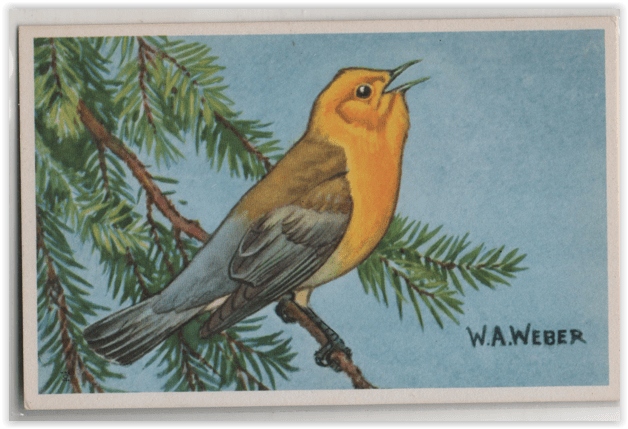
Walter A. Weber was an artist whose use of color made him a natural for these postcards (as well as the annual National Wildlife stamps). Weber was not as much of a bird specialist, as his wildcat paintings and paintings of various dog breeds for National Geographic also had wide popularity. Some of his popular later work included eagles for the Apollo missions and U.S. Mint.
The NWF postcards were also a natural for the paintings of Lynn Bogue Hunt, best known for his covers on Field & Stream magazine. His work also graced at least one of the federal duck stamps, and could be found in limited edition books like “Grouse Feathers”, a volume for “brush worn partridge hunters” which will now run you a couple hundred.
(See, some people are squeamish about this, but a lot of conservation work is done by and on behalf of people who want to conserve wildlife for rifle and rod. It’s a perennial question: who gets more joy from wildlife: the person who gets up at three to sit in cold water in hopes of shooting a duck or the person who orders Peking Duck Pizza at the Peter Piper’s Pizza palace? But that’s a whole nother blog, not to mention a whole nother blogger.)
There are plenty of other bird artists whose work on postcards we haven’t hit yet (some folks did nothing but owl paintings for postcards.) But let’s finish with a realistic bird painter, whose ducks pleased a whole generation and never even saw a shotgun.
I wonder, every now and then when I have finished wondering if we will ever own cars as energy-efficient as Fred Flintstone’s, how much longer television will continue. My television provider (remember when you used to just turn on the set?) has let me know I can renew service at a higher price OR stream everything they have onto my phone or computer. I realized that I tend to watch only when going to bed at night or getting up in the morning. Most of my TV-style entertainment comes from YouTube, where I can summon up what I want to see without worrying about schedules.
One of the things I watch regularly are videos about what parts of our society have disappeared and which are about to disappear: important stuff like typewriter erasers and rotary phones. They’re kind of cute, since they are put together by beings thirty years younger than I, so some of the phenomena they observe are things I never heard of in the first place. But this sort of discussion always makes me wonder about the things which didn’t make their list.
For example, I recently discussed groceries with someone older than I am (there are two or three of these people left) and she was recalling the shock and trauma which afflicted her, oh, once a week when she would forget to open the freezer carefully. They had the style of fridge which was standard in my years, with the freezer on top. The stuff in the door would shift and that little can of frozen orange juice concentrate would come sailing down to bash her toes.
At our house it was mainly frozen grapefruit juice concentrate, and I was maybe a little quicker to jump out of the way, but I do remember those frozen missiles. But I haven’t browsed the frozen food cases lately and wondered: do they still….
The Interwebs tell me the answer is “Well, kind of.” One or two companies make a container that LOOKS the same, but it is now made of plastic and peels open. Americans prefer the real thing out of a carton or plastic bottle: easier to drink without thawing and mixing it up and probably much more natural (even if the fine print says “Made from concentrate”.)
While I was at it, I looked up airmail stamps, those wildly expensive (ten cents!) devices you licked and put on a letter if it was going overseas or if you wanted it to go really really fast. The U.S. Postal Service suspended this sort of thing in 1977, saying most mail that went a certain distance traveled by air anyhow. Well, kind of. There were still airmail options available right up until 2012, when the USPS stopped it all over, provoking the same complaints from people who collect airmail stamps.
This lack of solid fact is pandemic on the Interwebs. I wondered about my wardrobe in the Sixties, which, on cool days, included zipping myself into a parka. I knew these still existed, but had they all been rebranded as hoodies? A definite answer came from the Ones Who Know These Things: parkas exist. They have linings, see, while hoodies do not. Well and good, until I ran into the store selling lined hoodies for cool winter wear. This world is filled with trouble-makers, marshmallow manicotti.
I take it for granted that drugstores no longer exist (drugs are evil, so these establishments are now called strictly ‘pharmacies’) and postage stamp machines survive only in supervised areas (since the quarter that used to buy you three first class or six ‘vintage’ stamps now wouldn’t buy you enough postage to mail a postcard). And I understand why the current generation will never understand the phrases “ten cent cone” or “penny for a gumball”. I fear for the future of the flashlight (why use something you know you’ll have no batteries for when you need it if you can just use the app on your phone?) and the glove compartment road map.
But there is hope. The car cigarette lighter was reborn as a charging dock for phones, and craft projects requiring pipe cleaners can continue since these are now marketed as straight craft items, bypassing the whole tobacco accessory business.
So bygones don’t HAVE to go by. A few dedicated people with imagination can bring a dying institution to life again. With that in mind, I think I will watch some television during prime time tonight.
If I can remember where I put those cables for my VCR.
This has so many rich flowers that everyone assumes it’s proud.
POLYANTHUS, CRIMSON “The Heart’s Mystery”
Elizabeth W. Wirt calls this the Crimson-Heart Polyanthus, which would explain why the floriographers had hearts on their minds.
POLYANTHUS, LILAC “Confidence”
Confidence is another word which has almost entirely changed its meaning since the floriographers used it. A confidence was a secret, something you only confided to someone you trusted. This person was your confidant. Eventually, the word switched to the feeling you had for that person, and confidence came to mean that trust. We use the original meaning nowadays only when we say “I am telling you this in the strictest confidence”, which most of the people I know translate to mean “You can pass this on to members of your immediate family, your five best friends, and your barber, but that’s ALL.”
*POLYPODIUM “Accord”
POMEGRANATE “Foolishness”*
I think this is because pomegranate seeds have traditionally been considered an aphrodisiac. But Robert Tyas says it stems from the flower, which is beautiful but has no aroma. Claire Powell attributes it to eighteenth century fops who wore pomegranates on their heads to ward off the smell of the people they met. Maybe all these suggestions are a bunch of foolishness.
POMEGRANATE FLOWERS “Elegance”
POPLAR, BLACK “Courage”*
Hercules wore a crown of this when he went down to visit Hades, and the leaves came to represent courage thereby. I have been unable to track down just which of Hercules’s tours led to this symbolism, because he seems to have gone down several times, just because he could. He did, after all, live before the days when a man could prove he was something by posting a video of himself crushing a beer can on his forehead.
POPLAR, WHITE “Time”
These leaves are white on one side and black on the other, representing day and night and, thus, the passage of time. And do you know WHY the leaves are like that? Well, it seems that while Hercules was in Hades (see last entry), his sweat bleached one side of them white while the heat of Hades scorched the other side. Now you know.
POPPY “Consolation”*
This means the consolation of sleep, considered Nature’s Healer, a cure for all ills, and so on. Dorothea Dix reports this meaning, but disapproves of it, though she does not explain what she has against sleep. It may have been because the poppy symbolizes sleep and comfort as a result of being the source of opium, once one of our only anesthetics. People abused it regularly even by Dorothea’s time, and taking drugs as a form of comfort would naturally have seemed foolish to a go-getter like her.
Poppy, California: see ESCHOLZIA
POPPY, RED “Consolation”
POPPY, SCARLET “Fantastic Extravagance”
Obviously the more expensive brand.
John Ingram, by the way, says you should take a poppy petal, set it in your left palm, and smack it with your right fist. If it breaks, your lover if faithful; if not, unfaithful. It seems to me it would work the other way, but Ingram generally knows his stuff.
POPPY, WHITE “Sleep”
POTATO “Beneficence”*
Because, Robert Tyas points out, it is kind to the poor. In his day, there was no cheaper food than potatoes. Roughly ten years after Tyas’s first book, the potato crop in Ireland failed,
and a lot of poor people who had depended on it had to starve or leave the country. Once in a while, the history of the human world is altered by the vegetable one.
POTENTILLA “I Claim, At Least, Your Esteem”
What, exactly, is the benefit of saying “I expect you to admire me, whether you like me or not”? If it’s just a matter of sour grapes, why not send sour grapes and be done with it?
PRIDE OF CHINA “Dissension”
This is also known as Pride of India. To many of our ancestors, any place out east was pretty much the same as any other.
PRIMROSE “Early Youth”
Another of the early bloomers of spring, the primrose collected all kinds of stories and symbolisms. The original primrose is supposed to have grown up from a beautiful boy, son of Priapus and Flora, who died young. In England, it was a symbol of conservative politicians, carried by the followers of William E. Gladstone (Lord Beaconsfield.) When Gladstone fell ill, his followers sent him thousands of primroses, which made it so difficult to breathe in his bedroom that he had no chance of recovery. Let’s all learn something from this.
PRIMROSE, Chinese “Lasting Love”
PRIMROSE, EARLY “Youth”
I suspect this might have been a misprint somewhere along the line for PRIMROSE “Early Youth”.
PRIMROSE, EVENING “Inconstancy”
Catherine Waterman says this is because the flowers don’t last very long. Lesley Gordon, however, says the Evening Primrose disappears from time to time, only to reappear somewhere else in the garden.
This may also be a reference to someone who has been led astray, or “down the primrose path.”
PRIMROSE, RED “Unpatronized Merit”
*PRINCE’S FEATHER “I Am Humiliated” To wear someone’s feather meant you were a fan or a follower of his. The meaning may be a reference to Beau Brummell, a friend of the Prince Regent of England until he ticked the prince off and wound up completely out of the fashionable circles he had once led.
PRIVET “Prohibition”
Hedges and enclosures, blocking the view, are often made of privet.
PUMPKIN “Bulkiness”
*PURPLE FRINGE “Doubtful”
*PUSSYWILLOW “The Future a promise Yet Unrealized”
Another plant that appears early in spring.
*PYRETHRUM “I Am Not Changed; They Wrong Me”
PYRUS JAPONICA “Fairies’ Fire”
The name might seem to refer to the burning flames of a pyre, appropriate to fairies as a fire in the plant kingdom. In fact, “pyrus”: in the name means it’s a member of the Pear family.
*PYXIE “Life is Sweet”
From fairies to pixies: what is this, Children’s Hour? Pyxie is actually short for Pyxidanthera, which sorely needs shortening.
Q
QUAKING GRASS “Agitation”
QUAMOCLIT “Busybody”
Also known as Quammoclet, or simply Busybody, this is a vine, obviously the kind which climbs all over everything.
*QUEEN ANNE’S LACE “Purity In the Blood Cannot Be Obtained Except By the Absence of Desire”
This is what I mean about some of our modern floriographers: no sense of language. The reference to blood is from the little bit of red on the flower, implying that Queen Anne pricked her finger while making lace. No hint which Queen Anne did this, but I like to think it was Anne Boleyn, who is also supposed to be the maid in “The maid was in the parlor, hanging out the clothes” when her nose was snipped off. She seems inclined toward such mishaps.
QUINCE “Temptation”
At some point, Biblical scholars grew worried about the Fruit of the Tree of Knowledge of Good and Evil, or Forbidden Fruit, munched by Eve and Adam. Calling it an apple suddenly
didn’t suit them, and they decided that the fruit must actually have been a Quince. This did not catch on. People prefer apples in their Edens.
Scholars retort that the only reason we believe it was an apple is because some writer in the early days of Roman Christianity confused the fruit in Eden with the very dangerous apples which grew in the garden of the Hesperides, That writer was so popular that the story caught on and we’ve all been wrong ever since.
Some Classical scholars, however, have decided that the fruit in the Garden of the Hesperides cannot have been apples at all, at all. Guess what they really were. That’s right: they were quinces.
I refuse to get involved in this argument in any way. How do you like them quinces?
R
‘RADISH “Coming of Spring”
Ragged Lady: see LOVE-IN-A-MIST
RAGGED ROBIN “Wit”
*RAGWORT “I Am Humble But Proud”
*RAMPIONS “Don’t Misjudge Me”
Once upon a time, a pregnant woman came down with one of those unaccountable cravings. She had to have rampions. She sent her husband out to find some, even though it was the dead of winter and the nearest fresh rampions were probably in the street markets in Istanbul. The bloke went out into the snow and came across a garden where beautiful rampions were growing. He snitched a couple for the wife and was immediately hauled in as a thief by the owner of the garden, who was, naturally, a wicked witch.
He claimed she was misjudging him; he was not a thief but a devoted husband. The witch let him go, but only on his promise to deliver the unborn child to her once it was able to
travel. Once she got the baby in her clutches, she named it Rampions, which, in German, is “Rapunzel”. And maybe you can take the story from there.
RANUNCULUS “You Are Radiant With Charms”*
Some sources distinguish between this, meaning “You Are Radiant With Charms”, and the cultivated Garden Ranunculus, which they say means “You Are Rich in Attractions”. Pshaw.
RANUNCULUS, WILD “Ingratitude”
See also BUTTERCUP, which is a ranunculus.
RASPBERRY “Remorse”
This probably goes back to the Bramble and all those little stickers.
Red Hot Poker: see FLAME FLOWER
RED SHANKS “Patience”
*REDWOOD, CALIFORNIA “Ability”
REED “Music”
Pan invented the Pipes of Pan by making this musical instrument out of Reeds. We will be coming back to Pan presently.
*REED, DRIED “A Shrill, Scolding Voice”
Maybe the author of this one had someone specific in mind.
REED, FLOWERING “Confidence in Heaven”
REED, SPLIT “Indiscretion”*
This goes back to the old story of King Midas. No, the OTHER story of King Midas. He was asked to judge a music contest between Apollo with a lyre and Pan with his pipes, the God of Music versus a demigod of dubious reputation. Midas went and gave the prize to Pan.
Apollo, infuriated that anyone would choose a self-trained amateur over an experienced professional with all the right moves, up and told Midas he was an ass, with the ears of an ass at that. By gum, when Midas reached up to put on his hat and leave, he found these long, fuzzy ears growing out of his head.
Being a king, Midas could afford a bigger hat to cover up this addition to his royal looks,
But of course his barber knew what was there. The barber also knew that if a single word about this reached the gossip columns, Midas would order the barber a haircut right down to the shoulders. (If the king was in a GOOD mood.)
Even in those ancient days, barbers were known for loving to talk. When he was nearly ready to explode with this untold secret, he rushed down to the river, dug a hole in the bank, and shouted into the hole, “King Midas has ass’s ears!” Then he covered up the hole and went back home, very much relieved.
But reeds grew from that hunk of ground (some stories make it bulrushes, so “Indiscretion” is applied as a meaning there, too) and to this day, when the wind blows across a clump of reeds, they whisper “King Midas has ass’s ears”. This is supposed to tell us something about ever being indiscreet with any secrets we happen to know.
By the way, if you go around listening to plants, you are likely to get a fairly strange reputation. Unless your friends are discreet, of course.
*REED, WATER “Unlucky Dealings”
*RENNET “Treason”
RESTHARROW “Obstacle”*
This plant gets its name from the same situation that gives it its name. The plant has tough roots, so tough that when a farmer who is plowing hits it, he has to stop, resting his harrow until he can clear the obstacle.
RHODODENRON “Danger”
Once upon a time, great jungles of this stuff filled gullies and valleys across the North American continent. Most of the early floriographers simply ignored it; it was considered a bothersome weed. Those who did notice it saddled it with meanings like “Distress”, “Beware”, and, most often, “Danger”. Only after about 1876 did it start being planted in American gardens.
The thing is poisonous, as you might have gathered from the meanings. But as long as you don’t munch on the leaves or use them in your hand-rolled cigarettes, you might be okay. “Might” is the best we can do, because you need to take “Loony Honey” into account. I would LOVE to spin a story right here about Loony Honey, the Johnny Appleseed of rhododendron, who planted it across the land, but the real story is more sinister.
Dorothea Dix mentions it in her book, and it has been known since at least 400 B.C. (see the Journal of the American Medical Association, April 1, 1988, page 2009 for further history.) Bees pick up nectar from the rhododendron, see, and produce a honey so potent it has been used as a weapon. This is just the sort of thing that would offend a floriographer: the honey was poisoned not by the hand of man or even by the bees but by the very plant itself. I know how they felt: can’t trust anybody nowadays.
RHUBARB “Advice”
My personal advice is that all you folks who deal in those drab strawberry-rhubarb pies pack it in and turn to rhubarb meringue pies instead. That is the opinion of this author only, and is not endorsed by any floriographers, but it seems like common sense to ME.
As noted heretofore, this is another one of them new years, a time when this column generally looks back to the world of books marking significant anniversaries. I thought I might start with things which are celebrating their fiftieth anniversary, and now I wish I hadn’t. The last thing I really need, when considering a new year full of hope and promise, is to remember that I was looking forward to the same sorts of things fifty years ago, and was old enough then to generate thoughts which are still present in my memory. This suggests I was more than two or three in 1973, which they tell me was fifty years ago. But I will deal with that elsewhere. You want to know about the books.
I noticed right away two books on the list which at least half my classmates picked up and read during 1973. Each was a pioneer in its own way, though the authors, honored in their fields, have seen their reputations continue in odd ways. One was Tim O’Brien’s memoir of the Vietnam War (a.k.a. the War in Viet Nam) If I Die in a Combat Zone, Box Me Up and Ship Me Home, which was banned from a number of school libraries as the decade went on, and won its author mighty praise. The Other was Lois Duncan’s I Know What You Did Last Summer, which set off a new wave of teen thriller novels and movies, few of which really earned a lot of stars from critics. So that’s what folks in my age group wanted: books their elders would disapprove of.
Not quite so popular but still gobbled up by certain of my classmates was the 16-personality heroine Sybil, whose story was told by Flora Schreiber in 1873, while others were fascinated by the grit of a well-thumbed copy of Serpico by Peter Mass. A small number of my adventurous colleagues found their way into Nancy Friday’s My Secret Garden. They must have picked that up at a bookstore, since it would not have been available at the school library. Nor would Jacquelinne Susann’s record-breaking Once is Not Enough (which made her the first author to have three consecutive novels hit #1 on the bestseller list) though this MIGHT have been in the Adults Only cupboard at our public library.
As far as I can recall, my classmates and I had no notion of other disreputable classics of the year 1973: Equus by Peter Shaffer or Gravity’s Rainbow by Thomas Pynchon). Later in life, I knew someone who never traveled anywhere without his copy of Gravity’s Rainbow. He didn’t especially relish flying, but after working his way into the first chapter of that classic he knew he’d be fast asleep. This is not what brought it its fame, but each reader reads a book for themself.
More vital to me personally at the time were the deaths of two authors who did a lot to make me what I am today (whatever that was), Walt Kelly and J.R.R. Tolkien. I had been familiar with Walt Kelly’s Pogo since shortly before birth, but I had only recently finished The Lord of the Rings, which set me off on a quest for more fantasy literature, which was exceedingly rare in those days, as publishers everywhere knew such junk didn’t sell.
This would lead me eventually to a book first published in 1973, William Goldman’s The Princess Bride. Not only is this an amazing and inimitable novel (though people have tried), but I treasure the paperback I picked up in 1974 or thereabouts, which bears along the top of the cover the words “Soon to Be a Major Motion Picture”. The movie, which became a classic as well, appeared in 1987, and I have always wondered what the record is for “Soon” to be a major motion picture.
Other classics appeared in 1973, but these are the works which jumped at my memory. When next we cover this topic, we will move to a year comfortably in the past. (Though 1923 is actually headlined by another disreputable book I read when I was…never mind how old I was in 1973. Far too young to be reading so subversive a tome, I’m sure.)
Now, your old Uncle Blogsy has never been a great one for New Year’s resolutions. I like the concept, and I applaud those who make them. But as making resolutions to do better in the New Year implies that I am not perfect to begin with, I prefer not to participate.
(As for those uncommonly enlightened souls who cry out that they hate New Year’s resolutions because there is no reason to wait for a special day to resolve to change things, I wish you the very best success with your resolutions of October 27 or May 14, but don’t quite see what the fuss is about. Making New Year’s resolutions doesn’t mean you CAN’T make resolutions any other day, like, say, March 18th, when you swear never to chug that much Guinness right after all that corned beef and cabbage or July 7th, when you resolve to make sure your bathing suit is secure before jumping off the high dive, or maybe on February 15th, when you swear you will check the first name of your beloved before mailing that…where were we?)
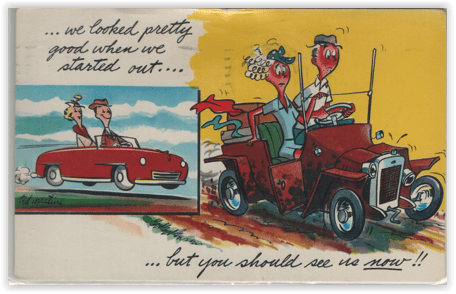
Anyway, New Year’s or not, postcards have always been willing to urge you on to self-improvement, whether they were dead serious, like the one at the top of the column or done for the sake of the joke, like the following.
(By the way, was our language able to support the reading :Never get tight, said the NOT”? Or is that a twenty-first century idiom?). Other admonitions came from the writings of experts (defined, then as now, as “anyone whose remark I like”) It was an era that believed in the power of positive thinking, even before that phrase was invented.
In fact, it may surprise you to find so many life counsellors, in an age when urgent effort and keeping your nose constantly to the grindstone were considered the only ways to success, went around suggesting that you could go too far that way.
Resolutions frequently involve swearing off bad habits. Some of our ancestors’ heroes picked out bad habits you might not expect. (Fra Elbertus was a nickname of Elbert Hubbard, one of the busiest life counsellors of his day.)
Another common sort of resolution is the one where you vow to get better at something. This kind was just as common in 1910, when this reflection was available on a postcard.
This is not to say that every single bit of advice provided by the benevolent postcard companies is especially useful.
Or even all that explicable. Still, I will say this is the easiest resolution I’ve seen so far this year.
A lot of our early history was concentrated around the Mediterranean, where palm trees are often handy. It became the custom to spread the road with palm fronds if a conqueror was to come that way. To this day, we speak of winners as “taking the palm”, though it has fallen into the category of semi-archaic quaint expressions like “That takes the cake” or “Don’t that beat all!”
PANSY “Thoughts”
As anyone with high school French can tell you, this is simply the Englishification of “Pensée” or “Thought”. It is essentially a violet gone uptown; further refinements on the flower are known as Heart’s Ease and Love-In-Idleness. This has inspired a number of cautionary poems about how Heart’s Ease became Love-In-Idleness. Let’s skip ‘em.
The pansy is also sometimes known as Johnny-Jump-Up, Three-Faces-Under-a-Hood, Cuddle-Me, and Kiss-Me-In-the-Pantry. You can see how these Thoughts were trending.
PANSY, BOUQUET OF SEVERAL “Love”
Particularly, says George O’Neill, on May Day.
*PANSY, WITH A BROKEN FLOWER “Adieu, But Remember Me”
PARSLEY “Feasting”*
The Greeks would wear a bit of parsley when attending a banquet or have a sprig of it placed on their plate before they dined, in the belief that this promoted appetite and inhibited drunkenness. There are still restaurants which place this at the side of your dish, but nowadays that’s just because it’s pretty. The habit really started to die off when the mineral content of parsley started to be played up, and parsley was bought for consumption rather than decoration. Another sign of the fading of the twentieth century.
*PARSLEY WRAPPED AROUND A CARROT “Fecundity”
Josephine Addison came up with this. I haven’t decided yet whether I approve.
PARSLEY, FOOL’S “Silliness”
*PARSNIP “Poison”
Several of my friends feel that way about it.
PASQUE FLOWER “You Are Without Pretension”*
This may SOUND like a compliment, but what it meant originally was “You Have No Claims” or “You can’t even pretend you have any claim on me or my heart”. Pretension became a derogatory term, from people who pretended to be superior.
This meaning occasionally turns up attached to Rose Campion, because the word Mme. De Latour used for Pasque Flower can be translated that way if you aren’t paying attention.
PASSION FLOWER “Religious Superstition”
Several books say this means “Faith” if presented upside-up and “Religious Superstition” only if presented wrong way around. For the most part, however, floriographers used this in a reaction against a romantic tendency to trace all the paraphernalia of the Crucifixion in the flower: this part represented the nails, this the crown of thorns, and so on. Nowadays writers blame this symbolism on the Victorians, but it was already going out of fashion when the floriographers came to sneer at it. Dorothea Dix, writing in 1829, attributed the whole thing to missionaries who preached well before her time.
Patience: see DOCK
PEA “An Appointed Meeting”
*PEA LEAVES “Liberality and Good Living”
PEAPOD “Akin”
“As alike as two peas in a pod”, you see.
PEA, EVERLASTING “Lasting Pleasure”
*PEA, SCARLET “Must Thou Depart?”
PEA, SWEET “Departure”
Malcolm Hillier says this comes from the way the Sweet Pea last such a very short time after being cut. (The Everlasting Pea lasts longer, hence its name and meaning.) But our authority in this question is Dorothea Dix, who takes an image from the poet Keats, of Sweet Peas looking as if they were on tiptoe to hurry away.
I hate to keep whining about this, but four books listed one meaning for “Pea, Sweet” and a completely different one for “Sweet Pea”.
PEACH “Your Qualities, Like Your Charms, Are Unequalled”
PEACH BLOSSOM “I Am Your Captive”
PEAR “Affection”
PEAR, PRICKLY “Satire”
Prickly pears are widely used in cattle feed. Recognizing them, cows will sometimes eat prickly pears they find growing wild, and die. They don’t realize that the prickles have to be removed before they can get at the good bits. That may be a good metaphor for satire, and it may not. It’s hard to tell, with these new glasses.
PEAR TREE “Comfort”
*PEAR, WILD “You Have Surprised Me”
Pearl: see ACHILLEA PTARMICA
PELARGONIUM “Eagerness”
This is just another word for the geranium—it means Stork’s Bill—but two floriographers prefer to use this word, and this meaning.
*PELLITORY “Free Will”
PENNY ROYAL “Flee Away”
It appears in too many reputable resources to ignore that this was once a staple of the homes of our ancestors, as a defense against fleas. Hence “Flea Away”. You never know when these people are putting you on.
PENNYCRESS “Indifference”*
Besides Mme. De Latour, only Emmeline Raymond mentions this plant. All the rest were indifferent.
PENSTEMON AZUREUM “High-bred”
There seems to be a controversy among botanist and horticulturists whether this is spelled Penstemon or Pentstemon. I’ll pass along bulletins as I get word.
PEONY “Bashfulness, Shame”
The floriographers are fairly united that the flower blushes because it is bashful, ashamed to be putting itself into the limelight. But anti-Victorian commentators insist the Victorians felt it was blushing from guilt. Some of these claim that real Victorians never allowed flowers into the house at all, as these were, after all, the sexual organs of plants, and would corrupt innocent minds. We are slowly getting over this attitude toward our ancestors, but you still find it here and there.
PEPPERMINT “Warmth of Feeling”
PEPPER PLANT “Satire”
PERIWINKLE “Tender Memories of Old Friends”
Katherine Mackenzie, a painter of flowers, tells us this was often planted on graves in the Old South, and that sometimes the only way to tell where a forgotten cemetery was is through the profusion of periwinkles, which have gone on after the tombstones have tumbled.
That being as it may, all the meanings of all the various periwinkles (which boil down to the memory cited above) go back to a story Jean-Jacques Rousseau told at parties about how he spied a periwinkle one day and the aroma reminded him of an old friend he hadn’t thought of in years. Everyone seems to feel this is terribly sensitive and romantic, so I guess it must be.
PERSICARIA “Restoration”
Also called Persicarsia, this is a type of Smartweed also known as Lady’s Thumb, or Virgin Mary’s Pinch. There has to be a story about this somewhere.
PERSIMMON “Bury Me Amid Nature’s Beauties”
PETUNIA “Never Despair”
Pheasant’s Eye: see ADONIS
PHLOX “Unanimity”
A lot of tiny flowers form one flowerhead in this plant. Romantic floriographers expand the meaning to “Our Souls Are One”.
*PHLOX. WHITE “Proposal of Love”
*PHLOX, WHITE WITH RED EYE “Weeping”
PIGEON BERRY “Indifference”
PIMPERNEL “Assignation”*
An assignation is an appointment, a rendezvous. Henry Phillips says the plant took this meaning because it closed when the weather was going to be wet, and opened all its leaves when the weather would be dry: easy to plan meetings with one of these on hand. More floriographers, though, claim the pimpernel can be counted on to bloom at precise times, like someone who has made an appointment. Claire Powell, in fact, tells us it opens at 7:08 A.M. and closes at 3:01 P.M. C.M. Kirtland holds out for 8 A.M. and Noon, but she may have been in a different time zone.
Recent floriographers hold out for more heroic meanings, which means they’ve read The Scarlet Pimpernel.
PINE “Pity”
This meaning is also sometimes applied to the Black Pine, and also to something called the Black Spruce Fir Pine, which covers ALL the bases.
PINE NEEDLES “Compassion”
*PINE NUTS “Sweetness”
PINE, PITCH “Time and Philosophy”
PINE, SPRUCE “Hope in Adversity”
And this meaning is also sometimes applied to the Norway Spruce and the Norway Spruce Fir. As hinted before, I decline to try to guess what our ancestors meant when they started sorting evergreens.
PINEAPPLE “You Are Perfect”
The Victorians considered the pineapple a perfect gift. When I suggested it last Christmas all I got were funny looks. But Catherine Waterman goes into raptures about this gorgeous plant. Even if it weren’t such a gorgeous plant, she says, we’d still adore it for its thrilling odor. And if it had no thrilling odor, the fruit is so tasty. I do like pineapple, except on pizza, but this seems a bit overboard.
PINK “Boldness”
*TWO PINKS ON ONE STEM “Unity”
*THREE PINKS ON ONE STEM “We Are Watched”
Two’s Company, you know.
PINK, CHINA “Aversion”
Sometimes the India, or Indian, Pink, this was definitely the China Pink to Henry Phillips, who gave it this meaning because in his day, China had closed its borders to foreigners, having an aversion to them.
PINK, CHINA, DOUBLE “Always lovely”
PINK, CLOVER “Dignity”
Clover Pink got its start as a misprint for Clove Pink, which is a kind of Carnation. A folklorist named Dorothy Hartley says the carnation was a clove pink because our ancestors floated it on top of heavy, clove-scented spiced wine. Lighter wines required a bit of borage floating on top.
*PINK, DIANTHUS KENA “Greeting”
A Dianthus is a pink or carnation, but I haven’t heard what kind of which this is.
PINK, GARDEN “Childishness’*
\*PINK, MAIDEN “Pure Love”
PINK, MOUNTAIN “Aspiring”
Now, I assumed this referred to people who climbed mountains. “Because it’s there”, don’t you know. But it’s a reference to the ancient award of a pink as first prize. Roses were also sometimes used for this. To say “He was the rose of all chemists” is to say “He was the best of all chemists”. If you read regency romances, you know the phrase “the pink of the ton” refers to someone at the very pinnacle of fashion. And most of us know what it means if someone is “in the pink of health” or simply “in the pink”. Paradoxically, this often means someone with rosy cheeks.
No one I have consulted sees any connection between pink and pinnacle, but I think we could pursue that.
PINK, RED “Pure Love”
The most popular minority meaning is “Woman’s Love”. Is someone making a point here?
PINK, RED, DOUBLE “Pure and Ardent Love”
How ardent can you be and still keep things pure?
Aristocrats sometimes wore a red pink as a symbol of their party during the French Revolution. It was safer to do this out of the reach of the authorities.
*PINK, SALMON “Forgive me”
PINK, STRIPED OR VARIEGATED “Refusal”
*PINK, VIOLET “I Find pleasure In Your Presence”
PINK, WHITE “Talent”
*PINK, WHITE, WITH PINK CARNATION “Acceptance of Invitation”
*PINK, WHITE, WITH PINK CARNATION PETALS “Acceptance of Invitation;
Make Haste”
*PINK, WILD “Wayward”
PINK, YELLOW “Disdain”*
Robert Tyas explains that the Yellow Pink, like disdainful people, takes much and gives little. Helen Field Fischer, “The Flower Lady of the Midwest”, says it is the flower itself which is disdained, saying that the yellow pink proved to be no more popular than the green rose.
PLANE TREE “Genius”*
The philosophers who hung around Athens sat under plane trees with their students to dish out philosophy. To be able to sit in the shade all your days and still get busts of yourself in all the libraries surely shows genius.
PLANTAIN “White Man’s Footsteps”
*PLUM “The More I See You, The More I Want You”
PLUM BLOSSOM “Keep Your Word”
Plum, Indian: see MYROBALAN
PLUM TREE “Keep Your Promises”*
Claire Powell points out that the plum puts out blossoms every year, but unless it is very well cared for, will produce fruit only every third year. The blossom symbolizes the promise, you see.
PLUM TREE, WILD “Independence”*
Being wild means never having to keep your promises, I guess.
Now, in our last thrilling episode, we expressed our deep feelings of sorrow when we discussed the plight of our snowbird friends and relatives, the ones who find themselves forced to go to areas of the world where they cannot enjoy the fun of being surrounded by snow at this festive time of year. No chance for them to be snowbound during the work week or to face the character-building challenge of walking a block or two through districts where no one has shoveled or salted since the last blizzard.
It should be noted that the postcard cartoonists, being a sympathetic lot, mourned with us about our less privileged brethren. The Russians had a proverb about the difference between cold weather and warm, noting that if one has the resources, one can deal with one but not the other. “When it is cold, every man has his own cold. But when it is hot, the whole family of man is hot.” The cartoonists took this to heart.
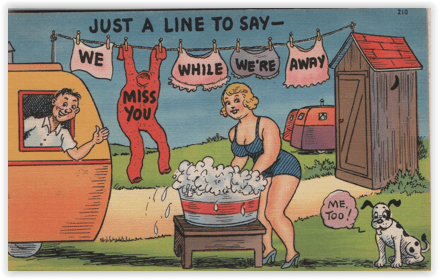
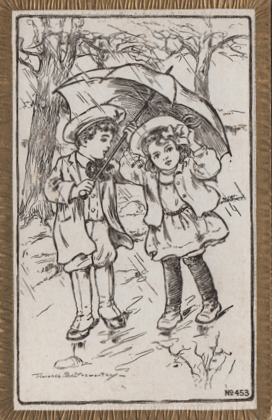
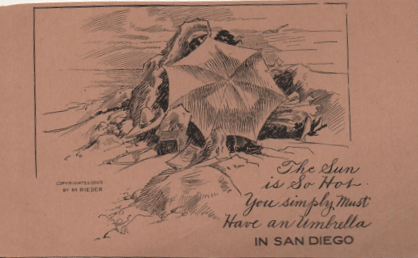
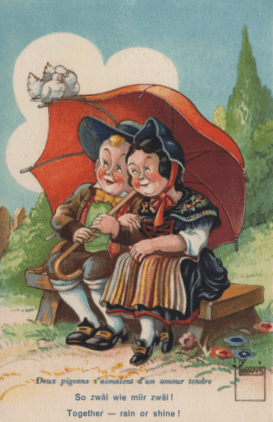
One of their most common examinations of the plight of those in the heat is the hunt for suitable shelter from the burning sun.
This shelter is almost always female, by the way, and sometimes big enough for two.
Naturally, it would be cruel to note that those of us in more fortunate climates don’t see all that much of the sun between, say, Thanksgiving and April Fool’s Day.
Because, after all, without things like a breeze or something else to help out, shade can only go so far. (You, in the back: I heard what you said about the wind in this chap’s situation. Just for that, you don’t get to shovel snow this afternoon.)
And sometimes shade is not available, so the snowbirds start changing into their summer plumage early.
Just like the postcard artists, we certainly feel compassion for those caught out on the beach, where, of course, there are no trees and what we do find on the beach just heats us up.
What kind of jackass, they ask, would willingly expose themselves to the heat when there is a whole world of wind chill waiting back home?
This little poem, written long ago by an anonymous author, appears on many postcards, almost always being complimented by four-legged philosophers.
A modern artist kept the philosopher but went for less poetic observations on his signs of summer.
There ARE those who feel they MUST go to the desert come December, of course. My theory is that they’ve been out in the sun too long.
So let us not revile our misguided brethren who head west or south during these joyful days, and simply relish the fact that WE are in a spot where, when it gets too warm, we can just take off one or two blankets. Now, if you’ll excuse me, I must run to the grocery store, and it will take about an hour for me to assemble all the layers of sweaters, scarves, and loholty-koholoties. Have fun in the snow!