I was intrigued by a couple of postcards I listed for sale over the holiday weekend, and thought about expressing my opinions about them here. This may happen one day, but what the two cards had in common was that each featured a chicken. And though I grew up in an era of reruns, it is nonetheless true that I have featured chickens in this space on more than one occasion. I feared that my many, many readers (at least half a dozen, when last tallied) might worry, “Is that all the birds he’s got?”
That brought to me my columns dealing with storks and their ancient delivery job. And I heard the echo “Okay, chickens and storks. What else ya got goin’?”
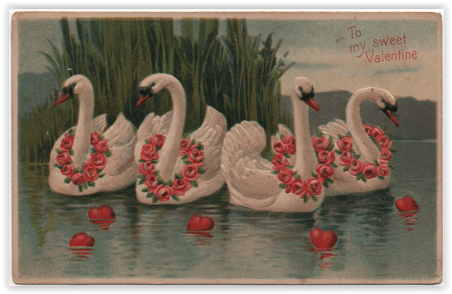
Well, there ARE other birds who have had their jobs on postcards, as I may demonstrate if I get around to it. Swans, for example. As seen above, swans are usually seen as elegant watercraft, frequently bearing wreaths or Valentines or Cupids to a person who needed ‘em. I have not inquired into this phenomenon, but I understand that swans are not you’re most easily trained avian messengers. They just LOOK prettier than carrier pigeons.
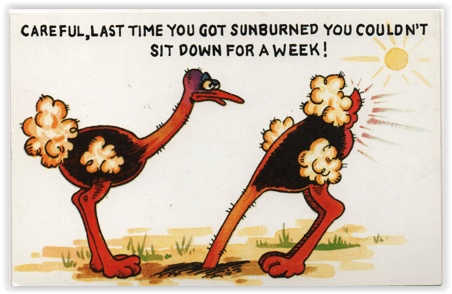
And then there are ostriches, whose chief job is to bury their heads in the sand. (I have seen not ONE postcard featuring the equally popular folklore job of swallowing rubber boots, tin cans, and anything else handy. Maybe I just don’t hang out with the right postcards.)
Geese are traditionally foolish, and frequently turn up as grim warnings. (A friend of mine recalls a flock of tame geese on her father’s farm who, during a sudden cold snap, did not seek shelter like the ducks, and were found complaining about being frozen in the pond next morning.)
Geese are also known for stretching their necks to look at thinks, which led to the phrase “to take a gander”, or take a look. The gander is the male goose, and gendering around is given several meanings here. Usually a rooster turns up in this sort of cartoon.
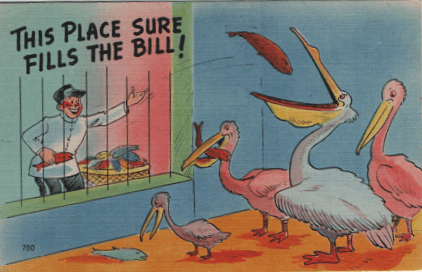
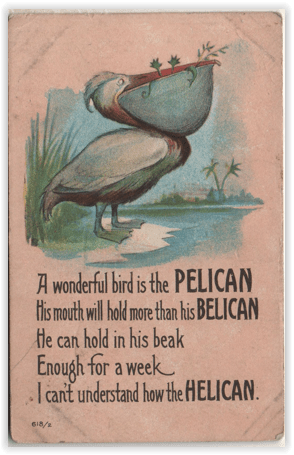
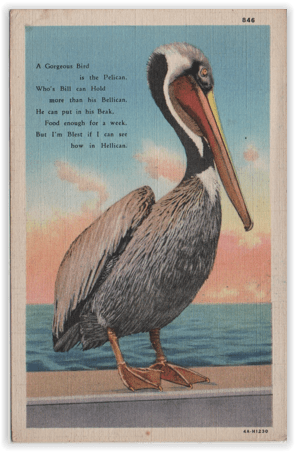
Then there are all the cards featuring pelicans. This is an exceedingly rare example.
Because it does not involve THE POEM. There is one poem about pelicans, though it exists in all sorts of variations.
It is the work of professional humorist and founder of the Tennessee Ornithological Society Dixon Lanier Merritt, who was, it says here on the Interwebs, inspired to write it by being sent a POSTCARD with a picture of a pelican on it. He wrote this in 1910, and lived long enough to see it attributed to just about every other poet on the planet.
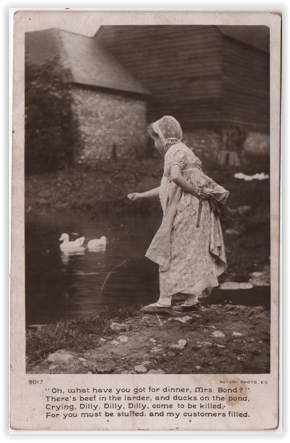
Speaking of poems, I had to look up this little ditty on ducks to make sure it actually existed. Yep, this is one of those nursery rhymes your parents may have forgotten to teach you.
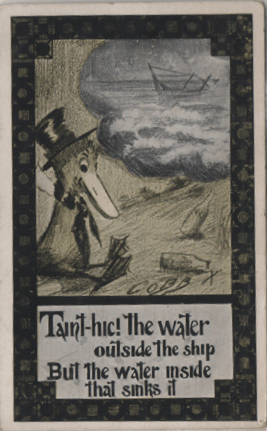
Ducks frequently turn up on postcards (frequently in conjunction with chickens, amid fowl rumors of marital infidelity). I’m not altogether certain how I came up with two rather grim, dark duck postcards for this little essay.
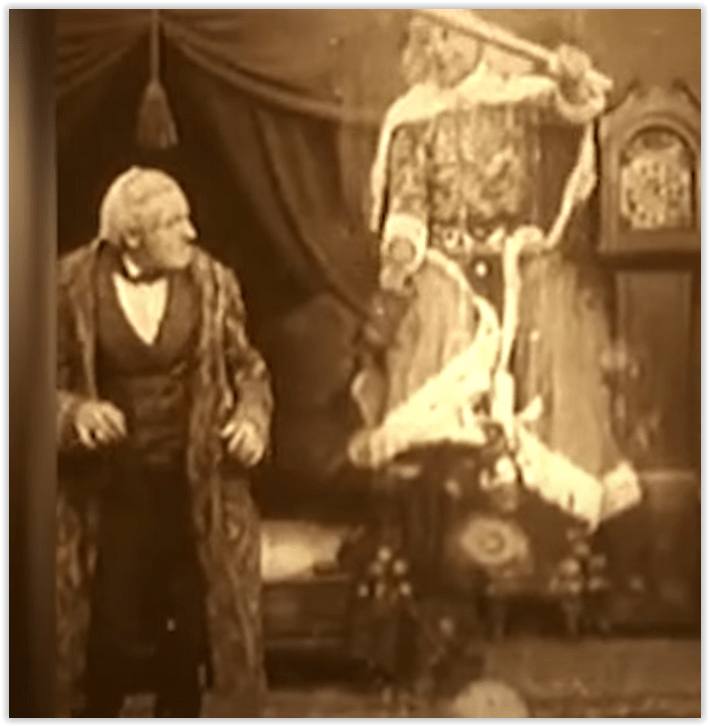
“Spirit,” said Scrooge, after a moment’s thought, “I wonder you, of all the beings in the many worlds about us, should desire to cramp these people’s opportunities of innocent merriment.”
“I!” cried the Spirit!
“You would deprive them of their means of dining every seventh day, often the only day on which they can be said to dine at all,” said Scrooge. “Wouldn’t you?”
“I!” cried the Spirit.
“You seek to close these places on the Seventh Day!” said Scrooge, “And it comes to the same thing.”
“I seek!” exclaimed the Spirit.
“Forgive me if I am wrong. It has been done in your name, or at least that of your family,” said Scrooge.
“There are some upon this earth of yours,” returned the Spirit, “who claim to know us, and to do their deeds od passion, pride, ill-will, hatred, bigotry, and selfishness in our name, who are as strange to us and all our kith and kin, as if they had never lived. Remember that, and charge their doings to themselves, not us.”
Gosh, it’s nice to know that after 180 years, Dickens is still a dangerous radical. Fred Guida, who saw every version of A Christmas Carol worth seeing (and plenty that were not) found only one, in Spanish, which includes this scene. Why do you suppose that is?
IT REQUIRES A FOOTNOTE: Bakers, forbidden to sell bakery on Sunday, nonetheless had to keep their ovens running, for starting up a cold oven on Monday would not have provided good baking. Poor people, having no oven at home, would pack up a Sunday dinner and take it there to rent a little space in the oven, as we saw people doing last time around and and we shall wee the Cratchits doing later. Some people felt this honored the letter of the law but violated the spirit, and wanted this practice shut down.
THE GHOST OF CHRISTMA PRESENTS, SPEAKING FOR ALL CRHISTANITY, COMES OUT IN FAVOR OF INNOCENT MERRIMENT RATHER THAN STRICT ADHERENCE TO THE COMMANDMENTS.
THE GHOST OF CHRISTMAS PRESENT, SPEAKING FOR ALL CHRISTIANITY, MAKES THE POINT THAT CHRISTIANITY SHOULD NOT BE BLAMED FOR ALL THE IDIOTIC THINGS PEOPLE DO IN ITS NAME.
SCROOGE IS SHOWN SOFTENING. This is probably the main reason: the Scrooge we heard back in the office chatting with the Charity Solicitors would not have worried about eh Sunday dinners of the poor. And some filmmakers are just not ready for Scrooge to be reasonable yet.
FUSS FUSS FUSS #13 The Reading version
A Christmas Carol was Dickens’s second most popular public performance, surpassed in the number of times he gave it only by his performances of the trial scene from the Pickwick Papers. What this meant was that he went on tinkering with it long after the official text was published. Like a lot of authors, he felt he could have done better, given a second chance. For the twenty-fifth anniversary edition, he replaced the charming original preface with another one in which he apologizes for not having spent more time on it, fleshing the characters out better, giving more of their background (and generally destroying his chance of producing a Christmas Classic.)
What remains of his tinkering goes the other way, however. He cut the Carol down into a two hour reading, and later cut it back farther to 85 minutes. We know he added bits as well, but he doesn’t seem to have written these down and they are lost. But his cuts, along with his performance notes, did survive, and can be seen in “A Christmas Carol: The Reading Version”, published in 1971 by the New York Public Library (which holds the prompt books) with notes and introduction by Charles Collins.
What is interesting, not to say alarming, is the number of what we consider classic bits that he cut. In the one hand, of course, they were not as classic when he did his readings. On the other, it would seem to prove that the author is not always the best judge of his own text.
Among the cuts were
The doornail
“Business! Mankind was my business!”
The wandering spirits outside Scrooge’s window
“She died a woman, and had, as I think, children.”
“Why to a poor one most?”
The two Significant Children under Christmas Present’s robe (he felt this would be a turn-off to certain audiences)
“It’s likely to be a very cheap funeral.”
“You don’t mean to say you took ‘em down, rings and all, with him lying there!”
“However and whenever we part from one another, I am sure we shall none of us forget Tiny Tim.”
“Heaven, and the Christmas Time, be praised for this! I say it on my knees, old Jacob; on my knees!”
“The Spirits have done it all in pone night.”
The meeting with the Charity Solicitors on Christmas morning
Our last time out, we were discussing Summer Romance, a time of young love filled with deep devotion, true emotion, and anything else that rhymes. We showed pictures and sayings of reasonably young people in the throes of a romance on vacation, where one could be young, free (when Mom and dad weren’t watching) and reckless (because, hey, it wraps up in two weeks anyhow.)
The postcards were not prepared to leave it at that, of course, so today we will look over some of the pitfalls of summer romance, whether those deals with romance….
Or finance….
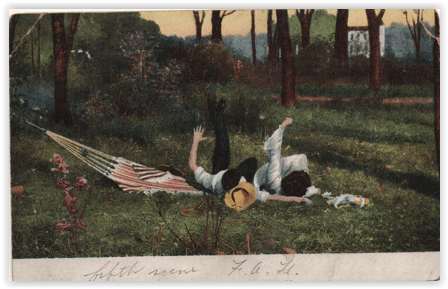
Or happenstance. Um, by the way, was that trunk way over there on the right where the other end of the hammock was attached? You want a little more slack than that, kids. It’s not a trampoline. Well, wait, if that’s what you WANTED…. Anyway, another unrealistic dream of summer romance.
And there is, always, the case of someone just choosing somebody else. (One of three possible endings Ernest Hemingway would allow in cases of true love. The other two involved death. Ernest was a real card when he got down to basics.)
The endings of romance probably fill as many cards as the beginnings: if the second type of card was sweeter, the first waa funnier. Naturally, your friends would be far too polite to tease you about your summer romance break-up, but somehow these did sell.
And, of course, there was no end of advice for the bereaved.
Or passing commentary of great sympathy.
Even if no emotional break-up is involved, there is simply that about the summer romance. Eventually, September came.
Was it easier on the heart to break up before the inevitable day when she had to return to her senior year at West Paltaukey Central and HE was forced to journey miles to his life as a junior at East Paltaukey West Central? A last kiss, many tearful promises, and….
Memories to last a lifetime. Ah well, best get your mind tuned to how much you’ll be able to say in that essay on “What I Did On My Summer Vacation”.
In my boy-days, it was traditional (by which I mean it may have happened three or four years in a row) for school to start today. It was a benevolent system, really, of easing us back into the daily grind. Three days of school, then a three day weekend for Labor Day, four days of school, a two day weekend, and then five days a week until the next legal holiday.
So I thought this might be a nice time to look back at postcards dealing with the summer romance. This was not an invention of modern times. As long as there have been ways to step away from work and/or home for a couple of weeks, there have been interesting romantic opportunities. Let parents and preachers warn against the dangers of giving your heart (to go no further) to someone you saw only fourteen days out of the year, the excitement of people from other places and other walks of life always attracted.
Even if it was just a matter of seventy or eighty miles away: the difference between town and country was far more marked in the days before the radio and television began to homogenize us. There was something piquant in meeting people who dressed completely differently from all your friends, and who not only thought YOU had an accent, but thought that that accent was cute.
Someone you might not have looked at twice back home was exotic in those clothes and with that vocabulary. And, in any case, it was summer.
Many of them had been looking forward to summer, too, and a sweet, no strings attached romance. (Or only strings of their tying.)
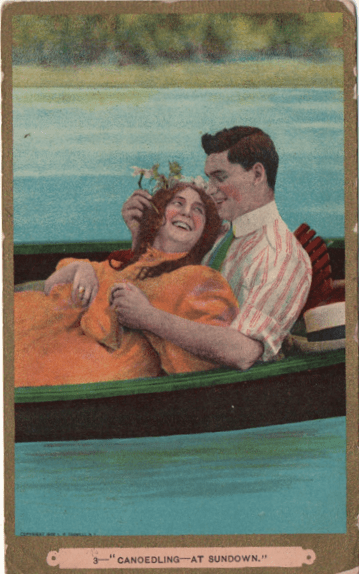
As always, people from the cities loved to go out on the water. Some people go for the swimming, while some look forward to the fishing. More are interested in a long ride, just the two of you, by moonlight, when no one among your elders can, er, correct your pronunciation of the names of the constellations the two of you have rowed out to see.
By the way, this is NOT the source of the word “canoodling”, but I do appreciate this caption writer’s work in the area of punning.
Just about any place your family went on its holidays, though, there were bound to be places your host knew about (and your parents didn’t, and with any luck, neither did theirs), where a young couple could do some serious discussion of current political and social issues.
Natural caution was advised in these matters, of course.
Holly, mistletoe, and berries, ivy, turkey, geese, game, poultry, brawn, meat, pigs, sausages,, oysters, pies, puddings, fruit, and punch, all vanished instantly. So did the room, the fire, the ruddy glow, the hour of night, and they stood in the city streets on Christmas morning, where (for the weather was severe), the people made a rough, but brisk and not unpleasant kind of music, in scraping the snow from the pavement in front of their dwellings, and from the tops of their houses; whence it was mad delight to the boys to see it come plumping down into the road below, and splitting into artificial little snowstorms.
The house fronts looked black enough, and the windows blacker, contrasting with the smooth white sheet of snow upon the roofs, and with the dirtier snow upon the ground; which last deposit had bee ploughed up n deep furrows by the heavy wheels of carts and wagons; furrows that crossed and re-crossed each other hundreds of times where the great streets branched off, and made intricate channels. Hard to trace, in the thick yellow mud and icy water. The sky was gloomy, and the shortest streets were choked up with a dingy mist, half-thawed, half frozen, where heavier particles descended in a shower of sooty atoms, as if all the chimneys in Great Britain had, by one consent, caught fire, and were blazing away to their dear hearts’ content. There was nothing very cheerful in the climate or the town, and yet was there an air of cheerfulness abroad that the clearest summer air and brightest summer sun might have endeavoured to diffuse in vain.
For the people who were shovelling away on the housetops were jovial and full of glee; calling out to one another from the parapets, and now and then exchanging a facetious snowball==better-natured missile far than many a wordy jest–laughing heartily if it went right, and not less heartily if it went wrong. The poulterers’ shops were still half open, and the fruiterers’ were radiant in their glory. There were great round, pot=bellied baskets of chestnuts, shaped like waistcoats of jolly old gentlemen, lolling at the doors, and tumbling out into the street in their apoplectic opulence. There were ruddy, brown-faced, broad-girthed Spanish Onions, shining in the fatness of their growth like Spanish friars, and winking from their shelves in wanton slyness at the girls as they went by; and glanced demurely at the hung-up mistletoe. There were pears and apples, clustered high in blooming pyramids; there were bunches of grapes, made in the shopkeepers’ benevolence to dangle from conspicuous hooks, that people’s mouths might water gratis as they passed; there were piles of filberts, mossy and brown, recalling, in their fragrance, ancient walks among the woods, and pleasant shufflings ankle deep through withered leaves; there were Norfolk Biffins, squat and swarthy setting off the yellow of the oranges and lemons, and, in the great compactness of their juicy persons, urgently entreating and beseeching to be carried home in paper bags and eaten after dinner. The very gold and silver fish, set forth among these choice fruits in a bowl, though members of a dull and stagnant-blooded race, appeared to know that there was something going on; and, to a fish, were gasping round and round their little world in slow and passionless excitement.
The Grocers’! Ah, the Grocers’! nearly closed, with perhaps two shutters down, or one; but through these gaps such glimpses! It was not alone that the scales descending on the counter made a merry sound, or that the twine and roller parted company so briskly, or that the canisters were rattled up and down like juggling tricks, or even that the blended scents of tea and coffee were so grateful to the nose, pr even that the raisins were so plentiful and rare, the almonds so extremely white, the sticks of cinnamon so long and straight, the other spices so delicious, the candied fruits so caked and spotted with molten sugar as to make the coldest lookers-on feel faint and subsequently bilious. Nor was it that the figs were moist and pulpy, or that the French plums blushed in modest tartness from their highly-decorated boxes, or that everything was so good to eat and in its Christmas dress: but the customers were all so hurried and so eager in the hopeful promise pf the day that they tumbled up against each other at the door, clashing their wicker baskets wildly, and left their purchases upon the counter, and came running back to fetch them, and committed hundreds of the like mistakes in the best humour possible; while the Grocer and his people were so frank and fresh that the polished hearts with which they fastened their aprons behind them might have been their own, worn outside for general inspection, and for Christmas daws to peck at if they chose.
But soon the steeples called good people all, the church and chapel, and away they came, flocking through the streets, lanes, and nameless turnings, innumerable people, carrying their dinners to the bakers’ shops. The signs of these poor revellers appeared to interest the Spirit very much, for he stood with Scrooge beside him in a baker’s doorway. And, taking off their covers as the bearers passed, sprinkled incense on their dinners from his torch. And it was a very uncommon kind of torch, for once or twice when there were agry words between some dinner-carriers who had jostled each other, he shed a few drops of water on them from it, and their good humour was restored directly. For they said, it was a shame to quarrel upon Christmas Day. And so it was! God love it, so it was!
In time the bells ceased, and the bakers’ were shut up; and yet there was a genial shadowing forth pf all these dinners and the progress of their coking, in the thawed blotch of wet above each baker’s oven; where the pavement smoked as if the stones were cooking, too.
“Is there a peculiar flavour in what you sprinkle from your torch?” asked Scrooge.
“There is. My own.”
“Would it apply to any kind of dinner on this day?” asked Scrooge.
“To any kindly given. To a poor one most.”
“Why to a poor one most?” asked Scrooge.
“Because it needs it most.”
Dickens sets out a detailed picture of early Christmas day for us. We can use this material to bring on another opulent display of props, set the scene, and give Scrooge another hint about Christmas, OR scoot right past it to the Cratchit Christmas dinner. Voting is split pretty evenly among the various versions.
Hicks goes straight to Bob’s house.
Sim I flies with the Ghost, who shows Scrooge “a place where miners dwell”. The family group is singing “Hark! The Herald Angels Sing”. After this they spot Bob Cratchit.
March materializes inside the Cratchit house. Magoo materializes just outside. Haddrick flies over London to land there. Finney skips all of this completely. Rathbone and the Spirit dematerialize as before and rematerialize in the Cratchits’.
Matthau and the Spirit fly over the city. The Ghost cries, “Look! The City of London at Christmas!” THEN they fly on to Bob’s place.
Using a streetlight as a flashlight and lifting roofs to peer into various houses, the Spirit takes McDuck straight to Bob Cratchit’s.
Curry and the Spirit fly to daylight. The Ghost, joyous, cries “Happy me! Happy everyone!” “Happy Humbug!” snorts Scrooge. The ghost asks if he is backsliding already. He replies, “Why should I be accused of being selfish when Christmas is such a selfish holiday?” Outraged, the Spirit lets him fall. Catching him in the nick of time, she asks if THAT was selfish. He says it was; she saved him only so she could annoy hi further. “Let’s see if I can convince you otherwise,” she says.
Versions which make more of the passage, if only a little, include Sim II, who finds himself standing with the Spirit in a snowy, thickly-populated, rather dark town square. The narrator explains that the Spirit dropped a few drops of good cheer from his torch. We spot Bob Cratchit galloping through the snow with Tim on his shoulder.
Bells ring; Scott walks with the Spirit in a daylit street. “What day is it now?” Scrooge demands. “Don’t you know? Christmas morning.” They pass a fish stall and a butcher shop. “There’s a lot of buying, isn’t there?” says Scrooge, rubbing his hands together. “Oh, Ebenezer, is that all you can see? Follow me and I’ll show you to what good use these things can be put.” “Is there some peculiar power that emanates from your torch?” “Oh, yes. There is.” Nodding, the Spirit moves on and declines to explain further.
Caine and the Spirit materialize in a dark square, but daylight and a crowd appear a moment after. It is time for the jolliest number of the production, “It Feels Like Christmas”, a musical evocation of what Christmas truly means (at least in this version.) The pair move through a cheerful bustle; Scrooge is detached and dubious. Making himself tiny, the Spirit moves in to bless a family of mice; Scrooge, peering into the mousehole, suddenly smiles. As holiday excitement expands through the crowd, Scrooge begins to look as if he regrets not being a part of it. The Ghost rejoins him, leading him into the dance. At the end, he is exhilarated. “Spirit, I had no idea! I wish to see friends, kin! Show me family!” (We will be transported to Fred’s Christmas party now, before we go to the Cratchits’.)
When Stewart reaches for the Spirit’s robe, we seem to see apples pouring from under it. The camera pulls back to show us the fruiterer in the square is refilling a bin. The Ghost casts a significant glance at Scrooge and sprinkles glitte4ing water from the torch as they move along. Scrooge asks why. “Is there a blessing in it?” “There is. My own.” They converse as described; when Scrooge asks “Why to a poor one most?” the Spirit answers in a tone that suggests Scrooge should have known this answer already.
It is Owen’s version which makes the most of this section. A pudd of smoke surrounds Scrooge and then we see people moving in and out of the baker’s. Scrooge asks what’s going on; the Spirit explains that the poor find it cheaper to take their dinners to the baker to be cooked. As we watch, two men bump into each other and start to snarl. Light blinks from the horn the Spirit carries, and the two men wonder aloud why they’re fighting. Scrooge asks what happened and is told that what is sprinkled from the horn is a spirit five times distilled: the Spirit of Christmas cheer, of love, of all that’s good, of all that makes this time of year different from any other time. The explanation goes on, but Scrooge has noticed two other men arguing. He points them out to the Spirit, who again flashes his torch and makes peace. Turning to Scrooge, he says “We stopped that.” Scrooge beams. “Yes, we did, didn’t we?” A bell chimes. “That church,” says the Ghost, “We have business there.” In the congregation, we find Fred and his fiancée sharing a hymnal. The Spirit leans over to confide in Scrooge, “I don’t believe for a moment that they love one another.” Scrooge disputes this. The Ghost goes on to say it is fortunate that the two don’t have the wherewithal to marry; their love will soon fade. Scrooge takes exception to that as well. “Their love will grow. They SHOULD be married.” Farther down the pew, we find Bob Cratchit and Tiny Tim singing “O Come, All Ye Faithful.” Looking down at Tim, Bob’s voice chokes off. A clasp of Tim’s hand hives him courage and volume again. When church lets out, , Fred and fiancée chat with Bob and Tim. As the Cratchits move on, Fred observes that the ice is perfect for sliding. His fiancée says they really shouldn’t: not in front of a church. She would seem to be borne out in this when the boys who ARE sliding are chased away by a clergyman. But when the boys are gone, that worthy has a quick slide himself. Convinced now, the young lady joins Fred in a glide along the ice. Of course they fall gleefully into the snow, where Fred kisses her. Our attention then shifts to Bob and Tim walking home.
We have been discussing certain postcards dating from somewhere between 1939 and 1955, which took on the aesthetic of the grade school Valentine: clear, firm illustrations, generally positive attitude, and really, really obvious puns. Someday, after the Lottery win comes through, I will mount an exhibition just of postcards and little Valentines based on “Cannot BEAR to be separated from you.”
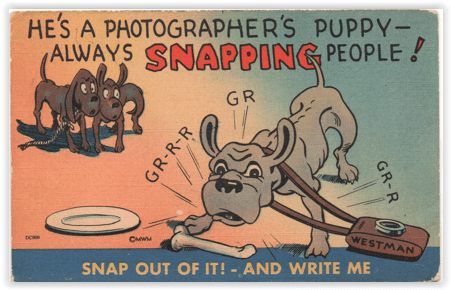
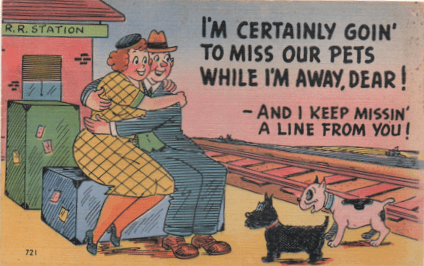
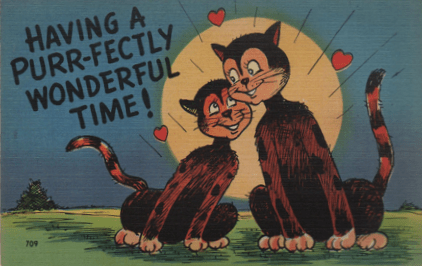
But there are a few that extend to greater effort in presenting puns. The photographer’s dog at the top of this column is not the first joke about dogs we might think of. And I believe I have mentioned my admiration of the second card, which is also a joke you might need to look at for a while. (If you are of one of the later generations, belonging to an era when cameras do not snap and people do not pet, you might not get the joke at all.)
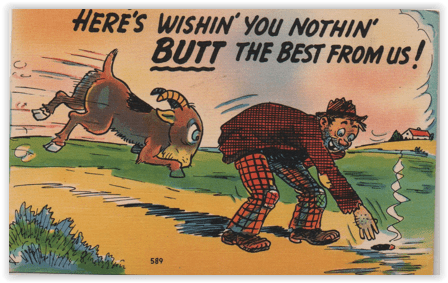
And one can only stand back in awe of a card which finds four separate meanings for But/Butt and gets them all in one use. Now, THAT is Art with a capital A (or B, but that makes it Bart.)
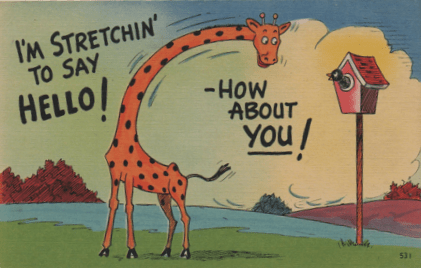
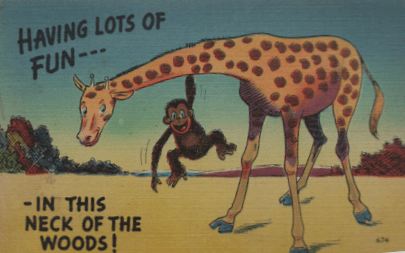
Then there are others, which simply go for friendly animals and avoid puns entirely. I’m not perfectly happy with this joke, if that’s what it is. DO giraffes stretch? I mean, aside from the rubber ones you toss into the baby’s crib for Ladislaus to teethe on.
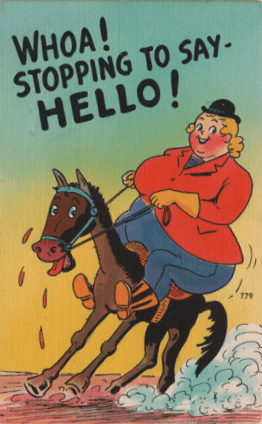
This image is also perfectly acceptable as a good-natured greeting, but there is no joke in he words, just the humor of a large woman on a small horse. (Unless you feel they were making a joke about the horse having a sense of WOE. I think that’s reaching to give the artist credit.)
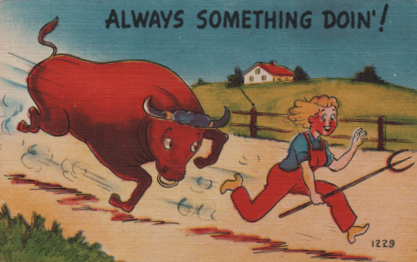
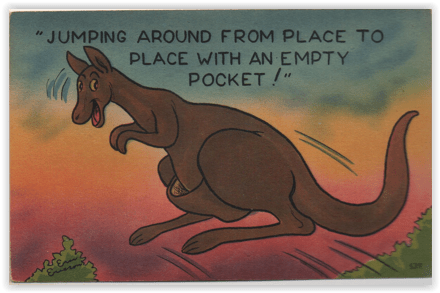
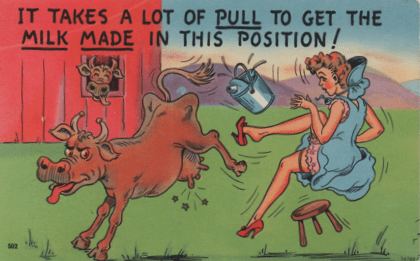
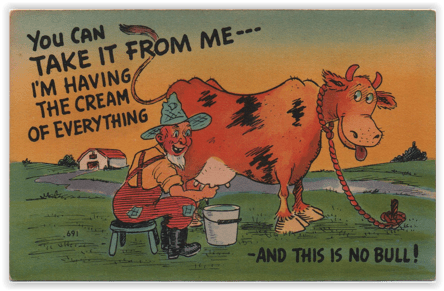
This one, too, just gives us a humorous crisis, which the victim is not taking seriously. But I would give the artist credit for having her chased by a bull, so this card could go out without any lines about “And That’s No Bull.” (We’ve discussed that before; it’s a nother caption that might fill a exhibition gallery with its many variations. Hey, I could do the two as one exhibition, and have a Bearish gallery and a Bullish gallery. What, you think I should leave these jokes to the experts? You just wait ‘til I have that Lottery cash; I’ll pay someone to follow you through the exhibition and tickle you so you HAVE to laugh.)
No laugh in this postcard, either. Just a happy puppy and an invitation. Well, they can’t all be diamonds.
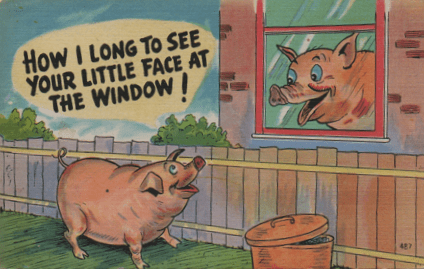
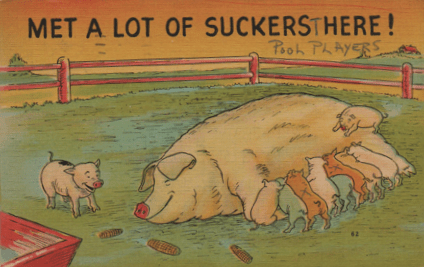
SOME postcards of this era, though, pass by plain pleasantness and go for something more surreal. This was a very popular postcard, to judge by the number for sale online. What’s it all about, anyway? We have a typical urban backyard pig outside and a massive hog who…lives in a house? I realize the early days of suburban communities could get a little freeform, but what’s…..
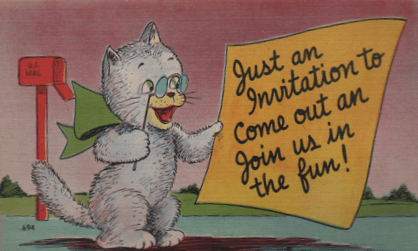
This card should have been featured in my column on the lorgnette. Why is the cat reading the letter with a lorgnette? Why is this cat reading the letter at all? That must mean the cat is not the sender of the invitation, since it just came out of the mailbox (where it turned up without an envelope.) I understand the purpose of the postcard was simply to serve as an invitation, and not be submitted to literary analysis, but I can’t really perceive the narrative.
As I was saying on Friday, I was investigating a whole nother subject when I fell down that doggone rabbit hole. (I’m a little behind the ties here: is there a new term to describe what happens when the Interwebs take you downstream from where you wanted to go? Are you rabbitholing? Have you been rabbitholed? I would hate to use a word incorrectly, especially that last one.)
Anyway, what I started out to study was what I call the Grade School Valentine school of comic postcard, something that seems to have been especially prevalent in the 1940s. You remember those grade school Valentines, which gave us our first exposure to mass puns: a picture of a cat holding a heart saying “I’m Not KITTEN Around, Valentine!” or a horse holding a heart and saying “Don’t Want To NAG, But Will You Be My Valentine?”
When you weren’t considering a class action lawsuit against the publishers for exposing children to something as dangerous as the Obvious Pun, you may have wondered what the people who created these works of art did the rest of the year. Surely, they couldn’t spend an entire year just thinking of new ways to have a puppy holding a heart say ‘DOG-DGONE It, You’d Be a Great Valentine!”
Wonder no more. The era of, oh, 1936 to 1955 seemed to have an inexhaustible appetite for postcards with the same sort of animal humor. You saw a little of that last Friday, with cartoonists working new excuses for a picture of a dog and the oxymoron “Doggone”. (How could you say Dog Gone when the Dog was right there and hadn’t gone anyplace?)
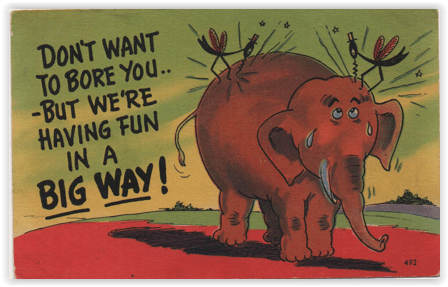
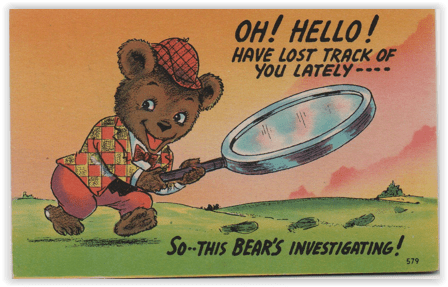
The larger format offered more space to play with the picture, and the fact that THESE cards were for expressing friendship to an older audience meant the artist could indulge in more than one pun in the same picture. Note that here we are observing the dual meaning of “track” while also playing with “bears” and “bear’s.”
Artists could also toy with more adult themes. This gag has no particular relevance to most second graders.
And the rolling PIN idea was more for grown-up sitcoms.
Maybe the postcards were outlets for jokes that came up while the artist was working on the more restrictive and demanding Valentine art form. Did the opposite ever happen? It would take a lot more research (and probably endless storage space for the Valentines and postcards) but did the artists sometimes apply the same joke to both, knowing two separate audiences might like the same gag and never realize the joke was available in both markets?
What a rich field for research! The harvest might be a Ph.D. and a chance to fertilize new areas of previously uncultivated….
You see the dangers, though. Too many of these multi-pun cards (can you find THREE in this picture?) and you start talking that way without realizing you’ve crossed a fence into…no, let’s stop here and get back to considering that class action lawsuit. We all see what comes of milking these gags until….
The moment Scrooge’s hand was on the lock, a strange voice called hi by his name, and bade him enter. He obeyed.
It was his own room. There was no doubt about that./ But it had undergone a surprising transformation. The walls and ceiling were so hung with living green, that it looked a perfect grove, from every part of which, bright gleaming berries glistened. The crisp leaves of holly, mistletoe, and ivy reflected back the light, aa if so many little mirrors had been scattered there; and such a mighty blaze went roaring up the chimney, as that that dull petrification of a hearth had never known in Scrooge’s time, or Marley’s, or for many and many a winter season gone. Heaped on the floor, to form a kind of throne, were turkeys, gees, game, poultry, brawn, great joints of meat, sucking-pigs, long wreaths of sausages, mince pies, plum-puddings, barrels of oysters, red-hot chestnuts, cherry-cheeked apples, juicy oranges, luscious pears, immense twelfth-cakes, and seething bowls of punch, that made the chamber dim with their delicious steam. In easy state upon this ouch, there sat a jolly Giant, glorious to see; who bore a glowing torch, in shape not unlike plenty’s horn, and held it up, high up, to shed its light on Scrooge, as he came peeping round the door.
“Come in!” exclaimed the Ghost. “Come in! and know me better, man!”
Scrooge entered timidly, and hung his head before the Spirit. He was not the dogged Scrooge he had been; and though the Spirit’s eyes were clear and kind, he did not like to meet them.
“I am the Ghost of Christmas Present,” said the Spirit. “Look upon me!”
Scrooge reverently did so. It was clothed in one simple deep green robe, or mantle, bordered with white fur. This garment hung so loosely on the figure, that its capacious breast was bare, as if disdaining to be warded or concealed by any artifice. Its feet, observable beneath the ample folds of the garment, were also bare; and on its head it wore no other covering than a holly wreath, set here and there with shining icicles. Its dark brown curls were long and free: free as its genial face, its sparkling eye, its open hand, its cheery voice, its unconstrained demeanour, and its joyful air. Girded round its middle was an antique scabbard; but no sword was in it, and the ancient sheath was eaten up with rust.
“You have never seen the like of me before!” exclaimed the Ghost.
“Never,” Scrooge made answer to it.
“Have never walked forth with the younger members of my family; meaning (for I am very young) my elder brothers born in these later years?” pursued the Phantom.
“I don’t think I have,” said Scrooge. “I am afraid I have not. Have you many brothers, Spirit?”
“More than eighteen hundred,” said the Ghost.
“A tremendous family to provide for!” muttered Scrooge.
The Ghost of Christmas present rose.
“Spirit,” said Scrooge submissively, “Conduct me where you will. I went forth last night on compulsion, and I learned a lesson which is working now. To-night, if you have ought to teach me, let me profit by it.”
“Touch my robe!”
Scrooge did as he was told, and held it fast.
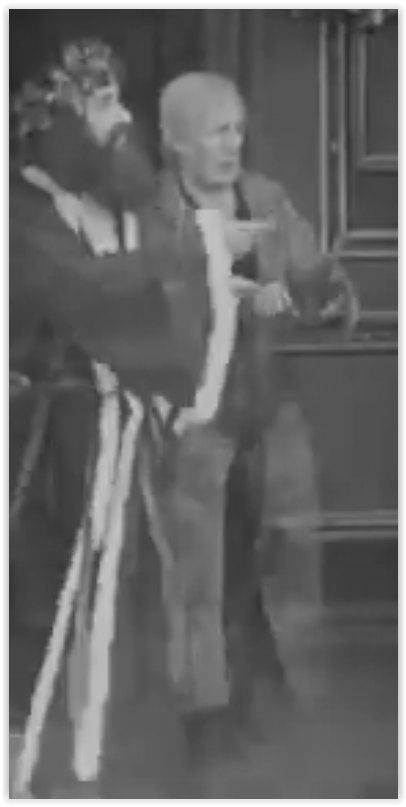
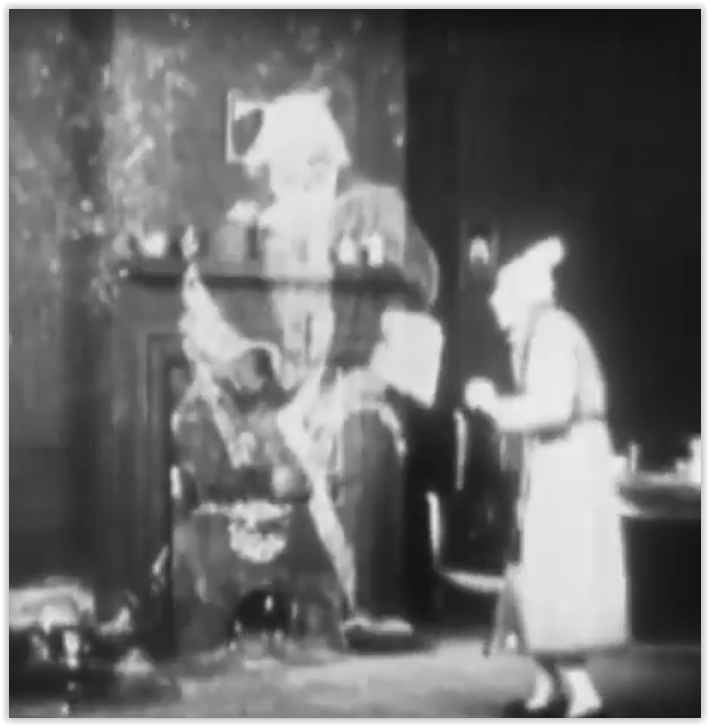
Look at all the room Dickens gave moviemakers to play in! Scrooge’s attitude to the Ghost, the Ghost’s opinion of him, and how much they have to say to each other all vary. There are also a few technical matters to employ in making a giant appear in a live-action film. Camera angles can do the trick, or a miniature room to make the actor playing the Ghost stoop a bit so as to clear the ceiling; Caine has a gigantic head which peers through the door at him. Since Dickens makes it clear this Spirit can change size at will, most versions bring him down to a manageable height after the first impact.
Other things are constant from Scrooge to Scrooge: that parlor which becomes a larder, the massive Ghost based generally on Leech’s illustration, and, especially, that line “Come in! and know me better, man!”
Following that line, Hicks finds himself facing a gross goblin who seems to have escaped from some historical movie about Nero or henry VIII. (He’s one of a line of Christmases Present who actually eat the props.) They exchange the dialogue much as written; Scrooge is softening. “Touch my robe,” orders the Ghost. “And you shall see how your clerk, with his paltry fifteen shillings a week, which you so grudgingly dole out to him, keeps Christmas! Touch my robe!” Scrooge raises his hand high, hesitates for just a moment, and then lets it drop on the Spirit’s garment.
“Come here and know me better, Scrooge!” calls Owen’s wide-eyed, robust, but not so very giant Spirit. This Ghost has had “a huge number” of brothers, “Some eighteen hundred!” Owen asks “What’re we going to do?” “Walk into the world this Christmas night so that you can hear and see and feel Christmas in the world this night.” “Did you say walk or fly?” “Touch my robe.”
The Ghost has to summon Sim I several times; Scrooge keeps calling “I’m coming.” When he does finally go into the next room, and see what is waiting for him, he turns away, shaking his head. The giant Ghost declares, “You have never seen the like of me before!” to which Scrooge makes the immortal reply, “No. And I wish the pleasure had been indefinitely postponed.” “So! Is your heart still unmoved towards us, then?” Scrooge begins the refrain that he will reprise several times. “I am too old! I am beyond hope! Go and redeem some young, more promising creature and leave me to keep Christmas in my own way.” He is given a lecture on how Christmas spirits live not just one day any more than the Christ Child sees to only one day. “You have chosen not to seek Him in your heart; therefore you shall come with me and seek him in the hearts of men of good will. Come. Touch my robe!” The Ghost chuckles as Scrooge shuffles forward.
March finds a Ghost who looks a great deal like his nephew Fred, sitting in a room rather heavier on decorations than food. He wears no beard, and is not a giant; his costume is about half jester and half lieutenant, bells replacing brass. He is suitably hearty though, and sings the most rollicking song in the production, “A Very Merry Christmas”. Scrooge walks around and around him, once reaching timidly in to ring some of the bells. During this number, the Ghost shows off a few tricks, finding a sprig of mistletoe under Scrooge’s nightcap, drawing a long garland from inside Scrooge’s dressing gown, and so on. Scrooge’s glee and wonder grow with each trick. His stuffed raven flies out the window. Under duress at first, but then with good will, Scrooge finds himself dancing with the Ghost. Not that he’s perfectly convinced: his face goes through an alarming series of conflicting expressions; at one point he tries to hide in the bed again. Finally, he asks what we’ve all been wondering, “Nephew? Fred?” “Nephew?” cries the Ghost. “I am the Spirit of Christmas Present. Pluck up your courage. Only good will happen to you.” The Ghost picks up, and raises his nose at, the bowl of gruel as Scrooge asks “Christmas Present?” “Yes. You don’t give many of them, do you?” Scrooge is abashed: “Not of late years,” he admits. “I do,” the Spirit replies, “It’s my business. None of this will be wasted, you may be sure.” “How did you come here?” “I came on my regular round.” “Spirit, if you have anything to teach me, I’m ready to learn.” The Ghost sings more of his song while spreading a tablecloth on Scrooge’s table. He sets the gruel in the center of this, gestures, and we are looking at a plum pudding on the table of the Cratchit household.
As Rathbone peers out the window, a voice calls “Come here! Come here and know me better, man!” The cold fireplace Scrooge peeked into a second ago is now ablaze, and there is food all over the place. In the corner sits a man with a Sants suit and the shortest beard of any Christmas present except for Hicks (well, and Curry.) Scrooge, removing that absurd nightcap at last, admits he has never seen the like of this Ghost before. “You could have known many of my older brothers, if you’d wanted.” The Spirit tosses the mug he is holding to one side, and rises: he is not quite a giant, but he is taller than Scrooge (now that the cap is gone.) Scrooge asks the Ghost to conduct him where he will; if the Spirit has ought to teach him, he is ready to elarn. “Good,” says the Ghost, a bit grim. “Toich my cloak.”
Magoo gets a rather rotund white-bearded man who observes that Scrooge has never seen the like of him before. “I’m not sure I see the like of you now,” says the squinting Scrooge. “So I’ve heard; you’re the one who’s too tight with a penny to buy himself a pair of spectacles.” The Ghost orders Scrooge to come in and know him better, man. Scrooge replies by asking “Are you the Spirit, sir, whose coming was foretold to me?” (He has to use that line here, remember, because in this version Christmas present is the first of the Spirits.) “Touch my robe,” the Ghost replies.
Haddrick finds a white-bearded Spirit very much like the last one; this Ghost does seem a wee bit younger, and carries a lantern instead of a crozier. He is not a giant, and stands in a room now featuring a Christmas tree and presents. “Come in! and know me better, man! I am the Ghost of Christmas Present! Lok upon me well!” “Spirit, take me where you will. I have already been forth this night—or last night—and I am anxious to end this ordeal.” “Touch my robe.” They rise through the ceiling.
Sim II’s Ghost is definitely based on the Leech illustration, even to the hairy chest. “Come in! and know me better, man! You have never seen the like of me before!” Scrooge merely shakes his head. His only line here is to request the Ghost to “Take me where you will. If you have ought to teach me, let me profit by it.” The Ghost looks a wee bit irritated, but rises and commands him to touch the robe. (You will observe that this Ghost actually wears a scabbard, as required by the text, but it looks like plain leather.)
Finney unlocks the door to the next room, but, hearing his name, runs back to bed. When the Ghost threatens to come fetch him, he scuttles to the door again. The light there is too bright for him; when the Ghost lowers it, he finds a vast, glittering array of food and a bushily-bearded, fully furred giant. “Come over here, you weird little man! I am the Ghost of Christmas Present! Now look upon me! You have never seen the like of me before!” “Never.” “Yet how many of my brothers have you rejected in your miserable lifetime!” “I’ve never met any of your brothers, sir.” “You have never looked for them.” “How many of them are there?” “What year is this?” “1860.” “Then I have 1859 brothers. Every year at this time, one of us visits your puny little planet to spread happiness and to remove as many as we can of the causes of human misery. That is why I have come to see you, Ebenezer Scrooge.” Scrooge is levitated to allow the Spirit a closer look. “You’re a funny-looking little creature. I must admit, I found it hard to believe you’d be as horrible as my brothers said you’d be, but now I come to look at you, I see they were understating the truth.” Scrooge protests that he is a man of high principles and generous spirit. The Ghost forces a large goblet on him and orders him to drink. Scrooge is reluctant, but finds the beverage to his liking; he says he’s never tasted anything like it before. “Of course you haven’t.” “What is it?” “The milk of human kindness.” The Spirit begins a poem which becomes a song; he rather dislikes humans, especially Ebenezer Scrooge, but the song is “I Like Life.” Scrooge explains that he hates life because life hates him. “You’re an even bigger fool than I took you for.” The Ghost teaches Scrooge the song; Scrooge reacts to it as he did the contents of the goblet; reluctant at first, he comes to enjoy it. He even enjoys being flown across the room by the Ghost. Eventually the pair of them burst through the glass of the window and sail into the night sky.
Matthau cries, “My parlor! What’s happened to my parlor?” Well, it’s packed with food; a fire blazes in the fireplace. “I am the Ghost of Christmas Present. Come in and know me Better, for you have never known the likes of me before!” “Who are you?” “The Christmas Spirit. Come!” “No!” Toys under a Christmas tree sing “Listen to the Song of the Christmas Spirit” as a terrified Scrooge is drawn in and shrunk to their size. He is forced to dance with them, and gradually seems to be enjoying himself. The Christmas Spirit itself is a tall man with white hair and a white beard. A wreath rests on his head. He carries the cornucopia torch, and an empty (but intact) scabbard hangs at his waist. Finally, catching up Scrooge and B.A.H. Humbug, he hurls them through the window. “I shall fall!” “Touch my robe and be lifted!” They fly.
Willie the Giant plays McDuck’s Christmas Present, so he is a proper giant, four stories tall, calling “Fee Fi Fo Fum” as he looks around for Scrooge. Scrooge thinks he’s going to be devoured, but the Ghost, showing him to room heaped with food, tells him there are better things to eat than a distasteful little miser. “Where did this all come from?” ””From the heart, Scrooge! It is the food of generosity, which you have long denied your fellow man.” “Nobody has ever shown ME generosity.” “You’ve never given them reason to. And yet there are still some who find enough warmth in their hearts even for the likes of you.” “No acquaintance of mine, I assure you.” “You’ll see.” The Ghost pushes the roof off the house and starts away. (Shall we note at this point that though in this version, Scrooge carries Christmas Past with him, he is carried away by Christmas Present? Or are we overthinking things?)
Scott is told to “Come in!” Scrooge is grim in reply: “I intend to,.” He blinks at the light until it is dimmed. “Come in, and know me better, man! You’ve never seen the likes of me before, eh?” “That’s quite true,” says Scrooge, his expression one of wonder and confusion, “I have not.” The Ghost is a robust bearded man who likes to laugh. “You never walked forth with any of the younger members of my family.” “No, not that I remember.” “Nor any of my elder brothers, born these late years?” “No, I’m afraid not, no. Do you have many brothers, Spirit?” “Over eighteen hundred.” “A tremendous family to provide for!” This remark, which IS a bit mercenary if you think about it, seems to offend the Ghost. “Take hold of my robe, Ebenezer Scrooge!”
The roliest poliest softest giant in all creation calls to Caine, heartily identifying himself twice, saying “Come in and know me better man!” no fewer than three times. Scrooge notes, “You’re a little absent-minded, Spirit.” “No, I’m a LARGE absent-minded Spirit!” He and Scrooge chuckle heartily about this. The Ghost goes on to explain that his mind is filled with the here and now, “And the now is Christmas!” “I don’t believe I’ve met anyone like you before.” The Ghost is surprised. “Really? Over 1800 of my brothers have gone before me.” Scrooge ventures a little joke about grocery bills; they laugh inordinately over it, and the Giant shrinks a little toward Scrooge’s size. “Have you ever noticed how everything seems wonderful at Christmas?” Scrooge replies, with some regret, “In all honesty, Spirit: no. Perhaps I’ve never understood about Christmas.” “Before the day is done, you WILL understand.” He marches over to throw open the window, tossing the eavesdropping Dickens and Rizzo into the snow once more.
When Curry is called, he closes his bed curtains. Light forces them back. “Come out, come out, and know me better!” The light flies back to the Ghost, a Black woman in a green gown. “No! Gi away!” Debit growls at the Spirit, but she throws him a leg of lamb. “I bet you’ve never had a Guest like me before.” Scrooge is still hiding; she takes a deep breath and blows the covers away. They converse as in the text, though when she mentions the other members of her family, Scrooge asks “Do you have many sisters?” “Nearly nineteen hundred. Come! Touch my robe!” “After that last Spirit, I’d rather not.” “This is not a multiple choice, Mr. Grumpy-face.” He says he can’t leave his dog; she points out that Debit is obviously happy with that bone. As she snatches him up and sails out into the night, he grumbles, “I’ve got to get a lock for that window.”
Stewart finds a dark-haired giant, not quite bare-chested, not so brightly lit; this Ghost relies on flickering firelight. “Come in and know me better, man! Have you never seen anything like this before?” “Not in this house.” The Ghost laughs; they discuss the younger members of the Ghost’s family. Scrooge’s line about providing for so large a family seems to offend this Ghost as well. He is stern as he rises. Stewart asks him to go ahead with whatever he has in mind. “I’d like to get this over and done with.” He moves like a condemned man on the gallows as he goes to touch the robe.
FUSS FUSS FUSS #12: How Do You Like Him Now?
Ghosts of Christmas Present regard Scrooge with a mixture of amusement and contempt. Lined up in order, from Most Amused to Most Annoyed, one must begin with Caine’s Christmas Present, a large-hearted soul who honestly believes everyone considers Christmas a time to be jolly and generous, and work to the other end in this order
Caine
Curry
March
Sim I
Owen
Sim II
Scott
Magoo
Stewart
Matthau: this Spirit is sort of a midpoint, neither very amused nor contemptuous, but more of warm, happy soul who will not take “no” for an answer
Haddrick
McDuck
Rathbone
Hicks
Finney
Finney’s Ghost doesn’t seem to have any affection for humans or Earth (so presumably they have Christmas other places, too) and particularly dislikes Scrooge, calling him weird, horrible, unpleasant, and funny-looking.
For their part, most Scrooges greet this Ghost with terror, though a few, like the textual Scrooge, are merely resigned to their fate. Sim I seems merely dismayed, while Scott is grimly angry. Caine, of course, seems to be as pleased by the encounter as the Ghost
As usual, I was thinking about something else entirely, but that will have to wait until next week. Whilst going through my inventory to find illustrations for THAT notion, I came upon another subject to worry about.
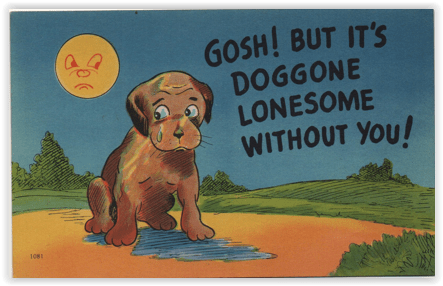
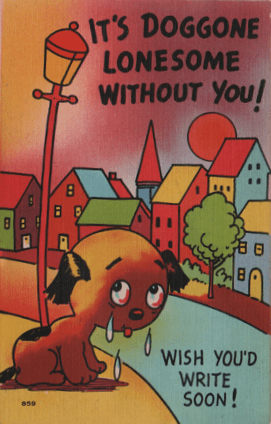
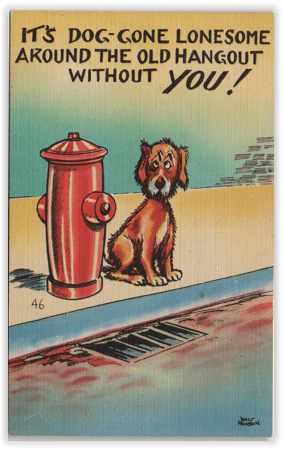
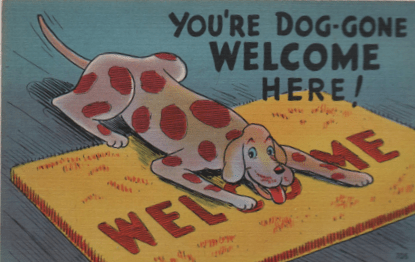
Postcards with dogs on them are always decent sellers: people do appreciate ‘em. A postcard publisher with lots of dog photographs will be guaranteed a goodly number of sales. And cartoonists who could draw cute dogs were a certain source of profitable jollity.
But a cartoonist can’t just draw a dog. There has to be an excuse, a caption, a joke or at least a mild pleasantry that requires the presence of a dog. Well, as many a cartoonist shows, the emphasizer “doggone” can be inserted into any sentiment to enhance the feeling.
I was aware, of course, that the word is a euphemism, a substitute for something you might not want to be heard saying when Aunt Charity was making fritters. The English language is rich with euphemisms. Some people, wishing to condemn a group of, say, fleas which had jumped to them from their pet, could simply say “Condemn those fleas!” But that sounded too much like the word they WANTED to say, so they would scale back to “Confuse those fleas!” or “Concern those fleas!” Making fleas concerned was so popular that it became the “Consarn it!” now heard primarily in westerns. (Euphemisms like being transformed to get as far as possible from their obscene or profane origin. This never works: folks are hardwired to look for offensive things–we may, one day, spend a few paragraphs recalling how shocked some moviegoers were at Disney naming a character Jiminy Cricket, with even a song exhorting someone in trouble to shout…where were we?)
So, no matter how it is spelled (hope you noticed the disappearing hyphen in these examples) it seems that, as one online dictionary put it, “doggone” is simply a substitute for “damn”. (It is clearly meant as a synonym for “God damn”—two syllables and all that—but the online writer was also doing a bit of euphemizing. Some other day we may argue which euphemism is less logical “God darn it” or “Gosh damn it” I can argue either side.)
This was not enough for some other websites, which took the phrasing “doggone it” (note the different spellings of THAT) and derive it through “dadgummit” and “dadburnit” (interesting substitution of Dad for God, probably more a matter of sound than a consideration of God the Father) up to “God blast it” and “dadblasted” and thence to “God ro it” or “dod rot it”, which became “dadratted” in some places, and simply “dratted” in others. That’s a long way to go to get to “drat”.
That seems to me to be getting farther and farther from the dogs (in contrast to those who feel our language is going TO the dogs, but that phrase deserves a whole nother blog) and I am more interested by those who start with “dog garn it”, which they trace to England in the 1840s. Whether or not this is related to the exclamation “Garn!” which is a nasal contraction of a disbelieving “Go on!” I can’t say. And which came first in the world of euphemisms: “darn” or “garn”? Inquiring minds want an answer to this goshdarn question.
The matter cannot be discussed without a bow in the direction of H.L. Mencken, whose writings on the English language are on a whole different level from his article about Millard Fillmore and the first bathtub in the White House. (Untrue, but he made it SOUND so authentic.) H.L. Mencken derives “doggone it” from “dog on it!” a curse that was itself a euphemism for “A pox on it!” frequently heard in merry old England, but increasingly unpleasant as time went on for those who knew that the pox was a reference to syphilis, and that therefore a euphemism was required.
Maybe we could all just look at the cute puppies on the cards and settle for the online writer who simply defined “doggoned” as “a slightly old-fashioned substitute for ‘confounded’.”
I don’t suppose there are a LOT of people in this country who recall reading the adventures of the Grey Ghost and Panther, a superhero team centered in a secret headquarters with a sign that said ‘SUPERSECRET HEADQUARTERS” on the lawn. The Panther’s equally secret identity was college professor Ursula I. Underwood, whom the Grey Ghost regularly addressed as “Deviled Ham.”
I was reminded of this recently when, discussing this most famous product, when someone asked “What is deviling, and how do you do it?”
I checked, and I find that you devil only two different foods: ham and eggs. Looking over the history of both these viands, I am convinced that there are places in this country where the two are served side by side, and a potluck lunch would not be the same without the two of them.
The “deviled” part of the name refers to extra spices, as you can see I Italian restaurants which offer a diavolo sauce on pasta or pizza. This part of the name has led to the eggs being referred to as “stuffed eggs” or “church eggs” in places where they still avoid drawing attention from infernal regions. It has also occasionally led to advertising bans.
There are no established traditional recipes for either of these foods, though the usual recipe for anything involving deviled ham simply involves opening a can from Underwood. (William Underwood, a British food expert who landed in New Orleans and then walked to Boston, pioneered the canned goods, especially sardines, which fueled the Western Movement and, incidentally, were also cited by some of the first complaints about littering.)
I note that, oddly, for something that is supposed to be spicy, all the DIY recipes for deviled ham involve mayonnaise, as do all the recipes for deviled eggs. The basic recipe for deviled eggs is “Hard boil the eggs. Slice in half the long way. Take out the yolk. Mash the yolk with mayonnaise and whatever else your grandmother used. Scoop back into egg.” Both deviled eggs and deviled ham are also subject to the hors d’oeuvres panic of the postwar world. The Fifties, especially, was an era of garnishing, so crackers with deviled ham and diced pineapple could be found next to deviled eggs tricked out with cocktail onions and maraschino cherries. This may have been the point at which several recipes added dill pickles to the yolk mix, still standard in many parts of the U.S. Nowadays, of course, the Interwebs spills over with interesting things to do with both of these foods, including slicing the eggs the short way across to make a deeper well for the filling and removing the filling from sandwich cookies and spreading deviled ham inside for a “savory surprise”. (Expect more people to be killed with cocktail skewers this fall. I’m surprised I have NOT found any recipes which involved stuffing deviled eggs with deviled ham, but maybe I just missed that page.
Yes, I hear your brain whirling. Devil’s food cake has no particular relation to these other dishes: they don’t call it Deviled Cake (yet.) Devil’s food cake was invented somewhere in the nineteen-aughts as an answer to Angelfood (or Angel’s Food) Cake, invented in the 1870s. Angelfood cake is light and airy; devil’s food was designed to be the darkest, heaviest chocolate cake around, with several diabolical twists on normal chocolate cake to make it denser and chocolatier.
I do suppose there are minds at work even as we speak, trying to reverse the process, and come up with angeled eggs or angeled ham (something less, spicy, I suppose: maybe a blend of mayonnaise and non-dairy whipped creamer, with marshmallows or….no. Surely any good angel would prefer a simple d…stuffed egg.)