Snowbird Cards

     So now it is October, that month when we see the days grow shorter.  (Interesting phrase: do they shrink longer come spring?)  In my part of the country, you can swear you smell leaves burning even in the middle of the big city, and cool breezes begin to dominate the air.  Pumpkin spice is to be found in coffee, cupcakes, and garbage bags, and gaudy face paint suddenly becomes respectable, whether the cause is Halloween or football.

     And a particular chunk of the populace starts planning how to get out of here.

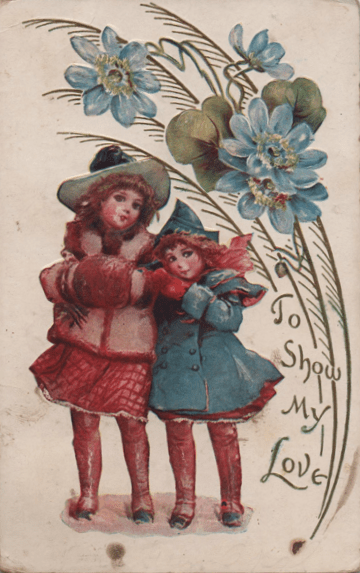
     Moving to another place with the seasonal change was once the sole possession of the rich: kings could move to Winter Palaces or the landed gentry would shift their activities from their city homes to their country estates, where perhaps wood for the fireplace was cheaper because they owned the trees out there.  But as time passed, and particularly by the time the postcard was dominating our communications systems, developers had taught the lower classes that getting out of town was perfectly affordable.

     There were many reasons to accept this opinion.  Getting down into the warmer climes meant enjoying the warm sun (we thought that was healthy in those days) and seeing a few sights you wouldn’t see at home.  So the trip would be good for you both physically and intellectually.

     And then there was the luxury of dining on foods you couldn’t find at home (along with the expectation that you would have to do none of the cooking or dishwashing while you were at it.)

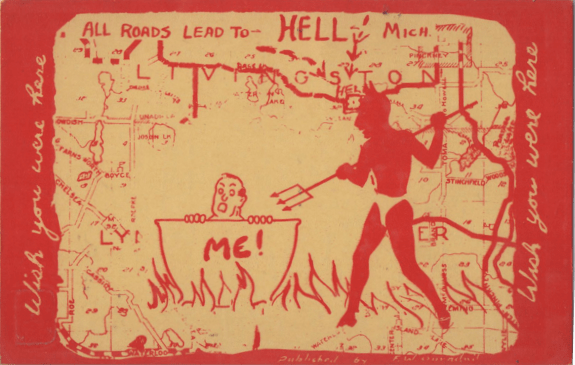
     But the MAIN reason to become a Snowbird and migrate south for the winter was the thrill of sending postcards to say “I’m down here!  And YOU aren’t!”

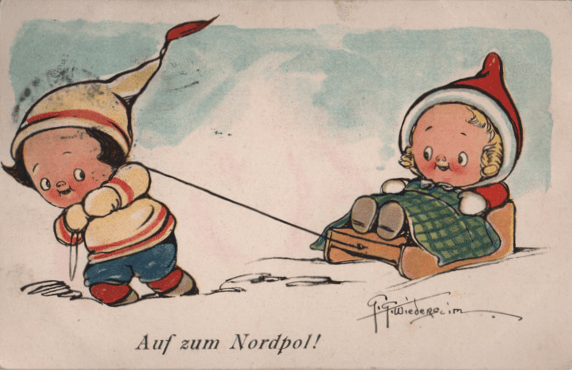
     Now in lands where the change of the seasons is really obvious, we have winters which are short of snow.  Droughts are not unknown in January and February.  But on postcards from Snowbird Lands, the north never sees a snowfall of less than eight inches, generally with high winds.  (Wind chill hadn’t been named yet, but we knew what it was.  Also note that on postcards, no matter how cold and snowy it may get, the pinup girls seldom wear much on their legs.  Only men wear boots.  Ah, didn’t notice him until I mentioned him, did you?  That’s my point.)

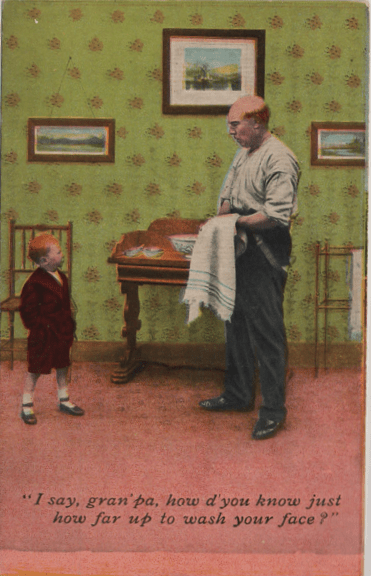
     And houses in the North lack any sort of central heating.  (Mind you, in the days before central plumbing OR central heating, when a bedroom included a basin of water for washing your face in the morning, it was necessary to break the crust of ice on top to get the sleep dust out of your eyes.  Postcard artists, always the traditionalists, kept northerners in this sort of home well into mid-century.)

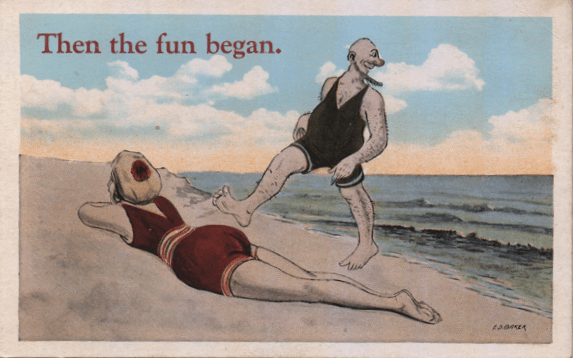
     This card from the Fifties actually rubs it in from two different directions.  Not only do YOU, up North, have to shovel to get to work, but YOU have to go to work, while I lie out on the beach all day.

     There were only two ways for the person stranded in the snow to fight back.  One was to take a vacation later in the winter and send such postcards to their friends who had returned to Snow and the City.  The other was to wait until summer and send one of these.

Screen Scrooges: The Founder of the Feast

     Scrooge bent before the Ghost’s rebuke, and trembling cast his eyes upon the ground.  But he raised them speedily, on hearing his own name.

     “Mr. Scrooge!” said Bob; “I’ll give you Mr. Scrooge, the Founder of the Feast!”

     “The Founder of the Feast indeed!” cried Mrs. Cratchit, reddening, “I wish I had him here.  I’d give him a piece of my mind to feast upon, and I hope he’d have a good appetite for it.”

     “My dear,” said Bob, “the children; Christmas Day.”

     “It should be Christmas Day, I am sure,” said she “on which one drinks the health of such an odious, stingy, hard, unfeeling man as Mr. Scrooge.  You know he is, Robert!  Nobody knows it better than you do, poor fellow!”

     “My dear,” was Bob’s mild answer, “Christmas Day.”

     “I’ll drink his health for your sake and the Day’s,” said Mrs. Cratchit, “not for his.  Long life to him!  A merry Christmas and a happy new year!—he’ll be very merry and very happy, I have no doubt!”

     The children drank the toast after her.  It was the first of their proceedings which had no heartiness in it.  Tiny Tim drank it last of all, but he didn’t care twopence for it.  Scrooge was the Ogre of the family.  The mention of his name cast a dark shadow on the party, which was not dispelled for full five minutes.

     After it had passed away, they were ten times merrier than before, from the mere relief of Scrooge the Baleful being done with.  Bob Cratchit told them how he had a situation in his eye for master Peter, which would bring in, if obtained, full five-and-sixpence weekly.  The two young Cratchits laughed tremendously at the idea of Peter’s being a man of business; and Peter himself looked thoughtfully at the fire from between his collars, as if he were deliberating what particular investments he should favour when he came into the receipt of that bewildering income.  Martha, who was a poor apprentice at a milliner’s, then told them what kind of work she had to do, and how many hours she worked at a stretch, and how she meant to lie a-bed tomorrow morning for a good long rest; tomorrow being a holiday she passed at home.  Also how she had seen a countess and a lord some days before, and how the lord was “much as tall as Peter”; at which Peter pulled his collars so high that you couldn’t have seen his head had you been there.  All this time the chestnuts and the jug went round and round; and bye and bye they had a song, about a lost child travelling in the snow, from Tiny Tim; who had a plaintive little voice, and sang it very well indeed.

     There was nothing of high mark in this.  They were not a handsome family; they were not well-dressed; their shoes were far from being water-proof; their clothes were scanty; and Peter might have known, and very likely did, the inside of a pawnbroker’s.  But they were happy, grateful, pleased with one another, and contented with the time; and when they faded, and looked happier yet in the bright sprinklings of the Spirit’s torch at parting, Scrooge had his eye upon them, and especially on Tiny Tim, until the last.

     The screenwriters often move this scene around, or combine it with the “God bless us” toast, but few omit it entirely.  There’s too much going on.  Mrs. Cratchit gets her big speech (and Dickens indulges a practice for making women the voice of reason in this story)  Our opinion of Bob Cratchit as one of those “No, everything’s all right, really” sort is confirmed.  And we get to twist the knife just a wee bit more in Ebenezer Scrooge.

     Hicks has the dialogue much as written.  The toast is drunk with no great willingness.  Tiny Tim, at request, sings “Hark! The Herald Angels Sing”, since the experts have never quite figured out what song Dickens had in mind when he wrote the passage.  (Still, there are so many songs about children lost in the snow/forest/jungle/big city/darkness/high weeds that it might be a version of any of those.)

     Owen accomplishes a major shift by having Mrs. Cratchit propose the toast to Mr. Scrooge.  “And here’s to next Christmas, may it bring us luck.  And may Mr. Scrooge give your father a raise!”  Martha and Bob, the only ones who know Bob has been sacked, look somber.  “And a merry Christmas to Mr. Scrooge!” Nob says, “I can drink to that.”  Scrooge is much abashed by all this.  “And now a story!”  Bob prepares to tell the children a story; Scrooge is eager to hear it.  “It’s about Aladdin!” he tells the Ghost, “And the magic lamp!”  After some coaxing, the Ghost is able to tear him away.

     In Sim I, Peter brings in the gin punch, and has some actual lines.  We hear the bit about Peter’s possible job.  The “God bless us” toast make Scrooge look rueful; his face really drops when the next toast is proposed, even before the family starts to boo and shout objections.  Thoroughly miserable, he turns to go, but the Ghost stops him.  The speeches are delivered more or less as written, and the lack of enthusiasm when the toast is finally drunk is obvious.  The scene fades in smoke.

     March omits this toast.

     Magoo pushes this scene to the very end, just before Scrooge appears, in the flesh, at the Cratchit household.  Some of the dialogue is omitted, but the toast is drunk with a thorough lack of enthusiasm.  Bob reproves the children, asking them to do justice to the day and to this marvelous turkey they are about to eat (having no idea that the reviled Founder of the Feast sent it.)

     Haddrick keeps the dialogue as written through “My dear!  Christmas Day!” when Bob adds “I’m sure Mr. Scrooge is a good man under hs hard front.  After all, he is a businessman.”  “And his business is making people unhappy,” comes the reply.  Then Mrs. Cratchit delivers her line about Scrooge being very merry and very happy, she’s sure.  “Are you very merry and happy?” the Ghost asks Mr. Scrooge.  “After that, I have cause to be.  But I’m not.”  “Why is that so?”  Scrooge explains he is unhappy for worrying about Tiny Tim; he now inquires about the boy’s future, as explained in the last chapter.

     Sim II omits the scene.

     In Finney, Bob toasts Tiny Tim for the fortune he’s made caroling, and joins this to a toast to Mr. Scrooge, naming them as the two individuals whose industry and generosity have provided the feast.  Mrs. Cratchit and the others thump their cups on the table, refusing to drink the toast.  “What are you trying to do?” Mrs. Cratchit demands, “Ruin our Christmas?”  “But his money paid for the goose, my dear.”  “No, YOUR money paid for the goose, my dear.”  “But he paid me the money.”  :because you earned it.”  She points out that Bob hasn’t had any raise in eight years.  “My dear, Mr. Scrooge assures me times are hard.”  “For you they are, not for himself.”  Bob, digging in his heels, insists, “Nonetheless, he is the founder of our feast and we SHALL drink to him.”  Mrs. Cratchit is not intimidated.  “The Founder of the Feast indeed!”  We return to our regularly scheduled dialogue through “My dear!  Christmas Day!”, with a modest embellishment in her opinion that a piece of her mind would give Mr. Scrooge indigestion for a month.  She finally turns to the others and announces, “Children, we shall drink to your father and Tiny Tim.  And for the sake of your father, I’ll even drink to that old miser Mr. Scrooe.  Long life to him and to us all.”  “A merry Christmas to us all.”  Now we can move to the God bless us every one toast, and the song “The Beautiful Day” from Tiny Tim.

     Matthau omits the scene.  It exists in McDuck only as the mournful look on Mrs. Cratchit’s face when Tiny Tim suggests thanking Mr. Scrooge for all the wunnerful food.
     Scott seems impatient to leave; when the pudding has arrived and been approved by the head of the household, he is glad to be finished.  The Ghost detains him.  “Just one more ceremonious moment.  Look!”  Bob kisses his wife under the mistletoe, and then proposes a toast to Mr. Scrooge, the Founder of the Feast.  The children rise slowly to drink it, and Mrs. Cratchit sits down hard, to deliver the “Founder of the Feast indeed!” speech.  “My dear, have some charity.”  She thinks this over.  “Very well, I’ll drink his health for your sake and the Day’s” and so forth.  Everyone drinks as if they are imbibing some vile medicine.  Scrooge points out that Bob made a good point: without him, there would have been no Christmas feast.  “My head for business furnished him employment.”  “Is that all you’ve learned by watching this family on Christmas Day?”  “No.  Not all.  But one must speak up for oneself, for one’s life.”  The family have a better time with the toast out of the way, and start singing “The Wassail Song”.  “We have some time left,” says the Ghost, “Tale my robe.”  They look toward the window, and a bright light.

     Caine hears Bob say “Mr. Scrooge,” and walks through the wall to answer.  Bob is proposing thr toast; his wife objects, going on to say “I would give him a piece of my mind to feast upon, and I bet he would choke on it.”  “:Choke!” agree Bettina and Belinda.  “My der.  The children.  Christmas Day.”  Mrs. Cratchit is a bit flustered at having vented unpleasant opinions on Christmas Day.  “Oh.  Well, I suppose that on the blessed day of Christmas, one must drink to the health of Mr. Scroooooooge, even though he is odious.”  Belinda and Bettina nod.  “Stingy.”  Bettina and Belinda nod.  “Wicked.”  Bettina and Belinda nod.  “And unfeeling.”  Bettina and Belinda nod.  Scrooge looks up anxiously at the Ghost.  Mrs. Cratchit goes on, “And badly dressed.”  Bettina and Belinda gasp in horror at how far their mother is going.  “And….”  Tim breaks in with “To the Founder of the Feast!  Mr. Scrooge!”  His mother relents.  “To Mr. Scrooge!  He’ll be very merry and very happy, I have no doubt.”  “No doubt!” snap the twins.  “Mmmm,” says their father, not perfectly convinced of the sincerity of the toast.  “Cheers.”  Now Tiny Tim sings “Bless Us All”; the family chime in.  Tim ends with a coughing fit, badly frightening Scrooge.  The Ghost draws him away, and Dickens reads us the closing line of the text.
      Curry has the toast to Mr. Cratchit, and then a toast to Mr. Scrooge, which becomes an excuse to reprise the song “Random Acts of Kindness”, this time phrasing it to explain how much happier we are with each other than Scrooge is with all his money.  Scrooge grumb;es, “I provide them with an income, and this is how they treat me.”

     Stewart begins with Bob proposing the toast; Mrs. Cratchit is stunned.  “Did you say Scrooge, Founder of the Feast?”  “Well, my dear….”  The written dialogue appears now, starting with “Founder of the Feast indeed!”; Bob recoils under the impact of “odious, stingy” and the other adjectives.  When convinced to go ahead with the toast, Mrs. Cratchit rushes through the words to get them out of her mouth all the faster.  “A nice gesture,” the Ghost remarks, But Mrs. Cratchit hasn’t finished.  “He’ll be about as merry as a graveyard on a wet Sunday.”  The Ghost laughs; Scrooge is offended.  Tim sings “Silent Night”; his brother looks grave.  The Ghost draws Scrooge outdoors.

Playing It Safe

     It is one thing to shout a warning to someone you see walking into danger.  That is an understandable, almost automatic response, whether the person is about to step into a manhole or mail a few thousand dollars to someone who has a real deal to offer on oil-rich property at an undisclosed location.  Once you’ve done it, you’ve done your duty, whether the person pays attention to your warning or not.

     Warning someone that they’re being too cautious, and need to walk into danger they’ve already spotted is another matter.  You will not be thanked for trying to break someone’s instinct for safety, and, after all, if they turn out to have been right, and you have advised them to be reckless, you will hardly be thanked for your advice.

     I have written before about a friend of mine who has moved from this plane of existence, as another friend likes to put it.  When alive, no one was more organized or businesslike than she.  That her carefully thought out plans never seemed to work she attributed to corruption in government or incompetence on the party of her partners.  She had a gambler’s sensibility, though.  If you lose, you shrug and go on to the next game.

     She spent years and numerous dollars setting up her syndicated radio show.  She had a great idea for a show, and had signed up thirty or forty artists to appear on it.  And she took no risks: not for her the idea of doing her show online: the Internet was full of scoundrels and not safe.  She would stick to good, reliable radio.  And, to make even more sure she would deal only with honest, upstanding souls who would realize the true value of her program, she offered it (at a minimum three million dollar contract) to college radio stations.

     Incredibly, she found an interested party in her hometown.  The University of Chicago considered her ideas intriguing, and invited her in for an interview to talk things over.  She turned them down.

     She explained to me that what they wanted was simply not safe.  Her father had always told her a white woman should not venture into the South Side of Chicago.  And Hyde Park was definitely South Side.

     “That’s true,” I told her.  “The University kidnaps white women and forces them to work as philosophy majors.”  She laughed at this, as well as my other warnings, and went on with her own business plan.  She died far too soon, and I believe she left her contracts and sample radio programs to the University of Chicago.  (I hope someone there realized not ALL of the painstakingly prepared demo discs were blank; she did learn how to work the computer the second year of her campaign.)

     Another friend of mine, who lectured the Chicago School Board on how to spell “CAT”, had a plan for revolutionizing the world of education.  She wrote a number of articles on her ideas (one of which she handed off to Barack Obama during one of his campaigns) and worked for a long time on a book which would spell out her theory of how children learn to read.  I was dubious about her basic principles, but had to admit they were worthy of publication.  She appreciated my support, but this did not extend to my advice on publishing her pioneering work.

     “I’ll have to publish it myself,” she told me more than once.  “It’s a book that will make every other textbook on teaching obsolete.  So if I offer it to a textbook publisher, they’ll buy it just so they can hide it somewhere in a back room and not threaten their own income.”

     Turns out she had also picked this up from her father, who had told her of a friend of his who invented an automobile engine which did not require gasoline to run, so a petroleum company bought up the rights to the invention and then suppressed it.

     But she had her whole campaign planned out, even to how she would promote it.  She would go from talk show to talk show with her book, promoting her message and….  But later, she decided even that wouldn’t work.

     “Oprah would never want someone like me on her show,” I was told.  “She doesn’t really want to cause controversy.”

     I am seldom rendered speechless for very long, and when I got my breath back, I objected.  Like my other friend, she just nodded kindly, knowing I had no idea how the wicked world worked.  And, like my other buddy, she died too soon, without seeing her dream turn to reality.

     In both those cases, the dream may have been better than reality; my warnings might have brought only trouble.  I do not remark about self-sabotage from some smug sense of superiority.  Have I ever told you about my first day of classes in college, when a young lady came over to chat and leaned WAY over my desk, so that I could see that under that light summer dress, she was pretty much barefoot all the way from Dan to Beersheba?  She said we’d met before and should get together later and talk over old times.  My reply was noncommittal, and somewhat incoherent.  This sort of thing as not part of my plan for college.

     I still think there was trouble ahead.  But if…oh, well.  Couldn’t have blogged about it anyhow.

Puzzlements

     The thing about the fine old jokes found on aged postcards is that some of them have become obscure with the passage of time.  Sometimes even a dedicated comedy archaeologist has trouble getting to the bottom of things.  One of my readers made a comment about piling something or other higher every time I explain things, but I think I got a garbled version of his message.  Maybe he sent the email by a party line.

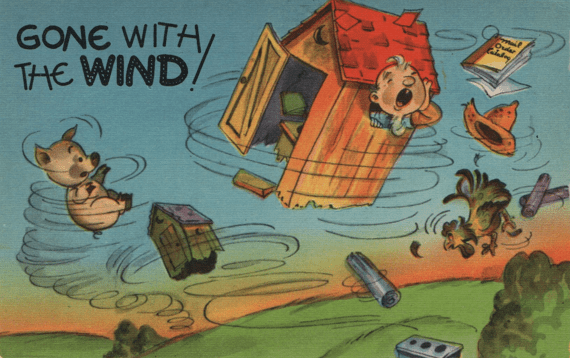
     Some cards involve mere temporary bewilderment.  The postcard at the top of this column is pretty straightforward.  My only complain is that the phrase, as I have always heard it, was “between you, me, and the fence post.”  I feel the cartoonist just decided drawing a row of lamp posts took less time than drawing a fence, AND made it easier to show a dog on each side.

     This one is a similar matter of phraseology.  A very quick hunt on the Interwebs shows me that the phrase I know “Broke But Happy” seems to be a generation or so younger than “Happy But Broke.”  I wouldn’t mind researching further, and discussing with you exactly what this says about the difference between the attitudes of people on each side of the Great Depression (if that IS the border between the two) but gosh, there are only so many hours in the day.  Anyhow, I polled a couple of readers like the one above, and got a unanimous response that they’d gotten along this far without the knowledge and would struggle on a while longer if I felt I could use my time more wisely finding a way to get AI to write these…but the messages got garbled again at that point.

     Now we arrive at the real puzzles.  I was a little unsure of why you would send this card to anyone, but in hunting through the Interwebs, I found two completely different postcards, each using this same text, and another which said “Nobody Knows Everything.  Don’t Try to Be an Exception.”  This tells me that this must have been a catchphrase (or meme, as young’uns on the Interwebs put it) around 1910.  So many similar sentiments exist, though, that hunting this one down proved fruitless.  SOMEBODY used this in a speech, song, or stage presentation, but unless someone can provide me with another clue, I’m stuck.

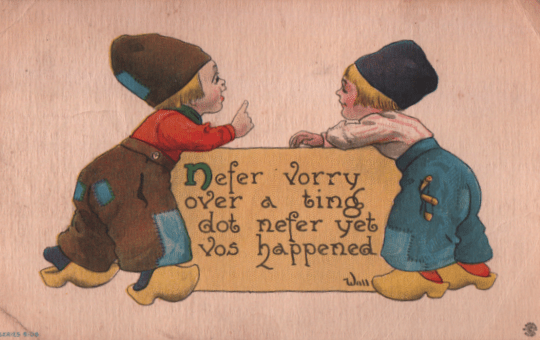
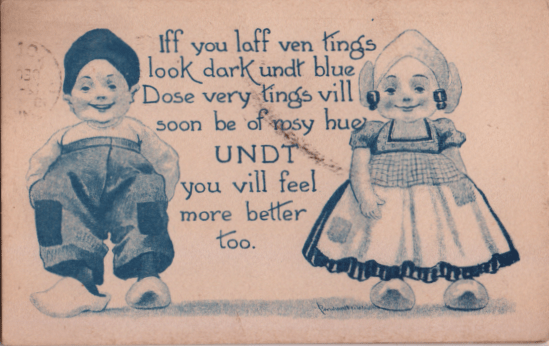
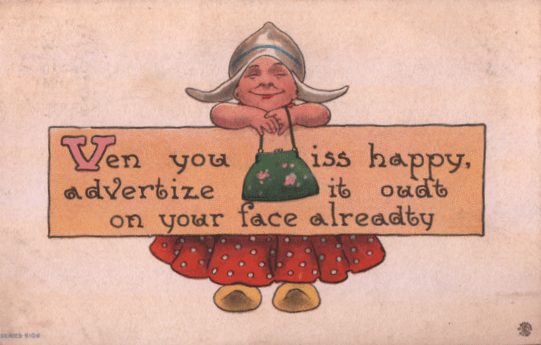
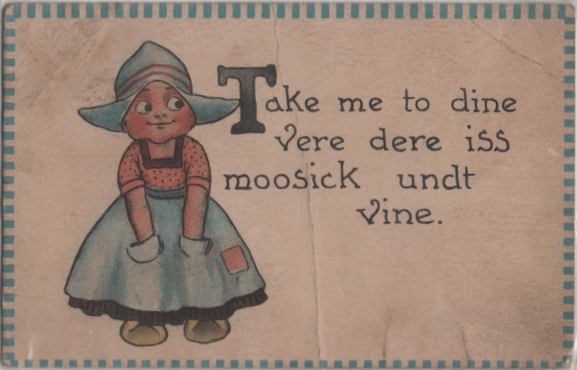
     We’ve mentioned the Dutch kids often, and the way their accent could make any observation cute or wise.  I can’t work my way around the Pennsylvania Dutch of this statement, though.  Are we COMPLIMENTING whatever town gets written into the banner, or insulting it?

     The kid on the right in this British postcard seems disgusted.  Does he hate the beach and wish he was back in the classroom conjugating Latin verbs?  Or is he grouching that today’s his last day at the beach and he has to go back?

     Is it just me or is this….  See, a dog sniffs things to check, basically, who else has urinated there, and deduce what he can.  So if this pooch is sniffing around to find out how I am, is the implication that…just me?  Okay, sorry.

     It seems a little late for this child’s bedtime, and she seems to be coming DOWN the stairs anyhow.  But ten seems rather late for her to be getting up.  And that “Papa says” seems to be lending a little doubt to the time indicated.  What’s the gag?  Nice picture of the phone, though.  (Did she maybe get a phone call from Papa, who is in some other time zone where it IS ten o’clock?  Yeah, that’s a long reach.)

     And this is a cow.  This is a cow that looks like something I would have photographed in my first days with a camera: why put such a crummy photo on a postcard?  And why oh WHY couldn’t somebody have written something on the card so we would know why and when and where it was necessary to photograph this particular…yeah, that one’s not answerable at this point.  Anyhow, it’s a cow.

     Anyone with suggestions about the answers to these questions may comment in the space provided.  Be wary of how you express yourself, as a mad message garbler seems to be invading a LOT of the glowing reviews I get on this column.

Screen Scrooges: Tiny Tim

      He sat very close to his father’s side, upon his little stool.  Bob held his withered little hand in his, as if he loved the child, and wished to keep him by his side, and dreaded that he might be taken from him.

     “Spirit,” said Scrooge, with an interest he had never felt before, “tell me if Tiny Tim will live.”

     “I see a vacant seat,” replied the Ghost, “in the poor chimney corner, and a crutch without an owner, carefully preserved.  If these shadows remain unaltered by the future, the child will die.”

     “No, no,” said Scrooge.  “Oh no, kind Spirit!  Say he will be spared.”

     “If these shadows remain unaltered by the Future, none other of my race,” returned the Ghost, “will find him here.  What then?  If he be like to die, he had better do it, and decrease the surplus population.”

      Scrooge hung his head to hear his own words quoted by the Spirit, and was overcome with penitence and grief.

     “Man,” said the Ghost, “if man you be in heart, not adamant, forbear that wicked cant until you have discovered What the surplus is, and Where it is.  Will you decide what men shall live, what men shall die?  It may be, that in the light of Heaven, you are more worthless and less fit to live than millions like this poor man’s child.  Oh God!  to hear the insect on the leaf pronouncing on the too much life among his hungry brothers in the dust!”

      And here we smack Scrooge right between the eyes.  In most versions, the Ghost doesn’t come right out and give the message as “You don’t care what happens to other people; this is what ha[p[pens to other people.  Of you hadn’t been obsessed by on taking care of yourself, this odd and thoughtful child might not be near death.”  In some versions, to be sure, we give another twist of the knife by making Tim the only one aside from Bob to stick up for Scrooge during the Toast.  (To do that, of course, they have to put the next segment before this one.)

     Hicks watches Tim lean on the crutch, looking up at Bob.  “Spirit, tell me that Tiny Tim will live.”  The conversation continues much as written; when Scrooge recognizes the quote, he murmurs “Me own words.”  The Spirit goes on with that magnificent final speech, but leaves out the insect on the leaf image.

     Owen puts this scene before dinner.  He asks about Tim, is answered, and says “No, no: surely he’ll be spared.”  “With the kind of care that money could buy, who could tell?  But Bob Cratchit has no money.  Not even a position, I’ve heard.  If all this remains unaltered by the future, next Christmas will not find Tiny Tim here.”  Scrooge then hears himself being quoted, and turns to stare at the Spirit.

     Sim I puts this all between church and dinner, presenting it much as written, except that the Spirit does not repeats the line about shadows being unaltered, as he does in the text.  He merely asks, “Why?  If he be like to die, he’d better do it, and decrease the surplus population.”  Scrooge’s head jerks on recognizing this remark.

     March has to nag to get an answer.  “Will Tiny Tim live?”  “My life on this globe is very brief; it ends tonight.”  “Will Tiny Tim live?”  “I see a vacant seat in the poor chimney corner, and a crutch without an owner, carefully preserved.  These shadows may be altered only by the Spirit of the Future.”  “Well, where do I find the Spirit of the Future?”  “Look within yourself, for if you continue as you are, the answer is there before you.”  Scrooge thinks this over, but when he turns to ask a question, the Spirit is gone.  Scrooge, looking around, suddenly stops and stares straight ahead in horror.

     Rathbone asks, “Spirit, tell me if Tiny Tim will live.”  “I see an empty chair by the chimney corner.  If these shadows remain unaltered, no brother of mine will find him here.”  Scrooge protests, but the Spirit replies, “I am the Present.  I cannot answer for the Future.”  Scrooge is of a mind to argue, but the Spirit cuts him off by saying he has another house from Scrooge to see.

     Magoo demands, “What’s wrong with that boy, the tiny one?”  “I see a vacant seat in the chimney corner, and a crutch carefully preserved.  If these shadows remain unaltered by the future, the child will die.”  Scrooge has a flashback of himself delivering the “If they be like to die” speech.  This act of the play closes on this, and the curtain falls.

     Haddrick brings this in after the Toast.  “Yon child.  Tiny Tim.  Tell me if Tiny Tim will live.”  “I see a vacant seat in the poor chimney corner, and a crutch without an owner, carefully preserved.  If these shadows remain unaltered by the Future, the child will die.”  “Is there no chance he’ll live?”  “If these shadows remain unaltered by the Future, none other of my race will find him here.  What of it?  If he be likely to die, he had better do it, and decrease the surplus population.”  “You use my own words against me.”  “You used the words.  Only you can undo them.”  “There is nothing I can do.”  “There is.  But you’ll have to find out the hard way.”  “The hard way?”  “My time is nigh.  Come!”

     Sim II does not give us much of the Cratchits, but their financial situation is indicated by how much they are bundled up, even indoors; there is much coughing, too, though they’re right up next to the fire.  Scrooge, eyes cast down, asks if Tiny Tim will live.  The Ghost replies, also giving him a quick vision of the empty chimney corner.  Scrooge’s eyes widen.  “No no.”  “What of it?  If he be like to die, he had better do it….”  “Don’t!”  “And decrease the surplus population.”  He goes through the whole insect on the leaf speech, his eyes raised to Heaven, his voice one of sorrow.

     In Finney, the toast before this and the one after are combined and given first; Scrooge and the Ghost walk from the house.  “What an unpleasant child!” cries the Ghost.  “There are few things more nauseating to see than a happy family enjoying themselves at Christmas.  Do you not agree?”  Scrooges knows he is being baited, but responds, “I think Bob Cratchit’s really quite fond of me.”  “So’s his wife: couldn’t you tell?”  “She doesn’t really know me.”  “That is one of the few things wherein Fate has blessed her.”  Scrooge walks on before asking “What will become of the child?”  The Ghost stops.  “What’s this?  Concern over a sick child?  Have you taken leave of your senses?”  “Don’t mock me, Spirit.  Is the child very sick?  Not that it’s of any great importance to me whether he is or not, but is he?”  “Well, of course, he’s sick.”  “You mean he’s seriously ill?’  the Spirits answers with only a gaze of deep solemnity.  “Will he live?  Well, WILL he?”  “What does it matter to you, Ebenezer Scrooge?  If he is going to die, then he’d better do it, and decrease the surplus population.”  Scrooge does not reply.

     In Matthau, Tim, running to Martha with his toy soldier, trips and falls.  Scrooge cannot intervene, and becomes distraught at this.  “Is there no way I can help him?”  “It is, perhaps, too late.”  We break off here to take Scrooge to his nephew’s party, but we return later to the Cratchits’, where Scrooge asks “What of that other child, so tiny he seems little more than a babe himself?”  “I see a vacant seat in the chimney corner, and a little crutch without an owner, carefully preserved.”  “Oh, dear God, let it not be!”  Scrooge falls across the vacant seat, calling “This cannot be!”  “Why not?” says the Ghost, “Who cares?”  Scrooge is astonished by this, which leads to the song “One Little Boy”, in which the ghost argues the case for Tim’s demise, forcing Scrooge to retort that one life DOES matter.  There is a line about decreasing the surplus population, a line which Scrooge has not, in this version, actually uttered.  He does admit to having thought it, though, and is ashamed of it.

     In McDuck, Tim, still looking at all the food, says “We must thank Mr. Scrooge.”  Mrs. Cratchit looks sorrowful, but says nothing.  “What’s wrong with that kind lad?”  “Much, I’m afraid.  If these shadows remain unchanged, I see an empty chair where Tiny Tim once sat.”  Tim, having observed that his father’s plate is nearly empty, offers some of his own food.  “You mean…Tim will….”  But the Spirit has vanished.  Scrooge cries out to him, demanding to know more about Tim.

     Scott steps to the table to peer at Tim as the boy eats.  The dialogue proceeds much as written, save that the Ghost sees “an empty seat at this table.”  Scrooge smiles a bit on hearing himself quoted, and says “You use my own words against me.”  Nodding, the Spirit laughs and replies, “Yes.  So perhaps in the future you’ll hold your tongue.”  He delivers a fierce “insect on the leaf” speech.

      In Caine, we get the Toast first, and the song “Bless us All,” closing i=with another of Tim’s coughing fits.  “Spirit, tell me if Tiny Tim will live.”  “That is the Future.  My realm is in the present.”  The Ghost speaks with an effort, he is already going gray.  “However, I see a vacant seat by the chimney corner, and a crutch without an owner.  If these shadows remain unaltered, I believe the child will die.  But what then?  If he is going to die, he had better do it, and decrease the surplus population!”  Scrooge turns, with a stricken, “Oh, Spirit!”  He turns to look with fear at the Cratchits again.  Dickens himself then gives us the paragraph (yet to come in the text) which closes the Cratchit section of the book.

     Curry also has the Toast first.  While the rest of the family clears the table, Tim hobbles to the fire and picks up a copy of Robinson Crusoe.  “Look familiar?” asks the Ghost.  Scrooge sees a vision of himself as a child.  Bob and his wife now go through the material about Tim hoping the people saw him in church ending with “People would be thankful for their good fortune.”  Scrooge murmurs “I am.”  “What?”  Instead of answering the Ghost, Scrooge moves in to look over Tim’s shoulder, enjoying Robinson Crusoe with him.  “A remarkable boy,” he says, “But so frail.  Spirit, tell me if Tiny Tim will live.”  The Ghost grows grey.  “I see an empty seat in the poor chimney corner, and a crutch without an owner.  If these shadows remain unaltered by the Future, the child will die.”  There is a vision of the empty stool.  “Oh no, Spirit!  Tell me he will be spared!”  “Well, if he’s going to die, he had better do it, and so decrease the surplus population, right?”  “I didn’t mean….”  “Next time,” the Ghost instructs him, “Find out who the surplus is.  Remember, Scrooge, no one is worthless or unfit to live.”  The “God bless us, every one” toast comes in here, and Bob observes how glad he is to be in the bosom of his family.  Scrooge mourns, “I wish I had a family to be with.”  The Ghost says he does, silly man, and whisks him to Fred’s party.

     Stewart, having asked earlier if Tiny Tim would live, watches him drink the “God bless us every one” toast and demands, “Is there no chance that the boy will be spared?”  “Not if the future remains unaltered.”  “Hmmmmm?”  “But so what if it happens?  If he is going to die, he had better do it quick, and decrease the surplus population.”  Scrooge pulls himself up on hearing the quote, and takes it like a boy being scolded.  The Ghost delivers the “Insect n the Leaf” speech with real feeling.

FUSS FUSS FUSS #15: When Does the Old Man Melt?

     When does the power of Christmas to make us feel for others infect Scrooge?  The textuial Scrooge shows signs of softening early on, at his old school.  The fact that he weeps for the young Ebenezer hardly counts: he is, after all, just feeling sorry for himself.  But at the end, when he is wishing he had given the caroler at his door something, he is obviously picking up an idea.  By the time he meets Christmas present, he admits it, and Dickens observes that this is a humbler Scrooge than before.

     Filmmakers often alter this.  Obviously suspense will grow if Scrooge keeps refusing to listen.  This does run the risk of making audiences feel that the only thing that matters to the old geezer is the sight of his own tombstone.

     I have listed our Scrooges in the order they thaw.

     Curry, an especially hardhearted old miser to start with, wishes he’d been kind to the caroler.  He backslides a bit later, it is true, but the change has started.  The later visions seem to be working at his grumpiness as much as anything else.

     Hicks is very meek on meeting Christmas Present, actually using the line about Christmas past having taught him a lesson which is working in him now.

     Sim I is thawed by the visions of the past, but becomes despondent, frequently noting that he is too old to change his ways.

     Sim II is similarly very meek when he meets Christmas present, admitting the Ghost may have something to teach him; Rathbone is similarly inclined.

     Caine weeps during the breakup scene with Belle, and is hardly the same person afterward.  He laughs cheerfully with the Ghost of Christmas present, and admits that he may not have understood about Christmas.  The Cratchit dinner completes the change.

      Whenever Owen shows signs of relenting. Christmas Past pushes matters too far, freezing him up again.  He seems to understand that he has changed for the worse, and utterly refuses to look at any more visions of his past.  The Ghost of Christmas Present, a little less likely to lecture, accomplishes the transformation.

     March shows few signs of melting beyond enjoying the Fezziwig party, and Christmas present’s song.  He is not rendered wholly human until Tiny Tim’s song at the Christmas table.

      Magoo, merely puzzled by the Cratchits’ happiness, also seems to wait for Tiny Tim to convince him.

      Matthau, seeing Tiny Tim fall, rushes to catch him, showing that he has thought for others by now.  The recollection of his unkindness to Fred reduces him to tears.

     McDuck seems merely to regret his past, feeling sorry for himself.  But his concern for Tim’s future means, when he finds himself abandoned by the Spirit and standing in the snow while wearing only his nightshirt and slippers, he is more distraught about Tim’s situation than his own.

     Finney does wish he’d given the carolers something, but the sense of guilt makes him colder and grumpier.  He smiles while under the influence of the Milk of Human Kindness, but goes on snarling at the world and at Christmas.  Fred’s Christmas party is what makes the difference; he seems honestly to be considering what he “might have shared, and turned to happiness”.  His genuine regret when the Ghost of Christmas present departs indicates that he now attaches some importance to the holiday.

     Stewart is troubled by the visions of the past, particularly what they mean to his treatment of Fred, but he hasn’t especially changed.  He allows that he was happy with Belle, and at Fezziwig’s, but time changes people and those old days are gone now.  He greets Christmas Present as an unpleasant ordeal to be gotten through.  Fred’s Christmas party is what really starts to warm him up; the games and his sister’s favorite tune show Christmas to be of some value.

     Scott LEARNS things as he goes along but treats his experiences as information to be added to his knowledge of the world, not reasons for changing his philosophy or world view.  He declines even to admit he might have made some mistakes until he is abandoned by Christmas present.

     Haddrick shows not the slightest sign of relenting before he asks about Tim; he softened not a jot in the past, considering everyone he saw there, including himself, as a fool.  The Ghost of Christmas present ends by being disgusted with him (though he is at least thinking about things he never thought of before) and it takes the idea of dying unmourned to really melt THIS Ebenezer.

INTERLUDE

     In Matthau, Tiny Tim, having recovered from his stumble, tells Martha about the children next door, who claim there is no Santa Claus, and say his wooden soldier is no more than a clothespin his father painted.

     Martha sings “Yes, There Is a Santa Claus”, heavily inspired by “Yes, Virginia, There Is a Santa Claus”.  We watch the ghost of Christmas present turn into Santa Claus.  (We also see bob Cratchit painting the clothespin.)  Mrs. Cratchit brings the dinner into this with “And yes,  there is a goose”.  Later, there is a toast, with glasses of punch, ending with “God bless us, every one.”

Marking the Cards

     As you will recall from our last thrilling episode, we were discussing why postcards go about with their identity emblazoned on them.  My theory is that this derives from the late nineteenth century weirdness that had the U.S. Post Office selling Postal Cards while private publishers sold Private Mailing Cards or, as they came to be known, Post Cards.  This lasted for half a dozen years, and the laws and prices (Postal Cards were mailed for less because you had already paid the Post office a penny to buy them) but postcards went on being labelled even after Postal Cards and Private Mailing Cards faded into the past.  (There WAS a tendency among the public, which picks its own language, to refer to all these kinds of cards as “Postals” but this will send us down a whole new rabbit hole.)

     In any case, publishers of postcards realized that as long as they ;eft plenty of room for an address, and reminded people that any message had to be on the other side, they could decorate the address side any way they liked.

     The variety of ways of simply writing “Postcard” at this point is limitless.

     And some cards wound up with nearly as much picture on both sides (since the other side had to leave room at the side for the message.  Remember this; it is coming back into the plot later.)

     Some postcard company mascots were at least as interesting as the picture on the other side, too.

     You will remember, of course, Walter Wellman, a maverick artist who published his own cards, and the heavy-haired lady he liked on the address side.  As you will notice, however, this came AFTER the next big change in postcard regulation.

     From 1901 to 1907, U.S. postcards were of what is called the “undivided back” variety, because the law required that the address be prominent and easy to read and separated by the card from any message.  In 1907, though, the United States, finding that other countries did perfectly all right with cards that were all picture on one side, with message and address on the other (some countries issuing these cards in fact note that these could not legally be mailed in the United States), changed the rules.  Now postcards had to teach the senders how to do things all over again.

     Some senders never did get the hang of it, and, at first, many postcard companies adhered to an early draft of the law, which required that the message be just a teeny part of this side of the card.

     Other companies, realizing how much space they had to play with, found space for increasingly interesting trademarks.  This B was made famous by Bamforth, of Holmfirth, Yorkshire and New York, New York.

     AH would later moderate the size of its trademark, so people with a lot to say would buy their cards.

     The Fairman Company popularized its pink (a carnation, if you remember the flower language episodes of this column.)  Valentine used a globe (to show how their cards showed so many parts of the planet.)  William Wellman, as seen above, had his pompadour.  Other companies, long-lived or brief flashes, had their marks and logos (and, often, a unique typeface for the words “Post Card”.)

     Raphael Tuck & Sons liked to get their names in several places on the address side, along with some of the beginnings of the informational paragraph about the picture side.

     This led, of course, to cards with almost no space again for a message on this side.  But that phenomenon goes on to this day and is, thus, a whole nother blog.

Calling the Cards

     When we mail a letter, we do not have to write LETTER on the envelope.  Our packages may have notes on them about Media Mail or International Ground, but we don’t need to label them PACKAGE.  Still, postcards go right on explaining to people what they are, with the word POSTCARD (or sometimes the words POST CARD.  But that’s a whole nother blog.)

     It was not always thus, as can be seen from this advertising postcard from 1894 or thereabouts.  A card could be plunked in the mail and left to the wise decisions of the U.S. Post Office.

     This was way too simple for the government, however, and in 1895, a law was past allowing people to send postal cards OR private mailing cards.  (This one, from 1915, is from long after most of us stopped using Private Mailing Cards, but some companies like to do things the same way year after year without a lot of contradictions or concerns.)

     A Postal Card was an official U.S. Post office publication, and cost a penny when purchased at your local post office.  This covered the price of the card AND postage, whereas a Private Mailing Card (or Post Card, as it came to be known, in the belief that someone at the post office would be able to tell the Post cards from the Postal cards) cost TWO cents.  This is the kind of strategic thinking which has made Congress the guiding light of American Wisdom.

     Postal Cards also came with the postage (which you’d already paid for) printed on it, which led to numerous designs honoring this or that president.  (This was at a time when most of our postage stamps had either Benjamin Franklin or George Washington on them, so it allowed for variety.)

     There were also special Postal Cards which could be purchased with prepaid reply cards, if you wanted to make sure your customers replied.

     OBVIOUSLY, to help the Post Office know what they were dealing with, U.S. Government Postal cards SAID they were Postal Cards, and Post Cards had to follow suit.  Since the postcard craze spread around the world in no time at all, and other governments were as picayunish as our own, some companies made sure their cards were labeled in more than one language.

     Ambitious companies going for wide international sales went further.  I think my record so far is one card which had the word in twenty-four different languages, an important thing in the era before World War I when a card might cross several different language areas without ever leaving, say, the Austro-Hungarian Empire.

     Other publishers went their own way.  Remember Dr. Mak, the multi-talented alphabet reformer who made his own postcards?  Well, he labeled his, but in accordance with his spelling regulations.

     I don’t know if “Special Post Card” was an official U.S. Post office category, or this whiskey company came up with the idea on its own.

     And, of course, there’s always somebody who doesn’t QUITE read the whole memo.  But this is why our postcards put their names on the front (You may remember that rule, too: according to the U.S. Post office, the front of a postcard is the side with the address on it.  Well, it’s the side THEY have to deal with.)

Screen Scrooges: The Cratchit Christmas Dinner

     “And how did little Tim behave?” asked Mrs. Cratchit, when she had rallied Bob on his credulity and Bob had hugged his daughter to his heart’s content.

     “As good as gold,” said Bob, “and better.  Somehow he gets thoughtful sitting by himself so much, and thinks the strangest things you ever heard.  He told me, coming home, that he hoped the people saw him in the church, because he was a cripple, and it might be pleasant to them to remember upon Christmas Day, who made lame beggars walk and blind men see.”

     Bob’s voice was tremulous when he told them this, and trembled more when he said that Tiny Tim was growing strong and hearty.

     His active little crutch was heard upon the floor, and back came Tiny Tim before another word was spoken, escorted by his brother and sister to his stool before the fire; and while Bob, turning up his cuffs—as f, poor fellow, these were capable of being made more shabby—compounded some hot mixture in a jug with gin and lemons, and stirred it round and round and put it on the hob to simmer; Master Peter, and the two ubiquitous young Cratchits went to fetch the goose, with which they soon returned in high procession.

     Such a bustle ensued that you might have thought a goose the rarest of all birds; a feathered phenomenon, to which a black swan was a matter of course, and in truth, it was something very like it in that house.  Mrs. Cratchit made the gravy (ready beforehand in a little saucepan) hissing hot; Master Peter mashed the potatoes with incredible vigour; Miss Belinda sweetened up the apple-sauce; Martha dusted the hot plates; Bob took Tim beside him in a tiny corner at the table; the two Cratchits set chairs for everybody, not forgetting themselves, and mounting guard upon their posts, crammed spoons into their mouths, left they should shriek for goose before their turn came to be helped.  At last the dishes were set on, and grace was said,  It was succeeded by a breathless pause, as Mrs. Cratchit, looking slowly all along the carving-knife, prepared to plunge it in the breast; but when she did, and when the long expected gush of stuffing issued forth, one murmur of delight arose all round the board, and even Tiny Tim, excited by the two young Cratchits, beat on the table with the handle of his knife, and feebly cried Hurrah!

     There never was such a goose.  Bob said he didn’t believe there ever was such a goose cooked.  Its tenderness and flavour, size and cheapness, were the themes of universal admiration.  Eked out by the apple-sauce and mashed potatoes, it was a sufficient dinner for the whole family; indeed, as Mrs. Cratchit said with great delight (surveying one small atom of bone upon the dish), they hadn’t ate it all at last!  Yet every one had had enough, and the youngest Cratchits in particular, were steeped in sage and onion to the eyebrows!  But now, the plates being changed by Miss Belinda, Mrs. Cratchit left the room alone—too nervous to bear witnesses—to take the pudding up, and bring it in.

      Suppose it should not be done enough!  Suppose it should break in turning out!  Suppose someone should have got over the wall of the back-yard, and stolen it, while they were merry with the goose: a supposition at which the two young Cratchits became livid!  All sorts of horrors were supposed.

     Hallo!  A great deal of steam!  The pudding was out of the copper.  A smell like washing-day!  That was the cloth.  A smell  like an eating-house, and a pastry-cook’s next to each other, with a laundress’s next door to that!  That was the pudding.  In half a minute, Mrs. Cratchit entered: flushed, but smiling proudly, with the pudding, like a speckled cannon-ball, so hard and firm, blazing in half of half-a-quatern of ignited brandy, and bedight with Christmas holly stuck into the top.

     Oh, a wonderful pudding!  Bob Cratchit said, and calmly, too, that he regarded it as the greatest success achieved by Mrs. Cratchit since their marriage.  Mrs. Cratchit said now the weight was off her mind, she would confess she had had her doubts about the quantity of flour.  Everybody had something to say about it, but nobody said or thought it was at all a small pudding for a large family.  Any Cratchit would have blushed to hint at such a thing.

     At last the dinner was all done, the cloth was cleared, the hearth swept, and the fire made up.  The compound in the jug being tasted, and considered perfect, apples and oranges were put upon the table, and a shovel-full of chestnuts on the fire.  Then all the Cratchit family drew round the hearth, in what Bob Cratchit called a circle, meaning half a one; and at Bob Cratchit’s elbow stood the family display of glass; two tumblers, and a custard-cup without a handle.

     These held the hot stuff from the jug, however, as well as golden goblets would have done; and Bob served it out with beaming looks, while the chestnuts on the fire sputtered and crackled noisily.  Then Bob proposed:

      “A Merry Christas to us all, my dears.  God bless us!”

     Which all the family re-echoed.

     “God bless us every one!” said Tiny Tim, the last of all.

     Dinner at the Cratchits’ was one of the high points of Dickens’s public readings of the Carol: audiences rose to their feet and cheered when the pudding finally reached the table.

     This sequence, and those which immediately follow, are frequently mixed, matched, and otherwise rearranged.  Film-makers want to move the story along, and we really CANNOT sit and watch the family devour an entire goose (not to mention the mashed potatoes and applesauce.)  You need “How did Tim behave in church?” at the start and “God bless us every one” at the end; since Tim is a hard act to follow, you can toss all the other Cratchit material in wherever it fits in between these.

     In Hicks, a knock on the door proclaims the arrival of the goose.  The children rush to it while Mrs. Cratchit ushers Bob to the fire.  She takes his comforter while Bob brings his slippers.  They discuss Tim’s behavior in church; both have to look away when Bob says he thinks Tim is growing stronger.  His wife replies, “I wish I could believe you, Bob, but I’m afraid.”  The goose is ushered in now by the little Cratchits.  “There never was such a goose!” Bob declares, “There never will be such a goose.”  Preparations move quickly while he predicts that its flavor will exceed all expectations.  He mentions the applesauce and the mashed potatoes, and the family set to.  The scene jumps to the end of the meal.  These are the least elegant Cratchits on film: a stubby candle sits on the table, and we watch one the girls wiping her mouth on the tablecloth.  ”And even now we haven’t eaten it all,” crows Mrs. Cratchit, tapping a bone on the platter.  They laugh.  Scrooge chuckles, which the Ghost observes.  “I envy them,” Scrooge admits.  Now Bob Notes “Regarding the momentous question: pudding.”  There is a tumult; he further observes that his wife looks pale, maybe, and nervous.  She says she prays all will be well with the pudding.  She and Tim go to fetch it while the other Cratchits clear away and wash the dishes.  Bob troubles the children with horrible suppositions regarding the pudding while Tim, in the next room, lights the brandy.  Bob dims the lights as the pudding arrives, flaming; he pronounces it a beautiful pudding.  “A Merry Christmas to us all,  my dears!” he exclaims, dishing it out.  “God bless us all!” cry his children.  “Good bless us all!” says Tim, who, exhausted by all this adventure, leans heavily on his crutch.  He raises his eyes to his father.

     In Owen, Bob and Martha have moved into the kitchen to mix the punch.  Martha senses something is wrong.  Closing the door so the others won’t hear, Bob admits that he has been sacked by Mr, Scrooge, but asks her not to mention it to her mother.  They move into a very well-appointed dining room, airy and nicely furnished.  Peter is sent for the goose, which shortly appears on the table.  Everyone eyes it hungrily; Tim can’t keep his hands still for all the excitement.  “There never was such a goose!”  Mother carves, and we fade to the finish of the meal.  “We haven’t eaten it all at last!”  Bob suggests the possible theft of the pudding as a joke to Tim; an anxious wait follows.  One of the girls give bulletins from the kitchen door; by the time the pudding arrives, Scrooge’s face is as alive with anticipation as any of the others.  Mrs. Cratchit serves the pudding around, taking none herself.  Martha forces a spoonful on her.  The Spirit repeatedly beams his light on the family.  The two toasts—blessing us from this segment and the founder of the feast from the next—are blended.

      In Sim I, we get a bit of Martha’s speech from the previous segment, and then the discussion of Tim’s behavior in church.  Immediately after Bob fails to convince himself that Tim is growing stronger every day, we insert the “Will Tiny Tim live?” sequence.  The arrival of the pudding is discussed; we then cut to the empty table and the punch.

      When March fades in at the Cratchits’, they are singing the Ghost’s song themselves, decorating their light, airy front room while preparing food.  Peter, a tall young man, is snitching bits of this and that; the goose is roasting on a spit.  They borrow the riddle game from Fred’s party; Scrooge plays along eagerly but is offended by the solution.  Bob repeats “He said Christas was a humbug!”  While the children finish trimming the Christmas tree, the parents discuss Tim’s behavior in church; Bob tries to convince himself “He’ll see many a Christmas after us.”  Mrs. Cratchit finds the cheer fantasy of this devastating; even Bob mutters “A few more shillings a week.”  Mrs. Cratchit tries to cheer him up, saying “A cheerful heart is the best healer.”  Tim sets the star on top of the tree and then sings “God Bless Us, Every One”.  Scrooge is transfixed.  (I hate to complain, by the way, but what in the WORLD is Tim wearing?)

     In Rathbone, all the Cratchit scenes are compressed into a kind of medley.  Bob sets Tim by the fire and compliments Martha on her mashing of the potatoes.  The Cratchits go into raptures at having a whole goose to themselves.  (The bird involved is the size of a modest chicken.)  Four of them pull up to the table now; Bob cries, “Three cheers for the Cratchits!”  They appear to have completely forgotten about Tim, who is still sitting by the fire, and now asks if he can come to the table.  Bob, unabashed, lifts the boy and brings him over.  Bob then says grace and suggests that God bless them; Tim augments the toast as in the text.

     Magoo’s Mrs. Cratchit brushes away a tear as Bob discusses Tim’s behavior in church.  The smallest of Cratchit dinners—basically bread and soup—is set out as everyone sings “Razzleberry Dressing” (officially known as “The Lord’s bright Blessing”.)  This is a rousing little number completely at odds with Dickens’s uncomplaining Cratchits.  (On the other hand, Dickens gives them more food.)  In any case, the young Cratchits are quickly convinced that being together is better than having a lot of stuff at Christmas.  The song concludes with a request that “God bless us, every one!”

     In Haddrick, Bob concludes the discussion of Tim’s behavior in church with “As good as gold.  He’ll see many a Christmas yet, I’m sure.”  Tim doesn’t look it; as Peter goes off with the two little Cratchits to fetch dinner, a fragile, dispirited Tim slumps by the fire.  Scrooge, meanwhile, asks how such a dull and rational fellow as Cratchit can become so irrational this night.  “He is with his family, and they make him happy.”  “They make him poor, that’s for certain.  But poverty seems to weigh light enough on him.”  “It’s Christmas!”  “But they have nothing to celebrate Christas wth!”  “It is the spirit of the evening that makes small things great and inadequate things seem beautiful.”  “I don’t understand you.”  “That is why you are here.”  Scrooge insists he need no such intangibles to make things meaningful.  “Now, take money…..”  “You do that often enough.  I don’t want to hear about it.”  The family sit down to what Scrooge has called a sad, inadequate dinner; his is now amazed to watch them enjoy it.  “Bless my soul!”  “That is our intention, Ebenezer Scrooge.  I think we may be achieving it.  Slowly.”

     Sim II gives us only the discussion of Tim’s behavior in church.  Scrooge lowers his eyes, abashed, at being reminded of who made lame beggars walk and blind men see.  We skip ahead to the family gathered around the fireside; Tim sings one line of “The Little Boy lost in the Snow” and then we bless us, every one.

     Finney watches the goose and the punch being prepared.  Bob is quite over the top enjoying the preparations; everyone else seems to enjoy how much he enjoys them.  The goose is not much larger than Bob’s two hands.  Tim and a brother return from carol-singing, having earned tenpence ha’penny.  Tim is toasted as a breadwinner by his father, which takes us to the next scene.

     In Matthau, Tim proceeds to a teeny Christmas tree and exclaims at Santa Claus’s generosity.  “Not at all like Mr. Scrooge,” says one of his sisters.  Everyone else boos at the mention of the name, but Tim tells them not to think unkindly of Mr. Scrooge: not at Christmas.  “Why not?  It’s his thinking that keeps us poor.”  Bob, skipping around in the text, joins Tim by saying “Now, Mr. Scrooge is the founder of the feast.”  “:Feast?” his wife demands.  “With a goose no bigger than a canary bird?”  Scrooge turns to the Ghost and demands, “Must I listen?”  :Surely you’re not surprised.”  Surprised or not, Scrooge is stricken.  “Oh, instead of docking Bob, why didn’t I give him exytra for Christmas?”  Tim hobbles off to get his new toy, a wooden soldier.  Mrs. Cratchit admits that sometimes she loses hope that Tim will ever get well, and wishes they had the money to see him cured.  Bob replies that Tim has the hope and faith he needs.  In fact, in church, he said he hoped the people saw him, and so forth, at last, from the original text.

     All we get of this from McDuck is Tim exclaiming, “Look at all the wunnerful things to eat!”

     In Scott, Bob remarks on Tim’s behavior in church, but Scrooge is watching the two children escort Tim from the room.  “Look at how they support him!”  “What did you say?” the Ghost inquires.  “Nothing.  It’s….  Nothing.”  Mrs. Cratchit looks tragic when Bob notes how Tim is growing stronger every day.  “Yes, Bob.  I’m sure you’re right.  He is getting stronger.”  In every version, Mrs. Cratchit declines to believe this, but here you can tell from Bob’s face that he knows she doesn’t.  He tells her, clutching the crutch to him, that the important things is that they’re all JHERE.  Pulling a later section out of the text, Bob reveals that he has a position in mind for Master Peter, working for Mr. Scrooge’s nephew, Fred Halliwell.  Scrooge is affronted: who would hire a child at such an exorbitant salary?  Fred must be doing it to spit him.  The goose comes to the table and is much praised.  Bob carves this goose; he also says grace, to which Scrooge says “Amen.”  “Did you say something?”  “No.”  “I thought I heard….”  “I said nothing.”  “Oh.”  The family dines.  “A very small goose,” Scrooge observes.  “It is all Bob Cratchit can afford.”  Scrooge is offended again.  “Berry Christmas to us all!”  “And God bless us, every one!”  Bob is much struck by Tim’s addition of this.

     In Caine, Tim is so excited by the feast that he begins to cough.  His mother makes him sit down, and asks how he h=behaved in church.  Bob tells her, his voice breaking.  “A remarkable child,” says Scrooge.  The food is spread out on the table and they set to.  Scrooge observes, “Such a meagre feast.”  “But very much appreciated.”  Scrooge will not be comforted.  “O pay Bob such a small amount.”  Then he hears his name, and we are brought to the toasts.

     In Curry, we hear how Tim behaved in church, but Scrooge is confused by “As good as gold.  No, better.”  “There’s something better than gold?” he demands.  We move quickly to empty plates and the Toast.

     In Stewart, we are told how Tim behaved in church as Bob tries to ease his shoulders.  Mrs. Cratchit replies to who made lame beggars walk and blind men see by saying “Not many remember that.  You can count on it.”  Bob says he thinks Tim is growing stronger; Martha seconds this notion.  The goose is brought to the table and Mother carves; there is a decent attempt to reproduce the text on screen.  They joke with Tim about the food; Scrooge injects “Will Tiny Tim live?” at this point.  Meanwhile, the Cratchits have arrived at worrying whether the pudding is all right.  Martha helps her mother lift it out of the copper; lighting the brandy produces a tiny flame.  There is much business as Bob takes the first taste; Mrs. Cratchit’s relief when he pronounces judgement is profound.  The Ghost explains to Scrooge “There’s nothing wrong with that pudding except that it’s a very small pudding for such a large family.”  Scrooge replies that nobody complained.  “Any Cratchit would blush to even hint at such a thing.”  We proceed to “God bless us, every one!”

Bearable Jokes

     In the folktales of just about every group of people around the world, the Apex Predator holds a serious place.  Whatever animal this is—the lion, the tiger, the wolf, the shark—is the supervillain, the great threat, the ever-present menace, the shadow in the wilderness  (In fact, the traditional folk villain role was sometimes denied to the lion, which people could see napping in the sun WAY too often.)

     The bear, however, which is a big and powerful animal, and certainly willing to kill unwary humans who got too close, is almost never accorded that role.  Part of the reason is that it had a power which had been denied to the tiger and the wolf.  It could walk for long distances on its hind legs.  Primitive humans were amazed and terrified by an animal more massive than they who could take on this human custom.  It occupied a nearly unique mystic status; in Finland, for example, it was customary to perform a ritual apology to any bear you killed, explaining that it was not actually killed by YOU but by the Russians.

     You don’t often see bears on their hind legs on postcards, but they DO spend a lot of time chasing unwary humans.  This results both from the ferocity of the angry bear and partly because it was so easy to make puns on “bear”.

      We have covered elsewhere the many, many postcards about people running off with a bear behind, so we will not repeat any of that here.  Nor, by special request, will I tell any more variations on the classic joke about the preacher and the bear.

      The role of bears in tales and on postcards is complicated, however, because of the fact that the bear is so dang cute.  Okay, maybe this is not our best example.

     Cute and kind of slow-moving, you see.  So particularly as time went by, his role in stories became that of the Assistant Villain, the Apex Predator’s hired muscle, the strong enforcer who, on his own, thinks very slowly and is easily distracted.

     This became further complicated after Teddy Roosevelt famously spared a bear cub while hunting, and became the namesake of the Teddy Bear.

     In American history, particularly, you don’t see a LOT of stuffed wolf toys for children.  Lions and tigers were kitties and cuddly and far, far away, but the wolf continued to be a menace on the verge of civilization.  But bears were suddenly as cuddly as could be.  (The gag here is that this bear is made of felt, and “stuck on tight” to the postcard since 1907.)

     Bears were your friends, trustworthy in winter and summer.  (A wolf would sneak up on you.)

     There were plenty of postcards which asked “What is Home without a Mother?” or “What is Home without a Father?”  But you never saw a wolf on a card like that.

Whoooo’s On Second?

     We have been going through my inventory looking at birds which are not storks or chickens, which seem to be out most popular postcard avians.  We have covered such obvious choices as vultures and ostriches, and looked briefly into the postcard lives of pelicans, ducks, and geese.  For reasons not known to me, I have found no cartoon woodpeckers in my files (sorry, Woody) while flamingos, a postcard staple, are valued manly for their decorative qualities, and almost never appear in cartoon postcards.

     Songbirds are fairly generic.  They seem to appear on postcards to do two things, one of which is singing.

     This is a bit of folk wisdom passed along the generations.  We have examined elsewhen the sparrows which watch behind the once omnipresent horse, looking for undigested seeds in horse droppings.  (Interesting how our ancestors, whom we accuse of being too prudish for everyday life, were interested in bathroom functions out in the wild.

     Though there were some cartoonists who found the other function of songbirds to be just as annoying.  (Rather like humor immortal Will Cuppy, who preferred to sleep during the daylight hours and felt songbirds particularly were out to get him.)

     Meanwhile, in another part of the forest, we have the owl, who had three basic purposes on postcards.  As mentioned here and there, I have virtually no Halloween postcards.  On Halloween, an owl’s function was closest to its role in real life and folklore: terrifying apex predator.  But the rest of the year, it weas usually a symbol of wisdom (a result of its large eyes and tendency to stand there watching you with apparent disapproval.  The ancient Greeks made the owl a sidekick of Athena, Goddess of Wisdom, essentially for its face alone.

     Wisdom not being all that useful in comedy, however, its OTHER job was to say “Who?”

     We mentioned a few weeks ago an era of postcard cartooning which seemed to derive its aesthetic from grade school Valentines.  Well, “whooooo” fit in just as well on postcards.  This was especially useful when combined with some sort of pursuit of learning, as can be seen from these two cards reminding you that you missed Sunday School last week.

     Although it did have other applications.