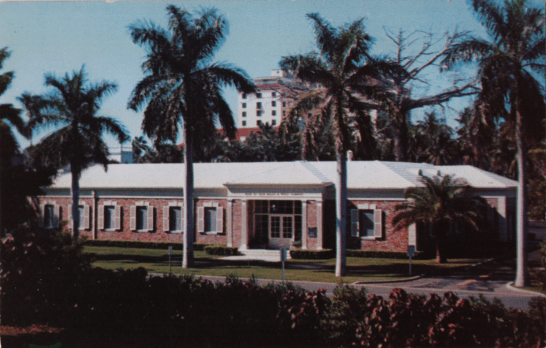
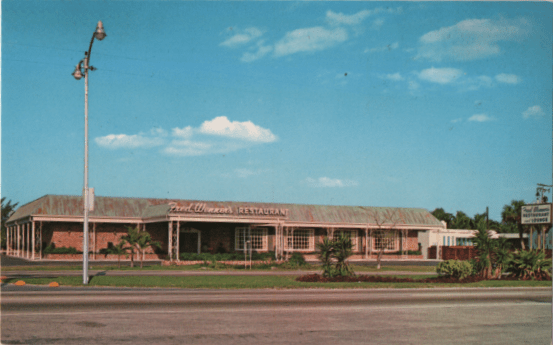
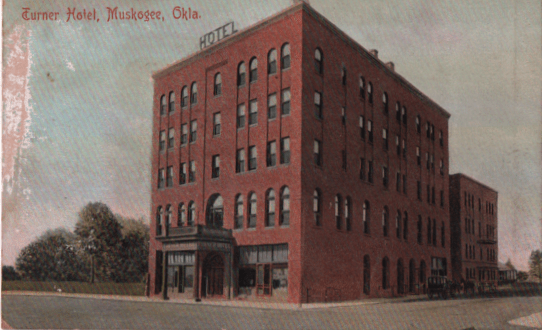
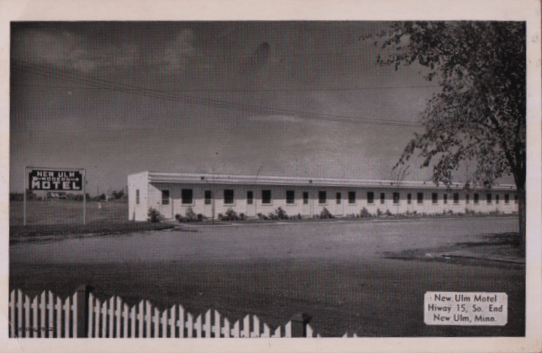
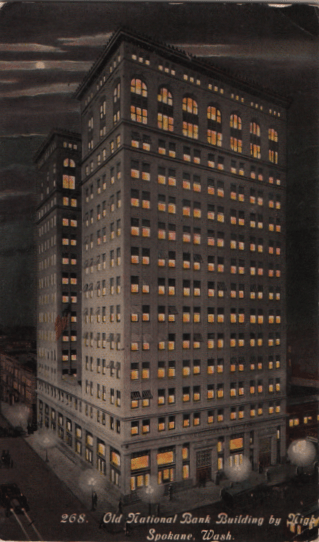
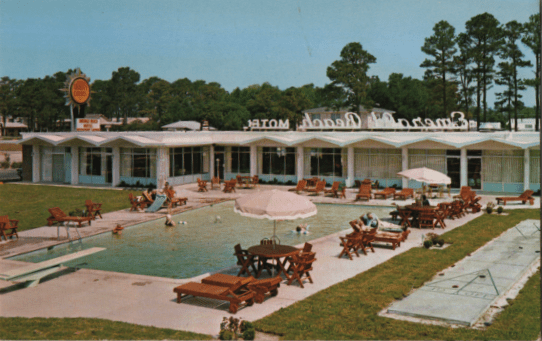
I understand, honest I do. You spent a lot of time and money on your building. You’re proud of it. The architect promised this would be a building which would stand the test of time, and you want people to see it. By what right do I call the child of your corporate dreams “boring”?
Maybe I just rush to judgement. Maybe my untrained eye simply fails to see in the classic lines of your building the long meetings, the give and take of urban design, the effort and argument that went into the creation of a structure defined by its—how shall I put this—utter blandness.
So explain it all to me? Were you responding to a trend in building styles, or rebelling against them? What was the aesthetic principle which went into designing the three buildings we have looked at so far? What is it about these buildings which should have called to my eye and brain instead of what really happened, which was that I had to flip over the postcard to learn I had just looked at a bank, a restaurant, and a hospital, in that order?
The problem isn’t just with late mid-century architecture. Buildings from earlier in the century also call up a reaction of, “Oh. A building.” Instead of “Wow! What an interesting post office!”
Would “Well, THERE’S a pile of bricks!” be enough for you?
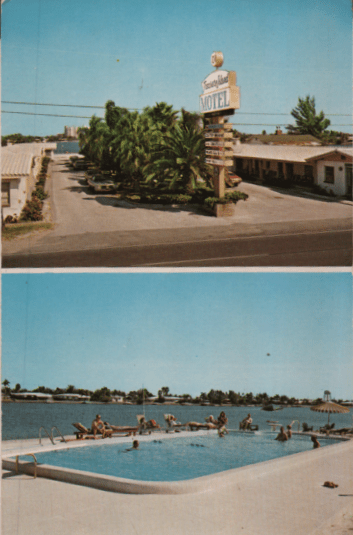
I suppose part of the reason for printing these postcards in the first place was just to let us know what your motel looked like, so we’d know it when we drove up. At some point in any road trip, the participants reach a point at which the availability of a shower and a freshly made bed are all that matter.
But do you HAVE to emphasize a building which would appeal ONLY to people who have been driving for fourteen hours?
Those of you who feel your building is not very interesting and instead show off the sign and the parking lot are not helping all that much.
Maybe if you just show us the entrance to your place we’ll be more engaged. AND maybe not.
Postcard publishers are not unaware of the various problems. The Teich Company was a pioneer in taking a picture of a building and then recoloring it to make it look the way it would at night. All those lighted windows were supposed to lend the view more excitement.
This technique was still considered viable a generation later, though here we have relied on straight photography (with the result that some windows are left dark.)
Other postcards, inspired by the building owner or the photographer, figured that if the building was not all that interesting, maybe showing off the pool would help. Another nice try.
This, by the way, also goes back to the 1930s. Even an art deco façade (and an art deco pool) could only go so far in calling to the viewer’s eye.
As the century went on, the double-image postcard became more popular, building both views to equal size, and treating the viewer to TWO tedious visions in place of just one.
The design, at least, is interesting. It does make us pause for a moment and marvel that somebody thought this was a really great image for a postcard.
The high point of this sort of design has to be the waterfront view, which shuts out excess appeal in favor if showing us the same building twice. At least the building management got its money’s worth on this one.
Sweet Pea was flinging flower petals which could be smelled but not seen by those outside the pastel world of the park phronik. Her partners danced a little mid-air dance, watching Arthur and Julia move slowly down the walk, occasionally brushing a little grass or dirt off each other, bumping shoulders now and again in lieu of holding hands, and discussing the Historiologic Theory courses.
Meadow Saffron sniffed at them. “Huh! I bet they think it’s THEIR idea!”
Unfirom’s upper eyelids came down a bit. “They think it’s their invention.”
Bluebell flew up to consider his eyelids and demand, “How many times have we done this now?”
The angel blinked. “I don’t count. It would be like numbering my headaches.”
Having run out of petals, Sweet Pea started to gather her hair up like a chocolate kiss on the top of her head. “Weren’t they darling when they were falling all over everything?”
“Thanks to us,” Bluebell agreed, juggling a couple of broken pencil tips.
Primrose sniffed. “Oh, they must’ve had some natural talent to be quite so lummoxy.”
“How come they all say that about ‘Remember me’?” Meadow Saffron shook her head, and then zipped over to Sweet Pea, quite unfairly poking the other phron in the stomach while Sweet Pea’s hands were up in the hair. “You almost messed it all up there at the end, when you had to go and poke her in the behind that way.”
Sweet Pea wiggled her hips, not releasing her grip on her hair. “We-ell, I thought she’d like it.” Her chin came up. “I believe she did.”
“You are so shallow,” snorted Meadow Saffron. “Love ain’t all pokes in the bottom. When would you eat?”
Sweet Pea snorted right back at her accuser. “Oh, you’re so deep I need my boots.”
Bluebell flew over to assist Meadow Saffron in jabbing Sweet Pea’s tummy. “Well, I need clothespins for my nose.”
“You’d look better,” Sweet Pea retorted, pooching out her stomach in defiance.
“Hold there.” Unfirom reached down to pull the phronik away from each other. “No more poking. “You each have your voice in the chorus, with your individual talents for this work.”
“And it is so much work,” put in Primrose, sticking her tongue out at her partners.
Unfirom nodded. “That’s why there are phronik in the parks. Sex is inevitable, but love takes work.”
Sweet Pea’s nod echoed that of the angel. “I saw a couple last night and they were doing a whole lot of work. He had her hang by her knees from the fence over there and….”
The gaze of the angel made her story trail away. Meadow Saffron shook four fingers at her. “You should have been making them fall in love!”
“They didn’t have time!” Sweet Pea stuck a thumb in her mouth and pulled back a ways from those fingers. “And neither did I.”
Unfirom sighed, and released his grip on the phronik. Bluebell flew straight at Sweet Pea, whispering, “You didn’t call me!”
“Well, well, you were so piggy about that Double Booty Burger you found,” retorted Sweet Pea, wiggling back some more.
“Hey!”
Unfirom stiffened as Meadow Saffron poked two fingers into his stomach. “What is it?” he inquired.
“Hey, are the people we go to all this work for going to be happier because of us? Or what?”
The angelic face was noncommittal. “Some of them.”
The phron took offense at this lack of commitment. “So why bother, hey?”
Bluebell zipped up to join her, also poking the angel’s stomach. “If it doesn’t make ‘em happier, we got all kinds of fries to eat!”
Unfirom nodded to Arthur and Julia, who had just reached the street, stepping out of the park. “Because you changed the nature of their meeting, their future has been changed. They will move in together at the end of their junior year, and get married the following summer. After five years of struggle, she will come into a great deal of money, which will enable them to complete their studies. They will become important scholars, she perhaps a bit more respected than he, but it is the money which will lead to a separation, reconciliation, divorce, remarriage, and, in general, a series of rifts and patches which will go on for the rest of their lives.”
He found himself the focus of eight enormous eyes.
“Will they be happier?”
He shrugged. “At times.”
Bluebell tossed her head. “Oh well. They’ll be tons more interesting.”
“I s’pose,” said Meadow Saffron, nodding slowly.
Sweet Pea, however, leapt straight up, high over the angel’s head. “Hey-hoop-dee-hah!” She kicked out her right foot to point, using her left hand to shade her eyes. “Lookit lookit lookit! He’s throwing away half of a perfectly good Booty Biscuit Basket.”
The phronik scattered in the direction she led. Typical, Unfirom knew; once the couple had left the park, they had no further interest in Arthur and Julia. And it would be wrong, of course, to get too personally involved with one couple with so many more to service. Angels with guardian assignments had a steadier line of work.
He turned and moved up the path and came upon them tearing into the leaden biscuits from some pedestrian’s discarded breakfast. He passed without comment; it was an added service of theirs, really. The thought of doing something to discourage litterers had crossed his mind more than once, but the thought of what he could actually do had never accompanied it. He would get no help from the phronik on such a crusade, as it would cut into their meal plans. They didn’t really need to eat at all, but, unlike Unfirom, they could. And they did, with gusto. Gusto was not in Unfirom’s nature. Litterbugs who had visited Booty Burger, the Ranch Wagon, Nathaniel’s Pizza, Big Boo’s Chicken, and smaller, similar establishments, provided the major part of a phron’s diet in Griese Park.
The powerhouse among these was Booty Burger, which was funding the fight against turning the location into a passive park. The other dining establishments, though generally opposed to the move, let Booty Burger do the battling. Museum management had hinted that some eatery not involved on the wrong side would get the café franchise inside the new building. Booty Burger declined to be swayed by such enticements, and carried on its battle without fear of reprisal. Booty Burger’s whole public image was, after all, based on fearlessness (or, some said, shamelessness.)
“We’ll turn our liabilities into assets,” their CEO had declared, back when Booty Burger was little more than three push pins and a handful of paper clips on a map of the state. “Everybody sees the health reports on Eyewitness News. What we can’t hide, we flaunt.”
So a line of popular and audacious commercials now filled the region, letting everyone know that Booty Burger would “Put Beef On Your Booty”, contrasting the pale, lifeless waifs who subsisted on kale with the curved and crooning sirens who dined on what the management had the audacity to call “real food”. Besides the Booty Burger (and its larger sibling, the Double Booty), there were Booty Shakes (the commercial for which had been banned), the Big Bundle, the Big Dog, and Mr. Greasy Fries. The design team had gone the distance in producing the most obnoxious packaging possible: the food came to the customer in burnt sienna boxes covered with big black splotches.
It seemed to the angel that almost all patrons of the nearest Booty Burger contributed to the advertising push by tossing their empties in the park. Stained baskets clustered like pimples on the pavement. In a graceful swoop, Unfirom caught up a large basket and tossed it at a larger metal basket near him. He did not miss, of course.
Not far away, a grumbling man did the same with a Booty Burger bag. Unfirom did not warm to his fellow caretaker. His eyes narrowed.
The man was a tall man, thoroughly and perfectly groomed. His collar button was undone, true, but the collar was open only to a degree which spoke of casual professionalism. His expression was pleasant without being warm, handsome but not offensively so. He was no stranger. Unfirom was used to seeing him in the park around dawn or at dusk, the rest of his hours being spent in conference with museum officials about details of the grand new building or the latest scheme for landscaping which would set off the magnificent new structure. When his eyes strayed toward the center of the ball diamond, Unfirom knew he was seeing a grand fountain which sprayed silvery water in a manner wholly new and beyond the scope of any other museum fountain in the state. His eyes, turning next toward the little playground littered with chicken wing boxes, saw instead a grand concrete terrace, as required by any good museum’s beauty. One did not need to be an angel to read his eyes when he turned his gaze up the street toward the nearest Booty Burger.
During the glance at the home of heretical hamburgers, Unfirom blinked himself into view. “Interesting use of space,” he noted, coming up next to the developer.
The man turned and looked up at Unfirom, apparently startled by the need to do so. He was not shorter than most people. The angel, appearing not to notice, said, gesturing to the cracked blacktop of the playground, “I understand that bit was built atop old sod houses.”
“That so?” The developer frowned. Such a thing might affect stability, but it would certainly bring hordes of preservationists into the discussion.
Unfirom’s right arm swung back and forth. “When a truck goes by, you can see the swings wobble.”
“You don’t say.” The developer’s eyes narrowed, but looking more narrowly at Unfirom’s face failed to divulge any Booty Burger guile.
“Some people blame the ghosts of the children who have played there over the last seventy years.” Unfirom took a deep breath, putting his shoulders back. “But it’s hard to believe in ghosts on a morning like this.”
The developer looked to the playground and then studied Unfirom again. “And the story about the sod houses….”
“I was involved in a county boundary project and did some research at the U.” He had, in a way, some eighty years back before the park was established or he was condemned to help phronik in it. “I wasn’t working on this part of town, but I saw some of the old maps which referred to ‘dugouts’ in this area.” He nodded to his listener, footnoting, “That’s what they would have called any cabin that was partially underground.”
“Mm…yes.” The developer’s eyes went up and down Unfirom, still trying to find the Booty Burger agent beneath the air of a man who had to share his research with everyone he meets.
“If it’s true,” Unfirom went on, looking at the playground again, “Then putting a playground here was an act of genius. Anything heavier would have sunk over the years.” Nodding to himself, he moved to the curb, as if planning to jaywalk across the street. Out of the corner of one eye, he watched the man stomp one foot on the ground, eyes on the swingsets. He nodded again. He had not changed the man’s mind, of course, but from one seed of doubt, much might come.
The angel vanished, his eyes suddenly on another tall man, who looked to be about sixty but was, in fact, seventy-three. This man was idly watching his track, his eyes having no reason to wander toward the sturdy white-haired woman coming up the sidewalk, a German shepherd ahead of her on a slack leash. For her part, she was paying no attention to the man.
Well, they WOULD pay attention to each other. Where were the phronik now? He strode through the grass, leaving no footprints. The people who came to the track to get in shape should have his job, he thought: the number of miles he covered every day just hunting for his crew would wear an elephant down to poodle dimensions.
The size and shade of the stains on the pizza box told him the crusts they were passing around the circle had been lying in the park since at least noon on the previous day. Well, it kept any dogs from eating the crusts and getting sick. The phronik sang as they passed each bit of crust around the circle, so no more than two mouths were full of food on any single note.
“John didn’t like the way his popcorn popped
So he built a new machine that had the poppers topped;
A drop of oil and it made corn that folks would crave
But then somebody came out with the microwave!
Percolator, coffeemaker
Subaru and Studebaker:
All ya got is all yer gonna get,
Waddya bet?”
Unfirom stepped up to the musical circle, taking inventory. “Where’s Primrose?”
They didn’t look at him. He was opening his mouth to repeat the question when a whistle blasted in his ear.
The phronik in general limited their musical accompaniment to blades of grass, which were excellent for a variety of rude noises. Unfirom swallowed before inquiring, his tone angelically gentle, “Where did you find that?”
Primrose pointed, her wrist the highest point on her arm, level with her forehead. “Next to the red horsey swing. I think Booty Burger is giving them away with the Chunky Chicken Chews. Don’t you think we could bake cookies with whistles inside?”
“No.” Now he pointed. “But that may come in handy while you’re dealing with these two.” Now he pointed.
All the phronik swooped up to viewing height. “Gosh!” cried Sweet Pea. “A puppy!”
“Sweet,” said meadow Saffron, not looking at the full-grown German shepherd. “Have they met yet?”
The angel nodded. “In college, they thought they were in love. The affair broke up after two years. They have not seen each other since a class reunion thirty years ago.”
Bluebell shrugged and kicked at a passing gnat. “Is that any of our business? They already….”
The angel looked over to the man, still oblivious to dog, woman, and the invisible conspiracy. “They do not, at the moment, even know they’re in the same part of the country. If they do not meet soon, they will meet again fifteen years from now, when he moves into the same senior facility where she is living. They will renew their acquaintance at dinner, and she will invite him to visit later. In the wee hours of the morning, he will slip into her room, and her bed, and remain there until morning, when he will finally realize she died shortly before he came into the room.”
Sweet Pea’s hands were over her mouth. “Oh, dear!” said Meadow Saffron
“The shock will cause a stroke which will leave him unable to speak until his own death two years later.” Unfirom nodded to the couple. “Shall we?”
Once upon a time, there existed a series of plain oblong volumes called “Boring Postcards”, in which the editors reprinted what they considered some of the blandest, least interesting postcards ever produced. They eventually begged for mercy and terminated the series, as the more postcards they showed off, the more people sent to them, and they were having trouble staying awake. I will not assume their mantel, but I thought we could look at a few contenders from my inventory.
Boring is, of course, in the eyes of the beholder. The advertising postcard at the top of this column might not interest SOME people, but as one who was once involved in the used book trade, I gazed on it with awe when first I saw it, exclaiming, “So THAT’S why we get so many copies of those two books!” The next postcard may seem perfectly reasonable to some folks, but I had a friend who would have passed it by with a yawn. Mountains, lakes, landscape…what did THEY ever do that was interesting? (AND, it must be admitted, as mountains go, Rib Mountain here is not so breathtaking.)
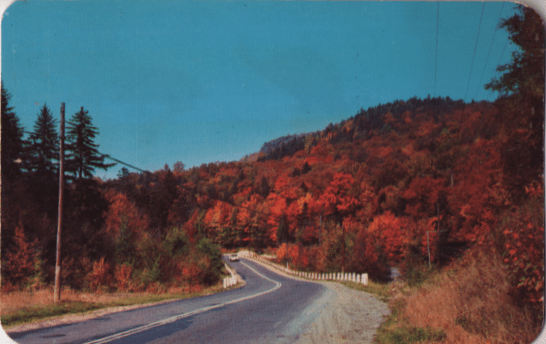
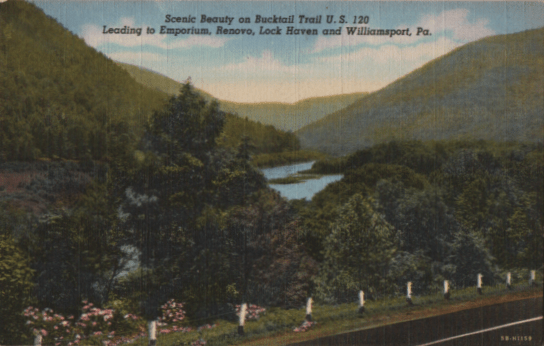
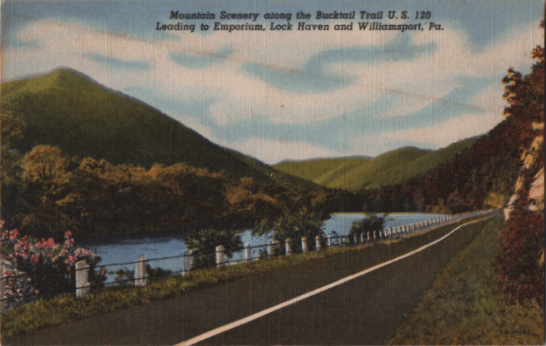
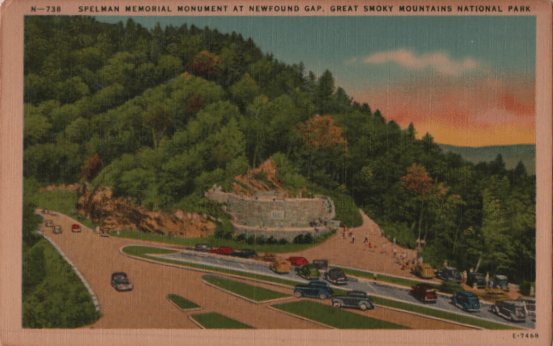
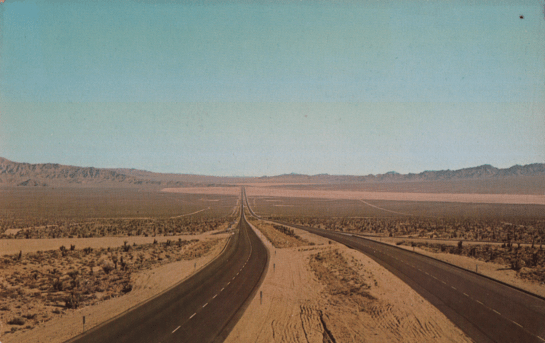
My friend’s attitude may explain some of the beautiful scenery shown by our ancestors, who were careful to make sure we could see the road going through it. After all, the hills and valleys had been there for years, but it took Modern Man to build a road.
In fact, not only does the road take up larger and larger portions of the picture, but we are also always given a good view of the posts alongside. “See our beautiful, safe road?” the cards say. “Use that and you can take your own pictures of those old green mountains.”
“In fact, LOTS of you can do it at the same time and (see our guard rails?) be perfectly secure on the highway!”
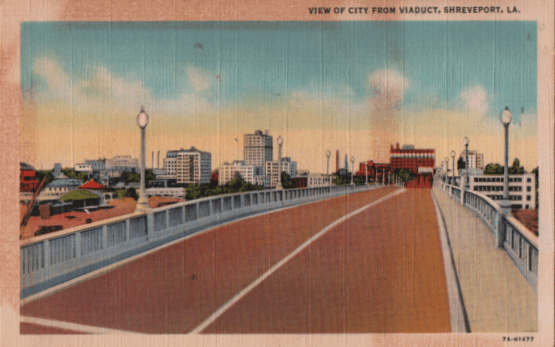
This card, you’ll note, claims to be a view of Shreveport. I’m glad they mentioned it.
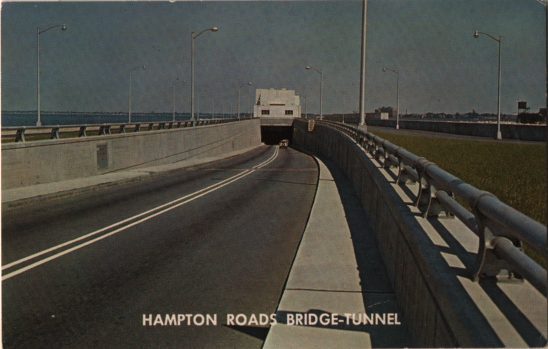
After the money and manhours that went into building the highway, the viaduct, the bridge, the tunnel, you can’t blame people for being proud of it. They want to SHOW it to you. This does not mean that all that many of us will be thrilled to look at it.
The saga of forcing a way through the wilderness is an exciting one in its own right (and, after all, on occasion the wilderness won). Yet we are ungrateful. No matter what the story was, that stretch of pavement does not appeal to our pitiful imaginations. Yes, I know: if I were lost in the wilderness myself, a road would be the most beautiful thing ever, as that would lead me to the nearest Starbuck’s. And yet….
And, um, it must be admitted that there are parts of the country where the most boring of pavements is no more boring than the surrounding countryside. Maybe it’s a problem with my own mind. Maybe I am so twenty-first century that I need something to happen every few seconds to keep me entertained.
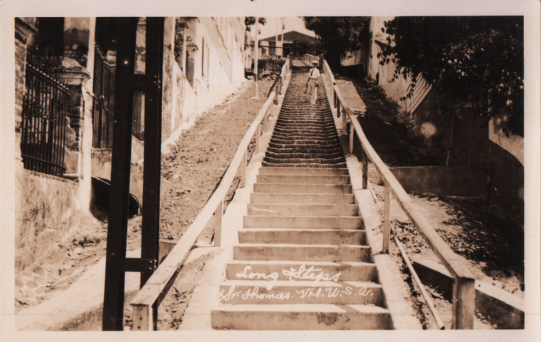
So for those like me, here’s this postcard view of one of the world’s great outdoor staircases. Ignore my yawns: I’m just impossible to please.
Once upon a time, Chicago decided to retool the Loop. State Street, in those days a bustling shopping district, was redesigned with bigger sidewalks and smaller streets. Motor vehicles were banned except for cabs and buses, and the whole area was renamed the “State Street That Great Street Mall”. Vast sidewalks would give people more room to walk, combining a stroll down the boulevard with leisurely shopping and lunching. Public sculptures were added to enhance the idea of a place to see and be seen, and enjoy an afternoon on the town.
The experiment went badly. Now, if you visit State Street, you will find little evidence of the mall ideal. Streets were widened again and sidewalks put back the way they were. One explanation for the failure was that it was the fault of an odd species known as “People”. People, it was said, find it hard to believe they’re enjoying themselves without a bit of bustle, a hint of inconvenience.
In short, said the Powers That Were, people won’t believe it’s exciting without a crowd. How do you know things are fun if you aren’t being elbowed by other people trying to have fun?
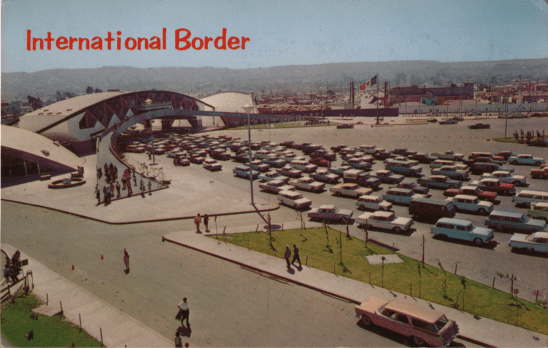
This could explain why so many postcards stress the crowded nature of the places they celebrate. Traffic is shown to be a sign that something fun is going on. Didn’t you ever get into a line without knowing what it was for, just because this many people had to know something you didn’t?
So postcards brag about traffic congestion, as if to call out “See how important and attractive we are? Better join the crowd or you’ll miss the big show!”
Oh sure. In the golden age of postcards, there was a hint about how much more interesting streets filled with cars are than the dirt roads in YOUR community, where you may see one horseless carriage a week. And yet, the aesthetic survived into an age during which a stream of cars bumper to bumper was no longer a novelty, and a vast parking lot more of an inconvenience than a celebration of the automotive industry and its production.
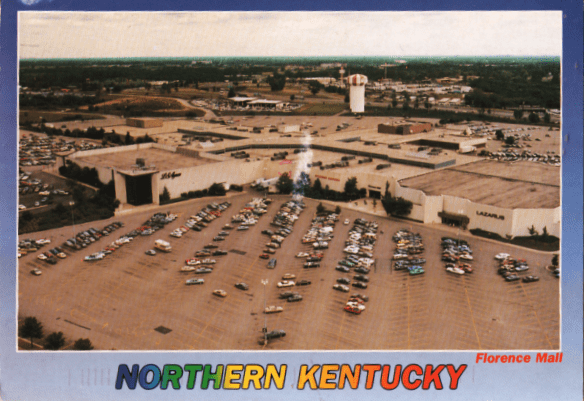
We reached a point at which the empty space in a mall parking lot was more exciting than a packed acre of pavement. (Yes, this is one of a series of postcards promoting the beauties of Northern Kentucky. Makes you want to jump in the car and rush right out.)
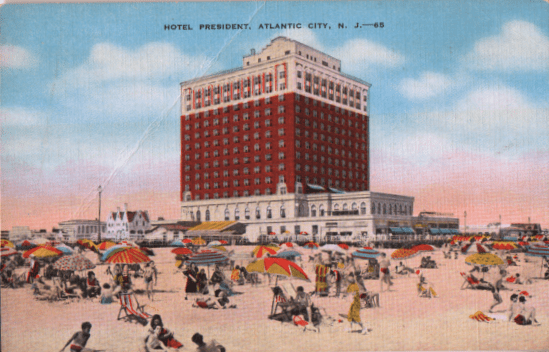
The phenomenon goes on without cars, of course. What fun is a quiet little beach where you just sit and look at the water and the sand and the sunlight? YOU want to know there’ll be masses of people visiting at the same time. A crowded beach MUST be a quality beach.
After all, this enhances the possibilities that you’ll see people who look worse in their bathing suits than YOU do. This is easily worth the minor inconvenience of having people trip over your beach blanket or spill their beer on your toes while you’re napping in the sun. (In fact, having people to block the sunshine will help prevent sunburn. So there’s that.)
If you don’t have to duck and sidle to get past a dozen different beachgoer encampments to see the water, if there’s no chance for your kids to get lost, why did you drive eight hours to get here?
Postcard companies knew you wanted to be able to tell people you were HERE, braving the crowds and finding the last eight inches of space unclaimed by other tourists. These scenes established your credentials as a vacationer ready to fight for fun.
A street market or street festival is hardly something to brag about if you could move at speeds of more than twenty feet per hour. Those authentic ceramics you brought home mean so much more to the people you show them to if they’ve already seen a postcard of the crowds you had to push through to find them. (Do NOT mention how long it took to get those Made In China stickers off your Mexican pottery.)
It just seems to be one of our criteria for a Real Experience. If a thousand or so people weren’t trying to occupy the same space and do the same things at the same time you were there, you didn’t have a good time.
Arthur Braling was less prepossessing in the world of primary colors, but so many things are. He was not without a certain charm, red curls combed high above a bright, eager face. He wore a red necktie over a white shirt, not because Mershon College had any rules about this, but because he happened to like to wear neckties.
This was really all most of his classmates knew about Arthur: “He likes to wear neckties.” It was all most of them really wanted to know. A small coterie of associates found him useful. His notes were always complete and he always remembered which paragraph the professor really leaned on in a lecture.
With a smile, Arthur was always willing to supply missing details of an assignment, cram information into other brains the night before an exam, and warn that a prof had reached a point where a pop quiz was inevitable. Despite unheroic proportions, he was this close to being named honorary captain of the Mershon Wrestling Team; Coach knowing very well who had kept his wrestlers eligible during a rocky period.
Being useful is far from the same as being interesting. Arthur’s only close friends were leftovers from high school, relationships maintained from kindergarten on, who kept in touch via emails filled with esoteric trivia quizzes.
Unencumbered by social obligations, Arthur had plenty of time to explore the town, the campus, and the respective libraries of each. He had acquired the habit, encouraged by his roommate, a late sleeper, of taking a long, leisurely stroll in the early hours of morning. The whole town could be covered end to end in about half an hour, but Arthur preferred a leisurely pace. He could visit the neighborhood where you saw where the railroad tracks had run, when the trains were still running. Blocks and blocks of houses here had no sidewalks in front of them. The neighborhood with the churches and the homes bankers had built a century or more before was another direction. Still another was the new part of town, with the elementary school, and the expanse of identical houses.
Today’s walk had taken him past the Mershon Museum of Fine Arts (closed at this hour, but with much to read posted on the outdoor announcement board) and Griese park. He tried to take this walk at least once a week. He knew about the plan to turn the park into a passive one—had signed a petition against it that was going around—but supposed he could take a walk here either way.
He liked the sense of elusive history in the park, a little harder to find than in his walks through the Grandview cemetery, at the other end of town, or on campus, with all its commemorative plaques. These corners where feet had worn the grass away in shortcuts had probably been mutilated that way for generations, while the names and the dates scrawled in the concrete went back some forty years. He paused before one of the oil drum trashcans. Could an expert tell the age of an oil drum by some features unobserved by the uninitiated? Could that expert do it even through what was obviously the ninth or tenth coat of industrial green paint?
Turning slowly, he studied Griese park: the old swings, the broken benches, the backstop at the softball diamond. How old were these things? If he got involved in the movement to preserve the park as it was, he’d have excuses to dig through the back issues of the Mershon Messenger. No time, really, he supposed. His eyes swept across the view again, resting on the woman who read on the bench no longer than on the trash cans.
Julia Sangerman yawned and brushed her hair back from under her glasses. Bringing a book out here to read still seemed a little extreme, but it was quieter than the lounge in the dorm. And getting out of her room was vital. Over the summer, Meredith had developed a fitness mania, which involved an early morning nude exercise session.
“Exercise rags just constrict the muscles, Jul. You have to try this!”
Julia had no objection to getting up at this hour, but watching her roommate flop around to “Bohemian Rhapsody” before breakfast was more than flesh and blood could bear. Besides, Meredith’s intention to run a marathon had not changed her habit of staying out until one in the morning. Some day, that girl was going to break down completely, and Julia wasn’t planning to be there to watch it happen.
She shifted the big book on her legs. Last year, she had done her early morning reading in the library after breakfast. Cutbacks meant the building didn’t open before ten now. Any extra credit she could scrape together, she could use.
Julia was quite a respectable student. Left to herself, she could easily have achieved a 3.5 GPA, with time left over for a life. At Mershon, this would have graduated her cum laude. But her grandparents, whose funding took care of her room, board, tuition, textbooks, and microwave popcorn, would settle for very little less than 3.95 and summa cum laude. More than just these four years’ schooling hung on this result. The estate would one day be divided among six cousins, five of them divvying up half of it, with the other half going to the one with the best academic credentials. Julia wanted that money: it would cover a master’s degree, a doctorate, and a number of years of study in Europe.
Such exalted and expensive goals were difficult to reconcile with a naked roommate defining triceps to The Best of Queen. (She could at least have edited out “Fat-Bottomed Girls”.)
She slid her thin skirt a little tighter around her thighs, braced the books against the breeze, and slid out the paper she was using to take notes. A butterfly flitted across this page, on its way to an odd young man swinging a bag of books as he strolled along the crooked path. Her eyes followed it for a space, but not as far as Arthur’s smiling face.
In a tree above the bench, a small bird broke suddenly into a high trill. Arthur looked up, but rather too far up. Neither he nor Julia heard a short snort of disgust, or the cry of “Watch this!”
“Oopf!” Arthur’s right toe caught in a crack just as his bag of books was on the upswing. The straps tore loose from his hand, sending eight hundred dollars’ worth of the wisdom of civilization in the general direction of the singing bird.
“Heads up!” he shouted, seeing the bag start back down, well short of the feathered musician.
Julia’s head did come up, allowing Arthur’s investment to land squarely in the middle of the kingdom of the Ostrogoths. Books and bookbag bounced forward, sending Julia’s bookmark in one direction, and her notes in another.
“Hey, I’m sorry!” Four hands grabbed for the notes. Julia’s hair was not thick enough to provide a good cushion as foreheads met. Arthur pulled back in time to swat her flying glasses, sending them into the grass under the bench instead of onto the cracked pavement.
“Good one!” Julia told him, reaching down for them, between her ankles. She did not notice, in doing so, the knee—not hers, as they were deep in grass now–on the hem of the skirt. Glasses in hand, she came up, only to come back down.
“Oh! Sorry!” Arthur jumped back, slipped, and saw one foot headed for the glasses in her hands. Twisting desperately, he sent the foot instead into the spine of the Ostrogoths, and himself sat down hard next to his bookbag.
The pair paused, glaring at their common enemy, those inanimate objects strewn in the grass. Arthur got a knee under himself and grabbed for his bookbag. A cloud—or something—drifted across the sunlight, making him mistake his aim. He took the bag up by the bottom seam.
He distinctly remembered zipping the bag shut. He always zipped the bag shut. Still, books, notebooks, pencils, pens, and one disc flew free. A breeze he had not noticed until now took a personal interest in his History 211 notes.
Julia had her glasses in one hand, and slapped the other toward the fleeing flashes of white. “I’ve got….”
Her feet were still behind her on the bench. As she lurched up to capture more pages, one shoe hit the concrete support. The shoe came loose, throwing her off balance so that she knocked Arthur’s bookbag from his hands. She used her nose for this.
“Whose side are you on?” Her head continued into his chest like a cannonball in a blanket. He hadn’t touched a woman’s hair since he was four.
Julia started to say “I….” but felt her glasses slip from her hand. She swept around to grab them before they bounced. Arthur, always helpful, had made the same grab at the same time.
“Long time no see,” Julia noted, as their heads collided once more, this time cheek to cheek.
“Sorry.”
“Don’t give up now. You’re just getting the hang of it.” Pushing back with one foot, she snatched at her specs, bringing her bare foot down on a book which had been six inches away just a moment before. Not knowing what it was, but feeling sharp corners, she threw her weight to the other side, twisting to look. Her other foot, however, was insecure on a small stack of paper discussing Jeffersonian democracy.
“Hang…ack!” Seeing her falling, Arthur had moved forward automatically but did so more quickly than he intended as one of Julia’s flailing hands took hold of his necktie. A move the wrestling coach would have admired enable him to avoid crashing facefirst onto the bench, but he had to add another twist to avoid kicking the tumbling Julia. One more sagacious twist was too much to ask of fate. His face buried itself in the grass, coming down with enough momentum to pull Julia, who still had a grip on his tie, up and over.
Julia jumped up as he squawked. She had not ridden on a man’s man since she was three. She landed on all fours, her hands square on top of Arthur’s extremely dull disquisition on Thomas Jefferson and religious change.
Sitting up, Arthur might have caught an indiscreet glimpse of his future had he not had to roll away or get kicked in the face as Julia scrambled to catch a stray page of trivia about Amalric of the Ostrogoths. What his eyes spotted instead was his forlorn, empty bookbag. He took hold of that as he came around.
He was already moving it when he realized one of Julia’s feet was caught in a canvas handle. He did not have time to slow down, and Julia landed hard in the dewy grass as pages flew up from under her hands.
Arthur got his feet under him. “I’m really….”
“You’re sorry!” snapped Julia. “I’ve heard it before!” She caught up the heaviest thing at hand and flung it up at him.
Paul had no interest at all in his Business Administration minor, but his parents had insisted. The Public Relations textbook flying through the air represented two weeks’ salary at his cafeteria plate-scraping job. It was going to miss him high and wide: to catch it, he needed to jump up on the bench.
Julia repented the second the book left her hand, charging after it. You didn’t throw textbooks, which cost their weight in dollar bills. It was in Arthur’s hand by now: such heavy reading sent him backward over the bench. Julia had to skid sharply to avoid dark brown shoes, and sat down hard in front of the bench. She was up again almost immediately, flailing at the stapler which had slid under her just before she landed. This left her no time to notice the figure limping around the bench. The two heads which came together should have been used to this by now.
She caught hold of his shoulders; he grabbed an arm. For a moment they clung to each other, huddling for protection against what was obviously a hostile universe.
Arthur came to his senses and tried to push her away, but Julia pulled him closer. “Listen!” she whispered. “We’ve got to do this scientifically.”
“Got it,” Arthur replied. “You grab the books, and I’ll get all the papers together.”
They dropped away from each other, moving on all fours through the dirt and scraggled grass. Julia snagged the stapler first, while Arthur slapped his hands down on pages of Jefferson. From the stapler, Julia moved to the Public relations text, bouncing back for a moment when the wind ruffled the pages at her. But the best defense…she pounced on the book.
Julia had more to handle, by weight, but the books took less actual travel. Arthur found that a list of Ostrogothic kings could apparently take wing without warning, apparently aiming for the next zip code. He threw himself bodily on the sheet of paper, and took on a grim grin as it crumpled beneath him.
Julia moved more slowly: she had already encountered a stapler, and she knew pencils lay in wait, their leads all sharp for the dense. Then, too, she had to keep part of an eye on the unguided and possibly lethally thick skull of her fellow hunter, bounding after loose paper. Arthur was doing his best, for his part, to follow paper and watch out for her remarkably solid cranium. Eyes may stray, though, while two people crawl on all fours around spots where dogs had paused.
“Gotcha!” cried Arthur, snatching at a pair of fugitive fragments of his genius. He wasn’t aiming to bump hips with Julia, but he hadn’t done much to prevent it, either. The papers crumpled in his grasp as she swung her hips right back at him, nearly knocking him over.
“You play fair or I’m telling the lifeguard,” he snarled, shoving a hand against her to push off in pursuit of another list of Ostrogoths, just as she was about to snag a pen.
Eventually, she rose, pens and such tucked in the canvas bag, books stacked by size in her arms. “This might be all,’ she called. “Did you have four pencils and a pen?”
“Just right,” said Arthur, coming up from under the bench, a massive wad of undergraduate notes clutched to his chest. “Let’s see what’s here.”
Julia came to her feet, looking around. “I don’t see any more. “You must have….” She turned to face him, and found no face. Looking down, she found him sitting crosslegged in the dirt, the papers heaped in the fortress formed by calves and thighs.
She set the books on the bench and came back up, her head cocked to one side. “You want some fresh ground pepper on that salad?”
“No, thank you. And I didn’t order these assorted greens.” Arthur plucked a few leaves from among the paper and flung them aside.
Julia watched him sort the pages into piles, feeling a little ridiculous so many miles above him. Checking her skirt and seeing it was already grass-stained, she sat down across from him, just in time to keep the fourth pile from taking off in a sudden breeze.
“I guess we can’t drop anything if we’re down here already.” She tucked one ankle under herself. He grinned up at her; she was still taller even sitting down. “Oh, don’t bet on me when it comes to dropping things. I could drop a porcupine cover with Krazy Glue.”
She laughed, and pushed her disarranged hair back from her forehead. “My name’s Julia, by the way.”
“I saw that.” He pointed to her name on the first stack of paper, and shifted the finger to the next stack. “I’m Arthur.” The finger moved on to the third stack. “I see you’ve got Dr. Bronson this semester. What’s he like?”
“Sweat. He likes sweat on the faces of students who can’t guess what he’s going to do next. I’m glad to have those. I could have printed out new pages, but those have all my corrections, and I don’t want to start over. He’ll ask for them two days before I expect.”
“Thanks for the warning: I’ve got him in spring. I’ll lay in some aspirin.”
“Tranquilizers,” she corrected. “And don’t get him the period after lunch. Bad for your digestion.”
“Maybe I’ll change my major to Physical Education.” Arthur glanced at his watch. “Speaking of digestion, it’s about time for breakfast.”
Julia didn’t often eat breakfast, but it sounded like a good idea just now, perhaps due to all this exercise.
She set her hands on the bench to pull herself up. Nearly there, she whirled, almost falling back on top of him. Arthur put up both hands to catch her, abandoning the piles of paper he had so painstakingly gathered.
“Are you all right?” he demanded. “What happened?”
Her eyes narrowed in suspicion but, realizing he had been down on the ground all along, pulled herself back up. “I’m okay.”
“All right.” Arthur pulled the four piles of paper together into one. “Um, I like your perfume, by the way.”
“I’m not wearing any.” Julia reached for the stack of textbooks but paused, looking back at him under the crook of her elbow. “Why shouldn’t I remember you, with all these bruises?”
She was frowning. Arthur frowned back. “What?”
She straightened, the books gathered between her arms. “Didn’t you just…whisper in my ear that I should remember you?”
“No. But it’s not a bad idea.” Arthur reached past her and took up his canvas bag. Shaking it a little, he held it open. “Here. Unless you want to carry my books to school for me.”
Her mouth jerked up on one side. “Put the papers in there. They won’t get away this time.”
“Good thought.” He slid the stack in among his pencils. “Ready?”
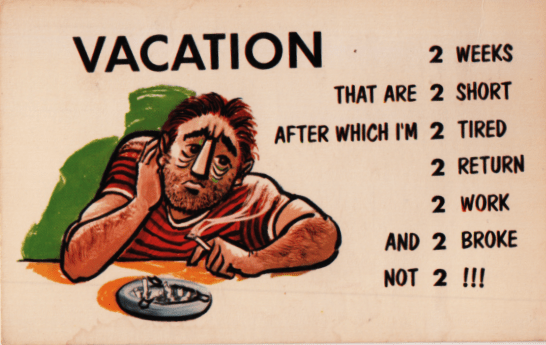
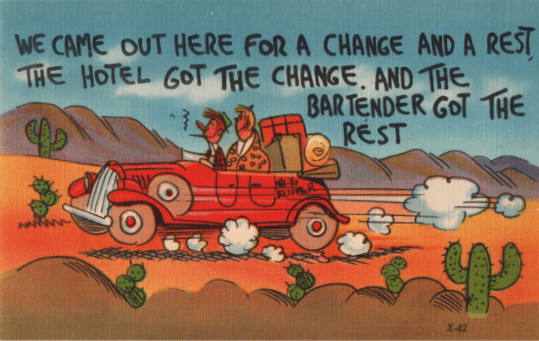
The unofficial start of summer, Memorial Day, has come and gone, despite the fact that June is not quite here yet, and the vacation season is upon us. Vacations became a major subject with postcard artists around mid-century, when postcards stopped being everyday communication ad became brief messages from far away (postage went up, and telephones became more common.) So there are plenty of postcards which deal with how much better a couple of weeks away from the daily grind can make you feel.
Well, actually, I found just one, seen at the top of this column, and THAT is mostly an ad for the healthy effects of visiting the baths in Hot Springs. There are MANY more postcards about how rotten vacations make you feel.
Whether this is an accurate reflection of the strain of moving outside one’s routine and working hard to have fun, or just an expression of guilt at leaving your friends behind in the humdrum reality from which you have escaped, the theme of “Wow, I’m exhausted; wish I was back there mowing the lawn and kicking the air conditioner with the rest of you” is to be found on card after card.
Yes, these cards say, all the overeating, overdrinking, overexposure to fresh air and sunshine, and over (pick what you like to do when YOU’RE out of town) takes its toll. That peanut butter sandwich and 1 ounce bag of chips down in the receiving room sure looks good when you’ve been in sidewalk tables consuming steaks two inches thick and beverages with umbrellas in them. Gosh, you tell your friends, you don’t know if you’ll survive.
If you have the kind of friends most of us have, this is going to convince nobody: that’s part of the reason for sending such cards. You’re rubbing it in their faces. But there is another theme which is more realistic, and which they WILL believe.
Whether YOU’RE exhausted or not, these cards tell your friends, your supply of ready cash has died while out of town.
In fact, those peanut butter sandwiches may be cut down to one slice of bread for the first month or so after you get back to work, and you will be well into October before you can go to the vending machine and pay for that ounce of salted carbs again.
Your friends, who have taken out loans for exotic vacations themselves, will appreciate the thought that after your swell trip, you’ll be sticking those souvenir umbrellas in paper cups of tap water at lunchtime for some days to come.
If they envy your tan, you tell them by postcard, they should reflect that, after all, it cost you roughly twenty bucks per square inch. You may hint that blue sky and sunshine alone did not cost you your savings, but at the same time, you ARE thoroughly broke now. And if they are STILL jealous of what you did on your summer vacation, however much it put you in debt….
After all, you’re not claiming you didn’t have a good time.
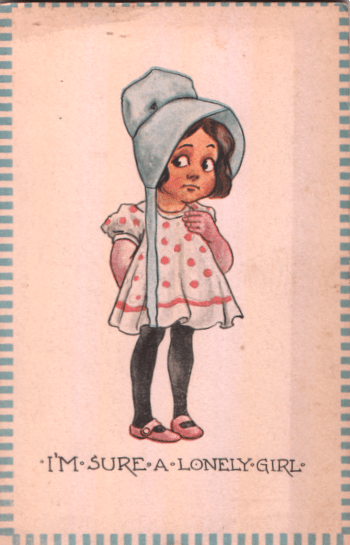
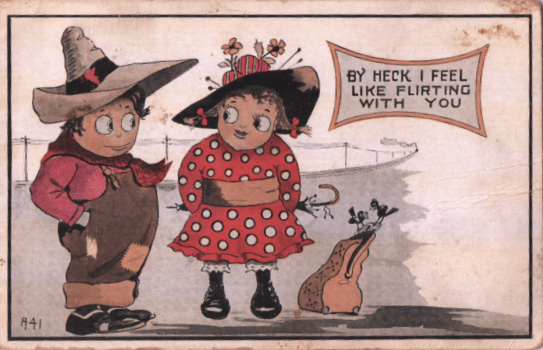
We have discussed hereintofore the ways in which postcards were the texts of their generation: a quick message (which, in some areas, allowed a person to send a message in the morning, get an answer before lunch, and reply by sunset). We have also discussed how the characters on the card could speak for the sender in both caption and image, rather in the vein of people who reply to a text with a film clip of a sitcom star palming his forehead in response to a fine old joke.
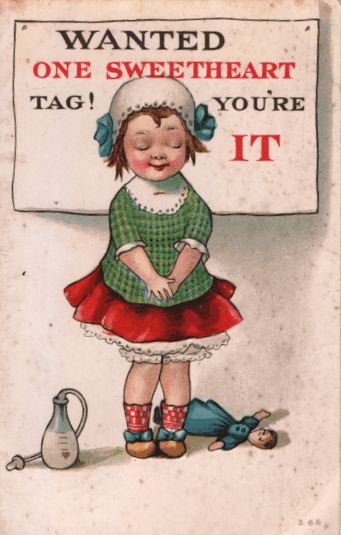
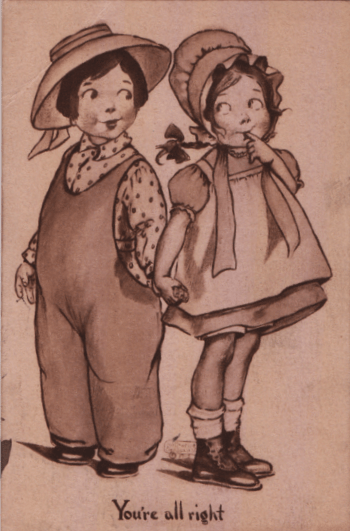
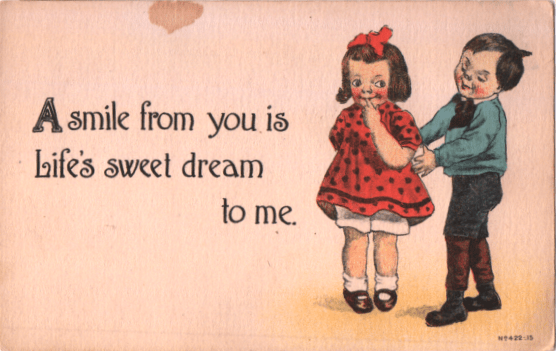
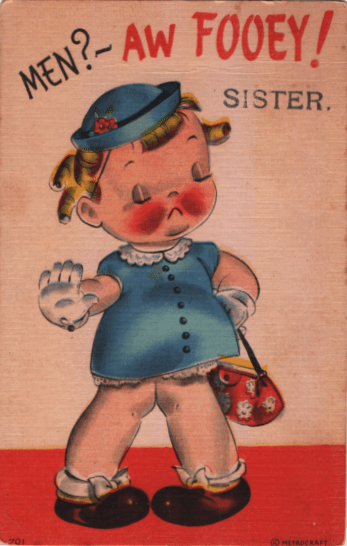
But it must be almost weeks since we have discussed how the characters on the cards also provided a shield for the sender. Children were especially ripe for this kind of protection. A kid could say something meaningful (though the meaning here is a little obscure) which you could, if the recipient of the card responded badly, could be denied. (“Ah, that was just the first postcard I picked up. I didn’t even look at the picture.”)
Which could be very useful when it came to affairs of the heart. You could use the cute kid card as a hint, if your chosen was someone susceptible to hints.
And if not, not. You could always just say “Well, I thought it as a cute card myself.”
This was also important because postcards had one feature which, in a perfect world anyhow, electronic love notes do not. ANYBODY could see them: the mailman (always labeled in cartoon and comedy as an incurable gossip), any neighbors who happened to be on hand when the mail was delivered, your parents and/or siblings if you live with them…and this was true at both ends of the message. The sender ran the same risks as the recipient (and don’t forget the good old boys sorting mail at the post office.)
This may help explain why so many postcard albums were sold during the Postcard Fad Years of, oh,1905 to 1912 or thereabouts. It was very handy to have everybody know you were a postcard collector. This would hide the occasional blush-making card among the other cards your other friends kept sending you AND gave you the excuse “Oh, good! Another card for my collection of cute kids!”
Who could object to pictures of cute little children? Especially if they added another layer of security by talking in baby talk.
Your parents might be dubious about your excuses, but this pretense provided THEM with a reason to ignore the occasional not-very-subtle caption. Cute card: that’s why she ran upstairs with it. She wanted to put it in the album right away. Cute card.
There was a vast variety when it came to cuteness
And subtlety. The cute kids postcard became like any other part of the courtship process. You try this style, and if it doesn’t work, you move on to some other artist who might have a lighter touch.
Or not.
And, if worse came to worst, there were options for that.
For all customers. Maybe YOU couldn’t say it, but the kids on cards could.
Unfirom blinked. He could still see the survey crew, and the park. Now, though, there were new colors, paler shades of the real greens and blues he’d seen a moment ago. This alternate August N. Griese park always bothered his eyes. It was out of focus.
The grey-haired human costume had vanished, returning him to his natural form, providing the only sharp, clear colors in this universe. Unfirom was a tall, brilliant angel, his aura clearly defined, his wings perfectly defined, his robes falling in creases evenly spaced around his body, his face proving that it is possible to be both ageless and timeless, and yet immediately identifiable as an old fuddy-duddy.
He frowned at the pale browns and blues of the survey crew. They’d started early. Shrugging, he turned to the tennis players. The park was waking up. He sighed. That meant it was time to alert the phronik. It was time, in short, to get to work. He sighed again.
It was not that Unfirom disliked his assignment to Griese Park. Liking or disliking an assignment was alien to angelic dignity. That which was given him to bear, he would bear.
He did wish the phronik were less generous about giving him things to bear.
The place to start was the patch of weeds in that space too narrow to mow between the fence around the tennis courts and the sidewalk. His third step nearly came down on a tiny creature who sat cross-legged among the dandelions, weaving a necklace of grass.
“Good morning, Sweet Pea,” he called, drawing back his foot.
She paid no attention to the foot. “Good morning, Mr. Angel. Does this mean it’s daytime again?”
“The sun’s up.”
Sweet Pea, still weaving the necklace, rolled onto her stomach and set her chin on the sidewalk. Her toes wiggled thoughtfully. “Should I ask HIM, then?”
Sweet Pea was a small woman with a head out of proportion to her body, and eyes out of proportion to her head. A teeny pink skirt clung to her waist as an ornament only, as it offered no cover. She was a phron.
“Where are your sisters?” asked Unfirom, feeling a change of subject would improve the conversation.
“Oh, in the park somewhere.” She waved both hands up behind her.
“Let’s go find them.”
She kicked her feet behind her. “Why don’t we stay here and let them find us? I might be about to see a bunny.”
Unfirom considered pink toes. Angelic faces lack the ability to show slyness, so his expression did not change as he inquired, “What if Primrose is about to see a bunny?”
Sweet Pea rolled over, planting her palms on the ground. “It’s not her turn! She saw six yesterday!” She frowned, setting her left index finger on her chin. “Or did she see the same bunny six times?”
“Let’s go ask her.” Unfirom waved to the park. Rising on invisible wings, Sweet Pea flew as far as his right shoulder, and sprawled out. His upper lip twitched, but he did not shake her off.
Unfirom knew from experience that there was no hope of success in hunting for a phron. Even in a park as small as this, there were simply too many places to hide. The easiest, if most abhorrent to an angel, method to finding a phron was to wander without direction. So Unfirom looked around, chose the direction most likely to lead him to a phron, turned his back on it, and strode away. An easy amble would have worked better, but there was a limit to Unfirom’s adaptabilities.
“How come we can’t watch bunnies instead of people?” the phron on his shoulder asked him.
“I’ll explain when you’re older,” the angel replied. “Aha!”
“Aha!” echoed Sweet Pea, rising. “What is it?”
A small white paper bag was rolling in the grass. Griese Park sat within three blocks of no fewer than seven fast food joints, for which reason its detractors on the City Council referred to it as Greasy Park. Stooping, Unfirom snatched up the bag, giving it a little squeeze.
“Ah, get out!” snarled a voice from within.
“You get out,” the angel replied, rolling the bag up from the bottom. A pair of legs emerged, and a brilliant blue skirt, followed soon after by matching blue eyes in a large head.
A mouth was included. “I thought all you guys were supposed to do was kiss sleeping babies and pull little kids out of frozen rivers.”
“I scored poorly in baby-kissing.” Unfirom bounced the rolled bag on the ground. It swung as if caught by a wayward breeze, and twirled into one of the dented oil drums which served the park as garbage cans. “Have you seen your sisters?”
“Lots of times.” Bluebell wrinkled her nose.
Angelic noses do not wrinkle. Unfirom did raise an eyebrow. “Recently? It’s time to go to work.”
“We think Primrose is going to see a bunny,” Sweet Pea put in.
“That twitch?” Bluebell snorted. “She wouldn’t even look at a bunny unless it was one she cut out with one of her bunny cookie cutters.”
“Ooh, that’s right: she can make her own bunnies!” Sweet Pea slapped her palms against the soles of her feet.
“Almost as fast as the bunnies do,” yawned Bluebell.
“To work,” said Unfirom. “The morning’s first target is within reach.”
“Well, those loafers should help, if we have to,” Bluebell declared. “They probably found an ice cream….”
“Wait!” Unfirom raised a hand. He had heard the start of a duet.
“Percolator, coffeemaker,
Subaru and Studebaker:
All you got is all you’re gonna get:
Waddya bet?”
Beneath empty swings sat Primrose and Meadow Saffron, the remaining pair of Unfirom’s tribulations, singing as they played an elaborate form of pattycake, using hands, feet, and any other body part within reach.
“Mamma made her money with a shake of her hips
And bought a place that manufactured buggy whips;
They made so many dollars she was getting bored:
Along game a joker name of Henry Ford!
“Percolator, coffeemaker,
Subaru and Studebaker:
All you got is all you’re gonna get:
Waddya bet?”
“Is anyone ready for work?” Unfirom inquired. The first two phronik were swinging on the hem of his robe.
“He’s giving us a choice,” said Primrose, continuing the game without looking up.
Meadow Saffron slapped her own right shoulder twice with her left hand, and then Primrose’s left shoulder. “No, he’s not. I can tell. It’s the way those lines at the sides of his eyes squinch up.”
Primrose slapped each of her own knees, and then Meadow Saffron’s elbows. “I really ought to work on my cookbook, you know. There are only twelve recipes ready.”
Meadow Saffron’s palm bounced off her own ears and then Primrose’s nose. “You do know all your recipes are pretty much the same, don’t you?”
Primrose punched Meadow Saffron in the mouth and then kicked her in the stomach. “What do you know about research? Or cooking? And how am I supposed to do any real work with that itty-bitty kitchen in the park lodge? She stamped both feet together on an already flattened cigarette butt. “AND ants all over the place?”
Meadow Saffron dove down to snatch the cigarette butt from under her opponent’s feet. Sweet Pea sped down between the two combatants, the game having obviously moved beyond pattycake.
“Spoilsport,” grunted Bluebell, as Primrose and Meadow Saffron slapped the intruder’s arms and thighs in agreement.
“There is work to be done,” said Unfirom, with no change of expression.
“Keep spanking me and we won’t have to,” whispered Sweet Pea. She looked over her shoulder as Primrose, and spotted something farther back. “Ooh, those men are back with their sticks and bracelets! What do they want this time?”
“I told you.” Unfirom’s voice lowered a bit under the weight of frustration. “They are surveying this park to show whether it would be economically viable to make changes the city has in mind.”
Primrose slapped her hands to her hips. “Well, tell them we need a better kitchen!”
“Oh, oh, and new benches!” said Bluebell. “Because people can’t sit on the broken ones and drop their ice cream bars for us.”
“We could use a band shell,” meadow Saffron suggested. “So we could sing along.”
“Or a gazebo,” sighed Bluebell, falling over on her back and floating along a breeze, crossing and uncrossing her feet.
“And paint the horsey swings!” cried Sweet Pea.
“And a newsstand on the corner!” shouted Primrose, kicking herself in the forehead. “There used to be one!”
“Actually,” said Unfirom, “As I have mentioned, the museum people would like to turn this into a passive park, which would set off their new building and attract the right sort of people.”
“What’s a passive park?” Meadow Saffron tossed herself onto her stomach in the grass, examining the handle of a broken plastic spoon.
“Fountains and flower beds, primarily,” the angel said. “People walk through it and take pictures in it. There are signs to keep people off the grass, and sometimes a guard to make sure no one picks the flowers. Dogs are not allowed. It will be peaceful and decorative and very appropriate when the new museum building goes up across the street.”
The phronik flew back from his face to make sure he wasn’t joking. “No track?” Primrose demanded. “What about the gorgeous guys running around it in their teeny teeny shorts?”
“No more puppies being walked on strings?” squeaked Sweet Pea.
“No more bottoms in white tennis panties?”
“What about the playground and all the ice cream those little kidleys drop?”
The angel shook his head. “That is all wrong for a passive park.”
“Let’s drop something on them!”
Bluebell and Primrose shot into the air. “Something sharp and heavy!”
With skill born of much practice, Unfirom caught all four pairs of wings as the phronik rose to the assault. “That will do no good.”
“They’d just send more, right?” sighed Meadow Saffron.
“The park is not our assignment,” the angel intoned. “If this must become a passive park, we shall work as we always have. There is a target for us now.”
“Two more?” demanded Meadow Saffron. “Already? This IS an active park!”
Unfirom strode forward, releasing the phronik one at a time to flutter alongside. “This way. Quickly, before others arrive.”
He stopped five yards from a bench constructed of L-shaped concrete blocks with boards bolted to them. A young woman with masses of hair of an indeterminate shade sat there reading a book on Ostrogoths. She was doing so through very thick eyeglasses.
“Her?” demanded Blubell. “Never!”
“Look.” Unfirom did not need to point. His voice compelled their eyes toward the concrete path that ran parallel to the cinder track.
A smallish young man with a prominent Adam’s apple, clear complexion, and what might almost be described as a red pompadour was moving in long, easy strides along the path, swinging a canvas bag. Bright, wide eyes turned left and right, nostrils widened and narrowed as he took in deep breaths of the morning air.
“Well, okay,” said Bluebell. “He might be that desperate.”
“Aw, I think he’s cute.” Sweet Pea rose a little in the air for a better view.
“His name,” Unfirom informed them, “Is Arthur. Her name is Julia. They are sophomores at Mershon College, but they have not yet met. They will meet next semester, in their Political Science 203 course.”
Meadow Saffron yawned and stretched her toes. “Yes. But when are they going to DO It?”
“Next May,” the angel replied. “Because she feels sorry for him.”
Four pairs of eyes turned to Julia. “Ooh, I could just bite her!” cried Sweet Pea, curling tiny fists.
“He will be so shocked when he finds out about this, three weeks later,” Unfirom went on, “That he will never ‘DO It’ again.”
“Oh no oh no oh no oh no,” said Primrose, her hands to her throat.
Meadow Saffron showed no signs of yawning now. “We have to help!”
“You know what to do,” said the angel. “If you can force them to meet now, and make sure they are attracted to each other, you can change the outcome.”
The phronik swirled into the air, taking up positions in the tree behind Julia’s bench. Each tucked herself into a hiding place among the leaves.
Unfirom strolled over to stand under the tree, his hands folded back under his wings. “You do remember that they can’t see or hear us?”
Primrose sniffed. “You do your job. We’ll do ours.”
The postcard shown here came into inventory with a number of other World War II postcards, and it attracted my attention for a number of reasons, including, but not limited to, where a pilot might encounter a cavalryman trying to execute a jumpy, why the pilot is wearing a parachute (unless he’s going to be next on the horse), why we have THREE people in full uniform, and, most of all, what is that woman doing on the scene anyhow?
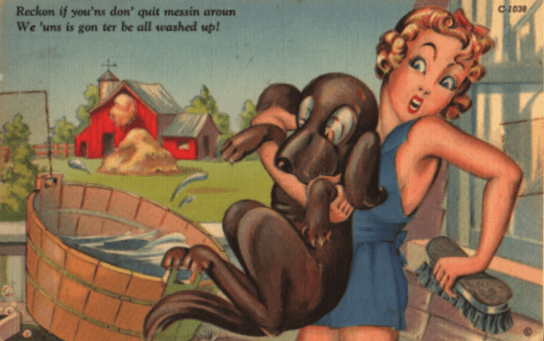
The answer to that last one is simple, really. She’s there to help sell the postcard, rather like the young lady shown here trying to wash her dog. The joke doesn’t have anything to do with WHO is washing the dog, nor how that person should be dressed. But at least she is a part of the gag, unlike the lady in the first postcard. And that rather scanty outfit is practical, as anyone who has washed a large dog will understand.
There are plenty of postcards ABOUT good-looking young women. What I was wondering about was how often the ladies walked into a joke where they were not essential, but just helpful in catching the eye of the customer. Here, for example, all we REALLY need for the gag are the cows. Having someone to milk the cows helps focus the joke. Having someone in high heels is not positively essential.
And there are some jokes which are just funnier, really, if the punchline goes to a woman. A man could just as easily have been walking Fido here. But he would have seemed either inconsiderate or just stupid, whereas this young lady can just be classified under, say, “Blonde Jokes” as we take the postcard to the cash register to buy it.
This joke didn’t particularly REQUIRE a woman either, or a very tiny woman (look at her height compared to that of the mailbox and/or newspaper. Of course, this was during World War II, when men overseas were thinking of the “little woman” back home.)
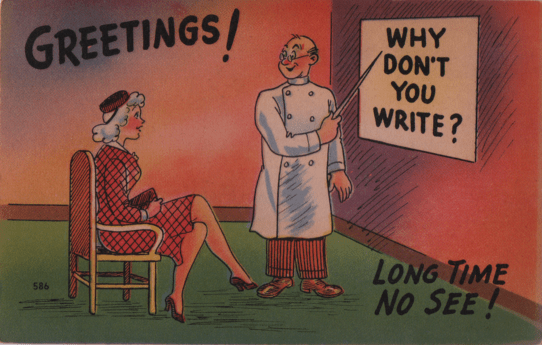
There is no reason for a female patient crossing her legs for this card. Would anybody have bought it without her?
And anybody at all could have been picking a peach. (At least she’s doing something. What is the SCOTTIE doing there? Are we going for double the market?)
The phenomenon does not begin at mid-century either. This joke from thirty years earlier could have been done—in fact WAS done—with two men in the role. But the artist wanted to draw a shapely female golfer, and I bet his sales figures corresponded with hers.
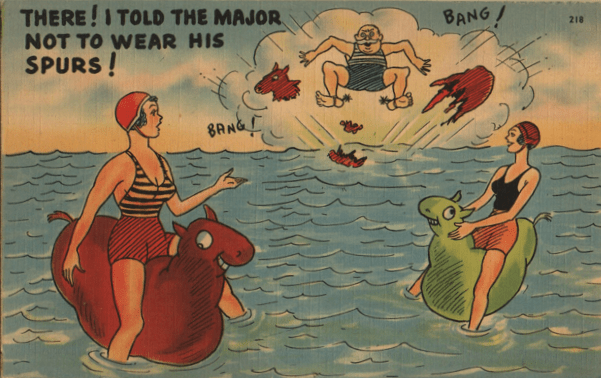
None of these ladies is quite as pointless as the bysitter in the first postcard. Somebody HAD to be around to deliver, and receive, this joke, and since we’re at the beach, why NOT a couple of healthy young women in 1930s bathing costumes?
And here, the speaker must really be female, to fit the punchline.
But, as people who used the same pun in different contexts pointed out, it did not necessarily have to be the pinup model type preferred by other artists.
The shapely ladies who produce the punchline (or, as here, the straight line) are simply there to nourish the sales figures, to help profits grow. We could call them womanure. But I don’t think we will.
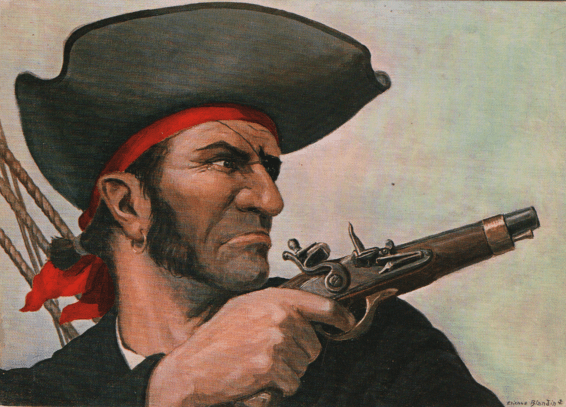
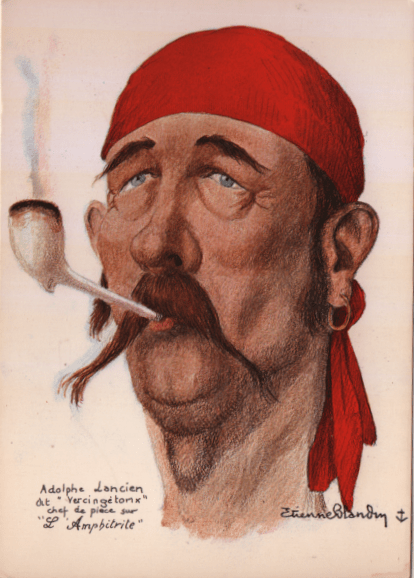
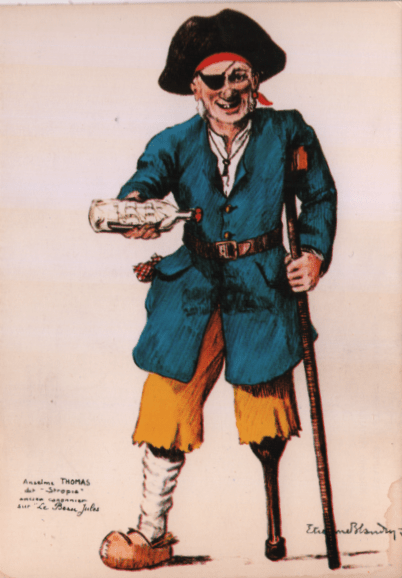
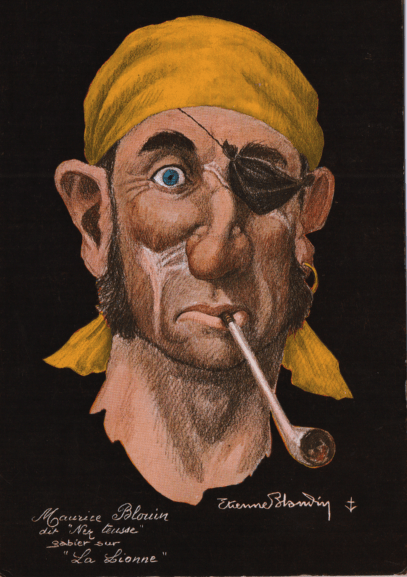
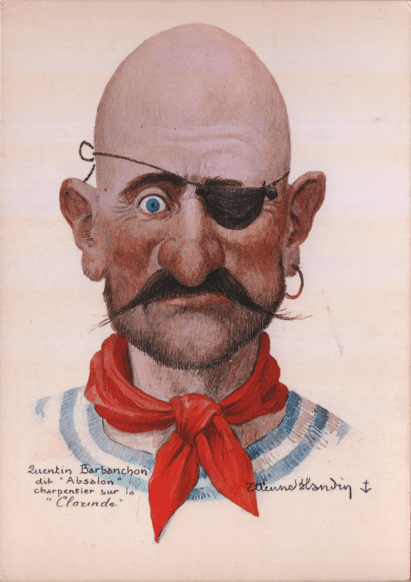
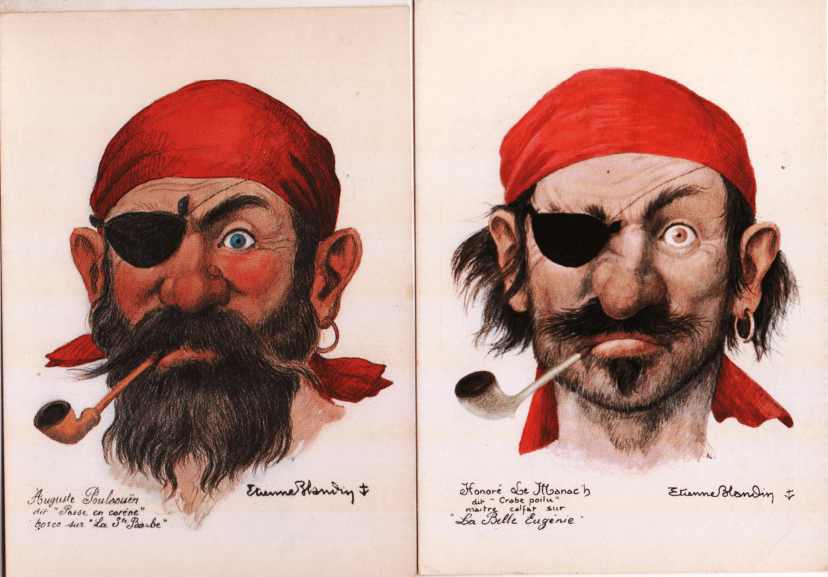
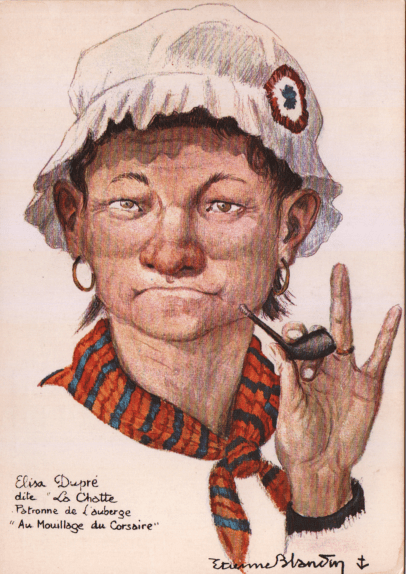
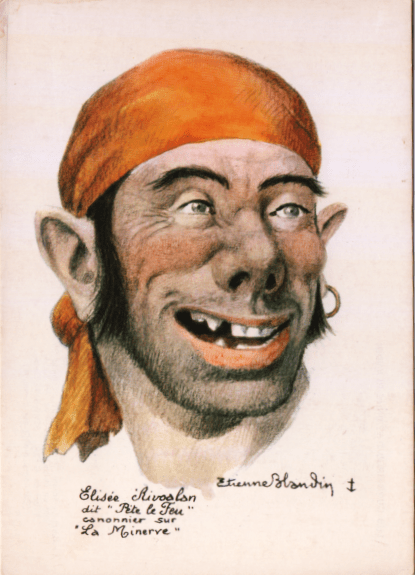
A jolly collection which came into inventory here in Blogsytown is about one fifth of a set of Corsaires. These are colorful portraits of freebooters and privateers (I don’t see ANYOE using the word “pirates”) from Dominique Leroy here–a captain also known as the Pistol Corsair, who was captain of the Foudroyant (Lightning)—to ship’s carpenters, sail specialists, and even onshore support staff.
There were eighty-six portraits in the full set, each with a name, a nickname (essential for a pi…corsair), and the role they played aboard whatever ship each served. It’s a maritime malefactor trading card set–I was half expecting a table of statistics on the back, with voyages, battles, and loot recorded there. They are individual, colorful, and completely the product of the imagination of artist Etienne Blandin.
Born into a sailing family in 1903, Etienne was determined to follow the family trade. But he was expected to do things the right way: one didn’t just run away to sea. His school had what we would call Sailor Prep courses. Standards were high, and Etienne simply couldn’t manage the right grades in math, of all things. (Essential for navigation, I suppose.) Disappointed, he took the advice of his father, who felt the boy had artistic ability. (Wait a minute: don’t these stories usually work the other way round?)
He became a painter and an art teacher, but experienced a sort of midlife crisis when only 28. He’d been painting landscapes and still lives and Biblical scenes, but he looked at his work and decided something was missing. He gave up painting and turned to studying maritime history.
When he took up his brush again, he was painting portraits of ships, a genre of paintings which occasionally turns up on postcards as well as in galleries. These were received very well by the public and by the French Navy, and he was appointed one of the Painters of the Navy, which meant that he could go on missions as a crew member on military vessels (but only during school holidays, since he was also still teaching.)
The government had made no plans for including the painters of the Navy in any sort of wartime role, and World War II found Blandin working with an infantry regiment before the course of the war lost him that job. He went back to teaching and painting, which he continued until failing eyesight led to his retirement from both those jobs at the age of eighty. (In the meantime, he also compiled, and painted over a thousand illustrations for, a reference guide to all known maritime flags.) He died in 1991, leaving behind a catalogue of paintings unrivalled by other specialist artists.
Somewhere in the vast world of fans and collectors, there MUST be a guide to his 86 Corsaires which explains when he did these paintings, who decided to make them into postcards, and to what degree each is based on someone he knew personally, or whether all these characters and their wild world sprang straight from his imagination. Nowadays there’d be a graphic novel series, animated cartoons, live action movies and who knows what-all else. (Maybe there were, and nobody on the Interwebs wants us landlubbers getting involved.)
According to a website which shows some 75 of the 86, there are 83 men and 3 women in the set. They have many things in common—the red bandana, the clay pipe, the eyepatch—but each is an individual with a backstory we are left to imagine. Because of this, they also do not have birthdates, death dates, or anything else to take them out of a seventeenth-eighteenth century pirate Neverland filled with seaside inns, disreputable hijinx, and high seas adventure. Yar-har, fiddle-dee-dee indeed.