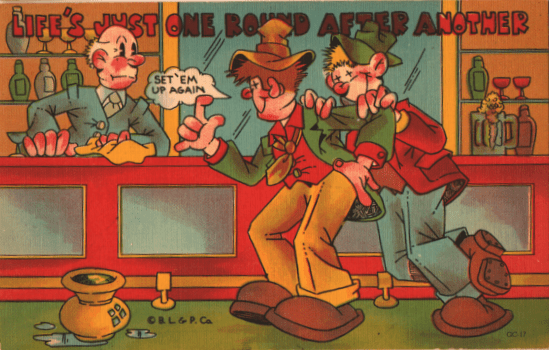
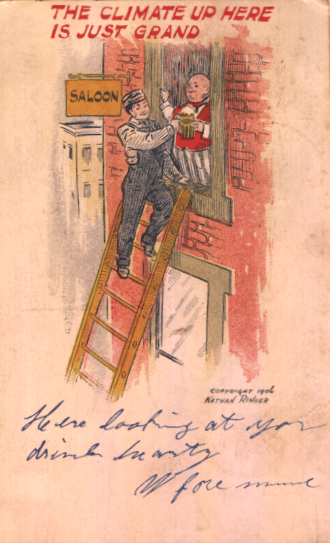
Earlier this week, we considered the classic saloon, as portrayed vintage postcards. We considered particularly the swinging doors, the bar rail, the spittoon, and free lunch. And we allowed as how there was one feature we needed to consider in a blog, that indispensable dispenser, the bartender.
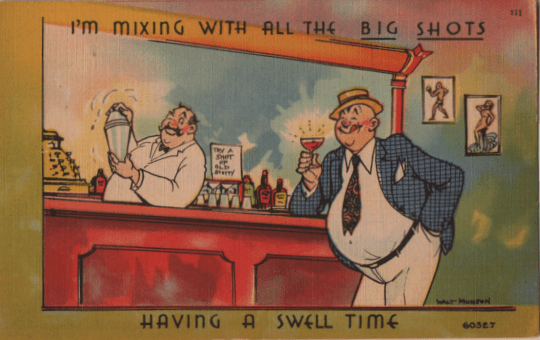
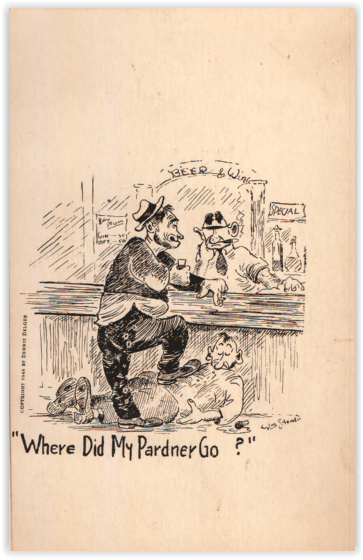
The customer, of course, is the only really indispensable human feature of the bar in cartoons (and to the establishment’s accountants, to be sure.) But the bartender runs a close second. Waiters and cigarette girls belong to postcards set in nightclubs, and the barmaid, or female bartender, is seldom seen. Postcards set in bars generally demand a man behind the bar, frequently a robust soul in a white shirt, with a handlebar mustache above a ready smile. This depends on the kind of bar being portrayed, of course.
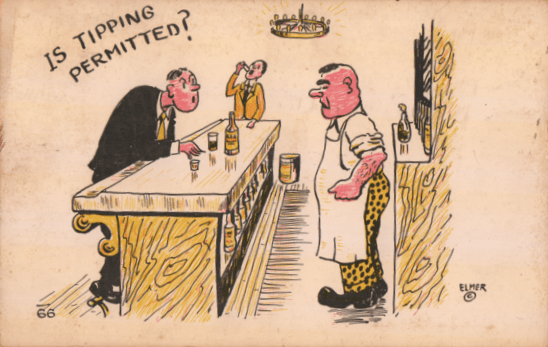
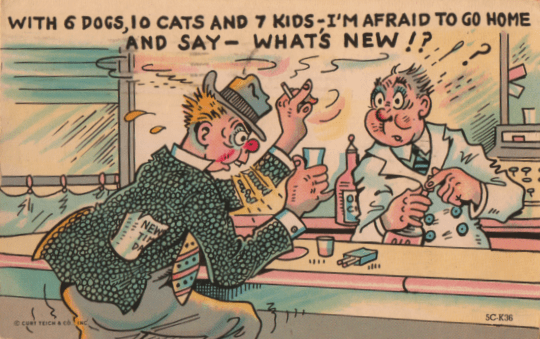
The bartender’s role in most postcards is similar to the job he performs in the three-dimensional world: straight man. He is there to react to what the customer says. Sometimes this is a mere question of etiquette and custom.
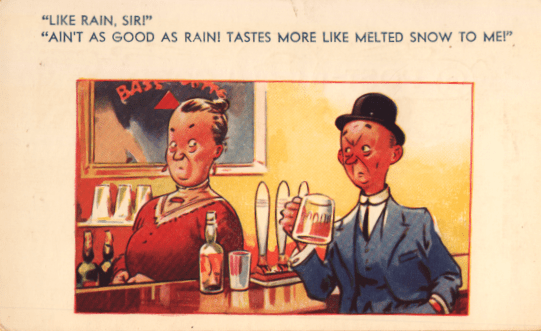
Sometimes it’s an observation on the weather, or the service, or the beverages on sale.
When a customer offers advice, the bartender is there to nod.
Action is reserved for times of need: as when a customer orders another drink and the bartender has a faint suspicion that this would be a bad idea. Knowing when and how to cut off a customer is nearly as important to a bartender as knowing what kind of glass to use for an Old-Fashioned. The postcard, as opposed to poems and songs in American literature, usually takes the side of the bartender in these discussions.
But the most important job of the retail mixologist is that straight man role. Listening to the concerns, worries, and opinions of the customers is the way to encourage return trade. The best bartenders have developed an ability to read body language without actually listening. The customer’s gestures and tone can tell a skilled listener whether they are telling a joke, sounding off about politics, complaining about their kids…it may be necessary to listen long enough to catch up a word or two for guidance (Is he complaining about his kids, his wife, his girlfriend, his boss?) but the best can respond with sympathetic nods or grunts and never take in the cascade of lubricated monologue.
The stress of actually listening might spill over otherwise. (I herewith apologize to any bartenders and/or bartender substitutes whose attention I may have monopolized over the years…though one of them said my conversation was very cost-effective. It saved them the expense of turning on the radio to provide background noise.)
We have several times in this space considered the actions of alcoholic beverages on the people seen on vintage postcards. This alcohol appears in many roles depending on the angle the artist has decided to take: the toast at a banquet, the beer keg in the cellar, those cans and bottles in the fridge, the still up in the hills. But no artist could produce pictures for picture postcards without being able to draw the good old saloon.
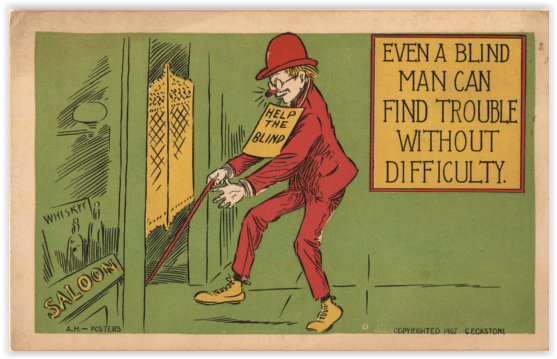
The good old saloon, which had become a vision in American nostalgia somewhere around World War I had certain features essential for its portrayal. One was the entrance: a set of double-hinged swinging doors to push through on your way in or be thrown through on your way out.
Known in the trade as “café doors” or “batwing doors”, these seem to have become associated with bars in the wild west and migrated eastward. They had a certain practical appeal: a LOT of saloons, despite what you’ll see in the movies (or on postcards) were tiny hole-in-the-wall establishments with packed crowds and no ventilation, so they allowed for a little air circulation. They also did not obstruct the sounds of laughter and song, which helped guide strangers to an establishment.
If you were wondering, the trademark saloon entrance did not make up the entire door system. In winter, or during closing hours, there was usually a second pair of doors that filled the whole doorway to keep the cold or the after-hours intruder, on the outside.
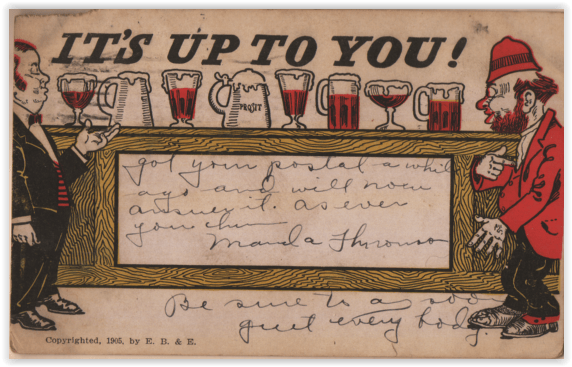
The smallest bars generally had the smallest variety (in the early days of the west, you paid for a shot of whatever they had on hand) but the tradition of different vessels for different beverages was essential at any saloon which wished to be considered a “drinking establishment”. (If this were a worthwhile column, we would consider the differing expectations of people who went to a “bar”, a “pub”, a “tavern”, a “saloon”, or…well, maybe after I get that genius grant I’ve applied for.
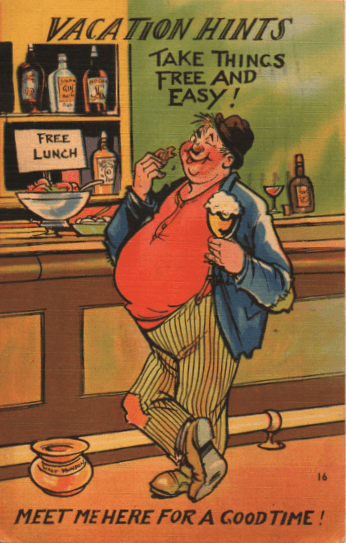
But people who reminisced about the good old saloon were less likely to recall what they drank than what they ate. The “free lunch” was a feature which New Orleans claims as its own invention, but which spread throughout the United States, becoming almost as essential to saloon nostalgia as those swinging doors. This “free lunch” was not free: you had to order a drink before you had access to it (the restrooms worked on the same principle). The pale descendants of the Victorian free lunch can be seen in the bowls of peanuts or pretzels or chips now seen in drinking establishments (often brought to the table AFTER you order.)
Once upon a time, though, there were wedges of cheese with a knife in them, big joints of meat with a knife there, sausages, eggs hardboiled or pickled, sauerkraut, pickles, pickled onions, stewed tomatoes, boiled potatoes…the variety was limited to the imagination of the owner, the ethnic makeup of the neighborhood, and the budget. This food array did, if you were wondering, cost more than the price of one beer would cover. But if you look over the possible menu items, you’ll see that salt was a major ingredient: starch was also important. The owners counted on their customers eating something to go with their drink and then having to order more drinks to wash down the food. The art of turning a profit by putting out free sides was delicate and arcane.
Coming down toward the floor, we find two more articles essential to a postcard saloon. One of these is the cuspidor, or, more vulgarly, the spittoon (there were less pleasant names for it, but we were just discussing food, after all.) The custom of chewing tobacco, at one time apparently nearly universal among Americans (visitors from Europe were always commenting on this), was on the wane, partly because cigarettes had become cheaper and more acceptable socially. But even though tobacco spitting gags were pretty much retired by the time postcards came along (thank goodness), the habit itself never disappeared, and the saloon liked to be known as a place where men could relax and indulge in habits that society (and or wives) didn’t care to see could be indulged. (This also explains all the pin-ups you see tacked to walls in postcard bars, but that’s a whole nother blog.)
And no self-respecting cartoon bar could do without the footrail any more than they could the spittoon. These were designed to make it more comfortable for a man to stand for hours at the bar, and went right on to the Modern Era (defined as the time when it became legal for women to order a drink right at the bar. Before that they had to sit at a table while a man brought the drinks over.)
We have not hit ALL the cliches of the old-time saloon, of course: there’s that big mirror, the piano player, the poker tables, the “two doors” (restrooms), the…but it is important to recall that not EVERY drinking establishment had all these things at the time, as seen above. All a saloon really needed was alcohol, a counter to sell it across, and one other thing. But that will be discussed on Friday.
That was a good year for fairies. News of how Sleeping Beauty’s christening had gone wrong spread far and wide, and the story of princess Dimity’s christening added to the buzz. Any king or queen with a new baby sent invitations to every fairy imaginable, come the christening. In one land, where the queen had been delivered of three baby boys, each and every fairy was invited to attend, with twenty-seven extra places laid at the tables so as to honor any fairy the court scribes had forgotten but who showed up anyhow.
At the same time however, the Fairy Queen had called her court together to work things out. “What with every fairy having to give every prince or princess a present,” she said, “There are just too many chances for a fairy who’s having a bad day doing someone a nasty turn, and giving us all a bad name. Besides, I’m worn out from having to attend all those parties AND think up some new present. I can’t get any other work done. Teeth are piling up under pillows. From now on, one fairy will be sent to take a gift from all of us. This fairy shall be known as a Fairy Godmother.”
When this was explained to the queen with three sons, she exclaimed, “What an excellent notion! I won’t have to worry so much about doing or saying the wrong thing and maybe upsetting one out of a hundred fairies!”
Three Fairy Godmothers, then, attended the christening of the three new princes, each lining up at the bedside of the prince chosen for her. The fairy who stood by the cradle of Prince Alain was named Orchid. She gazed at the small prince and declared, “He shall be the handsomest prince in all the world.” The other guests nodded their approval. and the Queen smiled.
A fairy named Fennel stood next to the cradle where Prince Archels was sleeping. She tapped her wand on the railing and said, “He shall be the strongest prince in all the world.” The court applauded softly, so as not to wake little Archels.
Then a fairy named Snowdrop leaned over the third cradle, where Prince Affretz waited, looking around and blinking at everything. Waving her wand over the cradle, she announced, “He will be the ugliest prince in all the world. And for a while, he’s going to have a really serious limp, too, I think.”
Everyone stared. No one could remember doing anything to upset her. But she just smiled, and then the three fairies disappeared, taking with them the Queen’s gifts.
Rues were rules, so that was all there was to the fairy gifts: no one could come along and make amendments to what Snowdrop had given Prince Affretz. The Queen ordered her soldiers out, commanding them to find Snowdrop and ask what was meant by such a gift. But no one saw Snowdrop for many years.
Everyone could see, as the princes grew up, that the fairies had meant exactly what they said. Prince Alain was so amazingly beautiful that for so long as he lived, he never saw a butterfly. Butterflies were so ashamed of their own looks when he was around that they flew away to hide. Prince Archels was so strong that four soldiers accompanied him whenever he played on the lawn, to keep him from accidentally knocking the castle over. And Prince Affretz was so tremendously ugly that people used to follow him when he went for a walk, begging him to come around to their garden and scare the crows away.
The Queen knew better than to leave everything to the fairies, og course. Prince Alan had training from the best soldiers in the kingdom, so that he was not merely good-looking, but also brave. “Too many soldiers have bright buttons on their tunics but no courage inside,” she said,.
Prince Archels was attended by numerous teachers and professors, to nake sure he was not only strong but smart. “Too many strong men have muscles in their arms and nothing in their heads,” the Queen said.
And she simply assigned any spare academicians or wise men to study with Prince Affretz. “He needs any help he can get,” his mother said. So he took singing lessons, and dancing lessons, and went to classes on etiquette and geography. He learned swordsmanship and penmanship, interior design and gardening. Astronomers came to speak with him about the moon and stars, and cobblers came to show him how shoes were made.
As the brothers talked to each other about what they’d learned, they all grew up into pretty good princes. When prince Alain rode his horse through the streets, people would sigh, “Oh what a prince is our Prince Alain! He’s so handsome and brave!”
“Prince Archels!” they would shout, when the second brother rode among them, “Prince Archels! Don’t you just adore him? He’s so strong and intelligent!”
And when Prince Affretz rode down the street, his horse wearing special blinkers so it wouldn’t glance back and see him, people would sigh, “Well, there goes that nice Prince Affretz. Pity he’s uglier than a mudtoad.”
Other princes might have grown angry, or envious, but Affretz had been much taught about manners and logic, so he threw no tantrums. “I can’t help being ugly,” he said, “But I can make up my own mind about being nasty.”
So when there was a ball and no one would dance with Prince Affretz because he was so ferociously ugly, and limped besides, he simply smiled (which made things worse.) Then he’d go over to sit with the musicians and play any instrument that would hide his face.
One day, the three brothers decided it was high time they headed out into the world to seek some of their fortunes. “I’m tired of staying around the castle doing good deeds,” said Prince Alain. “Besides, everyone around here has already seen all my outfits. I think I should look up some dangerous places and find out if dragons are as dangerous as everyone says. It’ll be a change from all the duchesses who want to dance with me all the time.”
“I’ll ride with you,” said Archels. “I’ve read about other countries, but I’ve never seen one up close. Besides, when I dance with a duchess, I almost always break at least one of her ribs.”
Prince Affretz nodded. “We might as well all go. I don’t suppose the duchesses will miss me much.”
The Queen, learning of their plan, gave them permission to go. “You will learn things you wouldn’t at home,” she said. “But take care of yourselves, since one day you need to take over things around here.”
Putting on their finest armor, the princes rode out from the castle. Each rode one of the best horses in the stables, and were followed by a fourth horse, pulling a wagon. So eager were the brothers to see new lands and make the acquaintance of dragons that for the first couple of days they would not stop to make camp, one brother sleeping in the wagon while the other two led the way, and eating a quick meal before mounting a horse and giving another brother a turn in the wagon. In this way, they could keep moving until familiar lands were left behind and there was a chance to find something interesting.
It wasn’t until the third day that Affretz, climbing into his saddle, asked, “Where are we going, by the way?”
“Good question,” said Alain. He turned to his brother Archels. “You picked the road. Is it leading anywhere in particular?”
“I have read,” said Archels, “That away to the west there is a high, dark castle under a curse. A high, bitter forest of thorns stands around it, and no one has come out of that place for seventeen years now. I thought we might go have a look at that.”
“Sounds like trouble,” said Affretz. “Good.” And the three brothers continued westward.
In our last dissertation in this space, we considered the image of the placid milk cow, and how postcard artists revealed a darker side, showing rebelliousness of which city folk had never herd. (No, I will NOT apologize. You knew what blog this was when you clicked on it.
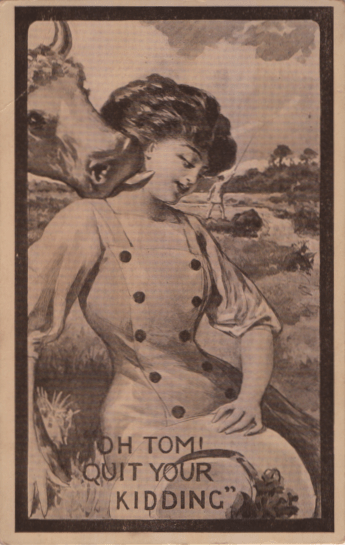
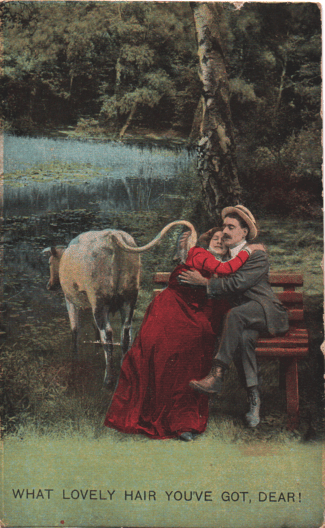
This time, we will look into the lives of, primarily, city folk who were not expecting cows to be anything more than rural decorations, devoted to eating buttercups, providing butter for the morning muffin, and acting as calm reminders that city folk had left the hazardous, random ways of the city for safer zones. Sometimes, this sudden appearance of a cow is presumably pleasant, as in the many “deluded lover” postcards which appeared on postcards for well over seventy years.
Both sexes were liable to this delusion. But we’ve discussed that whole phenomenon hereintofore. (Cows, by the way, seem to be the most common actors in this gag, though pigs, bears, and even elephants sometimes take on the job. Goats, I suppose, were too ornery to be used in that context, but what did the postcard artists have against, say, sheep? This suggestion of a thesis or dissertation topic is offered without charge. Just one of the services your Uncle Blogsy provides.)
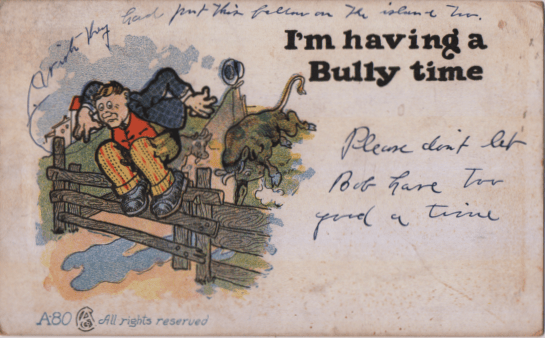
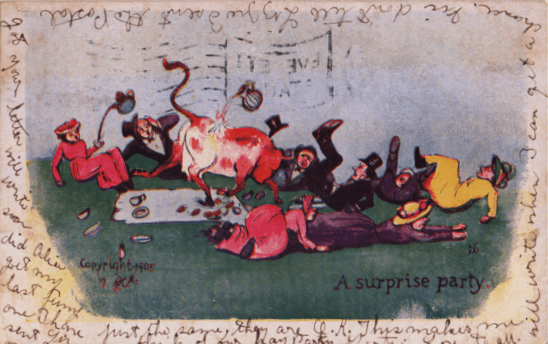
More often, though, the context of unexpected cows comes when city folk trespass in a meadow. THIS job is often taken by the bull, a subject also discussed with some brilliance in this space before today. (No, I do not employ guest bloggers. You’re staying after class and drawing cows one after an udder.)
Tramps are often shown dodging bulls I fields, but often the trespassers are clueless city tourists who assumed the cows were no more likely to come after them than the trees or fence posts they wind up using as shelter.
These trespassers are sometimes taking a shortcut while walking out in the country, and make the acquaintance of the bull right away. Other tourists, however, have time to make themselves comfortable on a random patch of grass before they attract attention. They find this unreasonable.
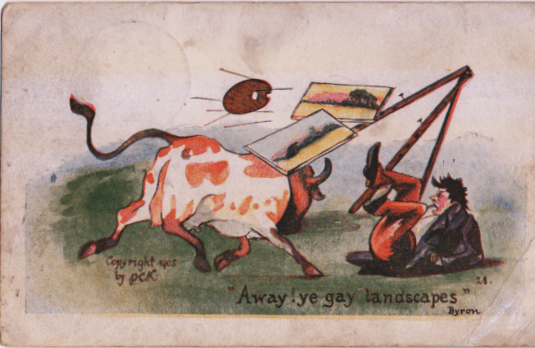
After all, why would any animal object to the presence of a harmless tourist, just trying to enjoy the great outdoors, and perhaps record the moment for that photo album back home.
Or even record the sweet, dreamy peacefulness of the pasture for viewers in an art gallery or museum. Some cattle have no regard for their artistic legacy.
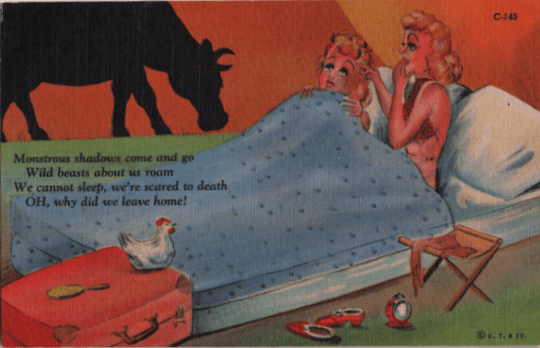
Perhaps SOME of the blame should be applied to the city folk themselves. They came out to enjoy the sights and sounds of the country, and look at the farm animals, even bringing a tent so they can enjoy those sights and sounds through the night. So why the shock on hearing those sounds and seeing those sights? What did they THINK cows did of an evening?
After all, the city folk are just as exotic to the cows as the cows are to the city folk. In fact, um, I suppose this particular postcard sold on the basis of people who wanted to look at these city folk, rather than the fearsome, alien silhouette on the tent wall. But everybody to their taste, as the old lady…yeah, another Dickens joke. Were you expecting Shakespeare in this spot?
We all have those days. Even if we LIKE our job, it can weigh down on our nerves and seem, suddenly, too much to ask of an intelligent being. Even I, marzipan meatloaf, who live the thrilling, glamorous life of a blogger, have been known to wish I had a simpler way of making my daily bread. Clipping coupons from Grandma’s stock portfolio, or checking each of the fifteen Swiss bank accounts uncle jasper set up seem much more soothing some days than the exciting life I lead on a daily basis.
You may not be aware that humans are hardly unique in this. Postcard artists have for years chronicled the discontent of the quiet, humble dairy cow. The life looks pretty appealing: wander around in the sun eating buttercups and stand still for a while as a trained professional takes the milk that is, admittedly, weighing you down. Could a cow really ever get tired of so straightforward a career. (There’s the speed dating to make sure milk continues to flow, but I don’t suppose it’s all THAT much worse than an annual performance review._
And yet, cow rebellion is a regular side of farm life. Just about every cow gets annoyed by the business at some point, and a few are downright hostile all the time. It may be something on the buttercups.
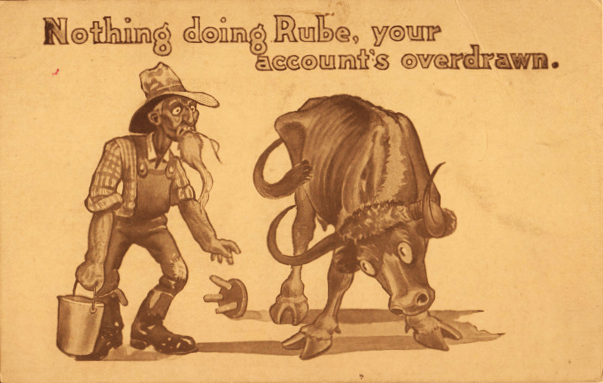
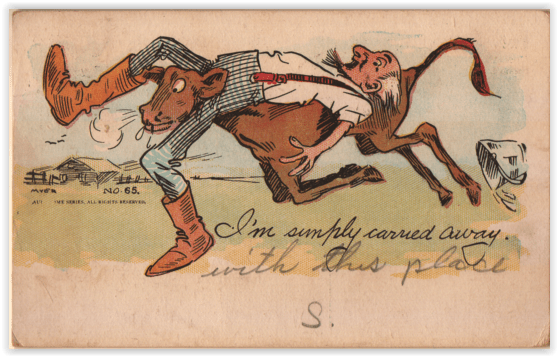
Some cows know they’re quicker than their support staff, and can elude capture (particularly if the pursuer is encumbered with bucket and milking stool) for as long as the game is entertaining.
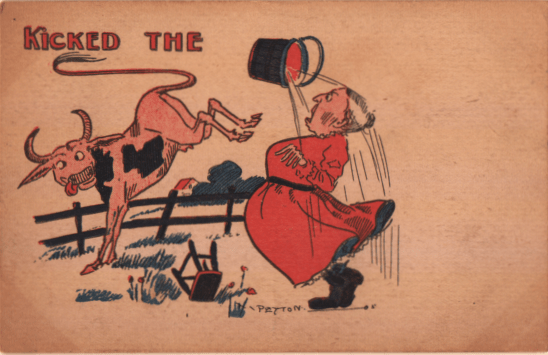
But the veteran cow knows a good swift kick is less trouble. You can frighten or injure the milker and, with luck, knock over the milk pail, making a whole morning’s work into mud.
If the milkstaff is really slow at getting out of the way, this sport can become the stuff of legend (and/or postcard.)
The farmer’s own strategies can be turned against him. And this is a game which is renewed every day. Many the farmer has been amazed by a cow’s ability to come up with new and annoying tricks to keep dairy profits down.
You might think a cow would be a little more careful about this, as there are very few career opportunities available for those who don’t want to keep the cream on its way to market. But perhaps this does not occur to the work-a-day cow.
After all, it is written on the wall of the barn: Old Milk Cows Never Die. They Just…well, you know.
When Sleeping Beauty pricked her finger on the spindle and fell asleep, everyone else in the castle fell asleep, too. A thorny bush grew high all around the castle so that no one could get in except one very daring prince, a hundred years later.
Now, the country could hardly run by itself while king and queen and government were all fast asleep in that unreachable castle, not for a hundred years. So when it became obvious that things in the royal castle were going to be pretty quiet for a while, the people consulted the sleeping king’s younger brother, and asked him to be the new king.
The new king had a wife and, soon after they had both been crowned, the new queen gave birth to a baby girl, who was christened Dimity. Dimity’s parents had learned a thing or two about what had gone on in the older king’s castle, so when the day came to christen the princess, they were very careful to invite EVRERY fairy in the kingdom to the party. And even at that, the king whispered to two of the fairies, Sainfoin and Chamomile, as they arrived, “Please don’t give the princess any gifts until the end of the evening. It may be that some angry fairy will arrive unexpectedly. We may need you to change whatever curse she puts on our daughter.”
Nothing of the kind happened. Everybody had a wonderful time. There was plenty to eat and drink, and lots of music for dancing. The party was so successful in fact that it might be going on tonight if the queen had not whispered to the king, “We should probably start letting the guests go home so Dimity can get to sleep.” Because the baby, as guest of honor, had been laughing and cooing throughout, to be admired by all the guests bringing gifts.
The king called for the waiters, and told them, “It is time to ask the guests to leave the party. Be polite, of course, and mention that I will shake their hand as they leave, and give out golden party favors as thanks for their attendance at this momentous evening.”
The waiters were skilled at this sort of thing, and most of the guests, though sorry such a lively party had to break up, decided it was, indeed, time to go home. The only guest who made a fuss, oddly enough, was the fairy Sainfoin.
“I’m having a good time,” she told the waiter. “So many kings and queens give stuffy old parties, but this is fun. Let’s dance!”
The waiter bowed. “But the King will shake your hand as you leave,” he said, “And I know he’s giving out golden rings as party favors.”
“When I want a gold ring,” said Sainfoin, “I can gather buttercups and make one. I’m going to dance for hours yet, and I’m going to have another piece of that red cake with the butter frosting, too.”
“Oh please, Ma’am” said the waiter. “The princess needs her sleep. And everyone else is going home.”
Looking around, the fairy saw that the waiter spoke the truth. Soon there would be no one left for her to dance with. And the royal chef was packing away the last of the cake, to put in the kitchen until the next day’s lunch.
“Well!” said Sainfoin, hands on hips. “And just when the party was getting good! Well, well!” She looked up to the throne where the queen sat holding the Princess Dimity, who was waving her hands, obviously willing for the party to go on herself.
“Aha!” said Sainfoin. “I remember I was asked not to give the princess a gift until later. Here’s my present for your precious princess who needs her sleep. When she is sixteen years old, she will stub her toe on an old wooden horse trough and from that day forth, she will never sleep again until one day she DIES from being so tired. So THERE!”
Sainfoin stamped a foot. A puff of smoke rose around her and she disappeared. She didn’t wait to get a gold ring or shake the king’s hand.
The royal couple were stunned by this gift to their new daughter, but fortunately Chamomile had not yet departed.
“I can’t remove my sister’s gift,” she told the queen. “That’s against the rules. But I can do this. The princess will have a year from the time she stubs her toe to find some prince who can put her to sleep, so that she does NOT die.”
The queen wrinkled her nose. “How will he do that?” But Chamomile also disappeared in a puff of smoke, leaving the king with two extra gold rings.
The king and queen put Princess Dimity to bed. Then they stood at the window of the princess’s bedroom, looking uphill to that bigger castle surrounded by thorns, where hardly anyone ever went in, and no one ever came out.
The next day, they sent out an order that every single wooden horse trough in the country was to be burned. The people were upset about this, because they had already had to go sixteen years without spindles, by order of the previous king. But the current king sent a shiny new metal trough to everyone who burned their wooden one, so most all of the people were happy again, once the smoke had cleared. (A lot of those troughs were completely waterlogged, and burning them took weeks.)
One old lady who lived not far down the road from the castle was NOT happy. “My babies splashed and played in that dirty old trough,” she said, “And so did my grandbabies. And one day my grandbabies may have babies of their own.” So she took her horse trough and hid it in her attic.
Princess Dimity grew up to be as beautiful as her cousin who slept in the dark enchanted castle up the hill. No one ever told her about Sainfoin’s curse, because once everyone was convinced all the wooden horse troughs in the country had been burned, they felt there was no reason to worry about it.
There are those who yearn for the good old days. They give assorted reasons: prices were lower, people were more civil, there were not electronic devices beeping at us to tell us that a friend has uploaded another video of her performing bunny to TikTok. But there is a frequent refrain to all of this, that “Life was simpler then.”
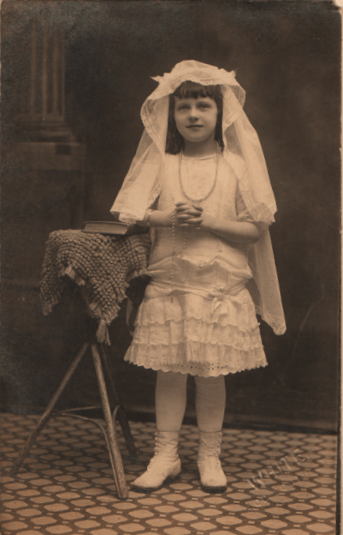
I don’t get it, myself. I don’t at all remember a serene, unflustered distant era. I may worry today about different stuff than I did eons ago, but I don’t see that things I worry about now are any more complicated. And the good old days had their own sets of rules, especially where children were concerned. Children were, according to some experts, supposed to be fed on a steady diet of bread and milk and reminded that they were to be seen and not heard. Only at puberty (a word not uttered among children at the time, of course) would a child start to become an adult. A rite of passage might or might not occur (Bar Mitzvah, First Communion, heading off to a more rigorous school) around the age of 12. It was time, a child was told, to take up the knowledge and responsibilities of an adult. It was time to become aware of a wider world, to look ahead (or around) to gainful employment, to prepare for marriage.
It was, in short, time to cover your shins.
The custom of requiring children to wear short pants and short skirts until puberty was not universal, of course. Many working-class children, a lot of whom had jobs, HAD to wear long pants: work on the farm or in the factory presented constant dangers to the knees.
Yet, we see it again and again in the middle and upper classes. Growing up meant it was time to “put on long pants.” A common remark to girls whose knees were showing was “Pull your skirt down; you’re a big girl now.” As soon as you turned twelve, or thereabouts, your knees and ankles disappeared.
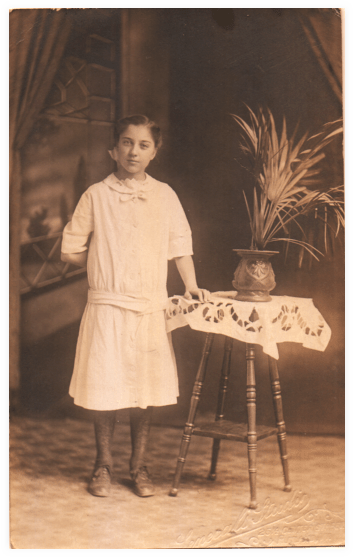
There are plenty of rppcs showing children on the crux of this moment: that rite of passage where one got a really fancy new dress
Or a highly polished new suit. Note that knees are still visible at this point (even if covered by stockings). The ritual has not occurred yet; one is still an awkward fledgling.
Or not awkward (I swear she’s about to deliver a lecture on hermeneutics) but still not old enough to qualify for floor-length wardrobes.
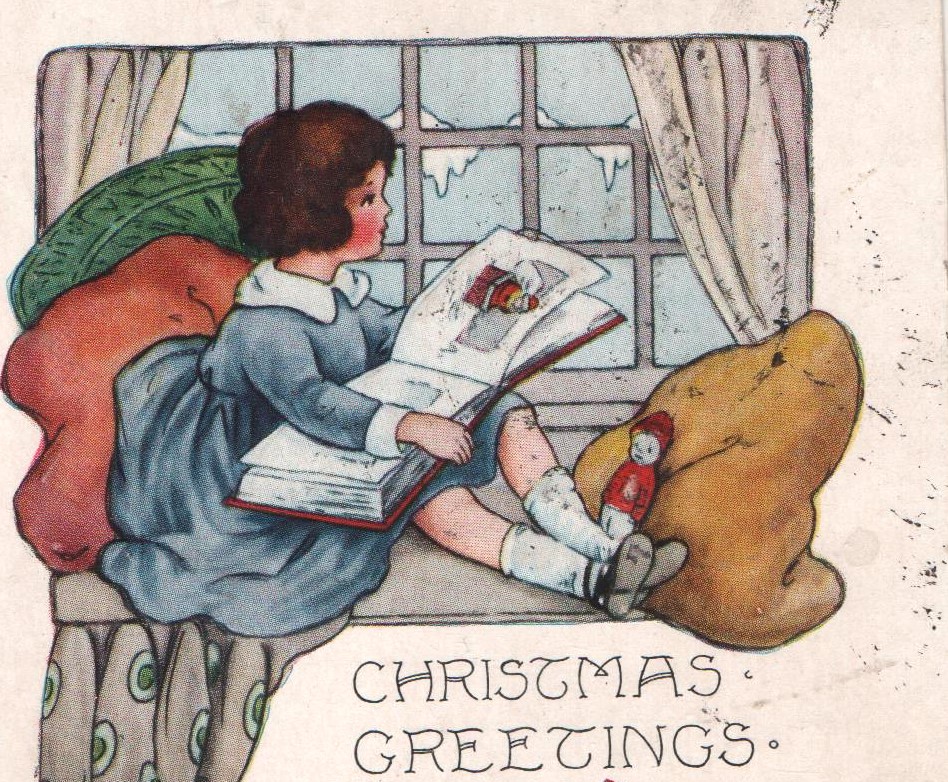
The day would come when changing fashion meant there were fewer inches of fabric between the grown-up and the child. And yet, as seen in the postcard at the top of this column, the perception that boys wore shorts and girls wore skirts which barely reached the knees. Many cartoonists kept this up long after the custom had passed (Richie Rich has not, as far as I can tell, donned long pants to this day) and the realities of life had changed completely. (MY grade school sent out a note every spring to parents that children in school were NOT allowed to wear “shorts, cut-offs, or culottes”. Not one of us knew what “culottes” were: it was just one more thing for us to worry about.)
Yes, oh eager blogwatchers, today is Valentine’s Day: a day of romance and/or chocolate and/or jewelry and/or cigars and/or…has anybody done a checklist Valentine, offering the recipient a list of things they can wish for? I have the sentiment for the inside already: “All you’re going to GET is this card, but it doesn’t hurt to wish.” (Yeah, I did a stint as a freelance greeting card writer, and my only triumph for February was a special efficiency Valentine which wished people a Happy VD…see, in those days Sexually Transmitted Diseases were known as Venereal Diseases, which commonly got abbreviated as…yeah, it wasn’t all that funny back in the day, either. That’s why I moved on to the more lucrative profession of blogger.)
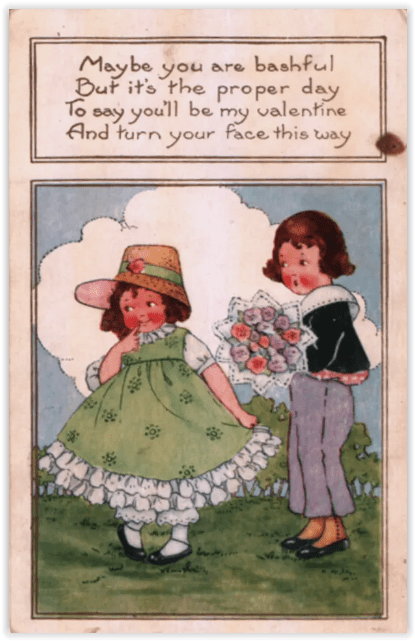
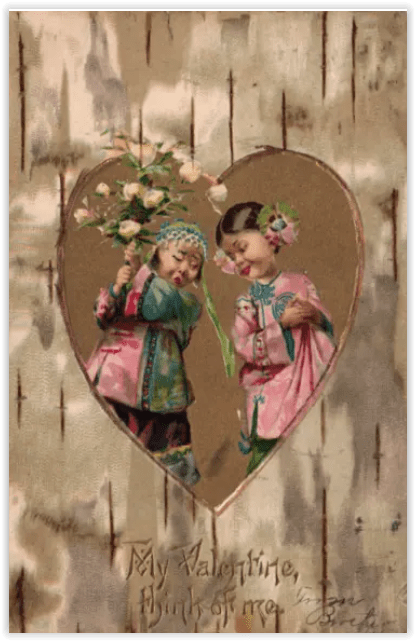
Anyway, as you already knew or guessed, our ancestors were not slow about sending Valentine postcards. These tended to run along the sort of themes you might expect. (This verse turns up on at least three postcards with pictures by different artists. Whoever wrote it just hit all the right notes.)
And if you know your antique postcards, you also know about the “Vinegar Valentine”, a custom which began in the Victorian days of luxurious greeting cards dripping with lace. I learned about these in grade school history classes, and was always taught they were made to send to people you didn’t like. I have grown to doubt this. Maybe they were more like Old Maid cards (which used much of the same aesthetic) and people just liked to laugh at the caricatures, and eagerly collected them, even in the days when you could get ten for a penny at some sale of scrap paper.
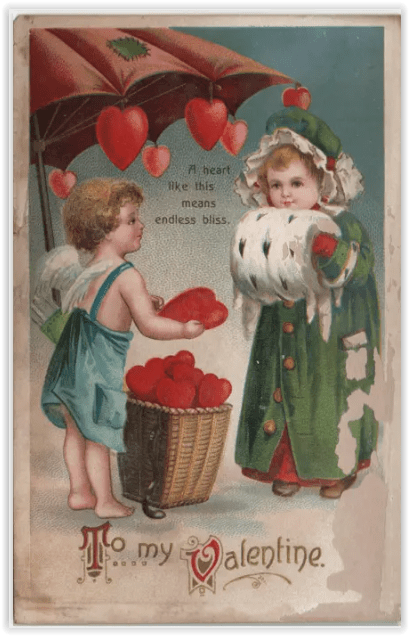
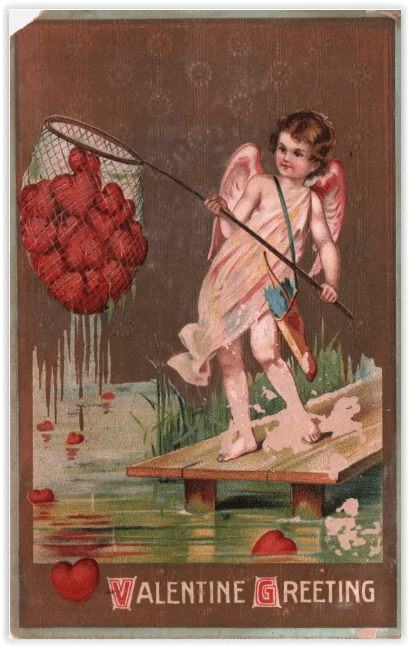
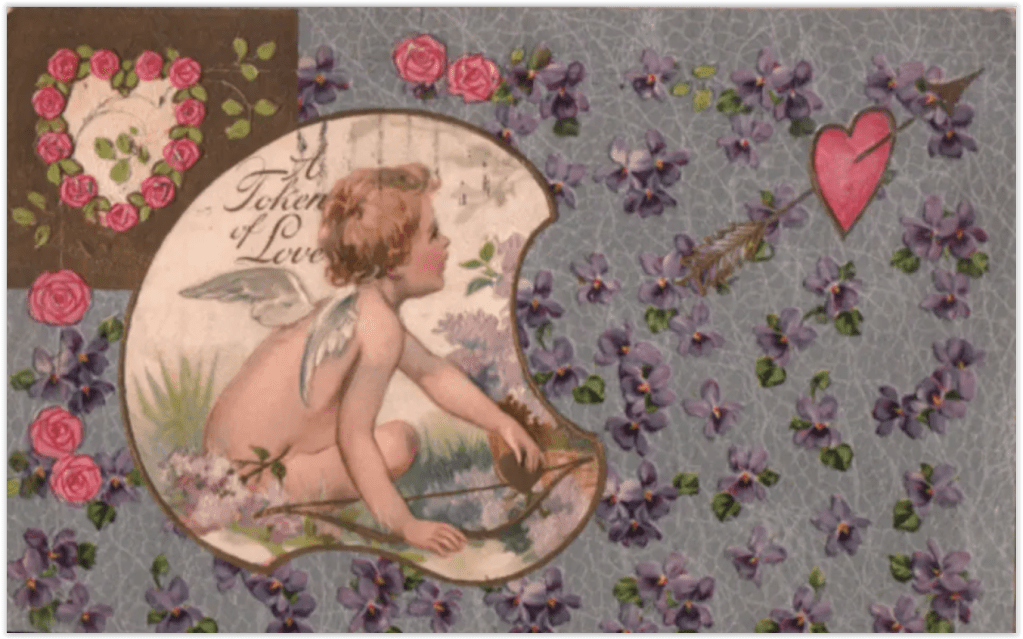
Cupid got his best day out on Valentine’s Day, where he takes on a variety of jobs depending on the artist’s imagination. He might be a chestnut vender
Or a fisherman
But the most common occupation for Cupid on Valentines was as a mailman, delivering hearts to all and sundry. Of course, some senders preferred to take their greetings over personally. (That way you could seal it with a kiss on arrival.)
Artists could actually apply Valentine wishes to any picture, of course. Love being universal, one could draw whatever ethnic group seemed especially charming and affix the wishes accordingly. (Yes, there are plenty of cards featuring Dutch kids with Valentines…enough for a whole nother blog, really.)
Some artists, perhaps under deadline or just figuring whatever they were good at was good enough, kind of cheated. This one could just as easily have gone out labelled “Easter Wishes” or “Birthday Greetings”.
If that seems to be a thoughtless rush to bring out Valentines so people could spend money on them, this idea is not new. This 1907 Valentine is festooned with advertising slogans, emphasizing the profits which could be made by associating products with romance.
And why fight it, after all? THIS postcard is good at Neiman-Marcus (on or around Valentine’s Day, 1997) for two Valentine’s Day coffee mugs or (if you use your credit card) a tote bag with this same logo. I assume it is unredeemed because even in 1997, everyone already HAD plenty of coffee mugs and tote bags.
If, like Cupid here, you are in danger of being overwhelmed by all the holiday wishes, take courage, there are those who are fighting back. For such people, in my greeting card days, I invented the Belated Valentine. Somehow this was not even as popular as my line of Belated Get Well cards, but I still think they have possibilities. My favorite was “Happy February Fifteenth! I wanted to show you the depth of my devotion and the extent of my emotion!”
Inside, it said, “But I also wanted to wait until the cards were marked down.”
Scrooge was better than his word. He did it all, and infinitely more; and to Tiny Tim, who did NOT die, he was a second father. He became as good a friend, as good a master, and as good a man, as the good old city ever knew, or any other good old city, town, or borough, in the good old world. Some people laughed to see the alteration in him, but he let them laugh, and little heeded them, for he was wise enough to know that nothing ever happened on this globe, for good, at which some people did not have their fill of laughter in the outset; and knowing that such as these would be blind anyway, he thought it quite as well that they should wrinkle up their eyes in grins, as have the malady in less attractive form. His own heart laughed; and that was quite enough for him.
He had no further intercourse with spirits, but lived upon the Total Abstinence Principle, ever afterwards; and it was always said of him, that he knew how to keep Christmas well, if any man alive possessed the knowledge. May that truly be said of us, and all of us! And so, as Tiny Tim observed, God Bless Us, Every One!
At this point, in most cinematic versions, a narrator steps in to read us those first three lines, at least, and frequently the last two, usually over a scene of Scrooge with Tiny Tim.
In Sim I, as we watch Scrooge walk along the street (at one point patting the blind man’s dog) we are told that Scrooge was better than his word. He became as good a friend, and so forth. And to Tiny Tim “who lived and got well again”, he was a second father. We watch Tim run to him, calling “Uncle Scrooge!” We are further told that it was always said of him, right through to the end of the passage. The narrator goes on to bless us, every one, and the closing credits appear over “Silent Night”.
In Rathbone, we return to the booklined room seen at the beginning, where the narrator delivers an abbreviated version of the passage.
In Sim II, as Scrooge laughs in a brightening light, the narrator gives us the first two sentences, and then the rest beginning at “It was always said of him”. The closing credits come over “God Rest Ye, Merry Gentlemen.”
In Matthau, B.A.H. Humbug tells us ”And that’s how Scrooge became as good a friend, as good a master, and as good a man, as the good old city knew. He asked for no reward, for his own heart laughed, and that was enough for him. May that truly be said of us all, and so, as Tiny Tim observed, Gpd Bless Us, Every One!” Scrooge sings “Mankind Shall Be My Business” surrounded by the Cratchits, with Fred and Mrs. Fred.
Imn Scott, a narrator gives us “Scrooge was better than his word. He became as good a friend, as good a master, and as good a man, as the City ever knew. And to Tiny Tim, who did NOT die, he was a second father”. He then jumps to “It was always said of him” and so on to the end. Meanwhile, on a sunny day, Scrooge has walked to the Cratchits’. Tim runs out to meet him. They walk off, hand in hand. A song about Scrooge, and blessing us, every one, closes off the story.
In Caine, Dickens tells us “Scrooge was better than his word. He did it all, and infinitely more.” Rizzo, anxious, asks “And Tiny Tim?” Dickens feigns sorrow, replies “And to Tiny Tim, who did NOT die….” Rizzo cries, “Aw, isn’t that swell!” “To Tiny Tim, he became a second father. He became as good a friend” and so on through that passage before skipping the usually skipped lines about intercourse with Spirits and blindness, which would be awkward nowadays, and goes to “And it was always said of him”, taking that nearly to the end. Tiny Tim calls “God bless us!” and Scrooge answers, “God Bless Us, Every One!” “The Love We Found”, a new version of “The Love Is Gone” plays while the camera pulls back across the table, out the door, and over the roofs of London (above lobsters who are singing in the windows.) Rizzo, offscreen, remarks, “Nice story, Mr. Dickens.” To which Dickens replies, “If you liked this, you should read the book.”
In Curry, we are told that Scrooge was as good as his word. No…better. He became as good a friend, and so on, “and he kept Christmas in his heart forever.” The credits roll over scenes of London.
In Stewart, we dissolve from the fire Bob is building in the office to the fire in Scrooge’s sitting room. Fred, offscreen, tells us, “My uncle was better than his word.” He reads farther from the text than most, as far as “He let them laugh, and little heeded them.” We watch the Cratchits arrive at Scrooge’s. Fred goes on “It was always said of him” and on through that passage. Scrooge lifts Tim, who says “God Bless Us Every One!” We take a long look at the other little Cratchits. Then everyone walks into Scrooge’s, and the credits roll.
AFTERWORDS
So that was the book I put together twenty-five years ago or thereabouts. I saw it as a coffee table affair, filled with stills from the various versions discussed, which might serve as an inspiration to other writers to try the same format with other books which had numerous film adaptations: Tom Swayer, say, or Hamlet, or, hey, The Gift of the Magi. Maybe one day someone will turn this into the book I expected publishers to line up for a chance to publish.
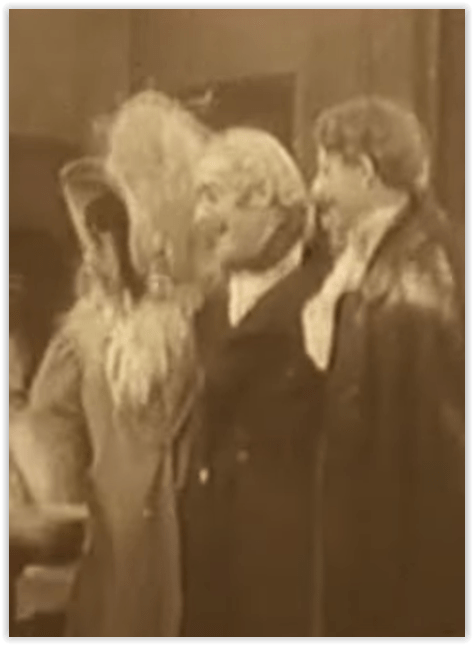
I could not illustrate even this version as I would have liked, since I do try to steer this side of copyright infringement. Where I did use scenes from the movies, I relied heavily on silent versions not discussed in the text which are old enough to be in the public domain. This included versions from:
1901: the oldest known surviving film of A Christmas Carol, long almost entirely lost except for the scene of Marley appearing in the doorknocker. Now something like 60% of the movie can be watched online. It was also long rumored that Scrooge was portrayed here by Sir Seymour Hicks, since, coincidentally, 1901 was the first year he portrayed the miser on stage, but this is now believed to be one Daniel Smith.
1910: A Thomas Edison production, notable for including as Bob Cratchit one Charles Ogle, who had earlier played Franken=stein’s monster in Edison’s version of THAT classic.
1913: This appeared under several titles (Scrooge, Old Scrooge, A Christmas Carol), but you should definitely look it up. Scrooge here absolutely IS Sir Seymour Hicks, who would portray Scrooge again, in the version we called Hicks. In this earlier film, he is as wildly eccentric as any Scrooge you’d care to see. Like a lot of silent versions, which were based on cheap theatrical productions, Scrooge sleeps in his own office (saves on sets) and, going along with the sort of CEO who would do that, he is probably the grungiest Scrooge ever, looking as if he has not changed his clothes in a monrh or bathed in a year.
1922: Scrooge is here portrayed by Henry W. Esmond, a very popular actor now best remembered as Laurence Olivier’s father-in-law.
1923: This version starred Russell Thorndike, younger brother of actress Dame Sybil Thorndike, who played opposite him in a silent version of Macbeth. He is now remembered less for his acting career than for the mysteries he wrote about the somewhat sinister vicar Dr. Syn.
Next Monday, we will start serializing another of my dazzlingly brilliant but somehow unpublished books: another nonfiction opus if I can turn up the manuscript I’m looking for, or a novel if I decide to throw to the winds all hope of becoming an Interwebs Influencer.
Wedged as we are between the death of the last lingering New Year’s resolutions and the start of Lent, I meandered through a bit of James Branch Cabell, an author my grandfather read but tried to keep me from reading. His reputation for elegant naughtiness was well-deserved, and he would find no shortage of controversy nowadays with his depiction of women as essentially dangerous creatures: he stated here and there among his works that they were a snare and a paradox for unsuspecting men. Women, he declared, was the great inspiration, leading men to attempt mighty deeds beyond what they would have tried otherwise. AND they were the ultimate obstacle, bent on preventing men from accomplishing the very deeds that were being attempted in their honor.
Which brings us to the promised topic of today’s column: the Fisherman and His Wife.
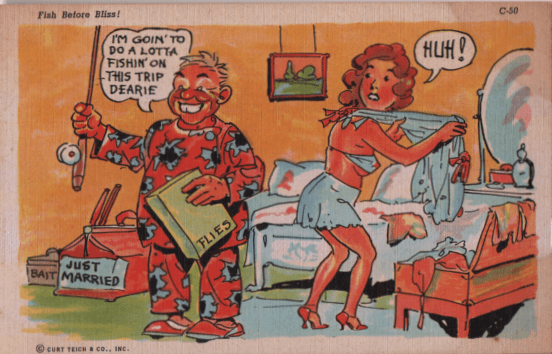
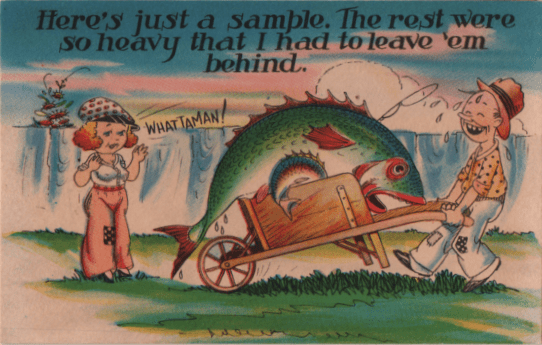
Ideally, to that alien observer we discussed last time, who thinks, from looking over our postcards, that the fisherman was king of our universe, a wife would exist to encourage and support her fish-hunting hubby. And yet they would see, again and again, that our cartoonists insisted it was not so.
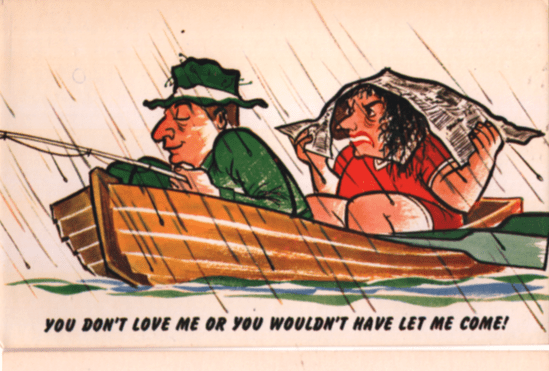
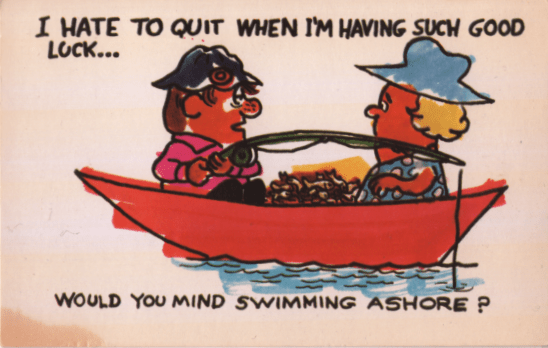
The fisherman’s wife, according to the postcards, regards herself as long=-suffering, and wishing to share that suffering with her partner.
They are a terrible distraction when a man is busy trying to catch the wily enemy.
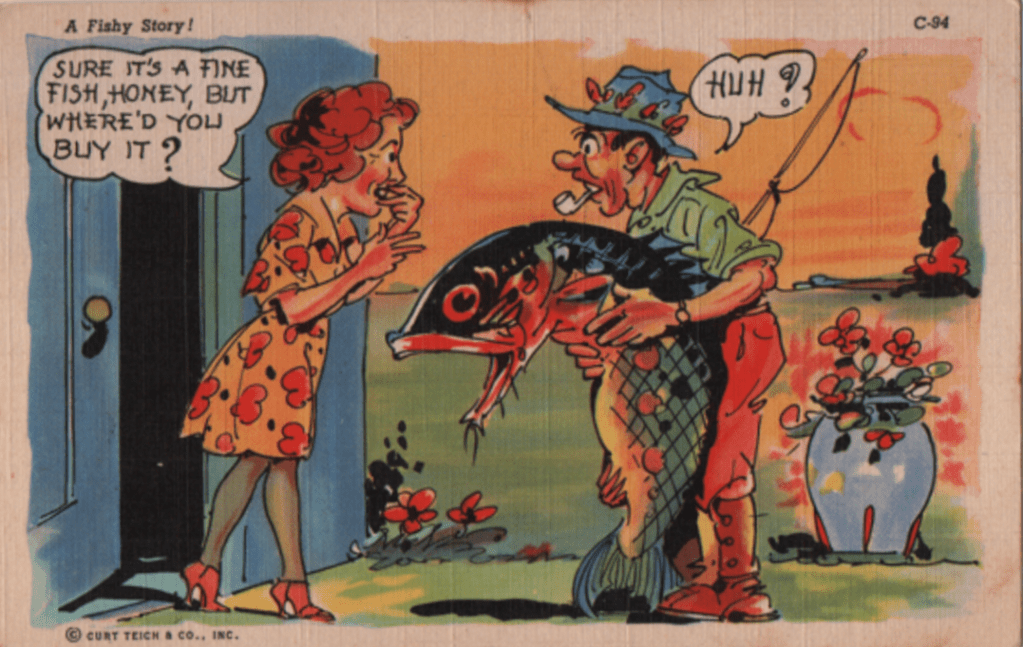
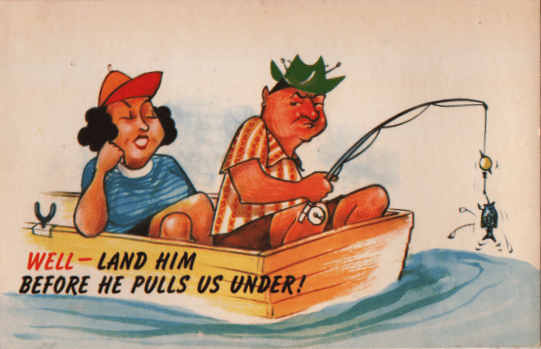
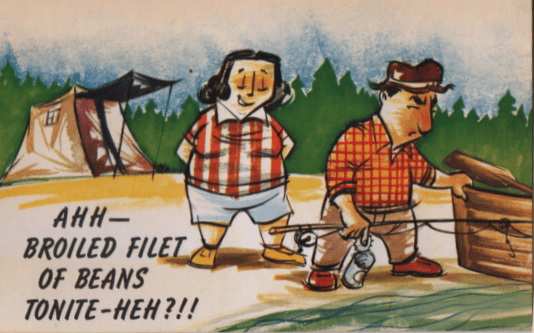
Even when the husband is successful, they can be heard critiquing his work.
And offering unsolicited advice.
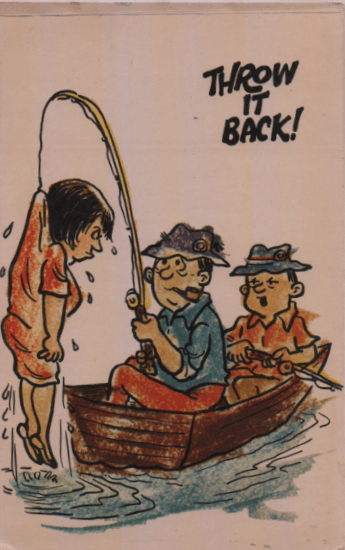
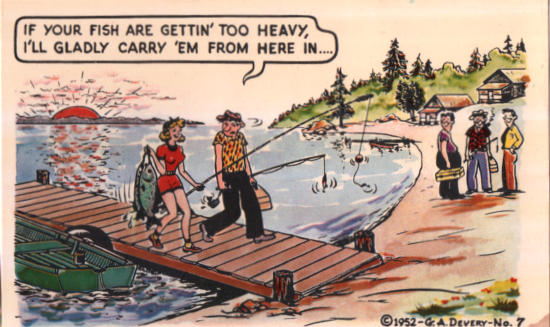
Even when they do their best to be helpful wives do not, on postcards, quite GET it.
Failing to understand the seriousness of the fishing pursuit.
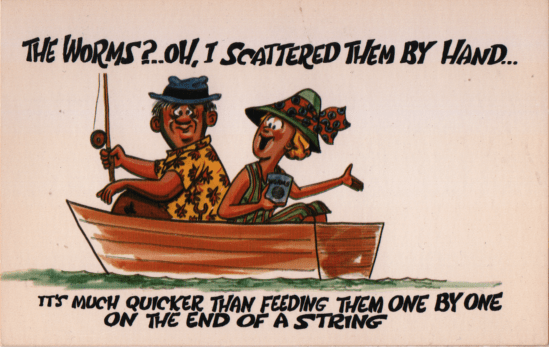
And even, when convinced to take part in the noble sport, declining to take their spouse’s superiority with the seriousness this deserves.
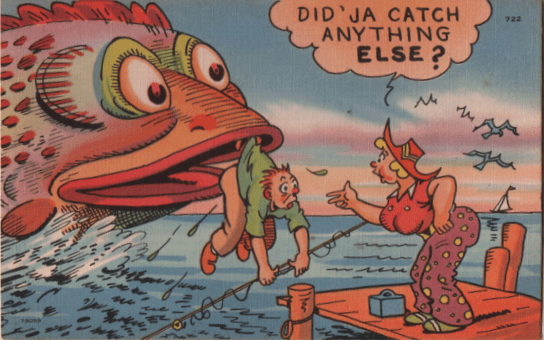
When the fisherman leaves them onshore, however, the carping (sorry) continues.
Wives, say our fishy cartoonists, are never satisfied.
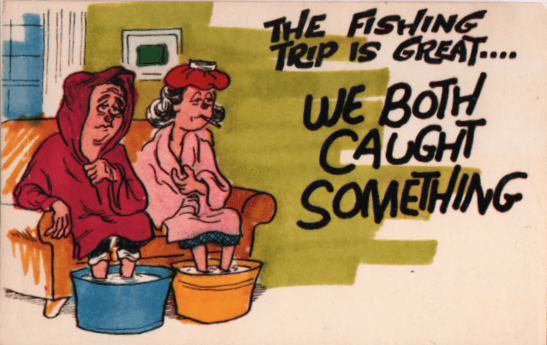
Rare, rare indeed, our alien friend will learn from our postcards, is the married couple who enjoy the fishing trip on a basis of complete understanding and shared passion. Mind you, if that alien also gets hod of the postcards about how husbands behave around the house, there might be an antidote to this version of twentieth century womanhood, but since fishing postcards predominate, this may be too much to hope. (By the way, James Branch Cabell’s wife was known to state, with pride, that she had never read even one of her husband’s books. These things do have a way of evening out.)





























 Blogsy Babbles