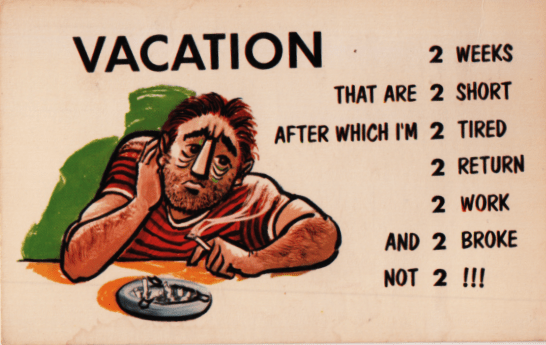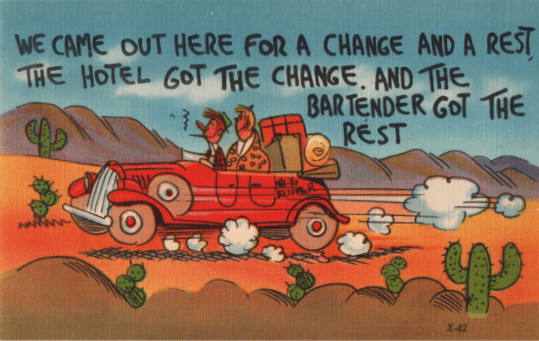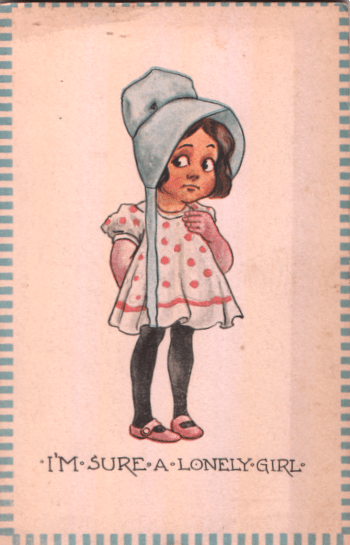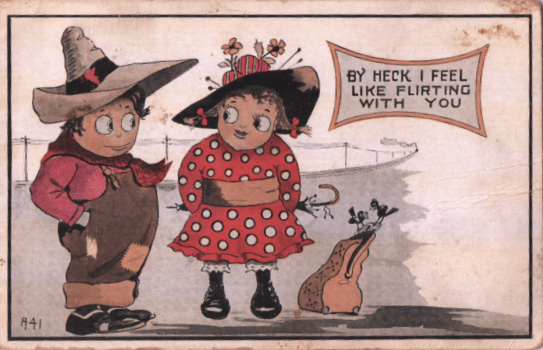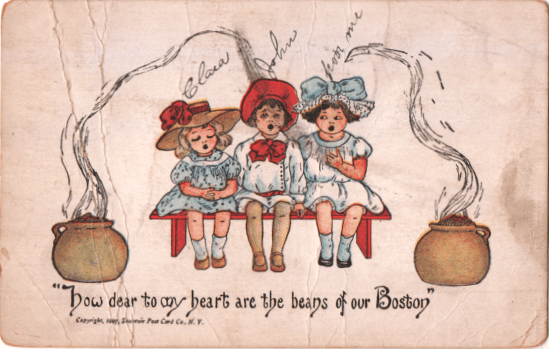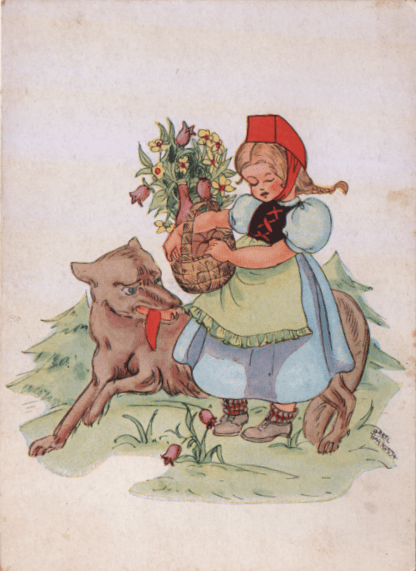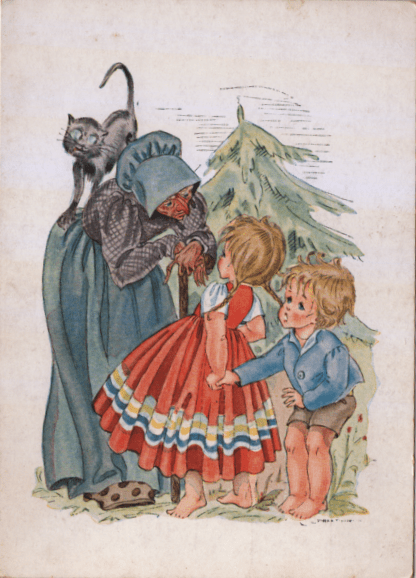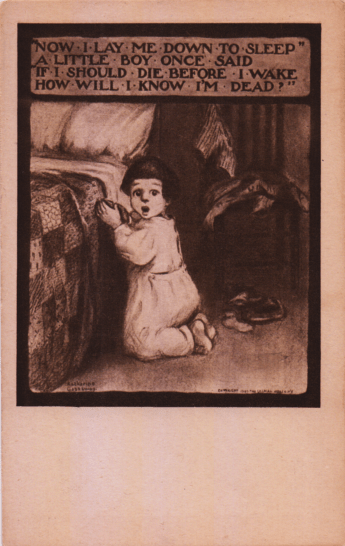
We all have those days. Even if we LIKE our job, it can weigh down on our nerves and seem, suddenly, too much to ask of an intelligent being. Even I, marzipan meatloaf, who live the thrilling, glamorous life of a blogger, have been known to wish I had a simpler way of making my daily bread. Clipping coupons from Grandma’s stock portfolio, or checking each of the fifteen Swiss bank accounts uncle jasper set up seem much more soothing some days than the exciting life I lead on a daily basis.
You may not be aware that humans are hardly unique in this. Postcard artists have for years chronicled the discontent of the quiet, humble dairy cow. The life looks pretty appealing: wander around in the sun eating buttercups and stand still for a while as a trained professional takes the milk that is, admittedly, weighing you down. Could a cow really ever get tired of so straightforward a career. (There’s the speed dating to make sure milk continues to flow, but I don’t suppose it’s all THAT much worse than an annual performance review._
And yet, cow rebellion is a regular side of farm life. Just about every cow gets annoyed by the business at some point, and a few are downright hostile all the time. It may be something on the buttercups.
Some cows know they’re quicker than their support staff, and can elude capture (particularly if the pursuer is encumbered with bucket and milking stool) for as long as the game is entertaining.
But the veteran cow knows a good swift kick is less trouble. You can frighten or injure the milker and, with luck, knock over the milk pail, making a whole morning’s work into mud.
If the milkstaff is really slow at getting out of the way, this sport can become the stuff of legend (and/or postcard.)
The farmer’s own strategies can be turned against him. And this is a game which is renewed every day. Many the farmer has been amazed by a cow’s ability to come up with new and annoying tricks to keep dairy profits down.
You might think a cow would be a little more careful about this, as there are very few career opportunities available for those who don’t want to keep the cream on its way to market. But perhaps this does not occur to the work-a-day cow.
After all, it is written on the wall of the barn: Old Milk Cows Never Die. They Just…well, you know.
When Sleeping Beauty pricked her finger on the spindle and fell asleep, everyone else in the castle fell asleep, too. A thorny bush grew high all around the castle so that no one could get in except one very daring prince, a hundred years later.
Now, the country could hardly run by itself while king and queen and government were all fast asleep in that unreachable castle, not for a hundred years. So when it became obvious that things in the royal castle were going to be pretty quiet for a while, the people consulted the sleeping king’s younger brother, and asked him to be the new king.
The new king had a wife and, soon after they had both been crowned, the new queen gave birth to a baby girl, who was christened Dimity. Dimity’s parents had learned a thing or two about what had gone on in the older king’s castle, so when the day came to christen the princess, they were very careful to invite EVRERY fairy in the kingdom to the party. And even at that, the king whispered to two of the fairies, Sainfoin and Chamomile, as they arrived, “Please don’t give the princess any gifts until the end of the evening. It may be that some angry fairy will arrive unexpectedly. We may need you to change whatever curse she puts on our daughter.”
Nothing of the kind happened. Everybody had a wonderful time. There was plenty to eat and drink, and lots of music for dancing. The party was so successful in fact that it might be going on tonight if the queen had not whispered to the king, “We should probably start letting the guests go home so Dimity can get to sleep.” Because the baby, as guest of honor, had been laughing and cooing throughout, to be admired by all the guests bringing gifts.
The king called for the waiters, and told them, “It is time to ask the guests to leave the party. Be polite, of course, and mention that I will shake their hand as they leave, and give out golden party favors as thanks for their attendance at this momentous evening.”
The waiters were skilled at this sort of thing, and most of the guests, though sorry such a lively party had to break up, decided it was, indeed, time to go home. The only guest who made a fuss, oddly enough, was the fairy Sainfoin.
“I’m having a good time,” she told the waiter. “So many kings and queens give stuffy old parties, but this is fun. Let’s dance!”
The waiter bowed. “But the King will shake your hand as you leave,” he said, “And I know he’s giving out golden rings as party favors.”
“When I want a gold ring,” said Sainfoin, “I can gather buttercups and make one. I’m going to dance for hours yet, and I’m going to have another piece of that red cake with the butter frosting, too.”
“Oh please, Ma’am” said the waiter. “The princess needs her sleep. And everyone else is going home.”
Looking around, the fairy saw that the waiter spoke the truth. Soon there would be no one left for her to dance with. And the royal chef was packing away the last of the cake, to put in the kitchen until the next day’s lunch.
“Well!” said Sainfoin, hands on hips. “And just when the party was getting good! Well, well!” She looked up to the throne where the queen sat holding the Princess Dimity, who was waving her hands, obviously willing for the party to go on herself.
“Aha!” said Sainfoin. “I remember I was asked not to give the princess a gift until later. Here’s my present for your precious princess who needs her sleep. When she is sixteen years old, she will stub her toe on an old wooden horse trough and from that day forth, she will never sleep again until one day she DIES from being so tired. So THERE!”
Sainfoin stamped a foot. A puff of smoke rose around her and she disappeared. She didn’t wait to get a gold ring or shake the king’s hand.
The royal couple were stunned by this gift to their new daughter, but fortunately Chamomile had not yet departed.
“I can’t remove my sister’s gift,” she told the queen. “That’s against the rules. But I can do this. The princess will have a year from the time she stubs her toe to find some prince who can put her to sleep, so that she does NOT die.”
The queen wrinkled her nose. “How will he do that?” But Chamomile also disappeared in a puff of smoke, leaving the king with two extra gold rings.
The king and queen put Princess Dimity to bed. Then they stood at the window of the princess’s bedroom, looking uphill to that bigger castle surrounded by thorns, where hardly anyone ever went in, and no one ever came out.
The next day, they sent out an order that every single wooden horse trough in the country was to be burned. The people were upset about this, because they had already had to go sixteen years without spindles, by order of the previous king. But the current king sent a shiny new metal trough to everyone who burned their wooden one, so most all of the people were happy again, once the smoke had cleared. (A lot of those troughs were completely waterlogged, and burning them took weeks.)
One old lady who lived not far down the road from the castle was NOT happy. “My babies splashed and played in that dirty old trough,” she said, “And so did my grandbabies. And one day my grandbabies may have babies of their own.” So she took her horse trough and hid it in her attic.
Princess Dimity grew up to be as beautiful as her cousin who slept in the dark enchanted castle up the hill. No one ever told her about Sainfoin’s curse, because once everyone was convinced all the wooden horse troughs in the country had been burned, they felt there was no reason to worry about it.
There are those who yearn for the good old days. They give assorted reasons: prices were lower, people were more civil, there were not electronic devices beeping at us to tell us that a friend has uploaded another video of her performing bunny to TikTok. But there is a frequent refrain to all of this, that “Life was simpler then.”
I don’t get it, myself. I don’t at all remember a serene, unflustered distant era. I may worry today about different stuff than I did eons ago, but I don’t see that things I worry about now are any more complicated. And the good old days had their own sets of rules, especially where children were concerned. Children were, according to some experts, supposed to be fed on a steady diet of bread and milk and reminded that they were to be seen and not heard. Only at puberty (a word not uttered among children at the time, of course) would a child start to become an adult. A rite of passage might or might not occur (Bar Mitzvah, First Communion, heading off to a more rigorous school) around the age of 12. It was time, a child was told, to take up the knowledge and responsibilities of an adult. It was time to become aware of a wider world, to look ahead (or around) to gainful employment, to prepare for marriage.
It was, in short, time to cover your shins.
The custom of requiring children to wear short pants and short skirts until puberty was not universal, of course. Many working-class children, a lot of whom had jobs, HAD to wear long pants: work on the farm or in the factory presented constant dangers to the knees.
Yet, we see it again and again in the middle and upper classes. Growing up meant it was time to “put on long pants.” A common remark to girls whose knees were showing was “Pull your skirt down; you’re a big girl now.” As soon as you turned twelve, or thereabouts, your knees and ankles disappeared.
There are plenty of rppcs showing children on the crux of this moment: that rite of passage where one got a really fancy new dress
Or a highly polished new suit. Note that knees are still visible at this point (even if covered by stockings). The ritual has not occurred yet; one is still an awkward fledgling.
Or not awkward (I swear she’s about to deliver a lecture on hermeneutics) but still not old enough to qualify for floor-length wardrobes.
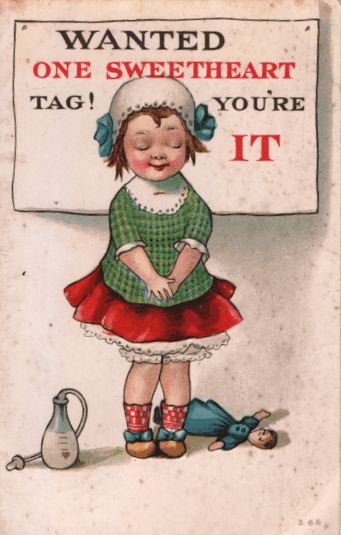
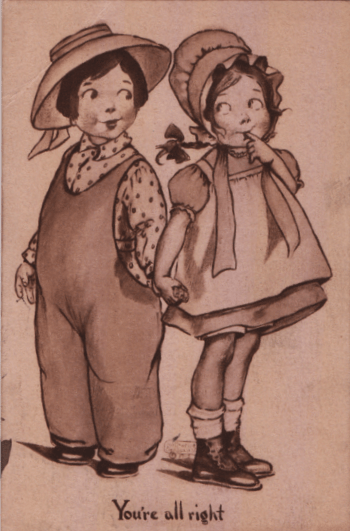
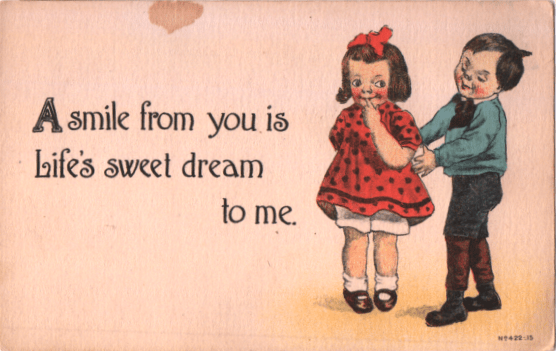
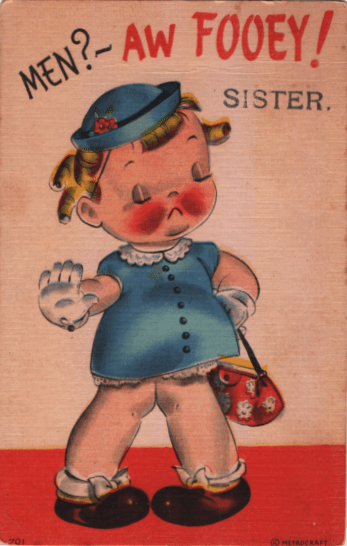
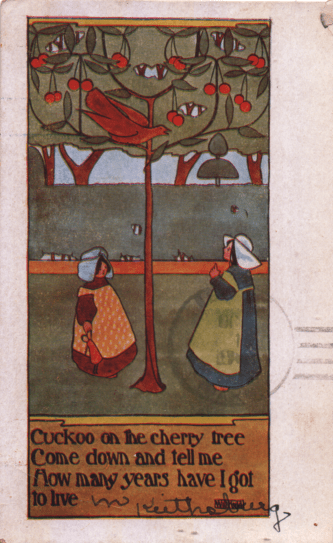
The day would come when changing fashion meant there were fewer inches of fabric between the grown-up and the child. And yet, as seen in the postcard at the top of this column, the perception that boys wore shorts and girls wore skirts which barely reached the knees. Many cartoonists kept this up long after the custom had passed (Richie Rich has not, as far as I can tell, donned long pants to this day) and the realities of life had changed completely. (MY grade school sent out a note every spring to parents that children in school were NOT allowed to wear “shorts, cut-offs, or culottes”. Not one of us knew what “culottes” were: it was just one more thing for us to worry about.)
Yes, oh eager blogwatchers, today is Valentine’s Day: a day of romance and/or chocolate and/or jewelry and/or cigars and/or…has anybody done a checklist Valentine, offering the recipient a list of things they can wish for? I have the sentiment for the inside already: “All you’re going to GET is this card, but it doesn’t hurt to wish.” (Yeah, I did a stint as a freelance greeting card writer, and my only triumph for February was a special efficiency Valentine which wished people a Happy VD…see, in those days Sexually Transmitted Diseases were known as Venereal Diseases, which commonly got abbreviated as…yeah, it wasn’t all that funny back in the day, either. That’s why I moved on to the more lucrative profession of blogger.)
Anyway, as you already knew or guessed, our ancestors were not slow about sending Valentine postcards. These tended to run along the sort of themes you might expect. (This verse turns up on at least three postcards with pictures by different artists. Whoever wrote it just hit all the right notes.)
And if you know your antique postcards, you also know about the “Vinegar Valentine”, a custom which began in the Victorian days of luxurious greeting cards dripping with lace. I learned about these in grade school history classes, and was always taught they were made to send to people you didn’t like. I have grown to doubt this. Maybe they were more like Old Maid cards (which used much of the same aesthetic) and people just liked to laugh at the caricatures, and eagerly collected them, even in the days when you could get ten for a penny at some sale of scrap paper.
Cupid got his best day out on Valentine’s Day, where he takes on a variety of jobs depending on the artist’s imagination. He might be a chestnut vender
Or a fisherman
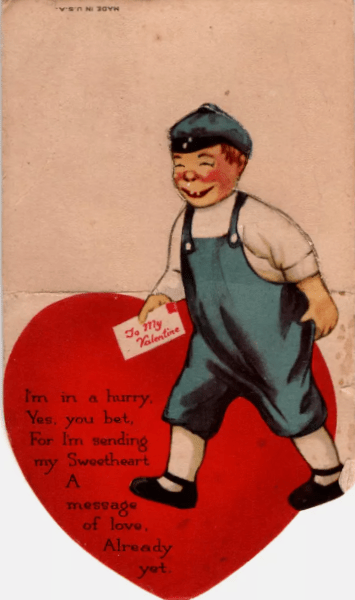
But the most common occupation for Cupid on Valentines was as a mailman, delivering hearts to all and sundry. Of course, some senders preferred to take their greetings over personally. (That way you could seal it with a kiss on arrival.)
Artists could actually apply Valentine wishes to any picture, of course. Love being universal, one could draw whatever ethnic group seemed especially charming and affix the wishes accordingly. (Yes, there are plenty of cards featuring Dutch kids with Valentines…enough for a whole nother blog, really.)
Some artists, perhaps under deadline or just figuring whatever they were good at was good enough, kind of cheated. This one could just as easily have gone out labelled “Easter Wishes” or “Birthday Greetings”.
If that seems to be a thoughtless rush to bring out Valentines so people could spend money on them, this idea is not new. This 1907 Valentine is festooned with advertising slogans, emphasizing the profits which could be made by associating products with romance.
And why fight it, after all? THIS postcard is good at Neiman-Marcus (on or around Valentine’s Day, 1997) for two Valentine’s Day coffee mugs or (if you use your credit card) a tote bag with this same logo. I assume it is unredeemed because even in 1997, everyone already HAD plenty of coffee mugs and tote bags.
If, like Cupid here, you are in danger of being overwhelmed by all the holiday wishes, take courage, there are those who are fighting back. For such people, in my greeting card days, I invented the Belated Valentine. Somehow this was not even as popular as my line of Belated Get Well cards, but I still think they have possibilities. My favorite was “Happy February Fifteenth! I wanted to show you the depth of my devotion and the extent of my emotion!”
Inside, it said, “But I also wanted to wait until the cards were marked down.”
Scrooge was better than his word. He did it all, and infinitely more; and to Tiny Tim, who did NOT die, he was a second father. He became as good a friend, as good a master, and as good a man, as the good old city ever knew, or any other good old city, town, or borough, in the good old world. Some people laughed to see the alteration in him, but he let them laugh, and little heeded them, for he was wise enough to know that nothing ever happened on this globe, for good, at which some people did not have their fill of laughter in the outset; and knowing that such as these would be blind anyway, he thought it quite as well that they should wrinkle up their eyes in grins, as have the malady in less attractive form. His own heart laughed; and that was quite enough for him.
He had no further intercourse with spirits, but lived upon the Total Abstinence Principle, ever afterwards; and it was always said of him, that he knew how to keep Christmas well, if any man alive possessed the knowledge. May that truly be said of us, and all of us! And so, as Tiny Tim observed, God Bless Us, Every One!
At this point, in most cinematic versions, a narrator steps in to read us those first three lines, at least, and frequently the last two, usually over a scene of Scrooge with Tiny Tim.
In Sim I, as we watch Scrooge walk along the street (at one point patting the blind man’s dog) we are told that Scrooge was better than his word. He became as good a friend, and so forth. And to Tiny Tim “who lived and got well again”, he was a second father. We watch Tim run to him, calling “Uncle Scrooge!” We are further told that it was always said of him, right through to the end of the passage. The narrator goes on to bless us, every one, and the closing credits appear over “Silent Night”.
In Rathbone, we return to the booklined room seen at the beginning, where the narrator delivers an abbreviated version of the passage.
In Sim II, as Scrooge laughs in a brightening light, the narrator gives us the first two sentences, and then the rest beginning at “It was always said of him”. The closing credits come over “God Rest Ye, Merry Gentlemen.”
In Matthau, B.A.H. Humbug tells us ”And that’s how Scrooge became as good a friend, as good a master, and as good a man, as the good old city knew. He asked for no reward, for his own heart laughed, and that was enough for him. May that truly be said of us all, and so, as Tiny Tim observed, Gpd Bless Us, Every One!” Scrooge sings “Mankind Shall Be My Business” surrounded by the Cratchits, with Fred and Mrs. Fred.
Imn Scott, a narrator gives us “Scrooge was better than his word. He became as good a friend, as good a master, and as good a man, as the City ever knew. And to Tiny Tim, who did NOT die, he was a second father”. He then jumps to “It was always said of him” and so on to the end. Meanwhile, on a sunny day, Scrooge has walked to the Cratchits’. Tim runs out to meet him. They walk off, hand in hand. A song about Scrooge, and blessing us, every one, closes off the story.
In Caine, Dickens tells us “Scrooge was better than his word. He did it all, and infinitely more.” Rizzo, anxious, asks “And Tiny Tim?” Dickens feigns sorrow, replies “And to Tiny Tim, who did NOT die….” Rizzo cries, “Aw, isn’t that swell!” “To Tiny Tim, he became a second father. He became as good a friend” and so on through that passage before skipping the usually skipped lines about intercourse with Spirits and blindness, which would be awkward nowadays, and goes to “And it was always said of him”, taking that nearly to the end. Tiny Tim calls “God bless us!” and Scrooge answers, “God Bless Us, Every One!” “The Love We Found”, a new version of “The Love Is Gone” plays while the camera pulls back across the table, out the door, and over the roofs of London (above lobsters who are singing in the windows.) Rizzo, offscreen, remarks, “Nice story, Mr. Dickens.” To which Dickens replies, “If you liked this, you should read the book.”
In Curry, we are told that Scrooge was as good as his word. No…better. He became as good a friend, and so on, “and he kept Christmas in his heart forever.” The credits roll over scenes of London.
In Stewart, we dissolve from the fire Bob is building in the office to the fire in Scrooge’s sitting room. Fred, offscreen, tells us, “My uncle was better than his word.” He reads farther from the text than most, as far as “He let them laugh, and little heeded them.” We watch the Cratchits arrive at Scrooge’s. Fred goes on “It was always said of him” and on through that passage. Scrooge lifts Tim, who says “God Bless Us Every One!” We take a long look at the other little Cratchits. Then everyone walks into Scrooge’s, and the credits roll.
AFTERWORDS
So that was the book I put together twenty-five years ago or thereabouts. I saw it as a coffee table affair, filled with stills from the various versions discussed, which might serve as an inspiration to other writers to try the same format with other books which had numerous film adaptations: Tom Swayer, say, or Hamlet, or, hey, The Gift of the Magi. Maybe one day someone will turn this into the book I expected publishers to line up for a chance to publish.
I could not illustrate even this version as I would have liked, since I do try to steer this side of copyright infringement. Where I did use scenes from the movies, I relied heavily on silent versions not discussed in the text which are old enough to be in the public domain. This included versions from:
1901: the oldest known surviving film of A Christmas Carol, long almost entirely lost except for the scene of Marley appearing in the doorknocker. Now something like 60% of the movie can be watched online. It was also long rumored that Scrooge was portrayed here by Sir Seymour Hicks, since, coincidentally, 1901 was the first year he portrayed the miser on stage, but this is now believed to be one Daniel Smith.
1910: A Thomas Edison production, notable for including as Bob Cratchit one Charles Ogle, who had earlier played Franken=stein’s monster in Edison’s version of THAT classic.
1913: This appeared under several titles (Scrooge, Old Scrooge, A Christmas Carol), but you should definitely look it up. Scrooge here absolutely IS Sir Seymour Hicks, who would portray Scrooge again, in the version we called Hicks. In this earlier film, he is as wildly eccentric as any Scrooge you’d care to see. Like a lot of silent versions, which were based on cheap theatrical productions, Scrooge sleeps in his own office (saves on sets) and, going along with the sort of CEO who would do that, he is probably the grungiest Scrooge ever, looking as if he has not changed his clothes in a monrh or bathed in a year.
1922: Scrooge is here portrayed by Henry W. Esmond, a very popular actor now best remembered as Laurence Olivier’s father-in-law.
1923: This version starred Russell Thorndike, younger brother of actress Dame Sybil Thorndike, who played opposite him in a silent version of Macbeth. He is now remembered less for his acting career than for the mysteries he wrote about the somewhat sinister vicar Dr. Syn.
Next Monday, we will start serializing another of my dazzlingly brilliant but somehow unpublished books: another nonfiction opus if I can turn up the manuscript I’m looking for, or a novel if I decide to throw to the winds all hope of becoming an Interwebs Influencer.
Wedged as we are between the death of the last lingering New Year’s resolutions and the start of Lent, I meandered through a bit of James Branch Cabell, an author my grandfather read but tried to keep me from reading. His reputation for elegant naughtiness was well-deserved, and he would find no shortage of controversy nowadays with his depiction of women as essentially dangerous creatures: he stated here and there among his works that they were a snare and a paradox for unsuspecting men. Women, he declared, was the great inspiration, leading men to attempt mighty deeds beyond what they would have tried otherwise. AND they were the ultimate obstacle, bent on preventing men from accomplishing the very deeds that were being attempted in their honor.
Which brings us to the promised topic of today’s column: the Fisherman and His Wife.
Ideally, to that alien observer we discussed last time, who thinks, from looking over our postcards, that the fisherman was king of our universe, a wife would exist to encourage and support her fish-hunting hubby. And yet they would see, again and again, that our cartoonists insisted it was not so.
The fisherman’s wife, according to the postcards, regards herself as long=-suffering, and wishing to share that suffering with her partner.
They are a terrible distraction when a man is busy trying to catch the wily enemy.
Even when the husband is successful, they can be heard critiquing his work.
And offering unsolicited advice.
Even when they do their best to be helpful wives do not, on postcards, quite GET it.
Failing to understand the seriousness of the fishing pursuit.
And even, when convinced to take part in the noble sport, declining to take their spouse’s superiority with the seriousness this deserves.
When the fisherman leaves them onshore, however, the carping (sorry) continues.
Wives, say our fishy cartoonists, are never satisfied.
Rare, rare indeed, our alien friend will learn from our postcards, is the married couple who enjoy the fishing trip on a basis of complete understanding and shared passion. Mind you, if that alien also gets hod of the postcards about how husbands behave around the house, there might be an antidote to this version of twentieth century womanhood, but since fishing postcards predominate, this may be too much to hope. (By the way, James Branch Cabell’s wife was known to state, with pride, that she had never read even one of her husband’s books. These things do have a way of evening out.)
Three years ago or thereabouts, we considered in this space the nightmare possibility of an alien civilization coming to earth years hence and finding little that remains of our culture but boxes and boxes of someone’s stock of old postcards. The nightmare, of course, would be that the columns found in this space would no longer exist to EXPLAIN these postcards. Thus, the successors to our command (such as it was) of the Earth would have to conclude that men fished, and women wondered why.
We have also discussed the fact that women DID fish, but to go by the evidence presented by the cards, the vast majority of women on Twentieth Century Earth were, at best, just a distraction to the poor, persecuted fisherman.
The fisherman, we see from the cards, was a man with a purpose, a noble quest, always discouraged and sometimes even foiled, in one way by the presence of women.
Success in his chosen art was hardly guaranteed, and even when he did achieve some major goal, he could count on women somehow getting in the way of his triumph.
The most skilled of fishermen could hardly set out to work at his craft without some woman providing both distraction and obstruction.
This was never the fault of the fisherman, of course, but of huge masses of women who chose to swim in the traditional sacred fishing sites (to judge by how many more times than two this particular gag was used.)
Even those women who did become skilled at the manly art of fishing turned out to be impediments to the men concentrating on their own piscatorial pursuits.
Some men did apparently attempt to explain their passion, with little success.
Attempts to include the ladies on fishing retreats generally ended in disappointment.
And those women who DID fish expressed undeserved scorn for the men who had attempted to show them the way. But there was one threat even worse than the prideful female who thought herself worthy of the fishing rituals.
But he was early at the office next morning. Oh, he was early there. If he could only be there first, and catch Bob Cratchit coming late! That was the thing he had set his heart upon.
And he did it: yes, he did! The clock struck nine. No Bob. A quarter past. No Bob. He was dull eighteen minutes and a half, behind his time. Scrooge sat with his door wide open, that he might see him come into the Tank.
His hat was off, before he opened the door; his comforter, too. He was on his stool in a jiffy, driving away with his pen, as if he were trying to overtake nine o’clock.
“Hallo,” growled Scrooge, is his accustomed voice as near as he could feign it. “What do you mean by coming here at this time of day?”
“I’m very sorry, sir,” said Bob. “I AM behind my time.”
“You are?” repeated Scrooge. “Yes, I think you are. Step this way, if you please.”
“It’s only once a year, sir,” pleaded Bob, appearing from the Tank. “It shall not be repeated. I was making rather merry yesterday, sir.”
“Now, I’ll tell you what, my friend,” said Scrooge, “I am not going to stand this sort of ting any longer. And therefore,” he continued, leaping from his stool, and giving Bob such a jab in his waistcoat that he staggered back into the Tank again: “and therefore I am about to raise your salary.”
Bob trembled, and got a little nearer t the ruler. He had a momentary idea of knocking Scrooge down with it, holding him; and calling to the people in the court for help and a strait-jacket.
“A merry Christmas, Bob!” said Scrooge, with an earnestness that could not be mistaken, as he clapped him on the back. “A merrier Christmas, Bob, my good fellow, than I have given you, for many a year! I’ll raise your salary, and endeavor to assist your struggling family, and we’ll discuss your affairs this very afternoon, over a Christas bowl of smoking bishop, Bob! Make up the fires, and buy another coal-scuttle before you dot another I, Bob Cratchit!”
It’s a great scene, sometimes suspenseful in the possibility that Bob in a panic, will knock Scrooge down before the old man gets his point across. Screenwriters just love Scrooge’s “therefore” doubled, and so do the actors.
In Hicks, we dissolve from the food at Fred’s on Friday night to the food on the Cratchit table next morning. Mrs. Cratchit reminds Bob that he promised Mr. Scrooge to be all the earlier this morning. Choking down the last of his coffee, he rushes out, pausing only to let Tim put his hat on for him. The Cratchits watch from the window as he hurries out, minding the ivy pavement; Scrooge, meanwhile, peers through a grimy window to see him approach. Spying the clerk, Scrooge jumps to his accustomed position at the desk, his back to the door, trying not to successfully to stop grinning. Fortunately for his scheme, when Bob enters, the clerk, like us, can see only Scrooge’s back, just as at the beginning of the movie. Bob believes he can still slip in unobserved and, of course, is incorrect about this. “Mr. Cratchit! What do you mean by coming here at this time of day?” “I am very sorry, sir. I AM behind my time.” “I think you are, sir. I think you are!” Bob starts to explain, but Scrooge breaks in to say he is not going to take this. He thumps his desk, trying not to giggle at the effect of this. During the “therefores”, he gives Bob a playful push. Bob seizes the ruler in self-defense. When he realizes his employer has just spoken of raising his salary, he cries, “Sir! You’re joking!” “Never more serious in my life, Bob,” says Scrooge. Once Bob is convinced, he is ordered from the office to go be with his family; Scrooge even hands him his hat. “They’ll be wanting you today!” As Bob rushes out, Scrooge calls, “Merry Christmas! “Happy New Year to everyone!” “God bless us all! God bless us, every one!” We hear “Hark! The Herald Angels Sing” and then see Scrooge in church, in the same pew as Bob.
Sim I comes rushing into his office, very happy to see Bob is not present. He assumes his pose. Bob hustles faster and faster along the street, still hoping he can make it in time. Scrooge can’t help looking up. “Cratchit! You’re late!” “Sir!” “What do you mean by coming here at this time of day? Hmmmm?” The dialogue proceeds as written, through “I was making rather merry myself.” “Well, we won’t beat about the bush,” Scrooge informs him, his manner firm, businesslike. But he delivers the line about raising Bob’s salary laughing, and nodding to assure Bob he means this. Bob is not convinced, so Scrooge goes on, “I haven’t taken leave of my senses, Bob: I’ve come to them. From now on I want to try to help you raise that family of yours, id you’ll let me.” He makes a remark about a bowl of hot punch, then orders Bob to buy another coal scuttle before he dots another I, thumping the desk to emphasize this stern command. Finally believing the old man is in earnest, Bob rushes to build up the fire. Scrooge goes on laughing. “Ah,” he finally snarls to himself, “I don’t deserve to be so happy.” He tries to get back to business and gives up, throwing his pen over one shoulder. “But I can’t help it. I just can’t help it.”
In Rathbone, we watch Bob rush in and start to work, only to be called on the carpet by the boss. Scrooge is back to his finest Franz Liszt manner, and Bob is very frightened, blaming his lateness on the previous night’s merriment. You see, someone mysteriously sent them an enormous turkey, and…. Scrooge snaps that he is not going to take this any longer and then laughs, giving Bob a jab with one elbow. Bob has no idea what’s going on, his eyes widening as Scrooge lifts a cloth from the desk to reveal a punchbowl. Only when Scrooge fills a glass with punch and hands it to him does Bob begin to catch on. The two men raise their glasses in a toast and fade from view.
Sim II finds us in the office: the clock shows 9:18. The dialogue is abbreviated, with most of Bob’s mashed into one speech; he is shrinking and staring through most of this scene, looking as pitiable as at any point in the movie. He continues to back away as Scrooge turns friendly, apparently more frightened by the new Scrooge than the old one. Scrooge breaks into a booming and slightly sinister laugh; he does not mention a new coal scuttle.
In Matthau, Cratchit is rushing up the street and into the office, where he is met by his employer. “You’re late!” “Just a minute and a half: it will never happen again, sir.” Scrooge rushes into the “I’m not going to stand for this” and proceeds through THREE therefores, way over the op on every one of them, dropping next to a very mild “I’m going to raise your salary.” Stunned, Bob drops the overshoes he’s been clutching. Scrooge wishes him a merry Christas, “merrier than any I have given you. Make up the fires! And use lots of coal!” Bob is still taking this all in, asking, “But sir…is such an extravagance good for business?” Scrooge is shocked by such a mercenary thought, using it as a cue to launch into “Mankind Should Be My Business”. During this song, he ventures outside to make amends with everyone he offended earlier during the song “The Stingiest Man In Town”: the match girl, the chestnut vendor, the newsboy, the charity solicitors (not previously seen), and even the cats and dogs who sang along with the earlier song.
Scott, humming, unlocks his office and glances at the clock. “Nine o’clock. Late again, eh, Cratchit? We’ll see about that.” Cratchit runs up to the counting-house. As he takes out his key, one elbow bumps the door and it opens, dashing his hopes of being the first one there. Bracing himself, he enters quietly, apparently still hoping he can get in unobserved. A call of “Mr. Cratchit!” makes him wince. “Yes, sir.” “Do you know what time it is?” “Yes, sir.” “What time is it?” “Eighteen minutes oast the hour, sir.” “Eighteen and a half minutes past the hour. What do you mean by coming here at this time of day?” The dialogue proceeds as written through “therefore I am about to double your salary.” Scrooge tosses a small bag of coins to Bob, who looks unsure about which of them is going mad. “Double my salary, sir?” Scrooge laughs and embraces him. “I’ll double your salary for a start, and endeavor to assist your family in any way I can. And Tim will walk again, upon my life he will. But we’ll talk about it over a Christmas bowl.” He pauses, studying Bob’s face, and asks, “What’s wrong with you?” “Nothing, sir. It’s just that….” A look at Scrooge’s smile, which is broad and genuine, makes him start over: “Nothing. Thank you, sir.” Scrooge returns to business. “Make up the fire before we freeze to death. And buy some more coal before you dot another I, Bob Cratchit!”
Stewart is grave; his clock shows 9:18. Bob is in great apprehension; hurrying in, he begins to write furiously. Scrooge waits a moment and then calls “Mr. Cratchit: a word with you.” The cold, sadistic schoolmaster is back; Bob comes out of the Tank, clutching his own elbows for warmth and moral support. “What do you mean by coming here at this time of day?” “I’m very sorry, sir. I am behind my time.” “Oh, yes, you are. Indeed you are.” “It’s only once a year, sir. I was making rather merry yesterday, sir.” Bob nods along as Scrooge begins his scold. Come the line about raising the clerk’s salary, a gleeful Scrooge thumps his desk with a triumphant “Ha!” and adds “Merry Christmas, Bob!” Bob lunges for the fire irons to defend himself against the madman. Scrooge, observing this, delivers the next lines in self-defense. Bob takes a while to understand it all, but once the threat of violence subsides, Scrooge orders him to make up the fire, hands rubbing together as if the old man has noticed the cold for the first tie. Bob sets to it with a right good will.
Nostalgia Time: In 1991, I was able to sell an article on what I deemed, watching Saturday morning cartoons (nostalgia for some other time) were the dumbest new toys being slung at us for the holiday buying season. This was fun (it was headlined by Baby Magic Potty, after all) and I produced one of these articles every year for the next half dozen years. These did NOT sell.
This week I turned up a copy of the 1995 edition. Realizing that some of the hapless children who experienced these toys may be old enough to read on their own, I have reproduced that minor opus, so that you can re-experience the joy or tedium of your childhood discoveries. I have resisted the temptation to change the phraseology, so you can see what sort of blogger I was in The Time Before Blogs.
Heckuva life, working in product development. You’ve got to redesign last year’s cupholder so next year’s Chevillac Gottago can be touted as the newest and most improved car on the market. You have to add a wire or a function to your keyboard every ten days or your computer falls behind the competition. And every fall, you need to come out with new toys that do more than last year’s, or do it better, or faster, or meaner, or cuter.
Bur hey, this is America. Yanke ingenuity gave us the first commercially viable phonograph, the first marketable electric light, the first balloons-and-bluegrass festival.
Of course, it also gave us the Edsel.
So here is this fall’s crop of new toys, all decked out in cute commercials with snappy jingles, hoping to induce Santa to pack them into the sleigh. It is inevitable that one or two come at us that looked good in development conference rooms but which Santa wouldn’t be caught in a chimney with. Those are the toys on my personal Wish List (as in “I wish I knew what was in the minds of the geniuses who came up with these.”
I.BIG JOHN
Any toy featuring a toilet leaps to the top of this list. In this competition, you dump your “green scuzzies” into Big John and pull the handle. Unfortunately, the plumbing is a bit clogged. Your aim is to dump all of your scuzzies and keep the toilet from flushing them all over you. I see this as the educational toy of the year: Dozens of children will be inspired to become plumbers because of this Christmas surprise.
II.SURPRISE HAT SUSIE
Take off Susie’s hat, and you find out what color her hair has been streaked! Jewels drop out of the hat: gee, they’re color-coordinated with that stripe of hair! Ans the hat can turn into a purse!
Any interest taken in this doll after the first five minutes is up to the owner.
III.SUZIE STRETCH
It is NOT a good year for little girls named Susie. This particular Susie is a doll you bind to yourself at the wrists, ankles, and waist, so she can dance with you, run with you, exercise with you, and so forth. But wait! There’s more! At night, you twist her head around so that her second face, the one with closed eyes, is uppermost, so she can sleep with you, too. It’s another educational toy, I think: something to do with teaching us the dangers of co-dependency.
IV.BUBBLE PUP
The 1995 version of “Let the kids run around and knock over furniture” game, unlike previous versions like Grabbin’ Grasshoppers, has a dish full of soapy water that can be spilled on the rug. A fat, benign puppy squats in the center of the game board and blows bubbles, which the players catch in little cups. Since the bubbles break immediately in the cup, arguments about the score can add gaiety to the spills and broken lamps.
V.PRINCESS WISHING STAR
Ask a question, wave your magic wand, and touch the princess. Stars on her head blink “YES”, “NO”, and “?”. The star that remains lit at the end answers your question. This connection of asking questions with waving a wand, disturbs me. Isn’t it another question of how our society is turning away from traditional values into New Age gimmickry? Why can’t the kids use a Magic Eight Ball, like their ancestors?
VI.KARATE FIGHTERS
The problem, I guess, with the classic Rock-‘Em-Sock’Em Robots was that the plastic fighters were fastened down at the feet, and thus unable to kick each other in the crotch. This has now been remedied, thanks to modern technology.
VII.LIBERTY BASE
I guess this is deep I the future, when the Statue of Liberty has tipped a little, and is buried bust-deep in the dust of civilization or something. Anyhow, you use her as a secret military base. Her fce even pops open so your fighters can fly out shooting. This is also an educationall toy: national monuments CAN be functional.
VIII.POWER SPARK WELDER
This machine tool pumps out molten plastic, so you can put toys together after you’ve smashed them. In fact, the commercial tells us we can now smash toys as much as we want. Good. Can we start with Big John?
IX.STAR CASTLE TEA PARTY SET
If you haven’t been paying attention over the last few years, you may not know that the major theme for the nineties is miniature playsets: teeny figures that come with teeny houses or teeny haunted houses, and an endless line of accessories. It is not surprising that someone should have come out with this miniature castle, complete with princess, secret passages, furniture, and so forth. Ah, but not only can you play adventures with this castle, you can also close it all up, dill it with water, and use it at your tea party. The tops of the towers are the cups, and the whole castle is the pot. No word on what the miniature princess thinks of all this. She may be thrilled to have a castle with indoor plumbing.
X.CHICKEN LIMBO
This is similar to the bar you use for dancing the limbo, but in this version a lastic chicken stands over you as you bend yourself under her. If you fail to clear her tail, she emits a wicked, cackling laugh. This is so dumb it is obviously destined to become a bestseller on every college campus from coast to coast.
These are just the top ten. Honorable Mention awards must go to Mimi and the Gor-gons, simply for having the dumbest name of any new product this season, and Barbie’s Mustang, a two-seater that stretches into a four-seater when needed, simply because a list of this nature is not official if barbie isn’t mentioned somewhere.
This 1995 crop shows promise. Whether Big John becomes as much of a classic as Baby Magic Potty, or if Surprise Hat Susie can ever mean as much to us as that pair of boots Barbie had a few years back with rubber stamps in the heels remains to be seen. But the toys of this new holiday season are definitely one more example of the practice of good old Yankee ingenuity.
Pigs are apparently nearly inextricable from Human society. One author says you can find them in more settlements than you find dogs, which confirmed his suspicions about humanity. One conspiracy theorist connected all the dots a few decades ago, and endorsed a ban on eating pork: he declared this a form of cannibalism. (See, the clues are that story about Circe turning Odysseus’s crew into pigs, and in the dietary laws of…never mind. The Interwebs will tell you all about it, along with notes about which current politicians are to blame for it.)
We have covered pigs before in this space, but largely in conjunction with the bygone habit of sending postcards with pigs on them as a New Year’s wish for prosperity. (This is ripe for study in thesis or dissertation: a geographic determination of which countries sent cards with pigs for that, which sent cards with fish—also discussed hereintofore—and which sent both, just to be sure.)
As with other animals in the postcard universe, pigs have their lives reduced to only a couple of traits useful to cartoonists. And for a majority of cartoonists, pigs had two basic habits: they ate a lot and they fed a lot.
There were outliers, of course—a few postcard pigs made loud nises, and some were simply there to be fat without considering their dining habits—but by and large, pigs were what the educational community once called “eager eaters” (as opposed to picky eaters.) Eager eating was encouraged among small children, despite all the postcards which warned them not to be a pig.
But for those (of us, admit it) who go on vacations simply to seek out the best all-you-can-eat buffets, this was a Good Thing (or a SWILL thing, if you HAVE to.)
There are a few postcards dealing with butchers and such realities of a pig’s life, this was NOT the sort of feeding that tickled the cartoonists’ pens.
But the observation of a pig’s dining style (see the pop song “Would You Like To Swing On a Star”), what really amused the postcard artists was the way pigs fed others, especially their children.)
It’s not as if the pig is the only animal that nurses its young lying down, nor even that it refuses to do this any other way. It’s just the sheer resemblance the classic nursing pig has to tourists like me at that all you can eat buffet.
The sow (or Mama Pig) has six nipples, see, so she can efficiently handle half a dozen offspring at once. And we humans find this fabulously funny, providing us with dozens of punchlines.
We COULD have had a blog dealing just with the hungry piglets and demands made on Mom. But my inventory is low on these since, for some reason, they proliferated in the second half of the twentieth century, not the first. (Was the first half of the century more squeamish, or the second half more removed from the realities of livestock? There: another dissertation topic. I keep pitchin’ ‘em and you keep whackin’ ‘em over the backstop.)
The tickling gag and this one seem to be the most popular, with four or five cartoonists each trying a hand at them. For reasons not known to me, the gag about “Mom, can Eustace stay for lunch?” is covered only on cow postcards. Similarly, the joke about other animals, including pigs, coming over for a drink applies mainly to Mama Cow. Perhaps Mama Pig lying down takes away some opportunities for free mil delivery.
Maybe it’s just a matter of pigs being easy to draw (One big fat oval, a circle, and a snout) or that little piggies are so cute, that make for so many mama-and-piglets postcards. Or perhaps, like the conspiracy theorists, we just see our own plight in the life of the pig. (Note on vocabulary: I did grow up in pork producing territory, where the word ‘hog’ was everywhere and ‘pig’ was used only when referring to Porky, on TV. Postcard artists, as well as other comic creators, just seem to think ‘pig’ is the funnier word, so I have followed suit. I need all the help I can get.)