This is a series where we seek out at least one good solid conspiracy theory about each President of the United States. We prefer those which were active at the time the President in question was, and the theory should be considered, by a majority of Mainstream Historians (as any good Conspiracy Theorist knows them) have decided is pretty surly phony. And it is cheating for me to make up my own. Thus we have not even MENTIONED the possibility that Martin Van Buren was actually a very large koala.
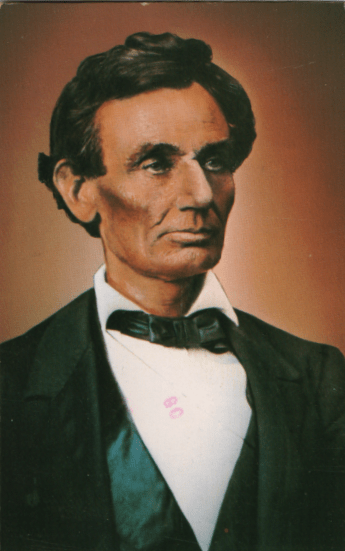
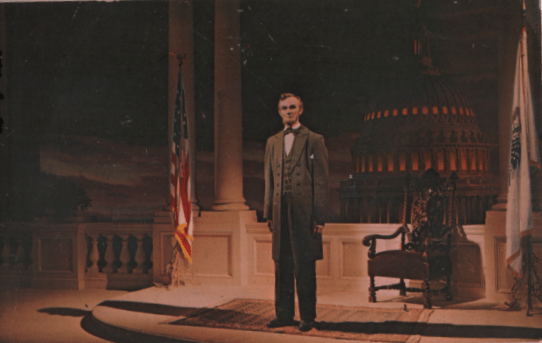
We have now reached our sixteenth president, one Abraha Lincoln. It would make a whole nother blog to assign a ranking to him, but he is certainly one of the top ten most theoried presidents. The stories start before his birth and run right up through his death, and the theories about his assassination alone would fill a couple of blogs (and have already filled books.) I can touch on only a few here, as I want to avoid making a career out of this (and attracting hostile fire from the people who actually have.)
Did Abraham Lincoln help cover up his mother’s illegitimacy? Historians feel Abe was led to believe in his youth that his mother’s parents were married and a number of historians suggest they actually were.
Did Abraham Lincoln cover up his own illegitimate birth? Thoms Lincoln is nobody’s favorite character in this story. By all accounts a slow-moving, slow-thinking man (he was eight years old when he saw his own father killed and would have died next to his father’s body had his older brother not picked up a rifle: does anybody blame his personality, or lack of it, on that?), he is felt by some theorists to have been simply too dumb to be the father of a major figure in American history. As the very spot of his son’s birth is argued by some theorists (North Carolina instead of Kentucky), arguing about famous Southerners who would have made more logical genetic sources has grown up as a hobby as well. Those spoilsport Mainstream Historians point out that Nancy Lincoln was a much more intellectual type (she taught Thomas how to read; he never mastered writing) and let it go at that.
Who did plan to kill Abraham Lincoln? Any good conspiracy theorist knows better than to blame the fellow with his hand on the trigger: who was BEHIND John Wilkes Booth? (And if you want a less-traveled conspiracy theory road, go into the question of whether Booth died when the official histories say, or escaped and lived on in deep regret somewhere in the Wild West.) The idea that Jefferson Davis, the still defiant President of the Confederacy, had planned the whole thing as a means of starting the war over COULD actually have let the war go on. Lincoln’s Secretary of War, Edwin M. Stanton, who was in charge of the hunt for John Wilks Booth, is accused of botching the search on purpose so Booth would not mention Stanton had hired him at the behest of a bunch of Northern millionaires who wanted to plunder the Southern finances. Andrew Johnson, Lincoln’s Vice President, was said to have done it to gratify Northern businessmen himself (this possibility was investigated at the time, and nothing came of it; the fact that the member of the Booth gang given the job of assassinating Johnson went off and got drunk instead is at the heart of this theory). Members of Congress who felt Lincoln would be too soft on the South after the war did it so they could get revenge on the Southern states and make a profit. Pope Pus IX, whom we have already visited in this series, ordered it because the United States was always a threat to the evil Catholic takeover of the civilized world (AND the Surratts, mother and son who went to the gallows for being part of the Booth gang, were Catholic, so what more proof is needed?) I am alarmed to find no evidence that anyone accused the Freemasons of having something to do with it; maybe I just haven’t found the right source. Or one of the people already mentioned was a good Mason, and thus part of two separate evil plots.
And those are just the birth and death conspiracies. For all the theories in between, you will have to climb into your own rabbit holes. The rest of us move on, since we’re only a third of the way through the Presidents. Anyway, if I go on much longer, I’ll start in on that theory that Edgar Allan Poe ghost-wrote the Gettysburg Address, and killed Lincoln for denying him credit. What’s that? Poe died in 1849, long before the Lincoln Presidency? Huh! That’s what the mainstream Historians want us to believe.
A Sheriff’s snip must contain a large number of well-trained troopers. Anything might come up which required their attention: the suppression of a revolt, the arrest of a governor-general (which might require defeating an entire planet’s military force), that sort of thing. The troopers aboard the Rhododendron were the best Sheriff Parimat had found on the planets in her sector or hereditary soldiers whose ancestors had served hers, and whose families had grown up in the demanding world of a troopship. They could decimate a planet’s population at the first assault, amd sundue the remaining ninety percent of the population in a matter of days.
The troops were at this moment very busy erecting a blue and yellow arch from immense plastic blocks. The illumination of the Rhododendron’s largest cargo bay blasted full brightness on them, except where massive silver balloons obstructed the light.
The Imperial ship Panoply had not, in fact, been very far away when taw Brust’s message reached it; the Panoply had been making an extended stay on Dwill IV. His Imperial Worship had decided at once to be present at the capture of the Drover and the Dragonshelf and had sent word that the Sherrif was not to presume to take the miscreants into custody before he arrived.
This added to the sheriff’s responsibilities, but as she was confident of the Dragonshelf’s apprehension, Sheriff Parimat felt that order was the least of her worries. She stood now in the cargo bay, dressed in the short tight uniform worn only for Imperial receptions. This reception had to be perfect, and she inspired her troops to greater efforts with dignified scowls, and resisted the impulse to pull her uniform tunic down a little farther.
Thre Panoply had already emerged into normal space, and was proceeding toward the Rhododendron with all speed, perhaps in an attempt to arrive before the required arch was ready. Speedy, though neither as quick as the Rhododendron nor as elegantly powerful as the Drover, the Panoply existed solely to convey the Imperial Court from planet to planet. Settling the Court on a variety of planets spread out the destruction provided by such a ravenous band of bureaucrats, who simply moved in to assume the income, residences, and duties of the governor-general, who was reduced to the equally honorable and exhausting job of entertaining and provisioning the Imperial visitors. The sheriff had already received the congratulations and hearty blessing of the Governor-General of Dwill IV.
Things were coming together into a tradition which went back generations. This was her own fourteenth Imperial visit, but that fact gave her little foundation for the self-possession she projected to her troops.
“it’s never perfect,” her father had told her, during what was to be his last Imperial visit. “His Imperial Worship will always find the little things we have missed. Which is just as well, Deputy, since to aspire to His perfection would be viewed as dangerous presumption.”
Her mind shifted for one second to that visit, and the soccer game on stilts where her sists Amergiri broke both legs. She ordered her mind back to the current Imperial honor.
One or two of their least damaged prisoners were being brought forward (as gifts) along with one or two of the most damaged prisoners (to show her troops were doing their jobs.) Behind these came two hundred crew members in filmy brown gowns. They would be presenting a newly composed dance which combined the best of Laitrean clog dancing with barefoot stomping of blue sporkrats. Immense trays of food for His Imperial Worship’s immediate refreshment waited at eight foot intervals along the gold-fringed red carpet which would be used this once and then stored in the Rhododendron’s Imperial Museum.
“Yoour Grace.” Chief Deputy Brust came up next to her. She glanced at him, winced internally at that blue uniform which reached to just above his knees, and looked away again.
“Has the Drover slowed down?” she demanded. “Don’t so much as hail the ship before His Imperial Worship….”
“That is not going to be a problem, Your Grace. The pirate has, er, changed course. Away from the Lodeon System.”
“What?” She whipped around to face him.
“Yes, Your Grace. And their progress is steady now, as if the pirate is learning the controls.”
Sheriff Parimat searched her deputy’s face for any sign of “I told you so.” The face was too well trained. “The Dragnshelf’s pilot may be helping him. That….”
The sound system in the cargo bay screamed to life with the sound of lurons and bagpipes. “Panoply preparing to dock,” called a deep voice.
“Tell me at once,” she ordered, amid the echoes. “Will the new course take them out of my sector?”
“No, Your Grace. It….”
She nodded. “Change our course and follow.”
Brust glanced toward the massive docking door. “His Imperial Worship….”
“Is too close to be inconvenienced. They will have docked by the time we….”
Clicks and clunks could be heard behind the bagpipes. She gave her deputy a push. “Go give the order, man! Get out of sight!”
“Your Grace, I am willing to share responsibility….”
“Get out! His Worship will see those knees and sell you as a hair transplant donor!”
Turning away from him, she sent her transport square down to floor level, checking her troops to make sure everyone was smiling. The smiles were in glorious states of identical joy, though their eyes went to their commander, to see how she was taking this. She nodded; His Imperial Worship had been known to sentence officers to slow death for looking the least bit gloomy as he passed. Brust would never have made it through such scrutiny in his current mood.
Her own lips drew back to expose flawless teeth. The announcement from the shi[p’s computer—“Docking Complete”—produced a thrill that was indistinguishable from a severe stomach cramp. Her palms itched, too: a sign, on her planet, that one was about the be handed the dirty end of a stick.
The massive door opened at her command, the last command she would be allowed to give without Imperial consent as long as His Worship remained on board. She took a step back under the eyes of the gigantic portrait of His Worship which ornamented the docking door of the Panoply.
The face split; the Rhododendron’s orchestra struck up the Imperial Welcome as banner-bearers marched from the Imperial ship. From each banner swung a prisoner, writhing on whatever tentacle or limb was attached to the high pole. Any not twisting sufficiently were tapped with a long blue rod which emitted a small puff of blue smoke wherever they touched.
Behind the banners and rods marched the Imperial Band, three hundred performers whose uniformed consisted of little blue bells which dangled from every protuberance. Then came the Skull-Bearers, a hundred Imperial officials with skintight gold uniforms and, the Sheriff knew, immense appetites. His Imperial Worship’s ancestors had always had the skulls of their enemies borne before them. The skulls displayed today were carried in shining blue cages, which also encased their still-living bodies.
Finally, in a luxurious transportation chair covered with an unnecessary Imperial ceremonial canopy, rode a little round man with fluffy white hair. On each side of this floating chair marched his pets, in perfect formation, snouts in the air.
The Stasheffe Principle states that where humanoid settlements take root and flourish, some form of porcine life will inevitably be found flourishing as well. Or as Dr. E. Butler of Lattreya University summarized it, “Where there’s people, there’s pigs.”
Pigs were an Imperial totem. His Worship was always accompanied by a cadre of twenty-six, selected for strength and aggressiveness from the stock available throughout the Free Imperial State and trained in the intimate intimidation of every form of intelligent life under His Worship’s command. His chief hog buyers, Nosfre Since and Lanos Gelen, walker in dignity behind His Worship, surrounded by naked little demi-hogs, bred down from a semi-civilized population on Gellag VII, who watched their fathers ahead with little glittering eyes which spoke of roast pork dinners.
The chair stopped. The Sheriff approached to a respectful distance. His Worship did not at once deign to recognize her, instead surveying the crowd as he used a straw to sip orange blood from a thing with feathers which snuggled on a tray between a perch and a sole.
His eyes at last came around to her and he nodded, allowing her to come nearer, bracing herself for the crackle of electricity as she moved within his protective aura, which drew most of its power from devices in the vicinity, so its current could not be compromised at its core.
“How nice!” said His Worship, setting one damp hand on her stomach. “The uniform is drab, perhaps, for such an occasion. This is, after all, our first official visit to the Drover. You’ll want to dress up.” On the last word, his hand bunched the fabric of her uniform to raise her hem.
“There will be time to change, Your Imperial Worship.” Sheriff Parimat forced herself to stand completely still as her hem slid up more. “I have the pleasure to inform Your Worship that the Drover has changed course, to allow Your Worship the gratification of personally conducting the final pursuit and capture.”
His bottom eyelids slid up. “Exquisite. But now to more immediate business, my love. My pets require exercise after their journey.” He waved a languid hand toward the Panoply, which was equipped with special areas where his favorite pigs could commit atrocities in comfort. “You have deputized some of your crew?”
This was no more than she had expected. “Certainly, Your Worship. As the traitors are so close, would they not prefer to wait until the capture is accomplished? The Drover also, ad Your Worship will know, has entertainment facilities.”
“At best, that pair of prisoners can satisfy less than a third of the company at one time,” His Worship replied, taking another sip as the former bird deflated, breathless, between the fish. “In any case, it is unwise to allow them to give in to ennui by waiting too long. Deputize twelve of your crew at once.” His Worship smiled a dreamy little smile.
She knew he disliked to send prisoners to pig service; they were unknown quantities and might contaminate his pets. “It shall be done, Your Worship. It has been done.” She swallowed. “Your Worship said twelve, am I correct?”
“Twelve.” His Worship gestured to a barred transportation square. “I would not dream of denying you the honor of taking part.”
Ridiculous! He stepped away from the tumble of garlic. He might have moved on, crushing the cloves underfoot, to symbolize what he would do to the idiots who concocted such a trap, but reflected that if they were setting traps in the corridor, they might have forgotten the old passage behind the tapestry of Mt. Zengo. He pulled this aside and moved into a dim world of dusty shadows.
It was not the difficulty—he knew this place bottom to top, having lived in it for seven hundred years–but the absurdity. He, Count Cardula, forced to slip around a castle he usually ruled with the twin rods of fear and pain, all because the cursed vampire hunters had drawn his own offspring into the battle against him.
He slapped away a cobweb which was adhering to his cummerbund. Until he was in command again, he couldn’t have the thing cleaned. They would pay. The Count’s two daughters and that pretentious professor were twisting now in the dungeon, and their lackies were dead. Only the heir to the castle remained to be brought in.
He ran a hand up his forehead and across his hair. This was smooth and supple again, thanks to the drink that last terrified hunter had provided. Not worth saving for torture, the pitiful coward had given him the extra strength he would need for this. The heir to Castle Cardula was cunning, and youth was on….
The Counr paused. What was that sound? It was familiar, but out of place. Where was he used to hearing it? He would have recognized the sound at once in..in his quarters but not…of course!
A grim smile drew up the tips of long red lips. That was the sound of a buffing cloth against leather. He had that satisfaction in the boy, at least. Cardula Junior was tending to appearances. This foolish youngster had picked that up, at least, from the grand example the Count had set: impress the foe not only with power but with its presentation. Magnificence alone had won the Count several of his victories. Pity the fool had turned to the light, but he was unworthy of the castle in any case, if he was stupid enough to pause at this moment to polish his boots.
The Count had reached the end of the passage; the boy would realize his mistake now. His cape flapping up behind him, the ancient vampire sprang into the room. “And so! You….”
He paused, puzzled, before dropping into dust. His diamond stickpin glittered for a moment, and then became as dull and dead as the rest of him.
The heir to…no, the ruler now of Castle Cardula rose, the cloth in his hand. He looked down at what little remained of the ancient figure of evil and nodded. He had known no undead lord could survive seeing the son shine.
You will recall our mission in the search for a conspiracy theory about each President of the United States: we are looking for old theories, not something somebody on the Interwebs made up last week, and we seek accusations which turned out to be untrue, or at least unproven. The mid nineteenth century was a time of serious division and hot rhetoric, so the theories can be found falling thick.
With ZACHARY TAYLOR, we start our assassination conspiracy theories. Taylor, not unlike some candidates before and after him, was not interested in politics. A career military man, he had never even voted when he was talked into running for President. He died in 1850 during a major recurrence of cholera, though some people blamed the a refreshing dish oof cherries and cold unpasteurized milk he refreshed himself with after a hot day and a long ceremony when the cornerstone of the Washington Monument was laid. Stories started at once that this was a cover-up: obviously, pro-slavery politicans and/or militant Catholics had administered arsenic. In the late twentieth century, his body was exhumed and tested for arsenic, and the verdict was that it had been cholera all along. A small group of historians DOES insist that the medical examiners botched the arsenic test, so the theory goes marching on.
I can find no hint that anybody regarded MILLARD FILLMORE as part of the plot to assassinate his predecessor. Apparently the thought of Millard Fillmore doing anything at all was considered ridiculous by the time he took office. (He DID dump Zachary Taylor’s entire Cabinet, unlike every other vice president who found himself catapulted into the top job. His attempts to keep peace in a rapidly polarizing country did lead to the abolitionist forces declaring he was part of a conspiracy to allow slavery to thrive and spread. Subsequent historians have absolved him of guilt in this: not that he DIDN’T allow all that, but because they feel he didn’t so much plan it as sit back and watch it happen.
FRANKLIN PIERCE’S legendary bad luck pursued him even after the White House. Horrified at the idea of a civil war, he worked hard to avert the catastrophe, urging that a committee made of all the living former presidents of the United States could patch things up. The idea of James Buchanan and Millard Fillmore helping out appealed to nobody, and all he got was a reputation among aboltionists of being a traitor to the Union. One writer published an article claiming Pierce was a member of a secret society dedicated to overthrowing the government, which spread to such an extent that the Secretary of State, William Seward, wrote to demand if this was true. Pierce denied it, and went on having to deny it, even after the original writer of the charges admitted it was a hoax.
JAMES BUCHANAN, occasionally named the worst President in U.S. history ran in 1856 against, among others, Millard Fillmore, even more often named the worst resident in US history. It was a match of titans. Thew problem with conspiracy theories about the fifteenth President is that so many of them turn out to have been true. He DID lean on the Supreme Court to decide things the way he thought they should be. He DID preside over an administration so based on bribery that a Congressional committee came THIS close to impeaching him (when the members decided not to go for impeachment, Buchanan immediately crowed that he had been absolved of all guilt.) However, back in the 1840s, a journalist made a sneering remark about his “better half”. Since Buchanan was not married, readers were expected to fill in the blank. The debate has raged on ever since. Was the bachelor president in lifelong mourning for a deceased fiancée, or covering up his same-sex relationships? The host of historians have come to no verdict, but there is one unpopular but tempting theory that Buchanan, also saluted as the only President we can be sure never cheated on his wife, simply wasn’t interested. The idea of a President being not only amoral but asexual is too strange for most.
The flange was tricky; it hadn’t been attended to in some time. Nubry had to shake the whole assembly to break off bits of corrosion while Bott eased out the faulty flange, trying not to let any bits of it fall into vital parts of the machinery. At least, he thought, she was pilot enough not to try to fix something she knew nothing about. Bott had served on one BBB-44 where a flange that had been replaced with a pair of dardnapples, resulting in the burnout of five rotors.
Even trickier was fitting a new, clean flange into a spot formerly occupied by a corroded one. He kept one eye on Nubry while he worked, squeezing himself into a spot in the service access tunnel from which he could still reach up into the prospondor and watch her at the same time. This still might be part of a plot.
But she was doing just what he would have been doing in her place: cleaning up the old flange to see if any of it could be salvaged. People outside official imperial supply lines could not afford to waste a thing. Sage havens where new parts could be found were far apart and subject to closure without notice.
Wjicj is what she was currently talking about. “I can’t afford to go to any places like that anywayCould I? I could not! They’d be raided in seconds. I’ve been on their wanted list ever since they…. Have I? yes, I have! Usually I set my course and do maintenance in the mornings. Then I work in the library, afternooons, and bring things up to date. And in the evenings I check my charts and textbooks, so I can decide which way to run next, and learn better how to maintain the Dragonshelf. How long has it been now? I’d say it’s been….”
“Oh, great leaping honk!” The wrench slipped and cracked across all four fingers on Bott’s ;eft hand.
Nubry, sitting on the floor to clean the flange, leaned way over to peer under the prospondor. “Am I talking too much? Distracting you? Yes, I am!”
Boot had been wondering, in fact, when she would need to stop for breath. But, shaking his nhand and shoving the wrench back to its previous position, told her, “It is nice to hear a voice that’s not coming from a computer.”
She sat back. “Do yours talk? Oh, of course: you had it talk to me. Ours was silenced for safety’s sake. There’s no one else, so I do talk to myself quite a lot. Otherwise, things get so quiet. The library ship was never this quiet when people were using it.”
Rising, she spun to indicate the ship, her hands in the air. Her mouth opened but her hands slapped to her hips at the sound of another smothered exclamation from inside the access tunnel.
“This pprospondor’s more corroded than anything I’ve seen before,” growled Bott, when she peeked in at him again.
She dropped to all fours. “Can you get it fixed? Or is it too far….”
“I can fix anything when I’m sober, and I haven’t had a drink in three days,” he informed her. “But it’s dripping and I nearly got some on my clothes.”
Despite an unfamiliarity with her race’s facial expressions, he knew what she was thinking as she glanced at his clothes. The Drover had frequently commented on them, the word ‘chic’ never being used. “These were my father’s,” he said.
“Oh. We have lots of things here f you want new….”
“No!”
She did not reply. The flange was in a delicate spot right now, so he did not continue. No need to snap, he thought: as a fellow captain, she deserved a little better than that. When he could, he turned his head to explain, and couldn’t find her. He eased the flange a little to the left.
Then he heard, “They have squilgees in fifteen hundred planetary systems, but nowhere is it spelled the way it’s pronounced.”
A hand brushed his shoulder; his head jerked up, his forehead coming flat against the flange. When the stars cleared from his vision, he found she was draping a dropcloth over his shoulders.
“I’m sorry,” she said. “Did you hurt yourself?”
“Yes. But it knocked the flange right into place. I told you I can fix anything.” He tightened three remaining screws and slid out of the tunnel. “I’ll just wash my hands.”
“Oh!” He stopped just outside what should have been a sink station on the BBB-44. “Not there!”
At the same moment, he spotted the low light and the little altar. In some cultures, stepping into a shrine uninvited meant a death sentence.
She was right behind him, pointing at the small box on the table. “Those are family prayerstones. For the families that died when we were….The ones taken prisoner had theirs with them.” She lifted the stone she wore to her forehead again.
“Ah.” Bott could understand this without knowing much about it. “And those?” The vessels were of precious metal if he knew anything at all about loot.
Her face brightened at once. “Oh, those are thee trophies the Dangerous rebels won playing the other university fleets in volleyball. We were going for our fifth straight…oh well, volleyball isn’t the point, is it? No, it is not.”
She drew back, and Bott stepped out of the chapel. “I’ll wash up on my own ship. The computer’ll have a fit. So, where do you go from here? I can give you a lift. We’re the fastest ship known, so you’d get a real jump on whoever’s following you.” He did not mention that he didn’t know a lot about navigating his current vessel, nor that the computer was bound to make trouble about transporting contraband.
“Well.” Nubry folded her hands in front of her, her thumbs tapping together in quickfire. “Finding one of the other fleets is dangerous. I said that, didn’t I? Yes, I did. So what I’ve wanted to do….” Her eyes rolled toward him and her chin came forward.
Bott was about to ask, but in a rush, as if wishing to get the words said as quickly as possible she finished “Is go to the Library Planet.”
Bott shook his head. “Where’s that?”
“You never heard? No, you wouldn’t. They’d keep it quiet. It used to be the central library of imperial space, until it shut down in self-defense, and built security to keep everyone away, but legend says the librarians are all still there. I always thought I could land there and re-open.”
“The Library Planet it is, then.” Bott felt there had to be a commission in it for a pilot who delivered this many books somewhere. “If they don’t mind letting in a pilot who doesn’t want to read anything.”
They had stepped out of the BBB-44 into the cargo hold. Nubry stopped. “But everyone opposed to the Imperial government should read!”
Bott glanced back at her. “Why?”
Her eyes seemed to expand, her brain apparently so full of answers it threatened to explode. But she settled for “Because they don’t want you to!”
Bott had to admit this was a good reason. He led the way to the cargo hold door. Nubry stopped on the threshold and licked her lips, staring into the shadowed heights of the corridor beyond.
Having been through this once already, Bott could feel a little superior. “Of course,” he said, his voice ridiculously small amid the echoes, “It’s supposed to have a lot more people in it. Like your library.”
She moved up close behind him. “Too big,” she murmured. “Needs shelves.” They moved up and out, Bott trying hard to retrace the route back to the bridge without error.
“Of course,” said Nubry, “It is very beautiful.”
Bott shrugged. “If you like this kind of thing, I suppose.”
“How did you capture all this?”
Bott felt intense relief when the door ahead of them slid open ad he saw the bridge. “Because I had barely any crew aboard,” a familiar voice replied. “He really had very little opposition.”
Nubry stopped, taking in all the sights and sounds of the control room. “Welcome aboard,” the computer went on. You have joined the crew of the infamous Bott Garton, known for raping, pillaging, looting, driving badly, and dressing worse than any known lifeform.”
The little nose tipped up. “Those are his father’s clothes.”
“And you are Nubry,” the ship continued, late of the Dangerous Rebels, with a price on your head so high you’d best not mention it to your pirate escort.”
She glanced at Bott, and replied. “Not as big as the reward they’re offering for you.”
“There’s no accounting for tastes.”
Bott slid into his seat. “Ship, I want you to….”
“Why they worry about someone with a magazine and five recipe cards,” the ship went on, “I….”
“They know about the recipe cards already?” Nubry demanded. She stepped far enough into the control room to allow the door to slide shut behind her. “But you’re wrong. Yes, you are. We have 530,452,151 items,”
“I don’t believe a word of it. I’ll run a scan.”
“I….” Bott began.
A low whistle was followed by “530,452,262 items!”
“Well, I’m behind wit the accession list,” Nubry replied.
Bott tried again. “Ship….”
“Listen,” the computer said, “Do you have any of those new cultural encyclopedias? I got all the charts and navigational stuff, and engineering data, but this lummox stole me before they could load me with anything but the planetary culture stuff.”
“We can supply the answer to any reference question,” Nubry said. “If you let me know what you need….” Her head tipped to one side. “Do I call you ‘rover’?”
Bott opened his mouth to make a suggestion but the computer replied, with a diffidence he hadn’t heard before, “My original programmer called me Dassie.”
Nubry’s hands clasped before her. “Oh, I like that!”
Bott set his chin on his fist. There was no telling what literates would get up to.
I felt my way down the stairs. My uncle is as cheap as he is eccentric, and though you’d think a man with a flair for machinery could change light bulbs, he likes to wait until he can’t tell a copper wire from his vise grips.
“Still hunting the next great invention?”
“Nope.”
This sounded curt, even for him. But he seemed quite normal, eyes glaring at his workbench over the tops of tape-mended glasses. “Really? Giving up technological marvels?”
“Nope.”
I looked him over. “What, then?”
“Hunting one I lost.”
“An invention? Did it fall on the floor? It’s always so dark down here….”
“Didn’t lose it that way.”
“How, then?”
“Built it. Plastic and tin, this and that, with a screen.” He waved a hand over the debris on the tabletop. “New digital thermometer: quicker, more accurate.”
I nodded. “A lot of use to that. Still using those old digital elements you bought up when the Calculator Ranch went out of business?”
“That and the stuff from the old high school tech lab. Programmed the screen to adjust to a target temperature and beep if your temperature is over that.”
“Just the thing these days.”
“Had a regular old mercury thermometer to check it by. It said I was 99.1. Tried the new one: set the Adjust screen to 98.6, so it would beep. Didn’t beep.”
“Mm-hmm.” This sounded like a lot of his inventions.
“Said my temperature was 98.6. So I checked the old mercury one again. Now it said I was 98.6.”
“You’d cooled off on the idea.”
He didn’t laugh. I never have heard him laugh. “Had a thought. Took mine, set Adjust to 98 even. Tried it. Still didn’t beep.”
“So?”
“I checked. The mercury thermometer said my temperature was 98.”
“Could be normal variations.”
He glanced up over those glasses and back down. “Smart kid. So I took my iced tea.”
A hand swung toward his glass. That glass of tea has sat on a cabinet next to the workbench for as long as I can remember. It was clear once, but it’s never been emptied, only refilled, and is now fogged with decades of tea stain. “Ice cubes melted. Lukewarm. I set Adjust to 33 and put it in the glass. It didn’t beep.”
I studied the ancient brew. “So your thermometer doesn’t beep at all?”
He shook his head. “Cold tea.”
“So you think your Adjust adjusts the actual temperature of what it’s in? People with fevers alone would want….”
“Switched Adjust to 65 and held it up in the air. Felt goosebumps: not just because the room was getting cold.”
“You could use that for a thousand things!”
“Set it to 200 degrees and stuck it in the tea again. Nearly scalded my hands picking up the glass.”
“Didn’t the thermometer get hot, too?”
“Not the handle. Just the tip.”
“And you lost it? How big was it? Where did you see it last?”
“Wondered how far it would go. Nice and small for a cutting torch. Set Adjust at six thousand: see if I could cut metal.” He nodded to an old car door that he’s had next to the bench since before automatic transmissions. I didn’t see any cuts in it.
“And?”
“Melting point of tin is 449.5.” He glared at me over his glasses again, and then at an irregular disc of metal on the floor. ”Jumped back. Dropped the handle and screen into the puddle.”
He took up a little bundle of wire. A stack of similar bundles littered the workspace. “If I could remember what I put in there in the first place….”
I groped my way back to the stairs and started up. This didn’t seem the right time to ask if he wanted to buy band candy.
We continue our hunt for the conspiracy theories which bedeviled the Presidents of the United States, following the same rules as before. These have to be contemporary conspiracy theories accusing the Presidents of nefarious plans, not something made up by me or the Interwebs later, and they must be conspiracies which Mainstream Historians, by and large, dismiss (which, on the Interwebs, is tantamount to proof that the theory must be True Fact.)
MARTIN VAN BUREN was hit with just about every conspiracy theory possible during his main two presidential campaigns (he made sure the party knew he was available until the day he died, and actively ran four times.) In 1836, he was the main candidate for his party against three heavy hitters on the other side (the Whigs didn’t really have their act together yet, and apparently decided if they ran three candidates, this would at least deny Van Buren a majority, so Whigs in Congress could pick a winner.). One of the most fascinating was that this son of a Dutch bar owner and lifelong attendant at Dutch Reformed services was secretly a Catholic following the orders of Pope Gregory XVI to overturn America’s independence. Keep this one in mind; it will come back into the story in future episodes.
WILLIAM HENRY HARRISON, speaking of recurrent conspiracy theories, was accused of being too old and senile (he was 67) to be president. More damaging (to his opponents) was the story spread around that he was a backwoods hick who owed his rise in politics to a military career, and was not competent to know how to run a country. (Unlike his opponent, Harrison actually came of wealthy parents.) Some writer said he should just be given a pension and a barrel of hard cider and sent home to his log cabin. Harrison’s folks grabbed hold of this, played on the “log cabin and hard cider” slogan and absolutely stomped Van Buren in the election. (For the record, Harrison actually DID live in a log cabin when he headed west to find his fortune.)
When William Henry Harrison was elected president, his running mate, JOHN TYLER, went back home to the farm, expecting he wouldn’t be needed for much of anything. When told Harrison was very ill and unlikely to live much longer, Tyler stayed home, feeling it would look opportunistic to go running up to Washington. Does this SOUND like someone who was plotting to overthrow the Party that nominated him? His opponents, within and without the Whigs, threw this one at him a lot during the campaign, and much more thereafter. . Nonetheless, Tyler, who had left the Democrats to join the Whigs, was now getting tired of the Whigs as well. As the first Vice President to be vaulted into the Presidency by the death of his predecessor, Tyler found a hostile Congress and Harrison’s Cabinet all trying to declare him “Vice President Acting President” instead of President. The Cabinet told him he should just ask them to vote on policies and do whatever a majority of them decided. Tyler politely and forcefully declined and was named President. Was “His Accidency” a closet Democrat seeking to overthrow the Whigs all along? Historians believe he was actually just a maverick who wanted to do things his own way. (Nonetheless, he lived into the era of the Civil War, and served in the Confederate Congress.)
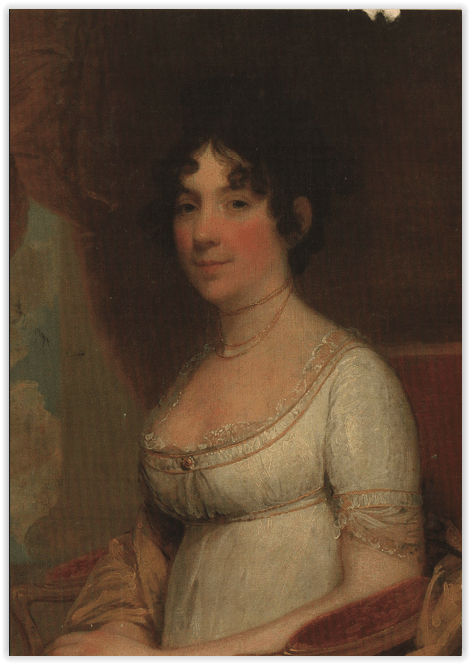
JAMES K. POLK won a vicious race which is still the only election where two former Speakers of the House ran against each other, and every past President of the U.S. (plus Dolley Madison) was either a candidate as well, or telling the candidates what to do. After the election, Whig supporters of Henry Clay published an interview with a man who claimed to have transported out-of-state voters into Louisiana to steal the election, and swore that Polk had actually gotten more votes in some parishes than there were voters. Mainstream Historians are dubious about this, pointing out that even if Louisiana did go the wrong way it would not have changed the outcome. At the time, the Whigs countered such middling objections by saying flatly that if part of Louisiana’s vote was fraudulent, then Polk had obviously cheated in every other district where he won. (Um, this one will come back in another episode as well.)
Bott shook his head and set one hand on a soft orange chair. The Free Imperial State demanded three different licenses for permission to read, five to carry a book aboard your ship, and another, plus a series of tests, to own a book. The licenses for what he was seeing right now would probably require a computer filing system larger than the Drover.
“And you have more?” he demanded.
“This is just the reading room,” said the Captain of the Dragonshelf, waving one hand toward a distant door. “The real collection is in the stacks.”
“All these books!” Bitt exclaimed, reaching for some slim ones on the glass table.
“We actually call those magazines,” she informed him. “They’re like books, but more quickly printed and distributed on a more regular basis. They’re more fragile, too, so they’re harder to find.”
Bott had never heard the word “magazine” applied to a book. Did this mean there was a wepon inside? He flipped up a plain cardboard cover to find only a few words and a lot of pictures. And such pictures.
Encouraged by this sudden interest, she stepped over to stand next to him. “These are all recent acquisitions: they haven’t been properly accessioned yet. What is it? Oh.” She cleared her throat. “Harpsichord Harlots and Ballet Sluts on Point. Yes, these magazines are really rare, aren’t they? Yes, they are!”
He turned his head up toward her. “Do you have many books like this?”
She backed away four steps. “Well, those we can find. The only way to save anything of a culture is to save everything; since you don’t know what will be important to a researcher. Except when Principal Hiatt was in charge. She would never let us keep a book if you couldn’t read the spine.” She shook her head.
Bott considered the spines of the oddly-positioned nudes in the pictures. He had seen this sort of thing in bars, of course, but was a little shocked to find them in a book…a magazine.
“You really go through the galaxy trying to find things like this?”
The sides of her face were tinged with red. “I am a librarian, sir. I preserve yesterdays for tomorrow, whatever today thinks of them.”
Bott hands trembled on the magazine cover. There was a lot more to this librarying business than he had thought. His eyes went to clear plastic shelves filled with books, or magazines, that the Dragonshelf had picked up in remote places. Being a pirate had brought him plenty of dangers. He considered himself brave. But he could think of no pirate in history who had so sedately risked an imperial sentence of rearranged bones and inflated organs the way this librarian had.
The Free Imperial State had realized early on that the printed word was the greatest threat to control of information. Technological communications were easy: the government merely made sure that adjacent planetary groups used processes which were all but totally incompatible, meaning that revolutionary texts infecting Group A were unable to reach Group B. Sensors and censors built in everywhere along the line made sure that none but the Imperial officials with the highest classification had access to everything within the system. Lower orders received only what was rationed to them.
Books, however, could not have their texts homogenized, being fixed in place and requiring only two machines to process: an organ to take in the information and an organ to process it. Thus, the suppression of what existed in every civilization’s tradition of libraries was essential to control.
The first move in controlling libraries was positive support from the Free Imperial State. Imperial officials would gradually promote the principle that for an Imperial library to contain a text implied approval of the text. So public monies were spent on books deemed conducive to the public welfare, and books found wanting were made unavailable.
This economic protection of the masses, however, affected only the text which came to the hands, paws, or flippers of those who could not afford to buy them. An attempt to control bookstores the same way, arguing that since bookstores paid taxes and enjoyed the benefits of taxation, they were also Imperial institutions lasted only until bookstore proprietors offered to pay a higher tax for being allowed to sell unapproved books. It had to be demonstrated to these misguided souls that simply selling a book unapproved by the Free Imperial State argued approval of it, which might, in some (most) cases, be evidence of the capital crime of treason.
But even killing the librarians and booksellers who protested was no satisfactory. The process was piecework: every book, every bookseller, every library assistant, had to be tracked down individually. Something broader and more inclusive was needed. Destruction of printing plants and book warehouses gladdened the heart, but not really any more effective. A licensing system, which meant anyone dispensing books had to pass an exhaustive test of psychiatric, emotional, and political responsibility, had shown promise but, again, was simply too diverse. Too many different civilizations with completely different ways had to be taken into account.
Until one emperor, considering the latest license proposal, had a brainstorm. Instead of applying the test to people who dispensed books: simply provide a much simpler (and far more restrictive) exam to everyone in space and decree that anyone who failed was forbidden to read. Anyone without a license would be put to death in the most shameful, painful way the local civilization could imagine. After a transitional generation or two, literacy would be restricted to those who could be trusted to think properly and read proper texts. The bad books would turn to dust from disuse, and a non-literate population could communicate through their local technological systems, which were simpler to edit and restrict.
The transitional period had taken longer than expected but, as a whole, success was ridiculously easy. There were now only about three thousand licensed literates in all the Free Imperial State. Even they had to take recurring tests to make sure they conformed to current approved thinking. All of these were members of the ruling system of the Free Imperial State; everyone else was a part of the laboring class. Some jobs involved skilled labor, and there was room for advancement. But almost no one rose from the skilled labor level to any level of official office.
This made running a government much simpler. But there were always ingrates. Resistance forces—no one was sure how many—had organized bootleg universities, mainly as fleets of small quick ships that could get out of the way of Imperial Truant Forces. Nubry was the last survivor of one of these fleets.
Bott shut the book…magazine. “You must have a real variety of books. Why didn’t you join one of the other university fleets?”
She had her back to him. I’ve been followed…and it’s been years! You’d think they’d give up when they couldn’t catch me the first dozen times.”
“If you got away, and kept away this long, you must be a good pilot.”
She turned a little in his direction, noticed he had closed the b…magazine, and shrugged. “That’s the training. I was going to be Library Pilot. Wasn’t I? Yes, I was! I was much better than Chedler was.” She bit her lip and turned away. The ball of hair on the back of her head bounced as she marched toward a door at the far end of the Reading Room. “But the ship hasn’t been responding properly. Maybe you can fix it. The engine room is this way.”
Bott knew where the engine room was on a BBB-44, but it was more polite, he supposed, to let her show him. When they reached the place, he released a mighty sigh. Finally, he was somewhere familiar. The first thing he noticed was a rotor housing that wobbled as they passed. If only he had his toolkit from his old ship, a couple of RK stabilizers and a brace and….
“It’s been shaking a lot when I get to change direction,” she said, stopping at the central aisle. “Hasn’t it? Yes, it has!”
“Is that all?” Bott replied. “That’s not so serious, You need….”
“I know,” she told him, with a sharp nod. “I need a new prospondor flangy.”
Bott frowned. She seemed all business about it. “A what?”
Wrinkles of uncertainty rose above dark eyes. “A prospondor flangy?”
The rebels might have modified their engine, he supposed. He spread out one hand. “I’d say your prospondor needs a new flange.”
“Is that how you say it?” Her head came toward him.
Bott retreated. “Say what?”
“Flangy.”
Bott had never heard this word before.” Flange?”
“Soft g, silent e,”she murmured. “Flange. Flange. See, I had to learn so many words from just reading the service manual. I hadn’t taken the Engineering for Pilots course yet.”
Bott understood none of this, so he decided it couldn’t be very important. He raised a hand to point. “Isn’t that the storeroom there?”
“It is,” she told him. “But I’m not sure we have any more fl…flanges?” She tipped her head, looking to see if he approved of the plural.
But he was already moving down the little metal stairs to the door he’d spotted. ”Let’s see!” Oh, it was amazing to be in a ship where you knew where you were going! No slave pens to stumble onto, not on a BBB-44. He flipped on a light and gasped at the beauty of the storeroom, with all the cartons in tidy rows and tools lined up in stained buckets. Well, the first rows of boxes weren’t so immaculate: someone had been scribbling all over them.
“Let’s see,” he said again, moving among the stacks. “Here!” He took down a reassuringly heavy box and, sure enough, found two prospondor flanges inside, still wrapped.
“Well!” Nubry was still standing in the doorway. “Amazing!” She waved a hand at the boxes with strange designs in black marker scribbled on them. “I looked through all these and didn’t find a thing I needed. But you walk in and go right to the box!”
Bott never minded a little applause, but he couldn’t feel this was his most amazing achievement. “Prospondor components are always sixth row down, with the flanges on the second shelf.”
She almost absent nose wrinkled, and she tapped one foot. “Well, why don’t they write that down?”
Bott raised one eyebrow. The literate certainly were different.
Those who have been checking this space for a while will recall our study of the men on postcards who keep on rowing even when their partner makes it difficult. Looking over the postcard world recently, I realized that we had left out another role for the hardworking, helpful male.
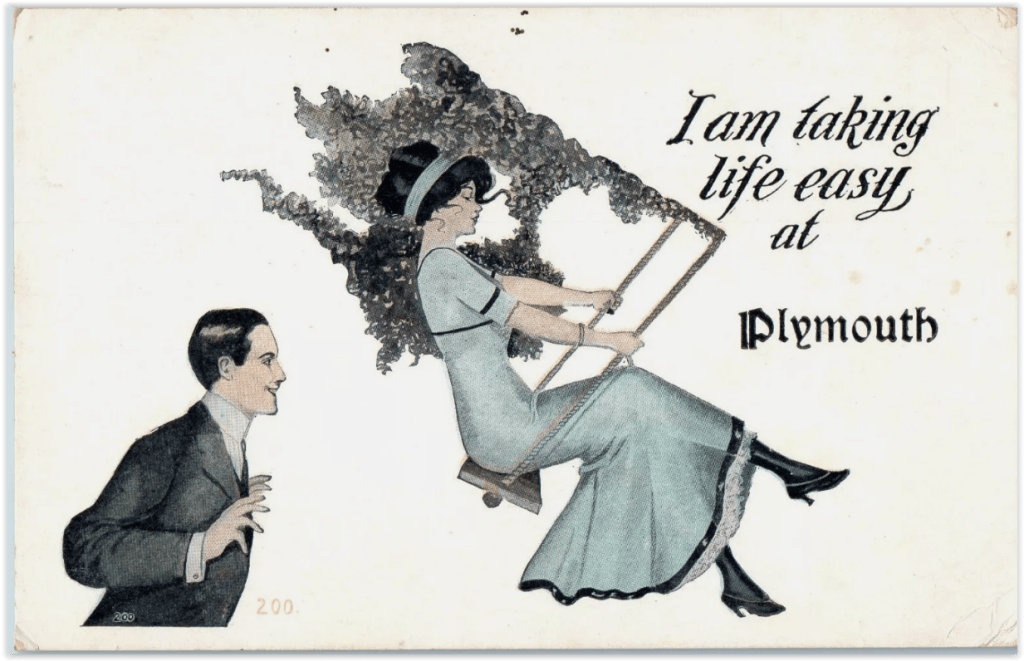
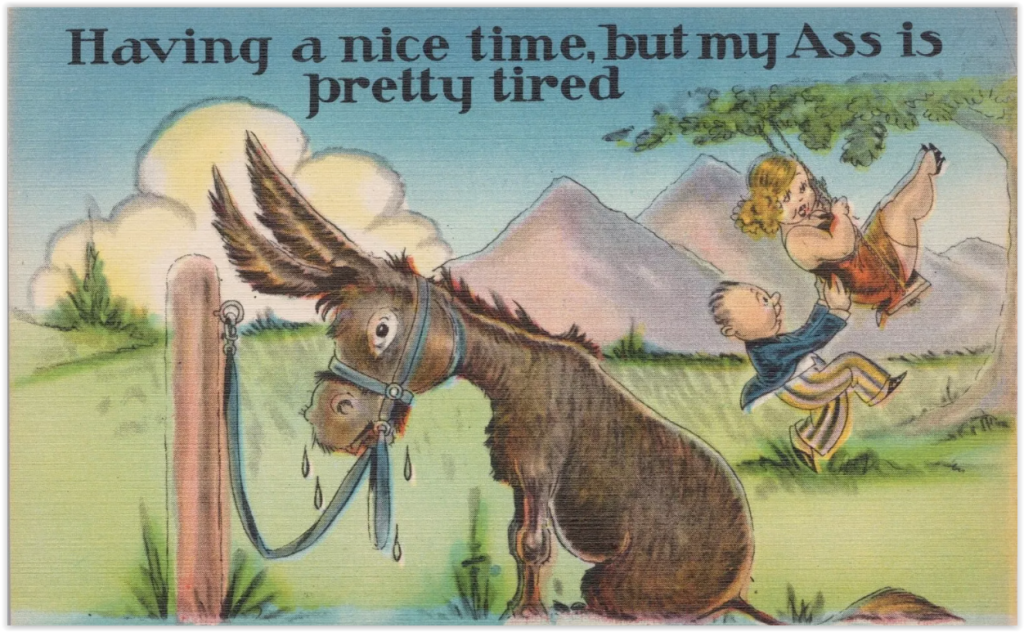
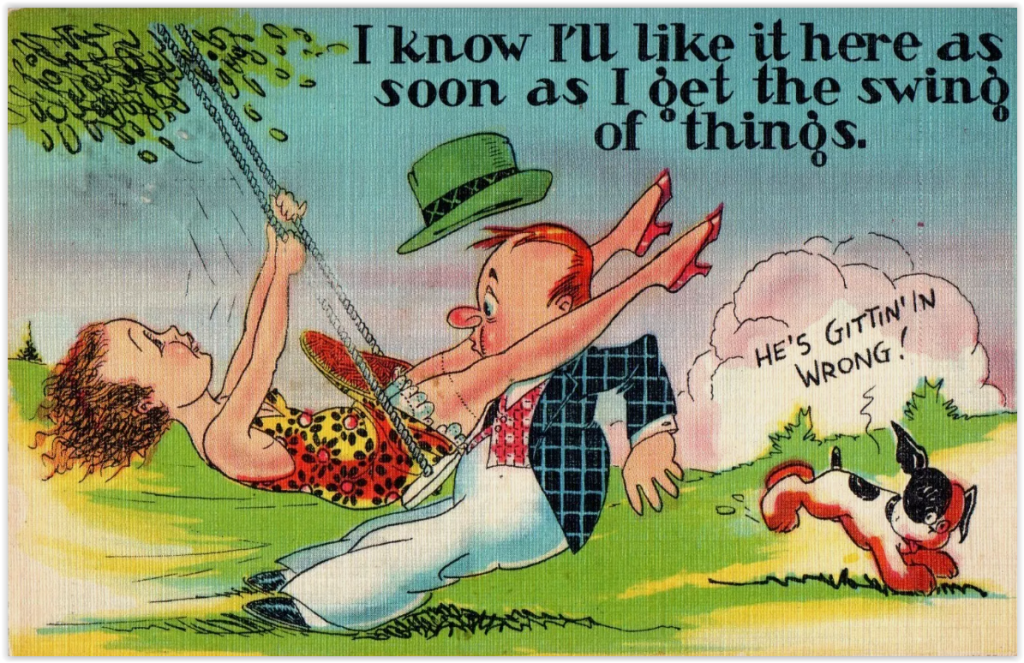
These are the long-suffering men who are willing to provide motive power for ladies in swings. The swing pusher is a more cheerful chap than the postcard boater. You hardly ever see THESE gentry complain. No matter how hard the work gets, they are always willing to lend a hand.
Let us compare their counterpart in the art world. Here is one of the most famous swinging couples, portrayed in the eighteenth century by Fragonard. THIS gentleman is not making him useful at all. Unlike our more modern AMERICAN man, he is there only for what he can see.
You don’t catch our homegrown swing helpers thinking of such low matters.
I have read some unworthy commentators who say this is really the result of mid twentieth century morals, that what interested Frago’s hero couldn’t even be suggested on a comic postcard, and that what seems like a chivalrous and selfless dedication to the task is due to the fact that another part of the body was perfectly okay in a joke.
Of course, we can all see that this exists only the mind of those perverse critics. Look at this chap. Does he look as if HE is just interested in the feminine situpon. Consider his noble expression and join me in scoffing.
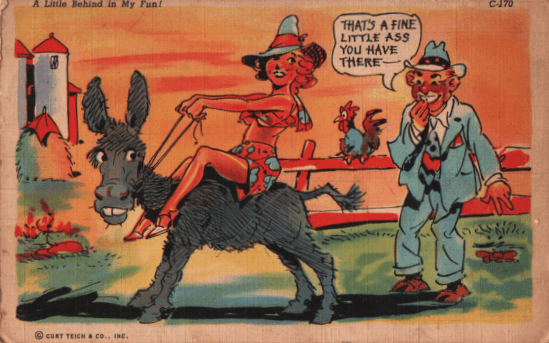
A reference to a poor, exhausted donkey does not change matters. This man is clearly working hard and doing it just so the young lady has a good time.
It’s going up in a swing which is the focus of these postcards, not some imagined obsession with the southern end of the body.
And the men are simply examples of the cheerful, helpful man of the postcard world. He is already to help out, even when the young lady does not require his assistance. He knows a kind word and a compliment will make the day advance.
And his mind is as far as possible from any thought, no matter how our twenty-first century prurience may judge him, from the considerations of anatomy or sex which Fragonard showed in the Continental male of an earlier age.
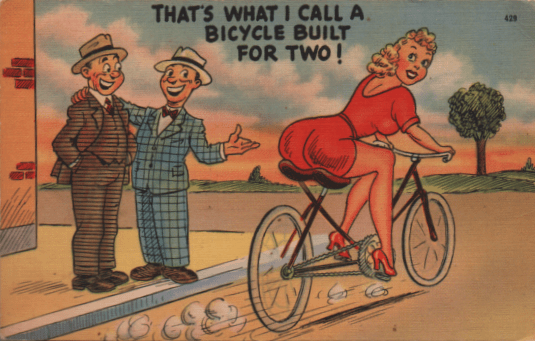
This guy doesn’t count. It’s an accident. Even the dog realizes things have gone wrong. And anyway…that is…maybe this artist produced Canadian postcards, too, and was used to French humor. (Stop snickering, you two in the back row. With minds like that, YOU’LL never be swingers.)
Remember, as we return to our attempt to find a “conspiracy theory” about each of the Presidents of the United States, that we have two basic rules: the conspiracies must have been debunked by a majority of Mainstream Historians, and they can’t be something I or some other Interwebs rumor-monger made up recently. We want bogus stories contemporary with the Presidents, or at least stories which rose within a few years of their deaths.
As we progress through our conspiracy theories, the phrase we will refer to most is “The more things change, the more they stay the same.” When considering Presidents of the United States accused of being part of vast conspiracies, it turns out we have a limited number of themes for such things.
Now, JAMES MADISON is absolutely the kind of man you’d expect conspiracy theories about (and the last person likely to be nominated if he ran for the top office nowadays.) He was a small chap, and thoroughly introverted (how he married one of the brightest extroverts in Washington is still argued over today.) When he wasn’t writing things in cipher (always a bad sign), he liked to stay in the background, writing things other people could quote, or outright ghost-writing things for more flamboyant souls. Among his works published anonymously were his parts of the Federalist Papers, in which he argued for a stronger central government than the Articles of Confederation allowed for. After he ghostwrote most of the Constitution, he then joined the Jefferson side of things, in a party suspected of plotting against the country and the Constitution. When the Adams administration passed some unpopular laws involving tariffs and immigrants, Madison wrote a landmark resolution asserting the rights of individual states, and was accused of conspiring, with Jefferson, to overthrow the very Constitution he had helped write, and, in fact, everything the United States of America stood for. Does this sound at ALL familiar? (He was not suspected of that for long, though; he was dismissed as a compulsive hypocrite. Is that better?)
JAMES MONROE was a frenemy of James Madison and the last President of the United States to run unopposed. His presidency was known as the Era of Good Feelings. This was because the Federalist Party, after a busy period churning out conspiracy theories, had evaporated during the War of 1812, and no real competition had developed for the Republican (also known as the Republican-Democrat, Democrat-Republican, and Democratic) Party. HE was suspected of planning to undermine the divinely-decreed economy of the Slave States because he had expressed misgivings, back in 1800, about the execution of the leaders of a revolt who had been saying what Monroe and his friends had been saying back in the 1770s. In the end, the leaders WERE hanged, and Monroe did not disturb the Slave States unduly during his administration.
JOHN QUINCY ADAMS has already appeared once, in his father’s great conspiracy theory, but his election to the Presidency provoked plenty of conspiracy theories, because he had NOT received the majority of the popular vote. The election was close enough that Congress had to step in to make a decision, and Andrew Jackson’s supporters felt there was no coincidence when Speaker of the House, Henry Clay, was named Secretary of State. Clay and Adams denied this to their dying days (which doesn’t necessarily make it untrue), and a hearty hatred was set up between the Whigs, who favored Clay, and Jackson’s Democratic (Democratic-Republican, Repub…etc.) followers.
As a result, in the NEXT election, ANDREW JACKSON, a military man, was suspected of planning a coup if he got shortchanged this time around. Bayonets, not ballots, it was said, would put him into office. Jackson enjoyed a good fight in plain political battlefields, and there seems to have been nothing behind the coup conspiracy.








 Blogsy Babbles