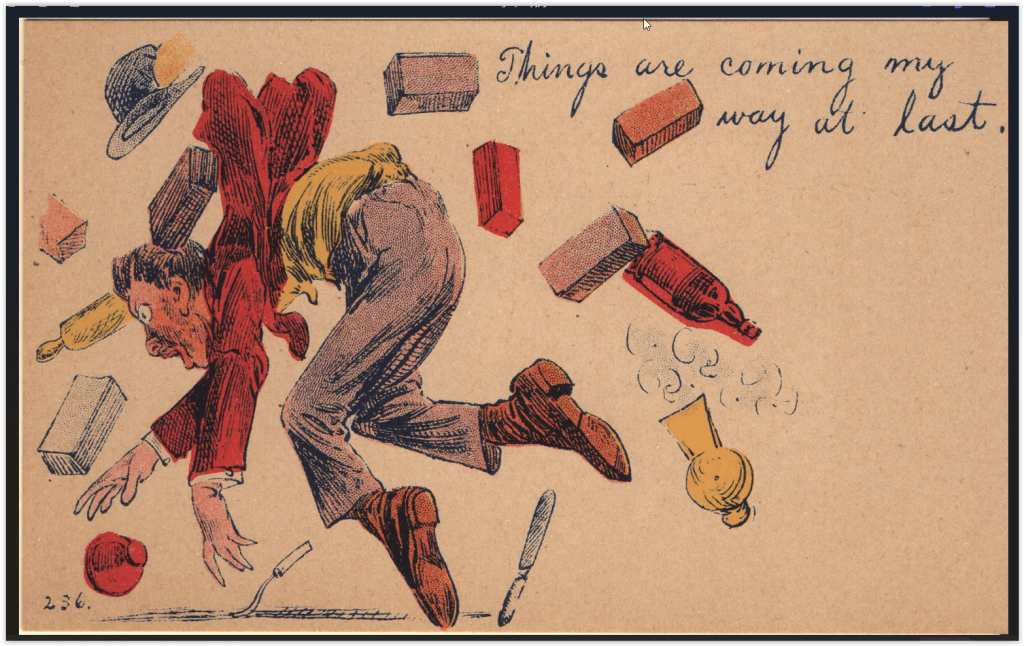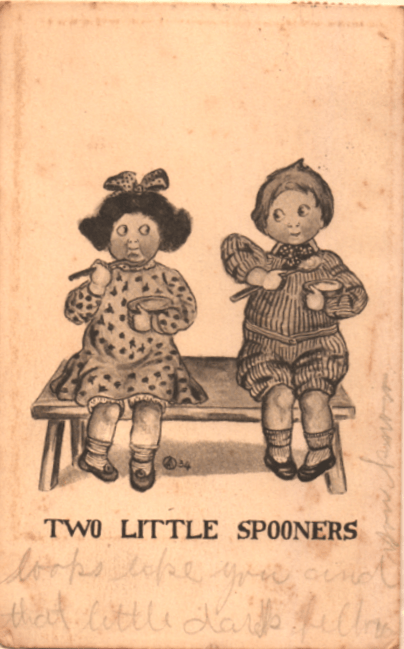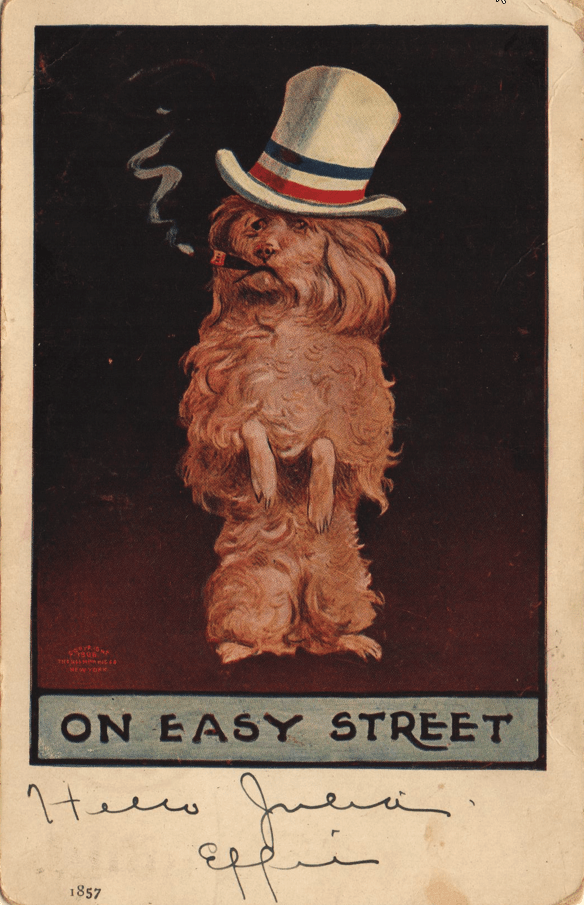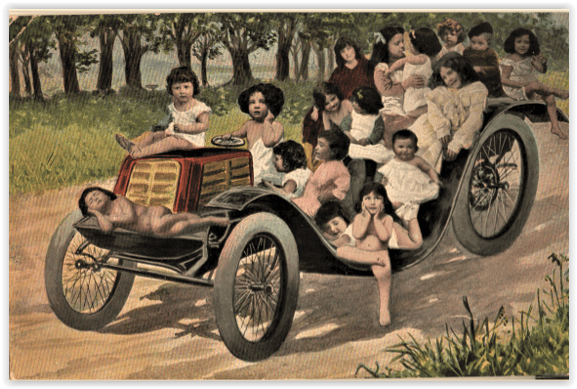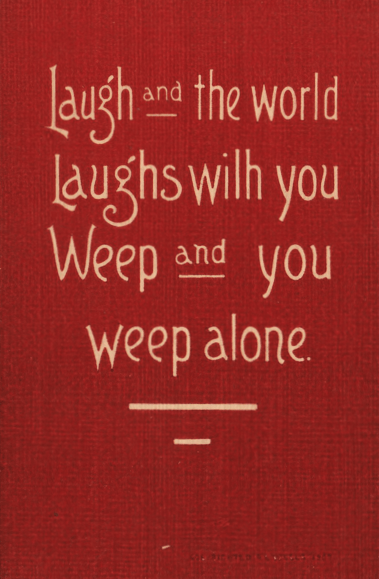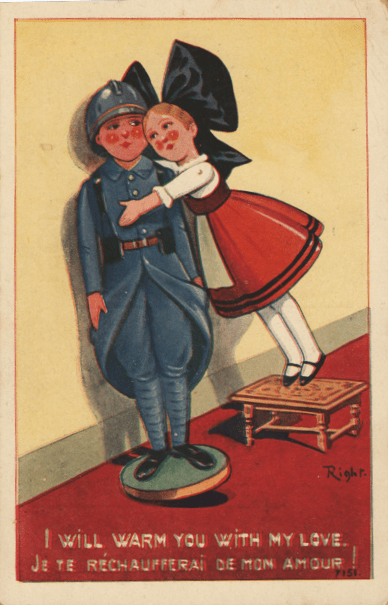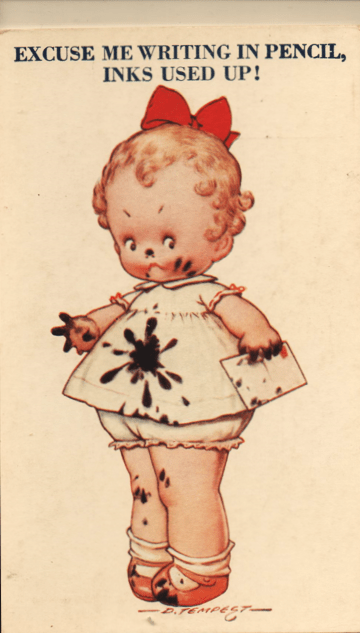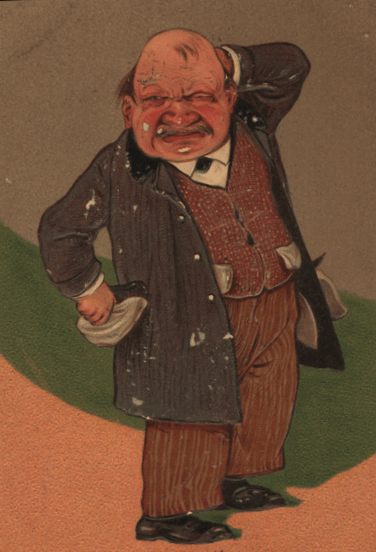
It is time for my annual column where I go through my inventory and discover I have no Halloween postcards for sale. There ARE Halloween postcards, and postcard mongers who can offer you a fine array, but these folks exist at a higher financial level than I can compete with, and therefore I have to seek my Halloween terrors elsewhere. The postcard featured at the top here, for example, strikes a lot of people as a grotesque horror. But it was intended, back in the day, to be funny.
This, also, could do as a Halloween card only in a pinch. Yes, the man saying “ootsy boo boo” to the baby IS a tad frightening. But this artist was great at grotesque faces, and if you look more closely, with a saturnine attitude, everyone in the picture seems to be wearing a weird mask.
And you can’t call it a Halloween card simply because the joke is frightful. (People would start asking why I write Halloween columns all the year long.)
If we look for genuine nightmares in our Halloween greetings, we might take this picture of a health spa where large men drinking from the mineral springs to renew their youth discover all the restrooms are already occupied. Can’t immediately recall any really four-star horror movies that used this idea, but perhaps we’d be ahead of the curve. (Or at least at the front of the line.)
Here we do finally get into genuine horror movie material. Pity it was sent as a happy congratulations card.
And this cabinet card, from a line which did the same thing as souvenir postcards but in an era when picture postcards were barely a blip on the radar, was intended as a celebration of heroic engineering: not nightmare fuel for prospective passengers.
This was simply a convenient way of showing a person was in the city without having to do any shooting on location. It was NOT intended as the first in a series of science fiction horrors in which giants stomped all over defenseless cities.
Anyway, that’s what people tell me. I do wonder.
This was meant to simply be funny, not horror fodder at all. “Lobster” has been used for various people over the decades, sometimes for a rich man, sometimes for one who was merely surly. This card laughs at the idea that any woman would voluntarily get into bed with an unpleasant person just because he’s rich. It’s the incongruity that matters, the unlikelihood: not the scary picture.
You can tell by the victim’s face here that he is perfectly comfortable having the seat of his britches mended. You were supposed to laugh at the joke about “closing up the rear”, not quiver on the edge of your seat with suspense at whether the short-sighted attacker can be trusted with that needle.
I have TRIED to sell this as a Halloween card on the basis of completely untrue rumors (always useful for selling things) that it represents an unaired Twilight Zone episode in which the hero (is that Mickey Rooney again?) wishes to be pursued by women. This would be the closing shot, where you can wonder whether they will toss him on the grill…or just be left in suspense about where the incoming beach bunny is going to take hold.
This seems at first glance to be a large man giving small pig a humanback ride, but if you look closely, you will see he is a butcher. The image is grotesque, but it just won’t DO as a scary Halloween postcard. Everyone is smiling.
Bott’s head swung left and right as he fingered the grenades on his belt. There was no way to predict where danger waited: overhead, underfoot, forward, behind. He studied what seemed to be holes I the corridor walls. Were they ornaments, part of the structural design, or the aiming mechanisms of traps?
Lights sat high, within translucent ridges which could resist attack in case of a slave riot. A slight hum could be heard coming from somewhere I the ceiling. Ort from the lights. Or from a waiting tank of gas which would snuff or suppress an enemy. He heard also three footsteps for each one of his, presumably echoes. His head continued to swivel, eyes open.

Bott had never bought all those late-watch tales about haunted ships. “Drover’s too new to be haunted anyhow,” he told himself, stopping again to make sure those echo footsteps stopped as well. “They designed it like this to scare the prisoners, to keep the crew quiet.”
The crew. Were there security devices in the walls, things a duly-trained crew member would know about, but unknown to an interloper? He slid his feet along the floor in case these were sound-activated. Such devices would more likely damage him than finish him off: a slow slave would be an object lesson to the others.
He turned a corner and passed a communications booth. A white light was flashing on a small monitor inside. He wondered if that was all right.
This new corridor seemed colder and darker. After a few steps, Bott realized this was because the walls were another color. On large ships, corridors were color-coordinated, so crew members could tell where they belonged. They had only to match the color of their uniforms to the wall.

In most of the ships Bott had raided, none of them anywhere near the level of the Drover, cargo bays had been orange. He couldn’t recall anything blue.
A door confronted him after only a few more sliding steps. The security slot next to it was blue. He reached for his deck of security cards and pulled out a dark blue one. With any luck, it was a cargo pass. He wondered what the LIGHT blue card was for.
The door slid back. He waved the card in the doorway first, to see if this triggered anything. When his hand was not shot away, he moved forward.
And looked down. He stood on a narrow bridge stretched over a vast cavern that could have swallowed his ship and the BBB-44 together. Bott shuddered. This was no cargo bay: not for what he called cargo, at least. This was an entrance to the slave quarters. The bridge was meant as a final obstacle for unrestrained sales to pass if they joined in revolt. Before they could escape their pen, they would need to move in single file across this bridge, under the guns of Imperial guards above.
Bott stared into the cold blue depths. He knew nothing about the slave pens aboard the Drover. He knew the ones on Coderah. In escaping those, he had nearly left his right arm and shoulder behind, and it would have been a cheap enough price to pay, at that.
He heard the tiniest sushing sigh. Whirling, Bott threw himself against the door as it started to slide shut. One foot and one shoulder held it in place and, throwing his weight against it, he was able to push through.
“That was stupid,” he told himself, panting on the other side, “You’ve got the bilstim card.”
He did not, however, have all day. When he could breathe again, he moved back up the corridor to the communications station.
A blue-rimmed viewscreen was now showing something, but Bott couldn’t tell what it was. He took the blue card he’d used on the door, turned it up the long way, and set it into the slot provided.
“I….”
A voice he had not heard before declared, “If this is a further complaint about the food, I must inform you that the drover still does not have a full complement of supplies. Mashed lumpucks will continue to be served without maynage until we can take up the remaining portion of our allotted supplies.”
“I wan’t going to complain,” Bott protested. “Um, the food’s okay, really.”
“What did you want then?” snapped the voice.
Bott reminded himself that he was the captain. “Link me to the main computer. Er, if you can.”
“One moment, please. I shall put you through.” There followed a burst of static in which Bott thought he could catch the wotds “Why can’t they take time to do it the right way?”
After that came a short whistle. A much more familiar voice demanded, “What are you doing down there?”
“I….”
“He’s going to complain about the food, I just know it,” growled the other voice. “Going over my head will do no good, you know. I still won’t have any maynage.”
“Oh, get off the line,” said the Drover.
After another grumble of static, the bridge computer asked Bott, “Why did you have to go through him? Touchy as a cook, he is.”
“Well, I didn’t know how else to reach you.”
“Oh, that’s right. You wouldn’t. You’re the pirate. Well, that gold card you were so flashy with a little while ago has a contact system built into it. Just hold it up the long way and press the sides. Do it that way from now on and cut out the middle grouch.”
Bott was glad to know about this, but felt it vital to assert his command position. “I’ll call you any way I like.”
“You are, of course, the captain, by all rights of theft and plunder,” the Drover told him. “But that’s no reason you need to put up with the moods of every subordinate computer.”
“Who was that?”
“Oh, he issues food and monitors conditions in the slave quarters. I don’t need to tell you you took a wrong turn, do I, Captain?”
Bott was willing to put off that discussion for a bit. “How many different computers do you have here?”
“I,” said the Drover, “Have one hundred and seventy-eight first level computers on my staff, each communicating with some three hundred lesser brains. Not counting yours, of course.”
“Why so many?”
“The ship can be run from a number of different stations,” the Drover explained, “And makes it impossible, in case of a slave revolt, for the ship to be taken over by unauthorized persons all at once.”
“Impossible? It’s a good thing I didn’t know about that before I did it.”
A growl of static was followed by “The master system works only if a full crew s available to conduct a proper resistance. Special codes are entered if part of the crew is captured or pressed into service by the slaves, and cards will be bypassed. It was planned that my staff was to be generational: entire families growing up here to regard the Drover as their home. Hiding places are provided where they could lead an armed resistance for years, if necessary, as the slaves learned their cause was hopeless. If you had simply called ahead, I could have told you I wasn’t quite ready yet for pirates.”
“I’ll remember that next time,” Bott promised. Thinking it over, he went on, “Are there any crew here now, hoed up to plan a resistance?”
“No,” the Drover told him. “More’s the pity. I’d make lovely, ingenious suggestions about what they could do with you.”
“You wouldn’t lie to me, would you?”
The voice went a bit chilly. “Has any computer ever lied to you?”
Bott thought this over. “No. Omitted data, let me mislead myself, yes. But lie outright? No.”
“All right, then. Go back the way you came, past two turnoffs, until you see the orange corridor you should have taken? If you are color-blind I can arrange to play tinkly music when you get there? No? Then go up the corridor past the first five cargo bay doors and enter the sixth. You can count to six, can’t you?”
“I’ve done it before. That’s the number of guards I took out at your front entrance.” He yanked his card from the slot.
He marched back up the corridor, thinking over possible loopholes in the computer’s declaration that no crew members were waiting in ambush. The orange corridor was warmer and less shadowed than the blue one, but he did not feel notably enheartened. The sixth cargo bay did not cheer him, either. Naturally, the Drover had had no time to take on much cargo, so the captured ship sat alone at one end of the immense room. The BBB-44 rested on a white oval on the orange floor.
And that was all. It sat silent, entrances closed, unguarded. Bott would have preferred a ring of armed guards, weapons pointed at him. He had dealt with that sort of thing before. But this ship was still: not dead, but waiting.
He moved forward, feeling alone and absurdly young, remembering the big abandoned hangar where he had found, cleaned, and repaired the very first ship he’d had on his own. The TDA-3 had been nowhere as big, but in this cargo cavern the captured ship looked smaller.
What kind of creatures might be waiting inside. Nothing too bizarre would be flying a BBB-44, surely. He unhooked a grenade from his belt, wishing he’d asked the Drover to do a scan, or even release that gas it had suggested.
“I can take on anything when I’m sober,” he muttered. “And I haven’t had a drink for three days.” This was true. He had taken on a lot of things that he wasn’t able to beat, of course. But here he was.
He bounced the grenade in his hand. “If only I could find out something without having to….”
As you will recall from our last thrilling episode, we were looking through a portfolio of beach postcards produced in 1948 by Curteich. These accordion-pleated collections were essentially cartoon collections, the postcards printed on both sides of the page (as opposed to other similar portfolios where you could tear out and mail individual cards.) It satisfied the desires of postcard buyers who liked some jokes well enough to want to keep them AND cheered up the publisher, who could use up a number of older designs which had had their day but were still available to fill up a booklet.) “Fun On the Run” was a collection which emphasized romantic and other mishaps which occurred when scantily-clad people gathered in a warm place far from their homes. WHICH could include (for the vacationer and the postcard company) near or complete nudity.
This was in an era when nudity was carefully monitored by the Powers of Morality in government, so you can observe how our postcard artists (Ray Walters again in both the first two examples) have to play it safe. The skinny-dipping postcard gets the point across without displaying anything actionable, while the second lets you know how much skin she is showing by emphasizing the danger presented by solar rays.
When a man ventured on sunburn comedy, he had to stay rather more covered. (The voluminous shorts are really just there to make him look inelegant and sloppy, like most Walters heroes. By the way, look closely and you WILL observe that his sign will burn “ME N’ U” into his back. I have been scolded for making a joke of my own and suggesting it says MENU. In case you thought the Powers of Morality have gone to sleep since 1948.)
A matter which has concerned our official and unofficial porn-sniffers has always been nipples. Note that our victim here does not have any, and that the swimsuits worn by the lifeguards, which strike me as impractical for the job, are just barely big enough to cover the really objectionable feature of the human chest.
One way around this, pursued here by another Teich artist, is the silhouette. Is the lady strolling in the nude by moonlight, or is she simply wearing a very tight bathing suit? Guess which answer was ready for anybody who complained.
How form-fitting a swimsuit can be, or could be in the late Forties, is limited by the demands of fabric, so this twilight bather is not fooling anybody. But as long as it’s POSSIBLE that she is wearing a suit…and, in any case, nothing really naughty is SHOWING, which is the point (or points.)
The artist did give this lady a skirt…which is transparent…but not where it can bother the viewer.
This panel, though, did worry me. Perhaps, I thought, the Curteich folks were allowed to show genuine nipples since this was, after all, merely a panel in a folding accordion, and NOT on open display in a postcard rack at the beachfront gift shop. But quick research showed that this very image WAS available on an individual card as well as in Fun On the Run. The only thing I can think of is that they could always say they are NOT showing exposed nipples. This lady’s bosom is demurely hidden behind a beach ball…which is transparent but which IS still covering her chest.
This argument has its legal limits. Men had to make use of cloudier beachballs. We can imagine the scene at that gift shop in 1948. “I’d like to buy a beach ball, please.” “Of course. Men’s or women’s?”
A perennial difficulty with postcards, from the day these started including pictures until today, is that finding a card which would be perfect for Cousin Tabitha is never enough. If the card is really perfect to send Tabitha from your vacation spot it’s good enough to keep, too. One answer to this is to go ahead and buy two of the same card, one for yourself and one to send. The postcard companies had nothing against that, BUT to appeal to people with more efficient tendencies, they would publish little accordion pleated portfolios of a bunch of cards, so you could buy a card for Tabitha (did YOU bring her address?) and also buy a small cartoon book of what the company had to offer. These selections come from a 1948 portfolio from Curt Teich and Company, which features an unusual image on the outer cover: we don’t often see women chasing men on a postcard (I think he’s about to let them win) nor do we often see men with hairy chests. Please remember the word “chests”; this comes in later in the story, and I don’t want you substituting other words.
The portfolio collects some eighteen images, plus two more on the outer covers, dealing with fun at the beach, with a heavy emphasis on romantic fun. Part of the appeal of a vacation is meeting new people and seeing new sights, possibly both at the same time. This card is a reprint from somewhere in the 1930s, when men wore these coverall suits and this artist, whose name I have not learned, could do homage to Walter Wellman’s postcard couples.
See, the 1940s saw a shift away from the female figures Walter Wellman and this really talented follower of his liked to draw.
Both artists liked to point out that the male half of the equation does not always emerge as the alpha predator.
This, now, addresses another sort of predator on the beach, and is by artist Ray Walters, of whom you will see a lot in this folder and, indeed, in any collection of Curt Teich comic postcards. This is not really his best work. I don’t understand why anybody would dive into the water with a cigar and…. What was that? Oh, you think so. I see, and that “bang bang” has more than the two meanings I saw? You could be right, but in that case…well, that cigar is still going to go out and get soggy once he hits the water.
It is true that a number of the women shown by either artist can be found at a disadvantage. This was NOT, however, the norm for beach postcard tradition.
Ray Walters particularly seems to have preferred the young woman on vacation who was n control of her destiny and interested in meeting people on her own terms.
And doing very well at that, thank you very much.
Of course, this caused comment from onlookers, but she didn’t care. (And if you are interested in how little she might care, and how MUCH cheek she could show–you do know ‘showing cheek’ meant to be impudent, right?—come back on Friday.)
Bott stepped back onto the bridge and glowered at the delicate instrumentation. It had taken a day just to figure out how to flush the toilet. How long would it take hi to master flying the ship?
His eyes passed across seats and control consoles so elegantly incorporated into the walls and floor that only someone trained for it could be sure whether they were leaning on an armrest or firing the forward guns. His singers drummed along the doorframe and a dozen navigational screens lit up, all purple and gold, at stations around the bridge.
The best thing, he figured, was to act like he meant to do that. He ambled to the nearest display and tried to decode what it was telling him.
Even at this level of sophistication, a navigational screen could not remain a mystery to someone who had logged as many hours as Bott. “Hey! Something’s moving out there! Put it on the big screen.”
The Drover identified his intended target without difficulty and displayed it as demanded. Bott took a step back. His old ship had had a much smaller screen for this sort of thing. But he sauntered to his seat under the massive image.
“That ship’s not flying so well.”
“It has my sympathy.”
Bott frowned, leaned forward, and then leaned back. “That’s a BBB-44!”
“I know.” The computer sniffed. “Mere cargo hauler.”
“What are you, then?”
“A cargo enhancer. Slaves shipped in my hold will have a tale to tell their grandchildren.”
Bott crossed his ankles. “If they survive.”
“They survive.” The ship’s voice was as chilly as its programming allowed. “If they are not overly choosy or sensitive, a company of slaves to the size of….”
“A triple B,” muttered Bott. He could see the command bubble sharp and clear; that black collar around it marked a ship of fine vintage. Oh, it had seen service; there were dents and valleys in the surface, and bits of it wobbled as it limped along. Cables under the skin raised little shadows; patches were clearly visible. Dozens of ships of similar era and construction were in use where Bott grew up: large and sort of awkward, but not without grace.
It was backheavy for speed, but that didn’t matter if you knew how to fly. That was a ship that would be malleable, adaptable. Ships filled with high-tech gadgets designed to do precisely just one thing were always difficult, with circumstances on a trip always changing. That bulk was a ship one could work on, a ship one would not be afraid to scratch: that ship knew how to fly, and not just cover its shortcomings with snappy backchat.
“No Imperial registration,” the Drover noted.
Bott had no plans to get rid of the Drover, since he had been clever enough to get it in the first place. But it was not a bad plan to have a ship to fall back on, if the worst came to the expected. And chances were, based on its erratic course and high speed….
“It must have been abandoned. We’ll take it.”
“Tale it?” the ship inquired.
Bott leaned forward, considering the console. “You might as well know what business I’m in.”
“How delightful!” cooed the drover. “Not merely a thief, but a pirate. And one who yearns for empty ships, where there’s no crew to give him trouble. Even better, perhaps, a ship where the crew died of something painful and highly contagious, like Batterian Fever.”
Bott had not thought of this. “Is that something that would linger, once the crew was dead?”
“Oh, don’t fret. You can’t catch it.”
“Are you….”
“It’s a brain disease.”
Bott growled a reply, but his mind was on the flashing tabs before him. “Even at my speed,” the computer remarked, “It’ll be out of range long before you learn how to follow.”
“I can catch anything when I’m sober,” he snarled. “And I haven’t had a drink in three days.”
“Excellent Maybe you can catch Batterian Fever. I have something to look forward to yet. First the patient’s eyes start to bulge from internal pressure; sometimes they pop out and dangle. Then….”
Bott sat back and pointed at the huge image. “Ship.”
“I know it is.”
“I meant you.”
“Oh,” said the Drover. “The proper form of address is ‘Oh beautiful and mighty Drover!’ It wouldn’t hurt to say ‘please’, and if you dropped to your knees and grovel….”
“Ship.”
“Yes?”
“Go get that.”
“I beg your pardon?”
Bott took a little plastic card from inside his jacket. “I have this security card,” he said, “Which I think means I have the authorization to give orders. At least to the navigational computer.”
“I’m sure all those pads on the console are good for something.”
“I’m sure they are. And so are your audio receivers.” He slid the card into the correct slot. “Now go catch up to that ship and take it.”
“I thought you were so excited about doing it all your big bad self.”
“Ship, stop clowning and start moving.”
“Oh, transistor,” said the ship. “Oh, you would, would you? Sure he has the card, but you could…oh, it’s no use talking to you, you…you machine.”
Bott was trying to watch screens and pads at the same time, to see what happened when which ones lit up. “Ha! It worked!”
“Yes,” the computer replied, with a touch of disgust. “As long as you put that card in the right place, we have to do what you order. So long as you ask for things we were specifically programmed not to do.”
“You wouldn’t have to,” Bott pointed out, “If you’d tell me which of these buttons is which.”
“That’s one of the things.”
Bott looked from the navigational screen to the visual. “Mighty bulky. You shouldn’t have any trouble catching up.”
“I hope it’s not a mine. How tragic if I were destroyed as a result of your clumsy crimes.”
Bott was preparing to answer when a violet flare with a yellow tip burst out of the other ship. “Shields out!” he ordered.
“I thought of that already.”
Bott started to tap his fingers on the edge of the control panel, but jerked his hand back to tap them on his knee instead. “Someone’s on board, then,” he muttered. “Unless it’s an automatic defense response.”
The other ship seemed to flatten a little as it changed course. “And it’s moving too fast for its structure,” he went on. “Either the pilot’s dead or knows something I don’t.”
“Gracious!” exclaimed the Drover. “Is such a thing possible?”
Bott sneered. The ship pointed out, “It’s headed for the Tomajar Marble Belt. You’ll never catch it now.”
“Me?” Bott sat back and put his hands behind his head. “You’re doing the chasing. I’ll just watch and see whether you can catch it.”
The ship did not reply, but Bott felt a surge through his chair and the control panel. A dt on the navigational screen was coming closer to the center circle.
“Cut in front of it,” he said, leaning forward. “Ten it can’t….”
“You just sit there and watch. I’ll show you how this is done.”
The Drover itself was beginning to show on the viewscreen. Bott sucked in his lower lip. The capture would be gratifying, of course. But he was sorry he wasn’t actually involved in it.
The other ship continued to fire, and the Drover continued to gain. A tiny black square appeared on the drover’s immaculate surface. In the blink of an eye, a huge paisley bubble had risen from this opening. Another blink and the square had closed, sending the bubble toward the other ship. The bulky craft increased speed, but not as much as did the bubble.
Bott put up a hand as the bubble burst in a screen-filling flash. The navigation screen showed him both ships had changed course again, one to avoid the bubble, the other to intercept a ship avoiding its bubble. The bubble was gone when he risked looking at the big screen again: a shimmering silver beam surrounded the smaller ship.
“Spuh-rockets!” He jumped to his feet. “Get a cargo hold ready!”
“How I wish I had thought of that. Of course, I assumed I would just pull your prize along like a sleigh. If…..”
“Well?” Bott demanded, when the computer did not continue.
“They’re firing up the tractor beam.”
“Is that going to be a problem?”
“Let’s say I wish they were shooting up into you instead.”
Bott looked to the big screen again. “Is there a pattern to the shots? Is it an automatic defense response?”
“Now, there’s a thought. Where did it come from?” The small ship disappeared behind the sleek silhouette that had captured it. “No. No real pattern.”
“There’s a crew, then.” Bott’s hands fell to the grenades strung on his belt. “I’ll go see.”
“Shall I gas the hold for you?” the computer inquired politely. “So you can rape and pillage as you go?”
“No, thank you,” said Bott, with a little curtsy. “Just stay on this course unless it looks like we’re going to hit something.”
“Now, you’ve got it, right? I want to be transported to 1962. For real, and as myself, knowing what I know. No changes. Me, Durward Bailey as I am in 2024…only give me different clothes.”
“Different clothes,” murmured the massive brown caterpillar.
Durward strode from his desk to his unmade bed and back, a matter of thirteen steps. “I know how these things work,” he declared, shaking a finger at the placid, mighty spirit. “Don’t grant the wish until I’m done spelling it out. I’ll nod twice, like….” He caught himself. “I’ll nod twice.”
“Nod twice. Yes, master.”
The old rhinestone brooch looked as if it had been in the secondhand shop for sixty years. Durward Bailey had been flipping it aside in the box of junk when the pin on the bock got lodged under his thumbnail. Something like this happened whenever he took time to shop among old stuff that fascinated him. Midcentury martini glasses snapped in his hands, cigarette cases broke at the hinge, and now one artifact decided to strike first.
Swearing he’d get tetanus from it, he had badgered the old lady who ran the place into giving it to him for free. Durward Bailey would have preferred cash, but she opened the cash register to show how empty it was. He couldn’t even get injured in a spot where it might be profitable.
For free, the brooch looked a little better but not much. He took it home and tried to polish it, thinking of eBay millions, and a small hairy caterpillar crawled out. Throwing it on the floor, he watched in awe as the caterpillar grew, its head bumping the ceiling before it inquired, in a gentle voice, what he needed. The ancient spirit had the power to grant him one wish.
This was more like it, and Durward didn’t have to think long about his wish. He had fantasized since grade school about going back to before he was born, starting a new life before his current hard luck began. Having considered in daydreams just where to place bets and make investments, he might die before the twenty-first century, but he would die rich, in a world where the laws and lawyers to bedevil the wealthy didn’t exist. No longer would he be Durward Bailey, a nobody who worked a nothing job and came home to watch nothing television until he fell asleep so he could do it all again tomorrow. Mr. Durward Bailey III (no reason not to keep his own name, since he wouldn’t have been born yet, but he could class it up a bit) would be a person of substance, a man to remember.
“Give me the right clothes for the period, and five hundred in cash…cash of the period, too. I want to be in the United States, with U.S. currency, got that? I want to look as if I belong there: no surprise tricks like some Twilight Zone episode, where I’m stuck with something from the wrong decade so I can’t win.”
“Nothing like a Twilight Zone episode. You will be transferred as you are now, Master, save for your clothes and cash.”
Durward shook both fists at the caterpillar. “And no time limits. Once I’m there I stay there. No yanking me back to this dump just as things are turning my way.”
“No yanking back.” The genie nodded. Durward thought it over, and nodded twice himself.
He blinked. In place of his unmade bed was a different unmade bed, and next to it was a small screen television with rabbit ear antenna, and an oblong radio. He turned. Where his computer had sat on his broken-down desk a dented typewriter waited. Looking up, he found a bare light bulb where the cheap ceiling fan had hung. This was it: the 1962 counterpart of his 2024 apartment. He took a long look so he could describe it to reporters in about ten years, telling about where he had started his rise to the top. It was exactly what he’d wished for.
He frowned. Well, no: not exactly. Something was not quite…he glared at the couch. It was light gray. The floor was light gray. The blankets on the bed were a darker gray. He raised his hands. There was no color to anything; it was all black and white. What was THIS all about?
“Submitted for your approval, a Mr. Durward Bailey, who made a wish to be transported to a world of the past, but not in a way LIKE a Twilight Zone episode.”
Durward, recognizing the voice, took a deep breath.
“A man of few achievements and fewer prospects, but with one unexpected chance to change his future, Durward Bailey chose to shift from his ordinary life to a place where he was sure his knowledge would make him extraordinary. And–knowing how such wishes work out–he specified that he was not to be sent to something LIKE a Twilight Zone episode.”
“No!” Durward screamed. “No no no! I know how these stories work out! Get me out of here!”
He rushed for the door of the apartment. It didn’t open. Hammering on the panels, weeping, he begged for the genie’s attention. Then Durward Bailey realized he was not pounding on wood but glass.
“Proof,” the calm relentless voice went on, “That knowing how things work out may not prevent them from doing so…in the….”
Durward Bailey gazed in horror through the great glass wall and saw thousands of people looking back from couches of light orange or pale beige. He dropped into a heap on the floor, his body heaving for just three seconds before the credits rolled.
Have I mentioned—more than thirty times—that this is not a food blog? But maybe what I am writing about here doesn’t count. Folks on the Interwebs have differing opinions on this (as with everything else) so let’s not wait around.
The appearance on the market of Coca-Cola flavored Oreos (good stuff) and Oscar Mayer Popcorn (haven’t tried it yet) has led some commentators to claim we are headed for the Apocalypse. I suspect these people don’t wander down the aisles of the grocery stores the way I do. And as a dealer in pop culture, in book and postcard form, I know that the fascination with innovation in food is not limited to our own generation. I was among those who sent suhhestions to the Lays folks when they were soliciting new flavors for potato chips: a blip on food marketing which grows smaller in the rearview mirror (during on of the last years, I tried to check whether one of my new flavor suggestions—was it liver and onions?—had already been suggested, and found that Lays listed over half a million suggestions JUST from my state JUST in one month. I think I understand why they stopped asking us.)
So I have prepared one of those “Not Really!” quizzes. Here is a list of products, by brand name or by concept. Your job is to answer the simple question “Did this really exist?”
1.McDonald’s grilled pineapple sandwich
2.Korn Kinks
3.Crapola
4.Gluten Globs
5.Protein Elbows
6.Bone Broth
7.Tomato Jell-0
8.Campbell’s Oxtail Soup
9.Mushroom Jerky
10.Pickled turkey gizzards
11. Pork-flavored turkey
12. Pickled beet potato crisps
13.Canned bread
14.Canned hamburgers
15.Canned red velvet cake
ANSWERS
1.Yes, let’s start with an easy one. This was the Hula Burger, for those observing Lent; not available now for some sixty years, but for curiosity’s sake alone….
2.Yes. Not a great moment in American marketing, but the mascot of this 1920s cereal had her own line of postcards and a LOT of attitude
3.Yes: a high fiber granola blend I used to find in the cereal aisle
4.No, alas, I could not find this anywhere. There ARE products with added gluten, but this ame is still available
5.Yes. This is a high protein macaroni with a catchy name
6. Yes, you can see this everywhere for people on a keto diet
7.Yes. Jell-O was used in so many salads that several vegetable flavors appeared
8.Yes. And no, you did not find a whole cow’s tail inside
9.Yes: you can find several types for those who have gone vegetarian but miss the jaw workout jerky can provide
10.Yes; available in various brands. Is the demand for giblet gravy dropping that low?
11.Yes, this was touted as a kosher pork product
12.No. At least, I couldn’t find it on the Interwebs. I remain convinced it’s out there somewhere
13.Yes. This has been eaten as a necessity, but also won over a lot of fans who PREFER their bread out of a can.
14.Yes. People have been coming out with these since the 1950s and there are several brands on the market, including a couple of canned plant-based cheeseburgers
15.No. Or at least not so far. Canned cake is apparently sweeping Japanese vending machines, and as soon as some American company thinks of a way, red velvet cannot be far behind.
The curve of space, vast and beautiful beyond comprehension, was no more beautiful than the Drover. Immense for a ship as the immeasurable parabola was for the universe, she was the product of three generations of engineers trained from birth for her construction. The Drover had been intended for a century and more to be the model and prototype for every space vessel to follow. Henceforth, all spacefaring ships would be divided into two classes: those constructed before the Drover, and Real Ships. The illiterate mastercrafters who built her had explored the concept of elegance as motive power to the point of building the fastest, most beautiful vessel in the history of the universe. Fifteen engineers, learning she had been completed, had voluntarily walked into a minefield, and Lag Leman, Inspector General of the Imperial Fleet, had died of heartbreak on seeing the whole ship all at once without due preparation.
The Drover was currently as far off course as she was beautiful. A meandering publicity tour, designed to show off the latest accomplishment of the Imperial workshops, had been woven into her regular work assignment transporting slaves from one work zone to another. On her first two stops along this tour, Imperial citizens marveled at the genius and technology which had created a vast beautiful ship in which some twenty-seven million disposable workers could subsist for up to a generation until they could be unloaded where needed. She was a lightleap forward for Imperial efficiency.
But right now she lurched through space far from her intended cruise of celebration. A lurch, in a vast ship traveling at 930,000 feet per second, can be alarming. Something unplanned had transpired on her third stop. The Drover was still irritated about this.
“You,” said the bridge computer, its voice simulator producing tones of exquisite charm, “Are a lobster-fingered lummox.”
“Ah shut up,” said the pilot. He ran one hand across his stubble chin. “I can fly anything when I’m sober and I haven’t had a drink in three days.”
“What about that Patbad Casual I had to mix you?”
“Call that a drink?”
Bott Garton was out of place. He was less personally elegant than the bolts which secured the lid of the toilet in the captain’s quarters. His hair was blackish-brownish, and badly trimmed; his face was reddish and smudged. His clothes were all of a color most nearly approaching gray than anything else. This offended the fastidious Drover as much as the rest.
“If you insist on spoiling that seat with your presence, you could at least put on a uniform,” she said. “I have eighteen thousand.”
Dark-rimmed eyes jerked back and forth, studying the array of lit and ulit squares on the console before him. “They wouldn’t fit me.”
The computer was as elegantly offended as possible. “I am capable, lummox, of custom designing a uniform to accommodate any number of limbs, size of body, and oddly-placed respiratory organs. AND of constructing it in ten minutes’ time.”
“Those rags still wouldn’t fit me.” Bott pressed two red pads and a green one. His seat seemed to bounce, and the flight path altered one iota.
“Do you know,” said the computer, its tone now gentle and conversational, “I’ve thought about asking where you learned to fly.”
Bott grunted. The computer continued, “Instead, I believe I’ll inquire IF you ever learned to fly.”
His underteeth stuck out. “I flew with the pirates of Philthoothiel. They maybe don’t gly to Imperial standards, but they’re the best pilots in the universe.”
He clicked a green pad off and a red one on. The bridge wriggled as if shaking itself dry.
“Nothing rubbed off, did it?” the computer inquired.
Bott returned the pads to their previous status and then slammed both fists against the elegant undulations of the navigational panel. “All your command pads are in the wrong places!”
“That IS the worst of illegal training,” said the Drover, in tones of warm sympathy. “Illiterates have to learn to console by position. So you can fly only those ships constructed in your own planetary system. My admiration for Imperial control increases by the moment. Ouch.”
Bott had tried a blue pad. The ship’s speed doubled. “Ha! I can fly anything.” His fingers hovered over the rainbow array.
“Want a hint?” the Drover suggested. “Hmmmm? Hmmmm?”
“Quiet!” The pilot lowered his hands to his lap. “If I can just manage the turning sequence, I’ll be set. We’ve been going in too many straight lines, making too many square corners. If you weren’t so fast, they’d have us by now.”
“I know.” The computer emitted a genteel sigh. “It’s one of the curses of superiority.”
A purple pad released a gentle chorus of clarinets. “That’s a meal call,” the computer told him. “How did a fumble-fingered doofus like you ever get past my security?”
“It was only fair,” growled Bott, running a hand through his thick, greasy hair. “They take my ship; I take theirs. A meal call, huh? So the purple pads are all for communications? Shipboard?”
“Maybe,” said the Drover. “How did you do it?”
Bott considered a slanting line of yellow pads, separated by other yellow pads by the purple ones. “Why? Recording this for my trial?”
“Does it make a difference? They will surely never catch so great a pilot.”
“I can steal anything when I’m sober,” Bott replied, looking again for any kind of pattern to the colors. “And I hadn’t had a drink in three days. I gassed a few, and told the rest they were relieved for R&R.”
“They believed you? You?”
“I made sounds like an officer.” His hand went to a pink tab, but on reflection, he pulled it back. “They learn to take anything they get in that tone of voice. And nobody was gonna tell ‘em anything different because this is the Imperial Service. Nobody tells them anything.”
He set on finger against the pink tab. It lit up without any other obvious signs of reaction. “And I just worked my way through the ship, confiscating bigger and better security passes as I went.”
“Some of my security pads require thumbprints.”
“Thumbs can be easier to steal than passes.”
The computer sighed. “I suppose there are ships who would be thrilled to be stolen by a bloodthirsty pirate.” “Why’d you take off, then, if you’re so smart?” Bott considered a pad of forest green. “You could tell I wasn’t authorized.”
“I am merely the central computer.” The voice was polished but cold. “The navigational computer was the one that…. Yes, you; I’m talking about you. I told you he wasn’t one of ours. Oh, of course. As long as he has the right chip you’ll do anything he tells you.”
This was news to Bott. If he could set the navigational computer to automatic pilot, then, he could risk getting some sleep and let the ship continue on course. If he could figure out how to set a course. Those three green buttons way over here might be the automatic pilot.
The bridge lurched again.
“You didn’t have to do THAT,” complained the computer, as lights flashed around the bridge.
“I thought it might be….” An alarm throbbed higher and higher on a delicately modulated scale which started at Shriek and worked its way up.
“What’s wrong?” Bott demanded. “What’s wrong?” He jabbed at the green buttons, but they seemed to be locked and did not change color.
“None of this is easy to do,” the computer replied, “And it should be impossible. But you have skills. You increased speed, set a new course in reverse, and told navigation to ignore our previous orientation. I am now flying at sixty-two percent maximum speed at an angle I was really not designed to move. Among other things. I will begin to break apart in five point eight minutes. I blame the navigational computer most, if that makes you feel better.”
Bott started pushing pads at random. “Excellent strategy,” said the computer. “The sooner we disintegrate, the less chance they’ll catch you.”
“All right, I give up.” The pilot threw up his hands. “What do I do?”
“Oh, you’re asking me? I am quietly thrilled. Just ease thrust and engage the stabilizing propspondor.”
Bott had actually identified the main pads controlling thrust, so the first bit was simple. “Now,” he said, looking around. “The stabilizing prospondor. Right. I’d’ve thought of that myself if the siren hadn’t been screaming at me. Um.” He looked around and raised an index finger. “The little red one?”
“Some pilot!” exclaimed the computer. “The little red one! The little red one! I wish you wouldn’t use technical jargon, Captain Doofus; we computers have not been programmed to keep up with you. The little red one! Ha!”
“All right, all right! Which one, then?”
The computer sniffed. “The little blue one.”
Bott jammed a finger down. Alarms fell silent. He checked what he could of their heading and, making sure they weren’t aimed at any Imperial prison planets, rose from the seat. His first step was onto a plastic plate, which sent a plastic fork into the air and him back into the chair.
“Couldn’t you let me switch on the automatic maintenance crew? You have my bridge in a state of hopeless clutter.”
Bott settled back against the armrest and waved a hand in the air. “Oh, it was all just a little too sleek. Too smooth. I’d get lost if I didn’t have something to mark my place.”
“I knew it,” growled the computer. “When are you going to get around to painting naked bodies and obscene symbols on my hull?”
Bott leaned back and regarded the elegantly lighted ceiling. “Oh, you know: as soon as I figure out what color looks worst on you.”
“Well!” snapped the computer.
Bott rose again, grinning at getting the last word until she went on, “From your clothing, I had assumed all this time you were color-blind.”
There is never the usual outpouring of response when my column deals with bygone jokes I just can’t figure out. But I have to produce these now and again. A blogger always runs the risk of being considered omniscient and infallible, and I MUST do my best to correct this notion before someone demands I take over the government, or the banks, or the newspaper funnies pages and run these institutions properly. So I present here postcards like the one above, which obviously had a point about women and beauty treatments. Can’t quite see it: were we commenting on the fashion for beauty spots, or was there a fad for sprouting mushrooms around your mouth?
These are not all antiques. This comes from one of Absolut’s series of surefire gags around the turn of the current century, usually involving a picture puzzle where you needed to figure out what part of the picture had been made to look like a vodka bottle. But as a Scrooge scholar of minor fame, I must admit the punchline is eluding me. I’m missing whatever reference to Ebenezer they intended. The scene is spooky enough to involve ghosts, I guess, and there IS a Christmas Present.
I can’t even tell what this card from the same era is advertising. This may be because I don’t quite recognize that device as a phone, and it may be because phones could not, at that time, send texts or emails. So what makes it “eChat”? Was this the work of minds who also knew very little about the new electronic communications, who just figured anything with an e on the front of it would sell?
Or was it just an opportunity to send out a picture of a pretty girl and let the audience do the rest? That’s all I can think of with THIS card. It is a pinup first and foremost, of course, but I think the illustration would have been better used as part of a competition. I can see it being used even today in some corporation: “Write a good answer for the young man: First Prize, a box of company pencils and an all-expense paid trip to HR.”
Other cards just take aim at an obvious joke and miss. Unless I’M missing something obvious. We have discussed the “I Should Worry” fad, which involved this formula and a pun, generally about some mild disaster: “I should spill the glue and get stuck up”. This artist didn’t get that. If there had been a person in a swimming suit AND a bear we might have laughed at the homonym. Pointing out the two spellings is merely an insult.
I’ve studied this one for a while. Did the cartoonist READ the joke? I understand what we’re going for, but the couple could be a lot closer together, to prompt some wise guy to deliver the wisecrack.
See, what makes pearls so rare is that oysters are NOT always ready to shell out; even pearl buttons are scarce these days. What saves this, a little, is that throwaway joke on the sign, though the gag is now limited to those who recall a movie show included cartoons and other brief films known as short subjects or just shorts. (As in the fine but defunct old joke, “She paid her dues in Hollywood: for years she was filmed in nothing but shorts. Of course, you can’t show THOSE pictures in theaters.”)
And couldn’t the artist have had the man on the ladder looking THROUGH he glasses? Nice “cheesecake denied” trick with one shapely leg all we can see of the passerby, but that just makes sure the card doesn’t work as a pinup OR a visual gag. (“Visual” gag? Great: it’s catching.)
Look, nobody said you have to start singing “Little Drummer Boy”.
I understand, okay? A lot of you have jokes about “pumpkin spice already?” you’re planning to toss at people. Been there. Do it myself. But this is not part of the popular hatred for impending holidays (and/or winter) but an expression of the basic human impulse to say “Wait. What? It was just Memorial Day a couple of weeks ago, wasn’t it? It can’t possibly be that time of year. I just got the air conditioner to…. Fall starts next week? Are you sure you didn’t flip over two pages of the calendar at once?”
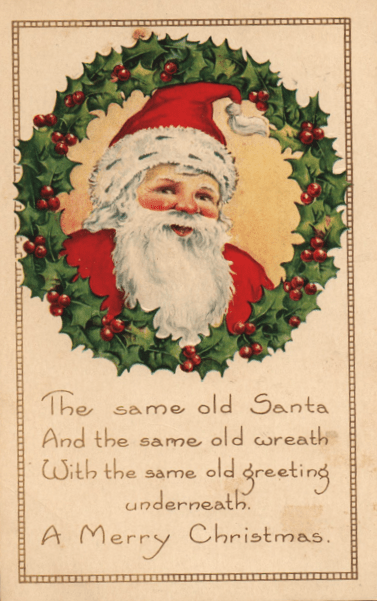
Anyhow, I have started adding Christmas postcards to my offerings for sale online. Yes, I KNOW there are other holidays which come first but a) I don’t have many Halloween cards, which are highly collectible and seldom turn up in the job lots I add to my inventory, and b) I listed all my Thanksgiving cards in August.
This is partially out of a concern for certain of my customers. Christmas preparations come in two schools, the “I Must Get Ready, I Have Only Three Months To Go”, and, “Ready? You Need To Do Something Before Christmas Eve?” And, see, both of these schools of thought spend about the same amount of money.
So I am making my listings for those of you who are planning vast decoupage displays for your front window. (I dislike the idea of my vintage collectibles being pasted to your composite backings, but what you do once you’ve paid is your business.) I am thinking of people who MUST have forty-seven vintage postcards, unused, to serve as gift tags. In short, I am prepared to exploit the weaknesses of people who start their Christmas shopping in June, and are now just looking for those last flourishes. (And, hey, those in the second camp, who figure “Well, better get started”, buy one thing, and then do nothing else until the Winter Solstice.)
I know I’m ahead of time by the standards of analog retail establishments, but they are restricted by the floorspace in the store. I have fewer concerns with display space on the world wide interwebs.
And it sort of comes naturally to me. For those who came in late and could not guess from my polished and professional style, I have been a professional writer since 19…hmm, must’ve turned over six pages in the calendar at once. Having chosen to spend my time writing short stories, the second least profitable writing choice after poetry, I had to pay attention to the demands of my market. And your magazine world works on an entirely different calendar.
To keep that rabbit hole shallow, let’s just point out that any monthly magazine which published Christmas material needed to see it in March. February was even better. So while the rest of the world was busy sending Valentines, I was writing fiction about warm hearthsides decorated with evergreens while outdoors the snow fell and reindeer danced on the shingles. (When this story was published, as sometimes it would be, it logically appeared in the February issue of the magazine, since the date on the cover and the newsstand stocking date were so…never mind. We’re keeping this short and eighty percent of you have never seen a newsstand.)
What I’m saying, Egg Nog Latte, is that just putting Christmas postcards up for sale is not nagging you to get busy and celebrate the occasion. Those of us on my side of the equation, after all, will do our celebrating much later ourselves. And that’s only if something actually sells.