I am not sure we have ever discussed in this space the phenomenon of the pin-up joke, a classic of humor for decades. Of course, you know what a pin-up is: THAT goes back for centuries (possibly millennia, depending on whether those cave paintings and ancient sculptures were offerings to a fertility goddess or just proof of some guy sitting around with paint and clay and something predictable on his mind.) Here, for example, is a postcard of the early twentieth century, demonstrating that a young lady who knew what she was doing could show off knees and curves even in an ankle-length dress.
But we are discussing the pin-up JOKE, a little piece of make-believe in which we pretend the gag is the main point of the exercise. The actual point is the well-formed female centerstage, with the joke and everything else just props, or even after-thoughts. Cartoonist Irby did a series of postcards in which Scottie observes a number of different young ladies and makes a mild remark to give us another excuse to buy the card.
This goes back to the earliest days of postcards for the simple reason that cartoonists had been doing similar things since at least the eighteenth century. We’re not selling naughty pictures, said the cartoonists: we’re making wry observations on human life and there just happens to be a scantily (or un) clad lady in a prominent spot.
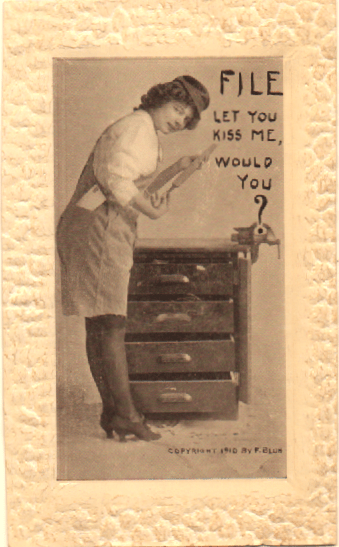
In the early twentieth century there was a popular theme (largely lost by the second half of the century) of photographs showing ladies whose garments were alluring because they were based on men’s outfits. We have examined how baseball uniforms gave several companies a profitable line of gags, and THIS company produced a series showing this young lady dressed for her own style of DIY projects.
However the joke is framed, we never lose sight of the overall (sorry) plot. The large wealthy chap here is the punchline of the joke. But he is NOT the point of the cartoon. People dressed like the hero of the Monopoly board do not sell postcards.
At mid-century, a heavy sigh about modern fashion did the trick. In the good old days, a customer would complain while paying for a card that was going into the collection and not the mail, ladies were modest.
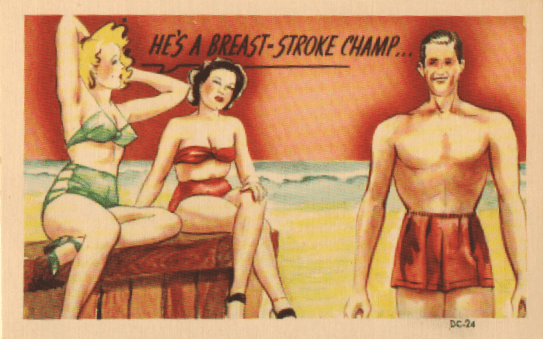
We must discuss the whole phenomenon of bathing suit pin-ups someday. Throughout the history of the genre, reality was optional. THIS card, for example, was produced at a time when, I have been informed by people who lived through it, women were expected to wear an uncomfortable rubber undergarment beneath their suits, simply to prevent scenes like this.
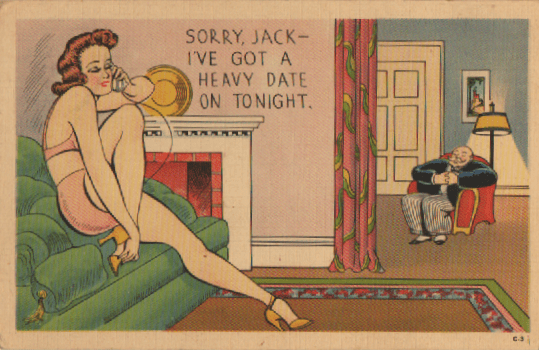
Of course, lingerie pin-ups were COMPLETELY authentic and true to the era.
A man frequently featured in these gags, sometimes to deliver the punchline but more often as a stand-in for you, the viewer. Or simply as another excuse. You bought the postcard because HE was funny. Right?
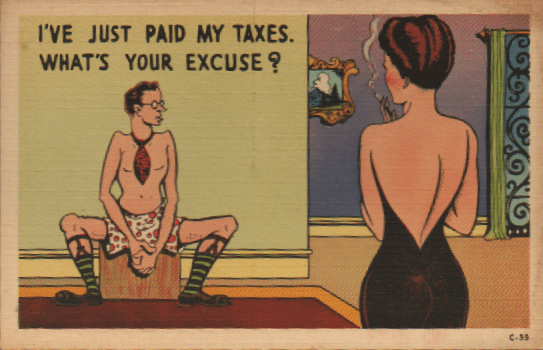
Of course not. No one was going around buying the postcards for the male commentator, even if he was topless.
Of course, I have no statistics on this sort of thing. I wasn’t there.
Mr. Horner owned a long, black car, which he loved. He washed it four times a week, and he polished the hood ornament and the chrome every day. Twice a month he took it to a mechanic named Harvey, who made sure the engine worked perfectly.
Because there was nothing Mr. Horner liked better than driving, especially driving fast. He liked to streak along the streets with his gas pedal shoved all the way down, his engine roaring. What he did not like was having to stop. When anybody or anything got in hs way, he would honk his horn, screech to a stop, and then honk some more until he could move on.
At first, he had a plain ordinary car horn. That was enough to let people know what he wanted, but after a while it didn’t seem to him to give enough motivation. People didn’t always move fast enough. Sometimes people walking across the street Mr. Horner wanted to use would make a face at him, and walk even slower just to make him mad. So he went to Harvey and asked for a bigger, louder horn.
Harvey found a big silver horn at the back of the garage and fitted it onto Mr. Horner’s car. When Mr. Horner drove out that afternoon, he had to stop on Chestnut Street for a man walking a big dog across the street. He tried out his new horn. “Beeeeeep!”
The man and the dog ran all the way across the street and hid behind a tree. Mr. Horner laughed and put his foot down hard on the gas pedal.
But at the next crossing, he found four men with briefcases crossing the street. Mr. Horner honked again, “Beeeeeep!” The wind was blowing hard, so the neckties of all four men were blowing back over their shoulders. Anyone who looked as silly as that deserved to be honked at.
But the four men didn’t know they looked silly, and they didn’t pay the least attention to Mr. Horner’s car. They went on walking across the street, talking to each other as if what they had to say was more important than letting Mr. Horner drive.
When Mr. Horner could drive again, he turned right around and drove to Harvey’s shop. “I want a louder horn,” he said.
So Harvey dug a big gray horn out of a pile at the back of the garage, It made a deep, loud sound like a foghorn: “BEEE-EEEP!” Even Mr. Horner had to put his hands over his ears.
“Now, that’s a good horn,” he said.
Once it had been fitted to his car, he drove off through the city. No one got in his way, though, until he came to a bridge downtown, where he saw those same four men with brief=cases in their hands and their ties on their shoulders, walking along the sidewalk that crossed the bridge. They were not in his way, but he drove right next to them on the bridge, and then put both hands down on the knob that worked the horn.
“BEEE-EEEP!” The four men jumped right over the side of the bridge and landed in the water. Mr. Horner laughed loud and long, and drove on. “Now, that’s a good horn,” he said again.
At the very next corner, though, an old lady was walking very slowly across the street. Mr. Horner had to stop, but of course he leaned on the button that played his horn. “BEEE-EEEP!”
The old lady didn’t even look at him, and kept on walking. “BEEE-EEEP!” said Mr. Horner’s horn again.
Now the old lady looked up. “You don’t scare me,” she said. “I’ve heard louder horns than that in my time, and that one isn’t going to stop me on a day when potato salad is on special sale.” And she just walked on until she had reached the other side of the street.
And of course Mr. Horner drove right back to Harvey’s garage. “I need a better horn,” he told Harvey. “Some old lady said she’s heard louder ones.”
“Oh, an old-fashioned horn,” said Harvey. “I think I have one of those.”
Harvey went to the back of the garage, pushed some boxes around, and brought back a shiny brass horn. He fastened this to the car so the big black bulb at the end would be right outside Mr. Horner’s window. Mr. Horner got into the driver’s seat and squeezed the bulb, which made the horn boo “ah-OOOOOOO-gah!”
“That is some horn,” said Mr. Horner. “We’ll see if that does the trick.”
But by now the sun was going down. Mr. Horner drove home to the garage where he parked his car. To get in, he had to drive across the sidewalk that ran in front of the building where he lived. And just as he arrived, someone was walking along that sidewalk.
“Perfect,” said Mr. Horner, and squeezed the bulb.
“ah-OOOOOOO-gah!”
The man jumped straight up into the air. Mr. Horner laughed so hard he couldn’t drive forward into the garage.
“Good afternoon, sir.”
Mr. Horner looked out his window. The man he had just honked at was leaning on the car door, smiling. It was a tall man in dusty clothes, with a long, dry face. “Good afternoon, sir,” he said again.
Mr. Horner mashed his gas pedal down to drive into the garage. The car did not move. “Got to tell Harvey about this,” he grumbled, and tried again.
“Tell me, sir,” said the stranger. “Do you have right-of-way on this particular sidewalk? If you’re the only one who’s allowed use of it, I do apologize. I assumed it was all right for ordinary people to walk on it as well.”
Mr. Horner squeezed the bulb of the horn again. “ah-OOOOOOO-gah!” If it didn’t chase the man away, it might at least call someone from the building to help him.
The back door clicked and thumped. The stranger climbed into the back seat.
“I do believe you owe me a ride,” he told Mr. Horner.
Mr. Horner looked back. The man was wearing boots, tracking mud right up onto the floor of his beautiful car. “You get out!” he shouted. “You get right out before I call….”
Tires squealed. Mr. Horner’s foot was not even on the gas pedal right now, but his car jerked backward, turned around, and then sped off down the wrong side of the road. Other cars on the street honked and spun away, driving up over the curbs as Mr. Horner’s long black car sped past.
“What are you doing?” Mr. Horner screamed. “Watch what you’re doing!”
“You’re in the driver’s seat,” said the stranger, not concerned at all. “Why don’t you honk your horn at them if they’re in your way?”
Mr. Horner looked around when he heard a loud “HOOOOT!” A long gray truck couldn’t turn away in time, and Mr. Horner’s car was speeding straight at it.
He grabbed the horn. “ah-OOOOOOO-gah!” This didn’t make the truck move any faster.
With a thump and a screech, the long black car hit the long gray truck, bounced away, and went speeding along the street again.
“Oh, my beautiful car!” moaned Mr. Horner. “Do you see that dent?”
“Honk your horn,” said the stranger. “Maybe it’ll go away.”
Mr. Horner started to say “You get….” But his car bounced off the street and into somebody’s yard. He put his hands over his face as his beautiful car smashed through a tall wooden fence and sped on into somebody else’s yard.
When he thought he could look again, he found the car had left the city altogether and was speeding through the countryside. From the bouncing and bumping, he knew they were no longer on any kind of road, but driving across the fields. Though of course this meant there were no trucks to fear, it did not mean there was nothing in the way.
“Look out for those cows!” Mr. Horner shouted.
“You could honk at them,” the stranger suggested, his voice thoughtful, “But I don’t believe you should. They have horns too.”
The long black car hit no cows, as the cows had enough sense to get out of the way. It splashed through a brook and then into a dark forest.
“We can’t get through all these trees!” wailed Mr. Horner.
“Honk your horn.” The stranger propped his muddy boots on the front seat. “Maybe they’ll run.”
The car rumbled and bumped along the forest floor, just missing some trees and scraping along the sides of others. “Stop this car!” shouted Mr. Horner. “You stop this right now!”
He was lucky he was wearing his seat belt. When the long black car stopped with a jerk, his face nearly hit the steering wheel.
He sat quietly for a moment, and then reached for the door handle. “I’m going to call the….”
“What’s that sound?” inquired the stranger.
Something was rustling among the trees. Mr. Horner pressed his face to the window. The sky had gotten dark; he could see stars. But something darker was coming toward them among the trees.
“What’s that?” Mr. Horner was whispering, for fear whatever it was would hear him.
“Oh, I wouldn’t worry about it,” the stranger told him. “You’ve got such a nice, loud horn, he probably won’t hurt you at all.”
Mr. Horner jammed his foot down on the gas pedal. Whatever was coming was still far away, but it was obviously taller than the trees, so tall that it blotted out the stars in the sky as it approached.
“Why won’t the car move?” cried Mr. Horner.
“I thought you were in such a fuss to stop,” said the stranger.
Mr. Horner heard a distant sound like horse’s hooves. The big shadow above the forest was taking the form of a huge horse made of night, with a giant of a man on its back. This giant was raising a huge black horn toward its face. Mr. Horner stomped six times on the gas pedal.
He never meant to touch the bulb of his horn, but his hand was in the wrong place. The “ah-OOOOOOO-gah!” sounded mighty small in the woods.
The shadow sounded its own horn. “Tahn-TAAAAAAAAAAAAAAAAAAAAAAAAAAAAAAA!”
It was the loudest horn Mr. Horner had ever heard, the loudest horn anybody in the world had ever heard. He slapped his hands over his ears.
The world shook. Trees whipped back and forth, bending almost to the ground. Mr. Horner saw one big hoof coming down, and knew it was big enough to smash his car flat with one step. He ducked down under the steering wheel to hide on the floor of the front seat.
He thought he heard thunder. Then he thought maybe the car was rolling over. He didn’t care. He squeezed himself even flatter to the floor.
He stayed there for a long time, until the world was quiet again. Then he eased up to where he could look out the window, if he still had a window and the car was around it.
All he saw outside was a dark forest. There was no big shadow with a horn, no big hoofprint in the ground, no knocked-down trees.
“Where did it go?” he whispered.
Nobody answered. Mr. Horner pulled himself back into the driver’s seat and looked in the back. The stranger was gone as well, though muddy footprints were all over everywhere.
Mr. Horner refastened his seat belt and started his long black car. He drove carefully among the trees until he came to a dirt road. Following this back to the highway, he found his way into the city. A light was on at Harvey’s garage.
Harvey was shocked. “We did you do to your car?” he asked, looking over the dents and scratches on the body and the cracks in the windows.
“Never mind,” said Mr. Horner, his voice hoarse. “Can you fix it?”
“Oh, yes,” Harvey told him. He slid a hand along the dented door. “Oh, by the way, I found a really big, really loud horn in a storage room. Do you want to hear it?”
Mr. Horner, shivering, wiped his forehead. “I don’t want any more horns, thank you, Harvey.”
He reached for his phone and started for the door. But he stopped. After a quick look left and right, he tiptoed back to Harvey and whispered, “Do you think you could get me a siren?”
“I don’t suppose that means I will accompany Your Majesty to the cobbler’s shop.”
“Perhaps you forgot, sir knight, that you speak to a king who pulled his sword from a stone.”
“Perhaps Your Majesty forgets that Your Majesty speaks to the knight who had to go to the Haunted Quarry for that legendary rock to add to the hilt so Your Majesty would have a stone in his sword.”
“To serve at Camelot is not like service at lesser courts.”
“Don’t I know it! I had to go to the Mines of Lessia to fetch Your Majesty’s legendary helmet, Your Majesty’s saddle had to come from the half-mythical Oh-Gee Stables, and Your Majesty’s royal coffee cup required a three month journey to the legendary island of Lobrasil. Would it be so horrifying for the Lord of Camelot to own something that just came off the rack?”
“Speaking of the rack, Sir Comvent, I suppose you could find other things to keep you busy while someone else visits the Lady of the Leg.”
“I have never refused one of Your Majesty’s commands, and this one suddenly sounds more interesting.”
“I thought it might. The Lady lives beyond an impassable forest, on the other side of an uncrossable sea, and the top of an unclimbable mountain. The tales say she is famous for her legs, and her footwear.”
“It shall be done, Your Majesty. I shall bring back a pair of enchanted boots, and a full report on this matter of legs.”
“I thought you might.”
(Six months later)
“Your Majesty’s boots.”
“Sir Comvent! I had almost lost faith that you would one day return! Was the journey arduous? Were you not tempted to remain in the castle of the Lady of the Leg?”
“If Your Majesty will tell me which bard told her story, I will have the whole saga written up for Your Majesty. After which, I will slay the storyteller.”
“The Lady’s legs did not stand up to inspection?”
“Each leg was more amazing than the one before it.”
“Each…she had more than two legs?”
“It is a matter of definition, Your Majesty. In her youth, she dared the eagles’ nest on Eagalaram, and the Lord of the Eagles nipped off her right leg. So she might be said to have only one leg. On the other…hand, she had made for her a thousand replacement legs, each resplendent and amazing and stacked in her storage locker when not in use.”
“Well, you can hardly complain about quantity OR quality, Sir Knight. Have you spent all this time in travel, or did the Lady have some arduous quest for you to accomplish ere she would release the boots?”
“She gave me a choice of two quests, Your Majesty. I could clean and rearrange her storage locker, which involved moving those legs along with thousands of shoeboxes and the empty eggs from which she drew magic stockings. The other was a matter of spelling, so I chose to do the cleaning and rearranging. Your Majesty’s boots were actually in a corner behind a stack of broken shoehorns.”
“Hmmmm. Now that you mention it, I may need an enchanted bootjack to go with these boots. But that seems hard work as opposed to spelling. What did she wish you to spell?”
“That isn’t what I meant, Your Majesty. She said I could clean her locker or surrender my soul. And as I didn’t know whether she meant I would be giving up salvation or walking back to Camelot barefoot, I decided not to take the chance.”
“Well done, Sir Comvent. If you ever decide to give up being a Knight of the Round Table, you will make an excellent footman.”
A few months gone, we discussed in this space the concept of the trade card, a Victorian sales device issued by stores who realized that if people started collecting these, they would come to the store to see if a new one was ready. Getting someone into the store was half the battle, after all, so companies vied to produce attractive series of cards. Then the postcard came along, and just knocked the trade card right off the collectibles map, as postcards could be swapped with friends at a distance, with the addition of a simple postage stamp.
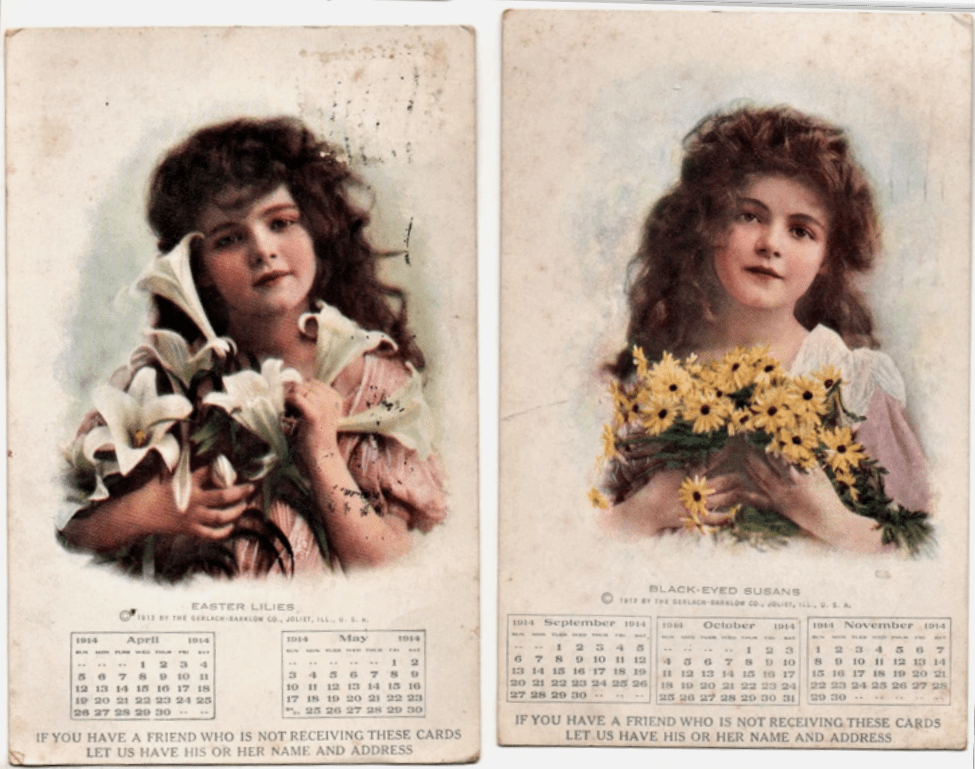
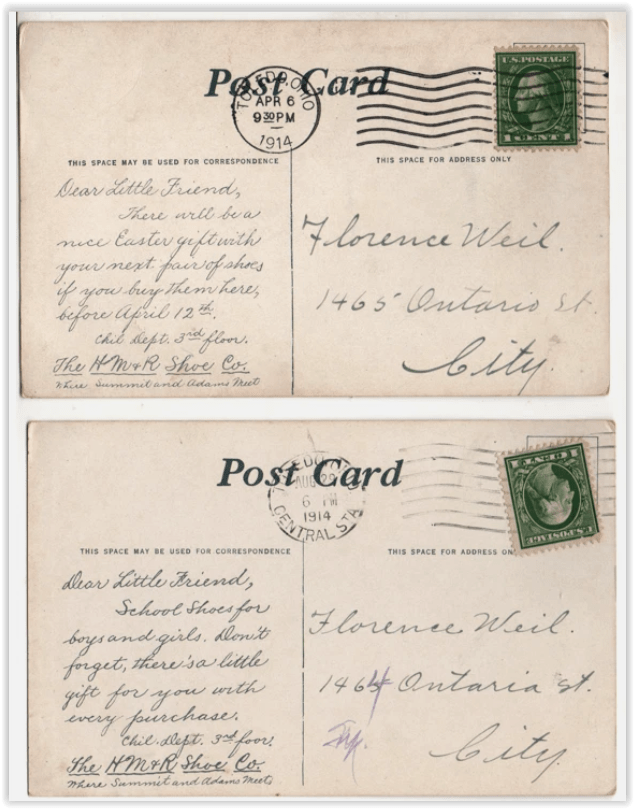
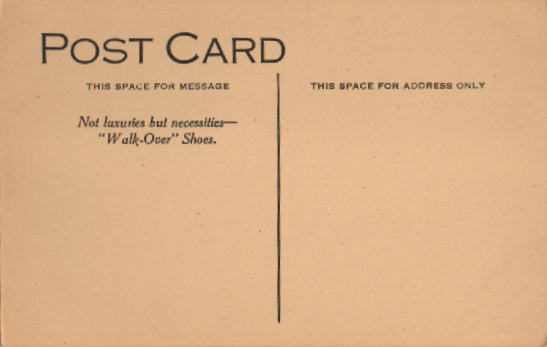
And yet, as seen here, some companies did try to carry on the tradition. Bour Quality Coffee and Royal Garden Teas brought out a series of fashionable young ladies as trade cards which could also be mailed as postcards. This dates from 1908 or thereabouts, and features a plain postcard back, without any product information. Of course, you’d check out your local grocer to see if there was a new one in the series. The HM & R Shoe Company, on the other hand, mailed out these calendar/pretty girl/flower cards to potential shoe buyers.
These were NOT cards you could put a message on and send to your friends (despite the card telling you to inform any friends of yours unfortunate enough not to be getting them) because the shoe company put its own message on each, corresponding to whatever shoes you might be looking for in the months involved. (I’m sorry I don’t have a complete set, so I’d know what months are prime shoe months.)
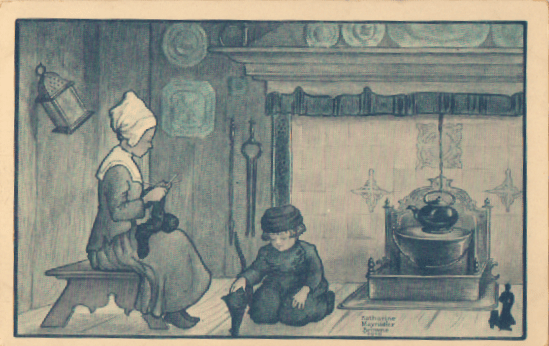
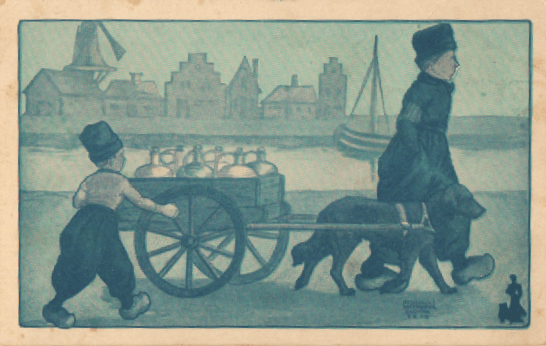
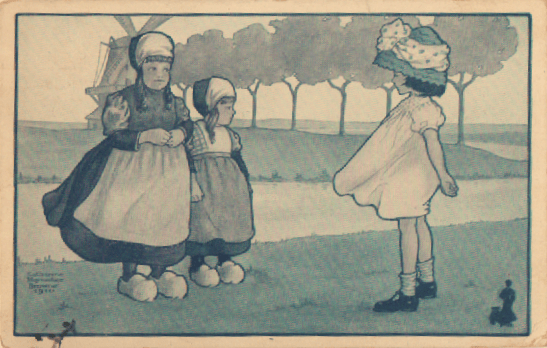
About this same time, the world was going through a craze for postcards with Dutch kids on them. Advertisers were quick to make up postcard trade cards for this hot market.
Why you would pick kids who wore wooden shoes to advertise YOUR shoes is not clear to me, but a collectible is a collectible.
You will note that this comes from the “picturesque” school of Dutch kids postcard. The blue tint is supposed to remind you of the coloring of the Dutch tiles used in home decoration for generations.
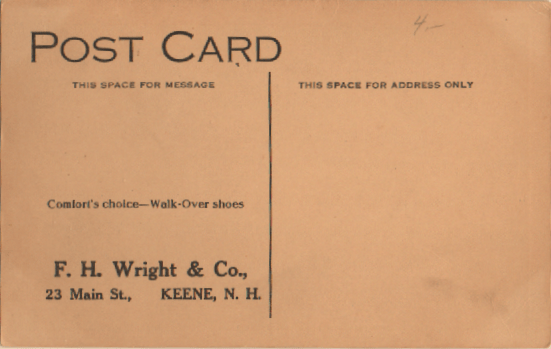
Like the HM & R cards, the messages change from card to card, to keep up your interest. (Adding a specific retailer’s location was possible, as you see. You can also see how it limits the usefulness of the postcard as a postcard. But it’s a Collectible, remember.)
Maybe they did gradually realize that maybe showing the actual shoes they sold would be plus.
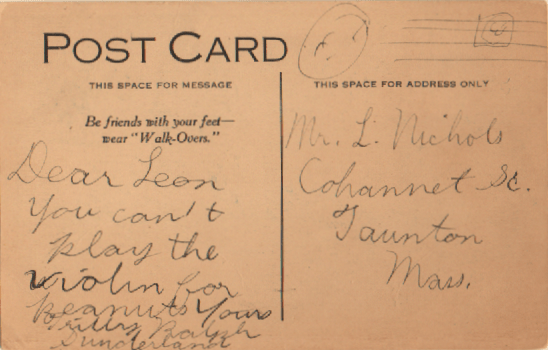
And, if you want evidence that people DID actually use these as postcards, here is a message for Leon (along with predictable advice about shoes which may have been more palatable.)
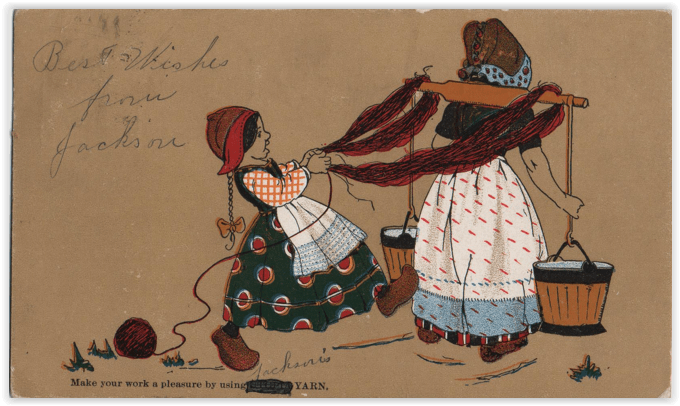
In fact, as mentioned hereintofore, the earliest Dutch kids postcard I have seen was a card advertising Utica Yarn.
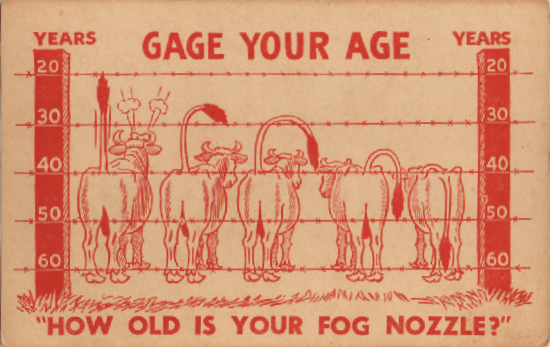
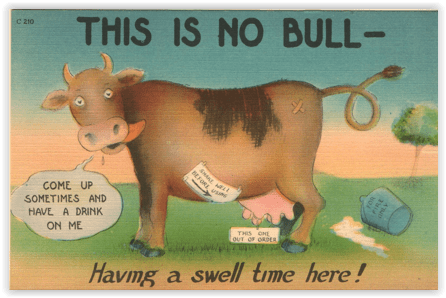
But though the world keeps turning around, we never quite gave up on the trade card. THIS old joke, for example, was simply another postcard, not especially rare. I did wonder, when I picked it up, what a fog nozzle is, really, and what it had to do with this old joke.
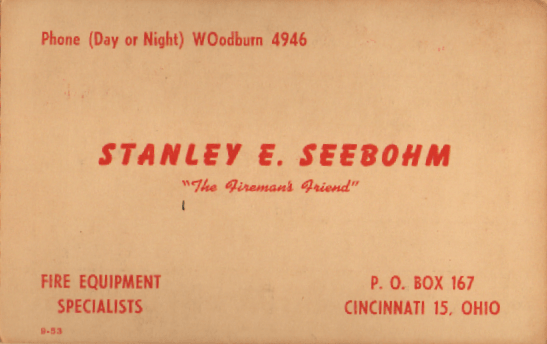
Why, lo and behold, THIS one was no longer a postcard at all, but had been adapted as a trade card for firefighting supplies. This came some forty years after any of the other cards shown above. The more things change, the more things (and jokes) stay the same.
Once upon a time, there was a cow in a fairy tale.
“What am I doing here?” she complained. “I don’t wear glass slippers, and I don’t have a basket of goodies for Grandma. I don’t believe I even have a Grandma. I can hardly trade myself for magic beans. If I could, I don’t have hands to climb a beanstalk. I can chew, moo, and give milk…if there’s someone around to take it. This is not very promising.”
Nevertheless, she started off along the road that runs through fairy tales. She walked until she found a fairy godmother waiting under a tree.
“Oh!” said the fairy. “I wasn’t quite expecting a cow.”
“No,” said the cow. “It’s a surprise to me as well.”
“Mmmmm.” The fairy looked the cow up and down. Her mouth twisted to one side. “Welllllll, I suppoooose it’s my duty to turn you into a princess. If I can.”
“Don’t be daft,” said the cow, taking a step back. She kept both eyes on that star-tipped wand. “Why would anybody want you to do that?”
“Don’t you want to be a princess?” the fairy asked, her eyebrows arching way up.
“I am a cow,” the cow informed her. “I never get carried away to a high tower, there to await a prince. I never have to prick my finger and fall asleep for a hundred or two years. And witches don’t come around feeding me poisoned apples. Who would be a princess if she was lucky enough to be a cow?”
“Well!” The fairy set her hands on her hips. “If that’s the way you feel about it, very well. But should you change your mind and want me to change the rest, just whistle. No. Wait. You can’t really whistle, of course. Just snap your fing…. How about you moo in a low and wistful way?”
“Okay,” said the cow, making a note to herself not to moo wistfully for a while. She moved on down the road.
The road took a turn around a tall, rocky hill. On the far side of this, the cow found a dragon abusing a princess who was tied to a stake. “How’s this for a hotfoot?” demanded the big lizard, blowing fire to heat the ground around the woman’s bare toes.
“Now, what do you suppose I’m expected to do about this?” muttered the cow. It was obvious that someone had to do something. The princess’s hair was singed all down one side, and her gown was covered with dark scorch marks.
“I have no experience at all fighting dragons,” the cow said. “I just chew, moo, and give milk.” Thinking about this, the cow eased in closer. When she had moved in close enough, she bit down on the dragon’s tail and chewed a bit.
This attracted the attention of the dragon, which turned. “Huh!” the dragon confided to the princess, “Thought I felt a knight jabbing at me, but I don’t see anyone.” The dragon saw the cow, but, knowing cows have nothing to do with fairy tales, didn’t suppose she had anything to do with it. “Now, where was I? Oh, yes, cooking sole food.”
The dragon blew flames at the ground again. The cow reached out again and chewed its tail some more. The dragon whipped around to look, but by now the cow was munching slightly smoky grass.
“An invisible knight, eh?” the dragon growled to the princess. “My mother told me about these things. Better pull back for a bit until I learn his secret.”
With a bound and a flick of the tail, the dragon hopped to the other side of the hill. The cow waited until it was out of sight, and then ambled forward to chew the ropes which held the princess to the stake.
‘That was very well done of you,” said the princess, stumbling free. “Thank you, sir.”
The cow batted long eyelashes at her. “I make allowances for people who live in castles,” she said. “But where I come from, not so many people address a cow as ‘sir’.”
“Oh!” The princess was rubbing sore wrists. “I thought you might be a prince under a spell.”
“No. To tell you the truth, I am a cow.”
“It was very well done of you, all the same,” the princess said, brushing scorched hair back. “But how did you reach me? The cow is usually traded for something else by this point in the story.”
“I have no idea, really,” the cow said. “Wow, that looks as if it hurts.”
The princess was trying to walk on singed feet. “It does, rather. Could I hold onto you on the way back to the castle? Thank you.”
They moved slowly along the road, discussing Jack and the Beanstalk, a story the cow had always taken an interest in, and about which the princess had recently read an article. “Apparently, the beanstalk represents how humans always strive for social betterment.”
‘Fancy that!” said the cow. “That must be why I haven’t seen the farmer or his boy lately.”
“Aha!”
The cow and the princess pulled to the side of the road as the dragon came bounding back. “Thought you could trick me, huh, you prince in disguise? Well, it isn’t going to work again!”
“I am a cow,” said the cow.
“Likely tory,” the dragon snorted. “I’ll deal with you in a second. Right now, I’m going to chomp this princess. I haven’t had any breakfast yet and I’m wasting away to nothing.”
The dragon felt that there seemed to be too much dragon, but decided not to mention this. “Why not eat me instead?” she said. “I’m bigger, so you’d get more to eat. And it is socially acceptable. Lots of people eat cows.”
“Cows are far too fatty,” said the dragon, with a sniff. “I like the crunch and the scream when I bite into a princess.”
“Would it make any difference to you if I screamed right now, before the crunch?” the princess inquired.
“I’ll moo a bit myself, if that helps,” said the cow. And she gave out with a low and wistful sound.
The fairy godmother blinked into view. “So you decided to be a princess after all?”
“And be dessert?” the cow demanded. “Perish the thought. If you want to make yourself useful, turn this dragon into a princess.”
“Hey, now!” The dragon took two steps backward.
“A dragon? Into a princess?” The fairy was shocked. “They have nothing at all in common!”
“I don’t know,” said the princess. “I have an aunt, Princess Gyrdolene, who is practically a dragon as it is.”
The fairy frowned. “I could maybe turn a dragon into a cow.”
“I wonder if fairy godmother crunch,” said the dragon, licking one of its hind claws.
The cat wondered why this looked familiar, and then remembered a friend back in the barn. “Why not turn the dragon into a pussycat?”
The others stared at her. “A cat?” The princess shook her head. “Why not a dragonfly? Then I could swat it.”
“No, wait.” The dragon sat back. “I think…I believe I used to be a pussycat. Yes, I distinctly remember. A girl traded me to a wizard for some magic string.”
“What became of her?” the fairy inquired.
“I never knew. I remember now. The wizard was taking me home when he ran into bandits in the forest.” The dragon nodded. “Yes, that was it. He turned me into a dragon so I could eat the bandits.”
“What became of the wizard?” the princess asked.
The dragon licked his lips. “I believe I mistook him for a bandit. In the heat of the moment, you know.”
“Well?” the cow demanded. “Are we going to stand here reminiscing or are you going to turn this dragon into a pussycat so it can crunch fish instead of princesses?”
“Done!” The fairy swung her wand.
A flash of light made everyone blink. When eyes were opened, blank space sat where the dragon had been. A small gray cat was admiring its reflection in a puddle by the side of the road.
“Very good.” The fairy patted the cow on the head. “You’ve arranged everything, Yvonne.”
“My name’s not Yvonne,” said the cow. “It’s Collywobble.”
The fairy frowned. “But the title of this story is Yvonne and the Princess. My name is Parsleyroot. So who….”
The cat looked up from the puddle. “My memory is coming back. My name’s Yvonne.”
The fairy shook her head. “If you’re Yvonne and this is the princess, what is this cow doing in the story at all?”
“I was wondering that,” said the cow. “I hope it’s over now.”
I need to get this off my chest. You’ll understand why.
First off, despite all the rumors which have surrounded my discoveries in the pianowork of Wolfgang “Whiskey Pete” M’Cloud, I did NOT use some kind of computer magic on his recordings. I lack the skill even to come up with some of his amazing fingerings, and, in any case, this story goes back to before the days when such alterations were not within the budget of mild-mannered music collectors.
It was 1976 when I went to that auction and bought that big box of piano rolls. I’ve told that story before. I the early days of recorded music, the machinery was simply not able to cope with percussion instruments: drums, chimes, pianos. Your piano men who could would record their work for piano rolls, which could be played back on a piano and not on the primitive disc or cylinder machines. Everyone wants to find a previously unknown Scott Joplin or Jelly Roll Morton piece.
I was a little excited to find I had reproducing rolls, the piano roll’s sophisticated cousin, which could record more flourishes and tricks than a basic player piano: dynamics, especially. Unfortunately, these came from the files of a defunct piano company and consisted mainly of the performances of one Wolfgang M’Cloud. These were drab, dull, and included not a single song unrecorded elsewhere: mass-produced songs written for mass consumption, middle of the road hymns and songs of the generation before his. The only thing mildly interesting was that these were the original rolls. The paper had been cut and pasted, as was common in the studio, to correct the occasional missed note. This generally matters only if the song or the performer matters to somebody. And Wolfgang M’Cloud mattered to nobody living.
That did NOT mean they did not matter. The night after I had closed up the box again, to be added to my other unnecessary purchases, I slept with difficulty, waking over and again from dreams where a hand reached to me out of the ground as someone called “Help me!”
The seventh or eighth time, I just got out of bed and went into my study. Maybe making a list of the songs on the rolls would put me to sleep. And the box of piano rolls said “Help me!”
I sat down in the old kitchen chair I used at my desk, thought it over, and decided the only way to figure out whether I was awake was to open the box. I did this, and from among the musical scrolls rose a head with tousled grey hair, followed by a body in a tousled grey suit.
“W-Wolfgang M’Cloud,” I said. I had seen his face about six times on advertising flyers in the box.
“Yes.” His voice was deep and echoed with gloom. “You must help me. You CAN help me. I am denied entry to Heaven while people believe the lie. You can help me.”
I pulled a piece of paper and pencil over. “How can I help?” I hoped this wasn’t going to be expensive. The hollow-eyed specter didn’t look like anybody I wanted hanging around.
“You must correct the lie.”
I raised the pencil to the paper in what I hoped was an encouraging way. “The lie?”
He fixed me with those deep, grieving eyes. “ I am NOT the brilliant piano player people think me.”
As far as I ever knew (or have learned since), no one ever listened to a commercial M’Cloud piano roll and thought “What a genius of technique!” But I had never argued with a ghost before and didn’t plan to start now.
“By day, I played piano for our theater, and when the movie was bad, there was always the music. A local businessman started a company which built reproducing pianos.” The ghost sobbed, and ran his hands through his hair. “I played like an angel for the audiences in the theater, but…this mechanical piano frightened me. I could not…could not face it without help.”
I continued to brandish a cheerful pencil while he broke off, face buried in his hands. From between his fingers, he went on, “Everyone at the company knew how much I had to drink before I could sit up to the keyboard. When they thought I could not her, they called me…Whiskey Pete.”
He straightened suddenly, his face one massive scowl, causing me to squeak my chair back along the floorboards to put a little distance between us. “You must show people the sodden fool I was. Let the piano rolls be played as I really played them. Show the world my shame, that I may no longer wait under the shadow of the genius they believe my recordings represent.”
Of course, that was not the end of our association. Each night at midnight, he would reappear, and I would take up the task of painstakingly removing every correction, every edit the piano roll company had made. He was able to tell me where they had cut new notes, so these could be covered. He showed where even the tempo had had to be changed.
Paper, scissors, and glue were not expensive, but to make his repentance complete, I had to locate a reasonable facsimile of that obscure brand of piano. I found one already restored or I might be at it today. It even came with half a dozen of the published Wolfgang M’Cloud rolls, to the ghost’s great pain.
But that pain was nothing compared to that in his face when the old piano was set up in my living room and I put in the first of the rolls we had worked on. “Oh!”
He shuddered. The cacophony made him shrink toward the box of piano rolls. “Oh! Make them public. Let my shame be known. Let me rest.” I have never seen that ghost again.
I sat there and listened to the rest of the roll. I rewound it and tried another. His whiskey-tempered performance struck me as unrestrained, improvisatory. The cacophony held together. And so I, to some slight degree, invented the jazz genius Whiskey Pete M’Cloud, a tortured soul who slaved away at an uninspiring theater job by day and indulged his genius by night. That’s all I needed to do: touch up the story a bit. The wild errors Wolfgang made under the effects of the bottle have been studied and analyzed by musicologists ever since.
Why tell anyone now? Well, the doctor says I’ll be lucky to make it another month, the way my health is going. And you see that chair? My deck chair, the one Wolfgang leaned on as he looked over my shoulder as we consulted and fussed over those old piano rolls.
Damaged? Yeah. Those burn marks are where his fingers sat. Just taking out a little…insurance, let’s say.
It has been some time since we meandered through Memory Kitchen, largely because this is NOT a food blog. But casseroles came up in an online chat, and this threw my mind back into the Iowa kitchen of my boy days.
And I must break your heart at the outset. We never ate casseroles, at least nothing WE caked casseroles. It is amazing how anyone who grew up in Casserole Central can have eluded them. I have mentioned a cousin of mine who, having grown up in Miami, was amazed on visiting one of her mother’s high school reunions, at the variety of casseroles, congealed salads, and bars. (I tried to explain about sheet cakes, but I know my limitations.)
I think I understand where we took a left turn at Dubuque, but we can discuss this as we got through a list of the casseroles of my youth.
Creamed Tuna and Peas on Toast: I have never seen this entrée. My mother used it as a threat. SHE regarded it as comfort food, but my father, who did not eat tuna OR peas, would not have allowed such a thing to happen.
Tuna and Noodle Casserole: This, however, was unavoidable, and was offered to us every other Friday during hot lunch. Tuna is something you either accept or loathe, and I thought the stuff was pretty good. (My memory may or may not be affected by the amount of salt I threw on just about everything). During a period of American history when canned tuna was inexpensive, I tried to duplicate this by cooking noodles and adding a can of tuna and a can of Midwestern Balm (Campbell’s Cream of Mushroom Soup.) It never had the same cachet, and I believe now it was because I was always too hungry (as well as lazy) to pour this into a casserole and bake it. The baking seems to work its magic on the noodles, turning them into a substance known only to food scientists and midwestern buffets.
Hamburger Macaroni: This is the original, a dish my mother served up from my earliest days on solid food (to judge by the pictures of me where I have smeared it all over my face.) This is ground beef browned in a pan, drained, and then garnished by the addition of cooked macaroni and tomato paste. Let others call it Goulash; let others call it Pasta. This was hamburger macaroni easily the first dish I dismayed my parents by utterly refusing to eat once the fun of spreading it on myself was played out.
Hamburger and Noodles: No, come back. This is an entirely different entrée. THIS is ground beef browned and drained and then garnished with cooked NOODLES instead of elbow macaroni, and Cream of Mushroom Soup instead of tomato paste. And not cooked in the oven before serving. (Note also a complete lack of crushed cornflakes or potato chips on these entrees. I don’t remember anyone doing this in my day, but I was not allowed out to eat at other people’s houses. My hamburger macaroni reputation preceded me.)
Beef and Noodles: Now this was a step up. IF you have roasted your cut of beef in a can of C of M plus a can of water, and have covered it carefully so the sauce does not cook dry, you have an excellent gravy for warming diced leftover beef (and adding noodles.)
Maidrites: I am not getting into this ancient debate, but one of the three recipes I know for this dish—the least traditional—involves taking the hamburger and noodles recipe and instead of adding noodles, scooping the result onto a bun and eating it as a sandwich. Very filling, but NOT a maidrite. Trust no one who offers you this and calls it by the wrong name.
You will note several similarities among these dishes. They involve cooking something in a frying pan and then adding some kind of pasta and, except for Hamburger Macaroni, large amounts of C of M. And, at out house, these were never rebaked in the oven, which meant I grew up accustomed to noodles and elbows al dente.
For which I think the world should be grateful. If I had been brought up on “Add cream of mushroom soup and then stick it in the oven”, what manner of casserole would have resulted the time my mother brought home a pound of liver and said “Here, cook this.”
Years gone, when folks ate fresh bread every day, despite a lack of electric bread machines and the Baker Do-Maker, the baking of that bread was vital to the community. Recipes and techniques were handed down from grandparents to grandchildren, and handed down again when those grandchildren had grandchildren of their own. Many of these recipes were similar, of course, varying just a bit from town to town. And every resident of every town knew that the bread of THEIR town was the only REAL bread, the only bread worthy of its crust and crumbs.
Towns in Moraska were known for their excellent bread, but there were regional differences. In Kuczka, the baker added poppyseed to the bread dough, while in Kucera, caraway seed was used. To those of us far from Kucera and Kuczka, this may seem trivial, but it led to arguments every year when the two villages held their great market fair. Each village took its turn providing bread for the fair, but those years that the bread had caraway seed, no one from Kuczka would eat it, while in the other years, people from Kucera turned up their noses. This meant hungry marketgoers, and hunger leads to anger, so unfair words were inevitable on fair days, no matter which bread was brought.
Eventually, the mayors of the two towns talked it over, and announced that this year, bakers from both villages would bring dough to be baked the morning of the fair in the massive ovens always erected for the Great Market Fair.
“And so no unpleasantness can result,” each mayor told his village, “THIS Great Market Bread will contain NO seeds of ANY kind.”
People marveled at the simple wisdom of this decision, and the master bakers nodded in agreement. “Very wise is our mayor,” The Master Baker of Kucera told his assistant. “I’ll wager the Mayor of Kuczka never thought of that.”
“No seeds at all: it’s genius,” said the Master Baker of Kuczka to her helpers. “Obviously, OUR mayor thought of that. No one in that hamlet of poppyseed-eaters would have come up with it.”
As the day of the Market Fair approached the mayors the mayors reminded their bakers again and again, “The bread for this Fair must be the best bread available. Without seeds.”
“Without seeds,” said the Master Baker of Kucera.
“Without seeds,” said the Master Baker of Kuczka.
Each baker used the finest ingredients in stock, and mixed up a goodly batch of dough, to be taken to the fairgrounds. But as the dough was being packed into the wagons, each baker paused to consider.
“It won’t really be bread without poppyseed,” murmured the Master Baker of Kucera. “I can put in just a few. Then, when the bread is kneaded, I’ll set aside those loaves for people who know real bread when they taste it.” And he mixed in a bushel basket of caraway seed to his dough.
“I could make just a few loaves with caraway,” the Master Baker of Kuczka told her chief assistant. “Mix some seed in at this end of the dough, and we’ll see to it that that bit goes to the real bread eaters.”
“How much, Mistress?” said the assistant.
“Two bushels,” she told him.
So it was a pair of guilty-seeming bakers who rode with their bread dough to the fairgrounds, and set it in warm spots to raise and rest. The mayors nodded to the bakers, and then to each other, knowing that this year, at least, there would be no fighting over ingredients.
Two mounds of bread dough were quickly raised into mountains, with the warmth of the ovens and the sun becoming two and then three times as big. “Now,” the mayors announced to the crowds who had come around the ovens just to see thus amazing seedless bread, “To show how our two communities get along, all the raised dough will be kneaded together into one great ball of dough.”
“Oh dear,” thought the Master Baker of Kucera.
“Uh-oh,” muttered the Master Baker of Kuszka.
The bakers ran with their assistants to the bread dough. “Here, let us do the hard work,” said the Master Baker of Kucera, hoping to pull out the dough with poppyseed.
“No, no,” said the Master Baker of Kuczka, thinking of the caraway, “We’ll take care of it.”
“I insist,” said the master Baker of Kucera, stepping between her and the mountains of dough.
“So do I,” she replied, giving him a little push.
One of his assistants took up a big stirring spoon and swung it hard between her shoulders. One of her helpers snatched a ladle from one of the nearby soup pots and bashed it down into the other assistant’s ear.
The kitchens were right in the middle of the fairgrounds, out in the open, so of course everybody could see at once what was going on. “What’s going on?” demanded a rhubarb farmer, more to make conversation than anything else.
“Those cooks from Kuczka are poisoning the bread!” cried a parsnip salesman from Kucera.
“Nothing of the kind!” snapped a beer merchant from Kuczka. “That’s swine of a cook from Kucera was throwing rats in the soup!”
The rhubarb farmer and the parsnip vendor clutched at this man’s neck, but a farmer from Kuczka, seeing this, planted a fist square in the face of the parsnip man. A butcher came running with a knife, but tripped over a basket kicked between his legs by a plumseller.
In no time, people up and down the fairground were punching, kicking, and elbowing each other. As newcomers arrived at the Great Market, they located fighters from their village, and joined the melee. Screams and curses rose like fog of the fairgrounds.
And all this time, two mountains of bread dough continued to rise. Soon there was no room for two balls of dough, so they pulled together into one while the people around the ovens were busy observing that this year’s Fair had gotten to the exciting part much earlier than usual.
“This would never have happened if your baker hadn’t been so pushy,” shouted the mayor of Kucera, clinging to his hat as the battle raged around him.
“Our baker?” demanded the mayor of Kuczka, kicking him in the shins. “What about your baker?”
No one in the crowd paid much attention to the actual bread they were fighting about. So not one of them noticed that a bubble in the dough popped out a big shape kind of like an arm, and another a leg. They continued to roll in the dirt of the fairground, clawing and spitting, until they could not ignore a cold, dark shadow.
The first to see was the Master Baker of Kuczka, who screamed. This was not unusual, as she had been screaming for some time, laying about her with a bread board. What she screamed now, though, was “What is that?”
People looked where she swung the bread bord. Those not already on the ground fell to it. Teller than the trees surrounding the fairgrounds, smelling of yeast and radiating heat, was a blobby giant with eyes that scowled down at the crowd.
“What is it?” the people whispered to each other. “What is it?”
The Mayor of Kucera rose from the crowd, looked for his hat, and then decided to forget about it. Raising his face to the giant, he called, “What are you? What do you want?”
“I am bread of both of you!” the giant said, setting fat hands on doughy hips.
The people waited for more, but when there was no more, the mayor of Kuczka, wiping dirt from his face, called “What are you doing here, Master?”
A great yeasty wind came from the giant’s mouth. “I am no master. I am bread. I do what I am made to do. You made me; you command me.”
One big hand came up to spread over the fairgrounds. “I can grow larger. Each pf my feet could crush your villages to sticks. My hands can lay waste your fields. I can choke every one of you. I can leave your children hungry and homeless in a wasteland.”
The hand came down to its hip again. “Or I can be made into loaves, to feed everyone. You made me: it is your decision. The seeds of both results have been sown.”
“Seeds,” murmured the mayors.
“Seeds,” sobbed the master bakers.
Everyone knew in the same moment that this was their bread, and the argument they had put into it. The giant had spoken yeasty truth: they could let the argument grow until it destroyed both villages which would, of course, deprive the world of two mighty fine bread recipes, among other things.
“Loaves!” screamed the Master Baker of Kucera. “Leaves of bread for everyone, even if it has SESAME seeds in it!”
“Let it be loaves!” cried the Master Baker of Kuczka, looking to the two mayors.
“You are sure you can have it that way?” came a question on the yeast.
“Yes!” cried farmers and merchants and mayors.
“As you need.”
The blink of a rabbit’s eye, and the giant was gone. There was no bread dough anywhere. But a familiar aroma brought people rushing to the bread ovens, where they found hundreds of golden loaves, ready to be turned out. Half of these held caraway seeds, and half poppyseed.
“Gimme some of that caraway bread,” said the mayor of Kuczka. “It’ll be strange, but better than bread with no seeds, I guess.”
“Or no bread at all,” agreed the mayor of Kucera, still checking the sky above to be sure the giant was gone. It might be that each man was thinking if the giant came back it would be beast to eat the other village’s bread away first, but they smiled, and raised buttered slices of competing loaves.
And so it was that the villages of Kuczka and Kucera added to the usual adventures of a great festival, as they do to this day, the adventure of sampling their neighbors’ bread. The seeds of discord were not allowed to grow, and both breads are now baked in both villages, without any hint that preferring one seed over another signifies any lack of mental capacity or moral rectitude.
Mind you, there’s still that argument about putting ketchup on fried eggs at breakfast. But you should eat breakfast before setting out for the Fair.
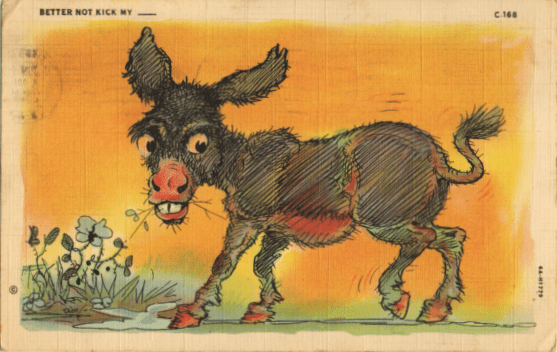
It has been a while, so I thought we might revisit the new arrivals to my inventory which I would characterize as Ass Joke Postcards. Now, I realize the world has turned around a little, and that innocent three-letter word has a popular new meaning as “Something Bad”. So, no: these are not postcards involving really bad jokes…at least, that’s too broad a definition Not ignoring the fact that in some of these the broad…look, you’ll figure it out as we move along.
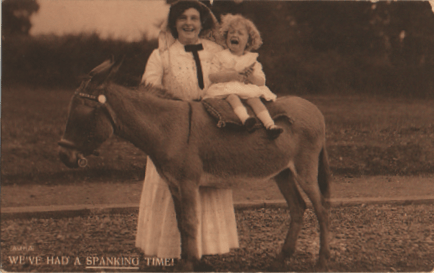
A donkey is pretty much the linking theme in these postcards; Here, it seems that the ass in question is a mere bystander. Unless you want to argue that why the bysitter is crying is what happened to…but spanking jokes are now considered more questionable than ass jokes, so we should probably move along. (Anyway, this use of the word ‘spanking’ is now almost totally obsolete, though still in use in the phrase “Brand spanking new”.)
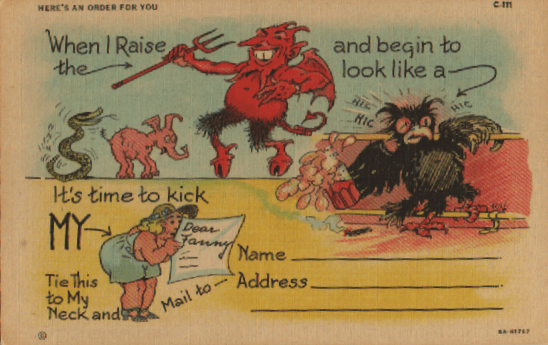
Here, we have a situation which usually resolves itself with an ass joke but has here substituted the speaker’s “dear fanny.” (By the way, what IS that bird on the right? I wanted so much to call it a boiled owl, but the more I looked, the less like an owl it seemed.)
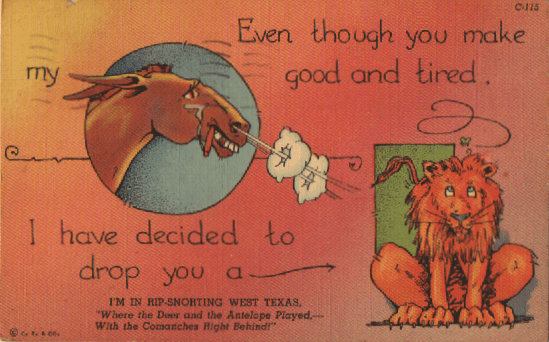
This is a new version of a card we have discussed before, playing on the theme that saying one’s poor donkey is tired is above suspicion and perfectly proper. What makes this unusual is that it is one of a small number of cards repurposed by the Teich Company to include a note in the cartoon (and a longer one on the backside) about West Texas. Were the cards involved CHOSEN by someone in Texas, or was this handled at the company headquarters?
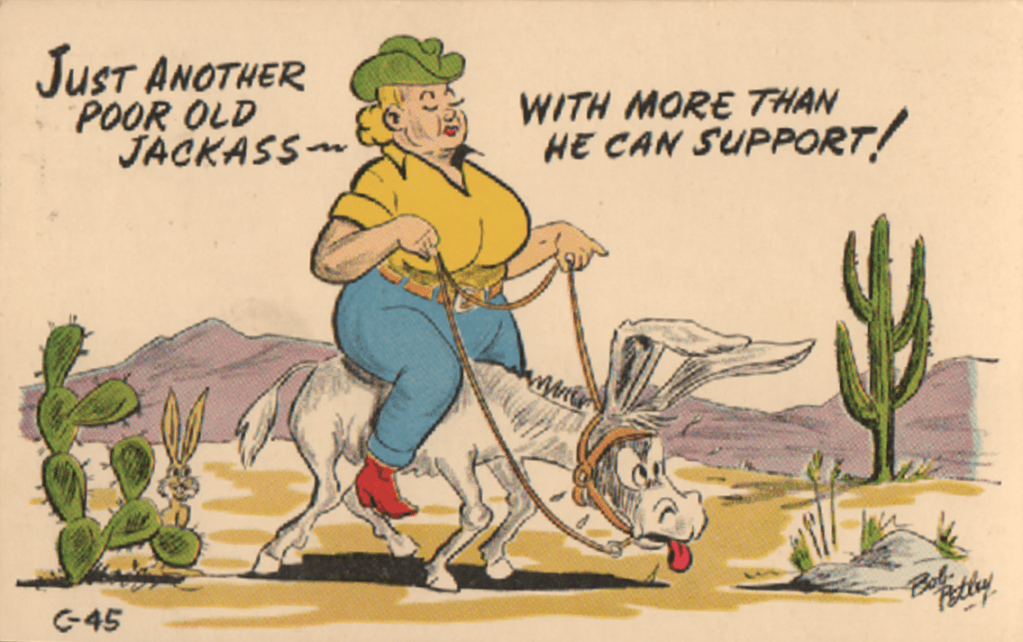
We have devoted a lot of blogspace on different postcards with this ass joke, but this version was a new one on me (so to speak.) Bob Petley has done without the funny little hat with its lonesome flower usually worn by the woman, AND her usual cry of “Tally Ho”, and has given her a far more opulent figure. Always interesting to see how different artists cover a classic theme.
This is another ass joke done by numerous different artists, involving many different states, and alternating between a woman and a cowboy. This is the only one I’ve seen so far where the artist has spent more time drawing the four-legged ass than what most artists would have felt sold the card.
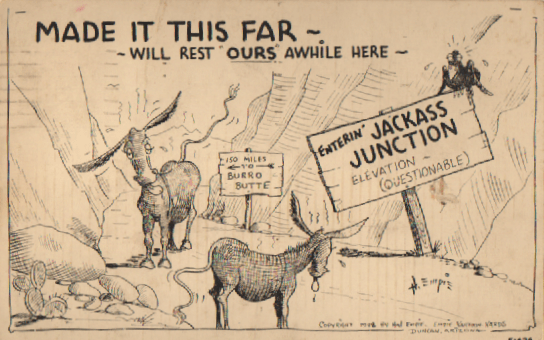
Hal Empie gets at least three puns into this one. (Yes, still counting Butte.) No humans in sight to confuse the viewer about what is meant. Even the caption noting that we are resting our asses here OBVIOUSLY means the four-legged variety.
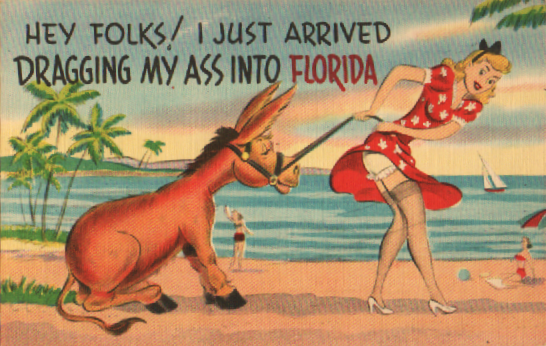
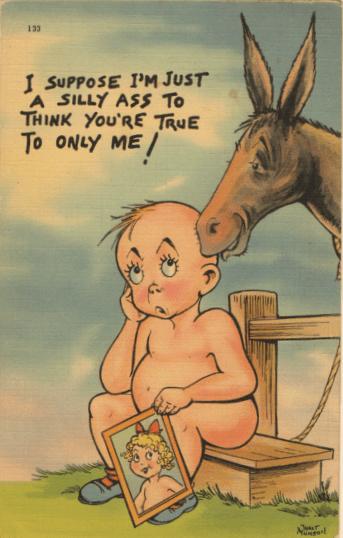
This takes the word in an entirely different direction. Unless Walt Munson has drawn the protagonist naked (except for shoes) to give our minds a boost toward the more common definition.
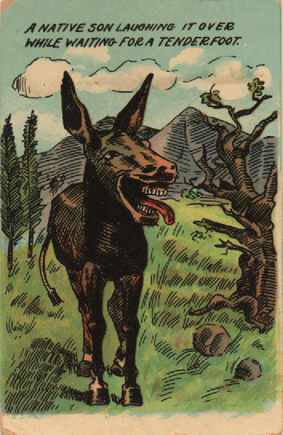
While this gag uses no wordplay at all. (There MAY be a hint that the locals are all jackasses, but this is not really confirmed by the caption.)
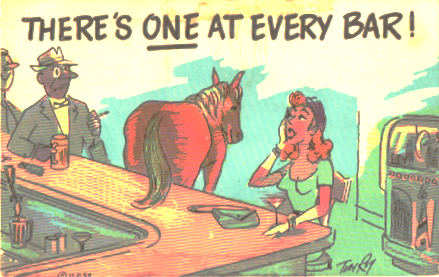
And we come to the end, with another appearance of a classic ass joke which does not include a donkey at all, at all, but plays along the same general notes as the old familiar song. (The Vicar of Bray?)
“I know it. Just weigh ‘em out and give me scrip to take to the bank.”
“Of course, sir. Your weekly delivery of gold has been the making of our establishment. My wife and I….”
“Dadgum it!”
“I’m sorry, sir. I keep forgetting.”
“Nothing against your good…lady, Milligan. Jus’ brings back memories of…other…wives.”
“I would not wish to cause any pain, good sir, to someone who has been the mainstay of our finances here. I have hired more help, and we are now one of the most respected assay offices in the territory.”
“Okay by me. Just weigh it out, can you?”
“Certainly, sir. These really are high quality….”
“Fine. Lemme get my victuals and such and get back to the cabin.”
“Sir?”
“I said I want to get back home.”
“You know you will be followed again, sir?”
“If ever’one in the dadblasted county don’t know where I live by now, they’re welcome to waste their time. Long as you don’t waste mine.”
“The mayor hired a priest to check whether your home is the center of evil magic.”
“And he’s welcome to waste his money.”
“You never go out to mine anywhere, and never have any guests but those guards you hired. And they’re tight-lipped about where you find all this gold.”
“They don’t know. I pay ‘em not to get curious.”
“I don’t suppose, sir, that you could put my mind to rest about whether such a supply of fine gold is legally obtained. I will not breathe a word, even to my…spouse.”
“Magic beans.”
“If you don’t wish to tell me, sir….”
“If you don’t wanna listen, it’s no extra sand in my boots.”
“I hope I have not insulted you, sir, by my….”
“Had a mine miles south of town. Ever’body knows that.”
“Yes, sir. It hasn’t been worked in months.”
“Pulled out a couple ounces of dust once, headed back to town. Hot day. Got lost an’ went ‘round in circles ‘til this jasper comes by, gives me a swig of water, offers to swap magic beans for my poke.”
“Magic beans, sir.”
“Magic beans. I wanted another swig from his canteen so I swapped. Got home, planted the beans. Figured I might save myself buying a couple cans at Finley’s. Beans grew up overnight, right up toward the sun, and I climbed until I came out next to this castle. like.”
“And there you found a goose that laid golden eggs, sir?”
“Didn’t go in the castle. Didn’t like the looks of it. Either gimme my scrip and laugh after I leave or listen up.”
“Sorry, sir.”
“I look around for something more my style, and there’s this shed, ten times as tall as me, with the door open a crack. I slides in and I sees all this silver wire all over everyplace. Like spider webs, it was, only when I brush up against it, it’s solid silver.”
“No kidding?”
“Just what I said. And a voice says ‘Hush! Don’t wake the…wife.”
“And who….”
“I look around and at the top of one of these big old webs is this spider the size of your shop window. I tips my hat and says I likes his webs but I wasn’t fixing to try and take any home with me.”
“A prudent move, sir.”
“Says he don’t care. He’s got plenty, being the spider that spins silver webs. His…wife might get upset, though. She’s got a nasty sting about her, he says, and it casts spells on folks, He told me about this goose that laid the golden eggs and a cow that gave silver milk and a pig with streaky gold and silver bacon.”
“Amazing!”
“I said that. Shouldn’t’ve. Feel this stab in one arm an’ I looks up to see this spider twice as big’s the man of the house. She don’t look happy, so I ducks out, shins down the beanstalk, and chops it up for kindling.”
“But how does….”
“Ever since, I takes care not to get too far from my own chamber pot by the bed at home. Them big nuggets you seem to like…well, gimme my scrip and tell me if you’d ruther I took my homemade gold over to Sweeny’s Assay Office instead.”
“Thank you for the interesting story, sir. I hope to see you again next week. I guess your gold’s no dirtier than what the mayor brings in.”





 Blogsy Babbles