This page seems to be having a run on Marital Woes postcards. A really serious blogger would either settle in for an in-depth discussion of marriage in comedy through the centuries, or move on to some other significant topic, like “Are there regional differences in what people put into their devilled eggs?” But we are not a food blog here (p.s.: I already did a blog on the relationship between devilled eggs and devilled ham and devil’s food cake, which you can check elsewhere on the Interwebs.)
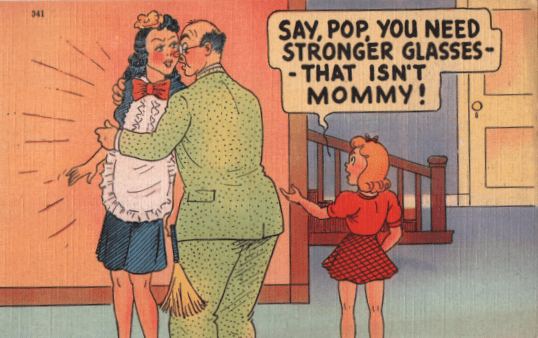
However, what we are going to do is switch from infidelity at the office to issues closer to home. It surprises me how long jokes about dealing with the maid went on in a world which was gradually deciding that hiring servants was the exception rather than the rule.
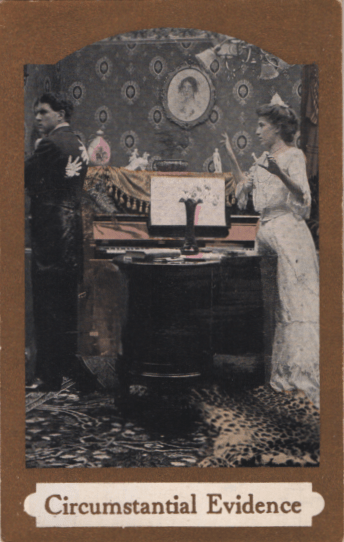
The joke, of course, depends less on the foolery itself than in the master of the house getting caught at it. There are other comic possibilities, but those involve more words and action than can really be done in one postcard illustration, like this one from 1906 or thereabouts.
There are certain conventions to be observed in framing the joke, which might not need a caption, but which DID require that the maid be a good deal younger than the husband cheating or the wife cheated on. Not all maids were, or are, twenty-somethings with the budget needed to pay for short, suggestive uniforms. But, again, though there might be excellent comedy in a story about a young man cheating on a young wife with a maid who is twice his age, it would be hard to do that on a postcard, even if you used both sides. (Of the postcard, I mean. I WISH you would stop letting these stray giggles of yours interrupt us in our study of vintage comedy.)
It’s the “getting caught” moment which has the comic impact required.
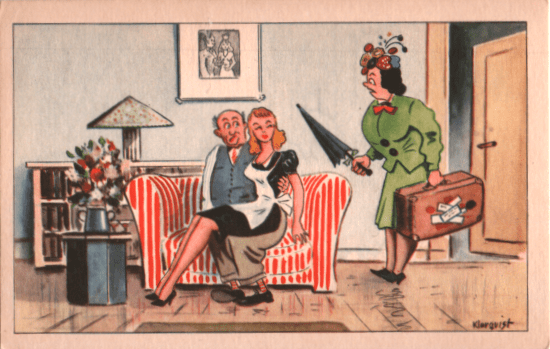
Even when that moment is denied, at least for now.
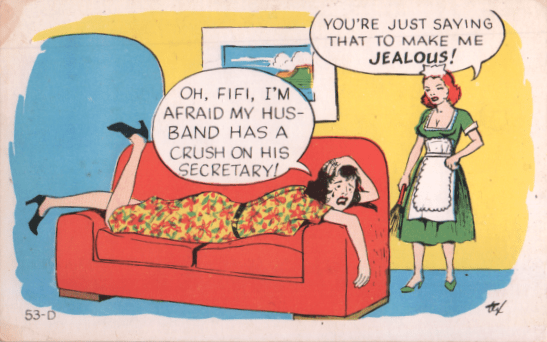
Or when somebody other than the lady of the house handles the discovery.
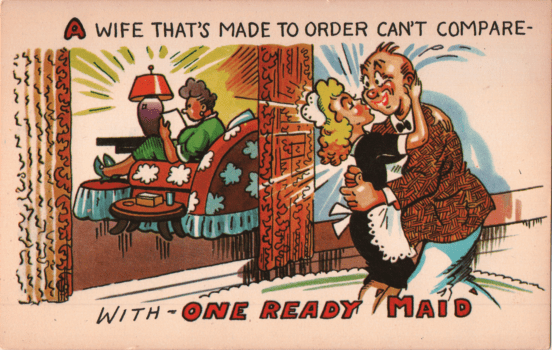
When hubby is having a heavy-duty flirtation with the cook, of course, the cook doesn’t even need to be present. Cooks seem always to have been involved in making biscuits or something similar when the mister drops by the kitchen.
Yeah, maybe someday I will also do an in-depth study of the handprint postcard. Anybody who wants to can take the job of analyzing just where those handprints are and deciding what was going on in the kitchen.
The same goes for those of you who might be interested in why there don’t seem to be many postcards about the lady of the house fooling around with the chauffeur. Is it because more postcards were bought by men, who wouldn’t have found that funny? Or did this arise out of a desire to mock the rich and their minions? (Look back over the cards in this column: how many of these homes look big enough to require a host of servants? For cleaning, I mean: not for other purposes.) Maybe, looking over this selection, postcard cartoonists simply liked drawing feather dusters. We can return to this, I suppose, at some future date. I need to get back to devilled egg recipes. (The maid just brought me another tray. Gotta go.)
It was testimony to the lung capacity of Klamathans that Louba was able to sigh so heavily in midflight. “Stick a hat on me butt an’ see if I thinks better that way.” She leapt over the third box of assorted chocolates. “I feels a right lumpuck.”
“They roast lumpucks, don’t they?” inquired Chlorda, slapping at flames in her hair as she ran.
The four contestants fled deeper into the forest, taking full advantage of the canopy of broad green leaves. The shelter wouldn’t do much good for long; each fugitive could see the smouldering holes in the leaves as they rushed on under the wailing lop-eared owls. Not one of them doubted that the Emperor had intended all along for them to come this way. Bott felt that to refuse to fall into this trap would only upset His Imperial Worship.
“All you have to do,” he told himself, “Is make it through this. Then you can retire and live on your reputation for the rest of your days.”
Pretty soon, though, his crew would look to him again for answers. Nubry’s book could carry him only so far. How could he choose between doors if there were no doors to choose?
“Ove here!”
Seeing what Bassada had seen, they swung as one in that direction. Smoke was building up around them: if nothing else that big square well might clear their throats.
“Is it a door, do you think?” Chlorda peered down inside. “Someone jump down and find out.”
“Try it yerself.” The blue was climbing on the wall of the well, but only to get farther under the little roof provided over the top. “Tell us how ye likes it.”
There wasn’t room for all four of them under the little tin roof. Bott looked around for any sign of doors it would soon be impossible to see. The only thing to be seen beyond smoke, leaves, and trees was the well, its stones all marked with carved pictures of Nastrid snails.
Not snails. He frowned. This was a message. He’d never seen that symbol before, but he was recognizing it. Maybe it had been a picture in Nubry’s….
His hand went into the grenade satchel, but came up without the book. He looked from the stones to the horn he’d picked up earlier, the malachite one. He shrugged, and brough it to his lips.
The Klamathans looked to each other, Chlorida shuddering at the sound that came from the horn. “Perhaps his people play a dirge before they’re melted into…lala!”
Everyone jumped left and right from the shelter they’d been elbowing to ge into. Long glass spikes shot up from the well. “Good thing we didn’t any of us try it!” said Louba. “We’da…well, kick me sister and listen if I yells!”
The spikes sat on the roof of a long glass case sliding up before them. A door swung open just as the spikes pierced the tin roof.
“I can pay anything when I’m sober,” Bott told them, setting the instrument back into the satchel. “And I haven’t had a drink in three days. Let’s go!”
The smoke had thickened; there was nowhere else to go. The Emperor was easily wealthy enough to burn down an entire forest and then replace it.
Bott knew some regrets as the four of them squeezed into the glass elevator/ Chlorda pressed his shoulder, whispering congratulations/. The blue stood right behind him, rubbing the seat of his pants. A pinch on his left thigh told him Louba was not going to be left out.
“Crew,” he said as the glass chamber started to slide down into the well, “You know we’re here because nobody has been waiting for the captain’s orders before acting.”
Green shoulders shrugged. “Ain’t easy, cap’n. Cep’n these bits o’ batbait, ain’t had a cap’n since afore I got inta this rebelment business. Me last cap’n wouldn’ put me up fer promotion: said I was too green. So I killed some people.” The big green shoulders bounced again, setting off more bounces around the room. “Mosta her fambly,as II recall. Never knew she’d be so attached to ‘em.”
Bott scowled, ignoring the fingers trickling along his spine. “Well, we’re going to have to take this more seriously if we plan to escape.”
The gold smiled and shook her head. “You do understand, Captain, that His Imperial Wormhips doesn’t intend for us to win this game.”
“We have a chance until he actually kills us.” Bott looked away from the horned skulls peeking in through the walls of the case. “And we should be able to go on for quite a while yet. He wouldn’t let the game end early.”
He found himself surrounded by soft shrugs. “Been here days now,” said Bassada, dealing one buttock a solid squeeze. “Not so bad a life: always sumpm ta do. We c’d stay on and be traps fer what prisoners he sends in next.”
“Until they get tired of feeding us,” said the gold, sliding a hand down Bott’s chest.
The blue continued to give a good workout to what she had hold of. “Anyway, even if we gits out, we gots a whole Drover ta git troo. Even if we does it, where’s we goin’ next?”
Bott glanced down to make sure Chlorda’s fingers didn’t catch in any of the holes torn in his jacket. “That woman you saw—the real one, not the one who went down the ravine—was escaping Imperial forces with…with a special cargo on her ship.” He looked over his shoulder at his crew. “That ship is waiting at the end of this maze.”
Louba grabbed his head and gave it a hug. “Bite m’thigh an’ call it measles! Cap’n Bottsy knows it all!”
Chlorda rubbed one of her cheeks against Bott’s, nudging the green arm out of the way. “Do you honestly believe we’d be allowed to try anything with your friend’s ship?”
The skulls outside the case had given way to exceedingly large Bialfa fireworms. Bott shook his head free and considered his crew again. “I’d as soon be killed in her, escaping, as in this maze.”
The faces around him showed affection, but little conviction. Bott thought it over and added, “The ship has carpeting on the floors.”
Bassada tipped her head to the left. “Does it got…stuff onna ceilin’s we could hang swingy-swings from?”
Bott tried to remember, even as he said “Of course!”
“Sold!” cried Louba. “Ya doesn’t even hasta fly it!”
His crew seemed to be all fingers and lips. Bott wondered if they had squeezed all the breath out of him permanently when the lights went out. Then his nose caught the acrid burnt egg smell peculiar to fireworms.
“I don’t suppose you could arrange to bring that ship of yours in here,” said Chlorda, pulling away from him.
The car stopped descending. “Gotta motivate this thing.” He could feel Louba backing away. She put one hand on each of his shoulders.
“No! Wait!”
The case shuddered under the impact as she came down from her leap. It seemed to work. Bott felt himself moving down again. Then he realized he was moving down upside-down.
“She bunged the frung…ack…floor!”
One advantage to having a crew of Klamathans, Bott decided. There wasn’t much more comfortable to land on in a chute like this.
“Opf!” cried Chlorda, as he bounced away from her stomach. “The…captain has some heft.”
“Jus’ as well,” said Louba, rising to her feet and starting to lower his clothes. “I’m guessin’ it’s time I was stood in a corner.”
Bott raised a hand. “Let’s wait and see if this room has corners, okay?”
He rose from among his crew and considered their landing spot. This new room was a dim, irregular metal box with all sizes of chutes opening from the ceiling, and alarming bumps and ridges along the floor. There were dark obstacles around them, which might hide anything, and anything else could be dumped on them from a chute. He could still smell the enchanting aroma of fireworms. Rumor said His Imperial Worship had the largest fireworms in captivity. Rumor had not said WHERE they were in captivity.
“Help me,” someone whispered.
Bott looked to his crew, a hand still up. The sound seemed to have come from a large pyramid on their left. There was chute above the pyramid; something dropped from it as they watched. Bott hoped it wasn’t a victim of fireworm infestation. Once the fireworms took over the major internal organs, such people were hard to kill, no matter how hard they tried to die.
He took a step forward, using both hands to gesture to his crew to stay back. He was not especially surprised to find them right behind him as he came around the pyramid.
“Help me,” Nubry whispered again, turning toward him as he approached.
She was being drawn backward over a large iron book, which was open to form a wedge, its spine against hers. Small objects were dropping from the chute, landing with pinpoint accuracy in baskets attached to her wrists and ankles. Her face twisted as the weights drew rrach limb farther and farther down.
“I’ll cut them offa ya, Hon,” said Louba, moving forward. The captain shoved an elbow into her stomach to attract her attention.
“Can’t…release…all the…weight at once,” the prisoner gasped. “It’s…mined.”
“Ah.” Nodding to Bott, the green took a step back. “Cap’n’ll tink o’ sumpm.”
“I know,” she whispered. “You…got away…from the HSUs. I didn’t…think…you could.”
Bott pointed to a high metal ridge away to the left. “Check that out,” he ordered. “Tell me if there’s anything behind it. All of you. And wait for my next command.”
The Klamathans, impressed by a new metal in his voice, hurried away. As soon as he saw the blue backside disappear around the ridge, the captain tore out his knife and slashed at the ropes holding the baskets to the prisoner.
“Bott!” Nubry wailed, as the second basket came loose. “Look out!” He leapt for shelter.
The blast helped push him farther. He ducked little lead weights that flew free, mixed with bits of the prisoner.
“Another copy, Cap’n?” Chlorda inquired, as he rejoined the crew.
He nodded. “How could she have known about us escaping the HSUs unless she was watching an Imperial monitor? Let’s go.”
They started forward, but Bassada lingered, wiping blood from the sides of Bott’s face. “Y’know, Cap’n,” she murmured, “Sometimes ‘ey makes prisoners watch ‘em monitors, too.”
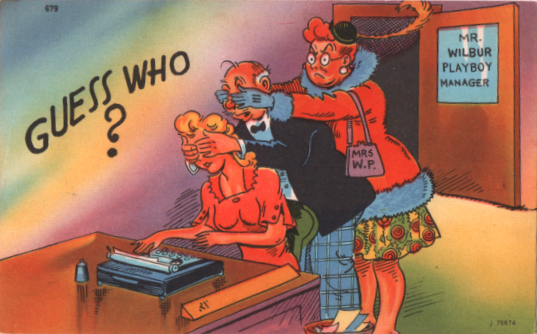
Last week in this space, we considered a couple of the cartoon side effects of marriage: fighting about money and carrying groceries. In checking my inventory of fascinating but somehow not yet sold postcards, I find another popular cliché about the married man, especially, the married man of business: the suspicion that his work at the office came with certain benefits not mentioned to wifey at home.
Cartoonists assumed for decades that executives take far too much of a hands-on approach at the office. Of course, every good cliché is based on a LITTLE truth. The story was told where I worked that the CEO’s office was designed with a back door from which a bygone executive could walk into the area where his underlings worked, but which was really there so that if his wife showed up without warning, certain young ladies would have an escape route.
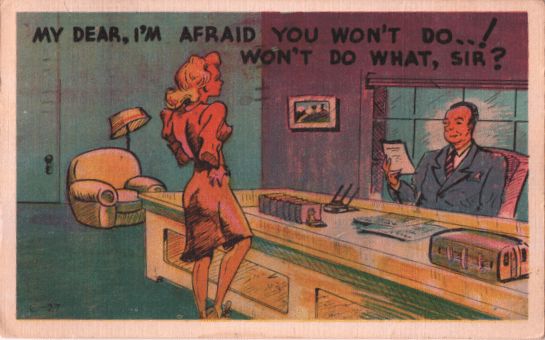
Exaggeration, however, is at the base of much comedy. Cartoonists knew readers would nod and smile at the suggestion that applicants for a secretarial post simply assumed there were duties not mentioned in the job description.
Or that the interview would involve a test of their dedication to the work at hand. (Somebody just snickered; I heard you. I wasn’t going to say “at hand”, but make of it what you will. Once we start down that path, though, no words are safe.)
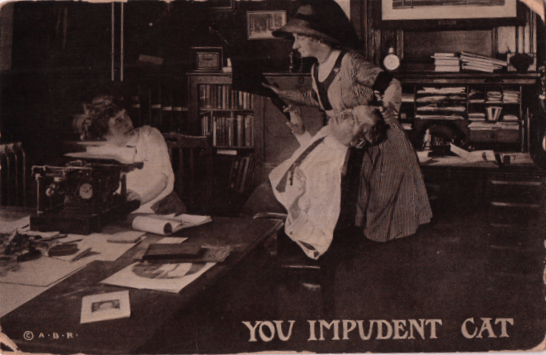
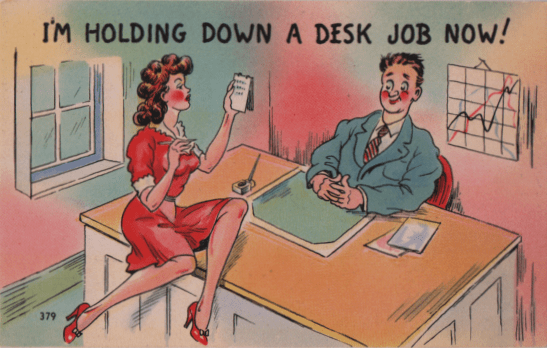
Is this joke confused, or is the cartoonist playing on our confusion? The executive here has the desk, but his secretary is the one holding it down. (Stop snickering; you’ll wake the other readers.)
And who’s crazy about their position here? Our businessman seems more pleased at how well chair and secretary seem to be made for his satisfaction. (More snickering. Okay. Have you heard the one about a scholarly speaker explaining how 1930s businessmen in Chiago took advantage of their authority? The speaker noted that the president of a major museum “naturally created a position for his mistress.” When the audience laughed, he spluttered a bit and said, “Oh, you know what I mean: he found a place for her on his staff.”)
Anyway, THIS cartoonist makes it clear who is entertained and who is entertaining.
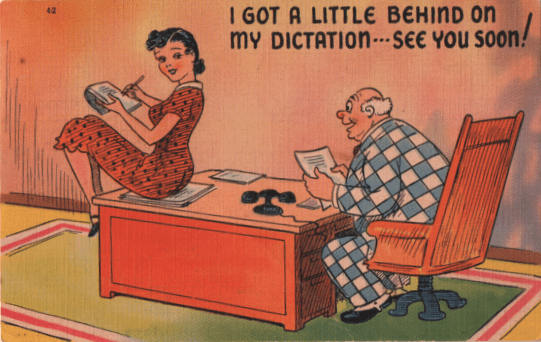
A big part of this cliché, though you have observed it is not universal, is that the businessman taking advantage of that private office is a good deal older than the secretary involved. Neither this, nor the basic premise, are limited to mid-century jokers. These were established at least as early as 1908, when this joke was mailed.
This is one of a very few such gags where the secretary is a little bit older herself. There are other interesting points here as well: the typewriter, the arrangement of the office, her expression, and, most worthy of a whole nother blog, that this is one of several postcards on our theme which refer to “my busy day”. I may have to look that one up and find out if it was a song or a comedy catch phrase in 1909 or thereabouts. (I heard that murmur about “getting busy”; if you thought you could make me snicker, you’re late on the job and your check will be docked.)
And here we look into a deeper, darker secret. All those young men who were taught that hard work and ambition would bring them fame and fortune were actually inspired by another perk of work: if they kept at it, one day THEY would have that private office for their own hanky panky, with or without a back door they could use. (Yeah. Just giving up. You’re not you without snickers.)
“Is this your entire stock of flying carpets, shopkeeper?”
“As far as I know, ma’am.”
“What’s THAT mean?”
“I suspect three or four may have floated to the ceiling over the years, but it’s hard to be sure.”
“I like that. No need to suspect the maid is sweeping dust under them, hey? But you’re charging way too much for all of these. I was looking for something at a reasonable price.”
“I do have a small stock of flying throw rugs, ma’am. Or perhaps you’d be interested I one of these flying handkerchiefs.”
“What use is a flying hanky?”
“They do fly, ma’am. They may be less comfortable for travel, but if ma’am is making a short trip, and has a good grip….”
“Interesting point. What do they look like?”
“I have one right here, ma’am. It comes with this sheet of instructions as well.”
“Instructions? All I need to know is how to make it go. Or were you going to sell me a magic wand for some extravagant price?”
“No, ma’am. The flying hanky is only a penny.”
“A whole penny?”
“Make me an offer.”
“Well, you’re trying for reasonable prices, I guess. Here’s a penny. Now, how do I make it fly?”
“Here is the word of command, ma’am.”
“You mean all I have to do to make it fly is say ‘Presto’?”
“Yes, ma’am.”
“Hey! Presto! Presto! Shopkeeper!”
“Yes, ma’am?”
“A little help here? Presto? Is there some other word to make it STOP flying?”
“Yes, ma’am. Right down here on the instructions.”
“Well, tell me what it is!”
“But ma’am was uninterested in the instructions. I’d have to charge a gold piece for them now.”
“Well, hurry up! There’s a carpet on your ceiling up here and something keeps reaching out from it and pulling my hair!”
“Ah! I wondered what had become of those flying monkeys.”
The foursome made cautious progress through a broad square room with dark blue walls. They had deciphered the floor tiles so as to proceed without immediate impalement, but this brought Bott no great sense of accomplishment. Anyone who couldn’t figure out not to step on the tiles with holes in them didn’t deserve to make it. A trap this simple meant a more devious one later. Or sooner.
A big green hand swept up behind him to prop him up while the other thumped him on the back. “Gittin’ troo again, Blogsy Cap’n. Tan me toes iffen ‘at’s not halfway!”
Louba swung the thumping hand up to indicate a row of white tiles which did seem to mark the midway point. Bott nodded, making no real comment. Despite her size, the green Klamathan reminded him of young Mijedad Bianco, who had started firing way too soon, leading to the capture of the ship, and had burned for it. Bott would have to watch Louba very closely. In fact, he intended to keep an eye on all three of them, and not for the pleasure of it.
“Iffen ‘ere’s bushes next door, I goes firsts. Us greens I natural outdoorsy types.”
“Yer right,” Bassada told her. “Whenever I looks at yez, I t’ink wide, open spaces. He’d git lost. Ya’d probly rip his clothes besides.”
“I’d set off his grenades, I tell ya,” Louba replied.
The gold sniffed with disdain, but spoiled it by licking her lips. She and Bassada had been busy with an argument on the virtues of multiple climaxes over several hours opposed to holding back for one bone-shattering conclusion. The phrase about bones struck Bott as unnecessarily graphic. But he had apparently won their undying affection by dropping the Nubry doppelganger; a “hard man”, they called him, imbuing the term with at least three meanings.
“Oh, friction burns are a sure sign,” said Chlorda, agreeing with something the blue had said. One golden toe touched the halfway point on the floor.
The blue walls were suddenly green with orange patches; bells hidden behind them struck up a jolly, jingling tune. Everyone froze. Then Bott slid one hand slowly into his pocket.
“Ship,” he murmured, once had had the card to his lips. “What did we just do?”
“Did you know that Elsie had calves named Beauregard and Beulah?”
Bott nodded, not especially surprised. “You’re going to be bilstim useful, aren’t you?”
“Unless you’ve been named Imperial Worship, lummox, that’s all the information you get out of me.”
Sliding the card away again, Bott looked ahead, left, right, and, remembering the dome in the ceiling, up. There was nothing new to see.
“Keep an eye on the spear holes,” he said. Then he stepped into the row of midway tiles.
The bells rose in volume, but nothing else occurred. The company moved on. “I perfers other women’s men,” said Bassada, “No chance a getting’ too personal.” Bott wiped his forehead and was grateful, again, that there wasn’t much room between trapped tiles.
”Ah, refrain yerself.” Louba shook three fingers at the blue. “Youse guys fallalloxed up yer operation at Greenwood Bungaloo so much ya shoon’t need anythin’ else ‘til yez finds shoes ta fit yez.”
Bassada snapped two fingers on each hand, dismissing Greenwood Bungaloo. “Yeah? If yer Cap’n Stillwell han’t’a took his vacation we mighta hadda chance.”
While those two rehashed the story of Greenwood Bungaloo, Chlorda had a chance to ease closer to Bott. Her lower lip and underteeth were sticking out, in a face that clearly said, “You’ll need to work hard to keep up with me.” Bott walked a little faster. Gold Klamathans were partial to what they called the Breadmixer, in which each partner kept their right ankle on their partner’s left shoulder.
“You understand,” he said, “I’m no Captain Tiberius, to have sex with every crew member on a mission.”
He took two more steps before the clearer air told him he was walking alone. He looked back to find three Klamathans staring at him, the gold with crossed eyes. “Well, grab me grin!” cred Louba, punching herself in the chin.
Complete confusion that the captain would expect a say in their debate, or even object, showed in every line of every face as well as every line that showed of their bodies. Then the green slapped one massive buttock. “Aw, Cap’n Bottsy’s joshin’!”
“It must be a jest,” Chlorda breathed at him, leaning in. “I’ve had no one but these two for weeks. And they smell funny.”
The b;ue took two steps toward them. “”Yez gots to unnerstan’. “All ‘at keeps us goin’ is tings we finds ta play wit’ along the way. A jumprope, like stretchnose here gots, a little box of Itteh Ga Sugar, earrings what….” She cast her eyes not, not at all demurely. “Dangle.”
Louba’s big right hand was rubbing the captain’s shoulder. “Seem when ya never been off yer home planet….”
This shocked Bott more than anything they’d said during the previous discussion. “You’ve never….”
Bassada and Louba, he learned, had spent their whole lives at home, while Chlorda had left Klamath only twice, on school field trips. Bott’s shock, which was obvious, was immediately taken up by his crew.
“’At’s what yez needs in a cap’n!” Bassada told the others. “A man wit’ experience!”
“It’s what I need in a man,” Chlorda agreed. “A captain with experience!”
Bott fretted that his resistance was weakening. What they expected would weaken him further, but he had missed working with a crew. This might be the price he had to pay.
He summoned his strength to object again. “We know the Emperor’s watching,” he said, easing his shoulders from under Luba’s arm. “Why put on a show?”
Chlorda stared at him. Bassada and Louba broke into booming guffaws. Before Bott could inquire after the joke, guffaws gave way to a cry of “Tripplepletz!”
Bott swung around to look. The tiles of the halfway line had disappeared behind them. Coming up a ramp from where the tiles had been were short, square metal boxes on low wheels. Turning again, to order his crew to move a little faster, he found them three rows ahead of him, daintily dancing around the tiles with spearholes.
All but impossible to knock over or turn from their courses, Hall Security Units held attachments capable of inflicting any one of ninety-eight highly painful and potentially crippling injuries on anything that triggered their ten foot freeze frames. And that was only standard Imperial issue: the Emperor’s special game versions would have more functions and a larger area of capture. Bott spent only a fraction of a second estimating how far apart the units were from each other before turning to pursue his crew.
The HSUs did not worry about s[earholes; the stabbing of the fine points didn’t even budge them as they trundled forward. The spearholes were becoming more numerous, forcing Chlorda, in the lead, to look around for safe tiles. Their foe would catch up long before they reached the end of the room. Bott reached into his satchel, loosed a grenade, and leapt after Bassada as he made a practiced toss over one shoulder.
This had not escaped the notice of his crew. Louba slowed to check behind her. “Nothin’,” she said.
Bott shrugged. “They can’t all….”
With a loud “PLOOM”, what might have been steam billowed from the grenade. Bott wrinkled his nose. A gas grenade would aid the HSUs more than the fugitives.
The steam did not disperse. The chunky robots did not advance through it. As the steam went white, crunching signs indicated that the HSUs had reached the barrier, and found it sufficient.
Louba set her hands on her hips and shook her head in admiration. “Well, bra me with barb wire an’ call me dainty!”
“Let’s go!” Admiring the bumpy wall himself, Bott realized it wasn’t big enough to block the entire passage. As he turned his head, he saw the first of the HSUs come into view.
“Flallop!” cried Chlorda, who had reached the bronze door tucked among many tiles with spearholes. She had pulled this to one side, waving the rest toward the safe tiles and the threshold, only to see a line of HSUs coming straight at them. Bott was reaching into the grenade satchel again when he spotted Bott getting ready to grab a grenade and throw it at them.
The Klamathans understood this the same moment he did, and they all plunged into the mirrored corridor. Chlorda had to jump: the door had opened against her and clicked into the wall. They could not shut off pursuit that way: this would be a test of speed. Twelve, twenty-four, and then countless fugitives found a way among the mirrors as the HSUs rolled toward the door, hampered not a bit by the excessively large number of spears.
To their left, down one narrow byway, waited five dull silver doors, one of which was likely to be real. A brown door waited in a cluster of bronze doors at the far end of the tunnel of mirrors, down a short flight of stairs.
“Brown door!” Bott sped toward it, bouncing now and again from himself in the mirrors, without checking to see if the others were following orders. He could nearly feel the throbbing of those freeze frames, which could paralyze a captive without dulling the ability to fee pain.
Leaping down the stairs, he put a hand to the brown door and looked back to find his crew bouncing after him, some more than others. He nodded, his back to the door. The HSUs came on.
There was a reason HSUs were not used outdoors. Unable to deal with terrain that wasn’t flat, they stumbled at the first step. A loud metal avalanche followed the Klamathans, gradually slowing as the HSUs bumped into each other, jabbing metal arms out just as the freeze frames took effect.
“Nice work Bottsy Cap’m<” said Louba, rubbing a hip against her captain. “Now what? Does we jump back over for ‘at silver door or use what we got?”
Bott doubted his ability to jump past all those freeze frames, but the green Klamathan had a good idea. It would be just like Imperial designers…. Looking up, he found a metal sign above the brown door. From here, he couldn’t tell if there was one above the many silver doors he could now see among the mirrors. The sign here said, ‘THIS EXIST OPENS INTO A CHAMBER OF FLAMING HORROR”.
All Bott could read of this, however, was the word Nubry had taught him “EXIT”.
“This way,” he said, pulling at the broad, arrow-shaped handle.
They studied, but did not at first enter, the broad green landscape. Not far from them waited a vast ice-blue lake, little white flashes here and there advertising an availability of fish.
“Lodeon doesn’t look like this, does it?” All Bott could remember from travel ads was yellow mountains and big buildings.
“Purdy nice, though.” Louba took a couple of steps into the grass. “If anybody was to want ta stop an’…rest.”
She looked over one shoulder, lowering long lashes as her eyes swept up and down the captain. Bott felt four other eyes on him, and took six steps past the green Klamathan. “Better move on as fast as we can.” His voice was a little louder than it needed to be. “This has to be a trap.”
“Weather seems about right, Captain.” Chlorda licked a finger to hold it up to test the breeze. She spent half a second longer than she really needed to on that finger, in Bott’s opinion.
“Thinkin’ I could struggle along layin’ round here a few days.” Louba shook out her hair which, since it was soaked with sweat, was redolent of fillberry pie. Bott’s stomach rumbled. It seemed a long while since he’d eaten?
“Too nice fer me.” Bassada stepped up and ran a finger of her own along the green Klamathan’s back. “Why’d his Imperial Wort’less make sumpm fer funsies? Gotta be sumpm dangersome to it.”
“Don’t listen to her, Bottsy Cap’n. She gots feets in her pajammers!”
Bott swung a hand along the line of the horizon. “There’s too much of it. The trap could be waiting anywhere. The lake. The trees….”
“Closer than that, I do suppose.” The gold Kalamathan moved up to a line of shrubbery and, raising one leg straight out, parted the top branches to look between them. This revealed a steaming wooden tub piled high with bubbles.
“Me fer ‘at!” cried Bassada, leaping forward.
“I saw it first!” Chlorda plunged forward, but was just too far away for her foot to miss the rim.
Bott jammed a hand into one of his pockets, found a gear he’d stowed there, and let it fly. It passed just above the leg covered with golden down and dug a well through the shimmering bubbles. This allowed a passage for a fountain of flames in response.
“I enjoy a hot bath, but oh my!” said Chlorda, returning to hug her captain.
“Getting’ kinda tired of ‘at Emperor,” growled Bassada.
“Touch nothing,” Bott ordered. “We need to find a door somewhere. Maybe….”
“Lala!” Chlorda raised an arm.
Louba was halfway up a tree trunk, reaching for something that hung from a branch. “Come help us find the door!” the gold shouted.
“Yer not cap’n today, lumplegs,” Louba replied. “Call back tomorra.”
“It’s her weakness, Captain,” Chlorda told him, as they spotted what Louba was reaching for. “Red silk panties with tassels. I suppose if we just let her die there’ll be more of everything…for everybody.” She glanced at the captain and then strode toward the tree.
Bott’s eyebrows slid down as he hurried after her, and his upper teeth jabbed into his underlip. Captain Huti had been brought to a sticky end by just such a crew. Unsuccessful pirate crews lacked cohesiveness, pursuing whatever seemed best at the moment, regardless of plan.
Six hands were reaching for green ankles as green fingertips brushed the underwear in the tree. Yowling as it burst into flame, a green fist knocked the flaming lingerie away from the tree. It flew too far, hitting the surface of the lake. The entire lake burst into flame and shot into the air. The hissing did not stop as it all came back down, and was not the result of flame hitting water.
As you no doubt recall, we spent our last thrilling episode discussing how postcard cartoonists addressed the age-old question of how husbands and wives handled their mutual finances. Here is another expression of a perennial joke, as mentioned in that essay. (And, again, if you decide to hunt through the world for other examples so as to get your Ph.D. with a dissertation comparing the different expenses listed in these budgets, kindly mention this column. And mention this column kindly.)
But though we mentioned a few side issues which turned into their own comic traditions, like the price of hats, there were other branches of this rabbit hole we did not explore.
But there is one cliché which attracted a number of postcard cartoonists, even as to this day it can be found in the adventures of, say, Dagwood, or Leroy Lockhorn. And that is the poor carrying home all the things his wife has bought.
The situation is filled with possibilities: one could do a Bingo game of different applications of the gag, from the lady who kindly removes one box from the stack her husband is carrying so he can see where he’s walking to the lady who gets home only to find she is accompanied by a stranger whose wife accidentally swapped with her because the piles of purchases were so high neither could tell which man was behind them. When it comes to the comic strip of the twenty-first century, these variations are a Christmas tradition in spite of those who do their shopping on the Interwebs. But in the golden age of postcards, one theme reigned supreme.
It ain’t subtle. We are given to understand that any man might let his wife get away with buying a lot. But only a truly submissive, downtrodden male would then allow himself to be used as a beast of burden to haul it all home.
Real men, we are given to understand, don’t go shopping with their wives. They are working in an office, bawling out underlings about the budget, and come home to faint dead away when presented with the bills. (Had they gotten a little mor exercise carrying hat boxes and such, they might have averted that fate, but the cartoonists never mention THAT.)
Far and few were the cartoonists who expressed doubts about whether a husband could be trusted to do any shopping without escort.
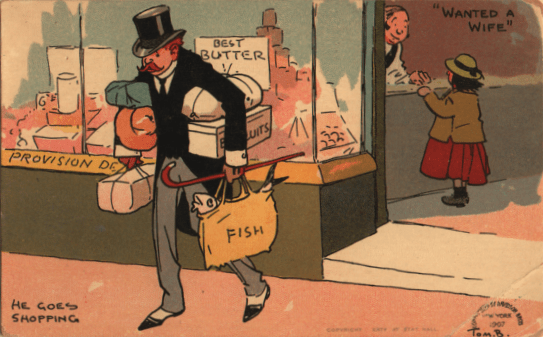
And it took a really big man, like cartoonist Tom Browne, to show us the results when a bachelor went to the store. The joke is on the poor dub shown here, who thinks having a wife would save him from all this. Obviously, he hasn’t been shopping in the postcard rack.
One of the most reliable gambits for the cartoonists preparing our postcards in days of old was marital discord. And among the prime choices of causes for marital discord was one that just about any postcard buyer could sympathize with was financing said marriage. Long before a genius noted that “Romance without finance ain’t got no chance”, we were arguing about whether “Two can live as cheaply as one.”
By the way, both of these phrases have resided in the realm of cliché so long that the Interwebs are of no use in tracking their origin. Each has been used for so many different songs that I was overwhelmed with videos and lyric sheets, and once I got past those I was in a wilderness of blogs about personal finance.
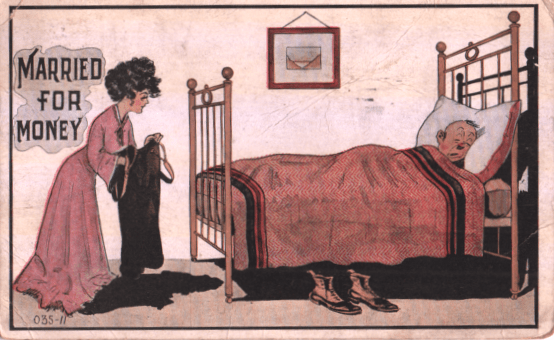
I have not even bothered to check on the origin of the gag about women going through their mate’s pockets while he sleeps. You do know that fine old joke, don’t yu. “My wife is always demanding money. Monday it was two bucks, Tuesday she wanted ten, and then yesterday she wanted five.” “What does she do with it all?” “I don’t know. I never give her any.”
Of course, the question of how much money a man should give the woman who managed the household expenses was a reliable gambit for personal finance articles and comedians for decades as well. “I was cleaning out George’s pockets and found a piece of paper with the name Lola and a phone number. You can bet I interrogated him about that.” “What did you get out of him?” “A new coat and forty more dollars a week spending money.”
Another solid comedy ploy was the money either spouse tried to hide from the other. I comedy, at least, it is always assumed that each is saving up to buy some expensive item for themselves. (In dramas, each is saving up to buy something for the other, but one spouse finds the money and assumes the worst, and the whole story nearly reaches divorce court before it is resolved.) But women traditionally also had a stash they called Mad Money: something tolive on if they got so mad at their husband they just walked out. (When you’re writing your dissertation on comedy and the status of women in society, please cite this blog. My academic credentials need the boost.)
If you have never seen boxes like those being carried by the delivery boy in front, you have never cleaned out a really good attic: people NEVER threw away hat boxes. Women’s hats come up over and over in the history of matrimonial cartoons, either because hats were so expensive, or because hat boxes were easily recognizable and made the joke that much easier on the audience.
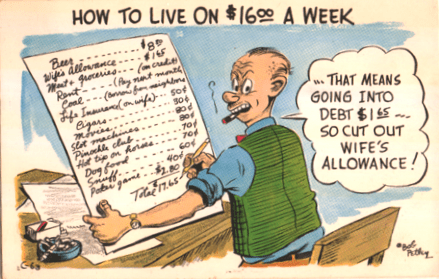
This popular gag is also useful in historical research. I have seen versions at $15 a week, $16 a week, $25 a week…yes, you can write THAT dissertation, too. Remember to spell my name right in the footnote.
You have seen this artist before in this article: the whole series runs to at least ten different observations on the reasons people get married, and the reality they face later on. I do like it that the puppy gets to put in two cents worth on the quality of the food.
As miserable as that situation is, however, the postcard cartoonist could think of one worse fate. (Unless this is just wishful thinking. I’ve seen a few documents on what postcard artists got paid. I don’t suppose THOSE pockets showed much at night beyond pennies and scraps of paper with punchlines scribbled on them.)
At a great distance from the ravine, four eyes were able to watch the screaming woman drop, not only as a figure on a screen but as a blip on a graph. A third screen blinked on to allow them to witness the impact.
“We will not make that mistake in the future.”
His Imperial Worship leaned back, setting Imperial shoulders on the light blue cushions of his chair, and checked instruments to his left and right. “We see the problem. In removing all forms of loyalty and faith, so she could betray the pirate, we no doubt removed knowledge of proper use o the prayerstone. He was paying attention, wasn’t he?”
Nubry rose to tiptoe, chin forward so she could study the figure in the chair. Anything she might learn could be a help. But she was not near enough to see much of the instruments he looked over.
The librarian stood between halves on an immense eggshell, wrists and ankles held by icy blue manacles which were attached to nothing. Small squares of the same blue material hovered here and there around here. They seemed to work on the same principle as the traveling squares, and were used to change her position inside the machine.
For the eggshell was a large copy machine of a kind Nubry had not seen or experienced before. It had the capability to produce a functioning replica of anything held within its field. Or, depending on adjustments His Imperial Worship could make from where he sat, slightly altered copies.
Also before the Emperor were all manner of screens showing parts of the audience, the bets being made, and the progress of prisoners through the maze. Nubry could see from her position how Bott and the three women he’d met made it into the next chamber, just before a dark flood would have washed them into the chasm. She nodded.
She could also see the screens which showed what he allowed the betting multitude to know, altering the computer’s reports just enough to manipulate the betting. Somehow, this was the most shocking thing she’d seen so far. The ability to torment prisoners, the power of life and death at the press of a little tab: these were not enough. His Imperial Worship had to make a profit on it. For a mighty force of evil destruction, this seemed mighty petty. But the Emperor had turned out to be a mighty petty mighty force of evil destruction. She had never imagined a destructive power doing so much giggling.
“We’ll give them a full day before we start damaging their arms. Or, truly, before you do.”
An Imperial finger came down on a little yellow square. A manacle she had not hitherto noticed, in her hair, brought her head forward. Her wrists came up behind her back. It was apparently an Imperial duty to make her as uncomfortable as possible between copies.
He didn’t even look back to see if this hurt. “I am sure you dislike the manacles, my sweetness, but they are essential. During the tests, Poor Sherrif Tino of Shenshark twisted so much that he broke his neck. And then the copies were useless, of course. Fun for a little while, but not good for anything else.”
Nubry tried to ignore the sweat trickling down the sides of her neck and the front of her throat: there was no way to wipe it away. She willed her muscles to stop trying to find a comfortable position. There were no comfortable positions.
She supposed she ought to be planning an escape, but these manacles were entirely new to her. She knew as well that she should be collecting information. On the cuffs, of course, and on this monstrous copier, but there must also be a clue to the maze somewhere on those screens.
Her eyes, though, kept turning to the screen where Bott Garton was walking with the three multicolored women. They had come to a cave; crawling through this, they had moved into a room filled with yellow choking mist. Crawling faster, they were headed toward a red door, a blue door, and a yellow door. Bott was in the lead; she wished she could hear what was being said.
He brought her book out of his satchel again. What could he want with “Bunny Bunk and the Purple Pillow”? He couldn’t read it. She had intended to teach him to read, in return for him teaching her how to pronounce all those words she knew from books but had never heard said out loud.
“You are not attending.” Another Imperial finger hit another tab.
Nubry threw her head back against the manacle in her hair as the blue mist rose around her; she felt her right shoulder joint separate. Why was she trying not to scream? Anything this painful had to have been designed to make people scream. So the Emperor could giggle. It was so unfair, like the Imperial guards. They dressed to be as frightening as they could, armed themselves so as to be as frightening as they could, and learned to talk so they sounded as frightening as they could. Then they laughed at you for being scared.
So she ground her teeth and concentrated on that blue dot on that certain screen. The dot blurred as her eyes watered, but it was still there, the Dragonshelf’s position in the maze. The books were still all right. She pulled uselessly at the manacles, and forced her brain around that thought. The books were still all right. Bott would get the books. And then he would come for her.
“You must tell me how you like it, so I can record the data.” Hs Imperial shifted his chair just a little, and pressed another lighted square. “I’m told it combines the pangs of giving birth with the pains of being born. Inanimate objects simply fade away after fifty or so copies are made, but sentient beings promise such pretty things every time a little more life is torn from them.”
It was in Nubry’s mind to ask him why doing things like this made him giggle. But now it felt as if an overinflated remfball was being forced up her throat by a splintered remfball bat.
Then she was staring at a kneeling copy of herself panting on a light blue traveling square. “Oh!” she gasped, no less startled by this vision than she had been the first time.
Then the copy was gone, as the traveling square shifted and the third Nubry dropped into darkness.
“So she won’t meet you and be traumatized, poor puppet.” His Imperial Worship turned to consider the pinioned librarian. He was going to giggle again; Nubry just knew it.
“Perhaps I should make four copies at once. I understand the pain increases exponentially.” The Imperial thumb came down, and Nubry’s ankles rose toward her wrists.
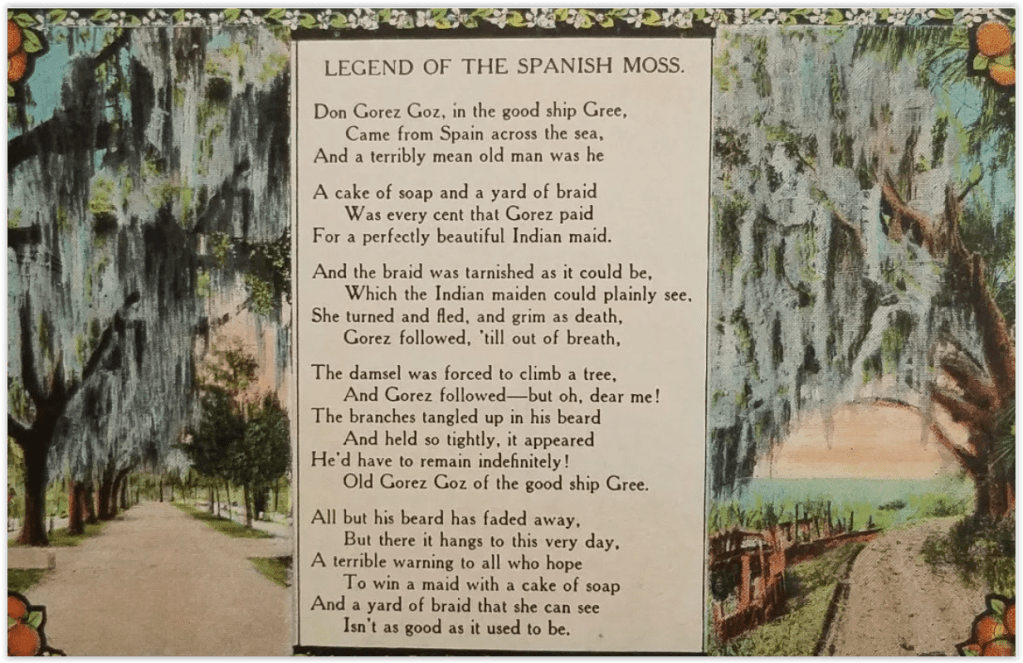
When I received THIS wordy postcard, I checked, as I usually do, to find out how many other examples were for sale on eBay. Hoo boy, as they say in Paris. There were at that moment 1183 postcards featuring the Legend of Spanish Moss, at prices ranging from low to exorbitant. There was a vast variety of pictures, so I persevered in hopes that MY picture happened to be a rare variant worth its weight in lottery tickets.
The postcards were far from uniform in telling this particular tale. Allowing for abridged versions available on postcards with bigger pictures, coffee cups, and trading cards, I find three different traditions, equally represented on postcards issued in Florida, Mississippi, Alabama, and Louisiana, explaining the attractive and/or spooky moss which was frequently used for bedding or insulation, and was reputedly the preferred stuffing for the earliest bayou voodoo dolls.
One set of postcards is part of a general “star-crossed lover” tradition which has rots extending to Greek Myth and can be found in every part of the planet. In this version, rather than two lovers divided by war or feud, we have an engaged couple “a thousand years ago” (sometimes named Hasse and Laughing Eyes) whose wedding never happens because Hasse is killed in an attack by a rival group. In one telling, they are killed together while in others, Laughing Eyes dies of sorrow. In either case, the lovers are buried together, Spanish moss appearing on the oak which grows from the grave, presumably the muscular hero being the tree hung with the hair of his beloved, which goes gray with the passing of years.
This is pretty standard stuff, so let us turn to the two traditions of Gorez Goz, a name I refuse to believe in. The tale of this Spanish sea captain, whether he is an outright villain or unfortunate schlub, comes from two poems, one credited to P.M.L., and the other by T.S.Y. (The latter poem is sometimes known as “The Meanest Man Who Ever Lived”, though I have not seen this title on a postcard.) The chief difference between the two appears to be the motivation of the fleeing Indian princess. In the version seen at the top, she is afraid of the bearded captain and sets off into the swamps, whereas in the other version (here shown in abbreviated form), she is offended by the fact that the braid of thread Gorez offers for her is tarnished, and runs off because her pride is injured. In both, the captain’s beard defeats him, catches in the trees, and becomes Spanish moss.
I have hunted without success for where in the world the name of the captain comes from (in the second poem, his ship is the good ship Glee, easy to rhyme but just as unlikely as its captain’s moniker.) There IS an account online which traces the story to the 1764 wedding of a French sea captain with an Indian princess who died not long after the wedding and became the subject of a religious argument, the captain wanting his wife buried while the lady’s family demanded she be exposed on a platform according to their tradition. The captain compromised by burying his wife but exposing locks of her hair in trees. THAT then became Spanish moss. The captain and his ship and his bride are named in this version, but as I found this in only one source, which goes on to note that the princess was the daughter of the Choctaw spirit Father of a Thousand Leaves, I will set it aside. Anyway, it’s not on a postcard.
The only reliable chat about the whole legend tells how, to tease each other, Spanish explorers in the region referred to Spanish moss as “French hair” while the French explorers called it “Spanish beard”. I have failed so far to trace either of the poets known by their initials, so unless someone out their can prove to me that the L in P.M.L. stands for Laughingeyes, I am going to take it for granted that the name came first, and the ancient legends came later, about the same time postcards needed to be sold to romantic tourists. (This WOULD make it even younger than the joke I’ve decided not to make, about something like this being afoot in most legends.)
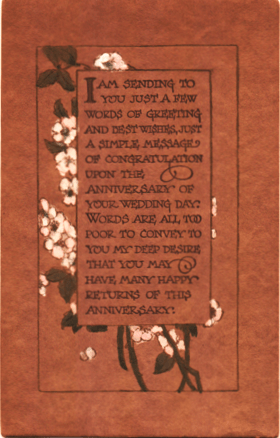
It has been a while since we have discussed the postcard which is all, or nearly all, words. Our ancestors were great fans of an art form which some prefer to call poetry, though sometimes the same sentiments were written in a paragraph that didn’t pretend to be anything but prose. I don’t know if today’s generation would understand a sentiment written out not to be part of a huge essay but just to exist on its own as…what? A text? A tweet? A meme? Okay, you’re going to relate to these postcards more than I thought.
Anyhow, I recently acquired a large collection of postcards described as “romance and marriage, which included a half dozen of these wordy cards. Be warned that they do deal with the fantasy and reality of both. Oh, and as seen by the one at the top of this column, some of them are examples of just Too Many Words. This leaves the sender nothing to say (which may have been the point.)
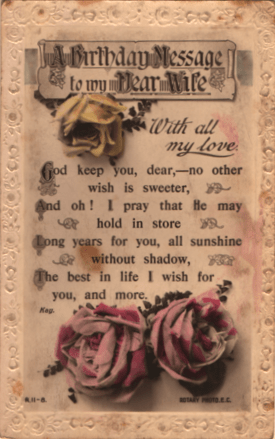
This is a little more flowery (so to speak), and really a little easier to read because of that. This is the only postcard in this article which was actually messaged: a man wrote a two-line message endorsing the front of the card, and handed it to his wife (whom he addresses in the message as “Wife”.)
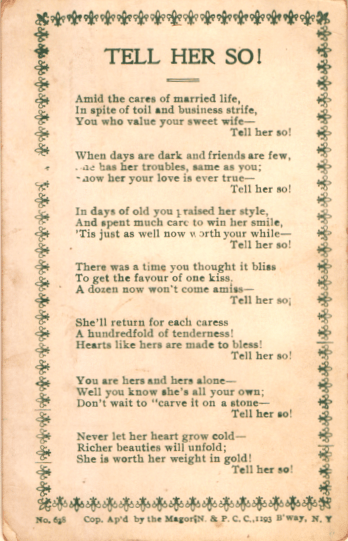
We have discussed hereintofore the habit of a generation or two around the turn of the last century for what I call “refrain” poems, where a sentiment is hammered in by putting it at the end of every stanza. (I’ll look into whether or not these were all inspired by the best-selling poem “Excelsior”, but that’s a whole nother blog.) Telling other people how to treat their spouses, however, has no specific age in history, and I am not sure this doesn’t do the job better than some 300-page how to books on the same subject. (On the other hand, the song “Little Things Mean a Lot” covers the same territory, and has a melody.)
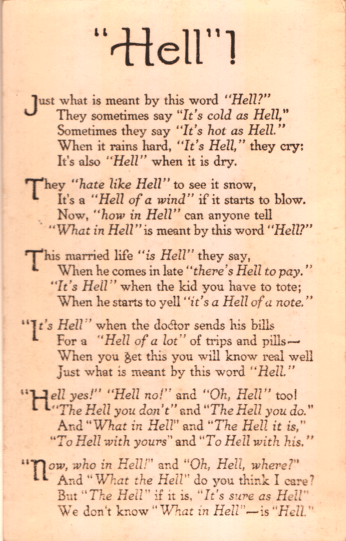
This, however, tosses the whole question into the cold, harsh light of day, what some might call “real life”. I feared the worst on seeing the title, but steel your nerves, good reader. The moral of the story is also better done here than in many a trade paperback self-help volume.
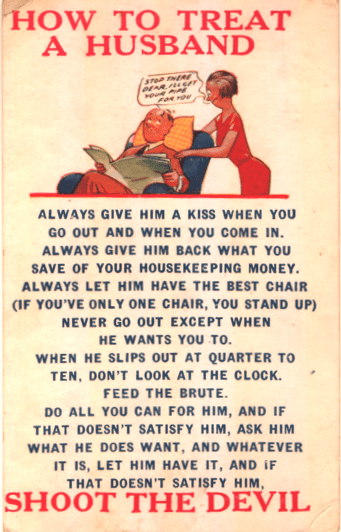
It should be understood that there were plenty of postcards as well about how to treat your husband. This is a British contribution to the literature of interpersonal relations.
How this got into the collection I hesitate to ponder. But I like its attitude and I admire its courage, since it bears all the marks of a card published somewhere around 1912, when, I was always taught, Americans minded their language in public. (I have also read that we simply became more mealy-mouthed somewhere around 1929.) I started rewriting this text in my head, substituting other words. But the result would be merely derivative, larcenous, and unpublishable. Consider your own version…AFTER you decide why this was part of the matrimonial postcard collection.
















 Blogsy Babbles