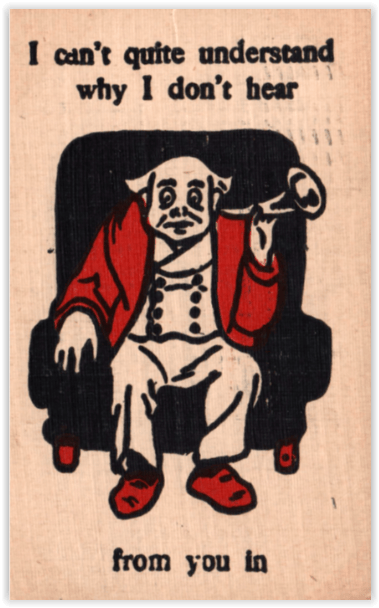
There are plenty of online reference sources which indicate when a word or phrase is found for the first time in printed sources. If a word has more than one meaning, a good source will give a date for each usage. What I need, in my vending of bygone postcard humor, is one which tells me the LAST time was word was used for a particular meaning. I hate it when people explain jokes to ME, so I’d like to avoid that when I use one of these. (I am annoying enough without adding joke explanation to the rest.)
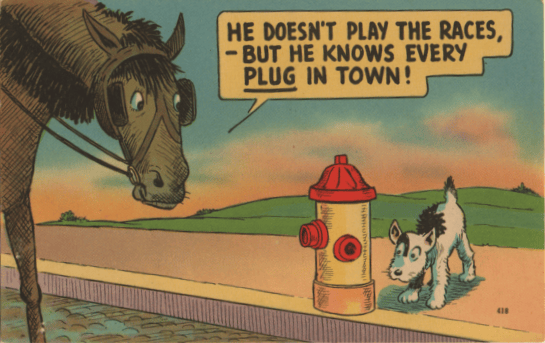
Slang ages at uneven rates, sometimes becoming so widespread people forget it WAS slang, and sometimes becoming extinct in a matter of months. This gag, for example, relies on a conjunction between “plug” for a horse, and “plug” for a fire hydrant, or fireplug. The wordplay is not completely bygone, as “fireplug” IS still used to mean that little red streetcorner R2-D2. But most people using the term nowadays employ it figuratively, as a noun or adjective referring to someone who is small, stocky, and tough.
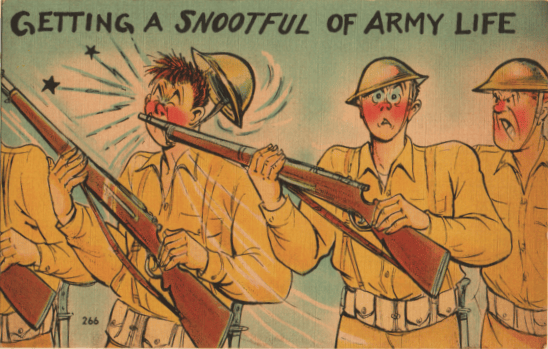
“Snootful”, primarily used to refer to an excessive amount of alcohol (when already consumed), is also still used, for that, or just an excessive amount of anything. But the interwebs has labeled it Obsolete and Vintage. So if you use it in public, people will start opening doors for you and helping you out of chairs.
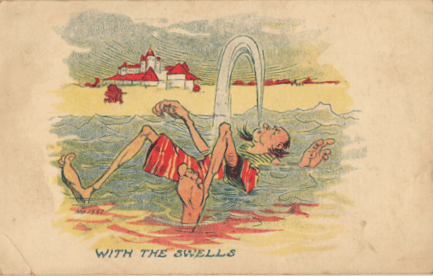
A “Swell” is still used to describe a wave in a body of water. But this joke, alas, has been on life support for eons. You CAN describe something as “swell”, though it has an ironic tang of ancient history, like saying “keen” or “nifty”. But the reason we call impressive things “swell” comes from an earlier use when a person who was dressed to impress or otherwise carried a certain presence, real of feigned, was referred to as “A swell”. This particular wordplay is at least as old as the comic song of Edwardian days in which a large man at the beach describes himself “The Big Heavy Swell of the Sea”. Saying you were out with the swells implied you were hobnobbing with the rich and famous. (Note to self: check on the word “hobnob”.)
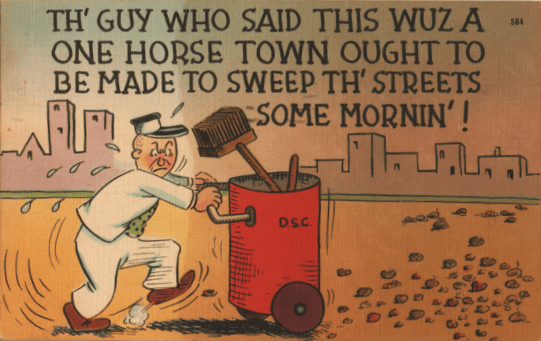
“One Horse Town”, meaning a small, insignificant metropolitan area, still means that, the Interwebs informs me, but, perhaps even worse than “swell” or “snootful”, is called neither Obsolete nor Vintage but “nostalgic”.
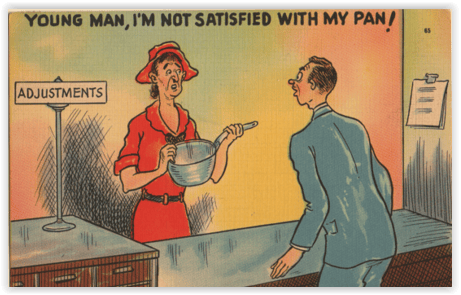
Among the rea dangers of slang is that a word which once meant something the pearl-clutching lady next door might have used in public without blushing (much) now means something spicier. Getting a laugh because you didn’t know is NOT the same as getting a laugh because the joke is funny in itself. Here, for example, the word “pan” means “face”, a usage that was alive and well for two or three generations. The first seven slang dictionaries on the interwebs do not so much as mention “face” as a meaning for “pan”. “Pan” has joined the legion of words that have switched jobs to refer to someone’s sex life and is apparently enjoying such a wide use as an adjective or noun for “bisexual” that it pretends it never had any other career.
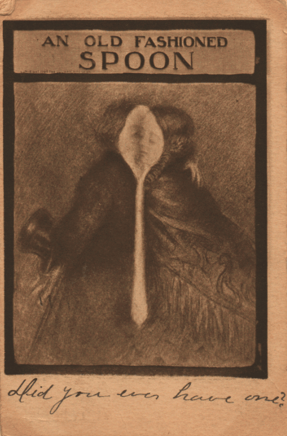
“Spoon”, as here, still means to cuddle. But an unsuspecting speaker will not know until the listener snorts how specific the cuddle is in the modern mind. Someone saw this card and commented that the pair here are NOT, in fact, spooning, according to the newfangled preferences. Maybe I’ll just give up the postcard biz and write captions for T-shirts. Stay tuned for my first big hit: “The Twenty-First Century: I’m not from around here.” (Note to self: make sure “big hit” still means what you think.)

