The weather has been so ridiculously warm for November in my part of the world (A lot of the trees are still green. In MY day, they would have gone to orange to red to brown to rustling underfoot by now. I say it’s the fault of AI, or Autumn Interference. If the sinister scientists who are constantly planning to replace the natural world with expensive secret replacements at no profit to themselves are not stopped soon, we may all be replaced by cheerful androids who never gain weight, never complain about the weather, and write blogs which are strightforward praise of their…where were we?)
Anyway, I looked at this postcard and thought of snowflakes, because no two are alike.
Now, the sand dollar (or sea cookie or pansy shell or snapper biscuit) of common commerce is the skeleton of a sea creature which, dried out and bleached by the sun, made early beachcombers think of big silver coins. Maybe no two sand dollars are alike. But when I started looking up other postcards showing the Legend of the Sand Dollar, I learned one thing: no two legends of the sand dollar are exactly alike.
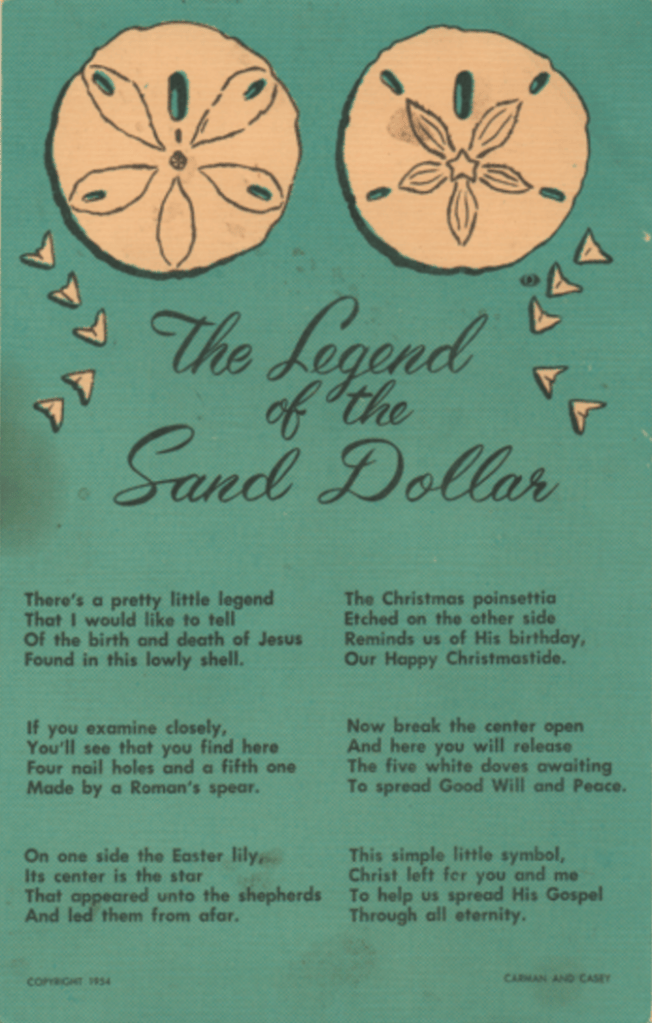
My particular “pretty little legend that I would like to tell” finds the Crucifixion wounds–four nail holes and spear wound (that big one is a mouth, and the four others kind of for breathing), with a five petaled design that can be seen as an Easter lily and/or the Star of Bethlehem on one side, with the poinsettia on the other to remind us of Christmas (if the Star of Bethlehem didn’t already do that for you.) Break the skeleton open and you find five doves of good will and peace. (There are always five, used more or less as teeth.) Note that the pretty little legend does NOT claim any of this was the Sand Dollar’s idea, or the thought behind its design
Also note the copyright; this may explain all the variations. Sand dollars themselves are not trademarkable, and anybody who wants to can see what someone else saw, as long as they write it up differently AND human beings, having a natural tendency to build up a story, are willing to add detail. Other postcards credit “Some say” while others call it “another interpretation” to see in those doves the angels of Christmas morning.
Some make the legend shorter. A kind of poem from 1965 is the shortest: “The five holes remind of us of the wounds on Christ’s hands, feet, and side, The poinsettia and star of Holy Christmastide: Break open the shell and you will find The doves of good will and peace of mind.” Another short sort of a poem is attributed to one V.L. Little, one of those poets not found off postcards: “The sand dollar, no intrinsic value has he Only reminders of Our Lord up from the sea: Four little holes for the nails which held him to die Another one, too, where the spear pierced his side. A Star for the Manger, a bell to ring, And inside, five doves, his praises to sing.” I’ve been looking, but I do NOT see the bell. I was never good at those hidden picture puzzles in kids’ magazines, either.
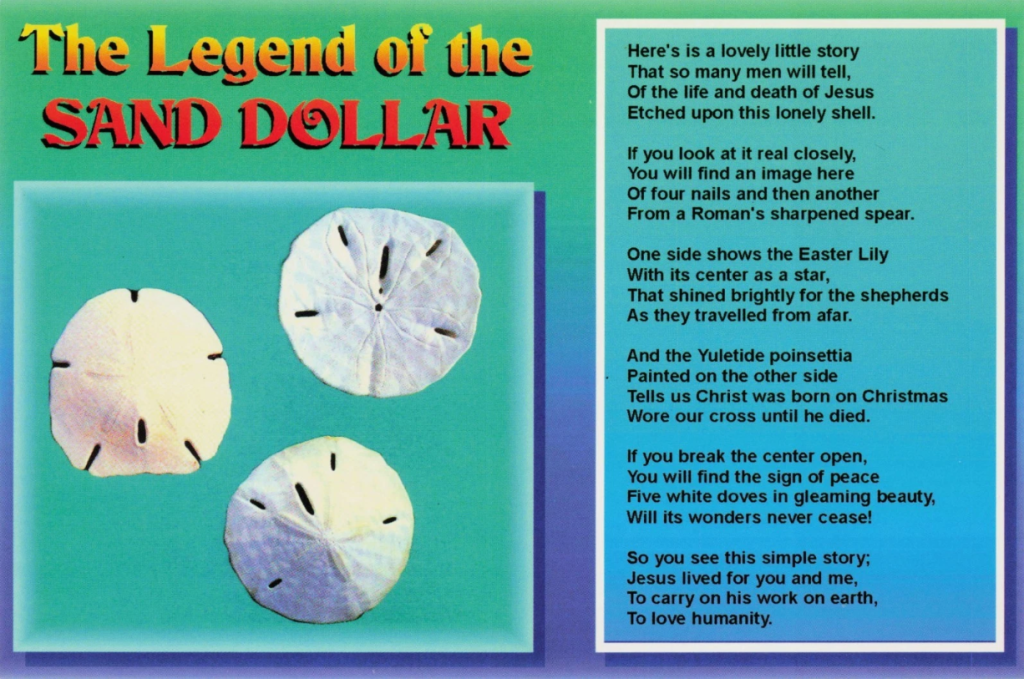
Again, no suggestion is made that the sand dollar did all of this on purpose. Other writers, tell us the Holy Ghost Shell, or even the Holy Shell, also known as the Sand Dollar, is “one of the most unusual specimens of marine life” and explain the markings were put there specifically as divine memory aids. One, attributing this to an “undated legend”, states that “as a reminder of spreading the Gospel, Christ left us this unique creature from the sea so common that all mankind could share its message of love and kindness to our fellow man.” Another, in verse, concludes “God gave us this little symbol To remind us of His Son And to understand His Gospel Until our earthly days are done.”
J.R.R. Tolkiien, objecting to critics who saw the Lord of the Rings as an allegorical tale about World War II, pointed out the difference between allegory and application, the first being the plan of the creator of a work and the second being what the reader made of it. It makes little difference to me at the grocery store whether you feel you are drawing the lesson from nature or whether nature was designed the way it is because Someone knew that one day we would associate lilies and poinsettias with certain holidays and so printed them on the abandoned bones of a sea corpse to prompt us.
All these versions and more are available now on postcards, shot glasses, coffee mugs, coasters, clocks, soap, and jewelry, not to mention in books and sheet music. Rather like the Spanish Moss Legends, you pays your money and you takes your choice.
Not bad for a dollar.

