He wanted to call a cab, but this was not allowed. “We do have a car or two around the place,” Ada pointed out. Within seconds of her summons, one of the numerous Silberwetter relatives/employees brought around a modest brown vehicle probably used only for driving past taxpayers.
Still in slippers and robe, Ada waved farewell to her Watson from the front door. “Don’t forget to write if you find work!” she called, as Matt crunched through snow to the car. “Oh, and one other thing!”
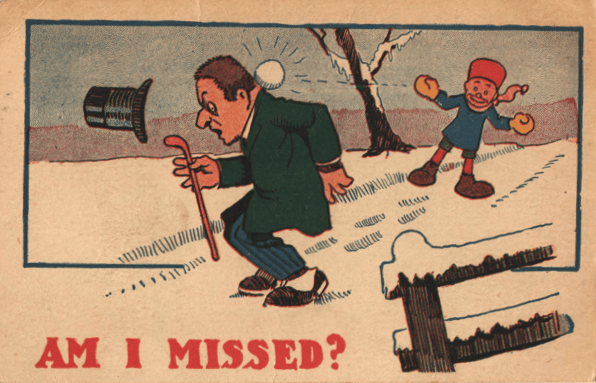
She didn’t say what the thing was. Matt turned around. His head rocked back as the world exploded.
Whipping off his glasses to shake away the snowball, he could see Ada bent nearly double with laughter, one hand pressed against her robe to hold it sort of shut. The glasses were jammed into a coat pocket and Matt’s free hand scooped up ammunition.
“Yaaaaah!” she jeered. “You couldn’t hit the barn side of a broad!”
Nonetheless, she shrieked and fled inside as the snowball flew and landed well wide. Matt wasn’t watching it; he had already bent to scoop and pack a good snowball, one a man could control. The front door was closed, but Ada was certainly just inside, peering through a window, or a spyhole in the door. He reached for his glasses.
Ada didn’t show. The chauffeur, in the driveway, cleared his throat. Matt’s feet were cold, and the hand filled with snow was colder. He turned toward the car.
But when his ear caught the click of a door, he spun and fired. With a decent snowball, and a clear view of the target, his throw was a dead bullseye.
Matt was still new to the detective business. But he needed only two clues—the sight of Ada clinging to the doorframe, vibrating with mirth, and the brown leather slippers of whoever he had just pasted, to bring him the proper deduction and send him diving through the open rear door of the waiting automobile. Five solid snowballs hit the side of the car as it rolled out of the driveway.
The chauffeur made no comment whatsoever, and, after giving it long serious thought, Matt got up off the floor and settled into the back seat. He wiped off his hands and then looked the chauffeur over for any hint to his fate. He knew the man slightly, one of Marshall’s more muscular grandsons, generally used as an escort if reporters crowded too gregariously around the office, but on occasion sent out to hint away anyone Marshall Silberwetter felt was too interested in Mrs. Marshall Silberwetter.
If the man also recognized Matt from that cautionary ride over the summer he did not say so. In fact, he said nothing at all until the car was sailing swiftly along the weekend-quick expressway to the city limits.
Then he said in a voice lacking any curiosity or interest at all, “What’s going on?”
“Going on?” Matt inquired, voice a little too high.
The chauffeur nodded as if he had expected exactly that reply. ‘Don’t get me wrong. This isn’t orders or anything, and I’m not paid to spy on anybody. It’s just that if Mrs. Silberwetter is planning anything bigger than, say, a surprise party, Mr. Silberwetter’s going to want to know what it is and maybe it’s worth my time to be the one to tell him.”
Matt shrugged. Too fast, much too fast. He swallowed before he spoke, and forced his voice into the bass register. “Well, she wanted some information.”
“What kind?” The voice held complete disinterest now, absolute apathy.
Government work had left its mark on Matt: you never told a lie when a tiny bit of truth would do the same job. ‘She’s curious about who killed Jerry Silberwetter.”
The chauffeur glanced in the rearview; his face now showed interest. “Uncle Geegee? What for? That was years ago, and she never liked him much, as far as I knew.”
Just as well, Matt thought, with a profound desire to share that ignorance. “Oh, you know. She gets bored.”
“Oh.” The man nodded. “Figures.”
Matt nodded back. “Some people need a project to keep them going in winter. They should try working for a living.”
The driver smiled. It was none of his job to insult the boss’s wife, but he was disinclined to correct anybody else who did.
Having thrown himself waistdeep into trouble already, Matt felt he might as well wade in farther. “You knew him? Got a couple of fiendish suspects you want to add to her list?”
This was taken in the spirit intended. “I don’t hand out with a lot of fiends.” The man at the steering wheel raised a hand from it to wave at the ceiling. “Uncle Geegee made a t of bad friends—you do that if you try to get somewhere in politics—but nobody knew that until he was dead. But they never proved anything on any of them…or Aunt Liz, who got all his money and stuff.”
Matt nodded. The man had more to say, but he didn’t want to spoil his air of amused disinterest by asking questions. He could always get Ada to explain “Aunt Liz”.
“And she…is this where you said?”
Matt, looking around, realized a whole new crisis had sneaked in while he was conducting a highly professional investigative interview. How much did you tip the grandson of a politician who made more in a week than you did in a decade? Particularly if the driver was also related to, oh, two or three people who might have recently tried to kill you?
He did not look at the bill he slipped from his wallet pocket and passed it over the seat. The chauffeur also did not look at it before putting it away. “Thank you, sir.” Matt mumbled something and moved out and up toward the glass doors of the library.
Tombstone research seemed the less likely gambit, and also the quickest. What he really wanted to consult were the microfilm copies of back issues of the newspapers. Concrete data was needed here, and everything about Ada Silberwetter was too slippery to….
Matt shook several thoughts from his head and moved toward the card catalog.
Minutes later, he was seething. He always seethed in the Public Library building, which was an insult to his professional training and his personal feet: there was so far to walk to find nothing. He hadn’t expected a million books on tombstones, but he also hadn’t expected a conspiracy to hide what there was. The use of two different systems of classification numbers, a general lack of accurate labels, and a building whose form demanded that function follow at a respectful distance all worked in league against anybody trying to resolve a murder.
So tombstones were a dead loss. (He paused. He jotted that down.) In the Microforms Department, things were held in little cardboard boxes in little rows, all with nice labels. In a very little time, he was settled into a tiny cubicle with all the newspapers of approximately the right vintage.
On the way, he had picked up a publicity flier called “Under the Picasso” in case he needed more paper for notes. At the top of this, in bold curlicued numbers, he put the date of the newspaper that first mentioned the demise of Gerald G. “Jerry” Silberwetter. He smiled at this date: not only was it a solid fact, but it also suggested, from what he recalled of the story, that Ada Silberwetter was older than he was. Though she didn’t look it. He put a hand toward his ever expanding bald spot. Then, returning to the microfilm, he scrolled on.
By the time he was finished, he had covered both sides of the Picasso flyer with notes, but he had to admit he was none the wiser. He had followed the story from headlines to brief mentions on the editorial page. (His experience over the summer following accounts of Gus Thacter’s murder and Richard Watanabe’s death had taught him how it worked) but no clues had popped off the page.
The city government was always, at least in the papers, being struck by crisis after crisis: the murder of Jerry Silberwetter was big enough to hold a spot for three days before the arrest of Carleton Nairn for being “less than candid” to investigators from the latest fraud-and-waste committee. But it sprang back into large type with the Shoebox Papers. A shoebox found by police in Silberwetter’s closet has disgorged documents incriminating a score of civil servants with previously spotless reputations. Matt jotted down the names: MacTaggart, Westhoff, Hosier, Zimmerman, Medina, Underwood, Herrig, Hunnicutt…. The papers were overwhelmed to think that this tireless undercover investigator had been killed by one of the fiends he sought to expose.
They showed not a hint that Silberwetter might not have intended these papers for a grand jury. Matt had heard the stories of some of these people when he started, but not much: “Out of office, out of mind”. He should probably look into some and try to estimate how much the “martyr detective” was into them for.
He was drawing little stars next to their names when his eye fell upon the name MacTaggart for perhaps the sixth time and he finally made the connection.
That reel of microfilm was out of the box and scrolled into view in no time. MacTaggart: Wilson MacTaggart. “Thank God I’m beautiful,” he muttered, “I’ll never make it on brains.” One editorial was especially proud of Jerry Silberwetter for that: the man had selflessly investigated even his own brother-in-law, the husband of his sister Elisabeth.
In the time it took him to find a clean space to scribble “Aunt Liz?”, Holly had moved to the top of his suspect list and fallen back down again. Revenge was a nice motive in a book, but how far did it go in real life? Wilson MacTaggart hadn’t gone to prison; he hadn’t even lost his job. The Shoebox papers had not produced anything hot enough to bring anyone to trial, even, except for Zimmerman and Underwood, whom he’d never heard of. There had been a few reprimands, but MacTaggart was not among those reported as receiving one. Anyway, considering her remarks about her parents, Holly Luya MacTaggart made an unlikely angel of vengeance.
Still, it was something to think about, something to report to Ada to show he could do detecting on his own.
He returned all the reels of film to the front desk and sauntered along the hallways to the exit. On the way out, he paused at a display of cheap little literary magazines stacked for passersby to carry off. One was a title he’d read in market listings, though he’d never actually seen the magazine.
He chuckled as he picked it up. If this were one of his mother’s books, Barbara Chang would see some chance item which would make the whole mystery clear.
The name “Jinx Bottym” caught his eye on the Contributors age. THAT was how he knew the name of the magazine. He flipped to her contribution.
HEARTBEAT OF HYSTERIA
Reading poltergeists at 3 A.M.
It’s dark.
He looks around quick.
Just a branch against the screen:
Nothing to Worry About.
He sets down his book
And takes a long look around the room.
He has just decided there is
NOTHING TO FEAR
When the hand reaches from under his pillow.
A passing patron dropped a book. Matt leapt two feet into the air. Then, licking his lips, he set the little magazine into a coat pocket. The poem made one thing clear, certainly.
He never should have given up that job at the bar.

